


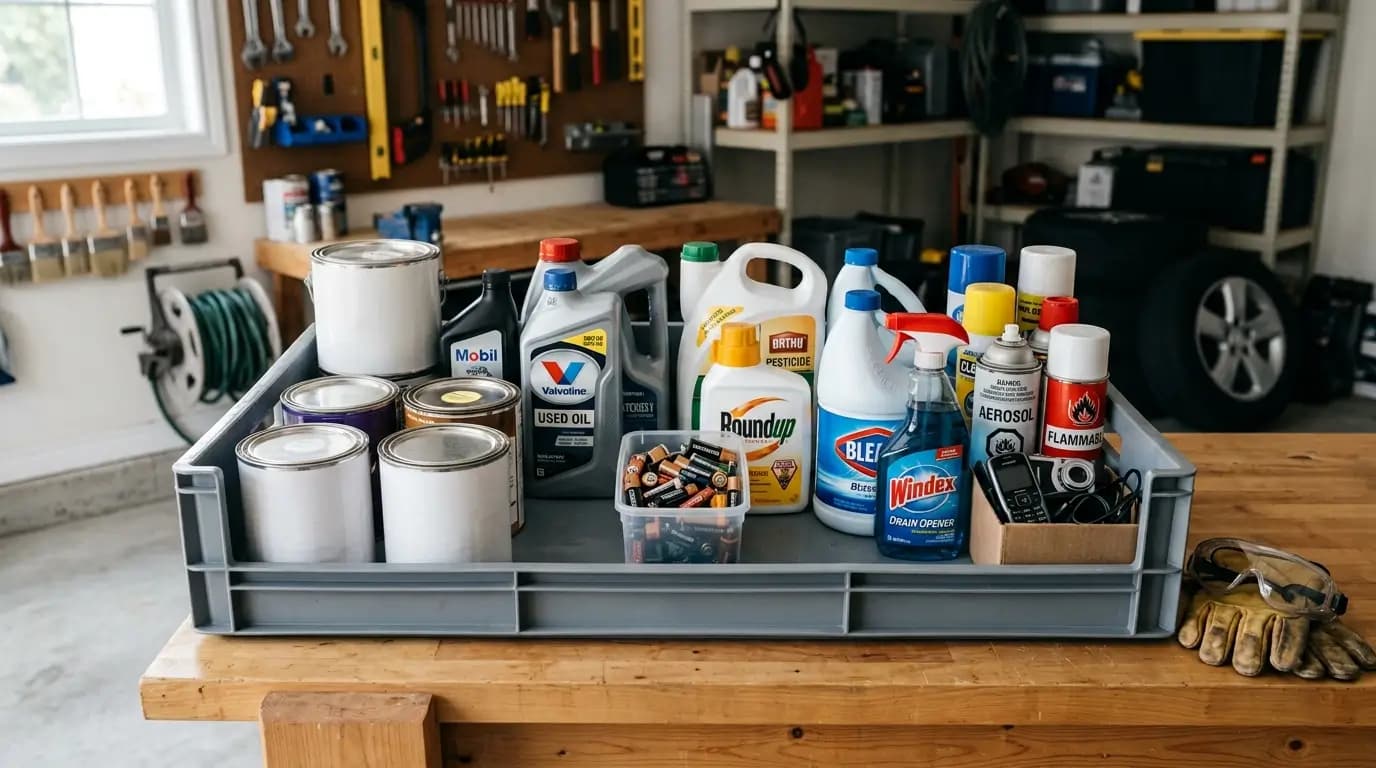
Household hazardous waste is leftover consumer product — paint, solvent, pesticide, drain cleaner, motor oil, batteries — that would be classified and controlled as hazardous waste if a business had generated it. Because a household generated it instead, most of that control disappears. In the United States it is explicitly carved out of the federal hazardous waste rules. In the UK it sits outside the hazardous waste regime almost entirely.
That carve-out is the whole story, and it is the part every consumer-facing guide skips. The exemption is not a statement that the material is safe. It is a decision that regulating millions of kitchen cupboards is impractical. The chemistry does not change at the front door, and neither does the risk to the person who eventually handles it.
I spent seventeen years on the receiving end of that decision — as Hazardous Waste Routing Lead at Heritage Environmental Services, and in environmental assurance roles at Clean Harbors, Stericycle, Biffa, Veolia and SUEZ. This guide covers what HHW is, how three jurisdictions treat it, and the point at which the household exemption runs out.
Key takeaways
The points below cover the definition, the legal position in three jurisdictions, and the moment the household exemption runs out:
- HHW is post-consumer material that meets a hazardous waste characteristic — ignitable, corrosive, reactive or toxic — but is excluded from hazardous waste control because a household produced it.
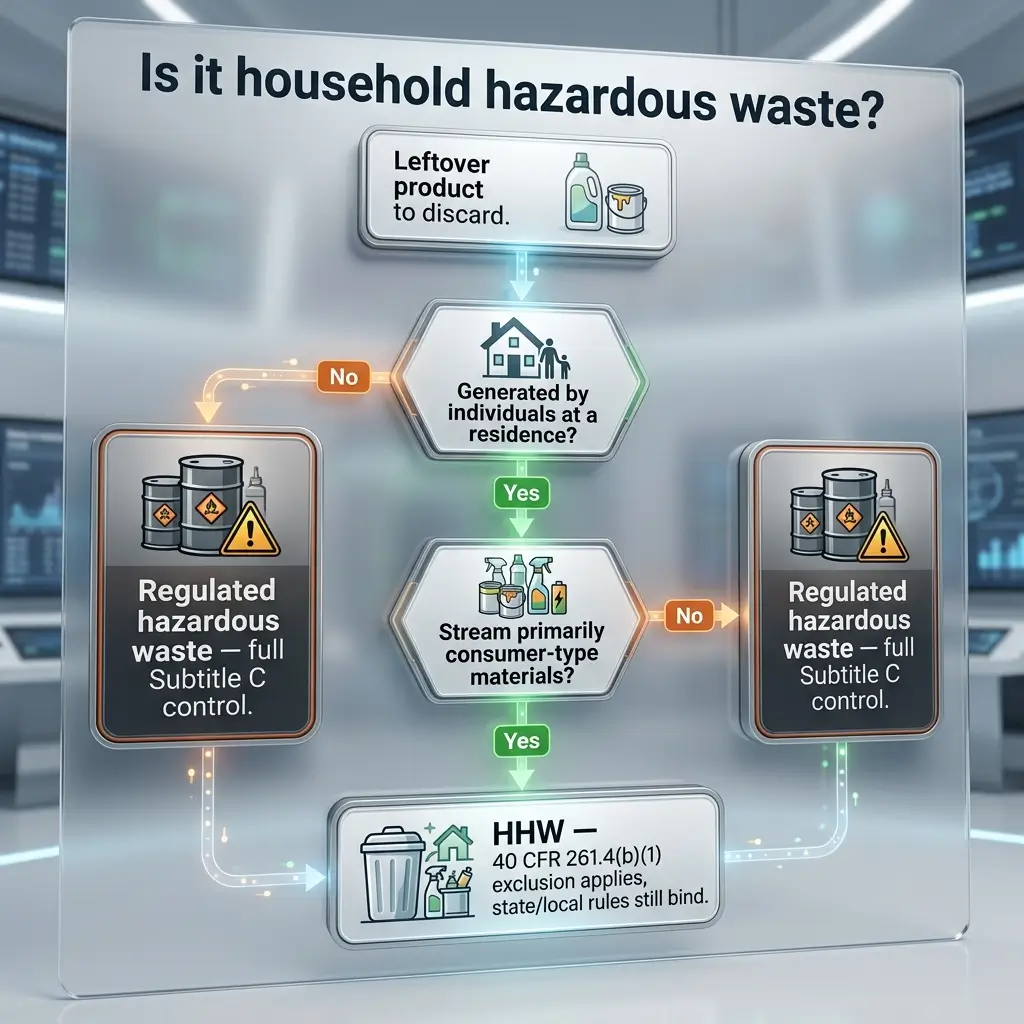
- The US exclusion sits in 40 CFR 261.4(b)(1) and has two conditions: the waste must come from a residence, and the waste stream must be made up primarily of consumer-type materials.
- Excluded from federal Subtitle C does not mean unregulated — HHW is still a solid waste under RCRA Subtitle D, so state and local rules apply and often prohibit trash and drain disposal outright.
- In England and Wales the Hazardous Waste Regulations 2005 do not apply to domestic waste except for asbestos and separated domestic fractions; the mixing prohibition bites the moment the waste is accepted for collection.
- EU Member States were required to set up separate collection of household hazardous fractions by 1 January 2025 under the Waste Framework Directive.
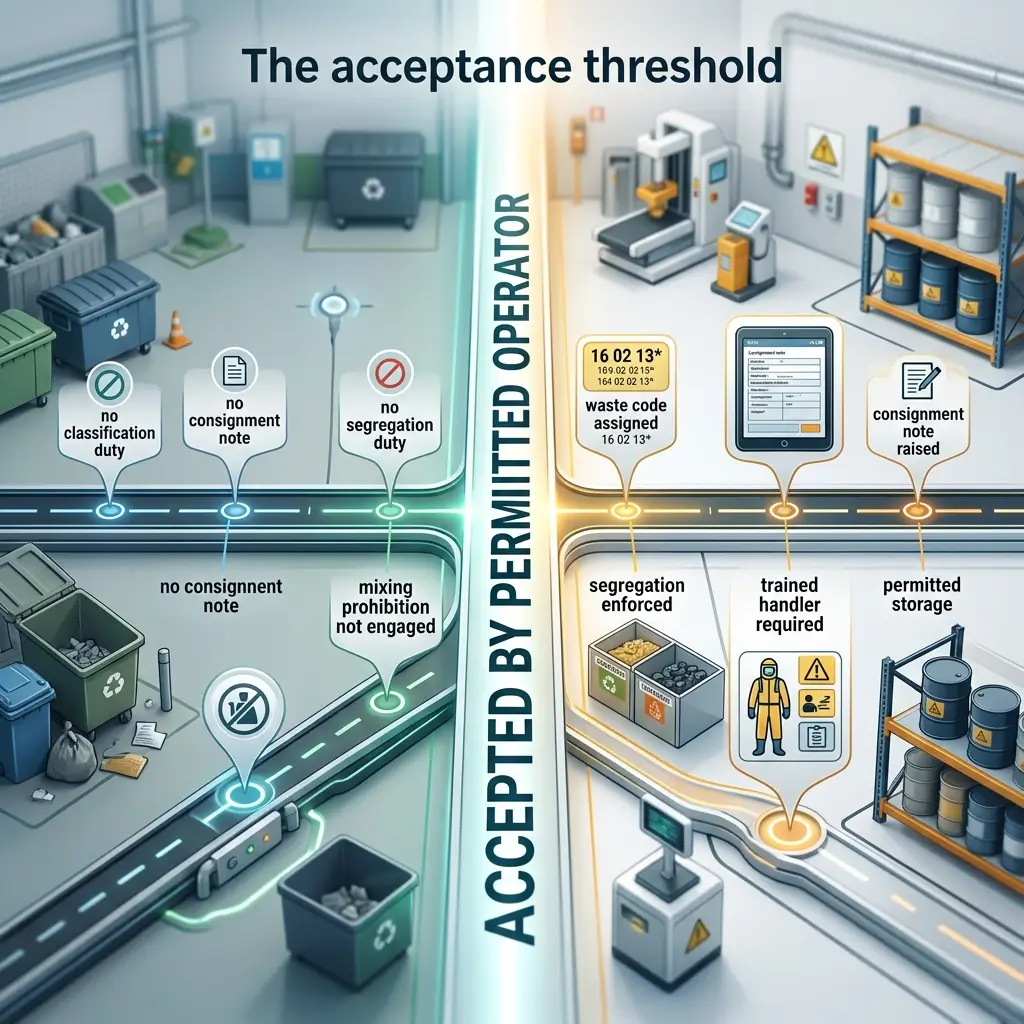
- The exemption ends at the handover. Once a permitted operator accepts the material, it is hazardous waste with consignment paperwork, trained handlers and segregation rules.
What household hazardous waste is, and the two-part test behind it
HHW is defined by two things at once: what the material does, and who produced it. The hazard properties are the same ones that classify any industrial waste — a substance that ignites, corrodes, reacts or poisons. What makes it household hazardous waste is origin, and origin is what triggers the legal exclusion rather than any difference in chemistry.
That distinction matters more than it sounds. A five-litre can of xylene-based paint stripper in a workshop is a regulated hazardous waste with a manifest, a permitted carrier and a disposal record. The same can in a garage is household hazardous waste. Identical contents, identical flash point, entirely different legal treatment.
The two conditions in the US exclusion
EPA sets out two criteria that a waste must satisfy to fall inside the household exclusion. Both have to be met — meeting one is not enough, and this is where small businesses operating from a residential address most often get it wrong.
The conditions EPA states for the exclusion are:
- The waste must be generated by individuals on the premises of a temporary or permanent residence. Generation location, not purchase location, is what counts.
- The waste stream must be composed primarily of materials found in wastes generated by consumers in their homes. A drum of industrial degreaser stored in a garage does not become household waste by being in a garage.
Why "household-like" premises also qualify
EPA reads the exclusion to cover places that function like residences without being houses. Its stated interpretation extends to bunkhouses, ranger stations, crew quarters, campgrounds, picnic grounds and day-use recreation areas.
For anyone running a remote site with accommodation, that reading is worth knowing. The crew quarters waste may sit inside the exclusion while the workshop waste fifty metres away does not, and the two streams end up in the same skip unless somebody has drawn the line deliberately.
The hazard groups, and what actually sits in each
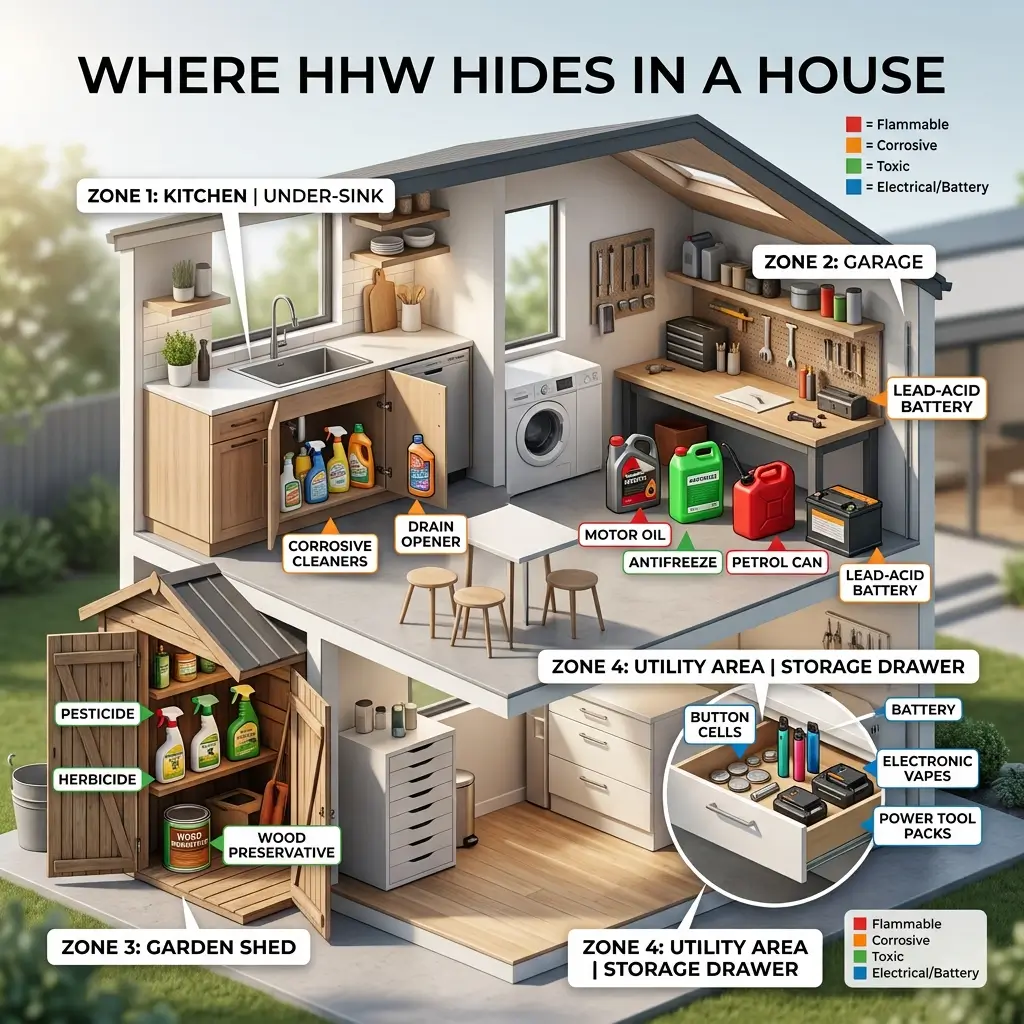
Most guides publish an alphabetical list of products. That is useful for a resident deciding what to bag up, and useless for anyone who has to store, transport or bulk the material. Grouping by hazard property is the more informative cut, because the property is what determines what a substance can safely sit next to.
Five groups cover almost everything that arrives at a collection point. The proportions shift by season — garden chemicals in spring, antifreeze and de-icer in autumn — but the categories hold.
| Hazard group | Common household items | Why it fails in normal waste |
|---|---|---|
| Ignitable | Solvent-based paint, thinners, petrol, lighter fluid, aerosols, nail polish remover | Vapour ignites from a compactor spark or friction heat |
| Corrosive | Drain and oven cleaner, brick acid, pool chemicals, battery acid | Burns through sacks and skin; degrades containers in storage |
| Reactive | Pool chlorine, some fertilisers, old picric acid, unstable peroxides | Reacts violently with an incompatible neighbour, often on contact with water or acid |
| Toxic | Pesticides, herbicides, wood preservative, mercury thermometers, antifreeze | Leaches to groundwater; antifreeze in particular is palatable and lethal to pets |
| Energetic and electrical | Lithium-ion batteries, vapes, power tools, phones, gas canisters | Short-circuits or crushes into thermal runaway inside a collection vehicle |
Two items in that table cause disproportionate trouble and deserve naming separately.
The categories I would flag to any resident before the rest are:
- Anything with a hidden battery — vapes, greeting cards, toothbrushes, toys, tools. The battery is the hazard, not the device, and most people do not know it is in there.
- Empty aerosols and gas canisters — treated as empty by the resident, still pressurised and still holding propellant residue in practice.
- Decanted liquids in drink bottles — no label, unknown contents, and the single most common cause of a container being routed to expensive unknown-substance analysis.
- Old pesticides with withdrawn active ingredients — often decades old, degraded, and no longer legal to use, but perfectly legal to hold.
How HHW is regulated in the US, UK and EU
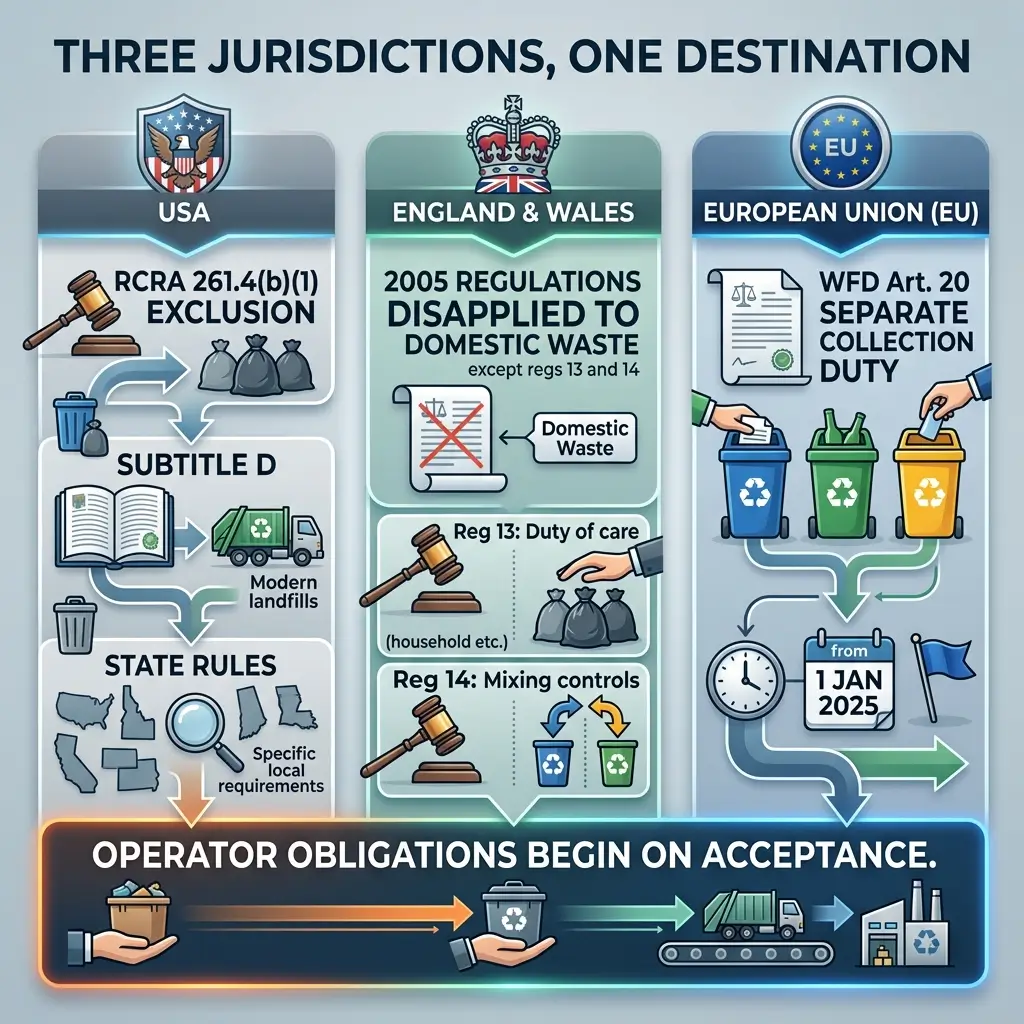
All three jurisdictions reach the same practical destination — keep this material out of ordinary waste — by three different legal routes. Anyone advising across borders needs to know which route they are on, because the obligations on the householder differ sharply while the obligations on the operator converge.
| United States | England and Wales | European Union | |
|---|---|---|---|
| Governing instrument | RCRA, 40 CFR 261.4(b)(1) | Hazardous Waste (England and Wales) Regulations 2005 | Waste Framework Directive 2008/98/EC |
| Status of household waste | Excluded from Subtitle C; regulated as solid waste under Subtitle D | Regulations do not apply to domestic waste except asbestos and separated fractions | Key control articles disapplied until the waste is accepted by a permitted operator |
| Duty on the householder | None federally; state and local rules bind | None under the Regulations | None directly |
| Separate collection duty | State and local | Local authority provision | Member States required to set up separate collection by 1 January 2025 |
United States — excluded from Subtitle C, not from control
The exclusion is narrower in effect than it reads. EPA is explicit that although HHW sits outside Subtitle C, it remains regulated under Subtitle D of RCRA as a solid waste — which pushes the real rules down to state and local level, where they are frequently stricter than the federal baseline.
California is the clearest example. State law makes it illegal to put HHW in the trash, down the drain, or to abandon it, and expressly excludes waste generated by running a business from a home. A guide that stops at the federal exclusion will mislead a Californian reader completely.
England and Wales — domestic waste sits outside the regime
The Hazardous Waste (England and Wales) Regulations 2005 state that, apart from regulation 13 on asbestos waste and regulation 14 on separated domestic fractions, the Regulations do not apply to domestic waste. Later amendments confirmed that an occupier of domestic premises carries no obligation for asbestos produced there — a contractor doing the work is treated as the producer instead.
The consequential detail is where the mixing prohibition starts to apply. It applies from the point the waste is accepted for collection, disposal or recovery, or accepted at a site for domestic waste. Before that moment, nothing. After it, mixing is an offence.
European Union — separate collection since January 2025
The Waste Framework Directive, as amended by Directive (EU) 2018/851, disapplies several hazardous waste control articles to mixed household waste, and disapplies the mixing and inspection articles to separate household hazardous fractions until a permitted or registered undertaking accepts them.
Against that, Article 20 required Member States to set up separate collection for hazardous fractions produced by households by 1 January 2025, specifically so that they are treated properly and do not contaminate other municipal streams. That is the direction of travel across all three jurisdictions: leave the householder unregulated, and put the obligation on the collection system instead.
The practical points to carry across from all three regimes are:
- No jurisdiction places a hazardous waste duty on the householder for ordinary domestic chemicals
- All three place the duty on whoever accepts the waste, and that duty is substantial
- Asbestos is the standing exception in England and Wales, where a contractor becomes the producer
- State and local rules do the real work in the US, and several prohibit disposal the federal position permits
The handover point: where the household exemption ends
Every legal system covered above ends the exemption at the same event — acceptance by a permitted operator. That is the single most useful thing to understand about HHW, and it is almost never stated plainly.
Before acceptance, the material is a bag of chemicals with no paperwork and no chain of custody. One second after, it is hazardous waste with a classification code, a consignment note, a permitted storage location, segregation requirements and trained handlers. Nothing about the substance changed. Everything about the obligations did.
I have watched people underestimate what that transition demands. Auditing acceptance areas across Heritage Environmental Services and Clean Harbors sites, the failure I wrote up most often was not a missing permit — it was an acceptance point staffed as though it were a reception desk. A resident hands over a box. Somebody has to open it, identify unlabelled contents, decide a classification code, and place it with compatible material. That is a technical decision made in seconds, outdoors, with a queue of cars behind.
The obligations that switch on at the moment of acceptance are:
- Classification — assigning a waste code to material that frequently arrives with no label at all
- Segregation — separating incompatibles before anything is bulked or stored
- Consignment documentation — the record that follows the waste to its treatment destination
- Competence — the person deciding all of the above needs to be trained to do it, not simply available
- Storage compliance — bunding, fire separation and quantity limits at the holding point
What goes wrong between the cupboard and the collection point
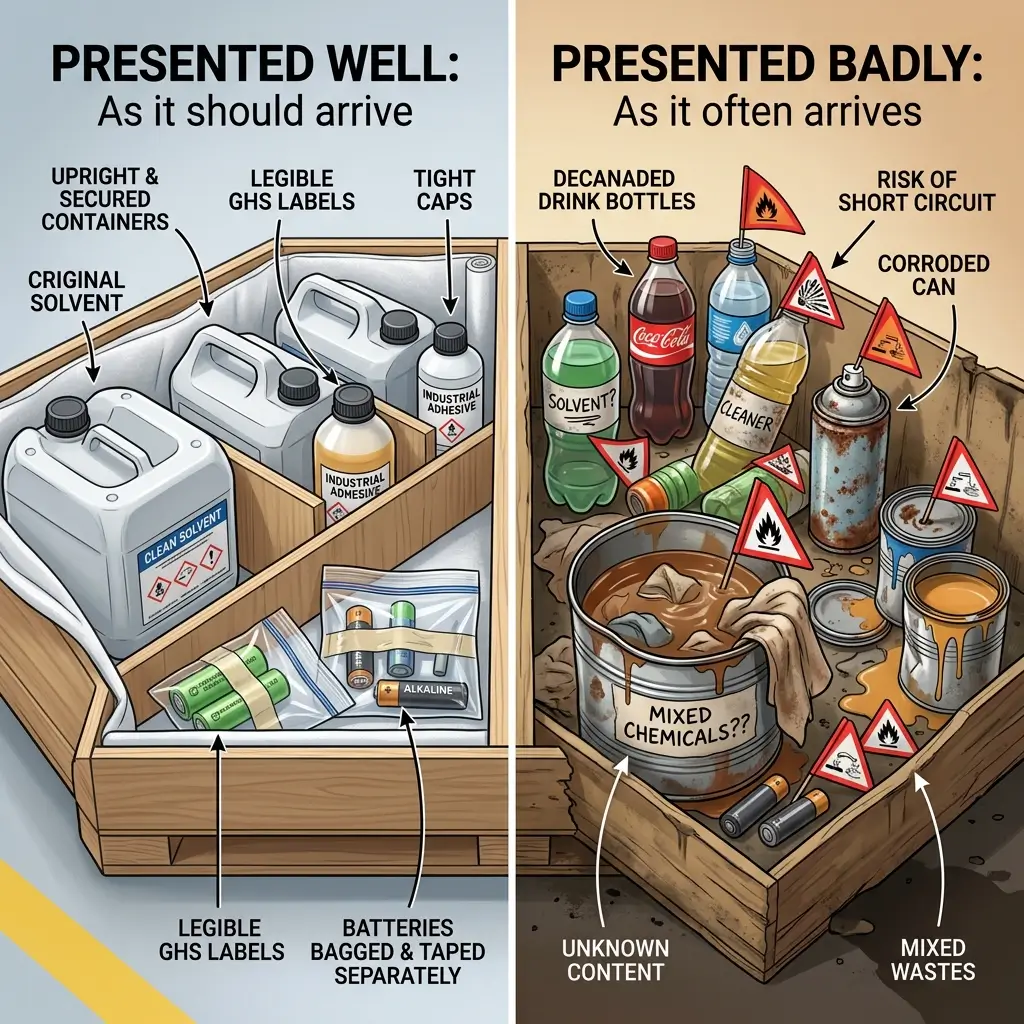
This is the stretch nobody regulates and nearly everybody gets wrong. The material has left the exemption's protective assumption — that it is sitting quietly in a house — and has not yet reached anyone competent to handle it. Three failure modes account for most of what I have seen.
Batteries hidden inside other things
The battery problem is now the largest single fire risk in municipal waste, and it arrives disguised. Research reported for the Environmental Services Association found more than 1,200 battery-related fires in UK refuse vehicles and waste facilities in a twelve-month period, a 71% rise on the preceding year, with the industry cost estimated above £1 billion annually.
What makes it hard to solve is that residents are not being careless. They are discarding a greeting card, not a battery. Research by Material Focus cited in the same briefing found that close to a fifth of UK consumers admit to binning batteries incorrectly, and that most are not confident about how to dispose of them properly.
Working across Biffa and SUEZ operations, the pattern I saw repeatedly was that awareness campaigns aimed at "batteries" achieved very little, because the householder did not believe they were throwing a battery away.
Decanted liquids with no label
A litre of something in an old lemonade bottle is a genuine problem. The operator cannot classify it, cannot safely open it, and cannot bulk it with anything. It goes to analysis, which is slow and expensive, or it goes to a lab-pack, which is also expensive.
The wider hazard is domestic. Storing chemicals in food and drink containers is a recognised cause of accidental poisoning in children, which is why every regulator's advice repeats the same instruction: leave it in the container it came in, with the label attached.
Mixing done with good intentions
People consolidate. Three half-tins of thinner become one full tin; two bottles of cleaner become one. It saves space and feels tidy, and it is the most dangerous thing a householder can do with this material. EPA's guidance is direct — never mix HHW with other products, because incompatible products may react, ignite or explode, and contaminated material may become unrecyclable.
The reactive combinations most worth naming for a domestic audience are:
- Bleach with acidic cleaner (limescale removers, some drain products) — releases chlorine gas
- Bleach with ammonia (glass and multi-surface cleaners) — releases chloramine vapour
- Pool chlorine with any organic material — oil, brake fluid, or even a solvent-wetted rag can ignite it
- Acid with any metal container — hydrogen generation inside a sealed can
Storing and moving HHW safely before it leaves the house
Between deciding to dispose of something and actually disposing of it, most HHW sits for months. That storage period is where domestic incidents happen, and it is entirely within the householder's control.
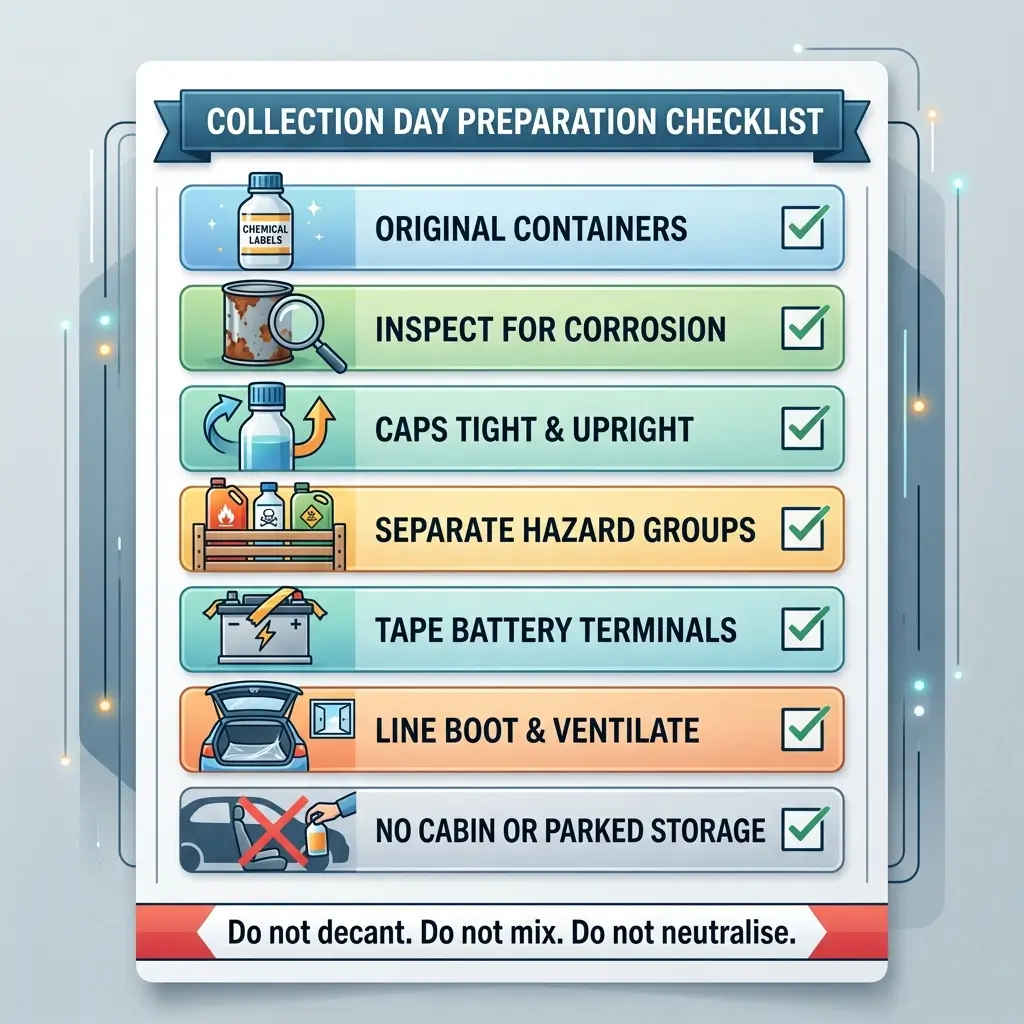
The sequence below is what I would tell a resident preparing for a collection day. It is deliberately dull, and it removes almost all of the risk that reaches the operator.
Work through these steps in order before transporting anything:
- Leave everything in its original container. The label is the classification. Without it, the operator is guessing and you may be refused.
- Check the containers before you touch them. A corroding or swollen container should not be moved by you — contact the collection service or your fire service for instructions.
- Tighten every cap and stand containers upright. Most spills in a car boot are a lid that was never fully closed.
- Separate the hazard groups physically. Acids away from bleach, flammables away from oxidisers, in different boxes or crates.
- Tape battery terminals and bag batteries individually. This is the step that prevents the short circuit, and it takes seconds.
- Line the boot or footwell and travel with a window open. Vapour accumulates in a closed vehicle, particularly in summer.
- Never transport in the passenger cabin, and never leave the load in a parked car. Heat is the variable people forget.
⚠️ Safety critical: Never attempt to neutralise, dilute or "make safe" a household chemical before disposal. Adding water to some products generates heat or gas. Present it as it is and let the operator classify it.
Where HHW goes after it is collected
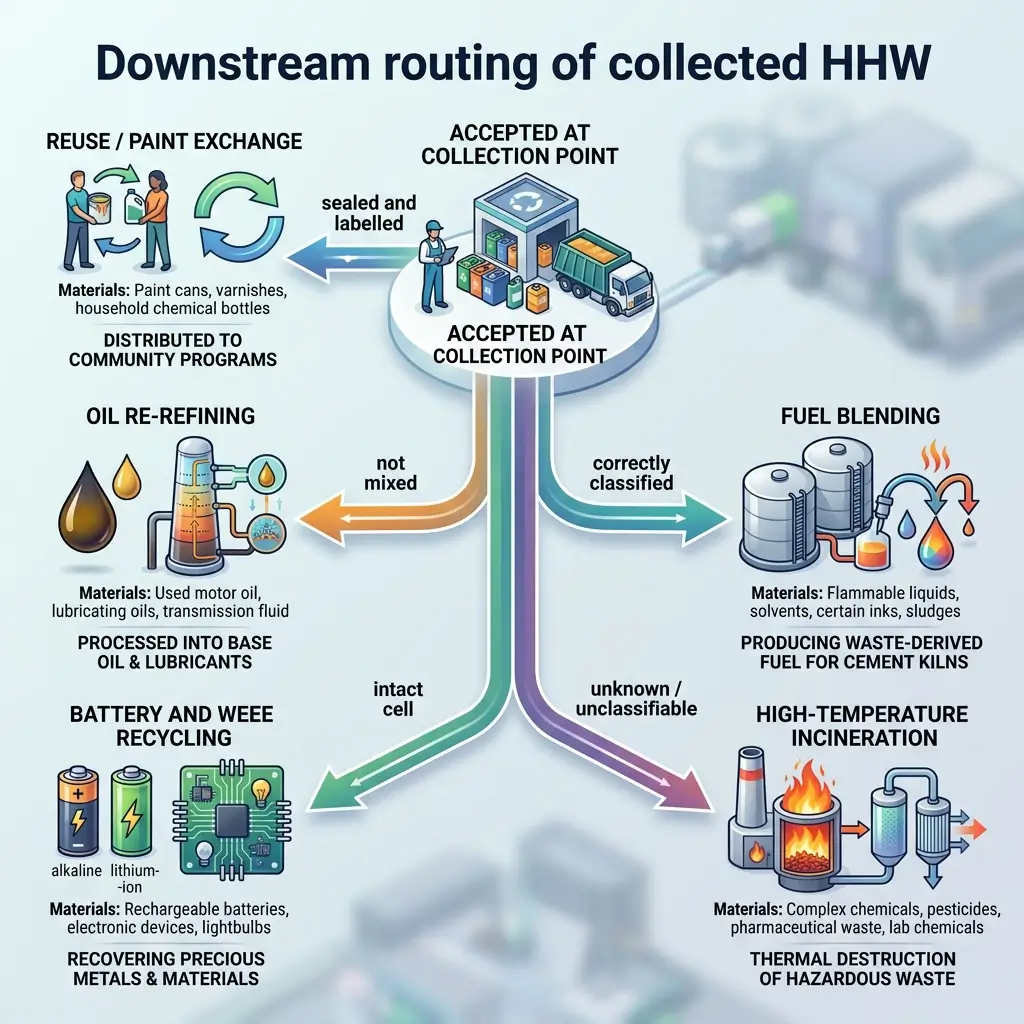
Residents almost never ask this, and it is worth knowing, because it explains why collection services are strict about presentation. The material does not go to one place. It splits across several routes according to what it is, and each route has its own acceptance criteria.
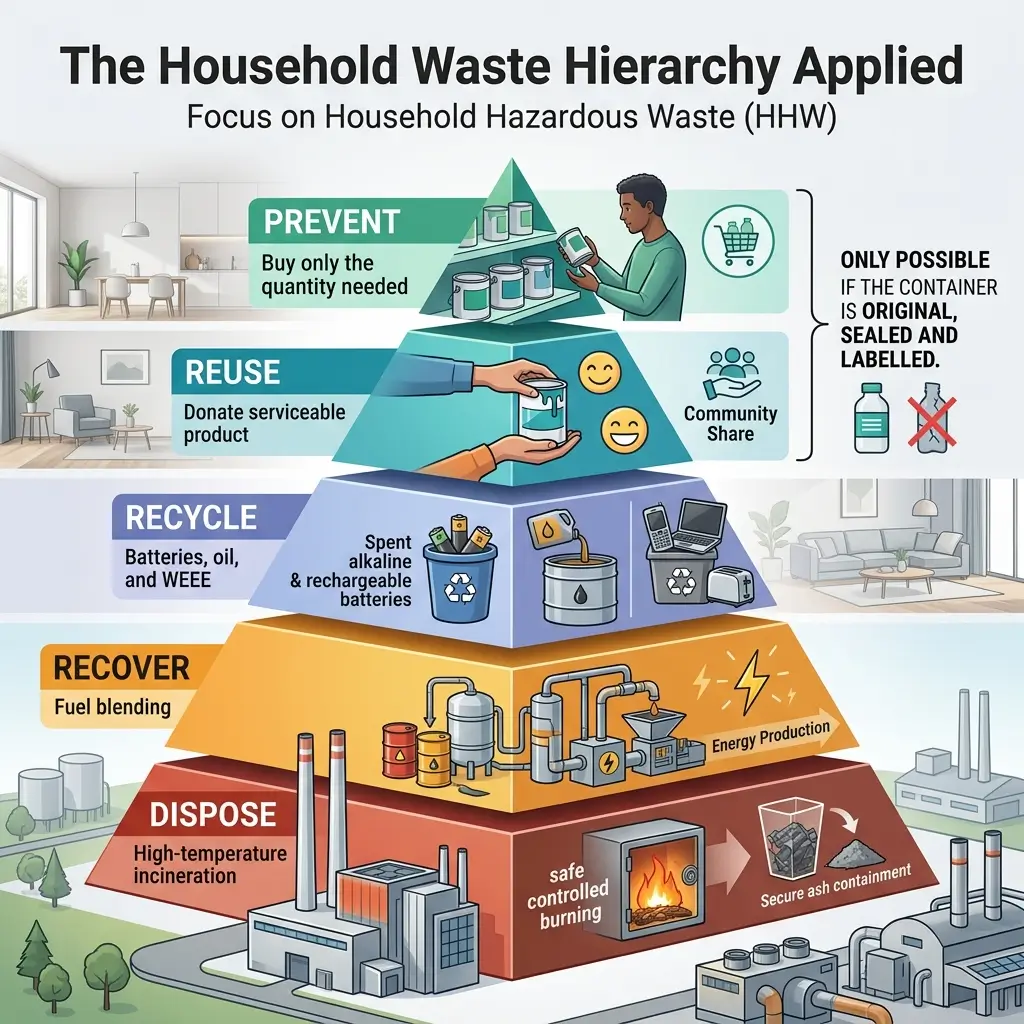
Reuse sits at the top of that hierarchy and is chronically underused. Serviceable paint, unopened garden chemicals and full solvent tins can often be redistributed rather than destroyed. At Veolia and SUEZ sites I audited, the constraint on reuse was rarely demand — it was that the material arrived contaminated, decanted, or in a container nobody could verify.
| Material | Typical route | Determining factor |
|---|---|---|
| Serviceable paint, unopened product | Reuse or paint exchange | Original sealed container with legible label |
| Waste oil, antifreeze | Recovery and re-refining | Not mixed with solvent or water |
| Lead-acid batteries | Lead and acid recovery | Intact casing |
| Lithium-ion batteries, WEEE | Specialist recycling | Terminals protected, undamaged cell |
| Solvents, thinners | Fuel blending or high-temperature incineration | Correct classification, no chlorinated contamination |
| Pesticides, unknown mixtures | High-temperature incineration | Positive identification, or lab-pack if unknown |
The single factor that decides which route a container takes is its condition on arrival. Practical consequences worth stating to any resident:
- A decanted container almost always drops to incineration, because nothing else will accept an unverified substance
- A contaminated batch loses the whole batch, not just the contaminating item — one chlorinated solvent can reclassify a full bulking tank
- Damaged batteries cannot be recycled through the normal route and need specialist handling at higher cost
- Empty and fully dried containers usually belong in ordinary household waste, and taking them to a collection point wastes capacity that other residents need
The grey zone: home businesses, landlords and house clearances
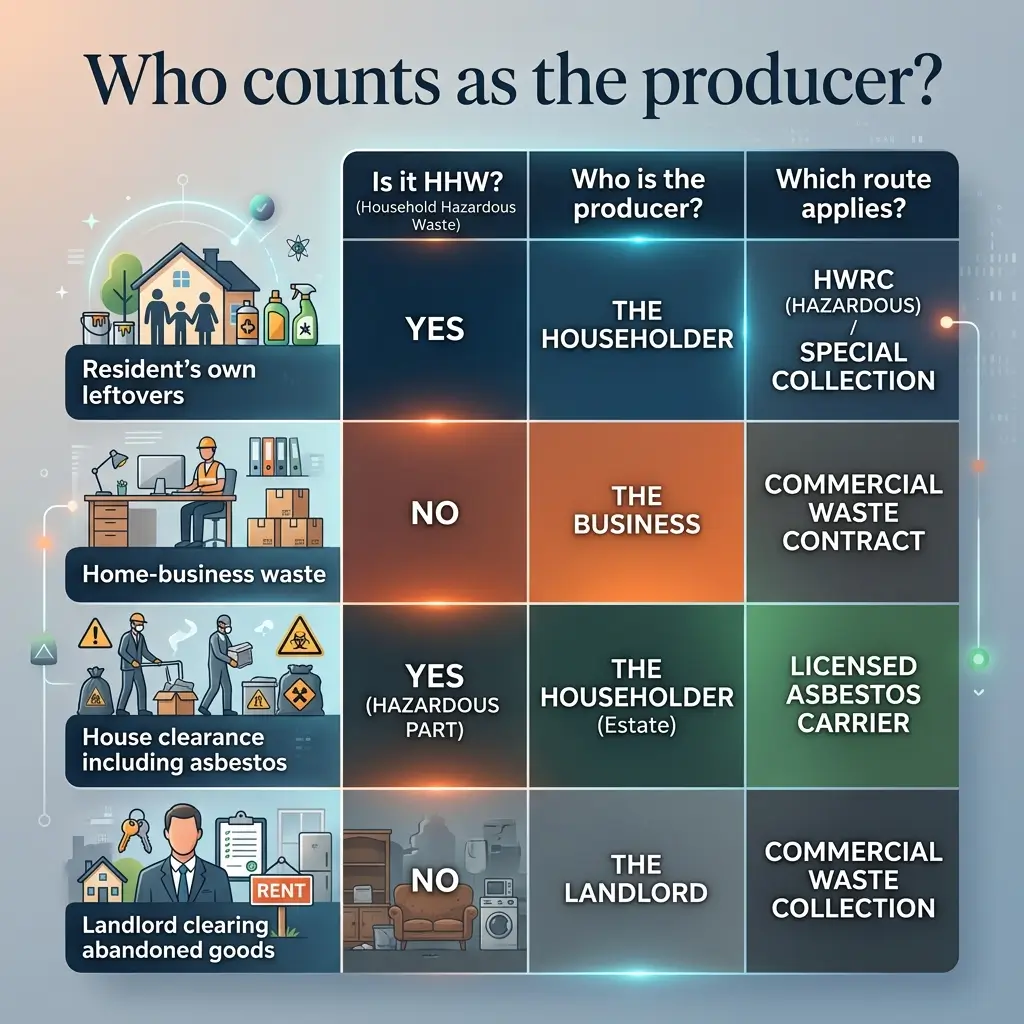
Three situations sit awkwardly across the residence line, and all three come up constantly. In each, someone assumes the household exemption covers them when it does not.
The exemption is tied to generation by individuals at a residence. Commercial activity happening at a residential address is not household generation, however domestic the setting looks. A mobile mechanic's waste oil, a home hairdresser's chemicals, a craft business's solvents — none of these are HHW, and in the US they are more likely to fall under very small quantity generator (VSQG) rules than under the exclusion.
That is a workable route rather than a dead end. A VSQG is limited to 100 kg of non-acute hazardous waste (or 1 kg of acute waste) on site at any time, and California's DTSC sets out that a VSQG may self-transport up to 100 kg a month to a household hazardous waste collection facility without registering as a transporter or raising a manifest. Facilities may accept VSQG waste, but they are not obliged to — call before you drive.
House clearances are the one that catches families out. Clearing a deceased relative's garage frequently turns up decades-old pesticides, asbestos-containing materials and unlabelled chemicals in quantities no household would normally hold. The material is domestic in origin, but the volume and age push it beyond what a collection event is set up to accept — and in England and Wales, asbestos is one of the two express exceptions where the Hazardous Waste Regulations 2005 do bite, with a contractor treated as the producer.
Before assuming the exemption applies, check the following against your situation:
- Was the waste generated by a business activity? If yes, it is not HHW regardless of the address
- Is the quantity consistent with household use? Drum quantities signal commercial generation
- Does it include asbestos? In England and Wales this is expressly carved back into the Regulations
- Are you a landlord clearing a tenant's abandoned property? You are not the generator, and the local authority route may not be open to you
- Is it agricultural? Farm chemical waste has its own regime and is not household waste
Frequently asked questions
These are the questions that come up most often from residents and from small operators who are unsure which side of the line they sit on.
Is household hazardous waste actually illegal to put in the bin?
Federally in the US, no — the household exclusion means no federal prohibition applies. State and local law is a different matter, and many jurisdictions including California prohibit trash, drain and abandonment disposal outright. Check your state or local authority rules rather than the federal position.
What is the difference between HHW and universal waste?
Universal waste is a separate US regulatory category covering widely generated items such as batteries, lamps and mercury devices, with streamlined handling rules. HHW is defined by household origin. The same battery can be HHW from a home and universal waste from an office.
Can I pour leftover cleaner down the drain if I run the tap?
No. Dilution does not remove the hazard, and domestic treatment systems are not designed for it. Septic systems in particular can be disabled by biocidal cleaners, and material reaching a storm drain typically enters watercourses untreated.
Is latex paint household hazardous waste?
Usually not once it is dried out. Water-based latex paint can generally be dried solid and disposed of in normal household waste, while oil and solvent-based paints remain HHW. Some collection programmes accept liquid latex for reuse — check yours before drying it.
What do I do with a swollen or leaking container?
Do not move it. Corroding, swollen or leaking containers need specific instructions, and EPA advises contacting your local hazardous materials official or fire department for them. Ventilate the area, keep children and pets away, and wait.
Are empty containers still hazardous?
Residue matters. EPA notes that even empty HHW containers can pose hazards from remaining residue. Fully dried or genuinely empty containers usually belong in normal waste — with the notable exception of gas canisters, which many programmes require even when empty.
Does the household exemption cover my home office or home business?
No. The exclusion requires generation by individuals at a residence, and commercial activity at a residential address does not qualify. California's rules state this expressly. In the US you are more likely to be a very small quantity generator, which carries its own obligations.
What to do this week
Open the cupboard under the sink and the shelf in the garage. Sort what is there into three piles: still usable, empty and dry, and waste. The first pile gets used or given away. The second goes in normal household waste. The third goes to your local collection point.
That is the entire job. It matters for a concrete reason. Somebody at the other end has to open the box you hand over, and how you pack it decides what they are dealing with.
The three actions worth taking before the next collection day are:
- Stop buying more than you will use. Prevention removes the disposal problem rather than moving it.
- Pull the batteries out of anything you are discarding, tape the terminals, and bag them separately.
- Check what your local service actually accepts before you load the car, because acceptance criteria vary considerably between programmes.
About the author — Ryan Foster
Ryan Foster is an American Environmental Management, ISO 14001 and Sustainability Assurance Consultant with 17 years of continuous field experience across waste management, hazardous waste routing, spill control and wastewater compliance in 14 countries. He served as Hazardous Waste Routing Lead at Heritage Environmental Services and has held environmental assurance roles at SUEZ Recycling & Recovery, Remondis, Biffa, Veolia Environmental Services EU, Clean Harbors and Stericycle Environmental. He leads Foster Environmental Assurance from Zurich, Switzerland.
Credentials: NEBOSH International General Certificate, ISO 45001 Lead Auditor, ISO 14001 Internal Auditor, IOSH Managing Safely, Dangerous Goods Awareness.
Sources and further reading
- US EPA — Household Hazardous Waste (HHW), including the 40 CFR 261.4 exclusion criteria and Subtitle D position
- The Hazardous Waste (England and Wales) Regulations 2005
- Directive 2008/98/EC on waste, consolidated text as amended by Directive (EU) 2018/851 — Article 20 on household hazardous waste
- California Department of Toxic Substances Control — Household Hazardous Waste
- Resource Media — ESA policy briefing figures on battery fires in UK waste facilities