

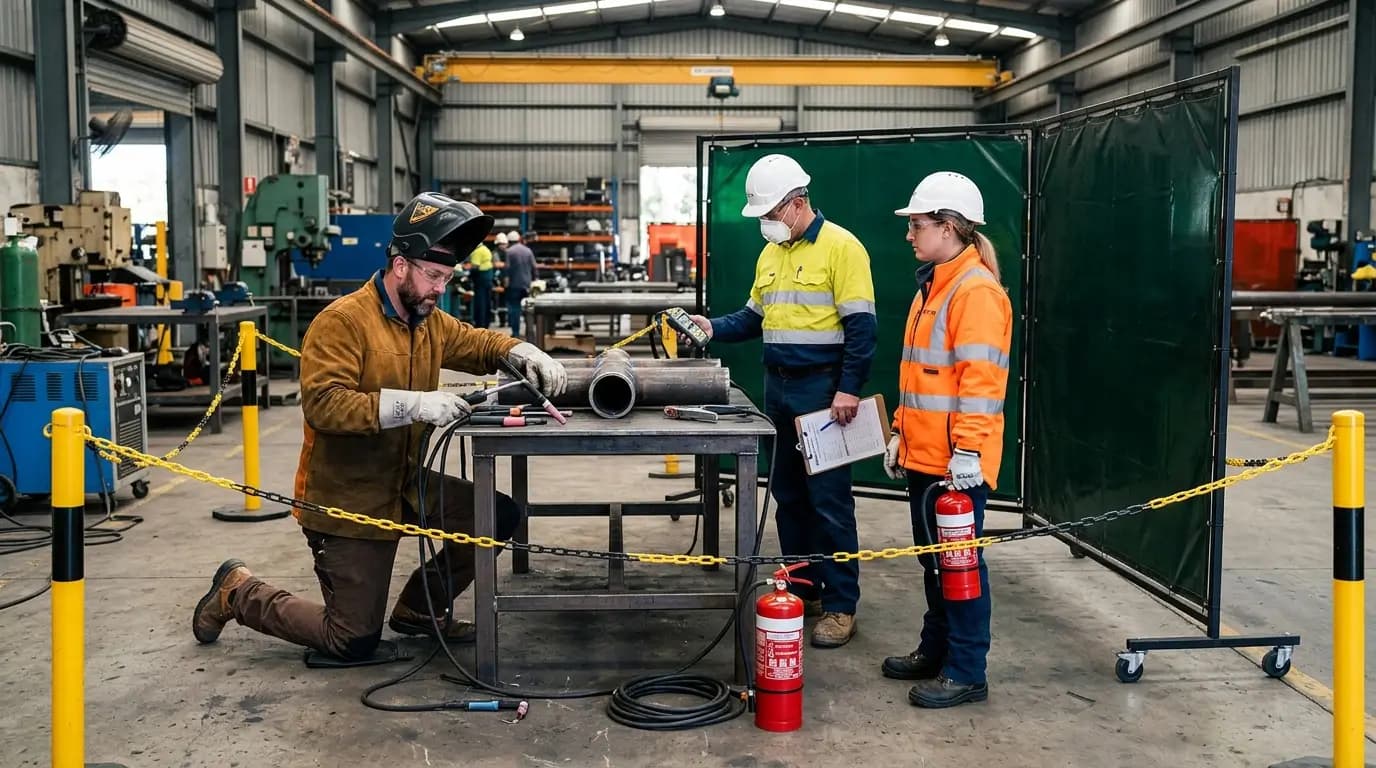
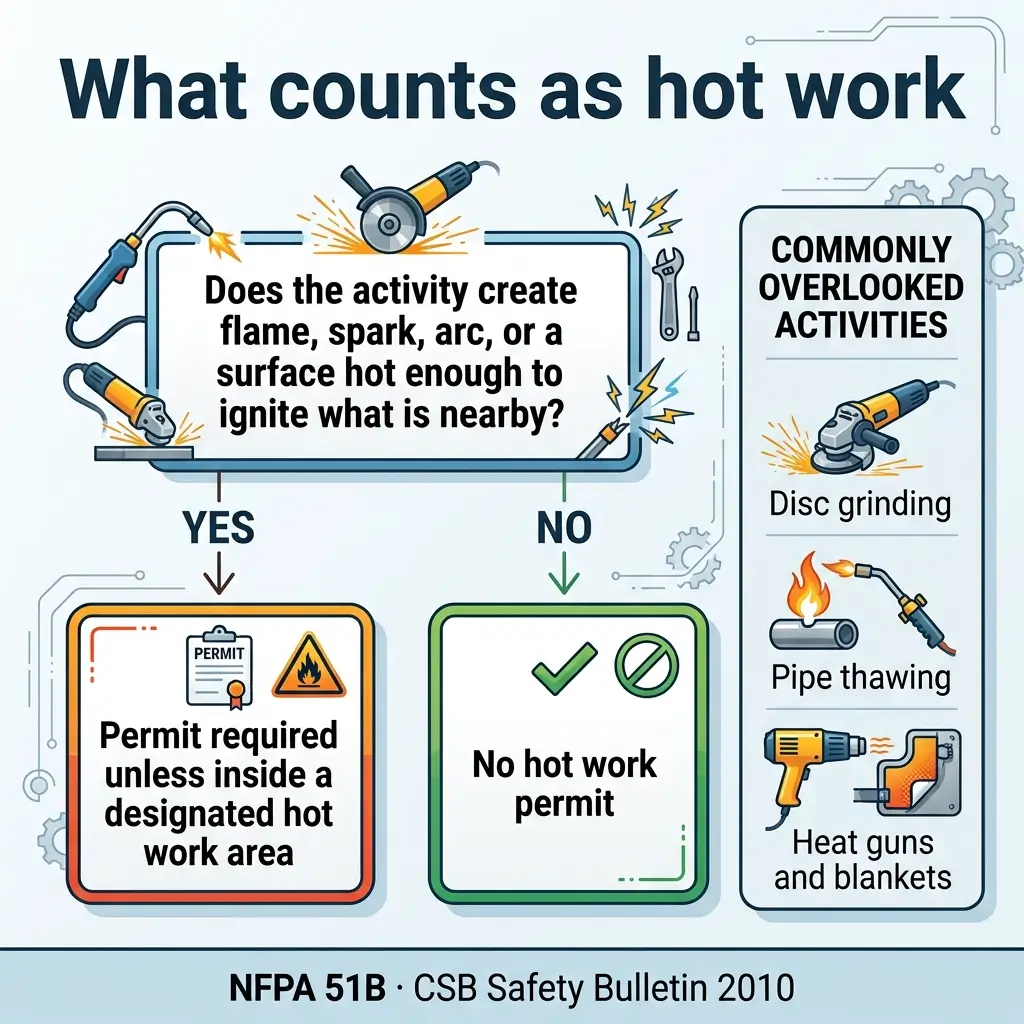
Hot work is any activity that introduces an ignition source into a workplace — welding, flame cutting, brazing, soldering, grinding, thawing pipes with a torch, or running a bitumen boiler. The definition turns on the ignition source, not on the trade doing the job. That distinction decides whether a permit is raised, and it is where most hot work programmes go wrong before anyone strikes an arc.
I have spent nineteen years in oil and gas HSE, most of it on gas plants, pipelines and offshore campaigns where hot work is controlled harder than anywhere else in industry. The recurring finding is never that a crew did not know welding was dangerous. It is that the permit was signed in the office, the gas test was taken at the convenient point rather than the work face, or the fire watch left at the same moment the welder did.
This article covers what counts as hot work, the hazards in the order they actually kill people, what US and UK law require, and the controls that survive contact with a live site.
Key takeaways
Five points carry most of the weight in this article, and four of them correct something that is stated wrongly almost everywhere else:
- Hot work is defined by the ignition source it creates, so grinding, abrasive cutting and pipe thawing are hot work even though no welding is involved.
- OSHA's 35-foot figure in 29 CFR 1910.252 is not a clearance you must achieve. It appears three times and means three different things: a floor-sweep radius, a relocation target that applies only where practicable, and a fire watch trigger.
- Fire watch duration depends entirely on which authority you are citing. OSHA general industry requires at least half an hour. NFPA 51B has required 60 minutes since its 2019 edition. US construction sets no number at all.
- OSHA incorporates only the 1962 edition of NFPA 51B, and only for one introductory paragraph. "OSHA requires NFPA 51B" is false.
- The control that prevents fatalities most reliably — combustible gas monitoring before and during the work — is not required by OSHA for hot work near flammable tanks. The US Chemical Safety Board has made this point since 2010.
What counts as hot work
Hot work is any process capable of igniting a flammable atmosphere or combustible material. Regulators and standards bodies define it by capability rather than by trade, and every serious permit system follows that logic.
The US Chemical Safety Board defines it as work involving burning, welding or a similar operation capable of initiating fires or explosions, and explicitly folds in cutting, brazing, grinding and soldering. NFPA 51B extends the same test to heat treating and any other operation likely to produce sparks or flames.
The activities most permit systems name
Permit forms usually carry a list, and the list is a prompt rather than a boundary. If an activity produces flame, spark, arc or enough heat to ignite what is nearby, it is hot work whether or not it appears on the form.
The operations that a hot work permit normally covers are:
- Arc and gas welding, including tack welding and habitat welding
- Flame cutting and gouging, oxy-fuel or plasma
- Grinding and abrasive disc cutting, which throw incandescent particles further than most crews expect
- Brazing and soldering, including torch and induction methods
- Pipe thawing with a torch or heat blanket
- Bitumen and tar boilers, hot air blowers, lead heaters and heat guns
- Abrasive blasting in a flammable atmosphere, where static and impact sparking apply
- Powder-actuated tools, which use an explosive charge
The three exclusions that cause incidents
Three activities get argued out of the permit regime again and again, and each has its own fatality history.
Grinding is the most common. Crews treat it as mechanical work because there is no flame, but an abrasive disc produces a stream of burning steel and disc particles, and grinding is named in NFPA 51B and in the CSB's definition.
Pipe thawing is the second. It reads as maintenance rather than as a heat source, yet a torch on a frozen line near lagging or a cable tray is a straightforward ignition risk.
The third is heat with no visible spark at all — hot air guns, heat blankets and lead heaters. No spark makes the hazard look smaller. Autoignition temperatures for common solvents sit well inside what a heat gun delivers.
Designated areas versus permit areas
A designated hot work area is a permanent location built and maintained for the job — a welding bay with non-combustible construction, no stored combustibles, and fixed extinguishing provision. Work inside one does not need a permit, because the controls are engineered into the space and verified on a schedule.
Everywhere else is a permit area. OSHA's 1910.252(a)(2)(xiii) puts the duty on management to establish the designated areas and to set procedures for cutting and welding in every other location.
| Activity | Why it is hot work | Common exclusion error |
|---|---|---|
| Arc welding | Arc, spatter, molten slag | None — always captured |
| Disc grinding | Incandescent particle stream | "It's mechanical, not hot" |
| Plasma cutting | Arc plus high-velocity molten metal | Treated as a cold-cut alternative |
| Pipe thawing | Open flame or sustained heat | Logged as maintenance |
| Heat gun on lagging | Surface temperature above solvent autoignition | "No flame, no permit" |
| Powder-actuated tool | Explosive charge, hot fastener | Treated as fixing work |
Why hot work starts so many fires
The numbers are worth stating precisely, because they are usually quoted loosely. NFPA's research on structure fires started by hot work found that US fire departments responded to an estimated average of 3,396 structure fires a year involving hot work between 2017 and 2021, causing 19 civilian deaths, 120 civilian injuries and $292 million in direct property damage annually. Welding torches were the most common equipment involved.
The occupational picture is worse than the structural one. The CSB has identified more than 60 fatalities since 1990 from explosions and fires during hot work on tanks alone, and has stated that hot work is among the most common causes of worker death in the incidents it investigates. Those deaths were spread across food production, pulp and paper, wastewater treatment, fuel storage and oil production — not confined to refineries.
Sparks travel further than the work area
The mechanism behind most of these fires is simple and consistently underestimated. Molten slag and grinding particles fall, bounce and roll. On a grated deck they drop through to whatever is on the level below. Through a floor crack or an open doorway they reach spaces nobody surveyed.
OSHA addresses this directly. 1910.252(a)(2)(i) requires precautions wherever floor openings or cracks cannot be closed, and applies the same rule to holes in walls, open doorways and broken windows. The standard also requires ducts and conveyor systems that could carry sparks to distant combustibles to be protected or shut down.
Conduction is the quieter path. Cutting a pipe or a beam heats steel some distance from the cut, and 1910.252(a)(2)(xii) prohibits work on pipes or metal in contact with combustible walls or ceilings where conduction could cause ignition. I have seen this one missed more often than any other spark-travel route, because the hazard is on the far side of a structure the crew never walks.
Why the fire starts after everyone leaves
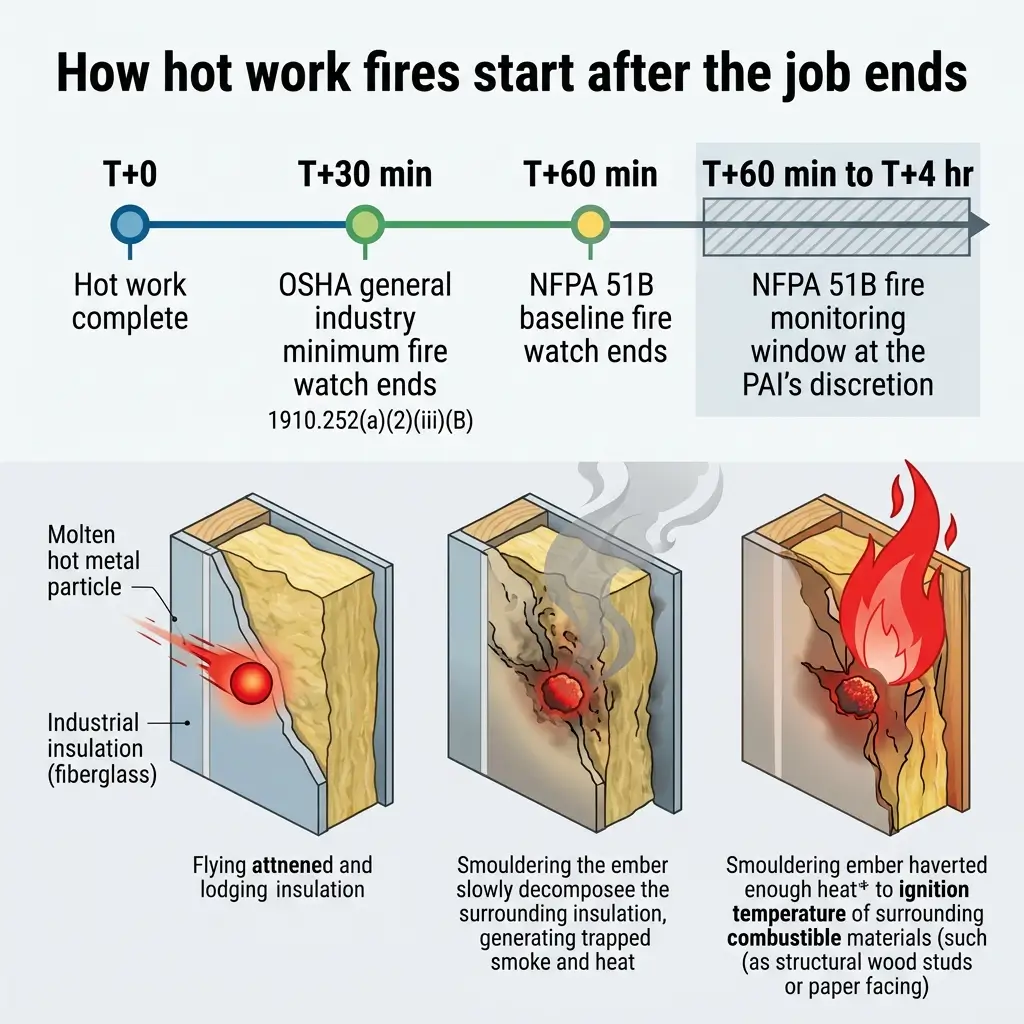
A hot particle lodged in insulation, dust or timber does not produce flame immediately. It smoulders, sometimes for hours, until it finds enough oxygen and fuel to break into open burning. By then the crew has packed up, the permit is closed, and nobody is watching.
That single mechanism is the reason a post-work fire watch exists, and the reason its duration is the most argued-about number in hot work.
Hot work hazards, in the order they kill people
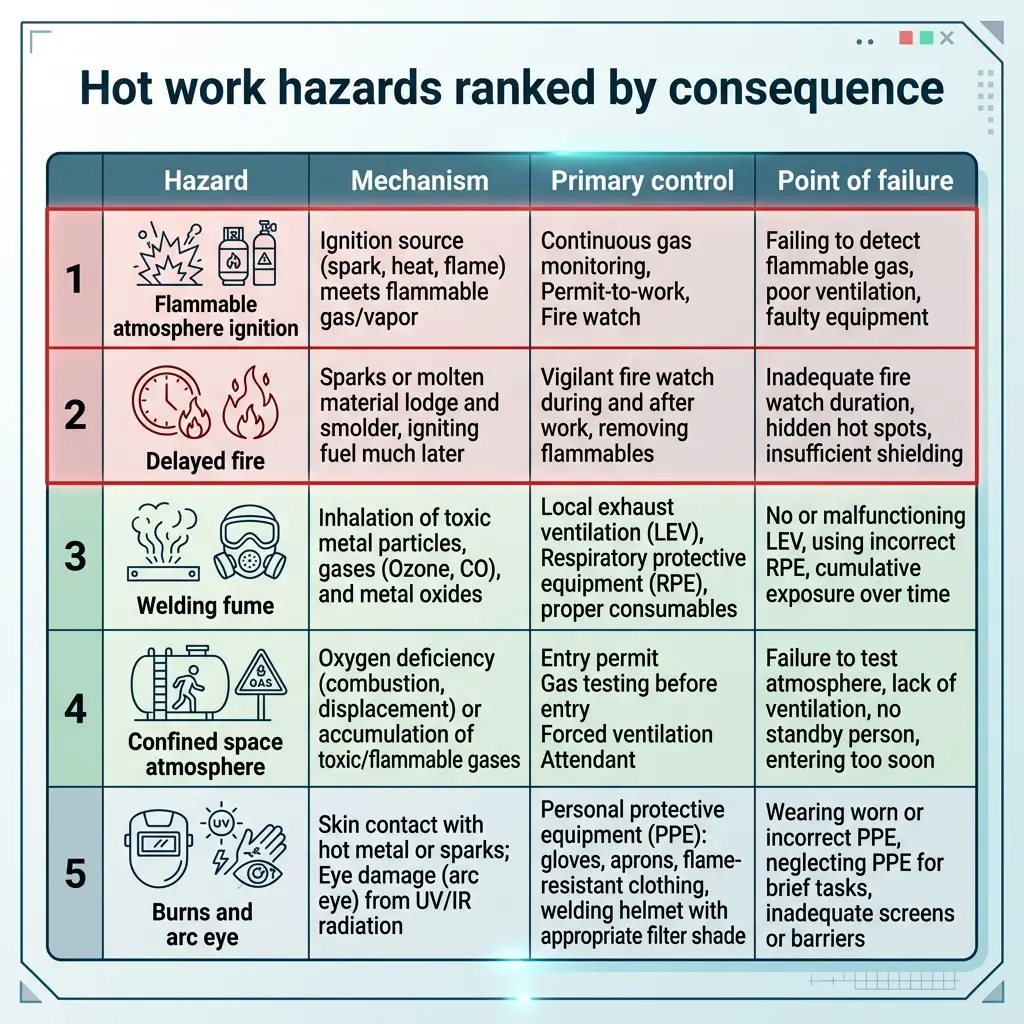
Most articles list hot work hazards alphabetically. Ranking them by consequence changes what a supervisor prioritises in a pre-job brief.
Ignition of a flammable atmosphere
This is the hazard that produces multiple fatalities from a single event. A vessel, drain, sump or line contains flammable vapour, the atmosphere is inside its flammable range, and the hot work supplies the ignition source. The CSB's tank investigations share a common feature: in every case the workers had no knowledge that an explosive quantity of vapour had accumulated.
OSHA prohibits cutting and welding in the presence of explosive atmospheres, including those that may develop inside uncleaned or improperly prepared tanks that previously contained flammable material, and in areas where combustible dust has accumulated. It also requires used drums, barrels and tanks to be cleaned thoroughly enough to be certain no flammable material or heat-reactive residue remains, with all connected pipework disconnected or blanked.
Delayed and smouldering fire
Second by frequency, first by property loss. The control is time, not equipment: a fire watch that stays long enough, and a documented check of adjacent and lower spaces before the permit closes.
Welding fume
The health hazard has been reclassified upward. Following IARC's assessment, the HSE issued safety alert STSU1-2019, endorsing the reclassification of mild steel welding fume as a human carcinogen and strengthening enforcement expectations for all welding fume. General ventilation is no longer accepted as adequate control. Engineering controls, typically local exhaust ventilation, are expected for indoor welding regardless of duration, with respiratory protective equipment where LEV alone does not control exposure and for welding outdoors.
Manganese in mild steel fume carries a separate neurological risk. Stainless steel work adds hexavalent chromium and nickel compounds.
Confined space atmospheres
Welding inside a vessel consumes oxygen and generates fume in a space with no dilution. OSHA treats ventilation as a prerequisite for confined space hot work. Where the space is under 10,000 cubic feet, the minimum mechanical rate is 2,000 cubic feet per minute per welder. The standard also states plainly that oxygen must never be used for ventilation. Inert purge gas creates the opposite hazard — an asphyxiating atmosphere that gives no warning.
Burns, arc eye, shock and noise
Real, routine, and largely managed by PPE and equipment discipline. Arc eye from a few seconds of unshielded exposure is the most common reportable injury on a fabrication site, and it usually happens to someone walking past rather than to the welder.
| Hazard | Mechanism | Primary control | Where it is usually missed |
|---|---|---|---|
| Flammable atmosphere ignition | Vapour in flammable range meets spark or flame | Isolate, drain, purge, gas test at the work face and during work | Test taken at the access point, not the work face |
| Delayed fire | Smouldering particle in concealed material | Fire watch of adequate duration plus post-work monitoring | Watch ends when the welder stops |
| Welding fume | Inhalation of metal oxides, manganese, Cr(VI) | LEV for indoor work; RPE for residual fume and outdoor work | Treated as duration-dependent |
| Oxygen depletion or enrichment | Consumption by the process, or purge and leak gas | Continuous monitoring, ventilation, standby attendant | Purge gas not tracked after isolation |
| Burns and arc eye | Radiant heat, UV, spatter | Screens, correct filter shade, FR clothing | Bystanders and passers-by |
What the law and standards actually require
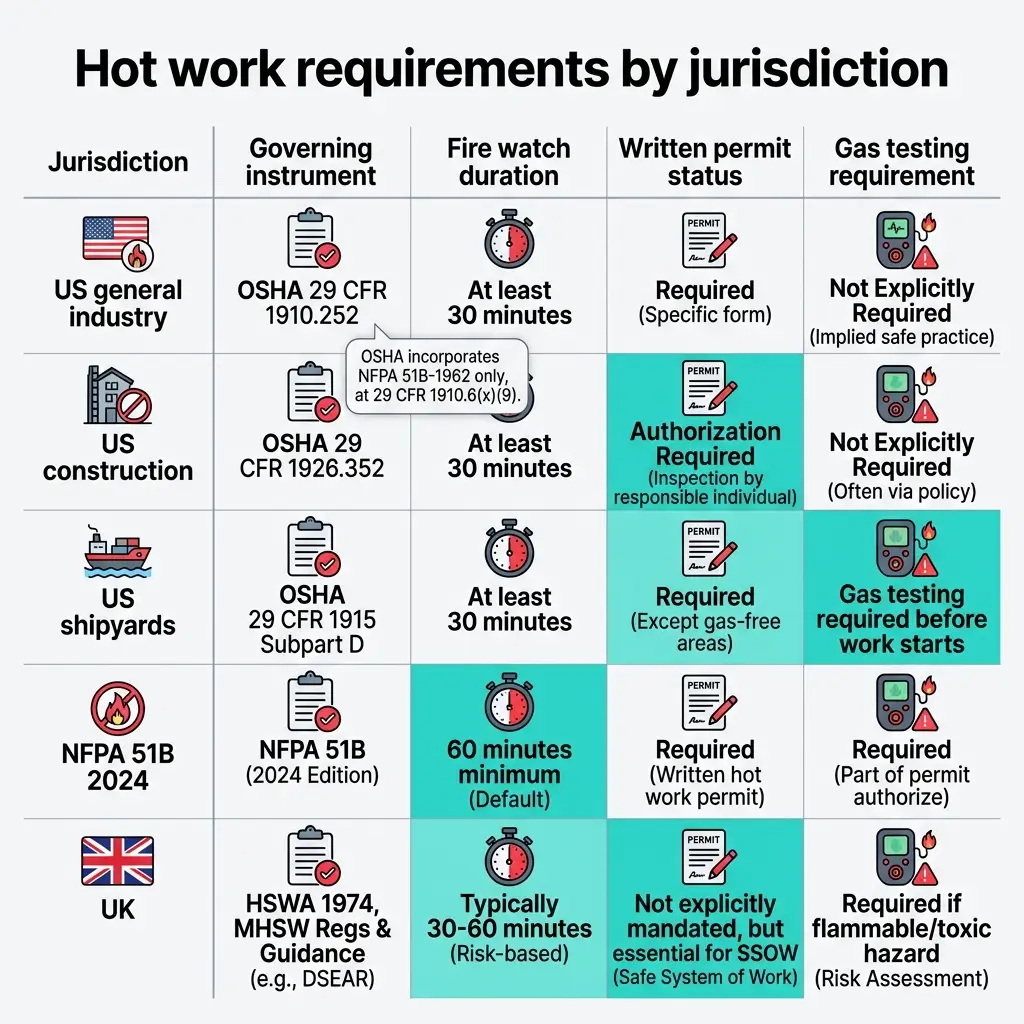
Hot work sits under different instruments in different jurisdictions, and the numbers attached to it are not interchangeable. Any procedure that states a fire watch duration without naming its authority is a procedure that will be argued over after an incident.
United States
General industry sits under 29 CFR 1910 Subpart Q, principally 1910.252. Construction sits under 29 CFR 1926.352. It contains no 35-foot figure, no fire watch duration and no permit requirement. It does require the same precautions on the far side of any wall, floor or ceiling being worked on, and requires drums and hollow structures that have held flammables to be filled with water, or cleaned, ventilated and tested, before heat is applied. Shipyard employment sits under 29 CFR 1915 Subpart D, which is stricter than either and requires a Marine Chemist or other competent person to certify spaces before hot work.
Three points routinely get stated wrongly.
OSHA does not adopt current NFPA 51B
29 CFR 1910.6 incorporates NFPA 51B-1962 by reference, for the introductory text of 1910.252(a)(1) only. That is the entire federal adoption. Current NFPA 51B may still bind you through your state fire code, your Authority Having Jurisdiction, or your insurer, but not through OSHA.
A written permit is not federally mandatory in general industry
1910.252(a)(2)(iv) requires the area to be inspected by the individual responsible for authorising the work, who must designate the precautions to be followed, "preferably in the form of a written permit." Preferably is the operative word. Most fire codes, insurers and corporate standards close that gap, and a written permit is the practical baseline everywhere.
The 35-foot figure is not a clearance requirement
This is the most widely repeated error in hot work content. In 1910.252 the number appears three times and asks for three different things: sweeping combustible floor debris for a 35-foot radius; relocating combustibles at least 35 feet where practicable, with flameproofed covers or shields where it is not; and triggering the fire watch requirement where appreciable combustibles sit within 35 feet. The standard requires you to clear or shield, and to post a watch either way.
United Kingdom
There is no dedicated UK hot work regulation. The duties come from three directions. The Regulatory Reform (Fire Safety) Order 2005 places general fire precaution duties on the responsible person in England and Wales. The Dangerous Substances and Explosive Atmospheres Regulations 2002 require risk assessment, zoning and control of ignition sources wherever an explosive atmosphere may occur — which is precisely what hot work introduces. Schedule 1 of DSEAR goes further and names a permit-to-work system, issued by a person with responsibility for that function before the work starts, as a general safety measure for work carried out in hazardous places. COSHH covers the fume.
For the permit system itself, HSE's HSG250 is the reference document, and HSE's own permit-to-work guidance lists introduction of an ignition source into a controlled area as a recognised failure mode. In UK construction, the Joint Code of Practice on fire prevention on construction sites is usually contractually binding through the insurance policy.
Consensus and industry standards
NFPA 51B, 2024 edition, is the reference standard behind most hot work permit programmes. AWS Z49.1 covers welding safety practice. In refineries and gas plants, API RP 2009, 8th edition (March 2022), is the document my sector actually works to, with API RP 2201 governing hot tapping.
| Jurisdiction or standard | Instrument | Post-work fire watch | Written permit required |
|---|---|---|---|
| US general industry | 29 CFR 1910.252 | At least 30 minutes | Preferred, not mandated |
| US construction | 29 CFR 1926.352(e) | No duration stated — "sufficient time" | Not stated |
| US shipyards | 29 CFR 1915 Subpart D | At least 30 minutes, subject to survey | Certification by competent person |
| NFPA 51B (2024) | Consensus standard | 60 minutes baseline, plus monitoring at the PAI's discretion | Yes, outside designated areas |
| UK | RRFSO 2005, DSEAR 2002, HSG250 | Not prescribed; risk-assessed | Expected as good practice; usually contractual |
Hot work safety precautions that hold up in the field
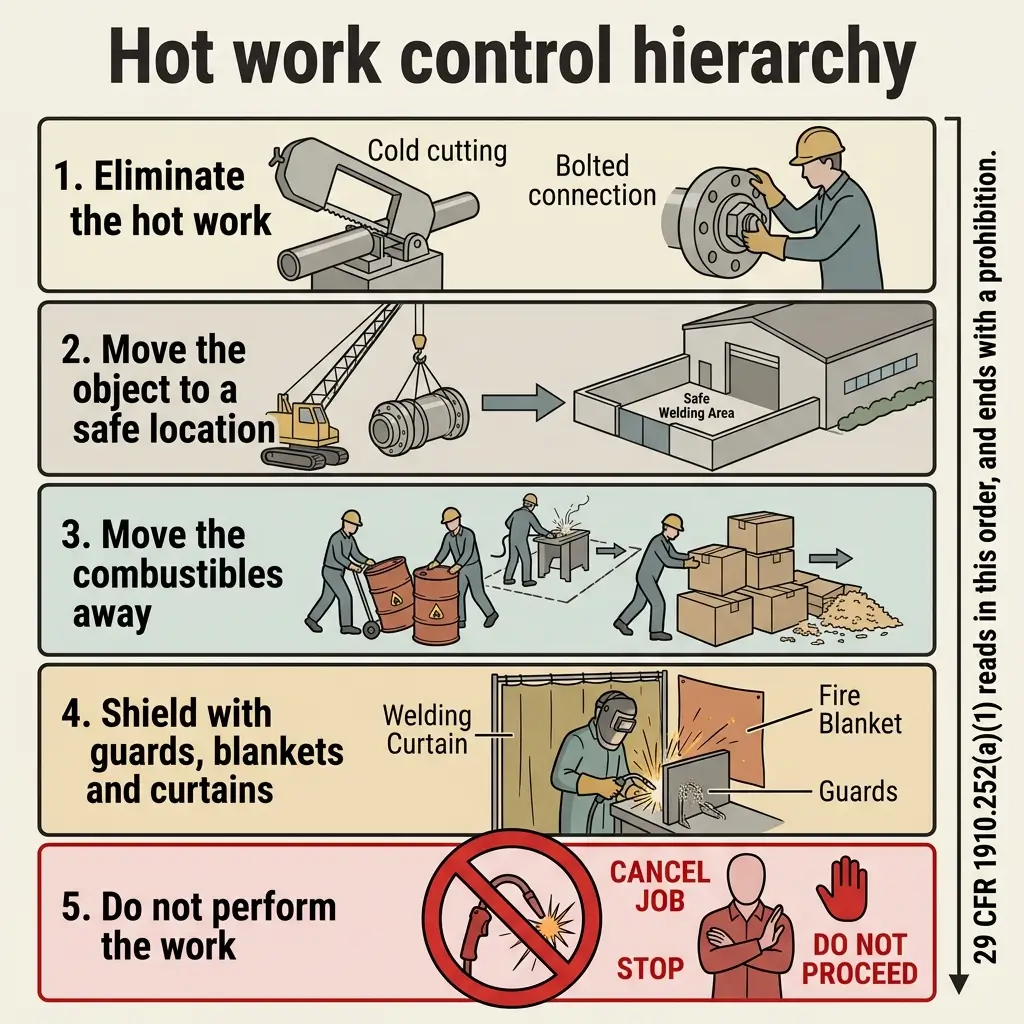
OSHA's basic precautions in 1910.252(a)(1) are a hierarchy, and reading them in order tells you what a good procedure looks like. Move the object to be welded if you can. If you cannot, move the fire hazards away from it. If you can move neither, use guards to confine the heat, sparks and slag. If none of those is achievable, the standard states that welding and cutting shall not be performed.
That last line is the part most procedures drop. It exists.
Eliminate the hot work first
The CSB's first recommendation, ahead of every control, is to avoid hot work where an alternative exists. Bolted or flanged connections instead of welded ones. Mechanical or hydraulic cold cutting instead of flame cutting. Press-fit or grooved couplings instead of soldered joints. Replacing a component rather than repairing it in place.
On turnaround planning I now ask a single question of every hot work item on the schedule: what would it cost to do this cold? The answer is often less than the permit administration, the fire watch hours and the isolation time the hot version requires.
Gas test at the work face, and keep testing
This is where my sector's practice diverges sharply from general industry, and where the fatality data says general industry should catch up. OSHA does not require combustible gas monitoring for hot work near flammable tanks — a gap the CSB called out in 2010 and which remains.
Three rules hold up. Test with a calibrated combustible gas detector before the work starts. Test at the location the work will actually happen, not at the access point. And keep monitoring during the work rather than treating the pre-start reading as a certificate.
Test adjacent and connected spaces too. A clear reading in the vessel you are working on tells you nothing about the drain running beneath it.
Isolate, drain, purge and blank
Before hot work on or near anything that has contained flammables, the equipment and connected pipework are drained or purged, and the connections are physically disconnected or blanked. A closed valve is not an isolation. OSHA requires venting of all hollow spaces, cavities and containers before preheating, cutting or welding, and recommends inert gas purging.
Blanking is the step that gets deferred under schedule pressure, because it takes a break of containment to achieve. It is also the step that turns a vapour path into no path.
Set the fire watch so it survives breaks
A fire watch that does anything else is not a fire watch. The failures in published loss histories cluster at lunch, at shift change, and at the moment the welder finishes. OSHA requires fire watchers to have extinguishing equipment readily available, to be trained in its use, and to be familiar with how to raise the alarm.
Two conditions matter beyond duration. Where hot work is done on one side of a metal wall, partition, ceiling or roof and combustibles on the other side cannot be relocated, 1910.252(a)(2)(x) requires a fire watch on the opposite side as well. And the person doing the hot work cannot be the watch.
Close the permit properly
The pre-start sequence I use, and the one I check when auditing someone else's:
- Confirm the alternative was considered and rejected for a stated reason.
- Walk to the work face with the issuer, the performing authority and the fire watch together.
- Survey 35 feet in every direction, including below and behind, and identify openings, gratings, ducts and the far side of any metal partition.
- Remove or shield combustibles, sweep the floor, and cover openings.
- Isolate, drain, purge and blank any system that has contained flammables.
- Gas test at the work face, record the reading, and set the monitoring regime for the duration.
- Confirm extinguishing provision and the alarm route with the fire watch.
- Sign at the location, not in the office.
- Run the fire watch for the full duration your governing authority requires, then monitor.
- Close out with a documented inspection of the work area and all adjacent and lower spaces.
Where hot work control fails on real sites
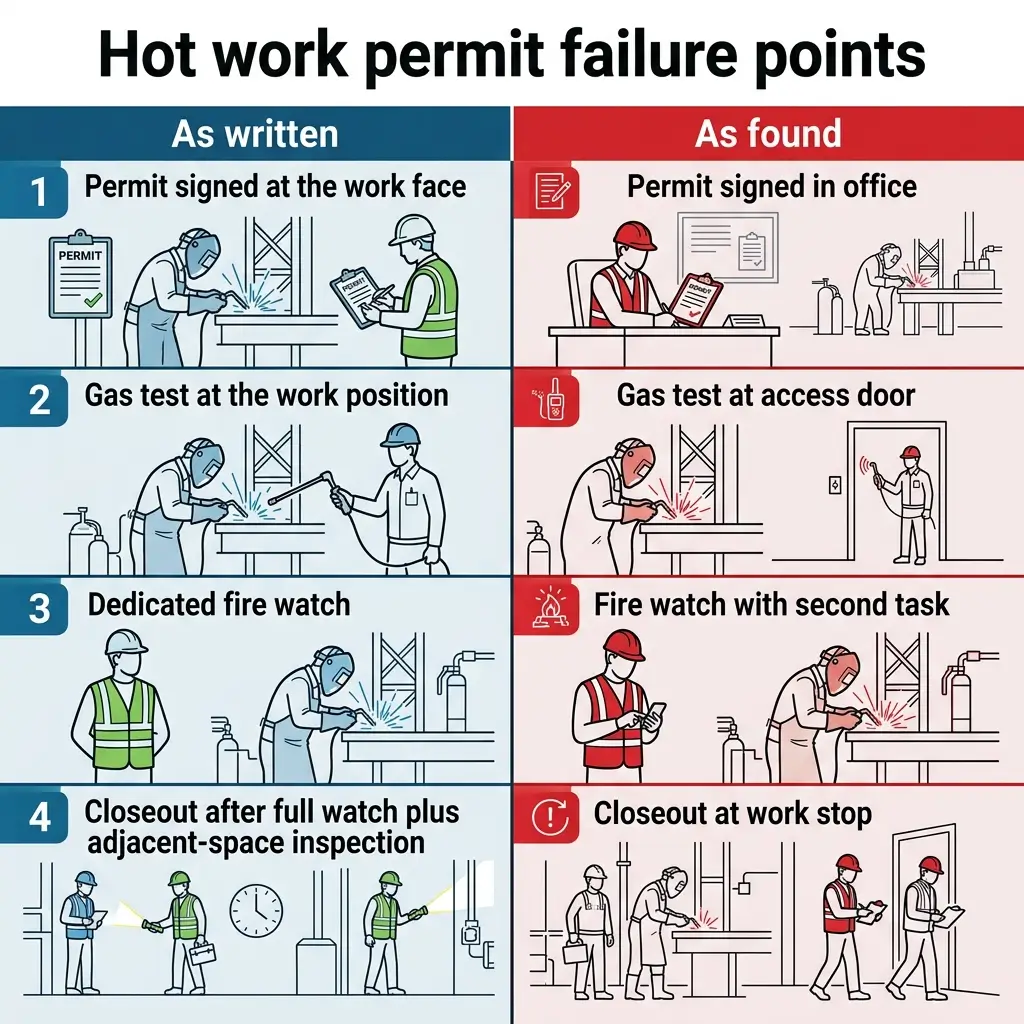
Everything above is well documented and widely trained. The gap that matters is between the written control and the state of it at the work face, and that gap opens in the same few places.
The permit signed away from the work
On an offshore campaign for Neptune Energy in the UK sector, I found a permit that had been approved without anyone walking the job first. The form was complete and correctly signed. Nothing on it had been verified against the actual condition of the location.
I stopped the work, had the controls reinstated and confirmed in the field, and briefed the crew before restart. The lesson transfers cleanly: if you are auditing a permit system, do not read the forms. Ask the issuer where they were standing when they signed. You will learn more from that one question than from a file review.
The gas test that missed the drain
Working as gas plant safety advisor for Harbour Energy in Denmark, I found hot work in progress near an open process drain during a routine walkdown. The atmosphere at the work position was not the atmosphere the permit had been written against.
I stopped it, had the drain controlled and the atmosphere retested at the work position before restart. An open drain is a vapour path from somewhere you did not survey, and a gas reading taken twenty metres away at a convenient point is a reading of a different location. If you issue permits, test where the work is, not where the access is.
The fire watch with a second job
The most common finding I write up on hot work is a fire watch who is also holding a fire blanket, fetching consumables, or acting as banksman. Under schedule pressure this looks efficient. It removes the only control specifically designed to catch a fire nobody expected.
| Failure mode | What to check | What good looks like |
|---|---|---|
| Permit signed remotely | Ask the issuer where they stood when signing | Issuer walks the location before signature |
| Gas test at access point | Compare the test location on the form to the work position | Test at the work face, recorded, repeated during work |
| Fire watch doing a second task | Watch the watch for ten minutes | Watch has no other duty and no other task assigned |
| Adjacent spaces unchecked | Ask who inspected the level below | Documented inspection of below and behind at closeout |
| Watch ends with the arc | Compare closeout time to work-stop time | Full duration per governing authority, then monitoring |
Competence: who issues, who works, who watches
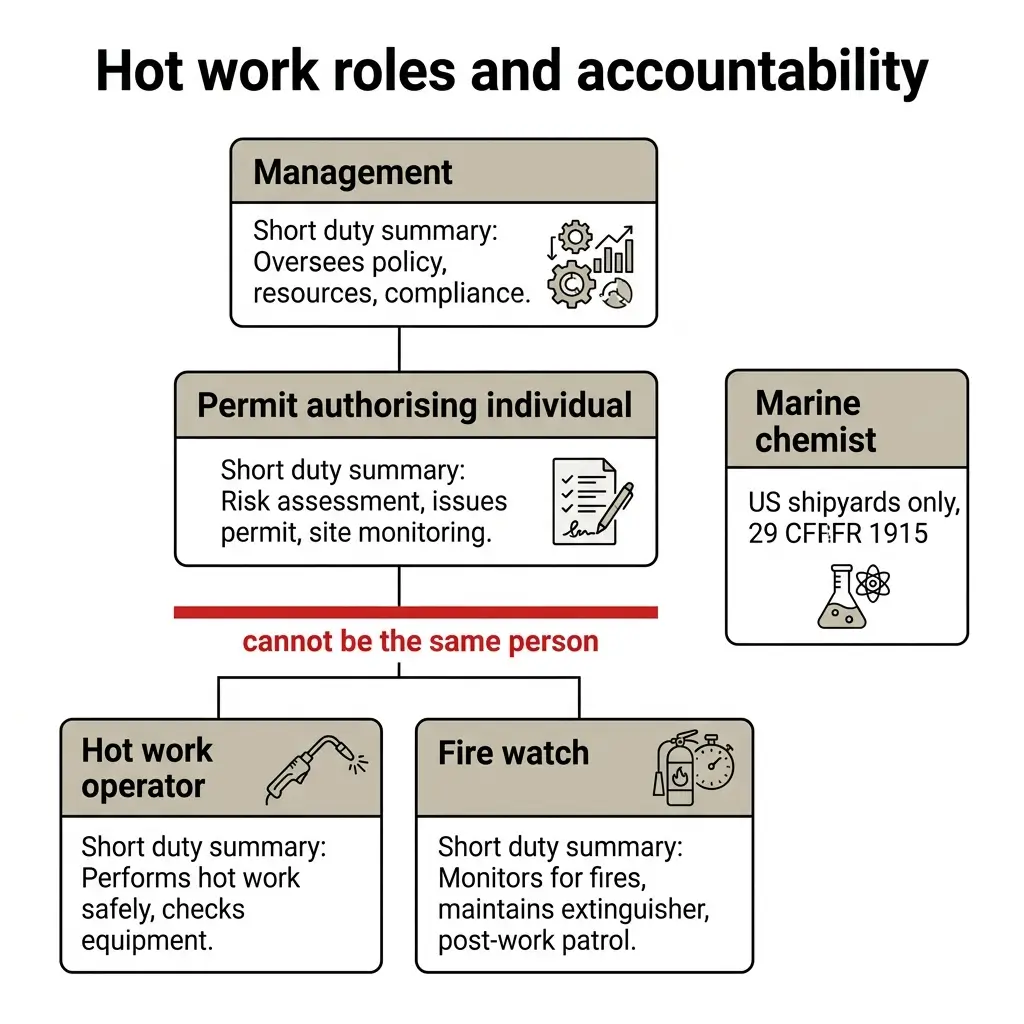
Hot work distributes accountability across at least four roles, and confusion between them is a recurring cause of failure. OSHA sets out management, supervisor and fire watcher duties separately in 1910.252, and NFPA 51B adds the permit authorising individual as a named role.
The distinction that matters most is between the person who authorises the work and the person who performs it. They cannot be the same person, because authorisation is a check on the performer's judgement.
| Role | Core duty | Competence needed |
|---|---|---|
| Management | Establish designated areas, set procedures elsewhere, appoint the authorising individual, warn contractors of hazards they cannot see | Knowledge of the site's fire loading and flammable inventory |
| Permit authorising individual | Inspect the area, designate precautions, issue the permit, set the fire watch duration | Trained in the permit system; authority to refuse |
| Hot work operator | Perform the work within permit conditions, stop if conditions change | Trade qualification plus hot work and equipment training |
| Fire watch | Watch for fire during and after the work, raise the alarm, use the extinguisher within its capacity | Trained in extinguisher use and alarm procedure; no other duty |
| Marine chemist (US shipyards) | Certify spaces safe for hot work | NFPA-certificated; a legal requirement under 29 CFR 1915 |
There is no federal OSHA fire watch certification. Some jurisdictions, New York City and Massachusetts among them, do operate their own credentials, so check locally rather than assuming a national card exists.
A hot work permit checklist for site use
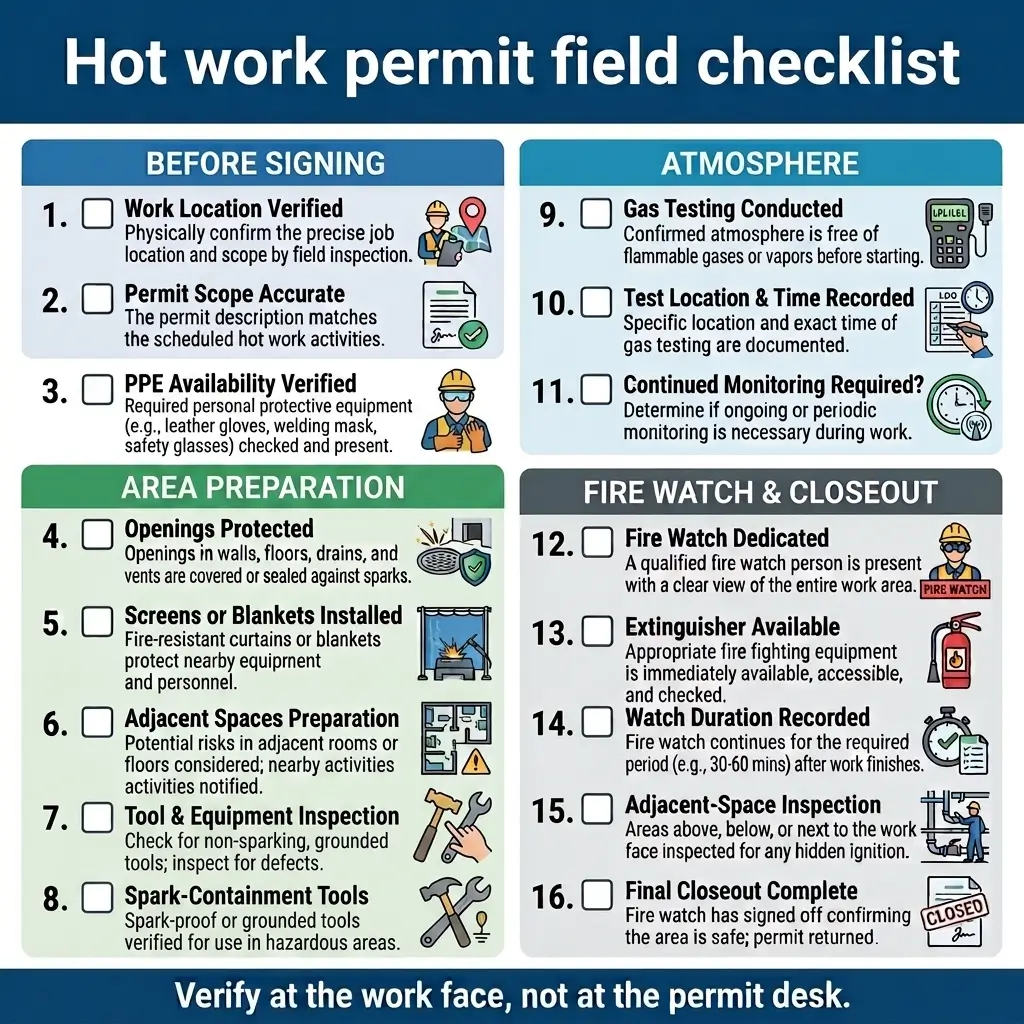
This is the check I run at the work face, not at the permit desk. Print it, or rebuild it inside your own permit form.
Before signing, confirm every line below at the location:
- A cold alternative was considered and the reason for rejection is recorded
- The permit names the specific location, not the area — "east wall, ground floor plant room" rather than "main building"
- The permit has a stated expiry, usually one shift
- Combustibles within 35 feet are removed, or shielded with flameproofed covers where removal is impracticable
- The floor is swept clean for 35 feet and combustible flooring is wetted, covered or shielded
- Floor and wall openings, gratings, ducts and conveyors are covered or shut down
- The far side of any metal partition, wall, ceiling or roof has been inspected
- Systems that have contained flammables are drained, purged, and physically blanked or disconnected
- Sprinkler protection is in service — hot work is prohibited while it is impaired
- Gas testing is done at the work face, recorded, and a continuous monitoring regime is set
- Extinguishing equipment is at the location and the fire watch is trained in its use
- The fire watch is named, has no second duty, and the end time is written on the permit
- The alarm route is confirmed with the fire watch
- Closeout requires inspection of adjacent and lower spaces before the permit is cancelled
Frequently asked questions
These are the questions that come up most often in permit training and in the searches around this topic.
Is grinding classed as hot work?
Yes. An abrasive disc produces a stream of incandescent particles capable of igniting combustible material and flammable vapour. NFPA 51B names grinding explicitly, and the CSB includes it in its definition. Grinding is the activity most often argued out of a permit regime, and the argument does not hold.
How long must a fire watch stay after hot work?
It depends on the authority. OSHA general industry requires at least half an hour under 1910.252(a)(2)(iii)(B). NFPA 51B has required a 60-minute baseline since its 2019 edition, plus fire monitoring afterwards at the permit authorising individual's discretion. US construction states no duration. Name your authority in the procedure.
Does OSHA require a written hot work permit?
Not in general industry. 1910.252(a)(2)(iv) requires the authorising individual to inspect the area and designate precautions, "preferably in the form of a written permit." Fire codes, insurers, corporate standards and NFPA 51B generally close the gap, so a written permit is the practical requirement almost everywhere.
What is the OSHA 35-foot rule for hot work?
There is no single 35-foot rule. The number appears three times in 1910.252 with three different meanings: sweep combustible floor debris for a 35-foot radius, relocate combustibles at least 35 feet where practicable, and post a fire watch where appreciable combustibles sit within 35 feet. It is not a clearance you must achieve.
Do you need a permit in a designated hot work area?
No. A designated area is a permanent location built and maintained for hot work, with non-combustible construction and no stored combustibles. Work outside one requires authorisation. The risk is that designated areas drift — combustibles accumulate and the exemption stops being valid. Re-verify them on a schedule.
What is the difference between fire watch and fire monitoring?
NFPA 51B separates the two. Fire watch is continuous, dedicated observation during the work and for a set period afterwards. Fire monitoring is the less intensive checking of the area during an extended period after the fire watch ends, and the permit authorising individual decides its length.
Is a hot work permit needed for confined space work?
You will usually need both. A hot work permit and a confined space entry permit control different hazards, and each documents its own requirements for ventilation, gas testing, rescue arrangements and standby personnel. Neither substitutes for the other.
Key points
Hot work is defined by the ignition source it creates, which is why grinding, thawing and heat guns belong inside your permit regime. The numbers attached to it — 35 feet, 30 minutes, 60 minutes — mean specific things under specific instruments, and quoting one without its authority is how a facility ends up defending a compliant practice to an insurer who bought a stricter standard.
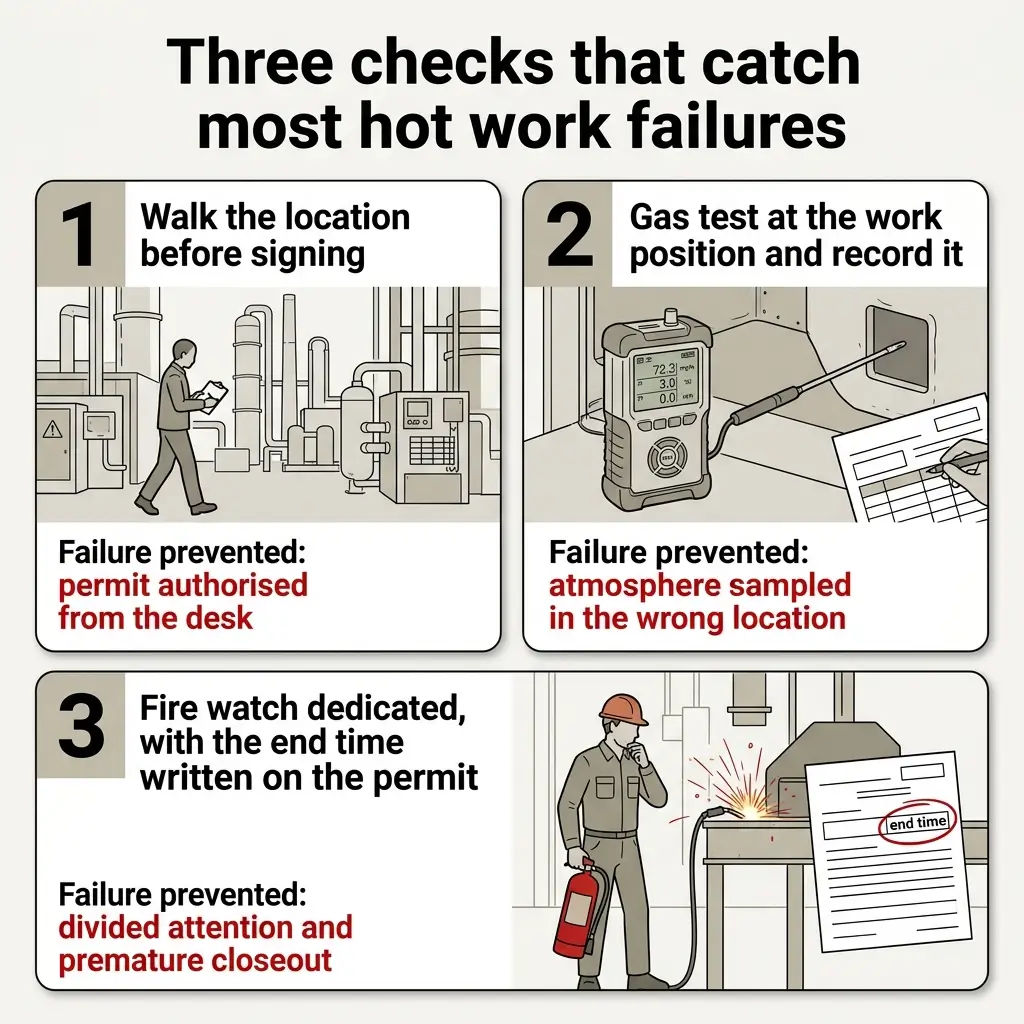
The controls that fail are rarely the ones nobody knew about. They are the walk that did not happen, the gas test taken somewhere convenient, and the fire watch who was also doing something else. All three are visible in ten minutes at the work face and invisible in a file review.
If you carry one habit away from this, make it the walk. Before signing a hot work permit, stand where the work will happen. Everything the permit asserts is either true at that spot or it is not true at all.
The three habits worth taking into your own permit system tomorrow are:
- Walk before you sign, and ask any issuer you audit where they were standing when they signed
- Test at the work face, record the location on the permit, and keep monitoring during the work
- Name your fire watch authority in the procedure, then check that the watch has no second duty
⚠️ Safety critical: Where hot work involves a vessel, tank, drain or line that has contained flammable material, the atmosphere must be assessed by a competent person before work begins. In US shipyard employment this legally requires a Marine Chemist. This article does not substitute for that assessment.
About the author
William Reed is a Principal Oil & Gas Energy Operations HSE Consultant with 19 years of continuous field experience across upstream oil and gas, offshore operations, gas processing, refining interfaces, wellsites and pipelines, spanning 14 countries. His focus is practical assurance — checking that controls still work where work actually happens. He currently leads Reed Energy HSE Assurance, based in Stavanger, Norway, following senior roles including Gas Plant Safety Advisor at Harbour Energy, Offshore Campaign HSE Lead at Neptune Energy, and Turnaround Energy HSE Lead at Oceaneering Energy Services.
Certifications include NEBOSH International General Certificate, ISO 45001 Lead Auditor, ISO 14001 Internal Auditor, IOSH Managing Safely, Permit to Work / Isolation Awareness, Confined Space Entry & Rescue Awareness, and Fire Safety Awareness.
Sources and further reading
- 29 CFR 1910.252 — Welding, cutting and brazing: general requirements, OSHA
- 29 CFR 1926.352 — Fire prevention (construction), OSHA
- Structure Fires Started by Hot Work, NFPA Research
- NFPA 51B, Standard for Fire Prevention During Welding, Cutting, and Other Hot Work, 2024 edition
- Seven Key Lessons to Prevent Worker Deaths During Hot Work In and Around Tanks, US Chemical Safety Board
- Safety alert STSU1-2019: change in enforcement expectations for mild steel welding fume, HSE
- Permit to work systems, HSE COMAH technical guidance
- Dangerous Substances and Explosive Atmospheres Regulations 2002, legislation.gov.uk
- Regulatory Reform (Fire Safety) Order 2005, legislation.gov.uk
- API RP 2009, Safe Welding, Cutting, and Hot Work Practices in the Petroleum and Petrochemical Industries, 8th edition, March 2022