

OSHA Cares Diversity Affairs is not part of OSHA. It is a retired name for a comedy brand created by stand-up comedian Calimar White, who performs as "Agent Ratliff" and now trades under the name Occupational Cares Diversity Affairs — a private Georgia LLC with no federal authority of any kind. The Occupational Safety and Health Administration has never operated a program, office or initiative by that name.
That distinction matters more than it looks. I run field assurance on multi-employer sites, and the recurring weakness I write up is not fencing or signage — it is who is allowed past a gate and on whose say-so. This guide covers what OCDA actually is, the federal case history attached to it, how to tell a real OSHA compliance officer from someone who is not, and where the complaints in those videos legally belong. Scope is the United States, with a short routing note for readers elsewhere.
Key takeaways
The six points below are what a reader needs before anything else on this page:
- OSHA has no diversity affairs office. OCDA is a private entertainment company, and its own website states it is not affiliated with OSHA.
- The "OSHA Cares" name was dropped around October 2024 and replaced with "Occupational Cares Diversity Affairs."
- The Department of Labor's Office of Inspector General searched White's home in 2024 over allegations of impersonating an OSHA agent.
- A Baton Rouge company sued White in federal court on 1 October 2025 (M.D. La., 3:25-cv-00876), alleging his team implied federal authority to gain entry.
- A real OSHA compliance officer presents credentials carrying a photograph and a serial number under 29 CFR 1903.7(a), and you can verify them by calling the Area Office yourself.
- OSHA does not handle discrimination or harassment complaints. Those go to the EEOC on a different and much shorter clock.
What OCDA is, and what it is not
OCDA is a content business. Viewers submit grievances about a manager through a website; a performer in business dress then arrives at that workplace, announces he is investigating complaints, reads them aloud to the supervisor, and the confrontation is filmed and published. The format is the product. There is no investigation, no finding, no enforceable outcome and no regulator behind any of it.
The confusion is by design in one narrow sense: the original branding borrowed the OSHA acronym, and the delivery — an ID number, an agency name, a partner, a clipboard — reproduces the visual grammar of a federal inspection closely enough that reasonable people at a front desk have believed it.
The name changed in 2024
The current entity is Occupational Cares Diversity Affairs. According to reporting by The Advocate, White rebranded from "OSHA Cares Diversity Affairs" in October 2024, roughly eleven weeks after federal investigators searched his home over an OSHA impersonation allegation. Any article still describing an active organisation called "OSHA Cares Diversity Affairs" is describing something that no longer exists under that name — and never existed as a government body.
What the entity is today
OCDA Official is registered as a domestic limited liability company in Georgia, based at White's home address outside Atlanta, per Georgia Secretary of State records cited in the same reporting. Its website now carries an explicit line stating it is not affiliated with OSHA. White has publicly maintained that OCDA is his own company delivering employee complaints to employers, and that he never claimed to be a federal agent.
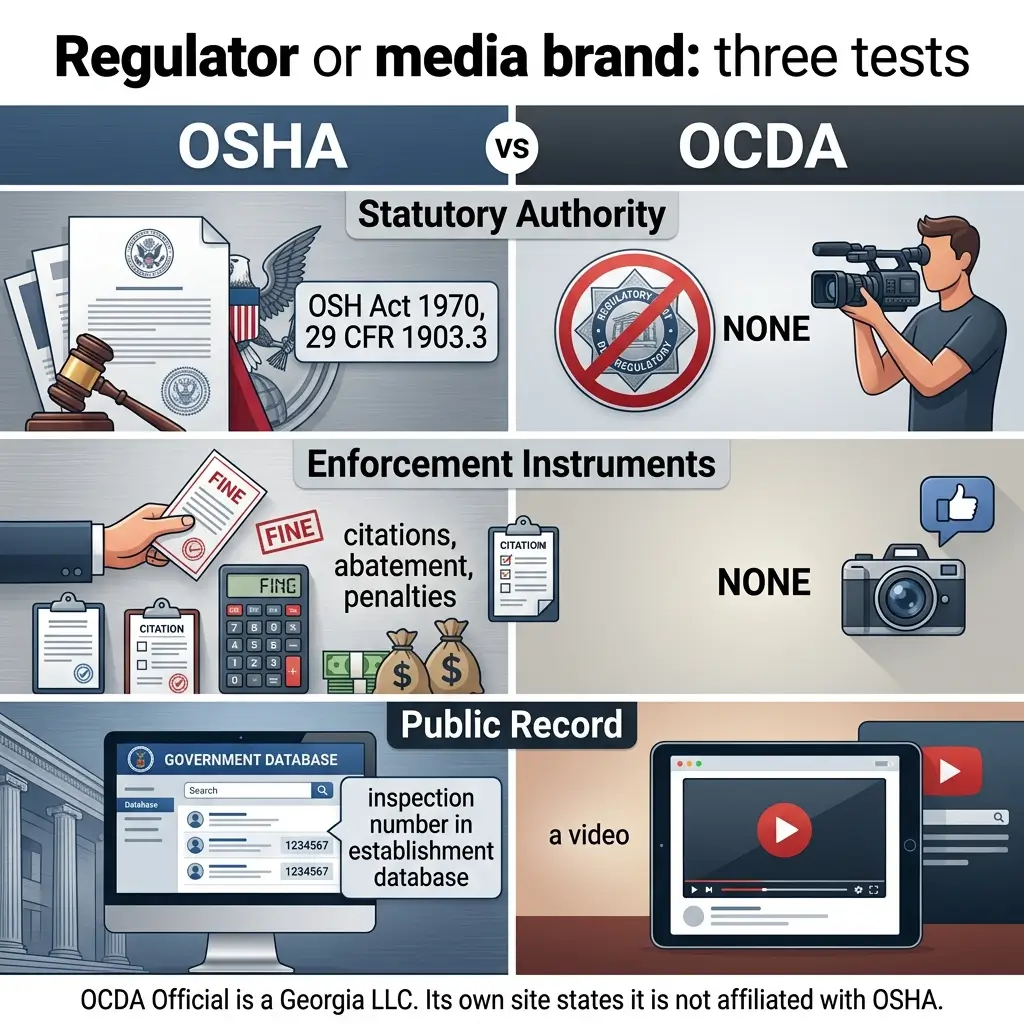
Three attributes separate a regulator from a media brand, and OCDA lacks all three:
- Statutory authority — OSHA's inspection powers come from the OSH Act of 1970 and are exercised only by Compliance Safety and Health Officers of the Department of Labor under 29 CFR 1903.3
- Enforcement instruments — citations, abatement dates and penalties, none of which a private company can issue
- A public record — real inspections generate an inspection number that appears in OSHA's establishment database
How the OCDA videos are made
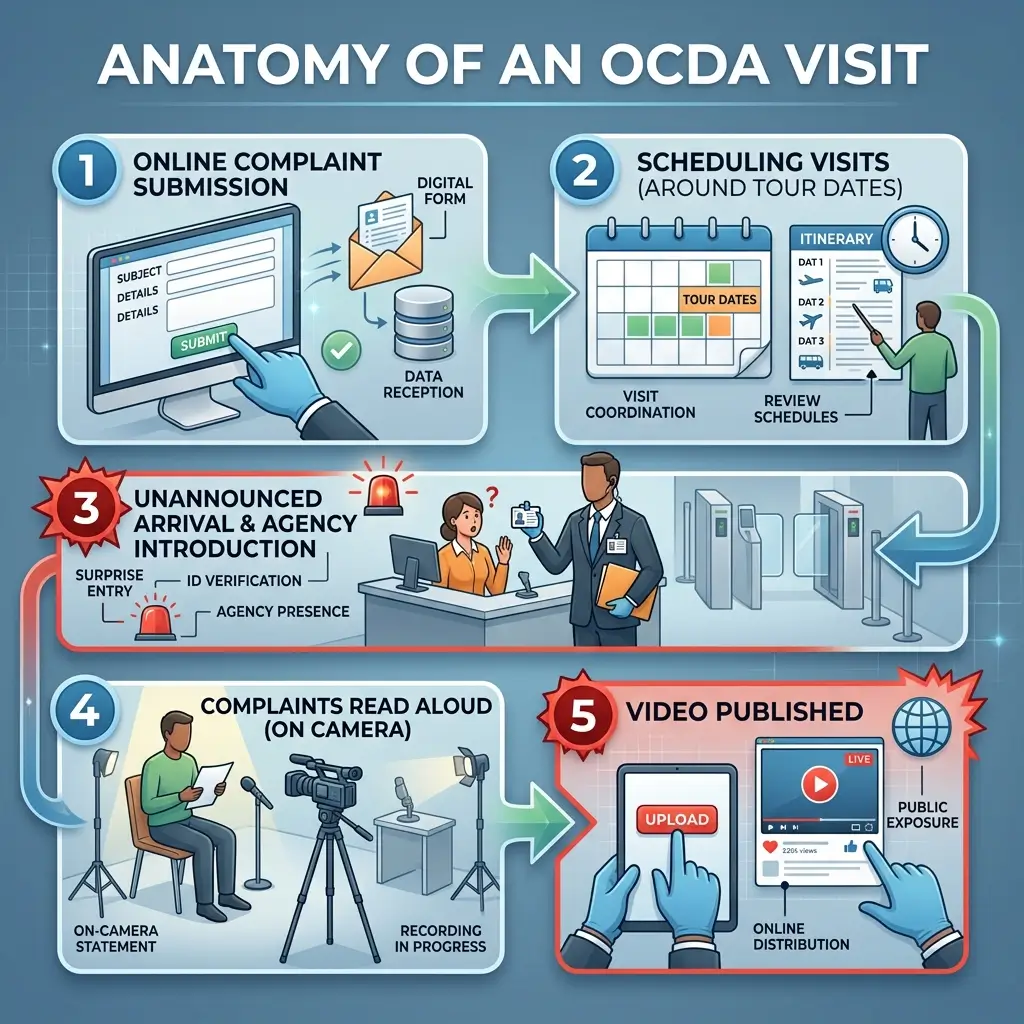
The production pattern is consistent across the catalogue, and understanding it explains why so many searches for OCDA start with the words "is it real." A viewer submits a complaint through the company's site. A date is arranged around a touring comedy schedule. The performer arrives unannounced at the workplace with a second comedian and a camera operator, states that he is there about complaints, and reads them out.
What follows is a confrontation staged for an audience that already knows the punchline. The employees on camera usually do not.
That asymmetry is the whole engine of the format, and it is also where the legal exposure sits. Reading a stranger's grievances aloud to a named supervisor, on camera, in front of colleagues, is a different act from telling a joke on a stage.
Four elements recur in the videos and each one carries a different risk profile:
- An agency-style name and an ID number — the element that has drawn impersonation allegations
- A stated purpose of investigating complaints — language that mirrors a regulatory visit
- Physical presence inside private offices — entry obtained during a moment of confusion
- Publication to a large audience — which converts a private encounter into a permanent, searchable one
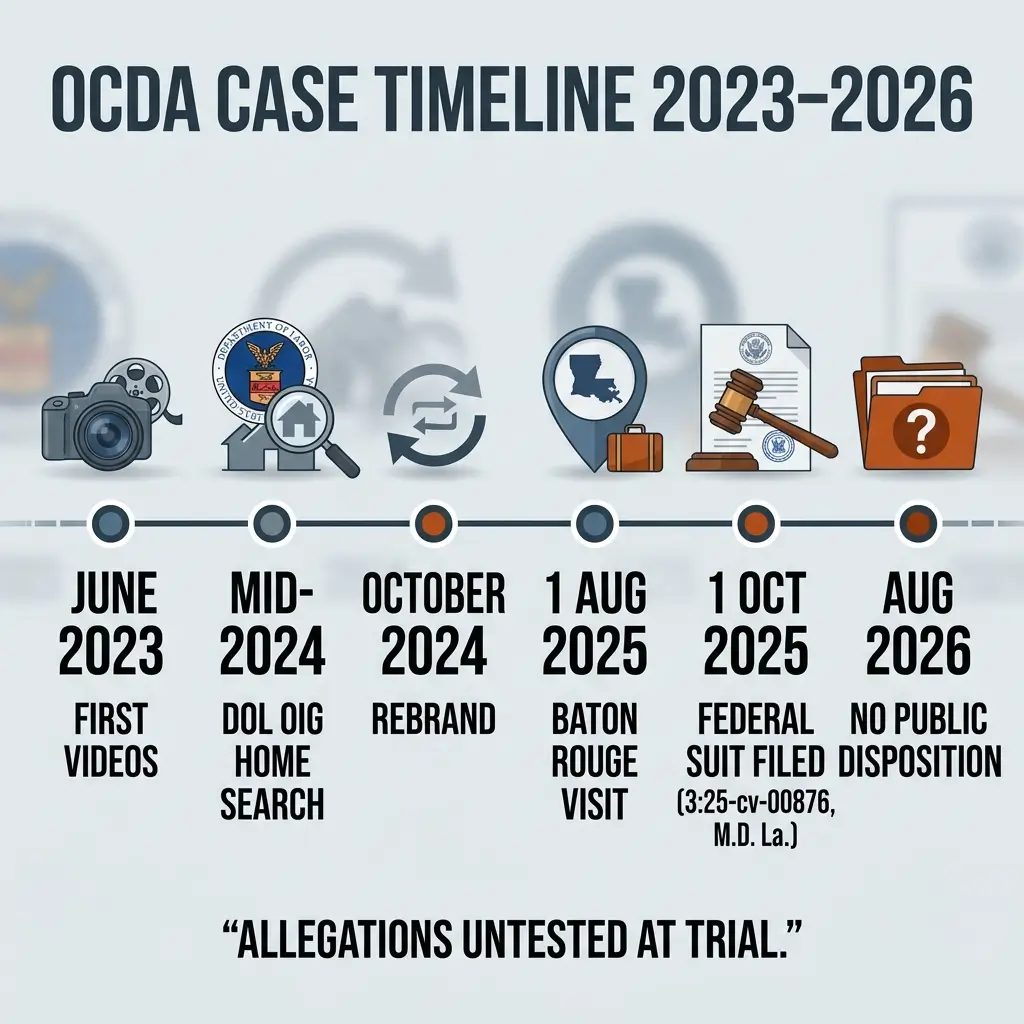
From federal raid to federal lawsuit: the documented timeline
Most guides to OCDA were written in 2024 and stop at "it's satire." The record since then is more substantial, and it is the part a workplace decision-maker actually needs. Everything below comes from court filings and mainstream news reporting rather than from the videos themselves.
The sequence of documented events is:
| Date | Event | Source basis |
|---|---|---|
| June 2023 | White posts early videos as "Agent Ratliff" of Occupational Cares Diversity Affairs; OCDA founded that year | Know Your Meme entry, citing his own posts |
| Mid-2024 | DOL Office of Inspector General searches White's home over alleged impersonation of an OSHA agent; firearms found; charged as a felon in possession | The Advocate, citing court documents |
| October 2024 | Rebrand from "OSHA Cares Diversity Affairs" to "Occupational Cares Diversity Affairs" | The Advocate |
| 1 August 2025 | Visit to Holmes Building Materials, Baton Rouge | Complaint, as reported by WBRZ |
| 25 September 2025 | Demand sent for removal of the video | WBRZ |
| 1 October 2025 | Federal suit filed: Holmes Building Materials, Inc. et al v. White et al, 3:25-cv-00876, M.D. La. | Federal docket listing |
| As at August 2026 | No public disposition located | — |
Two points of care on that table. Local reporting differs on the year of the Baton Rouge visit — one account gives 2024 — and I have followed WBRZ and the filing sequence in placing it in August 2025. And every claim in the lawsuit is an allegation that has not been tested at trial; the suit pleads defamation, false imprisonment, assault and battery, and asks the court to order the videos removed.
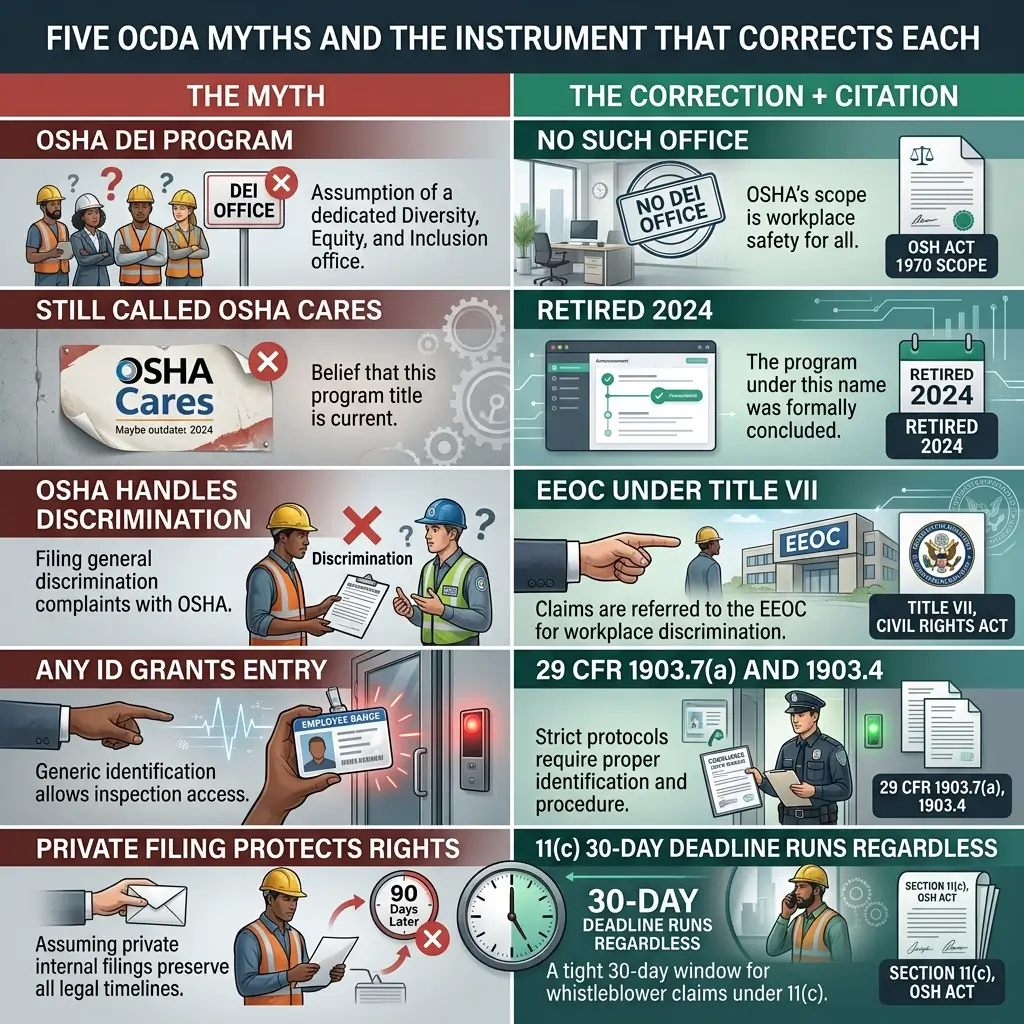
Five claims about OCDA that do not survive checking
Search results on this topic contain a quantity of confidently written misinformation, including at least one safety site describing OCDA's training programmes and community outreach as though they were real OSHA activities. None of that exists. Each belief below is stated as readers encounter it, then corrected against the instrument that governs it.
"OCDA is an OSHA diversity and inclusion program"
There is no such office. OSHA's jurisdiction under the OSH Act of 1970 is occupational safety and health — hazards, standards, inspections, citations. Workplace discrimination is enforced by an entirely separate agency, the Equal Employment Opportunity Commission, under Title VII and related statutes.
"It is still called OSHA Cares Diversity Affairs"
The name was retired in 2024. The company's own site now states that it is not affiliated with OSHA, which is the clearest available evidence that the earlier branding was a problem rather than a description.
"OSHA investigates harassment and discrimination complaints"
OSHA investigates unsafe conditions and retaliation for protected safety activity under Section 11(c) of the OSH Act. A complaint about racial harassment, favouritism or a hostile manager is outside its jurisdiction unless it is retaliation for raising a safety concern. Routing it to the wrong agency wastes the only thing a complainant cannot get back, which is time on the filing clock.
"Anyone holding an agency ID can inspect your workplace"
Only Compliance Safety and Health Officers of the Department of Labor hold inspection authority, and 29 CFR 1903.7(a) requires them to present credentials at the beginning of an inspection. An employer may also object to entry and require a warrant under 29 CFR 1903.4. A stranger with a laminated card and an ID number has no more right of entry than any other member of the public.
"Filing with a complaints service protects your legal position"
It protects nothing. Statutory deadlines run from the date of the adverse act regardless of what else a worker does in the meantime, and an 11(c) retaliation complaint expires in thirty days. Submitting a grievance to a private company is not a filing, does not toll a deadline, and does not create a record any tribunal will recognise.
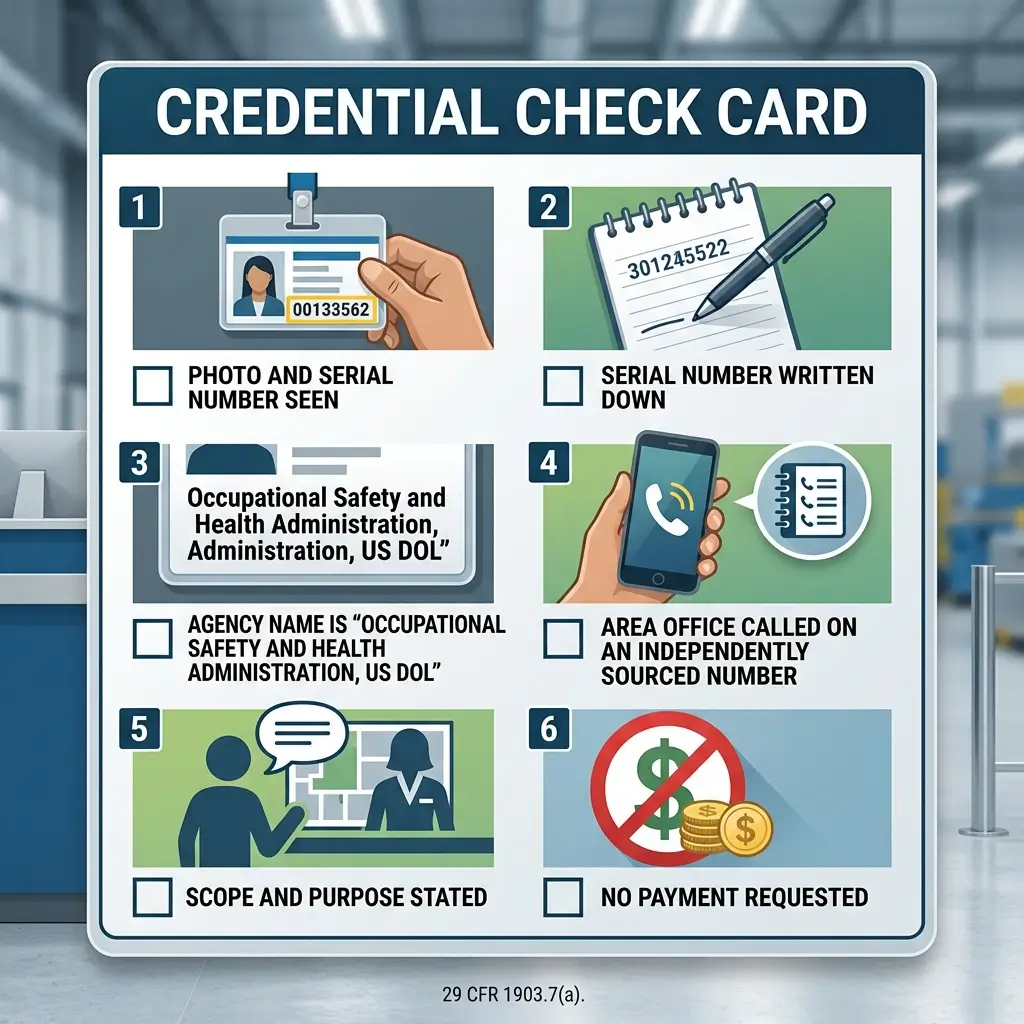
How to verify a real OSHA compliance officer
A genuine inspection has a shape, and it is easy to check without being obstructive. I check the same three things on any unannounced visitor to a controlled site — who they say they are, who sent them, and whether the person granting entry is authorised to grant it. Two of those questions are answered before anyone walks anywhere.
Credentials come first. Under 29 CFR 1903.7(a), the compliance officer presents credentials, explains the nature and purpose of the visit, and indicates the scope. Those credentials carry a photograph and a serial number. Nothing stops you writing the number down, and nothing stops you calling to confirm it.
The verification checks that separate a real visit from a staged one are:
| Check | Real OSHA visit | Warning sign |
|---|---|---|
| Credentials | Photo and serial number, offered or produced on request | Reluctance, a card shown at distance, an "ID number" quoted verbally |
| Agency name | Occupational Safety and Health Administration, US Department of Labor | Any variant name, or a shifting answer when pressed |
| Verification | Confirmed by calling the OSHA Area Office directly | A phone number supplied by the visitor |
| Purpose | Nature, purpose and scope stated at the opening conference | "Investigating complaints" with no scope and no paperwork |
| Payment | No penalty is ever collected on site | Any request for immediate payment |
| Recording | The officer records; filming for publication is not part of an inspection | A camera operator filming for social media |
The strongest single control on that list is the phone call, and it costs about four minutes. Use the number you look up, never the number you are handed.
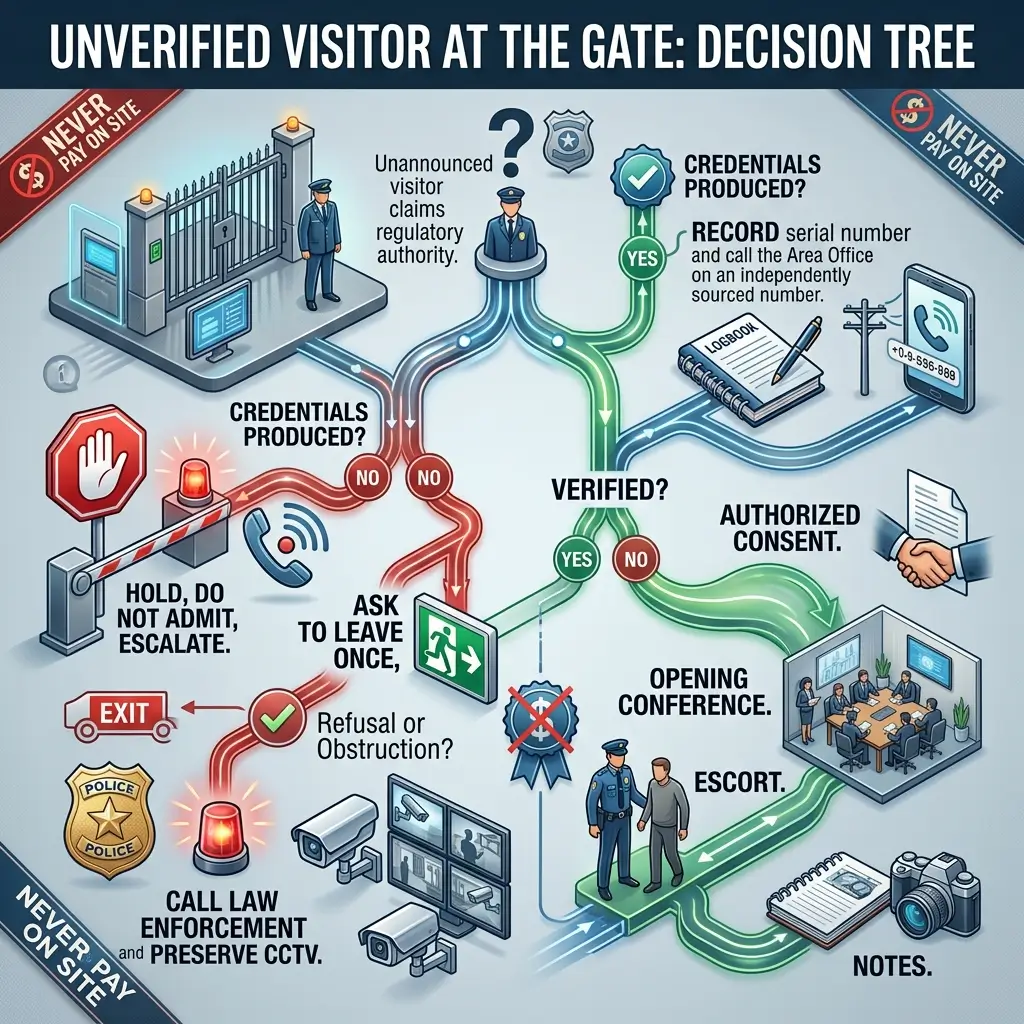
What to do when someone claiming authority arrives at your gate
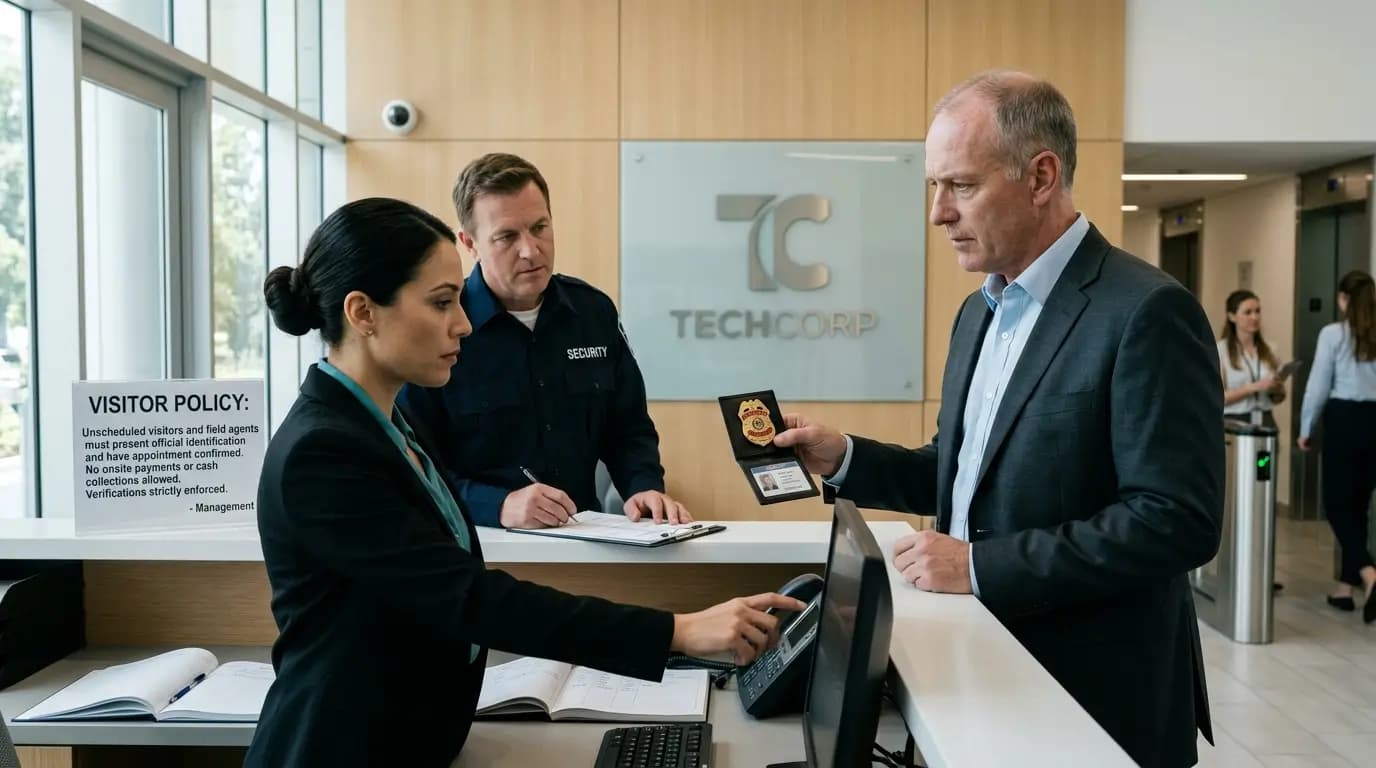
This is the section the rest of the article exists for. Across mine gates, rail yards, LNG turnaround compounds and data hall lobbies, the pattern is the same everywhere I have worked: the person who meets an unexpected visitor is the least senior person on site and the one under most pressure to be accommodating. Access control fails at the point of politeness, not the point of policy.
So the design principle is simple. Reception's job is not to decide. Reception's job is to hold, verify and escalate — and everyone at that desk should know they will be backed for doing exactly that, even if the visitor turns out to be genuine and mildly annoyed.
I ask one question when I audit this control: who at your front desk is authorised to consent to entry? If the answer is anyone, you do not have a control.
Work through these steps in order:
- Do not grant entry. Keep the visitor in reception or at the gate. Entry is consent, and consent given by an unauthorised person is still the moment the door opened.
- Ask for credentials and record them. Name, serial number, agency, time of arrival. Photograph the credential if permitted.
- Call the Area Office yourself. Use a number you look up independently. Do this before anyone walks anywhere.
- Notify the person authorised to consent. Usually the site manager or a named delegate. Have that name written into the visitor procedure rather than assumed.
- If genuine, run the visit properly. Opening conference, employer representative alongside the officer, an authorised employee representative under 29 CFR 1903.8, and contemporaneous notes throughout.
- If not genuine, ask them to leave. Once. If they do not, or block a doorway, or prevent someone leaving a room, call local law enforcement and preserve the CCTV.
- Never pay anything on the spot. Real penalties arrive as citations, in writing, after the fact.
- Debrief the same day. Whoever met the visitor should say what happened, in their own words, while it is fresh.
⚠️ Safety critical: Preventing a person from leaving a room, or searching premises while claiming federal authority, moves the conduct beyond nuisance. Falsely pretending to be an officer or employee of the United States and acting as such carries up to three years' imprisonment under 18 U.S.C. § 912, with a parallel offence at § 913 covering an impersonator who detains or searches.
Where workplace complaints actually go
The grievances dramatised in OCDA videos — favouritism, harassment, a supervisor nobody can raise anything with — are real categories with real forums. The reason this section belongs in a safety article is that the wrong forum usually means a missed deadline, and deadlines here are short and unforgiving.
The routes below cover the United States first, since OSHA is a US agency, followed by a short note for readers working under other regulators.
United States
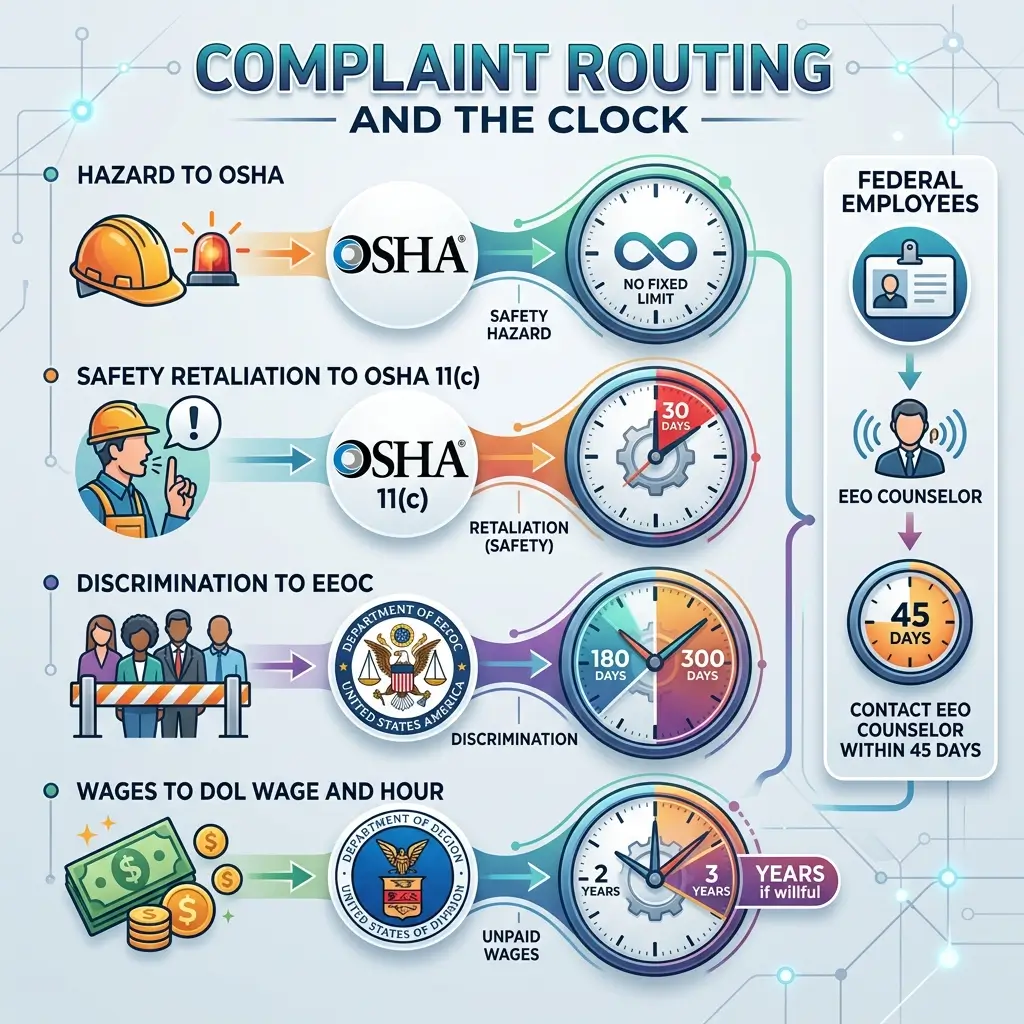
Four routes cover most of what viewers describe, and they run on four different clocks:
| Concern | Where it goes | Deadline |
|---|---|---|
| Unsafe or unhealthful condition | OSHA complaint or the State Plan agency | No fixed limit; file while the hazard exists |
| Retaliation for raising a safety concern | OSHA, under Section 11(c) of the OSH Act | 30 days from the adverse action |
| Discrimination or harassment based on a protected characteristic | EEOC, or a state fair employment agency | 180 days, extended to 300 where a state or local law covers the same basis |
| Unpaid wages or overtime | DOL Wage and Hour Division | Generally two years, three for willful violations |
Two details catch people out. Safety and health complaints can be filed confidentially, and a worker may request that their name not be given to the employer — but a whistleblower retaliation complaint cannot be filed anonymously, because OSHA has to interview the complainant. And federal employees run on a separate track, contacting an agency EEO counsellor within 45 days.
Outside the United States
OSHA's authority stops at the US border, and readers arriving here from elsewhere need a different door. In Great Britain, workplace concerns go to the Health and Safety Executive, or to the local authority for lower-risk premises such as offices and shops — HSE's reporting service routes both. In Canada, occupational health and safety is primarily provincial, so the regulator depends on where the work is done and whether the employer is federally regulated.
Why OCDA resonates, and what that says about internal reporting
Something worth sitting with: a comedy sketch about a stranger arriving to read your complaints aloud only works as fantasy if the ordinary route feels closed. Millions of views is not an endorsement of the format so much as a verdict on the alternative.
In my experience of running assurance across food plants, smelters, rail yards and construction interfaces, the honest test of a reporting system is not whether it exists. It is whether the last person who used it is still comfortable at work. Where I have seen that question answered badly, the reports do not stop — they move somewhere the employer cannot see, and social media is now the most obvious somewhere.
Contractors sharpen the problem further. On a multi-employer site, a subcontractor's worker often has no idea which of several systems they are supposed to use, and no confidence that any of them belongs to them. That is a bridging document failure showing up as silence.
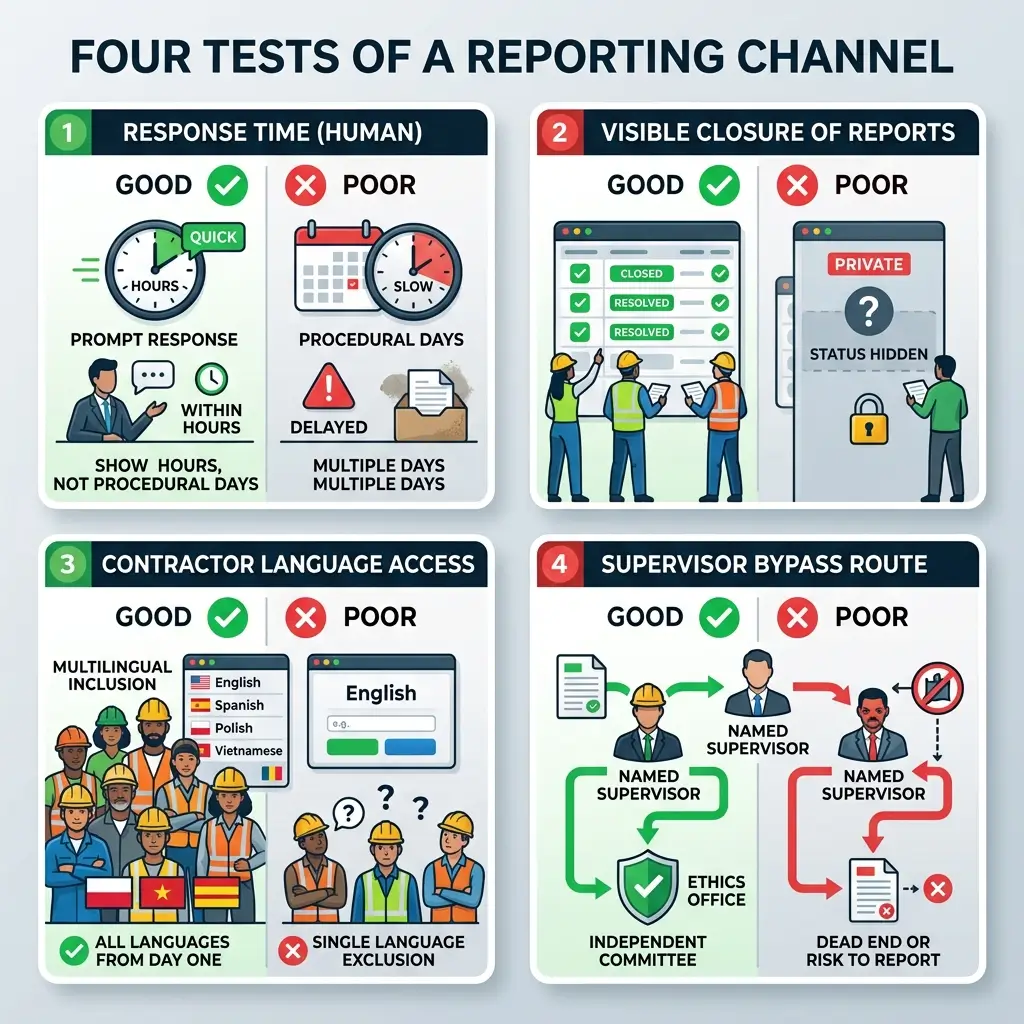
Four checks tell you more about a reporting channel than the policy document does:
- Time to first human response — measured in hours, not the number of days the procedure allows
- Visible closure — can a worker see what happened to a report someone else made?
- Contractor reach — is the channel open to a subcontractor's employee on their second day, in their language?
- Supervisor bypass — is there a route that does not pass through the person the report is about?
If those four are weak, no policy statement will hold the traffic. It will go somewhere else.
Frequently asked questions
These are the questions people most often type into a search box about OCDA.
Is OCDA a real government agency?
No. OCDA is a privately owned entertainment company registered as a limited liability company in Georgia. It holds no statutory authority, cannot inspect a workplace, cannot issue citations and cannot compel anything. Its own website states it is not affiliated with OSHA.
Is OSHA Cares Diversity Affairs connected to OSHA?
No, and the name itself was dropped in October 2024 in favour of Occupational Cares Diversity Affairs. OSHA has never operated an office, programme or initiative under either name.
Can OCDA legally enter my workplace?
Only with your consent, like any member of the public. There is no right of entry. If someone claiming authority is admitted through confusion and then refuses to leave, that consent can be withdrawn and local law enforcement contacted.
Does filing a complaint with OCDA protect my rights?
No. It is not a legal filing and it does not pause any deadline. A retaliation complaint under Section 11(c) of the OSH Act expires 30 days after the adverse action, and an EEOC discrimination charge in 180 or 300 days depending on state law.
Is impersonating an OSHA inspector a crime?
Falsely pretending to be an officer or employee acting under the authority of the United States, and acting in that character, is an offence under 18 U.S.C. § 912, punishable by a fine, up to three years' imprisonment, or both.
What is happening with the Agent Ratliff lawsuit?
Holmes Building Materials and a supervisor filed suit in the Middle District of Louisiana on 1 October 2025, pleading defamation, false imprisonment, assault and battery, and seeking removal of the videos. As at August 2026 no public disposition was located; the allegations remain untested.
Conclusion
OCDA is a comedy business with a legal history, not a workplace safety programme, and any page telling you otherwise is worth closing. The practical residue for a site team is small and worth writing down: reception holds and verifies rather than decides, credentials are confirmed on a number you looked up yourself, and nobody pays anyone at the door.
For workers, the more consequential point is the clock. Thirty days for safety retaliation, 180 or 300 for discrimination. A grievance filed with a private company does not stop either one, and the deadline is the part of this that cannot be recovered once it passes.
About the author
Benjamin Turner is a Canadian Occupational Health, Safety and Environment Field Operations and Contractor Interface Assurance Consultant with 18 years of continuous field experience across 14 countries. His work centres on verifying that site controls hold up in practice — including access control, visitor management and contractor bridging arrangements on multi-employer sites. He leads Turner Field HSE Assurance in Calgary, after senior roles with Alcoa, Nestlé, Canadian National Railway, Woodside Energy, Jacobs, Freeport-McMoRan and Equinix.
Sources and further reading
- OSHA, 29 CFR 1903.3 — Authority for inspection
- OSHA, 29 CFR 1903.4 — Objection to inspection
- OSHA, 29 CFR 1903.7 — Conduct of inspections
- OSHA, File a Complaint
- OSHA, Regional and Area Office directory
- EEOC, Time Limits for Filing a Charge
- Cornell Law School, 18 U.S.C. § 912 — False personation of a US officer or employee
- HSE, Tell us about a health and safety issue
- WBRZ and The Advocate reporting on Holmes Building Materials, Inc. et al v. White et al, 3:25-cv-00876 (M.D. La., filed 1 October 2025)