


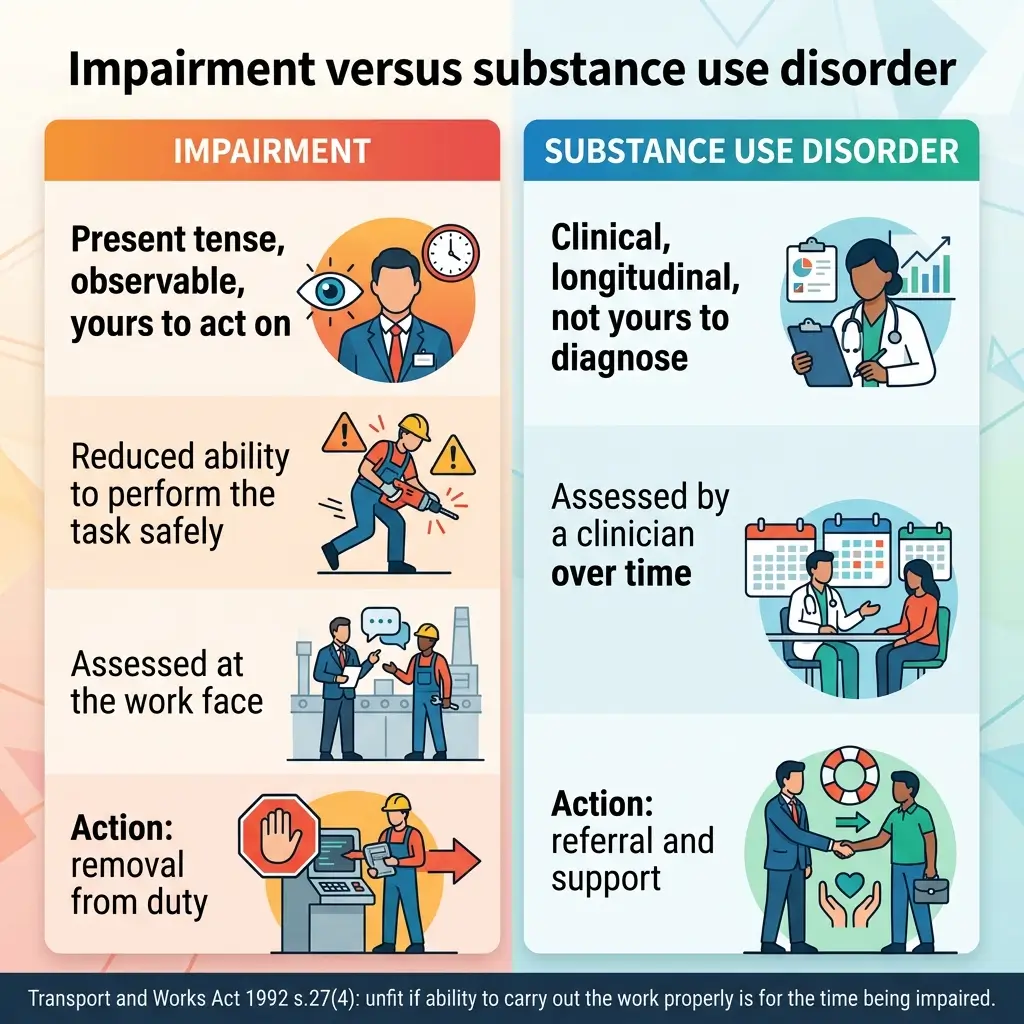
There are two different things being asked about here, and separating them is the whole job. Impairment is a present-tense, observable state — someone's ability to do their work safely is reduced right now, and you can see it. A substance use disorder is a health condition that a clinician diagnoses over time. You can act on the first from the floor of a packaging hall. You cannot diagnose the second from across it, and every serious error I have seen in this area starts with someone trying.
The signs below are indicators that a conversation, and in safety-critical roles a removal from duty, is warranted. They are not evidence that anyone has used a substance. In fifteen years across semiconductor fabs, spirits packaging, mining emergency response and airline ramp operations, the observations that held up were the ones written as descriptions of behaviour, and the ones that fell apart were written as accusations.
This article covers US, UK and international positions, for industrial and safety-sensitive settings.
Key takeaways
The six points below are what a supervisor or safety practitioner needs to hold onto:
- Impairment is observable and actionable; substance use disorder is a clinical diagnosis and is not yours to make. Write down what you saw, not what you concluded.
- US federal transport rules define the standard the rest of the world borrows. Reasonable suspicion must rest on specific, contemporaneous, articulable observations of appearance, behaviour, speech or body odours (49 CFR 382.307).
- The HSE's own guidance flags that the warning signs of drug and alcohol misuse — absence, behaviour change, dips in productivity, more near misses — can also be signs of stress or illness. Run the differential before you run the process.
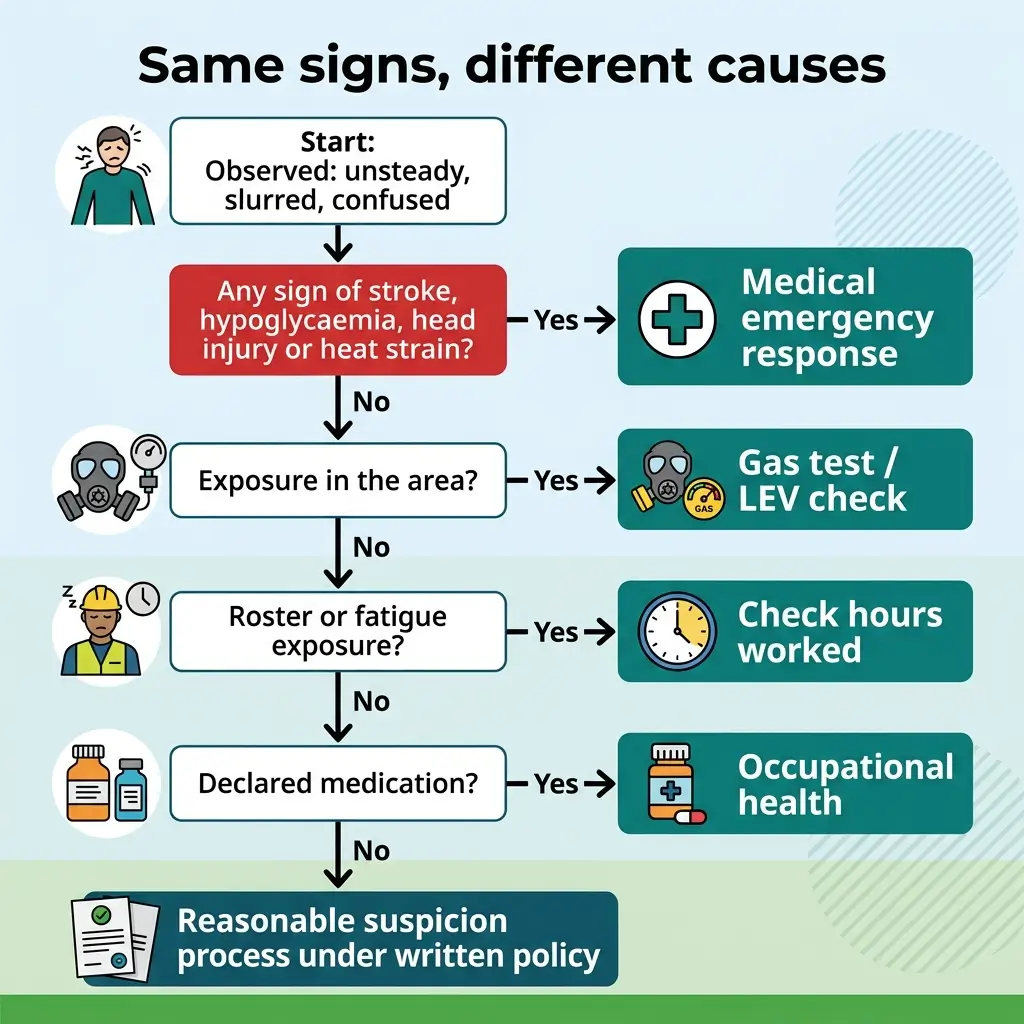
- Slurred speech, confusion and unsteadiness are also the presentation of stroke, hypoglycaemia, head injury and heat strain. If there is any doubt, it is a medical response first.
- Prescribed and over-the-counter medication is the most commonly missed explanation, and the one most likely to turn a well-intentioned referral into a discrimination claim.
- Substance use is not evenly distributed: SAMHSA found past-month heavy alcohol use highest in mining (17.5%) and construction (16.5%) among US full-time workers aged 18–64.
Impairment or disorder: what you are actually observing
The distinction is not academic — it decides what you are allowed to do next, and it is written into law. Under the Transport and Works Act 1992, section 27, a person working in a safety-critical role on a UK railway, tramway or other guided transport system commits an offence if they are unfit through drink or drugs. Section 27(4) then defines unfitness in a way worth reading twice: a person is unfit if their ability to carry out the work properly is for the time being impaired. The test is the impaired ability, not the substance.
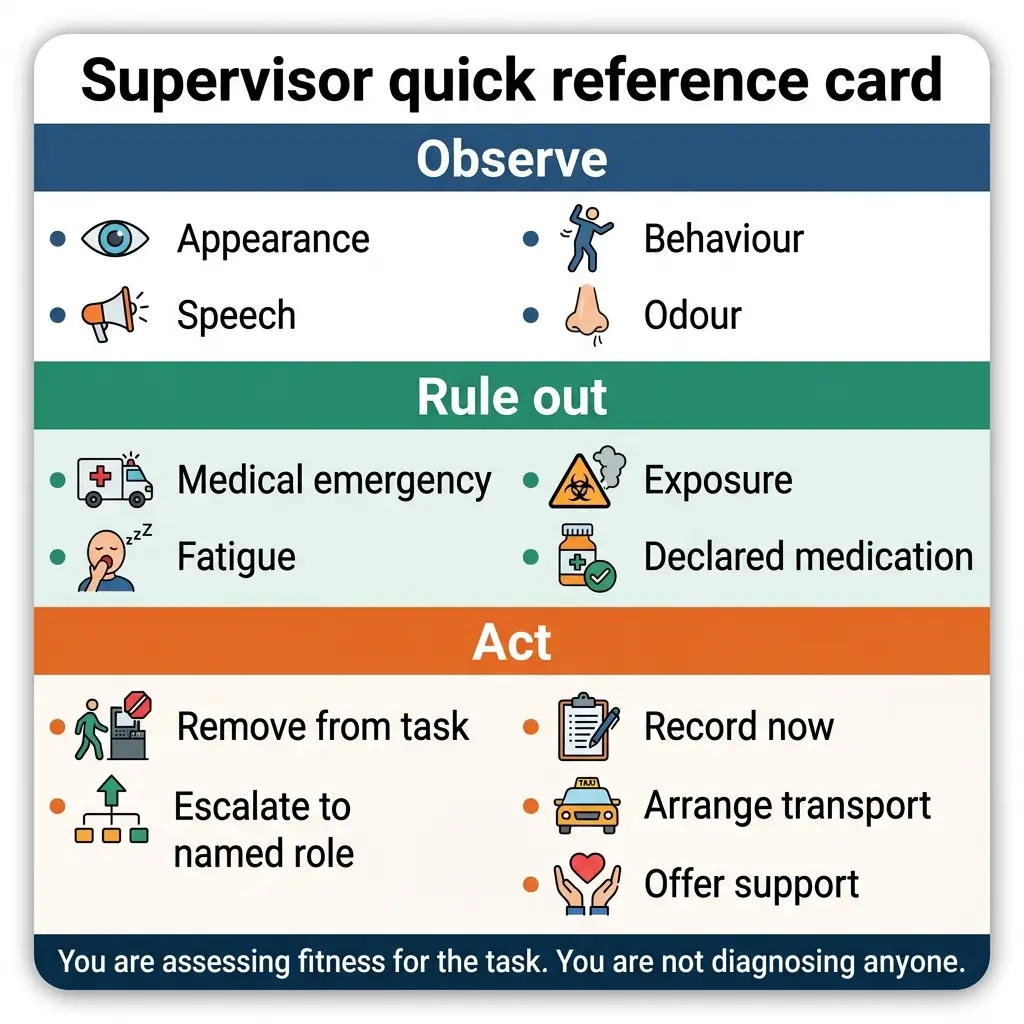
That framing is the useful one for anyone supervising work. You are assessing fitness for a specific task at a specific moment. A crane operator who cannot hold a steady focus is not fit to lift, and the reason is a separate question that comes later, usually from someone else.
The HSE draws the same line from the other direction, noting plainly that misuse is not the same thing as dependence. Most workplace impairment involving alcohol is not dependence at all — it is someone who drank heavily the night before a 06:00 start. The ILO's code of practice on alcohol- and drug-related issues goes further, treating alcohol- and drug-related problems as health problems to be handled like any other health problem at work, without discrimination.
Here is what an observation can and cannot carry:
| Your observation supports | Your observation does not support |
|---|---|
| Removing someone from a safety-critical task now | A conclusion that a substance was used |
| A documented fitness-for-duty concern | A diagnosis of dependence or addiction |
| A referral under a written policy | A disciplinary finding on its own |
| A request for testing where policy provides for it | A comment to colleagues about the person |
| A welfare conversation and an offer of support | A judgement about the person's private life |
The practical consequences of holding that line are:
- You never have to be right about the cause to be right about the removal. Unfit is unfit.
- The record stays defensible because it only claims what you actually perceived.
- The person keeps their dignity through a process that may turn out to be about their new blood pressure medication.
The four observation categories that hold up
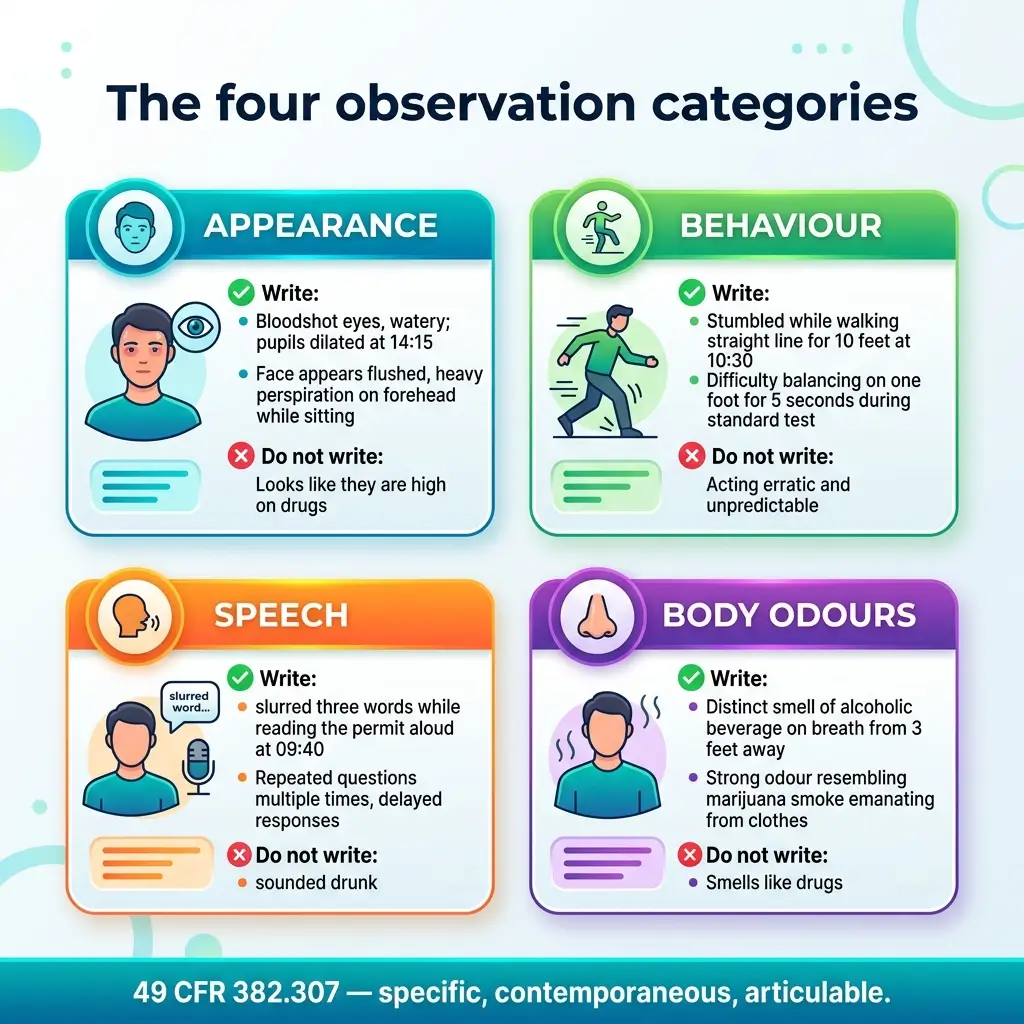
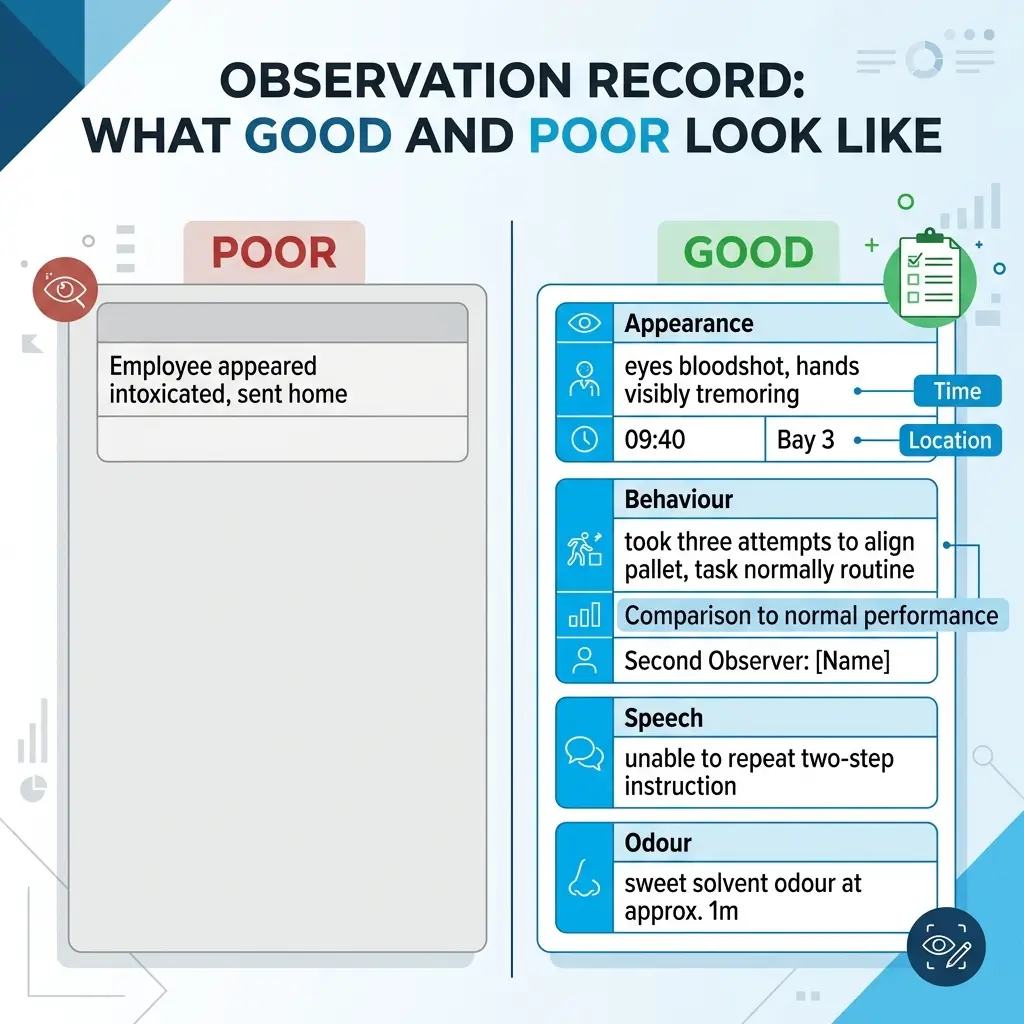
If you write your observation in four named categories, it survives scrutiny. If you write it as a narrative impression, it does not. US federal transport rules give the categories, and they are worth adopting whether or not you are regulated by them: a reasonable suspicion determination must be based on specific, contemporaneous, articulable observations concerning the appearance, behaviour, speech or body odours of the person (49 CFR 382.307). The controlled-substances limb adds that observations may include indications of chronic and withdrawal effects.
"Specific, contemporaneous, articulable" is doing real work in that sentence. Specific rules out "seemed off". Contemporaneous rules out writing it up three days later from memory. Articulable means you can say what you perceived in words that another person could have verified had they been standing there.
The signs practitioners are usually asking about, sorted into those categories, look like this:
| Category | What you may observe | How to record it |
|---|---|---|
| Appearance | Bloodshot or watery eyes; pupils noticeably dilated or constricted; flushed or unusually pale skin; sweating out of proportion to the work; tremor in the hands; dishevelled dress in someone normally tidy | Describe the physical state and the deviation from that person's norm. Note lighting and temperature. |
| Behaviour | Unsteady gait; difficulty with a task they perform daily; disproportionate irritability or elation; withdrawal from a normally sociable person; repeated short absences from the work position | Describe the action and the task it interfered with, with times. |
| Speech | Slurring; unusually slow or pressured delivery; losing the thread mid-sentence; inability to follow a two-step instruction | Record what was said and what was asked, not "was incoherent". |
| Body odours | Alcohol on the breath; solvent or chemical odour; heavy masking with mints, gum or fragrance | State the odour and the distance. Do not speculate on the source. |
Performance and attendance: the slower fifth signal
The four categories above are point-in-time. The pattern signals sit underneath them and appear over weeks: missed deadlines, a rise in rework, a step change in near-miss involvement, absence clustering around particular days, or a request for overtime that does not fit the person's usual pattern. The HSE lists unexplained or frequent absences, behaviour change, unexplained dips in productivity, more accidents or near misses, and performance or conduct issues as the warning signs to consider.
Pattern signals are the ones that should trigger a supportive conversation, not a test. They are far too non-specific to justify anything else — which is exactly the point of the next section.
Before you rely on any of these, check that your record answers these questions:
- When — date and clock time of each observation, not "that morning"
- Where — the location and the task in progress
- What — the perceived behaviour in plain description
- Who else — anyone else present who saw the same thing
- Compared to what — how this differs from that individual's normal performance
Why one sign proves nothing: run the differential
Every symptom on the list above has at least three innocent explanations, and several have explanations that are medical emergencies. This is the section the search results almost universally skip, and it is where supervisors get into trouble.
I spent a period as fatigue risk lead across Diageo's distillery and packaging operations, and one review has stayed with me. Reviewing roster data on a night packaging operation with a Scottish interface, I found high-risk forklift roles running past the fatigue thresholds the site had itself set — overtime had been stacked onto people already at the limit. Supervisors on that shift had been describing the resulting behaviour informally as people "not being themselves". Slowed reactions, short tempers, a driver who took two attempts to line up a pallet. Not one of those observations was about a substance. The cause was a roster.
We challenged the overtime stack, reset the roster window and briefed the supervisors, and extreme overtime peaks on that role dropped over the pilot. The transferable point is not about fatigue specifically. It is that the observable signature of reduced capacity is largely the same whatever produced it — and the workplace's instinct is to attribute it to the person rather than to the system that shaped the shift.
Run the alternatives explicitly before you name a cause:
| What you observed | Other credible causes | What to check first |
|---|---|---|
| Slurred speech, confusion | Stroke, hypoglycaemia, head injury, heat strain, carbon monoxide exposure, new medication | Medical response. Do not start a disciplinary or testing process. |
| Unsteady gait, poor coordination | Inner-ear infection, hypoglycaemia, fatigue, prescribed sedating medication, solvent exposure | Recent shift hours; medication declaration; last meal; task exposure |
| Bloodshot or watery eyes | Allergy, dust or fume exposure, night shift, crying, contact lenses, screen hours | LEV performance and dust control in that area; roster |
| Irritability, withdrawal, mood change | Bereavement, financial or domestic stress, chronic pain, mental ill health | A private conversation and a support offer |
| Frequent short absences from the workstation | Diabetes, IBS, pregnancy, prostate conditions, anxiety | Nothing. This one is not yours to investigate. |
| Rising near-miss involvement | Task redesign, new equipment, understaffing, roster change | Whether the pattern is individual or shift-wide |
⚠️ Safety critical: Slurred speech with confusion, sudden weakness on one side, an unequal facial droop, or a person who cannot be roused is a medical emergency until proven otherwise. Stroke, hypoglycaemia and head injury all present as apparent intoxication. Treating a stroke as a suspected impairment case costs the person their recovery window. When the two possibilities are on the table at once, medical response wins every time.
Before you attribute reduced capacity to the person, check what the system did to them:
- Hours worked — actual hours across the last seven days, not the roster as planned
- Task and exposure — solvents, CO, heat, noise and confined atmospheres in that area
- Recent change — new equipment, new process, a shift pattern altered in the last month
- Whether it is individual or shift-wide — if three people look tired, it is a roster finding
- Declared medication — check the declaration route has been used, and that it works
Prescribed and over-the-counter medication: the most-missed explanation
Legitimate medication accounts for more genuinely impaired workers than illicit drugs do in most industrial workforces, and it is the explanation least likely to be considered before a referral is made. Opioid analgesics, sedating antihistamines, benzodiazepines, some antidepressants, anti-epileptics, insulin and a long list of over-the-counter cold remedies all carry impairment potential relevant to driving, working at height, and operating machinery.
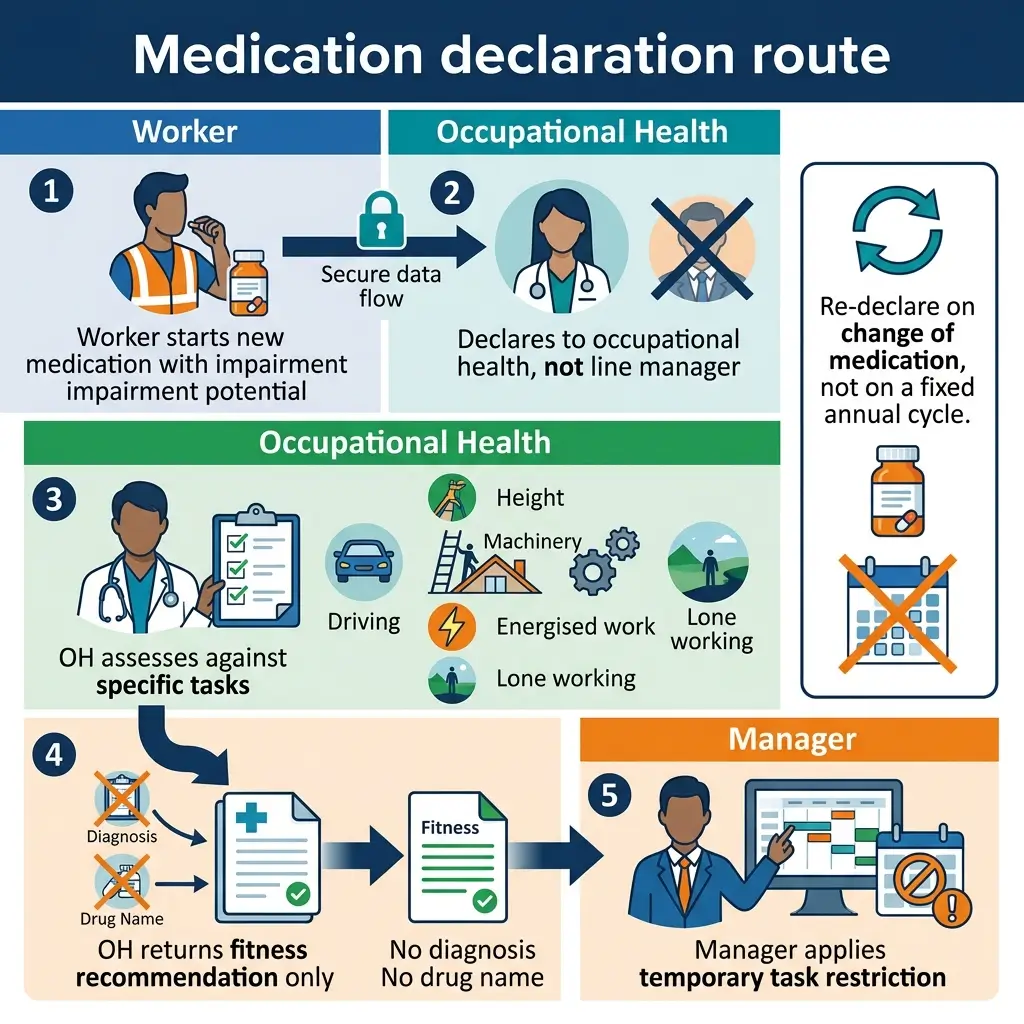
Two things follow. The first is a system requirement: you need a medication declaration route that a worker can use without it being a career event. In practice, that means declaration goes to occupational health or a nominated clinician, who returns a fitness-for-task recommendation to the line manager without disclosing the diagnosis or the drug. If the only route is telling a supervisor what you are taking, most people will not use it, and you will meet the medication for the first time during an incident investigation.
The second is a legal exposure. In the US, the ADA does not protect a person currently engaging in the illegal use of drugs when the employer acts on that basis, but it treats alcohol use disorder differently, and it protects people wrongly regarded as illegal drug users. The EEOC's guidance on applying performance and conduct standards to employees with disabilities sets out the boundary: an employer may hold everyone to the same performance and conduct standards, but medical inquiries need a business-necessity justification. Acting against someone whose test picked up a lawfully prescribed medication is the classic route into a claim.
The controls that make this work in practice are:
- Route declarations to a clinician, not a line manager, and return only a fitness recommendation
- Define the roles it applies to by task — driving, lifting, working at height, energised work, lone working — rather than by job title
- Re-declare on change, not annually; the risk arrives with the new prescription
- Brief the workforce that declaring protects them, because an undeclared sedating medication after an incident looks very different from a declared one
- Have the medical review officer, not the supervisor, interpret any positive test result
What the law expects of the observer
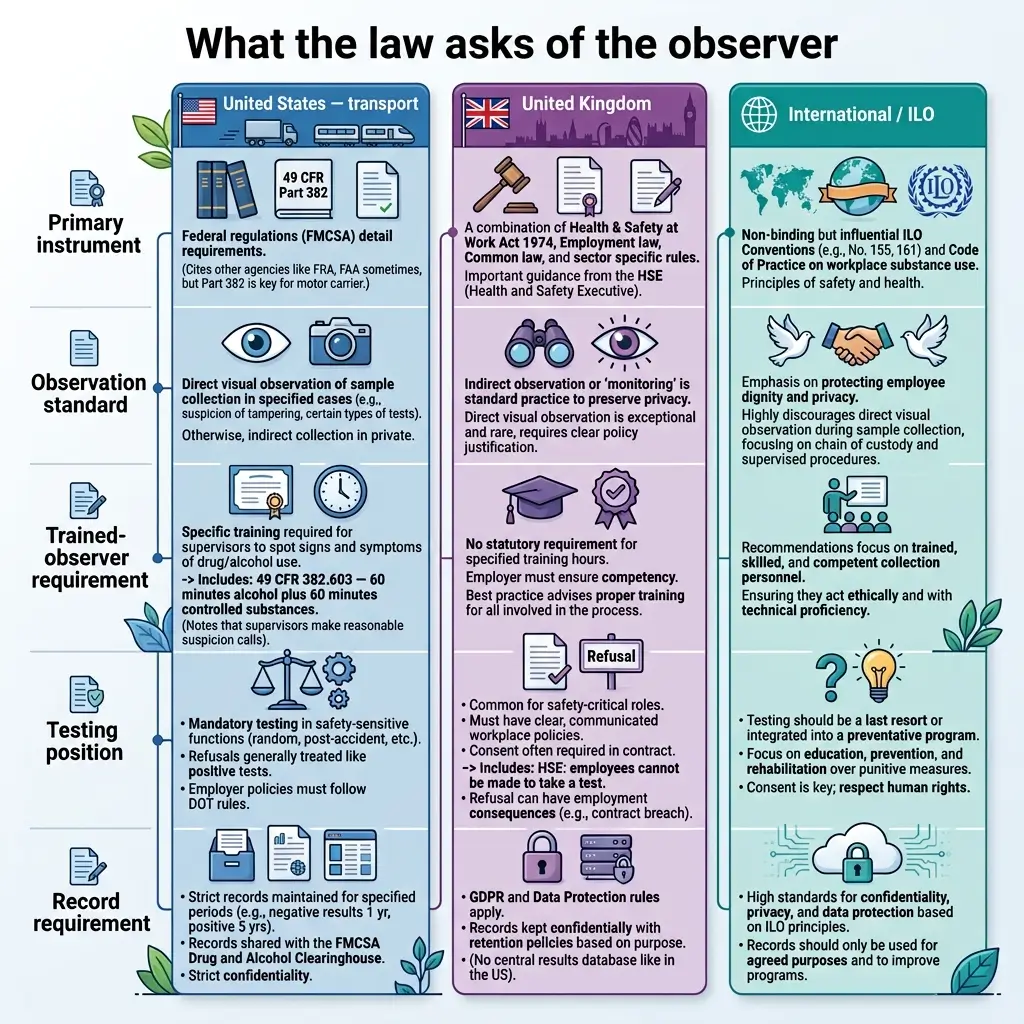
No jurisdiction asks a supervisor to identify a substance. Every jurisdiction asks the employer to manage the risk that an impaired person creates, and most constrain what the employer may do next. The differences matter if you operate across borders.
| Jurisdiction | Primary instrument | What it asks of the observer | Position on testing |
|---|---|---|---|
| United States (transport, safety-sensitive) | 49 CFR 382.307; 49 CFR 382.603 | Specific, contemporaneous, articulable observations by a trained supervisor; written record signed within 24 hours or before results are released | Mandatory where reasonable suspicion is established |
| United States (general industry) | OSH Act General Duty Clause; Drug-Free Workplace Act 1988; ADA (42 U.S.C. §12114) | No federal observation standard; policy-driven | Permitted, constrained by ADA and state law |
| United Kingdom | HSWA 1974 s.2 and s.7; MHSWR 1999 reg.3; Misuse of Drugs Act 1971 s.8; Transport and Works Act 1992 s.27 | Risk assessment and a written policy; act on knowledge of impairment in safety-critical work | Consent-based; refusal may have disciplinary consequences under policy |
| International | ILO code of practice; ISO 45003:2021 | Joint employer–worker assessment; treat as a health issue; confidentiality of information | Guided by national law and negotiated policy |
United States: the observation standard, and its limits
Two provisions are worth knowing even outside regulated transport. The trained observer requirement under 49 CFR 382.603 is one hour of training on alcohol misuse plus one hour on controlled substances, covering the physical, behavioural, speech and performance indicators. Recurrent training is not required by the rule — which, in my view, is a floor that no serious operator should treat as a ceiling, because unpractised observation skills decay like every other skill.
The second is a constraint most employers do not know exists. Where an alcohol test is not administered, 382.307(e)(3) prohibits taking action under that Part against a driver based solely on behaviour and appearance. The observation removes them from duty; it does not by itself establish the violation. The same rule requires the alcohol test to begin within two hours or the delay be recorded, and attempts to cease at eight hours. The person who determines that reasonable suspicion exists must not be the person who conducts the alcohol test.
United Kingdom: general duties, no testing right
There is no UK statute requiring drug and alcohol testing outside specific regulated sectors. What exists are general duties: the employer's duty under section 2 of the Health and Safety at Work etc. Act 1974 and the employee's own duty under section 7, backed by the risk assessment obligation in regulation 3 of the Management of Health and Safety at Work Regulations 1999. Under section 8 of the Misuse of Drugs Act 1971, an occupier or person concerned in the management of premises commits an offence by knowingly permitting the production or supply of a controlled drug, or the smoking of cannabis or opium, on those premises.
On testing, the HSE's position is that an employee cannot be compelled to take a test, though refusal where the employer has good grounds may carry disciplinary consequences under a policy the workforce was consulted on. That consultation is not a nicety — it is the thing that makes the policy usable when you eventually need it.
If you operate a single policy across borders, these are the points where it has to flex:
- Whether testing can be compelled — mandatory in DOT safety-sensitive roles, consent-based in the UK
- Whether observer training is mandatory — required by 49 CFR 382.603, not by UK law
- What the record must contain and when — 24 hours under the US rule, policy-driven elsewhere
- How medical information is handled — the ILO code asks for a confidentiality system in every case
- What counts as safety-critical — define it by task, because the legal definitions do not match
Where recognition breaks down: five failures worth auditing
The signs are not the hard part. Almost every organisation I have audited can list them. What separates a programme that works from one that produces claims is what happens in the ninety minutes after somebody notices something, and the failures are consistent.
The observation is recorded as a conclusion
"Appeared to be under the influence" is a conclusion wearing the clothes of an observation. It tells a tribunal, an investigator and the person themselves nothing that can be tested. The fix is mechanical: a form with the four categories as separate fields and no free-text box labelled "assessment".
One person observes alone
A single observer is a single point of failure, and the rule that the same person cannot both determine suspicion and conduct the alcohol test exists for that reason. Corroboration is not a legal requirement in most settings, but where a second trained person can independently observe before the conversation happens, take it. Where they cannot — night shift, remote site, lone supervisor — record that fact rather than pretending otherwise.
The person stays on the task while it gets discussed
This is the failure that hurts people. A concern is raised, a manager is called, someone goes to find the policy, and the forklift keeps moving for forty minutes. Removal from the safety-critical task comes first and is not a sanction. It is the same reflex as isolating equipment before investigating a fault.
The record is written the next day
Contemporaneous means during or immediately after. Under 49 CFR 382.307(f), the written record of the observations must be signed by the observer within 24 hours of the observed behaviour or before the test results are released, whichever is earlier. Even outside that rule, a note written the following morning has lost its precision and looks reconstructed.
The response is disciplinary only
An organisation whose only route is discipline has guaranteed that nobody will ever self-refer, and self-referral is the cheapest control available. The HSE's guidance on developing a policy puts it directly: where an employee tells you they have a drug or alcohol problem, an effective policy should aim to help and support them rather than lead to dismissal, while still being clear about where disciplinary action applies.
Audit your own arrangements against these five failures:
- Conclusion in place of observation — check the form has no free-text "assessment" box
- Single untrained observer — check training records against completed observation forms
- Task continues while it is discussed — check the time between first concern and stand-down
- Record written the next day — check the timestamps on your last three forms
- Discipline as the only route — check how many self-referrals you had last year
What to do in the first thirty minutes
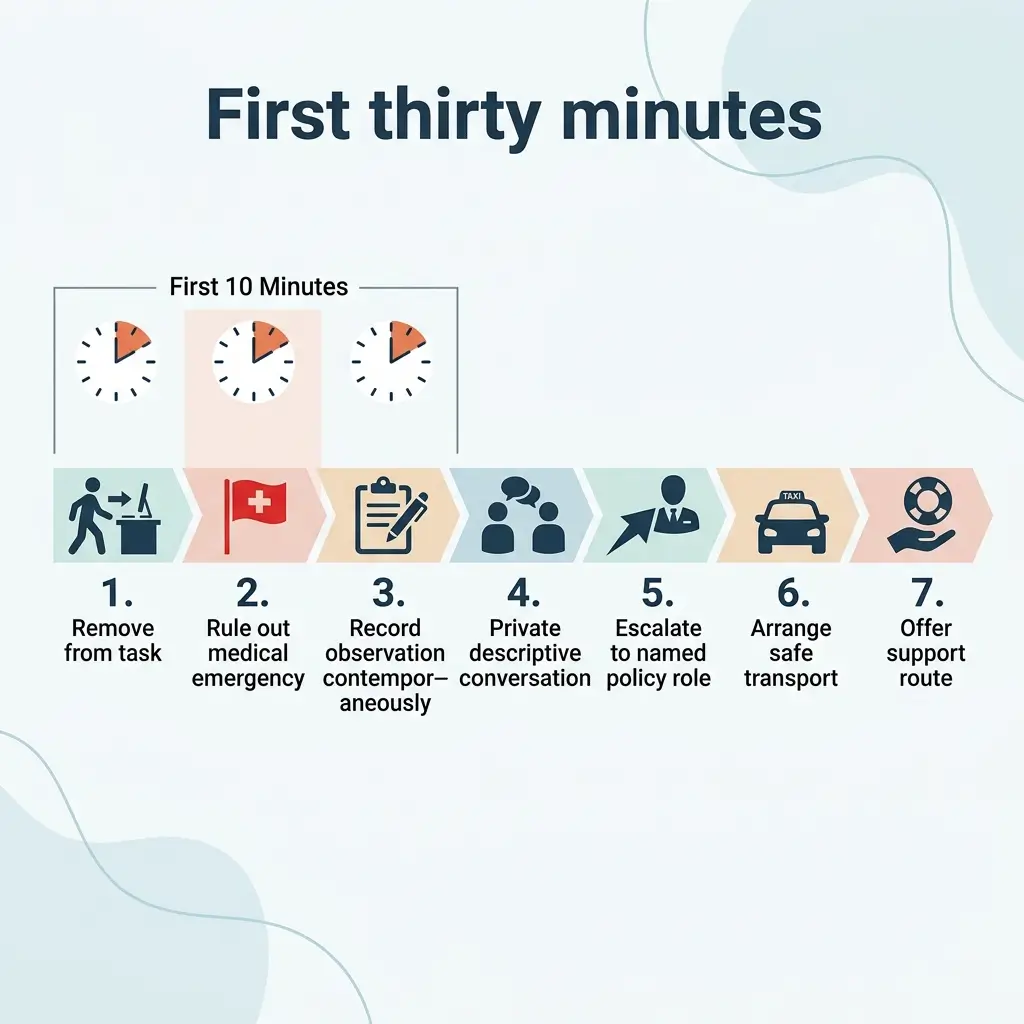
The sequence below assumes a written policy already exists. If it does not, the sequence stops at step three, and the gap you have found is a policy gap rather than a people problem.
Work through these in order:
- Remove the person from the safety-critical task. Machinery stopped, vehicle keys handed over, permit suspended. Frame it as a precaution, because that is what it is.
- Rule out a medical emergency. Confusion, one-sided weakness, facial droop, an unrousable person, or a known diabetic — call emergency medical help and treat impairment as a differential, not a conclusion.
- Write the observation while it is in front of you. Four categories, times, location, task, second observer if there is one. Sign and date it.
- Have the conversation privately, and describe rather than accuse. "I've noticed X and Y this morning, and I need to check you're safe to carry on" is a sentence that works whether the cause is a substance, a bereavement or a new prescription.
- Hand the decision to the named role in the policy — the Designated Employer Representative in a DOT programme, occupational health or HR elsewhere. The observer observes; someone else decides.
- Arrange safe transport home if the person is standing down. Sending an impaired worker to drive is the single most common way an organisation converts a managed problem into a fatality.
- Offer the support route in the same conversation, not later. An employee assistance programme mentioned two weeks after the event has already been read as a formality.
Where the risk concentrates: substance use by industry
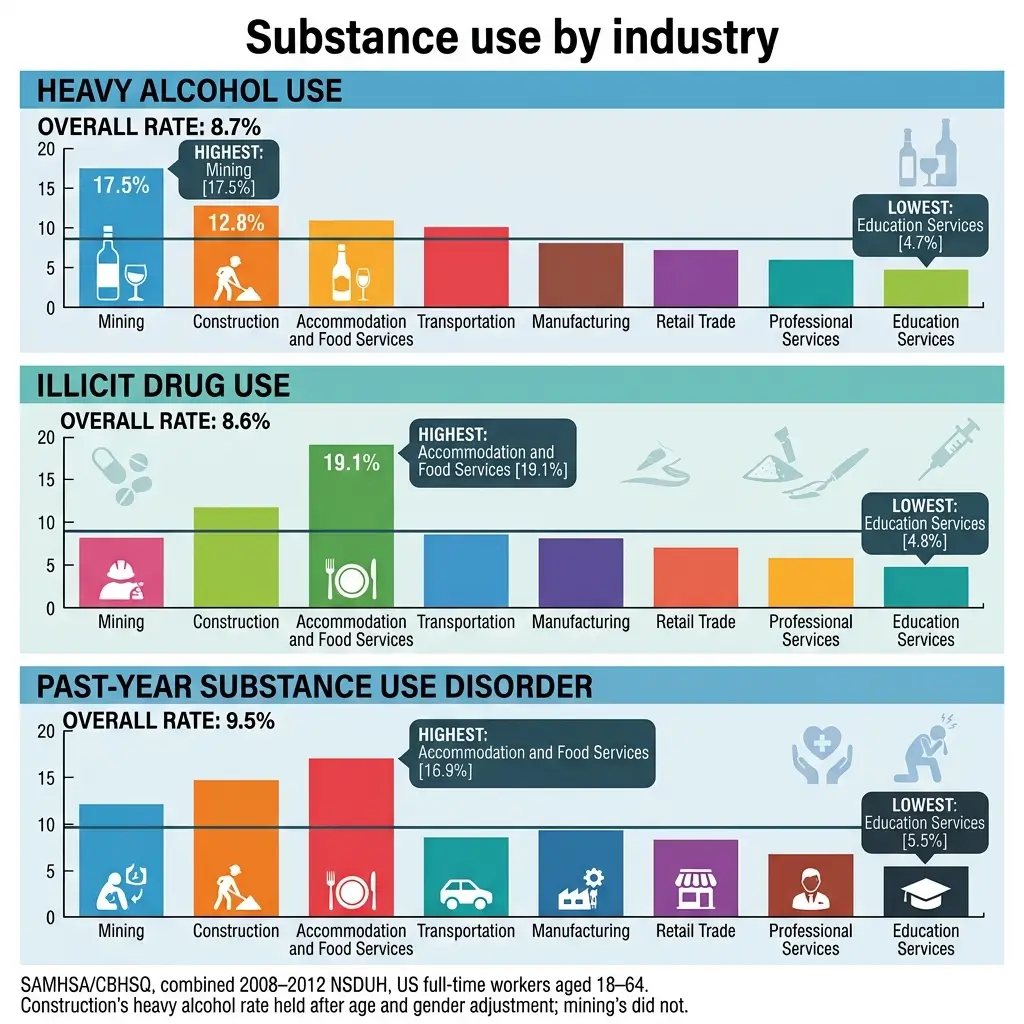
Prevalence is not uniform, and targeting supervisor training by sector is a better use of budget than spreading it evenly. The most complete industry breakdown remains SAMHSA's analysis of combined 2008–2012 National Survey on Drug Use and Health data, covering full-time workers aged 18 to 64 across 19 industry groupings.
SAMHSA reported the following annual averages for US full-time workers aged 18 to 64 from combined 2008–2012 NSDUH data:
| Measure | Overall rate | Highest industry | Lowest industry | Source |
|---|---|---|---|---|
| Past-month heavy alcohol use | 8.7% | Mining 17.5%; construction 16.5% | Health care and social assistance 4.4% | SAMHSA 2015 |
| Past-month illicit drug use | 8.6% | Accommodations and food services 19.1% | Public administration 4.3% | SAMHSA 2015 |
| Past-year substance use disorder | 9.5% | Accommodations and food services 16.9%; construction 14.3% | Educational services 5.5% | SAMHSA 2015 |
Source for all figures above: SAMHSA CBHSQ, Substance Use and Substance Use Disorder by Industry, April 2015. In that source, the overall past-month heavy alcohol use rate is 8.7%; mining 17.5%; construction 16.5%; health care and social assistance 4.4%.
Two caveats belong with those figures. The data is now over a decade old, predates widespread cannabis legalisation in the US, and is national to the United States — do not present it as a current or global picture. And SAMHSA itself tested whether the industry gaps survived adjustment for age and gender: construction's heavy alcohol figure held up, mining's did not, meaning mining's high rate is largely explained by who works in mining rather than by anything about the work.
What this is genuinely useful for is prioritisation. The sectors with the highest rates are, uncomfortably, also the sectors where impairment does the most damage — mobile plant, height, confined space and energised systems. Where those overlap, supervisor observation training stops being a nice-to-have.
What this data should change in a programme is where the effort goes:
- Train supervisors first where the sectors overlap with mobile plant, height and confined space
- Do not use national prevalence to justify testing an individual — it says nothing about that person
- Check your own leading indicators rather than borrowing a decade-old US national figure
- Watch the shift, not just the sector — night and heavy-overtime rosters change the picture
Frequently asked questions
These are the questions that come up most often when I run this material with supervisors.
What are the most reliable warning signs of substance abuse at work?
There are none that are reliable on their own. The most useful signals are changes from that individual's own baseline across four categories — appearance, behaviour, speech and body odour — observed at a specific time and place. A single sign in isolation is not a basis for anything except a check that the person is well.
Can an employer make an employee take a drug or alcohol test?
In the UK, no: the HSE's position is that employees cannot be made to take a test, although refusing where the employer has good grounds may carry disciplinary consequences under an agreed policy. In US DOT-regulated safety-sensitive roles, testing is mandatory once reasonable suspicion is properly established, and refusal is treated as a violation.
Is alcoholism or drug addiction a disability?
It depends on the jurisdiction and the circumstances. Under the ADA, a person currently engaging in the illegal use of drugs is not protected when the employer acts on that basis, but alcohol use disorder can be a disability, and people wrongly regarded as illegal drug users are protected. Employers may still hold everyone to the same performance and conduct standards.
What if the signs turn out to be a medical condition?
That is the expected outcome in a meaningful share of cases, which is why the process must survive it. If your response was to remove the person from a safety-critical task, describe what you saw, and route the decision to a clinician or named policy role, nothing has gone wrong. If your response was to accuse, it has.
Should supervisors be trained to spot impairment?
Yes, and in DOT-regulated US operations it is mandatory: one hour on alcohol misuse and one hour on controlled substances before a supervisor can make a reasonable suspicion determination. Outside regulated sectors it is not required, but untrained observers produce records that do not hold up.
What should I do if I suspect a colleague rather than a subordinate?
Report the concern through the route your policy names, and say what you observed rather than what you concluded. Do not confront the person yourself, do not discuss it with other colleagues, and do not let them continue a safety-critical task while you decide what to do.
Key points
The warning signs are the easy part of this subject and the part every article covers. What decides whether a workplace handles impairment well is the discipline applied either side of the observation: running the differential before naming a cause, and running a defined process afterwards that removes the person from danger without pre-judging them.
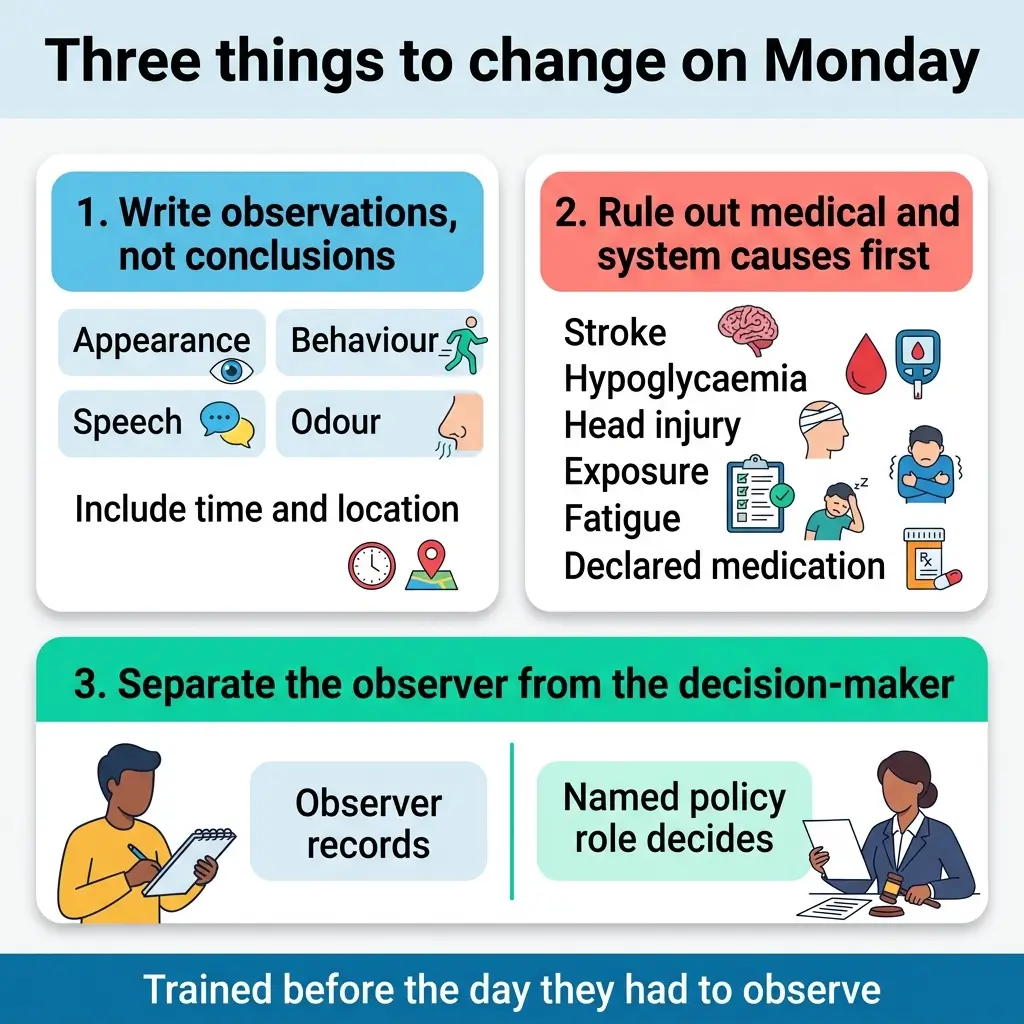
If you take three things from this into Monday:
- Write observations, not conclusions. Four categories, with times and locations.
- Rule out the medical and system causes first. Stroke, hypoglycaemia, exposure, fatigue and prescribed medication all present the same way, and the first two are emergencies.
- Separate the observer from the decision-maker, and make sure the observer was trained before the day they had to observe.
If you are reading this because you are worried about your own drinking or drug use rather than someone else's, occupational health, your GP and your employer's assistance programme are all confidential routes. In the US, SAMHSA's National Helpline is 1-800-662-4357; in the UK, the HSE points employers and workers to Talk to Frank for free, confidential advice. Seeking help before an incident is treated very differently from being found impaired after one, in almost every policy I have read.
About the author — Grace Thompson
Grace Thompson is an Irish Occupational Health, Safety and Environment (OHSE) Human Factors, Fatigue and Emergency Preparedness Consultant with 15 years of continuous field experience across 14 countries. She has led fatigue risk work across Diageo's distillery and packaging operations, emergency preparedness for Glencore's mining sites, and human factors assurance in Intel's semiconductor fabs, alongside roles with Veolia, Skanska, Boston Scientific, Pfizer, Ericsson, Heidelberg Materials, Aer Lingus, ESB and Smurfit Kappa. Her focus is designing work that alert people can perform safely — and verifying that the controls still hold at 03:00. She leads Thompson Human Factors Safety, based in Dublin.
Credentials: NEBOSH Diploma in Occupational Health and Safety; NEBOSH Certificate; CMIOSH or equivalent professional membership pathway; ISO 45001 Lead Auditor; ISO 14001 Internal Auditor; IOSH Managing Safely; Fatigue Risk Management Awareness; Mental Health First Aid; Incident Investigation (ICAM or equivalent pathway).
Sources
- US Department of Transportation, 49 CFR 382.307 — Reasonable suspicion testing
- US Department of Transportation, 49 CFR 382.603 — Training for supervisors
- Health and Safety Executive, Managing drug and alcohol misuse at work, including Develop a policy, Screening and testing and Safety-critical work
- Transport and Works Act 1992, section 27
- Misuse of Drugs Act 1971, section 8
- Health and Safety at Work etc. Act 1974, section 2
- US Equal Employment Opportunity Commission, Applying Performance and Conduct Standards to Employees with Disabilities
- SAMHSA CBHSQ, Substance Use and Substance Use Disorder by Industry, April 2015
- International Labour Organization, Management of alcohol- and drug-related issues in the workplace: an ILO code of practice