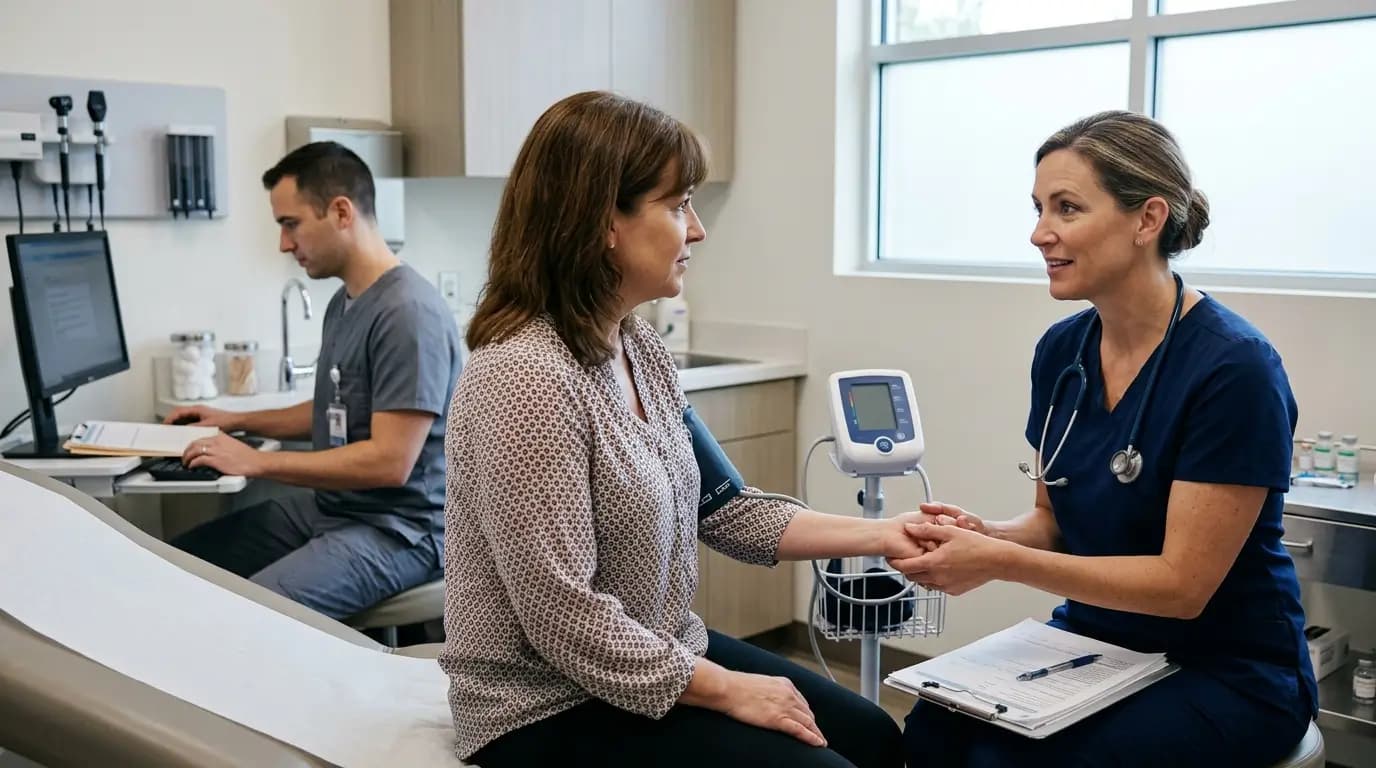



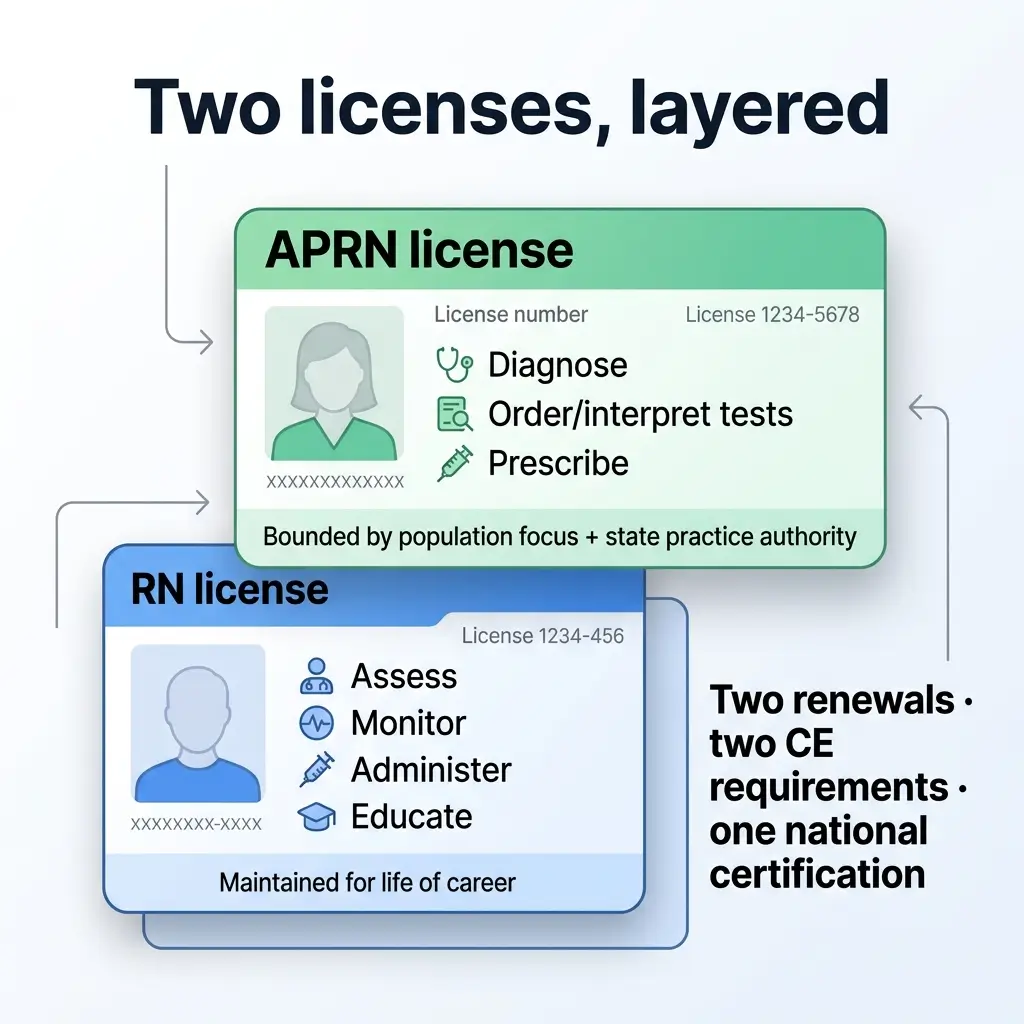
Every nurse practitioner is a registered nurse. The NP credential does not replace RN licensure — it layers a second, separate license on top of it, and that second license adds three things the RN license does not carry: the authority to diagnose, the authority to prescribe, and a defined patient population you are licensed to treat. Everything else people describe as "the difference" — the pay gap, the autonomy, the graduate degree — follows from that layering.
Two variables decide what an NP license is actually worth in practice, and neither appears in most comparisons: the practice-authority law in your state, and the population focus you commit to before you enrol. This guide covers both, and separates the federal wage data that applies to nurse practitioners from the widely quoted figure that does not.
Scope: United States regulation and pay data, current to August 2026. Career and regulatory information only — not clinical, legal or financial advice. Licensure rules change by state and by legislative session; verify anything decision-critical with your state board of nursing.
Key takeaways
The six points below carry most of the practical difference between the two roles:
- An NP holds two active licenses: an RN license and an APRN license, each with its own renewal cycle and continuing-education requirement.
- NPs hold prescriptive authority in all 50 states and D.C.; RNs administer medications on another provider's order and cannot prescribe in any state.
- The BLS median of $132,050 is not an NP figure — it is the combined profile covering nurse anesthetists, nurse midwives and nurse practitioners together. BLS puts the nurse practitioner median at $129,210 for May 2024.
- RN median pay was $93,600 in May 2024, with 3.39 million jobs and about 189,100 openings projected per year — a far larger job market than the roughly 320,000-strong NP occupation, even at NP's 40% projected growth.
- Under the APRN Consensus Model, your education, national certification and license must all match one of six population foci. Switching foci later requires a post-graduate certificate rather than simply a new job.
- Practice authority is state law, not a national credential. AANP's May 2026 map counts 27 states plus D.C. and two territories with full practice authority; the rest require a career-long collaborative or supervisory arrangement.
The core difference: one license or two
An RN license authorises nursing practice — assessment, monitoring, administering treatments ordered by a provider, coordinating care, and patient education. An APRN license authorises a defined slice of medical practice on top of that: making diagnoses, ordering and interpreting diagnostic tests, and initiating and managing treatment including prescribing.
That distinction is not a matter of seniority or experience. A charge nurse with twenty-five years in a cardiac ICU has clinical judgement most new NPs do not, and still cannot write a prescription. A first-week NP can. The line is drawn by the license, not by competence, and this is the single most common misunderstanding among nurses considering the move.
The layering matters administratively too. Becoming an NP does not retire your RN license — you maintain both. Two licenses, two renewals, two sets of continuing education, and in most states a separate national certification you must keep current for the APRN license to stay valid.
This table sets out what each license authorises and what it does not.
| Authority | Registered Nurse | Nurse Practitioner |
|---|---|---|
| Assess patients and monitor condition | Yes | Yes |
| Make a medical diagnosis | No | Yes |
| Order and interpret diagnostic tests | No | Yes |
| Prescribe medication | No — administers on order | Yes, all 50 states and D.C. |
| Practise without a physician arrangement | Not applicable | Depends on state practice authority |
| Patient population | Not restricted by license | Restricted to certified population focus |
The practical consequences of holding two licenses rather than one are:
- You keep working as an RN while you study. Most NP students stay in RN roles throughout their programme, which is why the transition is usually funded from earnings rather than pure debt.
- Your RN license must stay unrestricted. NP programmes require an active, unrestricted RN license as a prerequisite, and an action against the RN license generally reaches the APRN license too.
- Certification lapse is a practice problem, not a paperwork problem. In most states, losing national certification suspends the APRN license, though the underlying RN license remains.
Education and licensure pathways compared
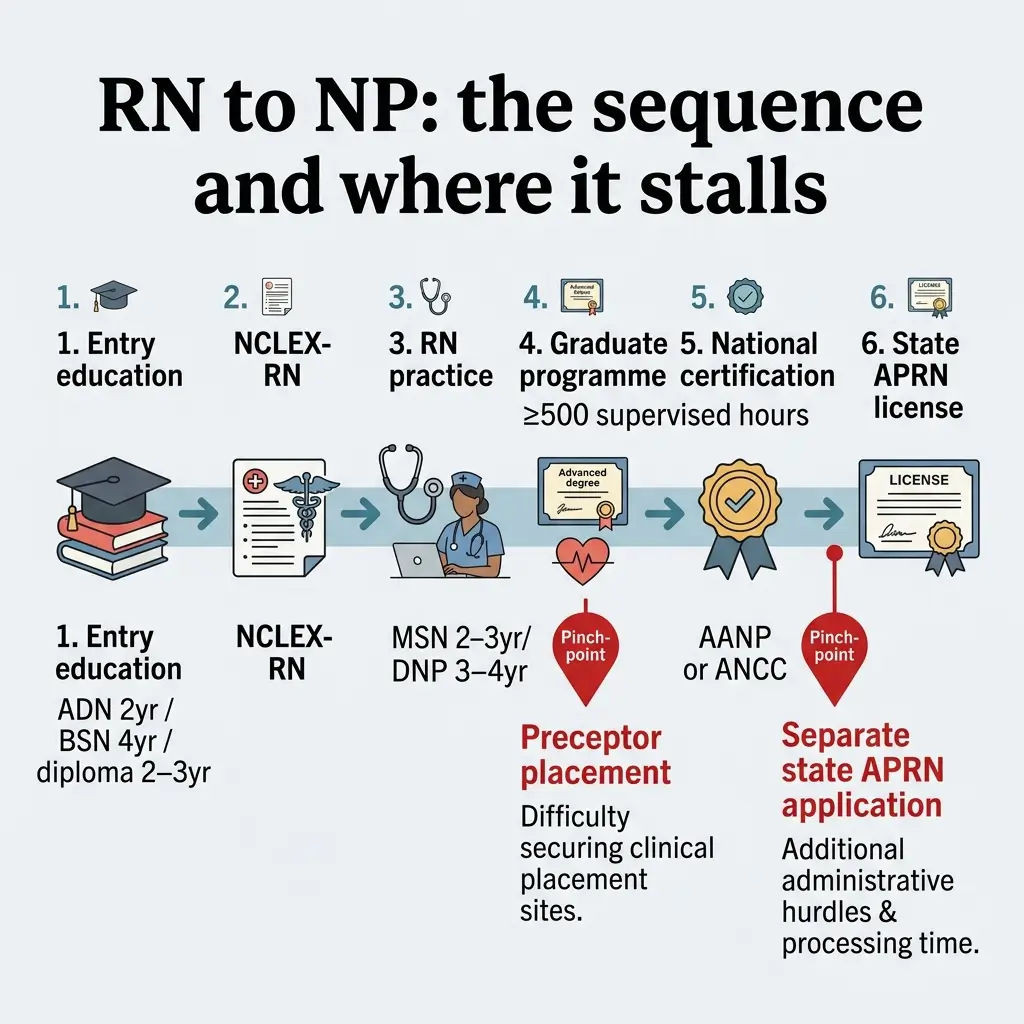
The RN path has three legitimate entry routes; the NP path has one, and it starts from an RN license. BLS lists a bachelor's degree as the typical entry-level education for registered nurses, but the profession still licenses through three routes: a BSN, an associate degree (ADN or ASN), or a hospital diploma programme. All three qualify a graduate to sit the NCLEX-RN and enter practice as a staff nurse, though BLS notes that hospital employers in particular may require a bachelor's degree.
The NP path requires graduate education — a master's (MSN) or a Doctor of Nursing Practice (DNP) — in a programme aligned to a specific APRN role and population focus, followed by national board certification and a separate state APRN license.
The DNP question
The doctorate is not required. Moving entry-level APRN preparation from the MSN to the DNP has been recommended and debated for over two decades, and it has never been mandated. Current entry-level preparation for NP practice remains a graduate degree at master's or doctoral level. A DNP may matter for faculty roles, health-system leadership or personal preference; it is not a licensure gate.
Timeline and sequence
The sequence is fixed even where the timings vary. Typical ranges, assuming continuous full-time study:
| Stage | RN route | NP route (from RN) |
|---|---|---|
| Entry education | ADN ~2 years, BSN ~4 years, diploma 2–3 years | BSN prerequisite if not already held |
| Licensing exam | NCLEX-RN | National board certification (AANP or ANCC) |
| Graduate education | Not required | MSN ~2–3 years; DNP ~3–4 years |
| Clinical hours | Supervised clinical in the programme | ≥500 faculty-supervised hours in the role and population focus |
| Second license | — | State APRN license, separate application |
The steps that catch people out, in the order they arrive, are:
- The RN license must be unrestricted before you apply, not before you graduate — a pending board action can stall an admission.
- Clinical placement is the bottleneck, not coursework. Many programmes require students to secure their own preceptors, and in saturated markets this is the step that extends a two-year programme to three.
- Certification body follows the population focus, not the other way round — AANP and ANCC certify overlapping but not identical foci, and some foci are certified by neither.
- The state APRN application is separate from certification and can take weeks after the exam result lands.
Scope of practice depends on your state, not your credential
This is the section most comparisons compress into "varies by state," and it is the variable that most changes what the credential is worth. Two family NPs with identical education and identical certification have materially different jobs depending on which side of a state line they work on. One can open and own a practice; the other cannot see a patient without a documented arrangement with a physician.
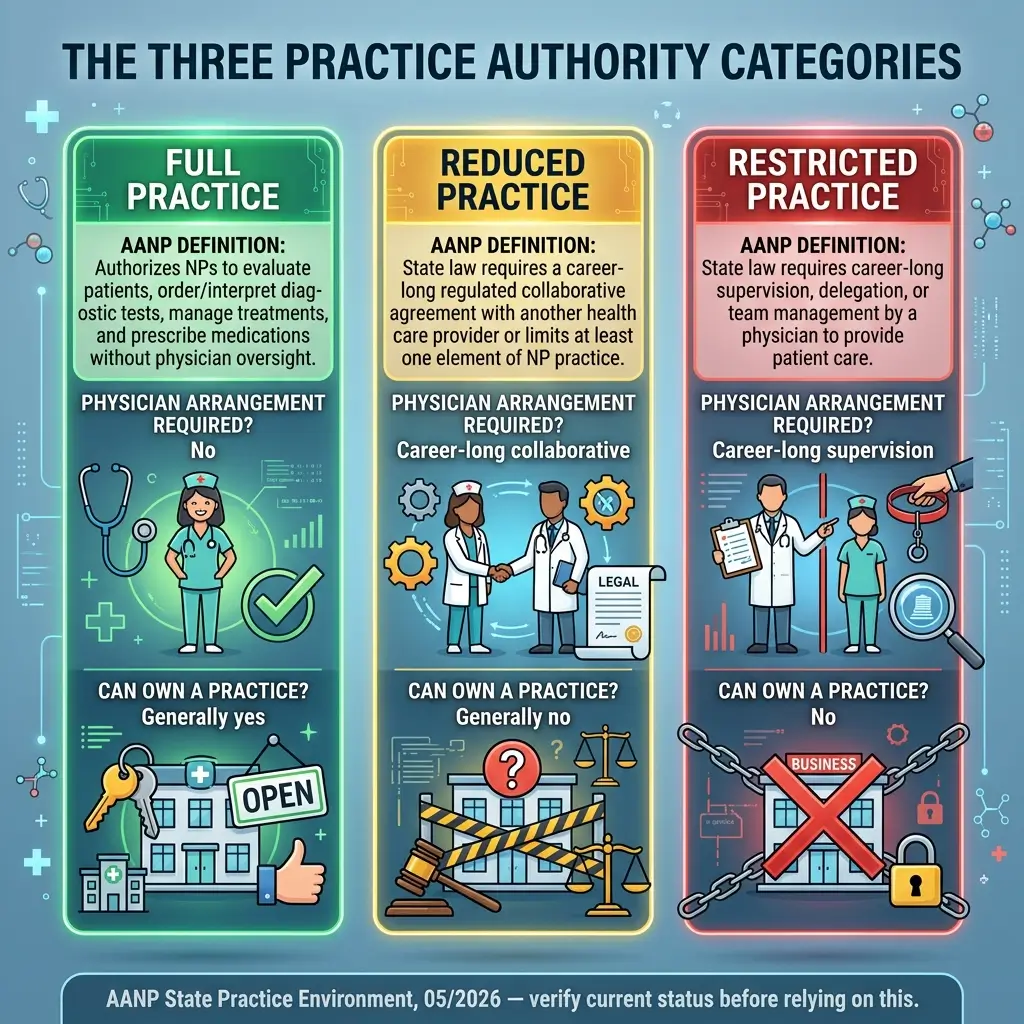
The American Association of Nurse Practitioners sorts every state into three categories, and the definitions are precise enough to be worth reading exactly rather than paraphrasing loosely.
| Category | What state law does | Practical effect |
|---|---|---|
| Full practice | Permits all NPs to evaluate patients, diagnose, order and interpret tests, and initiate and manage treatment including controlled substances, under the exclusive licensure authority of the board of nursing | NP can practise and, in most cases, own a practice without a physician arrangement |
| Reduced practice | Reduces the ability to engage in at least one element of NP practice; requires a career-long regulated collaborative agreement, or limits the setting of one or more elements | Collaborative agreement required for the length of the career, not only at entry |
| Restricted practice | Restricts at least one element; requires career-long supervision, delegation or team management by another health provider | Practice is dependent on a supervising provider being in place |
Source: AANP State Practice Environment, May 2026. Full practice is the model recommended by the National Academy of Medicine and the National Council of State Boards of Nursing.
Why the state count is reported inconsistently
You will see the number of full practice authority states given as 27, 28, 29 or 30 depending on the source, and all of them can be defended. AANP's own map, updated May 2026, counts 27 states plus the District of Columbia, Guam and the Northern Mariana Islands. Higher counts include states whose legislatures have passed FPA measures that AANP's map has not yet reflected — New Jersey eliminated its joint protocol requirement for qualified advanced practice nurses in March 2026, for example.
The practical guidance is unchanged by the dispute: check the AANP map for your specific state on the day you need the answer, and confirm against your state board of nursing before you sign anything.
⚖️ Jurisdiction note: "Nurse practitioner" is a protected title in the UK, Canada, Australia and New Zealand as well, but the regulatory structures differ substantially. UK advanced practice is governed by NHS England's multi-professional framework rather than a licensure tier under the NMC, and prescribing authority runs through a separate independent prescriber qualification. Nothing in this article's US practice-authority analysis transfers.
The three things to establish before accepting an NP post in an unfamiliar state are:
- Which category the state sits in, and whether a transition-to-practice period applies before independence begins
- Who holds the collaborative or supervisory agreement in reduced and restricted states, and what happens to your practice if that physician leaves
- Whether controlled-substance authority is separate, since schedules and DEA requirements vary independently of general prescriptive authority
Population focus is a licensure boundary, not a job preference
RNs move between patient populations freely. An RN can leave a med-surg floor for paediatrics, then for oncology, then for a school nursing post, without any change to their license. Employers may require orientation or a specialty certification, but nothing in the license restricts it.
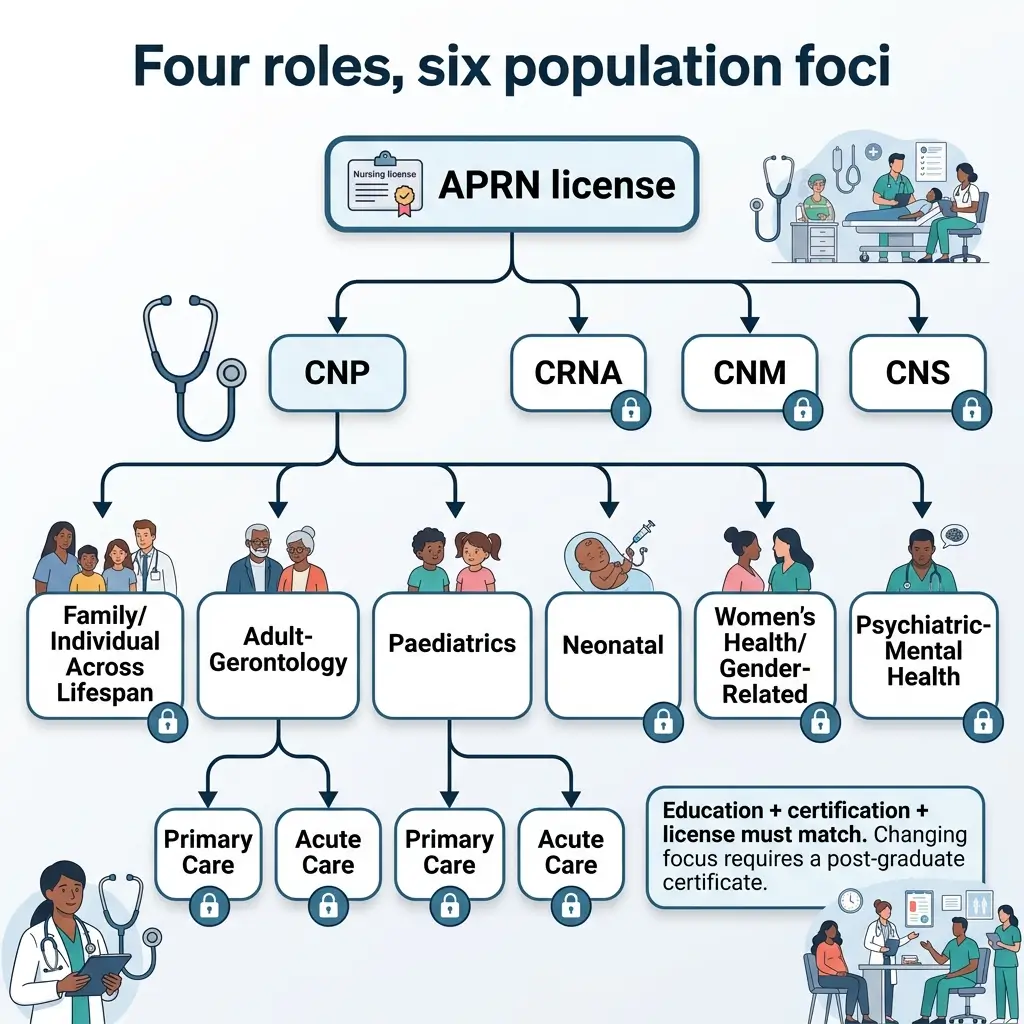
NPs cannot. Under the APRN Consensus Model, effective since 2015, an APRN is licensed in one of four roles and at least one of six population foci, and education, certification and licensure must be congruent in both. The six foci are family/individual across the lifespan, adult-gerontology, paediatrics, neonatal, women's health/gender-related, and psychiatric-mental health. For the adult-gerontology and paediatric foci, acute care and primary care are separate preparations.
The consequence is that the population focus chosen at application — often before a nurse has any exposure to the specialty — sets a boundary that is expensive to move later. Certification in one focus does not transfer to another; changing requires completing an education programme in the new focus, typically a post-graduate certificate.
This is why the family focus dominates the workforce: it is the broadest, and it keeps the most doors open. AANP reports that about 87% of the more than 461,000 licensed NPs in the U.S. were educated in programmes focused on primary care, and its breakdown of 2023–24 NP graduations shows how concentrated the choice is.
| Certification exam | Share of all NP graduations, 2023–24 |
|---|---|
| Family | 51.3% |
| Adult-gerontology primary care | 5.5% |
| Paediatric primary care | 2.4% |
| Women's health | 1.4% |
| Non-primary-care (adult acute, neonatal, paediatric acute, psych-mental health) | 33.6% |
Source: AANP, Nurse Practitioners in Primary Care, revised October 2025.
Half of all new NPs take the family route, and a third take a non-primary-care certification — a share that has been growing as psychiatric-mental health and acute care demand rises.
Questions worth answering honestly before committing to a focus:
- Would you take this population if the pay were identical across all six? If the answer is no, you are choosing a market, and markets move.
- Does your target employer hire that focus? Acute care roles frequently exclude primary-care-prepared NPs regardless of experience.
- What would a change cost you? Price the post-graduate certificate now, not after.
Salary and job outlook: reading the federal data correctly
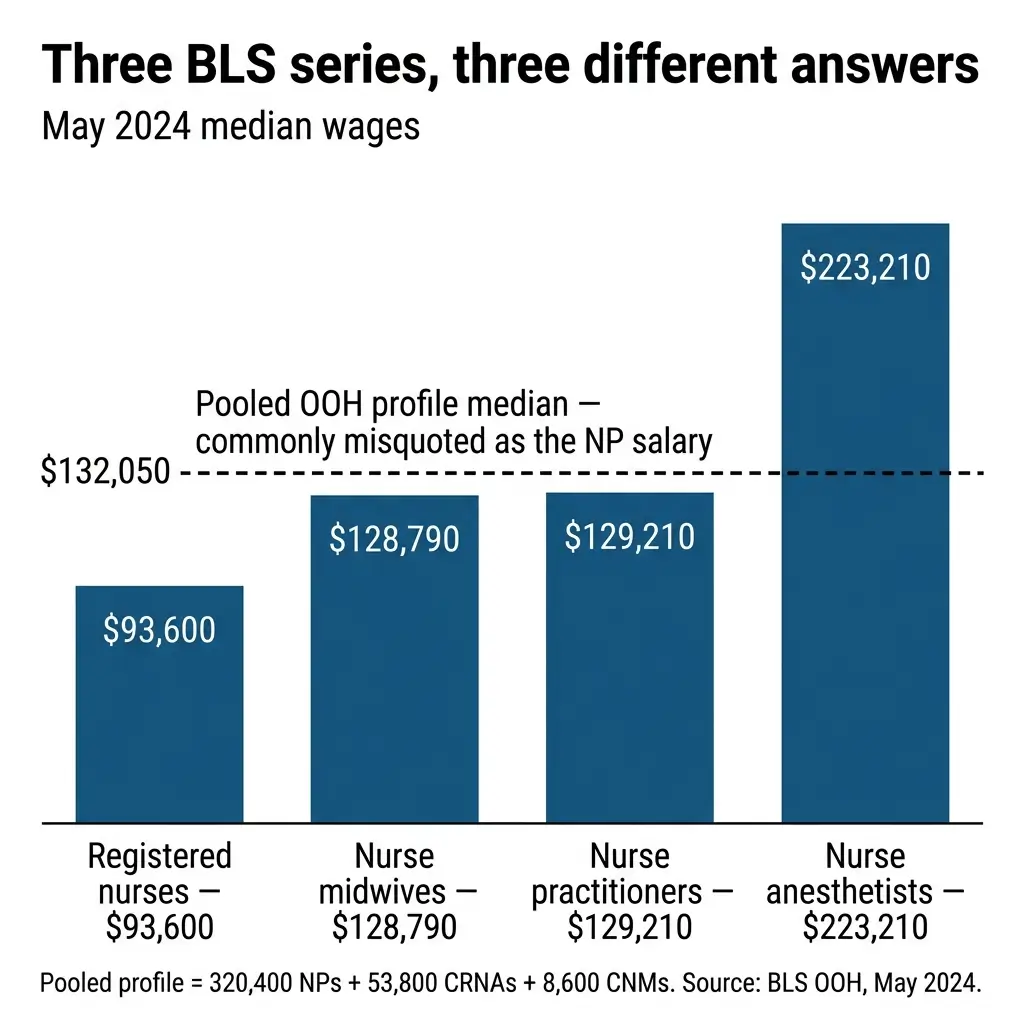
The most-quoted number in this comparison is the wrong number. Nearly every RN-versus-NP article reports NP median pay as $132,050. That figure comes from the BLS Occupational Outlook Handbook profile titled "Nurse Anesthetists, Nurse Midwives, and Nurse Practitioners" — three separate occupations pooled into one published profile.
The same page breaks the pool apart, and the breakdown is the whole argument. For May 2024, BLS reports nurse anesthetists at a $223,210 median, nurse practitioners at $129,210 and nurse midwives at $128,790. Roughly 54,000 nurse anesthetists earning six figures above the other two groups drag the pooled median above what any nurse practitioner should expect. The 35% growth rate carries the same problem: NPs alone are projected to grow 40% between 2024 and 2034, nurse anesthetists 9% and nurse midwives 11%.
NPs are also the overwhelming majority of that pool — 320,400 of the 382,700 jobs — which is exactly why the error is easy to miss and easy to repeat. For NP-only wage detail by state and metro area, the Occupational Employment and Wage Statistics series publishes nurse practitioners separately under SOC 29-1171.
This table separates the series so you can see which number answers which question.
| Measure | Registered Nurses (29-1141) | NP + CRNA + CNM (OOH profile) | Nurse Practitioners (29-1171) |
|---|---|---|---|
| Median annual wage, May 2024 | $93,600 | $132,050 | $129,210 |
| Lowest 10% / highest 10% | $66,030 / $135,320 | $98,520 / $217,270 | Published by percentile in OEWS |
| Employment, 2024 | 3,391,000 | 382,700 | 320,400 |
| Projected growth, 2024–34 | 5% | 35% | 40% |
| Annual openings | ~189,100 | ~32,700 | Included in the pooled figure |
| Typical entry education | Bachelor's degree | Master's degree | Master's degree |
Sources: BLS Occupational Outlook Handbook (May 2024 wage data, 2024–34 projections) and BLS Employment Projections.
What the numbers do and do not tell you
A gap of roughly $35,000 between RN and NP medians is real and consistent across data vintages. But three qualifications change how a working nurse should read it.
First, RN pay is compressed in the published median in a way NP pay is not. Shift differentials, overtime, weekend premiums and per-diem rates are a substantial share of many RNs' actual earnings, and an experienced RN working nights in a high-cost market can approach entry-level NP salary. Second, the transition costs two to four years of tuition alongside reduced hours, so the break-even point sits several years past graduation. Third, absolute job volume favours RNs heavily: 189,100 projected annual openings against an entire NP occupation of roughly 320,000. A 40% growth rate on a small base is still a small market, and it is a market with rising new-graduate supply.
The three checks worth running before you rely on any published NP salary figure are:
- Confirm the SOC code. 29-1171 is nurse practitioners; the OOH profile pools 29-1151 (anesthetists), 29-1161 (midwives) and 29-1171 together.
- Confirm the reference period. OEWS labels a release by its final panel month but pools six semiannual panels, so "May 2025" is not a snapshot of May 2025.
- Confirm median versus mean. NP mean sits above NP median, and sources mix the two freely.
⚠️ Verify before you cite: If you are using pay figures in a negotiation, a business case or your own writing, pull them from the BLS OEWS series for the specific SOC code and state the reference period. The OOH combined profile is accurate for what it measures and misleading for what people use it for.
Which path fits which nurse
Neither role is the advanced version of the other in any sense that matters day to day. They are different jobs that share a foundation, and the honest framing is a trade rather than a promotion.
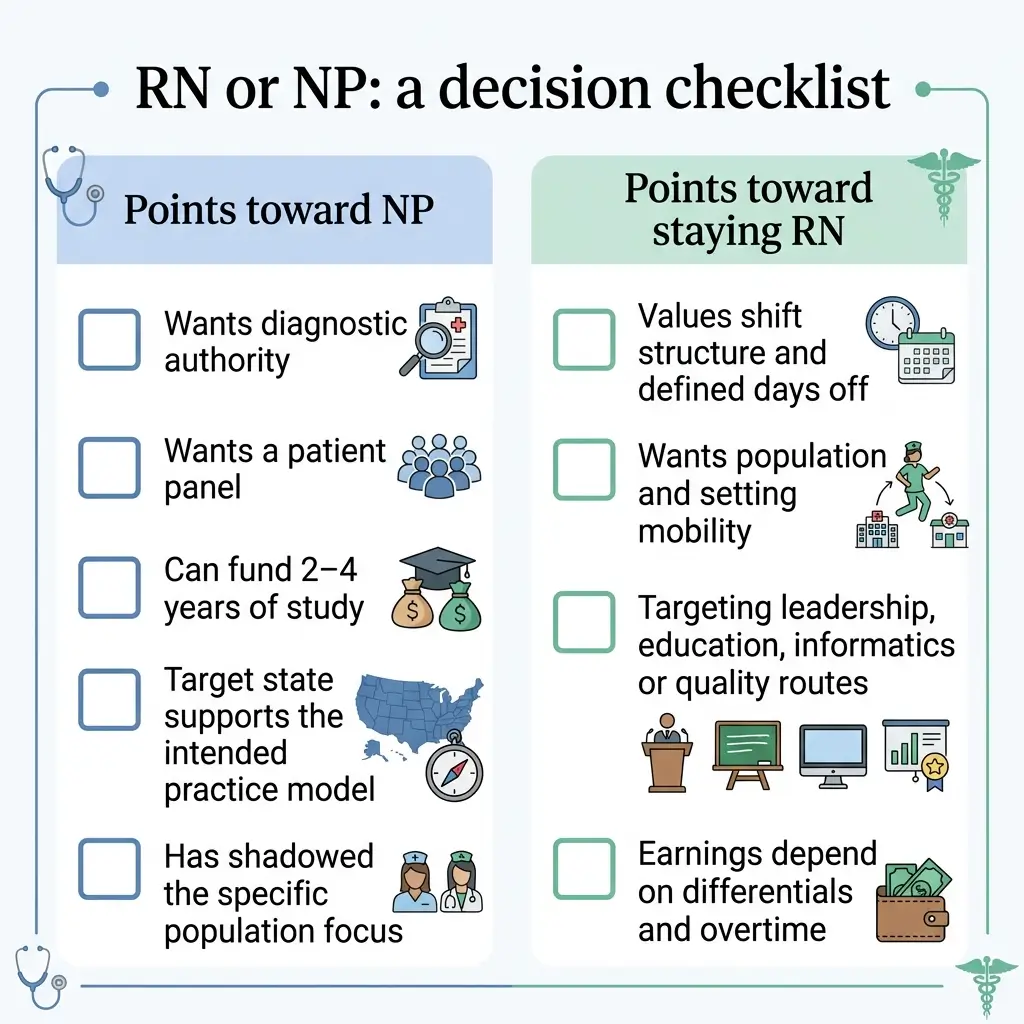
The NP route generally suits a nurse who wants diagnostic ownership — who is repeatedly frustrated by identifying a problem and waiting for someone else to act on it, and who wants that decision to be theirs. It suits people who prefer longitudinal relationships with a patient panel over shift-based acute care, and who can absorb two to four years of study without financial strain.
Staying in RN practice suits a nurse who wants the hands-on work, the shift structure with genuine days off, and the mobility to change populations and settings without a licensure barrier. RN practice also has advancement routes that do not require an APRN license at all: charge nurse, nurse manager, director of nursing, clinical educator, informatics, quality, research coordination, and the business side of healthcare.
A short honest test, before the tuition deposit:
- Do you want to make the diagnosis, or do you want to deliver the care? Both are real answers. Only one of them justifies the graduate programme.
- Have you shadowed an NP in the focus you are considering? A full clinic day, not an hour.
- Does your state's practice authority support the job you are imagining? An NP-owned practice is not a plan in a restricted state.
- Can you afford the transition without counting on a specific starting salary? New-graduate NP offers in saturated markets have compressed.
Frequently asked questions
These are the questions that come up most often from nurses weighing the transition, answered briefly here and covered in depth in the sections above.
Is a nurse practitioner higher than a registered nurse?
An NP has broader legal authority — diagnosis and prescribing — and higher median pay, but it is not a rank within nursing. NPs do not supervise RNs by virtue of the credential. It is a different licensed role built on the same foundation, not a promotion within the same job.
Can a nurse practitioner prescribe medication in every state?
Yes. NPs hold prescriptive authority in all 50 states and the District of Columbia, including controlled substances. What varies is whether that authority is exercised independently or under a required collaborative or supervisory arrangement, and DEA registration is a separate requirement.
How long does it take to go from RN to NP?
Typically two to four years of graduate study from an existing BSN — around two to three years for an MSN and three to four for a DNP, with part-time routes running longer. Add time if a BSN is needed first, or if clinical preceptor placement is hard to secure locally.
Do you keep your RN license when you become an NP?
Yes, and you must. The APRN license sits on top of an active RN license rather than replacing it, so you maintain both, including both renewal cycles and both continuing-education requirements.
Can an NP change specialty later?
Not freely. Population focus is bounded by licensure, and moving from, say, family practice to psychiatric-mental health requires completing an education programme in the new focus — usually a post-graduate certificate — followed by certification in it. Compare this with RN practice, where changing population requires no licensure change.
Is a DNP required to become a nurse practitioner?
No. Entry-level preparation for NP practice remains a graduate degree at master's or doctoral level. The move to a DNP requirement has been recommended and discussed for more than two decades without being mandated.
Do NPs earn $132,000 a year?
That figure is the median for a BLS profile combining nurse anesthetists, nurse midwives and nurse practitioners, and nurse anesthetists raise it considerably. For NP-only data, use the BLS OEWS series for SOC 29-1171, and expect wide variation by state, setting and population focus.
The short version
The NP credential adds diagnostic and prescriptive authority to an RN foundation, and it costs two to four years and a narrowed patient population to get. Whether that trade pays depends far less on the national salary gap than on two things nobody can answer for you: what your state's practice authority law permits, and whether you actually want to own the diagnosis rather than deliver the care.
Check the AANP practice environment map for your state, price a post-graduate certificate in a focus other than the one you are considering, and shadow an NP for a full clinic day. Those three steps will tell you more than any comparison table, including this one.
Sources
- BLS Occupational Outlook Handbook — Registered Nurses
- BLS Occupational Outlook Handbook — Nurse Anesthetists, Nurse Midwives, and Nurse Practitioners
- BLS Occupational Employment and Wage Statistics tables
- AANP State Practice Environment
- AANP State Practice Environment definitions, May 2026 (PDF)
- AANP — Nurse Practitioners in Primary Care
- AANP — Scope of Practice for Nurse Practitioners
- NCSBN — Consensus Model for APRN Regulation (PDF)