


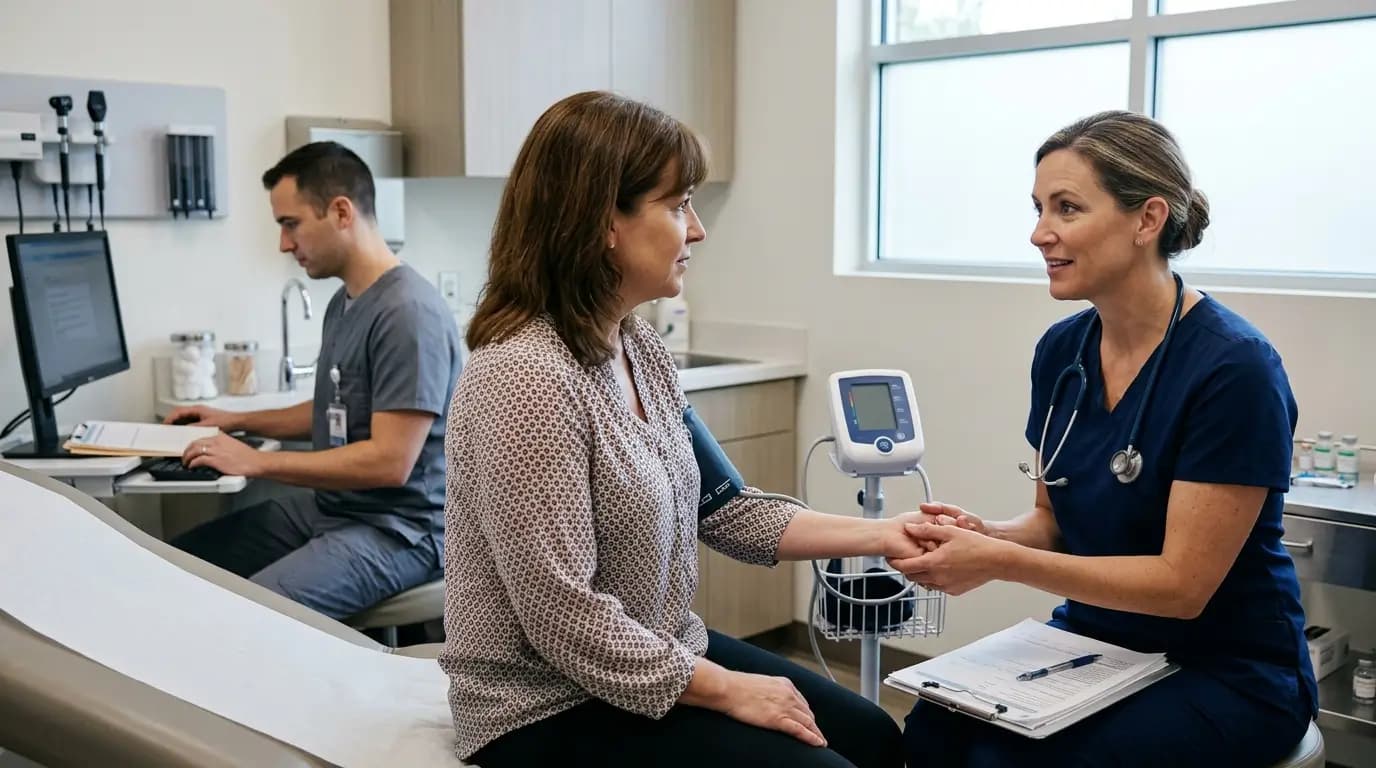
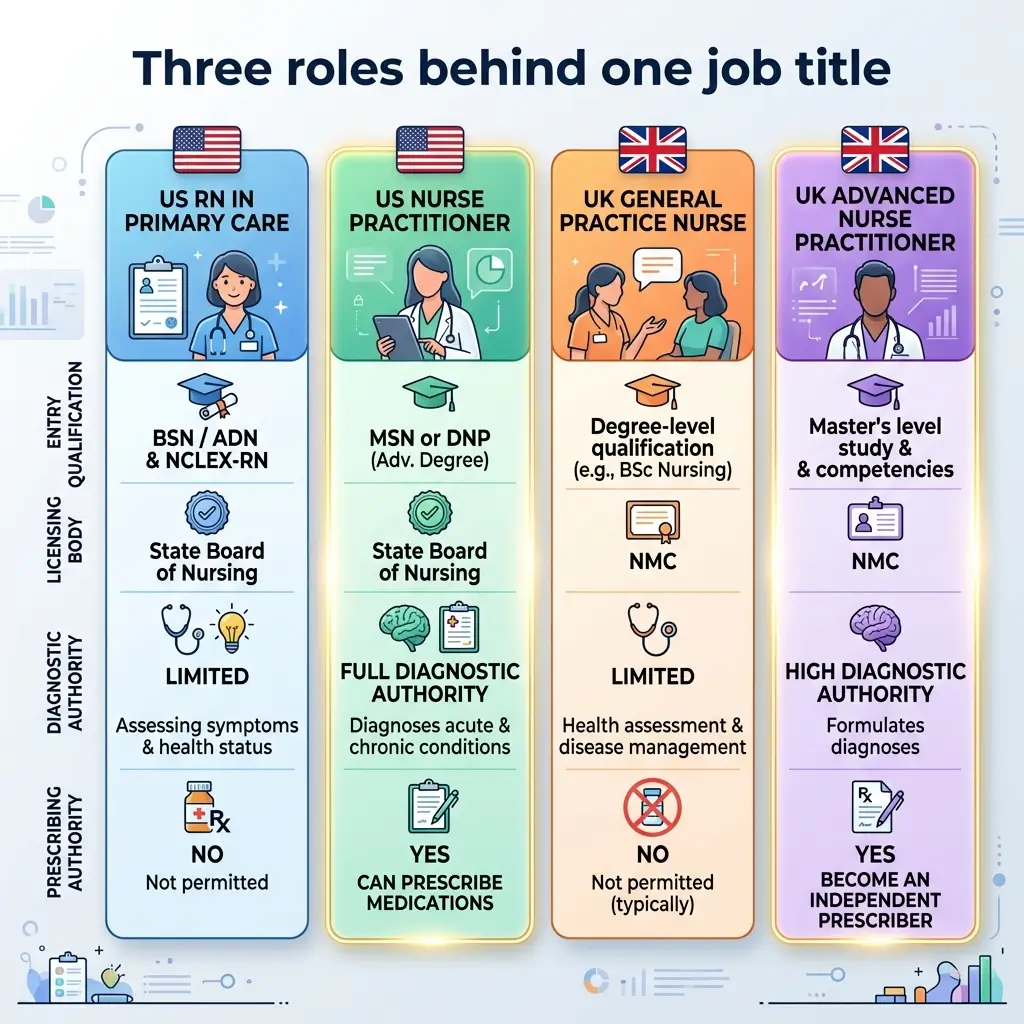
"Primary care nurse" is a description of where someone works, not a protected job title, and it covers at least three different jobs with three different legal scopes. In the United States it usually means a registered nurse in an outpatient clinic — or a nurse practitioner who diagnoses, treats and prescribes. In the United Kingdom it almost always means a general practice nurse, running her own clinics inside a GP surgery under NMC registration. The duties overlap. The education routes do not.
This guide covers both systems, with every licensing requirement sourced to the regulator that sets it. I write about this role from the employer side — I build competence frameworks and run site assurance, and primary care nurses are the clinicians whose decisions land on my desk as adjustments and restrictions. The clinical content here is regulator-sourced, not lived; the work-and-health section is where my own experience actually sits.
Key takeaways
The six points below carry the figures and dates that the rest of the article explains:
- In the US, entry is a nursing degree plus a state licensing exam. The median RN wage was $97,550 in May 2025, and RN employment is projected to grow 6% from 2025 to 2035 (BLS).
- Advanced practice is a different occupation with different numbers: a $134,920 median and 36% projected growth over the same decade (BLS).
- There is no BLS occupation called "primary care nurse". Any salary quoted under that heading has been borrowed from a broader category — and the RN figure for ambulatory settings, $91,230, sits below the headline RN median.
- In the UK, entry is an NMC-approved nursing degree or degree apprenticeship, followed by registration and a practice-specific induction. Registration is renewed through revalidation every three years: 450 practice hours, 35 CPD hours, five reflective accounts.
- Since 1 July 2022, registered nurses in England, Scotland and Wales can legally certify fit notes under SI 2022/630 — which makes the primary care nurse a direct input into workplace adjustments.
- Certification is optional in both systems. The US ambulatory credential (AMB-BC) needs two years' RN practice and 2,000 ambulatory hours.
Primary care nurse: the three roles the title covers
Before anything else, work out which of these three jobs a given advert, salary figure or course is actually describing. Readers get burned here constantly — someone reads a "primary care nurse salary" of $132,000, enrols on an associate degree, and discovers three years later that the figure belonged to a master's-prepared nurse practitioner.
When an employer asks me to map a health referral pathway, I start by establishing which of these roles sits at the other end of it, because the answer decides what that clinician is permitted to write down.
Primary care itself is the stable part of the definition. It is first-contact, continuing, generalist care: annual checks, immunisations, chronic condition reviews, minor illness, and referral onward when the problem outgrows the setting. What varies is which nursing role delivers it and what that role is legally allowed to decide.
| Role | System | Typical entry | Can diagnose and prescribe? |
|---|---|---|---|
| Registered nurse in primary care | US | ADN or BSN, then NCLEX-RN | No — works to a treatment plan |
| Nurse practitioner (family, adult-gero, paediatric) | US | MSN or DNP, national certification, state APRN licence | Yes, subject to state practice authority |
| General practice nurse | UK | NMC-approved degree, NMC registration | No — but can certify fit notes |
| Advanced nurse practitioner | UK | Master's-level practice, independent prescribing qualification | Yes, within scope |
The practical differences that decide which job someone is reading about are:
- Who owns the clinical decision — an RN in primary care assesses and escalates; an NP or ANP carries diagnostic and prescribing responsibility.
- Where the licence comes from — a US state board of nursing, or the NMC for the whole of the UK.
- Whether the employer is the health system — US clinic groups and NHS trusts employ directly, but most UK practice nurses are employed by the GP partnership itself.
- How autonomy is capped — by state law in the US, by scope of practice and employer governance in the UK.
What a primary care nurse actually does in a week
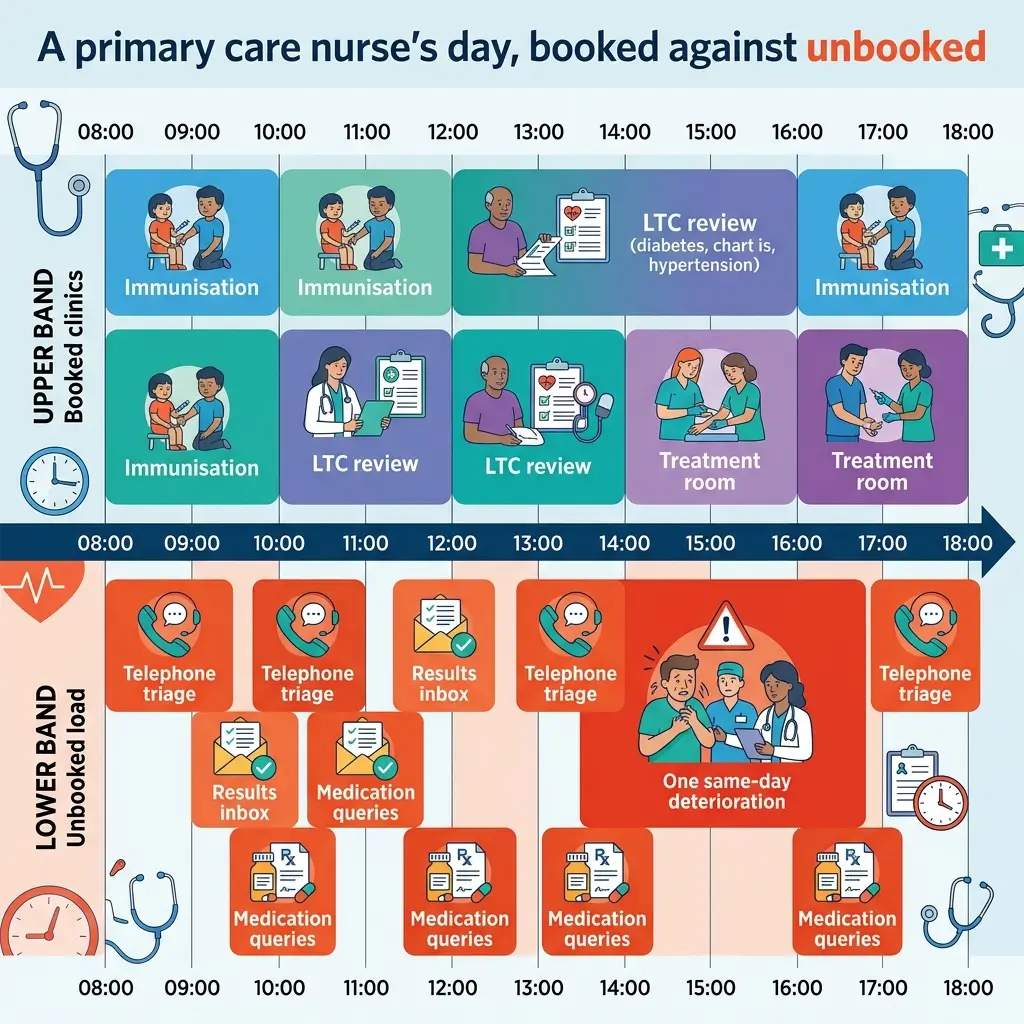
The job splits into work that is booked and work that is not, and the second half is the part that surprises people arriving from a hospital ward. A ward nurse finishes a shift and hands over. A primary care nurse finishes a clinic and still owns a results inbox, a recall list and three patients who telephoned.
The booked clinics
Scheduled work is the visible half: immunisations and travel vaccines, cervical screening, wound care and dressings, phlebotomy, blood pressure and spirometry, and the long-term condition reviews that structure the year. NHS Health Careers' general practice nurse profile describes a role running most aspects of patient care, sometimes as one of several nurses sharing duties and sometimes alone.
Diabetes, asthma and hypertension reviews are where a competent primary care nurse earns the practice its money and its outcomes. Each is a structured consultation with its own checks, its own escalation triggers, and a treatment plan the patient has to be persuaded to follow for another twelve months.
The unscheduled work
Same-day demand does not respect the appointment book. Telephone triage, results follow-up, medication queries and the patient who arrives with chest pain instead of a dressing change all land inside a clinic that was already full.
This is the load that determines whether the job is sustainable, and it is almost entirely absent from the course brochures.
Documentation, recall and coding
Every consultation ends in a record, and in primary care that record does more than protect the clinician. Coding drives the recall system — it is what pulls the patient back in twelve months, what triggers the screening invitation, and what tells the practice which cohort has been missed.
A day in a well-run primary care nursing role usually contains:
- Two or three booked clinics — immunisation, long-term condition review, treatment room
- A triage or duty slot — assessing same-day requests and deciding what escalates
- Results and correspondence — reviewing what came back and acting on it
- Recall and coding work — keeping the register accurate enough to be useful
- One unplanned deterioration — the patient who is sicker than the appointment suggested
The skills that separate primary care from ward nursing
Clinical skill transfers between settings. Judgement under thin information does not, and that is the skill primary care asks for first.
On a ward, a deteriorating patient is observed continuously and a colleague is thirty seconds away. In a clinic room, a nurse has ten minutes, one set of observations, no telemetry, and a decision to make about whether this person goes home or goes to hospital. The safety-critical competence is recognising the limit of the setting and escalating past it early.
Competence assurance is my own trade, and when I review a framework I check one thing before anything else: whether the sign-off covers the decision the person genuinely makes alone. Frameworks that assess procedures and skip judgement pass people who can take blood but freeze when the observations do not add up.
The second distinctive skill is behavioural. Chronic disease management is not delivered by the consultation; it is delivered by what the patient does for the eleven months afterwards. Nurses who are good at this are good at negotiation, not instruction.
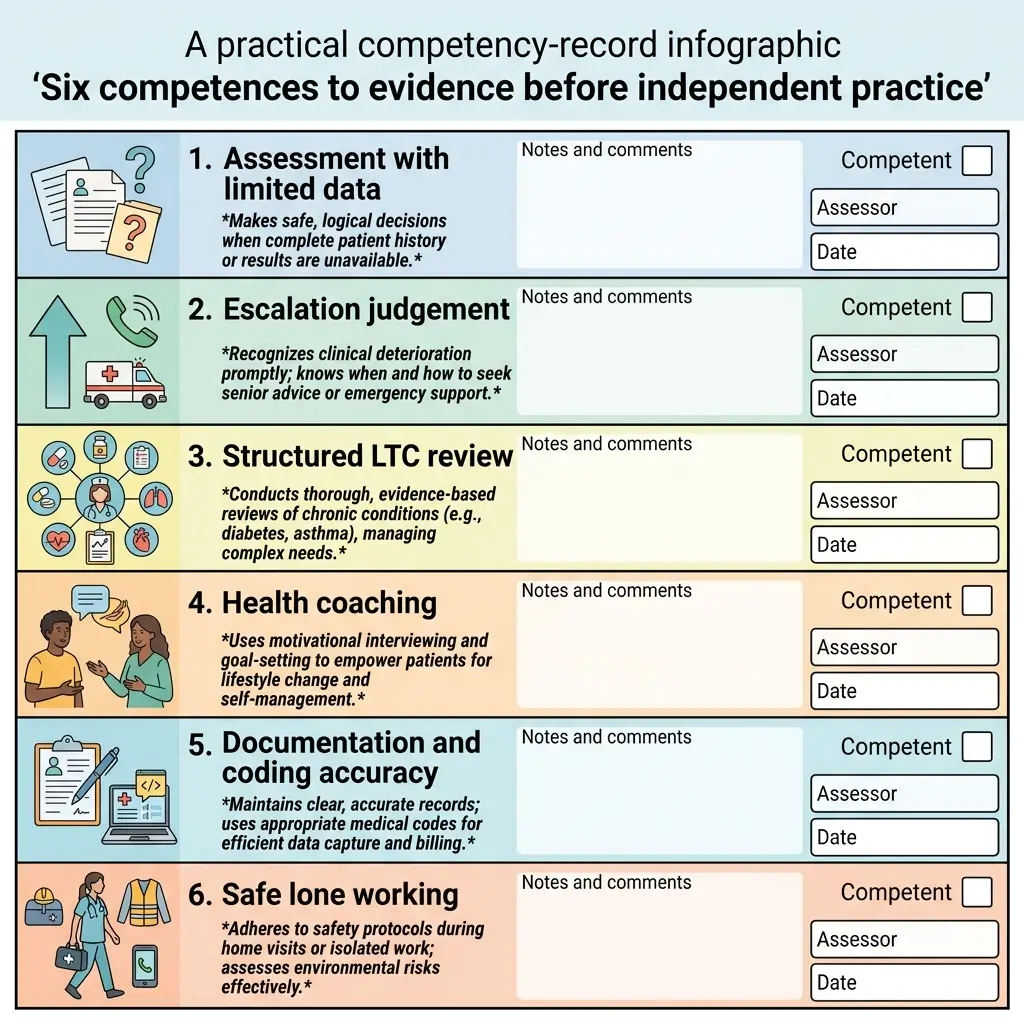
The competences I would want evidenced before signing off a primary care nurse as independent are:
- Assessment with limited data — taking a history that surfaces the thing the patient did not come in to say
- Escalation judgement — recognising the ceiling of the setting and acting before it is reached
- Structured long-term condition review — running a diabetes or asthma review to protocol without turning it into a checklist
- Health coaching — behaviour change technique, not health advice delivered louder
- Documentation and coding accuracy — because the recall system is only as good as the record
- Working alone safely — knowing what you do when the GP is out on a visit and you are the clinician in the building
Education and licensing, compared side by side
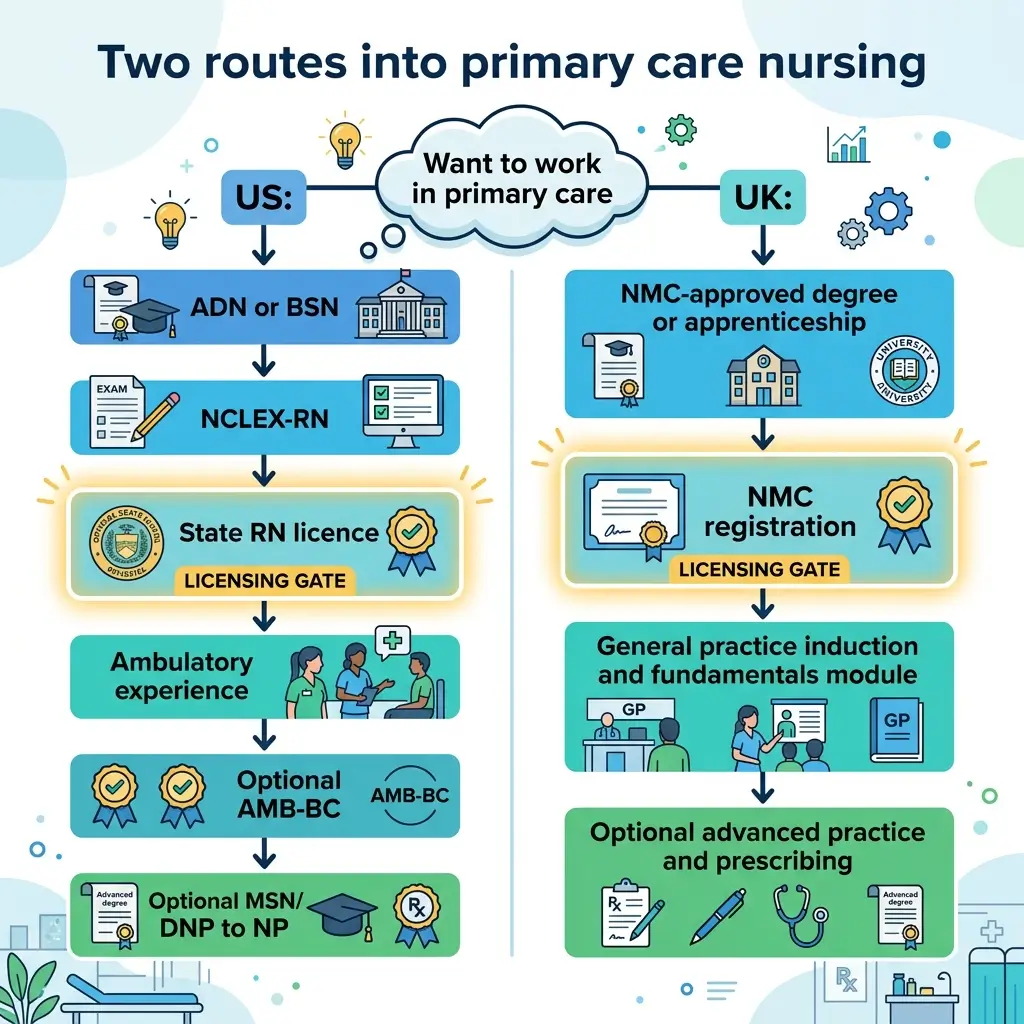
The two systems agree that a primary care nurse is a registered nurse first and a primary care specialist second. They disagree on almost everything else — the degree, the exam, the regulator, and how competence is maintained afterwards.
| Requirement | United States | United Kingdom |
|---|---|---|
| Entry qualification | ADN (2 years) or BSN (4 years) | NMC-approved nursing degree or degree apprenticeship |
| Licensing exam | NCLEX-RN | None — registration follows an approved programme |
| Regulator | State board of nursing | Nursing and Midwifery Council |
| Specialty credential | AMB-BC (optional) | Practice-specific induction and fundamentals module |
| Maintaining registration | State CE requirements, varies | Revalidation every 3 years |
United States: degree, NCLEX-RN, then ambulatory experience
More than one degree leads to the same licence. The BLS Occupational Outlook Handbook lists three routes — a bachelor's degree in nursing, an associate's degree, or a hospital diploma programme — and records a bachelor's degree as the typical entry-level education. Hospitals in particular often require the BSN, but a licensed graduate of any of the three qualifies for staff nurse posts.
Licensure is the actual gate, not the degree. Graduates must pass the NCLEX-RN and meet their state board's remaining conditions, which vary — background checks and renewal requirements are set state by state, not federally.
Certification comes later and stays optional. ANCC's Ambulatory Care Nursing certification (AMB-BC) requires an active RN licence, the equivalent of two years' full-time practice, 2,000 hours of ambulatory or telehealth clinical practice in the last three years, and 30 hours of relevant continuing education. The credential runs for five years.
⚠️ Timing note: ANCC is updating the AMB-BC test content outline with effect from 11 September 2026, with a short suspension while the exam is rebuilt. Candidates can test before 28 August 2026 or from 11 September 2026 onward. If you are studying now, check which reference list applies to your test date — there are two on the ANCC page.
Advancing to nurse practitioner means a master's or doctoral degree, national certification and a separate state APRN licence. What that licence permits then depends on where it was issued. AANP's State Practice Environment map, last updated May 2026, classifies every state as full, reduced or restricted practice. Trackers reading that map put full practice authority at 27 states plus the District of Columbia; counts published elsewhere run higher because they include recent laws AANP has not yet reflected. Check the map itself before making a decision that turns on it — the categories are AANP's, the tallies are not.
United Kingdom: registration first, general practice second
There is no separate qualification called "practice nurse". A UK primary care nurse is a registered nurse who has moved into general practice, and the route in runs through an NMC-approved degree — full-time, or as a degree apprenticeship for people already working as healthcare assistants or nursing associates.
The specialty learning happens after registration, through employer induction and a funded fundamentals-of-general-practice module, assessed against the national general practice nursing capability framework rather than a licensing exam.
Registration is then maintained by revalidation. The NMC's revalidation requirements run on a three-year cycle: 450 practice hours, 35 hours of CPD of which 20 must be participatory, five pieces of practice-related feedback, five written reflective accounts, a reflective discussion with another registrant, confirmation by a third party, and declarations of health, character and indemnity.
What transfers between the two systems, and what does not
Neither registration is portable. A US RN moving to the UK applies to the NMC and may sit a test of competence; a UK nurse moving to the US applies to a state board and sits the NCLEX-RN.
The points to check before committing money to a course are:
- The degree is not the licence — in the US the NCLEX-RN is the gate; in the UK it is NMC registration
- The specialty credential is optional in both — useful for hiring, never a legal requirement to work in primary care
- Prescribing is a separate qualification — never bundled into the base registration in either system
- Registration is portable between UK nations but not across the Atlantic — the NMC covers England, Scotland, Wales and Northern Ireland
- Continuing requirements differ in kind — US states set continuing education hours; the NMC requires reflection and third-party confirmation as well
Pay and job outlook: what the numbers actually say
Start with a correction, because it affects every salary figure published under this title. The BLS does not track an occupation called "primary care nurse". Figures quoted under that heading have been lifted from one of two much broader categories, and the two are far apart.
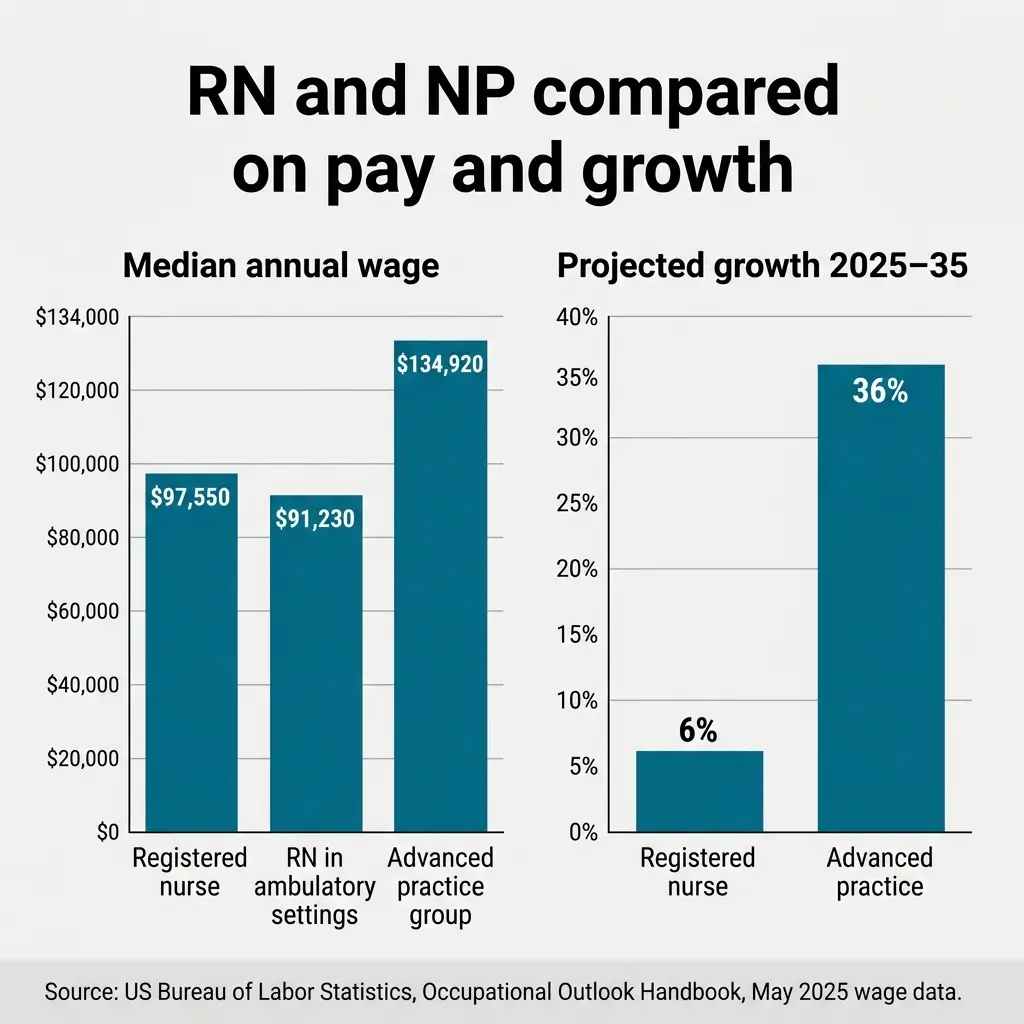
For registered nurses, the BLS reports a median annual wage of $97,550 in May 2025, with the lowest tenth under $68,940 and the highest tenth above $137,470. Employment is projected to grow 6% from 2025 to 2035, with about 180,800 openings a year, most of them replacing people who leave.
The setting matters more than most guides admit. Within that same RN figure, ambulatory healthcare services — physicians' offices, outpatient centres, home health, which is where primary care sits — record a median of $91,230, below the all-settings RN median and well below the hospital figure of $100,220. Primary care nursing generally trades shift premiums for sociable hours.
Advanced practice sits in a different band. The BLS profile covering nurse anaesthetists, nurse midwives and nurse practitioners reports a $134,920 median and 36% projected growth over the same decade — one of the fastest rates it tracks. Read that number carefully: it is a combined profile covering three distinct roles, not a nurse practitioner wage. The NP-only wage series is published separately under SOC 29-1171.
| Measure | Registered nurses | NPs, midwives, anaesthetists |
|---|---|---|
| Median annual wage, May 2025 | $97,550 | $134,920 |
| Median in ambulatory settings | $91,230 | — |
| Projected growth, 2025–35 | 6% | 36% |
| Annual openings | ~180,800 | ~32,200 |
| Source | BLS OOH | BLS OOH |
UK pay works differently and is frequently misreported. Most general practice nurses are employed by the GP partnership rather than by an NHS trust, so Agenda for Change is a benchmark rather than a guarantee. NHS Health Careers states that salary varies by employer, and that where the NHS employs directly the role typically starts at band 6 on a 37.5-hour week.
What the figures mean for someone choosing a route:
- The divergence is the story — RN demand is steady, advanced practice demand is growing six times faster
- Openings matter more than growth for a first job — 180,800 RN openings a year is a large market, even at 6% growth (source: BLS)
- Check the category behind any quoted figure — RN or advanced practice changes the number by roughly $37,000
- Check the setting too — ambulatory work pays below the RN median, which the headline figure hides
- UK pay is employer-dependent — ask which contract terms a practice actually applies before accepting
Where primary care nursing meets occupational health
This is the part of the role that gets left out of every career guide I have read on it, and it is the part I see from the other side.
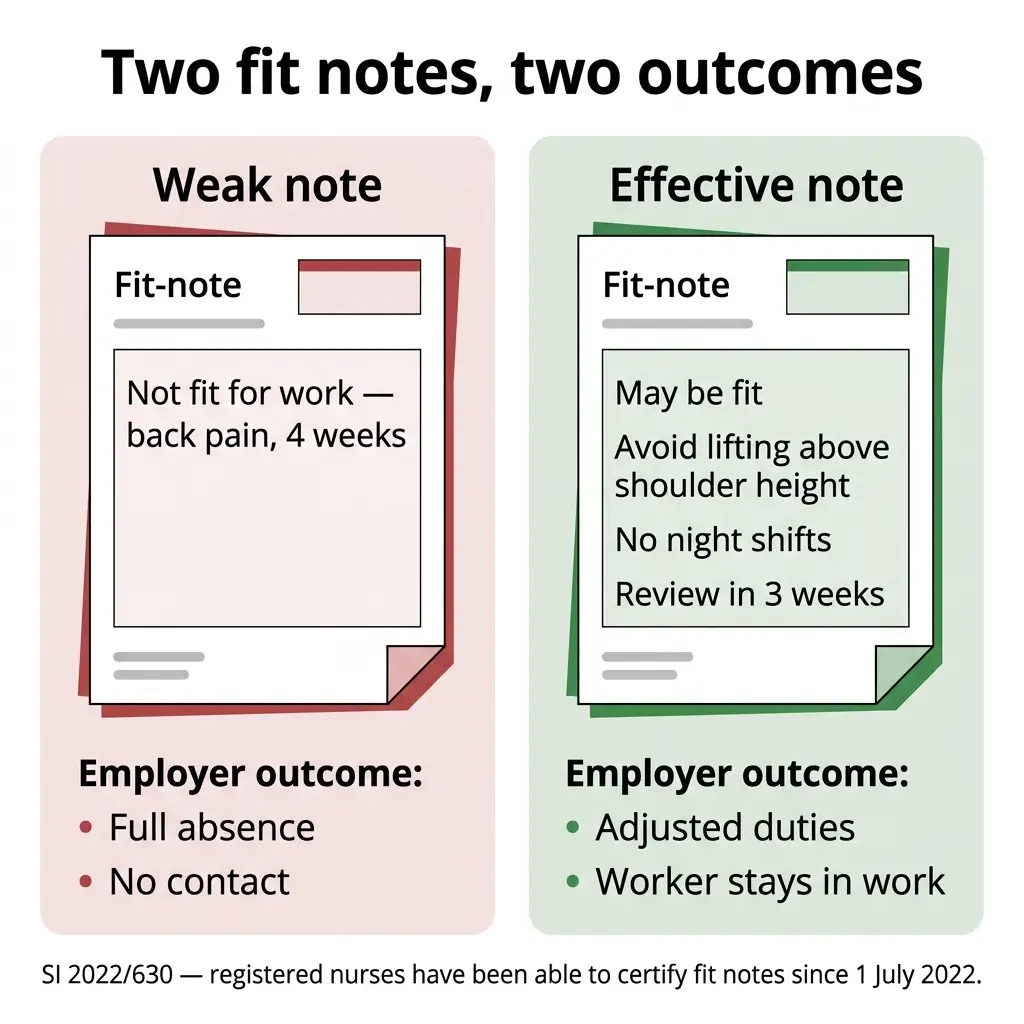
Since 1 July 2022, registered nurses in England, Scotland and Wales can legally certify fit notes. SI 2022/630 replaced "doctor" with "healthcare professional" throughout the 1976 and 1985 medical evidence regulations, adding nurses, occupational therapists, pharmacists and physiotherapists. The NMC's position is that the power is permissive: not every nurse will certify, and those who do should have employer support and training first.
That matters more than it sounds. The fit note is often the only clinical document an employer ever receives about a worker, and the "may be fit for work" box is where adjustments get specified. A note that says "not fit for work" ends the conversation. A note that names the limitation — no lifting above shoulder height, no night shifts for six weeks — starts one.
The volume behind this is not marginal. HSE's 2024/25 statistics record 1.9 million workers in Great Britain suffering work-related ill health, including 964,000 with stress, depression or anxiety and 511,000 with a musculoskeletal disorder. Most of those people never see an occupational health service. They see a primary care nurse.
In my work on MSD reduction across eight IKEA Industry factories in Poland and Portugal, and on fatigue risk for DP World's night container operations, the pattern was consistent: the adjustments that survived contact with production were the ones a clinician had written down specifically. Verbal advice relayed through a supervisor did not survive the first busy week. This is not a criticism of the clinicians — it is a consequence of a form that was designed for absence certification being used as an adjustment instrument.
Reading a note as the person who has to implement it, I would expect four things on the page before it can change anything. If you work in primary care and want your advice to reach the shop floor intact:
- Use the "may be fit" option and name the restriction — a function, a duration, a review date
- Describe capability, not diagnosis — employers act on what someone can do; they cannot lawfully act on much else
- Set a review point — an open-ended restriction becomes permanent by default
- Ask what the job physically involves — the patient's job title tells you almost nothing about their exposure
- Say when occupational health input is needed — you are not the workplace risk assessor, and saying so is the right call
Frequently asked questions
These are the questions that come up most often around this role, answered against the same regulator sources used above.
Is a primary care nurse the same as a nurse practitioner?
No. A nurse practitioner is a registered nurse with a master's or doctoral degree, national certification and a separate advanced practice licence. Many NPs work in primary care, but most primary care nurses are RNs who assess, treat to a plan and escalate rather than diagnose independently.
What is the difference between a practice nurse and a primary care nurse?
They usually describe the same job in different countries. "Practice nurse" or "general practice nurse" is the UK term for a registered nurse working inside a GP surgery. "Primary care nurse" is the broader American term, covering clinics, community health centres and physician offices.
How long does it take to become a primary care nurse?
In the US, about four years for a BSN or two to three for a hospital diploma programme, plus the NCLEX-RN; associate programme lengths vary by school, so check the one you are applying to. In the UK, three years for a nursing degree or longer as an apprenticeship. Add two to three more years for nurse practitioner study.
Do you need a BSN to work in primary care?
Not legally. BLS lists three routes to licensure, and a graduate of any of them can sit the NCLEX-RN and work as a staff nurse. But BLS records the bachelor's as the typical entry-level education, hospitals often require it, and it is the usual prerequisite for master's study.
Can a primary care nurse prescribe medication?
Only with a separate qualification. US nurse practitioners prescribe subject to their state's practice authority — full, reduced or restricted, per AANP's map. In the UK, prescribing requires an NMC-recorded independent or supplementary prescribing qualification, held by some practice nurses and most advanced nurse practitioners.
Can a nurse sign a fit note in the UK?
Yes. Since 1 July 2022, registered nurses in England, Scotland and Wales have been able to legally certify fit notes under SI 2022/630, alongside occupational therapists, pharmacists and physiotherapists. The power is permissive — nurses should have employer agreement and training before certifying.
Is primary care nursing less stressful than hospital nursing?
It trades one pressure for another. The shifts are usually sociable and the acuity lower, but the autonomy is higher, the clinical safety net is thinner, and the unscheduled workload — triage, results, recalls — continues after the clinic list ends.
Conclusion
If you take one thing from this, take the first section: establish which of the three roles you are actually looking at before you compare a salary, choose a course or accept a job. The title is doing too much work, and the gap between an ADN-prepared RN and a doctorally-prepared nurse practitioner is years of further study and roughly $37,000 a year.
The second thing is the part nobody advertises. A primary care nurse in the UK now holds a legal power that connects directly to whether a worker keeps their job, and the education routes have not caught up with it. If you are moving into this role, the work-and-health content is the gap worth closing on your own.
For anything that turns on scope of practice, check with your state board of nursing or the NMC rather than relying on any article, this one included. Licensing rules change, and they change by jurisdiction.
About the author
Chloe Anderson is a British OHSE Technical Educator and Site Assurance Consultant with 16 years of continuous field experience across 17 countries. She leads Anderson OHSE Assurance & Education in Edinburgh, and previously held senior roles with IKEA Industry, DP World, Novo Nordisk, Equinor, Dow, Fluor and Anglo American — including corporate wellbeing and MSD prevention across eight European furniture factories, and fatigue risk management for night container operations.
Sources and further reading
- US Bureau of Labor Statistics, Occupational Outlook Handbook — Registered Nurses
- US Bureau of Labor Statistics, Occupational Outlook Handbook — Nurse Anesthetists, Nurse Midwives, and Nurse Practitioners
- American Nurses Credentialing Center — Ambulatory Care Nursing Certification (AMB-BC)
- American Association of Nurse Practitioners — State Practice Environment
- Nursing and Midwifery Council — Revalidation requirements
- NHS Health Careers — General practice nurse
- legislation.gov.uk — SI 2022/630, Social Security and Statutory Sick Pay (Medical Evidence) (Amendment) (No. 2) Regulations 2022
- Health and Safety Executive — Health and safety statistics, key figures for Great Britain 2024/25