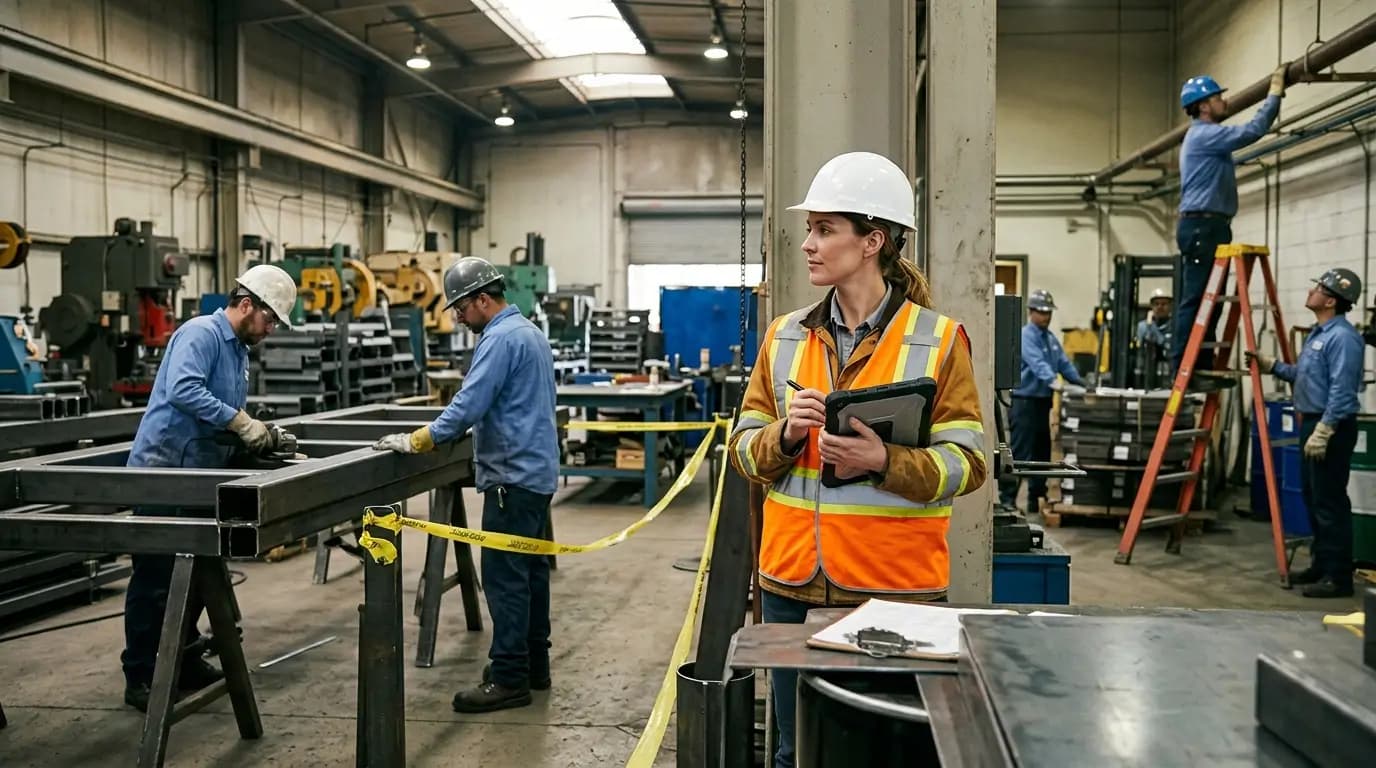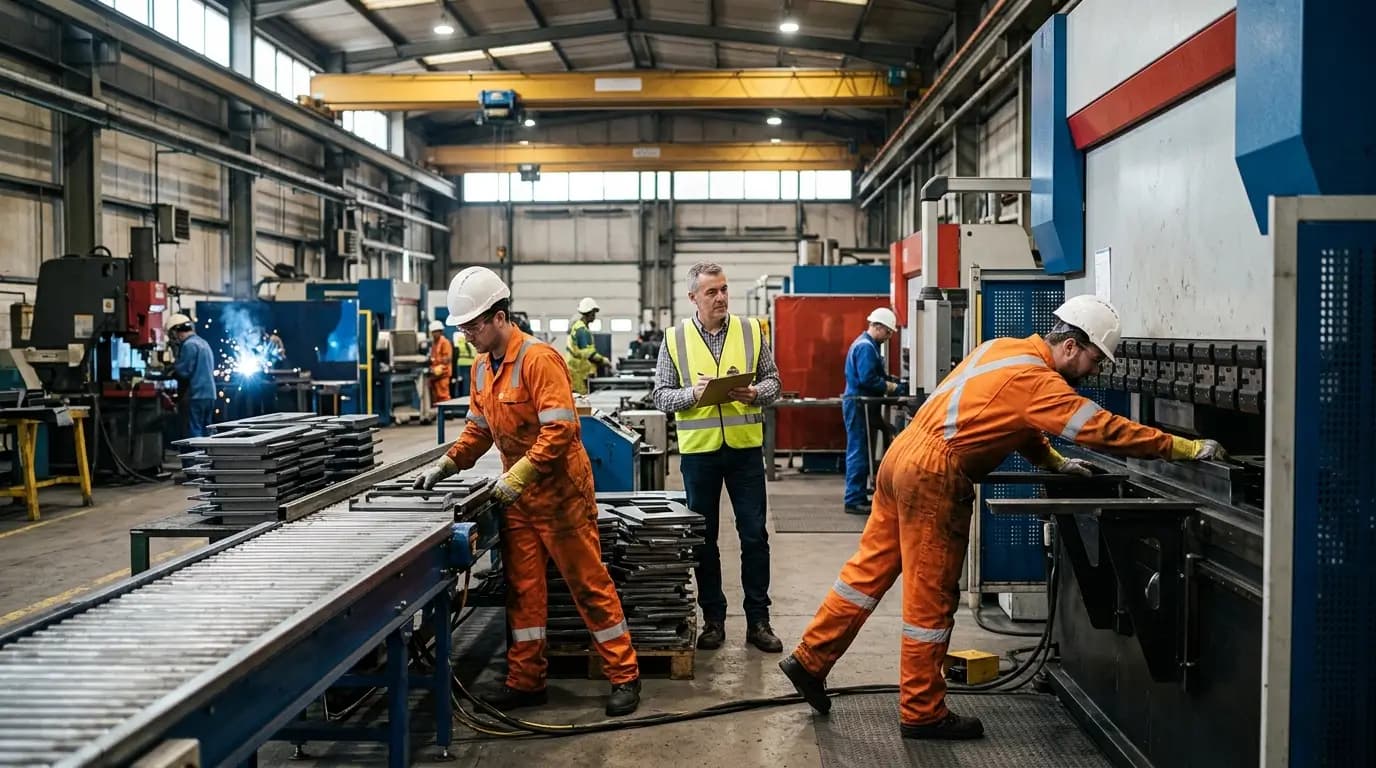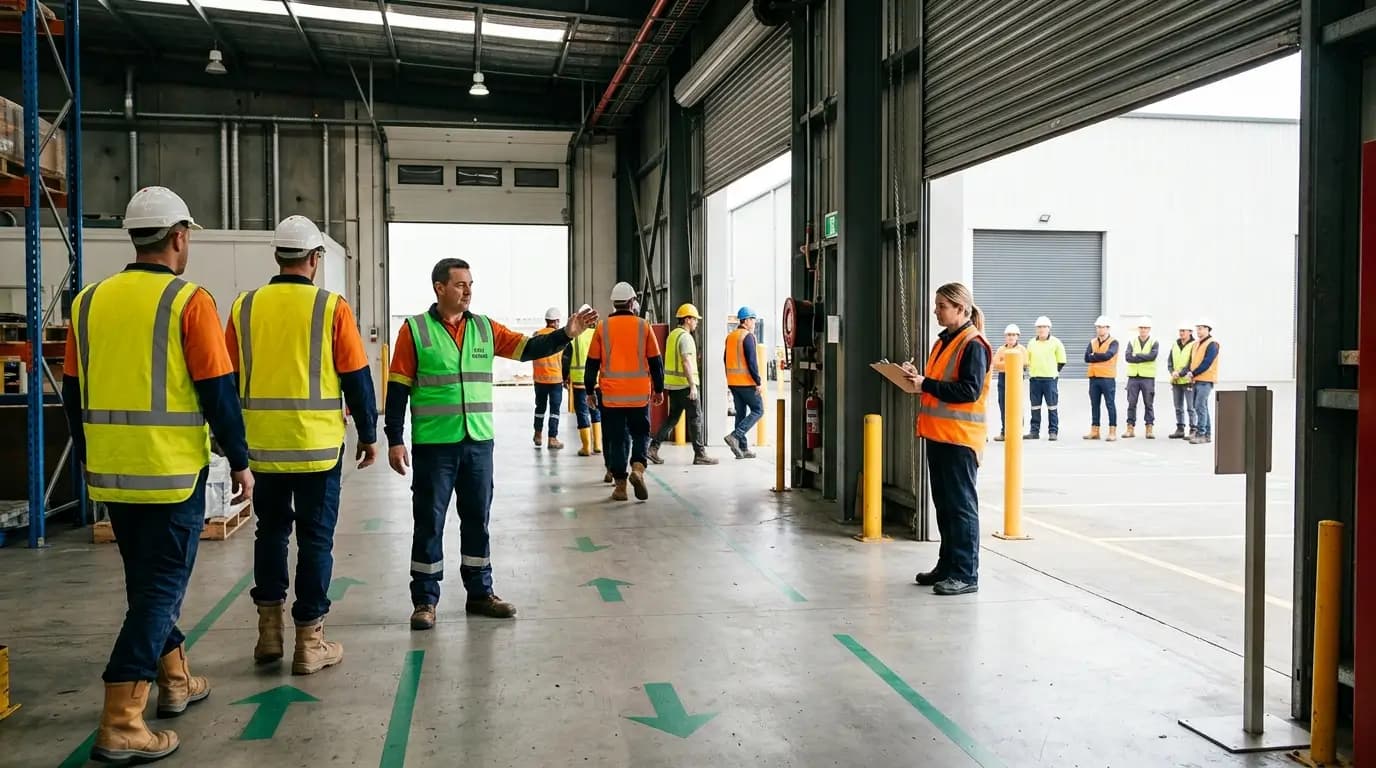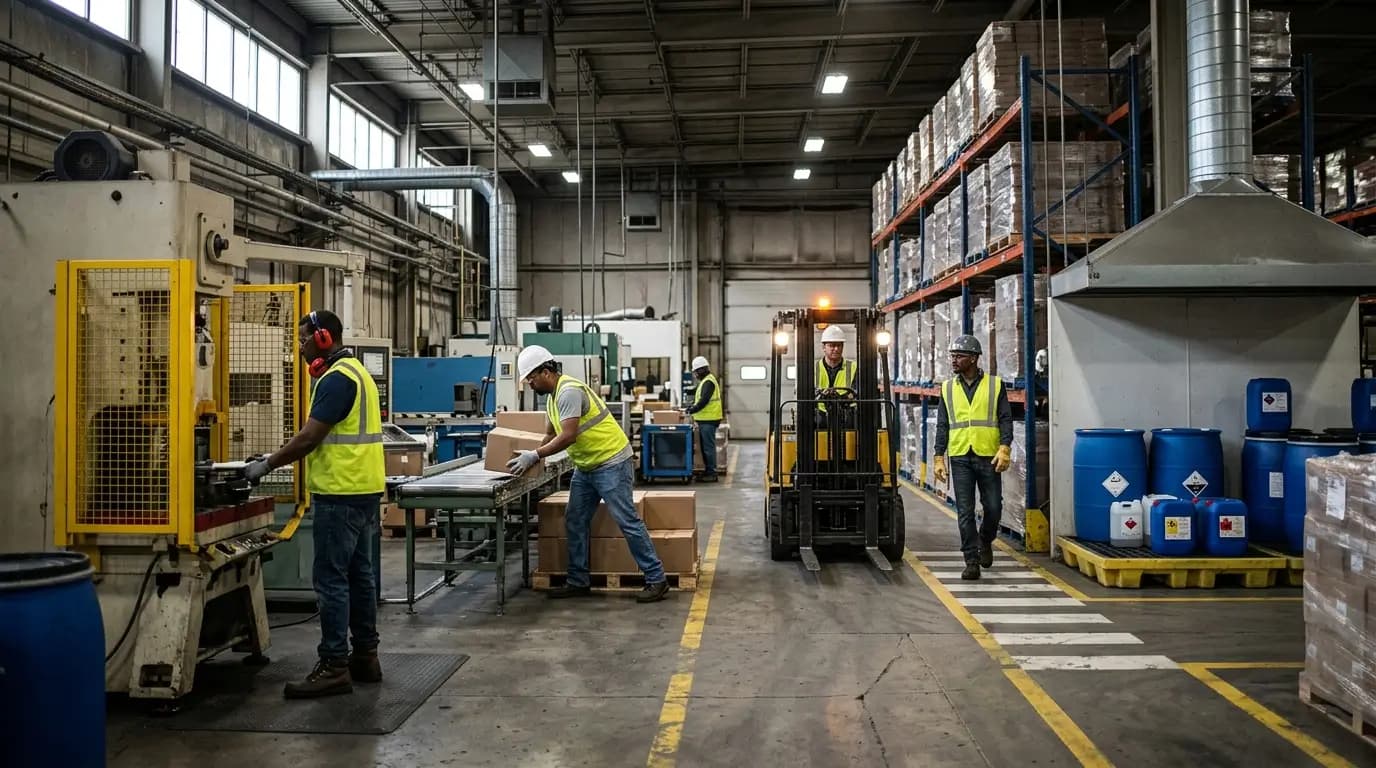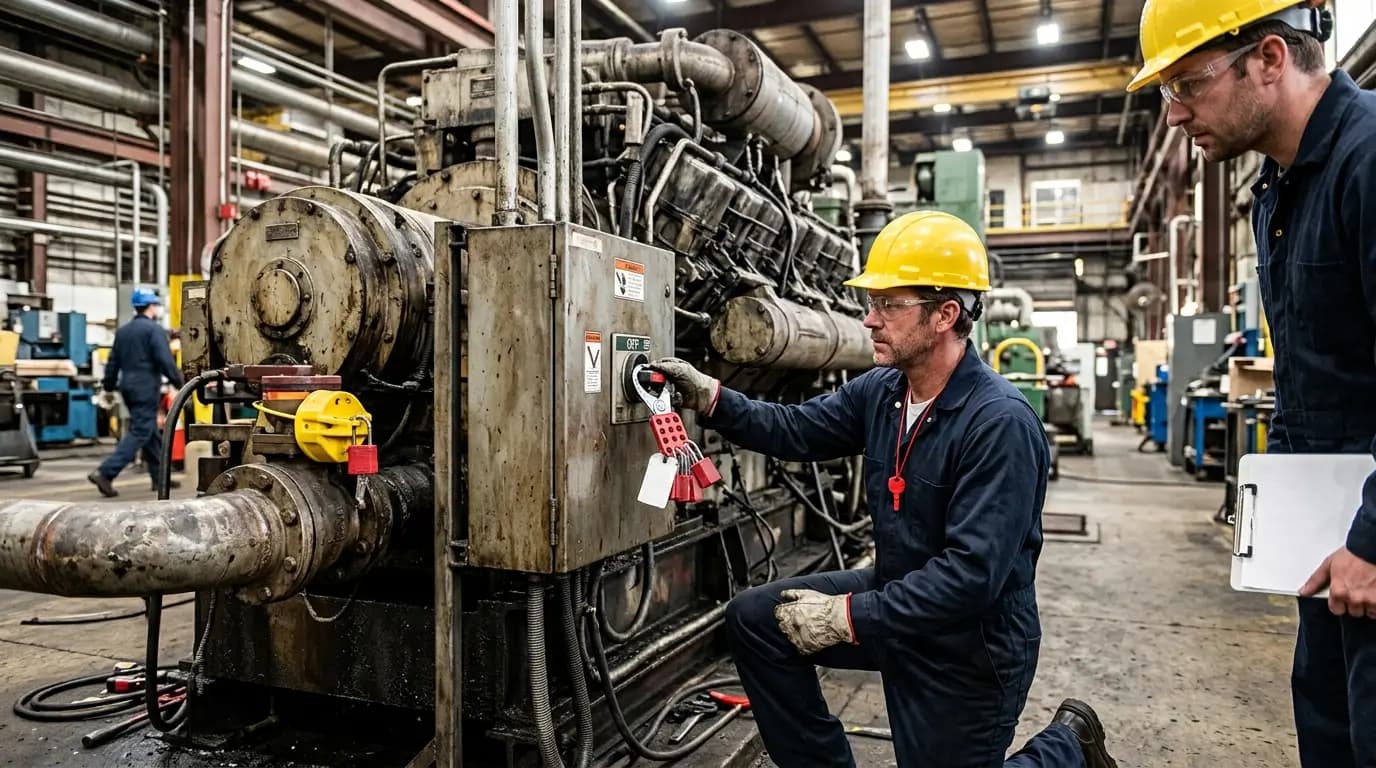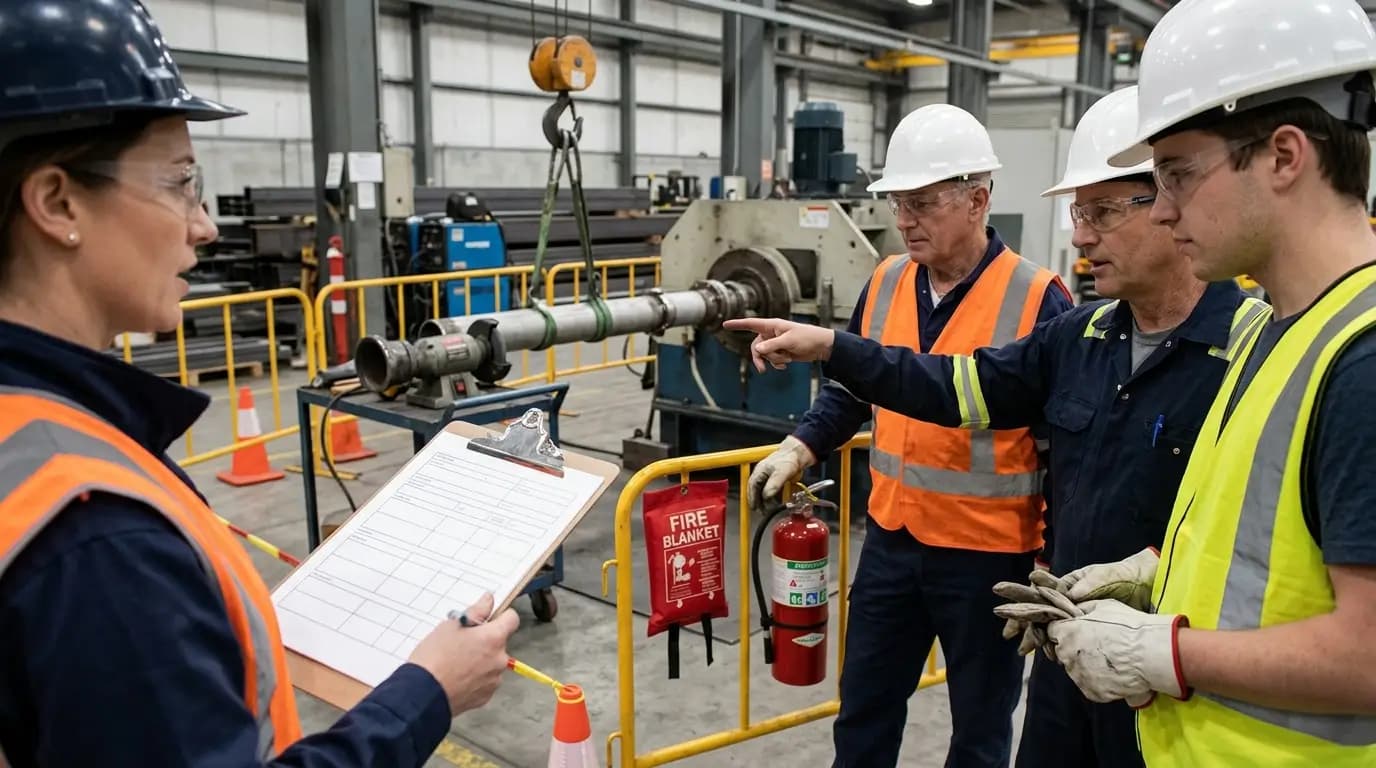


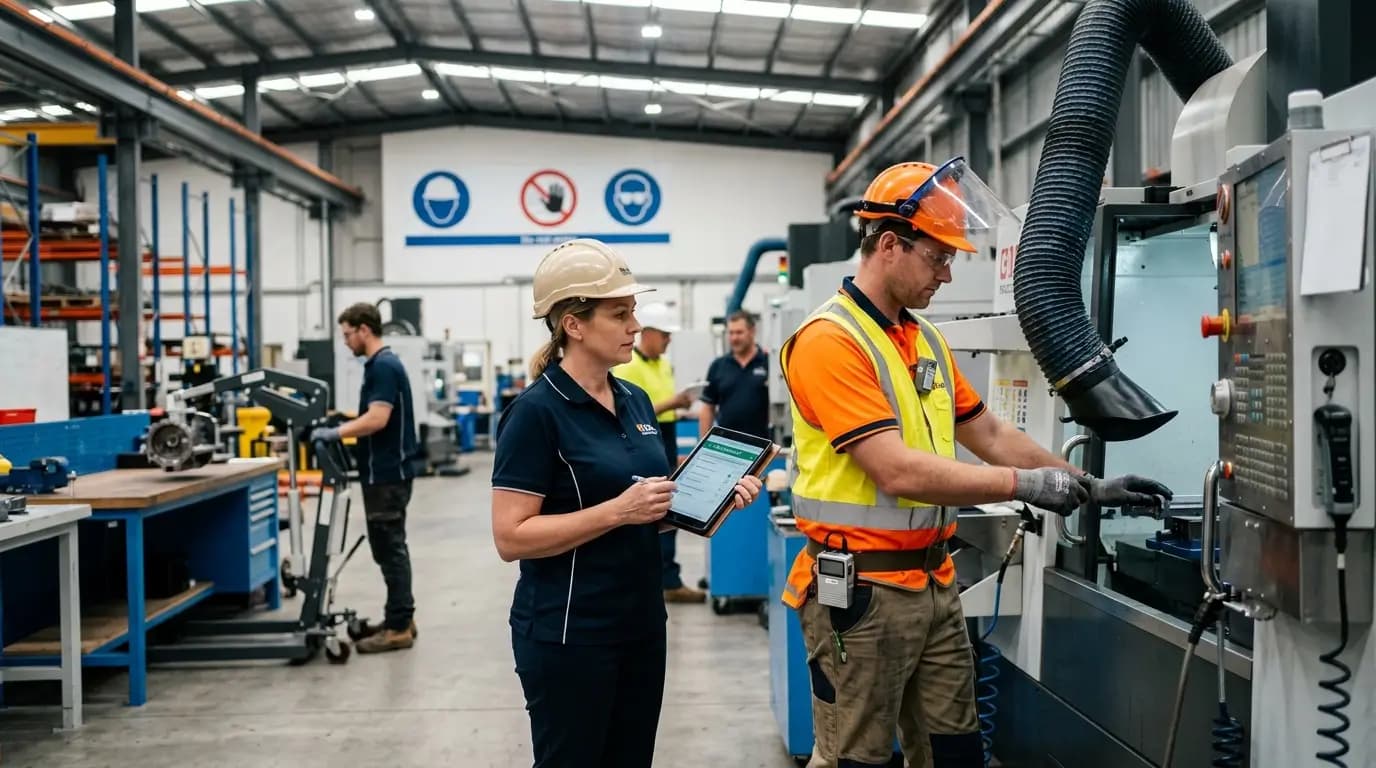
Occupational safety and health (OSH) is the discipline of anticipating, recognising, evaluating and controlling the hazards that arise from work — so that people are not injured, made ill, or killed by the job they do. The name contains two different professions. Occupational safety deals with events: the fall, the crush, the contact with live conductors. Occupational health deals with exposures: the dust, the noise, the solvent vapour, the shift roster, the load on a shoulder. They fail differently, they are found differently, and they are not resourced equally.
That imbalance is the single most useful thing to understand about this field, and it is the thread running through this guide. In sixteen years across pharmaceutical plants, container terminals, offshore assets and mine sites, almost every serious finding I have written up on the health side was invisible to the systems that were catching the safety ones perfectly well.
Key takeaways
Six points carry most of the practical weight of everything below:
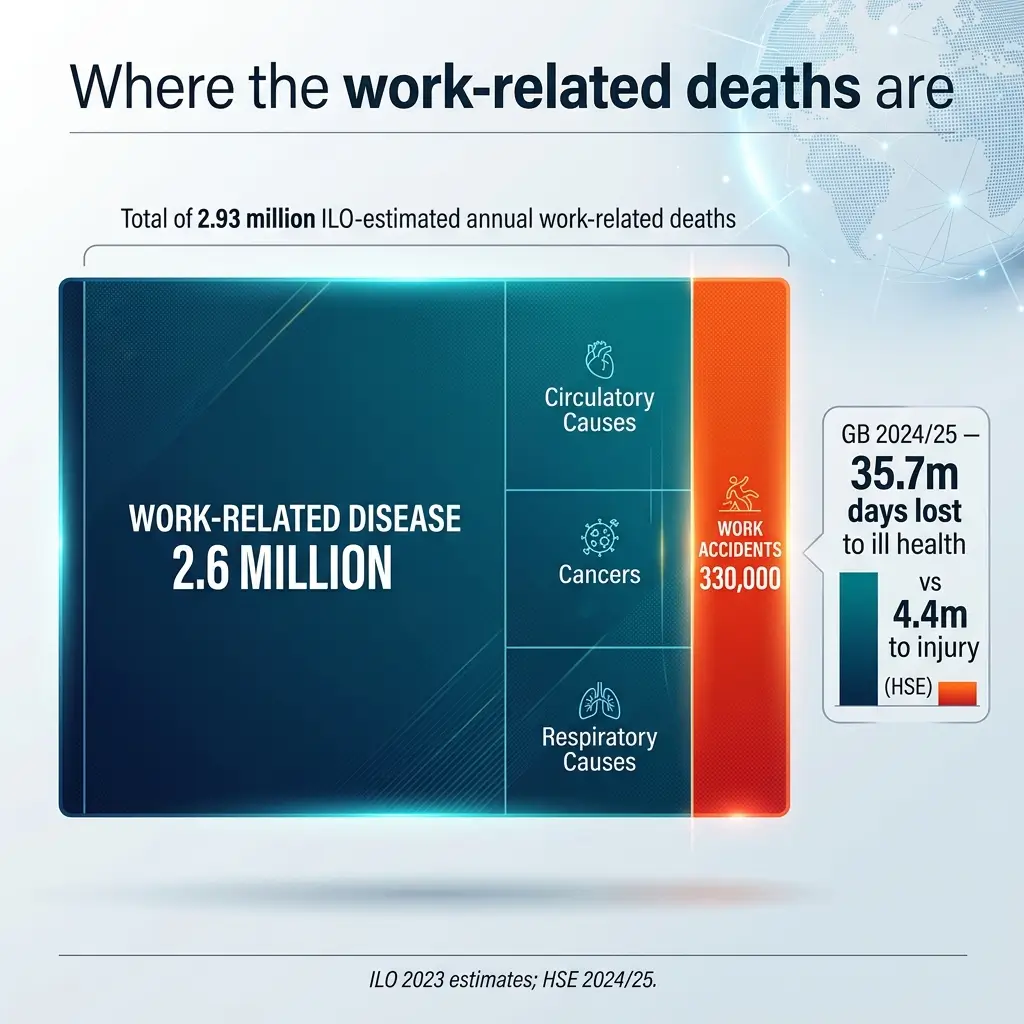
- OSH covers work-related injury and ill health. Globally, work-related diseases cause roughly 2.6 million of the nearly 3 million annual deaths the ILO attributes to work — accidents account for about 330,000.
- The US and UK use different legal tests. OSHA enforces against recognised hazards under Section 5(a)(1) of the OSH Act 1970; Great Britain requires employers to act so far as is reasonably practicable under Section 2 of the HSWA 1974.
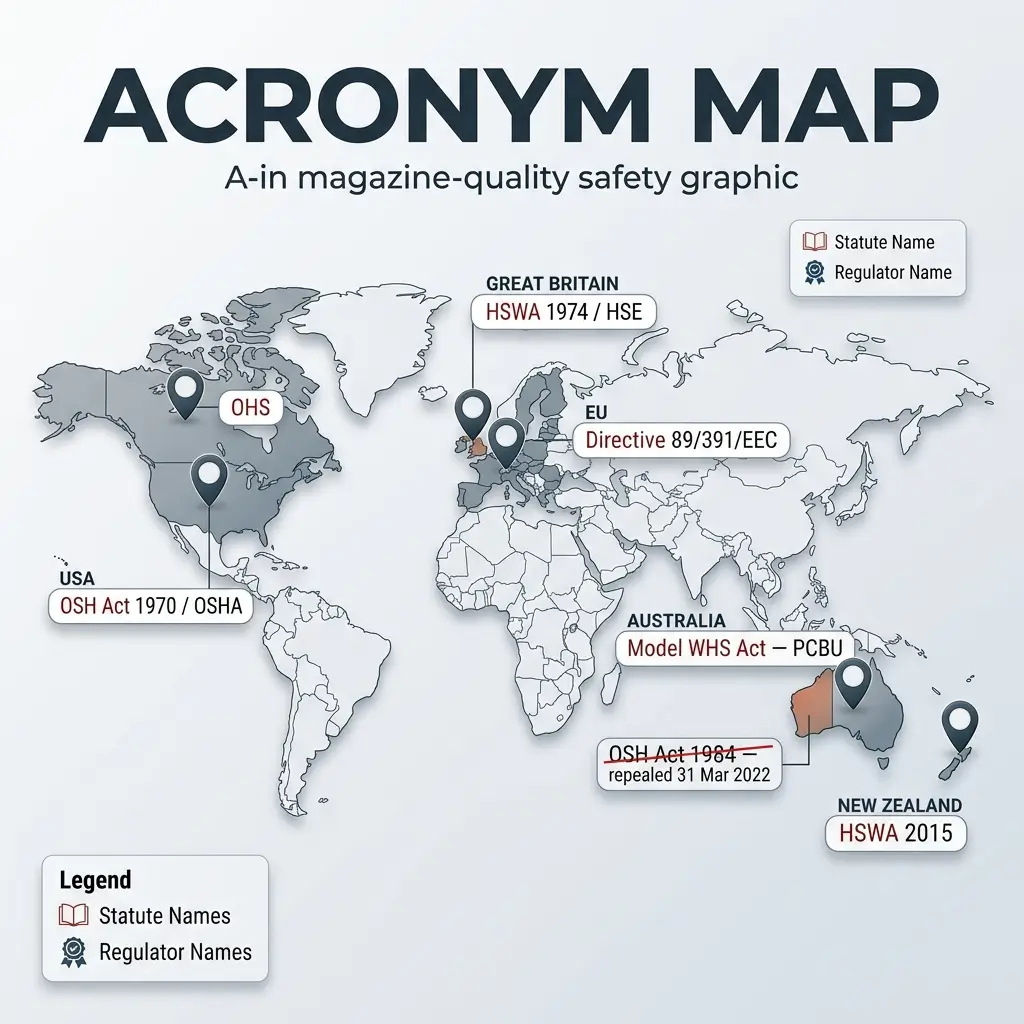
- OSH, OHS, WHS, HSW, EHS and SHEQ are not synonyms chosen at random — each maps to a jurisdiction and a statute. Western Australia's Occupational Safety and Health Act 1984, the origin of the "OSH" spelling in Australia, was repealed on 31 March 2022.
- Federal OSHA does not cover everyone. Self-employed people, immediate family members on family farms, and state and local government employees in states without an approved state plan sit outside its jurisdiction.
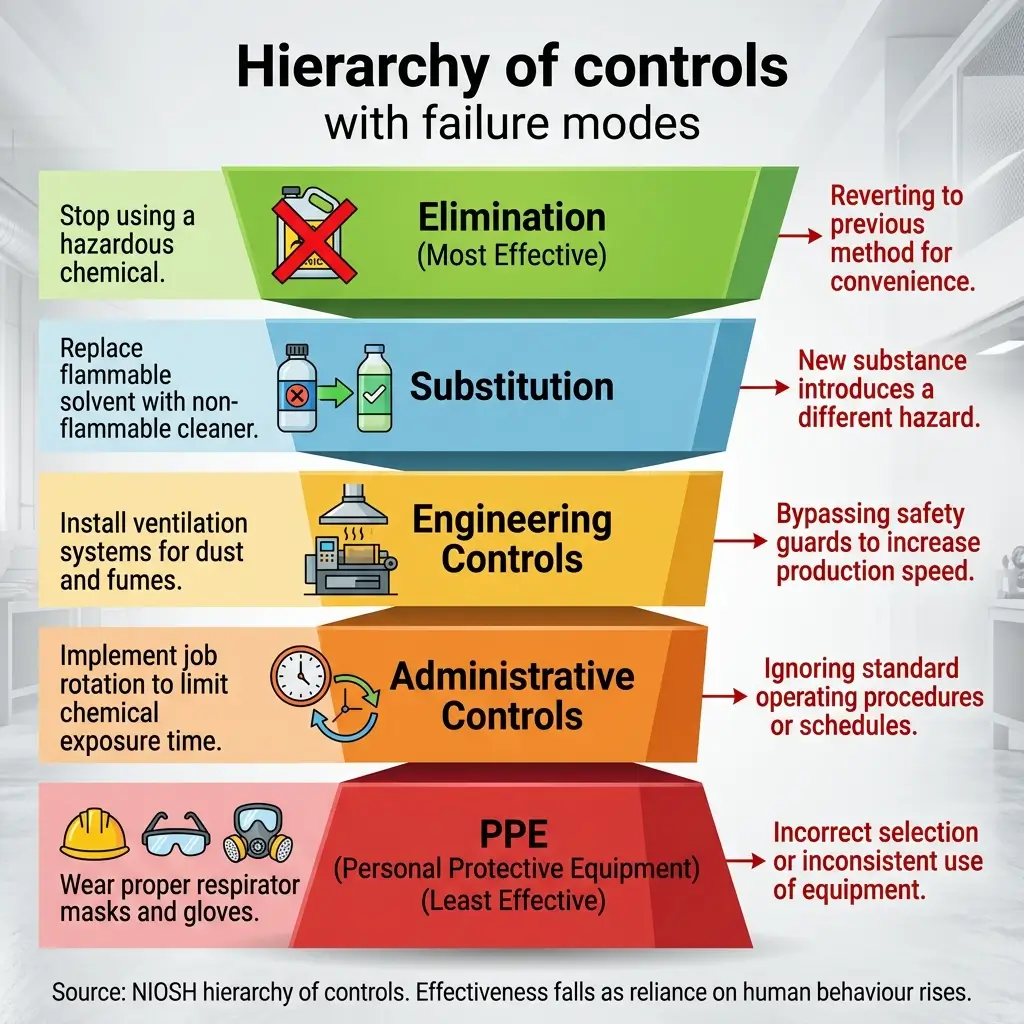
- Controls are ranked. The NIOSH hierarchy of controls puts elimination and substitution above engineering controls, and both above administrative controls and PPE, because the top of the hierarchy does not depend on a person doing something correctly every time.
- ISO 45001:2018 is a management-system standard. It tells you how to run the system; it does not tell you what a safe scaffold or an acceptable exposure looks like.
What occupational safety and health actually means
OSH is the multidisciplinary field concerned with the safety, health and welfare of people at work — and, importantly, of people affected by that work who are not employed by the organisation doing it. Contractors, visitors, delivery drivers, neighbours downwind of a stack. Every mature legal framework extends the duty past the payroll, because hazards do not check employment status.
The field draws on engineering, occupational medicine, occupational hygiene, ergonomics, toxicology, psychology and law. No single professional covers all of it, which is why a working OSH function is normally a small generalist team that knows when to bring in a specialist.
Safety and health are two disciplines, not one
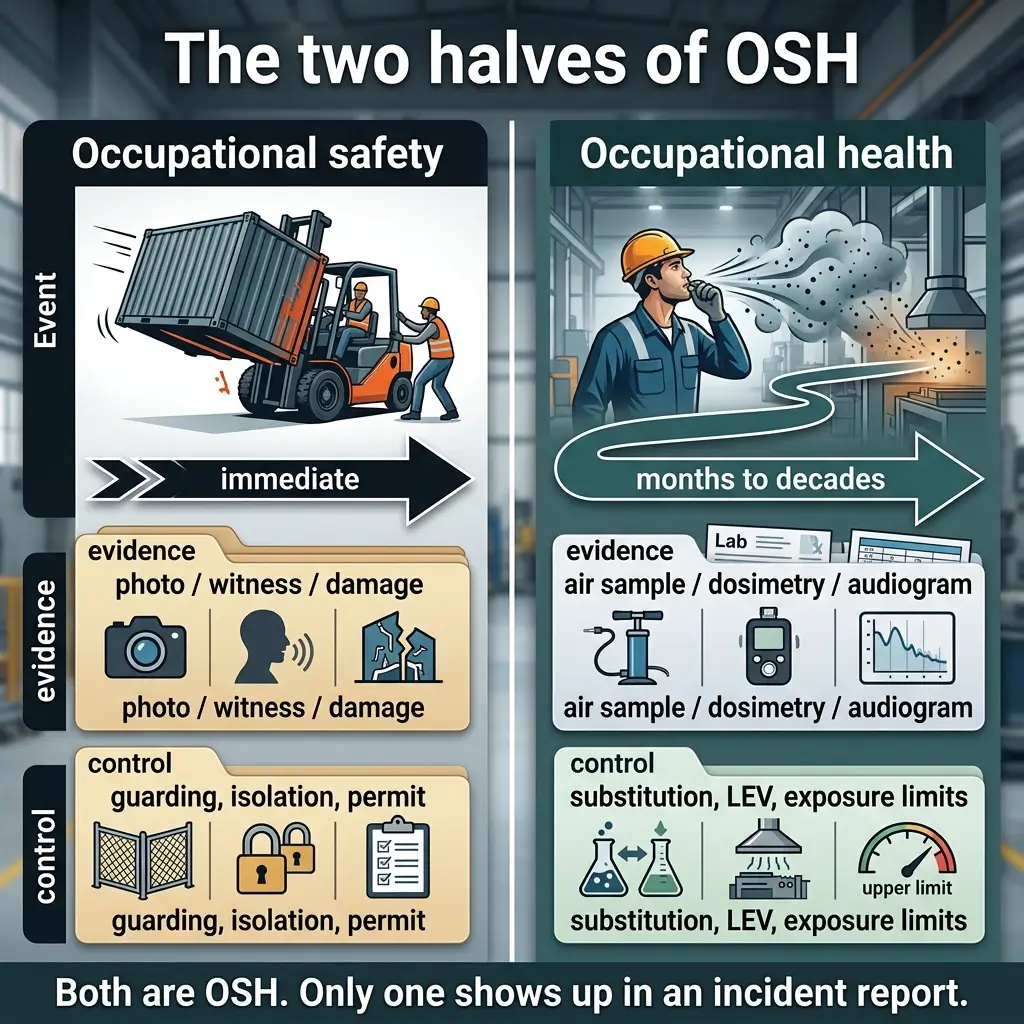
A safety failure announces itself. Someone falls, a load drops, a machine starts unexpectedly. There is a time, a place, a witness and usually a photograph. You investigate backwards from an event.
A health failure does not announce itself. A weigh booth that lets a plume escape does not produce an incident. It produces a slightly elevated exposure, repeated across a shift, a year, a career — and eventually a lung function result or a hearing threshold shift that nobody links to the booth. There is no event to investigate backwards from, which is why health hazards need to be sampled rather than reported.
This distinction decides how you find problems. If your entire assurance system is built on incident reports and near-miss cards, it is structurally blind to the health half of OSH. It will keep telling you things are improving.
The practical differences worth holding onto are these:
| Occupational safety | Occupational health | |
|---|---|---|
| Harm arrives as | A discrete event | Cumulative exposure |
| Time to appear | Immediate | Months to decades |
| How you find it | Incident and near-miss reporting, inspection | Monitoring, sampling, health surveillance |
| Typical evidence | Photographs, witness accounts, damage | Dosimetry results, air samples, audiograms |
| Dominant control | Guarding, isolation, barriers, permits | Ventilation, substitution, exposure limits, job design |
| Common failure | The control was bypassed | The control was never tested against the real task |
OSH also covers what the work does to the public
The definitions used by the ILO and by national regulators are deliberately broad. Great Britain's Health and Safety at Work etc. Act 1974 imposes a duty at Section 3 on employers and the self-employed towards people who are not their employees but may be affected by how they conduct their undertaking. That is why a scaffold over a public footpath and a solvent vent near a school are both OSH questions, not just planning ones.
The health half is the bigger half — and the harder one to see
If you only remember one set of numbers from this guide, make it this one. The International Labour Organization estimates that nearly three million workers die every year from work-related accidents and diseases, an increase of more than 5 per cent on 2015. Of those, 2.6 million deaths are attributable to work-related diseases, with work accidents accounting for a further 330,000. Circulatory disease, malignant neoplasms and respiratory disease are the top three causes and together make up more than three-quarters of the total.
Close to nine work-related deaths in ten are caused by something a worker breathed, absorbed, heard or endured — not by something that hit them.
National statistics tell the same story in a different register, and they are worth reading carefully because the reporting boundaries differ.
| Measure | Figure | Source and year |
|---|---|---|
| Global work-related deaths | Nearly 3 million, of which 2.6m from disease | ILO, 2023 estimates |
| Global non-fatal work injuries | 395 million workers | ILO, 2023 estimates |
| GB workers with work-related ill health | 1.9 million (highest on record) | HSE, 2024/25 |
| GB working days lost — ill health vs injury | 35.7 million vs 4.4 million | HSE, 2024/25 |
| GB work-related fatal injuries | 124 workers | HSE, 2024/25 |
| US fatal work injuries | 5,070 (rate 3.3 per 100,000 FTE) | BLS CFOI, 2024 |
| US recordable injury and illness cases, private industry | 2.5 million | BLS SOII, 2024 |
Two things in that table deserve a second look.
First, the British days-lost split. Ill health resulted in 35.7 million working days lost against 4.4 million lost to non-fatal injuries — roughly eight to one. Yet in most organisations I audit, the safety budget and the safety headcount run the other way round.
Second, a reporting artefact that quietly shapes how Americans think about this field. The BLS Census of Fatal Occupational Injuries counts fatal injuries; illness-related deaths are excluded unless an injury event precipitated them. The headline US number is therefore not a count of people killed by work — it is a count of people killed by workplace injuries. Occupational disease deaths exist in the US at scale; they just do not appear in the number everyone quotes.
What this looks like on a real shift
At an active pharmaceutical ingredient weigh booth in Macclesfield, the local exhaust ventilation was in service, in date, and had passed its examination. The paperwork was correct in every respect.
I smoke-tested it during the actual weighing motion rather than with the booth static. When the balance door opened mid-task — which it has to, because that is how weighing works — the product plume broke containment and drifted toward the operator's breathing zone. The fan was running the whole time.
I paused routine weighing on that booth, changed the door-opening sequence as an interim control, and escalated it for engineering redesign. Interim practice controls cut visible plume escape while the redesign was worked up.
The transferable point is not about weigh booths. It is that a running fan is not containment. If your LEV assurance consists of an annual examination certificate and a visual check that the unit is switched on, you have tested the equipment and not the control. Test the real motions — the door opening, the drum tipping, the bag shaking — because that is where exposure actually happens.
OSH, OHS, WHS, EHS: what the acronyms mean and where they belong
Practitioners moving between countries hit this immediately, and most online guides handle it badly — several still describe Western Australia's OSH Act as current law. The acronym you see on a job advert usually tells you which statute the organisation is working under.
| Acronym | Expansion | Where it is used | Anchor legislation or body |
|---|---|---|---|
| OSH | Occupational safety and health | International / ILO usage; formerly Western Australia | ILO Conventions 155 and 187 |
| OHS | Occupational health and safety | Canada, Victoria (Australia), general international | Occupational Health and Safety Act 2004 (Vic) |
| WHS | Work health and safety | Most Australian jurisdictions | Model Work Health and Safety Act |
| HSW / H&S | Health and safety at work | Great Britain, New Zealand | HSWA 1974; HSWA 2015 (NZ) |
| EHS / HSE | Environment, health and safety | Corporate usage worldwide | Internal; also GB's regulator, the HSE |
| SHEQ / HSEQ | Safety, health, environment, quality | EPC, energy, manufacturing | Internal; ISO 45001 + 14001 + 9001 |
The word swap is not cosmetic. When Australia harmonised, "occupational" became "work" deliberately — the intent was to cover work rather than only occupations, which widened the net over labour hire, contractors and gig arrangements. The same reform replaced "employer" with PCBU — person conducting a business or undertaking — as the primary duty holder.
Western Australia was the last holdout, and the change matters for anyone citing it. The Occupational Safety and Health Act 1984 (WA) was repealed by section 278 of the Work Health and Safety Act 2020 and ceased on 31 March 2022. The WHS Act and its regulations now cover all workplaces in WA's jurisdiction, including mines and petroleum operations.
What the law requires: one duty, four legal systems
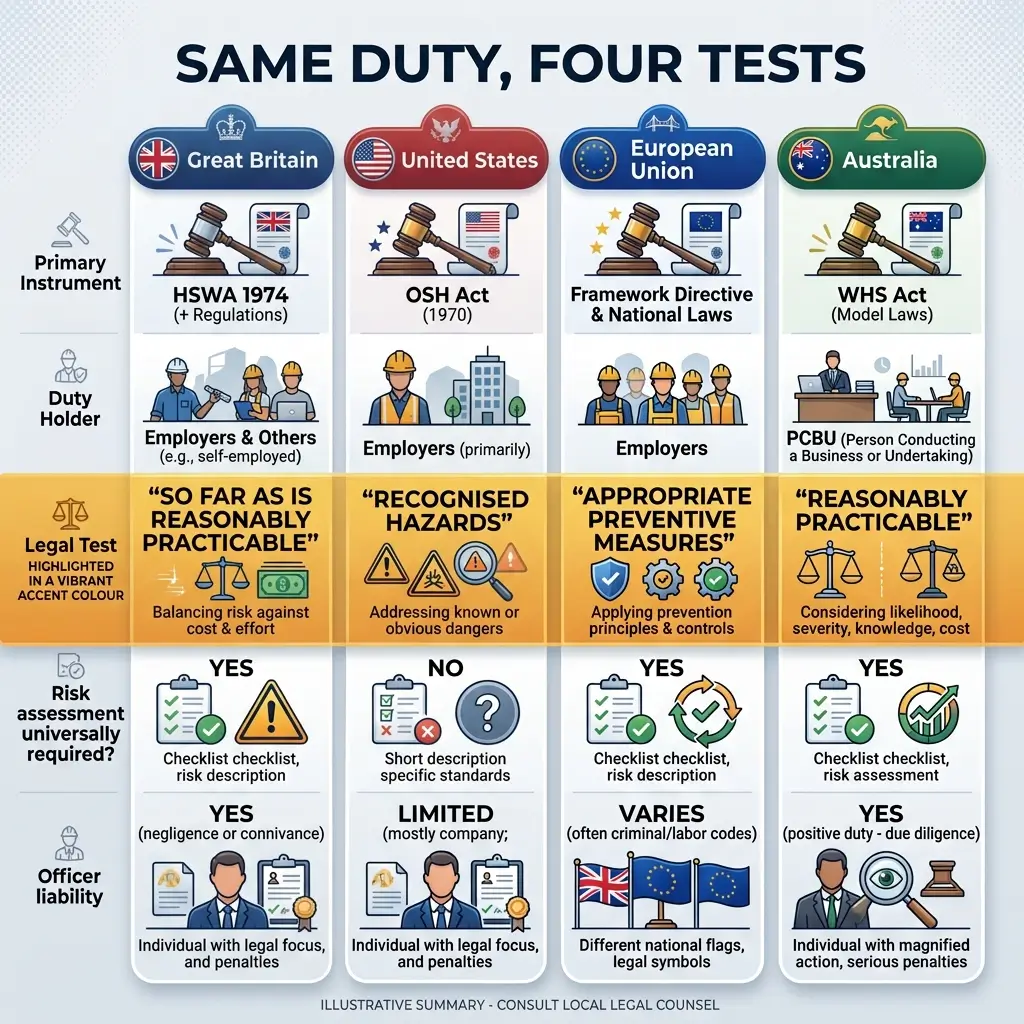
Every developed framework says the same thing in substance — the person who creates the risk must control it — and then diverges sharply on the test applied. If you write one global procedure, this section is the part that has to be right.
United States: recognised hazards under the OSH Act 1970
The Occupational Safety and Health Act of 1970 created both OSHA and NIOSH. Its general duty clause at Section 5(a)(1) requires that each employer furnish to each employee employment and a place of employment free from recognized hazards that are causing or are likely to cause death or serious physical harm, and Section 5(a)(2) requires compliance with the promulgated standards themselves.
Standards sit in four groups: general industry (29 CFR 1910), construction (1926), maritime (1915–1919) and agriculture (1928). The general duty clause is the gap-filler — it is used only where no specific standard applies to the particular hazard, which is why heat stress, ergonomics and workplace violence have historically been cited under it.
Who federal OSHA does not cover
This is the question I get asked most often by American supervisors, and most guides skip it entirely.
The OSH Act does not reach state or local government employers. Section 18 authorises states to run their own plans, which OSHA must approve if they are at least as effective; a state plan must then cover the public sector employers OSHA cannot reach. Currently 21 states and Puerto Rico operate plans covering all employers, and five states plus the US Virgin Islands run plans covering only state and local government employers. In the remaining states, public sector workers are outside OSHA standards and enforcement altogether. Self-employed people and immediate family members of farm employers also sit outside.
Sitting outside OSHA's jurisdiction is not the same as having no exposure to liability — state law, insurers and civil claims all still apply.
Great Britain: so far as is reasonably practicable
The Health and Safety at Work etc. Act 1974 takes a different approach. Section 2(1) places a duty on every employer to ensure, so far as is reasonably practicable, the health, safety and welfare at work of all employees. The Act sets out general duties for employers towards employees and the public, for employees towards themselves and each other, and for certain self-employed people.
"So far as is reasonably practicable" — SFAIRP — is the whole game. It requires weighing the risk against the time, cost and trouble of controlling it. The balance must be grossly disproportionate before cost wins. Note also that the burden of proof runs backwards compared with most litigation. It falls on the duty holder to show the further measure was not reasonably practicable.
The Act is a framework. The operational detail lives in regulations beneath it — the Management of Health and Safety at Work Regulations 1999 (risk assessment), COSHH 2002, the Work at Height Regulations 2005, RIDDOR 2013, and so on.
European Union: the Framework Directive
Directive 89/391/EEC establishes minimum safety and health requirements across Europe, obliges employers to take appropriate preventive measures, and introduces risk assessment as a key element with defined components including hazard identification and worker participation. Member States may set more stringent requirements. The directive aims at an equal level of protection for all workers, with narrow exceptions for domestic workers and certain public and military services. Individual daughter directives then cover workplaces, work equipment, PPE, manual handling and display screen equipment.
Working across Dow's European sites, the practical consequence is that "EU compliant" is never a complete answer. The directive is a floor; the Member State transposition is the law you are actually audited against, and the gap between a German and a Spanish implementation of the same directive is real.
Australia: model WHS laws and the PCBU
Australia's model WHS Act is adopted by all jurisdictions except Victoria, which retains its 2004 OHS Act. It has three distinguishing features. The PCBU is the primary duty holder. Officers carry a positive due diligence duty, meaning senior managers can be prosecuted personally for failing to acquire and apply knowledge of WHS matters. And industrial manslaughter is a specific offence.
Here is the comparison in one place:
| United States | Great Britain | European Union | Australia (model WHS) | |
|---|---|---|---|---|
| Primary instrument | OSH Act 1970 | HSWA 1974 | Directive 89/391/EEC | Model WHS Act |
| Duty holder | Employer | Employer, self-employed | Employer | PCBU |
| Legal test | Free from recognised hazards | So far as is reasonably practicable | Appropriate preventive measures | Reasonably practicable |
| Risk assessment | Standard-specific, not universal | MHSWR 1999 Reg. 3 | Directive Art. 6 — universal | WHS Regulations |
| Regulator | OSHA + state plans | HSE + local authorities | Member State regulators | State and territory regulators |
| Officer liability | Limited | Section 37 HSWA | Varies by Member State | Explicit due diligence duty |
How OSH works in practice: the risk management cycle
Strip away the acronyms and every OSH framework in the world runs the same four-step loop. Where organisations fail is almost never in the first three steps.
1. Identify the hazard. Walk the job as it is actually done, not as the method statement describes it. Talk to the people doing it on nights, because the night version of a task is often a different task.
2. Assess the risk. Judge how likely harm is and how severe it would be, against the controls that genuinely exist today. A risk assessment scored against controls you intend to install is a plan, not an assessment.
3. Select controls using the hierarchy. The NIOSH hierarchy of controls sets the preferred order of action. Elimination, substitution and engineering controls rank higher because they control exposure without significant human interaction; administrative controls and PPE can also reduce exposure but depend on people.
| Level | What it does | Example | Why it can still fail |
|---|---|---|---|
| Elimination | Removes the hazard | Prefabricate at ground level instead of working at height | Often only cheap at design stage |
| Substitution | Swaps in something less hazardous | Water-based solvent for a chlorinated one | The substitute brings its own hazards |
| Engineering | Isolates people from the hazard | LEV, interlocked guarding, fixed edge protection | Rarely tested against the real task motion |
| Administrative | Changes how people work | Permits, rotation, exposure-time limits | Erodes under production pressure |
| PPE | Puts a barrier on the person | Respirators, hearing protection, gloves | Depends on correct fit, wear and condition every time |
4. Verify that the control works. This is the step that collapses.
The step where it collapses
At a mining control point in South Africa, a supervisor told me his team completed daily critical control checks — the checks standing between the workforce and a fatal risk. He was entirely convincing. When I asked to see the evidence, there was no time-stamped field record of any of them.
I raised it as a systemic finding rather than an individual one, and required that verification be evidenced from the field. Assurance moved to evidenced field checks on sampled shifts.
I have used that finding in training rooms ever since, because it generalises further than mining: spoken "all good" is not verification. If your assurance depends on someone telling you a check happened, you are auditing confidence, not control. Ask for the artefact — the time-stamped record, the reading, the photograph taken at the location — and ask for it on the shift that is hardest to reach.
The four questions worth asking about any control in your workplace are:
- Does it exist right now, or is it in the plan and the procedure?
- Was it tested against the real task, including the door opening, the drum tipping, the awkward reach?
- Does the evidence come from the field, with a time and a place attached?
- Does it survive the night shift, the changeover, and the contractor who has never been here before?
The hazard categories an OSH programme has to cover
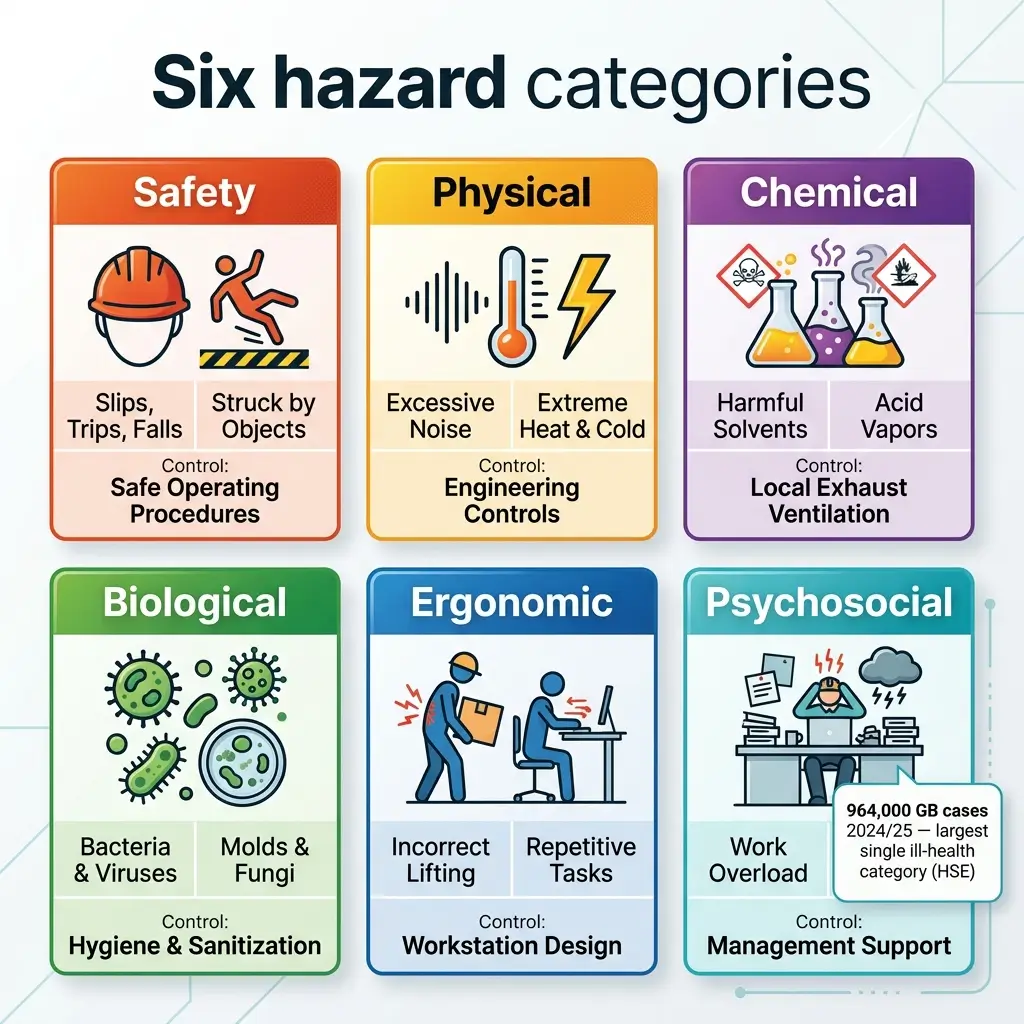
A programme that only manages the categories it can see will produce good injury figures and poor health outcomes. Six categories cover the field, and the last two are the ones most commonly under-resourced.
| Category | Typical hazards | Dominant control | Who assesses it |
|---|---|---|---|
| Safety | Falls, moving machinery, stored energy, vehicles, falling objects | Guarding, isolation, segregation, permits | Safety practitioner, competent person |
| Physical | Noise, vibration, heat and cold, radiation | Engineering at source, exposure time limits | Occupational hygienist |
| Chemical | Dusts, fumes, solvents, gases, corrosives | Substitution, containment, LEV | Occupational hygienist |
| Biological | Bacteria, viruses, moulds, legionella, blood-borne agents | Water system control, containment, vaccination | Hygienist, occupational health |
| Ergonomic | Manual handling, repetition, posture, force | Task and workstation redesign | Ergonomist, physiotherapist |
| Psychosocial | Workload, fatigue, shift design, bullying, low control | Job and roster design, management practice | HR with OSH; ISO 45003 |
Psychosocial risk is no longer a soft add-on. In Great Britain, stress, depression or anxiety accounted for 964,000 of the 1.9 million work-related ill health cases in 2024/25 — the largest single category, more than musculoskeletal disorders. Running a night container terminal fatigue programme at Jebel Ali and Tanjung Pelepas taught me that fatigue behaves like a chemical exposure and needs the same treatment: a measurable dose, a designed limit, and verification that the limit holds when the vessel is late.
Where ISO 45001 fits — and where it does not
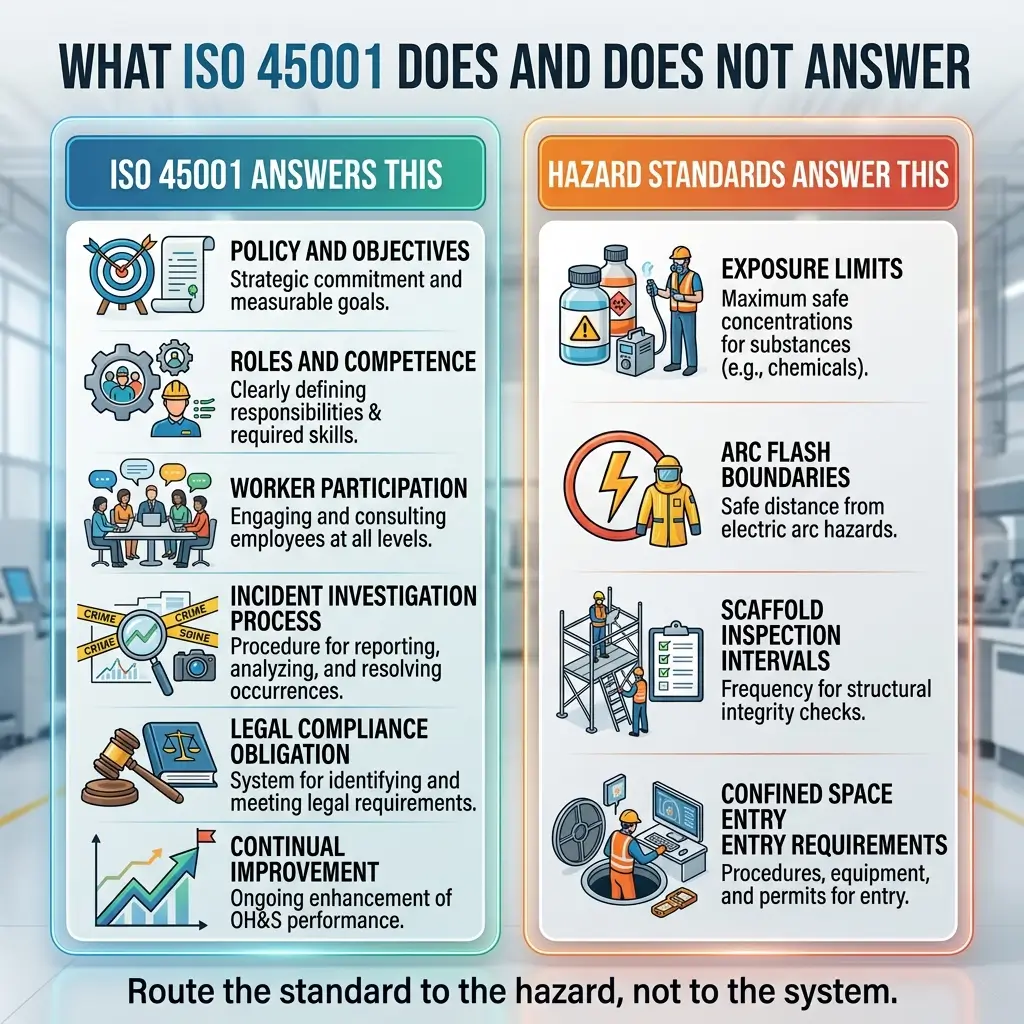
ISO 45001:2018 specifies requirements for an occupational health and safety management system: policy, planning, leadership, worker participation, hazard identification, legal compliance, emergency preparedness, incident investigation and continual improvement, on a Plan-Do-Check-Act cycle. It replaced OHSAS 18001 and shares the Annex SL structure of ISO 9001 and ISO 14001, so integration is straightforward if you already run one.
It is genuinely useful, and it is routinely misused in articles like this one. ISO 45001 is a system standard. It will not tell you the arc flash boundary, the workplace exposure limit for respirable crystalline silica, or how often a scaffold must be inspected. Those live in hazard-specific instruments. An article — or an audit — that answers a hazard question with an ISO 45001 clause has answered the wrong question.
Two things I look for when auditing a certified site, having led ISO 45001 work across chemical and offshore assets:
- Worker participation with teeth. Clause 5.4 asks for participation, not consultation theatre. Can a worker point to something that changed because they raised it?
- Legal register accuracy. A register listing a repealed statute — the WA OSH Act being the current favourite — tells you the system is being maintained by copy-paste.
Certification is evidence that a system exists and is being audited. It is not evidence that controls work at 02:10 on a Sunday. That still has to be checked in the field.
Who does OSH work: roles, competence and qualifications
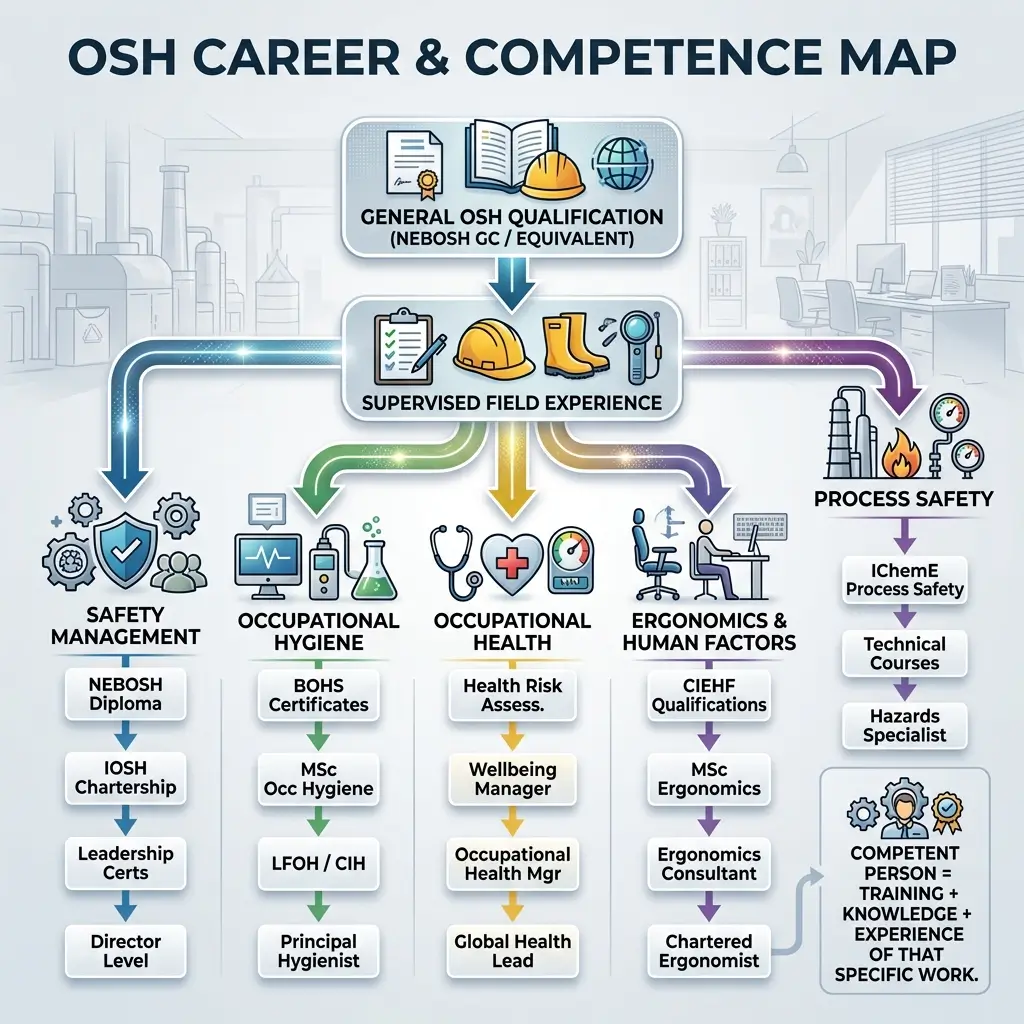
OSH is not one job. Confusing the roles is how organisations end up asking a generalist safety adviser to sign off an exposure assessment they are not qualified to make.
| Role | What they actually do | Common route in |
|---|---|---|
| Safety adviser / officer | Site-level risk assessment, inspection, incident support | NEBOSH General Certificate; IOSH membership |
| Health and safety manager | Programme design, legal compliance, assurance | NEBOSH Diploma; CMIOSH; NVQ Level 6 |
| Occupational hygienist | Exposure measurement, LEV assessment, control design | BOHS modules and Certificate of Operational Competence; ABIH CIH (US) |
| Occupational health nurse or physician | Health surveillance, fitness for work, case management | Clinical qualification plus occupational specialism |
| Ergonomist / human factors specialist | Task and workstation design, error and fatigue | CIEHF-recognised degree route |
| Process safety engineer | Major accident hazards, HAZOP, barriers, SIL | Engineering degree plus process safety training |
Note that a "competent person" is a legal construct, not a courtesy title. Different regulations define it differently, and the definition usually combines training, knowledge and experience of that specific work. A NEBOSH certificate does not make someone competent to inspect a scaffold, and no general safety qualification qualifies anyone to interpret a personal air sample.
Having trained more than 6,500 people across seventeen countries, the pattern I see most is organisations buying qualification instead of competence. The certificate is the entry ticket. Competence is demonstrated by watching someone assess a real task, in the real conditions, and explain their reasoning.
If you are entering the field, the honest sequence is: a recognised general qualification, then supervised field time in one sector, then specialisation once you know which half of OSH you actually want to work in.
Frequently asked questions
These are the questions that come up most often in induction rooms and in search results, answered short.
What is the difference between OSH and OHS?
None in substance — both mean occupational safety and health. The word order is a regional convention: OSH follows ILO and US usage, OHS is standard in Canada and Victoria, Australia. Neither implies a different scope of duty. Check which statute the organisation is working under rather than reading meaning into the letters.
Is OSH the same as HSE?
Not quite. HSE usually means health, safety and environment — a broader corporate function that adds environmental management. In Great Britain, HSE also names the regulator, the Health and Safety Executive. Context decides which is meant, and on a British site it is usually the regulator.
Who is responsible for occupational safety and health at work?
The employer or PCBU carries the primary legal duty and cannot delegate it away. Managers and officers carry duties for how they direct work — in Australia, an explicit due diligence duty. Workers must take reasonable care for themselves and others and must not interfere with controls provided.
Is OSH a legal requirement for small businesses?
Yes, with lighter documentation. In Great Britain the duty applies from the first employee, though a written health and safety policy is only required at five or more. Under OSHA, employers with ten or fewer employees are exempt from routine injury and illness recordkeeping but not from the standards themselves.
What does "so far as is reasonably practicable" mean?
It means balancing the level of risk against the time, cost and effort of controlling it — and doing whatever is not grossly disproportionate. Cost alone is not a defence for a serious risk. If challenged, the duty holder must show why a further measure was not reasonably practicable.
What are the main types of workplace hazard?
Six categories cover the field: safety, physical, chemical, biological, ergonomic and psychosocial. Programmes commonly manage the first well and the last two poorly, which is why ill-health figures stay high while injury figures fall.
Do I need a qualification to work in OSH?
For most roles, yes in practice. NEBOSH and IOSH qualifications are the usual entry route in the UK and much of the international market, and BCSP certifications in the US. Legally, what matters is competence for the specific task — which combines training, knowledge and relevant experience.
Where to start if you are building this from nothing
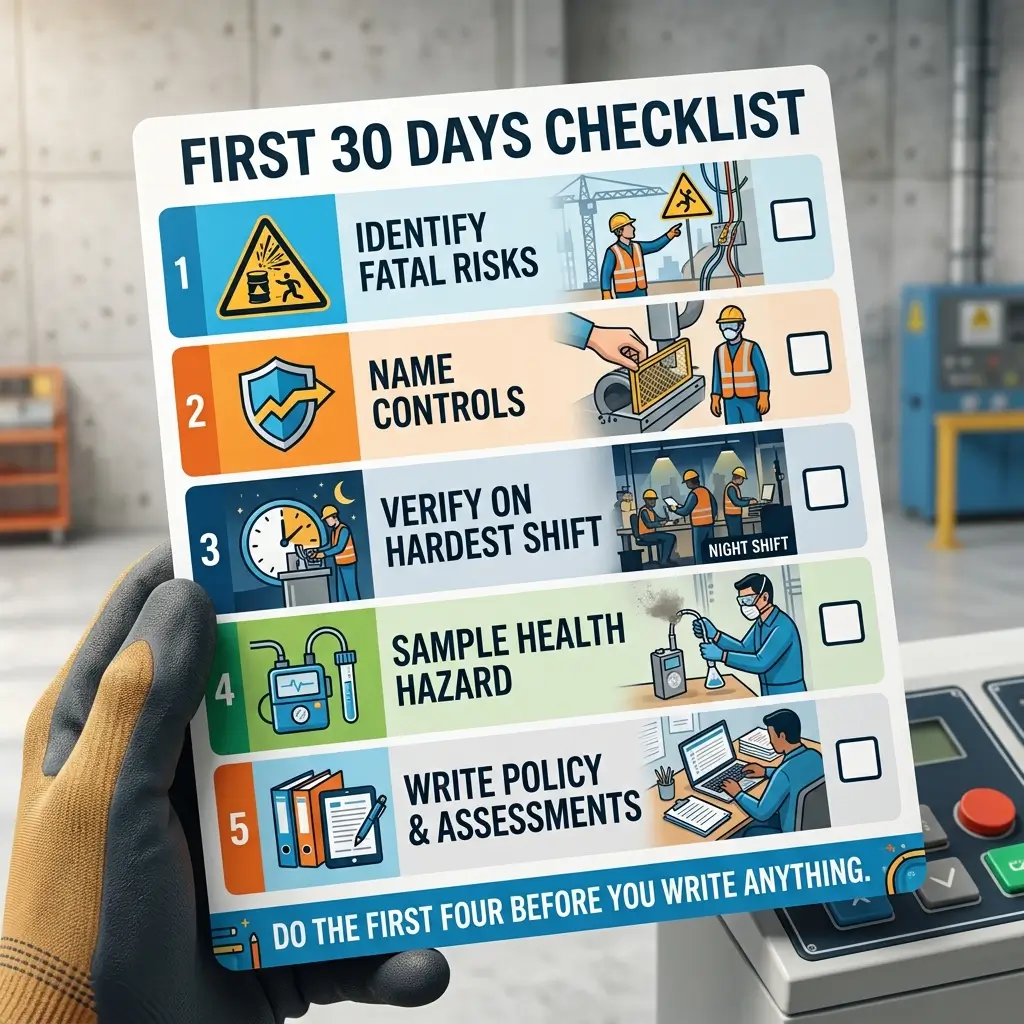
If you have been handed responsibility for OSH and no programme exists, resist the urge to write policy first. Policy is the easiest artefact to produce and the least predictive of whether anyone gets hurt.
Start instead by finding out what is actually true on your site:
- List the ways someone could be killed or permanently harmed here. Usually a short list — five to eight items.
- For each one, name the control that prevents it and go and look at that control on the shift where it is under most pressure.
- Ask for the evidence that the control was verified, with a time and a place attached.
- Do the same for one health hazard — noise, dust, solvent, fatigue — because it will not appear on any incident report.
- Then write the policy, the risk assessments and the training plan, against what you found.
Steps 1 to 4 will tell you more about your OSH performance than an entire management system manual. Everything else in this guide exists to help you do them properly.
Where a task genuinely requires specialist judgement — exposure assessment, structural adequacy, process hazard analysis — bring in someone qualified for that specific work. Reading a guide, including this one, does not make anyone a competent person for a task they have not been trained and assessed to do.
About the author — Chloe Anderson
Chloe Anderson is a British Occupational Health, Safety and Environment (OHSE) Technical Educator and Site Assurance Consultant with 16 years of continuous field experience across 17 countries. She holds an MSc in Occupational Hygiene (University of Birmingham) and a BSc (Hons) in Environmental Health (University of Manchester), is a Chartered Member of IOSH (CMIOSH), and holds the NEBOSH National Diploma and ISO 45001 Lead Auditor certification. Her field record includes 180+ workplaces inspected, 70+ audits, 150+ risk assessments and more than 6,500 professionals trained, through senior roles with AstraZeneca, Novo Nordisk, Equinor, Dow, Fluor, Anglo American and DP World. She leads Anderson OHSE Assurance & Education from Edinburgh.
Sources and further reading
- International Labour Organization — Nearly 3 million people die of work-related accidents and diseases (2023 global estimates)
- International Labour Organization — A safe and healthy working environment: a fundamental principle and right at work
- OSHA — OSH Act of 1970, Section 5: Duties
- US Bureau of Labor Statistics — Census of Fatal Occupational Injuries, 2024 and Injuries, Illnesses and Fatalities program
- HSE — Health and Safety at Work etc Act 1974 and Key figures for Great Britain 2024/25
- legislation.gov.uk — HSWA 1974, Section 2
- EU-OSHA — The OSH Framework Directive 89/391/EEC
- WorkSafe WA — Work health and safety laws
- NIOSH — Hierarchy of Controls
- ISO — ISO 45001:2018 Occupational health and safety management systems