
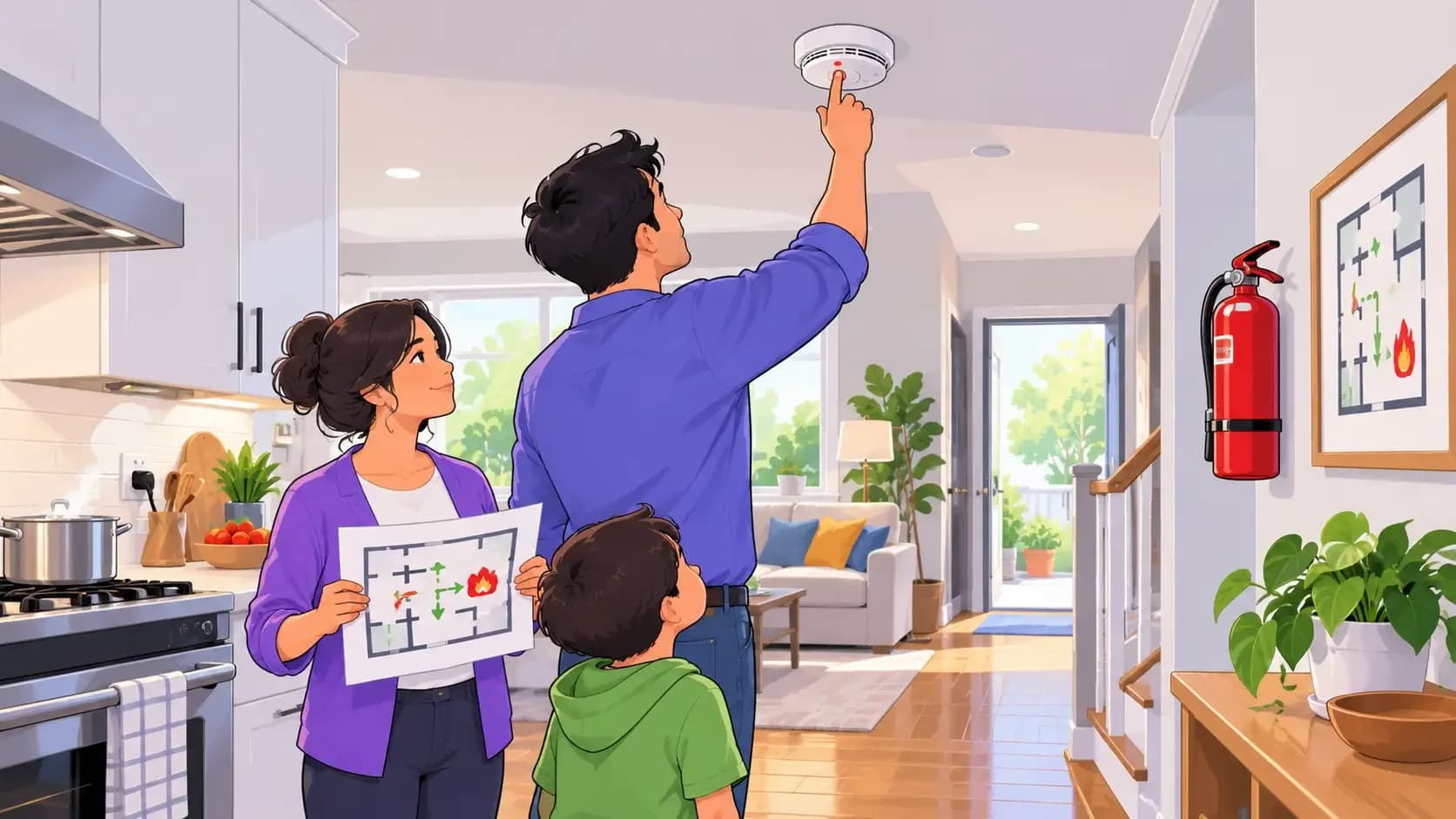
You have about three minutes. That is the number every decision in this article is built around, and it comes from full-scale burn testing by UL's Fire Safety Research Institute, which found the escape window in a furnished home has fallen from roughly seventeen minutes forty years ago to three minutes or less today. Synthetic furnishings, open-plan layouts and lightweight construction did that.
Three minutes is not enough time to find a torch, gather documents, or work out which window opens. It is barely enough time to wake five people and walk them out of a dark house. So the whole job is what you do before the alarm sounds.
I verify fire controls on industrial sites for a living — detection, egress, muster. This article applies the same walk to a house, with the legal position for the US, UK and Australia set out where it differs.
Key takeaways#
Six points carry most of the value in this article:
Modern furnished homes give occupants around three minutes to escape after ignition, down from about seventeen minutes forty years ago, according to UL FSRI full-scale testing.
Interconnection is the control most homes are missing: an alarm in the hallway that cannot wake someone behind a closed bedroom door is a warning nobody hears.
Smoke alarms are replaced ten years from the manufacture date printed on the back of the unit, not from the date you installed them.
In England, landlords must fit a smoke alarm on every storey used as living accommodation under the 2015 Regulations as amended in 2022; in Queensland, every home needs interconnected photoelectric alarms by 1 January 2027.
Your escape plan is only real if it has been walked in the dark. Painted-shut windows, security grilles and keyed deadbolts fail at exactly the wrong moment.
A closed bedroom door is the cheapest life safety control in the building — but it only works if there is an alarm inside that bedroom.
The three-minute constraint that governs everything else#
Everything below follows from one physical fact: a modern house burns faster than the house your fire safety habits were designed for. Polyurethane foam in sofas and mattresses releases heat and carbon monoxide at a rate that timber and cotton never did, and an open-plan ground floor gives the fire the air it needs.
FSRI's thermal imaging work found rooms behind closed doors sitting under 100°F (about 38°C) while open-door rooms in the same house passed 1,000°F (about 540°C). Carbon monoxide told the same story: roughly 100 ppm behind the closed door against 10,000 ppm in the open bedroom, per FSRI's Close Before You Doze programme. Those are not marginal differences. They are the difference between a room a firefighter can carry someone out of and one they cannot.
Timing matters too. NFPA's home structure fire research has consistently found that around half of home fire deaths result from fires reported between 11:00 p.m. and 7:00 a.m., when the household is asleep and nobody is watching the stove or the charger.
The three-minute window rules out more than most people expect:
Fighting the fire first, calling later — the call and the exit come first, always
Collecting possessions, documents or pets on the way — decide now what you are willing to leave
Re-entering for anyone — tell the arriving crew who is missing and where they sleep; they are equipped for it and you are not
Working out the route on the night — route decisions have to be made in daylight, months earlier
Smoke alarms: placement, interconnection and the date on the back#
Start where I start on any site — with detection, because everything downstream depends on the warning arriving in time. The three things I check are position, interconnection and age, in that order, and it is nearly always the second one that fails in a home.
Where the alarms go#
NFPA's household smoke alarm guidance is specific: inside every bedroom, outside each separate sleeping area, and on every level of the home including the basement. Mount on the ceiling or high on a wall, and keep alarms at least 10 feet (3 metres) from the stove so that cooking smoke does not train the household to disable them.
Two placements get missed in almost every house I have looked at. The basement or cellar alarm goes at the bottom of the stairs leading to the next floor, not in the middle of the ceiling. And the garage — increasingly where lithium-ion batteries charge overnight — usually has no alarm at all.
Interconnection is the control, not a nice-to-have#
An alarm that sounds only in the room it is in protects nobody who is not in that room. Interconnected alarms all sound together, so a fire starting in the kitchen wakes the child at the far end of the upstairs hallway.
This is the gap I would expect to find in most homes, and it is the one Queensland legislated away: every existing home there needs interconnected photoelectric alarms by 1 January 2027, per the Queensland Fire Department — alarms in every bedroom, in hallways connecting bedrooms, and on each storey. Retrofitting no longer means rewiring — wireless interconnected units pair to each other and install like a standard battery alarm.
The manufacture date, not the install date#
Alarms expire. The sensing chamber degrades whether or not the unit still chirps when you press test, and both NFPA and the US Fire Administration put the replacement point at ten years from the date of manufacture. That date is printed on the back of the unit. You will have to take it off the bracket to read it.
I have lost count of the industrial sites where a device was in date on paper and expired on the label. Do the same check at home: take one down tonight and read the date.
The maintenance schedule that actually keeps a domestic alarm working is short:
Check | Frequency | What good looks like |
|---|---|---|
Press the test button | Monthly | Loud, sustained sound from every alarm, not just this one |
Vacuum the vents | Every few months | No dust or cobwebs across the sensing chamber |
Replace user-changeable batteries | Annually, or on the first chirp | A single chirp every 30–60 seconds means low battery |
Read the manufacture date | Annually | Under 10 years old; replace the whole unit if not |
Test the interconnection | Annually | One alarm triggers all the others |
What the law actually requires where you live#
Here is the part most home fire safety articles skip, and it changes who is responsible. Workplace fire law largely stops at your front door. In England and Wales, the Regulatory Reform (Fire Safety) Order 2005 covers the common parts of blocks of flats — the corridors, stairs and, since the Fire Safety Act 2021, the structure, external walls and flat entrance doors — but not the inside of a single private dwelling. In the US, OSHA's fire standards regulate workplaces, not homes.
So inside your own home, the duty is yours. Where the property is rented, statute steps in and puts specific duties on the landlord.
Jurisdiction | Who is bound | Core requirement | Instrument |
|---|---|---|---|
England | Private and social landlords | Smoke alarm on each storey used as living accommodation; CO alarm in any such room with a fixed combustion appliance other than a gas cooker; repair or replace faulty alarms once reported | Smoke and Carbon Monoxide Alarm (England) Regulations 2015, as amended 2022 |
Queensland, Australia | All dwelling owners | Interconnected photoelectric alarms to AS 3786-2014 in every bedroom, in connecting hallways and on each storey, by 1 January 2027 | Fire Services Act 1990; Building Regulation 2021 |
United States | Set by state and local building codes | Local codes commonly adopt the NFPA 72 household provisions — alarms in every bedroom, outside sleeping areas, every level | NFPA 72; state and municipal codes |
Two details in that table are worth pulling out. England's 2022 amendment removed the word "solid" from the CO alarm trigger, so a room with a gas boiler now needs a CO alarm where it previously did not — and enforcement sits with local housing authorities, who can impose a penalty of up to £5,000 where a remedial notice is not complied with, per GOV.UK guidance for landlords. Queensland's rule bans ionisation sensors outright for domestic use. England's regulations do not specify the alarm type, though the guidance points landlords to BS 5839-6 for smoke alarms and BS EN 50291 for CO alarms, and recommends sealed-for-life batteries over replaceable ones.
Whichever jurisdiction you are in, three questions settle your position:
Do you own or rent? If you rent, the alarm duties in England and Queensland sit with the landlord — but testing and cleaning them generally sits with you.
Is your building a single dwelling or does it share common parts? Shared corridors and stairs bring a responsible person and a fire risk assessment into the picture.
Does your local code exceed the national position? Queensland is stricter than the rest of Australia; several US states are stricter than NFPA's baseline.
The escape plan, and the night walk that proves it#
A plan you have written is not a plan; a plan you have walked in the dark is. NFPA's guidance is two ways out of every room, a meeting point outside, and a drill practised twice a year — including one at night. The night drill is the one that finds the problems.
The failures are always physical and always boring. A bedroom window painted shut during decorating. A security grille whose key lives in a kitchen drawer. A first-floor window with no plan for the drop below it. A hallway narrowed by a bike, a buggy and three parcels waiting to go back.
That last one is not a domestic quirk. Auditing a suppression interface package in Malaysia, I found a temporary cable run straight across a primary escape stair — laid that morning, entirely reasonable to whoever laid it, and logged nowhere. I stopped the work, had the route reinstated and briefed the crew before restart. The escape route had not been designed badly. It had been quietly consumed by something temporary that nobody was tracking.
Homes fail the same way. The route is fine on the day you move in and degrades one convenient object at a time. That is why the check has to be a walk, not a memory.
Walk your drill in this order, at night, with the lights off:
Sound the actual alarm. Press the test button rather than shouting "fire" — everyone needs to recognise the sound they will hear at 2 a.m.
Note who does not wake. Young children, older adults and anyone using sleep medication frequently sleep through it. That person needs an assigned adult, and specialist strobe or bed-shaker alarms if there is hearing loss.
Take the primary route out of each room. Doors, hallway, front door. Time it.
Now take the second route. Open the window. If it is stiff, painted, barred or too high, you have found a job for the weekend, not a plan.
Meet at the fixed point. A specific object — the lamp post, the neighbour's gate — not "out front".
Do a headcount out loud. Muster only works when someone owns the count and says the number.
Repeat it once in daylight, using different exits, and again in six months.
⚠️ Safety critical: Never re-enter a burning building for a person, a pet or a document. Tell the fire crew who is missing and which room they sleep in. That information, given at the door, is what a rescue is built on.
Close before you doze: the free control most homes skip#
Closing bedroom doors at night costs nothing and buys survivable time in the room behind the door. FSRI's side-by-side experiments are the clearest evidence in domestic fire safety I know of, and the temperature and carbon monoxide gaps quoted earlier come from exactly that work.
There is an honest tension here, and most articles do not mention it. A closed door also muffles an alarm sounding in the hallway. Decibel testing by FSRI is part of why the guidance moved to alarms inside bedrooms rather than only outside them. Closing doors without an in-room alarm trades warning time for protection time — which is the wrong trade.
So the two controls are a pair, not alternatives. Close the doors, and put an interconnected alarm inside each bedroom. Do one without the other and you have weakened the arrangement rather than strengthened it.
The habit extends past bedtime. On the way out during a fire, close each door behind you: you are limiting the air reaching the fire and slowing its spread toward anyone still inside.
Three door habits are worth building into the household routine:
Every bedroom door closed at night, including the room of anyone who cannot self-evacuate
Doors closed behind you on the way out, front door included
If your exit is blocked, stay in the room with the door shut, seal the gap at the base with bedding, signal from the window and call the fire service with your room location
Where home fires actually start#
Prevention beats detection, and the causes are stubbornly consistent across countries. Cooking leads on ignitions; smoking materials have led on deaths for decades; heating and electrical faults sit behind them. NFPA's fire safety research summarises the position plainly: cooking remains the leading cause of home fires and home fire injuries, while smoking materials remain the leading cause of home fire deaths.
The pattern behind all of it is the same one I write up on sites: a heat source and a fuel brought close together by convenience, and left unsupervised.
Cause | What it looks like at home | The control that works |
|---|---|---|
Cooking | Frying or grilling left unattended; tea towel or packaging near the hob | Stay in the kitchen for frying, grilling and broiling; use a timer for anything slower |
Smoking materials | Smoking in bed or in a chair while drowsy or medicated | Smoke outside; deep, stable ashtrays; douse butts with water |
Heating | Portable heater near curtains, bedding or a drying rack; oven used for warmth | One metre (about three feet) clear of everything; never heat a room with a cooker |
Electrical | Overloaded sockets, daisy-chained extension leads, damaged flexes | One high-load appliance per socket; replace damaged leads rather than taping them |
Candles | Left burning in an empty room or near soft furnishings | Extinguish before leaving the room or sleeping; keep a torch for power cuts |
Grease fires deserve their own line because the instinctive response is the fatal one. Never put water on burning oil — it flashes the water to steam and throws burning fat across the room. Turn off the heat, slide a lid or a fire blanket over the pan, and leave it covered until it is fully cold.
The habits that remove most of the domestic ignition risk are these:
Never leave the kitchen while frying, grilling or broiling
Keep a 1 m (3 ft) clear zone around heaters, hobs and open fires
Give high-load appliances their own socket — no adaptor stacks behind the sofa
Check the room before bed: hob off, candles out, heater off, doors closed
Lithium-ion batteries: the newest hazard in the house#
This is the risk that has changed fastest in the time I have been doing this work, and it is why NFPA has made safe charging the theme of Fire Prevention Week 2026. NFPA has been open that it does not yet track a figure for US home fires involving lithium-ion batteries — but fire services are reporting rising numbers, and a battery in thermal runaway behaves nothing like a furniture fire. It vents hot toxic gas, it can reignite after apparent extinguishment, and a household extinguisher will not resolve it.
The domestic version of this hazard is mundane: a phone charging under a pillow, an e-bike battery on a wooden shelf in the garage next to the coats, a replacement charger bought because the original was lost.
NFPA's guidance for larger devices — e-bikes, scooters, power tools — is to charge them outside and away from exits. From egress work I would extend that to everything: do not charge anything on your escape route. A battery that fails in the hallway between the bedrooms and the front door takes out your primary exit and starts the fire in the worst possible place. Charge in a room with a door you can close.
The charging rules worth making household habit are short:
Use the charger that came with the device, or one the manufacturer approves
Charge on a hard, flat surface — a table or worktop, never a bed, sofa or under a pillow
Unplug when the charge completes; do not leave devices charging overnight unattended
Never charge on the escape route — not the hallway, not the landing, not against the front door
Stop using any battery that is hot, swollen, smells odd, hisses or leaks, and do not charge it again
⚠️ Safety critical: If a battery starts venting smoke or gas, do not attempt to move it or put it out. Get everyone out, close the door behind you and call the fire service.
Extinguishers, blankets and CO alarms: what is worth having#
Householders routinely buy the wrong extinguisher and place it in the wrong spot — usually behind the thing most likely to be on fire. An extinguisher belongs on the exit side of the hazard, so you never have to move toward the fire to reach it.
Fire classes differ by region, and it is the cooking-oil class that trips people up. In the US, cooking oil and fat fires are Class K under NFPA 10; in the UK, Europe and Australia the same fires are Class F under the EN 3 classification. A general-purpose ABC powder unit is not the right answer for a chip pan in either system. Class K wet chemical units are built for commercial kitchens; in a house, a fire blanket to EN 1869 is the practical control for a pan fire, and it costs a fraction of the price.
Carbon monoxide is a separate hazard needing a separate device — a smoke alarm does not detect it, and CO alarms carry their own standards, BS EN 50291 in the UK and UL 2034 in the US. Fit one in any room with a fuel-burning appliance, at the height the manufacturer specifies, and treat a sounding CO alarm as an instruction to ventilate and leave.
Device | What it is for | Where it goes | Standard to look for |
|---|---|---|---|
Fire blanket | Pan fires and clothing fires | Wall-mounted near the kitchen exit, not beside the hob | EN 1869 (UK/EU) |
ABC / dry powder extinguisher | General household fires, small and early | Hallway or garage, on the exit side | NFPA 10 (US); EN 3 (UK/EU/AU) |
Class K / Class F extinguisher | Cooking oils and fats | Kitchen, on the exit side | NFPA 10 Class K (US); EN 3 Class F (UK/EU/AU) |
CO alarm | Carbon monoxide from fuel-burning appliances | Any room with a boiler, stove, fire or heater | BS EN 50291 (UK); UL 2034 (US) |
Deciding whether to fight a fire at all is the part worth rehearsing, because hesitation costs the minutes you do not have. Attempt it only when every one of these is true:
The fire is small and contained — a pan, a bin, one appliance
Everyone else is already leaving and the fire service has been called
You have a clear exit behind you that the fire cannot cut off
You know the extinguisher is the right class and you have used one before
It is not a lithium-ion battery and not spreading as you approach
If any one of those fails, close the door and get out. A house is replaceable.
The twenty-minute home fire safety check#
Everything above condenses into one walk you can do this evening. I run the industrial version of this constantly; the domestic version takes about twenty minutes and finds something in nearly every house.
Work from the top of the building down, the way smoke travels up. Take a torch and a chair, and take the first alarm off its bracket so you get into the habit of reading dates rather than trusting them.
Run through it in this order:
Count the alarms against the standard: inside every bedroom, outside each sleeping area, one on every level.
Press test on each one and listen for whether the others answer. If they do not, interconnection is your first purchase.
Read the manufacture date on the back of each unit. Over ten years old, replace the unit.
Open every window you would use as a second way out. All the way, without force.
Walk the hallway and stairs looking for what has accumulated — bikes, boxes, drying racks, cables.
Find the keys for any window lock or security grille on an escape route, and keep them on the route.
Check the charging spots: nothing on beds or sofas, nothing on the hallway floor, no unbranded chargers.
Check the CO alarm in any room with a fuel-burning appliance, and its date too.
Agree the meeting point out loud with everyone in the house, and name a person to do the headcount.
Book the next drill — one at night in the next fortnight, and a daylight repeat in six months.
✅ Auditor's tip: The finding I would most expect to write up in a home is not a missing alarm. It is a set of alarms that are all present, all in date, and not connected to each other — full compliance on paper, no warning where it is needed.
Frequently asked questions#
These are the questions people most often search on home fire safety, answered against the guidance and legislation cited above.
How many smoke alarms does a house need?#
At minimum, one inside every bedroom, one outside each separate sleeping area, and one on every level including the basement. A larger or longer home needs more to cover the distance. Queensland additionally requires an alarm in hallways connecting bedrooms to the rest of the storey.
How often should smoke alarms be replaced?#
Ten years from the manufacture date printed on the back of the unit, not from installation. The sensing chamber degrades with age even when the test button still works. Sealed ten-year battery alarms are replaced whole; you cannot change the battery.
Are photoelectric or ionisation smoke alarms better for homes?#
Photoelectric alarms respond faster to smouldering fires — the type that starts in furniture and bedding overnight — and cause fewer cooking nuisance alarms. Queensland now permits only photoelectric alarms in dwellings. If you are replacing units, choose photoelectric.
Should bedroom doors be open or closed at night?#
Closed. UL FSRI testing found closed rooms staying under 100°F with roughly 100 ppm CO, against over 1,000°F and around 10,000 ppm in open rooms. Pair closed doors with an alarm inside each bedroom, because a closed door muffles a hallway alarm.
What should I do if a fire starts and I cannot get out?#
Stay in a room with the door closed, seal the gap at the base with bedding or towels, call the fire service and tell them exactly which room you are in, and signal from the window. Do not open the door to check the hallway.
Do I legally need a smoke alarm in my own home?#
If you rent in England, your landlord must fit one on every storey used as living accommodation. If you own in Queensland, interconnected photoelectric alarms are required by 1 January 2027. In the US, requirements are set by state and local building codes, which commonly follow NFPA 72.
Where should I not put a smoke alarm?#
Not in the kitchen or bathroom, and not within 10 feet (3 metres) of the stove — steam and cooking smoke cause nuisance alarms, and a household that silences alarms is one that eventually removes them. Keep them away from ceiling fans and air-conditioning vents too.
Conclusion: what to do tonight#
If you do one thing after reading this, take a smoke alarm off its bracket and read the date. If you do two, press the test button and find out whether anything else in the house answers.
Those two checks take four minutes and tell you whether the warning system in your home is a system or a collection of unconnected devices. Everything else in this article — the drill, the doors, the charging habits — is built on the assumption that everybody wakes up. That assumption is worth verifying.
Where alarm wiring, a fixed combustion appliance or a building with shared corridors is involved, use a licensed electrician, a registered gas engineer or a competent fire risk assessor. This article covers what you can check yourself; it does not replace either.
Sources and further reading#
Every claim above is drawn from one of the following primary sources:
NFPA — Smoke alarms — placement, testing and ten-year replacement guidance
NFPA — Escape planning — two ways out and twice-yearly drills
NFPA — Lithium-ion battery safety — Fire Prevention Week 2026 charging guidance
US Fire Administration — Smoke alarms — maintenance and replacement
UL Fire Safety Research Institute — Close Before You Doze — closed-door temperature and CO findings
Smoke and Carbon Monoxide Alarm (England) Regulations 2015 — as amended by SI 2022/707
GOV.UK — Smoke and CO alarm guidance for enforcement authorities — duties and penalties
Queensland Fire Department — Smoke alarms — AS 3786-2014 and the 2027 deadline
Leave a Reply