

The petrochemical industry converts hydrocarbon feedstock — naphtha, ethane, propane and other light fractions from refining and gas processing — into chemical building blocks, and then into the polymers, solvents, fibres, resins and fertilisers that almost everything else is made from. That is the definition most pages give you.
The distinction they leave out is the one that governs the risk: a refinery separates crude oil into fuels. A petrochemical plant builds molecules. It runs smaller inventories than a refinery, at higher reactivity, with intermediates that polymerise, peroxidise or run away if you let them sit. That difference is why a petrochemical site's worst day rarely looks like a fuel fire, and usually starts with a loss of containment nobody was watching.
In seventeen years across specialty chemicals and petrochemicals — tank farm HSE at Arkema Coatings, solvent exposure control at Solvay Specialty Polymers, drum and IBC handling at LANXESS — the finding I write up most often is not a missing guardrail. It is a control that exists on paper and has never been tested where the work happens.
Key takeaways
- Petrochemicals are the non-fuel products of oil and gas: olefins (ethylene, propylene, butadiene), aromatics (benzene, toluene, xylenes) and syngas derivatives (ammonia, methanol, hydrogen).
- The dominant risk is loss of primary containment, not the hazard categories most safety articles lead with. Fire, toxicity and confined space entry are consequences of containment failure, not independent problems.
- A petrochemical site in Great Britain sits under COMAH 2015 at lower or upper tier depending on Schedule 1 inventory; in the EU under Seveso III; in the US under OSHA PSM (29 CFR 1910.119) and the EPA Risk Management Program.
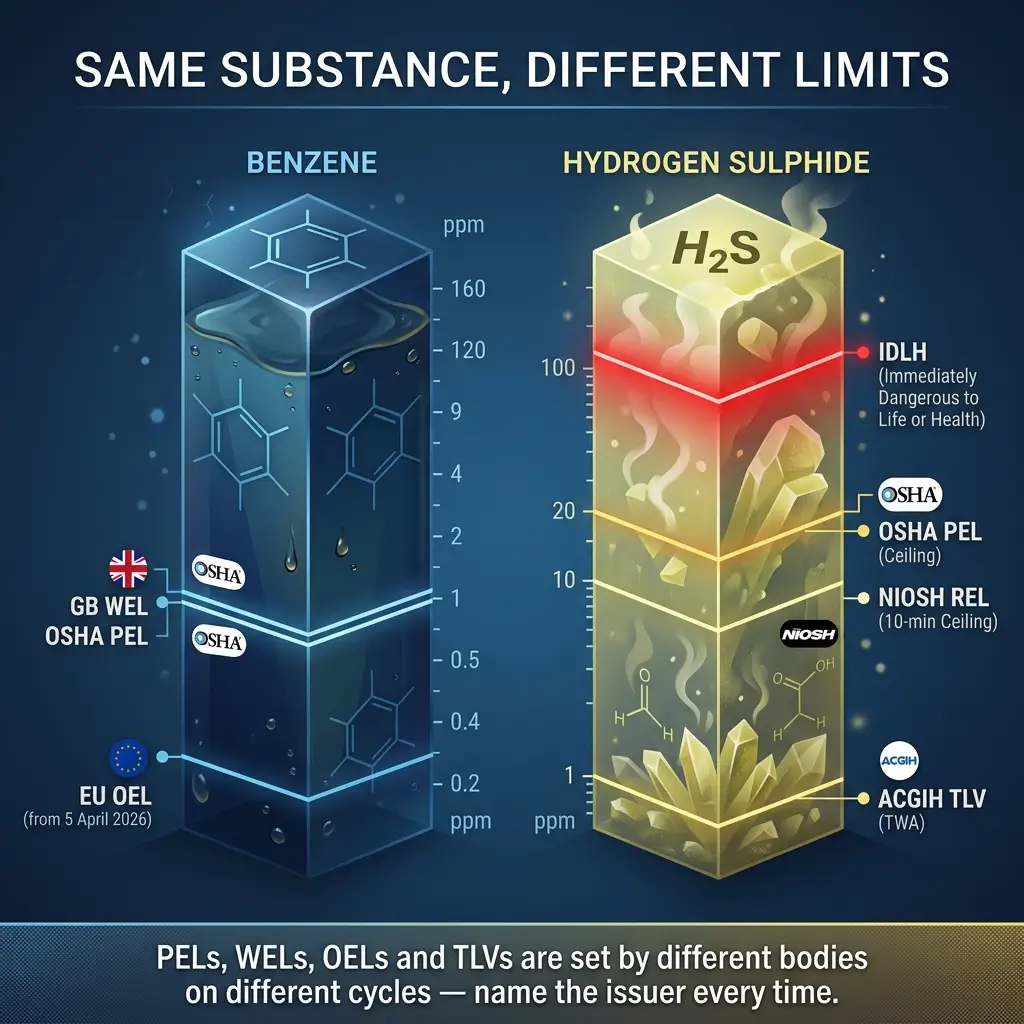
- Since 5 April 2026 the EU binding limit for benzene has been 0.2 ppm — one fifth of the OSHA PEL of 1 ppm. Multinational operators can no longer run one number across sites.
- Idle, out-of-service and "temporarily" isolated equipment carries a disproportionate share of catastrophic risk, because it falls outside both the operating routine and the inspection routine.
House style for all graphics below: technical line illustration, muted industrial palette with a single accent colour, clean sans-serif labels, red reserved for hazards and failure states. No photorealism, no depicted injuries, no identifiable people.
What the petrochemical industry actually is
The industry sits downstream of refining and gas processing and upstream of nearly all manufacturing. It takes a narrow set of feedstocks, cracks or reforms them into a handful of reactive building blocks, and then converts those building blocks into thousands of derivatives. Everything in the sector traces back to about a dozen molecules.
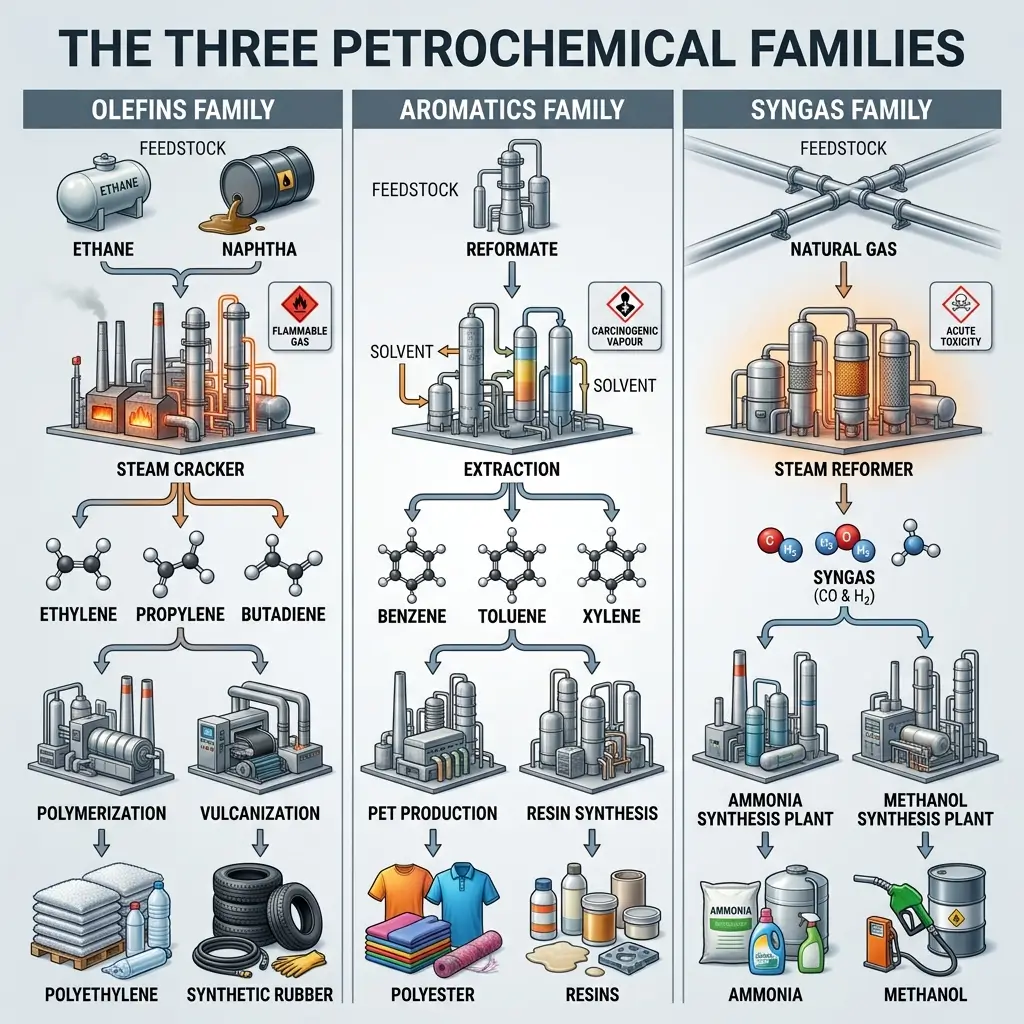
Those molecules divide into three families, and the family a plant works in tells you most of what you need to know about its hazard profile before you walk through the gate.
Steam crackers produce olefins by breaking larger hydrocarbon chains at high temperature. Catalytic reformers and extraction units produce aromatics. Steam methane reformers produce synthesis gas, which becomes ammonia and methanol. A large integrated complex runs all three, usually across a shared fenceline with a refinery that supplies its feed and takes back its by-products.
| Family | Typical feedstock | Core process | Example derivatives | Dominant hazard |
|---|---|---|---|---|
| Olefins | Ethane, naphtha, LPG | Steam cracking | Polyethylene, polypropylene, synthetic rubber | Flammable gas release; reactive polymerisation |
| Aromatics | Reformate, pyrolysis gasoline | Reforming and extraction | Polyester, resins, adhesives, solvents | Carcinogenic vapour exposure |
| Syngas derivatives | Natural gas | Steam reforming | Ammonia, methanol, urea, hydrogen | Acute toxicity; high-pressure hydrogen |
That table is also a map of where a site's fatal risk concentrates. Three points are worth holding onto when you read the rest of this article:
- The building blocks are more hazardous than the products. Polyethylene pellets are inert. The ethylene they came from is a flammable gas held above its critical temperature.
- Reactivity is the differentiator. Butadiene, ethylene oxide and many monomers do not simply burn — they react with themselves, with oxygen, or with contaminants, and generate their own pressure.
- Integration multiplies consequence. Where a cracker, a derivative unit and a tank farm share a site, an event in one can take feed or utilities from the others, and a single release can escalate across three operators.
Why petrochemical risk is not refinery risk
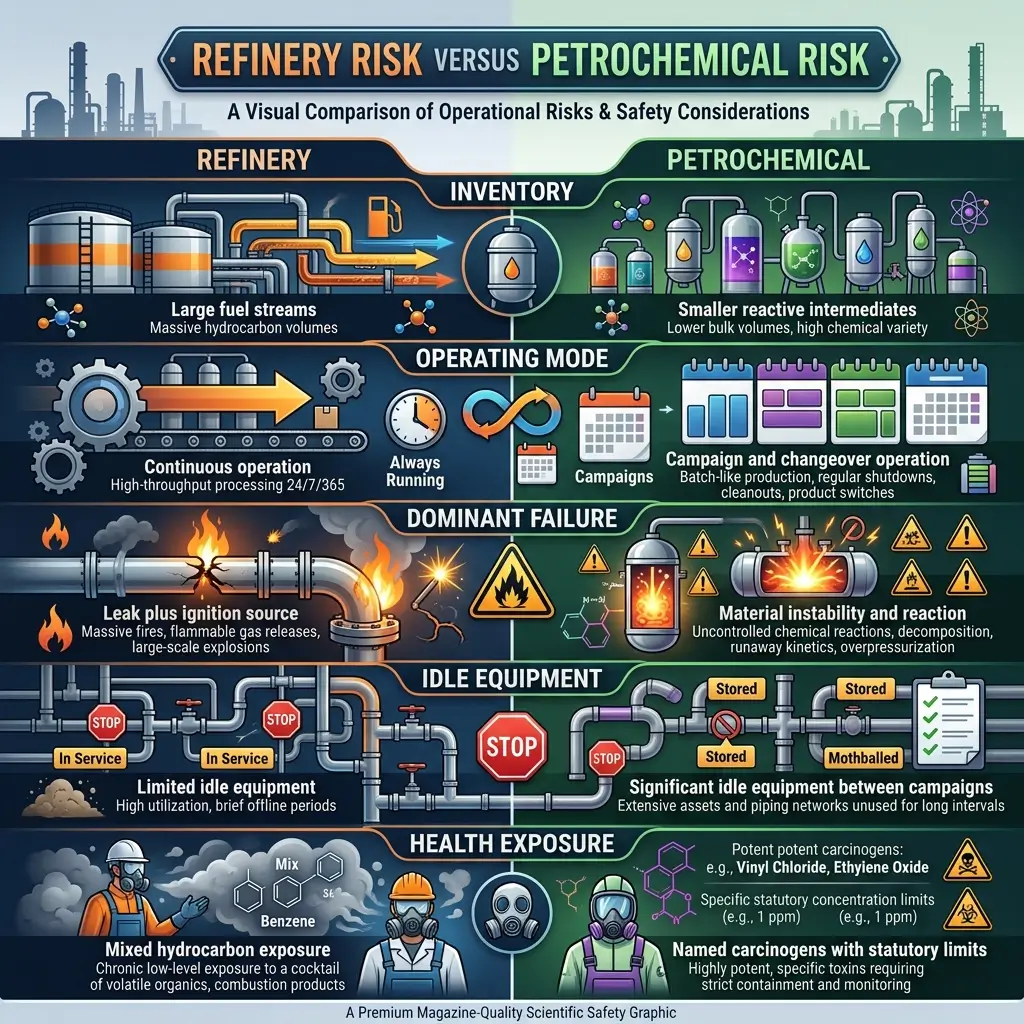
The two are often written about as one sector, and on a shared site they can look identical — same flare, same pipe racks, same permit office. The risk mathematics underneath is different, and treating a petrochemical plant as a small refinery produces predictable gaps.
A refinery is a high-volume, low-margin business processing large inventories of relatively well-understood fuel streams. A petrochemical plant is lower-volume and higher-margin, running reactive intermediates through specialised units, often in campaigns rather than continuously. It has more product changeovers, more idle equipment between campaigns, and more materials whose hazard is chemical instability rather than flammability alone.
This shows up in the failures. Refinery incidents are frequently about hydrocarbon inventory and ignition — a leak finds a source. Petrochemical incidents are frequently about a material doing something the process design did not account for: polymerising in a dead leg, forming peroxides in a vessel taken out of service, or reacting with air or water that should never have reached it.
The practical consequences for anyone managing HSE across both types of asset are:
- Mechanical integrity programmes need chemistry input, not just inspection intervals. A thickness reading tells you about corrosion; it tells you nothing about a polymer growing inside the line.
- Campaign and changeover work needs the same rigour as turnaround work. It rarely gets it, because it is shorter and feels routine.
- Management of change must cover taking equipment out of service, not only bringing it in or modifying it. This is the single most common gap I find.
- Occupational exposure control matters more, not less. Refinery streams are hazardous; aromatics and monomers are regulated carcinogens with named limits and mandatory surveillance.
Where the hazards sit, stage by stage
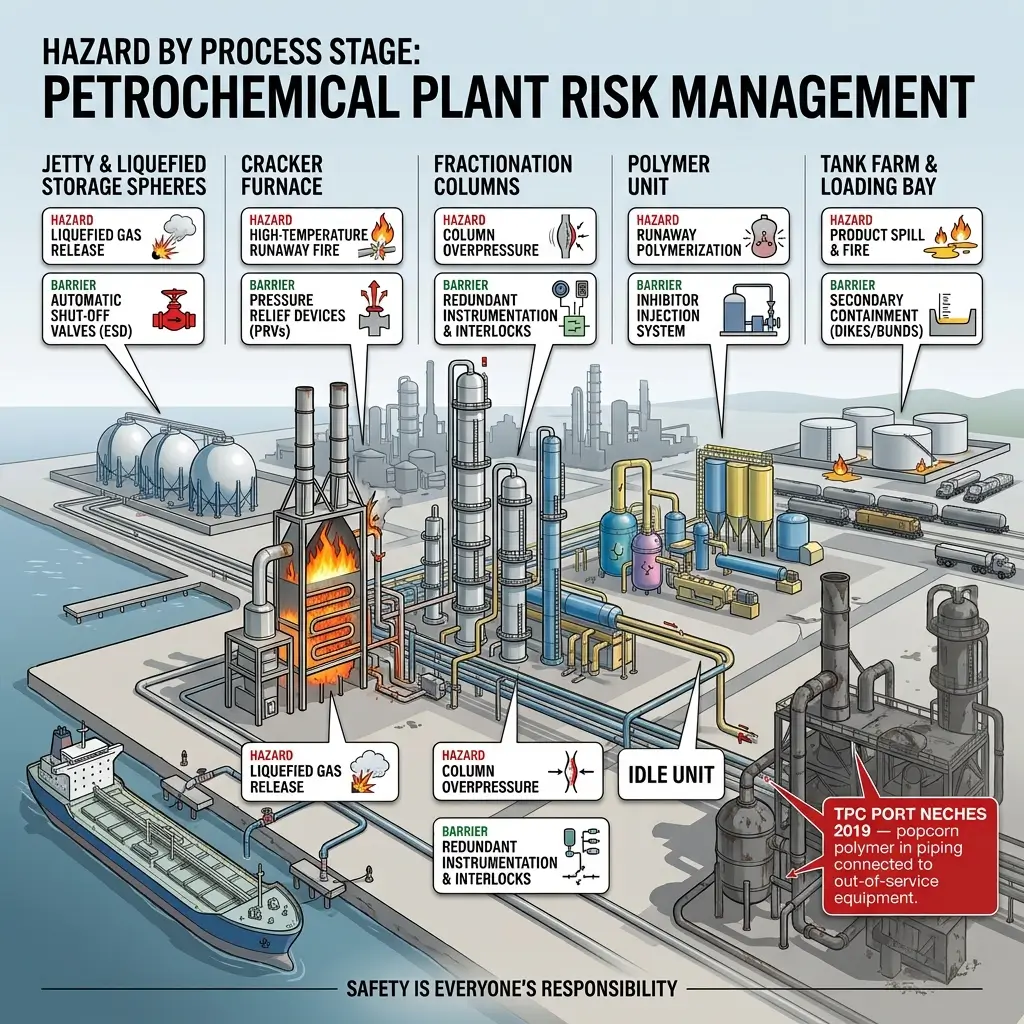
Most articles on this topic hand you a flat list — chemical exposure, fire, confined space, mechanical failure — as though the hazards were evenly distributed across the plant. They are not. Risk in a petrochemical facility is a property of where you are standing in the process, and the controls that hold are the ones matched to that stage.
Follow the molecule from the fenceline to the product warehouse and the picture becomes usable.
Feedstock reception and storage
Feed arrives by pipeline, ship, rail or road into pressurised spheres, refrigerated tanks or atmospheric storage. The hazards here are overfill, rollover, vapour displacement during transfer, and the connection and disconnection points where containment is deliberately broken by a person.
Transfer operations are the only routine activity in the plant where someone opens a hydrocarbon system by hand, several times a shift. Level instrumentation, independent high-level protection and disciplined line-up checks do the work. Overfill protection that has never been proof-tested is a paper barrier.
Cracking and reaction
Furnaces and reactors run at temperatures and pressures where small deviations escalate quickly. The hazards are tube failure, coking, loss of cooling, runaway exotherm and hydrogen embrittlement in reforming service.
This is where safety instrumented systems earn their cost. Under IEC 61511, a safety instrumented function is specified to a target integrity level, and that target only means something if the function is proof-tested at the interval the calculation assumed. When I audit here, I ask two questions: what is the SIL target, and when was the last proof test? A surprising number of sites can answer the first and not the second.
Separation and fractionation
Columns, reboilers, condensers and their associated pumps hold large volumes of hot, volatile liquid. The hazards are loss of containment at flanges, seals and small-bore connections, plus the thermal energy stored in the column itself.
Small-bore piping deserves specific mention. Instrument tappings, drains, vents and sample points fail more often than main lines because they are less inspected, more easily damaged, and frequently unsupported. If your inspection programme covers lines above a nominal diameter and stops there, you have excluded the population that leaks most.
Derivative and polymer units
Polymerisation, alkylation, oxidation and esterification units concentrate reactive chemistry. The hazards are runaway reaction, inhibitor depletion, contamination ingress and dust or fine handling at the pelletising end.
Inhibitors are the control that most often fails quietly. A monomer stabilised by an inhibitor is safe until the inhibitor is consumed, stripped by heat, or absent because a drum was refilled from the wrong stock. None of that is visible from a control room.
Tank farms, loading and transfer
Product storage and despatch bring vehicles, contractors, static electricity, bonding and earthing, and the highest concentration of non-routine work on the site. Bund integrity, drainage isolation and ignition source control are the barriers that carry the load.
Idle and out-of-service equipment
This is the stage nobody schedules and almost nobody audits, and it is where the sector's worst recent incident began.
At the TPC Group Port Neches facility in Texas on 27 November 2019, a section of piping ruptured and released roughly 6,000 gallons of butadiene in under a minute. The vapour cloud ignited. The blast injured two employees and a security contractor, triggered a mandatory four-mile evacuation, and started fires that burned for more than a month. Direct property damage ran to $450 million on site and $153 million off it.
The mechanism was popcorn polymer. It forms when oxygen reaches butadiene and generates peroxides, which then react with more butadiene to produce a hard, porous solid. The polymer grows, and it grows with enough force to crack steel. It had built up in a temporary dead leg — a section of piping created when a process pump was taken out of service and left connected.
The detail that should stay with anyone reading this: three years earlier, in 2016, an internal hazard analysis at the same facility had recommended that piping connected to out-of-service equipment be regularly flushed. The recommendation was never implemented. The CSB's final report (No. 2020-02-I-TX, December 2022) found the hazard was well known to the industry and poorly managed at the site, that the unit lacked remotely operated emergency isolation valves that would have limited the escalation, and recommended TPC build a process to identify and eliminate dead legs in high-purity butadiene service.
If you take one action from this article, make it this: get a list of every piece of equipment on your site that is out of service, and for each one, find out what is still connected to it and what is sitting inside.
The hazards that concentrate at each stage, and the barrier that carries most of the load, are:
| Stage | Principal hazard | Barrier that carries the load |
|---|---|---|
| Reception and storage | Overfill, vapour release at connections | Independent high-level protection, proof-tested |
| Cracking and reaction | Runaway, loss of cooling, tube failure | Safety instrumented functions at specified SIL |
| Separation | Loss of containment at small-bore connections | Inspection scope that includes small-bore piping |
| Derivative units | Runaway polymerisation, inhibitor loss | Inhibitor management and contamination control |
| Tank farm and loading | Ignition during non-routine work | Ignition source control and drain isolation |
| Idle equipment | Chemical degradation with no operator present | MOC covering removal from service, plus flushing regime |
Four questions carry most of the value when you walk a unit at any of these stages:
- What breaks containment here, and who does it by hand? Transfer connections and sample points are deliberate openings in the system.
- What is the barrier, and when was it last tested? A barrier with no proof-test record is an assumption.
- What is out of service, and what is still connected to it? Isolation valves do not stop chemistry.
- Where does a release go? Drains, bunds and low points decide whether a leak stays a leak.
Health hazards and the exposure limits that govern them
The acute hazards get the attention. The chronic ones do the quieter damage, and they are the part of petrochemical safety where the numbers differ most between jurisdictions — which makes a single global standard operating procedure quietly non-compliant somewhere.
Benzene is the defining example. It is a confirmed human carcinogen and the principal occupational cause of acute myeloid leukaemia, and it appears across aromatics production, pyrolysis gasoline handling, sampling and tank cleaning. Its limit has moved in the EU and stayed still elsewhere.
Every value below is attributed to the body that sets it, because these are not interchangeable numbers.
| Substance | Body / jurisdiction | Limit | Source |
|---|---|---|---|
| Benzene | EU binding OEL | 0.2 ppm (0.66 mg/m³) 8-hr TWA from 5 April 2026 | Directive (EU) 2022/431 |
| Benzene | Great Britain WEL | 1 ppm 8-hr TWA, skin notation | HSE EH40/2005 |
| Benzene | OSHA PEL | 1 ppm 8-hr TWA; 5 ppm 15-min STEL; 0.5 ppm action level | 29 CFR 1910.1028 |
| 1,3-Butadiene | OSHA PEL | 1 ppm 8-hr TWA; 5 ppm 15-min STEL; 0.5 ppm action level | 29 CFR 1910.1051 |
| Hydrogen sulphide | OSHA | 20 ppm ceiling; 50 ppm peak for up to 10 min once per shift | 29 CFR 1910.1000 Table Z-2 |
| Hydrogen sulphide | ACGIH TLV | 1 ppm 8-hr TWA; 5 ppm STEL | ACGIH |
| Hydrogen sulphide | NIOSH REL | 10 ppm 10-minute ceiling; IDLH 100 ppm | NIOSH |
Read the hydrogen sulphide rows together. The same gas carries a 20 ppm ceiling under the OSHA standard and a 1 ppm eight-hour TLV from ACGIH — a twentyfold spread on a gas that destroys the sense of smell before it reaches concentrations that kill. Any operator running assets in more than one country has to decide deliberately which number their alarms are set to, and write down why.
The benzene rows carry a second consequence. A European site that was compliant in March 2026 at 0.5 ppm needed to be at 0.2 ppm by April, and reaching that is not a respirator decision — it is an engineering one, affecting sampling systems, seal technology and tank cleaning methods.
Three practical points follow for any site handling these materials:
- Set the internal standard to the most stringent applicable value, not the local legal minimum, and document that decision so it survives a change of site manager.
- Exposure limits assume the monitoring is representative. Static monitors in a walkway do not measure what a sampler receives at a bleed point.
- Health surveillance is a legal requirement, not a benefit. Both the OSHA benzene and butadiene standards trigger medical surveillance at defined exposure frequencies; COSHH requires it where an identifiable disease may result.
The regulatory framework: three regimes, one hazard
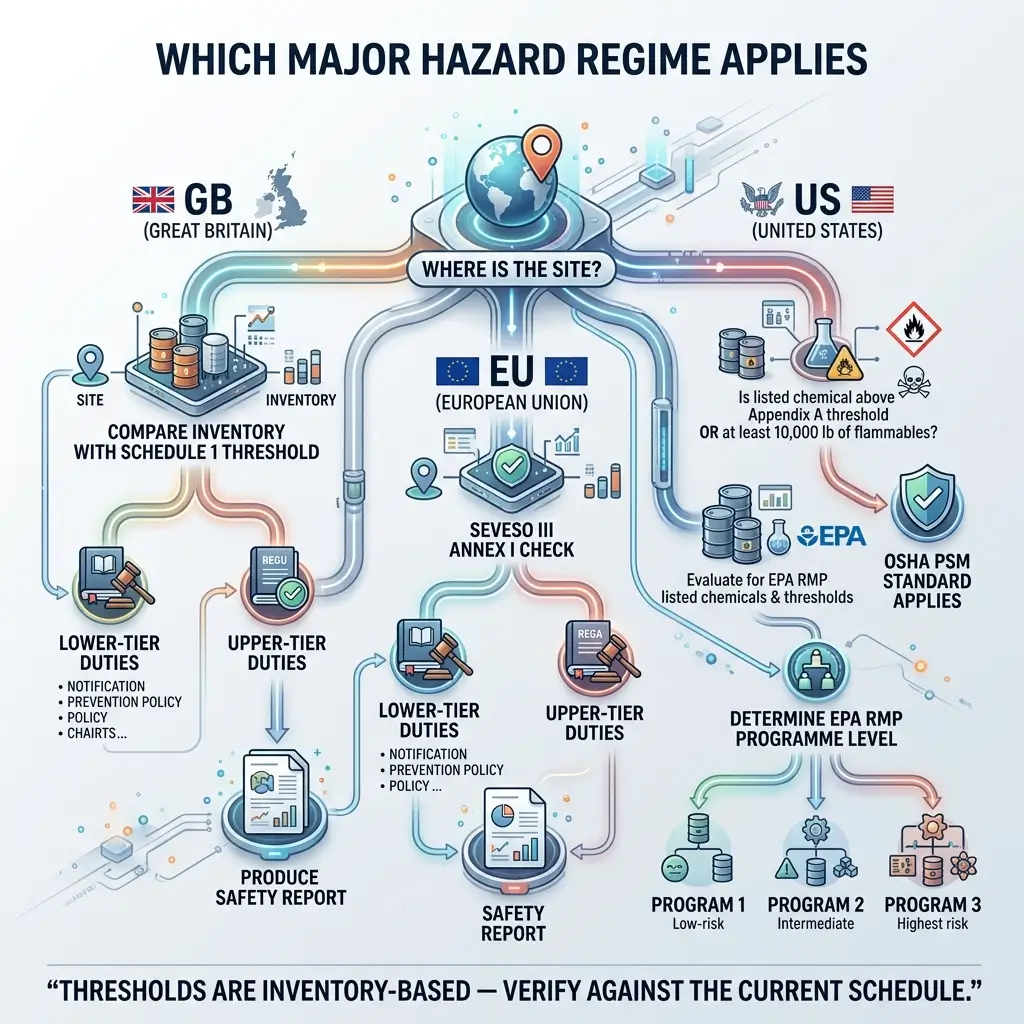
Major accident regulation converged internationally after Flixborough, Seveso and Bhopal. The three regimes below now ask broadly the same question — can you demonstrate control of your major accident hazards? — through quite different mechanisms. Which regime applies is determined by inventory, not by what the site calls itself.
Great Britain — COMAH, DSEAR and COSHH
The Control of Major Accident Hazards Regulations 2015 apply where the quantity of dangerous substances held on site exceeds the thresholds in Schedule 1. Exceed the lower threshold and you are a lower tier establishment; exceed the higher and you are upper tier, with a duty to produce a safety report for examination by the Competent Authority — HSE acting jointly with the environmental regulator. HSE's guidance is explicit that petrochemicals sit within scope.
Alongside COMAH, DSEAR 2002 governs explosive atmospheres and hazardous area classification, and COSHH 2002 governs exposure to the substances themselves, with the workplace exposure limits published in EH40/2005.
European Union — Seveso III
Directive 2012/18/EU is the parent instrument COMAH was written to implement, and it operates on the same two-tier logic, transposed into national law by each member state. Its scope was tightened to align with CLP classification, and it carries stronger public information and participation rights than either the GB or US regimes.
United States — OSHA PSM and EPA RMP
29 CFR 1910.119 applies where a process holds a listed highly hazardous chemical above its Appendix A threshold, or 10,000 pounds or more of a flammable liquid or gas in one location. It is performance-based and built on fourteen elements, and it has not been substantively revised since 1992 — a modernisation rulemaking has been open for several years without a final rule.
The environmental counterpart, the EPA Risk Management Program at 40 CFR Part 68, is in active flux. The 2024 Safer Communities by Chemical Accident Prevention rule was placed under reconsideration in March 2025. On 13 February 2026 EPA announced a proposal, published in the Federal Register on 24 February 2026, that would roll back several of its provisions — including elements of the safer technology and alternatives analysis and the third-party audit requirements. Compliance dates for much of the 2024 rule currently fall in May 2027. Anyone writing an RMP compliance plan this year should verify the position directly rather than working from a summary, including this one.
| Requirement | GB (COMAH 2015) | EU (Seveso III) | US (PSM / RMP) |
|---|---|---|---|
| Trigger | Schedule 1 threshold quantities | Annex I threshold quantities | Appendix A list, or 10,000 lb flammables |
| Tiering | Lower tier / upper tier | Lower tier / upper tier | Program 1/2/3 under RMP |
| Core document | Safety report (upper tier) | Safety report (upper tier) | PHA plus 14 PSM elements |
| Regulator | HSE with environment agency, jointly | National competent authority | OSHA (worker), EPA (offsite) |
| Current stability | Stable | Stable | RMP under active proposed revision |
The compliance actions that differ most between these regimes are worth listing plainly:
- Demonstration versus documentation. COMAH and Seveso require you to demonstrate control to a regulator who reads and challenges the case. PSM requires you to hold compliant documentation available for inspection. The second is easier to satisfy while being less safe.
- Offsite consequence is a separate regime in the US. Worker protection and community protection sit with different agencies under different rules, and the split creates gaps at the fenceline.
- Thresholds are inventory-based everywhere. A modest inventory reduction can move a site out of upper tier entirely, which is the cheapest risk reduction available to most operators and the one least often modelled.
The controls that actually hold
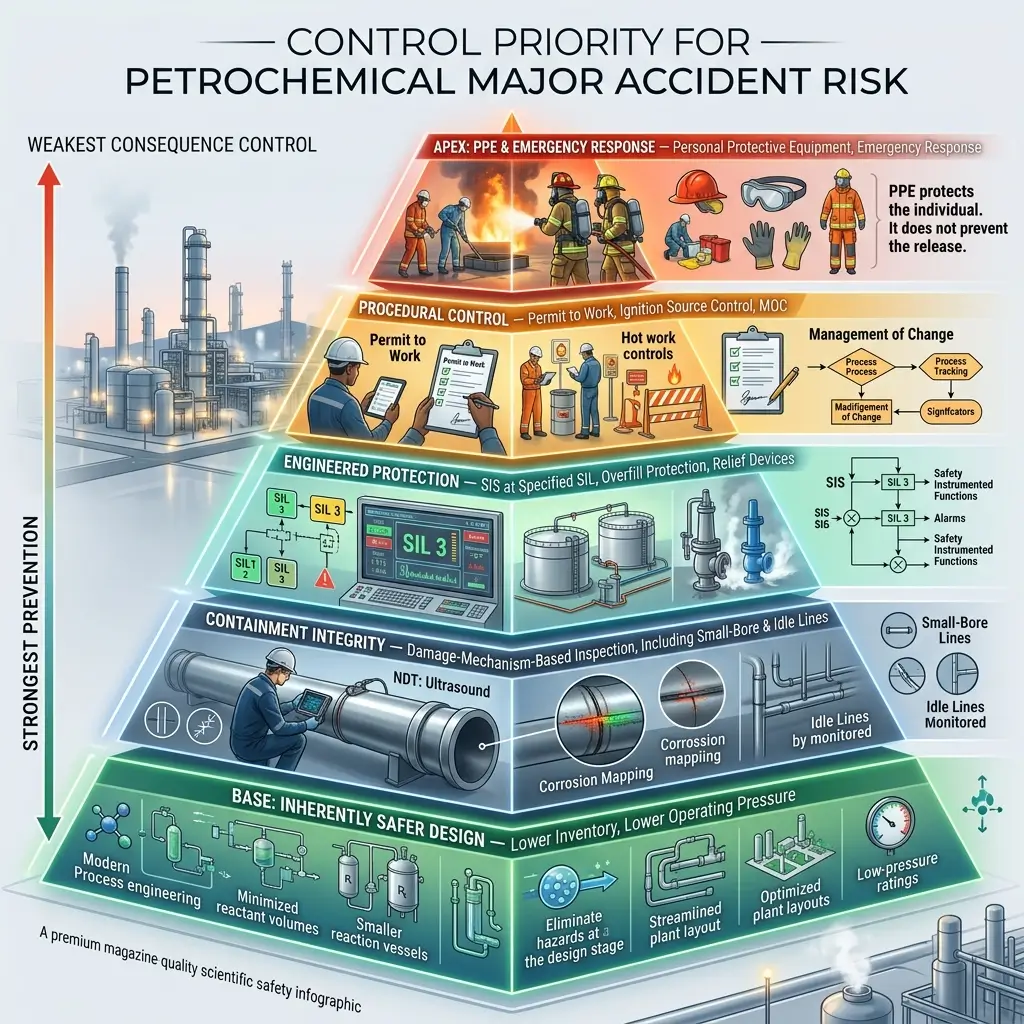
Ask most sites what controls their major accident risk and you will get a list topped by PPE and training. Both matter. Neither prevents a release. The controls that decide whether a petrochemical plant has a bad decade are structural, and they sit in a rough order of effectiveness.
Inherently safer design removes the hazard rather than managing it: less inventory, lower pressure, a less hazardous solvent, a continuous process instead of a batch one. It is only cheap at design stage, which is why it is worth forcing into every project gate and every management of change review.
Containment integrity is the barrier everything else depends on. That means inspection scope set by damage mechanism rather than by line size. It also means treating small-bore connections, dead legs and idle piping as populations in their own right.
Ignition source control is where field verification pays for itself, and where I have stopped the most work.
On a tank farm assignment for Arkema Coatings in the Netherlands, I found hot work being carried out near an open process drain. The permit existed. The controls were listed on it. At the work face, the drain was open, and an open drain in a tank farm is a direct path for vapour to reach an ignition source that someone has deliberately introduced. I stopped the job, had the controls reinstated, and briefed the crew before restart. Follow-up observations on that site showed the pattern recurring less often.
The transferable lesson is not "check permits". It is narrower than that: if you issue or audit hot work in a plant with process drainage, walk the drainage between the work and the nearest sump before you sign. The permit will tell you the drain is covered. Only the walk tells you whether it is.
Safety instrumented systems carry the risk that operators cannot, but only at the integrity level they were specified to and only if proof-tested at the assumed interval. Management of change is what keeps every barrier above from decaying — and it must cover equipment leaving service, not only equipment being modified.
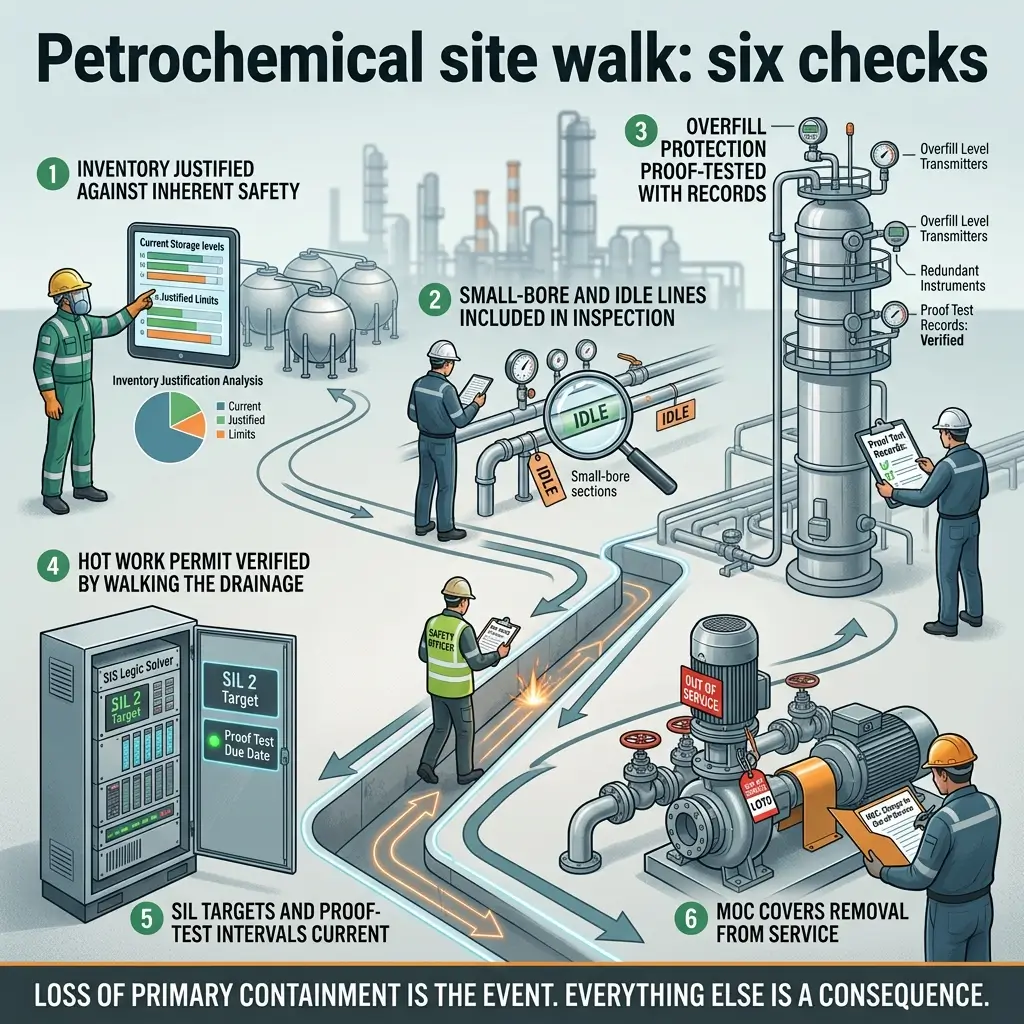
In priority order, the controls worth auditing first on any petrochemical site are:
- Inventory and inherent safety — how much hazardous material is present, and why that much
- Mechanical integrity scope — whether damage mechanisms drive the inspection plan, and whether small-bore and idle lines are in it
- Overfill and high-level protection — specified, independent, and proof-tested with records
- Ignition source control at the work face — hot work permits verified by walking the drainage and the vapour path
- Safety instrumented functions — SIL target known, proof test interval met, overrides logged and time-limited
- Management of change — covering removal from service, temporary changes and organisational change
Measuring whether the controls are working
A site can hold every control described above and still not know whether they are functioning. The measurement problem in process safety is that the outcome you care about — a catastrophic release — is rare enough that counting it tells you nothing until it is too late.
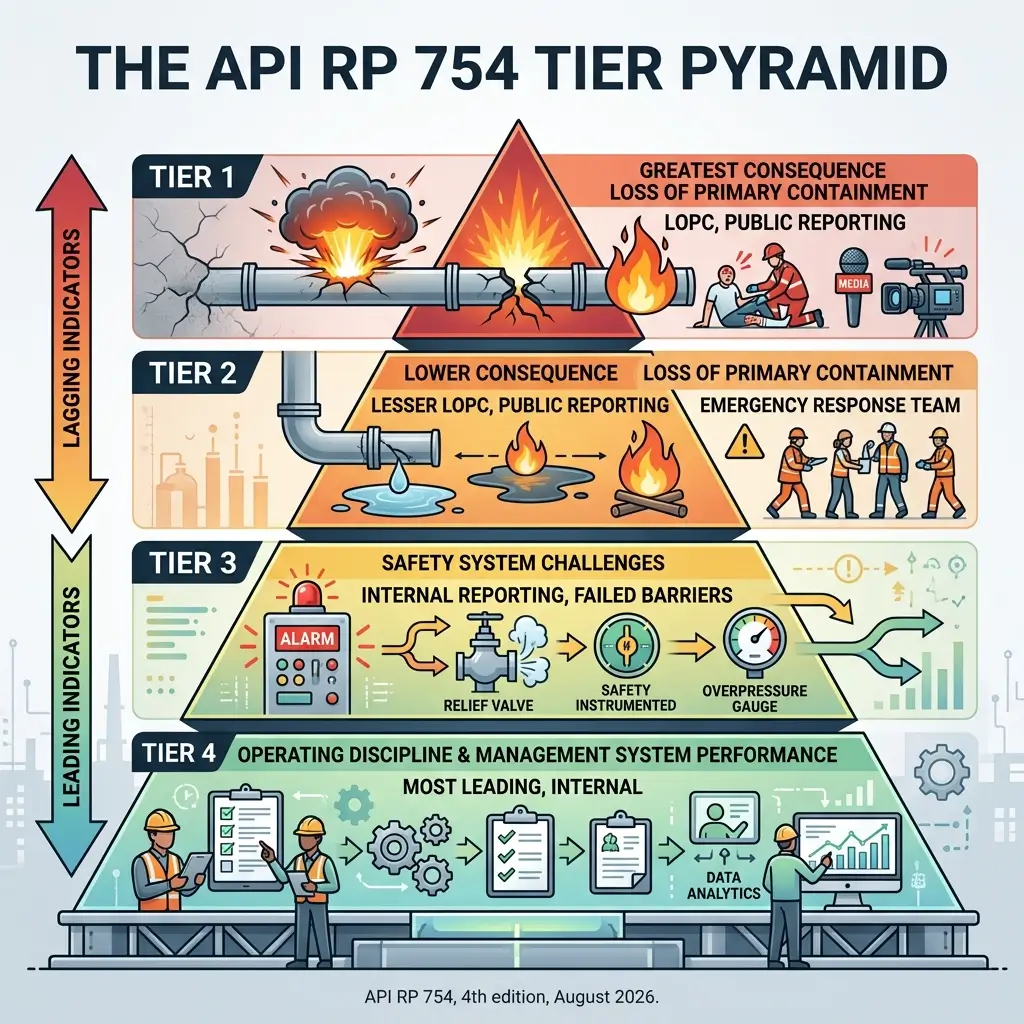
The industry answer is the tiered indicator framework in API Recommended Practice 754, Process Safety Performance Indicators for the Refining and Petrochemical Industries. It was created after the Baker Panel and CSB findings on BP Texas City identified exactly this gap. API published the fourth edition on 6 August 2026. It updates the direct cost thresholds for Tier 1 and Tier 2 events for inflation, refines the guidance on assessing fires, explosions and unignited releases, and expands the annex covering application beyond refining and petrochemicals.
| Tier | What it counts | Reporting |
|---|---|---|
| Tier 1 | Loss of primary containment with the greatest consequence — lost-time injury or fatality, third-party hospitalisation, or major direct cost | Public and industry benchmarking |
| Tier 2 | Loss of primary containment of lesser consequence | Public and industry benchmarking |
| Tier 3 | Challenges to the safety system — safe operating limit excursions, inspection results outside limits, demands on safety devices | Internal |
| Tier 4 | Operating discipline and management system performance | Internal |
When I review an indicator dashboard and it holds Tier 1 and Tier 2 counts with nothing beneath them, that tells me more about the programme than the incident numbers do. A site reporting plenty of Tier 3 findings is usually not a worse site — it is a site whose people are looking. The target is never zero Tier 3 events. It is catching enough of them that you never generate a Tier 1.
Two cautions apply to the framework:
- API RP 754 is a measurement framework, not a compliance tool. It does not substitute for PSM, COMAH or Seveso duties, and it was never intended to.
- Tier definitions changed in the fourth edition. Any trend line spanning the change needs the basis stated, or you will read an inflation adjustment as a safety improvement.
Frequently asked questions
Is the petrochemical industry the same as the oil and gas industry?
No. Oil and gas covers exploration, production, refining and distribution of fuels. The petrochemical industry takes non-fuel fractions from refining and gas processing and converts them into chemical products. The two are physically and commercially integrated, but they run different processes with different risk profiles.
What are the most common accidents in petrochemical plants?
Loss of primary containment is the root of most serious events — a release from piping, a seal, a flange or a vessel that then finds an ignition source or exposes people to a toxic vapour. Contractor injuries during maintenance and confined space entry follow, but containment failure dominates the fatal and catastrophic categories.
What qualifications do you need to work in petrochemical safety?
There is no single mandatory qualification. Employers typically expect a recognised general certificate such as NEBOSH or IOSH, plus process safety-specific training in hazard study techniques, permit systems and incident investigation. Site-specific competence — knowing the chemistry and the units — is what actually distinguishes practitioners in this sector.
Is benzene exposure still a risk in modern plants?
Yes. Modern closed systems reduce routine exposure substantially, but sampling, tank cleaning, maintenance breaks and abnormal operation remain exposure points. The EU lowered its binding limit to 0.2 ppm from 5 April 2026, which reflects a continuing regulatory judgement that the risk is not resolved.
What is process safety management in simple terms?
It is the set of arrangements that stops a hazardous material leaving the equipment holding it. It differs from occupational safety, which protects individuals from slips, falls and machinery. A site can have an excellent injury record and poor process safety — that combination has preceded several major disasters.
Are petrochemical plants safe to live near?
Regulated sites carry duties to assess and limit offsite consequences, and upper tier COMAH and Seveso establishments must produce safety reports and support external emergency planning. Risk is not eliminated. Local emergency plans and public information are published by the competent authority, and residents are entitled to them.
Key points
The petrochemical industry turns oil and gas fractions into the building blocks of nearly everything manufactured, and it does so by handling materials that are more reactive than the fuels they came from. Its risk is not evenly spread across the plant, and it is not primarily a PPE problem.
If you take three things from this article, take these. First, the dominant hazard is loss of primary containment, and every serious consequence downstream of that is secondary. Second, the equipment nobody is operating — idle units, out-of-service piping, dead legs between campaigns — sits outside both the operating routine and the inspection routine, and Port Neches is what that gap costs. Third, the numbers governing exposure differ by jurisdiction and are still moving, so a global procedure must name its source for every limit it states.
Where a site's inventory approaches a regulatory threshold, or where a hazard study needs facilitating, that is work for a competent process safety practitioner with access to the plant and its history. This article will help you ask better questions. It cannot assess your site.
About the author — Isabella Wright
Isabella Wright is a British Chemical Safety and Hazardous Materials Assurance Consultant with 17 years of continuous field experience across specialty chemicals, petrochemicals, tank farms, polymer processing and chlor-alkali operations in 14 countries. Her focus is practical assurance — checking that chemical controls still work at the bottle, the booth and the drain, not only on the SDS shelf. She currently leads Wright Chemical Safety Assurance, based in London, following senior roles including Tank Farm Chemical HSE Lead at Arkema Coatings, Solvent Exposure Control Lead at Solvay Specialty Polymers, and Chemical Safety Programme Lead at Huntsman Advanced Materials.
Credentials: NEBOSH International General Certificate · ISO 45001 Lead Auditor · ISO 14001 Internal Auditor · IOSH Managing Safely · Incident Investigation (ICAM or equivalent) · Dangerous Goods Awareness
Sources
- HSE — Control of Major Accident Hazards Regulations 2015
- HSE — EH40/2005 Workplace Exposure Limits
- EUR-Lex — Directive 2012/18/EU (Seveso III)
- OSHA — 29 CFR 1910.119, Process safety management of highly hazardous chemicals
- OSHA — 29 CFR 1910.1028, Benzene
- OSHA — 29 CFR 1910.1051, 1,3-Butadiene
- OSHA — Hydrogen sulfide standards
- NIOSH — Hydrogen sulfide IDLH documentation
- EPA — Risk Management Program: Safer Communities by Chemical Accident Prevention final rule and subsequent reconsideration
- US Chemical Safety Board — Fires and Explosions at TPC Group Port Neches Operations, Report No. 2020-02-I-TX
- API — Fourth edition of API RP 754, Process Safety Performance Indicators for the Refining and Petrochemical Industries