

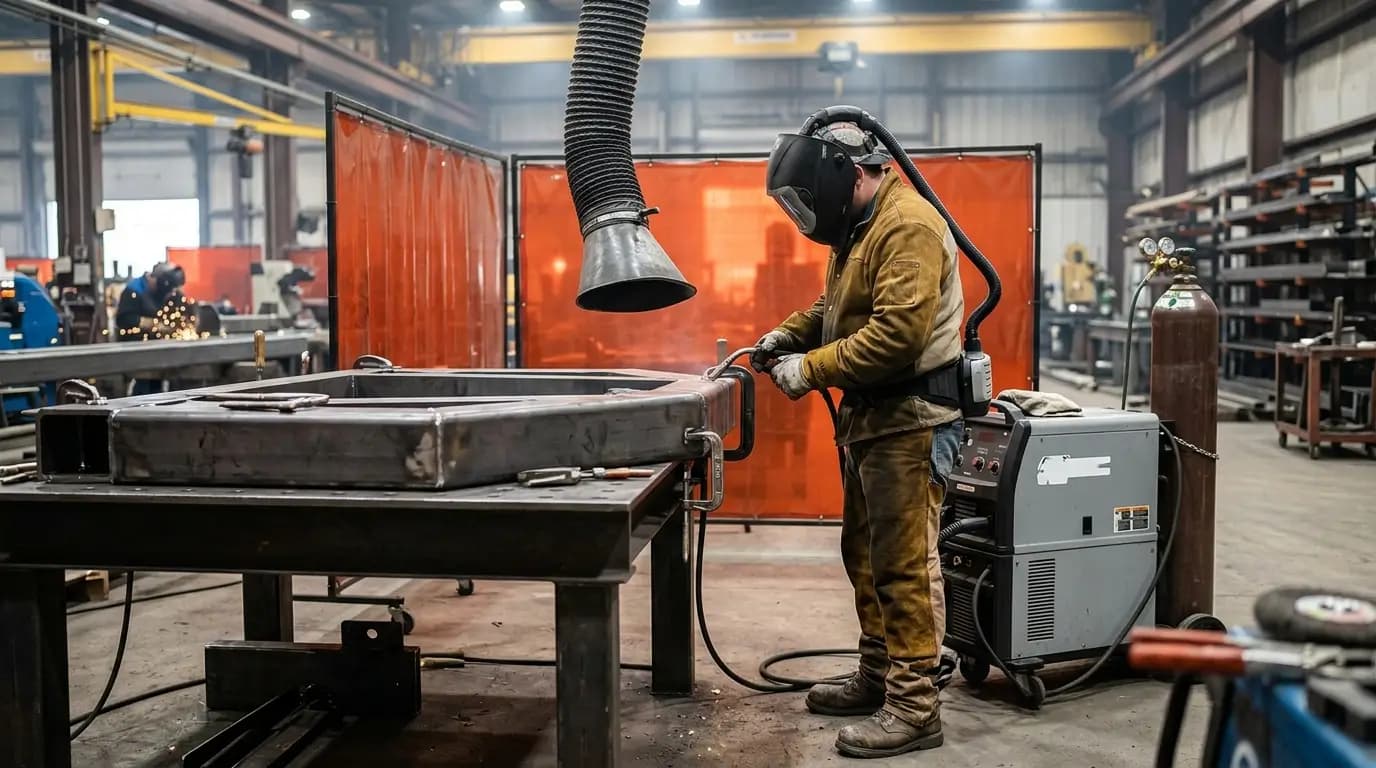
Two different questions hide inside the phrase "PPE for hot work," and answering the wrong one gets people hurt. The first is what protects a welder from spatter, arc radiation and fume. The second is what keeps that same welder working safely inside a heat load that their protective clothing is actively making worse. Most gear lists answer the first and ignore the second.
I have spent sixteen years sampling exposures and fit-testing respirators, including a welding fume programme with SKC Ltd and a heat stress programme with MSA Safety. The pattern I write up most often is not missing PPE. It is PPE selected from a catalogue category rather than from the job — the right kind of glove in the wrong class, a filter shade chosen for comfort, a disposable mask under a welding helmet that has never been fit tested on the person wearing it.
This article covers welding, cutting, grinding and brazing in the United States, the United Kingdom and the EU. It is written for the person choosing the equipment and the person verifying it on site.
Key takeaways
The six points below carry the decisions the rest of the article works through:
- Hot work PPE is a selection decision, not a shopping list. Four variables drive it: the process, the metal and its coating, the degree of enclosure, and the thermal environment.
- US filter shades sit in two different tables that do not agree. 29 CFR 1910.252(b)(2)(ii)(H) selects by electrode diameter; 29 CFR 1910.133(a)(5) selects by arc current. Use the current-based table and treat the value as a minimum.
- Respiratory protection is the residual control, never the primary one. OSHA triggers mechanical ventilation below 10,000 cubic feet per welder or a ceiling under 16 feet; HSE requires engineering controls for all indoor welding regardless of duration.
- Welding clothing has classes. EN ISO 11611 Class 1 covers low-spatter processes such as TIG; Class 2 is required for MMA, MAG, gouging and overhead work. A garment certified only to EN ISO 11612 is not welding clothing.
- Protective clothing raises the heat threshold it is measured against. ACGIH adds 3 °C-WBGT for double-layer woven clothing — which is what a welder in FR coveralls plus a leather jacket is wearing.
- Fit is the control, not the item. A respirator that has not been fit tested on that face, and gloves that stop the wearer feeling the torch, are both failures that pass a visual inspection.
Two different questions hide inside "hot work PPE"
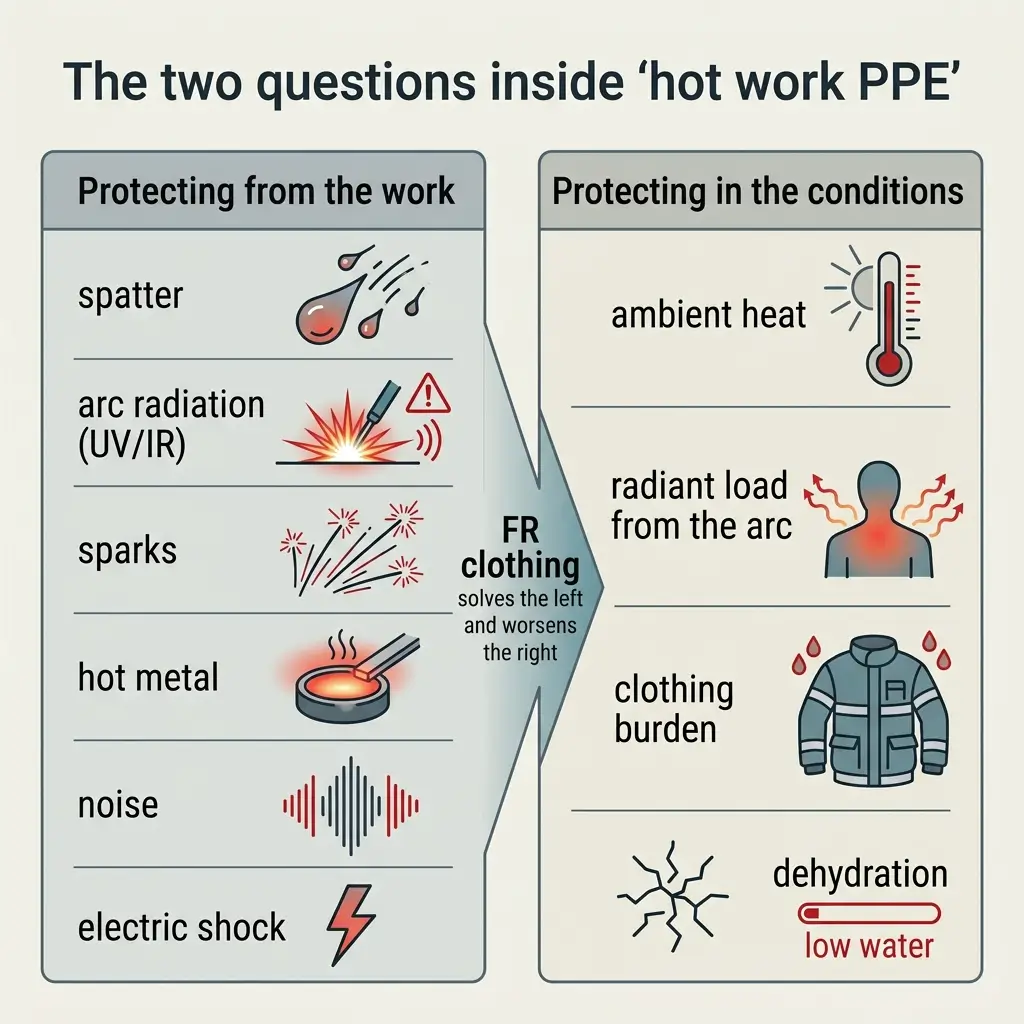
Search for hot work PPE and you get two kinds of article. One is about welding: helmets, leathers, gloves, aprons. The other is about working in heat: cooling vests, vented hard hats, hydration. Both call themselves the answer, and a supervisor reading either one comes away with half a control.
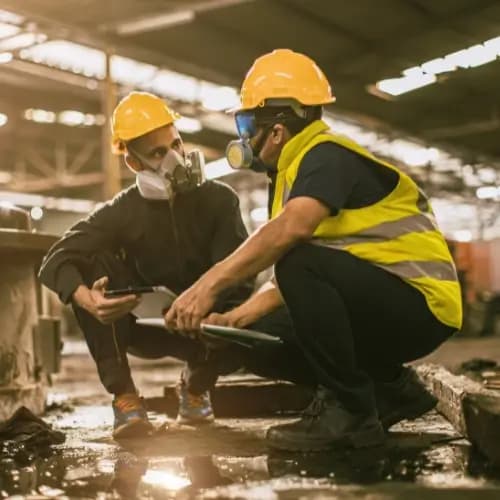
The two are connected in a way that matters. Everything that stops molten spatter also stops evaporative cooling. Flame-resistant fabric is heavier, less permeable and layered, and it is worn over a torso already absorbing radiant heat from an arc running at thousands of degrees. On a summer shift in a fabrication bay, the clothing that protects the welder from burns is the single largest contributor to their heat strain.
That is not an argument for less clothing. It is an argument for treating heat as a design input to the PPE decision rather than a separate topic, and for using the hierarchy of controls properly. PPE is the last layer. Where a job can be moved to a designated welding bay with fixed extraction, the operator ends up in less PPE, not more, because the residual risk is lower.
Three questions separate the two problems cleanly:
- What is the work throwing at the body? Spatter, radiation, sharps, noise, electric shock — this is the classic hot work PPE question.
- What is the work releasing into the air? Fume composition depends on the metal and its coating, and drives the respiratory decision entirely.
- What is the environment doing to the wearer inside all of that? Ambient heat, radiant load, workload and clothing burden combine into a heat strain question the gear list cannot answer.
What the regulations require, by jurisdiction
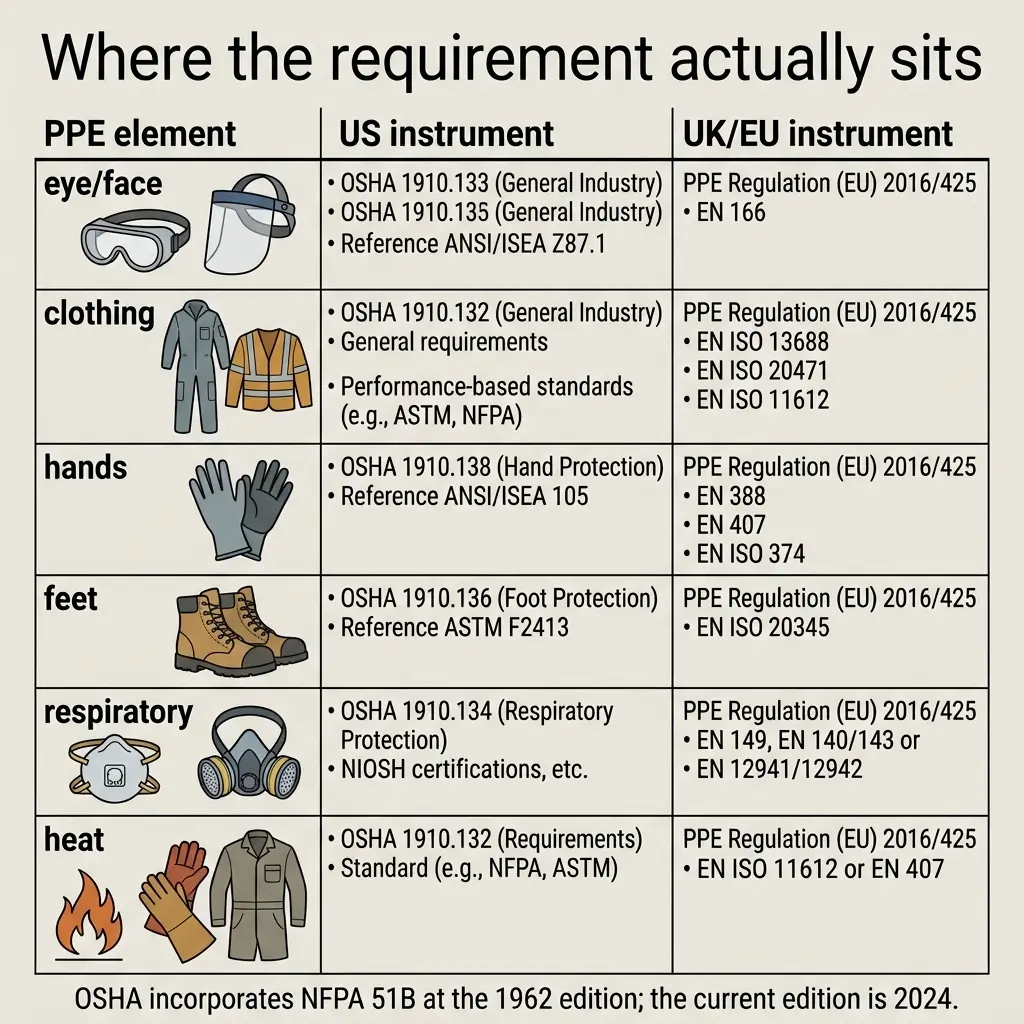
The legal frameworks differ more than the equipment does. In the United States, the welding standard says remarkably little about clothing: 29 CFR 1910.252(b)(3) requires protective clothing "in accordance with the requirements of § 1910.132" and leaves the specification to the employer's hazard assessment. The detail lives in consensus standards — AWS Z49.1:2021, referenced throughout Subpart Q, and NFPA 51B.
There is a trap in that reference chain. OSHA incorporates NFPA 51B by reference at the 1962 edition, and cites ANSI Z49.1-1967 in its labelling clauses. The current documents are NFPA 51B (2024) and AWS Z49.1:2021. Insurers and site standards will hold you to the current editions; federal enforcement rests on the old ones. Cite both, and work to the newer.
The UK approach is the reverse. There is no welding-specific regulation. Duties come from COSHH 2002 for fume and the PPE at Work Regulations 1992 as amended in 2022 for equipment — the 2022 amendment extended those duties to limb (b) workers, which matters on sites where welding is done by agency labour. The technical specification comes from EN standards.
This table shows where each jurisdiction sets the requirement for each item.
| PPE element | United States | United Kingdom / EU | Notes |
|---|---|---|---|
| Eye and face | 29 CFR 1910.252(b)(2); 1910.133; ANSI/ISEA Z87.1 | EN 175 (welding), EN 166 (impact), EN 169 (filters) | US shade tables are guidance-worded but enforced as minima |
| Body clothing | 29 CFR 1910.252(b)(3) → 1910.132; AWS Z49.1 | EN ISO 11611 Class 1 or 2 | EU classes garments; the US does not |
| Hands | 29 CFR 1910.138 | EN 12477 Type A or B | Type B where dexterity governs (TIG) |
| Feet | ASTM F2412 / F2413 | EN ISO 20345 | Spats or gaiters where spatter falls |
| Respiratory | 29 CFR 1910.252(c); 1910.134; 1910.1026 for Cr(VI) | COSHH Reg. 7; HSE alert STSU1-2019; HSG53 | HSE requires controls for all welding, any duration |
| Heat | General Duty Clause; state standards; NEP CPL 03-00-024 | Workplace Regs 1992 Reg. 7; ISO 7243 | No federal US heat standard yet |
The practical consequence for a multinational procurement standard is that the EU classification system is the more useful specification language. "EN ISO 11611 Class 2" tells a supplier exactly what to ship. "Appropriate protective clothing" does not.
A specification that satisfies all three jurisdictions at once needs to state four things:
- The garment class, not the garment description — EN ISO 11611 Class 1 or Class 2 against named processes
- The eye protection standard and the shade, tied to process and current rather than left to the operator
- The fume control expectation before the respirator — engineering control first, RPE for residual exposure
- Who the duty covers, including agency and contract welders, which UK law now makes explicit
Question one: what is the process throwing?
Start here, because the process determines the arc intensity, the spatter volume and the projectile risk, and those three set the eye, face and clothing decisions before anything else is considered.
Filter shade: the two tables that disagree
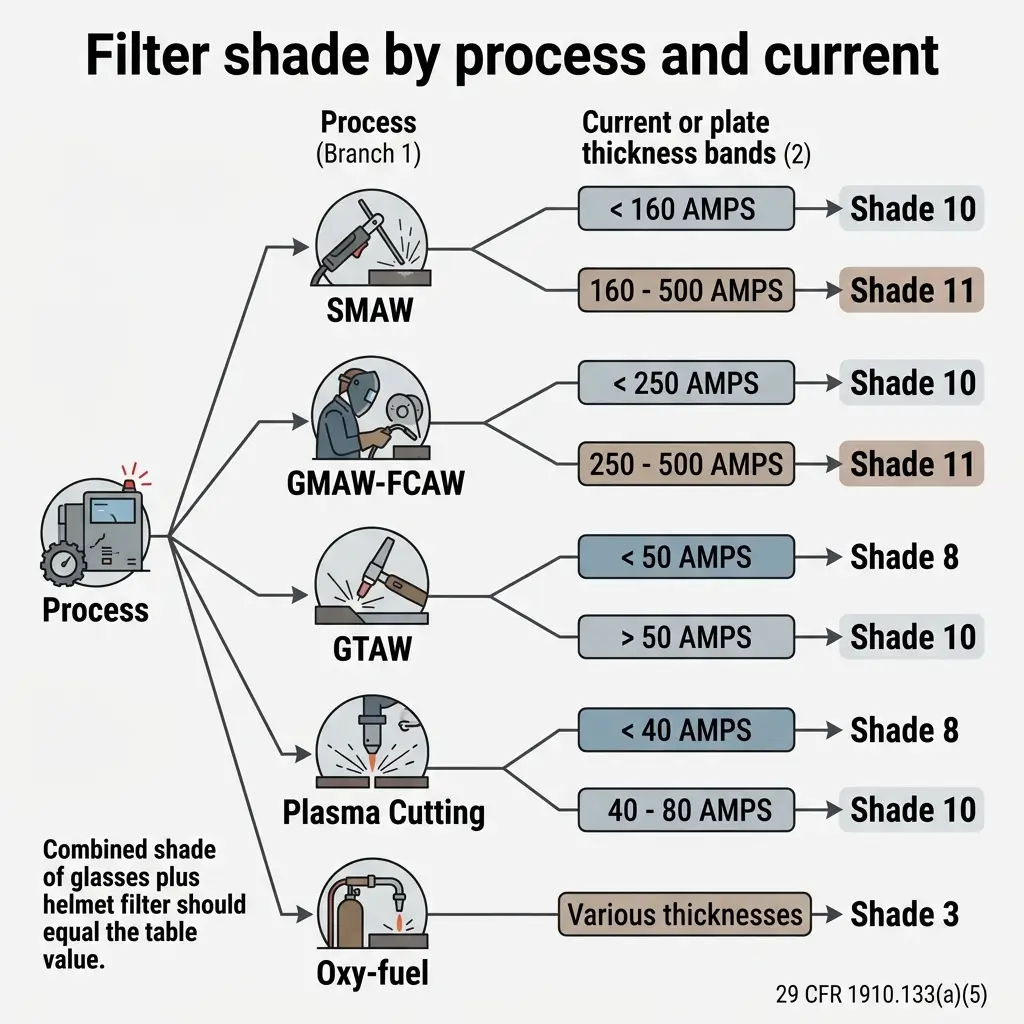
The US has two filter shade tables and they do not match. The welding standard at 1910.252(b)(2)(ii)(H) selects shade by electrode diameter — shielded metal arc welding with 1/16 to 5/32 inch electrodes gets shade 10. The eye and face standard at 1910.133(a)(5) selects by arc current, and gives shade 8 for the same process at 60 to 160 amps, rising to 11 above 250 amps.
Use the current-based table. It reflects how the hazard actually scales, and it is the one AWS Z49.1 aligns with. The stated value is a floor, not a target: the standard's own guidance is to start with a shade too dark to see the weld pool, then step lighter until the pool is visible without going below the minimum.
Two details get missed. First, an auto-darkening helmet must have its dark state set to the value from the table — the helmet does not select it for the welder. Second, where safety glasses with a filter are worn under a helmet filter, the combined shade should equal the table value, not double it.
Everything except the arc
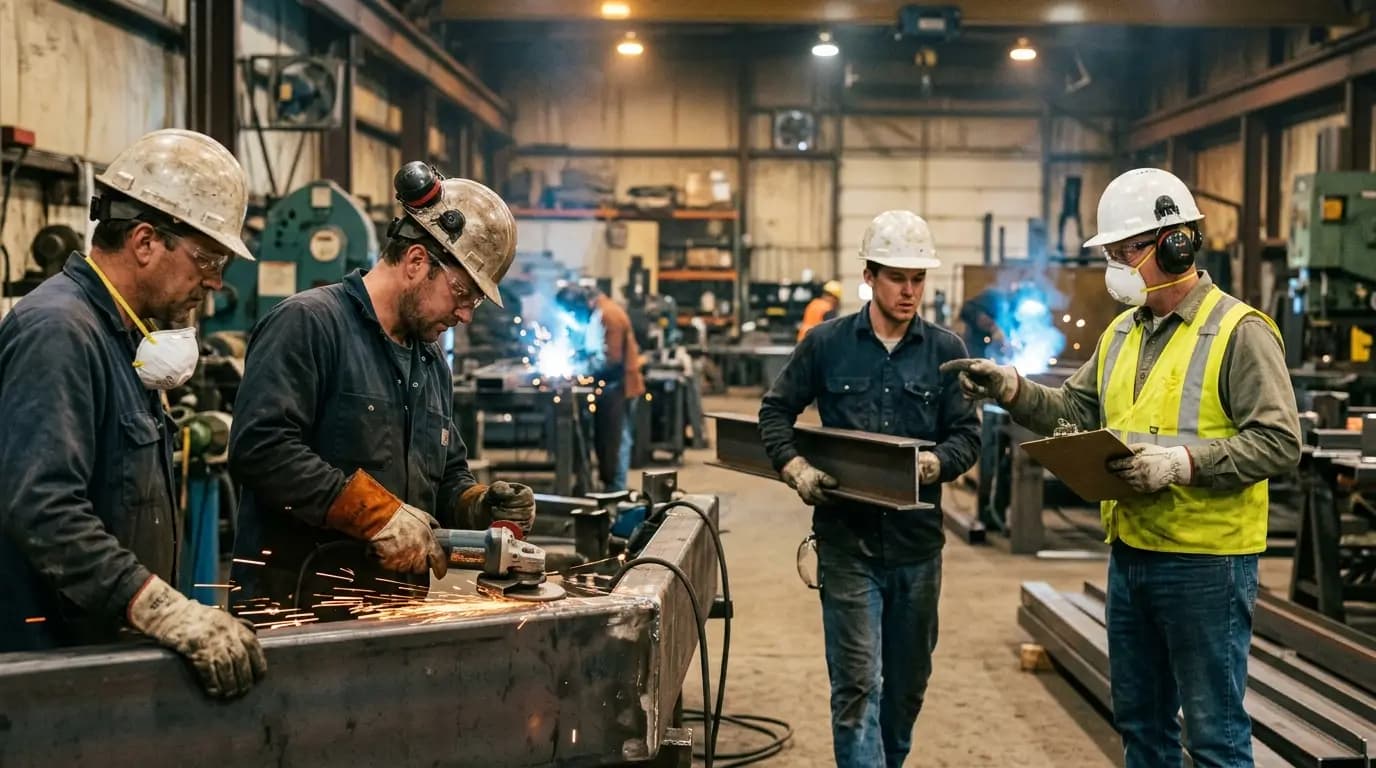
Grinding and cutting throw high-velocity fragments at angles a welding helmet was not designed for. 1910.133(a)(2) requires side protection where there is a flying-object hazard, which means Z87.1 spectacles with side shields under the helmet and a face shield for grinding.
Bystanders are the group most often left out. 1910.252(b)(2)(iii) requires screens or booths to protect adjacent workers from arc rays. Screens should stand roughly two feet clear of the floor so they do not choke ventilation — a detail worth knowing, because I have seen screens sealed to the floor for tidiness and the fume then pooling in the operator's breathing zone.
Match the eye and face protection to the process using these minimum shades from the OSHA current-based table:
- SMAW (stick), 60–160 A — shade 8 minimum; shade 10 at 160–250 A; shade 11 above 250 A
- GMAW and FCAW, 60–160 A — shade 10 minimum across the working range
- GTAW (TIG), 50–150 A — shade 8 minimum; shade 10 above 150 A
- Plasma arc cutting, under 300 A — shade 8 minimum, rising to 10 above 400 A
- Oxy-fuel cutting, plate under 25 mm — shade 3 minimum
- Grinding and chipping — no filter, but Z87.1 spectacles with side shields plus a face shield
Question two: what metal, what coating, what enclosure?
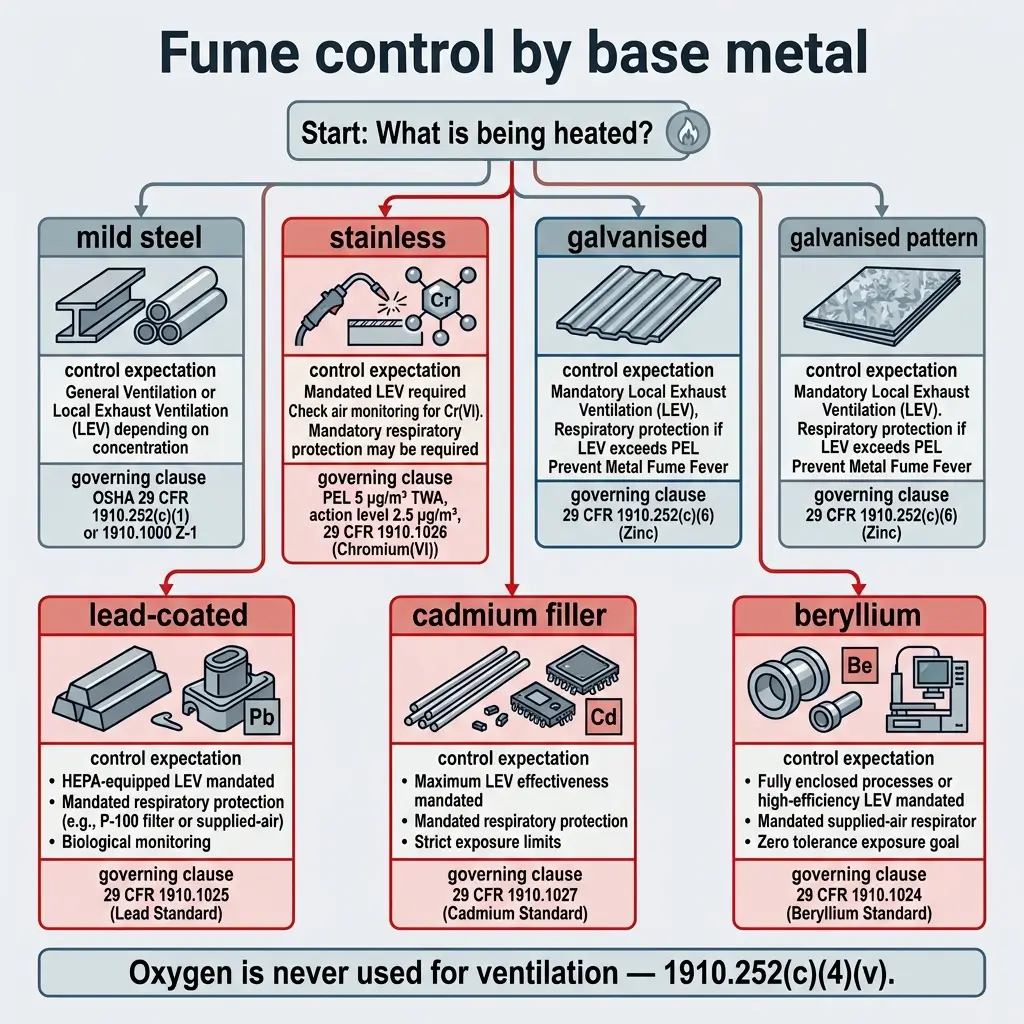
The respiratory decision has almost nothing to do with the welding process and almost everything to do with what is being heated. Mild steel, stainless, galvanised coating and lead paint produce four different exposure problems from the same torch.
Why this is not a PPE question first
Both regulators treat respiratory protection as the residual control. OSHA requires mechanical ventilation when welding happens in a space of less than 10,000 cubic feet per welder, in a room with a ceiling under 16 feet, or where partitions obstruct cross ventilation — at a minimum rate of 2,000 cubic feet per minute per welder unless local exhaust is used instead. Where a movable hood is used, 1910.252(c)(3) requires 100 linear feet per minute of capture velocity at the weld, which means 150 cfm with the hood 4 to 6 inches away and 600 cfm at 10 to 12 inches.
That distance relationship is the one I test most often, because capture velocity falls away far faster than people expect. A hood parked a foot from the arc for convenience is doing roughly a quarter of the work the operator believes it is doing.
The UK position went further in 2019. Following the IARC reclassification of welding fume as a Group 1 human carcinogen, HSE issued safety alert STSU1-2019, which states that general ventilation does not achieve the necessary control and that no welding may be undertaken without suitable exposure controls, regardless of duration, because there is no known safe level of exposure. Outdoor welding requires RPE, since LEV is not practical there.
Selecting the respirator
For most fabrication work the practical choice is a powered air-purifying respirator integrated into the welding helmet, or a disposable FFP3 under a conventional helmet. The powered option is usually better for a reason that has nothing to do with filtration: it does not need a face seal fighting a helmet, it is cooler on a long shift, and it does not fail when someone grows a beard.
Fit is where these programmes fall over. 29 CFR 1910.134 requires fit testing before first use and annually for tight-fitting facepieces, and prohibits facial hair that interferes with the seal. UK practice under HSE INDG479 is the same. A disposable mask handed out at the store counter and never fit tested is a documented item on a matrix and an unknown quantity on a face.
Use this table to route the fume decision by material rather than by process.
| Material or coating | Principal agent | Control expectation | Source |
|---|---|---|---|
| Mild steel | Iron oxide, manganese | LEV at the arc; RPE for residual fume | HSE STSU1-2019; 1910.252(c)(2) |
| Stainless / chrome alloy | Hexavalent chromium | PEL 5 µg/m³ 8-hr TWA; action level 2.5 µg/m³ | 29 CFR 1910.1026 |
| Galvanised / zinc-coated | Zinc oxide (metal fume fever) | LEV indoors; ventilation per (c)(3) | 29 CFR 1910.252(c)(6) |
| Lead paint or lead-bearing | Lead | LEV or airline respirator indoors; RPE even outdoors | 29 CFR 1910.252(c)(7)(iii) |
| Cadmium-bearing filler | Cadmium | LEV or airline respirator; NIOSH-approved RPE outdoors | 29 CFR 1910.252(c)(9) |
| Beryllium-containing | Beryllium | LEV and airline respirator unless testing proves otherwise | 29 CFR 1910.252(c)(8) |
One rule from that standard is worth memorising because it gets broken in confined spaces by well-meaning people: oxygen must never be used for ventilation. 1910.252(c)(4)(v) states it in four words, and the failure mode is a flash fire in an oxygen-enriched space.
Question three: what does the clothing have to survive?
European standards make this decision explicit in a way the US framework does not, which is why they are worth using even where they do not apply legally. The question a garment has to answer is how much molten metal it will stop and for how long it will hold back radiant heat — and EN ISO 11611 puts numbers against both.
Class 1 or Class 2
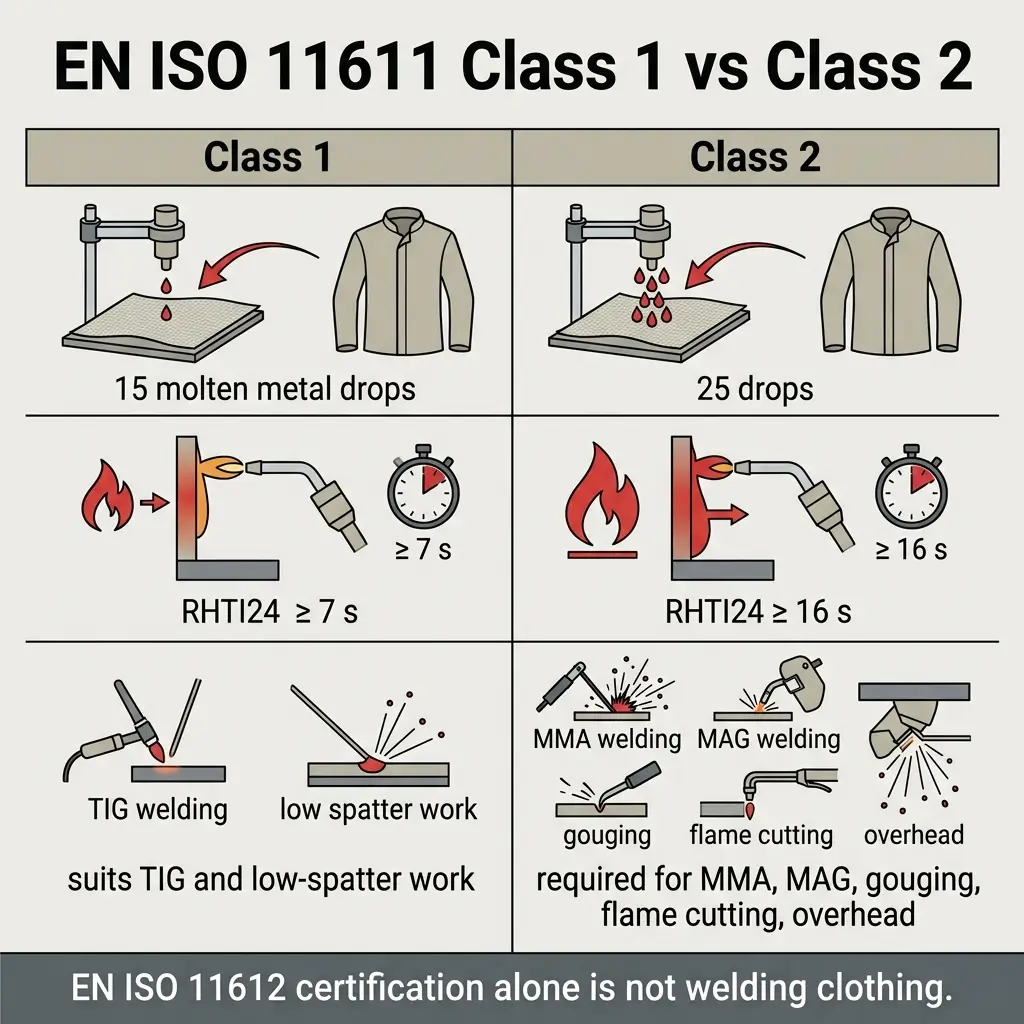
EN ISO 11611 sets two classes, tested by dropping molten metal onto the fabric and measuring how many drops it takes to raise the temperature behind it by 40 K. Class 1 withstands at least 15 drops and resists radiant heat for at least 7 seconds. Class 2 requires 25 drops and at least 16 seconds.
Annex A of the standard matches the class to the activity. Class 1 covers low-spatter techniques such as TIG. Class 2 is required for MMA and MAG welding, gouging and flame cutting, and for any work overhead or in constrained positions where spatter falls onto the operator rather than away from them.
The procurement error I see most often is a garment certified to EN ISO 11612 being issued as welding clothing. EN ISO 11612 is general heat and flame protection. It does not include the spatter or electrical-contact requirements that define EN ISO 11611, and the two are not interchangeable.
The details that decide whether it works
Design features matter more than fabric weight. Pockets must have flaps, trouser pocket openings are limited to a shallow angle so spatter cannot drop in, collars must fasten to the top, and no continuous exposed metal fastenings are permitted because they conduct heat to the skin. Trousers go over boots, never tucked in — a tucked cuff is a funnel.
Two failure modes have nothing to do with the garment specification. Oil and grease contamination destroys flame resistance, so a garment soaked from a previous job is no longer protective clothing until it has been laundered. And synthetic layers worn underneath melt onto skin, which is why base layers should be cotton, wool or an FR-rated synthetic, not an ordinary polyester t-shirt.
Hands are covered separately. EN 12477 classifies welding gloves as Type A, which prioritises thermal protection, or Type B, which prioritises dexterity for TIG work where the operator needs to feel the filler rod. Issuing Type A gloves to a TIG welder reliably produces a welder who removes them.
Before a garment goes onto a PPE matrix, check these six things:
- Standard and class marked on the label — EN ISO 11611 Class 2 for MMA, MAG, gouging and overhead work
- Pocket flaps and closed cuffs present — no open pocket mouths facing upward
- No exposed metal fasteners — press studs conduct heat through to skin
- Base layer specified, not assumed — cotton, wool or FR synthetic underneath
- Glove type matched to process — EN 12477 Type B where dexterity governs, Type A for heavy spatter
- A contamination and laundering route exists — oil-soaked FR is not FR
Question four: what is the heat doing to the wearer?
This is the question the gear lists skip, and the one that turns a correctly specified PPE set into an unsustainable one.
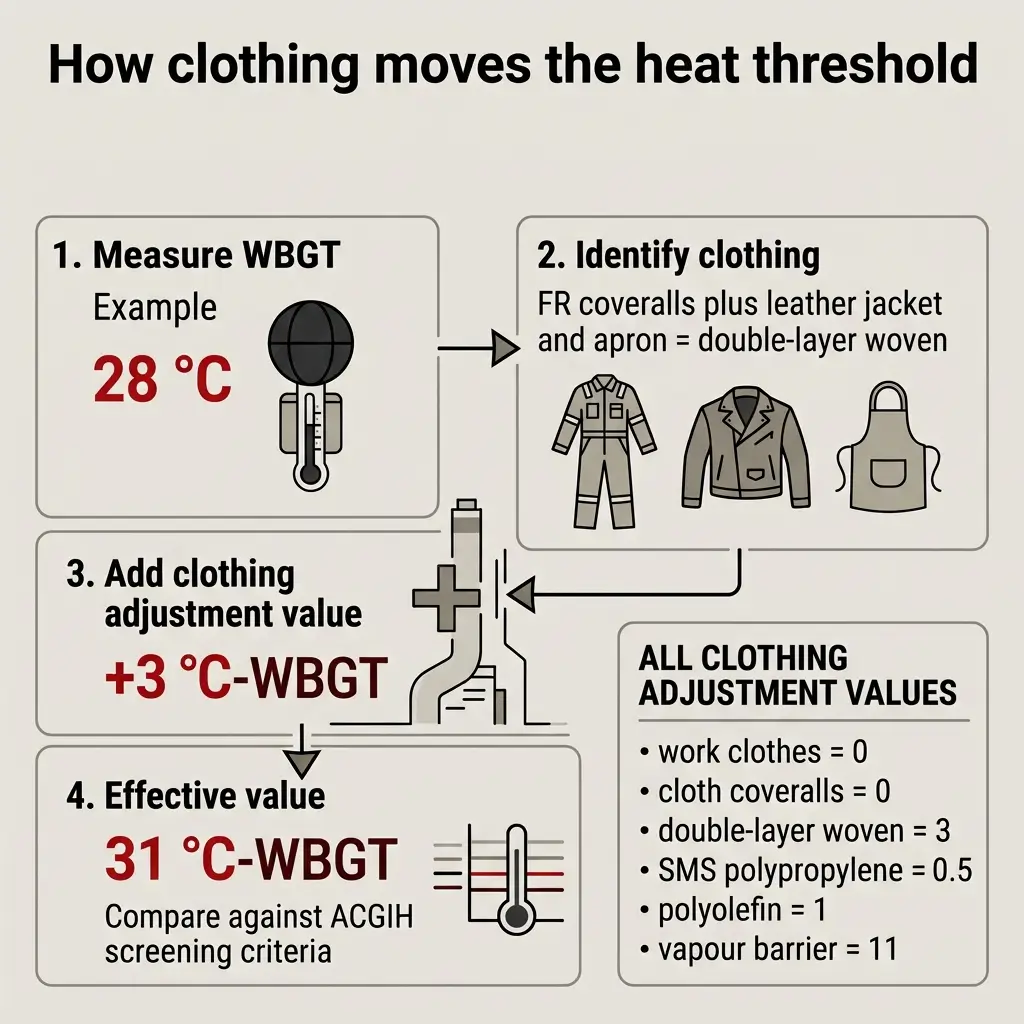
Heat stress screening uses wet bulb globe temperature, defined in ISO 7243 and applied through the ACGIH TLV and the NIOSH criteria document. The screening criteria assume light clothing. Where the worker is in something heavier, a clothing adjustment value is added to the measured WBGT before comparing it against the limit.
The published ACGIH adjustments are: work clothes and single-layer woven coveralls, add 0; double-layer woven clothing, add 3; SMS polypropylene coveralls, add 0.5; polyolefin coveralls, add 1; limited-use vapour-barrier coveralls, add 11 — all in °C-WBGT.
A welder in FR coveralls with a leather jacket and apron over them is wearing double-layer woven clothing. So take a fabrication bay measuring 28 °C-WBGT, with an acclimatised welder doing moderate work. The measured value looks comfortable against the screening criteria. Add the clothing adjustment and the effective exposure is 31 °C-WBGT, which pushes that welder from a mostly-continuous work allowance down into a heavily restricted work-rest cycle. Nothing about the room changed. The clothing moved the threshold.
The regulatory position on heat is unsettled in the US. The proposed federal rule, Heat Injury and Illness Prevention in Outdoor and Indoor Work Settings, was published on 30 August 2024 and has not been finalised; the post-hearing comment period closed on 30 October 2025. In the meantime OSHA cites under the General Duty Clause and reissued its heat National Emphasis Program, CPL 03-00-024, on 10 April 2026 for a further five years, targeting 55 high-hazard industries. Several states run their own standards. Check the position for your jurisdiction before writing it into a procedure.
Cooling PPE helps, with a caveat worth stating plainly. Phase-change and evaporative vests work by removing heat from the torso, and both are compromised when worn under an impermeable outer layer. Evaporative vests need air movement to function at all, so in a still, humid bay under leathers they do very little. Phase-change vests do not depend on evaporation and are the more reliable option in that situation.
Four measures do most of the work once the clothing burden is fixed:
- Acclimatise new and returning welders — the risk concentrates in the first week back, not in the hottest week
- Shorten the cycle rather than the clothing — adjust work-rest ratios against the adjusted WBGT, not the measured one
- Choose phase-change cooling over evaporative where an impermeable outer layer is worn
- Measure rather than ask — a WBGT reading takes minutes and replaces a judgement made by someone already heat-affected
Where hot work PPE actually fails
Every item above can be correctly specified and the job can still be unprotected. These are the failures I write up, and none of them is visible on a PPE matrix.
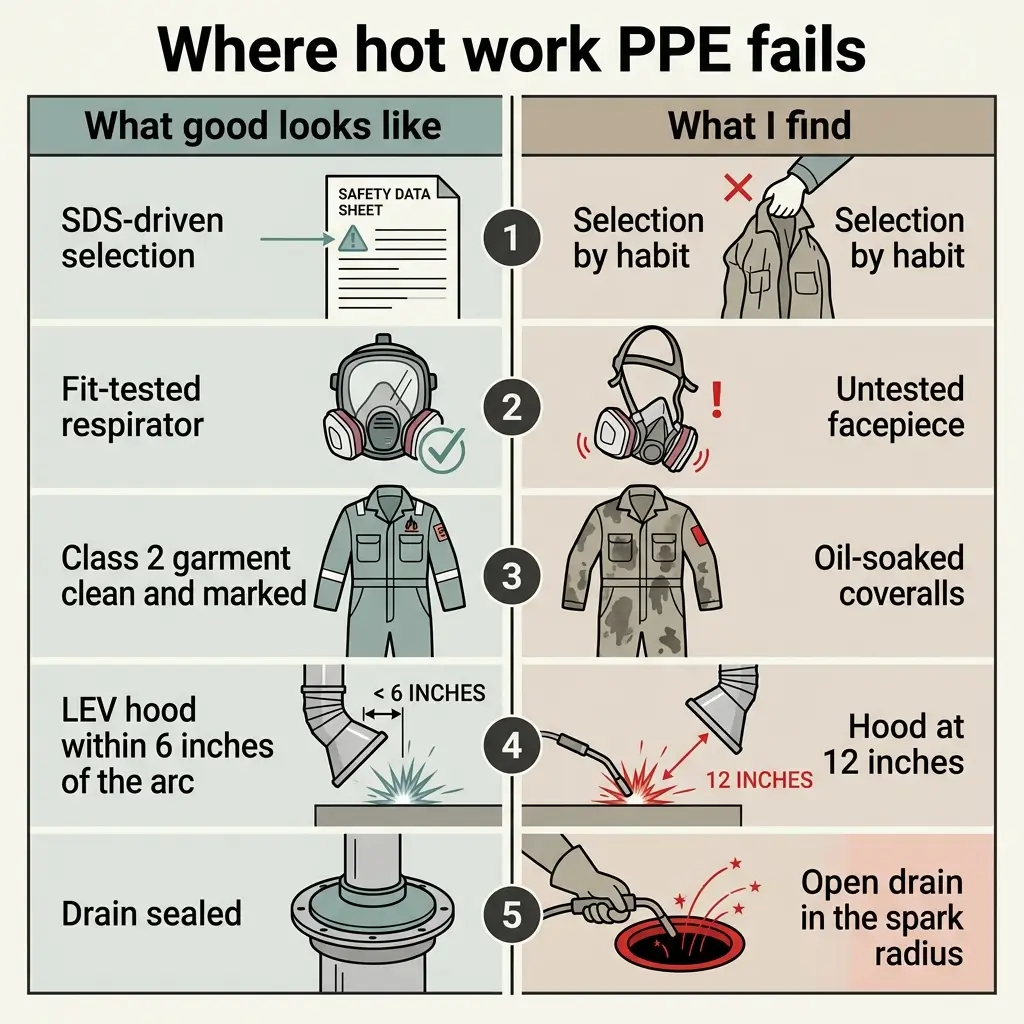
Selection by habit rather than by the material
On a walkdown for Dräger Safety Hygiene in Belgium, working on a respirator programme, I found PPE being issued by custom rather than by the hazard data. The safety data sheet for the material in use called for a different level of protection than the kit the crew were wearing, and nobody had gone back to the sheet since the job was set up. The gear was clean, in date and worn correctly. It was also the wrong gear.
I stopped that work pattern, had the controls reinstated against the actual material, and briefed the crew before they restarted.
The transferable check is small and takes a minute: pick one item off a welder and ask which document says that item is the right one. If the answer is "that is what we always use here," the selection has drifted from the assessment, and the assessment is now decoration.
PPE substituting for a control that failed
Auditing for TSI Incorporated Hygiene in Germany, I found hot work under way close to an open process drain. The crew were fully kitted — the PPE was not the problem. An open drain near hot work is a fire and explosion pathway, and no amount of flame-resistant clothing addresses it. I stopped the job, had the controls put back, and briefed the crew before restart.
That case is not a PPE failure and I would not present it as one. It matters here because of what it says about sequence. PPE protects the operator from the residual hazard after the area has been made safe. When it becomes the reason work proceeds, the order of controls has inverted, and the clothing is being asked to do a job it cannot do.
The quieter failures
Three more turn up repeatedly and are worth checking specifically:
- Fit testing that never happened — a tight-fitting facepiece issued without a fit test on that individual, or a fit test done two beards ago
- Contaminated FR clothing back in service — oil-soaked garments returned to the rack because the laundering route is slower than the job
- Gloves removed for dexterity — usually Type A gloves on TIG work, and the operator is making a rational decision about a bad issue
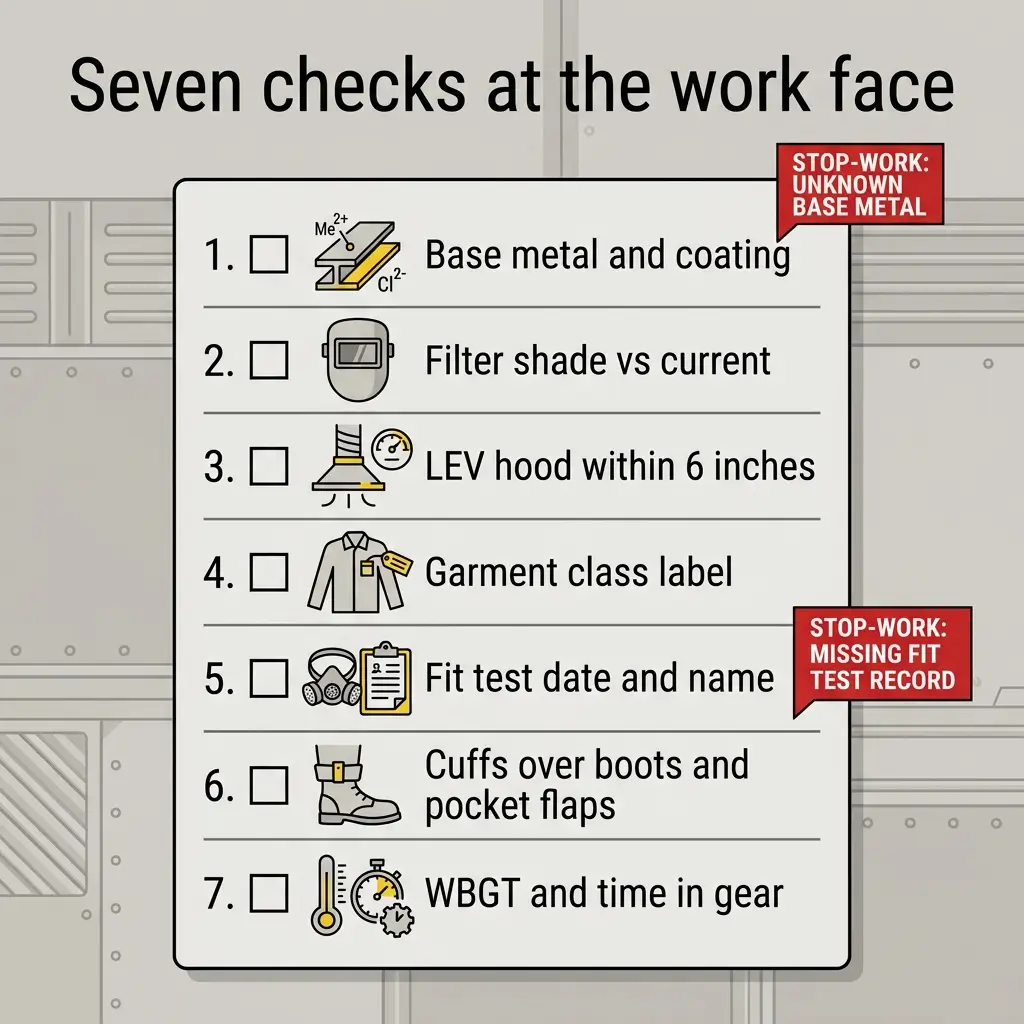
The verification I run at the work face
Verification happens where the work is, not where the paperwork is. Everything below can be done by a supervisor in ten minutes without instruments, except the last item.
Walk it in this order, because each check depends on the one before it:
- Ask what is being welded, and what is on it. Coating and base metal drive the fume decision. If nobody can answer, stop there — the exposure assessment does not exist.
- Check the filter shade against the process and current. Read the number off the lens or the helmet setting. Compare against the 1910.133(a)(5) minimum.
- Measure the LEV hood distance from the arc. Hand span is close enough. Beyond about 8 inches, ask what capture velocity it was commissioned at.
- Read the garment label. EN ISO 11611 and a class number, or an equivalent US specification tied to the hazard assessment. No label, no assurance.
- Ask when the respirator was fit tested, and to whom. The answer should be a date and a name, not a brand.
- Look at the trouser cuffs and pocket flaps. Cuffs over boots, flaps closed. These two details predict burn injuries better than fabric weight does.
- Ask how long the operator has been in the gear, and what the WBGT is. If nobody is measuring, the heat exposure is being managed by how the welder feels, which is not a control.
Two of those checks are worth escalating on immediately: no fit test record, and no answer on the base metal. Both mean the exposure has never been assessed, and everything downstream of them is guesswork.
Frequently asked questions
These are the questions that come up most often in training rooms and on pre-job briefs, answered against the clauses cited above.
What PPE is required for hot work?
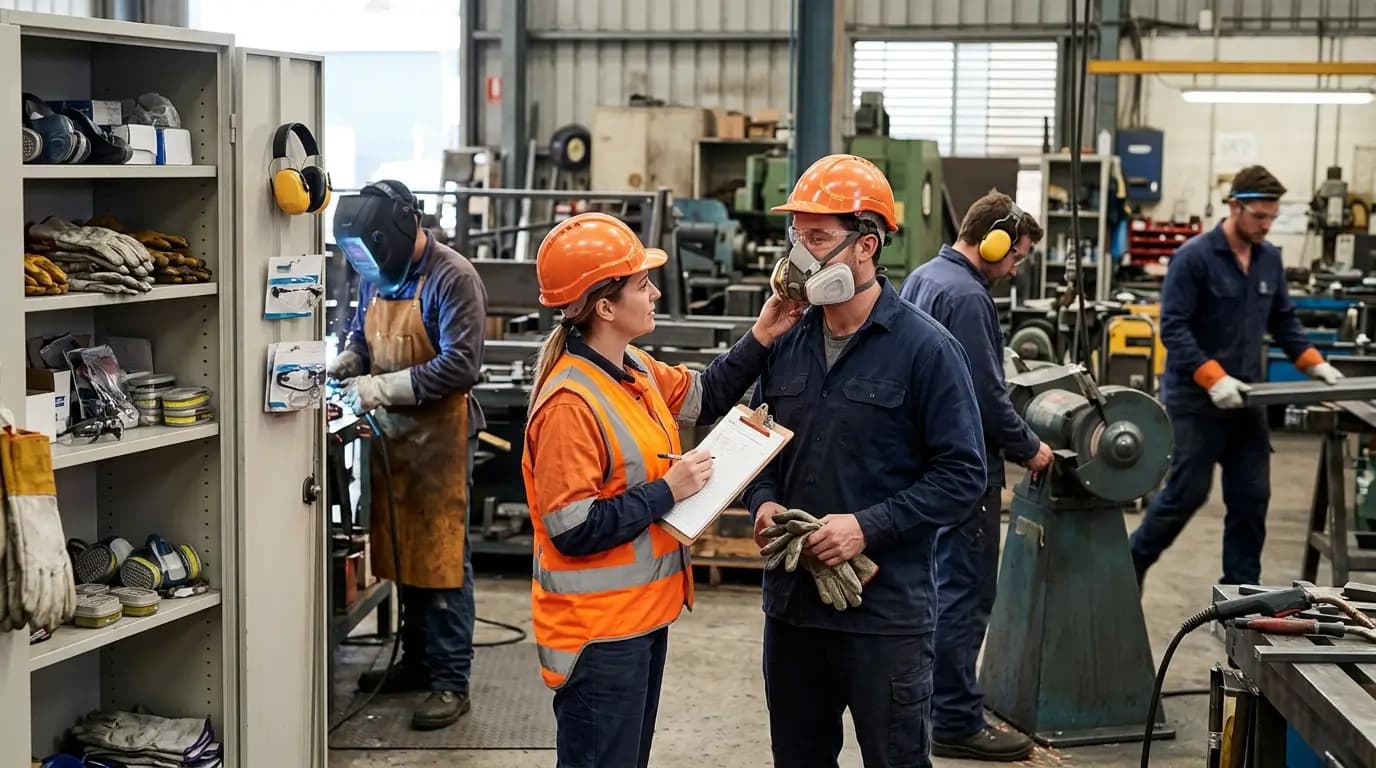
At minimum: a welding helmet with the correct filter shade, Z87.1 or EN 166 spectacles beneath it, flame-resistant clothing matched to the spatter level, welding gloves of the right type, safety footwear with spats where spatter falls, hearing protection, and respiratory protection where ventilation cannot control fume at source.
What shade lens do I need for welding?
It depends on process and arc current, not preference. Under 29 CFR 1910.133(a)(5), stick welding at 60–160 A needs shade 8 minimum, MIG and flux-cored at 60–160 A needs shade 10, and TIG at 50–150 A needs shade 8. Set an auto-darkening helmet to that value manually.
Is a welding helmet enough eye protection?
No. A helmet protects against radiant energy from the front, but grinding fragments and slag arrive from other angles and reach the eyes when the helmet is lifted. Safety spectacles with side shields must be worn underneath, with a face shield added for grinding and chipping.
Do I need a respirator for welding mild steel?
In the UK, yes, wherever LEV alone does not control exposure — HSE's 2019 alert removed the duration exemption for all welding fume including mild steel. In the US, ventilation comes first under 1910.252(c), and respiratory protection is required where controls cannot hold exposure below the applicable limits.
Can flame-resistant clothing cause heat stress?
It contributes to it. FR clothing reduces evaporative cooling, and ACGIH adds 3 °C-WBGT for double-layer woven clothing when screening heat exposure. The answer is not less protection but a shorter work-rest cycle, acclimatisation, and cooling measures that work under the outer layer.
Does OSHA have a hot work PPE standard?
Not a single one. Hot work PPE is covered across 29 CFR 1910 Subpart Q for welding, Subpart I for PPE generally, 1910.134 for respirators and 1910.1026 for hexavalent chromium, with AWS Z49.1 and NFPA 51B supplying the technical detail.
Who pays for hot work PPE?
The employer, in both jurisdictions. In Great Britain the PPE at Work Regulations 1992, as amended in 2022, extend that duty to limb (b) workers — which covers most agency welders — and prohibit charging workers for equipment the risk assessment requires.
Conclusion: what to change first
If you only alter one thing after reading this, make it the selection step. Most sites already own adequate equipment. What they lack is a traceable line from the material being welded, through the hazard assessment, to the specific item on the specific person — and a way to prove that line still holds on a Tuesday afternoon when the job has changed and the kit has not.
Where exposures may exceed a limit, or where a heat assessment is genuinely marginal, involve an occupational hygienist and get it sampled. A catalogue claim is not an exposure measurement, and a comfortable-looking WBGT reading is not a comfortable welder.
About the author
Sophia Bennett is a Principal Occupational Hygiene & Exposure Control Consultant with 16 years of field experience across 14 countries in Europe, the Americas, Oceania, Asia and the Middle East. She has led welding fume work with SKC Ltd, respirator programmes with Dräger Safety Hygiene, heat stress programmes with MSA Safety, and PPE fit assurance with DuPont Personal Protection, and now leads Bennett Occupational Hygiene Partners in Manchester. She holds the NEBOSH International General Certificate, ISO 45001 Lead Auditor and ISO 14001 Internal Auditor certifications, and IOSH Managing Safely. Her focus is proving that capture, fit and exposure controls still work where the work actually happens.
Sources and further reading
- 29 CFR 1910.252 — Welding, cutting and brazing: general requirements, OSHA
- 29 CFR 1910.133 — Eye and face protection, including the filter lens table, OSHA
- 29 CFR 1910.134 — Respiratory protection, OSHA
- 29 CFR 1910.1026 — Chromium (VI), OSHA
- Safety alert STSU1-2019: change in enforcement expectations for mild steel welding fume, HSE
- Personal protective equipment at work regulations 2022, HSE
- INDG479 — Guidance on respirator fit testing, HSE
- Heat Injury and Illness Prevention rulemaking status, OSHA
- NIOSH criteria for a recommended standard: occupational exposure to heat and hot environments, NIOSH
- ISO 7243 — Assessment of heat stress using the WBGT index, ISO
- ISO 11611 — Protective clothing for use in welding and allied processes, ISO
- AWS Z49.1:2021 — Safety in welding, cutting and allied processes, American Welding Society