

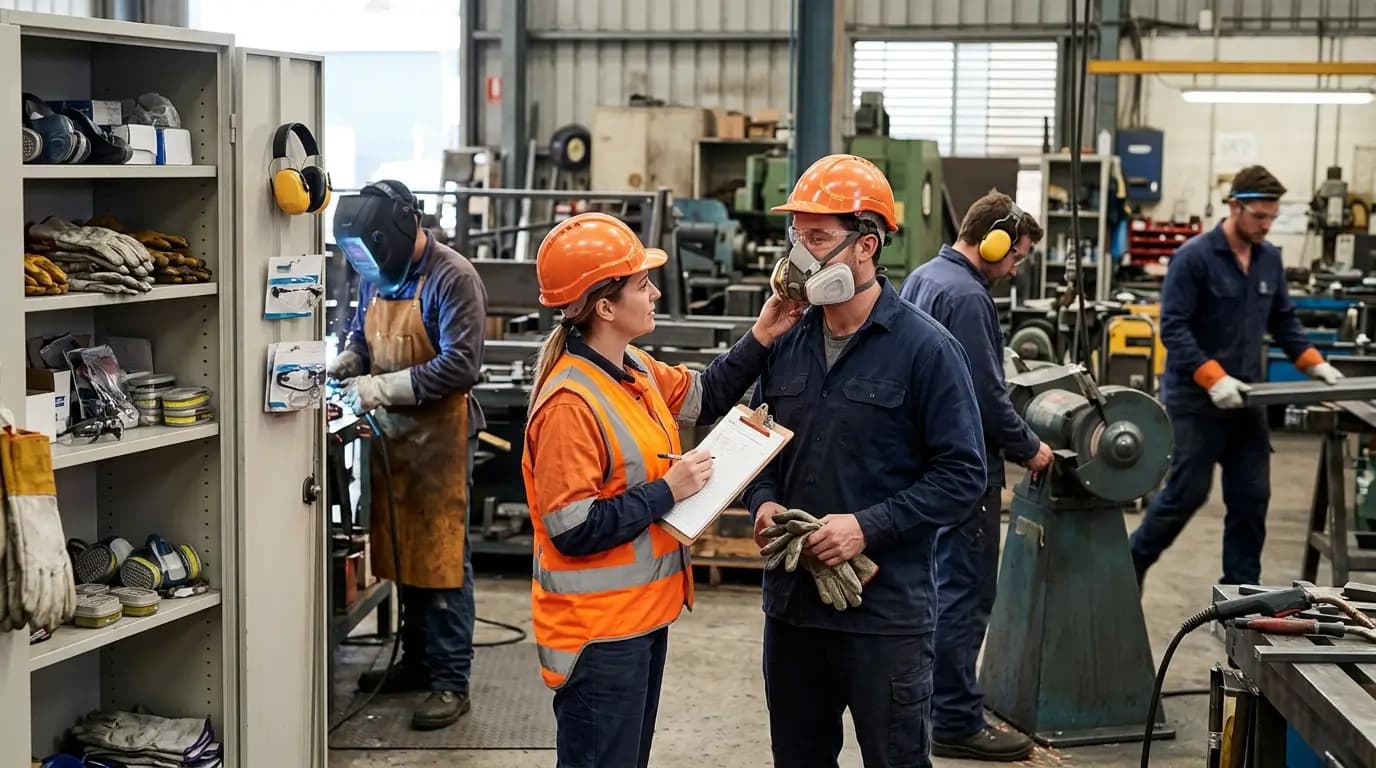
Most people searching for PPE requirements want a list of equipment. The regulations do not contain one. What OSHA, the HSE and the EU each set out instead is a list of conditions — the things that must be true before a helmet, a glove or an earplug counts as protection at all. Get the conditions right and the equipment list writes itself from your hazard assessment. Get them wrong and you can issue correctly specified, correctly certified PPE to every worker on site and still have people exposed.
I have spent sixteen years measuring what protection people actually receive, including four years inside PPE manufacturers' own hygiene programmes. The gap between the catalogue figure and the figure at the ear or inside the facepiece is where most programmes fail. Below are the ten requirements that close it, with the clause behind each one and the check I use to confirm it in the field.
Key takeaways
The six points below carry the rest of the article, and each one is a condition rather than an item of equipment:
- A written, task-specific hazard assessment is the first legal requirement in every jurisdiction — under 29 CFR 1910.132(d) the certification must name the workplace, the assessor, the date, and identify itself as a hazard assessment certification.
- Fit is a regulatory requirement, not a comfort preference. OSHA extended the explicit "properly fits" wording to construction on 13 January 2025.
- Employers pay for required PPE in the US, Great Britain and the EU. Since 6 April 2022 the British duty extends to limb (b) workers, not only employees.
- Labelled attenuation figures are laboratory values. OSHA, NIOSH and the HSE all publish a derating step, and they use different arithmetic.
- Over-protection is a real failure mode, not a safe margin — the HSE target for hearing protection is 70–80 dB(A) at the ear.
- PPE is worn as an assembly. Spectacle arms, helmet brims and respirator straps break each other's seals, and no single product certificate covers the combination.
What a "PPE requirement" actually means
Two different things get called a PPE requirement, and conflating them is the reason so many programmes look compliant on paper. The first is the equipment family a hazard calls for — eye protection where there is a projectile risk, hearing protection above a noise threshold. The second is the set of legal conditions attached to providing it. The first is a selection output. The second is the law.
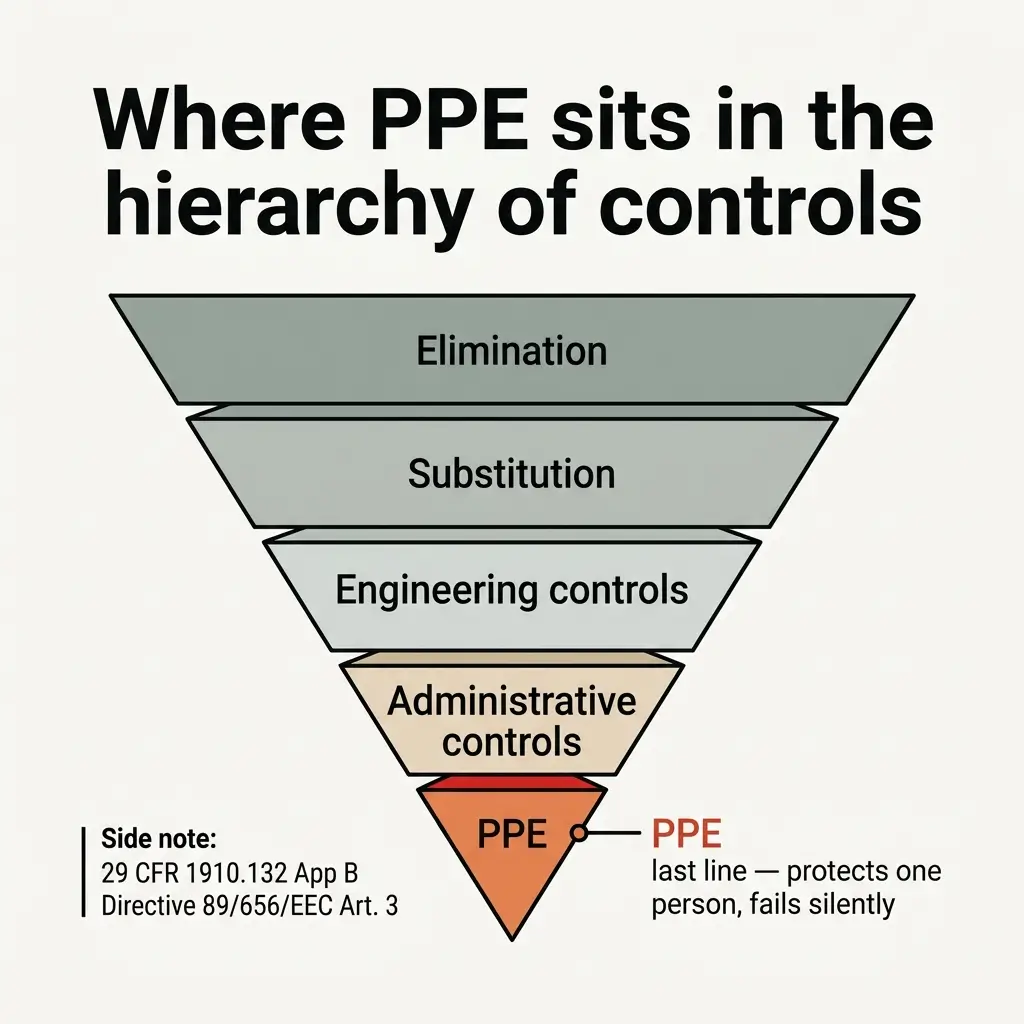
PPE also sits at the bottom of the hierarchy of controls in all three jurisdictions, and that placement is a duty rather than a preference. A British employer who reaches for gloves before asking whether the substance can be substituted has not met the standard, however good the gloves are. The same logic sits in OSHA's non-mandatory Appendix B to Subpart I and in Article 3 of the EU use Directive.
For orientation, these are the equipment families a hazard assessment normally resolves to, with the product standards a specifier would check on each side of the Atlantic.
| Body region | Typical hazard | US product standard | EU / UK product standard |
|---|---|---|---|
| Head | Falling and swinging objects, side impact | ANSI/ISEA Z89.1 (Type I / II, Class G, E, C) | EN 397; EN 12492 for climbing-style helmets |
| Eye and face | Projectiles, splash, optical radiation | ANSI/ISEA Z87.1 | EN 166; EN 169/170/172 for filters |
| Hearing | Noise above the action value | EPA-labelled NRR (40 CFR 211) | EN 352 series (SNR, H/M/L) |
| Respiratory | Dust, fume, vapour, oxygen deficiency | NIOSH approval under 42 CFR 84 | EN 149 (FFP), EN 140/136 with EN 143/14387 filters |
| Hand | Cut, abrasion, chemical permeation, heat | ANSI/ISEA 105; ANSI/ISEA 138 for impact | EN 388; EN ISO 374 for chemicals |
| Foot | Impact, compression, penetration, slip | ASTM F2413 | EN ISO 20345 |
| Body | Splash, particulates, flame, arc | NFPA 2112; ASTM F1506 | EN ISO 13688 with the hazard-specific standard |
| Visibility | Struck-by in traffic or plant movement | ANSI/ISEA 107 | EN ISO 20471 |
| Fall arrest | Fall from height | ANSI/ASSP Z359 | EN 361 and the rest of the EN 363 system |
The families are the easy part. Every requirement that follows is about the conditions attached to them, and those conditions are what an inspector or an auditor will actually test.
Read in that light, the ten requirements below group into four things a programme has to be able to demonstrate:
- That the choice was reasoned — a written assessment and a selection traceable to it (requirements 1 and 2)
- That the product matches the hazard class — the right mark, and a protection figure corrected for real use (requirements 3 and 4)
- That it fits the individual wearing it — including a measured fit where the law demands one (requirements 5 and 6)
- That it stays fit for purpose in service — paid for, trained on, compatible and checked where the work happens (requirements 7 to 10)
The legal baseline in the US, UK and EU
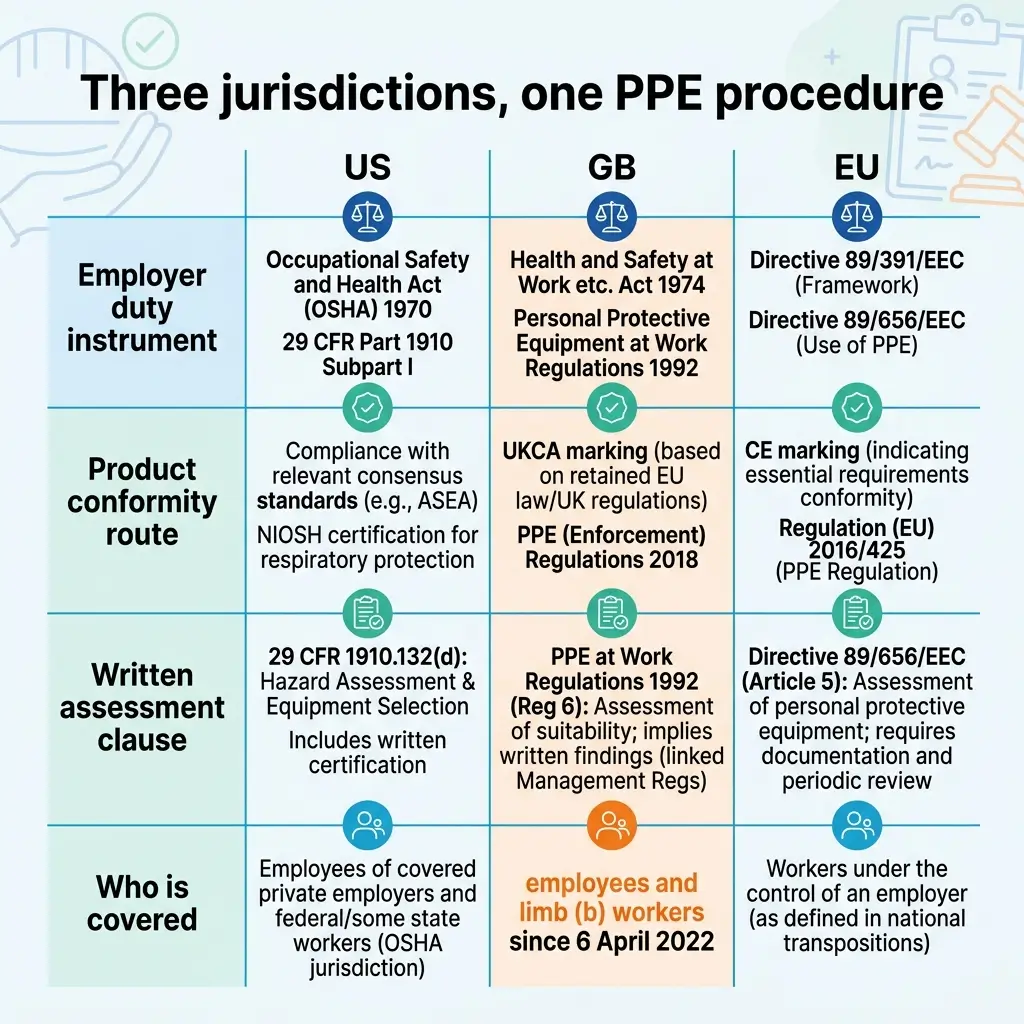
The three systems agree on substance and differ on structure, which matters if you run one PPE procedure across several countries. The US puts product criteria and employer duties in the same standard. Europe splits them: one instrument governs the product, another governs the employer's use of it. Great Britain kept the European split after leaving the EU.
United States — 29 CFR 1910 Subpart I and 1926 Subpart E
General industry duties sit in 1910.132 to 1910.138, with hazard assessment, selection, fit, training, payment and defect rules all inside 1910.132 itself. Construction runs in parallel under 1926 Subpart E, and OSHA's construction PPE page records the revision to 1926.95(c) that aligned construction with general industry on fit.
United Kingdom — PPER 1992 as amended by PPER 2022
The Personal Protective Equipment at Work Regulations 1992 set the employer duties: suitable PPE where risk is not adequately controlled by other means, compatibility, assessment, maintenance, storage, training and no charge to the worker. HSE guidance L25 explains how to comply with the 1992 Regulations as amended. The 2022 amendment extended those duties to limb (b) workers — casual and agency-type workers under a contract for services — from 6 April 2022, following a High Court finding that Britain had not fully transposed the underlying European directives.
European Union — Directive 89/656/EEC and Regulation (EU) 2016/425
Directive 89/656/EEC sets the minimum employer duties on PPE use and is transposed by each member state. Regulation (EU) 2016/425 governs the product — design, conformity assessment and CE marking — and is aimed at manufacturers and importers rather than employers. Its Annex I sorts PPE into three risk categories, with Category III covering equipment protecting against death or irreversible damage to health.
The practical divergences a multinational procedure has to absorb are these.
| Question | United States | Great Britain | European Union |
|---|---|---|---|
| Employer duty instrument | 29 CFR 1910.132–.138; 1926 Subpart E | PPER 1992 as amended by PPER 2022 | Directive 89/656/EEC as transposed |
| Product conformity | Standard-specific (ANSI, ASTM, NIOSH) | UKCA / CE-marked to designated standards | Regulation (EU) 2016/425, CE mark |
| Written assessment | Required and certified — 1910.132(d)(2) | Required — PPER 1992 reg. 6 | Required under Art. 5 and Annex I–III |
| Who is covered | Employees | Employees and limb (b) workers | Workers as defined nationally |
| Cost to the worker | None, with listed exceptions | None | None |
Where one procedure has to satisfy all three, three drafting decisions save the most argument later:
- Write to the strictest position, not the average — the British no-charge rule has no footwear or eyewear exception, so adopting it globally removes a per-country carve-out
- Name the product standard alongside the class, not instead of it — "EN 166 eye protection" is not a specification; the impact and splash markings are
- State which jurisdiction each numerical threshold comes from — an 85 dB(A) figure means a different duty in Manchester than it does in Michigan
Requirements 1 and 2: assess the hazard first
Selection errors almost never look like errors. The equipment is present, it is certified, and everyone is wearing it. What has gone wrong sits upstream, in an assessment that was never written against the actual task or was never consulted by the person who ordered the stock.
1. A written, task-specific hazard assessment
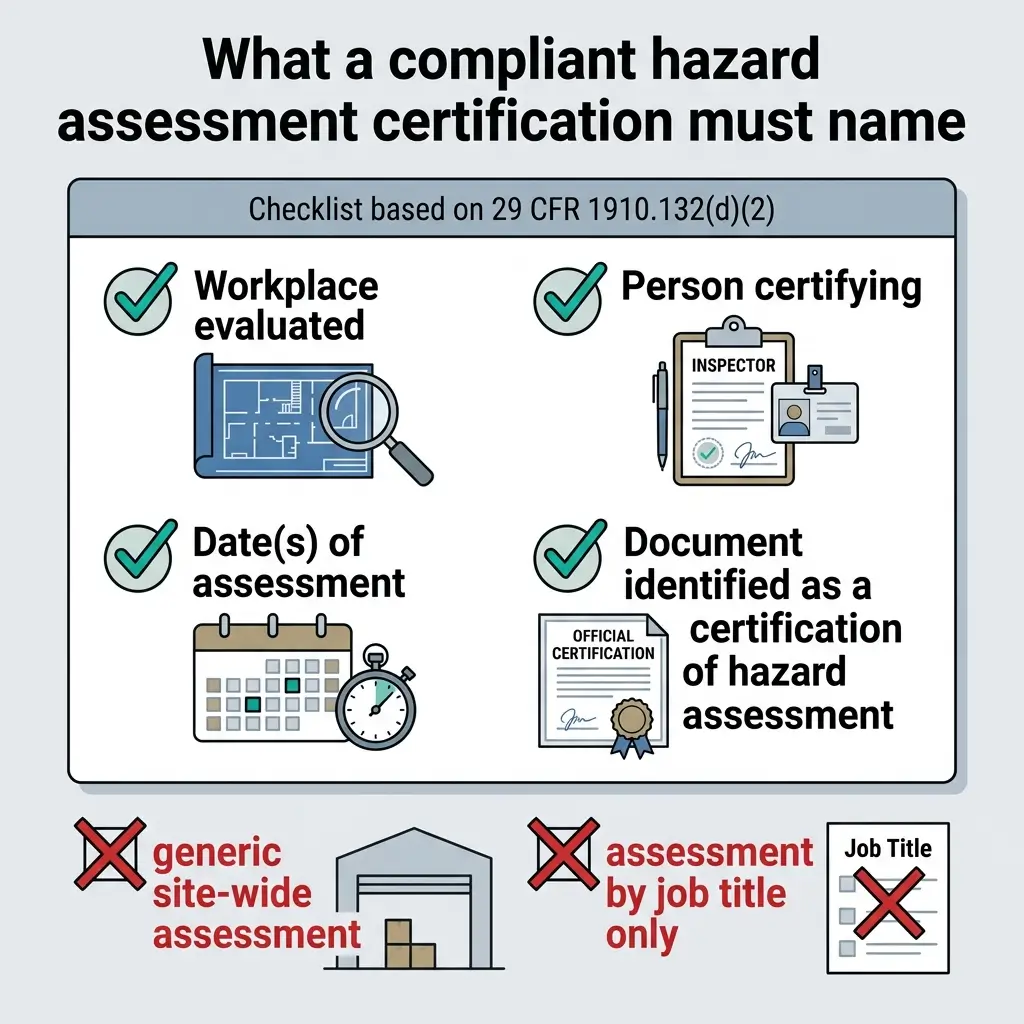
Under 1910.132(d)(1) the employer must assess the workplace to determine whether hazards are present that make PPE necessary, then select equipment that protects against those specific hazards and communicate the decision. Paragraph (d)(2) turns that into a document: a written certification identifying the workplace evaluated, the person certifying, the dates of the assessment, and identifying itself as a certification of hazard assessment. The British equivalent is regulation 6 of PPER 1992, which requires an assessment before choosing PPE.
Assessments fail on specificity far more often than on absence. "Chemical hazard — gloves required" satisfies nobody; the assessment has to name the substance, the task, the contact duration and the exposure route, because those are the inputs a glove specification needs. A separate assessment is expected for each distinct job or task, not one per site.
An assessment I would sign off contains these four things:
- The task, not the job title — decanting solvent from an IBC is a different assessment from operating the same plant
- The exposure route and duration — splash for two seconds and immersion for two minutes select different gloves
- The residual risk after higher controls — what is left once extraction, enclosure and procedure have done their work
- The named product and performance level — a class or rating, not a category
2. Selection driven by the safety data sheet, not by habit
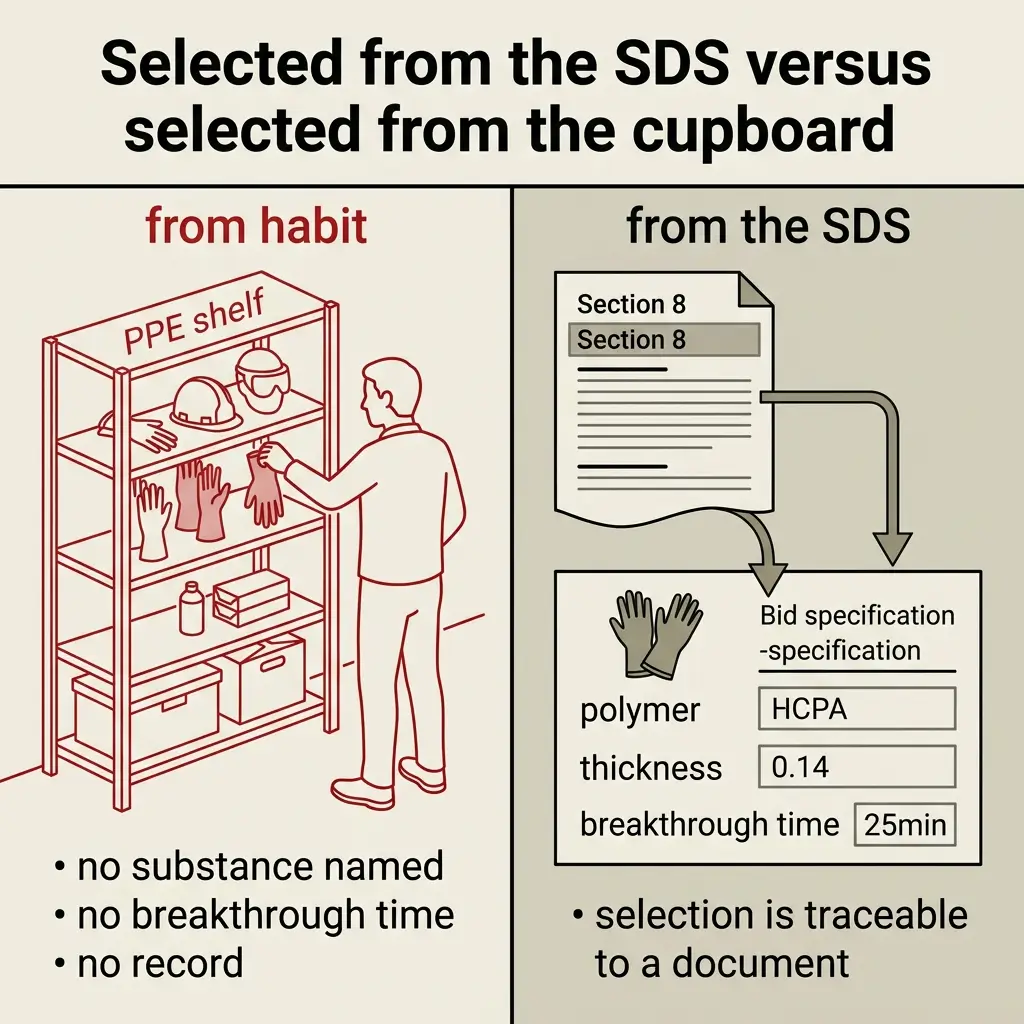
On a Dräger Safety Hygiene assignment in Belgium, working the respirator programme advisor scope, I found PPE being selected by habit rather than from the safety data sheet. The kit in use was the kit that had always been in use. Nobody had gone back to Section 8 to check whether it matched what was being handled that week.
I stopped the pattern, had the correct controls reinstated, and briefed the crew before the work restarted. It was logged as a stop-work intervention. Follow-up observations on that sector showed fewer repeats of the same failure mode afterwards, which tells you the fix was procedural rather than a matter of anyone's attitude.
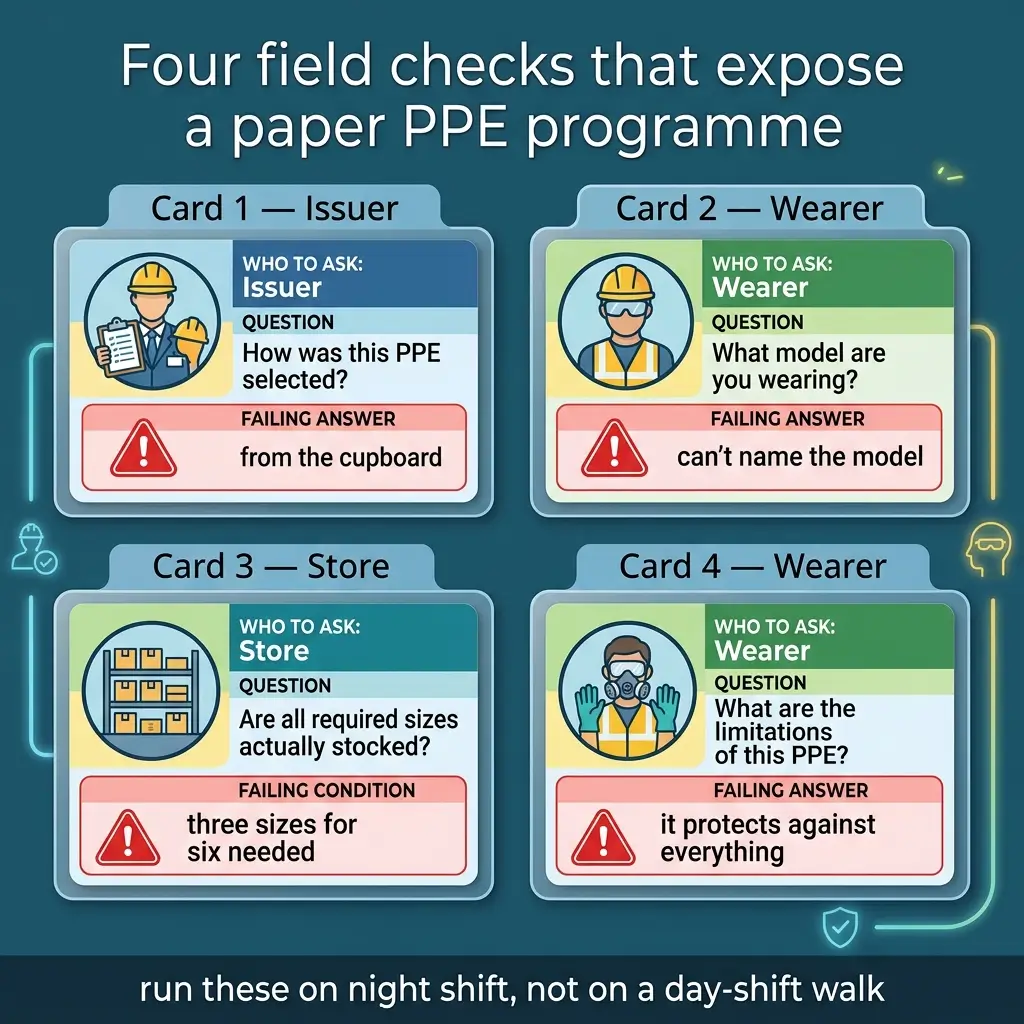
The transferable check is small enough to add to any pre-task brief. Ask the person issuing the PPE which document they selected it from. If the answer is the store cupboard, the SDS has been bypassed and the selection is unverified — however sensible the equipment looks.
Section 8 of a safety data sheet is where the answer lives, and it carries three things a habit cannot supply:
- The exposure limit and its issuer — an OSHA PEL, a British WEL from EH40, a NIOSH REL and an ACGIH TLV are different numbers set by different bodies on different cycles
- The material specification — glove polymer and thickness, not "chemical-resistant gloves"
- Breakthrough time — the figure that decides whether a glove is a splash barrier or an immersion barrier, and the one most often ignored
Requirements 3 and 4: match the mark and the rating
A certification mark tells you the equipment passed a defined test. It does not tell you the test matched your hazard. This is where competent specifiers and catalogue orders diverge, and it is the area where I write up the most findings.
3. The right certification mark for the right hazard class
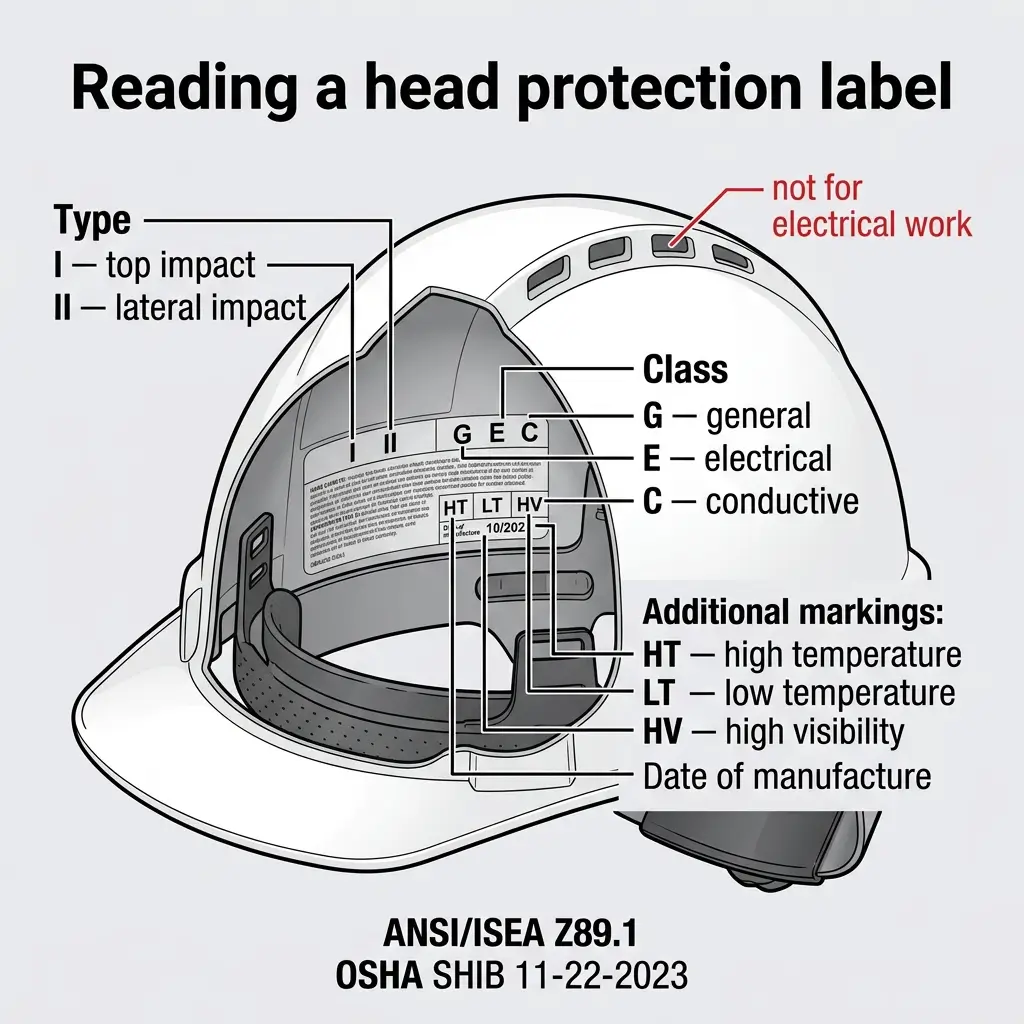
Marks carry classes, and the class does the work. A hard hat marked to ANSI/ISEA Z89.1 is compliant head protection, but Type I is tested for top impact only and Type II adds lateral impact. Class G, E and C describe electrical performance, and OSHA's bulletin on safety helmets in the workplace is explicit that vented head protection cannot be used for electrical work. That single line has stopped more purchases than any amount of general guidance.
OSHA has not made safety helmets mandatory. The bulletin is advisory and creates no new legal obligation. What it does is set out why chin straps and lateral impact performance matter where people work at height or near moving plant. That is enough to make a Type I purchase hard to defend in those settings without a written reason for it.
The class distinctions worth confirming before any bulk order are:
- Head — Type I or Type II; Class G, E or C; vented or unvented, remembering the electrical exclusion
- Eye — Z87.1 impact rating, and whether splash, dust or optical radiation protection is also marked
- Hand — the ANSI/ISEA 105 or EN 388 performance levels for each hazard present, plus EN ISO 374 permeation class where chemicals are involved
- Foot — the ASTM F2413 or EN ISO 20345 markings for impact, compression, penetration and any electrical hazard rating
4. Protection ratings derated before you rely on them
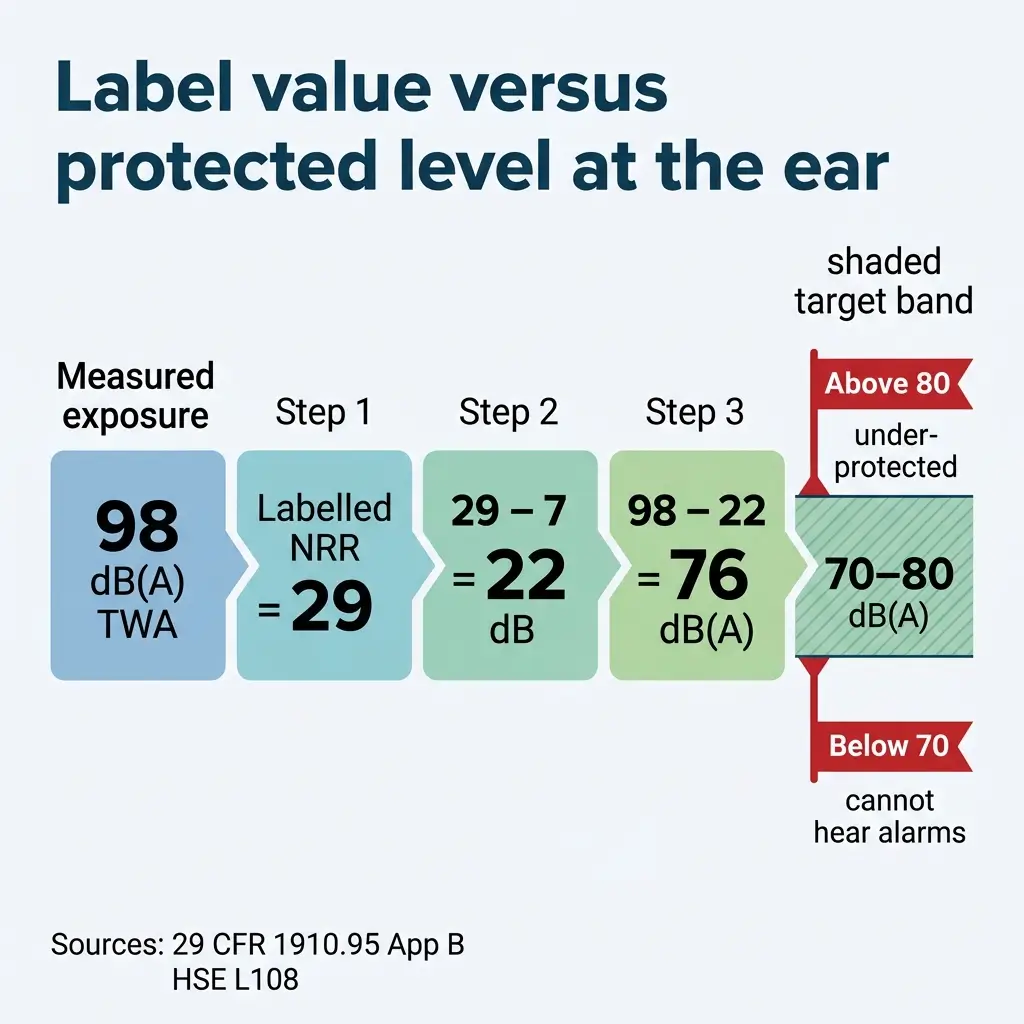
Every attenuation figure printed on a hearing protector is a laboratory result, produced with a trained experimenter fitting the device on a seated subject. Real workers achieve less. All three regulators acknowledge the gap and correct for it — using different arithmetic, which is why importing one country's calculation into another is a genuine error rather than a rounding difference.
The US method
Appendix B to 1910.95 is mandatory, and it sets out the conversion. Where exposure was measured on the A-weighting network, subtract 7 dB from the labelled NRR and take the remainder off the A-weighted TWA. The result has to bring exposure to a TWA of 90 dB, or to 85 dB for a worker who has already recorded a standard threshold shift.
A further halving of that figure is widely quoted as "the OSHA derate", and the distinction matters. OSHA's interpretation letter of 16 December 2021 states that current enforcement policy uses the unadjusted NRR to assess adequacy under the hearing conservation programme. The NRR−7/2 adjustment is applied when considering whether engineering controls should be implemented, not when judging whether the protector is adequate.
NIOSH used to sit alongside this with a variable derating scheme by protector type. That guidance has moved, and any article still quoting it is out of date. NIOSH's science policy update on individual fit testing now supersedes the derating guidance in Chapter 1 and Chapter 6 of its 1998 noise criteria document, and recommends measuring each wearer's personal attenuation rating instead of applying a population-level correction. If you are building a programme from scratch in the US today, fit test the protector rather than derating the label.
The British method
The Control of Noise at Work Regulations 2005 set three thresholds on daily or weekly personal exposure. The lower action value is 80 dB(A), with a 135 dB(C) peak. The upper action value is 85 dB(A), with a 137 dB(C) peak. The exposure limit value is 87 dB(A), with a 140 dB(C) peak.
One structural point separates them. The limit value is assessed with hearing protection taken into account; the two action values are assessed without it. HSE guidance on real-world hearing protector performance then instructs you to derate the calculated attenuation by 4 dB to account for fitting errors and interference from other PPE. That 4 dB does not apply to the assessment of performance against peak noise, which is a detail worth holding on to when you are working near the 135 and 137 dB(C) values.
The point people miss is the lower bound. The HSE target is a protected level of roughly 70 to 80 dB(A) at the ear. Below 70, workers are over-protected: they stop hearing reversing alarms, verbal warnings and the change in machine noise that tells them something is wrong. Selecting the highest SNR on the shelf is not a conservative choice, it is a different hazard. In four years running noise dosimetry and hygiene sampling programmes, over-protection at compressor houses and pump rooms was as common a finding as under-protection on the shop floor.
| Method | Correction applied | Where it is used |
|---|---|---|
| OSHA App. B (mandatory), A-weighted | NRR − 7 dB, unadjusted | Assessing HPD adequacy under the hearing conservation programme |
| OSHA engineering-control review | (NRR − 7) ÷ 2 | Feasibility of engineering controls, per OSHA's 2021 interpretation |
| NIOSH (current) | No population derate — measure each wearer's personal attenuation rating | Science policy update superseding the 1998 derating guidance |
| HSE (GB) | Calculated attenuation − 4 dB | Selection under L108; target 70–80 dB(A) at the ear |
Requirements 5 and 6: make it fit, then prove it
Fit is the requirement that has moved most in the last two years, and the one where the written rule has finally caught up with what practitioners were already being told at inspection.
5. Fit is a regulatory requirement in its own right
General industry has required properly fitting PPE for years under 1910.132(d)(1)(iii). Construction did not say so explicitly until OSHA revised 1926.95(c), effective 13 January 2025, to require that PPE is of safe design and construction for the work and is selected to ensure it properly fits each affected employee. OSHA's position is that this clarified rather than changed the duty — it had been issuing citations on the point already — but the explicit wording removes the argument.
"Properly fits", in OSHA's framing, means the equipment does not create additional safety and health hazards by being either too small or too large. That covers more ground than it first appears. A glove one size too large loses dexterity near rotating parts. Coveralls one size too large snag. A harness sized for a 95th-percentile male frame does not distribute arrest forces correctly on a smaller wearer.
The practical test is stock, not policy. Where I audit fit, I go to the store and look at what is physically available on the shelf, then compare it against the size distribution of the people on shift. A written commitment to properly fitting PPE means nothing where the store carries three sizes and the workforce needs six.
6. Respirator face-seal integrity and fit testing
Respiratory protection is the one family where fit is measured rather than judged. A tight-fitting facepiece has to be fit tested before first use and at least annually afterwards, using a qualitative or quantitative protocol, and retested when the wearer's facial features change through weight change, dental work or scarring. British practice sits under COSHH with HSE's fit testing guidance, and the underlying logic is identical either side of the Atlantic.
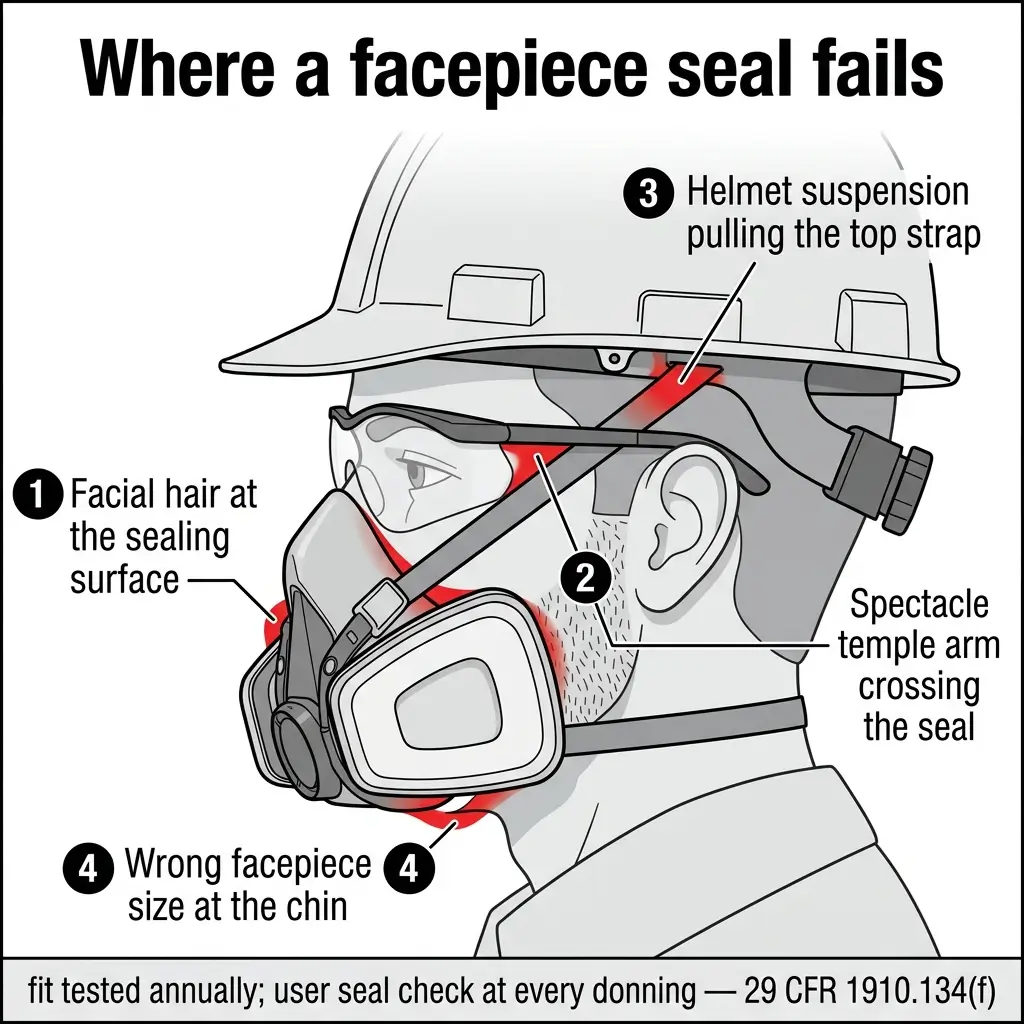
Facial hair at the sealing surface defeats a tight-fitting facepiece, and no amount of strap tension fixes it. This is not a grooming preference and it should not be enforced as one — where a worker cannot or will not shave, the answer is a loose-fitting powered hood, which needs no face seal. Framing it as a discipline issue rather than a selection issue is how programmes end up with people quietly working unprotected.
Before you accept that a respirator programme is functioning, confirm these five things:
- Fit test records exist for each wearer, naming the exact make, model and size tested
- The respirator on the shelf matches the one on the record — a different size is a different device
- User seal checks are performed at every donning, not only on the day of the test
- Cartridge change-out is driven by a schedule, not by smell or taste
- Storage protects the facepiece from deformation, sunlight and contamination between shifts
Requirements 7 and 8: pay for it, train on its limits
These two requirements are the least technical and among the most frequently cited. They are also the two that workers themselves notice first — nobody misses being asked to buy their own boots, and nobody forgets being told a dust mask would handle solvent vapour.
Both fail in the same quiet way: the duty is written into a policy nobody consults. Two documents settle whether that has happened on your site:
- The purchase or expense record — any line where a worker paid for required PPE is a finding, whatever the policy says
- The training record content, not its completion rate — a signed attendance sheet proves nothing about whether limitations were covered
7. The employer pays, with narrow exceptions
OSHA's payment for PPE provisions in 1910.132(h) require the employer to provide required PPE at no cost. The exceptions are specific and short — non-specialty safety footwear and non-specialty prescription safety eyewear that the employer permits off site, everyday clothing, ordinary weather gear, and replacements where an employee has lost or intentionally damaged the item. Employees may use their own PPE if the employer allows it, but the employer must still verify that it is adequate, maintained, sanitary and properly fitting.
The British position is simpler and has no equivalent carve-out for footwear or eyewear. PPER 1992 prohibits charging the worker, and since April 2022 that prohibition covers limb (b) workers alongside employees. If you run sites in both countries on one procedure, the British rule is the safer default.
| Item | US position | GB position |
|---|---|---|
| Required PPE generally | Employer pays — 1910.132(h) | Employer pays — no charge permitted |
| Non-specialty safety footwear | Exception — employee may pay if allowed off site | No exception |
| Prescription safety eyewear | Exception where non-specialty and allowed off site | No exception |
| Employee-owned PPE | Permitted if employer allows; employer must verify adequacy and fit | Employer remains responsible for suitability |
| Replacement after loss or wilful damage | Employer need not pay | Assessed case by case |
8. Training that covers limitations and end of life
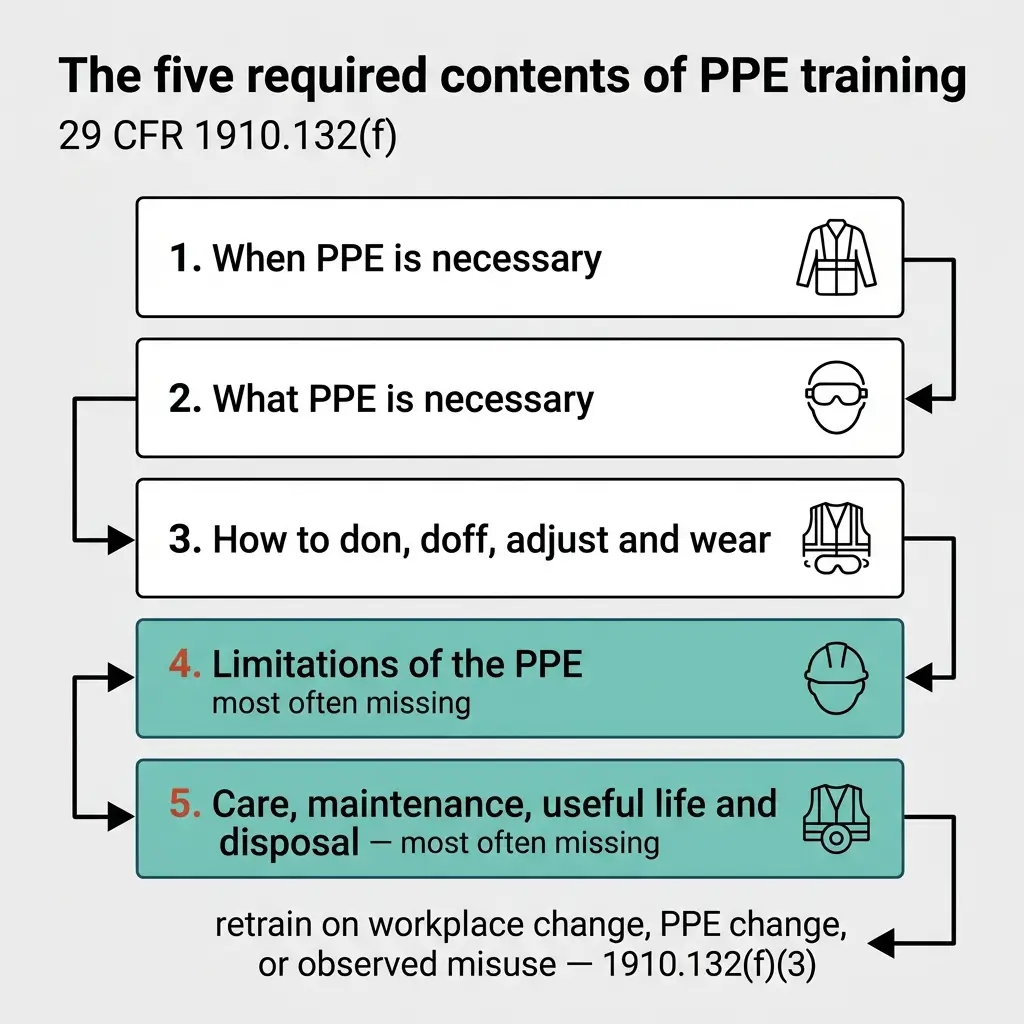
Training under 1910.132(f) has five required contents: when PPE is necessary, what PPE is necessary, how to don, doff, adjust and wear it, its limitations, and its proper care, maintenance, useful life and disposal. Most PPE training I review covers the first three well and the last two barely at all.
Limitations are the part that keeps people alive. A glove with a high abrasion rating is not cut resistant. A dust mask is not a chemical respirator. A Class E hard hat is rated to a test voltage, not to any voltage. Useful life is the other neglected half: harnesses, helmets and filters all have service lives that end regardless of appearance, and a worker who has never been told this will keep using equipment that looks perfectly serviceable.
Retraining is required whenever workplace changes make previous training obsolete, the type of PPE changes, or a worker's behaviour shows they have not retained the knowledge or skill. That third trigger is the useful one on audit — it means observed misuse is itself evidence of a training gap rather than only a discipline matter.
Requirements 9 and 10: one assembly, verified on shift
The last two requirements are the ones a document review cannot reach. Both need someone standing where the work happens, at the hour it happens.
9. Compatibility — PPE has to work as one assembly
Every item on a worker is certified alone. Nobody certifies the combination, and the combination is what they actually wear. British law is unusually direct here: PPER 1992 requires that where more than one item is worn, the items must be compatible and remain effective against the risks.
The interactions are predictable once you look for them. Spectacle temple arms break an earmuff cushion seal and cost several decibels. Helmet suspensions pull on respirator head straps and shift the facepiece off its sealing surface. A face shield worn over a half mask changes the exhalation path. Hearing protectors mounted on a helmet perform differently from the headband version of the same product, and the manufacturer's data will say so if anyone reads it.
Testing this takes minutes. Have the worker don the full assembly in the order they actually don it, then run the user seal check and look at the earmuff cushion contact. I have found more attenuation lost to a pair of safety spectacles than to any product deficiency.
The combinations worth checking on every site are:
- Earmuffs with safety spectacles or a respirator strap — the most common and most underestimated seal break
- Helmet-mounted hearing protection — different attenuation data from the headband equivalent
- Half mask under a face shield or welding helmet — clearance, and whether the seal survives the visor coming down
- Harness over cold-weather or chemical-protective clothing — strap positioning and adjustment range change with bulk
10. Field verification on the shift where the work happens
The last requirement is not written in any regulation as a clause of its own. Every regulator's enforcement stance assumes it anyway. Someone has to confirm that what was specified is what is actually worn, in the conditions where it is worn. My experience is that this almost never happens after dark.
Leadership walks cluster on day shift. PPE stores are staffed on day shift. Fit testing is scheduled on day shift. Night shift inherits whatever is left on the shelf, and the size distribution on the shelf at 03:00 is not the one the assessment assumed. Running night-shift control integrity work across hygiene assignments, the PPE findings I wrote up at night were consistently different from the ones I wrote up at noon — not worse people, a worse supply chain reaching them.
Four questions settle it faster than any audit form:
- "Which document did you select this from?" — asked of whoever issues the equipment
- "When were you last fit tested, and on which model?" — asked of the wearer, then checked against the store
- "Show me the smallest and largest sizes you hold" — asked in the store, on the shift being audited
- "What does this not protect you against?" — the fastest test of whether the limitations training happened
Frequently asked questions
These are the questions that come up most often in PPE briefings and in the search results for this topic. Where an answer is covered in depth above, the short version is here and the detail sits in the relevant section.
What are the main types of PPE required in the workplace?
Hazard assessment determines the answer, but the recurring families are head, eye and face, hearing, respiratory, hand, foot, body, high-visibility and fall arrest protection. Each has its own product standard on each side of the Atlantic, and the class within that standard matters as much as the standard itself.
Does an employer have to pay for PPE?
Yes. OSHA requires required PPE at no cost under 1910.132(h), with narrow exceptions for non-specialty safety footwear and non-specialty prescription safety eyewear allowed off site. Great Britain permits no charge at all, and since April 2022 that covers limb (b) workers as well as employees.
How often does PPE need to be inspected or replaced?
Defective or damaged PPE must not be used, and both the US and British rules require maintenance in good condition. Beyond that, follow the manufacturer's stated service life — helmets, harnesses and filters expire on time rather than on appearance, and a visual check does not detect UV degradation.
Is a fit test required for all PPE?
Formal fit testing is required for tight-fitting respirators, before first use and at least annually. Other PPE must properly fit but has no prescribed test protocol. The practical equivalent is holding a full size range in store and checking it against the workforce actually on shift.
Does OSHA now require safety helmets instead of hard hats?
No. OSHA's November 2023 bulletin is advisory and creates no new legal obligation. It sets out why helmets with chin straps and lateral impact performance suit work at height and near moving plant, and it confirms that vented head protection cannot be used for electrical work.
Can workers use their own PPE?
In the US, yes, where the employer allows it — but the employer must verify it is adequate, properly maintained, sanitary and correctly fitting, and need not reimburse the cost. Allowing employee-owned PPE transfers no duty; it only transfers the purchase.
What is the difference between an OSHA PEL and a UK WEL?
They are limits set by different bodies on different review cycles, and they frequently differ for the same substance. A NIOSH REL and an ACGIH TLV are two further values again. Never quote one as "the limit" — name the issuer and the jurisdiction alongside the number.
Where to start if your PPE programme is thin
If the ten requirements above look daunting against what your site currently holds, work them in order of how quickly a failure would hurt someone rather than how quickly it could be documented. Written assessments matter, but a worker in an ill-fitting respirator today is a more urgent problem than a certification with a missing date.
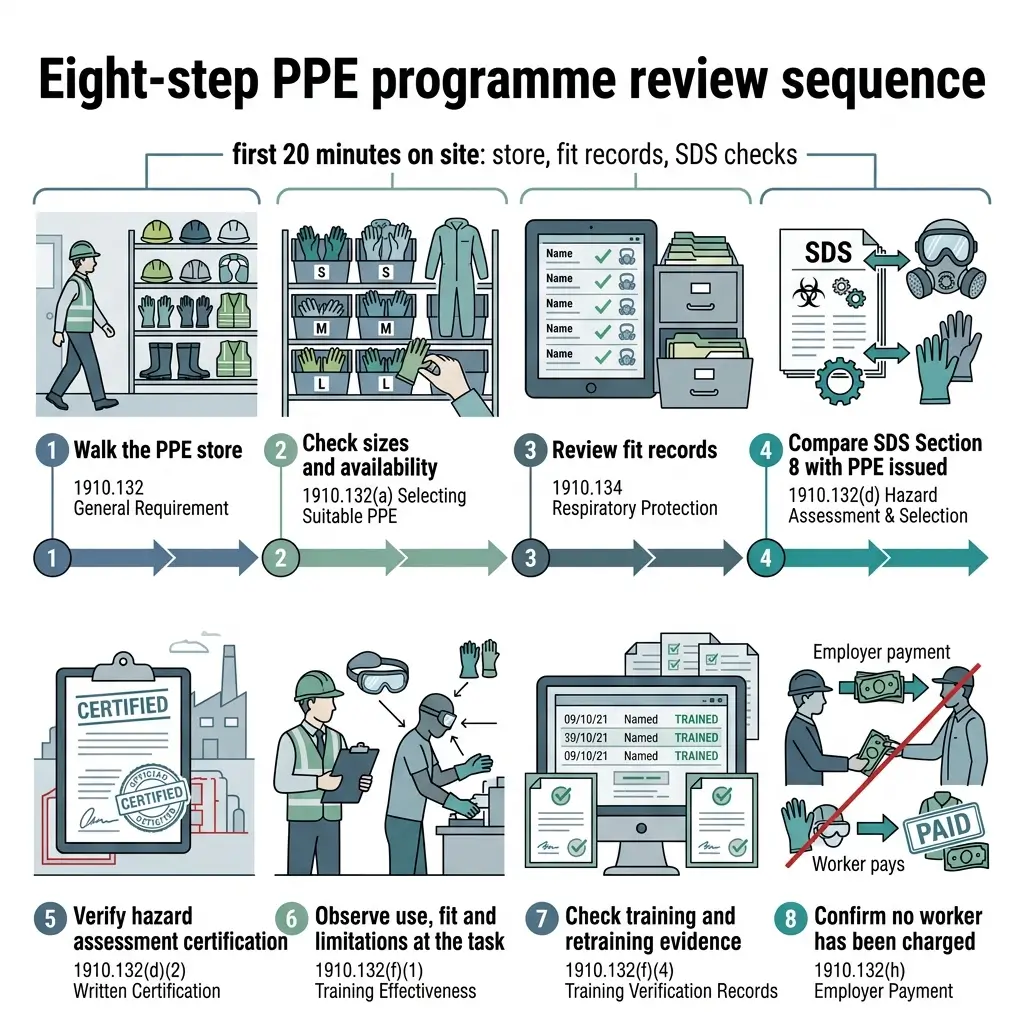
The sequence I use on a first assignment starts with the store and ends with the paperwork, because the store tells you the truth in about twenty minutes.
| Order | Action | Requirement addressed |
|---|---|---|
| 1 | Walk the PPE store on the shift being assessed and record the size range held | 5, 10 |
| 2 | Pull fit test records and match them to the respirators physically on the shelf | 6 |
| 3 | Check three SDS entries against the gloves actually issued for those tasks | 2 |
| 4 | Recalculate hearing protection against measured exposure, with the derate applied | 4 |
| 5 | Watch one worker don the full assembly and check the seals | 9 |
| 6 | Read the hazard assessment certification for the four required elements | 1 |
| 7 | Review training records for limitations and useful-life content | 8 |
| 8 | Confirm no worker has been charged for required PPE | 7 |
Two cautions apply to everything above:
- Specialist assessment is not optional. Noise assessment, respirator selection and chemical protective clothing specification all need a competent person with calibrated instruments and site-specific data. This article will help you ask the right questions of that person. It will not substitute for the assessment.
- Re-check every figure against the current text. Exposure limits, product standards and regulatory wording are revised on cycles that do not announce themselves, and a superseded number in a PPE specification is a live exposure rather than a clerical error.
About the author
Sophia Bennett is a British Occupational Hygiene and Exposure Control Consultant with 16 years of continuous field experience across occupational hygiene, chemical exposure assessment, noise and hearing conservation, dust and silica control, and respirator programmes. She has worked in 14 countries, inspected 180+ workplaces and conducted 70+ audits. Her PPE work is drawn from senior hygiene roles with Dräger Safety Hygiene, MSA Safety Hygiene Programmes, 3M Personal Safety Division EU, Ansell Protective Solutions and DuPont Personal Protection, and she now leads Bennett Occupational Hygiene Partners in Manchester.
Credentials: NEBOSH International General Certificate; ISO 45001 Lead Auditor; ISO 14001 Internal Auditor; IOSH Managing Safely; incident investigation (ICAM or equivalent pathway).
Sources
- OSHA, 29 CFR 1910.132 — General requirements
- OSHA, Personal Protective Equipment — Construction
- OSHA, Payment for Personal Protective Equipment
- OSHA, 1910.95 Appendix B — Methods for Estimating the Adequacy of Hearing Protector Attenuation
- OSHA, Standard interpretation, 16 December 2021 — application of the proposed NRR (subject fit)
- OSHA, Head Protection: Safety Helmets in the Workplace (SHIB)
- NIOSH, Science policy update: individual fit-testing recommendation for hearing protection devices
- NIOSH, Occupational Noise Exposure, Publication 98-126
- HSE, L25: Personal protective equipment at work
- HSE, Accounting for 'real world' factors in hearing protection
- HSE, Noise regulations overview
- legislation.gov.uk, Control of Noise at Work Regulations 2005, regulation 4
- EU-OSHA, Directive 89/656/EEC — use of personal protective equipment
- EU-OSHA, Regulation (EU) 2016/425 on personal protective equipment