

Six weeks of an empty school is not a pause in the duty holder's obligations. It is the specific event most of those obligations were written to control. Water sits still in pipework, local exhaust ventilation sits unused and drifts out of test, and the refurbishment work booked into the holiday because the children are away is the work most likely to disturb asbestos. Every hygiene control in a school building is time-based, and the summer break is the longest gap in the calendar.
This is a walkthrough of what I look at in an unoccupied education estate in the fortnight before term, in the order I look at it. It is written for the people who carry the duty — local authority estates teams, academy trust facilities leads, business managers, site managers — and it is UK-led, with a section on how the US framework differs.
Key takeaways
The points below are what a duty holder needs to be able to evidence before the building reopens:
- The legal duty for water systems sits under COSHH 2002 regulation 6 and HSWA 1974 sections 2 and 3, with ACoP L8 and HSG274 Part 2 as the recognised route to compliance — not a contractor's certificate.
- Hot water should reach 50°C at a sentinel outlet within one minute, cold should stay below 20°C after two minutes, and storage should sit at 60°C.
- Little-used outlets need flushing weekly, and once that regime starts it must be sustained and logged. Most school failures are record failures, not engineering failures.
- Local exhaust ventilation in science labs and DT workshops requires thorough examination and test at intervals of no more than 14 months under COSHH regulation 9 — not 12, and shorter for Schedule 4 processes.
- HSE inspected over 400 schools on asbestos management in 2022/23; most were managing it effectively, but a small minority had failings serious enough to require enforcement action.
- Anyone likely to disturb asbestos must be told where it is before they start — and that includes IT engineers running cable, not just builders.
Why an empty school is a hygiene problem rather than a quiet period
The reason a closed building needs more attention than an open one is that most hygiene controls are not devices, they are routines. A tap that gets used forty times a day is being flushed by its users. A fume cupboard in daily use is being watched by a technician who would notice if the airflow dropped. Take the occupants out and the passive part of the control system goes with them, while the hazard itself carries on developing.
Three things change over a six-week closure, and they change in different directions. Water becomes more hazardous through stagnation. Ventilation becomes uncertain because systems have been off and nobody has run them under load. And asbestos-containing materials that were stable all year become a live risk precisely because the empty building is when the drilling happens.
The duty holder is whoever controls the premises for maintenance purposes. In maintained schools that is usually the local authority; in academies it is the trust; in independent schools it is the proprietor or governing body. The distinction matters because appointing a contractor does not transfer the duty. You can outsource the flushing, the survey and the LEV test. You cannot outsource being the person who has to demonstrate that they happened and that the person doing them was competent.
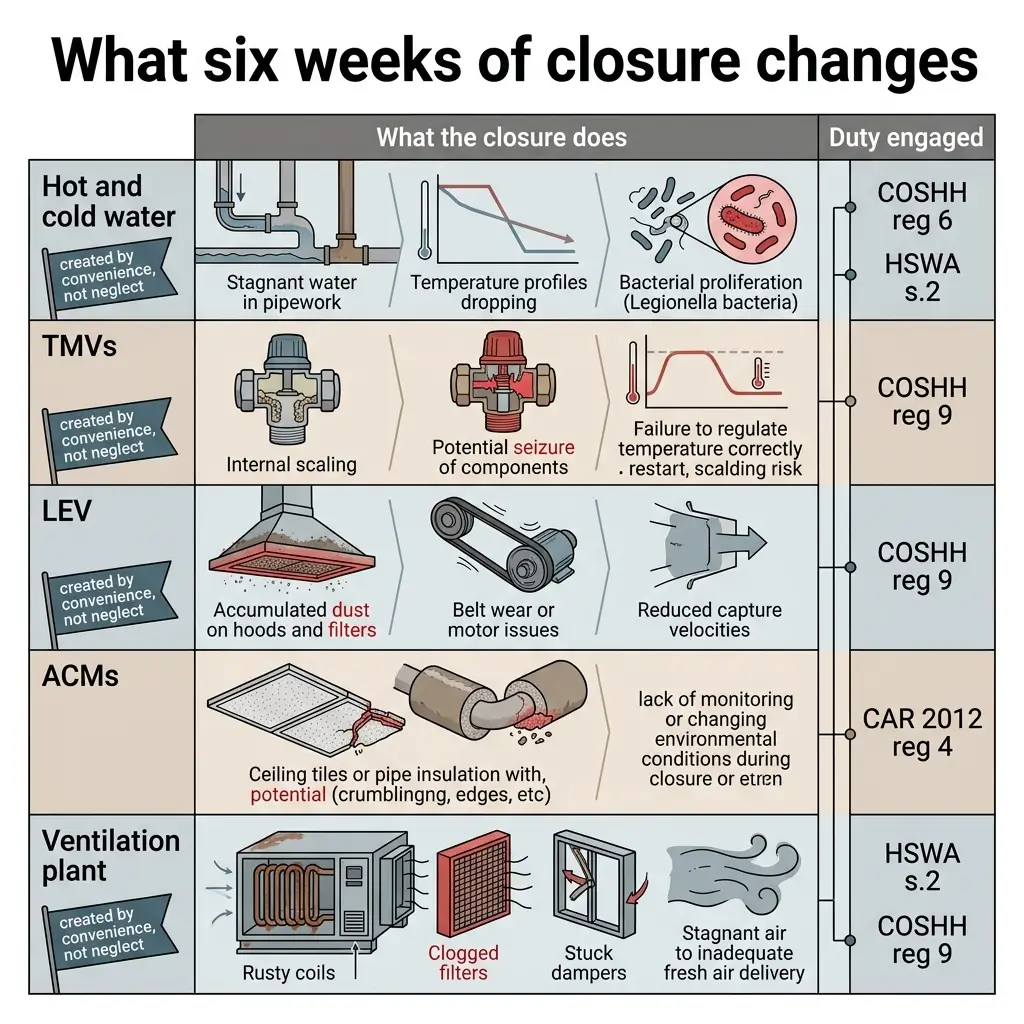
Here is what the closure does to each system, and which instrument is engaged:
| System | What six weeks does to it | Primary duty |
|---|---|---|
| Hot and cold water | Stagnation in dead legs and little-used outlets; cold water warming toward the growth range in loft tanks and long runs | COSHH 2002 reg 6; HSWA 1974 s.2–3 |
| Thermostatic mixing valves | Servicing deferred all year because it needs an unoccupied building | COSHH 2002 reg 6; scalding under HSWA s.3 |
| Science and DT extraction | Test interval quietly expires over the break | COSHH 2002 reg 9 |
| Asbestos-containing materials | Refurbishment and maintenance scheduled into the holiday | CAR 2012 reg 4, reg 5, reg 16 |
| Ventilation plant | Systems off, filters unchanged, dampers untested under load | HSWA 1974 s.2; BB101 as the design benchmark |
The pattern worth noticing is that four of those five failures are created by the closure being convenient, not by neglect. The work goes in the holiday for good reasons. The controls have to go in alongside it.
The water systems, and why I start there
Water comes first because it is the only one of these hazards that gets actively worse while nobody is in the building, and because the control is a number that can be checked in an afternoon.
The legal position is worth stating precisely, because a lot of school-facing material states it loosely. There is no "legionella regulation." The duty arises from the Health and Safety at Work etc. Act 1974 sections 2 and 3, and from regulation 6 of the Control of Substances Hazardous to Health Regulations 2002. What ACoP L8 does is set the standard a court will measure you against: it is an Approved Code of Practice, so if you have not followed it you must show you achieved the same outcome another way. HSG274 Part 2 is the technical detail underneath it, covering the hot and cold water systems that every school has.
The temperatures, and the timings that make them mean something
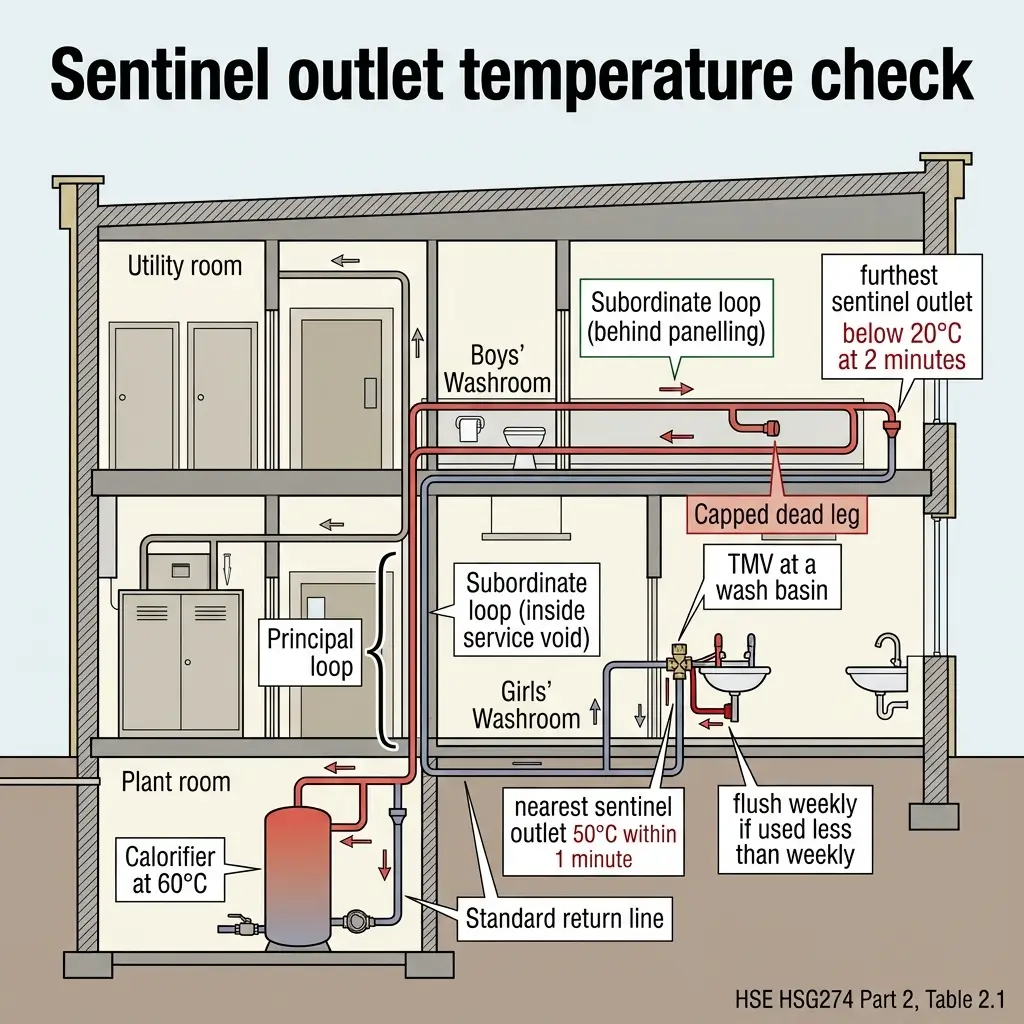
The three numbers are 60, 50 and 20. Water is stored at 60°C, delivered to the outlet at 50°C or above, and cold water is held below 20°C — because the growth range sits roughly between 20°C and 45°C.
What separates a real check from a recorded one is the timing. A hot tap will eventually reach 50°C if you run it long enough; that tells you nothing. The check is whether it gets there within one minute. On the cold side, the reading is taken at around two minutes, because a short run only tells you the temperature of the water sitting in the tail.
| Check | Criterion | Timing | Frequency |
|---|---|---|---|
| Sentinel hot outlets (nearest and furthest) | 50°C or above | Within 1 minute of opening | Monthly |
| Sentinel cold outlets | Below 20°C | At approximately 2 minutes | Monthly |
| Calorifier flow and return | 60°C flow; return not below 50°C | — | Monthly |
| All remaining outlets | Same criteria | Same timings | Annually, on rotation |
| Cold water storage tanks | Below 20°C stored | — | Typically six-monthly |
| Little-used outlets | Flushed until temperature stabilises | — | Weekly |
Source: HSE HSG274 Part 2, Table 2.1. Sentinel points are the outlets that represent the system hydraulically — nearest and furthest from the calorifier — not the two taps nearest the caretaker's office.
Flushing: the control that gets recorded but not performed
If I have one thing to look at in a school water file, it is the flushing record over the holiday, and I look at it sideways rather than reading it forwards.
Weekly flushing of infrequently used outlets is required, and a summer break turns most of a school's outlets into infrequently used outlets. The difficulty is entirely practical: the person who would do it is on leave, the site is on reduced staffing, and running every tap in a secondary school for two minutes each is a genuinely large job that produces nothing visible. So it gets signed rather than done.
The tells are consistent. Identical handwriting for six weeks in a single ink. Readings that cluster suspiciously tightly. Times recorded to the same minute across buildings that are four minutes' walk apart. A log with no failed readings at all across an entire summer, which is itself implausible in an estate with a loft tank.
The fix is not more forms. Assign flushing to a named person with the days blocked in their calendar and a route that follows the building's hydraulics rather than its corridors, and accept that in a large estate this is a real allocation of hours. Where that cannot be resourced, say so in the risk assessment and use a different control — capping and permanently removing genuinely redundant outlets is more defensible than a flushing regime that exists on paper.
⚠️ Safety critical: Flushing generates aerosol, which is the exposure route for legionella. Where a system has been stagnant for an extended period and the risk assessment identifies elevated risk, the flushing itself needs controlling — minimise aerosol, avoid spray, and consider respiratory protection for the person doing it.
Thermostatic mixing valves and the window that only opens in the holidays
TMVs sit at the point where the two duties collide. Water must be hot enough to control legionella and cool enough not to scald a child. The valve resolves that, which means the valve is a safety-critical component that fails quietly.
Servicing requires the building empty, which is why the holidays are the only practical window and why deferred TMV work accumulates year on year in a way that other maintenance does not. When I ask for TMV records in a school, the question that produces the most information is not "when were they last serviced" but "how many are there, and where is the schedule of them?" An estate that cannot produce the asset list has not been servicing them on any cycle at all.
The evidence I would want before term, in order of how much it tells you:
- The asset register — a schedule of every outlet, TMV and tank, matched to a schematic. Without this, nothing downstream is verifiable.
- The written scheme of control — specific to this site, naming the responsible person, not a template with the school's name inserted.
- The summer flushing log — with failed readings in it, and evidence of what was done about them.
- TMV service records against the asset register, with gaps explained.
- The risk assessment review date — and whether the summer refurbishment triggered one, because altering pipework is a trigger.
Asbestos and the summer refurbishment problem
The seasonal risk here is specific and it is not really about asbestos sitting in a ceiling void. Undisturbed asbestos in good condition, properly managed, is not the hazard. The hazard is the work that gets scheduled into the six weeks when the building is empty, carried out at pace against a fixed reopening date, by people who may never have been shown the register.
HSE ran a programme of over 400 school inspections across Great Britain in 2022/23 and published the findings in July 2023. Most schools were managing asbestos effectively. A small proportion — 7% — had failings significant enough to require enforcement action, according to HSE's published report on the management of asbestos in school buildings. The common improvement areas HSE identified are worth reading directly, because they are the same three things every time: an up-to-date survey showing where the ACMs actually are, a management plan setting out who does what and when including scheduled condition checks, and information reaching the people who might disturb it.
That last point is where schools most often come unstuck, and HSE's wording on it is broader than most people assume. The obligation covers anyone carrying out work likely to disturb asbestos — and the report names maintenance staff and IT engineers alongside builders. The person running a network cable above a suspended ceiling is doing higher-risk work than the person repainting a corridor, and is far less likely to have been handed the register.
Schools built between 1945 and 1980 deserve particular care. System-built structures using methods such as CLASP were used extensively for school premises in that period, and their construction means they can contain large quantities of ACMs, including structural columns fireproofed with asbestos. HSE publishes specific guidance for system-built premises.
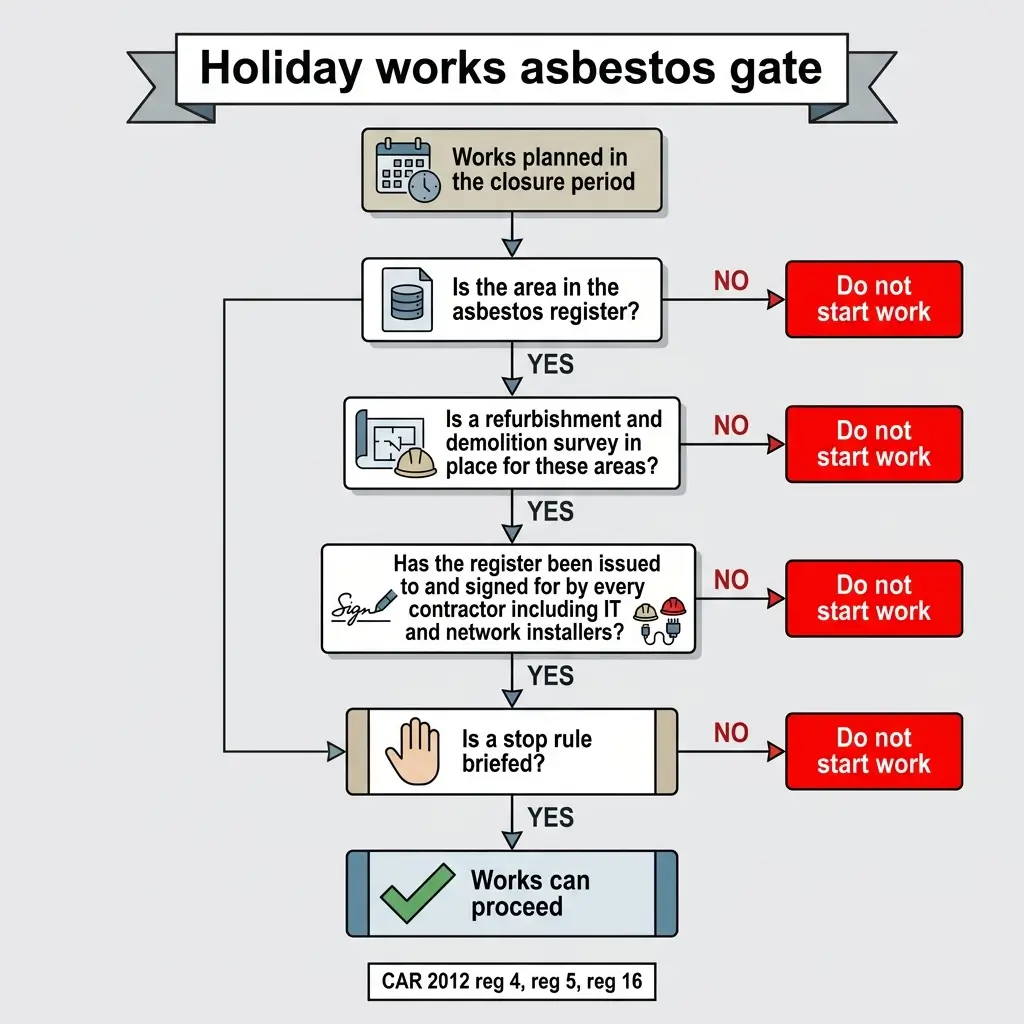
Before any holiday works package starts, these are the checks that matter:
- A refurbishment and demolition survey covering the actual work areas, not the management survey that covers the building generally. A management survey is not sufficient basis for intrusive work.
- The register issued to every contractor — in their hands, signed for, before the first fixing goes in. Not available on request from the office.
- The scope checked against the register by someone who understands both, because contractors reasonably assume that if they were let onto site the area is clear.
- A stop rule that everyone knows — what to do on encountering an unexpected material, and who has authority to halt. In a compressed summer programme this is the control most likely to be overridden by schedule pressure.
- Reinstatement checked before reoccupation, because damage caused during works is discovered in September by a caretaker, not in August by the contractor.
⚖️ Jurisdiction note: This section is the UK position under the Control of Asbestos Regulations 2012. The US framework for schools is entirely separate and considerably more prescriptive — see the comparison section below.
Ventilation, and the first warm week of term
Ventilation is the check most often skipped before reopening, because unlike a tap or a fume cupboard there is no obvious thing to test and no certificate that expires. The building feels fine when it is empty. It is not empty that matters.
Two documents get conflated here and they are aimed at different readers. Building Bulletin 101 (2018) is the technical design standard — written for engineers and architects specifying ventilation in new or refurbished schools. The Department for Education published separate operational guidance in February 2026 for staff running buildings day to day, and has confirmed no current plans to update BB101 itself. So for most existing school estates, BB101 remains the benchmark the systems were designed against, while the operational guidance governs what staff should actually do each morning.
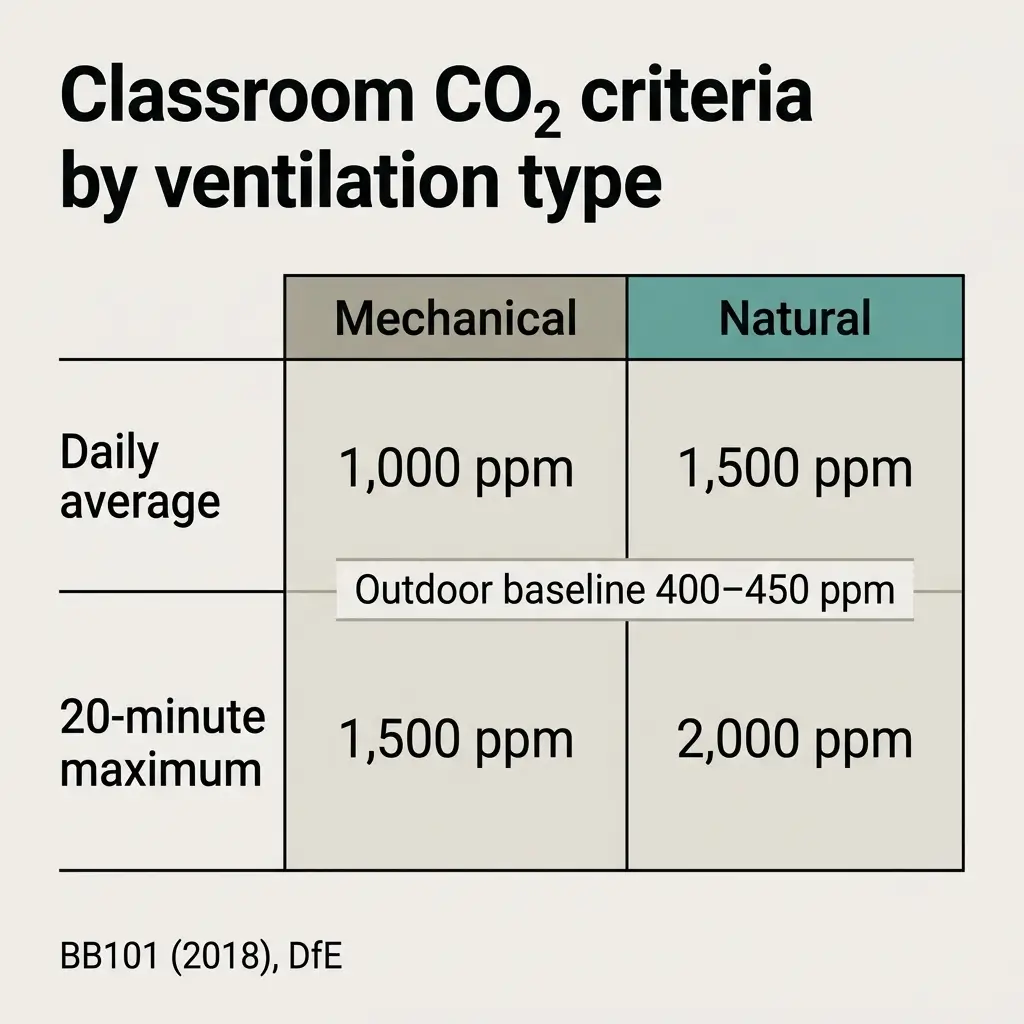
BB101's criteria depend on the ventilation type, which is why quoting a single CO₂ number for schools is wrong:
| Ventilation type | Daily average CO₂ | Maximum, not to be exceeded for more than 20 consecutive minutes |
|---|---|---|
| Mechanical (or hybrid in mechanical mode) | Below 1,000 ppm | 1,500 ppm |
| Natural (or hybrid in natural mode) | Below 1,500 ppm | 2,000 ppm |
Source: Building Bulletin 101 (2018), Department for Education. Background outdoor CO₂ is typically 400–450 ppm.
CO₂ is not toxic at these levels and is not being measured as a poison. It is a proxy: people exhale it continuously, so a rising level means outdoor air is not arriving fast enough to dilute what the occupants produce — and everything else in the air is accumulating on the same curve. That is why it anchors the guidance.
What the closure specifically does to ventilation is leave systems untested under load. Air handling units have been off or on setback. Filters have been sitting loaded. Actuators and dampers have not moved. Window restrictors installed during summer works may have changed the openable area a naturally ventilated classroom depends on, and nobody records that as a ventilation change because it was a security job.
Run the plant under something like real conditions before the children arrive, not on the first morning of term. If the estate has CO₂ monitors, the useful reading is a full occupied day in the warmest classroom on the top floor, not a spot check in an empty room.
The ventilation checks that repay the time before reopening are:
- Run every air handling unit under load and confirm dampers and actuators still travel through their full range
- Change filters that sat loaded through the closure, rather than waiting for the scheduled date
- Re-measure openable area in any room where window restrictors, secondary glazing or security work went in over the summer
- Log a full occupied-day CO₂ profile in the worst-case room — top floor, south facing, highest occupancy — in week one
Science labs and DT workshops: the extraction that fails quietly
This is the section where school estates most often carry a genuine legal exposure without knowing it, and it is the part of a school building closest to the industrial environments I work in. A DT workshop with a wood dust extraction system, a laser cutter with fume extraction and a bank of fume cupboards is, in COSHH terms, a small factory that happens to have fourteen-year-olds in it.
Local exhaust ventilation must be thoroughly examined and tested at intervals of no more than 14 months under regulation 9 of COSHH. The number that circulates in school-facing material is 12, which is not the statutory figure — although testing annually is sensible practice precisely because it builds in margin. The distinction matters in the other direction too: certain processes listed in COSHH Schedule 4 compress the interval to one or six months regardless of when the system was last tested, and wood dust extraction in particular is commonly tested six-monthly because of the established link with nasal cancer.
| System | Maximum interval | Governing standard | Record retention |
|---|---|---|---|
| Science fume cupboards (ducted) | 14 months (COSHH reg 9) | HSG258; BS EN 14175 | 5 years |
| Recirculating / ductless fume cupboards | 14 months | BS EN 17242 | 5 years |
| DT wood dust extraction | Commonly 6 months on risk | HSG258; COSHH Schedule 4 where applicable | 5 years |
| Laser cutter and solder fume extraction | 14 months | HSG258 | 5 years |
In schools, CLEAPSS guidance G9 is the sector reference technicians actually work to, and it sets an annual cycle for fume cupboards. Working to CLEAPSS keeps you inside the statutory interval with room to spare.
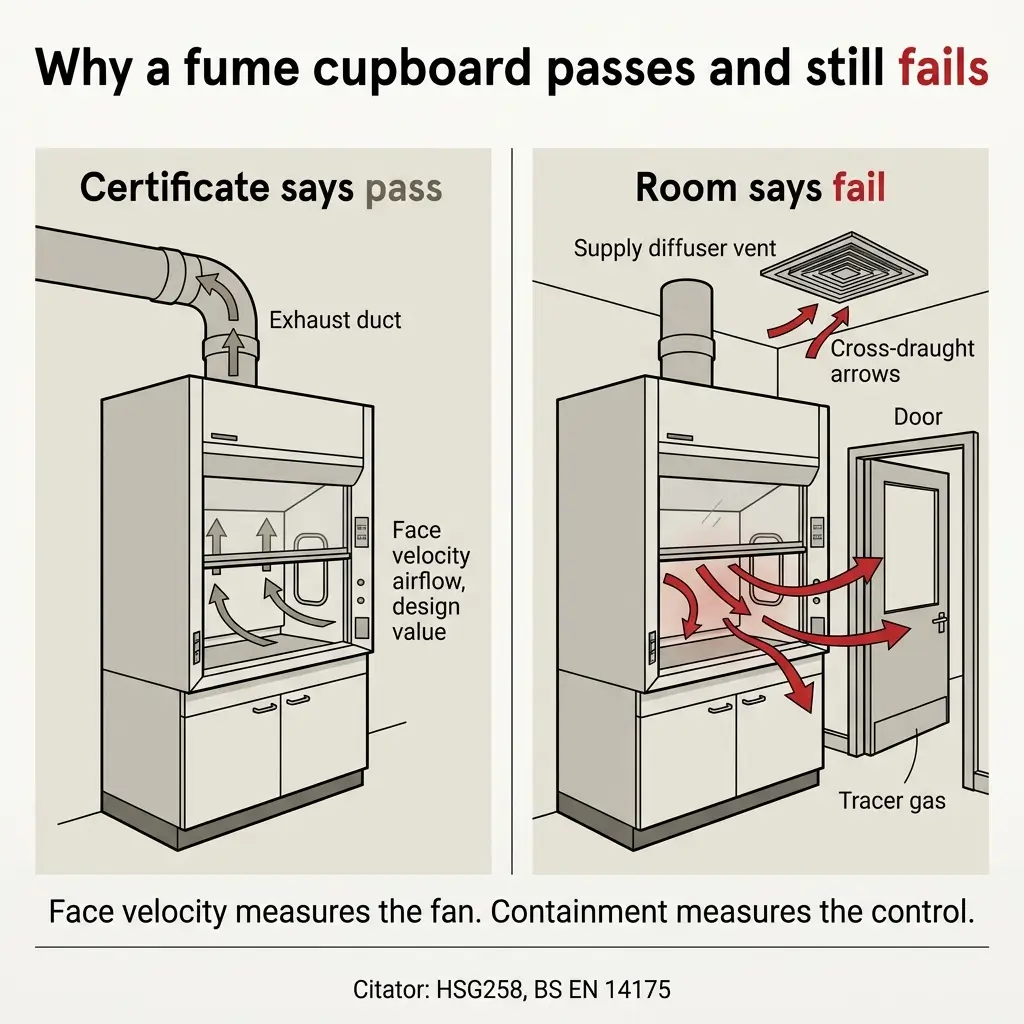
The failure mode I would look for is the one that does not show up on a certificate. Across LEV capture work with HSL Buxton Partners and dust control programmes at TSI Incorporated Hygiene, the recurring pattern in extraction systems is a unit that passes on airflow and fails on containment — face velocity is inside specification, so the certificate says pass, but the cupboard is sited next to a doorway or under a supply diffuser and the cross-draught pulls contaminant back out into the room. Face velocity is a measurement of the fan. Containment is a measurement of whether the thing works. A thorough examination should assess both, and a report containing only airflow figures has not tested what COSHH requires.
Two checks worth making before term, neither of which needs an engineer:
- Read the last report for the words, not the numbers. A report that states a pass with no observations, no photographs and no comment on room conditions is a weak report whatever figure it carries.
- Stand in the room and look at what has changed. New furniture blocking a make-up air path, a repositioned bench, a door that now gets propped open — all of these invalidate the conditions the last test was carried out under, and all of them happen over a refurbishment summer.
📋 From the field: The independence of the examiner matters more in schools than anywhere else, because the same contractor often supplies, maintains and tests the equipment. Someone with a commercial stake in the outcome is less likely to fail a borderline cupboard. Where the estate can support it, separate the testing contract from the maintenance contract.
How the same checks work outside the UK
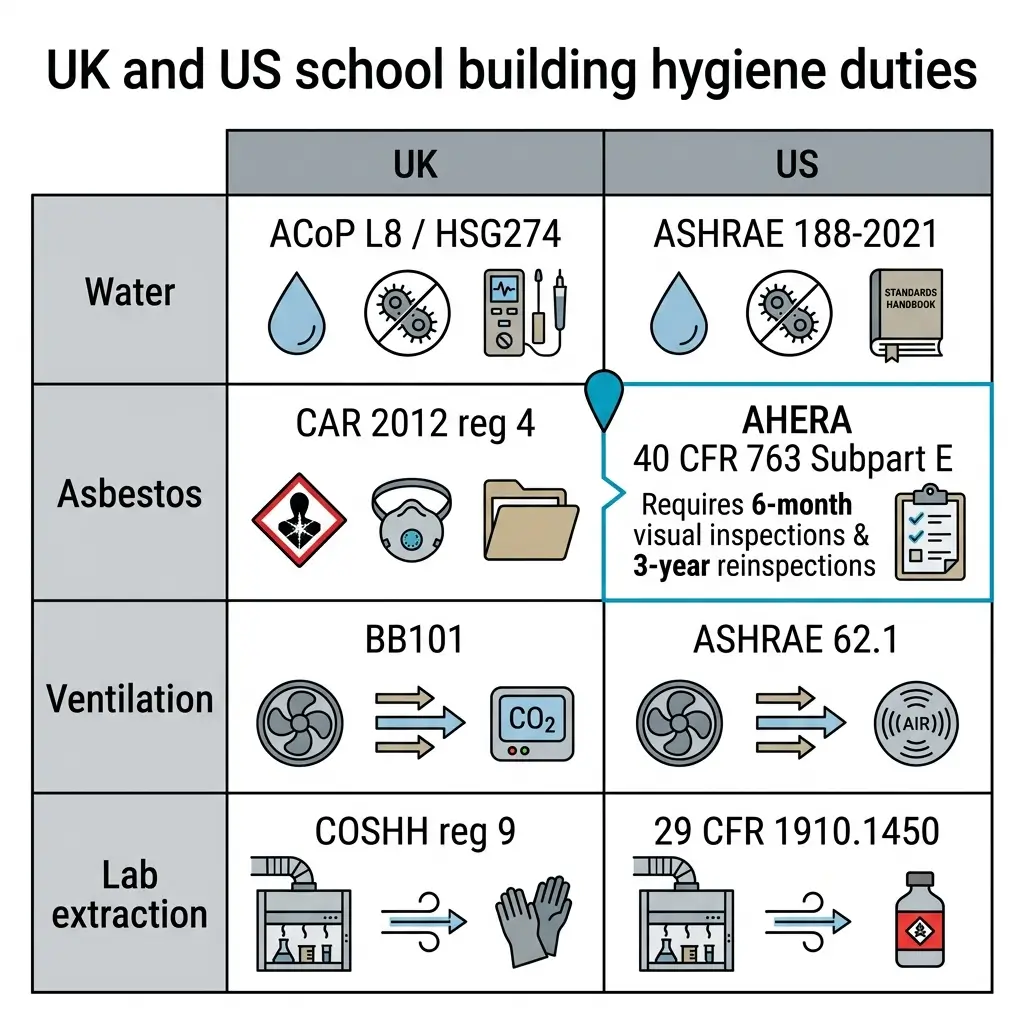
The hazards do not change across borders but the legal architecture does, and it changes in a direction that surprises people: for asbestos in schools specifically, the US regime is more prescriptive than the UK one, while for water it is less.
| Area | United Kingdom | United States |
|---|---|---|
| Water systems | COSHH 2002 reg 6 + HSWA; ACoP L8 and HSG274 Part 2 set the recognised approach with specified temperatures and frequencies | No single federal mandate for schools; ANSI/ASHRAE Standard 188-2021 is the consensus standard, with ASHRAE Guideline 12-2023 alongside it, and CDC guidance covers reopening after prolonged shutdown. Some states and cities impose their own requirements |
| Asbestos in schools | CAR 2012 reg 4 duty to manage; no fixed statutory surveillance interval, condition checks set by the management plan | AHERA, 40 CFR Part 763 Subpart E: management plan per building, periodic surveillance every 6 months, re-inspection every 3 years by an accredited inspector, annual written notification to parents and staff, a trained Designated Person |
| Classroom ventilation | BB101 (2018) as design guidance; DfE operational guidance for staff | ANSI/ASHRAE 62.1 for ventilation rates; EPA IAQ Tools for Schools as the programme framework; state and district rules vary |
| Lab and workshop extraction | COSHH reg 9, 14-month maximum interval; HSG258 | 29 CFR 1910.1450 for laboratories; no single equivalent statutory test interval |
The practical consequence for a multi-site or international operator is that a single global procedure has to be written to the more prescriptive requirement in each area, not to an average. A US school running on a UK-style asbestos management plan with no six-monthly surveillance is in breach; a UK school running on AHERA's surveillance schedule but without HSG274 temperature monitoring is also in breach. They are not interchangeable frameworks.
The pre-term walkthrough, in order
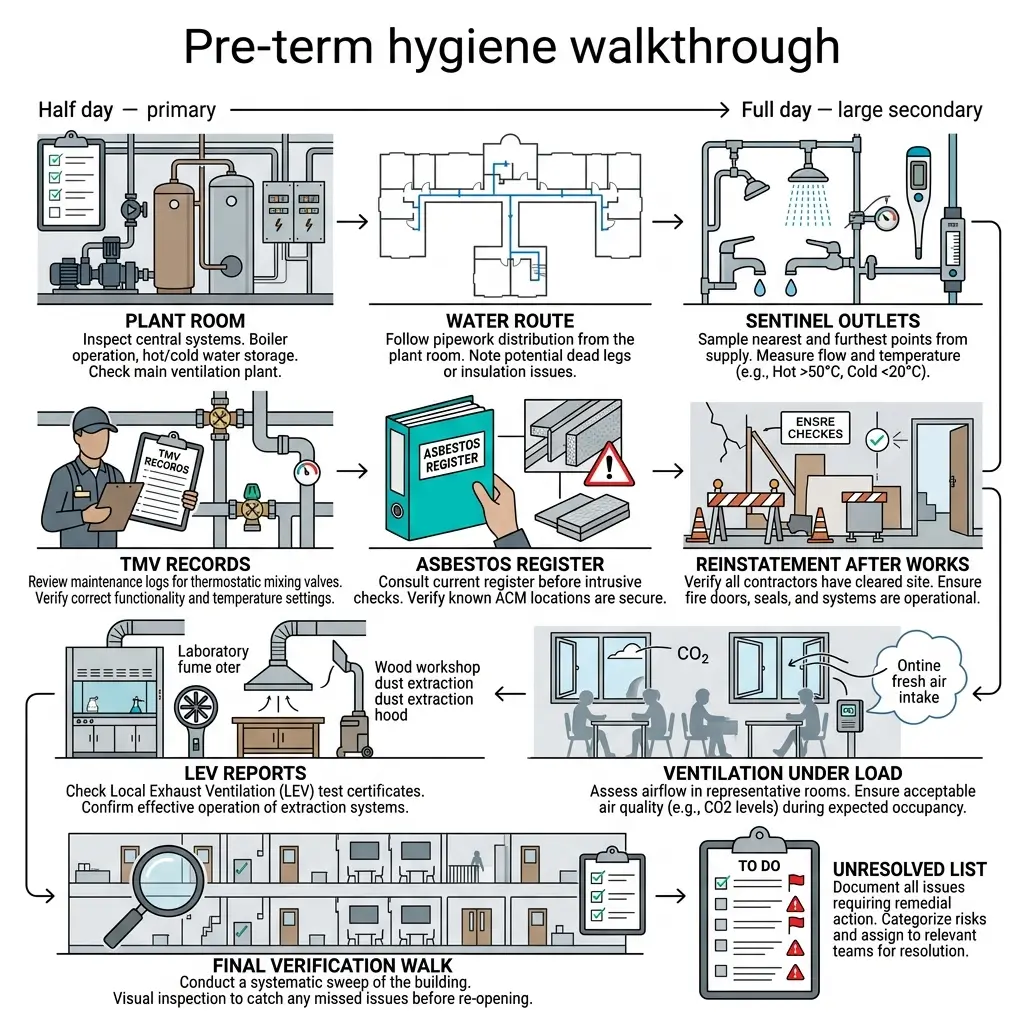
This is the sequence I would use, arranged so that each step produces the information the next one needs. It assumes about half a day for a primary and a full day for a large secondary.
- Start in the plant room, not the classrooms. Calorifier flow and return temperatures, the schematic on the wall, and whether the schematic matches what has been installed. Summer pipework alterations that never made it onto the drawing are found here or not at all.
- Pull the asset register and the written scheme before walking the building, so you are checking against something rather than forming impressions.
- Walk the water route hydraulically — nearest sentinel, furthest sentinel, then the outlets nobody uses: the disabled toilet in the far block, the changing room showers, the science lab eyewash, the kitchen hand basin that was replaced in July.
- Take real readings with a stopwatch. One minute hot, two minutes cold. Record the failures; a log with no failures is not a good log.
- Check TMV records against the asset register, and count the gap between how many valves exist and how many appear in the schedule.
- Review the holiday works package against the asbestos register, and ask who signed for the register — by name.
- Inspect reinstatement in every area where work took place, looking at ceiling tiles, service penetrations and pipe boxing.
- Read the LEV reports for observations and room conditions, then stand in each lab and workshop and look for what has moved since the test.
- Run the ventilation under load if you can, and log a full occupied-day CO₂ profile in the worst-case room in the first week rather than waiting for a complaint.
- Write down what you could not verify. The unresolved list is the useful output. An assurance walk that finds nothing has usually not looked hard enough.
Frequently asked questions
These are the questions estates teams and business managers raise most often when the summer checks come round.
Does a school legally need a legionella risk assessment?
Yes. The duty arises under regulation 6 of COSHH 2002 and sections 2 and 3 of HSWA 1974, which require assessment and control of the risk from exposure to legionella. ACoP L8 sets the recognised route to compliance. The assessment must cover the whole installation, including parts temporarily out of use and seldom-used outlets.
How long does water have to sit before it becomes a legionella risk?
There is no single threshold, which is why the guidance is built around weekly flushing rather than a stagnation limit. Risk rises with time in the 20–45°C growth range, so a warm loft tank over August is a very different proposition from a cold main in a cool basement. Treat any outlet unused for more than a week as needing flushing.
Is LEV testing in schools every 12 months or 14?
The statutory maximum under COSHH regulation 9 is 14 months. Many schools work to 12, and CLEAPSS guidance sets an annual cycle for fume cupboards, which is sensible because it builds in margin. Certain COSHH Schedule 4 processes require far shorter intervals of one or six months.
Who is the asbestos duty holder in a school?
Whoever is responsible for maintenance and repair of the premises. For maintained schools that is usually the local authority; for academies and free schools it is the trust. Where the building maintenance budget is delegated to the school, the duty is shared. Delegation does not remove accountability.
Do we need a new asbestos survey before summer works?
If the work is intrusive, yes — a refurbishment and demolition survey covering the specific work areas. A management survey is designed to keep known ACMs under control during normal occupation and is not an adequate basis for drilling, cutting or removing fabric.
What CO₂ level should a classroom stay under?
It depends on the ventilation type. Under BB101 (2018), mechanically ventilated spaces should average below 1,000 ppm across the day and not exceed 1,500 ppm for more than 20 consecutive minutes; naturally ventilated spaces average below 1,500 ppm with a 2,000 ppm ceiling on the same 20-minute basis.
Can we do the flushing ourselves or does it need a contractor?
You can do it yourself, provided the person is competent and the work is logged against the written scheme. Using a contractor does not transfer the duty. What matters is that the flushing is genuinely performed, recorded accurately, and that failed readings are acted on rather than filed.
What to take from this
The thread running through every section is the same: the controls in a school building are routines, and the summer break is when routines stop. The water regime, the LEV interval, the asbestos condition checks and the ventilation systems all depend on someone doing something on a cycle, and all four cycles have a six-week hole in them at exactly the point when the building is also being altered.
If you only have a day, spend it on the two things that are both high-consequence and cheap to verify: take real timed temperature readings at genuine sentinel points, and confirm by name that every contractor who worked in the building over the summer was issued the asbestos register before starting. Those two checks find more than any amount of file review.
And where you cannot verify something, write that down rather than rounding it up to compliant. A duty holder who knows exactly which parts of their estate are unverified is in a far stronger position than one holding a folder of certificates they have never read.
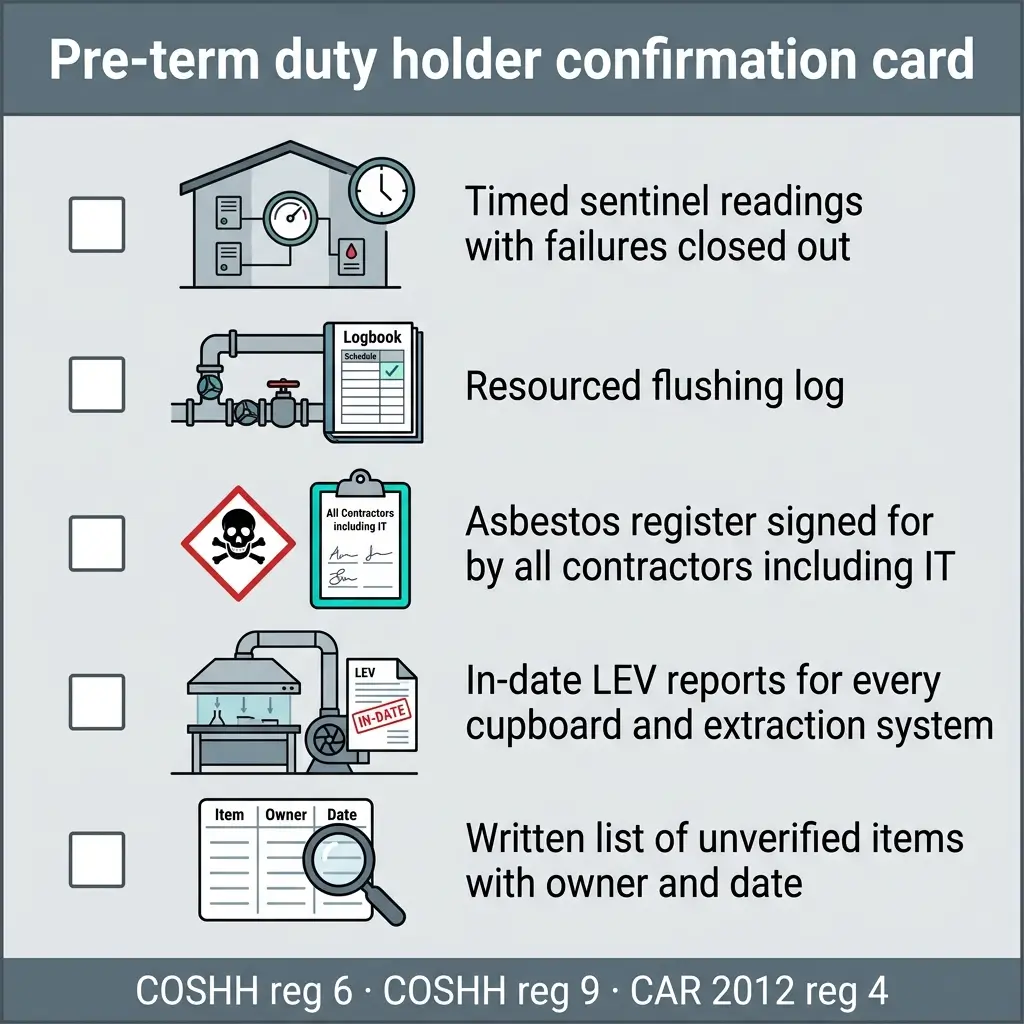
The five things worth confirming are in writing before the first day of term are:
- Timed sentinel temperature readings taken this month, with any failures and the action closed out
- The summer flushing log, resourced to a named person rather than signed retrospectively
- Signed receipt of the asbestos register by every contractor who worked on site, including network and IT installers
- In-date LEV reports for every fume cupboard and extraction system, read for observations rather than filed on the pass
- A written list of what could not be verified, with an owner and a date against each item
About the author — Sophia Bennett
Sophia Bennett is a British Occupational Hygiene & Exposure Control Consultant with 16 years of continuous field experience across occupational hygiene, chemical exposure assessment, dust and silica control, local exhaust ventilation and indoor air quality interfaces. Her focus is practical assurance — checking that controls still work where work actually happens. She currently leads Bennett Occupational Hygiene Partners, based in Manchester, United Kingdom, after senior roles including Hygiene Programme Lead at IOM Consulting and LEV Capture Advisor at HSL Buxton Partners. Credentials: NEBOSH International General Certificate; ISO 45001 Lead Auditor; ISO 14001 Internal Auditor; IOSH Managing Safely.
Sources and further reading
- Legionnaires' disease: The control of legionella bacteria in water systems (ACoP L8) — HSE, fourth edition
- Legionnaires' disease: a brief guide for duty holders (INDG458) — HSE
- Control of Substances Hazardous to Health Regulations 2002 — HSE
- Management of asbestos in school buildings 2022/23 — HSE, July 2023
- Asbestos in schools — HSE
- Duty to manage asbestos — HSE
- Managing and working with asbestos (L143) — HSE
- Managing asbestos in your school or college — Department for Education
- Asbestos management checklist for schools — HSE
- ANSI/ASHRAE Standard 188-2021, Legionellosis: Risk Management for Building Water Systems — ASHRAE
- Asbestos management plan updating requirements — US EPA