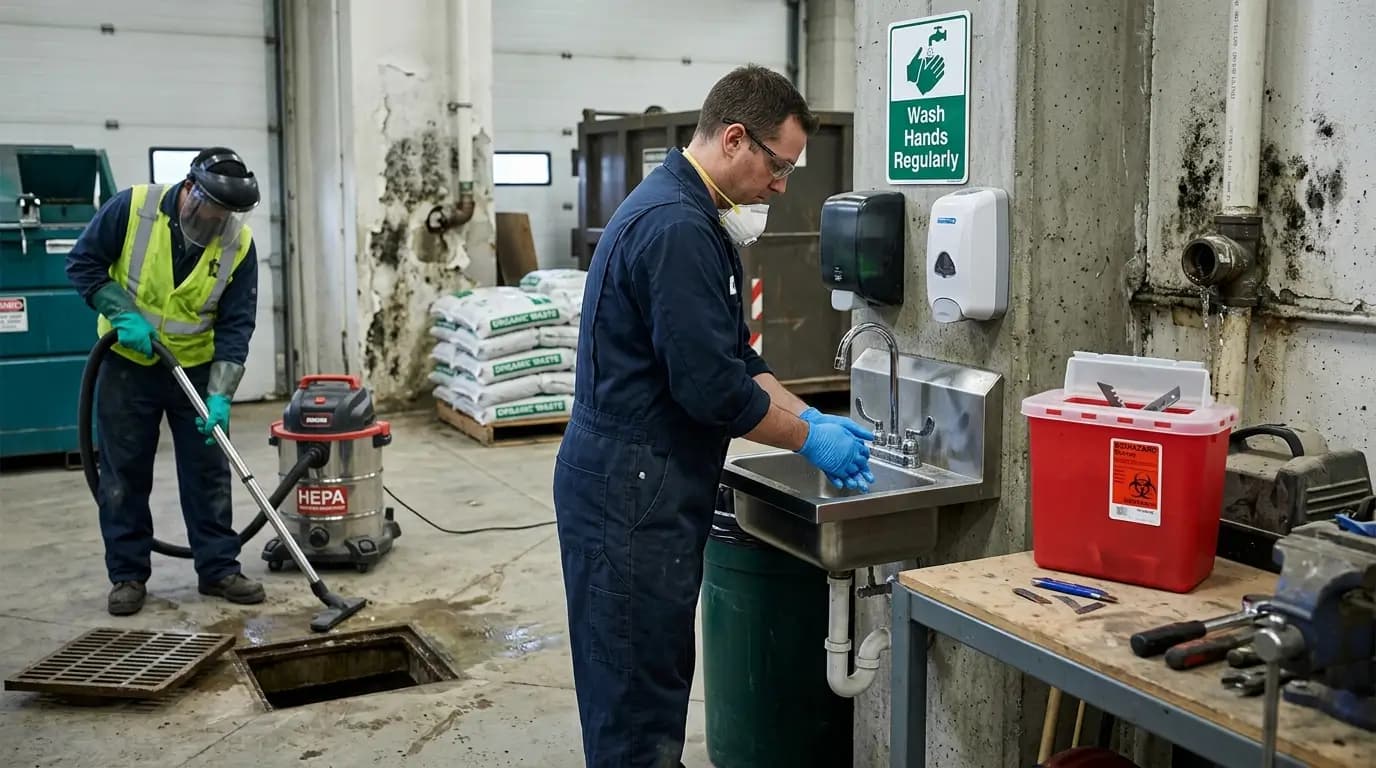


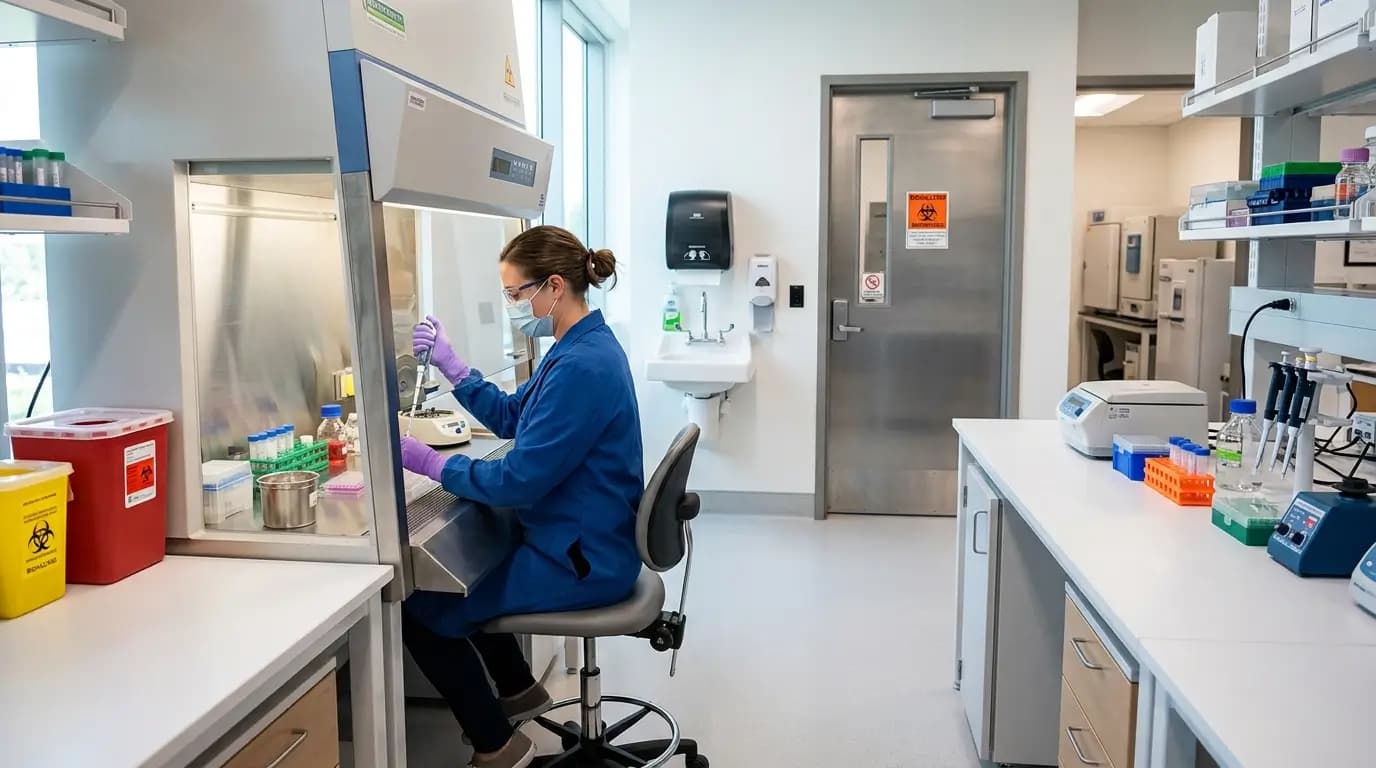
Biosafety Level 2 is the second of four containment tiers described in the CDC and NIH manual Biosafety in Microbiological and Biomedical Laboratories. It applies to work with agents that cause human disease but pose only a moderate hazard to the people handling them. In practice it means four things: restricted access, specific training, a certified biosafety cabinet for anything that generates aerosols or splashes, and standard laboratory PPE.
Here is the part most explainers skip: in the United States, BSL-2 is a recommendation. The BMBL is guidance, not regulation. In the United Kingdom and across the EU, the equivalent — Containment Level 2 — is a legal minimum written into the COSHH Regulations, and it carries a notification duty to the regulator that has no American counterpart. If you run a laboratory in one jurisdiction and read guidance written for another, you will get this wrong.
My background is occupational hygiene rather than microbiology: sixteen years verifying that ventilated enclosures actually capture what they are supposed to capture, across fourteen countries. A biosafety cabinet is a ventilated enclosure with a HEPA filter on it, and the reasons it stops containing are the same reasons a fume hood or an extraction arm stops containing. That is the part of BSL-2 I will spend the most time on, because it is the part I have seen fail.
Key takeaways
- BSL-2 is a package, not a room. It is a combination of practices, safety equipment and facility features assigned to a procedure, not a label attached to a building.
- Risk Group 2 and BSL-2 are different things. The agent has a risk group; the work has a containment level. They usually align, and sometimes they do not.
- In the US, the BMBL is guidance. What is legally enforceable is OSHA's Bloodborne Pathogens standard, 29 CFR 1910.1030, and — for federally funded recombinant work — the NIH Guidelines.
- In the UK, Containment Level 2 is law. COSHH 2002 Schedule 3 sets the containment measures, and deliberate work with Hazard Group 2 agents must be notified to HSE.
- WHO has moved away from the ladder. The 2020 Laboratory Biosafety Manual replaced prescriptive biosafety levels with core requirements and heightened control measures, driven by risk assessment.
- The cabinet is the weak point. An annual certification sticker proves the cabinet passed on one day. It does not prove containment today.
What BSL-2 means, and what it does not
BSL-2 describes a defined combination of laboratory practices, safety equipment and facility design applied to work with agents associated with human disease that present a moderate hazard to staff and the environment. It builds directly on BSL-1 rather than replacing it — every BSL-1 practice still applies, with additional controls layered on top.
The CDC and NIH set out three things that separate BSL-2 from BSL-1:
- Personnel receive specific training in handling pathogenic agents, and are supervised by scientists competent to work with them.
- Access to the laboratory is restricted while work is in progress.
- Aerosol- or splash-generating procedures are contained — carried out inside a biosafety cabinet or other physical containment equipment.
Everything else at BSL-2 follows from those three.
The agents typically handled at this level are ones a clinical or teaching laboratory meets routinely — hepatitis B virus, HIV, the salmonellae and Toxoplasma species are the standard examples. BSL-2 is also the default for work with any human blood, body fluid, tissue or primary human cell line where the presence of an infectious agent is simply unknown.
Risk Group 2 and BSL-2 are not the same thing
This is the single most common conceptual error I see repeated in laboratory documentation, and it matters because it drives the wrong control decisions.
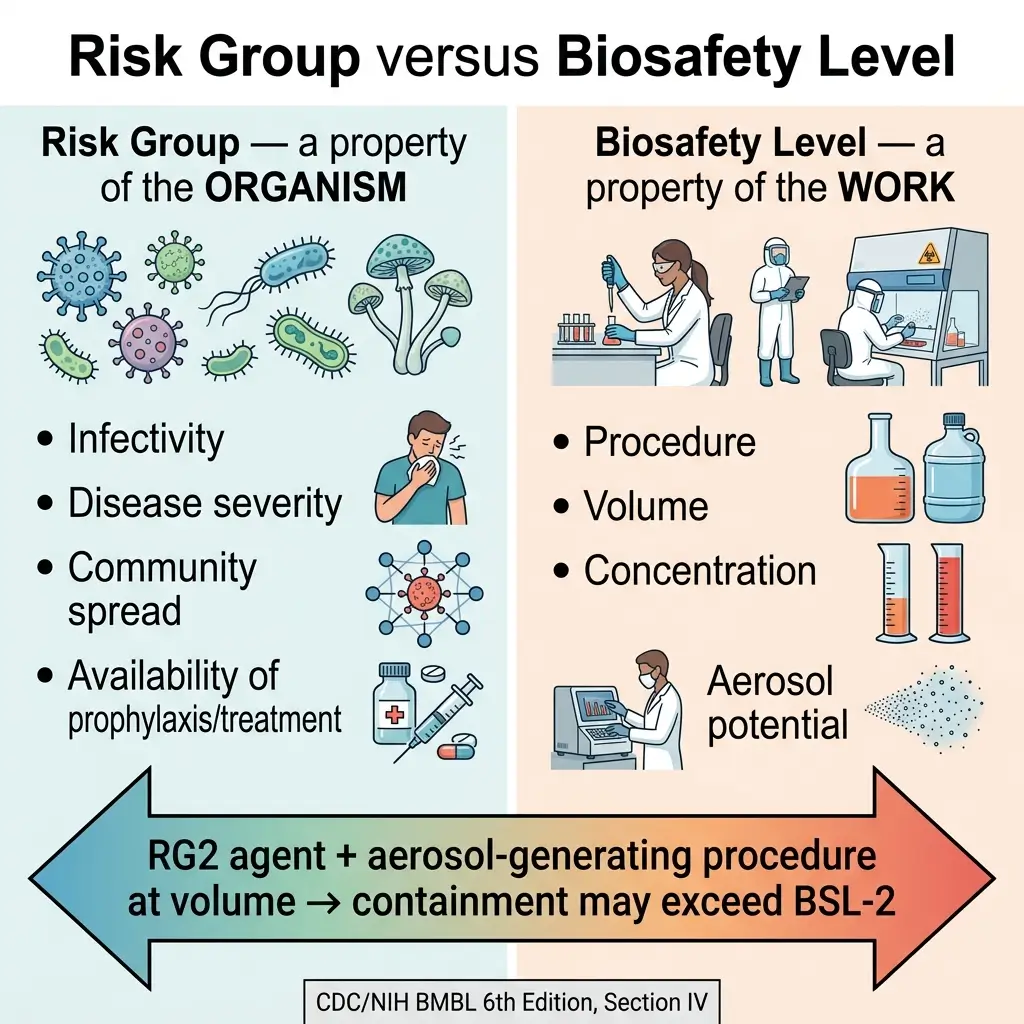
A risk group is a property of the organism. It reflects how likely the agent is to cause infection, how severe the resulting disease is, whether it spreads in the community, and whether prophylaxis or treatment exists. A biosafety level is a property of the work. It reflects what you are doing with that organism, in what volume, at what concentration, and by what procedure.
They line up most of the time. A Risk Group 2 agent handled in ordinary quantities is normally worked at BSL-2. But concentrating that agent, propagating it in large volume, or running a procedure that aerosolises it can push the containment requirement upward without changing the agent's classification at all. The organism has not become more dangerous — the work has.
The practical consequence is that no one can tell you the correct containment level from the name of the organism alone. In the US that determination goes through an Institutional Biosafety Committee; in the UK it comes out of a COSHH regulation 6 risk assessment. Either way, it is an assessment of the procedure.
BSL-2 protects against contact, not inhalation
The exposure routes BSL-2 is built around are percutaneous injury, mucous membrane contact and ingestion — needlesticks, cuts, splashes to the eye, and hand-to-mouth transfer. That is why gloves, eye protection and sharps discipline carry so much of the load at this level, and why the biosafety cabinet exists specifically to catch the minority of procedures that do produce aerosol.
Agents whose primary transmission route is inhalation of infectious aerosol do not belong at BSL-2. That is the dividing line into BSL-3, and it is a line worth holding, because BSL-2 facilities generally have no directional airflow to fall back on when a primary containment device fails.
The exposure routes BSL-2 controls, and the control that addresses each, are:
- Percutaneous injury — sharps discipline, engineered sharps protections, no recapping by hand
- Mucous membrane contact — eye and face protection wherever a splash is foreseeable
- Ingestion — no food, drink or cosmetics in the work area, and handwashing before leaving it
- Aerosol, as a secondary route — the biosafety cabinet, for the specific procedures that generate it
Is BSL-2 a legal requirement? US, UK, EU and WHO compared
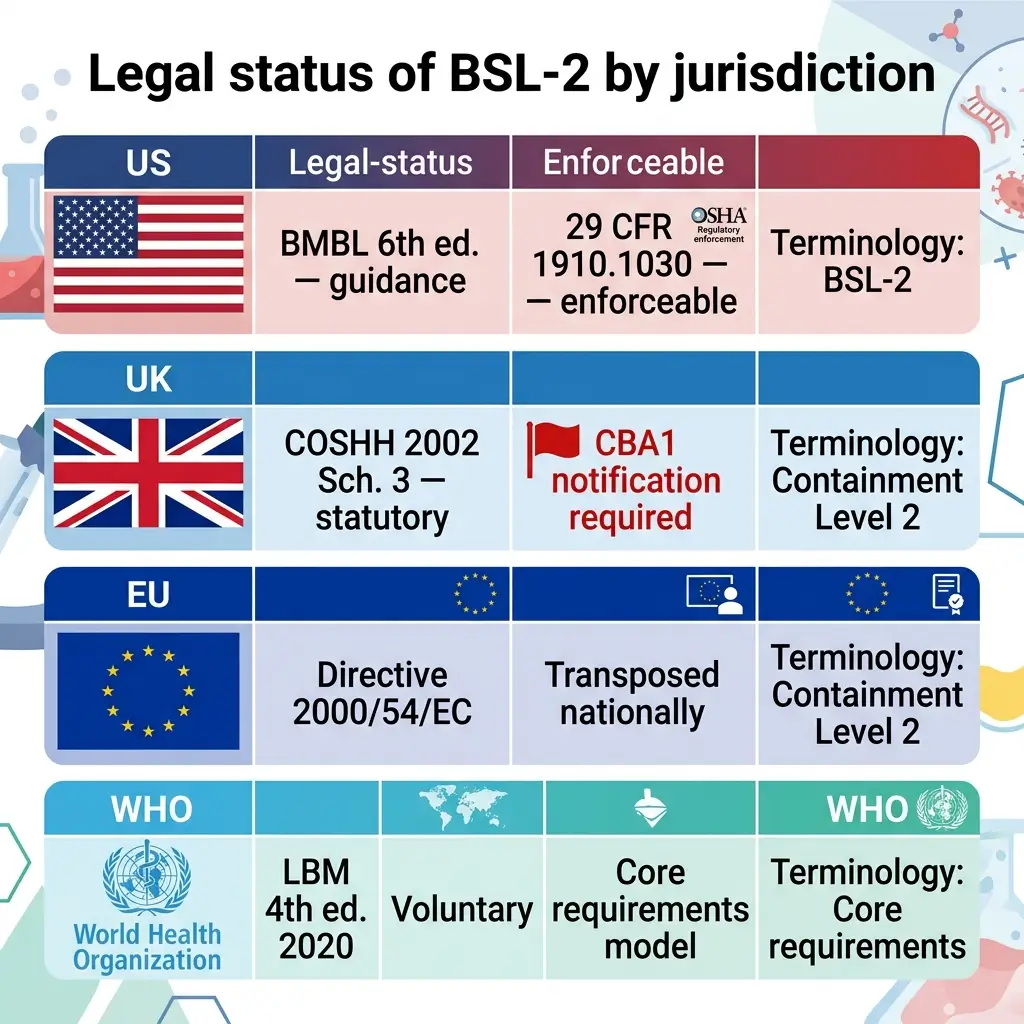
BSL-2 carries very different legal weight depending on where the laboratory sits, and this is the section that changes what a compliance manager actually has to do. The short answer: the term "BSL-2" appears in no enforceable US regulation, while its UK and EU equivalent is written directly into binding law.
| Jurisdiction | Instrument | Legal status | What it is called | Notification duty |
|---|---|---|---|---|
| United States | CDC/NIH BMBL 6th Edition, Section IV | Guidance | BSL-2 | None for BSL-2 work as such |
| United States | 29 CFR 1910.1030 | Enforceable standard | Not BSL terminology | Sharps log, OSHA 300 recording |
| United Kingdom | COSHH 2002, Schedule 3 | Statutory instrument | Containment Level 2 | Yes — HSE form CBA1 |
| European Union | Directive 2000/54/EC | Directive, transposed nationally | Containment Level 2 | Set by member state |
| International | WHO Laboratory Biosafety Manual 4th ed. | Voluntary, de facto global standard | Core requirements | None |
United States — the BMBL is guidance, the enforcement sits elsewhere
The BMBL is the reference every American biosafety programme is built on, and its sixth edition is the current one. It is not a regulation. No OSHA inspector can cite a laboratory for failing to meet BSL-2.
What they can cite is the Bloodborne Pathogens standard. 29 CFR 1910.1030 imposes requirements on employers whose workers have reasonably anticipated exposure to blood or other potentially infectious materials, covering exposure control plans, engineering and work practice controls, hepatitis B vaccination, hazard communication, training and recordkeeping. For a clinical or diagnostic laboratory handling human specimens, that standard reproduces much of what BSL-2 asks for — and unlike the BMBL, it has legal teeth. Its paragraph (e) provisions for HIV and HBV research laboratories go further still, requiring restricted access, written entry and exit procedures, and defined containment practices.
The second enforceable layer is the NIH Guidelines for research involving recombinant or synthetic nucleic acid molecules. These bind any institution receiving NIH funding for such work, and non-compliance puts funding at risk. They are where the Institutional Biosafety Committee requirement originates.
So a US laboratory does not comply with "BSL-2." It complies with 1910.1030 and, where applicable, the NIH Guidelines, using BMBL Section IV as the technical description of how.
United Kingdom — Containment Level 2 is a statutory minimum
The UK does not use BSL terminology. Biological agents are classified into four hazard groups under COSHH, and Hazard Group 2 covers agents that can cause human disease and may be a hazard to employees, are unlikely to spread to the community, and for which effective prophylaxis or treatment is usually available. Work with a Hazard Group 2 agent requires Containment Level 2.
The agents themselves are listed in the ACDP Approved List of Biological Agents, which covers Hazard Groups 2 to 4 only. An agent's absence from the list does not place it in Hazard Group 1 by default — unlisted agents are classified by risk assessment, and where two hazard groups could plausibly apply, the higher one is assigned.
The containment measures for each level sit in Schedule 3, Parts II and III of COSHH, with HSE's Management and operation of microbiological containment laboratories as the applied guidance for Levels 2 and 3.
The duty most American-authored material misses entirely is notification. HSE's current guidance states that deliberate work with Hazard Group 2, 3 and 4 agents must be notified using a CBA1 form to obtain clearance or consent. There is no equivalent step in the US for BSL-2 work. If you are commissioning a UK laboratory on the basis of a BMBL-derived design brief, this is the requirement you will discover late.
European Union — the same architecture, transposed differently
Directive 2000/54/EC on the protection of workers from risks related to exposure to biological agents at work sets out the same four risk groups and four containment levels, and member states transpose it into national law. The structure is familiar to anyone who knows COSHH Schedule 3, because COSHH Schedule 3 is the UK transposition of its predecessor.
The practical variation is in the detail of national implementation, the specific agent classification lists in use, and equipment standards — European laboratories certify microbiological safety cabinets to EN 12469, not to NSF/ANSI 49.
WHO — the ladder has already been retired internationally
This is the development the SEO-driven explainer articles have not caught up with. The fourth edition of the WHO Laboratory Biosafety Manual, published in 2020, moved away from the prescriptive definition of biosafety levels toward core requirements and heightened control measures.
The manual builds on a risk assessment framework, so that safety measures are balanced against the actual risk of the work on a case-by-case basis rather than assigned by tier. Core requirements — good microbiological practice, basic training, basic PPE — apply to all laboratory activity. Heightened control measures are added where a risk assessment shows they are warranted. The manual is not legally binding, but it has become the de facto global standard and has shaped many national codes.
The reason this matters for a practitioner is resource allocation. A prescriptive tier applies the same controls to every activity inside it, which in a low-resource setting means money spent on facility features that the actual work does not need, and less spent on training and technique that it does.
Where the jurisdictions genuinely disagree
SARS-CoV-2 makes the divergence concrete. CDC recommends BSL-2 facilities, practices and procedures as a minimum for diagnostic research, anatomic pathology, environmental testing and virus propagation involving SARS-CoV-2. The ACDP Approved List classifies SARS-CoV-2 as a Hazard Group 3 agent, which points at Containment Level 3, with derogations agreed to permit defined diagnostic activities at Containment Level 2.
Same virus, same year, two regulators, two answers. If your organisation runs laboratories in both countries, one procedure will not satisfy both, and the procedure that satisfies the stricter regulator is the one to write.
What BSL-2 requires: practices, equipment and facility
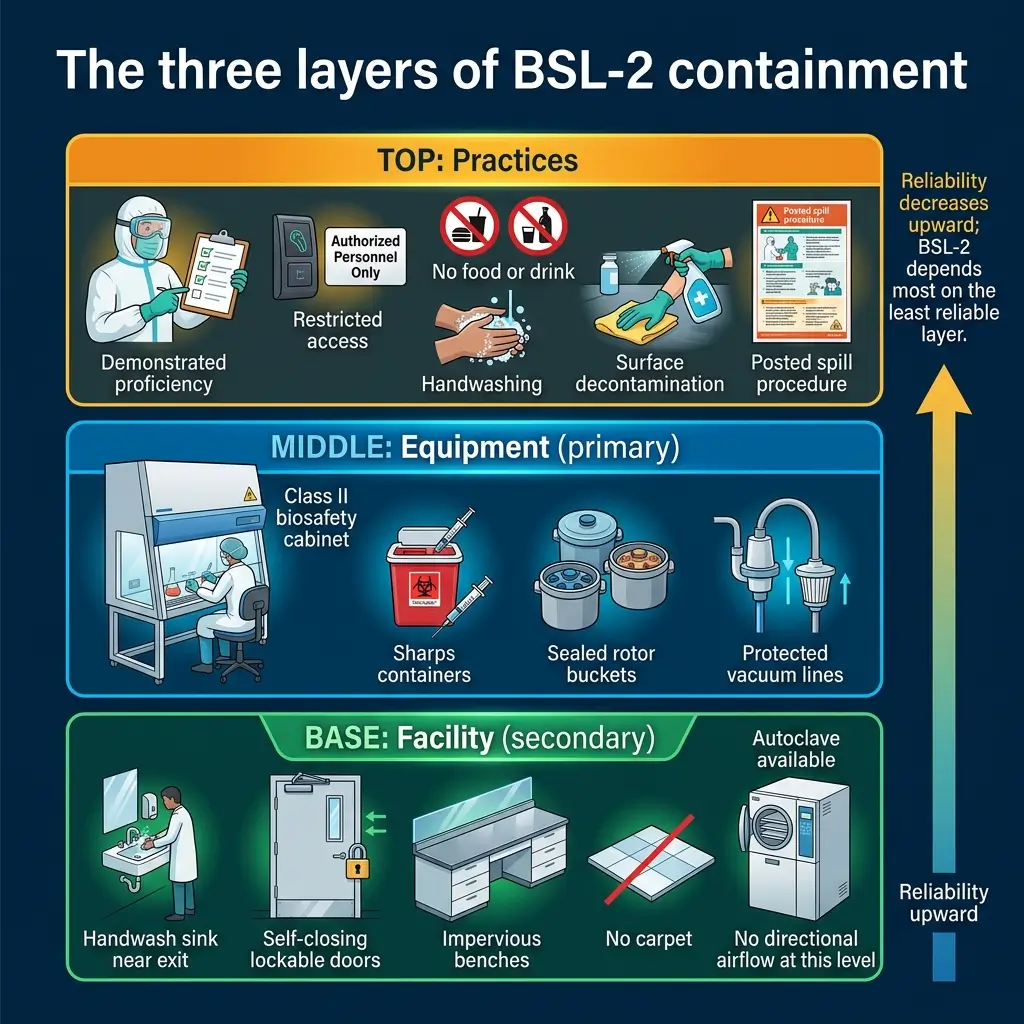
BSL-2 requirements are conventionally grouped into three layers — what people do, what equipment contains the hazard, and what the building provides as a backstop. The layering matters, because the layers are not equally reliable. Practices depend on people under time pressure. Equipment depends on maintenance. The facility is the only layer that works whether anyone is paying attention or not, and at BSL-2 the facility layer is thin.
Standard and special microbiological practices
The practice layer is where BSL-2 does most of its work, and where the sixth edition of the BMBL tightened several points that had previously sat at BSL-3.
The requirements a laboratory supervisor is accountable for at this level include:
- Demonstrated proficiency — personnel must show competence in standard and special microbiological practices before working at this level, which strengthened a previous expectation that training had merely been delivered
- Restricted access while work is in progress, with the supervisor enforcing institutional entry policy
- No eating, drinking, smoking, handling of contact lenses or application of cosmetics in the work area, with food stored outside it
- Handwashing after handling viable material, after glove removal and before leaving the laboratory
- Decontamination of work surfaces after work is completed and after any spill or splash
- A posted spill procedure, with spills involving infectious material cleaned up by staff who are trained and equipped for it — previously a BSL-3 requirement
- Decontamination of all cultures, stocks and potentially infectious material before disposal, by a validated method
- A facility-specific biosafety manual, prepared in consultation with the facility director and safety professionals, available and accessible to staff
- No animals or plants in the laboratory unless associated with the work
Primary containment — the biosafety cabinet
The biosafety cabinet is the defining piece of equipment at this level. Any procedure with the potential to generate infectious aerosols or splashes goes inside one.
Class II cabinets are the standard fitting for BSL-2. They are partial barriers: an inward air curtain at the front opening protects the operator, HEPA-filtered downflow protects the work, and HEPA-filtered exhaust protects the environment. That protection is produced entirely by airflow balance and filter integrity, which is why a Class II cabinet is a device that must be verified rather than assumed.
In North America, cabinets are designed, built and field-certified to NSF/ANSI 49, with field certification performed at installation and at least annually thereafter by an accredited technician. Type A2 cabinets maintain a minimum average inflow velocity of 100 ft/min (0.51 m/s) through the work access opening; Type A1 cabinets, 75 ft/min (0.38 m/s). In Europe, EN 12469 applies, and it weights demonstrated microbiological protection more heavily than fixed velocity figures. A cabinet that satisfies one standard's annual tests has not necessarily satisfied the other's.
PPE and the exposure routes it addresses
PPE at BSL-2 is aimed squarely at contact and splash, and the specification follows from that.
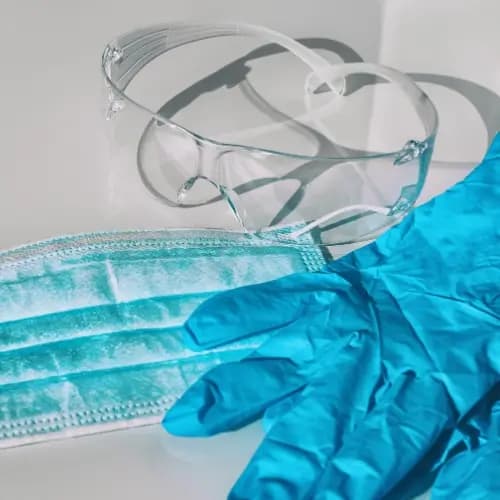
Protective laboratory coats, gowns or uniforms designated for laboratory use are worn while handling hazardous material and removed before leaving for non-laboratory areas — the cafeteria and the office are the two failures I would look for first. Gloves are worn for handling potentially infectious material and changed when contaminated or compromised. Eye and face protection is used where splashes are foreseeable, and under the sixth edition it must be disposed of as contaminated waste or decontaminated before reuse.
Respiratory protection is generally not part of a BSL-2 specification. That is deliberate: aerosol-generating work belongs inside the cabinet, and reaching for a respirator instead of primary containment is a control substitution in the wrong direction. Where a risk assessment does identify a respirator requirement, it brings a full programme with it — face-fit testing, medical clearance, maintenance and records — and that programme is not optional.
Facility and secondary containment
The facility requirements at BSL-2 are modest compared with BSL-3, and understanding what is not required is as useful as knowing what is.
BSL-2 asks for a handwashing sink, which may be manual, hands-free or automatic, and should be located near the exit door. Doors should be self-closing and have locks in accordance with institutional policy. Bench tops must be impervious to water and resistant to heat, organic solvents, acids and alkalis. Carpets and rugs are not permitted. Vacuum lines in use are protected. An autoclave must be available for decontaminating waste, though it need not be inside the laboratory room.
What BSL-2 does not require is sustained directional airflow into the laboratory, HEPA filtration of room exhaust, or a sealed envelope. Those belong to Containment Level 3 and above — under COSHH, a Containment Level 3 laboratory must be maintained at an air pressure negative to atmosphere with extracted air HEPA-filtered or equivalent. At BSL-2 there is no room-level containment to compensate when the cabinet is not doing its job.
Where BSL-2 containment actually fails: the cabinet
Almost every explainer stops at "aerosol-generating procedures are performed in a biosafety cabinet," as though naming the device settled the matter. It does not. A biosafety cabinet is a ventilated containment enclosure, and I have spent a good part of sixteen years demonstrating that ventilated enclosures fail quietly, stay in service after they have failed, and carry paperwork saying otherwise.
I want to be precise about what I am and am not claiming. My containment work has been in local exhaust ventilation and respiratory protection — capture verification at hoods, booths and extraction arms across pharmaceutical, chemical and manufacturing sites, and respirator programme work with Dräger and DuPont. I have not certified biosafety cabinets to NSF/ANSI 49. But the physics of an air curtain does not change because the contaminant is biological rather than chemical, and the four failure patterns below are the ones I find in ventilated enclosures regardless of what is inside them.
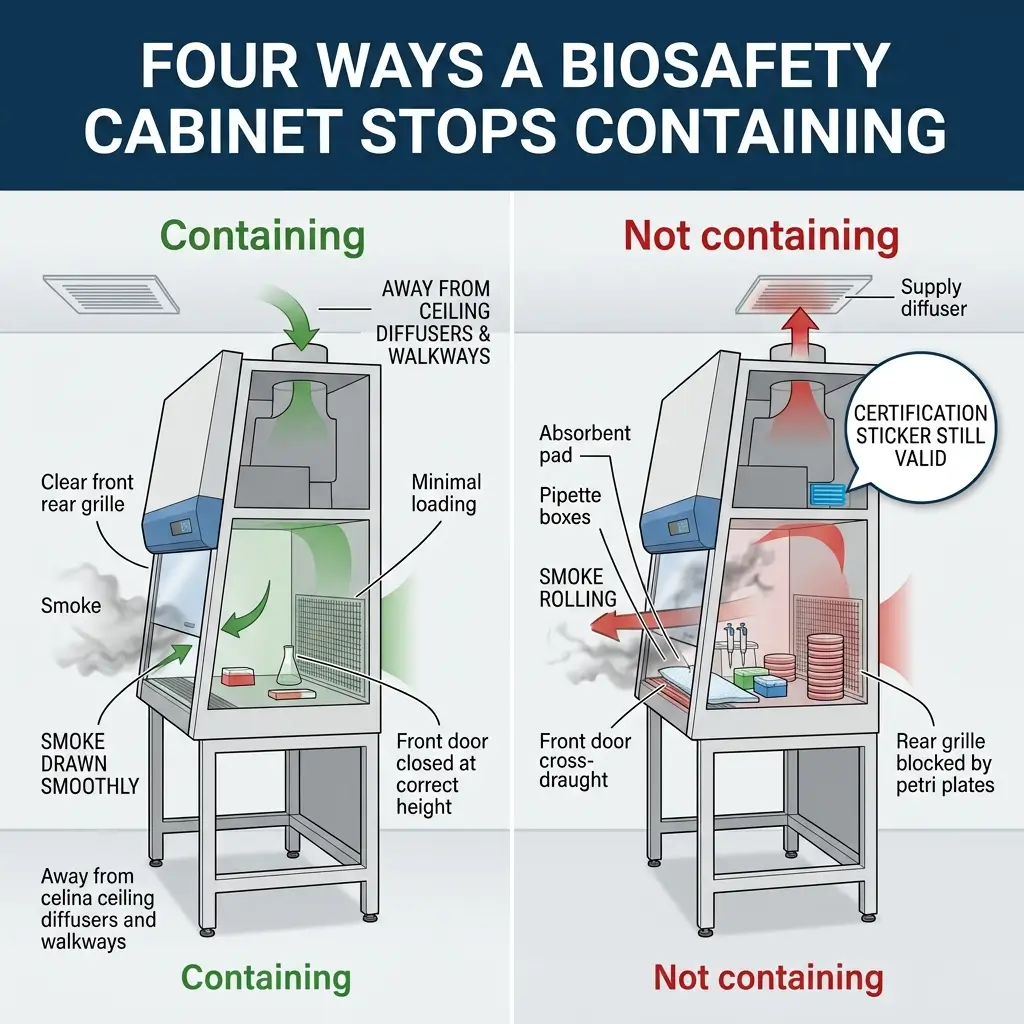
The certification sticker records one day, not today
An annual field certification tells you the cabinet met its performance envelope on the date the certifier tested it. Twelve months is a long time in a working laboratory. Filters load. Fans drift. Someone reroutes a duct during a refit and nobody tells the biosafety officer.
The check I would want any BSL-2 laboratory to be able to answer is not "when was it certified?" but "how do you know it is containing this morning?" A cabinet with a working, calibrated airflow alarm and a documented daily check answers that question. A sticker does not.
Some accreditation regimes require more frequent certification than the annual minimum — animal facilities and accredited clinical laboratories among them — so the annual figure is a floor set by the standard, not a ceiling set by your obligations.
Loading the cabinet destroys the airflow that protects the operator
This is the failure I find most often in ventilated enclosures of any kind, and it is entirely a work-practice problem.
The inward air curtain at the front of a Class II cabinet is a delicate thing. Blocking the front or rear grilles with absorbent pads, pipette boxes, waste bags or stacked plates disrupts it. So does rapid arm movement in and out through the opening, and so does an open laboratory door creating a cross-draught that the cabinet was never designed to fight. The cabinet keeps running. The display keeps showing a number. The containment is degraded and nothing announces it.
The diagnostic here is cheap: a smoke test at the working plane, with the cabinet loaded the way it is loaded in real work, not empty the way a certifier finds it. If smoke rolls out of the opening or stagnates at the back of the work zone, you have your answer in ten seconds and you did not need a report to get it.
The cabinet is verified as an island, and it is not one
Certification tests the cabinet. Containment depends on the cabinet and the room it sits in. Placing a cabinet opposite a door, adjacent to a supply diffuser, in a walkway, or next to a second cabinet whose exhaust it re-entrains will produce disturbance that a standalone test simply does not see.
When I assess a capture problem, the first thing I do is stop looking at the enclosure and look at what is happening around it. The number of times the enclosure was the actual fault is far smaller than the number of times a door, a diffuser or a person walking past was.
Sealed containment is assumed rather than demonstrated
Centrifugation is the classic aerosol-generating step at BSL-2, and the control is a sealed rotor or safety cup loaded and unloaded inside the cabinet. The gaskets on those cups perish. They get cleaned with the wrong agent, they crack, and they are almost never on an inspection schedule.
If you are auditing a BSL-2 laboratory, ask to see a safety cup gasket and ask who last inspected it. The pause before the answer is usually the finding.
Taken together, the four patterns above give a short diagnostic list you can work through at any cabinet:
- Currency — is there evidence of containment today, not evidence of certification last year?
- Loading — does the cabinet still contain when loaded the way it is actually used?
- Surroundings — what does the door, the diffuser or a passing colleague do to the air curtain?
- Sealed devices — who inspects the rotor and safety cup gaskets, and when did they last do it?
⚠️ Safety critical: Airflow alarms are only protective if someone knows what the alarm means and has the authority to stop work. An alarm that staff have learned to silence is worse than no alarm, because it has replaced vigilance with a false assurance.
Training, competence and health surveillance at BSL-2
Competence at BSL-2 is a defined requirement rather than a general expectation, and the paperwork trail differs sharply between jurisdictions. This is the layer most likely to be thin in a laboratory that grew into BSL-2 work rather than being commissioned for it.
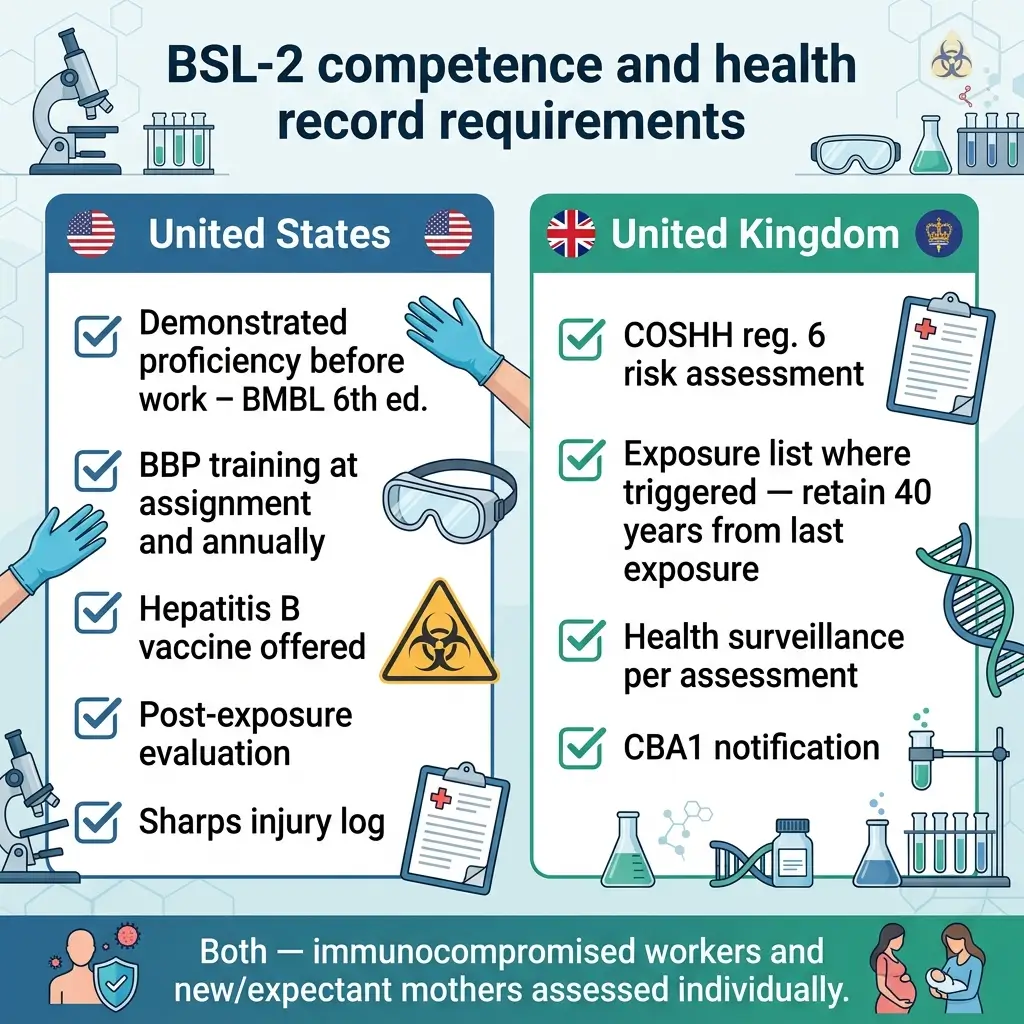
Under the BMBL sixth edition, the laboratory supervisor must ensure personnel demonstrate proficiency in standard and special microbiological practices before working at this level. Delivering a training course does not discharge that duty. Someone has to observe the work and record that it was done correctly, which means an assessor who knows what correct looks like.
Where OSHA's Bloodborne Pathogens standard applies, its training requirements are enforceable and specific — training at initial assignment and at least annually thereafter, with records retained. The standard also requires the employer to make the hepatitis B vaccination series available to employees with occupational exposure, and to provide post-exposure evaluation and follow-up after an exposure incident.
UK laboratories carry a different documentary burden. COSHH requires a list of workers exposed to certain biological agents, and where that duty is triggered the retention period is long — 40 years from the last known exposure for the higher hazard groups. Health surveillance requirements come out of the regulation 6 risk assessment rather than from the containment level itself.
Two groups need specific attention in the risk assessment, and both are routinely omitted:
- Workers with reduced or compromised immunity, including those on immunosuppressive medication, for whom the consequences of an exposure differ materially from the assumed healthy adult
- New and expectant mothers, whose infection risks HSE addresses in separate guidance and which the agent classification alone does not cover
Neither of these is captured by an agent's hazard group. The classification describes the organism's inherent hazard; it says nothing about who is standing in front of it.
BSL-2 compared with BSL-1, BSL-3 and "BSL-2+"
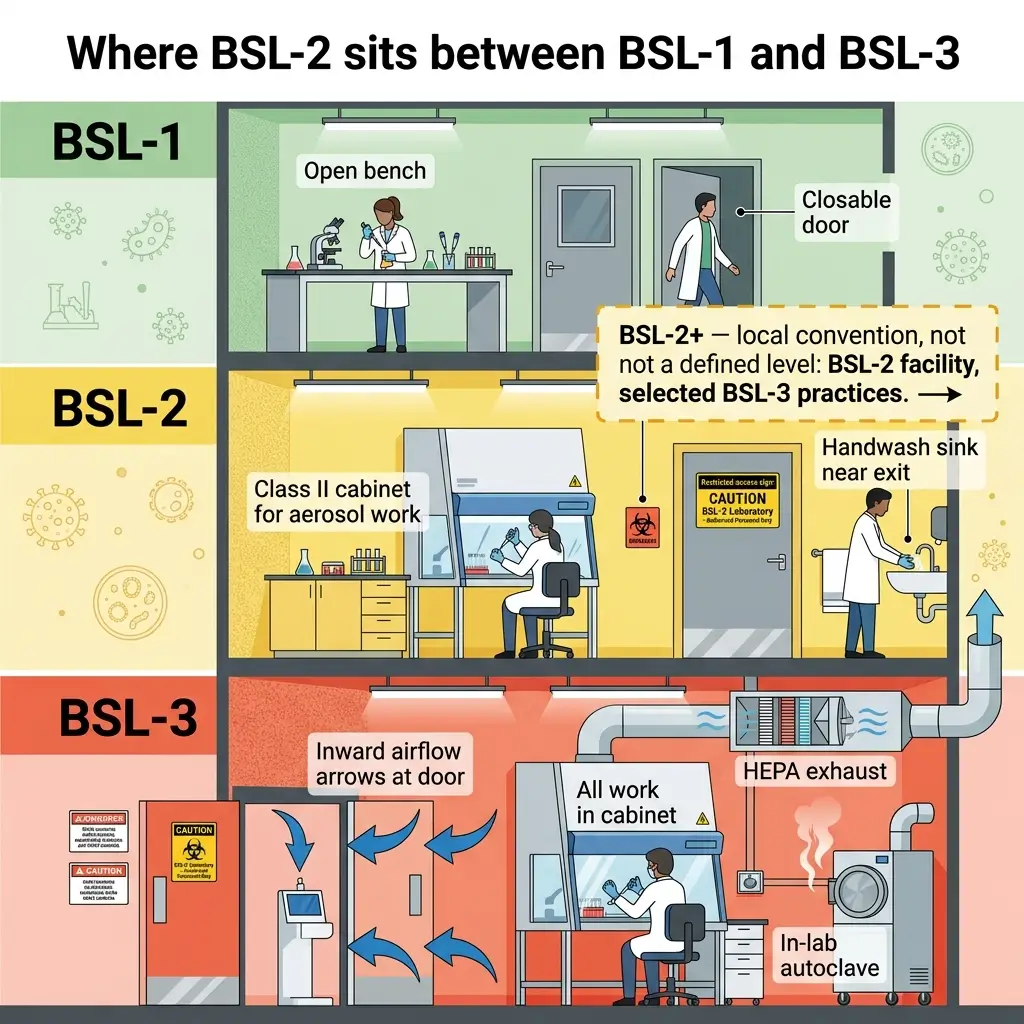
Placing BSL-2 against the levels either side of it clarifies what the tier is actually for, and exposes the one term in common use that has no official standing at all.
| BSL-1 | BSL-2 | BSL-3 | |
|---|---|---|---|
| Agents | Not known to consistently cause disease in healthy adults | Associated with human disease; moderate hazard | May cause serious or lethal disease by inhalation |
| Main exposure route addressed | Minimal | Percutaneous, mucous membrane, ingestion | Inhalation of infectious aerosol |
| Access | Door that closes | Restricted while work in progress | Controlled, with entry procedures |
| Primary containment | Open bench acceptable | BSC for aerosol- or splash-generating work | BSC for all handling of infectious material |
| Room airflow | None specified | None specified | Sustained directional inward airflow |
| Autoclave | Available | Available | Within the laboratory, ideally pass-through |
| UK equivalent | Containment Level 1 | Containment Level 2 | Containment Level 3 |
Source: CDC/NIH BMBL 6th Edition, Sections III–IV; COSHH 2002 Schedule 3.
BSL-2+ is a local convention, not a defined level
You will encounter "BSL-2+" or "BSL-2 with enhanced practices" in institutional biosafety manuals. It is not a level defined in the BMBL. It is a locally agreed package in which BSL-2 facilities are operated with selected BSL-3 practices — typically all work with biological material performed inside containment barriers as standard, rather than only aerosol-generating steps.
Institutions apply it to work with agents such as HIV, HBV and HCV, to patient samples that may contain them, to work carried out under a federal or state permit, and to emerging agents where the biosafety officer and IBC chair judge standard BSL-2 insufficient. Because the designation is local, its content varies between institutions, and a BSL-2+ approval at one university does not describe the same controls as a BSL-2+ approval at another.
If you are writing or reviewing a BSL-2+ approval, the useful question is which specific enhancements are being applied and against which assessed risk — not what the label is called.
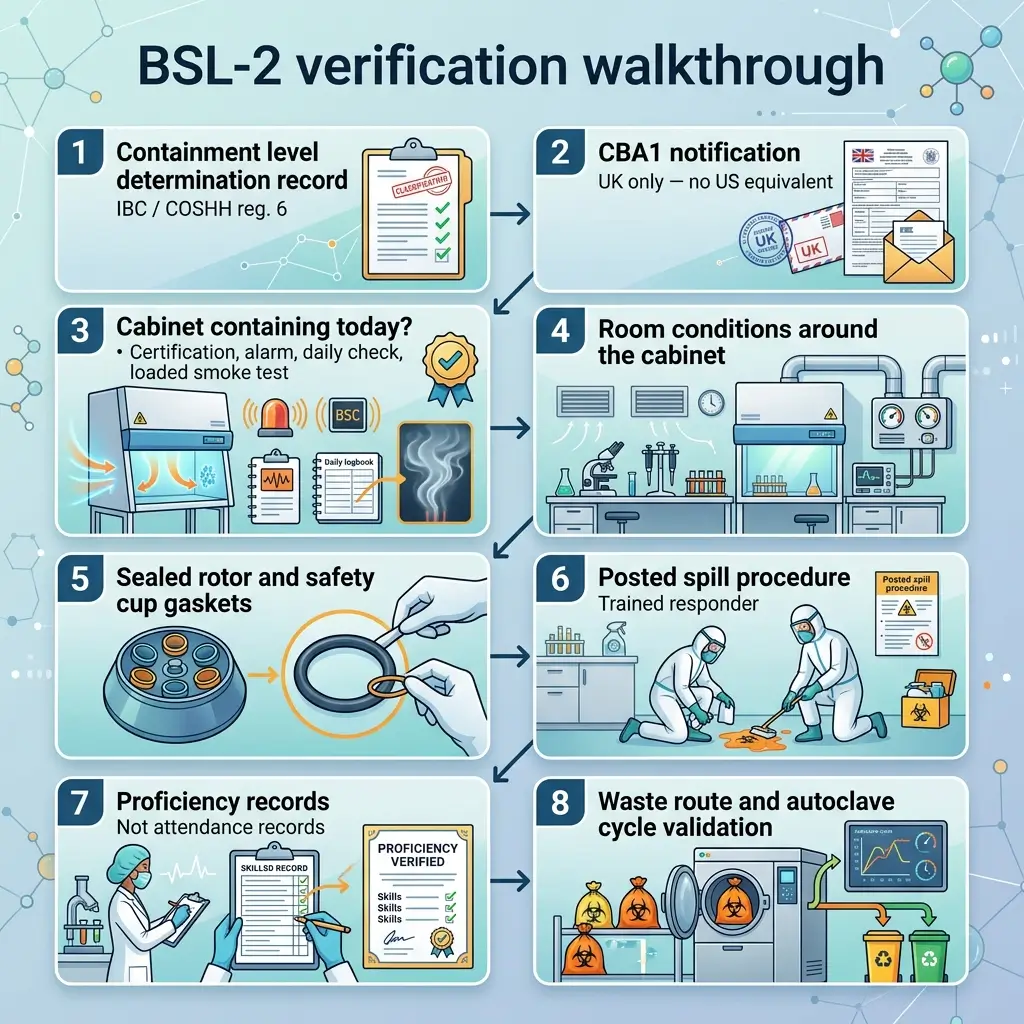
Verifying a BSL-2 laboratory: what to check on the floor
Commissioning documents describe the laboratory as designed. This section is about the laboratory as operated, which is a different thing and the only one that protects anybody. The checks below take a couple of hours and need no instrumentation beyond a smoke source.
Work through them in this order, because each one sets up the next:
Frequently asked questions
These are the questions that come up most often when a laboratory is moving into BSL-2 work, or when someone is reading American guidance in a British building.
What is the difference between BSL-2 and Biosafety Level 2?
They are the same thing — BSL-2 is simply the abbreviation. The term comes from the CDC and NIH manual Biosafety in Microbiological and Biomedical Laboratories. The UK and EU equivalent is called Containment Level 2 and is set out in COSHH Schedule 3 rather than in guidance.
What agents are handled at BSL-2?
Agents associated with human disease that pose a moderate hazard, transmitted mainly by contact, ingestion or percutaneous injury rather than by inhalation. Hepatitis B virus, HIV, the salmonellae and Toxoplasma species are standard examples. Unscreened human blood, tissue and primary human cell lines are also handled at this level.
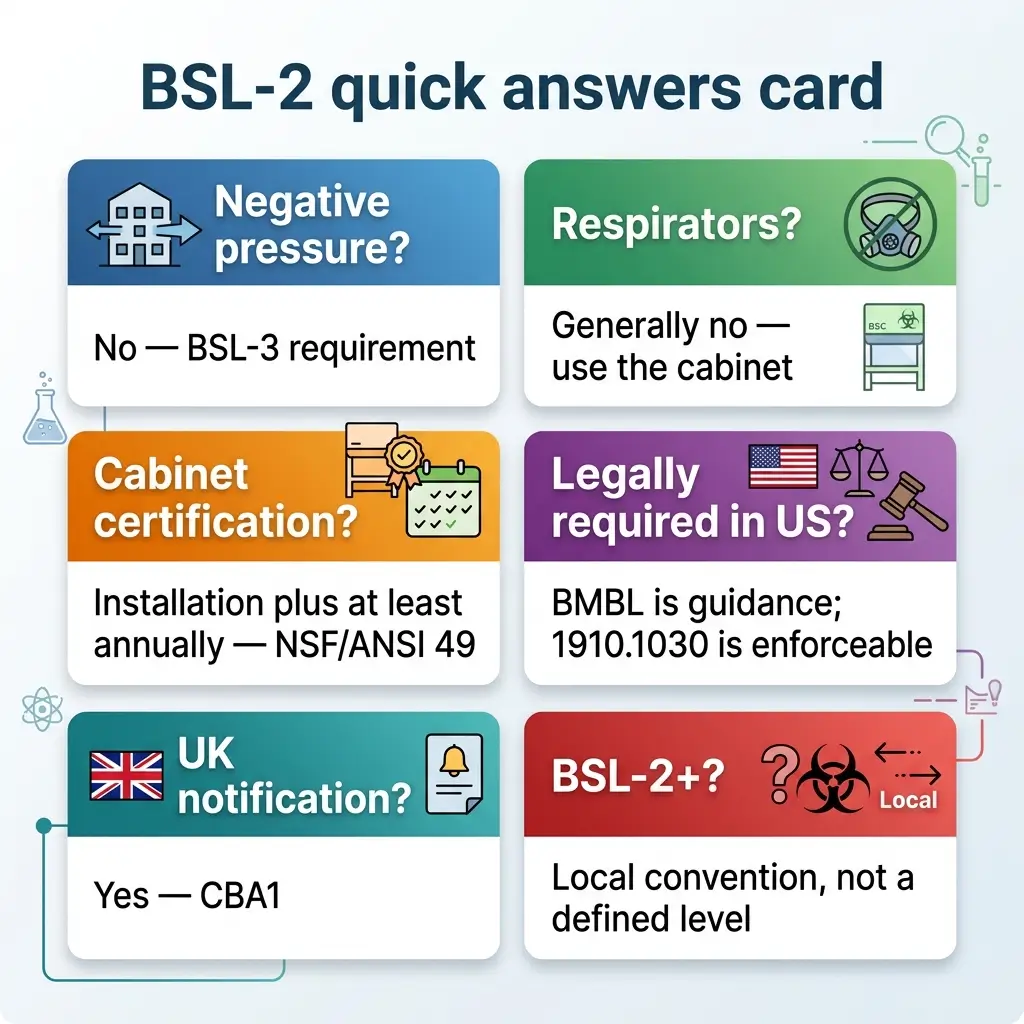
Does a BSL-2 lab need negative air pressure?
No. Sustained directional inward airflow is a BSL-3 requirement, not a BSL-2 one. Under COSHH, a Containment Level 3 laboratory must be held at negative pressure to atmosphere with HEPA-filtered extract. At BSL-2, primary containment does that work, which is why cabinet performance matters so much.
How often must a biosafety cabinet be certified?
NSF/ANSI 49 field certification is performed at installation and at least annually thereafter by an accredited technician. Some accreditors and institutional programmes require more frequent testing. European laboratories certify to EN 12469 instead. Annual certification is a minimum, not evidence of containment on any given day.
Is BSL-2 legally required in the United States?
Not directly. The BMBL is guidance. What is enforceable is OSHA's Bloodborne Pathogens standard, 29 CFR 1910.1030, for work with human blood and other potentially infectious materials, and the NIH Guidelines for federally funded recombinant nucleic acid research.
What does BSL-2+ mean?
It is a local institutional convention, not a level defined in the BMBL. It describes a BSL-2 facility operated with selected BSL-3 practices — usually performing all work with biological material inside containment barriers. Because it is defined locally, its content differs between institutions.
Do BSL-2 workers need respirators?
Generally no. BSL-2 addresses contact and splash exposure, and aerosol-generating work is controlled by performing it inside a biosafety cabinet. Where a risk assessment does identify a respirator requirement, it brings a full programme with it: face-fit testing, medical clearance, maintenance and records.
Key points
BSL-2 is the containment package for work with agents that cause human disease by contact, ingestion or injury rather than by inhaled aerosol. It is assigned to the procedure, not to the organism and not to the room.
Its legal weight depends on where you are. In the United States it is guidance, with enforcement running through OSHA's Bloodborne Pathogens standard and the NIH Guidelines. In the UK and EU the equivalent Containment Level 2 is statutory, and UK work with Hazard Group 2 agents carries a notification duty that has no American counterpart. Internationally, WHO has already moved past the prescriptive tier model toward risk-assessed core requirements.
The layer that fails is the biosafety cabinet, and it fails quietly. Certification records a day; containment is a condition. If you take one action from this article, make it the loaded smoke test — done in the laboratory's normal working configuration, with the door open and people moving, at the time the work is normally done.
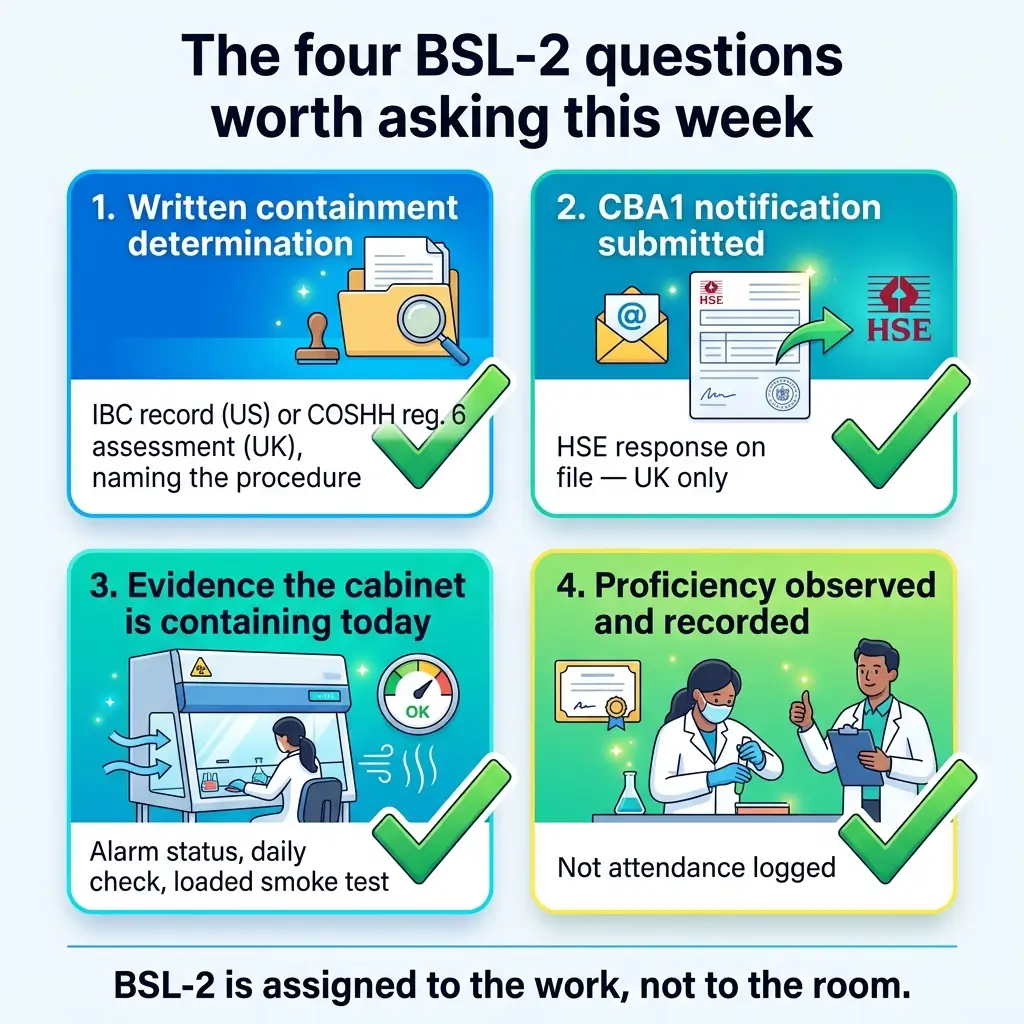
If you are responsible for a BSL-2 laboratory, these are the four things worth confirming this week:
- The written determination exists — an IBC record in the US, a COSHH regulation 6 assessment in the UK, naming the procedure rather than only the organism
- The notification position is settled for UK Hazard Group 2 work, with the CBA1 submission and HSE's response on file
- Someone can answer "how do you know the cabinet is containing today" without pointing at a certification sticker
- Proficiency was observed and recorded, not just delivered as a training course
Where a determination of containment level, a cabinet certification, or a health surveillance requirement is in question, that judgement belongs with a qualified biosafety professional and, in the UK, with your institution's biological safety officer. This article will help you ask the right questions; it does not substitute for that assessment.
About the author — Sophia Bennett Sophia Bennett is a British Occupational Hygiene & Exposure Control Consultant with 16 years of continuous field experience across 14 countries, specialising in verifying that ventilated containment and respiratory protection actually work where the work happens. Her containment background includes local exhaust ventilation capture verification with HSL Buxton Partners, laboratory sampling with Ansell Protective Solutions, respirator programme work with Dräger Safety Hygiene, and PPE fit assurance with DuPont Personal Protection. She leads Bennett Occupational Hygiene Partners in Manchester, United Kingdom.
.
Sources and further reading
- Biosafety in Microbiological and Biomedical Laboratories, 6th Edition — CDC and NIH; Section IV covers BSL-2
- 29 CFR 1910.1030 — Bloodborne pathogens — OSHA
- Bloodborne Pathogens — general guidance — OSHA
- Safe deliberate work with biological agents — HSE
- COSHH Regulations 2002, Schedule 3 — legislation.gov.uk
- The Approved List of Biological Agents — HSE and ACDP
- Management and operation of microbiological containment laboratories — HSE
- Laboratory Biosafety Manual, 4th Edition — World Health Organization
- Laboratory biosafety guidelines for working with SARS-CoV-2 — CDC
- LBM4 monograph: Biological safety cabinets and other primary containment devices — World Health Organization
- Biosafety cabinetry certification, NSF/ANSI 49 — NSF International