
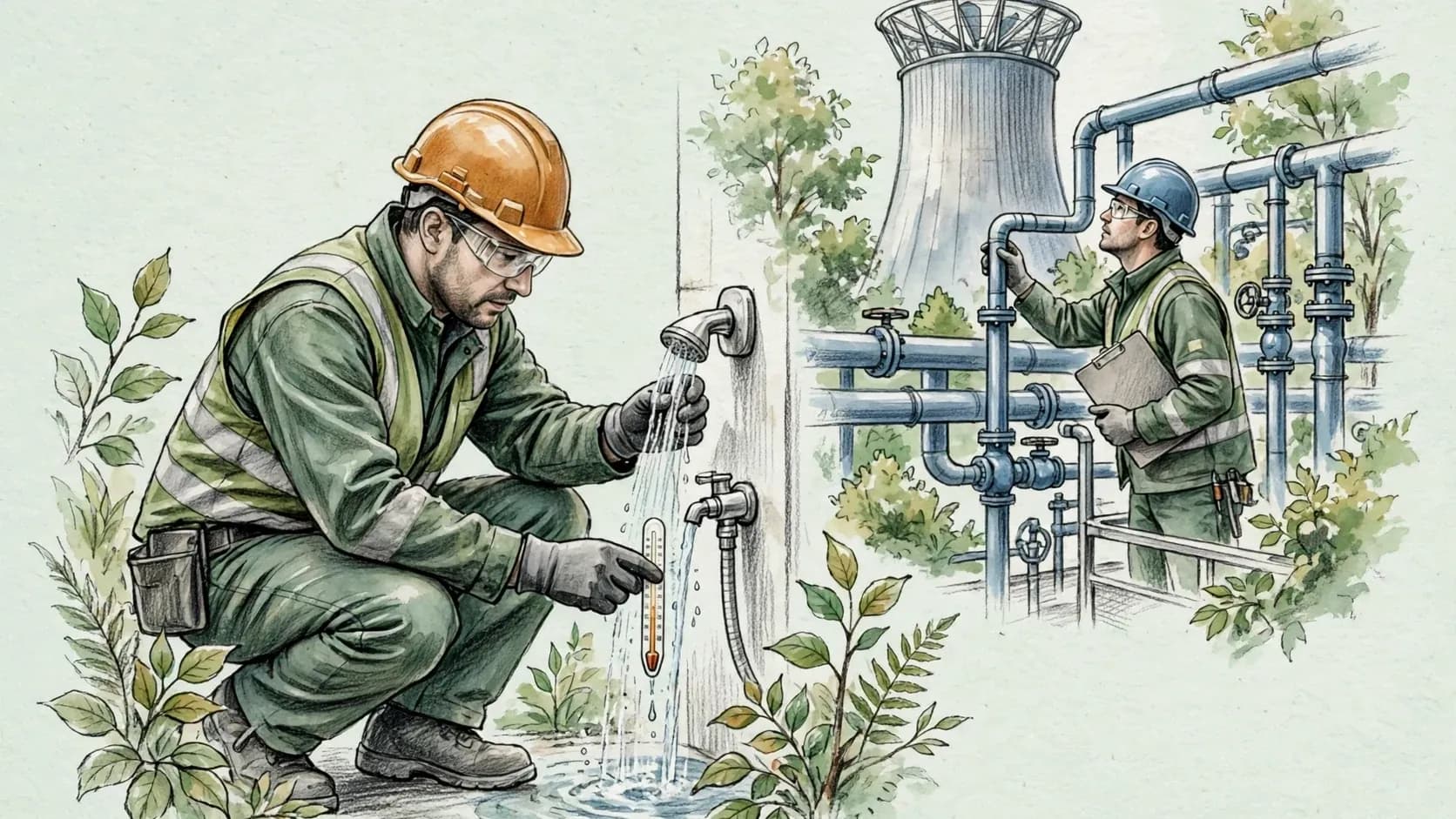
Legionnaires' disease is a potentially fatal pneumonia caused by breathing in tiny droplets of water that contain Legionella bacteria. You cannot catch it from another person, and you cannot catch it by drinking contaminated water. You catch it only by inhaling an aerosol — a fine mist from a shower, a tap, a cooling tower or a spa pool — that carries the bacteria into the lungs.
In the UK, the duty sits with the employer or the person in control of the premises: assess the risk, appoint a responsible person, write a scheme of control, run it, keep records, and review it. What follows covers where the risk lives, who is most at risk, what the law requires, and how prevention works in practice.
What Legionnaires' disease is#
Legionella bacteria are widespread in natural water — rivers, lakes and reservoirs — where they live at low levels and rarely cause harm. The problem starts in man-made water systems. Where water is stored, warmed and left still, the bacteria can multiply to dangerous levels. Where that water is turned into a mist, people can breathe it in. The disease that follows is a form of pneumonia, an infection of the lungs.
The same bacteria can also cause Pontiac fever, a milder flu-like illness without pneumonia.
Legionnaires' disease takes its name from an outbreak of pneumonia at an American Legion convention in Philadelphia in 1976, which caused 34 deaths. Investigators traced the cause to the hotel's cooling tower, and the bacterium was later named Legionella pneumophila. The name is a reminder of how the risk works: a building's water system, not a sick person, is the source. Legionella is a biological hazard.
Like other biological hazards it is controlled by managing the source, not by isolating people.
Three facts shape everything that follows. First, infection needs an aerosol: droplets small enough to be inhaled deep into the lungs. Drinking water that contains legionella does not cause the disease, because the bacteria must reach the lungs, not the stomach. Second, the bacteria need warmth, still water and nutrients — scale, sediment, biofilm and the amoebae that live in them all feed growth.
Third, anyone can develop the disease, but some people are far more vulnerable than others.
Where the risk lives at work#
Any workplace with a water system has some risk. The risk is reasonably foreseeable — and therefore must be managed — wherever water is stored, warmed and turned into a spray. The systems HSE's Approved Code of Practice L8 names are cooling systems, hot and cold water systems, spa pools and other plant that holds water.
In practice, that covers cooling towers and evaporative condensers, hot water cylinders and calorifiers, cold water storage tanks, showers and taps, spa pools and hot tubs, humidifiers, and decorative fountains.
The conditions that let legionella multiply are specific, and they are the reason the control measures are what they are:
- Temperature between 20°C and 45°C. This is the growth zone. Water held in this range for long enough lets the bacteria multiply. Below 20°C they are dormant; above 60°C they do not survive.
- Stagnant water. Dead legs and dead ends in pipework, little-used outlets, and tanks that hold water for days all create still water where bacteria can grow undisturbed.
- Nutrients. Scale, sediment, rust and biofilm — the slimy layer that forms on wet surfaces — all provide food. Amoebae in the water can also harbour the bacteria and protect them from disinfectants.
- Aerosols. Showers, taps, spray nozzles, cooling towers and spa pools all create the fine droplets that carry the bacteria into the lungs.
Some buildings carry more risk than others. Large multi-storey buildings with complex water systems and centralised hot water — hospitals, hotels and office buildings — are more at risk, as are any premises with cooling towers, decorative fountains or hot tubs. The more complex the system, the more places there are for water to sit still and warm up. The more outlets there are to monitor.
Risk is highest after a system has been out of use. A building closed for a holiday, a floor left empty, a shower in a room nobody uses — all of these let water sit still and warm up into the growth zone. Reopening a building after a shutdown is one of the most dangerous moments.
It is why flushing and temperature checks before reuse matter so much. Building safety checks after a closure should include the water system, alongside air and asbestos checks.
Who is most at risk#
Anyone can develop Legionnaires' disease. HSE identifies the people at more risk as the elderly, smokers, people who drink heavily, and people with cancer, diabetes or chronic respiratory or kidney disease. OSHA adds people with weakened immune systems, including transplant patients and people on dialysis. The pattern is consistent: the disease most often attacks people whose lungs or immune systems are already compromised. People over 45 are more vulnerable than younger adults.
Exposure is a separate question from vulnerability. The people most likely to be exposed at work are those whose job puts them on or near the water systems: cooling tower maintenance staff, plumbers and pipefitters, spa and hot tub attendants, and healthcare workers who use showers and hydrotherapy equipment.
That is why the RIDDOR reporting rule turns on the employee's job — whether it involves work on or near cooling systems, or on water systems likely to be a source of contamination.
That matters for how you assess the risk. A care home, hospital or hotel has residents and guests who are more likely to be in a high-risk group. The same water system carries a higher risk there than in an office of healthy young adults. HSE's guidance for hot and cold water systems asks for an assessment of whether residents are immuno-compromised and consequently in the "at risk" group, and for sampling where they are.
When you identify who is at risk, you are deciding how much control the system needs.
Symptoms and what to do#
Symptoms usually appear 2 to 10 days after exposure. Early symptoms can look like flu: low fever, headache, aching joints and muscles, fatigue and loss of appetite. Later symptoms are more serious: high fever, a cough that starts dry and later produces phlegm, difficulty breathing, chills, chest pain, and stomach symptoms such as vomiting, diarrhoea, nausea and abdominal pain.
Legionnaires' disease is treated with antibiotics, and early treatment matters. If you think you have it, contact a doctor as soon as possible, and say that you may have been exposed to legionella — for example, that you work on or near a cooling tower or water system, or that you have recently used a shower, spa pool or cooling system.
If the diagnosis is confirmed, the doctor must notify the UK Health Security Agency, because Legionnaires' disease is a notifiable disease in the UK.
For an employer, a case has legal consequences. Under the Reporting of Injuries, Diseases and Dangerous Occurrences Regulations 2013 (RIDDOR), a case of legionellosis must be reported to HSE when two things are both true:
- A doctor has notified the employer of the diagnosis.
- The employee's current job involves work on or near cooling systems at work, or on water systems likely to be a source of contamination.
A positive water sample on its own is not a RIDDOR report — RIDDOR is about people who are ill, not about water results. If a case is linked to your building, review the risk assessment at once and clean and disinfect the system.
The UK legal duty#
There is no single "legionella law". The duty comes from several pieces of legislation, and HSE's Approved Code of Practice L8 explains how to meet it.
- Health and Safety at Work etc. Act 1974. The general duty to ensure, so far as is reasonably practicable, the health, safety and welfare of employees and others affected by the work.
- Control of Substances Hazardous to Health Regulations 2002 (COSHH). Legionella is a hazardous biological agent under COSHH, so the duty to assess the risk and prevent or control exposure applies. HSE's guidance asks for a full COSHH risk assessment of hot and cold water systems.
- Management of Health and Safety at Work Regulations 1999. The duty to carry out a suitable and sufficient risk assessment, and to record its significant findings where five or more people are employed.
- Approved Code of Practice L8 (fourth edition, 2013), Legionnaires' disease: The control of legionella bacteria in water systems. L8 is not legislation, but it has special legal status: if you are prosecuted and you did not follow it, you must show you complied with the law in some other way. The technical detail sits in HSG274, split into three parts — Part 1 covers evaporative cooling systems, Part 2 covers hot and cold water systems, and Part 3 covers other risk systems.
- Notification of Cooling Towers and Evaporative Condensers Regulations 1992. If you have a cooling tower or evaporative condenser on site, you must notify your local authority in writing, with details of where it is located.
The United States takes a different route. OSHA has no specific legionella standard. Its guidance sits in the OSHA Technical Manual and the general duty clause, with temperature figures that match the UK ones — store hot water at 140°F (60°C), deliver it at a minimum of 50°C (122°F), keep cold water below 68°F (20°C) — and a requirement to clean and disinfect cooling towers at least twice a year.
The CDC publishes guidance for building owners and for healthcare facilities. If your organisation operates in both countries, follow the UK rules in the UK and the OSHA and CDC guidance in the US. A US search market does not establish US jurisdiction.
The six steps L8 expects#
L8 sets out six things a duty holder must do. They are a sequence, not a menu: each one depends on the one before it.
1. Carry out a risk assessment#
A competent person assesses the water systems to find where legionella could grow and spread, who is at risk, and what controls are needed. The assessment should identify the sources of risk, the people at risk, and the means by which exposure is to be prevented or controlled. Where five or more people are employed, the significant findings must be recorded.
2. Appoint a responsible person#
Name a person — the responsible person — with the authority and competence to manage the risk day to day. In a larger organisation, a deputy helps, and the appointment should be written down so there is no doubt about who is accountable.
3. Prepare a written scheme of control#
Write down, for your site, what is to be done, when, and by whom: the temperature limits, the flushing and cleaning routine, the monitoring checks, the sampling plan. What happens when a result falls outside its limits. The scheme is the document the responsible person actually uses, not a generic template filed away.
4. Implement the scheme#
Carry out the checks on schedule and act on the results. An out-of-specification temperature or a positive sample is not a filing exercise — it is a trigger to fix the cause, disinfect where needed, and test again.
5. Keep records#
Record who is responsible, the significant findings of the risk assessment, the written scheme and how it is carried out, whether each system is in use, and the result and date of every check. Keep the results of monitoring, inspections, tests and checks for at least five years. Keep the risk assessment and the written scheme while they are current, and for at least two years after they are replaced.
6. Review and monitor#
Review the assessment regularly, and at once when there is reason to think it is no longer valid — for example, after changes to the pipework or to how the building is used, after a failed check, or after a case linked to the building. The current (fourth) edition of L8 sets no fixed legal interval for review; the two-year review period in the earlier edition was dropped.
A review every two years is a common working rule for lower-risk premises. It is a working rule, not a legal duty — the assessment should record when it is next due and what would bring that forward.
Temperature control in practice#
Temperature control is the primary method HSE recommends for controlling legionella, because it works on the biology: keep the water too hot or too cold for the bacteria to multiply, and keep it moving so it cannot sit still in the growth zone.
| Measure | Figure | What it means |
|---|---|---|
| Growth zone | 20°C to 45°C | Legionella multiply in water held in this range |
| Dormant | Below 20°C | Bacteria stop multiplying but are not killed |
| Killed | Above 60°C | Bacteria do not survive |
| Hot water storage | 60°C or higher | Calorifiers and cylinders store water at 60°C or more |
| Hot water at outlets | 50°C or higher within 1 minute | Measured at sentinel outlets after running the tap |
| Cold water | Below 20°C | Stored and distributed below 20°C; below 20°C within 2 minutes at sentinel taps |
Warning
Water stored at 60°C can scald. Where a scald risk is identified, fit thermostatic mixer valves (TMVs) as close as possible to the outlets, so the water reaching the user is safe while the stored water stays hot enough to kill legionella. Pipe runs downstream of a TMV should not exceed 2 metres.
Temperature is only useful if it is checked. HSE's guidance asks for monthly checks at sentinel outlets — the outlets furthest from and closest to each tank or cylinder — and for the hot water storage cylinder temperature to be checked every month, with cold water tank temperatures checked at least every six months. Record the findings each time, and check the record annually.
Representative outlets should be checked on a rotational basis so the whole system is covered over time.
Flushing and cleaning are the other half of the routine. Stagnant water favours legionella growth, so remove dead legs and dead ends from the system, flush infrequently used outlets — including showerheads and taps — at least weekly, and clean and descale showerheads and hoses at least quarterly. Cold water storage tanks should be cleaned periodically, and hot water cylinders drained to check for debris or signs of corrosion.
Keep pipe runs as short and direct as possible, insulate pipes and tanks, and fit tanks with tight lids and insect screens.
Warning
Flushing can create the very aerosols that carry legionella. Flush through and purge to drain, without releasing aerosols into the air, and do it in a well-ventilated space. Anyone flushing a little-used outlet should not stand in the spray.
Cooling towers need their own routine. OSHA's guidance is to:
- Clean and disinfect cooling towers at least twice a year
- Use biocides periodically to control bacterial growth
- Inspect the system regularly to prevent scale, sediment and bio-fouling
Water samples should be taken from appropriate outlets, storage tanks and cylinders, and analysed for legionella by an accredited competent company, periodically, to show that bacteria counts are acceptable, with the frequency set by the level of risk in the assessment. Other control methods — copper and silver ionisation, and biocide treatments such as chlorine dioxide — should be assessed as part of the overall water treatment programme, with proper installation, maintenance and monitoring.
What to do if legionella is found or someone falls ill#
A positive water sample is a warning, not a diagnosis. HSE guidance sets action levels in colony-forming units per litre (cfu/l). A result above 100 cfu/l should prompt a resample to check the first result, a review of the risk assessment and controls, and action to fix the cause — then disinfection where needed and a further test to confirm the system is back under control.
Do not wait for a higher result before acting; the point of the action levels is to catch growth early.
If someone falls ill, the order is: care first, then reporting, then the system.
- The person should seek medical care promptly and say they may have been exposed to legionella.
- The doctor notifies the UK Health Security Agency.
- If the doctor also notifies the employer and the employee's job involves work on or near cooling systems or on water systems likely to be contaminated, the employer reports the case to HSE under RIDDOR.
- Then review the risk assessment at once and clean and disinfect the system.
- Where cases are linked to a building, an outbreak control team investigates, and HSE or the local authority may visit.
Checklist for employers and duty holders#
Work through this list against your own site. Every item should have a named person, a date, and a record.
- Identify every water system on site — cooling towers, hot and cold water, spa pools, humidifiers, fountains — and who is responsible for each.
- Have a competent person carry out a legionella risk assessment, and record its significant findings.
- Appoint a named responsible person, in writing, with a deputy where the site needs one.
- Prepare a written scheme of control for the site, with temperature limits, flushing and cleaning routines, monitoring checks and action levels.
- Store hot water at 60°C or higher, and check that it reaches 50°C or higher at outlets within one minute.
- Keep cold water below 20°C, and check it at sentinel outlets monthly.
- Flush little-used outlets at least weekly, to drain and without releasing aerosols.
- Clean and descale showerheads and hoses at least quarterly.
- Remove dead legs and dead ends from pipework, and keep pipe runs short and insulated.
- Notify the local authority in writing if you have a cooling tower or evaporative condenser.
- Clean and disinfect cooling towers at least twice a year, and sample water for legionella periodically.
- Keep monitoring, inspection, test and check results for at least five years, and the risk assessment and written scheme for at least two years after they are replaced.
- Review the assessment regularly and at once after any change to the system, a failed check, or a case linked to the building.
- Make sure everyone who works on the water system knows the scheme, the warning signs, and what to do if someone falls ill.
Frequently Asked Questions#
These are the questions duty holders and workers ask most often about Legionnaires' disease and legionella control.
Can you catch Legionnaires' disease from drinking water?
No. You can only catch it by breathing in tiny droplets of water that contain legionella bacteria. Drinking contaminated water does not cause the disease, because the bacteria must reach the lungs. The risk comes from aerosols — showers, taps, cooling towers, spa pools and spray nozzles — not from the glass of water on your desk.
How long after exposure do symptoms appear?
Usually 2 to 10 days after exposure. Early symptoms can look like flu — low fever, headache, aching joints and muscles, fatigue and loss of appetite. Later symptoms include high fever, a cough, difficulty breathing, chills and chest pain. Anyone with these symptoms after exposure to a water system should seek medical care promptly and mention the possible exposure.
Is Legionnaires' disease contagious?
No. It is not passed from person to person. It has an environmental origin: only people directly exposed to a contaminated aerosol can develop it. That is why control focuses on the water system, not on isolating people.
What temperature kills legionella?
Legionella do not survive above 60°C, so hot water is stored at 60°C or higher. They multiply between 20°C and 45°C, and they are dormant below 20°C, so cold water is kept below 20°C. Hot water should reach 50°C or higher at outlets within one minute of running the tap. Where scalding is a risk, thermostatic mixer valves are fitted close to the outlet.
How often should a legionella risk assessment be reviewed?
Regularly, and at once when there is reason to think it is no longer valid — for example, after changes to the pipework or to how the building is used, after a failed check, or after a case linked to the building. The current edition of L8 sets no fixed legal interval. A review every two years is a common working rule for lower-risk premises.
It is a working rule, not a legal duty, and the assessment should record when it is next due and what would bring that forward.
Do I need to tell anyone if I have a cooling tower?
Yes. Under the Notification of Cooling Towers and Evaporative Condensers Regulations 1992, you must notify your local authority in writing if you have a cooling tower or evaporative condenser on site, with details of where it is located.
Does the US have the same rules?
No, the framework is different. OSHA has no specific legionella standard. Its guidance sits in the OSHA Technical Manual and the general duty clause, with the same temperature figures — store hot water at 140°F (60°C), deliver it at a minimum of 50°C (122°F), keep cold water below 68°F (20°C) — and cooling towers cleaned and disinfected at least twice a year. The CDC publishes guidance for building owners and for healthcare facilities.
Follow the UK rules in the UK and the OSHA and CDC guidance in the US.
What is Pontiac fever?
Pontiac fever is a milder, flu-like illness caused by the same legionella bacteria, but without pneumonia. It is less serious than Legionnaires' disease, but it is a sign that a water system is amplifying legionella and needs attention.
Sources#
- Health and Safety Executive, Legionnaires' disease: The control of legionella bacteria in water systems — Approved Code of Practice L8 (fourth edition, 2013).
- Health and Safety Executive, Legionnaires' disease: A brief guide for dutyholders (INDG458) — who is at higher risk, including people over 45.
- Health and Safety Executive, Managing legionella in hot and cold water systems — growth temperatures, temperature control, flushing, cleaning and monitoring.
- Health and Safety Executive, Hot and cold water systems — things to consider — sentinel outlet checks, TMV temperatures, quarterly showerhead descaling.
- Occupational Safety and Health Administration, Legionnaires' Disease — exposure, symptoms, temperature figures and cooling tower maintenance.
- South Oxfordshire District Council, Preventing Legionella and Legionnaires' disease — how the disease is caught, symptoms, workplace controls and UKHSA notification.
Published 20 November 2026. Reviewed 20 November 2026 against HSE L8 and OSHA guidance.
Leave a Reply