

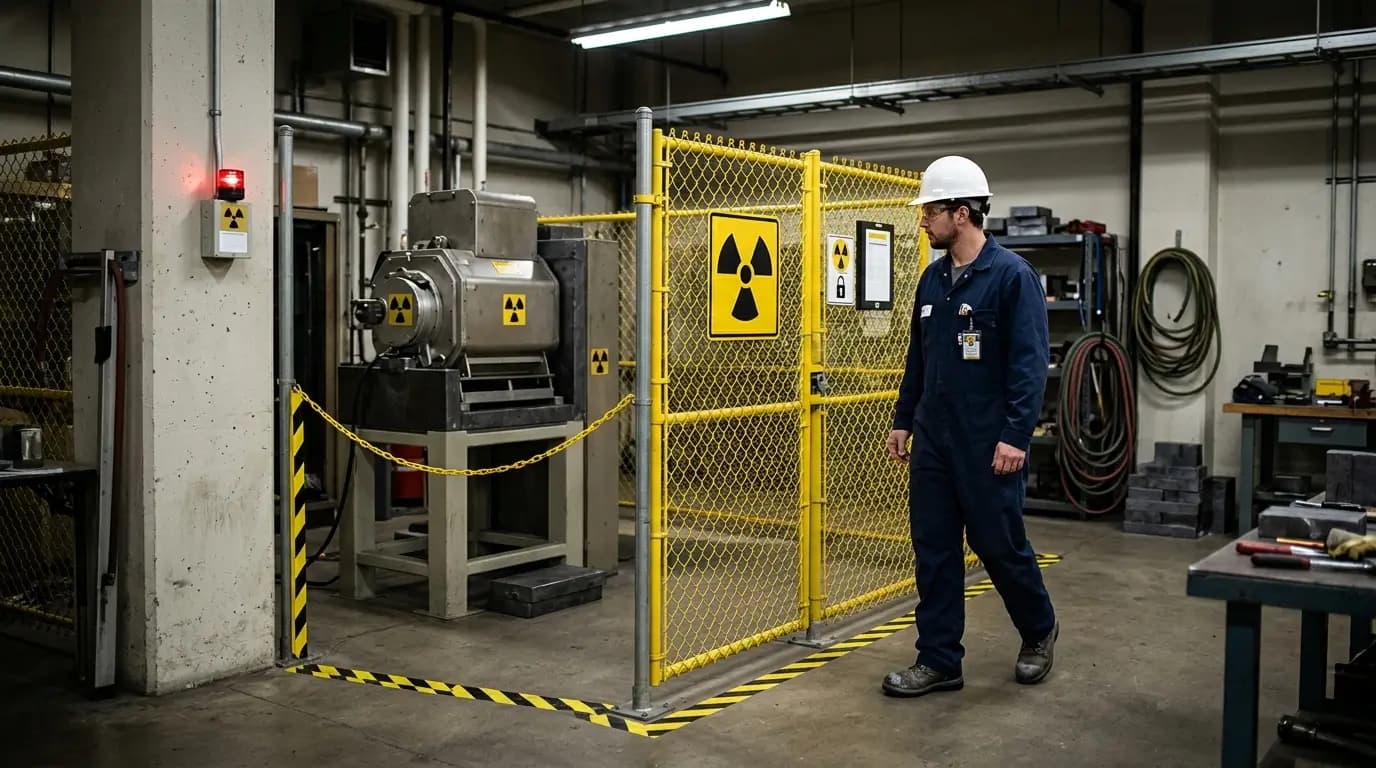
The radiation symbol does not mean "radioactive." It means ionising radiation may be present — which is a wider category, and the difference matters on a live site. An X-ray inspection cabinet on a food packing line carries a trefoil and contains no radioactive material at all; switch off the power and the hazard is gone. A gamma level gauge on a process vessel contains a sealed source that stays hazardous whether the plant runs or not.
The symbol is the same in both cases. What separates them is the wording next to it, and the dose rate that put it there.
That is the part almost every explainer skips. The trefoil is a constant. The sign is not: its required wording, its permitted colours and the threshold that triggers it all change depending on which regulator licenses the site you happen to be standing on. This article covers what the symbol means, the sign types you will meet, the numbers behind each one, and how the requirement differs across the US, the UK and the international standards.
Key takeaways
The points below carry the practical weight of the rest of this article:
- The trefoil (ISO 7010 W003) warns of ionising radiation or radioactive material. It carries no severity information — severity lives entirely in the accompanying words.
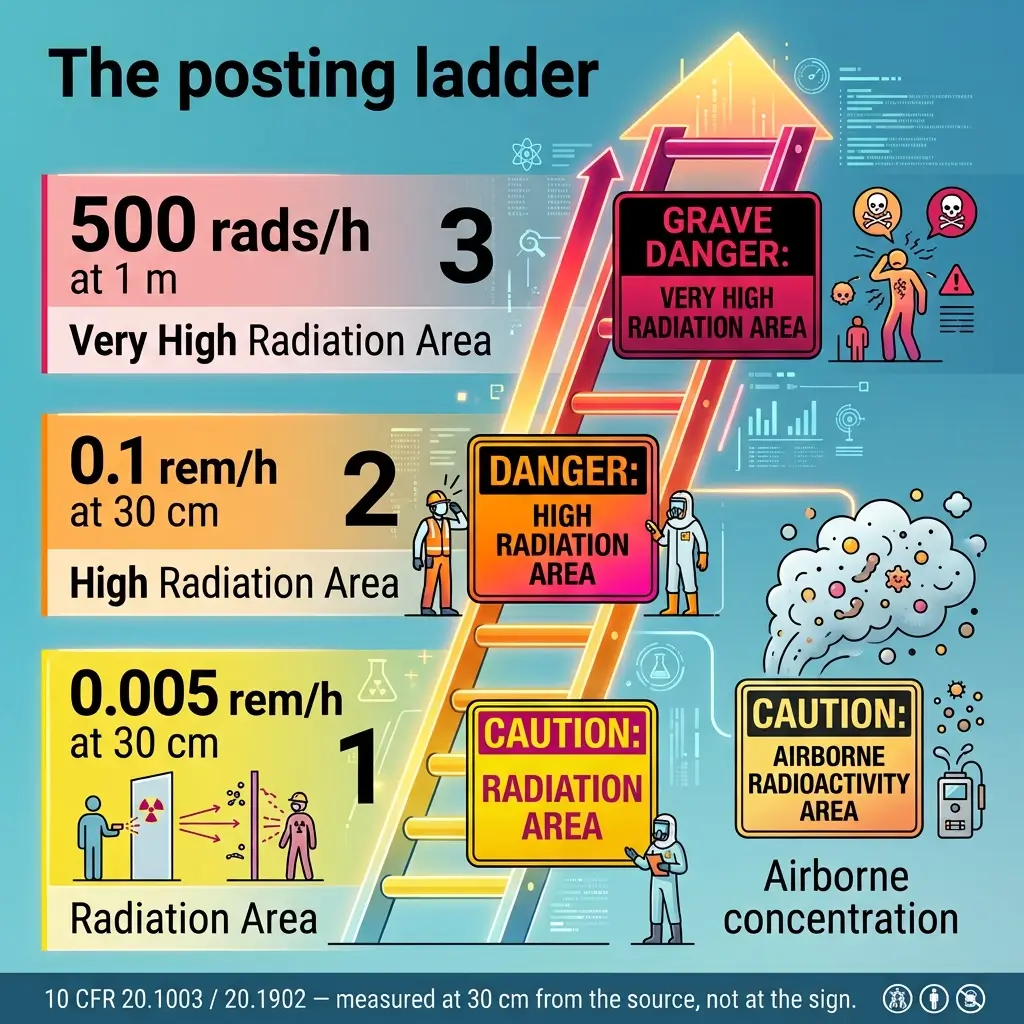
- Under NRC rules, a radiation area starts above 0.005 rem (0.05 mSv) per hour at 30 cm; a high radiation area above 0.1 rem (1 mSv) per hour at 30 cm; a very high radiation area above 500 rads (5 grays) per hour at 1 metre (10 CFR 20.1003).
- Which rulebook applies to your sign depends on your licence status. NRC licensees follow 10 CFR Part 20; Agreement State licensees follow state rules; every other US employer follows 29 CFR 1910.1096, which permits fewer colours and fewer wordings.
- The UK sets no prescribed wording at all. IRR 2017 requires "suitable and sufficient signs" that indicate the nature of the sources and the risks, and controlled areas must be physically demarcated.
- The 2007 red triangle supplementary symbol (ISO 21482) belongs on the source shield, under the device covers — never on doors, packages or containers.
- A missing sign is not automatically a breach. Both OSHA and the NRC exempt low-output sealed sources and short-duration attended work from posting.
What the radiation symbol means — and what it does not
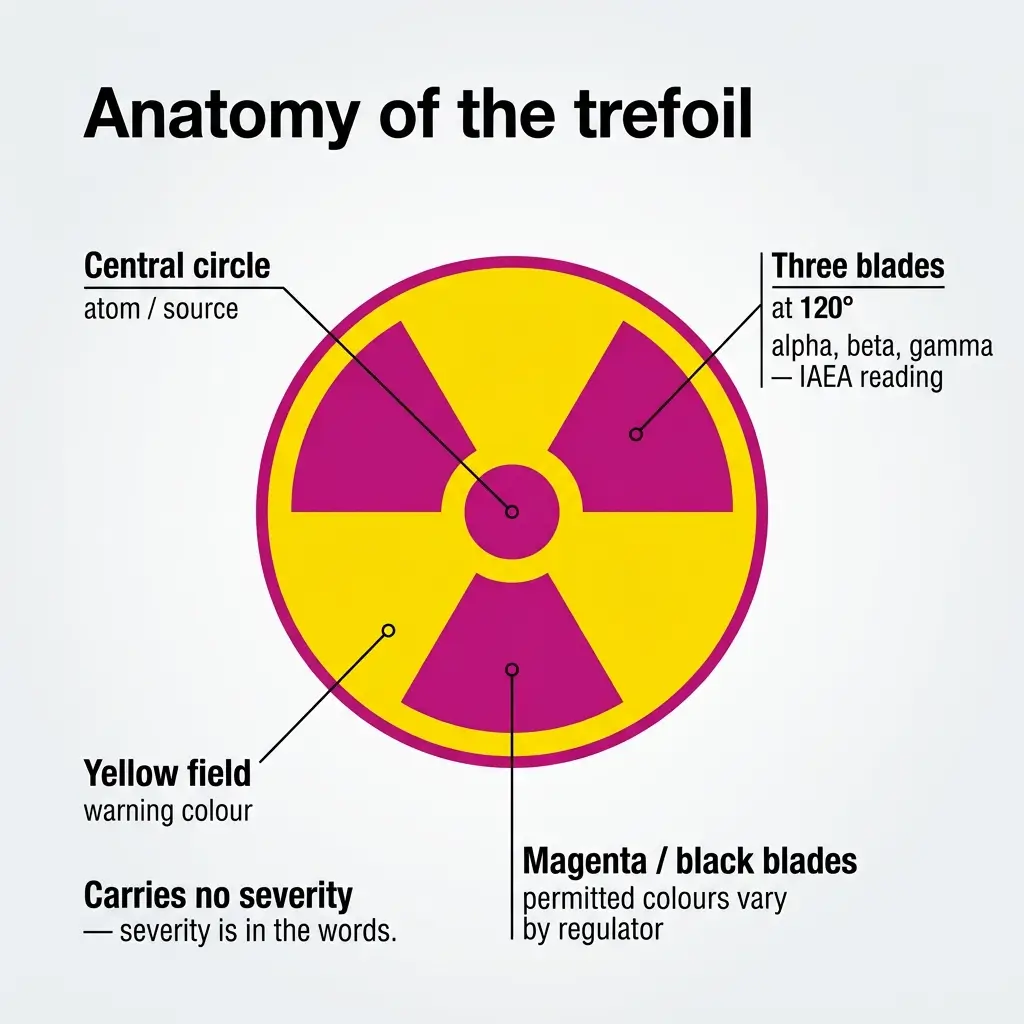
The trefoil is a warning of presence, not a measure of danger. It tells you that ionising radiation or radioactive material may be in the area, and nothing else. Everything a worker needs in order to decide what to do next — how close they may go, whether they need a dosimeter, whether entry is authorised at all — comes from the text, the barrier and the local rules, not from the graphic.
The design is deliberately abstract. The IAEA describes the central circle as the atom and the three blades as the three common types of ionising radiation coming off it — alpha, beta and gamma. That reading was applied after the fact rather than designed in, which is part of why the symbol communicates so poorly to anyone who has not been taught it.
It is not a radioactivity symbol
Ionising radiation is the broader category. X-ray sets, radiotherapy linear accelerators and particle accelerators all produce it without containing any radioactive material, and they all get a trefoil. That distinction changes how a worker should think about the space: with a machine source, the hazard follows the power supply and the exposure switch; with a sealed source, it does not.
It does not cover non-ionising hazards
Lasers, radiofrequency energy, ultraviolet and strong magnetic fields are separate hazards with separate registered symbols. A worker who treats the laser sign and the trefoil as the same warning will reach for the wrong control every time — eye protection and beam interlocks do nothing about gamma, and a lead apron does nothing about a Class 4 laser.
| ISO 7010 reference | Hazard warned of | Typical control expected |
|---|---|---|
| W003 | Radioactive material or ionising radiation | Distance, time, shielding, dosimetry, authorisation |
| W004 | Laser beam | Beam enclosure, interlocks, eyewear for the laser class |
| W005 | Non-ionising radiation (RF, microwave) | Exclusion zones, transmitter isolation |
| W006 | Magnetic field | Ferrous exclusion, implant screening |
| W027 | Optical radiation | Screening, filters, eye and skin protection |
One more confusion worth clearing, because it comes up in induction sessions constantly: the American civil defence fallout shelter emblem is a circle split into six alternating black and yellow segments with no central dot. It marks a place of protection, not a hazard, and the Office of Civil Defense rejected using the trefoil for exactly that reason.
The things the trefoil genuinely tells you, and the things it does not, split cleanly:
- It tells you ionising radiation or radioactive material may be present in this area, on this equipment, or in this container
- It tells you that entry, handling or dismantling is subject to controls set by someone else
- It does not tell you the dose rate, the isotope, or whether the hazard is present right now
- It does not tell you whether you are permitted to enter — that is the wording, the barrier and the permit
- It does not distinguish a sealed source from a machine source, which is the single most useful thing a worker could know
Why it is magenta on yellow: the 1946 design and the colour rules now
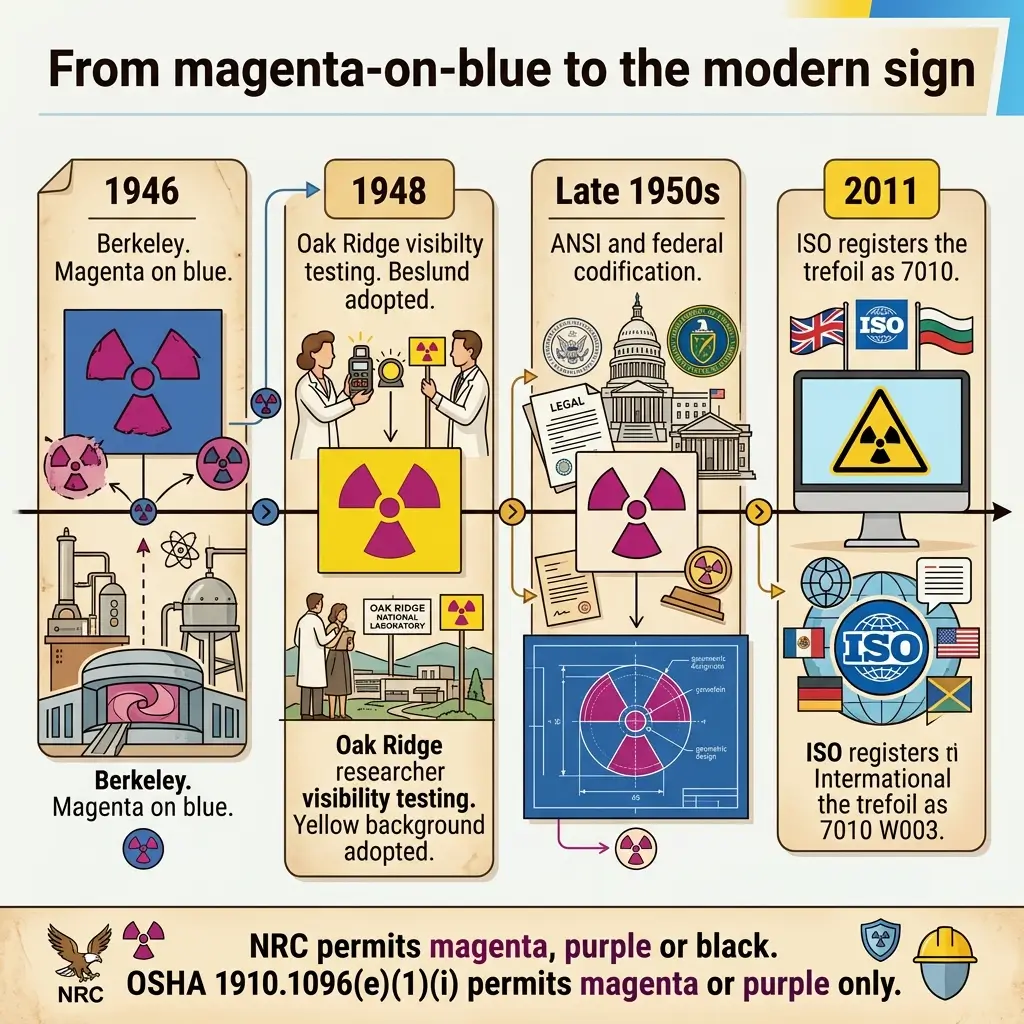
The symbol was sketched at the University of California Radiation Laboratory in Berkeley in 1946 by a small group in the Health Chemistry Group, and the Oak Ridge Associated Universities health physics collection preserves the correspondence explaining the choices. The first printed signs were magenta on blue. Magenta was picked because it clashed with nothing else in use and was expensive enough that nobody would adopt it casually.
Blue failed in the field. It faded outdoors and disappeared in poor light, and visibility testing at Oak Ridge settled on a yellow background instead. By the late 1950s ANSI and federal regulation had fixed the version still used today, and ISO later registered the trefoil as W003.
That history is charming, and it also has a compliance edge that catches multinational employers.
The permitted colours are not the same everywhere, and they are not the same within the US. The NRC allows magenta, purple or black on yellow at 10 CFR 20.1901. OSHA's standard for everyone else says "magenta or purple on yellow background" and stops there. Black on yellow is the most common combination in the rest of the world, so a European-sourced sign dropped onto a US site that is not an NRC or Agreement State licensee sits outside the wording of 1910.1096(e)(1)(i).
I have watched sign stock get standardised globally by procurement, on price, without anyone checking that clause. It is a small finding, and it is also the kind of thing that tells an inspector how the rest of the programme was put together.
There is one sensible exception. Sources and source holders that run hot can be marked with etched or stamped trefoils with no colour requirement at all, because paint will not survive. That allowance sits at 10 CFR 20.1901(b).
Before signing off a sign order, three checks take about a minute each:
- Confirm which regulator governs the site before choosing the colour, not after
- Check that the trefoil proportions are standard rather than a stylised vendor redraw
- Specify durability for the environment — outdoor, hot, washdown or offshore — since a faded sign is an unenforced boundary
The types of radiation sign, by the dose rate that triggers them
Sign types are not a matter of house style. In the US each one is triggered by a measured dose rate at a defined distance, and the wording is prescribed. Getting the class wrong is not a labelling error — it changes who may enter, whether dosimetry is required, and whether an alarm or control device has to be fitted.
The measurement point does most of the work here and is where I see the most confusion. The class is set by the dose rate at 30 cm from the source or from any surface the radiation penetrates. It is not the dose rate at the doorway where the sign hangs.
Radiation area
The entry-level class. Under NRC rules this begins where levels could give someone more than 0.005 rem (0.05 mSv) in one hour at 30 cm. OSHA's definition adds a second trigger that the NRC version does not have: more than 100 millirem over any five consecutive days. An intermittently used source can therefore sit below the hourly figure and still require posting.
High radiation area
Above 0.1 rem (1 mSv) in one hour at 30 cm. OSHA requires more than a sign here. The area needs a control device that does one of two things: drop the level below 100 millirem per hour on entry, or trigger a visible or audible alarm. That alarm has to alert both the person entering and their supervisor. Areas established for 30 days or less are exempt from the device.
Very high radiation area
Above 500 rads (5 grays) in one hour at 1 metre. This is the class where a person can receive a fatal dose in minutes. The wording is fixed as "GRAVE DANGER, VERY HIGH RADIATION AREA" — and note that this class exists in the NRC rules only. There is no equivalent tier in OSHA's standard.
Airborne radioactivity area
Triggered by airborne concentration rather than external dose rate, using the concentration tables in 10 CFR Part 20 Appendix B. It signals a contamination and intake hazard, so the controls are respiratory protection, containment and contamination monitoring rather than distance and shielding.
Radioactive material areas and container labels
Rooms holding more than ten times the Appendix C quantity get posted. Separately, containers of licensed material carry a label with the trefoil, the words, and enough information — radionuclide, estimated activity, the date of that estimate, radiation levels — for anyone handling them to take precautions. A trefoil label with no isotope and no date is a common and genuinely useless artefact.
| Class | Trigger | Measured at | Required wording |
|---|---|---|---|
| Radiation area | >0.005 rem (0.05 mSv)/h | 30 cm | CAUTION, RADIATION AREA |
| High radiation area | >0.1 rem (1 mSv)/h | 30 cm | CAUTION or DANGER, HIGH RADIATION AREA |
| Very high radiation area | >500 rads (5 Gy)/h | 1 metre | GRAVE DANGER, VERY HIGH RADIATION AREA |
| Airborne radioactivity area | Appendix B concentrations | Breathing zone | CAUTION or DANGER, AIRBORNE RADIOACTIVITY AREA |
| Radioactive material room | >10× Appendix C quantity | n/a | CAUTION or DANGER, RADIOACTIVE MATERIAL(S) |
Thresholds and wording from 10 CFR 20.1003 and 20.1902. Verified August 2026.
Three errors account for most of the misposting I see in this area:
- Measuring at the sign rather than at the source — the class is set at 30 cm from the source or the penetrated surface, which is often a different number entirely
- Treating "Caution" and "Danger" as severity levels — for a high radiation area they are alternative wordings for the same class
- Labelling a container with a trefoil and nothing else — without the isotope, the activity and the date of that estimate, the label tells a handler nothing they can act on
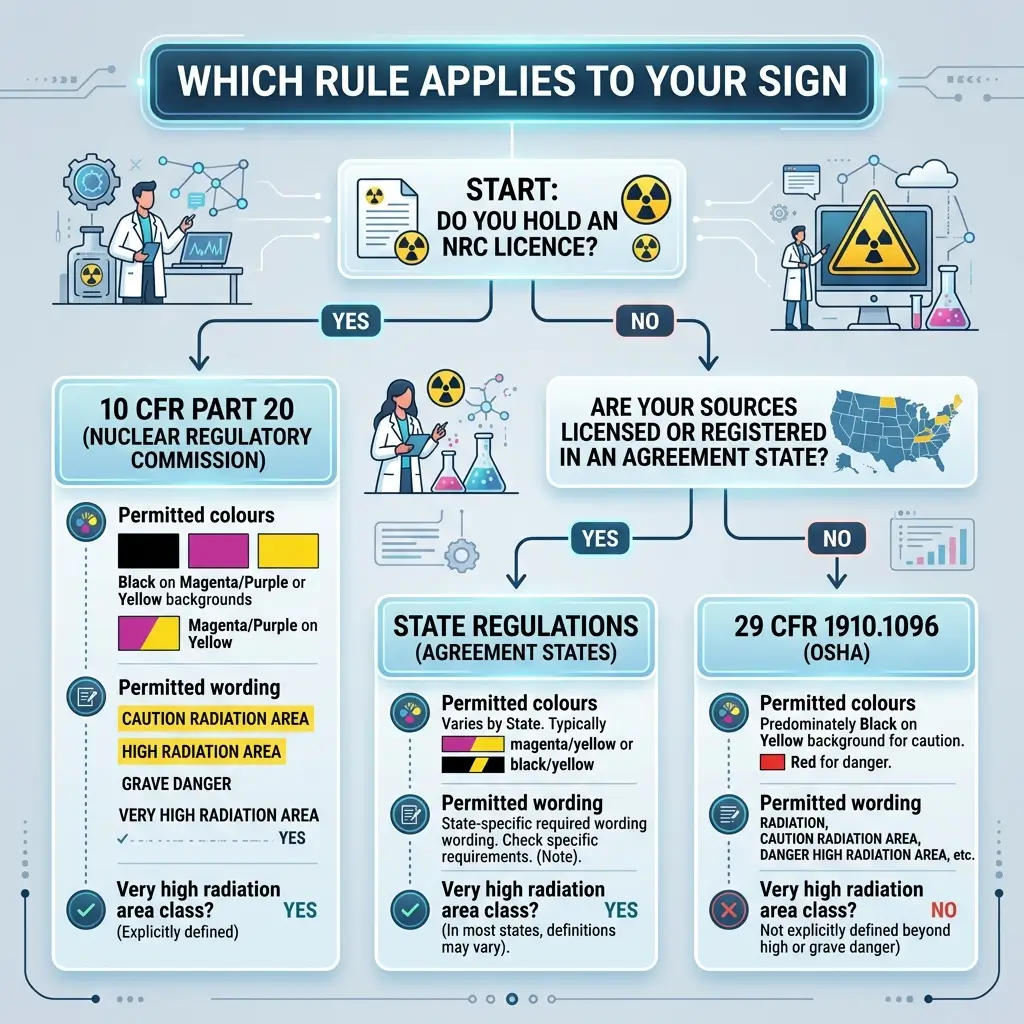
Which rulebook governs your sign: NRC, Agreement State, or OSHA
This is the question that decides everything above, and I have never seen it addressed on a page ranking for this topic. US radiation signage runs on three parallel tracks, and 1910.1096 says so directly at paragraph (i)(1).
NRC licensees are governed by 10 CFR Part 20. Employers in an Agreement State that have registered or licensed their sources there are governed by that state's regulations. Everyone else — a manufacturer with a small X-ray inspection cabinet, a contractor whose subcontractor brings a source onto the site — falls under OSHA's standard. Three tracks, three slightly different sign specifications.
The differences are small individually and awkward collectively.
| Point | NRC (10 CFR Part 20) | OSHA (1910.1096) |
|---|---|---|
| Trefoil colours | Magenta, purple or black on yellow | Magenta or purple on yellow |
| "DANGER" wording permitted | Yes, as an alternative to CAUTION | Not offered; CAUTION only |
| Very high radiation area class | Yes | No equivalent class |
| Radiation area trigger | >0.005 rem/h at 30 cm | Same, plus >100 mrem over 5 consecutive days |
| Sealed source posting exemption | ≤0.005 rem/h at 30 cm from the housing | ≤5 mrem/h at 12 inches from the housing |
| Control device on high radiation areas | Under separate NRC provisions | Required, or an alarm, unless the area lasts 30 days or less |
The exemptions deserve attention in their own right, because a missing sign is not automatically a finding. Both regimes allow rooms holding radioactive material to go unposted for periods under eight hours if the material is constantly attended and the area is under the employer's control. Both exempt low-output sealed sources. The NRC additionally exempts occupied hospital patient rooms and, under defined access controls, teletherapy rooms. Packages already labelled to DOT rules are exempt in transit.
When I audit this, I do not start with the signs. I start with the survey record, because the sign is only ever an output of it. The questions I ask in order are:
- Which regulator licenses this source — NRC, Agreement State, or nobody, meaning OSHA applies
- When was the last survey, and what dose rate did it record at 30 cm from the source or the penetrated surface
- Does the posted wording match that number, using the wording that regulator actually permits
- If the area is exempt from posting, on what basis — and is that basis written down anywhere
- Who holds the RSO or RPS role, and can the supervisor on shift name them
Outside the US: ISO 7010, IRR17 and the performance-based approach
Move outside the United States and the whole architecture changes. There is no prescribed sign wording, no fixed list of area classes, and the sign itself is a different shape.
The UK works through the Ionising Radiations Regulations 2017. Regulation 17 sets the designation thresholds. A controlled area is required where special procedures are needed to restrict exposure, or where someone working there is likely to receive more than 6 mSv a year. A supervised area is required where the likely dose exceeds 1 mSv a year, or where conditions need keeping under review. The signage duty then sits at regulation 19(1)(b), which requires suitable and sufficient signs, in suitable positions, warning that the area has been designated and indicating the nature of the sources and the risks. Regulation 19(2) requires controlled areas to be physically demarcated.
Read that again and notice what is absent. No prescribed words. No colour schedule. No dose rate in the regulation itself. The duty is to achieve an outcome, and an inspector will judge the sign against whether a person walking up to it would understand what is behind it.
The dose rate figure UK practitioners quote — 7.5 µSv/h averaged over the working day — comes from the ACOP and guidance in HSE's L121, not from the regulation. Treat it as an indicative criterion to discuss with your Radiation Protection Adviser, not a legal boundary.
The signs themselves look different
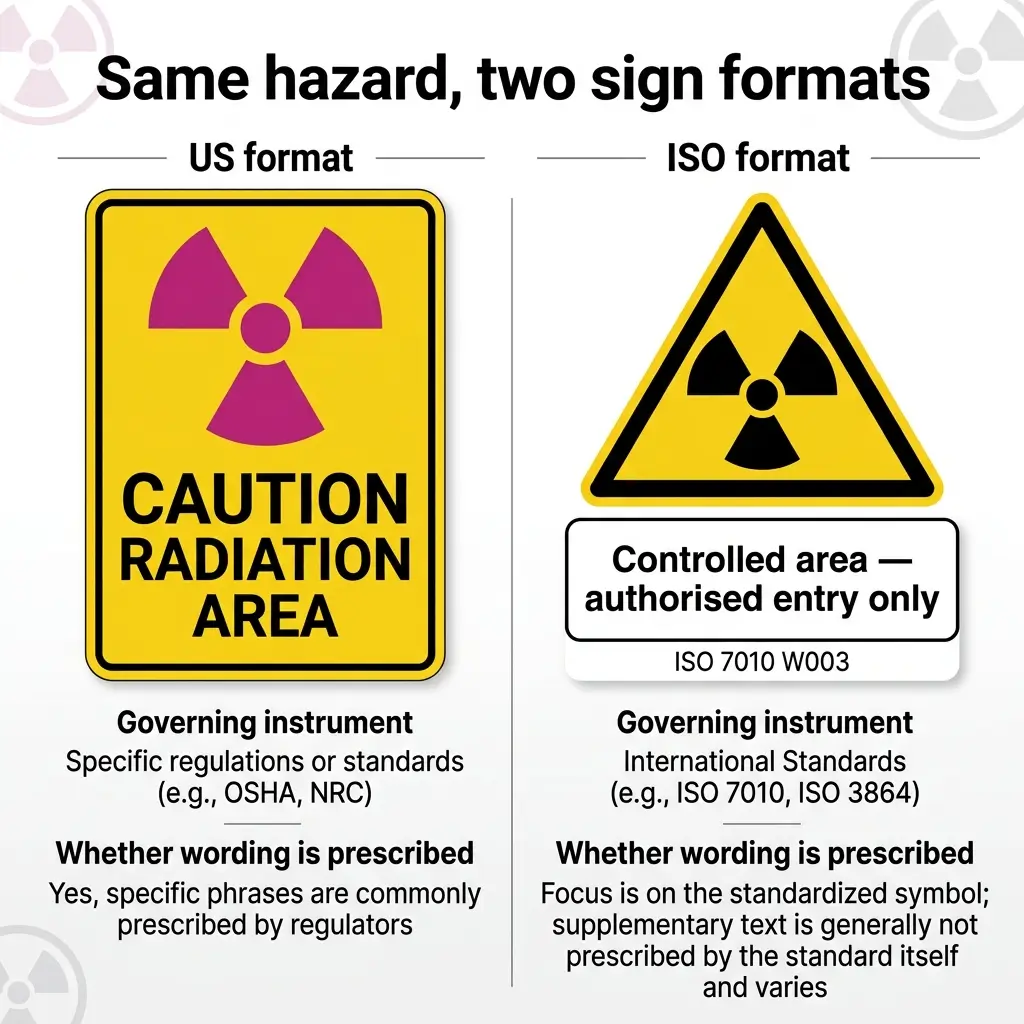
UK and EU warning signs follow the ISO 7010 geometry: a black trefoil inside a yellow triangle with a black border, with supporting text on a separate panel. The US sign is a magenta trefoil on a yellow rectangle with the prescribed wording built in. Two different objects for the same hazard.
For a company running one procedure across both, this creates a real design problem, and the usual compromise is a dual-format sign that carries the triangle pictogram alongside the US-format wording panel. That satisfies recognition in both directions.
| Element | US (NRC / OSHA) | UK (IRR17) | International (ISO) |
|---|---|---|---|
| Governing instrument | 10 CFR 20.1901–1902 / 29 CFR 1910.1096(e) | IRR 2017 regs 17 and 19 | ISO 361, ISO 7010 W003 |
| Sign shape | Rectangle with wording | Yellow triangle, black border | Yellow triangle, black border |
| Wording | Prescribed exactly | Not prescribed — must be suitable and sufficient | Not prescribed |
| Trigger | Dose rate at 30 cm | Annual dose likelihood plus need for special procedures | Not applicable |
| Boundary requirement | Posting | Physical demarcation for controlled areas | Not applicable |
Three habits keep a multinational signage standard out of trouble:
- Write the standard around the pictogram, and the wording around the jurisdiction rather than forcing one sign artwork everywhere
- Record the survey basis on the site file, not just the sign, since the UK duty is to justify the designation
- Name the RPA or RSO on the local rules, because in the UK the sign is one component of a system that includes local rules and a named supervisor
The 2007 supplementary symbol, and the three places it does not belong
The red triangle showing a trefoil, radiating waves, a skull and crossbones and a running figure is the one piece of radiation signage designed by testing rather than by committee. The IAEA and ISO ran comprehension studies across eleven countries with people who had no technical background, and published the result as ISO 21482 in February 2007.
It exists because of orphan sources. People with no way of reading a trefoil have broken open discarded teletherapy heads and industrial radiography cameras for the scrap metal in them, and have died. The message the symbol has to deliver is not "controlled area" but "drop this and run."
The specification is tight. Red background, black figures, white outlines, and a minimum size of 3.0 cm so that it stays legible. Where colour is impractical — engraving directly onto a source, for instance — the symbol is acceptable without it.
Where it goes, and where it must not
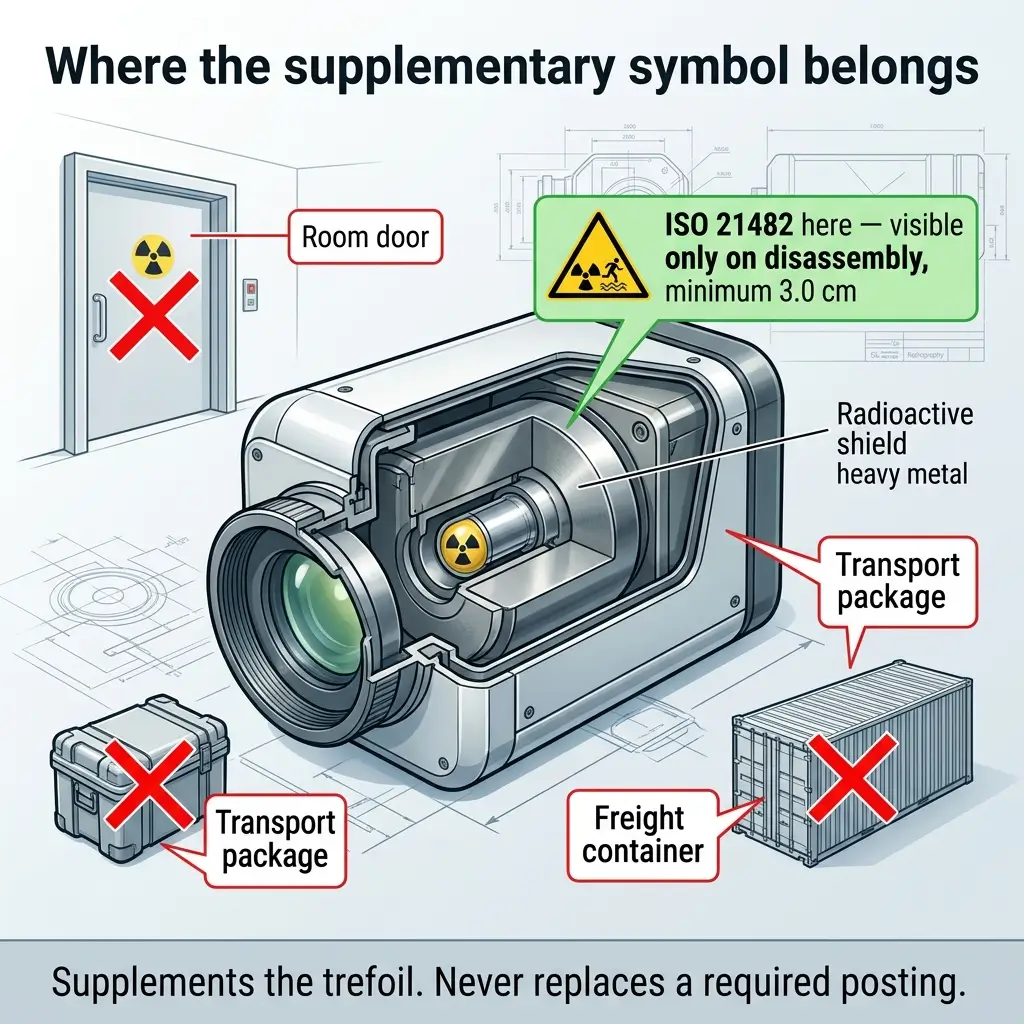
The placement rule is the part that almost every article online gets wrong, including the previous version of this page. The symbol belongs on the source shield, under the device covers, positioned so that it is not visible during normal use and becomes visible only when somebody starts to take the device apart. Where there is no cover, it goes on the housing in a discreet spot, clearly visible before disassembly.
The IAEA's own announcement is explicit that it should not be placed on building access doors, transport packages or containers. Put it on a door and you have destroyed the design intent: the symbol becomes background scenery that people walk past daily, instead of a last warning to someone who has already gone too far.
The rules that govern its use come down to four points:
- Use it for IAEA Category 1, 2 and 3 sealed sources — irradiators, teletherapy heads, industrial radiography cameras, large fixed gauges
- Place it on the shield or housing, under the covers where covers exist
- Never place it on doors, packages, freight containers or vehicles
- Never treat it as a replacement for the trefoil — it supplements the required postings and removes none of them
Transport labels: the trefoil you meet on a package
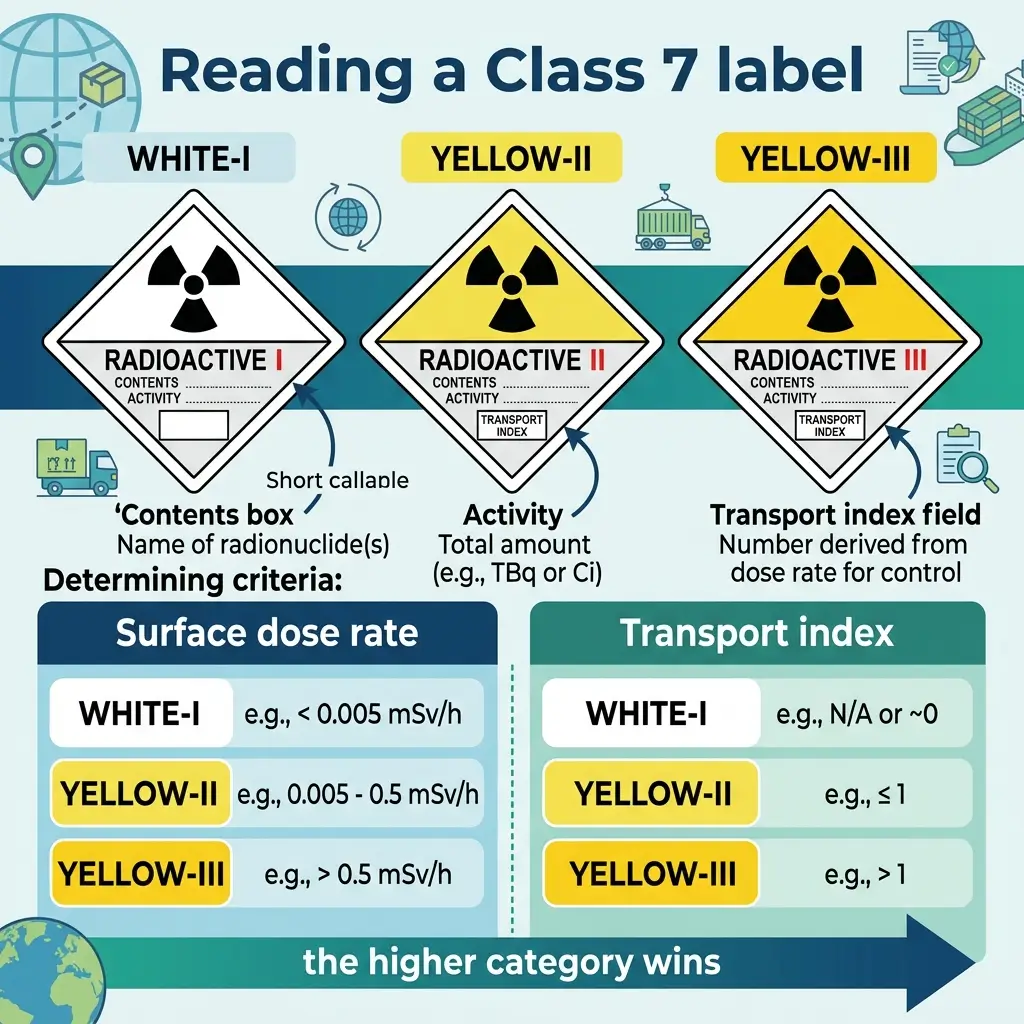
A package label is a different system again, and workers in goods-in areas meet it more often than they meet an area posting. US transport labels come from 49 CFR 172.403, and the category depends on two measurements: the dose rate at the package surface, and the transport index, which is the dose rate in millirem per hour at one metre.
The rule people misapply is that the label follows whichever of those two criteria gives the higher category. The regulation's own worked example makes the point. A package with a transport index of 0.8 and a surface reading of 0.6 mSv/h takes a YELLOW-III label. The transport index alone would not put it there; the surface reading does.
| Label | Transport index | Maximum surface radiation level |
|---|---|---|
| RADIOACTIVE WHITE-I | 0 | ≤0.005 mSv/h (0.5 mrem/h) |
| RADIOACTIVE YELLOW-II | >0 but ≤1 | >0.005 mSv/h but ≤0.5 mSv/h (50 mrem/h) |
| RADIOACTIVE YELLOW-III | >1 but ≤10 | >0.5 mSv/h but ≤2 mSv/h (200 mrem/h) |
| RADIOACTIVE YELLOW-III (exclusive use) | >10 | >2 mSv/h but ≤10 mSv/h (1,000 mrem/h) |
Values from 49 CFR 172.403(c). A measured transport index of 0.05 or less may be treated as zero, and any package holding a highway route controlled quantity takes YELLOW-III regardless.
Two further labels turn up alongside these. An EMPTY label marks a package that held radioactive material and has been cleared; a FISSILE label carries a criticality safety index and controls how much can travel together.
For anyone receiving packages rather than shipping them, the useful checks are short:
- Read the label category before signing, because YELLOW-III changes your handling and storage obligations immediately
- Look for physical damage — crushing, wetting, staining — since a degraded package triggers contamination and dose rate monitoring
- Do not stack or store to convenience; transport index totals drive separation distances
- Escalate rather than open anything whose label does not match its paperwork
Where you actually meet these signs
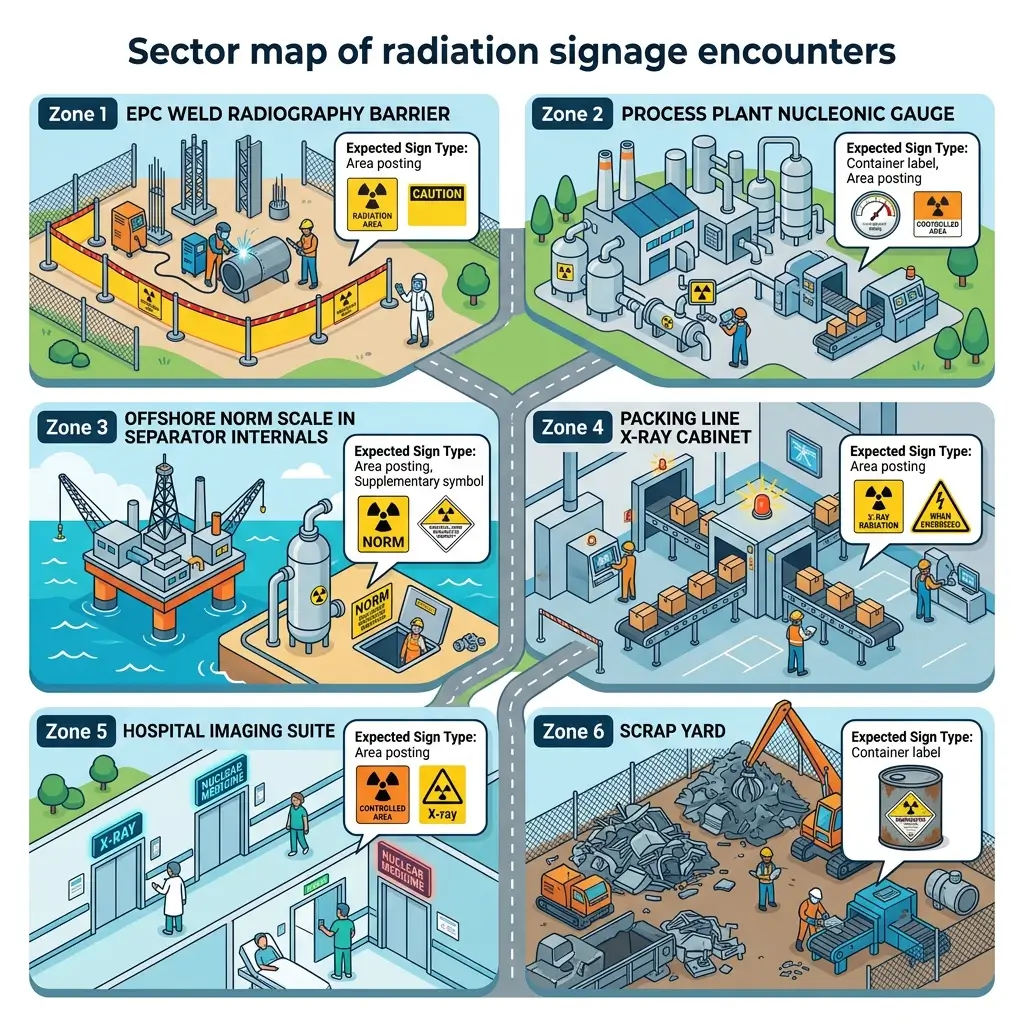
Most people who read a radiation sign are not radiation workers. They are welders, riggers, cleaners, night-shift operators and contractors who have walked into someone else's controlled area. Across seventeen countries, the sectors below are where I have seen that happen most.
Industrial radiography on construction and turnaround sites
Weld inspection with a gamma source is where a construction workforce most often meets a radiation boundary, and it is a contractor interface problem far more than a physics one. Managing contractor interfaces on Fluor mega-projects at Ras Laffan and Jamnagar, the pattern was consistent: radiography is scheduled at night to clear the area, a barrier goes up with trefoil signs and rope, and the risk sits entirely in whether every other crew on that corridor knows the barrier is live.
What I check on those walks is not the sign artwork. It is whether the barrier is lit, whether the signs face the direction people actually approach from, and whether the night supervisor for the neighbouring scaffold crew can tell me what the boundary is for.
Fixed gauges on process plant
Nucleonic level and density gauges sit on vessels and pipework across chemical and mining operations. Working on plant HSE at Dow and auditing critical risks for Anglo American, these were the sources most likely to be forgotten — because a well-shielded gauge often produces less than 5 mrem/h at the housing and needs no area posting at all. The label on the gauge is the only marker, and it is the one that fades, gets painted over during a turnaround, or ends up behind lagging.
Offshore and NORM
Naturally occurring radioactive material accumulates as scale inside production tubing and separator internals. It arrives as a maintenance and waste issue rather than a source issue, and the signage often goes up only once the pipework is opened. On offshore maintenance campaigns with Equinor, the interface I watched most carefully was between the scale-cleaning crew and everyone else on the deck.
X-ray inspection on packing lines
Food and pharmaceutical lines run product through X-ray cabinets continuously. From EHS work at Novo Nordisk, AstraZeneca and Philips, the recurring problem is complacency rather than dose: the cabinet is interlocked, nothing has ever gone wrong, and the trefoil on the housing becomes invisible to the operators who pass it forty times a shift.
Scrap, demolition and decommissioning
The highest-consequence encounter is with a source nobody knew existed. Demolition and scrap handling is where orphan sources surface, and where the ISO 21482 symbol is meant to do its work — assuming the housing still carries it.
Across all six settings, the failure mode repeats in the same three forms:
- The sign outlives the work — a barrier left standing after the crew has gone teaches people to walk past the next one
- The label outlives its legibility — painted over during a turnaround, buried behind lagging, or faded past reading
- The audience was never trained — the people the sign exists to protect are the ones who never attended the radiation briefing
What to do when you see one, and what an auditor checks
Stop before the barrier, not at it. The single most useful behaviour to train into a workforce is that the boundary is where the sign is, and stepping past a trefoil to read the small print is exactly the wrong instinct.
Beyond that, the right response depends on who you are.
If you are the worker
Read the wording, not just the symbol. "CAUTION, RADIATION AREA" and "GRAVE DANGER, VERY HIGH RADIATION AREA" are separated by a factor of a hundred thousand in dose rate. If the sign names a controlled area and you are not authorised for it, your entry is a regulatory matter, not a judgement call. If you find a trefoil label on something in a scrap stream, a skip or a demolition arisings pile, do not pick it up, do not move it, mark the spot and call it in.
If you are the supervisor
Your job is the boundary, not the source. Know which of your people can enter, know who the RPS or RSO is, and know when the work finishes so the barrier comes down and does not become permanent scenery. A barrier that stays up for weeks after the radiography crew has left is training everyone on site to ignore the next one.
If you are auditing
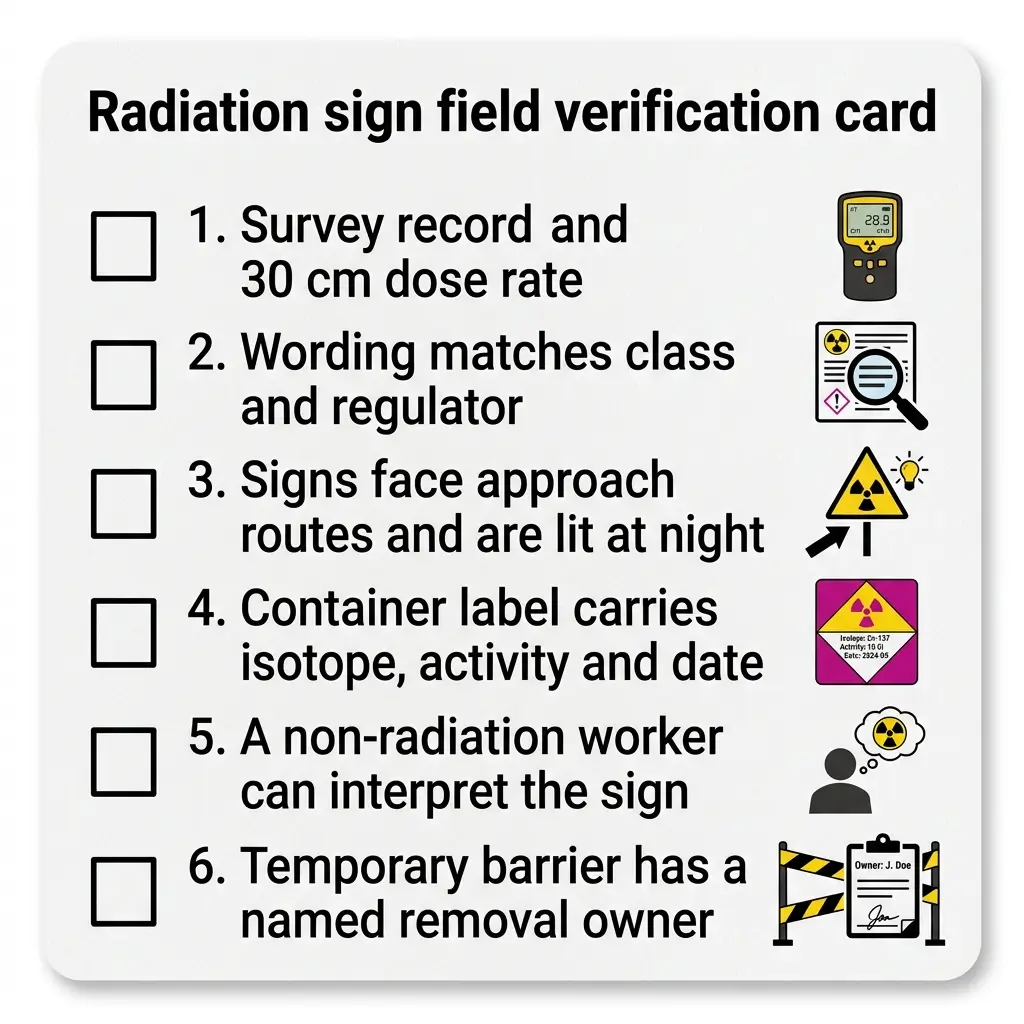
I do not photograph signs. I trace them back. The sign is downstream of a survey, a designation decision and a set of local rules, and if those three do not line up, the sign is decoration.
The verification sequence I use in the field runs like this:
- Ask for the most recent survey and the dose rate it recorded at 30 cm
- Compare the posted wording to that number against the regulator that actually applies
- Walk the boundary and check the signs face the approach routes people use, including at night
- Read one container label in full — isotope, activity, date of estimate, responsible person
- Ask a non-radiation worker on that shift what the sign means and what they would do
- Check the removal trigger for temporary barriers, and who owns it
That fifth step is the one that tells you whether the programme works. A perfect sign that nobody can interpret has protected no one.
Frequently asked questions
These are the questions that come up most often in inductions and in search, answered short.
What does the radiation symbol mean?
The trefoil warns that ionising radiation or radioactive material may be present. The central circle represents the source and the three blades represent alpha, beta and gamma radiation. It carries no information about how dangerous the area is — the accompanying wording and the dose rate behind it do that.
Why is the radiation symbol yellow and magenta?
Magenta was chosen at Berkeley in 1946 because it clashed with no existing colour code and was costly to reproduce. The original blue background failed visibility testing outdoors, so Oak Ridge replaced it with yellow. Black on yellow is now the more common combination internationally.
What is the difference between the trefoil and the red triangle?
The trefoil marks any area, equipment or container where ionising radiation may be present. The red triangle (ISO 21482) is a last-chance warning fitted to high-activity sealed sources, under the device covers, aimed at someone dismantling equipment who cannot read the trefoil. It supplements the trefoil and never replaces it.
Does a radiation sign mean the area is dangerous right now?
Not necessarily. A machine source such as an X-ray cabinet produces radiation only when energised, so the posting stays up while the hazard comes and goes. A sealed source emits continuously. Treat every posted boundary as live unless you are authorised and informed otherwise.
What is the difference between "Caution" and "Danger" radiation signs?
Under NRC rules, either word is acceptable for a high radiation area or an airborne radioactivity area — they are alternatives for the same class, not different severities. OSHA's standard does not offer the "Danger" option at all. "GRAVE DANGER" is reserved for very high radiation areas and appears only in the NRC rules.
Is the fallout shelter sign a radiation warning symbol?
No. The circular civil defence emblem marks a place of protection from fallout. It is not a hazard warning and has no regulatory link to the trefoil.
Do X-ray machines need a radiation warning sign?
Usually yes. The posting classes are triggered by dose rate, not by the presence of radioactive material, so a machine source that produces a radiation area needs posting the same as a sealed source would. Whether NRC, state or OSHA rules apply depends on the licensing of the equipment.
What should I do if I find a radiation label on scrap metal?
Do not touch it, move it or attempt to open it. Mark the location, keep people away, and report it to your supervisor and the site radiation protection contact immediately. Orphan sources found in scrap have caused fatalities, which is why the supplementary symbol exists.
Conclusion: read the sign against the survey
The trefoil is one of the most recognised graphics in industry and one of the least informative. It tells a worker that ionising radiation may be present and stops there. The dose rate, the class, the wording, the permitted colours and the entry rules all come from somewhere else — and which "somewhere else" applies depends on who licenses the site.
If you take one operational habit from this: verify the sign against the survey, not against the catalogue. Every posting is the visible end of a measurement, a designation decision and a set of local rules. Where those three agree, the sign works. Where they do not, you are looking at a yellow rectangle that has taught people nothing.
Where a source, a designation or a survey is in question, that is work for a Radiation Protection Adviser, a Radiation Safety Officer or an equivalent qualified professional. This article will help you read a sign and audit a boundary. It is not a substitute for that advice.
About the author
Chloe Anderson is a British Occupational Health, Safety and Environment (OHSE) Technical Educator and Site Assurance Consultant with 16 years of continuous field experience across 17 countries. She has worked across pharmaceuticals, offshore energy, chemicals, EPC construction, mining, ports, wind, maritime terminals, electronics manufacturing, civil infrastructure and aerospace environments, with a dual focus on technical education — toolboxes, competence routines and supervisor decision aids — and site assurance, verifying that controls hold at night, with contractors and under production pressure. She currently leads Anderson OHSE Assurance & Education, based in Edinburgh, after senior roles with IKEA Industry, DP World, Novo Nordisk, Equinor, Dow, Fluor and Anglo American.
Credentials: Chartered Member of IOSH (CMIOSH); NEBOSH National Diploma in Occupational Health and Safety; BOHS Certificate of Operational Competence in Occupational Hygiene; ISO 45001 Lead Auditor; IOSH Incident Investigation.
Sources and further reading
- 29 CFR 1910.1096 — Ionizing radiation, OSHA — caution signs, labels and signals at paragraph (e); posting exceptions at (g); jurisdiction at (i) and (p)
- 10 CFR Part 20 Subpart J — Precautionary Procedures, NRC — caution signs, posting requirements, container labelling and exemptions
- 10 CFR 20.1003 — Definitions, NRC — radiation area, high radiation area and very high radiation area thresholds
- Ionising Radiations Regulations 2017, Part 4, legislation.gov.uk — designation of controlled and supervised areas and the signage duty at regulation 19
- Work with ionising radiation: L121 Approved Code of Practice and guidance, HSE — free PDF; source of the 7.5 µSv/h designation criterion
- Deciding which employees are classified persons, HSE — classification thresholds and written arrangements for controlled area entry
- 49 CFR 172.403 — Class 7 (radioactive) material, eCFR — transport label categories
- ISO 21482:2007 — Ionizing-radiation warning: supplementary symbol, ISO
- New symbol launched to warn public about radiation dangers, IAEA — placement rules for the supplementary symbol
- Origin of the radiation warning symbol, Oak Ridge Associated Universities
- Examples of radiation signs and symbols, REMM, US Department of Health and Human Services