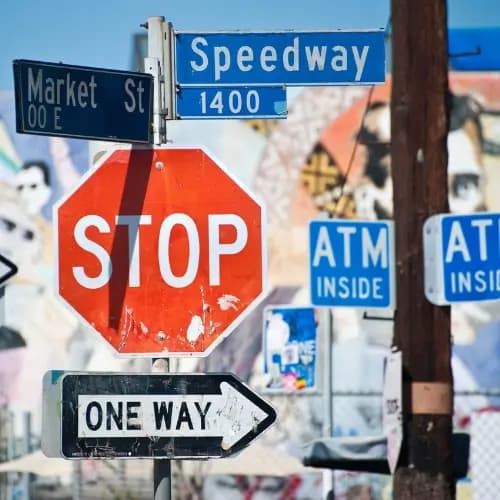


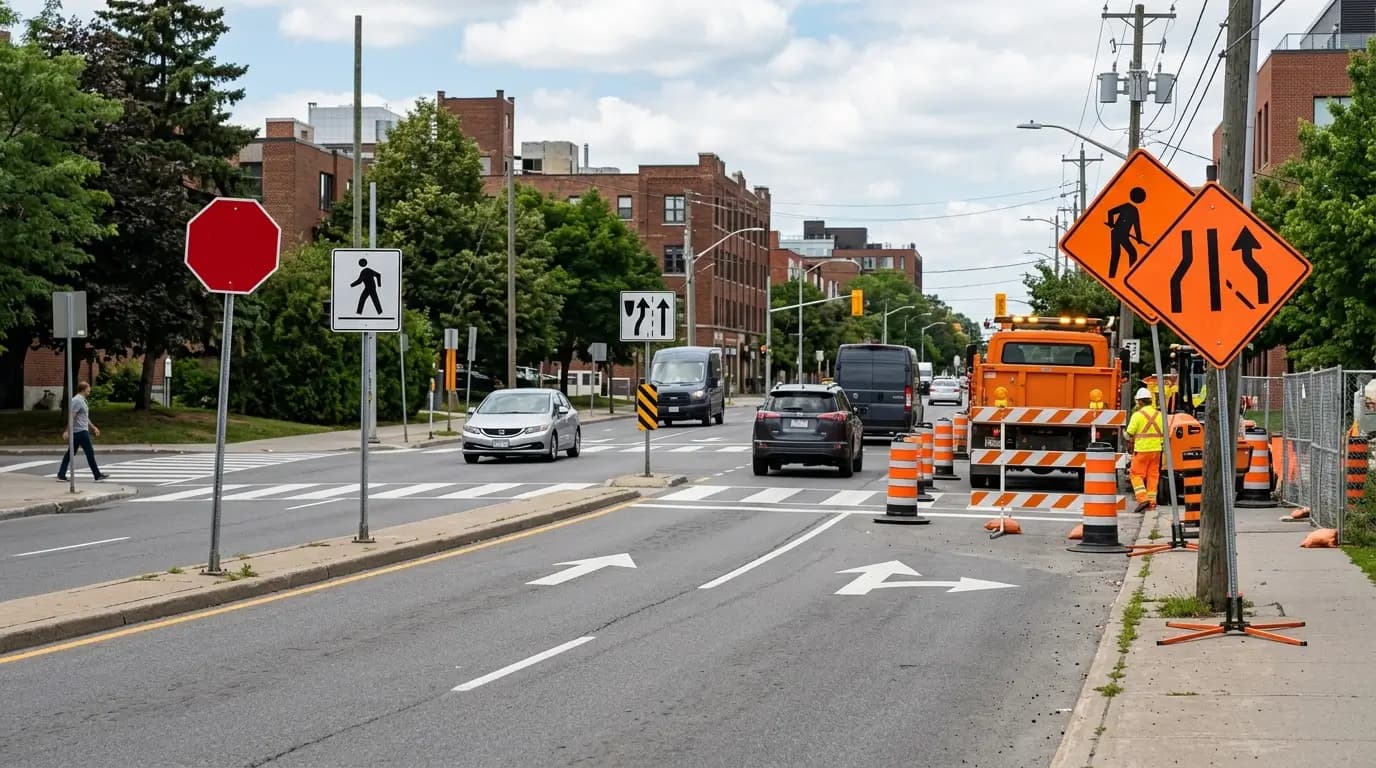
A traffic sign does most of its work before anyone reads a word on it. Shape and colour carry the meaning first, and the legend only arrives later — the MUTCD's own design rule is about one inch of letter height per 30 feet of legibility distance, so at 60 mph a six-inch legend is readable for a little over two seconds. That is why the 25 signs below are grouped the way a driver actually decodes them: family, then shape, then colour, then words.
I write this from the construction side of the fence. In 18 years across highway corridors, public interface works and night civils in 14 countries, almost none of the signing findings I raise are about somebody picking the wrong sign. They are about the right sign being unlit, undersized, obscured by a stockpile, or still standing three days after the work finished. This guide covers the United States (MUTCD 11th Edition and OSHA 29 CFR 1926 Subpart G) with UK and international comparisons, and it is written for supervisors, site engineers and safety advisers rather than for a driving test.
Key takeaways
Six points carry most of the practical weight in this article:
- Under MUTCD Section 2A.05, some shapes are reserved exclusively for one sign — the octagon is only ever STOP (R1-1), and the downward-pointing equilateral triangle only ever YIELD (R1-2).
- Colour maps to function: red and white for prohibition, yellow for permanent warning, orange for temporary traffic control, fluorescent yellow-green for pedestrian, school and bicycle warnings, fluorescent pink for incident management.
- The FHWA published the 11th Edition of the MUTCD in December 2023, effective 18 January 2024, with states required to adopt it or a substantially conforming supplement by 18 January 2026.
- OSHA does not write its own traffic sign rules. 29 CFR 1926.200(g)(2) points at MUTCD Part 6 — but the edition incorporated by reference at 1926.6 is still the 2009 MUTCD, so your OSHA duty and your state DOT duty can point at different books.
- FARS data compiled by the FHWA records 850 work zone fatalities in 2024, and more than half of fatal work zone crashes that year happened at night.
- MUTCD road signs and ANSI Z535 / 29 CFR 1910.145 facility signs are separate systems. Mixing them on a site boundary is one of the most common signing errors I write up.
How to read a traffic sign before you read the words
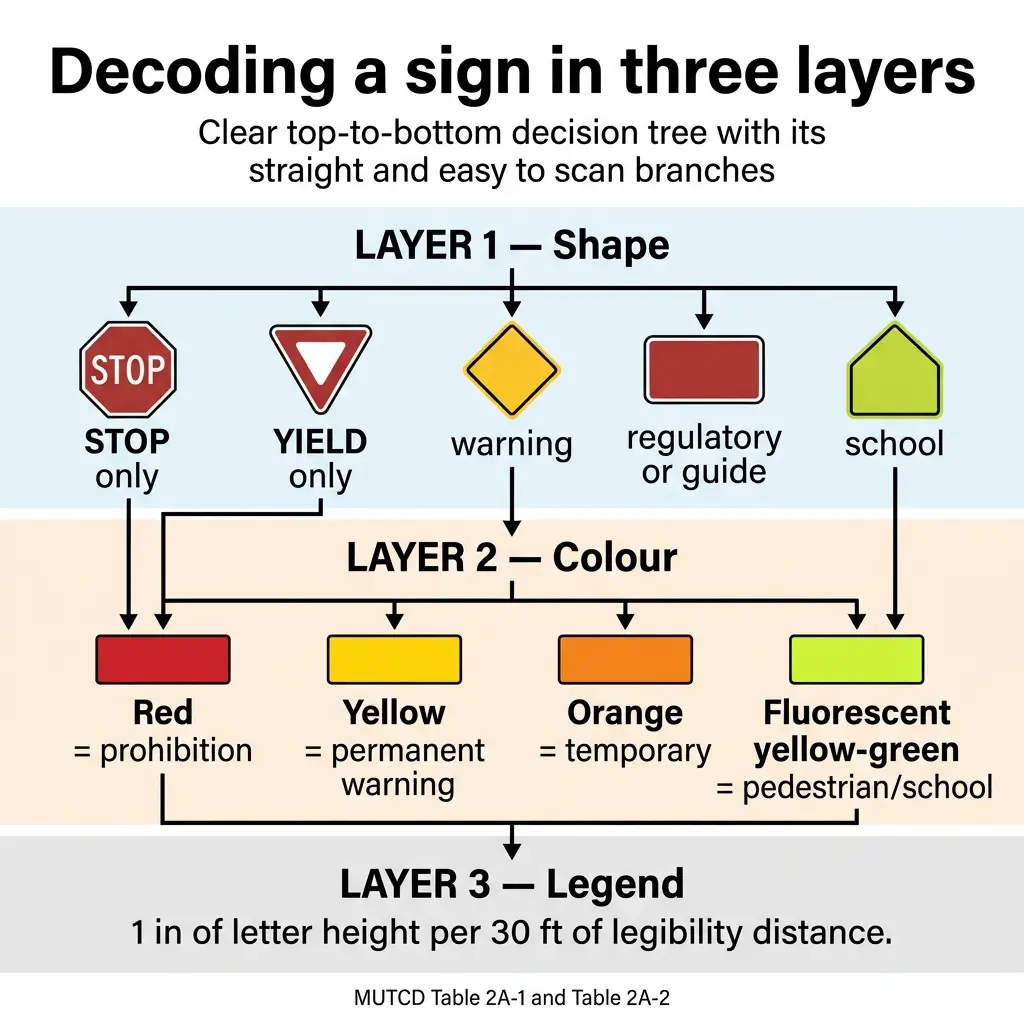
Every sign in this article resolves into a meaning through three layers, applied in order: shape, colour, then legend. That order is deliberate. The MUTCD reserves certain silhouettes for single signs precisely so a driver can identify them at a distance, in darkness, or from behind, before any text or symbol becomes legible.
What the shape tells you
Table 2A-1 of the 11th Edition sets out which shapes are exclusive and which are shared. The octagon, the downward-pointing equilateral triangle, the circle, the pennant, the upward-pointing pentagon and the Crossbuck each belong to one sign and nothing else. That exclusivity is the reason Section 2A.05 also forbids mounting a second sign on the back of one of these in a way that obscures its outline — the shape is the message.
| Shape | Reserved for | Designation |
|---|---|---|
| Octagon | Stop | R1-1 |
| Downward equilateral triangle | Yield | R1-2 |
| Circle | Grade crossing advance warning | W10-1 |
| Pennant (points right) | No passing zone | W14-3 |
| Upward pentagon | School | S1-1 |
| Crossbuck | Grade crossing | R15-1 |
| Diamond | Warning series (not exclusive) | W series |
| Rectangle | Regulatory and guide series | R, G, D series |
Source: MUTCD 11th Edition, Table 2A-1.
What the colour tells you
Colour assigns the sign to a family before the eye resolves the symbol. Table 2A-2 lists the common combinations, and the practical shorthand below is what I brief crews on. The one worth drilling is orange: an orange sign means the condition is temporary and the layout you learned yesterday no longer applies.
The colour meanings a site team should be able to recite are:
- Red — prohibition or a stop condition (STOP, YIELD border, DO NOT ENTER, WRONG WAY)
- White background, black legend — a regulation you must obey (speed limits, turn restrictions)
- Yellow — permanent warning of a condition ahead
- Orange — temporary traffic control; work zone conditions
- Fluorescent yellow-green — pedestrian, bicycle and school warnings
- Fluorescent pink — incident management
- Green, blue, brown — guide, motorist services, and recreational information
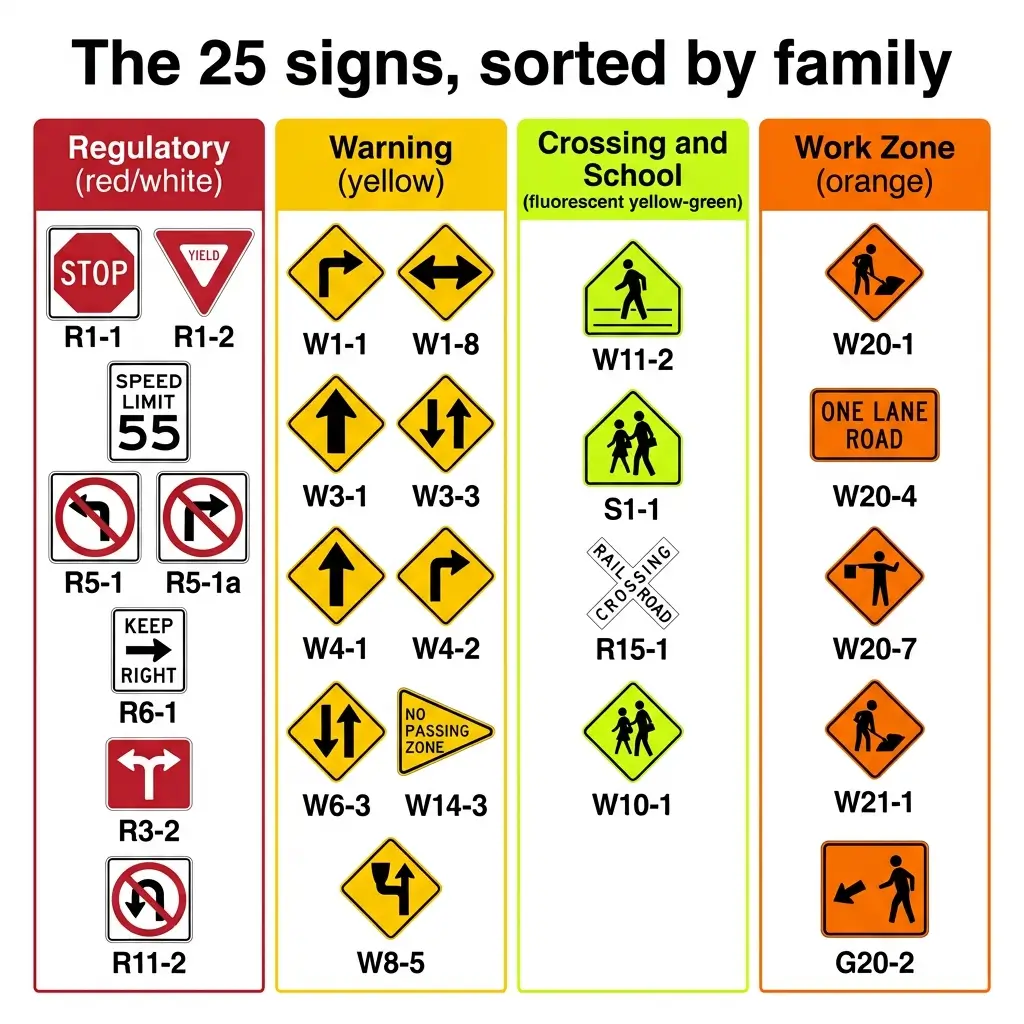
The 25 signs at a glance
The table below is the reference version — designation, shape and colour, and the meaning in one line. The four sections that follow explain what each family is doing and where it goes wrong on a live site. Sign designations are the national MUTCD codes; the 11th Edition renumbered a number of sections and revised some Part 6 designations, so confirm against your state supplement before you specify anything for procurement.
The four families these 25 signs fall into are:
- Regulatory (signs 1–8) — a legal requirement, enforceable as written
- Warning (signs 9–17) — a condition ahead that is not obvious from the road itself
- Crossing, school and pedestrian (signs 18–20) — where people and vehicles share space
- Temporary traffic control (signs 21–25) — the orange family, valid only while the work is live
| # | Sign | Code | Shape and colour | Meaning |
|---|---|---|---|---|
| 1 | Stop | R1-1 | Red octagon, white legend | Full stop at the line, crosswalk or edge of the intersection |
| 2 | Yield | R1-2 | Red and white downward triangle | Slow, give way, stop if needed to do so |
| 3 | Speed Limit | R2-1 | White rectangle, black legend | The legal maximum for this section of road |
| 4 | Do Not Enter | R5-1 | White square, red disc | Entry into this roadway is prohibited |
| 5 | Wrong Way | R5-1a | Red rectangle, white legend | You are already travelling against traffic |
| 6 | One Way | R6-1 | Black rectangle, white arrow | Travel permitted only in the arrow direction |
| 7 | No Left Turn | R3-2 | White square, red circle and slash | That movement is prohibited here |
| 8 | Road Closed | R11-2 | White rectangle, black legend | Road closed to all through traffic |
| 9 | Turn / Curve | W1-1, W1-2 | Yellow diamond | Alignment change ahead; reduce speed |
| 10 | Chevron | W1-8 | Yellow vertical rectangle | Sharp change of direction at this point |
| 11 | Stop Ahead | W3-1 | Yellow diamond, red octagon symbol | A stop condition is coming into view |
| 12 | Signal Ahead | W3-3 | Yellow diamond, signal symbol | Prepare to stop at a traffic signal |
| 13 | Merge | W4-1 | Yellow diamond | Two streams are about to join |
| 14 | Lane Ends | W4-2 | Yellow diamond | Your lane is about to disappear |
| 15 | Two-Way Traffic | W6-3 | Yellow diamond | Divided road ends; opposing traffic ahead |
| 16 | No Passing Zone | W14-3 | Yellow pennant, mounted left | Passing prohibited over this length |
| 17 | Slippery When Wet | W8-5 | Yellow diamond | Reduced surface friction in wet conditions |
| 18 | Pedestrian Crossing | W11-2 | Fluorescent yellow-green diamond | People on foot may be in your path |
| 19 | School | S1-1 | Fluorescent yellow-green pentagon | School zone; children present |
| 20 | Crossbuck (+ advance) | R15-1, W10-1 | Crossbuck; yellow circle | Railway grade crossing; yield to trains |
| 21 | Road Work Ahead | W20-1 | Orange diamond | A work zone begins ahead |
| 22 | One Lane Road Ahead | W20-4 | Orange diamond | Two directions will share one lane |
| 23 | Flagger | W20-7 | Orange diamond, flagger symbol | A person will be directing you; obey them |
| 24 | Workers | W21-1 | Orange diamond, worker symbol | People on foot are in the roadway |
| 25 | End Road Work | G20-2 | Orange rectangle | Normal conditions resume from here |
Regulatory signs (1–8): what the law commands
Regulatory signs give notice of traffic laws or regulations, and Chapter 2B requires them to be installed at or near the point where the regulation applies. That last phrase matters more than it sounds. A speed limit posted half a mile before the condition it governs is not a control; it is a document. The same logic runs through the whole family — the sign has to sit where the decision is made.
The two shape-exclusive signs in this group carry a design feature that is easy to miss. The octagon was reserved for STOP so that a driver approaching a stopped vehicle at an intersection can recognise the sign from behind, before its face is visible. Nothing else may use that outline. The downward-pointing triangle works the same way for YIELD.
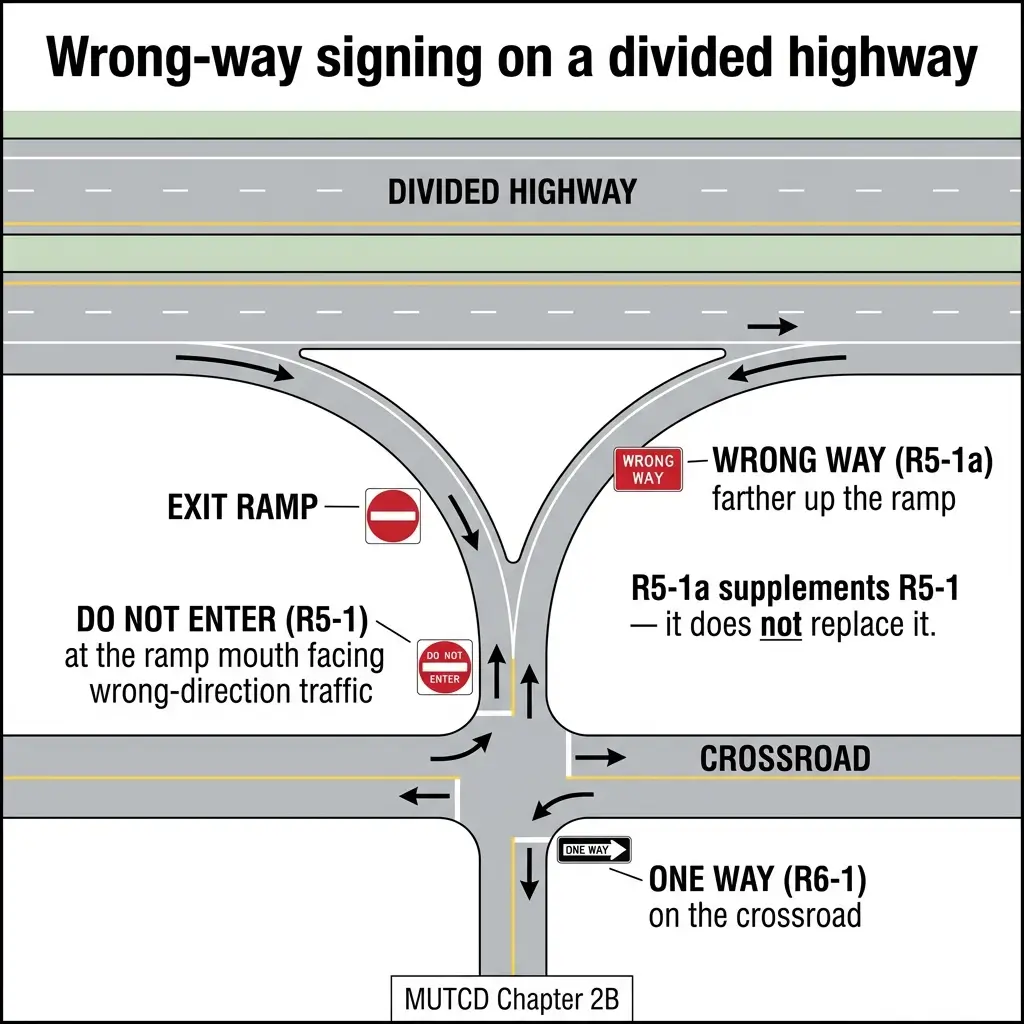
Signs 4 and 5 are a pair and are frequently confused. DO NOT ENTER (R5-1) faces the driver who is about to enter a one-way roadway or ramp in the wrong direction. WRONG WAY (R5-1a) is a supplement placed farther along that ramp or roadway, for the driver who has already made the error. If you only install one of them, install the first.
The regulatory points I check on a site approach are:
- Position over presence — is the sign at the point of decision, or at the point where the post was easy to drive?
- Facing — DO NOT ENTER should be turned or shielded from traffic it does not apply to, or it teaches drivers to ignore it
- Shape integrity — nothing mounted on the back of a STOP, YIELD or Crossbuck that breaks its silhouette
- Retroreflection — regulatory signs must be retroreflective or illuminated, and street lighting does not satisfy that requirement
Warning signs (9–17): what the road is about to do
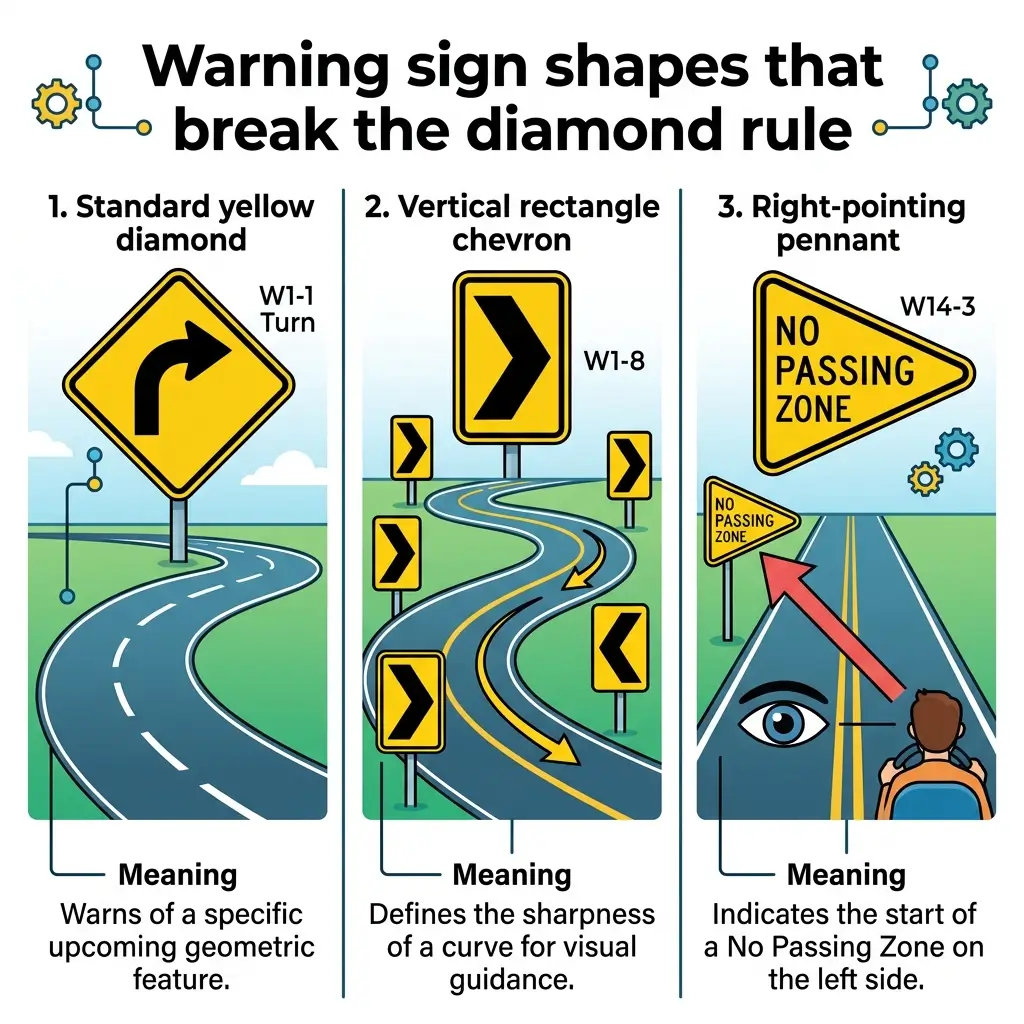
Warning signs give notice of a situation that might not be readily apparent. The yellow diamond is the default carrier, with two deliberate exceptions in this group: the chevron (W1-8), which is a vertical rectangle repeated through a curve rather than a single advance sign, and the No Passing Zone pennant (W14-3), which is the only sign in this list normally mounted on the left-hand side of the road.
That left-side placement catches people out. Ask a supervisor to audit the signing on a rural approach and they will walk the right shoulder, find no pennant, and record the run as compliant. The pennant is behind them on the other side, facing the same traffic.
Signs 11 and 12 — Stop Ahead and Signal Ahead — are the advance-warning half of a pair, and the MUTCD applies stricter retroreflectivity criteria to them because their red and green elements carry meaning. Table 2A-5 sets separate minimum levels for those coloured elements over and above the general yellow requirement.
Warning signs also age differently from regulatory signs. They sit on rural approaches, get hit by mowers and mud, and rarely generate a complaint when they fade, because the driver who needed one and did not get it is usually not around to file it.
The warning-sign failures I see most on live corridors are:
- Chevrons installed as a single sign rather than a repeated sequence through the curve
- Advance distance set by convenience, not by approach speed and decision time
- Vegetation growth — Section 2A.19 asks agencies to keep weeds, shrubbery and stored materials off the face of a sign, and this is the maintenance item that slips first
- Yellow used where the condition is temporary, when the whole set should have been orange
Crossing, school and pedestrian signs (18–20): where people meet vehicles
This group exists because the consequence of a miss is a person rather than a fender. The MUTCD gives pedestrian, bicycle and school warning signs their own colour — fluorescent yellow-green — so that they separate visually from the general yellow warning family, and gives the school sign an exclusive pentagon shape on top of that.
Sign 20 is really two devices working together. The Crossbuck (R15-1) is the passive control at the crossing itself, and its shape is exclusive to it; the circular W10-1 is the advance warning, and the circle is exclusive to that. A driver who sees a yellow circle on a rural approach should already be looking for track.
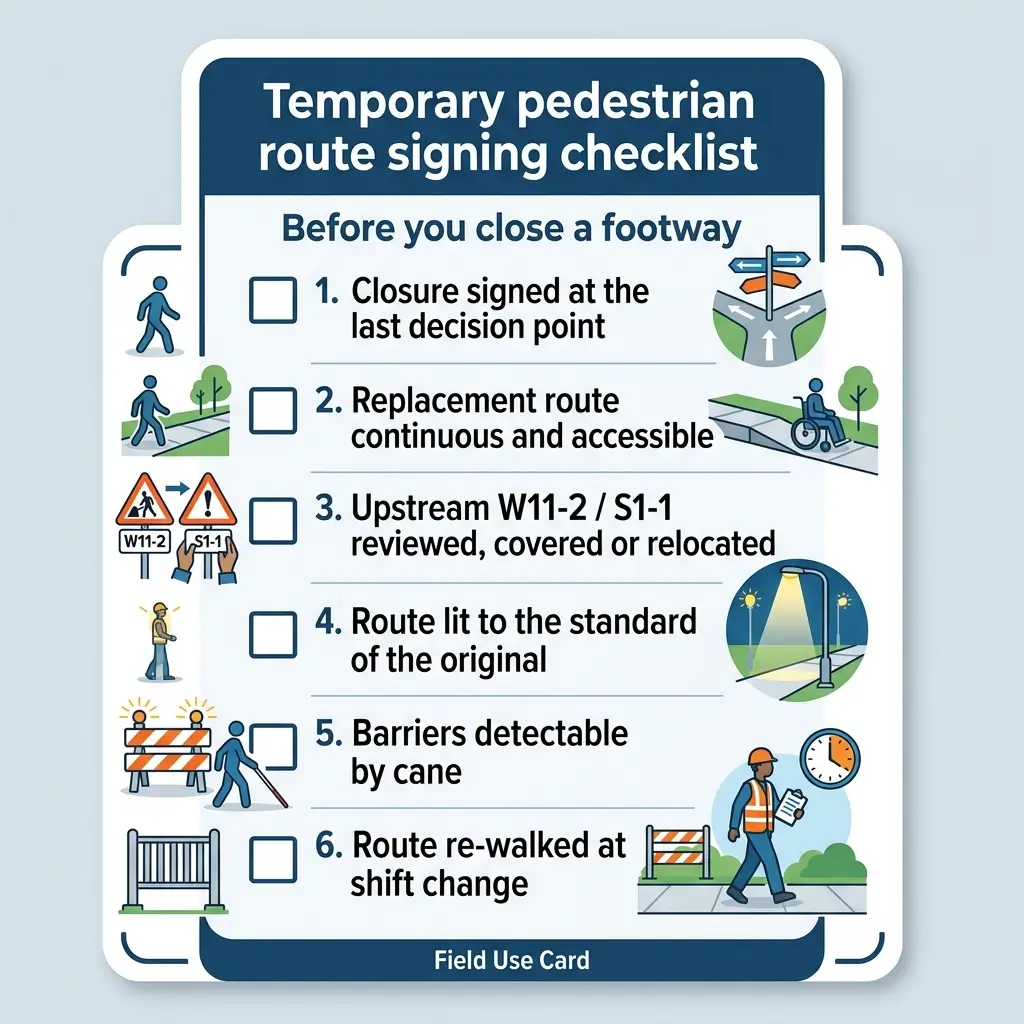
For a construction reader, the point of this group is temporary pedestrian routing. When a footway closes, the permanent pedestrian warning signs upstream are now pointing people at a route that no longer exists — and a diverted pedestrian route needs its own signing rather than a cone line and hope.
Before closing any footway on a live corridor, confirm the following:
- The replacement route is signed at the point people commit to it, not at the point they discover the closure
- The route is usable by a wheelchair user and a person with a white cane, and not only by someone walking unaided
- Permanent W11-2 and S1-1 signs upstream are reviewed against the temporary layout, and covered or relocated if they now mislead
- The diverted route is lit to the same standard as the one it replaces
Work zone signs (21–25): the orange family
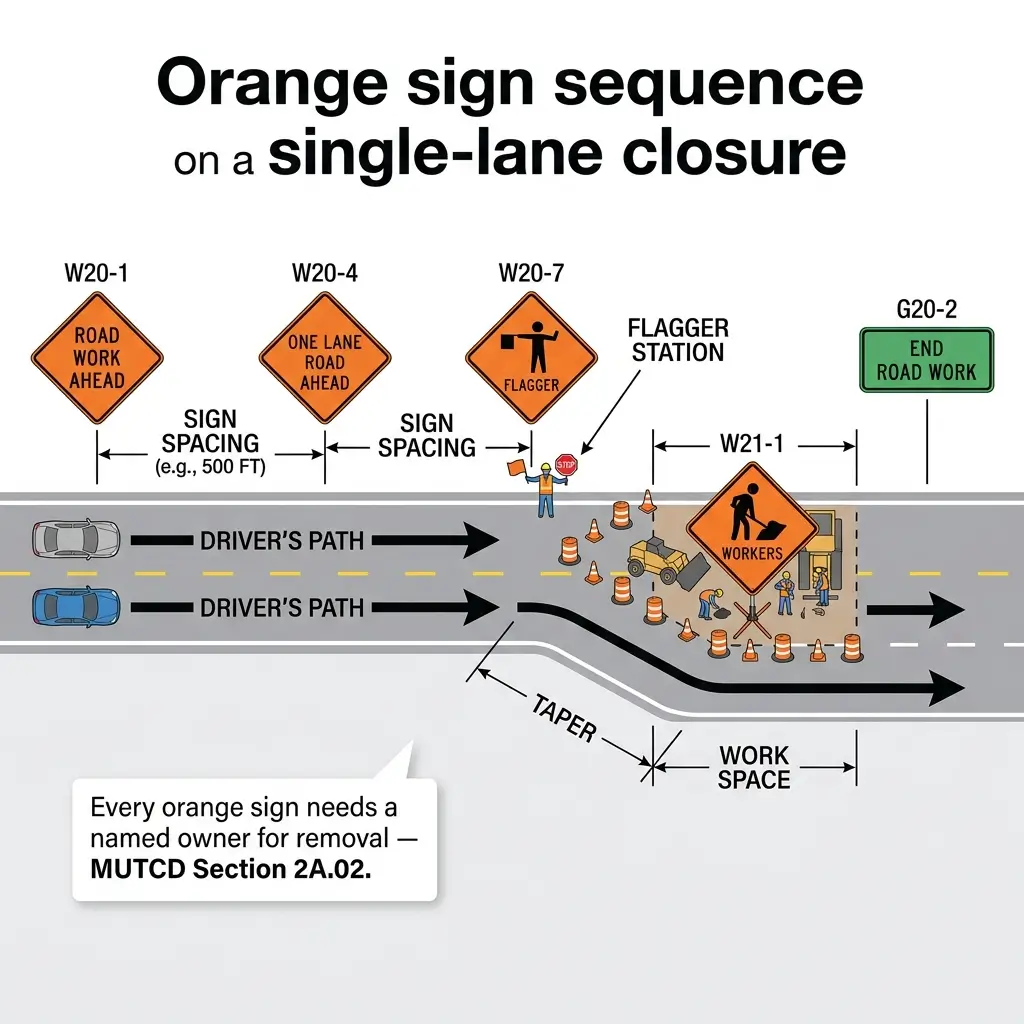
Orange is the only colour in this article that carries a time limit. A temporary traffic control sign says the layout is not the permanent one, and the corollary — the part crews forget — is that the sign becomes a hazard the moment the condition it describes stops being true. MUTCD Section 2A.02 is explicit that signs required by road conditions or restrictions must be removed when those conditions cease, and OSHA says the same thing from the employer's side: under 1926.200(a), signs required by Subpart G must be visible at all times while work is being performed, and removed or covered promptly once the hazard no longer exists.
The five signs here are the minimum vocabulary of a lane closure. ROAD WORK AHEAD (W20-1) is the general warning that a work zone begins. ONE LANE ROAD AHEAD (W20-4) tells a driver they will be sharing a single lane with opposing traffic. Flagger (W20-7) and Workers (W21-1) are both listed by the MUTCD as bold symbol signs, which puts them in the higher retroreflectivity band — the manual treats them as signs that have to be seen from a distance, at night, in the rain. END ROAD WORK (G20-2) closes the sequence.
Two US rules sit behind the flagger sign. 29 CFR 1926.201(a) requires that flagging, the use of flaggers, and the warning garments flaggers wear conform to MUTCD Part 6. Separately, 23 CFR Part 634 requires every worker on foot within the right-of-way of a federal-aid highway who is exposed to traffic or construction equipment to wear high-visibility apparel meeting ANSI/ISEA 107 Performance Class 2 or 3. The W20-7 sign is a promise to the driver that a trained person is ahead; the two rules above are what make the promise true.
The work-zone signing questions I ask at a pre-start are:
- Who owns removal of each orange sign, and at what trigger — end of shift, end of stage, or end of contract?
- Is the advance sign spacing set from the approach speed, or copied from the last job?
- Has anyone driven the taper at night, in the direction the public drives it?
- Does the flagger have a trained relief, or does the station go unmanned at breaks?
- When the work pauses over a weekend, which signs get covered, and who checks the covers held?
What the law actually requires: US, UK and international
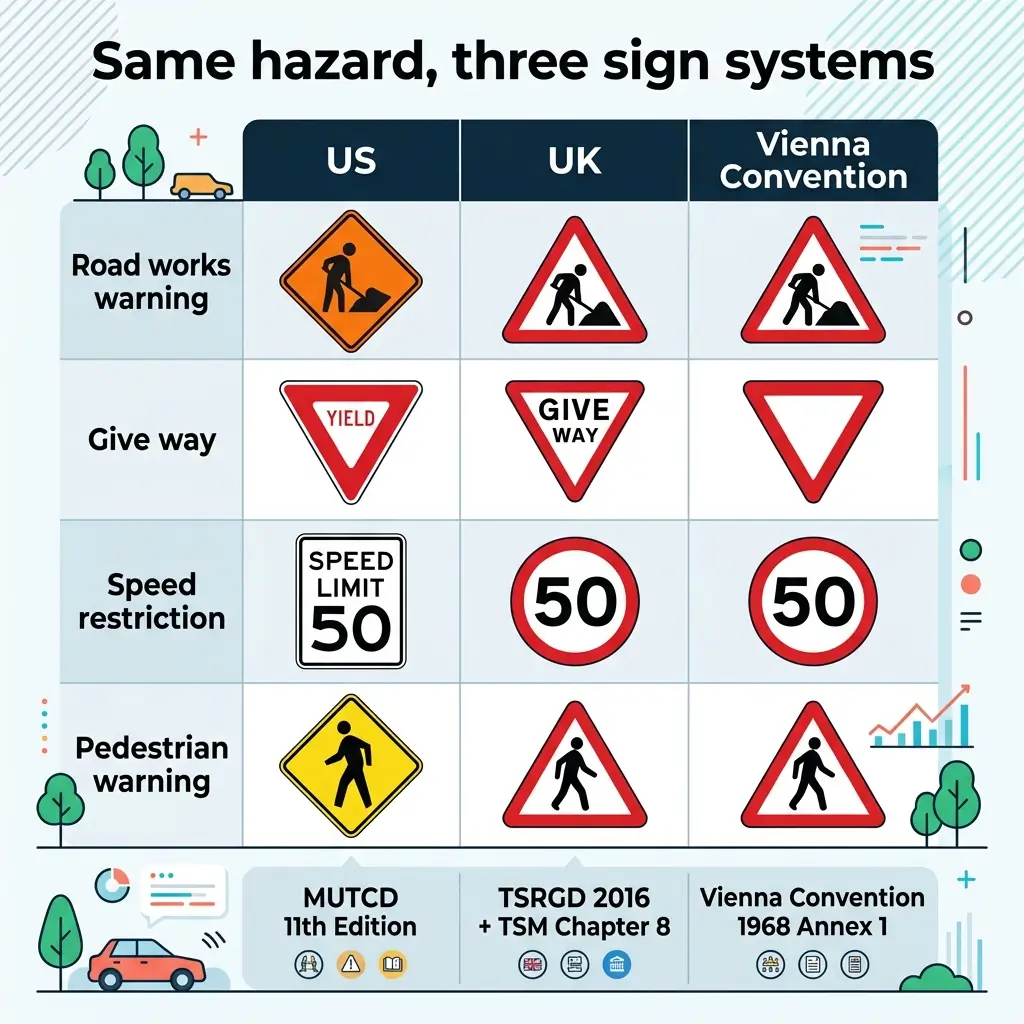
Three separate legal systems govern the signs in this article, and a contractor working across them cannot assume one procedure satisfies all three. In the US the split runs between the highway authority's duty and the employer's duty; in the UK it runs between a statutory instrument and a code of practice with statutory backing; internationally it runs through a UN treaty the US is not party to.
The wrinkle worth knowing in the US is an edition mismatch. The FHWA's current national standard is the 11th Edition of the MUTCD, published December 2023 and effective 18 January 2024, which states had to adopt or substantially conform to by 18 January 2026. OSHA's construction standards, however, incorporate the 2009 Edition by reference at 29 CFR 1926.6. Comply with the current state-adopted edition and you will satisfy both; assume the two documents are the same book and you will eventually be surprised in an inspection.
| Requirement | United States | United Kingdom | International |
|---|---|---|---|
| Sign design standard | MUTCD 11th Edition (FHWA) | TSRGD 2016 | Vienna Convention on Road Signs and Signals 1968 (UNECE) |
| Work zone / temporary signing | MUTCD Part 6 | Traffic Signs Manual Chapter 8 | National implementation of the Convention |
| Worker protection duty | 29 CFR 1926.200(g), .201, .202 | Safety at Street Works and Road Works: A Code of Practice, backed by ss. 65 and 124, New Roads and Street Works Act 1991 | ISO 39001 (road traffic safety management systems) |
| High-visibility apparel | 23 CFR 634 — ANSI/ISEA 107 Class 2 or 3 | Chapter 8 and the Code of Practice | EN ISO 20471 in most European jurisdictions |
| Warning sign shape | Yellow or orange diamond | Red-bordered triangle | Triangle (Model Aa) or diamond (Model Ab) |
The differences that catch multinational contractors out are:
- Warning shape flips — a European crew reads a red-bordered triangle as "warning"; in the US that shape means YIELD and nothing else
- Temporary colour differs — orange in the US, black-on-yellow in the UK
- The UK Code of Practice has statutory backing through the New Roads and Street Works Act 1991, while Chapter 8 itself is guidance in Great Britain
- The Vienna Convention permits variation — danger warning signs may be triangular or diamond, and markings may be white or yellow, so "Vienna-compliant" does not mean identical across borders
Where signing fails on real sites
This is the section the sign catalogues do not write, and it is where the injuries come from. FHWA's compilation of NHTSA FARS data records 850 work zone fatalities in 2024, down from 905 in 2023, with 169 of those being pedestrians and pedalcyclists — a category that includes construction, maintenance and utility workers on foot. More than half of fatal work zone crashes that year occurred at night, and speed was a factor in over a third.
Set against those figures, the failures I document are unglamorous. Not one of them is a sign selection error.
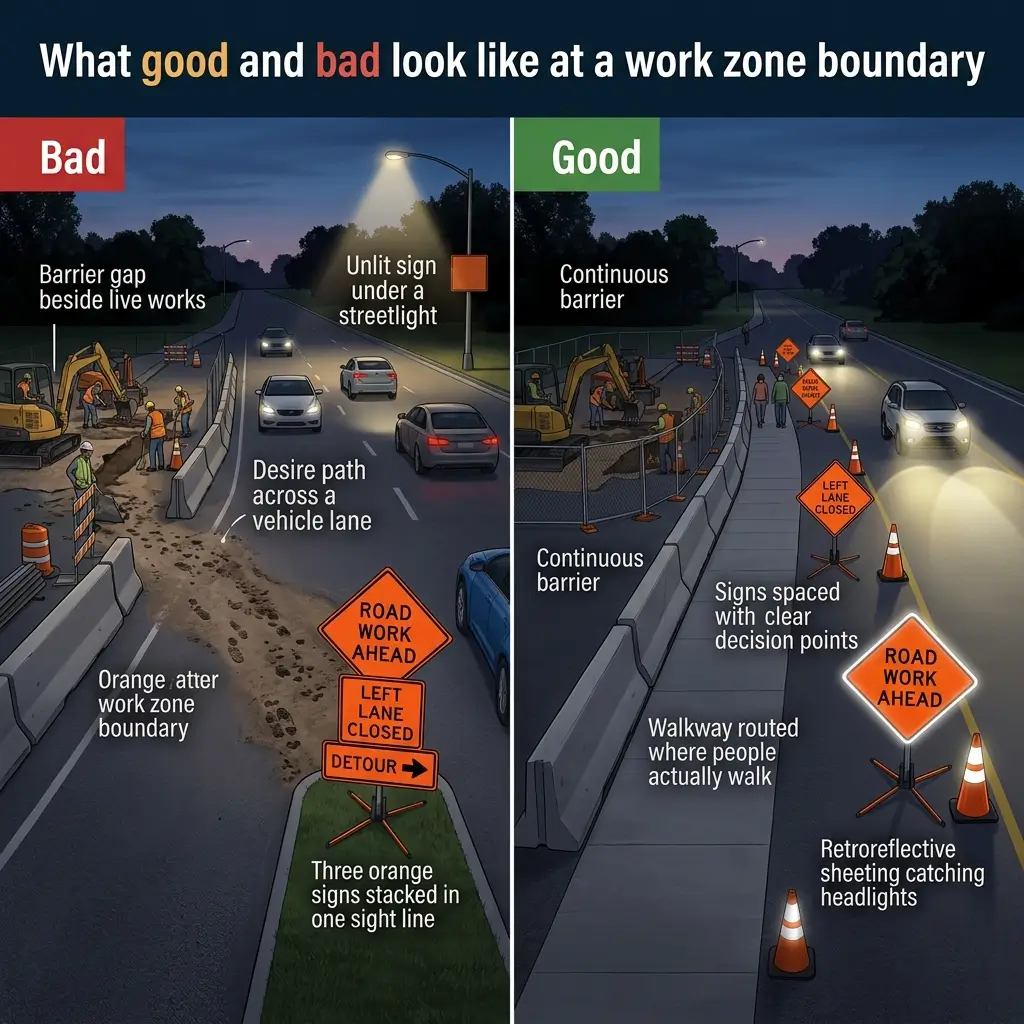
The barrier that had a gap in it. On a public interface package for Skanska USA Civil, I found a gap in the barrier line separating the public from live works during a routine walkdown. The signing upstream was correct and the drawing was correct; the physical line that the signing promised was not continuous. I stopped the pattern, had the controls reinstated, and briefed the crew before restart. Follow-up observations on that sector showed fewer repeats. The transferable point is narrow and worth taking: a sign is a promise about a physical arrangement, and only the physical arrangement can be audited. Read the sign, then walk the line it describes.
The route people actually took. On a Turner Construction assignment in Houston I found a desire path worn across a live vehicle lane. Nobody had decided to walk there. The signed route had become inconvenient enough that a shorter one formed, and once it formed it was self-reinforcing. Same response — stop, reinstate, brief before restart. Where a desire path exists, the segregation signing has already lost the argument, and adding another sign to the same layout will not win it back.
The night gap. Sign visibility is not a daytime property, and I have run night-shift control integrity work on more than one civils contract for exactly this reason. The MUTCD is direct on the underlying point: street or highway lighting does not satisfy a requirement for sign illumination, and agencies must run an assessment or management method to keep retroreflectivity at or above the levels in Table 2A-5. A layout signed and approved at 2pm has not been verified until someone has driven it at 2am.
The recurring failure modes, and what each one actually needs, are:
| Failure mode | What it looks like | What fixes it |
|---|---|---|
| Sign outlives the condition | Orange signs standing after the work finished | Named owner and removal trigger per sign |
| Signed route abandoned | Desire path worn across a live lane | Re-route to where people walk, then re-sign |
| Promise without the physical control | Correct signing, discontinuous barrier | Walk the line the sign describes |
| Daytime-only verification | Layout approved at 2pm, never driven at night | Night drive-through in the public's direction |
| Sign clutter | Six signs in one sight line, none read | Remove, relocate or space per Section 2A.20 |
Three questions separate a signing layout that works from one that only looks right on paper:
- Does the condition each sign describes still exist today?
- Can you walk the physical line the signing promises, end to end, without a gap?
- Has anyone verified the layout in the dark, travelling in the public's direction?
Traffic signs are not the same as ANSI Z535 facility signs
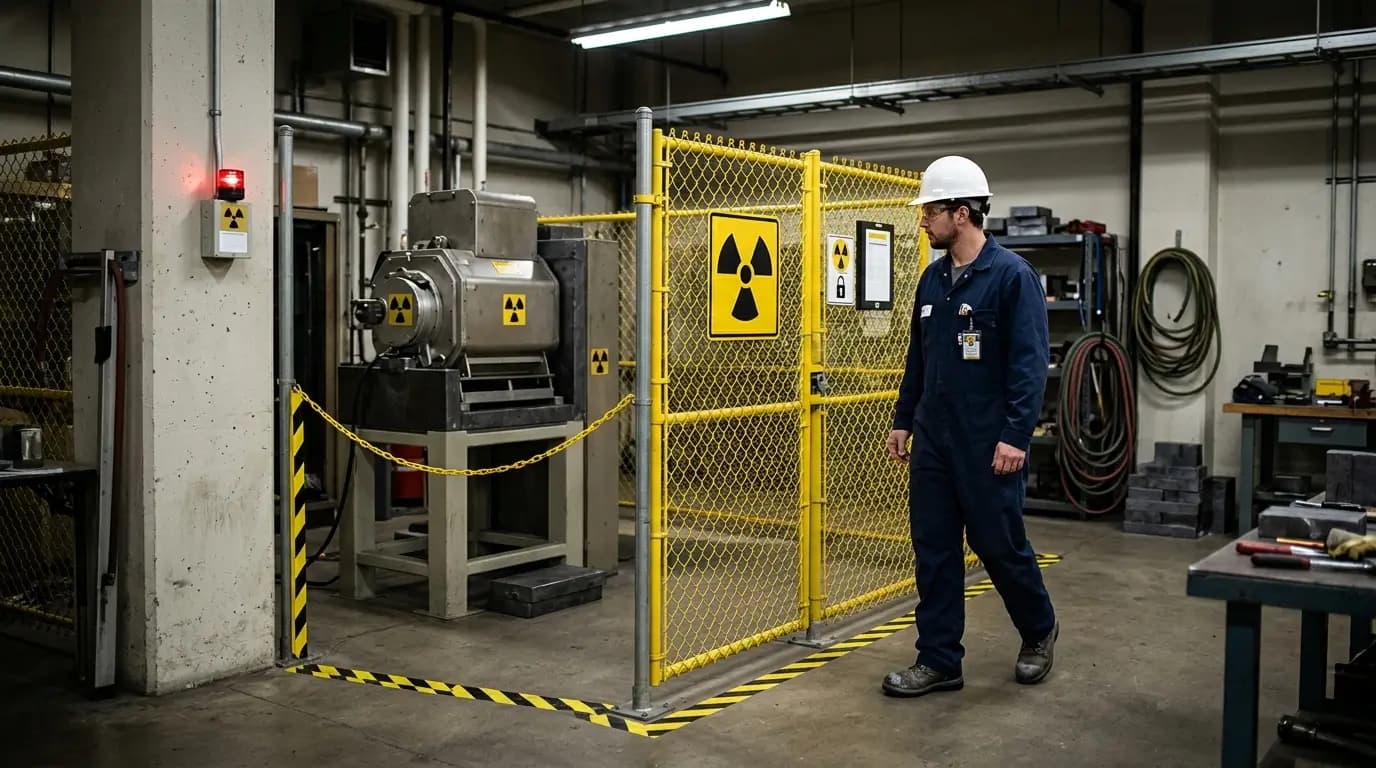
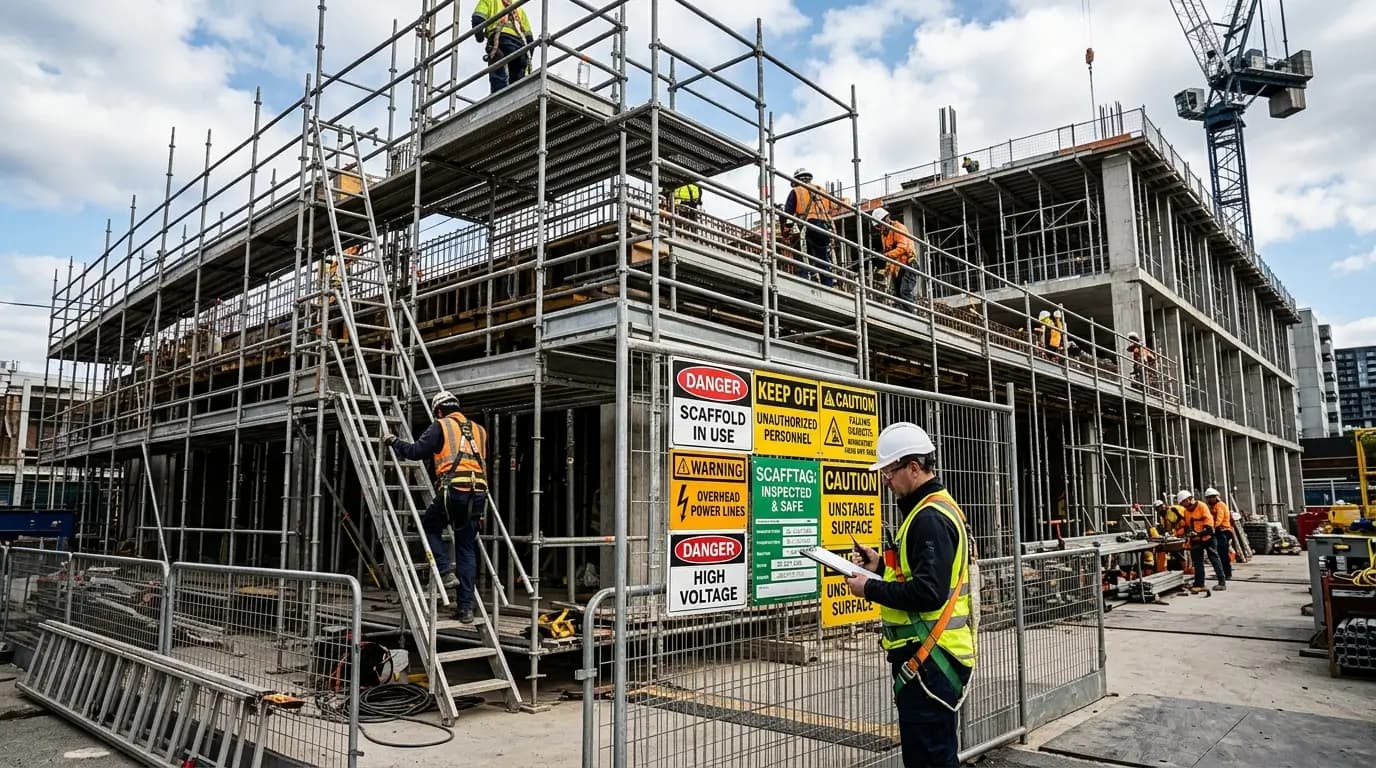
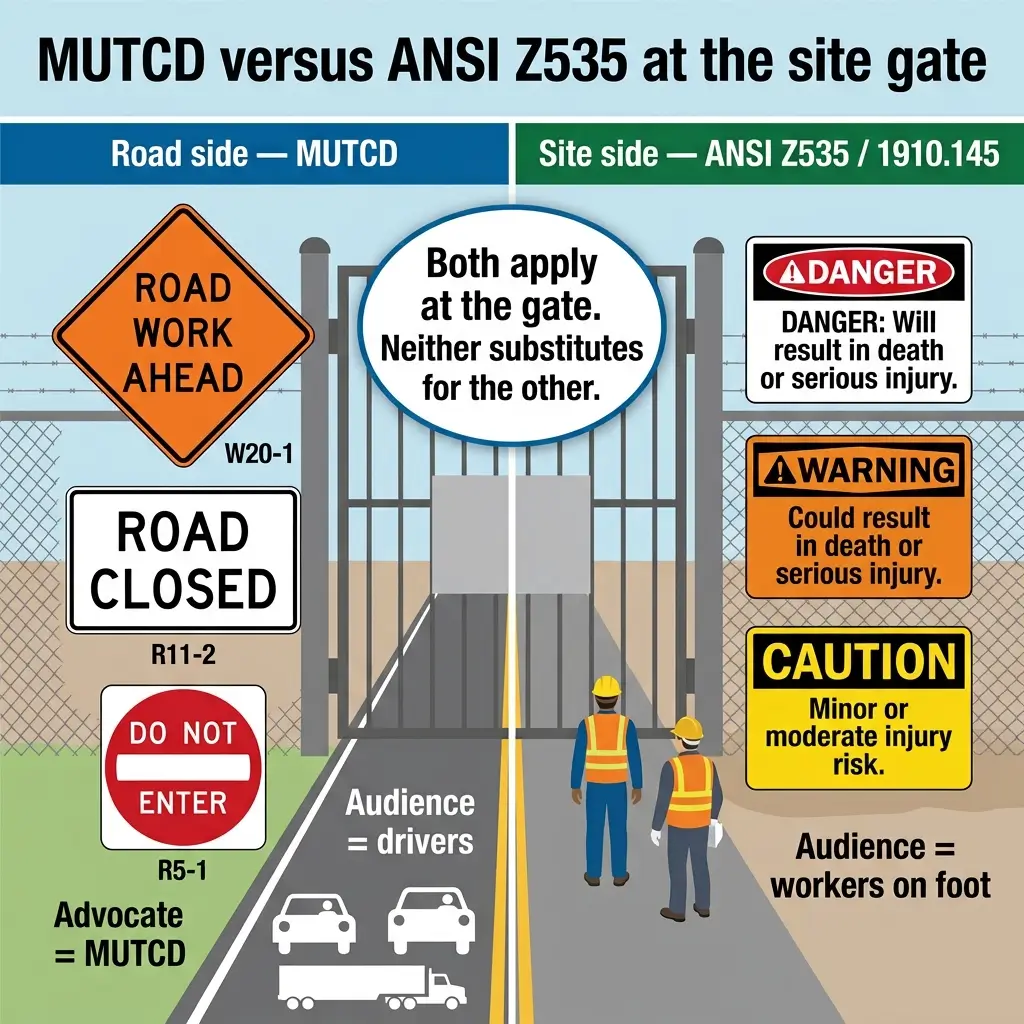
This distinction costs sites more than it should. The 25 signs above are traffic control devices, governed by the MUTCD and aimed at road users. The DANGER, WARNING and CAUTION signs on a plant fence are a different system entirely, governed in US general industry by 29 CFR 1910.145 and the ANSI Z535 series, and aimed at workers.
They meet at every site gate, and the failure is predictable: someone hangs a red-and-white DANGER board where a driver needs a regulatory or temporary traffic control sign, or paints a homemade orange diamond on plywood because the real one had not arrived. Neither device does the other's job. A driver at 45 mph is scanning for a shape and a colour that map to a road-user meaning, and an ANSI signal-word panel does not map to one.
The practical rule I give site teams is a boundary rule. Anything a person driving a vehicle on a public road will read is MUTCD. Anything a person on foot inside the site will read is 1910.145 and Z535. At the gate, both apply — to different audiences, on different posts.
The distinctions to hold in mind are:
- Audience — road users versus employees and site visitors
- Governing instrument — MUTCD Part 2 and Part 6 versus 29 CFR 1910.145 and ANSI Z535
- Design freedom — near zero for traffic signs; the MUTCD forbids substituting an alternative legend or design where a standard sign exists
- Legibility basis — approach speed and retroreflectivity versus a signal word readable at five feet or more
What I check when I audit work zone signing
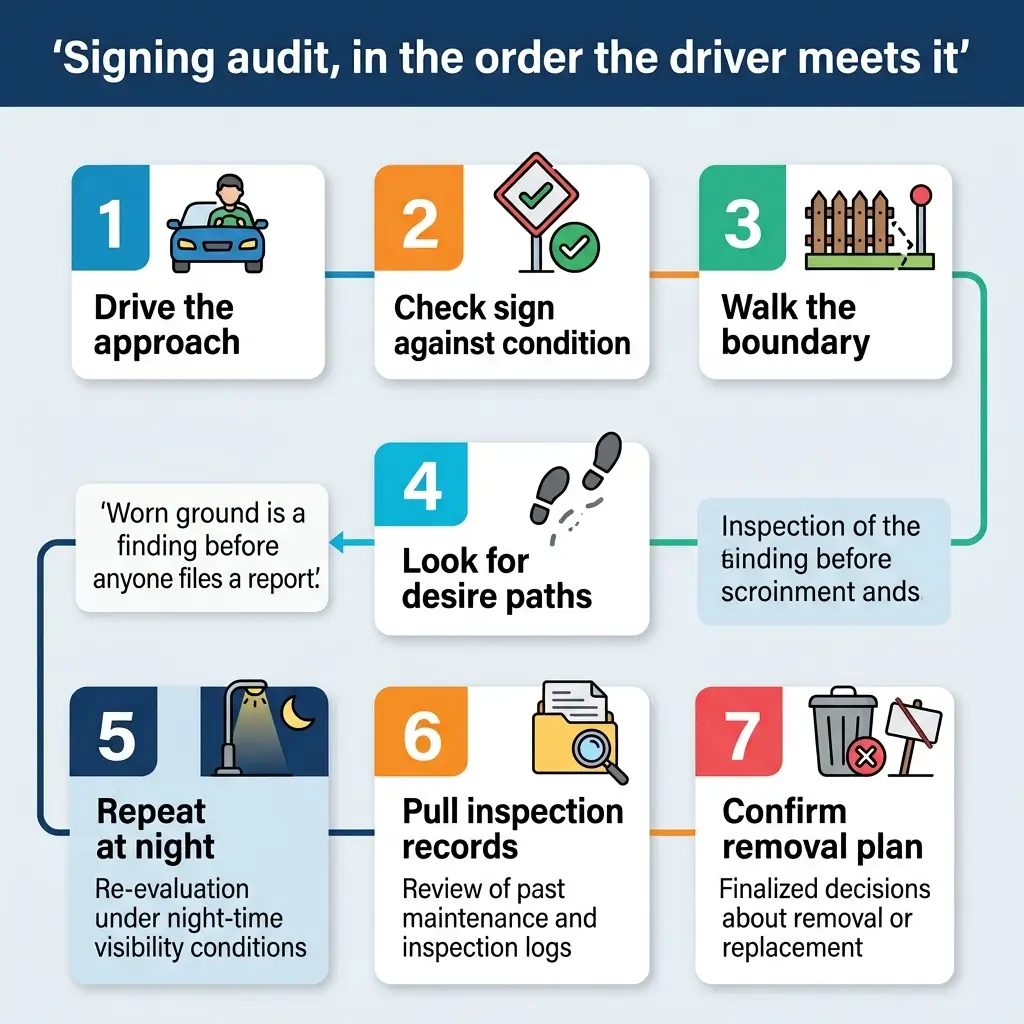
I audit signing in the order the driver meets it, not in the order the drawing lists it. That single change surfaces most of the findings, because a traffic management plan is drawn in plan view and experienced in elevation at speed.
I start upstream of the first advance sign and drive in. I want to know whether each sign appears with enough distance to act on it, whether any two of them compete for the same decision, and whether anything — a stockpile, a parked pickup, a hedge — has grown into a sight line since the layout was installed. Then I walk the same length on foot, because a barrier gap that is invisible at 45 mph is obvious at walking pace.
The last check is a records check, and it is the one that predicts whether the site will still be compliant next month. I ask who inspects the signing, how often, and where the record goes. If the answer names a role rather than a person, or a frequency rather than a trigger, the layout will drift.
The sequence I work through on a signing audit is:
- Drive the approach in the public's direction, at the posted speed, before reading any paperwork
- Check each sign against the condition it describes — does the condition still exist?
- Walk the boundary the signing promises, looking for gaps, not for signs
- Look for desire paths — worn ground tells you where the layout failed before anyone reports it
- Repeat at night if the work runs at night, in the same direction
- Pull the inspection records and check that the named inspector matches the person actually doing it
- Confirm the removal plan — who takes each temporary sign down, and on what trigger
Frequently asked questions
These are the questions site teams and drivers ask most often about sign meanings and the rules behind them.
What are the three main types of traffic signs?
Regulatory, warning and guide. MUTCD Section 2A.03 defines them by function: regulatory signs give notice of traffic laws, warning signs give notice of a situation that may not be readily apparent, and guide signs show routes, destinations, distances and services. Temporary traffic control signs are warning or regulatory signs rendered in orange.
What do traffic sign shapes mean?
Shape identifies the sign before the legend is legible. An octagon is only ever a stop sign, a downward-pointing equilateral triangle only ever a yield sign, a circle only ever the grade crossing advance warning, and an upward pentagon only ever a school sign. A diamond means warning; a rectangle means regulatory or guide.
Why are work zone signs orange?
Orange marks a temporary condition. It separates work zone signing from the permanent yellow warning family so a driver knows the layout in front of them is not the one they learned. The corollary is that an orange sign left up after the work ends is actively misleading and must be removed.
Are OSHA and MUTCD sign requirements the same?
They are linked but not identical. 29 CFR 1926.200(g)(2) and 1926.201(a) require traffic control devices and flagging protecting construction workers to conform to MUTCD Part 6. OSHA incorporates the 2009 Edition by reference at 1926.6, while state DOTs now work to the 11th Edition, so check which edition your contract and state supplement name.
How often should traffic signs be inspected?
The MUTCD asks agencies to establish a schedule for inspecting signs both day and night, and to use an assessment or management method that keeps retroreflectivity at or above the minimum levels. For temporary work zone signing the practical answer is different — inspect at every shift change, and again whenever the work stage changes.
Do traffic signs have to be lit at night?
They must be retroreflective or illuminated so that they show the same shape and similar colour by day and night. The MUTCD is explicit that street or highway lighting does not satisfy a requirement for sign illumination. In the UK, TSRGD 2016 changed the mandatory lighting requirement for many temporary signs, leaving the decision to the designer's risk assessment.
What is the difference between a DANGER sign and a warning traffic sign?
Different systems, different audiences. DANGER, WARNING and CAUTION signs come from 29 CFR 1910.145 and the ANSI Z535 series and are aimed at workers on foot inside a facility. Yellow and orange warning traffic signs come from the MUTCD and are aimed at road users. Neither can substitute for the other.
About the author
Jack Peterson is a Principal Construction & Infrastructure HSE Assurance Consultant with 18 years of hands-on experience across 14 countries, 17 of them in the field. He specialises in field verification of controls under night shift, contractor and schedule pressure, and has led public interface and highway corridor assurance work including a Highway Corridor HSE Lead role at Webuild and a Public Interface Safety Advisor role at Skanska USA Civil. He currently leads Peterson Construction Safety Partners in Houston, after senior roles with Turner Construction, Kiewit Infrastructure, Dragados USA, FCC Construction and Hochtief Infrastructure.
Credentials: NEBOSH International General Certificate; ISO 45001 Lead Auditor; ISO 14001 Internal Auditor; IOSH Managing Safely; incident investigation (ICAM or equivalent pathway).
Sources and further reading
- FHWA, Manual on Uniform Traffic Control Devices, 11th Edition, Chapter 2A — General (shapes, colours, retroreflectivity, mounting, maintenance)
- FHWA, MUTCD 11th Edition, Chapter 2B — Regulatory Signs
- FHWA, MUTCD 11th Edition, Part 6 — Temporary Traffic Control
- Federal Register, National Standards for Traffic Control Devices; MUTCD Revision, final rule
- FHWA, State adoption status of the MUTCD
- OSHA, 29 CFR 1926.200 — Accident prevention signs and tags and 29 CFR 1926.201 — Signaling
- OSHA, 29 CFR 1910.145 — Specifications for accident prevention signs and tags
- eCFR, 29 CFR 1926.6 — Incorporation by reference
- FHWA, 2026 National Work Zone Awareness Week fact sheet, FHWA-HOP-26-060 (FARS 2024 data)
- National Work Zone Safety Information Clearinghouse, work zone fatal crashes and fatalities data
- Department for Transport, Traffic Signs Manual Chapter 8, Part 3 Update 2020
- The Traffic Signs Regulations and General Directions 2016 (SI 2016/362)
- UNECE, Convention on Road Signs and Signals, 1968, consolidated text