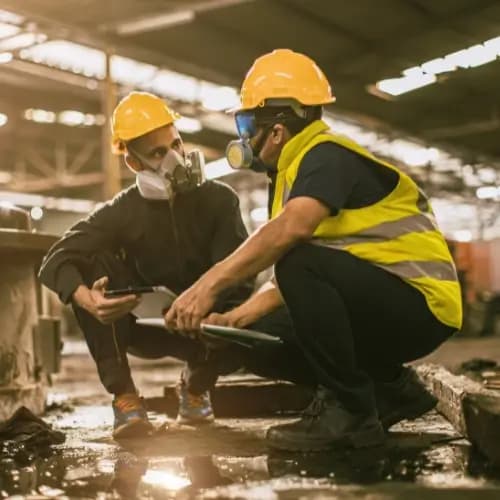


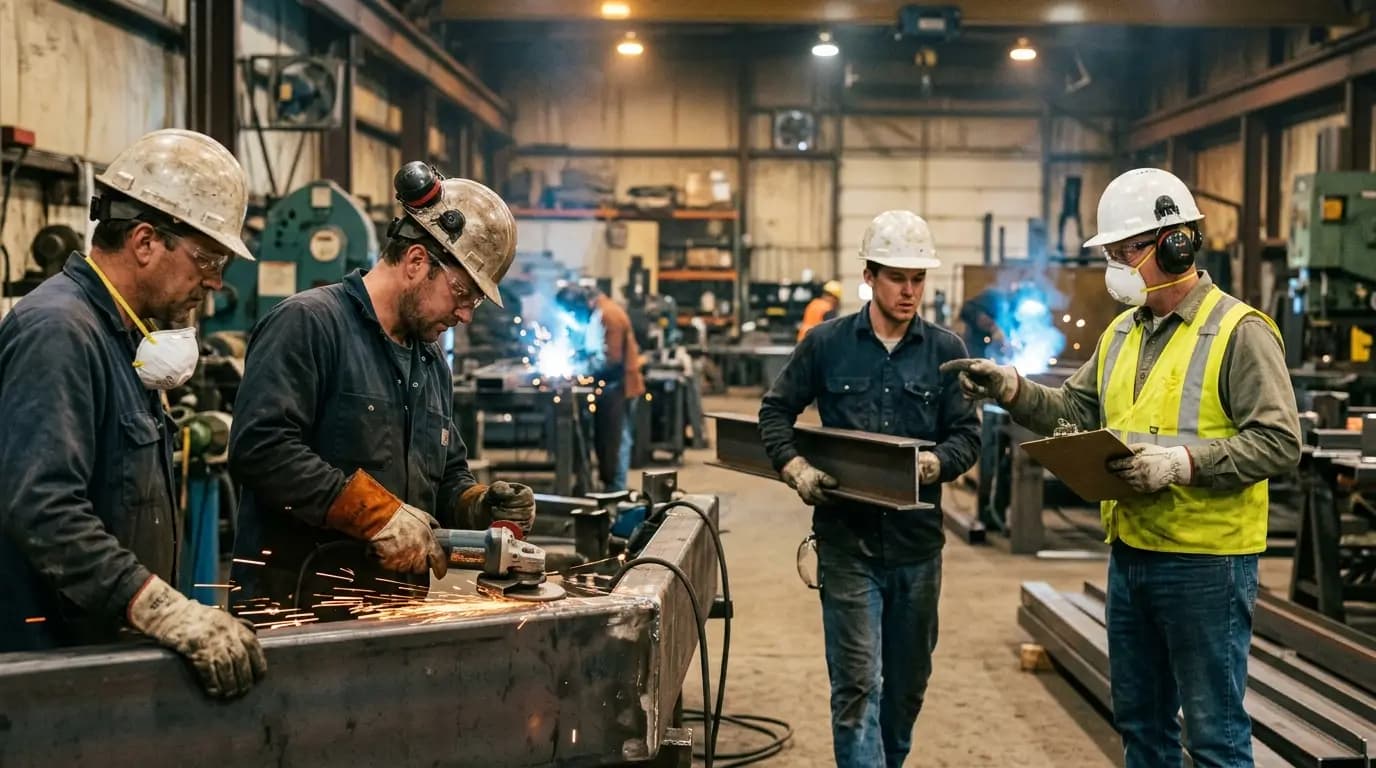
Nine of the ten reasons on this list are decisions someone made before the worker ever picked the item up. Sizing, selection, storage location, attenuation rating, shift length, who walks the floor at 03:00 — all of that is set upstream, and the person who takes the earplug out at hour six is living with the result.
That framing is not a soft one. It is the position the regulator has already taken. When OSHA finalised the revision to its construction PPE standard, the agency wrote that improperly fitting PPE may fail to protect, may create new hazards, or may discourage employees from using such equipment. Non-compliance appears in the rulemaking record as a foreseeable consequence of a procurement decision.
I have spent fifteen years in human factors and fatigue work across semiconductor fabs, spirits packaging halls, mine sites, water treatment plants and urban construction. The pattern holds everywhere. Where PPE use is poor, something about the work or the equipment made it poor, and it is usually visible within twenty minutes of walking the job. This article covers the ten reasons, what each one is actually telling you, and what to go and look at.
Key takeaways
Six points carry most of the argument that follows:
- OSHA's own rationale for the 2024 fit revision to 29 CFR 1926.95(c), effective 13 January 2025, names discouraged use as a consequence of poor fit — the compliance problem is written into the standard's justification.
- Two PPE standards sit in OSHA's final FY2025 Top 10: respiratory protection (1910.134) at fifth and construction eye and face protection (1926.102) at ninth.
- In the 2025 ISEA / J. J. Keller employer study, 56% of employers said workers simply did not want to wear PPE and 48% said workers did not think it was needed — but 55% also could not source large enough sizes and 52% could not source small enough ones.
- Over-specified PPE causes removal. HSE states plainly that hearing protectors taking the level at the ear below 70 dB should be avoided because users tend to take them off.
- Wearing PPE and being protected by it are different things. Expired insulating gloves, an unfit-tested respirator and a glove chosen against the wrong solvent all read as compliant from across the shop floor.
- In Great Britain, PPE duties under PPER 1992 were extended to limb (b) workers on 6 April 2022, which brings most agency and casual labour inside the same free-of-charge provision, training and maintenance obligations as employees.
What the law says about whose problem this is
Both sides carry duties, but they are not symmetrical. The employer's duties are extensive and come first in sequence; the worker's duty is to use what has been correctly selected, provided and explained. An article that opens with worker responsibility has the order backwards, and so does an enforcement programme built the same way.
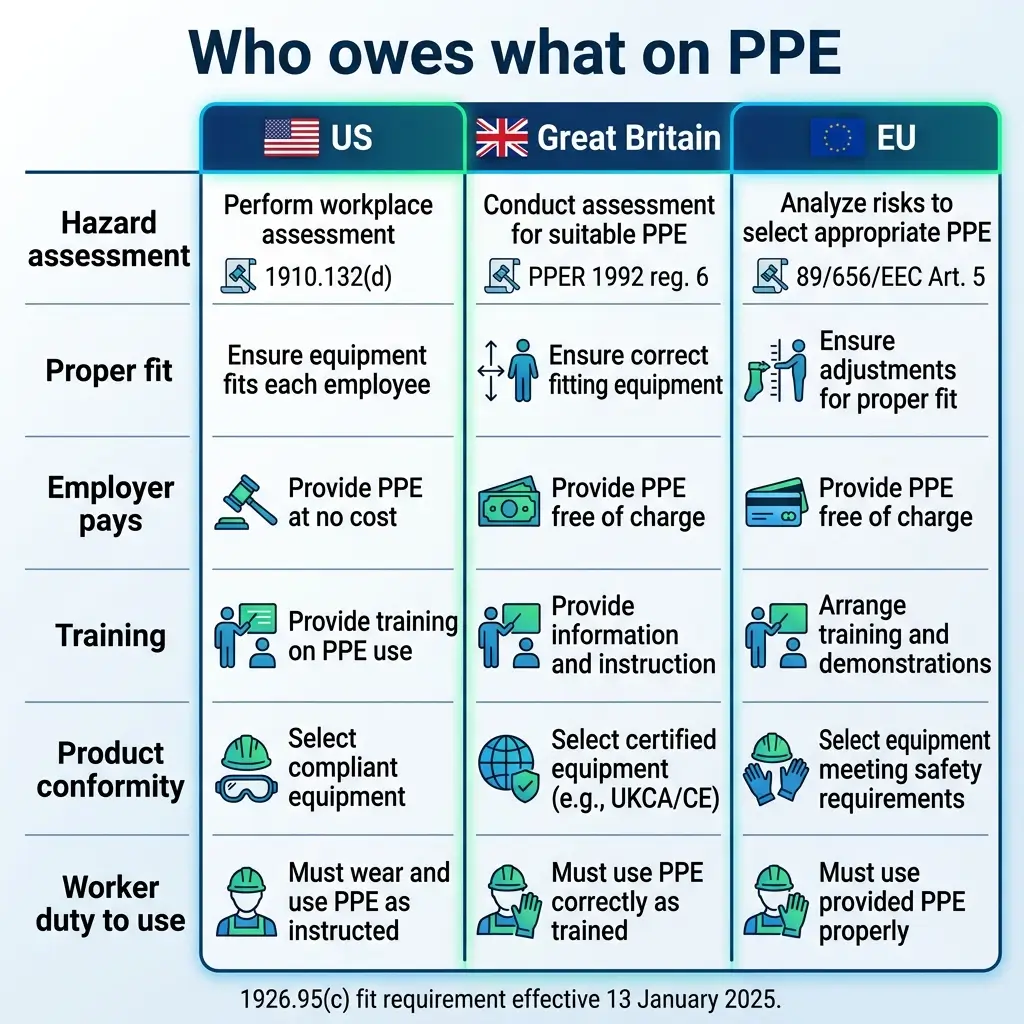
In the United States, 29 CFR 1910.132 carries four duties in sequence. The employer must assess the workplace for hazards before selecting anything. The PPE selected must properly fit each affected employee. Training must be given, and each employee must demonstrate understanding of it. And under paragraph (h), the employer pays — with narrow exceptions for ordinary safety-toed footwear and prescription safety eyewear taken off site. The construction equivalent at 1926.95(c) was aligned to the same fit language with effect from 13 January 2025.
In Great Britain, the Personal Protective Equipment at Work Regulations 1992 sit under sections 2 and 9 of the Health and Safety at Work etc. Act 1974, and were amended by the PPE at Work (Amendment) Regulations 2022 to extend the same duties to limb (b) workers from 6 April 2022. That change matters more than it sounds. Agency packers, casual harvest crews and short-contract cleaners are exactly the populations where PPE use is worst, and until 2022 the provision duty did not clearly reach them.
The table below sets out where the main duties sit across the three jurisdictions this site's readers work in.
| Duty | United States | Great Britain | EU |
|---|---|---|---|
| Assess hazards before selecting | 1910.132(d) | PPER 1992 reg. 6 | Directive 89/656/EEC Art. 5 |
| Must properly fit the wearer | 1910.132(d)(1)(iii); 1926.95(c) from 13 Jan 2025 | PPER 1992 reg. 4 (suitability) | 89/656/EEC Art. 4 |
| Employer pays | 1910.132(h), with listed exceptions | HSW Act 1974 s.9 — no charge to workers | Art. 4(6) |
| Training and demonstrated understanding | 1910.132(f) | PPER 1992 reg. 9; MHSWR 1999 reg. 13 | Art. 6 |
| Product conformity | ANSI/ISEA and NIOSH approval by type | UKCA marking | Regulation (EU) 2016/425 |
| Worker duty to use it | Enforceable by the employer; 29 CFR 1977.22 confirms discipline for refusal is not protected activity | HSW Act 1974 s.7; PPER 1992 reg. 10 | Art. 6 |
Two points on that last row are worth holding on to. OSHA does not cite workers, so a worker's refusal becomes an employer enforcement question rather than a regulatory one — and 29 CFR 1977.22 makes clear that discipline applied solely for refusing to follow a valid safety rule is not ordinarily discriminatory retaliation. In Great Britain the worker's duty under section 7 is a criminal one, but in practice it is almost never the route enforcement takes.
Before reaching for a compliance campaign, confirm that the employer-side foundation is actually in place:
- A written hazard assessment that names the tasks, not the areas — "grinding at bench 4", not "workshop"
- Sizing range on the shelf, evidenced by what is stocked rather than what the catalogue offers
- Fit test records for every wearer of tight-fitting respiratory protective equipment, current for the make, model and size in use
- Training records showing demonstrated understanding, not attendance
- Free issue and free replacement, including for agency and limb (b) workers
- A named replacement route a worker can use at 02:00 without finding a supervisor
Reasons 1–4: the equipment does not work for the person wearing it
The first four reasons have nothing to do with attitude. They are properties of the object that was handed over, and each produces predictable removal behaviour that a supervisor then reads as defiance.
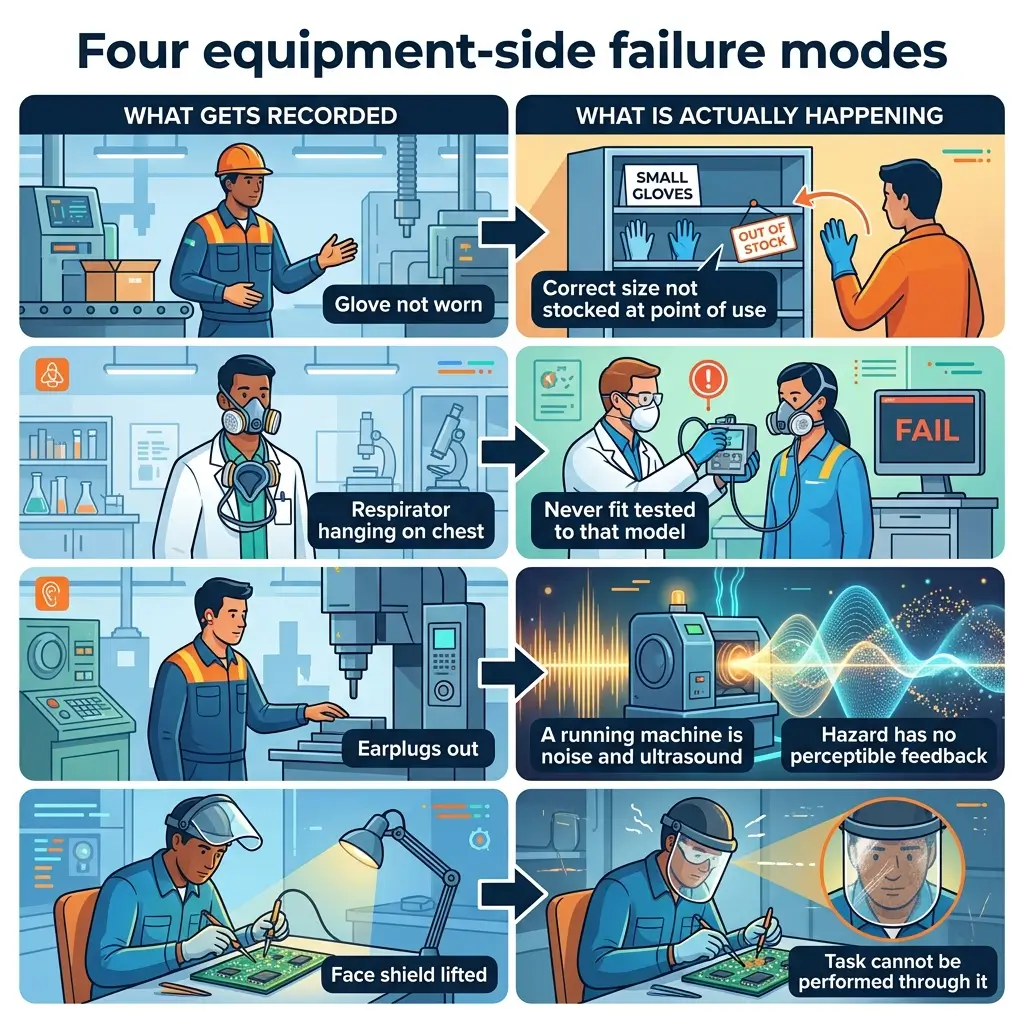
In each case the same substitution has happened between what gets recorded and what is true:
- Recorded as "would not wear gloves" — the correct size was not stocked at the bench
- Recorded as "mask worn incorrectly" — nobody ever tested the seal on that face
- Recorded as "complacent, long service" — the hazard produces no sensation to be complacent about
- Recorded as "removed PPE to work faster" — the task cannot physically be done in it
1. It does not fit them
Fit is the reason that outranks all the others, and it is the one most often mistaken for preference. A respirator that leaks at the chin, a glove that bunches at the web of the thumb, a harness with a chest strap that sits across the throat on a shorter torso — none of those are comfort complaints. They are protection failures that the wearer experiences as discomfort.
The supply side is a real constraint rather than an excuse. In the 2025 ISEA and J. J. Keller study, 55% of employers reported difficulty sourcing PPE in larger sizes and 52% reported the same for smaller sizes, and around a third had trouble finding options that fit women properly. That is not a workforce problem. That is a category that was built around a single assumed body and is still catching up.
I saw the sharp end of this on medical device assembly work, where a large proportion of the operator population was female and the glove range on the point-of-use dispenser started at a size that did not fit roughly a third of them. The recorded non-compliance was "gloves not worn during handling." The actual finding was that the correct size was three buildings away in central stores.
2. Nobody checked the seal, and nobody showed them how
Training is a table-stakes answer that most articles stop at. The sharper version is verification. Tight-fitting respiratory protective equipment only performs if it seals against that individual face, and the only way to know is to test it. HSE's guidance on RPE fit testing, INDG479, was revised in October 2025 and sets out when a test is required, which methods apply to which equipment, and what a fit test report must contain. A test result applies to that make, model, type and size only — swapping brand in a procurement round voids every record you hold.
That verification gap shows up in enforcement data. Respiratory protection under 1910.134 sits fifth in OSHA's final Top 10 most cited standards for FY2025, and the most frequently cited element is not workers refusing to wear respirators. It is employers skipping the medical evaluation that has to happen before anyone is issued one.
3. It protects against a hazard they cannot feel
Human risk perception runs on immediate feedback. A grinding wheel throws sparks and the eye protection makes obvious sense. Silica dust at a concentration that will matter in twenty years produces no sensation at all, and neither does 88 dB(A) on the third hour of a shift, because the temporary threshold shift makes the noise seem to have got quieter.
This is what sits behind the ISEA and J. J. Keller finding that 48% of employers said workers did not think PPE was needed. Read literally, that sounds like ignorance. Read properly, it is a mismatch between a hazard with a twenty-year latency and a control worn for eight hours a day with no perceptible benefit today.
The counter is not a poster about consequences. It is making the invisible measurable in front of the person: a real-time dust readout on the tool, a dosimetry result handed to the individual with their own number on it, a fit-test screen showing what the leak rate does when the strap is loose.
4. It makes the task measurably harder
Some PPE genuinely degrades performance, and pretending otherwise costs credibility with the people who do the work. Cut-resistant gloves reduce tactile feedback on small fasteners. Face shields fog. A full-face respirator narrows the peripheral field. The same ISEA and J. J. Keller study cited above is the source here too: 36% of employers reported that workers found PPE made their jobs more difficult. In most of those cases the workers are right.
The honest response is to treat that as a design input rather than an objection. Where the task cannot be done in the PPE, the task and the PPE are both wrong, and one of them has to move — usually the task, through tooling, jigs or a different sequence.
Reasons 5–7: the body reaches a limit before the shift does
The middle three reasons are physiological. They have a threshold, the threshold is reasonably predictable, and once it is crossed, removal is what a normal person does. Discipline aimed at this group will not work, because willpower is not the variable.
What makes these three different from the first four is that the removal is timed rather than immediate:
- Over-protection shows up as soon as someone needs to hear an instruction or an alarm
- Heat strain builds through a work period and peaks shortly before a scheduled break
- Item conflict appears when the job requires a posture the stack was never assessed in
Each of them will therefore be invisible to an observation programme that samples at the start of a shift.
5. It over-protects
This one is almost entirely absent from the advice available online, and it is one of the most common selection errors I find. More attenuation is not better. HSE's guidance on over-protection in hearing protection states that protectors reducing the level at the ear below 70 dB should be avoided. The wearer struggles to hear speech and warning signals and becomes isolated from their surroundings. In HSE's own words, they then tend to remove the hearing protection.
Think about what that means for a compliance programme. A site buys the highest SNR muff on the catalogue, believing it is being cautious. It has just built a control that the wearer will take off, in an environment where they now cannot hear a reversing alarm. The target is a protected level of roughly 70 to 80 dB(A) at the ear, calculated using one of the methods in HSE's L108, not the largest number available.
The same logic applies beyond noise. A powered respirator specified for a task that a half-mask covers is heavier, hotter and more likely to be parked on a bench.
6. It turns the task into a heat problem
Impermeable coveralls, arc-rated layers and full-face respirators all reduce the body's ability to shed heat. Add physical work and ambient temperature and the wearer reaches a physiological limit that has nothing to do with motivation. Removal at that point is a self-preservation response, and it usually happens in the least controlled place available.
The regulatory position in the United States is still unsettled. There is no comprehensive federal heat standard; OSHA's heat injury and illness prevention rulemaking opened in August 2024 and has not been finalised, so federal enforcement runs through the General Duty Clause, alongside state standards in California, Oregon, Washington, Minnesota, Colorado and Maryland. Internationally, ISO 7243 gives the WBGT method for assessing heat stress, and the clothing adjustment is the part people skip.
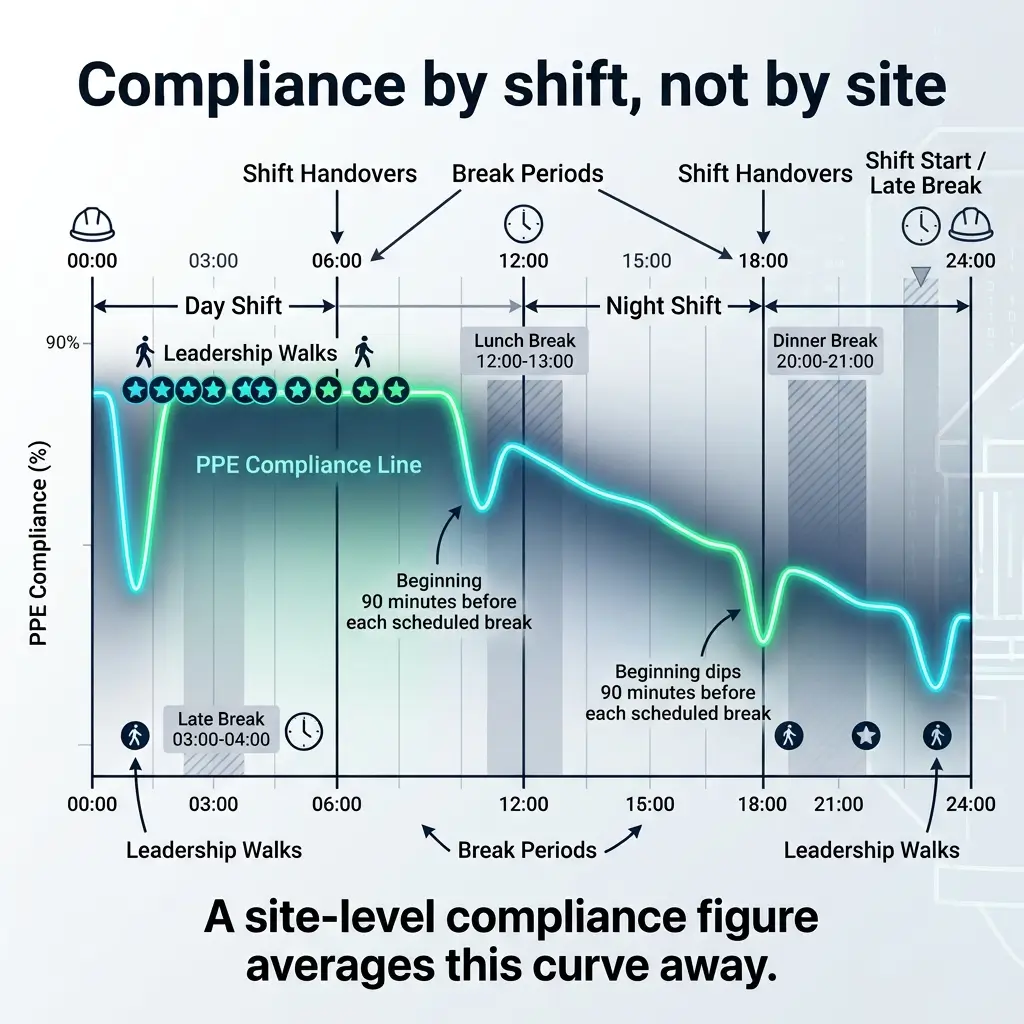
Where PPE is driving the heat load, the controls are work–rest cycling, cooling garments, scheduling the task outside peak temperature, and acclimatisation for anyone new or returning after a week away. Running night-shift packaging work at Diageo, the pattern I kept seeing was that heat-driven removal clustered in the last ninety minutes before a break, which is a rostering finding, not a behavioural one.
7. The items fight each other
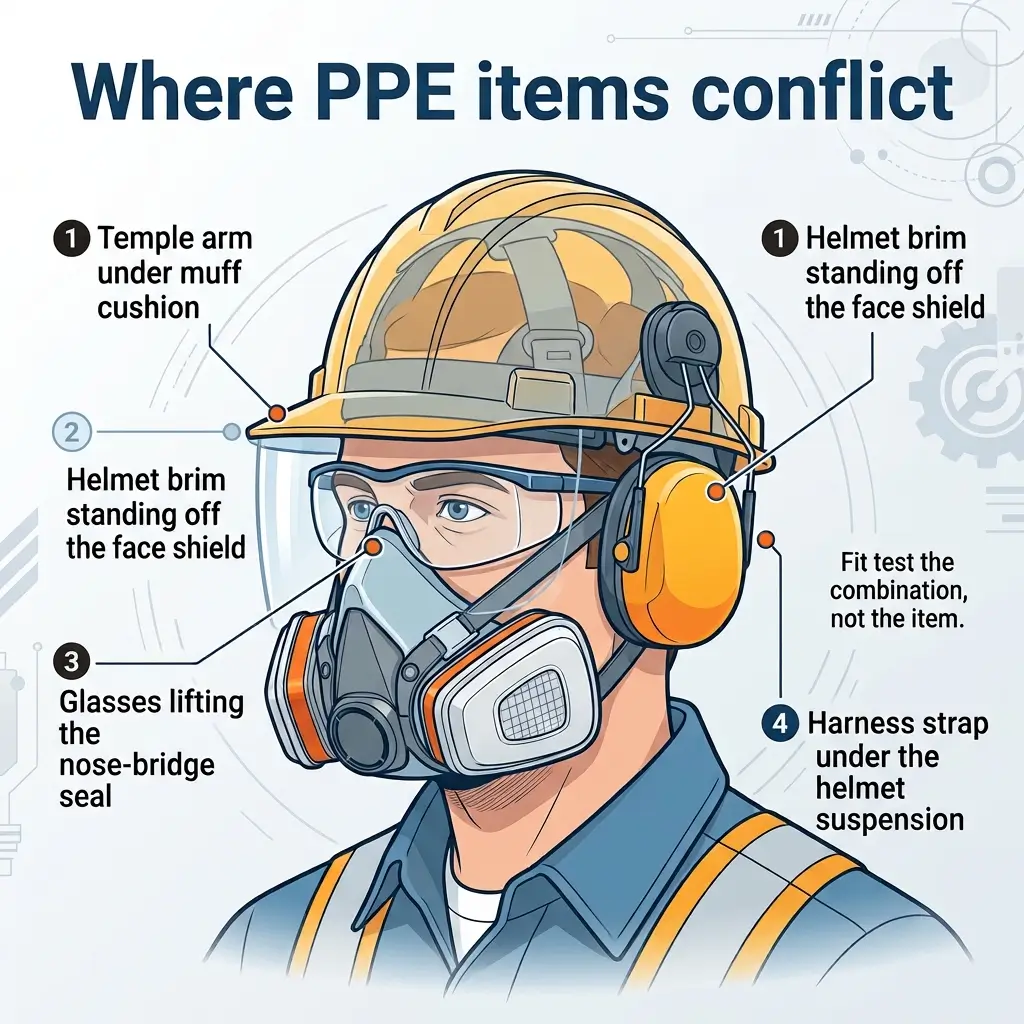
PPE is specified item by item and worn all at once. A hard hat brim lifts a face shield away from the chin. Earmuff cushions cross the temple arms of safety glasses and break both seals. A respirator's head harness runs under a helmet suspension that was not designed to accommodate it. Beard growth, prescription glasses and hearing aids all interact with facepiece seals in ways the individual item's certification never contemplated.
The table below covers the conflicts I run into most often and what actually resolves them.
| Combination | What breaks | Resolution |
|---|---|---|
| Earmuffs + safety glasses | Temple arms break the cushion seal, losing several dB of real attenuation | Move to plugs, or thin/cable-temple frames validated with the muff |
| Helmet + face shield | Brim stands the shield off, opening a gap at the chin | Helmet-mounted shield system tested as an assembly |
| Half-mask + safety glasses | Glasses ride on the nose bridge of the facepiece and lift the seal | Fit test with the glasses on, or use a full facepiece with an insert |
| Facepiece + facial hair | Stubble at the sealing surface defeats the seal | Loose-fitting powered hood, or hazard elimination |
| Helmet + hearing aids or ear defenders | Suspension displaces the device | Assess the full stack, not the items |
Whatever the combination, the rule is the same: fit test and evaluate the stack the worker will actually wear, at the same time, in the posture the job requires.
Reasons 8–10: the system around the equipment has failed
The last three are organisational. They are also the ones that produce the most misleading compliance statistics, because in each case someone can be wearing the wrong thing, correctly, and be recorded as compliant.
8. It was chosen by habit, not by the hazard assessment
On an assembly cell at a medical device campus in Minnesota, I watched a wipe-down being carried out with gloves that were incompatible with the solvent blend named on the safety data sheet. Nobody was cutting a corner. The gloves were the ones that had always been on that bench, the crew had used them for years, and the solvent had changed at some point without the glove selection changing with it.
I stopped the task, matched the glove to the SDS, and ran a short matching drill with the line — hold up a container, name the correct glove, check the answer against Section 8. Wrong-glove findings on that line fell after the drill.
The transferable point is uncomfortable. Every worker on that bench was fully compliant with the visible rule. Habit had quietly replaced the assessment required under 1910.132(d), and no amount of enforcement effort would have found it, because there was nothing to enforce against. This is what makes glove selection specifically worth auditing: breakthrough time is chemical-specific, and a nitrile glove that handles one solvent may last ninety seconds against another.
9. It is too far from where the hazard starts
Where PPE is stored, relative to where the hazard begins, sets the compliance rate more reliably than any campaign. If the dispenser is forty metres back down the corridor and the hazard starts at the door, some proportion of people will start the task and collect the PPE afterwards, or not at all.
This is a desire-path problem, and it is solved the same way desire paths are solved everywhere: put the resource where the movement already goes. Donning points belong at the boundary of the hazard zone, not at the entrance to the building. Restock has to be somebody's named task with a frequency, not a general expectation. And a worker on nights needs a way to replace a damaged item without finding a supervisor who is not there.
10. The norm on the floor says it is optional
The last one is the strongest predictor of all, and it is transmitted by observation rather than instruction. A new starter learns what is genuinely required by watching what experienced people do in the first week, and if the crew leader crosses the yard without eye protection, that is the rule, whatever the induction slide says.
Two structural factors make this worse than most sites realise. Night and weekend shifts get a fraction of the leadership presence that days get, which is where the divergence begins. And contractors arrive with their own norms, so a multi-employer site can run two definitions of "required" in the same building.
- Check compliance by shift, not in aggregate — a site-level figure hides the shift where the problem lives
- Check contractor compliance separately from your own crews
- Ask new starters what they were told informally in week one; that answer is the real standard
- Count leadership presence at night, in hours, and compare it against days
- Watch what supervisors do in transit — the walk across the yard teaches more than the toolbox talk
Wearing it is not the same as being protected
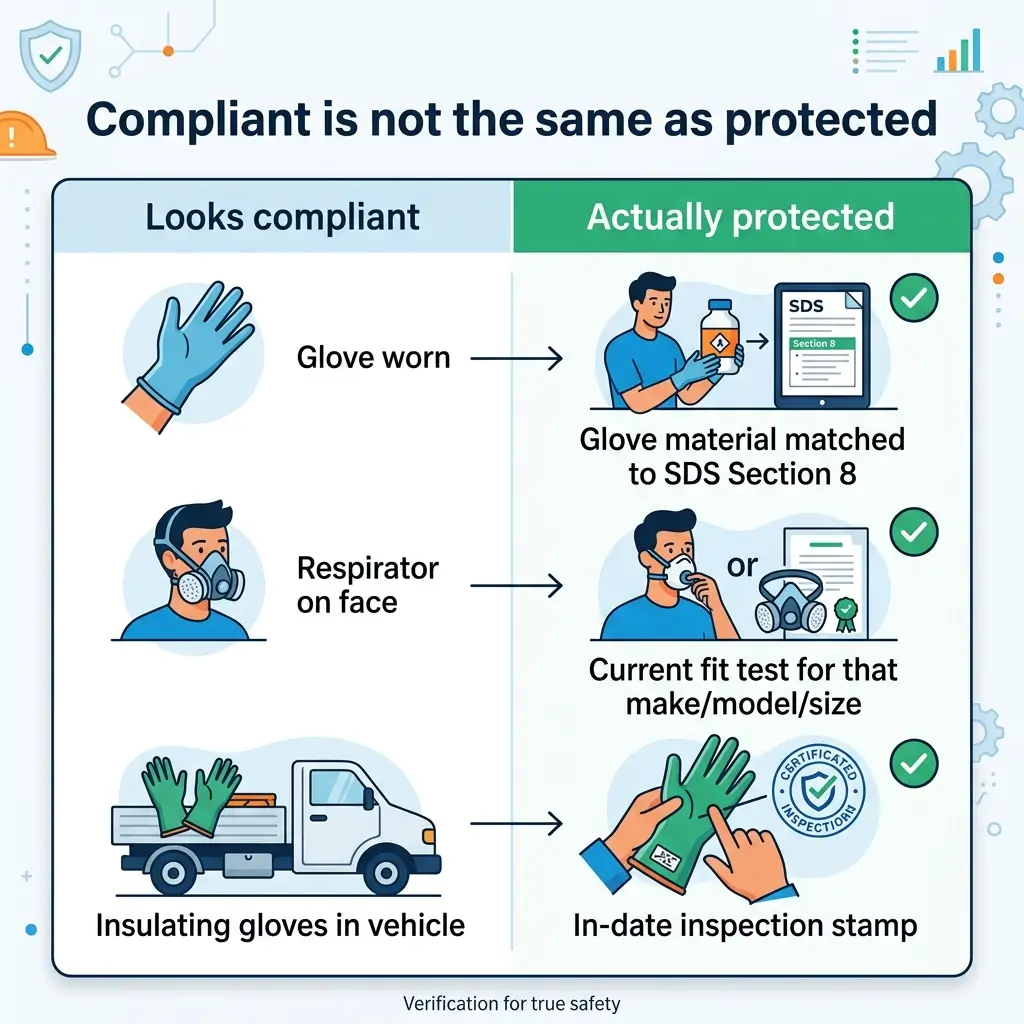
The most dangerous PPE failures do not look like non-compliance at all. They look like a compliant workforce, which is why walk-round observation programmes miss them completely.
On a line crew with an Irish electricity network operator, I found insulating rubber gloves staged for use past their inspection date. They were on the vehicle, they would have been worn, and every visual compliance check would have recorded a pass. I removed them from service, replaced them with in-date stock and reset the pre-use check. Out-of-date rubber goods findings fell afterwards, but the point stands: expired insulating PPE is not PPE, and the wearer had no way to know that from looking at it.
There is a second version of this failure, one step further upstream. At an active pharmaceutical ingredient weigh booth in Cork, smoke-tube checks showed capture failing at the analyst's breathing zone at the moment the sash opened. The fan was running. The gauge read normally. I stopped dispensing until capture was adjusted and re-verified. That case is about local exhaust ventilation rather than PPE. It belongs in this article because of what it implies about the layer below. When an engineering control degrades quietly, the respiratory protection stops being the second line of defence and silently becomes the only one — at exactly the moment nobody has told the wearer that their protection factor now matters.
Three checks separate wearing from being protected, and none of them can be done from across a workshop:
- In date and in condition — inspection dates on insulating and fall protection equipment, cartridge change-out schedules, filter loading
- Matched to this hazard — glove material against SDS Section 8 for the substance actually in use, not the one the bench was set up for
- Verified on this person — a current fit test for the exact make, model, type and size, with the glasses and helmet they wear on the job
What to check when compliance drops: a walk, not a memo
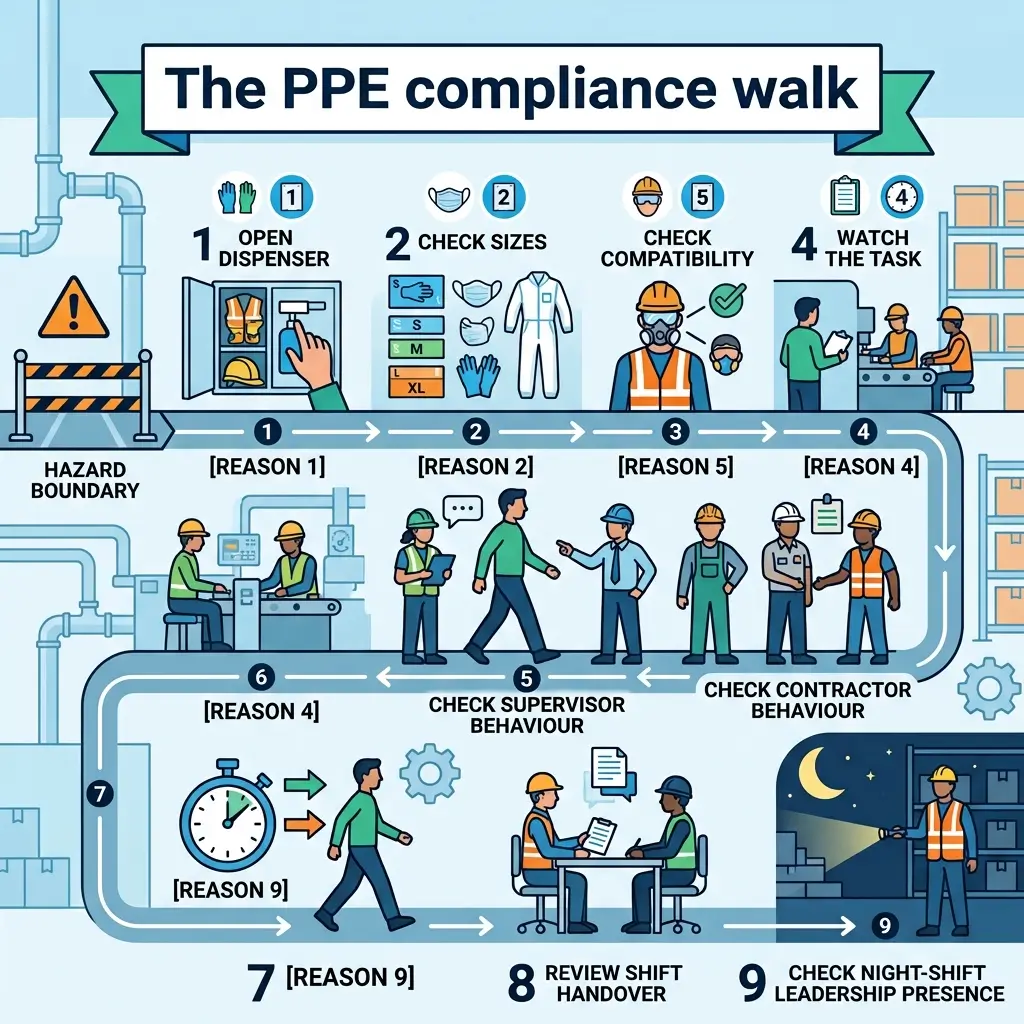
When a site tells me PPE compliance is poor, I do not start with the records. I start at the point where the hazard begins and work outwards, because every one of the ten reasons above leaves a physical trace that can be found in an hour.
The order I use, and what each step tends to reveal:
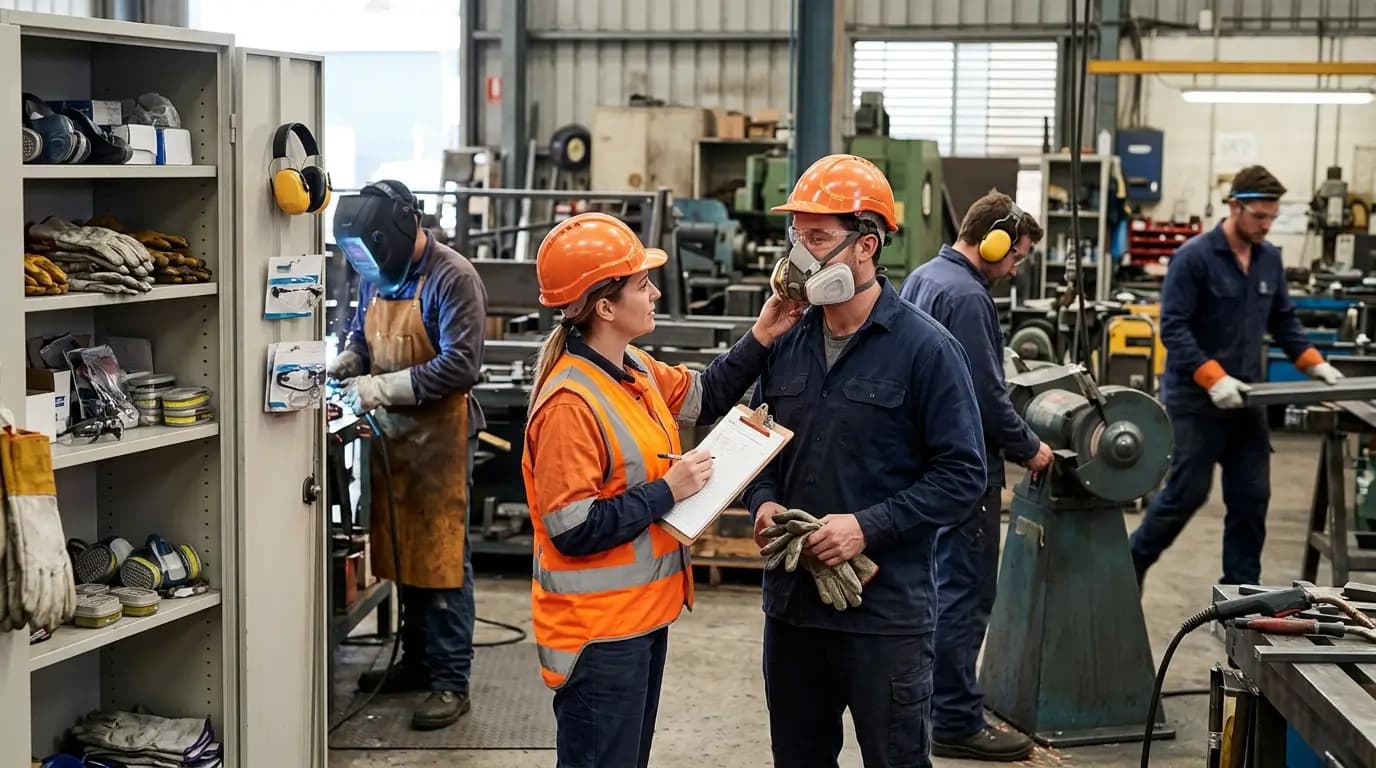
- Stand at the boundary of the hazard zone. Where is the nearest PPE? Time the walk. Anything over about thirty seconds is generating reason 9.
- Open the dispenser or store. What size range is actually stocked, today, not what the catalogue lists? This is where reason 1 becomes visible.
- Ask one wearer to don it in front of you. Not as a test — say why you are asking. Hesitation over strap order is a training verification gap, reason 2.
- Ask what it is protecting them from. If the answer is "it's the rule", the hazard has no perceptible feedback and you are looking at reason 3.
- Watch someone do the task in it for five minutes. Fogging, re-gripping, lifting a shield to see — that is reason 4, and it is a design finding.
- Check the attenuation or protection factor against the actual exposure. Over-specification, reason 5, is as much a defect as under-specification.
- Look at the whole stack together, in the posture the job requires. Reason 7 only appears when the items are worn at once.
- Pull five items and check dates and condition. Then check one glove selection against the SDS for what is genuinely in use.
- Ask when the last leadership walk happened on nights. Then ask a night worker the same question and compare the answers.
The table below maps each reason to the finding it produces and the first thing to check.
| # | Reason | What it looks like on the floor | First check |
|---|---|---|---|
| 1 | Does not fit | Item worn loose, modified, or not at all | Sizes actually stocked at point of use |
| 2 | Never verified | Facepiece worn but leaking | Fit test records against equipment in use |
| 3 | Hazard imperceptible | "It's fine, I've done this for years" | Is exposure ever measured and fed back? |
| 4 | Task made harder | Shield lifted, glove removed for fine work | Watch the task performed in the PPE |
| 5 | Over-protected | Muff lifted to hear, one plug out | Calculated level at the ear (target 70–80 dB(A)) |
| 6 | Heat strain | Removal clusters before breaks | Work–rest cycle and task scheduling |
| 7 | Items conflict | Glasses under muffs; shield standing off | Fit test the combination, not the item |
| 8 | Chosen by habit | Compliant with the wrong equipment | Glove material against SDS Section 8 |
| 9 | Stored too far away | Task started, PPE collected later | Distance and time from hazard boundary |
| 10 | Norm says optional | Day-shift compliance, night-shift drop | Compliance split by shift and by employer |
Where enforcement and accommodation genuinely belong
None of the above removes the worker's duty, and it would be dishonest to suggest it does. Where the equipment fits, has been verified, matches the hazard and is within reach, a refusal to wear it is a conduct matter, and both legal systems support the employer in treating it as one. What the ten reasons should change is the sequence: fix the upstream conditions first, then enforce against the small residue that remains.
A handful of specific situations come up repeatedly and are handled badly almost everywhere.
Religious and medical accommodation
In Great Britain, turban-wearing Sikhs are exempt from legal requirements to wear head protection at any workplace. Many published articles still describe this as a construction-only exemption — that was corrected on 1 October 2015, when section 6 of the Deregulation Act 2015 amended section 11 of the Employment Act 1989 to replace "on a construction site" with "at a workplace". Limited exclusions remain for urgent emergency response and certain military circumstances. The exemption covers head protection only and no other PPE, and the employer's duties to assess the risk and make head protection available are unchanged.
In the United States, OSHA's PPE standards contain no medical or religious exemptions on their face. The agency addresses religious refusal of hard hats through directive STD 01-06-005, and a medical condition that limits PPE use may engage reasonable accommodation obligations under the Americans with Disabilities Act — accommodation that must not itself compromise safety.
Waivers, and why they do not work
A signed waiver does not transfer the duty. OSHA has given no indication it would accept one, and in Great Britain section 9 of the Health and Safety at Work Act prohibits charging workers for PPE at all, which makes any agreement to go without it legally hollow. If a worker cannot or will not wear what the assessment requires, the routes available are redeployment, a different control, or a conduct process — not a signature.
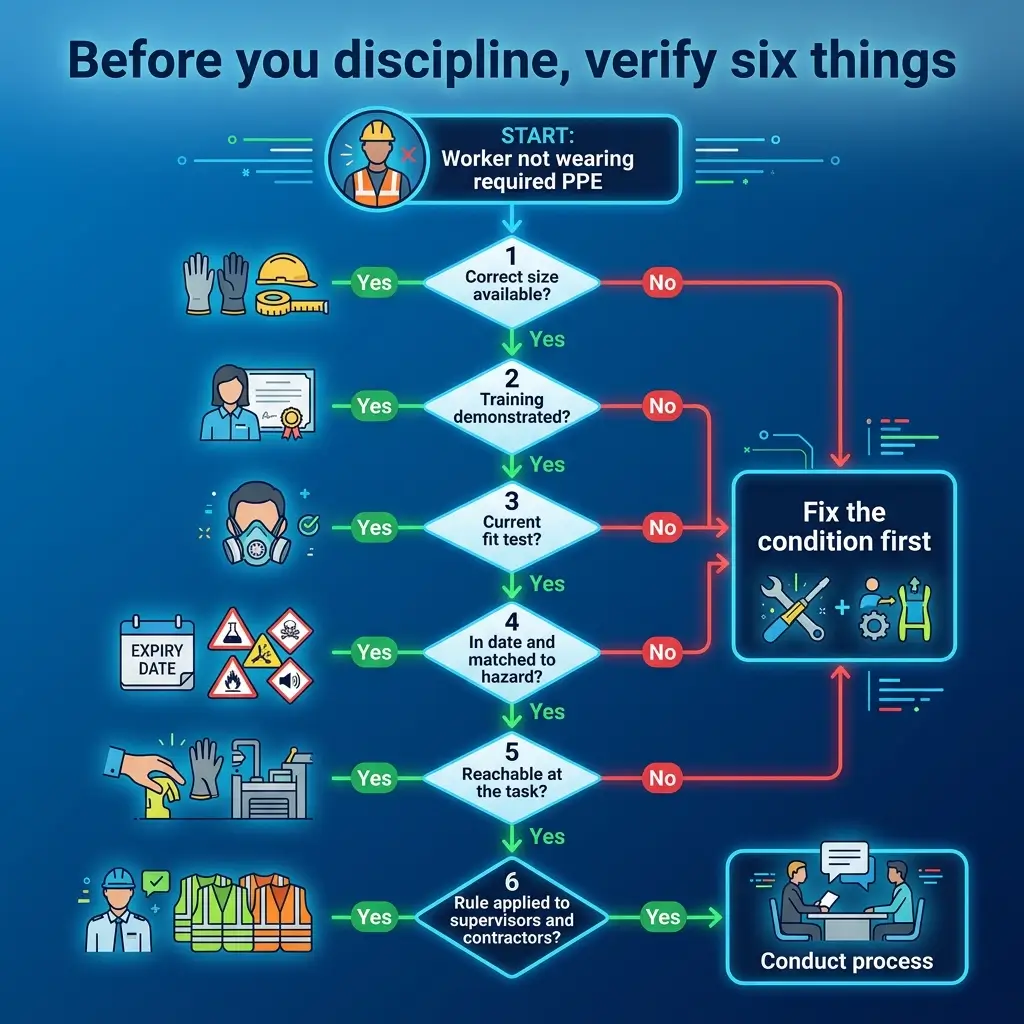
Before any disciplinary step, confirm each of the following is genuinely true:
- The PPE fits that individual and the size was available to them
- They were trained, and understanding was demonstrated and recorded
- Any tight-fitting RPE has a current fit test for the exact model in use
- The equipment is in date, in condition and matched to the actual hazard
- It was reachable from where the task begins
- The same rule is visibly applied to supervisors, managers and contractors
Frequently asked questions
These are the questions that come up most often when I present this material to supervisors and safety leads, and the answers people are most often surprised by.
What is the single biggest reason workers don't wear PPE?
Fit. It outranks everything else and is routinely misread as a comfort preference rather than a protection failure. OSHA's rationale for the 2024 revision to 1926.95(c) states directly that improperly fitting PPE may discourage employees from using it — which is why sizing availability, not attitude, is the first thing to check.
Can an employee legally refuse to wear PPE?
Not where a risk assessment requires it. In Great Britain, section 7 of the Health and Safety at Work Act 1974 places a duty on workers to co-operate with safety measures. In the US, OSHA does not cite workers, but 29 CFR 1977.22 confirms that discipline for refusing a valid safety rule is not protected activity. Verify the upstream conditions first.
Do employers have to pay for PPE?
Yes, in both jurisdictions. Section 9 of the Health and Safety at Work Act 1974 prohibits charging workers in Great Britain, and that duty now extends to limb (b) workers. In the US, 29 CFR 1910.132(h) requires employers to pay, with narrow exceptions for ordinary safety-toed footwear and prescription safety eyewear taken off site.
Is more protective PPE always safer?
No. HSE warns that hearing protectors reducing the level at the ear below 70 dB should be avoided, because wearers struggle to hear speech and alarms, become isolated, and tend to remove them. Aim for a protected level of roughly 70 to 80 dB(A), calculated using an L108 method rather than selecting the highest available rating.
How often should PPE be inspected or replaced?
It depends on the item and the manufacturer's instructions, but insulating and fall protection equipment carry dated inspection regimes, and respirator cartridges have change-out schedules based on exposure. Expired equipment that is worn correctly still reads as compliant on a walk-round, which is why date checks belong in the audit rather than the observation programme.
Does PPE fit testing need repeating?
Yes. Under HSE's INDG479, a fit test should be carried out at initial selection and repeated whenever the RPE type, size, model or material changes, or when something changes about the wearer that could affect the seal. A record covering one make and model does not transfer to a new brand after a procurement round.
What can I do about PPE compliance on night shift?
Split your compliance data by shift before doing anything else, then count leadership presence at night in hours and compare it with days. Night-shift divergence is usually a supervision-frequency and fatigue-scheduling finding rather than a workforce one, and it responds to rostering changes far better than to briefings.
About the author
Grace Thompson is an Irish Principal Human Factors, Fatigue and Emergency Preparedness Consultant with 15 years of continuous field experience across 14 countries, covering 170+ workplace inspections and 65+ audits. Her work centres on redesigning tasks and rosters so that alert people can follow the controls that have been specified for them — which is where PPE compliance is decided long before anyone reaches for an enforcement policy. She has held human factors and site HSE roles with Intel, Diageo, Glencore, Veolia, Skanska, Boston Scientific, Pfizer, Ericsson, Heidelberg Materials, Aer Lingus, ESB and Smurfit Kappa, and now leads Thompson Human Factors Safety in Dublin.
Credentials: CMIOSH or equivalent professional membership pathway; NEBOSH International Diploma in Occupational Health and Safety; ISO 45001 Lead Auditor; ISO 14001 Internal Auditor; Human Factors Awareness (CIEHF-aligned pathway); Fatigue Risk Management Awareness; IOSH Managing Safely; Manual Handling Instructor Awareness.
Sources and further reading
- OSHA, 29 CFR 1910.132 — General requirements, personal protective equipment
- OSHA, 29 CFR 1926.95 — Criteria for personal protective equipment
- Federal Register, Personal Protective Equipment in Construction, final rule, 12 December 2024
- OSHA, Top 10 Most Frequently Cited Standards, FY2025
- OSHA, 29 CFR 1977.22 — Employee refusal to comply with safety rules
- OSHA, Heat Injury and Illness Prevention rulemaking
- HSE, Extended scope of the Personal Protective Equipment at Work Regulations
- HSE, Personal protective equipment at work — L25 guidance
- HSE, Guidance on RPE fit testing, INDG479, revised October 2025
- HSE, Over-protection in hearing protection selection
- Legislation.gov.uk, Deregulation Act 2015 section 6 — explanatory notes on the Sikh safety helmet exemption
- Safety+Health, Employers weigh in on why workers won't wear PPE — ISEA / J. J. Keller study, March 2025