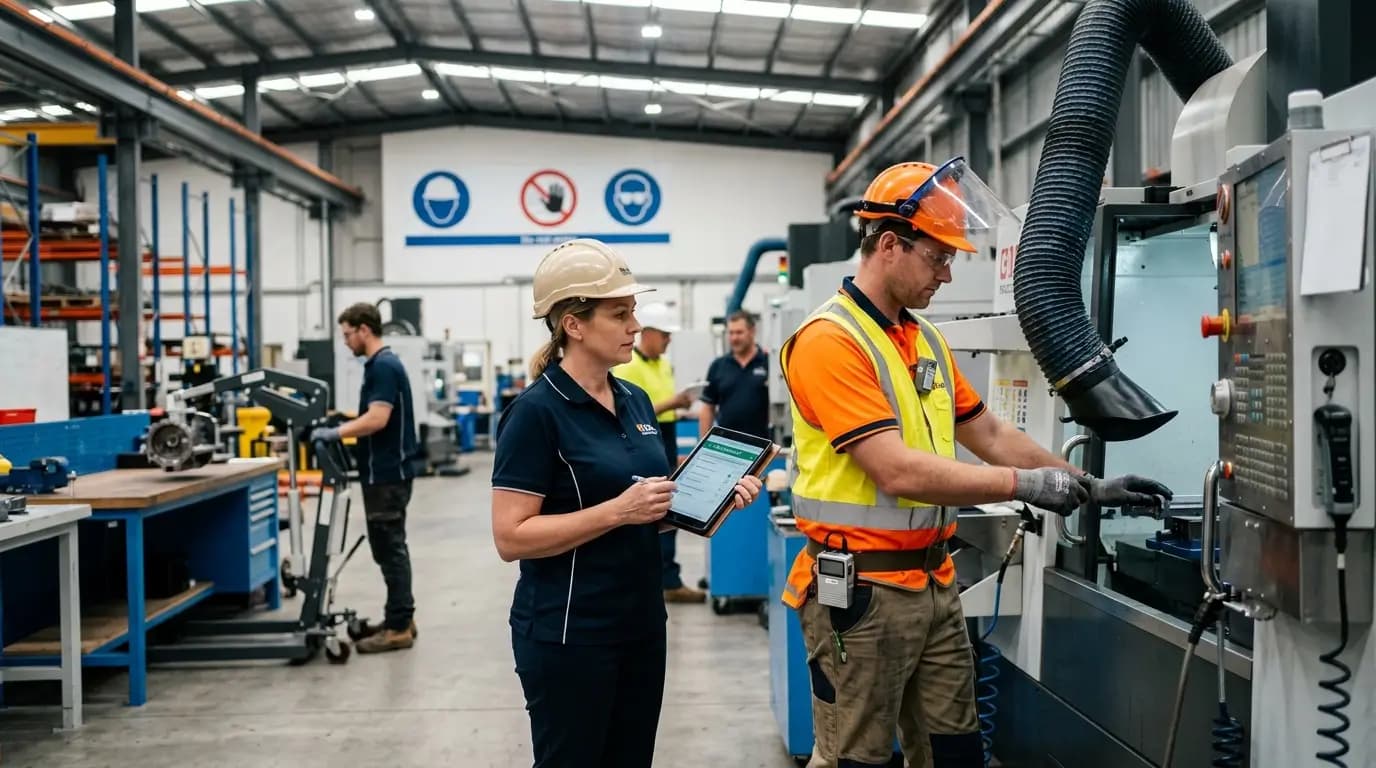


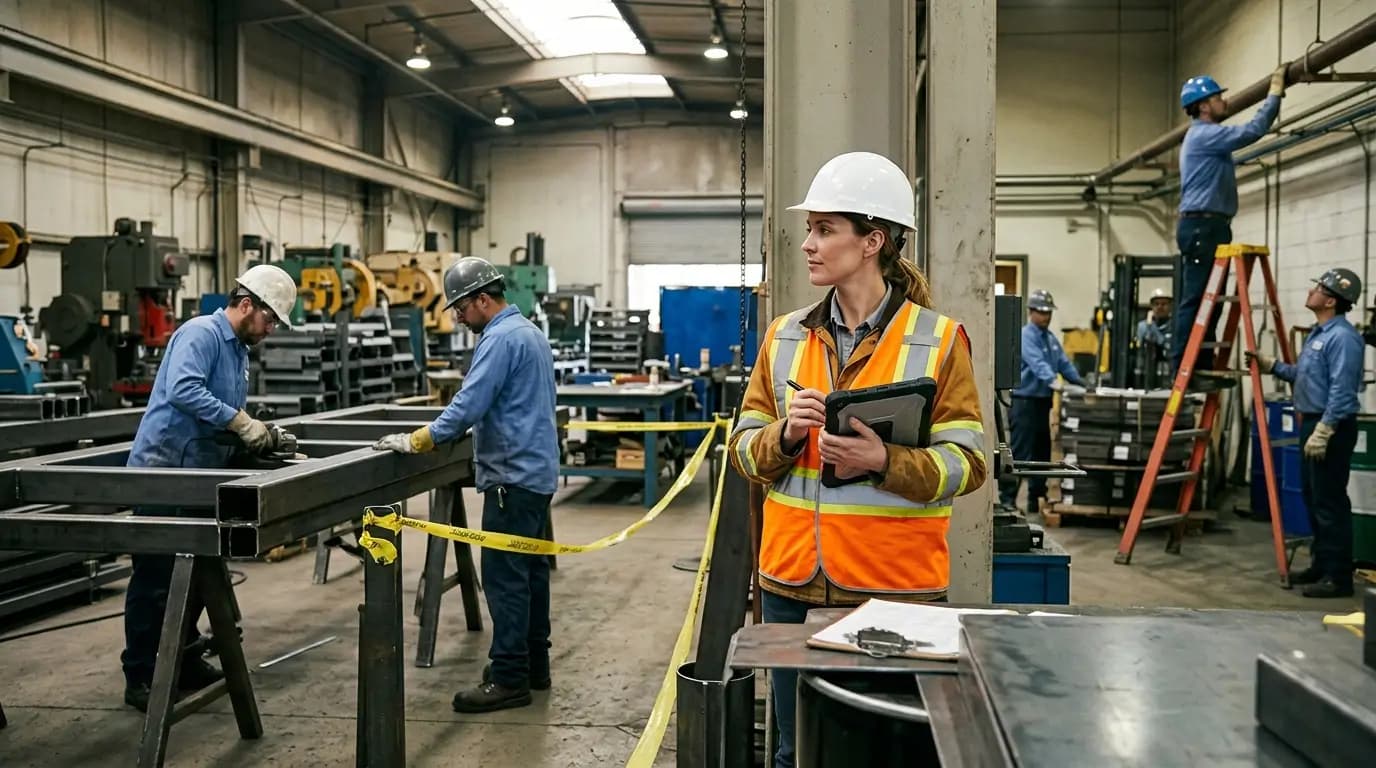
A broken safety rule almost never looks like defiance. It looks like a hose.
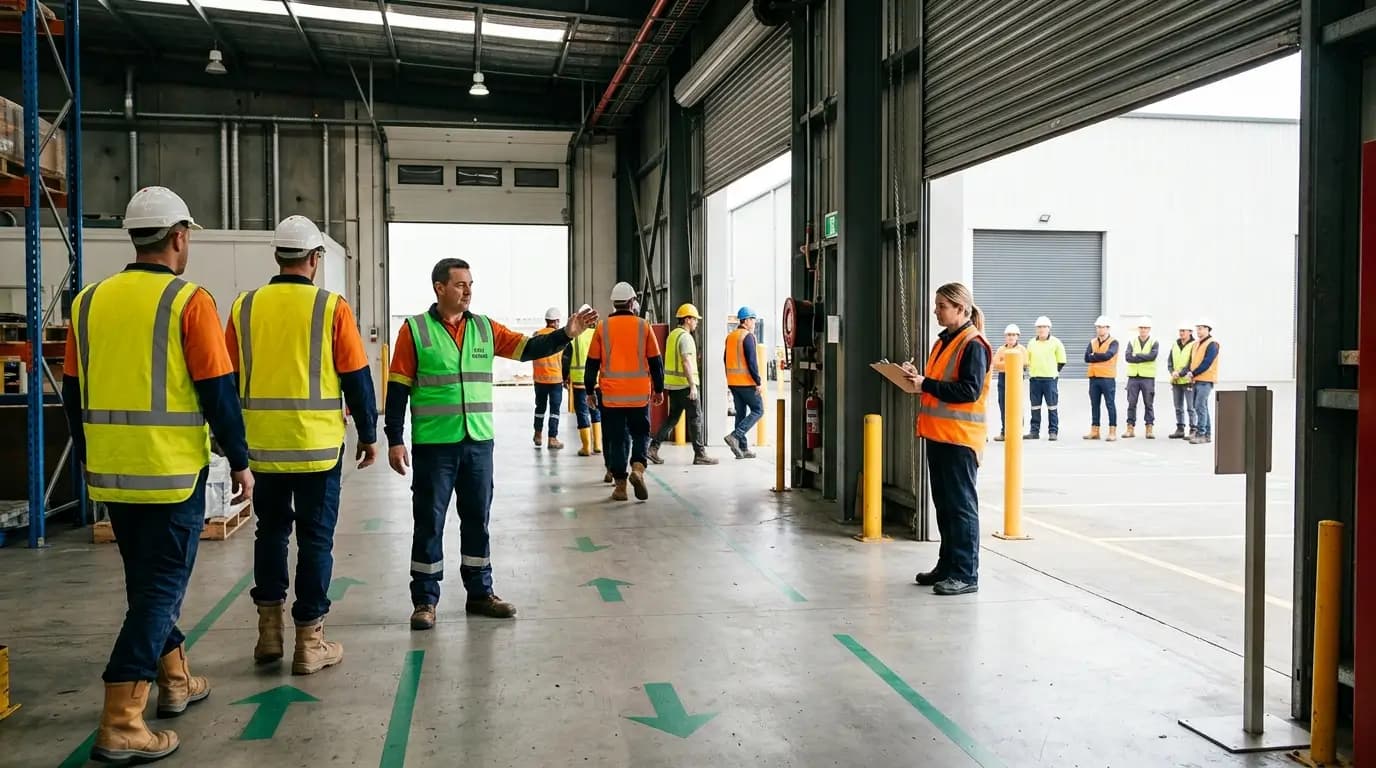
At 01:40 on a night sanitation shift in a Toronto ready-meals hall, I traced a clean-in-place hose pinned across a marked exit leaf. A hygiene rule had quietly cancelled an egress rule, and nobody in that building thought of themselves as a rule-breaker. That is the shape of almost every violation I have written up in 18 years and roughly 200 workplace inspections across 14 countries.
The ten examples below are the ones I find most often: PPE picked by habit, a guard muted, a permit signed in the office, a guardrail off "for a minute". For each one you get what it looks like at the work face, the standard it breaches in the US and the UK, and the single question that catches it.
Key takeaways
The short version, before the detail:
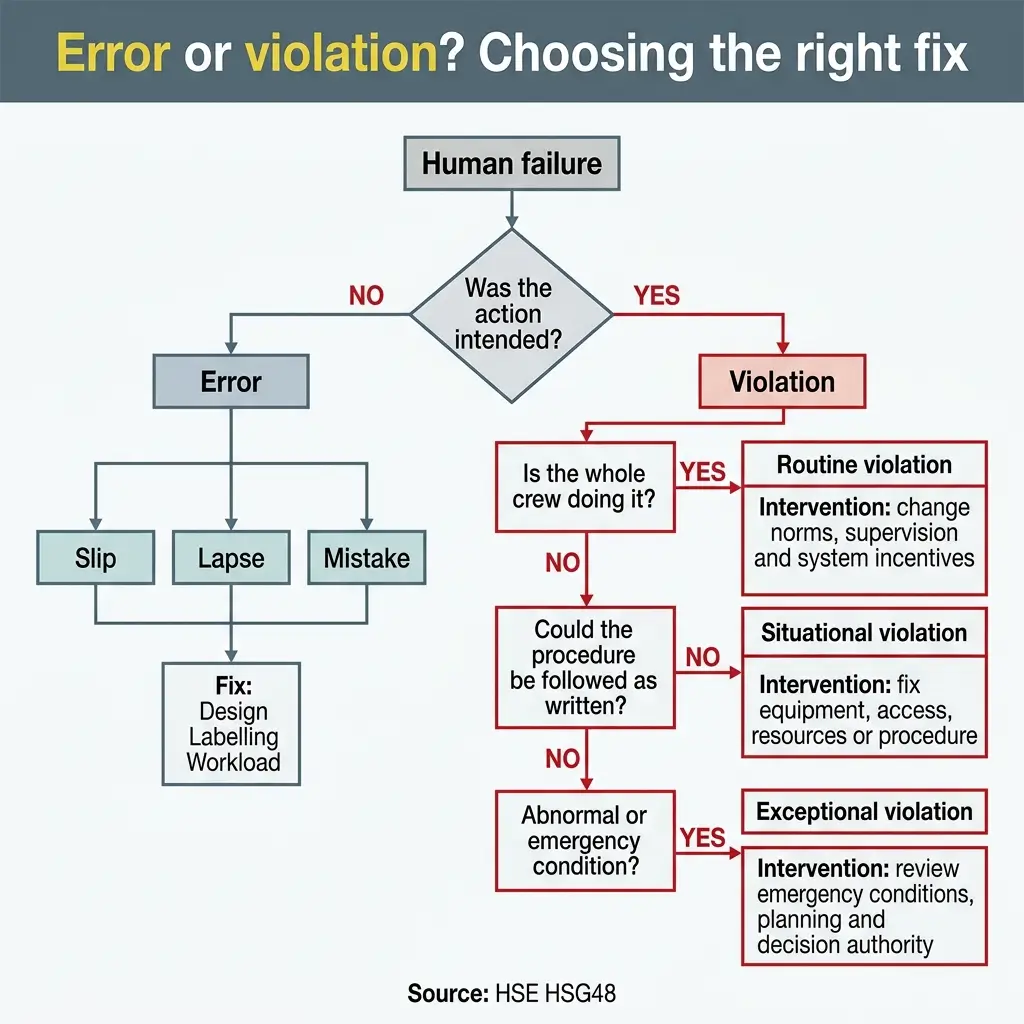
- A broken safety rule and a mistake are different failures with different fixes — the UK Health and Safety Executive splits human failure into errors (unintended) and violations (deliberate deviations), and treating a violation as a training problem usually fails.
- Most violations I stop are situational: the procedure could not be followed as written on that shift, with that equipment, in that time window.
- Fall Protection (29 CFR 1926.501) has topped OSHA's most-cited list for 15 consecutive fiscal years, and the FY2025 top ten contained the same ten standards as FY2024.
- The rules that break hardest are the ones verified from a desk — a signed permit, a signed berm inspection, a signed clearance confirm.
- Almost every example below is caught by one question asked at the work face rather than in the office.
What counts as a broken safety rule
A broken safety rule is a deliberate deviation from a procedure, permit condition, or regulation — someone knew the rule and worked around it anyway. That is different from a slip or a mistake, and the distinction changes what you do next. HSE's guidance on managing human failures separates the two: errors are actions or decisions that were not intended, while violations are intentional but usually well-meaning departures from the rule, made to get the job done.
That phrase — well-meaning — is the part practitioners skip. In 55-plus incident investigations I have never once found sabotage. I have found people trying to finish a shutdown, keep a line running, or help a colleague who was falling behind.
Errors are not violations
If a fitter reads the wrong gauge, that is an error, and the fix sits in design, labelling, and workload. If a fitter skips the gauge because the reading has been the same for two years, that is a violation, and the fix sits in supervision, rule quality, and whether anyone ever checks. Sending the second person on a refresher course changes nothing, because they already know the rule.
The three violation types you will meet on site
HSG48 groups violations into three categories, and each one responds to a different intervention. The table below is the one I use when I write up a finding, because naming the type stops the investigation from defaulting to "retrain the operator".
| Violation type | What it looks like | What actually reduces it |
|---|---|---|
| Routine | Breaking the rule has become the normal way the crew works; nobody flags it | Reduce unnecessary rules, raise the chance of detection, walk the job at the hours it runs |
| Situational | The procedure cannot be followed with the equipment, time, or access available | Fix job design, planning, and resourcing — the rule is not the problem |
| Exceptional | A rare deviation under abnormal or emergency conditions | Train for the unusual case, remove time pressure, build in a defence |
Three signals tell me which type I am looking at before I ask anyone a question:
- Everyone is doing it the same wrong way — routine. A single crew improvising means something else.
- The correct method is physically impossible here — situational. Look at the platform, the tool, the window, not the person.
- The condition is one nobody wrote a procedure for — exceptional. Check whether the crew was left to invent a method.
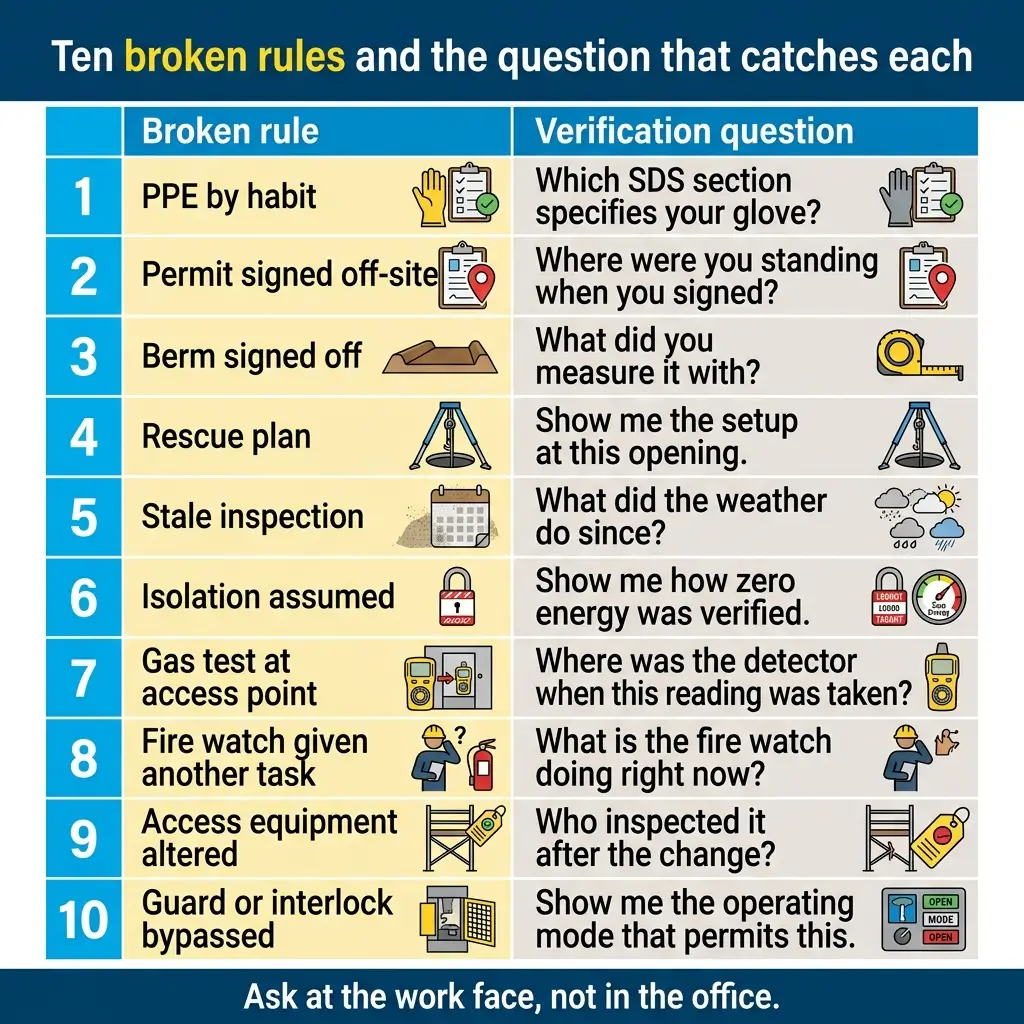
10 common examples of broken safety rules on real sites
Every example here is one I stopped myself, on a named site, with a named control breached. I have kept them concrete on purpose — "ignoring PPE" is a category, not an example, and a supervisor cannot go and look for a category. Each entry gives the observable form of the rule, why sensible people break it, and the check that catches it.
1. PPE chosen by habit instead of by the safety data sheet
In a coating cell in Chihuahua, I watched a wipe-down being done in gloves that were not compatible with the solvent blend named on the safety data sheet. Nobody had skipped PPE. The box on the wall said gloves, the crew wore gloves, and the glove material had been correct for the previous blend.
Chemistry changes faster than habit does. When a supplier reformulates, the SDS updates and the glove chart on the wall does not, so the control quietly stops working while looking untouched. I stopped the task, matched the PPE to Section 8 of the SDS, and ran a short matching drill on the line. Wrong-glove findings dropped afterwards.
In the US this sits under Hazard Communication, 29 CFR 1910.1200; in the UK, under COSHH 2002. The check: ask the operator which section of the SDS specifies their glove. If they reach for the wall chart instead of the sheet, the control is running on memory.
2. A guard or light curtain defeated without a documented mode
On an automation cell in Phoenix I found a light curtain muted with no documented temporary mode authorization. The cell ran. Product moved. The safeguard was electrically present and functionally absent.
Muting is a legitimate engineering function — during a defined mode, under defined conditions, with a defined authority. What I keep finding is muting with none of those three, usually introduced during commissioning and never removed. I stopped the cell, restored the safeguard, and required documented mode control before restart.
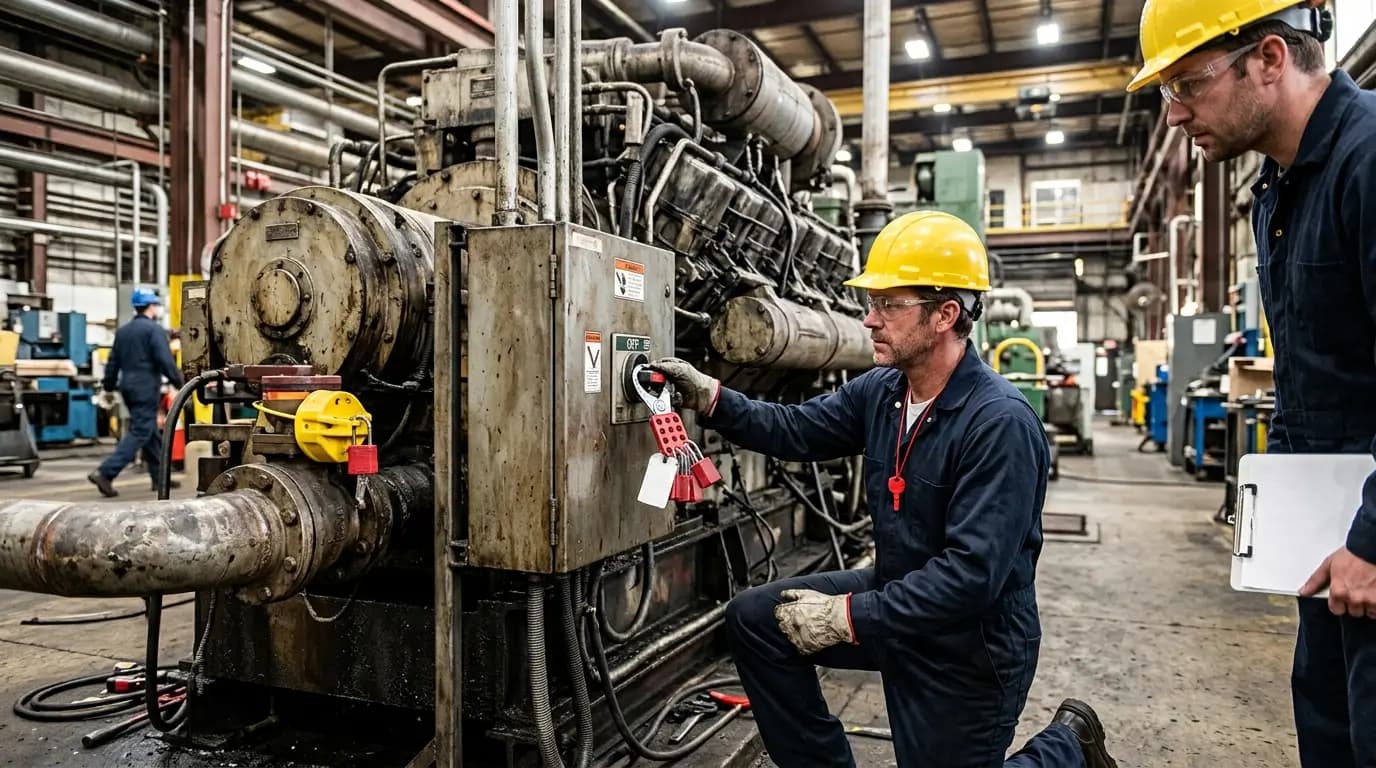
US: Machine Guarding, 29 CFR 1910.212, with 1910.147 where the work involves servicing. UK: PUWER 1998 regulation 11. The check: ask who authorized the mute and where that authorization is written. A mute without a mode is an open hazard wearing a safeguard's badge.
3. A permit signed somewhere other than the job
On an LNG turnaround at Karratha, a confined space entry permit had been approved without the issuer ever walking to the manway. Every box was filled. Every signature was present. The document described a vessel the signer had not seen that day.
This is the most consequential broken rule on this list, because the permit is the control that carries all the others. Once it is issued from a desk, the gas test, the rescue arrangement, and the isolation are all being asserted rather than verified. I voided the permit, required a field walkdown, and reset issuer expectations for the package. Office-issued confined permits on that scope stopped.
US: 29 CFR 1910.146. UK: Confined Spaces Regulations 1997. The check: ask the issuer where they were standing when they signed. You will learn more from that answer than from reading the form.
4. A rescue plan that does not fit the opening
During a pulp mill outage in Ontario I dry-fitted the rescue gear before a digester entry. The tripod base would not seat on the manway flange. The rescue plan was complete, approved, and unusable at that specific hole.
Generic rescue plans pass paperwork review because they describe a method, not a location. They fail at the flange, the platform edge, or the handrail that the retrieval line has to cross. I stopped the entry, changed the rescue method, and had the plan updated before the permit was reissued. A fit-check became mandatory before digester entries on that site.
The check costs two minutes: before signing, ask the standby to physically set up the retrieval at that opening. If the answer is a description rather than a demonstration, the plan is generic — and a generic rescue plan is not a rescue plan.
5. A guardrail taken down "for a minute"
On an industrial fit-out in Calgary I found a guardrail section removed on a mezzanine edge with workers still on the deck. The rail was leaning against a column, four metres from the opening it was supposed to close.
The phrase is always the same and the intent is always reasonable — a panel needs to come through, the rail is in the way, it will go back shortly. The problem is that "shortly" is not a control, and the person who removes the rail is rarely the person still standing there twenty minutes later. I stopped work, reinstated the rail, and coached the crew on temporary edge control: if a rail comes off, something else goes on before anyone stays.
US: Fall Protection, 29 CFR 1926.501. UK: Work at Height Regulations 2005 regulation 6, which puts collective protection ahead of personal protection. The check: walk the edge, not the drawing.
6. An escape route blocked by the job in hand
This is the Toronto CIP hose from the opening of this article, and it is worth stating plainly: the hose was there because the sanitation sequence needed it there. Food safety had not been weighed against egress, because nobody had ever been asked to weigh them.
Blocked egress is the most under-reported broken rule I encounter, because the obstruction is temporary, purposeful, and gone by morning. Day-shift audits never see it. I stopped the sequence, rerouted the hose, and added an exit check to the sanitation start card so the conflict got resolved before the shift began instead of during it.
US: 29 CFR 1910.36 and 1910.37 on exit routes. UK: the Regulatory Reform (Fire Safety) Order 2005. The check: walk your escape routes at the hour the messiest task runs. If you have only ever walked them at 10 a.m., you have audited a different building.
7. A control signed off that nobody measured
After heavy rain on an Arizona open pit, I measured berms along a haul approach that had already been signed off. They were below profile. The inspection record was complete and the control was not there.
Verification by signature is the quiet epidemic in critical control management. It is not laziness — a supervisor with fourteen checks and a two-hour window will reasonably prioritise the ones that look most likely to have changed, and a berm looks like a berm from a moving truck. I closed the road section, required a rebuild to spec, and coached verification with a stick gauge, which turns a judgement into a measurement.
The check for any critical control: ask what instrument was used. If the answer is "I looked", the control was observed, not verified.
8. An isolation step confirmed but not completed
On a substation outage in the US northeast I overheard a clearance confirm that moved faster than the switching order allowed. A step was acknowledged before it was completed. The words were right and the sequence was not.
Switching discipline degrades under outage pressure precisely when it matters most, because the cost of every extra minute is visible and the cost of a skipped confirm is not. I stopped the sequence and had the switching order restarted step by step. Clearance confirm quality improved measurably in follow-up observations.
US: 29 CFR 1910.147 and 1910.333 for electrical work practices. UK: the Electricity at Work Regulations 1989. The check: listen to a clearance confirm without watching the paperwork. Read-back that runs ahead of the action is the tell.
9. Work continued past a stated limit
On an installation vessel campaign in the North Sea, I checked the anemometer against the method statement during a blade lift. Gusts were over the stated limit. The lift was continuing.
Weather windows, load charts, and exposure ceilings share a failure mode: they are written as numbers and treated as guidance. On a vessel with a weather forecast closing in, the pressure to finish is enormous and entirely understandable. I stopped the lift and had the load path secured before briefing the bridge and deck teams. Subsequent lifts held for verified windows.
Limits are controls. If a number in a method statement can be exceeded without anyone stopping, then the real limit is whatever the crew decides on the day, and no risk assessment on that job is accurate. The check: ask who has authority to call the limit, and whether they were on the radio.
10. Yesterday's inspection treated as today's
After overnight rain on an Edmonton fit-out, I found a crew re-entering a trench with no revalidation. The inspection from the previous afternoon was valid, signed, and no longer describing the ground they were about to stand in.
Rain, frost, vibration, and traffic all rewrite excavation risk overnight, which is why the requirement is a daily inspection and not a project inspection. I evacuated the trench, required re-inspection and re-shoring before re-entry, and briefed the superintendent on the trigger conditions.
US: 29 CFR 1926 Subpart P requires inspection by a competent person before each shift and after any hazard-increasing event, including rainstorms. UK: CDM 2015 with HSG185. The check: ask when the last inspection was and what the weather did since.
The ten examples map to specific instruments in both jurisdictions, which matters if you write one procedure for multi-country operations:
| # | Broken rule | US instrument | UK instrument |
|---|---|---|---|
| 1 | PPE not matched to the SDS | 29 CFR 1910.1200 | COSHH 2002 |
| 2 | Guard or light curtain defeated | 29 CFR 1910.212 / .147 | PUWER 1998 reg. 11 |
| 3 | Permit signed away from the work | 29 CFR 1910.146 | Confined Spaces Regs 1997 |
| 4 | Rescue plan that does not fit | 29 CFR 1910.146(k) | Confined Spaces Regs 1997 reg. 5 |
| 5 | Guardrail removed temporarily | 29 CFR 1926.501 | Work at Height Regs 2005 reg. 6 |
| 6 | Escape route blocked | 29 CFR 1910.36–.37 | RRO (Fire Safety) 2005 |
| 7 | Control signed off unmeasured | Standard-specific inspection clauses | MHSWR 1999 reg. 5 |
| 8 | Isolation step not completed | 29 CFR 1910.147 / .333 | Electricity at Work Regs 1989 |
| 9 | Work past a stated limit | 29 CFR 1926 Subpart CC (lifting) | LOLER 1998 |
| 10 | Stale inspection relied on | 29 CFR 1926 Subpart P | CDM 2015 |
What enforcement data says about which rules break most
Citation data is a weak proxy for what goes wrong and a strong proxy for what inspectors find easy to see, so read it that way. What makes OSHA's list useful is its stability: the same standards appear year after year in slightly different order. These are not obscure hazards. They are the ones everybody understands and still does not control.
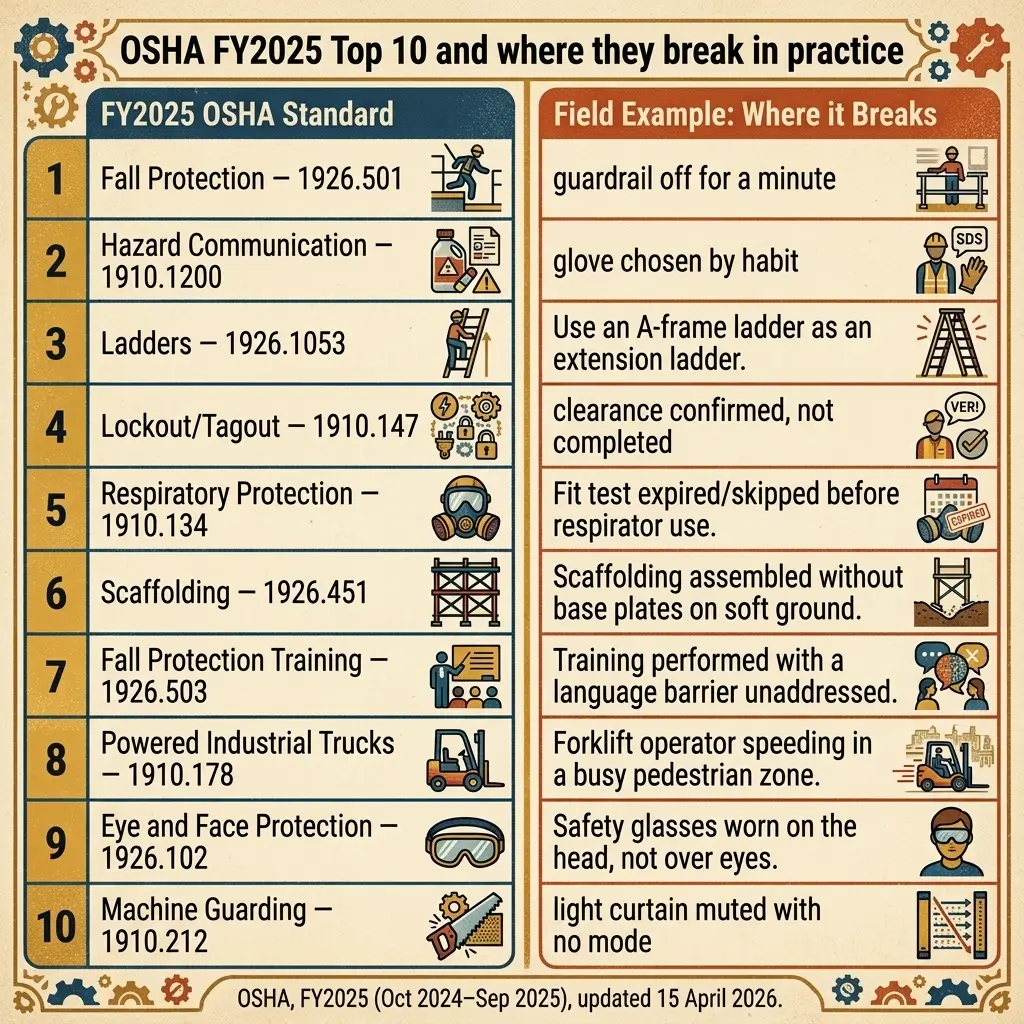
OSHA's Top 10 most frequently cited standards for FY2025, covering 1 October 2024 to 30 September 2025, ranked as follows.
| Rank | Standard | Reference |
|---|---|---|
| 1 | Fall Protection, general requirements | 29 CFR 1926.501 |
| 2 | Hazard Communication | 29 CFR 1910.1200 |
| 3 | Ladders, construction | 29 CFR 1926.1053 |
| 4 | Control of Hazardous Energy (lockout/tagout) | 29 CFR 1910.147 |
| 5 | Respiratory Protection | 29 CFR 1910.134 |
| 6 | Scaffolding, construction | 29 CFR 1926.451 |
| 7 | Fall Protection Training | 29 CFR 1926.503 |
| 8 | Powered Industrial Trucks | 29 CFR 1910.178 |
| 9 | Eye and Face Protection, construction | 29 CFR 1926.102 |
| 10 | Machine Guarding, general industry | 29 CFR 1910.212 |
Source: OSHA, list updated 15 April 2026. Fall Protection has held first place for 15 consecutive fiscal years.
Three things in that table are worth acting on rather than reading:
- Fall protection appears twice — once as a physical control and once as training, which suggests the gap is competence at the point of use, not the absence of equipment.
- Six of the ten cover hazards addressed by examples 2, 5 and 6 above, so a site that fixed only those three would move against most of the list.
- The ranking barely moves year to year. Treat it as a standing agenda for verification walks rather than annual news.
Why good crews break rules
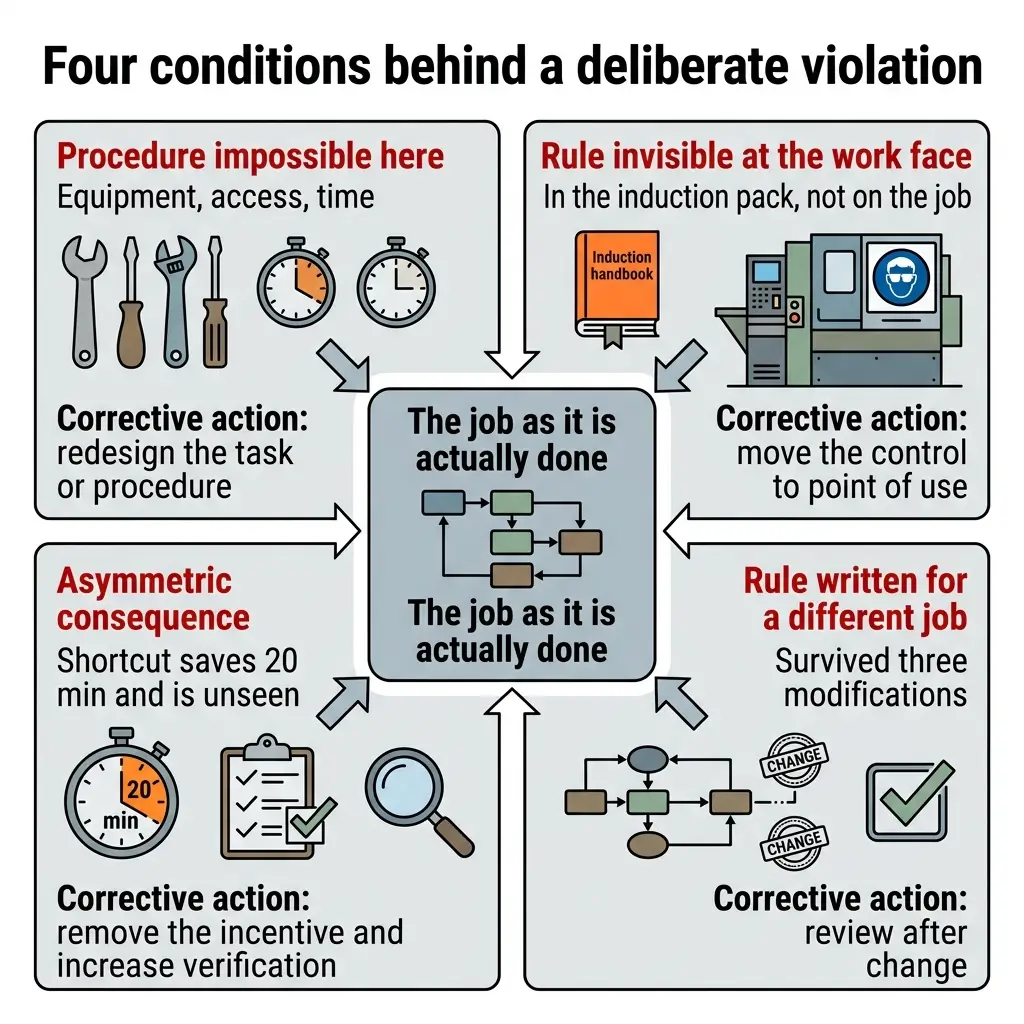
The instinct to treat a violation as a character problem is strong and almost always wrong. Across 80-plus audits I have found four conditions behind nearly every deliberate deviation, and none of them is carelessness.
The first is that the procedure could not be followed as written. The tripod does not fit the flange. The gas detector cable does not reach the work face. The rule assumes access that the plant does not have. This is HSG48's situational violation, and it is the most common one I find. Rewriting the rule is the fix; retraining the crew is not.
The second is that the rule was invisible at the point of work. On a brownfield interface in Singapore I reviewed a contractor bridging document that listed the contractor's own rules but never mapped them to the host's life-saving rules. Both crews were following rules. They were following different ones. I blocked mobilization until the mapping was complete.
The third is asymmetric consequence. Breaking the rule saves twenty minutes and is invisible; following it costs twenty minutes and is visible to a supervisor watching the schedule. Where that asymmetry stands, the violation is the rational choice, and it will recur under every crew you put on the job.
The fourth is that the rule was written for a different job. Procedures accumulate. A control written for a 2015 line configuration survives three modifications and stops matching the work, and the crew works around it because working around it is now the only way to produce.
The diagnostic questions I ask before writing any violation finding are:
- Could this procedure be followed here, today, with this equipment? If not, stop looking at the person.
- Where would the worker read this rule at the point of work? If the answer is "in the induction pack", it is invisible.
- What does following the rule cost, and who sees that cost? Schedule pressure is a design input, not an excuse.
- When was this procedure last checked against the actual task? Anything over three years deserves a walkdown.
How to find broken rules before an incident does
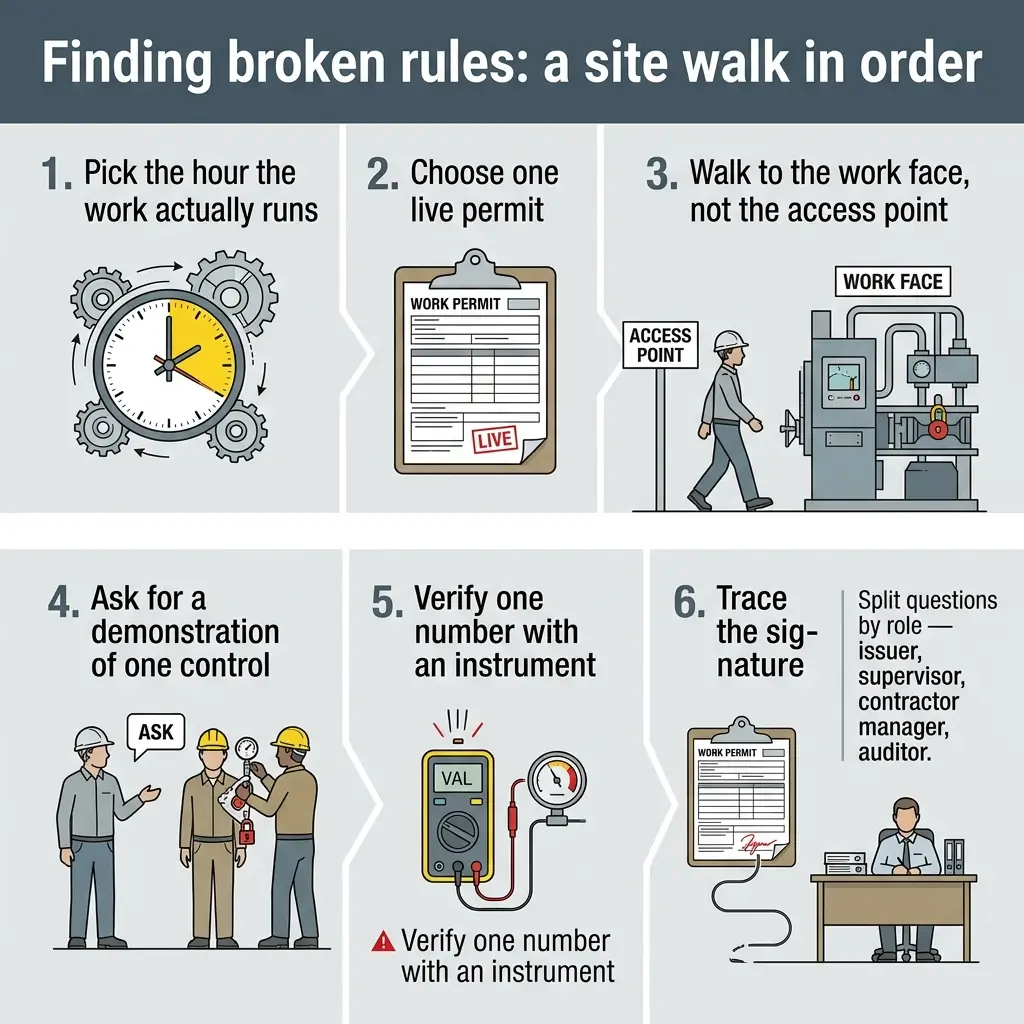
Broken rules are found at the work face, at the hour the work runs, by someone asking a question that cannot be answered from paperwork. That is the whole method. Most audit programmes fail at the second condition — leaders walk at 10 a.m. on a Tuesday and audit a version of the site that is genuinely safer than the one running at 02:00.
I found this directly when I compared day and night findings at a Winnipeg classification yard: leadership walks were almost entirely day-only. We scheduled night walkabouts and tracked closure. Findings rose first, then recurring issues declined — which is what learning looks like when it starts.
Different roles catch different failures, so the questions should split by role rather than being pooled into one checklist.
| If you are the… | Ask this at the work face | A bad answer sounds like |
|---|---|---|
| Permit issuer | Where were you standing when you signed? | "In the permit office, the details were all on the form" |
| Supervisor | What did you measure this control with? | "I had a look on the way past" |
| Contractor manager | Show me where our rules map onto theirs | "They have their own procedures, they're a good contractor" |
| Auditor | Set the rescue up for me at this opening | "It's covered in the generic plan" |
| Night shift lead | Walk me from here to the nearest exit | "It should be clear once sanitation finishes" |
Four habits do more to surface broken rules than any additional documentation:
- Walk at the hours the work runs — night, weekend, turnaround, changeover. Findings live there.
- Ask for a demonstration, not a description. "Show me" separates a real control from a described one.
- Verify with an instrument where the control has a number — gauge, anemometer, gas detector, tape.
- Trace one permit end to end per visit, from the signature back to the work face, and check whether the two agree.
Some controls require a competent person under the applicable regulation: excavation inspection, scaffold handover, confined space rescue, electrical isolation. For those, the check confirms that competence was applied. It does not substitute for it, and no article can make you the competent person.
Frequently asked questions
These are the questions readers most often search alongside this topic.
What is an example of a broken safety rule?
A guardrail removed from a mezzanine edge "for a minute" while people are still working on the deck. It is deliberate, well-intentioned, temporary, and breaches 29 CFR 1926.501 in the US and Work at Height Regulations 2005 regulation 6 in the UK the whole time the rail is off.
What are the three types of safety violations?
Routine, situational and exceptional, as set out in HSE guidance HSG48. Routine violations have become the crew's normal way of working. Situational violations happen because the procedure cannot be followed with the time, access or equipment available. Exceptional violations occur in abnormal or emergency conditions.
What happens if you break safety rules at work?
Consequences run from internal discipline to regulatory citation, prosecution and, in serious cases, imprisonment. In the US, employers face OSHA citations and penalties; in the UK, employees carry a personal duty under section 7 of the Health and Safety at Work etc. Act 1974. The injury risk usually arrives first.
Why do employees ignore safety rules?
Rarely from indifference. The four conditions I find most often are a procedure that cannot be followed as written, a rule that is invisible at the point of work, a shortcut that saves visible time at no visible cost, and a rule written for a job that has since changed.
What is the most commonly broken safety rule?
By citation volume, fall protection. Fall Protection general requirements (29 CFR 1926.501) has led OSHA's most-cited list for 15 consecutive fiscal years. By what I actually find on walkdowns, it is signing a control off without verifying it in the field.
Who is responsible when a safety rule is broken?
Both parties, in different ways. The employer must provide a safe system of work, adequate equipment, supervision and competence. The worker must not knowingly defeat a control. Where a procedure was impossible to follow, responsibility sits with whoever designed the job.
Should someone be dismissed for breaking a safety rule?
That depends on whether the violation was reckless or situational, and it is a decision for your HR and legal process rather than a safety article. Investigate first: if the procedure could not have been followed as written, dismissal removes a person and leaves the hazard exactly where it was.
Takeaways for your next site walk
Pick three of the ten examples above that plausibly exist on your site. Go and look for them at the hour the relevant work runs, and ask for a demonstration rather than an explanation. If you find one, ask which of the four conditions produced it before you write anyone up — because a violation you fix by retraining a crew that was already doing its best will be back on the next shift.
About the author — Benjamin Turner
Benjamin Turner is a Canadian Occupational Health, Safety and Environment (OHSE) Field Operations and Contractor Interface Assurance Consultant with 18 years of continuous field experience across 14 countries. He has stopped work on LNG turnarounds, mine haul roads, offshore wind campaigns, food production lines and urban construction sites, and has inspected more than 200 workplaces and investigated 55-plus incidents. His focus is field assurance — verifying that controls still work at night, with contractors, and under schedule pressure — and contractor interface, including bridging documents and life-saving rule alignment. He leads Turner Field HSE Assurance in Calgary, after senior roles with Alcoa, Nestlé, Canadian National Railway, Woodside Energy, Jacobs, Freeport-McMoRan, Honeywell, Ørsted, Equinix, Kimberly-Clark, National Grid, PCL Construction and Suncor Energy.
Credentials: CRSP, CSP, NCSO (Alberta), ISO 45001 Lead Auditor, ISO 14001 Internal Auditor, IOSH Managing Safely, WHMIS/GHS Trainer, incident investigation (TapRooT or equivalent pathway).
Sources and further reading
- HSE — Managing human failures: overview (errors and violations; routine, situational, exceptional)
- OSHA — Top 10 Most Frequently Cited Standards, FY2025
- OSHA — 29 CFR 1926.501, Duty to have fall protection
- OSHA — 29 CFR 1910.147, Control of hazardous energy
- OSHA — 29 CFR 1910.1200, Hazard Communication
- OSHA — 29 CFR 1910.212, General requirements for all machines
- legislation.gov.uk — Work at Height Regulations 2005, regulation 6
- legislation.gov.uk — PUWER 1998, regulation 11
- legislation.gov.uk — Confined Spaces Regulations 1997