

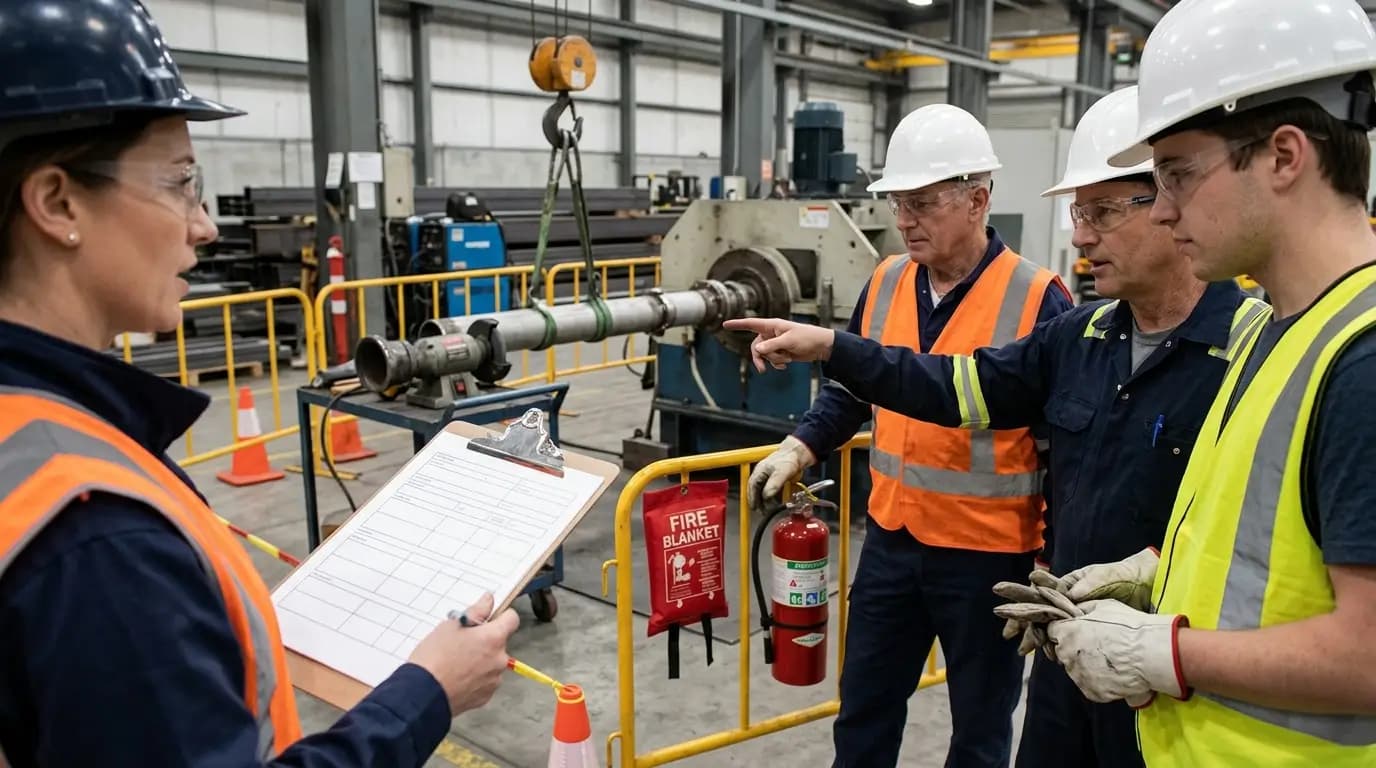
JSA stands for Job Safety Analysis. It is a task-level document that breaks one job into its steps, names the hazard in each step, and states the control that will be in place before the crew starts work.
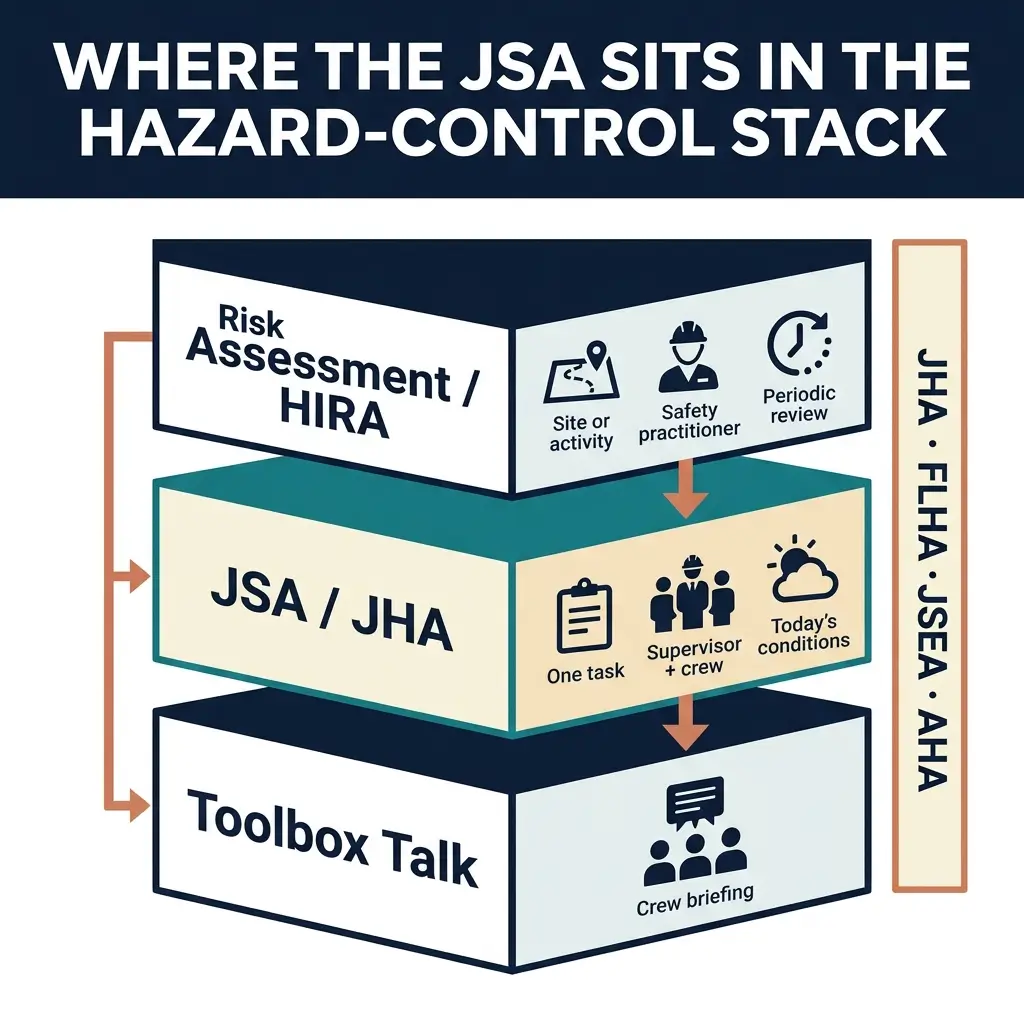
A JSA and a JHA — Job Hazard Analysis — are the same document under two names. The pair actually worth separating is the JSA and the risk assessment. One covers a single task on a single shift. The other covers an activity or a site and feeds the management system above it.
Across 200+ workplaces in fourteen countries, the JSA finding I write up is almost never a missing form. The forms are there, signed, filed. What fails is the gap between what the form says and what the crew is about to do.
This guide is anchored on US law, with the Canadian, UK and Australian equivalents in a comparison table, because the term travels further than the legal instrument behind it does.
Key takeaways
The short version, before the detail:
- JSA = Job Safety Analysis. JHA, FLHA, JSEA and job hazard breakdown all describe the same task-level process.
- No OSHA standard is titled "JSA." The enforceable anchors are 29 CFR 1910.132(d) for PPE hazard assessment and written certification, 29 CFR 1926.21(b)(2) for construction instruction, and the General Duty Clause.
- OSHA Publication 3071 is guidance, not a rule — but it is the federal method every US auditor recognises.
- Keep the step list under ten. CCOHS advises splitting the job into two analyses rather than writing an unreadable one.
- The signature is the weakest link. A signed JSA that does not match the work is worse evidence than no JSA at all.
- On a multi-employer site, decide whose JSA governs before mobilisation, not at the gate on day one.
What JSA stands for, and what it actually is
The full form is Job Safety Analysis. The method is old, simple and hard to do well: pick a task, list the steps in the order a worker performs them, ask what could hurt someone at each step, and write down the control that will stop it.
OSHA's own guidance uses the term job hazard analysis, and its booklet OSHA 3071 defines it as a technique focused on job tasks, examining the relationship between the worker, the task, the tools and the environment. The Canadian Centre for Occupational Health and Safety publishes the same method under job safety analysis. Two names, one technique.
Which word your site uses is a matter of client contract and regional habit. What matters is that everyone on the job means the same thing by it.
JSA, JHA, FLHA, AHA and SWMS — what the names mean
Field crews meet several labels for near-identical paperwork, and one of them is legally distinct.
| Term | Full form | Same as a JSA? | Where you'll meet it |
|---|---|---|---|
| JHA | Job Hazard Analysis | Yes | US manufacturing, OSHA guidance |
| FLHA | Field Level Hazard Assessment | Yes, done daily at the work front | Canadian energy and utilities |
| JSEA | Job Safety and Environmental Analysis | Yes, with an environmental column | Mining, some EPC contracts |
| AHA | Activity Hazard Analysis | Yes, on a prescribed format | US federal and USACE contracts |
| SWMS | Safe Work Method Statement | No — legally mandated document | Australian high risk construction work |
The SWMS is the exception. It is a statutory requirement, not a naming variant, and I cover it in the jurisdiction section below.
JSA versus risk assessment
These get used interchangeably in conversation and they should not be. A risk assessment sits above the JSA and asks which activities across a site carry unacceptable risk. A JSA takes one of those activities and works out how the crew will do it on Tuesday morning without getting hurt.
The practical differences that decide which document you need are:
- Scope — a risk assessment covers an activity, area or process; a JSA covers one task
- Author — a risk assessment is usually written by a competent safety practitioner; a JSA is written by the supervisor with the crew who will do the work
- Lifespan — a risk assessment is reviewed periodically; a JSA is valid only for the conditions in front of you
- Output — a risk assessment ranks and prioritises; a JSA sequences and instructs
Does OSHA require a JSA? What the law actually says
No OSHA standard is titled "Job Safety Analysis," and no rule says every job needs one. That answer disappoints people, and then they read it as "JSAs are optional," which is where the trouble starts. Several standards require a documented hazard evaluation that a JSA is the ordinary way to satisfy.
United States
The clearest anchor is the PPE standard. Under 29 CFR 1910.132(d)(1), an employer must assess the workplace to determine whether hazards are present that make PPE necessary. Under 1910.132(d)(2), that assessment has to be verified through a written certification identifying the workplace evaluated, the person certifying, the date, and the fact that the document is a hazard assessment certification.
Read those four elements again, then look at your JSA form. Most of them are already on it. Adding the missing one turns a voluntary document into your compliance record.
On construction sites, 29 CFR 1926.21(b)(2) requires the employer to instruct each employee in the recognition and avoidance of unsafe conditions. A task-specific JSA, briefed and signed, is the most straightforward evidence that this happened for this job.
The General Duty Clause, section 5(a)(1) of the OSH Act, then covers recognised hazards with no specific standard. This cuts both ways. A JSA that identifies a hazard and shows no control implemented is a written record that the employer recognised the hazard and did nothing.
Canada
Federal and provincial law requires hazard identification and control rather than a named form. CCOHS publishes the JSA method as standard practice, and provincial regulators expect documented pre-task hazard assessment on higher-risk work. Working out of Calgary, the term I hear most on Alberta and British Columbia sites is FLHA — the same analysis, completed at the work front, usually daily.
United Kingdom and Australia
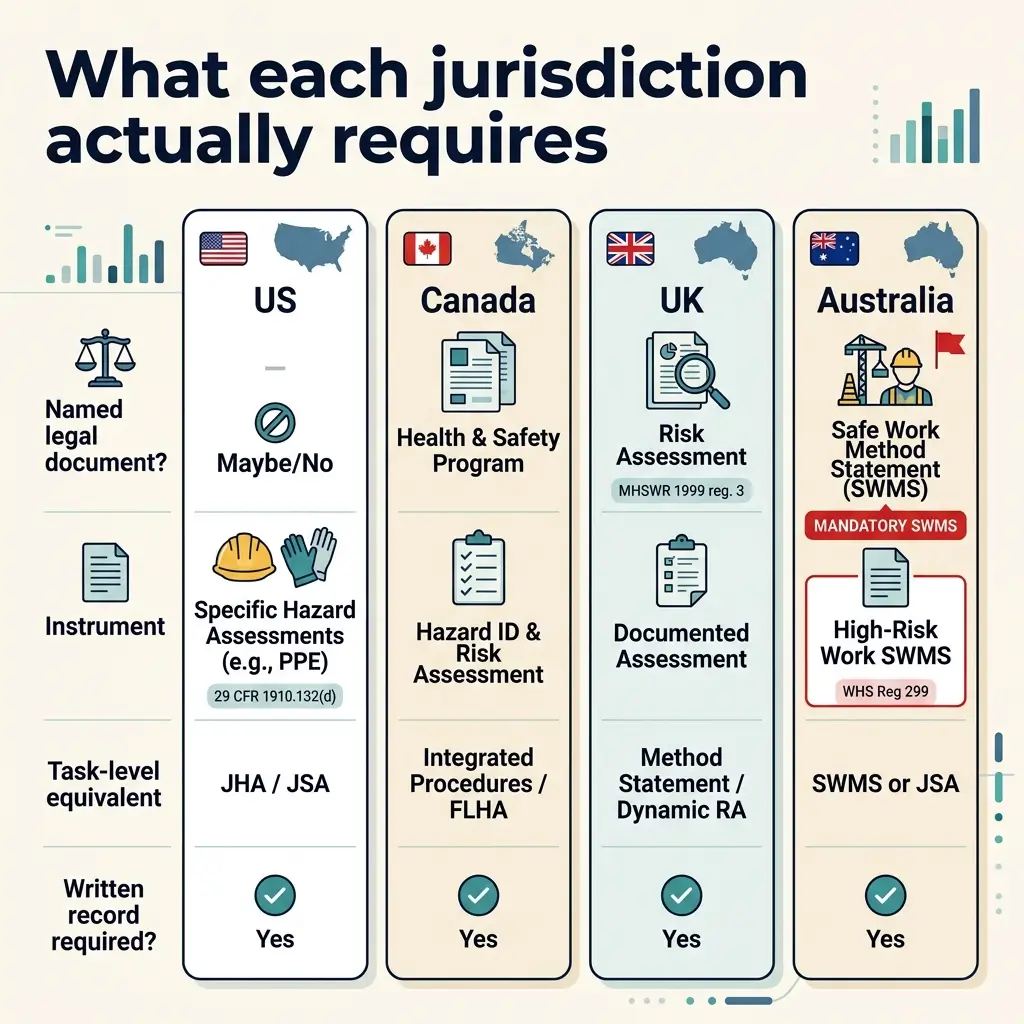
Neither jurisdiction uses "JSA" as a legal term, and importing US paperwork without checking this is a common error on multinational projects.
| Jurisdiction | Instrument | What it actually requires |
|---|---|---|
| United States | 29 CFR 1910.132(d); 1926.21(b)(2); OSH Act 5(a)(1) | Hazard assessment for PPE with written certification; instruction in hazard recognition |
| Canada | Provincial OHS legislation; CCOHS JSA guidance | Documented hazard identification and control before task start |
| United Kingdom | MHSWR 1999 reg. 3 | A suitable and sufficient risk assessment, recorded where five or more are employed. The task-level document is a method statement — RAMS |
| Australia | WHS Regulations 2011 reg. 299; Safe Work Australia SWMS guidance | A SWMS must be prepared before any of the prescribed high risk construction work starts |
The points that matter when you take a JSA process across a border are:
- In Britain, a JSA is not a risk assessment. It supports one; it does not discharge regulation 3.
- In Australia, a JSA does not discharge the SWMS duty for high risk construction work — the SWMS content is prescribed.
- In the US, adding the four certification elements from 1910.132(d)(2) upgrades a JSA into a compliance record at no cost.
- In Canada, expect a daily FLHA at the work front in addition to the task JSA on higher-risk work.
How to conduct a JSA in six steps — and where each one fails
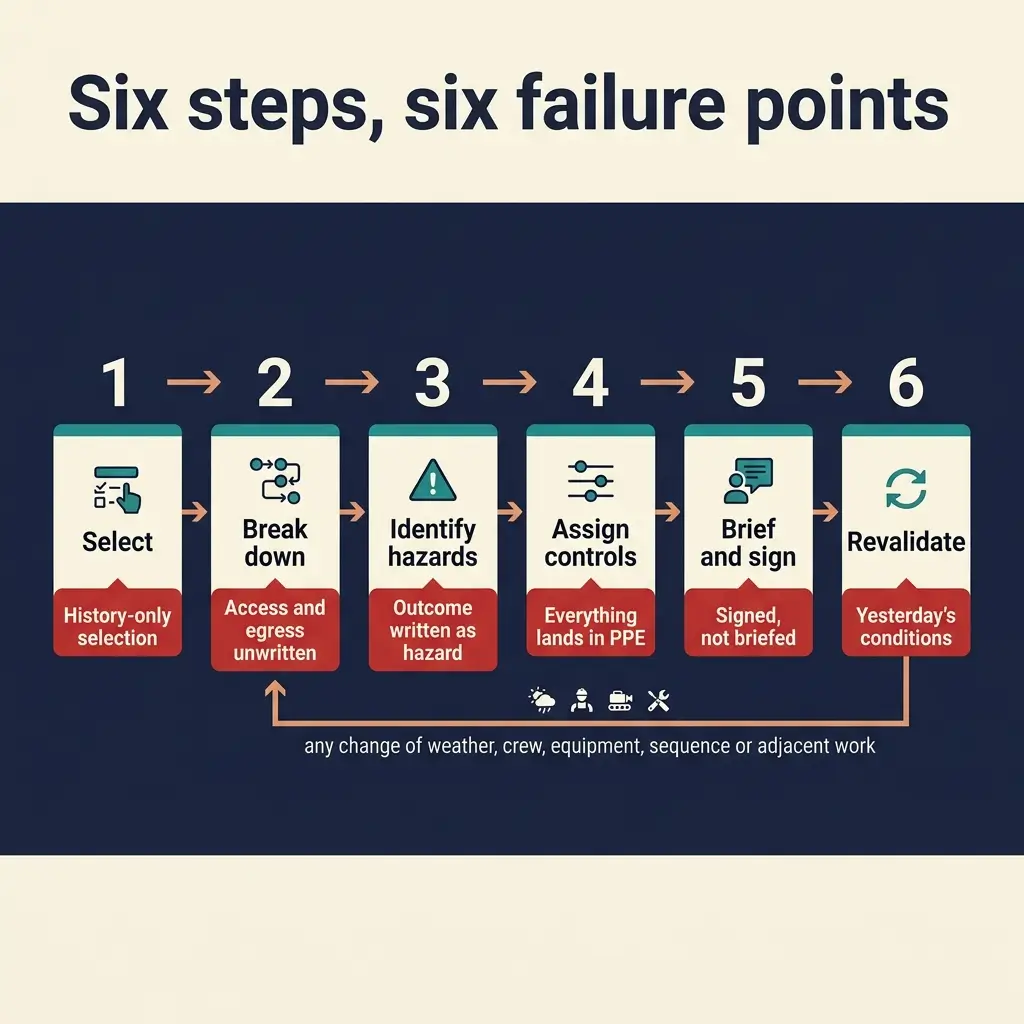
The method is four steps in most textbooks. I teach six, because the two the textbooks leave out — briefing and revalidation — are where the document either earns its keep or becomes wallpaper.
Step 1: Select and prioritise the task
Not every job needs its own analysis, and a site that tries produces a library nobody opens. OSHA 3071 sets the priority order. Take first the jobs with the highest injury rates, then the jobs that could cause severe injury even with no incident history. After those come jobs where one simple human error has a severe outcome, jobs that are new or changed, and jobs complex enough to need written instructions.
Where it fails: the selection list gets built entirely from injury history. History is a record of what has already gone wrong, not of what could. The third criterion — one error, severe outcome — is the one that catches the task nobody has been hurt on yet.
Step 2: Break the task into steps
List what the worker does, in sequence, starting each item with an action verb. Describe what is done, not how it is done. CCOHS gives a useful rule of thumb: most jobs fit in under ten steps, and if yours needs more, split the job into two analyses rather than write one nobody reads.
Where it fails: the steps between the steps go unwritten. The walk to the work face, the laydown, the route out — none of that is "the job," so none of it makes the list.
On a brownfield corridor in Calgary I walked a temporary works area and found cable drums staged across a primary scaffold egress stair. Every task JSA on that corridor was complete. Not one of them had a step called "leave the work area," so nothing in the paperwork ever looked at the stair. I required immediate relocation and added photo examples of a blocked stair to the temporary works checklist, and egress compliance on the following night shifts improved.
The transferable check is short: read your step list and ask how the crew gets in and how they get out. If neither appears, the analysis stops at the edge of the task and the hazard is usually just outside it.
Step 3: Identify the hazard in each step
OSHA 3071 frames this as detective work with five questions: what can go wrong, what are the consequences, how could it arise, what else contributes, and how likely is it. A good hazard description names the environment, who is exposed, what triggers it, and the outcome.
Where it fails: the hazard column gets filled with outcomes instead of mechanisms. "Slip, trip and fall" is not a hazard — it is what happens afterwards. "Condensate from the overhead line pooling on the ramp where the crew turns with a load" is a hazard, and it tells you what to control.
Step 4: Assign controls using the hierarchy
Work down the hierarchy in order: eliminate, substitute, engineer, administer, then PPE. OSHA 3071 puts it plainly — engineering controls that physically change the machine or environment are the most effective, and PPE is acceptable where higher controls are not feasible, while they are being installed, or in an emergency.
Where it fails: every line lands in the last two boxes. A JSA where the control column reads "trained personnel, PPE, be careful" for twelve consecutive steps has not applied the hierarchy — it has recorded that nobody tried. CCOHS says this outright: general statements such as "be careful" or "use caution" do not belong in the preventive measures column, because they describe neither an action nor how to perform it.
The second failure is the PPE column filled from habit. In a coating cell in Chihuahua I watched a solvent wipe-down being done in gloves that the safety data sheet for that blend did not support. The JSA said gloves. The crew wore gloves. Nobody had matched the glove to the chemistry after the blend changed. I stopped the task, matched the PPE to the SDS, and ran a short glove-matching drill with the line — wrong-glove findings on that line dropped afterwards.
If you write "gloves" in a control column, write which gloves and against which SDS section. Under 1910.132(d) the specificity is the requirement, not a refinement of it.
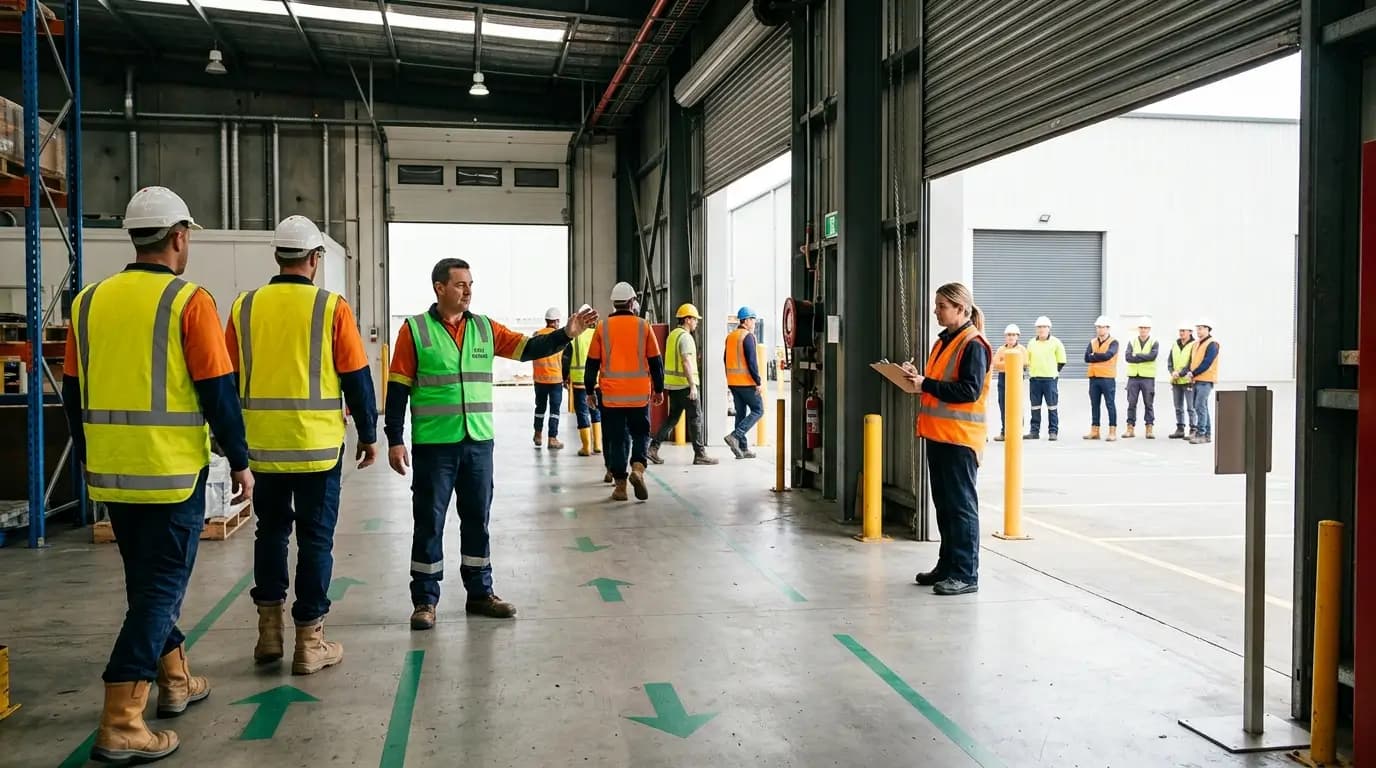
Step 5: Brief the crew, then sign
The JSA is delivered by a person, out loud, at the work location, to the people who will do the work. The signature block records that this happened.
Where it fails: the form circulates on a clipboard and comes back with eight signatures and no questions. A crew that signs without reading has produced a document that will be used against the employer rather than for it.
I look for one thing when I sit in on a briefing: does anyone change the form? A JSA that comes back from the field identical to the one that went out has not been briefed. It has been distributed.
Step 6: Revalidate when conditions change
A JSA is written against a set of conditions. When those change, the analysis expires — regardless of what the date on it says.
Where it fails: yesterday's document covers today's site. On an industrial fit-out in Edmonton, after overnight rain, I found a crew re-entering a trench with no revalidation and no re-inspection. The JSA and the excavation inspection from the previous day were both in order. Neither described the ground they were standing on. I evacuated the trench, required inspection and re-shoring before re-entry, and briefed the superintendent; post-rain revalidation on that site improved from there.
Rain rewrites trench risk. So does a crew change, a swap of equipment, a change in sequence, and any adjacent work starting up nearby.
British law states the same principle at the level above: regulation 3(3) of MHSWR 1999 requires an assessment to be reviewed where there is reason to suspect it is no longer valid, or where there has been a significant change in what it covers. A JSA written against dry ground and reused on wet ground has met both conditions.
The six steps, in the order you run them, are:
- Select the task against the OSHA 3071 priority criteria, not injury history alone
- Break it into under ten steps, action verbs, what rather than how
- Name the hazard mechanism in each step, not the injury
- Assign controls down the hierarchy, with PPE specified against the SDS or standard
- Brief it at the work location and expect the form to come back changed
- Revalidate on any change of weather, crew, equipment, sequence or adjacent work
Job safety analysis examples
Most published JSA examples use a ladder, a forklift or a chemical decant. Those are fine, and they are also the tasks that appear in every template pack, which makes them poor practice material. The three below come from sectors I have worked in — food manufacturing, data centre commissioning and rail freight — and are written as example analyses rather than accounts of specific incidents.
Note the fourth column. Most JSA forms stop at the control. The verification column asks how a supervisor confirms the control is actually in place, which is the difference between a written control and a working one.
Example 1: Night CIP hose changeover on a packaging line
Clean-in-place work runs at night, in a wet environment, on a line that is nominally shut down.
| Step | Hazard mechanism | Control | Field verification |
|---|---|---|---|
| Route hose from CIP skid to line | Hose laid across the primary escape door | Route along the wall; door swing kept clear | Walk the escape route with the crew before connection |
| Connect to caustic supply | Residual pressure releasing at the coupling | Confirm zero pressure at gauge; face shield and apron per SDS | Supervisor watches the gauge reading, not the operator's word |
| Run cycle | Hot caustic on wet floor; slip and chemical burn | Barrier the wet zone; no crossing traffic during cycle | Barriers physically in place before the pump starts |
| Break down and drain | Line drained hot | Cool-down interval before disconnect; drain to point of use | Temperature checked, not assumed from clock time |
Example 2: Raised-floor tile removal in a live data hall
The hazard here is an open hole in a floor people walk across in low light, with live systems underneath.
| Step | Hazard mechanism | Control | Field verification |
|---|---|---|---|
| Identify tile and check load path | Adjacent tile losing support when a stringer is removed | Confirm grid layout; lift one tile at a time | Grid drawing present at the work location |
| Lift tile | Fall into open floor void | Guard the opening before the tile leaves the frame | Guard in place before lift, not after |
| Work in void | Contact with live cabling and cooling pipework | Confirm circuits with the hall's own isolation record | Isolation record checked against the label at the void |
| Replace tile | Tile seated proud, creating a trip edge | Seat and check flush across all four edges | Walk the tile after replacement |
Example 3: Track-side inspection walk in a classification yard
Yard work at night combines moving equipment, poor lighting and long sight lines that feel safer than they are.
| Step | Hazard mechanism | Control | Field verification |
|---|---|---|---|
| Enter yard limits | Entering track occupied by another crew | Track protection confirmed with the yardmaster before entry | Protection confirmed by name and time, logged |
| Walk between tracks | Struck by movement from behind on the adjacent track | Fixed walking route; high-visibility clothing; no phone use | Route walked with a supervisor on first shift |
| Inspect at car | Standing in the foul of an adjacent track while writing | Position off the foul before recording | Observed once per shift by the supervisor |
| Exit yard limits | Protection released before the crew is clear | Positive clear-of-track call to the yardmaster | Release logged against the clear call, not the clock |
What separates these from a downloaded template is not the hazards. It is that each control has a named way of being checked. The habits worth copying into your own forms are:
- Write the mechanism, not the injury, in the hazard column
- Name the person or record that confirms each control, not the control alone
- Include a step for getting in and a step for getting out of the work area
- Put the verification in the form, so the supervisor's walk has a defined shape
Who owns the JSA on a multi-employer site
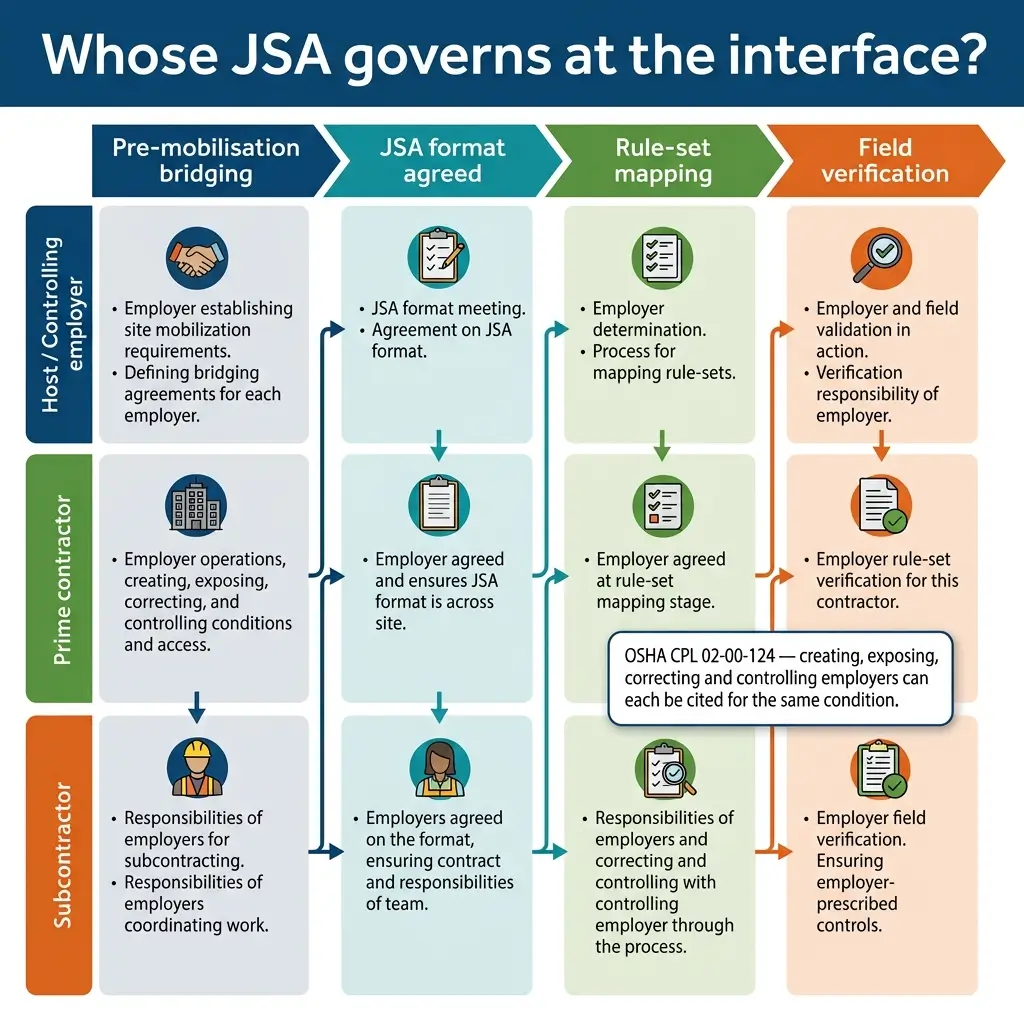
This is the question that gets skipped in planning and settled badly at the gate on mobilisation day. A subcontractor arrives with its own JSA format, its own hazard categories and its own life-saving rules. The host site has all three as well. Both are reasonable documents. Together they produce two definitions of safe on one job.
Reviewing a bridging document for a brownfield interface at a Singapore hub, I found a contractor rule set that listed its own life-saving rules but never mapped them to the host's. The rules were not in conflict, exactly — they were in parallel, which is worse, because nobody notices. I blocked mobilisation until the mapping was complete and briefed both parties, and subsequent mobilisations arrived with mapped rule sets.
US enforcement does not care whose logo is on the form. OSHA's multi-employer citation policy, CPL 02-00-124, sorts employers into creating, exposing, correcting and controlling roles, and more than one of them can be cited for the same hazardous condition. A controlling employer who accepted a contractor JSA without reading it is not insulated by having accepted it.
| Role | Who this usually is | JSA duty in practice |
|---|---|---|
| Creating | Whoever introduced the hazard | Their JSA has to cover the hazard they brought onto the site |
| Exposing | The employer whose people are at risk | Must brief its own crew, whoever wrote the analysis |
| Correcting | The party responsible for fixing the condition | Needs the JSA to reach them, not sit in a folder |
| Controlling | Host, prime or general contractor | Reasonable diligence to check contractor JSAs are real and current |
Settle the following before the first crew mobilises:
- Which format governs — host, contractor, or contractor-format-with-host-hazard-categories
- Where the two rule sets map, clause by clause, in the bridging document
- Who signs on the host side, and whether that signature means "reviewed" or "approved"
- What triggers a joint revalidation when adjacent work starts
- Where the JSAs are physically kept so a supervisor from either party can reach them at the work face
What an auditor checks in a stack of JSAs
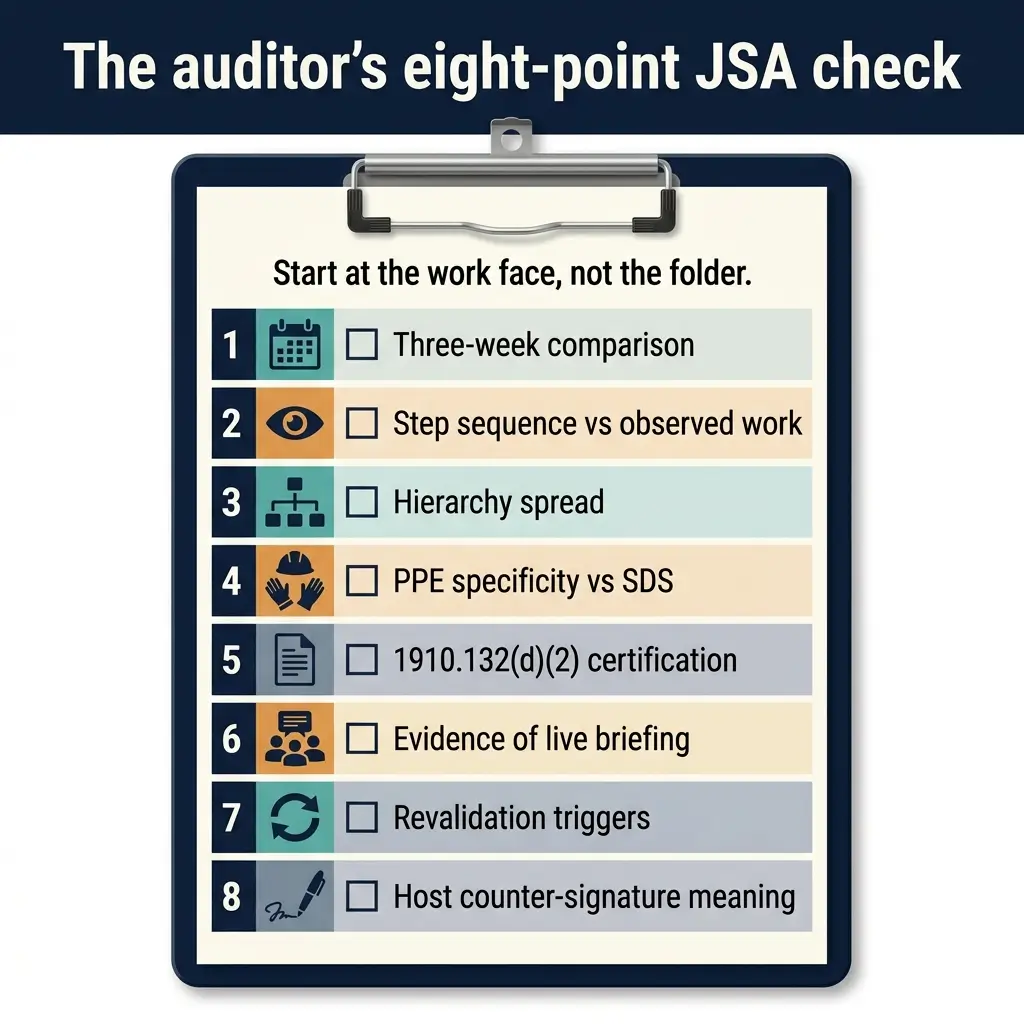
When I audit this, I do not start with the forms. I start at the work face, watch the job for ten minutes, and then ask for the JSA covering it. Reading the document first tells you what the site wishes were true.
Then I look for divergence. Does the step sequence on the form match the sequence I watched? Is there a step happening in front of me that appears nowhere on the page? Those two questions find more than any document review.
Run these checks on your own stack before someone else does:
- Pull three JSAs for the same recurring task from different weeks. Identical wording means copying, not analysis
- Compare the step sequence on the form to the sequence being worked. Any extra step in the field is an uncontrolled step
- Check the control column for hierarchy spread. All-administrative and all-PPE is a red flag on its own
- Confirm the PPE line is specific — glove type against the SDS, not "gloves"
- Look for the four certification elements from 1910.132(d)(2): workplace, person certifying, date, and that it identifies itself as a hazard assessment certification
- Ask a crew member what changed at the briefing. Silence means it was handed out, not briefed
- Check the revalidation trigger after weather, crew change or equipment swap
- Ask who signed on the host side for contractor-written JSAs, and what they checked
The JSA template columns worth having
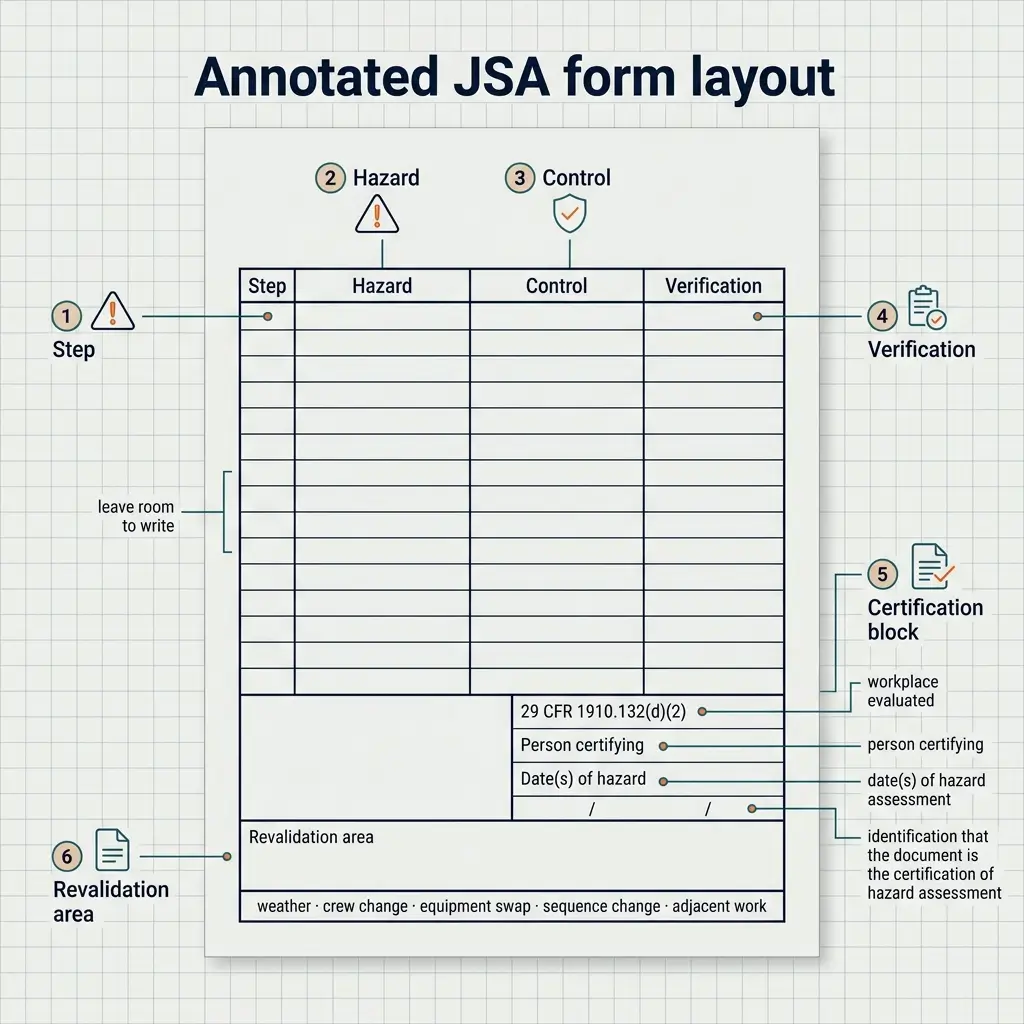
A JSA form has one design constraint that overrides every other: a supervisor has to fill it in with the crew standing there, in weather, on a clipboard or a tablet. Every column you add costs attention that the analysis needs.
Four columns do the work. Two more turn the document into a compliance record. Anything past that belongs in the risk assessment above it.
| Column | Purpose | Skip it? |
|---|---|---|
| Task step | Sequenced, action verb, what rather than how | Never |
| Hazard | The mechanism — environment, exposure, trigger, outcome | Never |
| Control | Highest feasible level of the hierarchy | Never |
| Verification | How the supervisor confirms the control is in place | Never — this is what makes the form work |
| Residual risk rating | Ranking after controls | Optional, and often filled in as "Low" without thought |
| Certification block | Workplace, person certifying, date, self-identifying title | Keep it — it satisfies 1910.132(d)(2) |
Two design details make more difference than the column set:
- Leave physical room to write. A form with four-millimetre rows guarantees single-word entries
- Put the revalidation triggers on the form itself, not in the procedure nobody carries
- Keep the signature block on the same page as the steps, so signing requires the reader to look at them
- Do not pre-print the hazards. A tick-box hazard list turns analysis into recognition
Frequently asked questions
These are the questions supervisors and safety coordinators ask most often once the form is in front of them.
Is a JSA the same as a JHA?
Yes. Job Safety Analysis and Job Hazard Analysis describe the same task-level process. OSHA guidance uses "job hazard analysis"; CCOHS uses "job safety analysis." Some organisations claim a distinction — JSA for how to work safely, JHA for what could go wrong — but no regulator recognises it.
Does OSHA require a JSA?
Not by name. No standard mandates a document called a JSA. However, 29 CFR 1910.132(d) requires a written, certified PPE hazard assessment, 1926.21(b)(2) requires instruction in hazard recognition, and the General Duty Clause covers recognised hazards. A JSA is the normal way employers satisfy all three.
How many steps should a JSA have?
Under ten for most jobs. CCOHS advises that if a job needs more, split it into two analyses or combine steps rather than write one long document. Too few steps hides hazards between them; too many produces a form nobody finishes reading.
Who is responsible for writing the JSA?
The supervisor of the work group, with the workers who will perform the task. Workers know the shortcuts, the awkward reach and the step that never appears in the procedure. A safety professional supports complex or high-risk work but should not write the document alone.
How often should a JSA be reviewed?
Whenever conditions change — weather, crew, equipment, sequence, or adjacent work starting nearby — and after any incident or near miss on that task. Beyond that, high-risk task JSAs deserve an annual review at minimum. A date alone never validates a JSA; conditions do.
Can a JSA be used against my employer after an incident?
Yes, in both directions. A signed, current JSA that matches what was actually done is strong evidence of diligence. A generic or copied one that identifies a hazard with no control implemented is evidence the employer recognised the hazard and did not act.
What is the difference between a JSA and a SWMS?
A SWMS is an Australian statutory document required under WHS Regulations 2011 before any of the prescribed high risk construction work starts, with content specified in regulation. A JSA is a method, not a legal instrument. Doing a JSA does not discharge the SWMS duty.
Conclusion: the three things worth changing
If you take three things from this into your next shift, take these.
Add a verification column to your form. The control tells you what should be true; the verification tells the supervisor how to find out whether it is, and it is the single change that most improves the quality of what gets written in the other columns.
Put the revalidation triggers on the form itself. Weather, crew change, equipment swap, sequence change, adjacent work. The trench in Edmonton was not a paperwork failure — the paperwork was complete. It was a document written against conditions that no longer existed.
Settle JSA ownership before mobilisation on any multi-employer job. Two rule sets running in parallel is not a conflict anyone reports, which is exactly why it survives until something goes wrong.
About the author — Benjamin Turner
Benjamin Turner is a Canadian Occupational Health, Safety and Environment (OHSE) Field Operations and Contractor Interface Assurance Consultant with 18 years of continuous field experience across 14 countries. His work centres on field assurance — checking that controls still hold at night, with contractors, and under schedule pressure — and on contractor interface, including bridging documents, life-saving rule mapping and stop-work quality. Much of the JSA and pre-task planning work described here comes from brownfield and temporary works assignments with Jacobs in Calgary and Singapore, industrial fit-out work with PCL Construction in Edmonton, and process and machine safety work with Honeywell. He leads Turner Field HSE Assurance from Calgary, after senior roles with Alcoa, Nestlé, Canadian National Railway, Woodside Energy, Jacobs, Freeport-McMoRan, Honeywell, Ørsted, Equinix, Kimberly-Clark, National Grid, PCL Construction and Suncor Energy.
Credentials: Canadian Registered Safety Professional (CRSP); Certified Safety Professional (CSP); National Construction Safety Officer (NCSO), Alberta; ISO 45001 Lead Auditor; ISO 14001 Internal Auditor.
Sources and further reading
- OSHA, Job Hazard Analysis, Publication 3071
- OSHA, 29 CFR 1910.132 — Personal protective equipment, general requirements
- OSHA, 29 CFR 1926.21 — Safety training and education
- OSHA, CPL 02-00-124 Multi-Employer Citation Policy
- CCOHS, Job Safety Analysis — OSH Answers
- UK legislation, Management of Health and Safety at Work Regulations 1999, regulation 3
- Safe Work Australia, Safe work method statement for high risk construction work