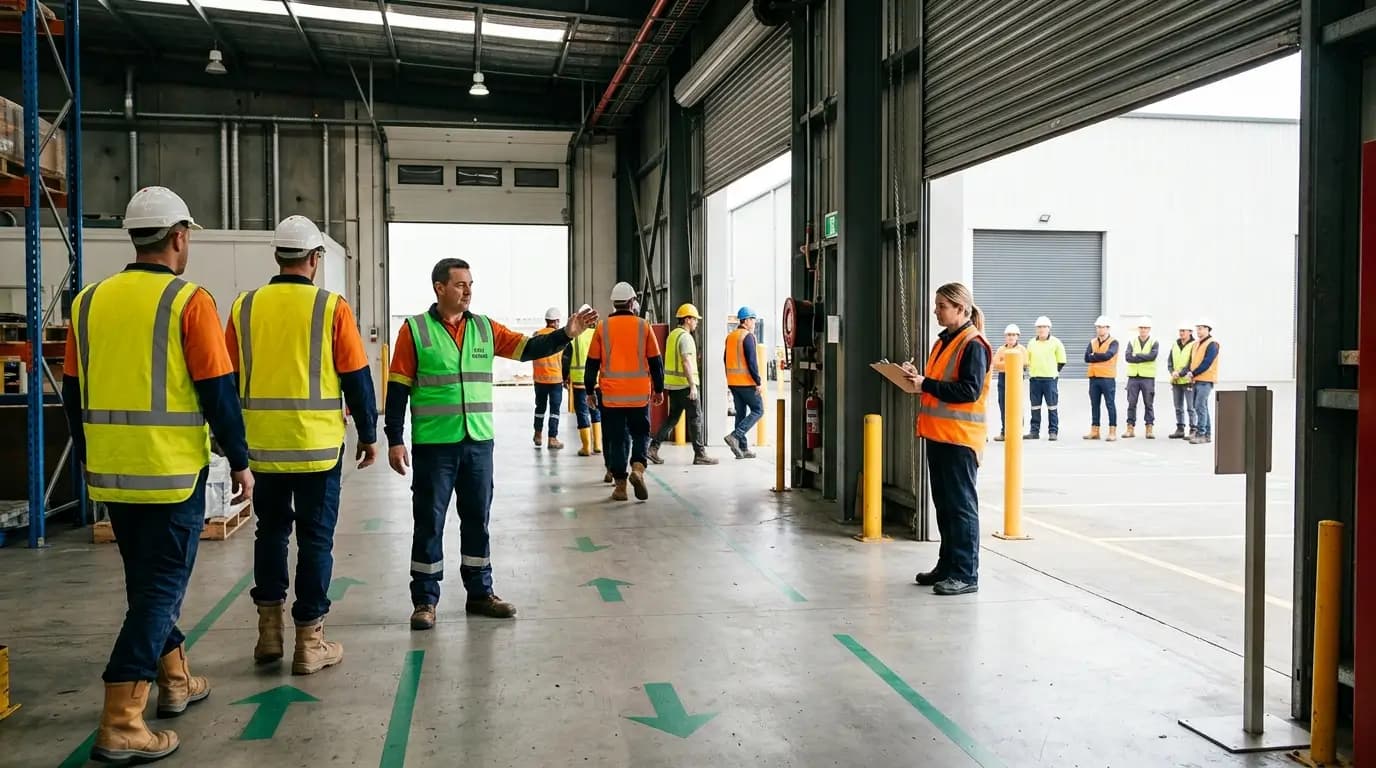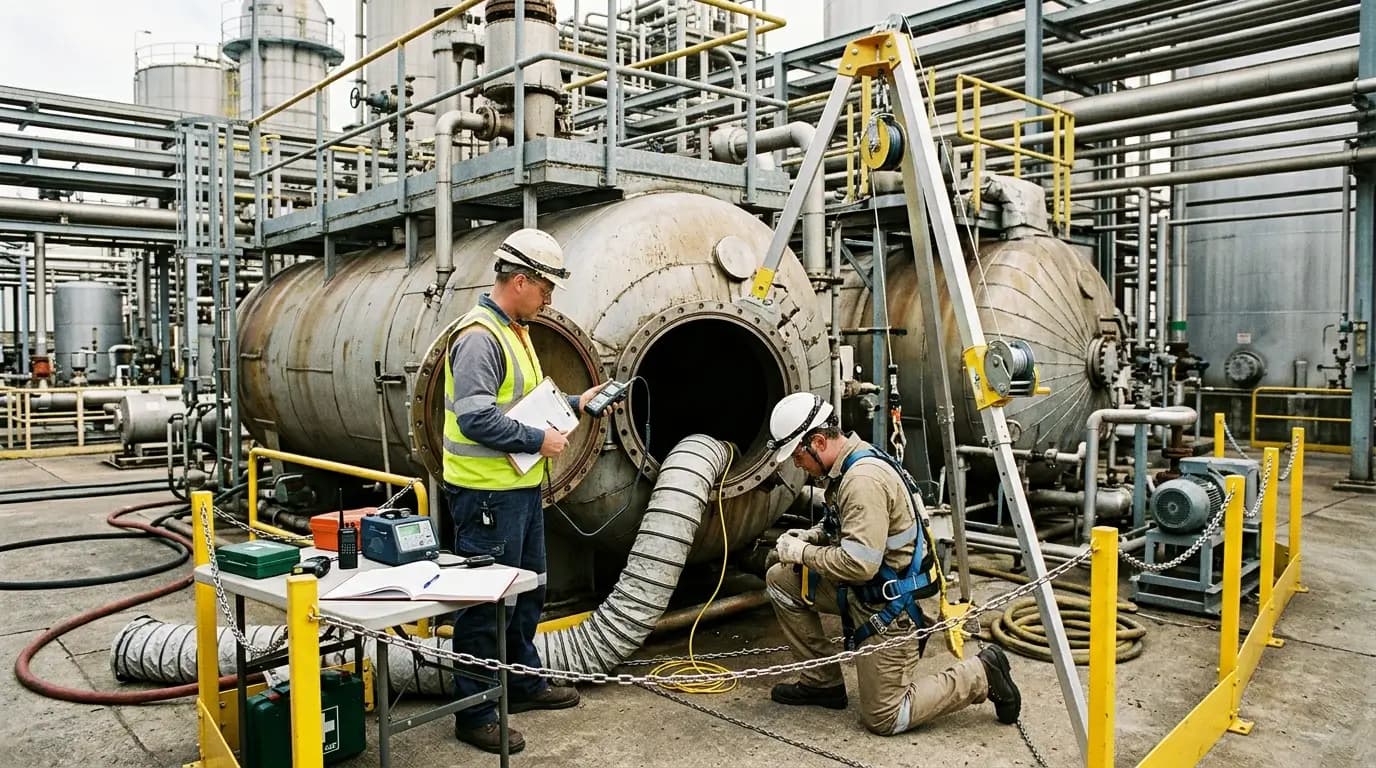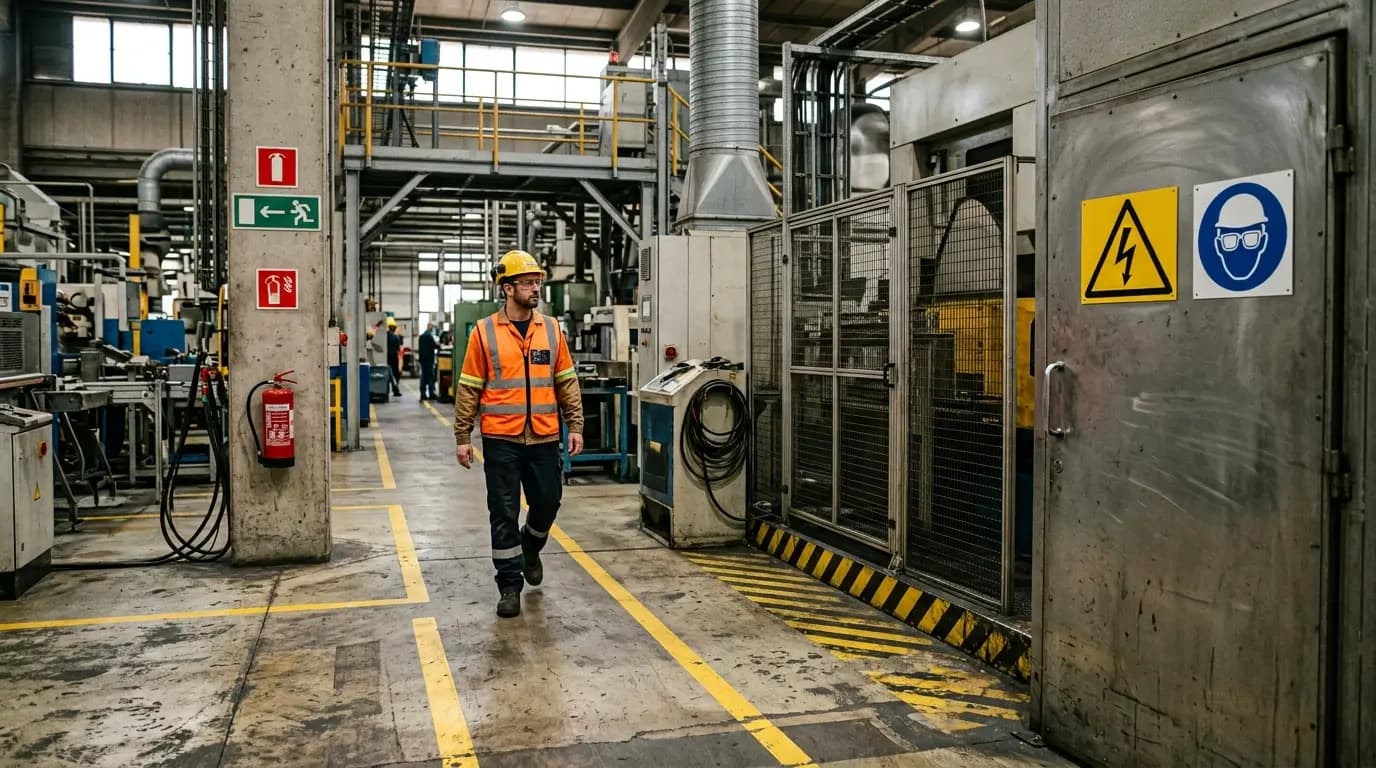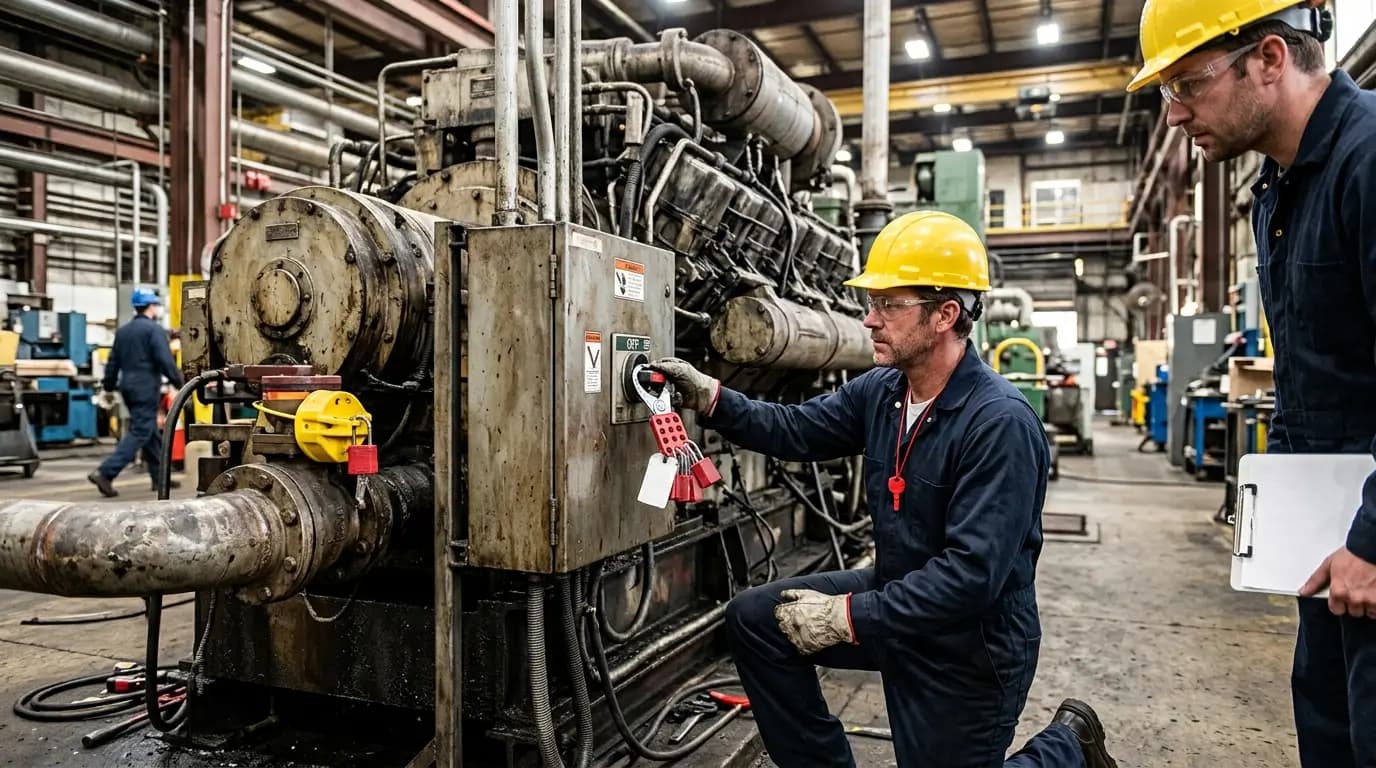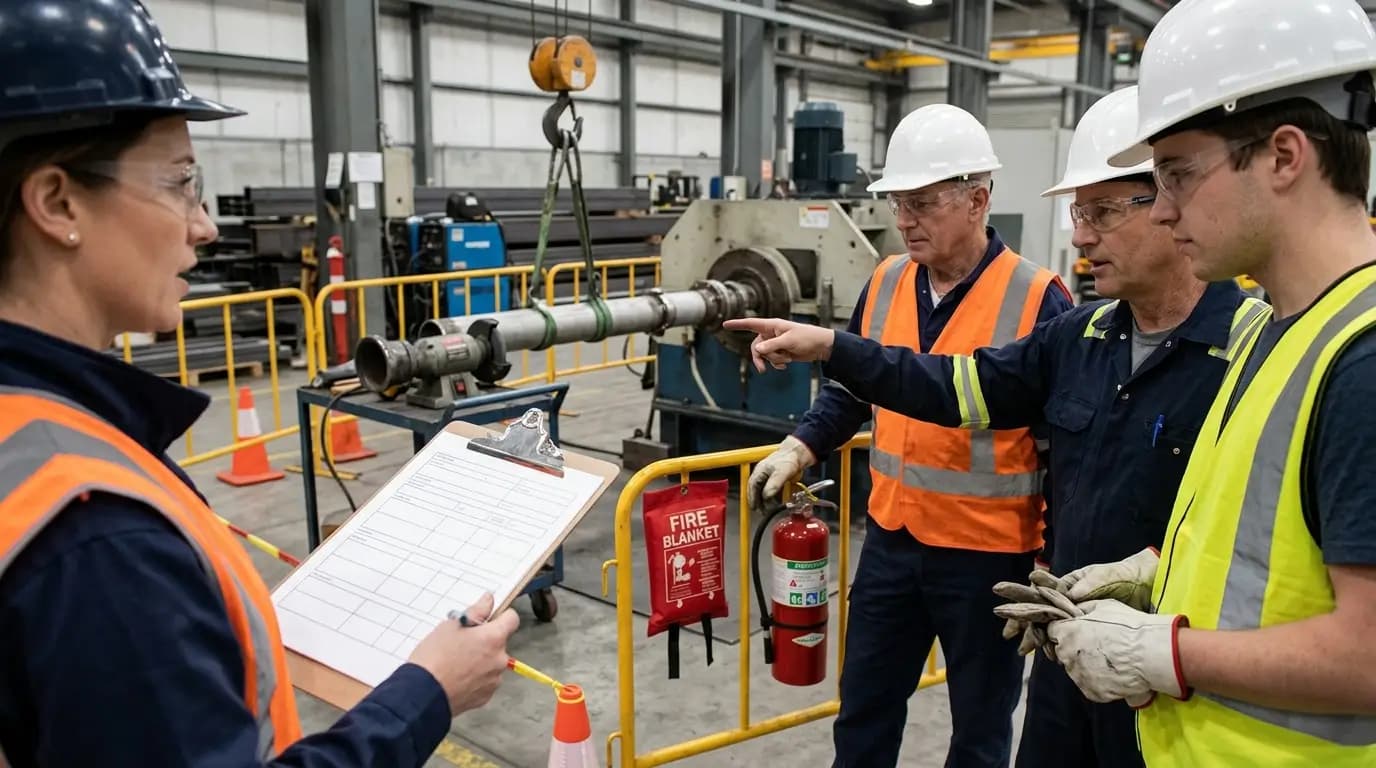


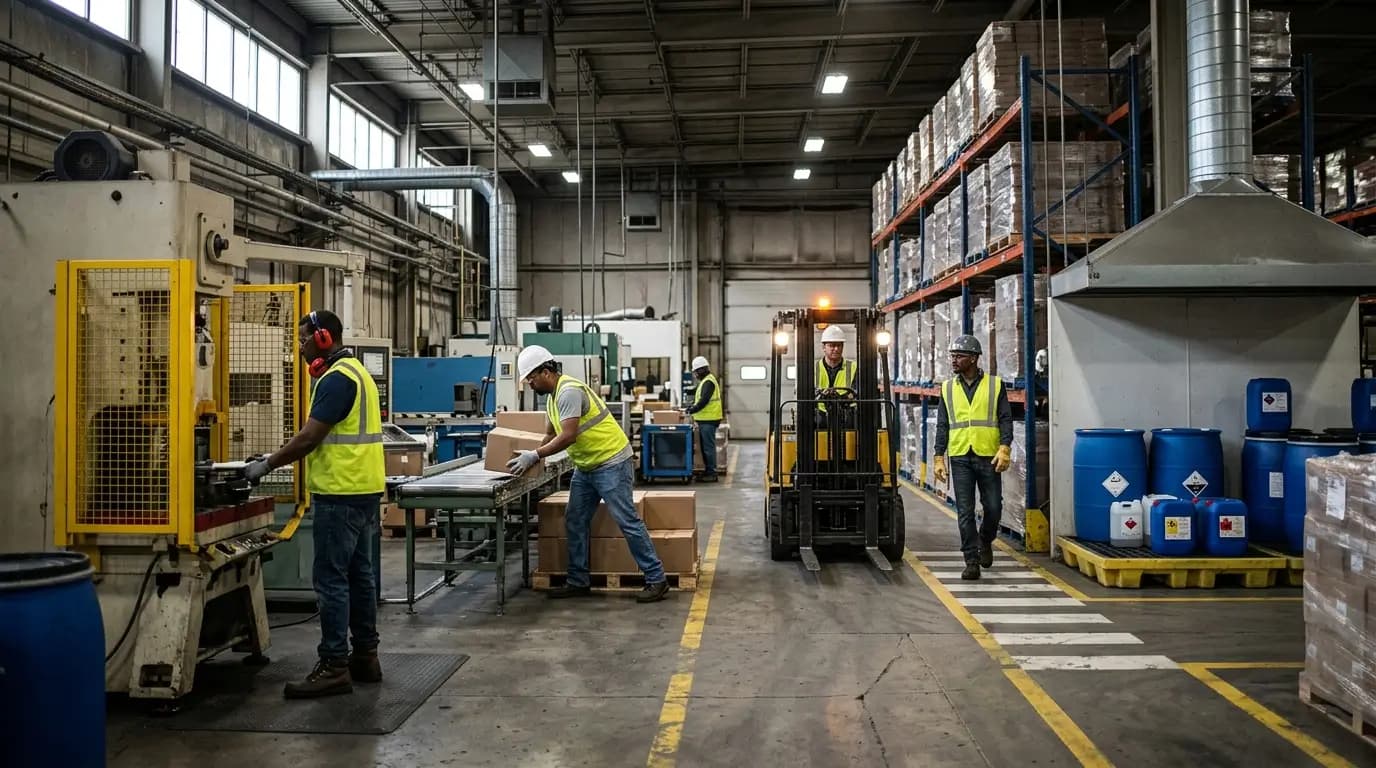
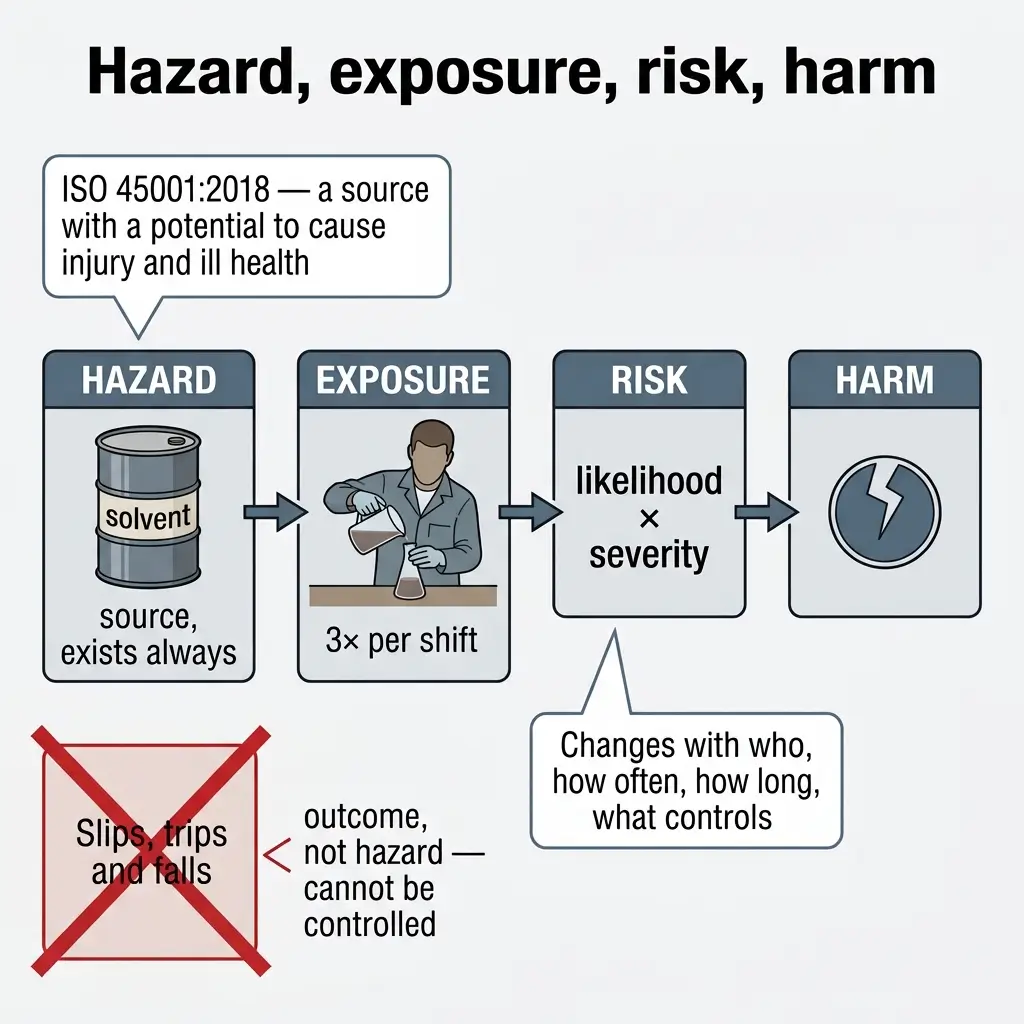
An occupational hazard is anything arising from work that has the potential to cause injury or ill health — a moving vehicle, a solvent vapour, a repeated overhead reach, a roster that runs people past the point where they can judge distance properly. ISO 45001:2018 puts it in seven words: a source with a potential to cause injury and ill health.
The part most articles get wrong comes next. The six-category list you are about to read is not a legal taxonomy and no regulator enacted it. It is a search checklist, and its only job is to stop you walking a site and finding five hazards you were already looking for while missing the sixth kind entirely.
That is the failure I write up most often. Across 180-plus workplaces in seventeen countries — pharmaceutical suites, container terminals, offshore decks, mine sites, furniture lines — the hazard registers I audit are rarely wrong about what they contain. They are wrong about what is absent, and the absences cluster by category with depressing consistency. This guide covers the meaning, the six types with real examples, the failure mode attached to each one, and what the law in the US, UK and EU actually obliges you to do about them.
Key takeaways
Six points carry most of the practical weight of what follows:
- A hazard is the source of potential harm; a risk is the combination of how likely that harm is and how bad it would be. Registers that confuse the two produce control columns nobody can act on.
- "OSHA's six categories of hazard" does not exist. No OSHA standard enumerates six hazard types. The list is a widely taught convention, and several top-ranking articles misattribute it to a regulator.
- Hazard identification is a legal duty even where the categories are not: MHSWR 1999 reg. 3 in Great Britain, OSH Act §5(a)(1) and 29 CFR 1910.132(d) in the US, Article 6 of Directive 89/391/EEC in the EU.
- The categories are not equally represented in the headline numbers. The BLS Census of Fatal Occupational Injuries counts 5,070 US deaths in 2024 but excludes illness-related deaths unless an injury precipitated them.
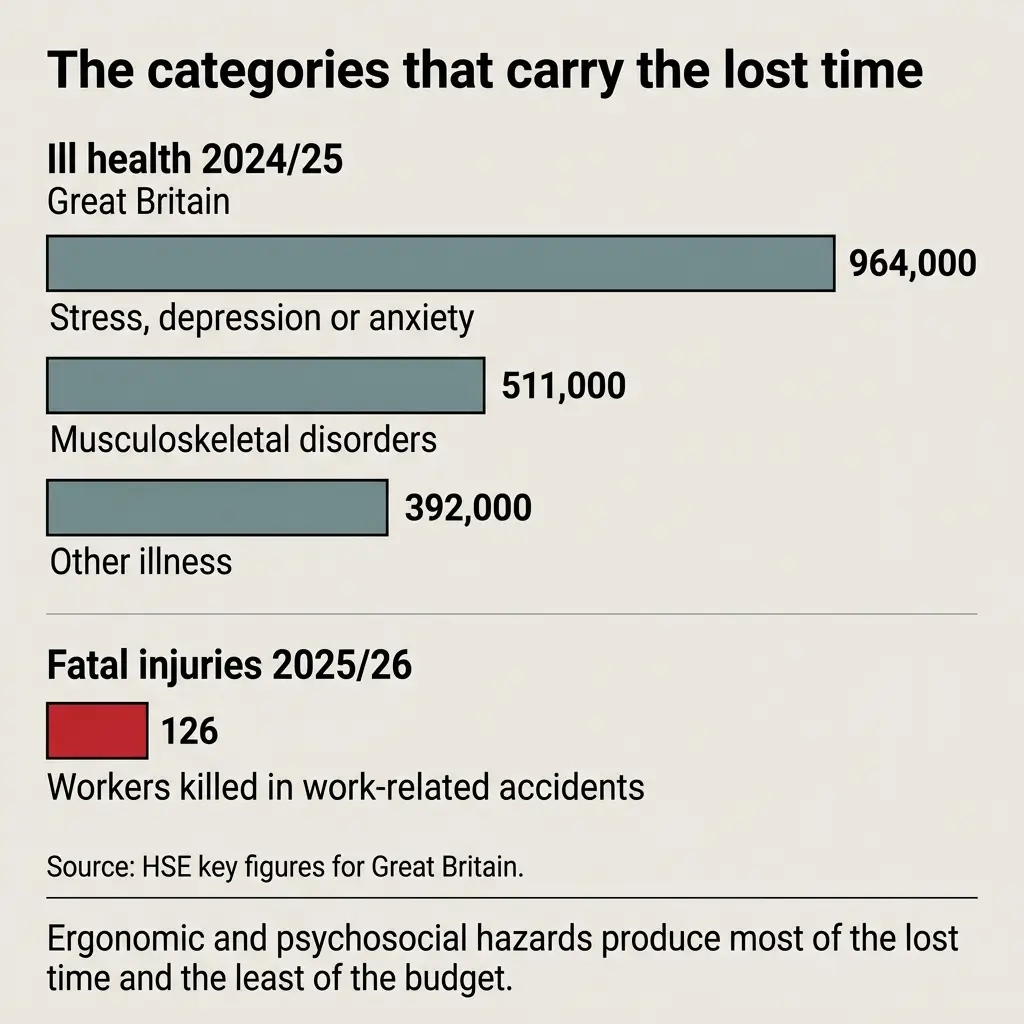
- Psychosocial is now the largest single category of British work-related ill health — 964,000 workers with stress, depression or anxiety in 2024/25, against 511,000 with musculoskeletal disorders (HSE).
- Latency hides whole categories. HSE recorded 2,146 mesothelioma deaths in 2024, nearly all from asbestos exposures decades earlier. No incident report was ever raised for any of them.
What an occupational hazard is — and how it differs from a risk
A hazard is a property of a thing or a situation. It exists whether or not anyone is near it, whether or not anything has ever gone wrong, and whether or not it appears on your register. A drum of caustic in a locked store is a hazard. A stationary forklift is a hazard. Neither is currently harming anyone, and that is precisely the point: hazard is about potential, not about outcome.
Risk is what happens when you introduce people, frequency and circumstance. It is the answer to "how likely, and how bad." The same hazard carries wildly different risk depending on who is exposed, how often, for how long, and what stands between them and it.
The definitions that practitioners actually work to differ in wording but agree in substance:
| Source | Hazard | Risk |
|---|---|---|
| ISO 45001:2018 | A source with a potential to cause injury and ill health | Combination of the likelihood of a work-related hazardous event or exposure and the severity of injury and ill health it could cause |
| HSE (GB) | What could cause injury or illness in your business | How likely it is that someone could be harmed, and how seriously |
| CCOHS (Canada) | Any source of potential damage, harm or adverse health effects | The chance or probability that a person will be harmed by exposure to a hazard |
| OSH Act §5(a)(1) (US) | A "recognized hazard" causing or likely to cause death or serious physical harm | Not defined in the Act; addressed through standard-specific requirements |
Why the distinction changes what goes on the register
This is not vocabulary policing. It changes what the control column can contain.
When a register names the outcome rather than the source, the control it produces is untargetable. "Slips, trips and falls" is not a hazard — it is a category of injury, and the only control anyone can write against it is "be careful." Name the source instead and the control writes itself: condensate dripping from an overhead line onto a ramp where crews turn with a load. That gets you a lagging repair, a drip tray, a rerouted turn, and a wet-floor inspection at shift start.
The same failure runs the other way on health hazards, where people write the disease. "Hearing loss" belongs in a health surveillance record, not a hazard register. The hazard is a specific noise source at a specific place for a measurable duration.
The checks that separate a hazard entry from a non-entry are short:
- Can you point at it? A hazard has a location, a substance, a piece of equipment, a task or a work pattern behind it. If you cannot point, you have written an outcome.
- Does it exist when nobody is there? If the entry disappears when the shift ends, it is a risk description, not a hazard.
- Does it name the mechanism? "Manual handling" is a task; "lifting 18 kg stacked panels above shoulder height, 40 times an hour" is a hazard with a control attached.
- Would two assessors write the same entry? Vague entries are the ones that get scored differently every review cycle.
The six types of occupational hazard
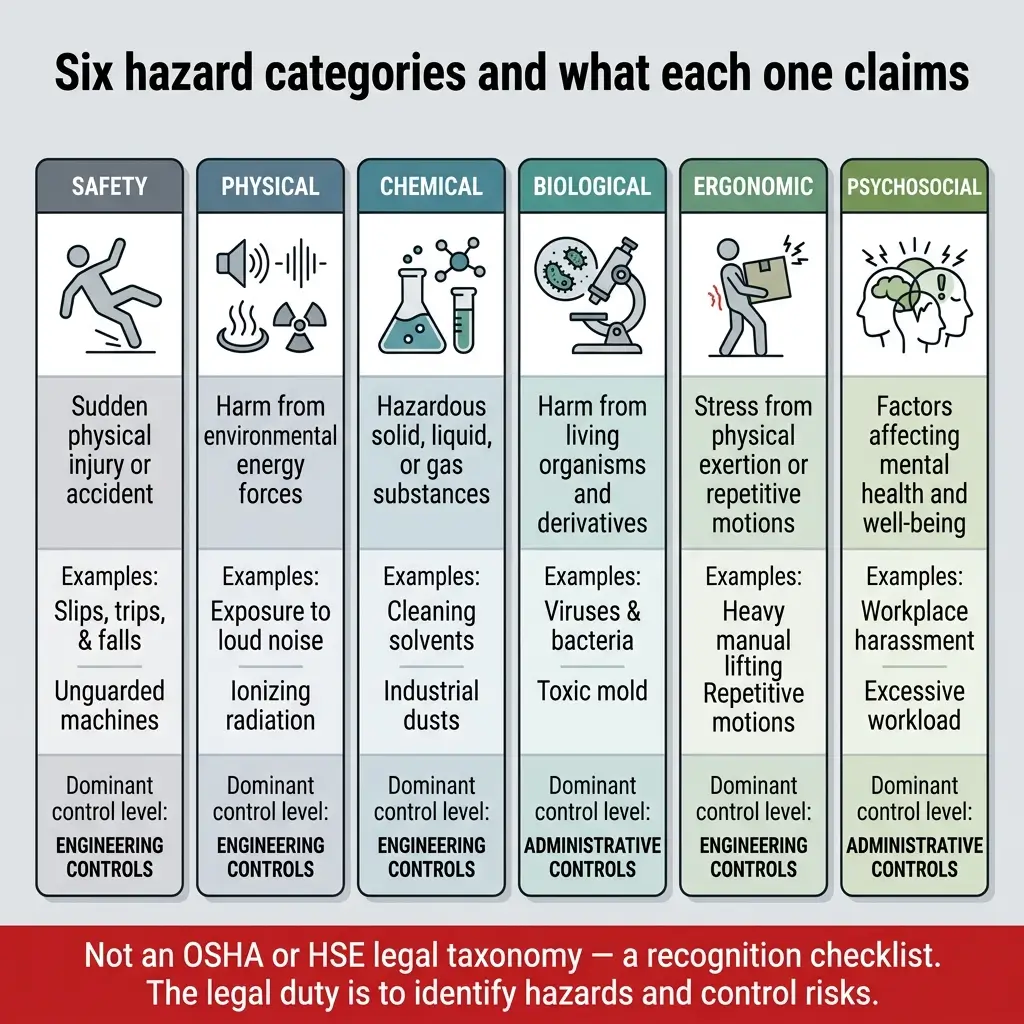
Six categories cover the field as it is taught and as most competent practitioners search a site: safety, physical, chemical, biological, ergonomic and psychosocial. Some sources publish four, some five. The variation is not a disagreement about what harms people — it is a disagreement about where to draw the line between "safety" and "physical," and whether psychosocial is a category or a footnote.
I teach six, and the reason is practical rather than theoretical. Four-category lists almost always drop psychosocial and ergonomic, and those two now account for the majority of lost working time in Great Britain. A checklist that omits the categories producing most of the harm is not a shorter checklist. It is a worse one.
| Category | What it is | Typical examples | Dominant control level | Who is competent to assess it |
|---|---|---|---|---|
| Safety | Energy released as a discrete event | Unguarded machinery, working at height, vehicles, stored energy, falling loads | Engineering — guards, isolation, barriers, segregation | Safety practitioner; competent person for the specific work |
| Physical | Energy acting on the body over time | Noise, hand-arm and whole-body vibration, heat and cold, ionising and optical radiation | Engineering at source, then exposure-time limits | Occupational hygienist |
| Chemical | Substances harming by inhalation, contact or ingestion | Dusts, solvent vapours, welding fume, acids, gases, sensitisers | Substitution and containment | Occupational hygienist |
| Biological | Living organisms and their products | Bacteria, viruses, moulds, legionella, blood-borne agents, animal handling | Containment, water system control, vaccination | Hygienist with occupational health input |
| Ergonomic | Mismatch between the task and the body | Repetition, force, awkward posture, static load, poor workstation design | Task and workstation redesign | Ergonomist or human factors specialist |
| Psychosocial | Harm from how work is designed and managed | Workload, low control, shift and roster design, bullying, isolation, role conflict | Job and roster design; management practice | HR with OHS input, guided by ISO 45003 |
Why "OSHA's six categories" is a claim worth correcting
Several of the highest-ranking articles on this query state that OSHA defined six categories of occupational hazard. One says the agency "has defined six main categories"; another that "OSHA identifies the 6 most common types."
No OSHA standard does this. Search 29 CFR 1910 and you will find substance-specific standards, an equipment-specific subpart structure, and the general duty clause — not a hazard taxonomy. What OSHA does require is a hazard assessment: under 29 CFR 1910.132(d), employers must assess the workplace to determine whether hazards are present that make PPE necessary, and certify that assessment in writing.
This matters beyond pedantry. If you build a compliance argument on a category list you believe is federal law, the list is not what an inspector will measure you against — the specific standard for the specific hazard is. And in a training room, telling supervisors that a teaching aid is a regulation costs you credibility the first time one of them looks it up.
The honest framing, which is also the more useful one, is this:
- The six categories are a recognition tool, taught by NEBOSH, IOSH and most national curricula because they work as a memory structure on a walk.
- The legal duty is to identify hazards and control risks, not to sort them into boxes.
- ISO 45001 clause 6.1.2 requires a proactive, ongoing hazard identification process, and lists prompts — routine and non-routine activities, emergencies, people, design changes — rather than categories.
- Categories earn their place in the gaps they expose, which is why the rest of this article is organised around how each one hides.
Safety, physical and chemical hazards: where they hide
These three are the categories most programmes are built around, and the ones where a mature site genuinely performs well. What follows is less about what they are — the table above covers that — than about the specific way each one still escapes a register that looks complete.
Safety hazards
Safety hazards release energy as an event. Someone falls, a load drops, a machine starts while a hand is inside it, a vehicle and a pedestrian occupy the same square metre. They announce themselves, they leave evidence, and they are what incident reporting systems were designed to catch.
US fatal injury data shows where the energy actually comes from. Of 5,070 fatal work injuries in 2024, transportation incidents accounted for 1,937, falls, slips and trips for 844, contact with objects and equipment for 756, and violence and other injuries by persons or animals for 733.
The examples worth carrying on a walk are the ones that change state:
- Working at height — edges that are protected during the build and open during the strip-out
- Vehicle and pedestrian interaction — segregation that holds at 10:00 and dissolves during a night surge
- Stored energy — hydraulic, pneumatic, gravitational and residual electrical energy after isolation
- Moving machinery — guards and interlocks, and whichever of them is muted for changeovers
- Structural and load-bearing limits — racking, temporary works, lifting gear, ground bearing capacity
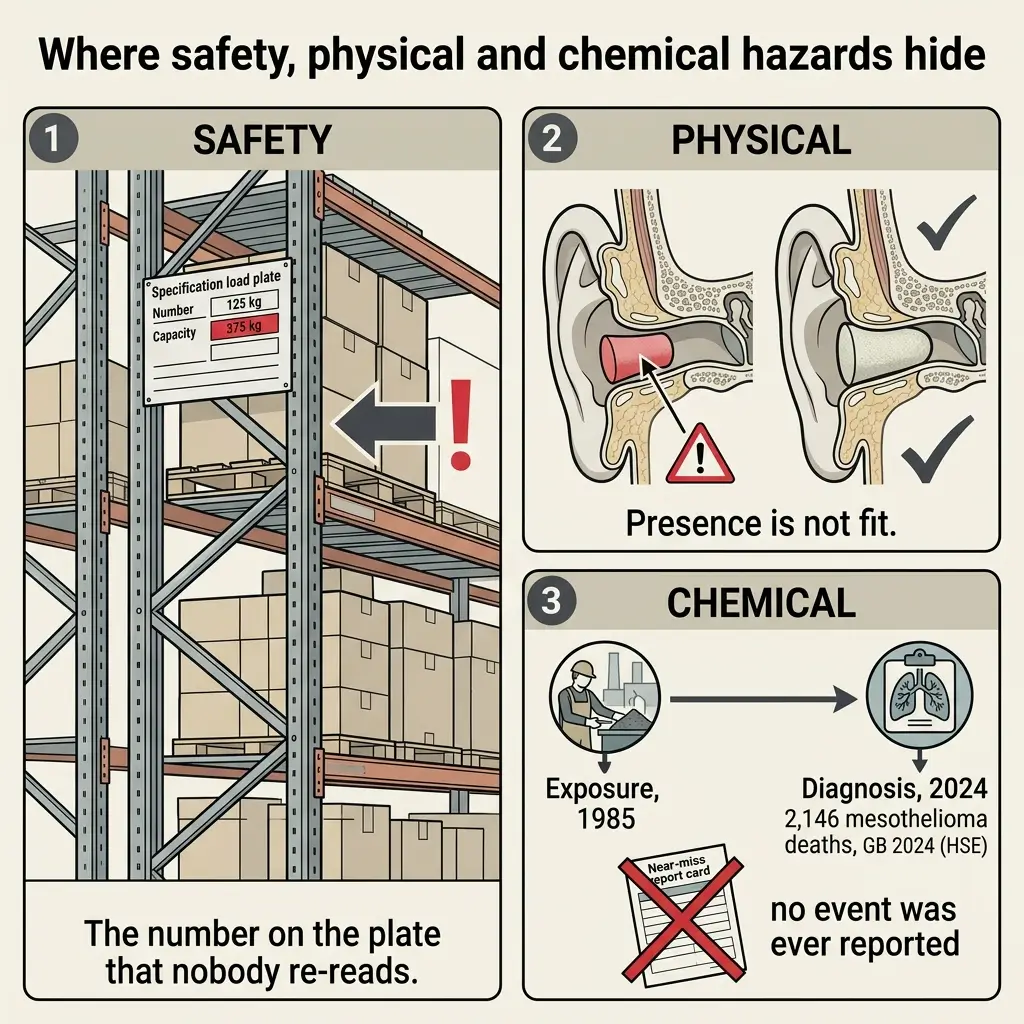
That last one is where I have stopped the most work, because the hazard is invisible until it is not. During a surge at a DP World port warehouse in the UAE, I found top-level pallets stacked above the posted beam rating. Nothing had failed. The racking looked exactly as it does on any normal day, the crews were working hard and well, and the load rating was on a plate on the upright where nobody had looked in months.
I cordoned the aisle, had the top level de-stacked, and triggered a racking inspection. Surge periods on that site subsequently gained weekly capacity spot checks.
The transferable point is that engineering ratings do not flex under commercial pressure. Velocity is not permission to outrun them. If your site has surge periods — a late vessel, a seasonal peak, a turnaround — the controls that fail first are the ones with a number on a plate that nobody re-reads.
Physical hazards
Physical hazards are energy acting on the body over time: noise, vibration, heat, cold, ionising and optical radiation. They occupy an awkward middle ground. They behave like health hazards, in that the harm accumulates and arrives late, but they feel like safety hazards, in that you can perceive them standing there. That combination is what makes them easy to under-control.
Noise is the clearest illustration. Everyone on a compressor deck knows it is loud. Everyone is wearing hearing protection. The checklist is green. And the protection is doing a fraction of what the catalogue attenuation figure promised.
Supporting a shutdown in a compressor utilities area, I checked hearing protection the way a wardrobe check never does — by looking at how the plugs were actually seated. Foam plugs were inserted shallowly, barely past the canal entrance. Every person had them in. The audit line item was satisfied by presence.
I coached correct roll-and-insert technique on the spot and failed the check. Follow-up verification on that area moved to confirming fit rather than confirming presence.
PPE compliance is fit and use, not costume. That distinction applies well beyond hearing protection, and it is the single cheapest verification upgrade available to most sites.
A note on the numbers, because this is where physical hazard articles most often mislead. Exposure limits for noise and airborne substances are set by different bodies on different cycles, and they are not interchangeable. The OSHA permissible exposure limit, the UK workplace exposure limit published in HSE's EH40, the NIOSH recommended exposure limit and the ACGIH threshold limit value are four separate values. Noise adds a further trap: OSHA applies a 5 dB exchange rate where NIOSH and most of the world apply 3 dB, which changes a calculated dose materially. Never write "the limit" without naming whose limit it is.
Chemical hazards
Chemical hazards harm by inhalation, skin contact, ingestion or injection, and they include the substances a site knows it has, the substances generated by its processes, and the substances that arrive with a contractor.
The middle group is where registers thin out. A COSHH inventory built from purchase records captures what was bought. It does not capture welding fume, diesel engine exhaust emissions, respirable crystalline silica liberated by cutting, thermal decomposition products from hot work on coated steel, or the vapour from a blend that changed formulation two years ago.
Common chemical hazards, grouped by how they reach a person:
- Inhaled — solvent vapour, welding fume, wood and flour dust, silica, isocyanates, gases displacing oxygen in a confined space
- Skin contact — acids and alkalis, solvents that defat and then carry other substances through, epoxies and sensitisers
- Ingested — contamination transferred from hands to food or cigarettes in areas without hygiene controls
- Injected — high-pressure fluid injection injuries, which present as a puncture and are a surgical emergency
The defining feature of this category is latency, and one figure makes the case better than any argument. HSE recorded 2,146 mesothelioma deaths in Great Britain in 2024, and these are attributed to past asbestos exposures — largely from work done decades earlier. Not one of those deaths generated a near-miss card at the time the exposure happened. There was no event to report.
That is the structural problem with chemical hazards, and with health hazards generally. If your assurance system is built on incident and near-miss reporting, it is blind here by design, and it will keep producing improving trend lines while the exposures continue. Chemical hazards are found by inventory, by process knowledge and by sampling — not by waiting for something to be reported.
Biological, ergonomic and psychosocial hazards: where they hide
These three categories share a problem. Each is routinely treated as belonging to someone other than the safety function — infection control, occupational health, HR — and a hazard that belongs to everyone in principle belongs to nobody in practice.
Biological hazards
Biological hazards are living organisms and the material they produce: bacteria, viruses, fungi and moulds, blood-borne agents, and the products of animals, plants and people.
The category is well-managed in the sectors that expect it. Healthcare, laboratories, waste and water treatment, food production and agriculture all build controls around it as a matter of course. The gap sits in the sectors that assume they are exempt, and it is almost always the same hazard: legionella in water systems. Cooling towers, evaporative condensers, showers used intermittently, deadlegs left in a modified pipework run, a welfare block on a long project that runs at low flow. A manufacturing site with no biological entry on its register very often has a cooling tower on its roof.
The exposures worth checking on any site, regardless of sector, are these:
- Water systems — cooling towers, spa or wash-down systems, and low-use outlets where temperature control has drifted
- Sharps and blood-borne agents — not confined to healthcare; waste handling, cleaning and facilities work all present exposure
- Mould and bioaerosols — damp building fabric, composting and waste processing, and contaminated metalworking fluid
- Animal and insect contact — agriculture, veterinary work, pest control, and any outdoor work where tick-borne disease is endemic
- Contaminated ground — excavation on former industrial or landfill sites
Where the sector genuinely carries no biological exposure, write that conclusion down with the reasoning. An explicit "assessed, not applicable, because" is a defensible register entry. A silent omission looks identical to an oversight.
Ergonomic hazards
Ergonomic hazards arise from a mismatch between the task and the body doing it — repetition, force, awkward posture, static loading, vibration transmitted through a tool, a workstation built for a fiftieth-percentile person and used by everyone else.
They are the category with the worst reporting characteristics of all. The harm builds slowly, it is attributed to age or to life outside work, and the point at which someone reports it is usually the point at which they can no longer do the job. By then the damage has a name and a prognosis.
On a furniture manufacturing line in Poland, running MSD prevention work for IKEA Industry, I timed cycles on an edge-banding infeed. Operators were lifting stacked panels to the feed above shoulder height and twisting as they did it, forty-odd times an hour. Everyone described it as part of the job. There were no reports, no lost time and nothing on the register.
I stopped the task pattern, trialled a height-adjustable feed assist, and coached early symptom reporting alongside it. What happened next is the part worth understanding: discomfort reports rose, and recordable strain severity on that line fell.
That inversion is the whole lesson. If people only report when they cannot work, your reporting rate is a measure of failure, not of prevention. A rising discomfort figure after an ergonomics intervention is usually evidence that the intervention worked.
Assessment tools exist and are worth naming precisely: the NIOSH lifting equation for lifting tasks, and HSE's MAC, ART and RAPP tools for manual handling, repetitive tasks and pushing and pulling. These are methods rather than standards. In Great Britain the legal anchor is the Manual Handling Operations Regulations 1992 and the DSE Regulations 1992; in the US there is no specific standard and ergonomic hazards are addressed through the general duty clause.
Psychosocial hazards
Psychosocial hazards arise from how work is designed, organised and managed, and from the social conditions of the workplace. ISO 45003:2021 is the first international standard to treat them systematically, and it groups them into aspects of work organisation, social factors at work, and the work environment, equipment and hazardous tasks.
The British data has settled the question of whether this is a real category. HSE's key figures record work-related stress, depression or anxiety affecting an estimated 964,000 workers in 2024/25 — 52% of all work-related ill health, and a larger share than musculoskeletal disorders at 511,000. Between them, ill health accounted for the overwhelming majority of the 40.1 million working days lost.
Set against that, HSE's current key figures record 126 workers killed in work-related accidents in 2025/26. Both numbers matter, and the resourcing on most sites I audit is allocated in inverse proportion to them.
What makes psychosocial hazards tractable rather than woolly is treating them as exposures with a dose. Running night container operations fatigue programmes for DP World at Jebel Ali and Tanjung Pelepas taught me to handle fatigue exactly like a chemical exposure: a measurable dose, a designed limit, and verification that the limit holds on the night the vessel arrives late. Framed that way, a roster becomes a control, and an overtime approval becomes a control decision.
The psychosocial hazards that show up most often on industrial sites are:
- Roster and shift design — rotation direction, consecutive nights, rest between shifts, and overtime stacked onto people already at threshold
- Workload and pace — demand set by a schedule nobody re-planned when scope grew
- Low control — people accountable for outcomes they have no authority to change
- Role conflict — the supervisor asked to hit the number and stop the job in the same breath
- Bullying, harassment and isolation — including lone working and remote camp arrangements
- Poor change management — reorganisations announced without a route for questions
Great Britain's practical framework is HSE's Management Standards, which cover demands, control, support, relationships, role and change. ISO 45003 is the international equivalent and is guidance, not a certifiable standard.
Occupational hazard examples by job and industry
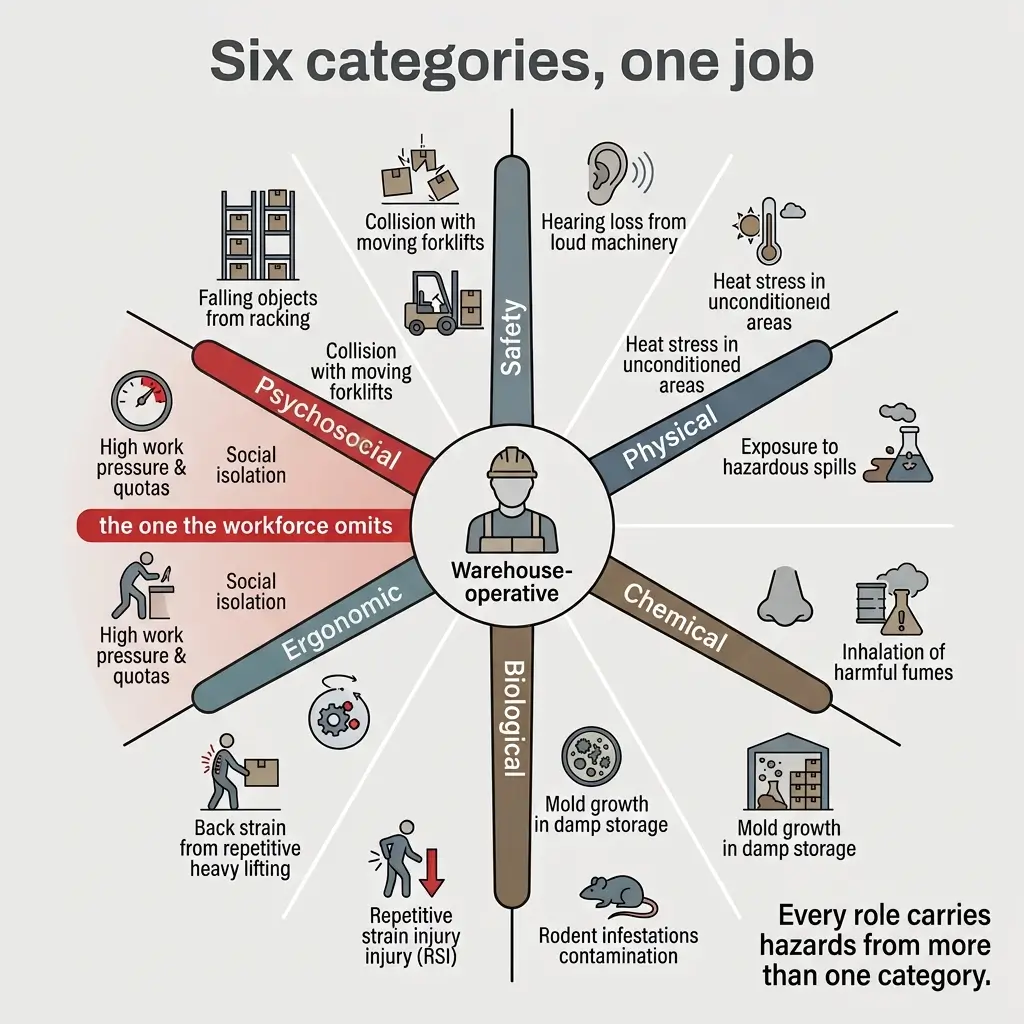
The categories become concrete when you apply all six to one role at once. The exercise below is the one I run in induction rooms, because it demonstrates the thing a category list is for: every job carries hazards from more than one category, and the ones people name first are almost never the ones that generate the most harm.
Note the final column. It names the category that role's own workforce most often leaves off the list when asked to describe their hazards.
| Role | Safety | Physical | Chemical | Biological | Ergonomic | Psychosocial | Most often missed |
|---|---|---|---|---|---|---|---|
| Construction worker | Falls from height, excavation collapse, plant movement | Noise, HAVS from breakers | Silica dust, cement dermatitis, solvents | Contaminated ground, weil's disease in wet works | Manual handling, kneeling, overhead work | Insecure work, long travel, piecework pace | Chemical |
| Nurse or care worker | Slips, sharps injury, aggression from patients | Ionising radiation in imaging areas | Cytotoxic drugs, anaesthetic gases, cleaning agents | Blood-borne viruses, TB, respiratory infection | Patient handling, static standing | Emotional demand, shift rotation, staffing levels | Ergonomic |
| Warehouse operative | Vehicle interaction, racking collapse, falling loads | Cold stores, noise | Fuel and battery gases, cleaning chemicals | Mould in damp goods, pest contamination | Repetitive picking, twisting, load weight | Pick-rate targets, night rotation | Psychosocial |
| Office and hybrid worker | Trailing leads, poorly stored materials | Poor lighting, thermal discomfort | Printer emissions, cleaning products | Legionella from building water systems | DSE posture, static sitting, laptop-only setups | Workload, always-on culture, isolation | Biological |
| Laboratory technician | Glassware, centrifuge and autoclave energy | Noise from extract plant, UV and laser sources | Solvents, corrosives, carcinogens | Cultures, samples, animal handling | Pipetting repetition, microscope posture | Lone working, funding pressure | Ergonomic |
| Offshore or process operator | Dropped objects, pressure release, confined space entry | Noise, vibration, heat stress in PPE | Hydrocarbons, H₂S, drilling fluids | Legionella in potable and utility water | Valve operation force, awkward access | Rotation length, isolation from family | Biological |
Two patterns hold across every industry I have worked in. The category a workforce names first is the one their PPE relates to, and the category they omit is the one with no visible control attached to it. A crew wearing gloves names chemicals. A crew wearing harnesses names height. Nobody wearing anything for it names roster design.
The way to use this table on your own site is straightforward:
- Take one role, not the whole site, and write the six headings out.
- Ask the people who do the job to fill them, before you fill any yourself.
- Note which heading stays empty — that is the finding, not the ones they fill.
- Check the empty heading against the work, on the shift when it is under most pressure.
- Write the reasoning down where a category genuinely does not apply.
How to identify occupational hazards on your own site
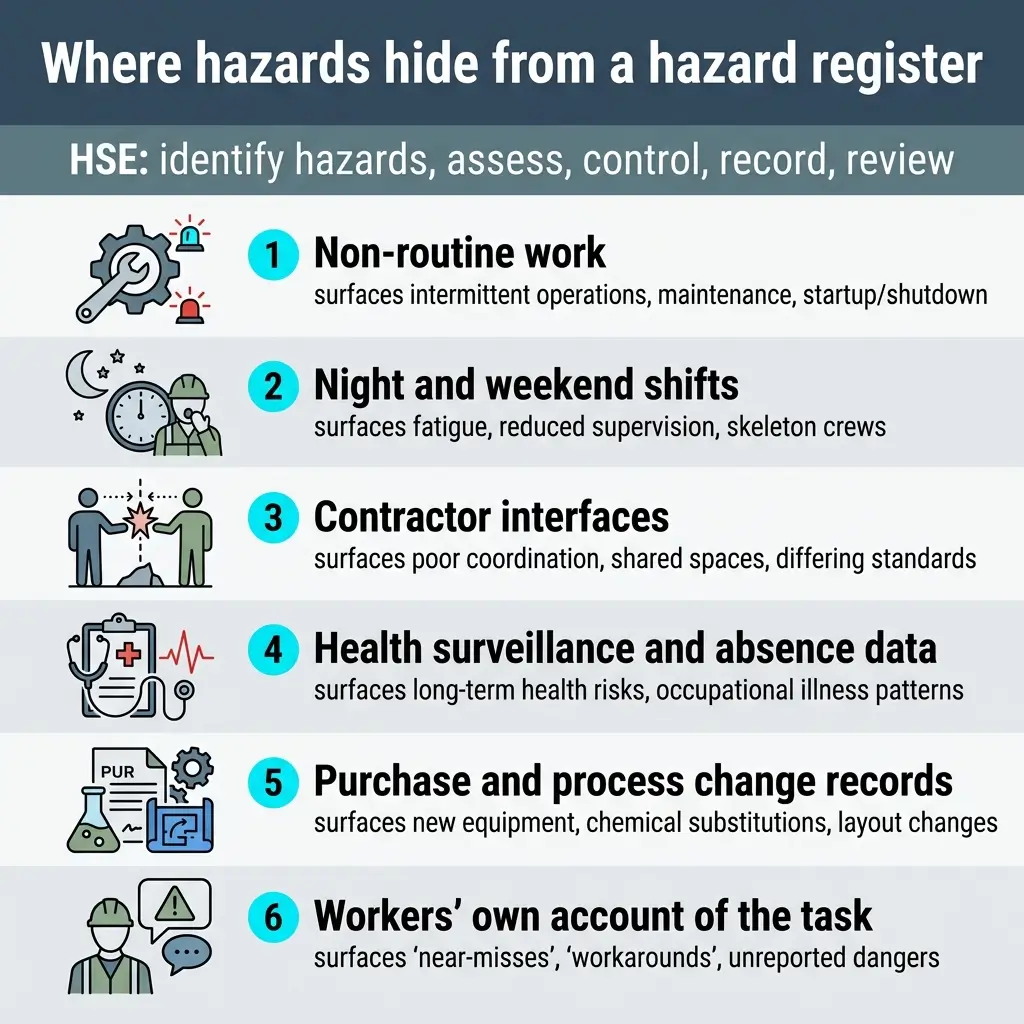
Hazard identification is a search, and the quality of a search depends on where you look rather than how carefully you look at the places you already know about. HSE's current guidance sets out five steps under the heading Steps needed to manage risk: identify hazards, assess the risks, control the risks, record your findings, and review the controls.
Worth knowing if you trained in Britain: the familiar "5 steps to risk assessment" from leaflet INDG163 has been withdrawn, and the current guidance uses the wording above. The job is the same and nothing you were taught is wrong, but citing the withdrawn leaflet in a procedure dates the document immediately.
HSE's own prompts for the first step are more specific than most site procedures: look at how people work and how plant and equipment are used, what chemicals and substances are used, what safe and unsafe practices exist, and the general state of the premises. It also directs you to non-routine operations — maintenance, cleaning and changes in production cycles — and to hazards to health including manual handling and the causes of work-related stress.
Non-routine work is where the categories multiply. A production line running normally presents a stable, well-understood hazard set. The same line during a changeover, a breakdown or a deep clean presents guards removed, chemicals at higher concentration, awkward access, time pressure and people who do not normally work there.
| Where to look | What it surfaces | Why registers miss it |
|---|---|---|
| Non-routine work — maintenance, cleaning, changeover | Guard removal, chemical concentration, awkward access | Assessments are written against normal running |
| The night shift and weekend cover | Fatigue, thinner supervision, workaround normalisation | Audits happen in daylight on weekdays |
| Contractor and interface work | Hazards introduced by others; two rule sets in parallel | Neither party owns the interface |
| Health surveillance and absence data | Exposure that never generated an incident | Sits with occupational health, not safety |
| Purchase and process change records | New substances, new equipment, altered task demand | MOC triggers on capital spend, not on task change |
| Workers' own descriptions of the job | Shortcuts, awkward reaches, the step that is not in the procedure | The procedure is read instead of the work |
Run the following on your next walk, in this order:
- Watch the job before reading the paperwork. Ten minutes of observation tells you what the site wishes were true when you then read the assessment.
- Ask what changes at 02:00, at changeover, and when the schedule slips.
- Walk one non-routine task end to end — a filter change, a clean, a breakdown response.
- Check each of the six categories deliberately, and note which one you have nothing for.
- Ask the people doing the work what hurts by the end of a shift, which finds ergonomic and psychosocial hazards nothing else will.
- Look for the hazard with no visible control, because absence of a control is usually absence of recognition.
Where the assessment needs specialist judgement — an exposure measurement, a structural adequacy question, a process hazard analysis — bring in someone qualified for that specific work. A general safety qualification does not make anyone competent to interpret a personal air sample, and no article makes anyone competent to skip that step.
What the law requires: US, UK, EU and international
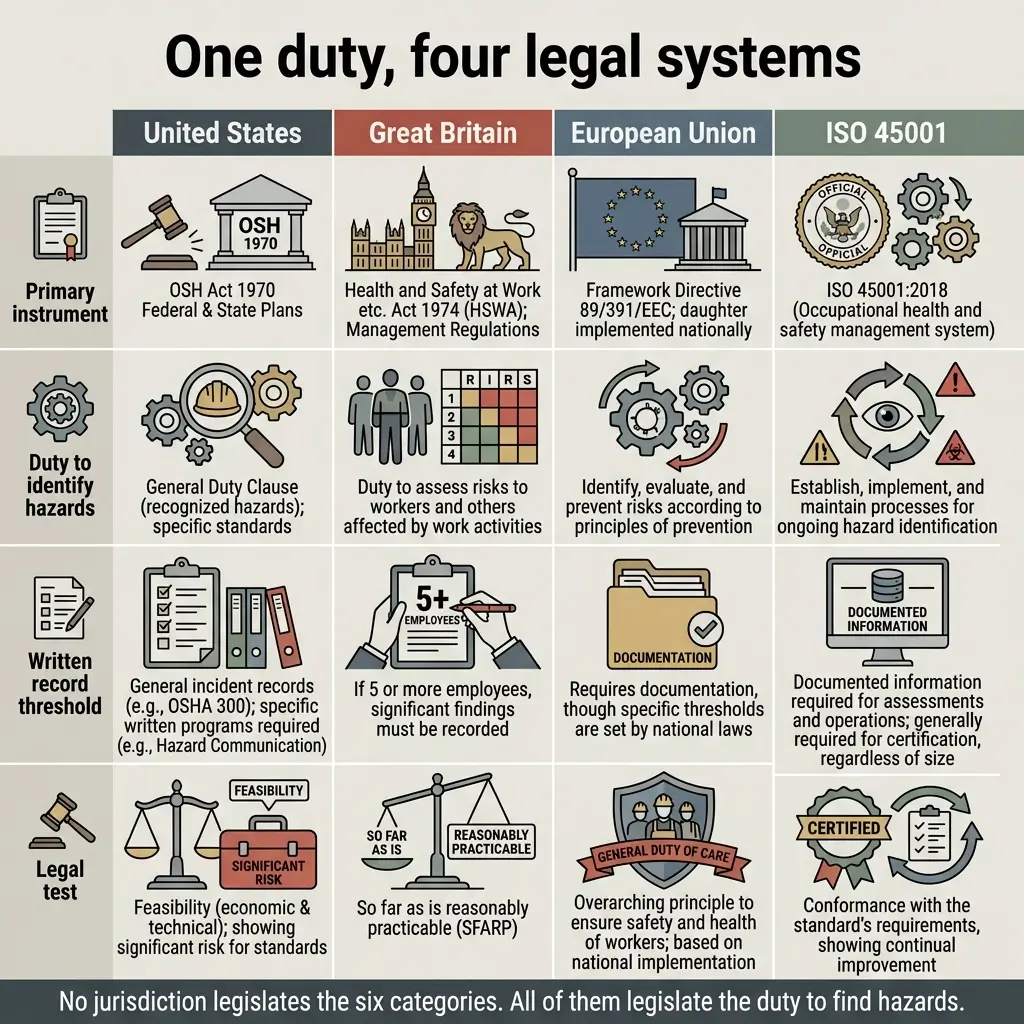
No major jurisdiction legislates the six categories. Every one of them legislates the duty to find hazards and control the resulting risks, and they diverge on how prescriptive that duty is.
Great Britain is the most explicit. Regulation 3 of the Management of Health and Safety at Work Regulations 1999 requires every employer to make a suitable and sufficient assessment of the risks to employees and to others affected by the work. Where five or more people are employed, the significant findings must be recorded — the hazards, who might be harmed and how, and what is being done to control the risks. The standard applied throughout is "so far as is reasonably practicable," which balances the risk against the time, cost and trouble of controlling it, and requires the imbalance to be gross before cost prevails.
The United States has no universal risk assessment rule. The duty arrives from two directions: §5(a)(1) of the OSH Act requires employers to furnish employment free from recognised hazards causing or likely to cause death or serious physical harm, and individual standards carry their own assessment requirements — most usefully 1910.132(d), which requires a workplace hazard assessment for PPE with a written certification naming the workplace, the certifier and the date.
| United States | Great Britain | European Union | International | |
|---|---|---|---|---|
| Primary instrument | OSH Act §5(a)(1); standard-specific rules | MHSWR 1999 reg. 3 under HSWA 1974 | Framework Directive 89/391/EEC | ISO 45001:2018 |
| Duty to identify hazards | Standard-specific, plus recognised-hazard duty | Universal and explicit | Universal, Article 6 | Clause 6.1.2, ongoing and proactive |
| Written record required | For PPE assessment under 1910.132(d)(2) | Significant findings, at 5+ employees | Employer must hold an assessment | Documented information required |
| Legal test | Free from recognised hazards | So far as is reasonably practicable | Appropriate preventive measures | Conformance to the system |
| Psychosocial in scope | Via general duty clause only | Yes — HSE Management Standards | Yes | ISO 45003 guidance |
One timing note for anyone building a procedure around the international standard. ISO 45001:2018 was last reviewed and confirmed in 2024, so the 2018 edition remains current, but a revision is at draft international standard stage and is expected to replace it. If your hazard identification procedure cites clause numbers, expect to re-check them rather than assuming they carry across.
Three practical consequences follow for anyone writing one procedure to cover several countries:
- A US-format hazard assessment does not discharge regulation 3. The PPE certification under 1910.132(d) is narrower than a suitable and sufficient risk assessment.
- The EU directive is a floor, not the law you are audited against. Member State transposition is, and implementations differ materially.
- Psychosocial hazards sit inside the legal duty in Britain and the EU, and reach US employers only through the general duty clause — which is a weaker and more contested route.
Controlling hazards: which control level works for each type
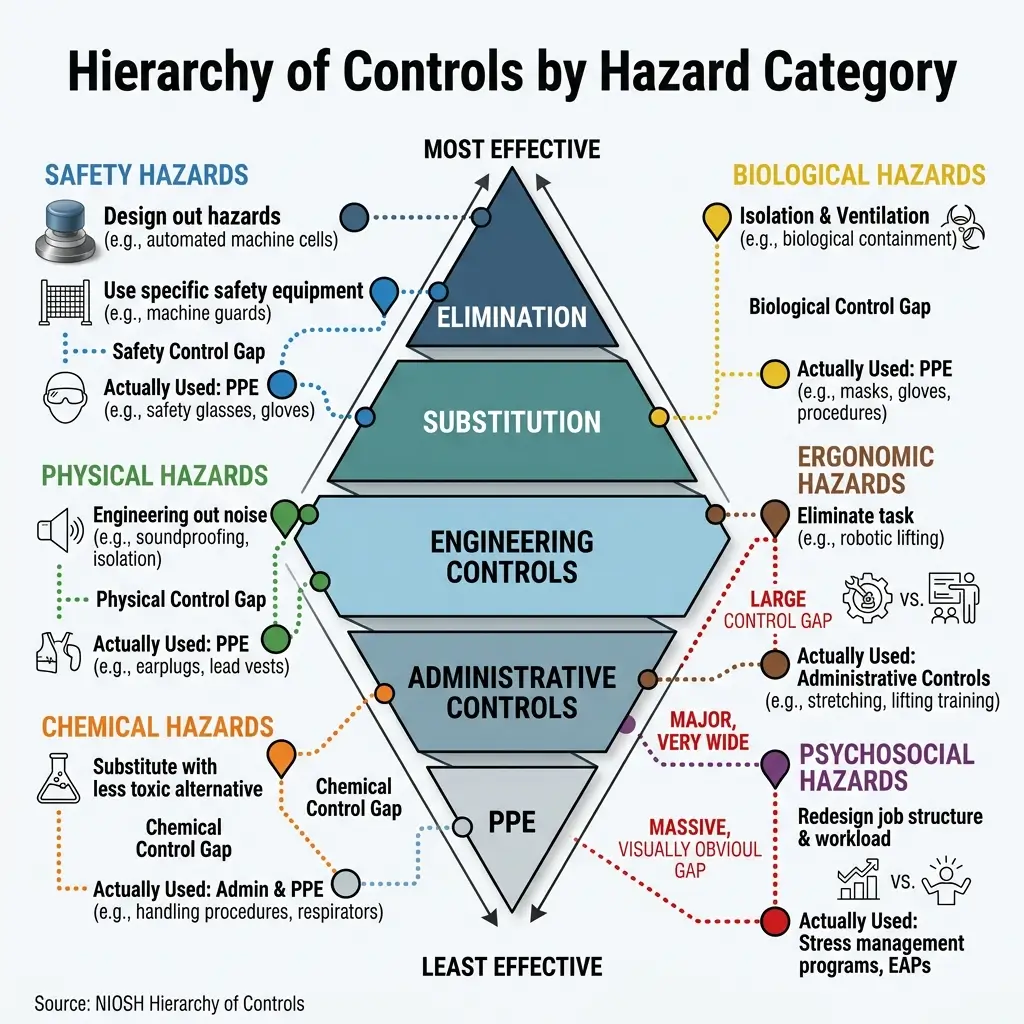
The NIOSH hierarchy of controls ranks controls by how much they depend on a person doing something correctly every time. Elimination, substitution and engineering controls sit above administrative controls and PPE because they work without anyone remembering to make them work.
That ranking is universal. What is not universal — and what almost no hazard article says — is that the hierarchy does not perform equally across the six categories. For safety hazards, engineering controls are usually available and usually decisive. For psychosocial hazards, there is no guard to fit; the equivalent of an engineering control is a roster redesigned so the exposure never occurs.
| Category | Realistic top-of-hierarchy control | The control most sites actually use | Where the gap costs most |
|---|---|---|---|
| Safety | Eliminate the approach; guard, isolate, segregate | Signage, permits, PPE | Signs competing with a shortcut lose |
| Physical | Reduce at source — quieter plant, damped tools, shielding | PPE plus exposure-time rules | Attenuation assumed rather than fit-tested |
| Chemical | Substitute; then contained transfer and LEV | RPE and general ventilation | LEV certified annually but never tested against the real task motion |
| Biological | Water system design and temperature control; containment | Cleaning regime and vaccination | Systems that fall outside anyone's ownership |
| Ergonomic | Redesign the workstation or the task | Manual handling training | Training a task that should not exist in that form |
| Psychosocial | Redesign the job, the roster and the workload | Wellbeing offer and resilience training | Treating an organisational hazard as an individual deficit |
The right-hand column is where I write most of my findings, and the pattern is consistent: the lower the category sits in organisational attention, the further down the hierarchy its controls sit. Nobody responds to an unguarded machine with a resilience workshop. That is roughly what happens when a workload hazard meets a wellbeing programme.
Four questions settle whether a control at any level is real:
- Does it exist right now, rather than in the plan or the procedure?
- Was it tested against the real task, including the awkward reach, the door opening, the surge?
- Does the evidence come from the field, with a time and a place attached?
- Does it survive the night shift, the changeover and the contractor who has never been here before?
Frequently asked questions
Short answers to the questions that come up most often in induction rooms and in search results.
What are the 6 types of occupational hazards?
Safety, physical, chemical, biological, ergonomic and psychosocial. Safety hazards cause injury through a discrete event; the other five cause harm through exposure over time. This is a teaching and recognition framework rather than a legal classification — no regulator has enacted it in a standard.
What is the difference between a hazard and a risk?
A hazard is a source with the potential to cause injury or ill health, and it exists whether or not anyone is exposed. Risk combines how likely harm is with how severe it would be, and it changes with exposure, frequency and controls. A drum of acid is a hazard; decanting it without gloves is where the risk sits.
What are the 4 types of occupational health hazards?
Sources that publish four usually list chemical, biological, physical and ergonomic — the categories affecting health rather than causing immediate injury. The omission is normally psychosocial, and sometimes safety. Since stress, depression and anxiety now account for 52% of British work-related ill health (HSE, 2024/25), a four-item list leaves out the biggest contributor.
Is stress an occupational hazard?
Yes, where it arises from how work is designed or managed. ISO 45003:2021 treats psychosocial hazards — workload, low control, roster design, bullying, role conflict — as workplace hazards to be assessed and controlled. HSE's Management Standards cover the same ground in Great Britain, and 964,000 workers reported work-related stress, depression or anxiety in 2024/25.
What is the most common occupational hazard?
It depends on which harm you count. For fatal injuries in the US, transportation incidents lead at 38.2% of the 5,070 deaths recorded in 2024 (BLS CFOI). For ill health in Great Britain, stress, depression and anxiety lead at 52% of cases (HSE). Fatal-injury data excludes illness deaths, so the two answers measure different things.
Who is responsible for identifying hazards in the workplace?
The employer holds the legal duty and cannot delegate it away, though the work is normally done by supervisors and competent safety staff with the people who do the job. Workers must take reasonable care and must not interfere with controls. Where specialist judgement is needed — exposure sampling, structural adequacy — a competent person for that specific work must be engaged.
Does OSHA define occupational hazard categories?
No. Several widely-shared articles claim OSHA defined six categories; no OSHA standard does. What the agency requires is hazard assessment — 29 CFR 1910.132(d) mandates a workplace hazard assessment for PPE with written certification, and §5(a)(1) of the OSH Act covers recognised hazards where no specific standard applies.
Conclusion: the category you cannot fill is the finding
A hazard register is judged on what is absent from it, not on what it contains. Every site I audit can show me a well-populated list of the hazards it already knew about, and the useful ten minutes is always spent on the heading that has nothing under it.
So the practical use of the six categories is not to file hazards more tidily. It is to make an absence visible. Take one job, write the six headings, ask the crew to fill them, and pay attention to whichever heading stays blank. On most industrial sites it will be psychosocial or biological. On a healthcare ward it will be ergonomic. Whichever it is, that is where the harm you are not currently counting is accumulating.
Where a specific exposure limit, structural question or process hazard applies to a workplace you are responsible for, have it assessed by a competent person against the standards in force in your jurisdiction rather than against an article.
About the author — Chloe Anderson
Chloe Anderson is a British Occupational Health, Safety and Environment (OHSE) Technical Educator and Site Assurance Consultant with 16 years of continuous field experience across 17 countries. She holds an MSc in Occupational Hygiene (University of Birmingham) and a BSc (Hons) in Environmental Health (University of Manchester), is a Chartered Member of IOSH (CMIOSH), and holds the NEBOSH National Diploma, the NEBOSH Certificate in Environmental Management and ISO 45001 Lead Auditor certification. The hazard identification work described here draws on MSD prevention across eight IKEA Industry factories in Poland and Portugal, night container terminal operations for DP World at Jebel Ali and Tanjung Pelepas, and occupational hygiene and critical-risk auditing with AstraZeneca, Novo Nordisk, Equinor, Dow and Anglo American. Her field record includes 180+ workplaces inspected, 70+ audits, 150+ risk assessments and more than 6,500 professionals trained. She leads Anderson OHSE Assurance & Education from Edinburgh.
Sources and further reading
- HSE — Key figures for Great Britain 2024 to 2025 (ill health, mesothelioma and fatal injury figures)
- HSE — Managing risks and risk assessment at work: overview and Steps needed to manage risk
- HSE — COSHH and work-related stress
- legislation.gov.uk — Management of Health and Safety at Work Regulations 1999, regulation 3
- OSHA — OSH Act of 1970, Section 5: Duties
- OSHA — 29 CFR 1910.132, Personal protective equipment: general requirements
- US Bureau of Labor Statistics — Census of Fatal Occupational Injuries, 2024
- NIOSH — Hierarchy of Controls
- ISO — ISO 45001:2018 Occupational health and safety management systems
- ISO — ISO 45003:2021 Psychological health and safety at work
- EU-OSHA — The OSH Framework Directive 89/391/EEC