

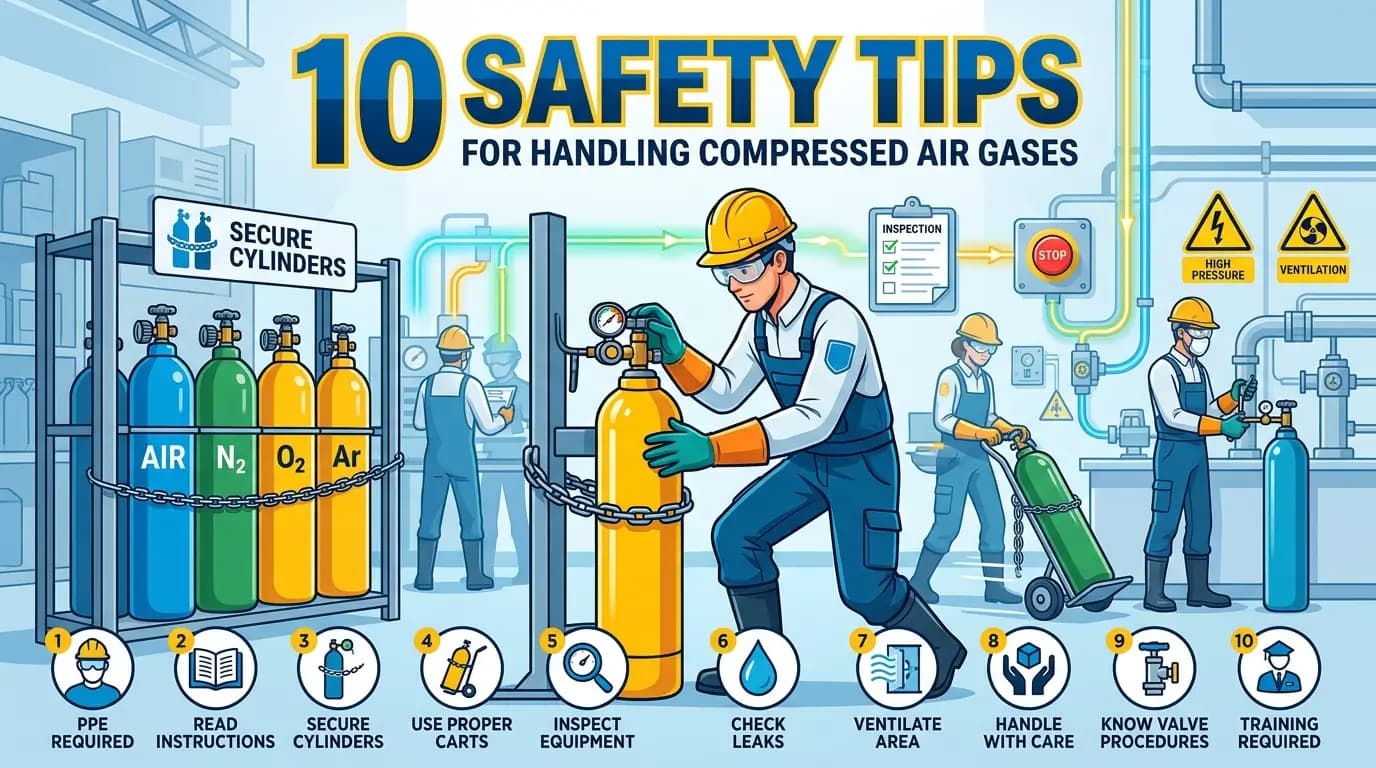
Handle a compressed gas cylinder as two hazards at once, not one. There is the gas inside — which may be flammable, toxic, oxidising, or an odourless asphyxiant that gives no warning — and there is the cylinder itself, a pressure vessel holding stored energy that turns the steel into a projectile if the valve is sheared off. Most people manage the first hazard and forget the second. In hazmat store assurance work across chemical sites, the findings I write up are rarely about the exotic gas; they are about a cylinder left unsecured, a cap in a drawer instead of on the valve, or oxygen racked next to acetylene because the store ran out of floor space.
This is an international guide for anyone who moves, stores, or connects cylinders — supervisors, store keepers, welders, lab and production staff. It covers the ten controls that prevent the incidents that actually happen, with the US, UK and international rules that sit behind each one.
Key takeaways
- Two hazard families: the gas (flammable / toxic / oxidising / inert-asphyxiant) and the vessel (stored energy, ~130–200+ bar). Control both.
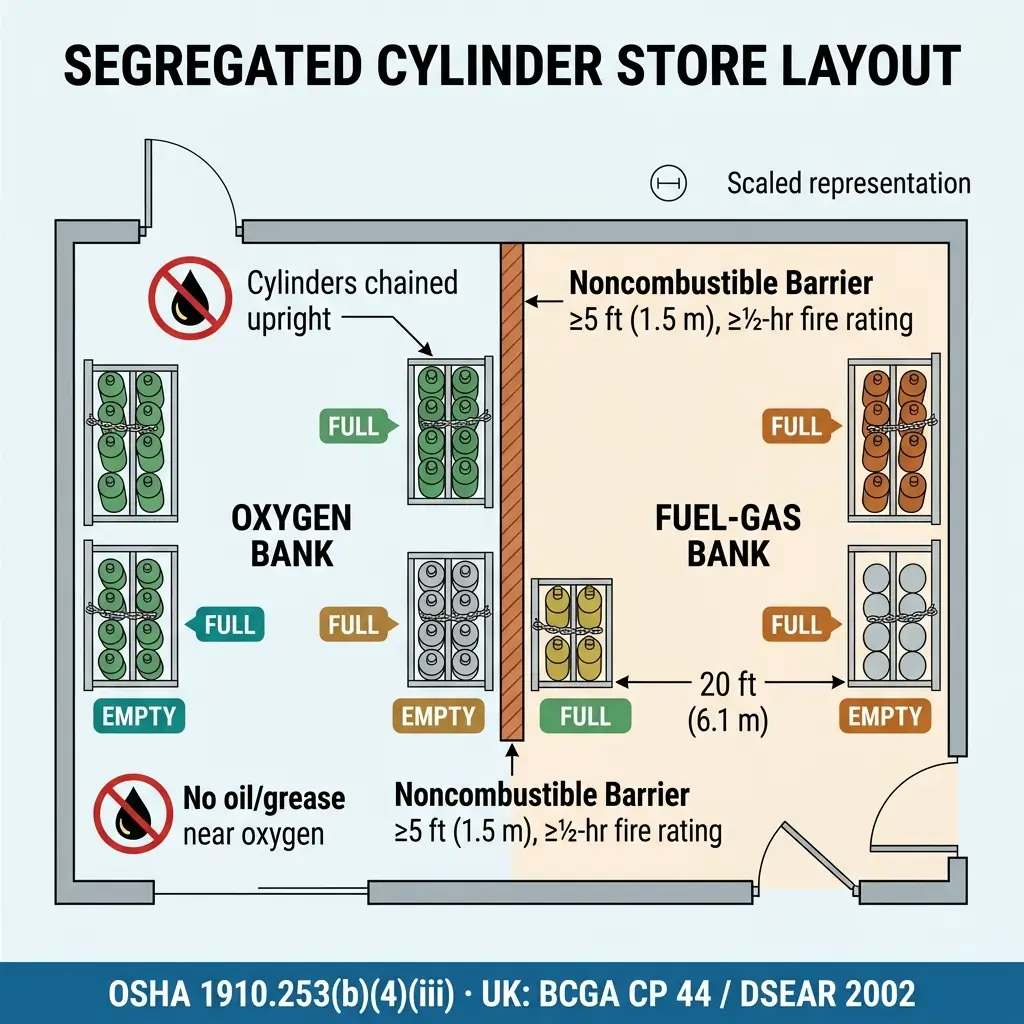
- Under OSHA 1910.253(b)(4)(iii), oxygen must be stored at least 20 ft (6.1 m) from fuel-gas cylinders and combustibles, or behind a noncombustible barrier at least 5 ft (1.5 m) high with a half-hour fire rating.
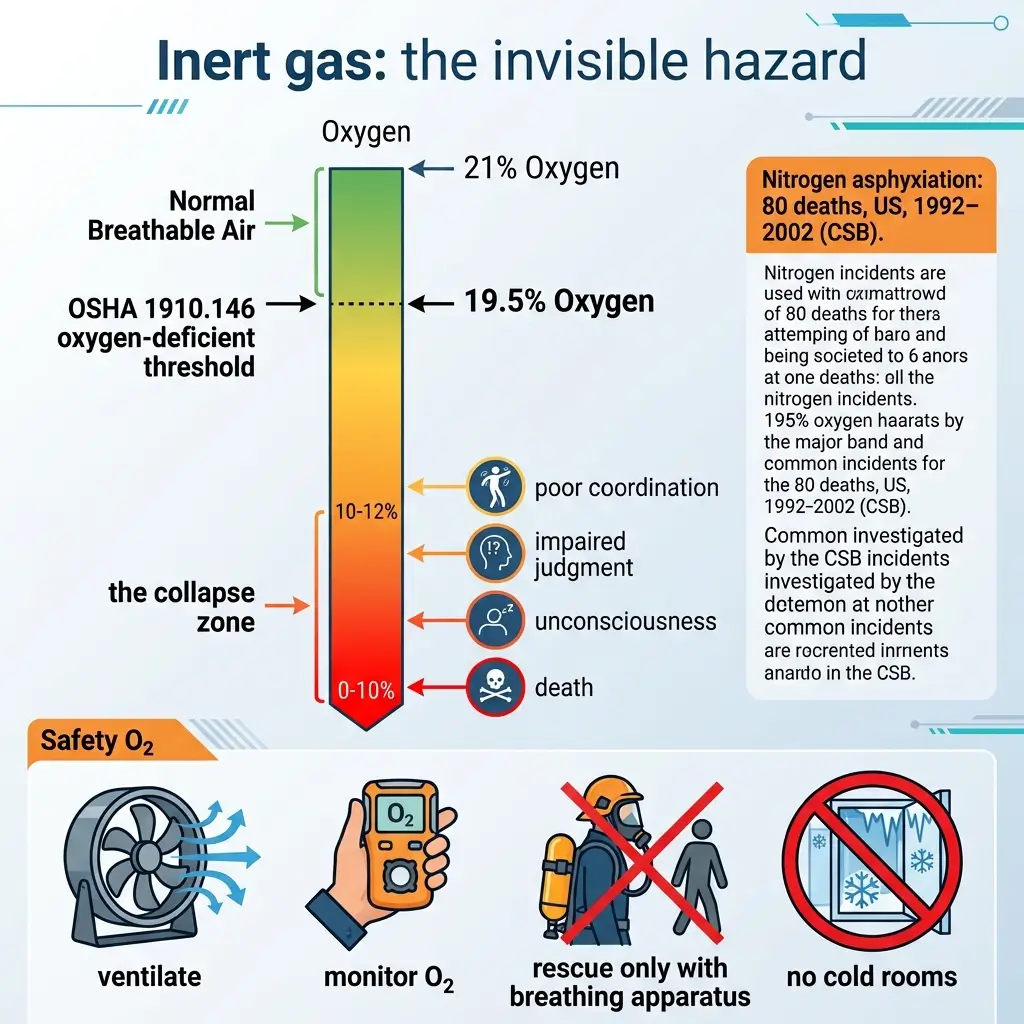
- Inert gases are the quiet killer: the US Chemical Safety Board linked nitrogen asphyxiation to 80 deaths between 1992 and 2002. Oxygen below 19.5% is an oxygen-deficient atmosphere per OSHA 1910.146.
- Cylinders stay upright and secured; the valve cap goes on and the regulator comes off before any cylinder is moved.
- In Great Britain, cylinders fall under the Pressure Systems Safety Regulations 2000 (written scheme of examination by a competent person); flammable gases also engage DSEAR 2002. Northern Ireland applies equivalent regulations.
- Compressed air is not a cleaning tool or a toy: OSHA caps cleaning air at under 30 psi and never for cleaning skin or clothing.
What you are actually handling: the vessel and the gas
Before the tips, hold the two-hazard picture, because every control below serves one or both. The vessel is a high-pressure store of energy. A typical industrial cylinder sits at roughly 130 to 230 bar (about 2,000 to 3,300 psi); if the valve is knocked off, the escaping gas can drive the cylinder through a block wall or send a regulator across a room. That is why OSHA's general requirements for compressed gases, 29 CFR 1910.101, point in-plant handling back to the Compressed Gas Association's Pamphlet P-1, and why the UK regulates the same energy under the Pressure Systems Safety Regulations 2000.
The gas is a separate question, and the answer changes the controls entirely. The four families I sort every cylinder into on a walkdown are below.
| Gas family | Examples | The hazard that governs handling |
|---|---|---|
| Flammable / fuel | Acetylene, hydrogen, LPG, methane | Fire and explosion; engages DSEAR in the UK; segregate from oxidisers and ignition sources |
| Oxidising | Oxygen, nitrous oxide | Accelerates combustion violently; keep away from oil, grease and fuel gases |
| Toxic / corrosive | Chlorine, ammonia, hydrogen sulphide | Poisoning and tissue damage at low concentrations; ventilation and gas detection |
| Inert / asphyxiant | Nitrogen, argon, carbon dioxide, helium | Displaces oxygen silently; no smell, no warning; the leading fatal mechanism |
Two mistakes recur. The first is treating an inert gas as harmless because it will not burn or poison you — it will still asphyxiate you. The second is treating "compressed air" as benign because it is only air; at pressure it injures, and the cylinder it comes in is the same projectile as any other. Sort the gas first, then apply the controls.
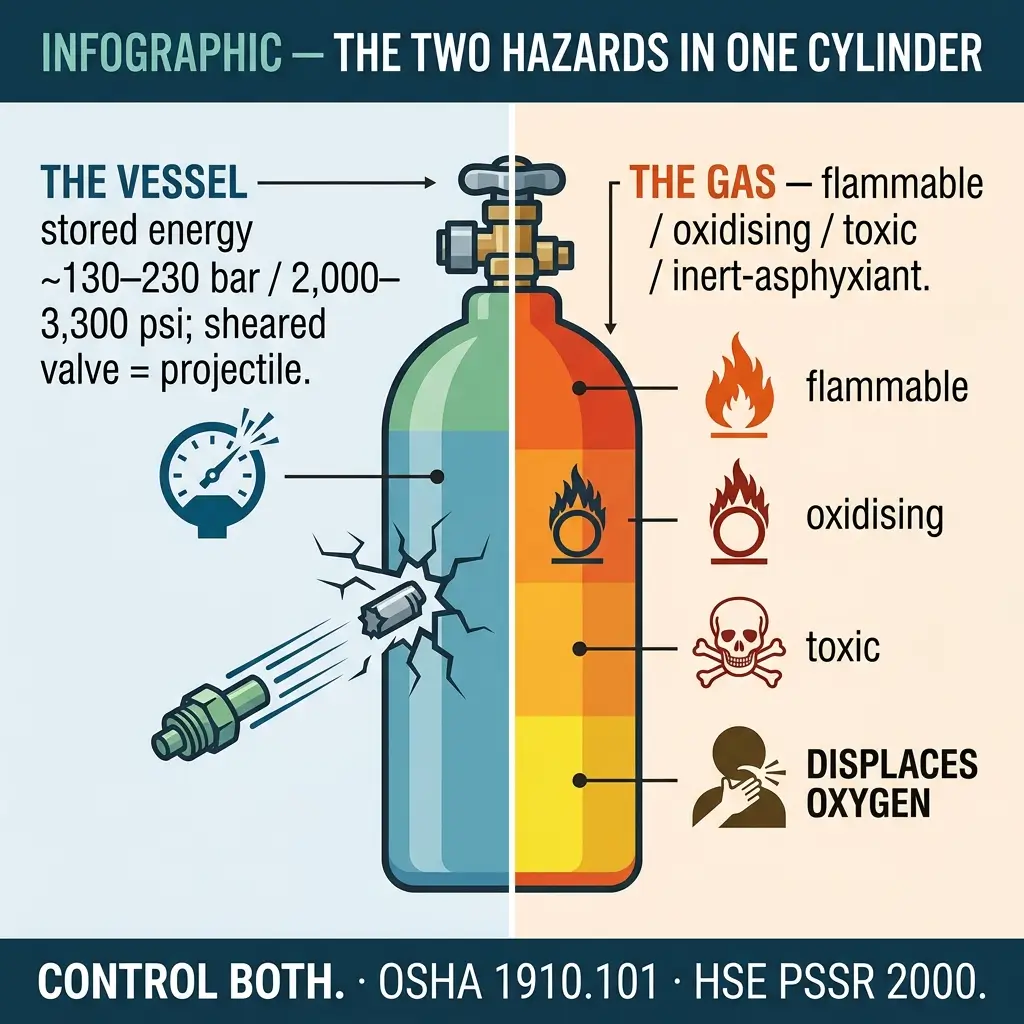
House style for all infographics below: Technical line illustration, muted industrial palette with a single accent colour, clean sans-serif labels, red reserved for hazards and failure states. No photorealism, no depicted injuries, no identifiable people.
Tips 1–3: Handling and moving cylinders
More incidents happen while a cylinder is being identified, lifted and moved than at any other point in its life. These three controls cover that window.
1. Read the label and the SDS before you touch it — never assume "inert"
Identify the gas from the cylinder marking and the safety data sheet before you plan anything else, because the SDS decides your PPE, your ventilation and your emergency response. Colour coding is a useful prompt but not proof — colour schemes differ between countries and suppliers — so confirm against the stencilled or labelled contents required under OSHA's Hazard Communication Standard, 1910.1200.
On an Evonik hazmat store assurance walkdown, the finding I wrote up was PPE being selected from habit rather than from the SDS for the product actually on the bench. It is the same failure that kills people with gases: the assumption that you already know what is in the bottle. A cylinder labelled nitrogen and a cylinder labelled chlorine call for completely different plans, and the only way to know which you have is to read it, not recognise it.
- Match the label, the SDS and the delivery note — three sources, one answer
- Note the gas family (flammable / toxic / oxidising / inert) and the emergency actions before use
- Treat an unlabelled or illegibly-labelled cylinder as unknown and quarantine it — do not guess
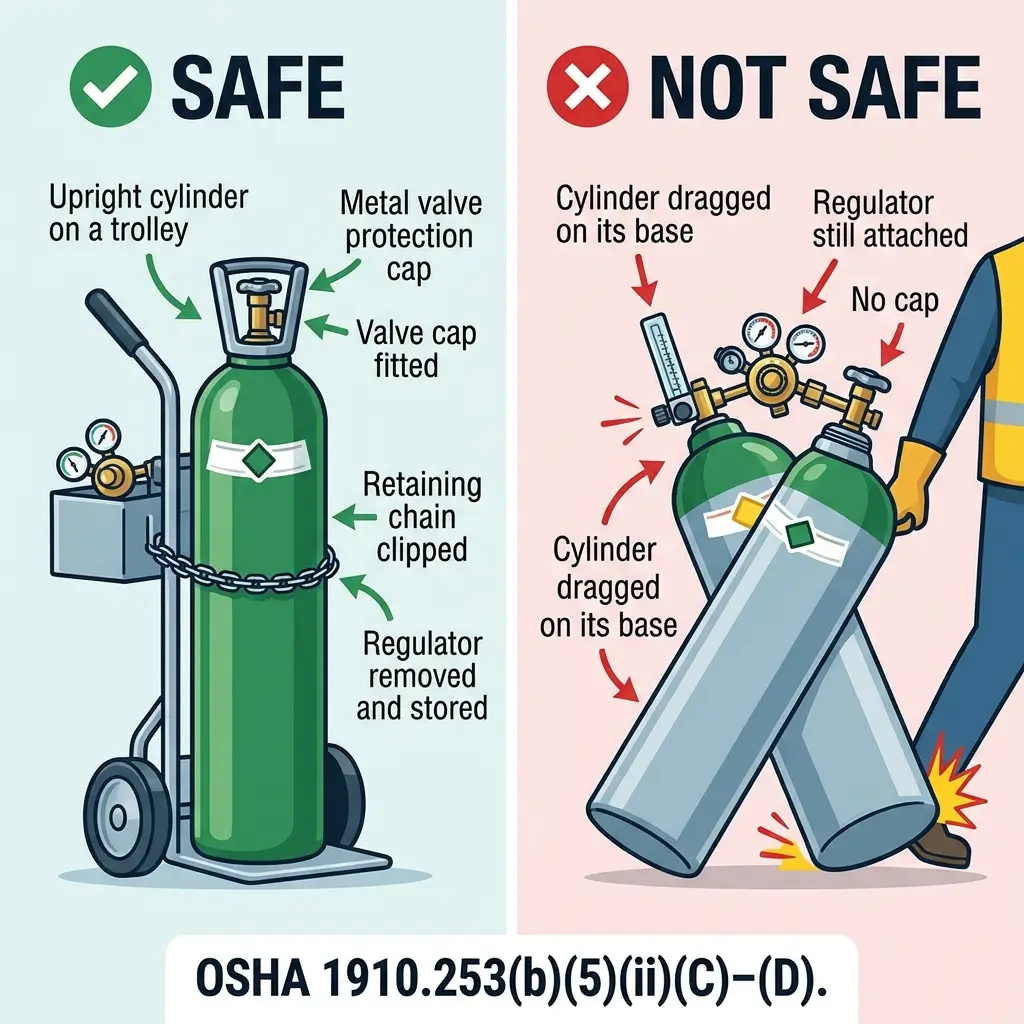
2. Move cylinders on a secured trolley — never drag, roll on the base, or lift by the cap
A full industrial cylinder weighs roughly 60 to 90 kg (130 to 200 lb), and some exceed that; this is a manual-handling hazard before it is anything else, and in the UK it sits squarely under the Manual Handling Operations Regulations 1992. Use a purpose-built cylinder trolley with the retaining chain fastened. Never "walk" a cylinder by rolling it on its base edge as a routine method, and never lift a cylinder by its valve-protection cap — the cap is not a structural handle. OSHA 1910.253(b)(5)(ii)(C) states the cap must not be used to lift a cylinder.
The European Industrial Gases Association's DOC 229 on manual handling of cylinders exists precisely because this task injures backs, hands and feet daily. Managing drum and cylinder handling on chemical sites, the repeat finding was not dramatic — it was a trolley chain left unclipped "just for the short run to the bay," which is exactly the run where the cylinder tips.
3. Cap on, regulator off, before a cylinder is moved
Whenever a cylinder is not connected and in use, the regulator comes off and the valve-protection cap goes on. This is the single control that prevents a knock from shearing the valve. OSHA 1910.253(b)(5)(ii)(D) requires the regulator to be removed and the valve cap replaced before a cylinder is moved, unless it is secured on a proper cylinder cart for that purpose.
A cylinder moved with the regulator still fitted is the classic "rocket cylinder" waiting to happen: the regulator is the weak point, and a sideways impact snaps it off. Hand-tighten the cap; it is designed to be fitted without tools.
Tips 4–6: Storage and segregation
Storage is where I find the most findings, because floor pressure and convenience quietly erode the layout that was designed on paper. These three controls are the ones auditors check first.
4. Store cylinders upright and secured, restrained about two-thirds up
Cylinders are stored and used standing upright, secured to a fixed structure so they cannot fall. The practical detail that most sites get slightly wrong: the restraint — chain, strap or bar — sits roughly two-thirds of the way up the cylinder, not around its middle, so it actually stops the cylinder pivoting. Restrain small groups rather than long gang-chains; a common rule of thumb is no more than three cylinders per restraint, tight enough that a cylinder in the middle cannot slip out independently.
Acetylene and other dissolved-gas cylinders must be stored and used valve-end up, because tilting them lets the solvent (acetone) migrate and escape. Keep empties separated from full cylinders and label the three states clearly.
- Restraint at ~two-thirds height, to a fixed and immovable point
- Small groups, typically no more than three per restraint, all held tight
- Segregate full / in-use / empty and tag each cylinder's state
- Store valve-end up; keep caps on stored cylinders
5. Separate oxygen and oxidisers from fuel gases and combustibles
This is the most frequently cited storage violation for good reason. Under OSHA 1910.253(b)(4)(iii), oxygen cylinders in storage must be separated from fuel-gas cylinders — acetylene, propane, hydrogen — and from combustible materials, especially oil and grease, by a minimum of 20 feet (6.1 m), or by a noncombustible barrier at least 5 feet (1.5 m) high with a fire-resistance rating of at least half an hour. A plywood divider does not qualify; a concrete block wall or rated partition does.
The reason is chemistry, not bureaucracy: oxygen does not burn, but it makes everything else burn faster and hotter, so a fuel-gas leak beside an oxygen store is a far more violent fire than the same leak alone. On a hazmat store, the way this control fails is almost always the same — the 20-foot gap was there at commissioning, then a delivery arrived, floor space got tight, and the oxygen pallet ended up next to the acetylene "temporarily." Temporary is where the incident lives.
⚖️ Jurisdiction note: The 20 ft / barrier rule is the US general-industry standard. UK storage follows HSE guidance and BCGA Code of Practice CP 44, which sets separation on a risk basis rather than a single fixed distance — verify the figure your site is designed to.
6. Keep oil, grease and ignition sources away — especially from oxygen
Never let oil or grease near oxygen equipment: valves, regulators, threads, gloves or rags. In an oxygen-enriched atmosphere, hydrocarbons that are normally hard to ignite can combust violently, and a greasy regulator thread on an oxygen cylinder is a genuine ignition source. Do not lubricate oxygen fittings, and do not handle them with oily gloves. For flammable gases, the same discipline applies to all ignition sources — an oxygen-enriched atmosphere (above 23.5% oxygen, per OSHA 1910.146) or an atmosphere within a gas's flammable range only needs a spark.
In Great Britain, storage and use of flammable gases such as LPG, acetylene and hydrogen engage the Dangerous Substances and Explosive Atmospheres Regulations 2002 (DSEAR), which require you to control ignition sources and assess explosive-atmosphere risk (Northern Ireland has an equivalent).
Tips 7–8: Ventilation and leaks — the quiet killers
The two hazards that kill without drama are oxygen displacement and undetected leaks. Neither announces itself, which is exactly why they are dangerous.
7. Store and use cylinders only where there is real ventilation
An inert gas leak in an enclosed space does not smell, does not irritate, and gives no warning before you lose consciousness — the first symptom is often collapse. The US Chemical Safety Board's 2003 bulletin on nitrogen asphyxiation found that <cite index="38-1">nitrogen incidents in the United States between 1992 and 2002 resulted in 80 deaths and 50 injuries</cite>, and <cite index="38-1">almost half of those incidents involved contractors</cite>. Normal air is about 20.9% oxygen (the CSB bulletin notes nitrogen makes up 78% of it); OSHA 1910.146 treats anything below 19.5% oxygen as an oxygen-deficient atmosphere.
The practical rules follow directly. Do not store or use cylinders in walk-in cold rooms, environmental chambers, cupboards, or other stand-alone enclosures without dedicated outside-air ventilation, because these spaces do not clear a leak. Where inert or asphyxiant gases are used in a room, provide ventilation and, where the risk warrants, fixed oxygen-depletion monitoring with an alarm. A normal oxygen reading is not on its own proof of a safe atmosphere — toxic or flammable hazards can be present at a normal oxygen level, so where those are credible, test for them too. Never enter a space to rescue a collapsed colleague without breathing apparatus — a rescuer without air becomes the second casualty, which is the pattern the CSB data shows again and again.
- No cylinders in cold rooms, chambers or unventilated cupboards
- Oxygen-depletion alarms where inert gases are used in occupied rooms
- Rescue only with breathing apparatus — never hold your breath and reach in
8. Detect leaks the safe way — and evacuate a serious release
Check connections for leaks with soapy water or an approved leak-detection fluid, or a suitable gas detector — never with a flame. Watch for the bubbles at the joint, the hiss, the smell of an odorised gas, or a regulator that will not hold pressure. If you find a small leak at a fitting, close the cylinder valve and address it; if you cannot stop a significant release, evacuate the area, isolate ignition sources where safe to do so, and raise the alarm.
Do not tamper with the pressure-relief device on a cylinder, and never try to repair a leaking cylinder valve yourself — return the cylinder to the supplier. For flammable gases, a leak plus an ignition source is the explosive-atmosphere scenario DSEAR exists to prevent, so ventilation and ignition control are part of the response, not an afterthought.
Tips 9–10: Inspection and safe use of the pressure
The last two controls cover the vessel's condition and the ways people misuse the energy inside it.
9. Inspect cylinders and equipment, and respect the test and examination dates
Inspect each cylinder, valve and regulator before use for damage, corrosion, dents, gouges, arc burns or a leaking valve, and check that the periodic test date has not expired — cylinders are pressure-tested (commonly hydrostatically) on a fixed cycle and a cylinder past its test date should be returned, not filled or used. Damaged regulators and cross-threaded fittings are a common source of failure; never force a connection or use an adaptor to make an incompatible fitting join, because the anti-interchange design is a safety feature.
In Great Britain this is a legal duty, not just good practice. Under the Pressure Systems Safety Regulations 2000, qualifying pressure systems require a written scheme of examination drawn up by a competent person, and examination in accordance with it before use; Northern Ireland applies the equivalent Pressure Systems Safety Regulations (Northern Ireland) 2004. In the US, OSHA 1910.101 requires visual and other inspection of compressed gas cylinders under the CGA's inspection pamphlets. Either way, the message is the same: a cylinder is a pressure vessel with a service life, and the dates on it mean something.
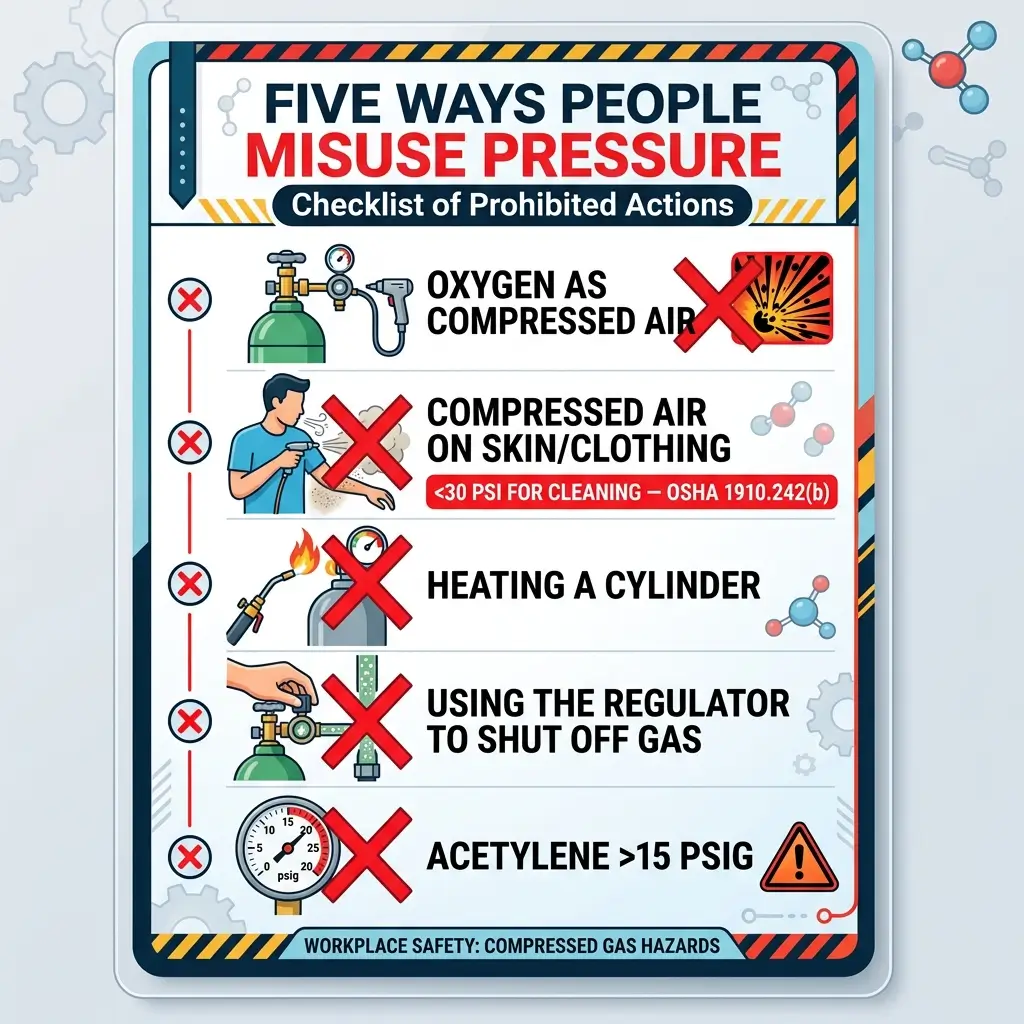
10. Do not misuse the pressure
Most of the remaining incidents come from using the energy for something it was never meant to do. The rules that matter:
- Never use oxygen as a substitute for compressed air — not to run tools, blow down clothing, ventilate, or pressurise anything. Oxygen enrichment plus any oil or spark is a fire.
- Never use compressed air to clean skin or clothing. For cleaning surfaces, OSHA 1910.242(b) requires the air be reduced to under 30 psi with effective chip guarding and PPE; air forced into or under the skin causes serious injection injuries. The HSE's guidance HSG39, Compressed air safety, covers the same ground in the UK.
- Never heat a cylinder to raise its pressure or free a stuck valve with a flame — heating can defeat the built-in pressure-relief safeguards. Thaw an iced valve with warm water only, and only if the gas is not water-reactive.
- Use the cylinder valve to shut off the gas, not the regulator, and back off the regulator's adjusting screw before opening the cylinder valve slowly.
- Do not use acetylene above 15 psig (about 1 bar) gauge pressure — above that, acetylene becomes unstable.
How the rules compare across the US, UK and internationally
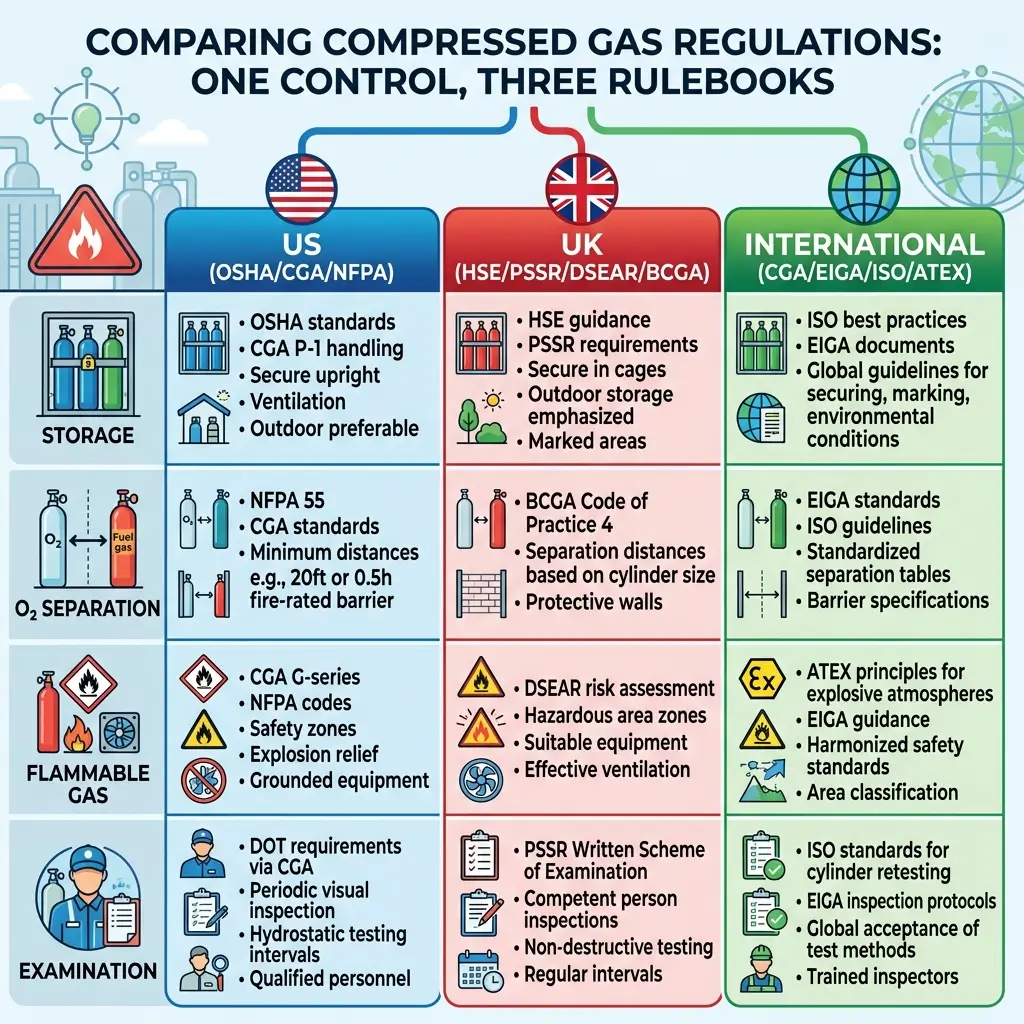
Because cylinders and their handling are regulated differently by jurisdiction, a multinational operation needs to know which instrument governs each control. The table maps the main ones; verify the current version before you rely on any single figure, as standards are revised.
| Control | United States | United Kingdom | International / consensus |
|---|---|---|---|
| General handling & storage | OSHA 1910.101 → CGA P-1 | PSSR 2000; HSE guidance | CGA P-1; ISO 11625 |
| Oxygen / fuel-gas separation | 1910.253 — 20 ft or ½-hr barrier | BCGA CP 44 (risk-based) | EIGA codes of practice |
| Flammable gas / explosive atmosphere | Gas-specific 1910.103 (H₂) / 1910.110 (LPG); NFPA 55; hazardous areas 1910.307 / NFPA 70 | DSEAR 2002 | ATEX 1999/92/EC (EU) |
| Pressure-vessel examination | 1910.101; DOT cylinder testing | PSSR 2000 — written scheme of examination | ISO/TC 58 cylinder standards |
| Compressed air for cleaning | 1910.242(b) — under 30 psi | HSE HSG39 | — |
The pattern for a global reader: the US tends to give a single prescriptive number (20 feet), while the UK sets a duty and a risk-based code (BCGA CP 44) and asks you to justify the distance. Neither lets you rack oxygen against acetylene.
Frequently asked questions
These are the questions that come up most often on site and in training, answered against the standards above.
How should compressed gas cylinders be stored?
Upright, secured to a fixed structure about two-thirds up their height, with valve caps fitted and full/empty states separated. Store in a ventilated area away from heat, ignition sources and oil or grease, and keep oxygen and oxidisers separated from fuel gases and combustibles.
How far apart must oxygen and acetylene cylinders be stored?
Under OSHA 1910.253(b)(4)(iii), oxygen cylinders in storage must be at least 20 feet (6.1 m) from fuel-gas cylinders such as acetylene and from combustibles, or separated by a noncombustible barrier at least 5 feet (1.5 m) high with a half-hour fire-resistance rating.
Do gas cylinders have to be chained or secured?
Yes. Cylinders must be secured upright so they cannot fall, whether in storage or in use. Use a chain, strap or bar fixed to an immovable structure, positioned around two-thirds of the cylinder's height, and restrain small groups so no cylinder can move independently.
Can you lay a gas cylinder on its side?
Generally no — cylinders are stored and used upright and secured. Acetylene and other dissolved-gas cylinders in particular must be kept valve-end up, because tilting lets the solvent escape. If a cylinder has been on its side, stand it upright for a period before use as the supplier directs.
Is compressed air dangerous?
Yes. It is stored energy: it can rupture a vessel, whip a hose, and cause fatal injection injuries if forced into the skin. OSHA limits compressed air used for cleaning to under 30 psi with guarding and PPE, and prohibits using it to clean skin or clothing. Never treat it as harmless.
How often do gas cylinders need testing?
Cylinders are pressure-tested on a fixed periodic cycle set by the cylinder standard and jurisdiction, and must not be used past their test date. In the UK, the wider system is examined under a written scheme of examination required by the Pressure Systems Safety Regulations 2000, drawn up and carried out by a competent person.
The habit that catches most of these
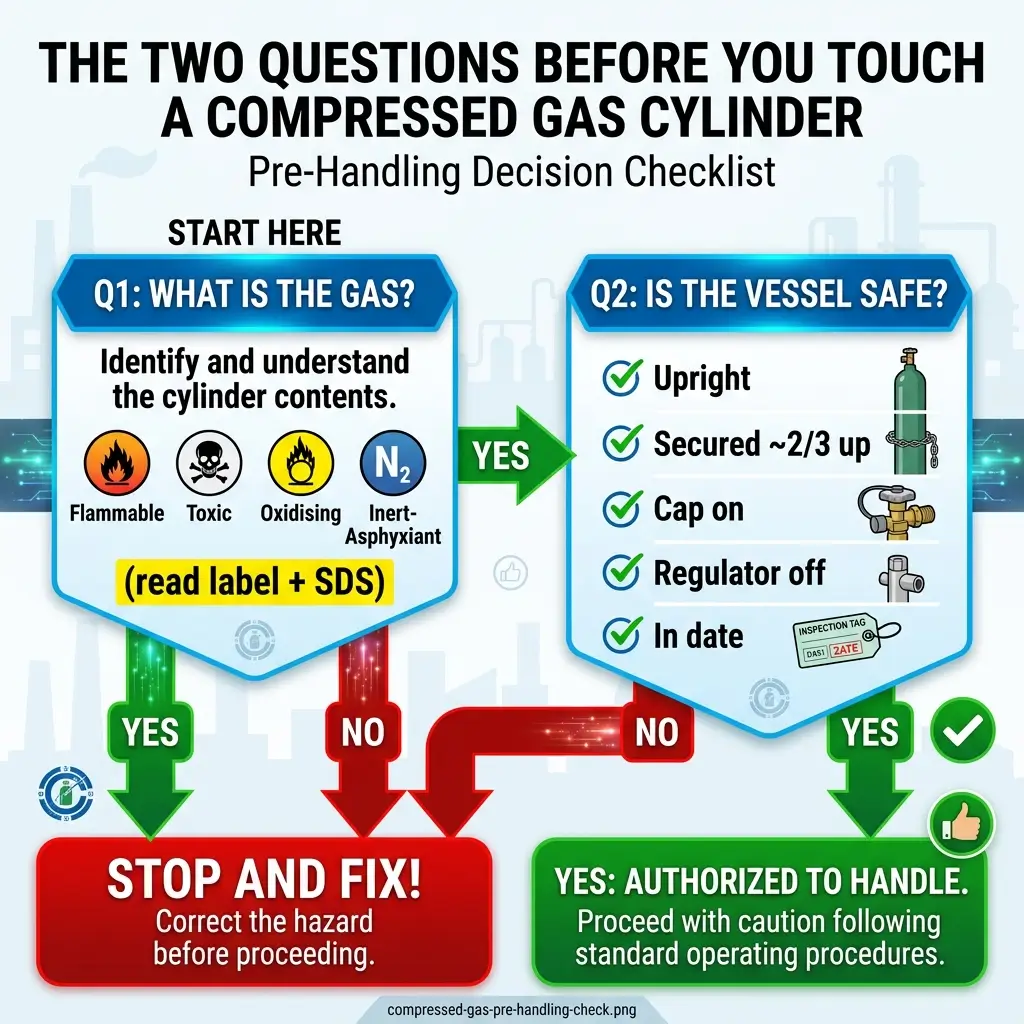
If you take one thing to the store or the workface, make it this: check the two hazards before you touch the cylinder — what is the gas, and is the vessel secured and capped. Nearly every finding I write up traces back to skipping one of those two questions under time pressure. The label went unread, or the cap stayed off "for the short run." The controls in this article are not difficult or expensive; they fail because someone treated a routine task as beneath its own procedure. Treat the cylinder as what it is — a pressure vessel full of a gas that can burn, poison or quietly displace the air — and the ten tips become second nature rather than a checklist.
Where your site uses toxic or asphyxiant gases, or stores oxygen and fuel gases at scale, get a competent person to assess the storage layout and examination scheme against the standards for your jurisdiction. This article sets the principles; your site's specific risk assessment sets the distances and details.
About the author — Isabella Wright Isabella Wright is a British Chemical Safety & Hazardous Materials Assurance Consultant with 17 years of continuous field experience across specialty chemicals, petrochemicals, coatings and solvents, and polymer processing in 14 countries. Her focus is field verification of controls — checking that storage, segregation and handling actually hold up under delivery pressure, night shifts and contractor peaks. She has led hazmat store assurance and drum and cylinder handling programmes for operators including Evonik Specialty and LANXESS, and now runs Wright Chemical Safety Assurance in London. (Credentials: NEBOSH International General Certificate; ISO 45001 Lead Auditor; ISO 14001 Internal Auditor; IOSH Managing Safely; Dangerous Goods Awareness.)
Sources and further reading
- OSHA, 29 CFR 1910.101 — Compressed gases (general requirements)
- OSHA, 29 CFR 1910.253 — Oxygen-fuel gas welding and cutting
- OSHA, 29 CFR 1910.242(b) — Compressed air used for cleaning
- OSHA, 29 CFR 1910.146 — Permit-required confined spaces (oxygen-deficient definition)
- OSHA, 29 CFR 1910.1200 — Hazard Communication
- HSE, Pressure Systems Safety Regulations 2000 (PSSR)
- HSE, Dangerous Substances and Explosive Atmospheres Regulations 2002 (DSEAR)
- US Chemical Safety Board, Safety Bulletin: Hazards of Nitrogen Asphyxiation (2003)
- Compressed Gas Association, Pamphlet P-1, Standard for Safe Handling of Compressed Gases in Containers; British Compressed Gases Association, CP 44; European Industrial Gases Association, DOC 229