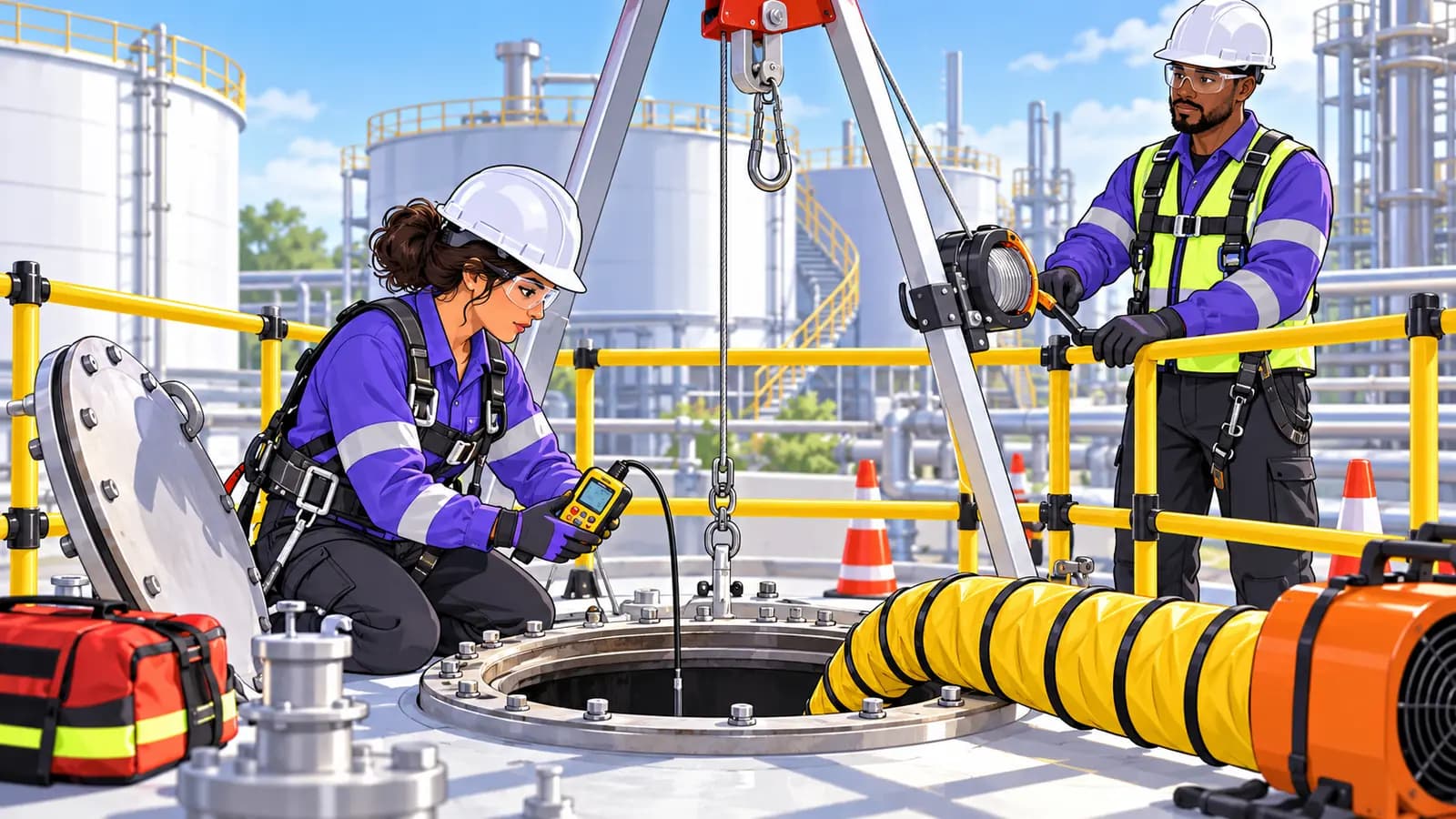
A confined space is a space big enough for a worker to climb into and do a job, with only restricted ways in and out, that was never built for people to stay in. That is the American test in three parts, and all three must hold at once. Britain asks a different question: is the place substantially enclosed, and does a listed risk foreseeably arise inside it?
The distinction matters because the two tests can disagree on the same tank. A wide open pit can fail the American access test and still fall under British law when gas collects in it. The permit question sits on top of both tests, and it turns on hazard, not on the size of the opening.
What Legally Counts as a Confined Space
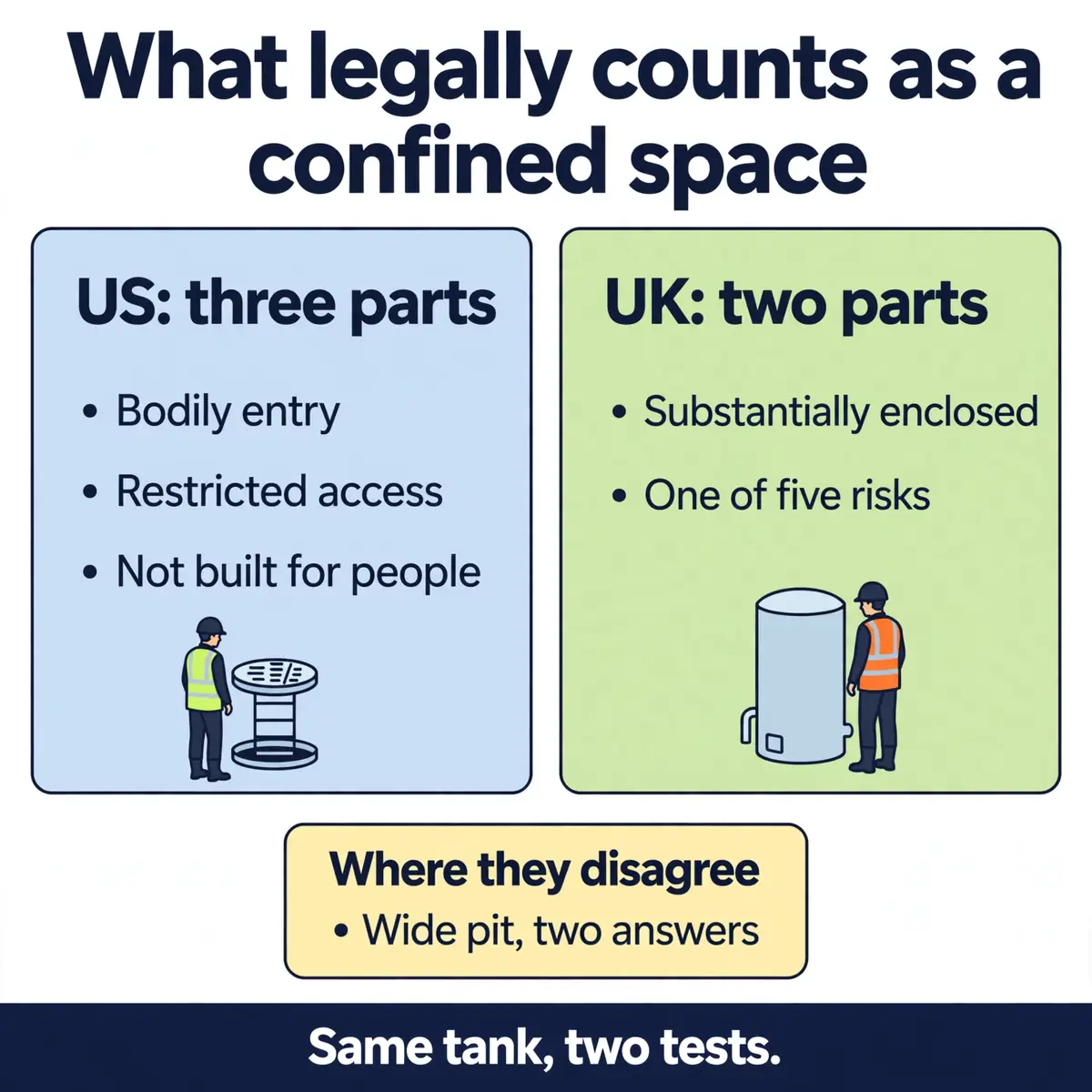
Most arguments on site about whether something is a confined space come from people applying the wrong country's test. The American rule describes the shape of the space. The British rule describes the risk inside it. A crew can pass one and fail the other on the same tank, so run both tests and work to the stricter result.
The US Test: Three Conditions, All of Them
OSHA's general industry rule defines a confined space as one that is large enough and so configured that an employee can bodily enter and perform assigned work, has limited or restricted means for entry or exit, and is not designed for continuous employee occupancy. The regulation lists tanks, vessels, silos, storage bins, hoppers, vaults and pits as examples of spaces with limited means of entry.
Miss any one condition and the space falls outside the standard. A crawl space too small to enter is not a confined space, because nobody can bodily enter it. A plant room with a normal door and full-height access is usually not one either, because the access is not restricted.
Construction work follows a separate standard, 29 CFR 1926 Subpart AA, which took effect in August 2015. Its definition at 1926.1202 is near-identical, though it reads "limited or restricted means for entry and exit" where general industry reads "entry or exit", and the duties on top of it are tighter.
The UK Test: Enclosure Plus a Specified Risk
The Confined Spaces Regulations 1997 define a confined space as any place — including a chamber, tank, vat, silo, pit, trench, pipe, sewer, flue or well — in which, by virtue of its enclosed nature, a reasonably foreseeable specified risk arises. Two things must be true: the space is substantially, though not necessarily entirely, enclosed, and one of five listed risks is present or foreseeable.
Those five specified risks are:
Serious injury from fire or explosion.
Loss of consciousness from a rise in body temperature.
Loss of consciousness or asphyxiation from gas, fume, vapour or lack of oxygen.
Drowning from a rising liquid level.
Asphyxiation or entrapment from a free-flowing solid such as grain, flour, sugar or sand.
The practical consequence is that in Britain the hazard creates the confined space. HSE's Approved Code of Practice L101, third edition, is the document to read alongside the regulations.
Where the Two Tests Disagree
The gap shows up on open-topped and oversized spaces. A large open pit with easy stair access can be squarely inside the UK regulations because carbon dioxide or nitrogen collects in it. The same pit can arguably fail OSHA's "limited or restricted means for entry or exit" condition. Run both tests on a multinational asset and write the procedure to the stricter outcome.
A space that only one test catches still needs the full treatment. Crews move between assets and between countries, and a worker who learned one definition will apply it everywhere. The safe system of work should name which test was applied and why, so the next crew does not reopen the argument at the opening.
Question | United States — 1910.146 | United Kingdom — CSR 1997 |
|---|---|---|
Must a person be able to bodily enter? | Yes, explicitly required | Not stated in the definition |
Must access be restricted? | Yes, a standalone condition | No |
Must a hazard be present? | No, not to be a confined space | Yes, one of five specified risks |
Is a permit always required? | Only for permit-required spaces | No, but a safe system of work always is |
Governing source |
When I audit a space that could go either way, three questions settle it faster than an argument about the wording:
Can a person get their whole body in and work? If not, the US test is already failed.
Is the enclosure changing the atmosphere? Accumulation, displacement or oxygen consumption inside the space is the UK trigger.
Would getting an unconscious person out be harder than from open ground? If yes, treat it as confined regardless of which test you land on.
Confined Space or Permit-Required Confined Space?
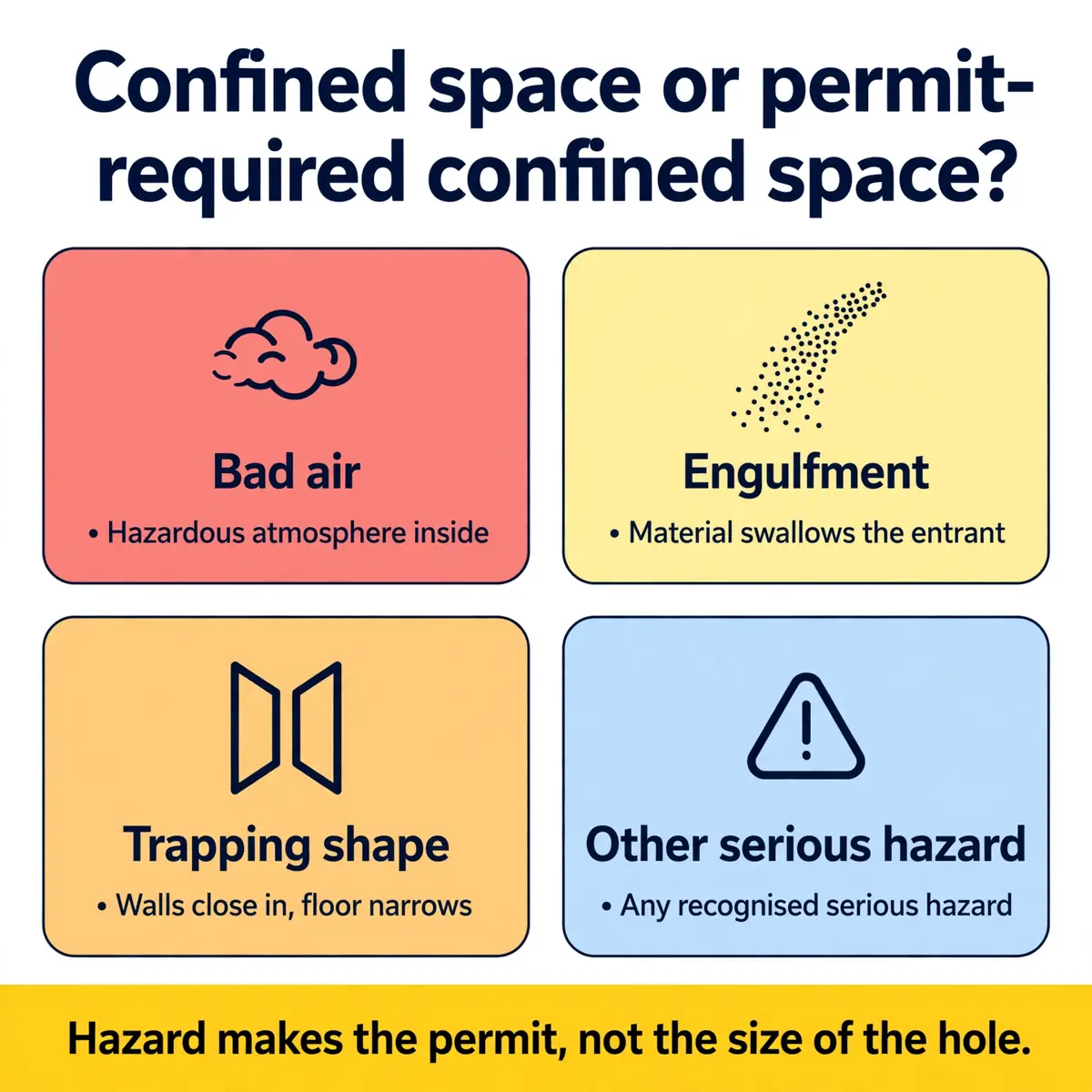
Under the US regime these are two different things, and conflating them is the most common error I see in written programmes. Every permit-required confined space is a confined space. Most confined spaces are not permit-required. The upgrade is driven by what is in the space, not how tight the opening is.
The entry assessment also needs to consider overlapping work: hot work hazards, carbon monoxide exposure, and whether teams actually practice emergency procedures that the permit relies on. The steps of a permit entry itself — permit, roles, testing and rescue — sit in the companion piece on confined space entry.
The Four Triggers for Permit Status
A confined space becomes a permit-required confined space if it has any one of four characteristics. It contains or has the potential to contain a hazardous atmosphere. It contains a material with the potential to engulf an entrant. It has an internal configuration where an entrant could be trapped or asphyxiated by inwardly converging walls or a floor sloping down to a smaller cross-section. Or it contains any other recognised serious safety or health hazard.
That last one is the catch-all, and it does real work. Residual product, live agitators, steam jackets, unguarded drops and unresolved electrical isolations all land there. A space with a clean atmosphere can still be permit-required because of what is bolted inside it.
Non-Permit Spaces, Alternate Procedures and Reclassification
There are three legitimate US routes into a confined space, and each carries a different evidence burden. A space where forced-air ventilation alone controls the only hazard — an atmospheric one — can be entered under the alternate procedures at 1910.146(c)(5), with a written certification instead of a permit.
A space can be reclassified as non-permit under (c)(7), but only if hazards are eliminated rather than controlled. OSHA states plainly that controlling an atmospheric hazard by forced-air ventilation does not count as eliminating it. Ventilation controls a hazard; it does not remove it.
Reclassification is not permanent. A hazard that returns puts the space straight back into permit status. The crew inside must leave while it is re-evaluated. A downgrade signed months ago means nothing if the work or the contents have changed since.
Route | Condition | What must exist | Clause |
|---|---|---|---|
Full permit entry | Any permit trigger present | Written permit, attendant, rescue arrangements | 1910.146(d)–(k) |
Alternate procedures | Only hazard is atmospheric, ventilation alone controls it | Monitoring data, written pre-entry certification | 1910.146(c)(5) |
Reclassified non-permit | All hazards eliminated, not controlled | Signed and dated certification of elimination | 1910.146(c)(7) |
Before accepting any downgrade on a site, I want to see four things on paper:
The monitoring data behind the claim, not an assertion that ventilation works.
The certification, signed and dated, naming the specific space.
What happens if a hazard returns — entrants leave, the space is re-evaluated, and the classification reverts.
Who made the call, and whether they have the authority to make it.
Confined Space Hazards That Kill People
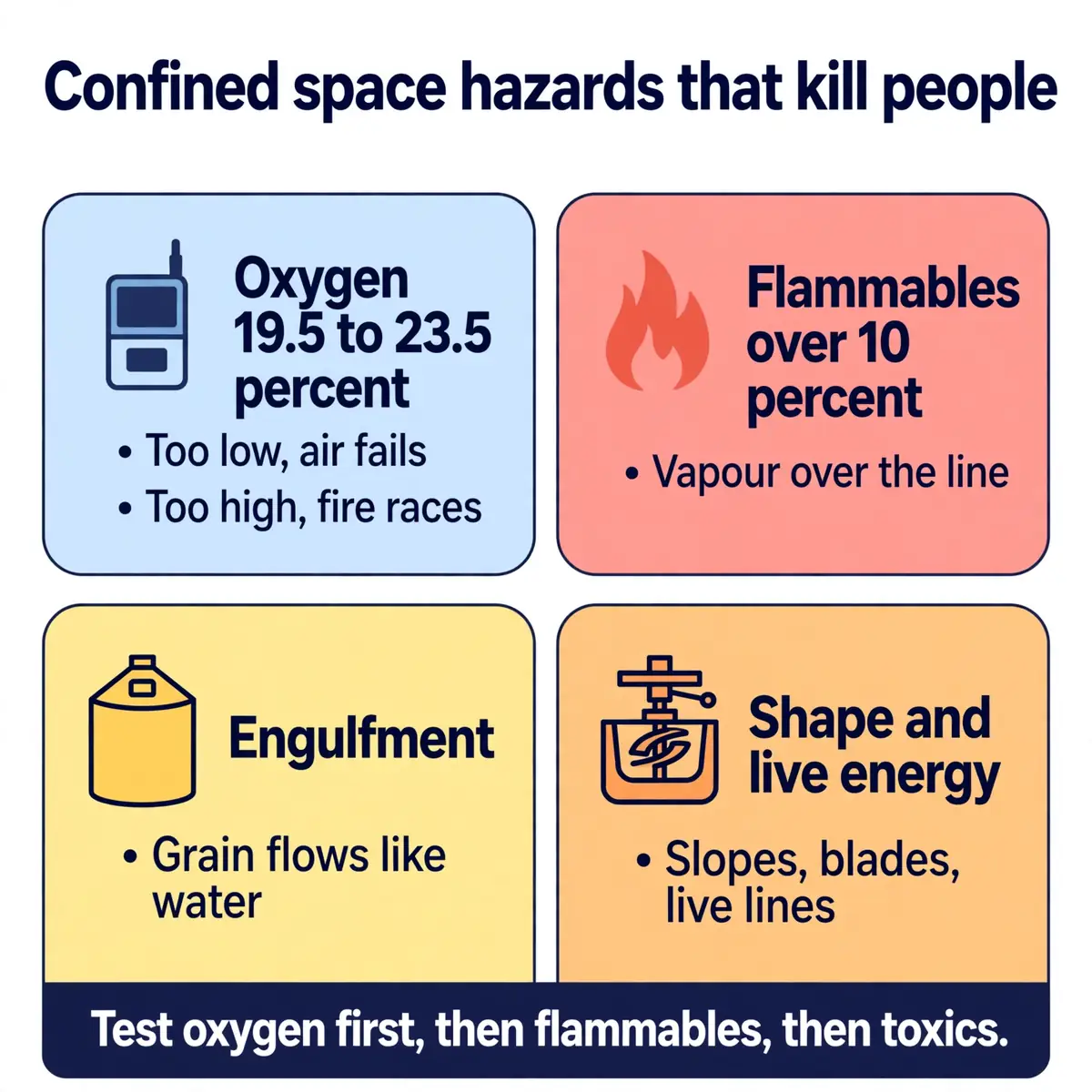
The hazard list in most articles is long and undifferentiated. In investigations the causes cluster tightly: the atmosphere, the material in the space, the shape of the space, and the energy that was never isolated. Everything else is a variation on those four.
Atmospheric Hazards, and the Numbers That Define Them
An atmosphere is legally hazardous under 1910.146(b) when oxygen falls below 19.5% or rises above 23.5% by volume. The same applies when flammable gas, vapour or mist exceeds 10% of its lower flammable limit.
The same clause covers combustible dust at or above its LFL, approximated as dust obscuring vision at 5 feet (1.52 m) or less. It also covers any substance above its permissible exposure limit, and any other condition immediately dangerous to life or health.
Oxygen enrichment is the one people underrate. Past that upper threshold, materials that normally smoulder will burn hard. A leaking oxygen fitting inside a vessel turns clothing into fuel. Depletion is more common — rust consumes oxygen, fresh concrete consumes oxygen, and purge nitrogen displaces it entirely.
WarningNever add oxygen to freshen the air inside a space. Enriched oxygen turns clothing and grease into fuel, and a small leak can make ordinary materials burn hard.
The testing order is prescribed, not conventional. Test oxygen first, then combustible gases and vapours, then toxics. Most combustible gas sensors are oxygen-dependent and will read low in a depleted atmosphere. Normal air holds 20.9% oxygen. HSE guidance in L101 warns that concentrations below 16% can lead to unconsciousness and death.
Engulfment
Engulfment means being surrounded and captured by a liquid or a finely divided flowable solid that can be aspirated to cause death by filling the respiratory system, or exert enough force to kill by strangulation, constriction or crushing. Grain, flour, sugar, sand, cement and sludge all behave this way.
A worker standing on a crusted grain surface over a void goes under in seconds, and the load above them makes an unassisted pull-out impossible. Rising liquid works the same way. The level climbs faster than a person can climb out, and the opening they came through is now under water.
Configuration and Entrapment
The shape of the space is a hazard in its own right. Inwardly converging walls, a floor tapering to a smaller cross-section, internal baffles, mixing blades and long horizontal traverses all complicate escape and rescue. A space that is easy to enter can still be one nobody can be dragged out of.
Entrapment does not need a collapse or a failure. The geometry alone does it. A worker slides down a sloping floor into a narrowing section and cannot climb back against the slope. The rescue plan has to be drawn around the shape, not the atmosphere alone.
Physical, Mechanical and Process Hazards
The rest of the list is familiar work-at-height, energy and process content, made worse by enclosure: unexpected start-up of agitators, live steam through a jacket that was closed but not blinded, and product back-feeding through a valve that was shut instead of blanked. Falls through the opening, heat, noise and poor lighting add to the risk.
Isolation under 1910.146 means blanking or blinding, misaligning or removing pipe sections, double block and bleed, or lockout of all energy sources. A closed valve is not isolation. A valve that was shut instead of blanked has killed people who trusted it.
WarningTreat every line into the space as live until it is blanked, misaligned or locked out. A closed valve can leak, be opened by mistake or fail under pressure.
The Rescuer Figure Everyone Quotes
Almost every confined space article states that more than 60% of confined space fatalities are would-be rescuers. That figure traces to a single NIOSH alert, Publication 86-110, issued in January 1986 and based on 16 deaths. It has been repeated ever since, usually without the date.
Later work does not support it at that level. Selman and colleagues, writing in Safety Science in 2018, analysed work-related confined space fatalities across comparable industrialised countries and found that no more than 17% were people undertaking rescue. Most of those deaths came from hurried, unplanned attempts, and almost all were caused by toxic atmospheres.
I still plan every entry as though a bystander will go in, because on real sites they do. But quoting a 1986 alert as current data in a rescue plan is the kind of thing that gets a whole document doubted.
Hazard | Mechanism | Defining criterion | Source |
|---|---|---|---|
Oxygen deficiency | Rust, purge gas, combustion, biological action | Below 19.5% by volume | 1910.146(b) |
Oxygen enrichment | Leaking oxygen fitting or supply line | Above 23.5% by volume | 1910.146(b) |
Flammable atmosphere | Residues, hot work, solvent coatings | Above 10% of the LFL | |
Combustible dust | Grinding, mixing, materials handling | At or above LFL; vision obscured at 5 ft | 1910.146(b) |
Toxic exposure | H₂S, CO, solvent vapour, product residue | Above the published PEL | 1910.146(b) |
Engulfment | Flowable solids or rising liquid | Any material capable of engulfing | 1910.146(b) |
Four questions separate a hazard list from a hazard assessment on a specific space:
What was in here last, and what did it leave behind? Residues and sludge continue to off-gas after draining.
What is connected to it that is still live? Every line into the space is a hazard until it is blanked or misaligned.
What will the work itself create? Welding, coating and grinding generate the atmosphere that kills.
What happens if the ventilation stops? If the answer is IDLH within minutes, the rescue plan carries the whole load.
Types of Confined Spaces
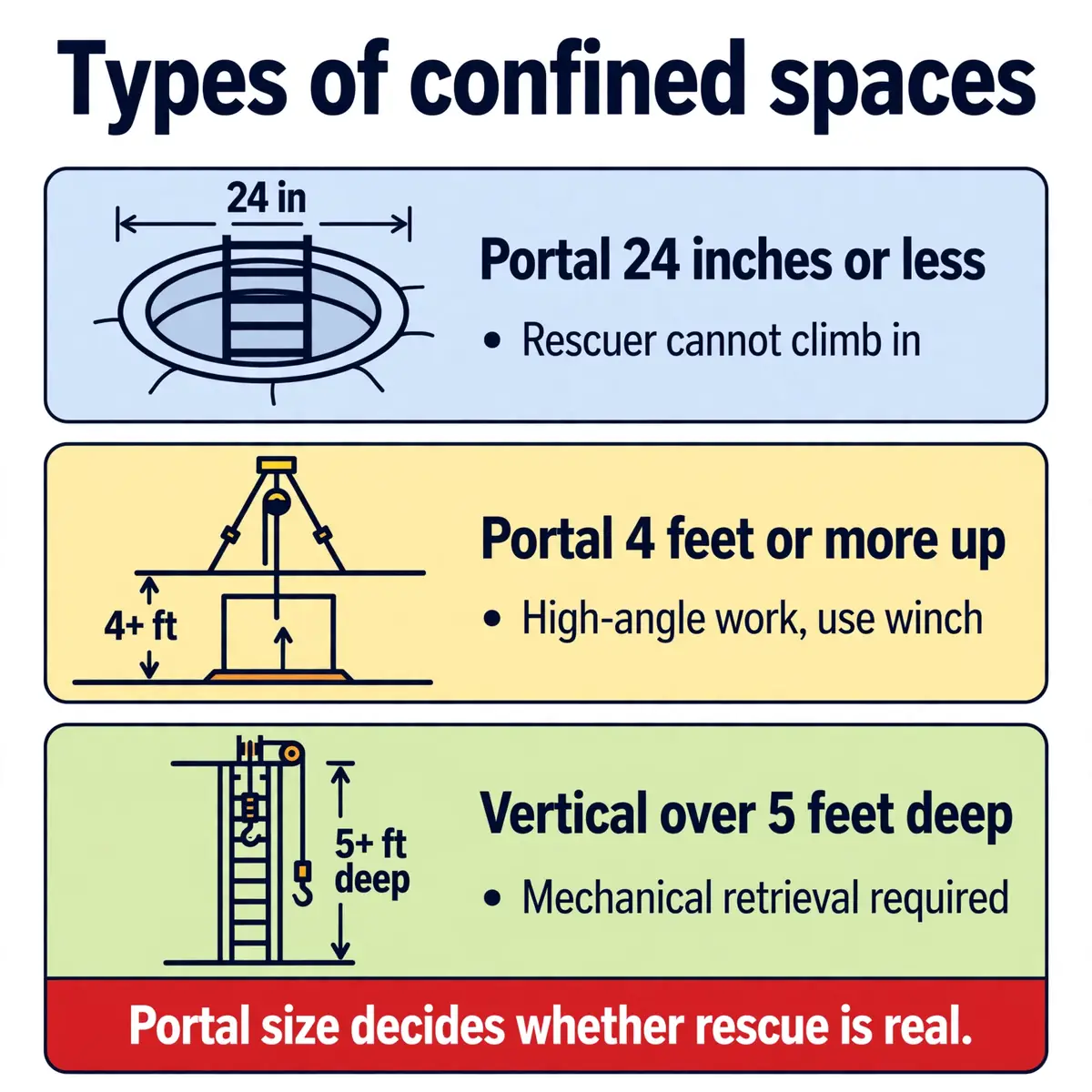
Spaces get classified two ways, and both matter. Legal status decides what paperwork and duties apply. Physical configuration decides whether a rescue can physically be performed — and that is the classification most programmes never write down.
By Legal Status
The regulatory categories are the ones covered above: non-permit confined spaces, permit-required confined spaces, spaces entered under alternate procedures, and spaces reclassified after hazard elimination. In Britain there is no permit category in the regulations themselves. Regulation 4 requires that entry be avoided where reasonably practicable. Where it cannot be avoided, work must follow a safe system of work. In practice on any significant asset that system is a permit.
Status is a live judgment, not a label painted once. A space reclassified after elimination reverts the moment a hazard returns. A non-permit space becomes permit-required when the work changes the atmosphere. Welding, coating and solvent cleaning inside a clean space can create the hazardous atmosphere that triggers the permit.
By Physical Configuration
OSHA's non-mandatory Appendix F sets out the configuration variables a rescue service has to be able to handle. These are the ones I use to decide whether a rescue plan is credible, because they are measurable rather than descriptive.
A restricted portal is the one to watch. At 24 inches or less, a rescuer cannot simply climb in wearing breathing apparatus. An unconscious casualty cannot be brought out with normal spinal immobilisation. Two spaces with identical atmospheres and different portal sizes are not the same job.
Variable | Categories | Threshold |
|---|---|---|
Internal configuration | Open or obstructed | Baffles, blades or staged equipment make it obstructed |
Elevation | Elevated or non-elevated | Portal 4 ft or more above grade is elevated |
Portal size | Restricted or unrestricted | 24 in (60.9 cm) or less in the least dimension is restricted |
Space access | Horizontal or vertical | Vertical portals may need rope technique or special packaging |
Retrieval | Manual or mechanical | Mechanical device required for vertical spaces over 5 ft (1.52 m) deep |
Before signing off any rescue arrangement, measure and record these five things:
The least dimension of the opening, in inches or centimetres, not "small".
The height of the portal above grade, which decides whether high-angle technique is needed.
The depth of vertical travel, which decides whether a mechanical retrieval device is required.
What is inside the space that a stretcher or casualty would have to be routed around.
Whether the rescue team has practised on a space that matches on all four of the above.
Confined Space Examples by Industry
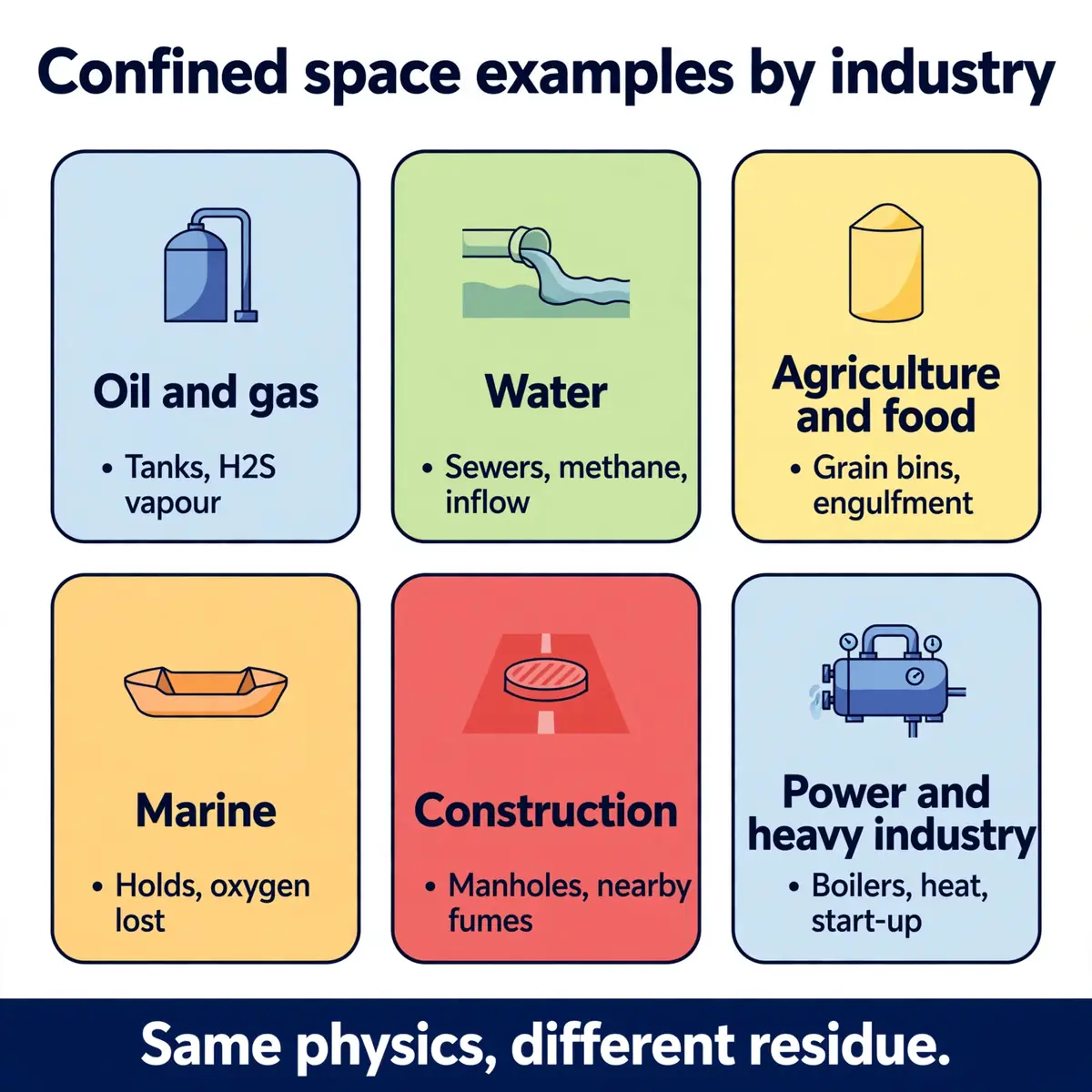
The same physics turns up in very different buildings. What changes is the material left behind and who is likely to be the first person through the opening. The table below covers the spaces that generate most of the entries I see, and the hazard that dominates each one.
Industry | Typical spaces | Dominant hazard |
|---|---|---|
Oil, gas and refining | Separators, storage tanks, columns, caissons, pig traps | H₂S and hydrocarbon vapour; nitrogen purge residue |
Water and wastewater | Sewers, wet wells, digesters, chambers | H₂S, methane, oxygen deficiency, sudden inflow |
Agriculture and food | Grain bins, silos, slurry pits, mixers, CIP vessels | Engulfment; CO₂ and ammonia; mechanical entrapment |
Marine and shipping | Cargo holds, ballast and fuel tanks, cofferdams, chain lockers | Oxygen depletion from cargo off-gassing and rust |
Construction and utilities | Manholes, deep trenches, attics, crawl spaces, formwork voids | Atmosphere from adjacent work; engulfment; collapse |
Power and heavy industry | Boilers, condensers, ductwork, ash hoppers, furnaces | Residual heat, oxygen depletion, unexpected start-up |
Three types of space cause disproportionate trouble because people do not expect them to be in scope:
Open-topped pits and bunds. Denser-than-air gases sit in them. Under UK law they are usually in scope; under US law it turns on access.
Spaces created by the work. Sheeted scaffolds, formwork voids and part-built plant become confined spaces partway through a job, long after the risk assessment was signed.
Rooms made hypoxic by design. Fire suppression systems that reduce oxygen deliberately create a confined space in an ordinary-looking room. HSE added this example when L101 was revised.
AlertA space can become confined partway through a job. Sheeted scaffolds, formwork voids and part-built plant change the risk after the assessment was signed, so reassess when the work changes the space.
What to Check at the Opening Before Entry Starts
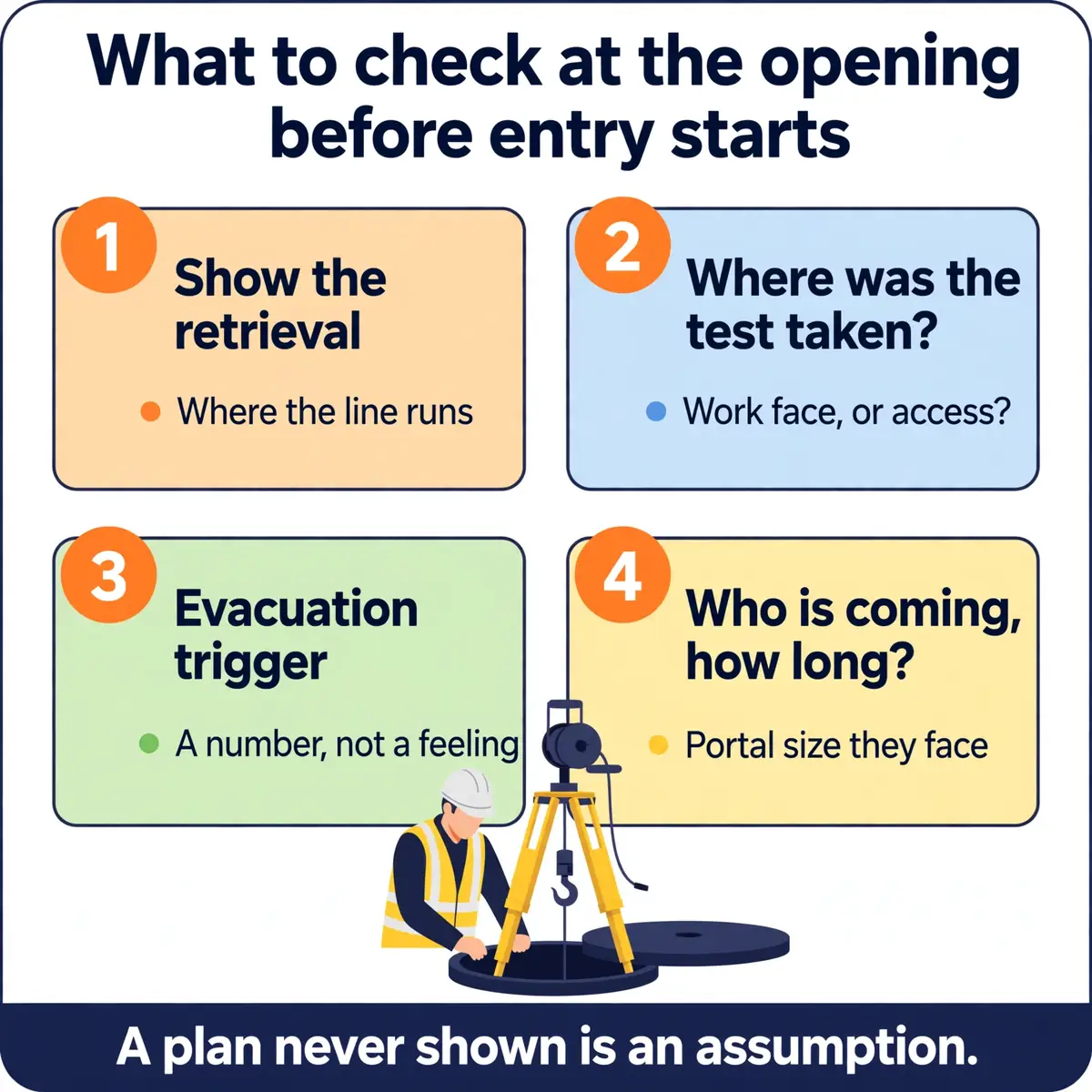
Paperwork is not where these fail. I have never found a confined space problem by reading a permit in an office. Every one I have written up came from standing at the opening and asking the crew to show me something. Two entries stand out, and both were stopped for reasons that were invisible on the form.
The Gas Test Taken at the Opening, Not at the Work Face
On a floating production interface assignment in the United States, I found during a live walkdown that the atmospheric test supporting an entry had been taken at the opening. Nowhere else. The permit was complete and the readings were in range. But the reading described the air at the access point, not the air where the work was going to happen.
That distinction is written into the regulation. Appendix B to 1910.146 directs that where a descent may involve a stratified atmosphere, the space is tested approximately 4 feet (1.22 m) in the direction of travel and to each side. The entrant's rate of progress is slowed to the instrument's response time. A single reading at the manway does not describe a stratified vessel.
I stopped the entry, had the controls reinstated, and briefed the crew before the work restarted. If you issue permits, ask one question before you sign: where exactly was the probe when that number was recorded?
Rescue Gear That Would Not Fit the Opening
On a drilling assignment out of Stavanger, I asked the standby to walk me through the retrieval at the opening rather than describe it. The rescue equipment on site would not physically work at that portal. The plan existed on paper and could not have been executed.
Under 1910.146(k), the employer has to evaluate whether a rescue service can reach the casualty in time and is equipped and proficient for that particular space. Rescue teams must practise on spaces that match the real ones for opening size, configuration and accessibility. Equipment that does not fit the opening fails that test regardless of what the plan says.
I stopped the work, had the arrangements corrected, and briefed the crew before restart. The lesson transfers to any entry, on any site: a rescue plan that has never been demonstrated at that specific opening is an assumption, not a plan.
Ask the standby these four questions at the opening, before anyone breaks the plane:
Show me the retrieval, don't describe it. Where does the line run, and what does it cross?
Where was the last gas test taken? At the work face, or at the access?
What is your evacuation trigger? A number, not "if it looks wrong".
Who is coming, and how long will they take? With the portal dimensions they will be arriving to.
Frequently Asked Questions
These are the questions crews and permit issuers ask most often about scope and classification.
What Are the Three Criteria of a Confined Space?
Under 29 CFR 1910.146(b), a confined space is large enough for a worker to bodily enter and perform assigned work, has limited or restricted means of entry or exit, and is not designed for continuous employee occupancy. All three must be met. The UK definition is different and does not include the size or access conditions.
Does a Confined Space Have to Be Small?
No. Size does not appear in either definition. A 30-metre storage tank and a cargo hold are confined spaces. What matters in the US is restricted access and lack of design for occupancy. In the UK it is enclosure plus a foreseeable specified risk.
Is a Trench a Confined Space?
Sometimes. A trench is listed in the UK definition and is a confined space where a specified risk such as gas accumulation is foreseeable. In the US it depends on whether it meets the three-part test. Excavation work is separately governed by 29 CFR 1926 Subpart P regardless.
How Much Oxygen is Safe in a Confined Space?
OSHA sets the acceptable band between 19.5% and 23.5% oxygen by volume. Below 19.5% the atmosphere is oxygen-deficient. Above 23.5% it is oxygen-enriched and a fire risk. Both conditions make the atmosphere legally hazardous under 1910.146(b).
Can One Person Enter a Confined Space Alone?
Not for a permit-required space. OSHA requires at least one attendant stationed outside for the duration of entry operations. The attendant may not perform duties that interfere with monitoring entrants. UK regulation 5 requires suitable and sufficient rescue arrangements before anyone enters.
How Do the General Industry and Construction Rules Differ?
Subpart AA applies to construction work and is stricter in five areas:
A competent person must identify the spaces.
Multi-employer coordination duties are more detailed.
Continuous atmospheric monitoring is required where possible.
Engulfment hazards must be monitored continuously.
Permits can be suspended rather than cancelled.
OSHA's construction FAQ sets out the differences.
How Long Must Confined Space Entry Permits Be Kept?
Cancelled permits must be retained for at least one year under 1910.146(e)(6). That record feeds the annual review of the permit space programme. Problems encountered during an entry are noted on the permit itself so the programme can be revised.
Sources and Further Reading
Every figure and clause was checked against these primary sources in November 2026:
29 CFR 1926 Subpart AA — Confined Spaces in Construction, eCFR
Confined Spaces in Construction — Frequently Asked Questions, OSHA
The Confined Spaces Regulations 1997 (SI 1997/1713), legislation.gov.uk
Confined spaces topic pages, including reduced-oxygen environments, HSE
Preventing Occupational Fatalities in Confined Spaces, DHHS (NIOSH) 86-110, NIOSH
Selman, Spickett, Jansz and Mullins, An investigation into the rate and mechanism of incident of work-related confined space fatalities, Safety Science 109 (2018), 333–343