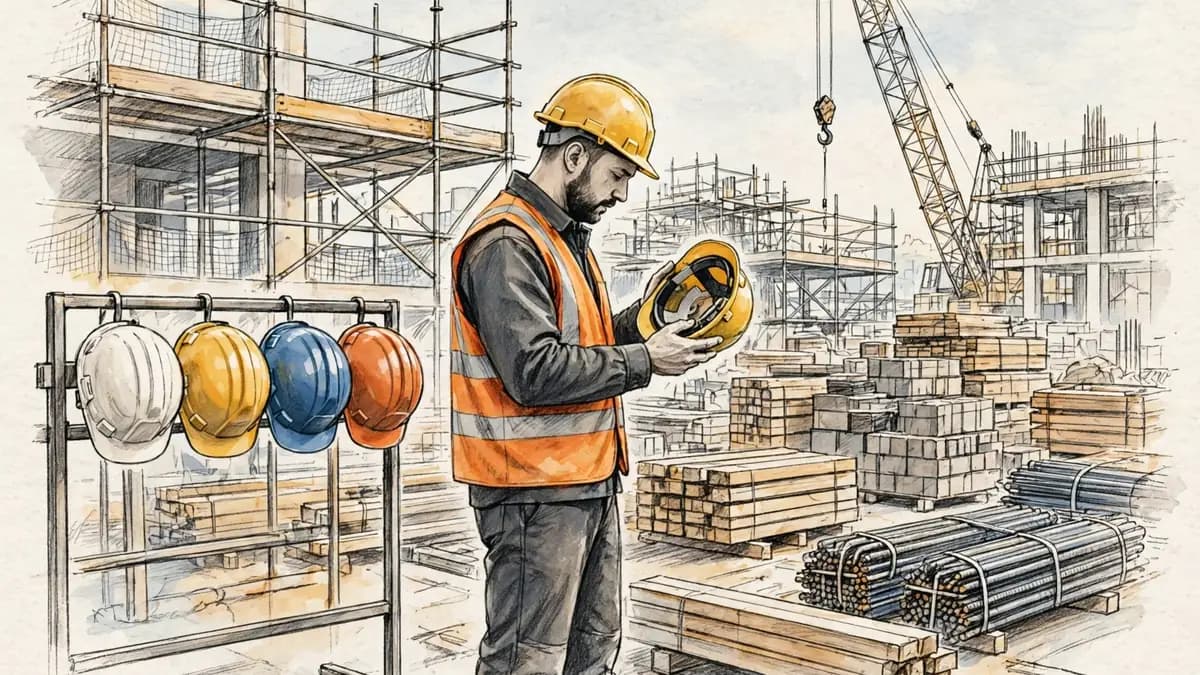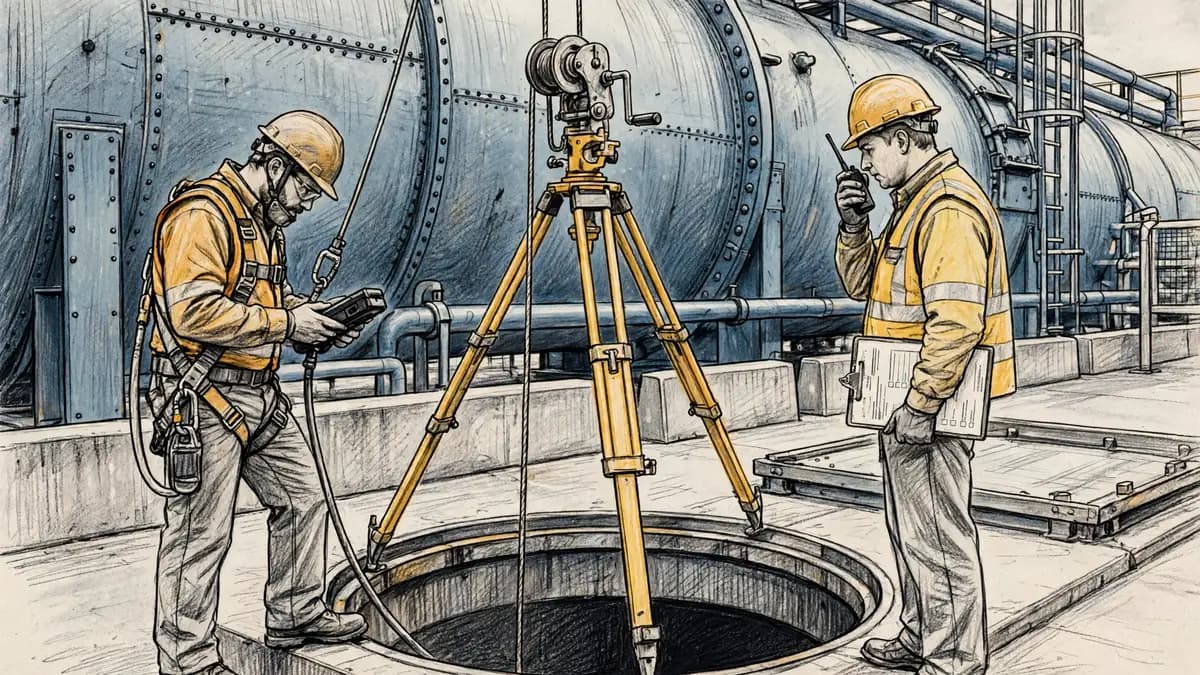
A confined space entry is safe only when three things are settled before anyone crosses the opening. A written permit names the space, its hazards and the people involved. The right protective equipment is chosen from those hazards, checked and laid out at the opening. And a rescue plan is ready that can bring an unconscious entrant out without sending a second person in unprotected. When any of the three is missing, the entry should not start.
In the United States the rules for this work sit in OSHA standard 29 CFR 1910.146, which covers general industry. Construction work follows a separate standard, 29 CFR 1926 Subpart AA, while agriculture and shipyard work fall outside 1910.146 altogether. In Great Britain the Confined Spaces Regulations 1997 set three duties, in order. First, avoid entry where reasonably practicable. Second, follow a safe system of work where entry cannot be avoided. Third, have rescue arrangements ready before work starts.
The two regimes differ in wording, but they demand the same discipline on the day. A space needs a permit when it holds one of four things:
- A hazardous atmosphere.
- A material that could engulf an entrant.
- A shape that could trap someone.
- Another recognised serious hazard.
What follows explains the permit, the roles, the equipment, the entry and the rescue in the order they happen. A crew should be able to run an entry from the first check to the last signature. For the question of what counts as a confined space in the first place, the definition is covered separately.
Before anyone enters: the permit system
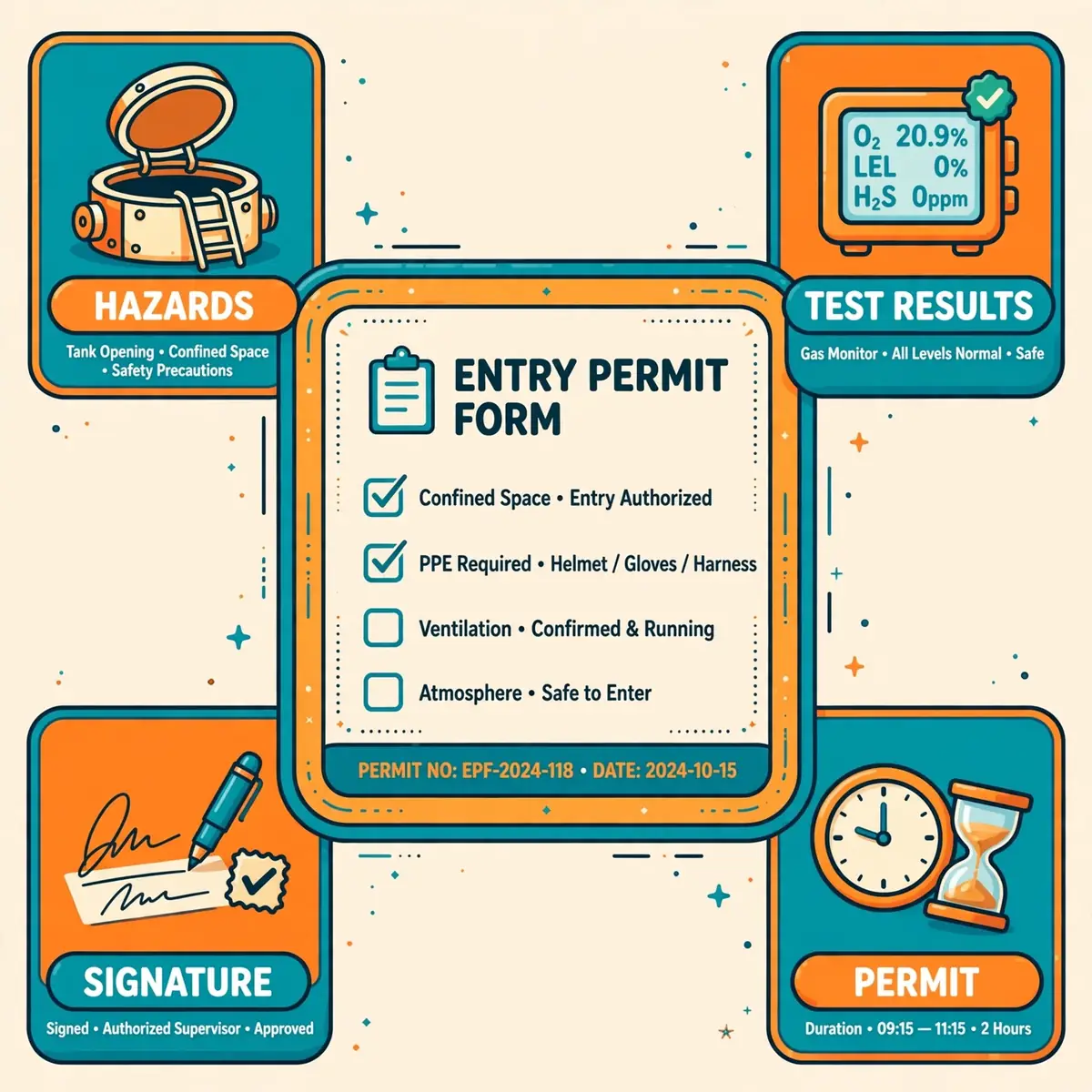
The permit is the document that turns a plan into an entry. Under 1910.146(e)(1), the employer must prepare an entry permit before entry is authorised. The permit documents that the measures in the programme have been completed. The permit is not a formality to be filled in afterwards. It is the record the entry supervisor checks. The entrants read it at the opening. And the reviewer studies it after the job to see what went wrong.
In Great Britain there is no single prescribed permit form. The Confined Spaces Regulations 1997 require a safe system of work. HSE guidance in L101 lists a permit to work among the precautions that system may need. The discipline is the same on both sides of the Atlantic. Nothing is left to memory. Every control the job depends on is written down before the first entrant goes in.
What the entry permit must record
1910.146(f) lists fifteen items the permit must identify, from the space itself to any extra permits for hot work. The list is a checklist, not a suggestion. A permit missing the hazards, the acceptable entry conditions or the test results is not a valid permit. The table below sets out all fifteen items and what each one records. A crew can use it to check a permit at the opening and spot a gap before anyone goes in.
| Permit item | What it records |
|---|---|
| The permit space to be entered | Which space, by name or location, so there is no doubt about the opening |
| The purpose of the entry | The task the entry exists to do, and nothing else |
| Date and authorised duration | When the entry runs and how long it may last |
| Authorised entrants | By name, or by a roster or tracking system that shows who is inside at any moment |
| Attendants | By name, the people who will watch from outside |
| Entry supervisor | By name, with a space for the signature that authorises entry |
| Hazards of the space | Every hazard the evaluation found, atmospheric and otherwise |
| Isolation and control measures | Lockout, blanking, purging, ventilation and other measures taken before entry |
| Acceptable entry conditions | The conditions that must exist for entry to be safe |
| Test results | Initial and periodic air test results, with tester names or initials and test times |
| Rescue and emergency services | Who can be summoned and how to reach them, with numbers and equipment |
| Communication procedures | How entrants and attendants stay in contact during the entry |
| Equipment to be provided | Personal protective equipment (PPE), testing, communications, alarm and rescue equipment for the job |
| Other necessary information | Anything else the particular space needs for safe entry |
| Additional permits | Other permits issued for the work, such as a hot work permit |
Two items deserve attention because they are the ones most often left blank. The test results must carry the tester's name or initials and the time each test was done. That lets the entry supervisor see how fresh the readings are. And the permit must name the rescue and emergency services that can be summoned. It must also give the equipment and numbers to call.
Who signs, how long it lasts, and when it is cancelled
The entry supervisor named on the permit signs it to authorise entry. The signature must come before entry begins. Before signing, the supervisor verifies that the tests named on the permit were done. The supervisor also checks that the procedures and equipment it specifies are in place. A signature on an unchecked permit is worthless. The rule places that check squarely on the supervisor, not on the entrants.
A permit lasts only as long as the task on it takes. There is no standard length, no shift permit and no weekly permit. The date and the authorised duration are written on the form. The entry supervisor must terminate the entry and cancel the permit when the work is finished. The same applies when a condition arises in or near the space that the permit does not allow. A new entry, or a change in conditions, means a new permit.
WarningNever extend a permit past its authorised duration to finish a job. Stop work, evacuate the space, re-test the air and issue a new permit if the entry is still safe.
The three entry roles: entrant, attendant and entry supervisor
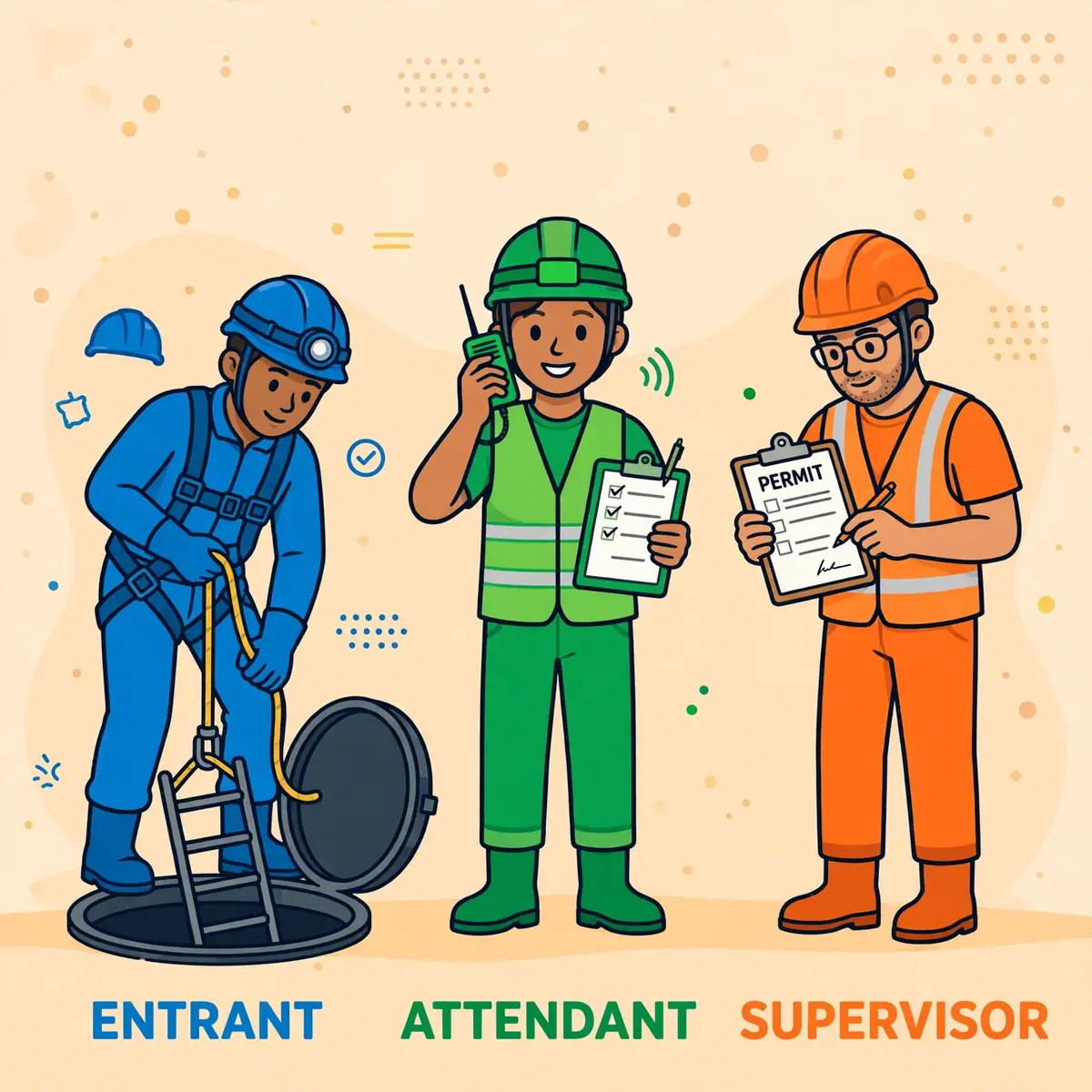
Three named roles run every permit entry, and the rule gives each one duties that no one else can carry. The authorised entrant does the work inside. The attendant stays outside and watches. The entry supervisor authorises the entry and owns the decision to stop it. One person may fill more than one role only when trained and equipped for each of them.
Training is the gate for all three roles. The employer must provide training at four points:
- Before duties are first assigned.
- Before duties change.
- When operations change and present a new hazard.
- Whenever performance shows gaps in knowledge or procedure.
The authorized entrant
An authorised entrant is an employee the employer has authorised to enter a permit space. The entrant must know the hazards they may face. That includes how exposure shows itself and what it can do. The entrant must also use the equipment the programme provides. Communication with the attendant is part of the job, not an extra. The entrant reports warning signs and answers the attendant's checks.
The entrant must leave the space as quickly as possible when any of these four triggers appears:
- An order to evacuate from the attendant or the entry supervisor.
- A warning sign or symptom of exposure recognised by the entrant.
- A prohibited condition detected in the space.
- An evacuation alarm.
No task inside a confined space is worth staying for once any of those four triggers appears.
The attendant outside the space
The attendant is the one person whose whole job is the entrants. At least one attendant must be stationed outside the space for the duration of entry operations. The attendant keeps an accurate count of who is inside, and watches for the behavioural effects of hazard exposure. The attendant stays in contact with the entrants, and orders evacuation the moment conditions turn against them.
The attendant stays outside until relieved by another attendant, and performs no duties that could interfere with monitoring the entrants. That last rule is the one most often broken. It breaks when an attendant is asked to fetch tools or hold a ladder. An attendant may enter for rescue only if trained and equipped for rescue and relieved by another attendant.
AlertAn attendant who leaves the opening to fetch equipment has abandoned the only watch the entrants have. If a second pair of hands is needed, bring a second person.
The entry supervisor
The entry supervisor decides whether acceptable entry conditions are present. That person authorises the entry, oversees it, and terminates it when required. That person may be the employer, a foreman or a crew chief, as the employer designates. Before endorsing the permit, the supervisor checks that the entries on it are complete. The supervisor also checks that the tests were done and that the equipment is in place.
During the entry the supervisor verifies that rescue services are available. The supervisor also checks that the means to summon them work. Unauthorised people who enter or try to enter are removed. And at handover the supervisor checks that the entry still matches the permit. Further checks follow at intervals set by the hazards. The supervisor also terminates the entry and cancels the permit when the work is done or a prohibited condition arises.
Making the space safe before entry
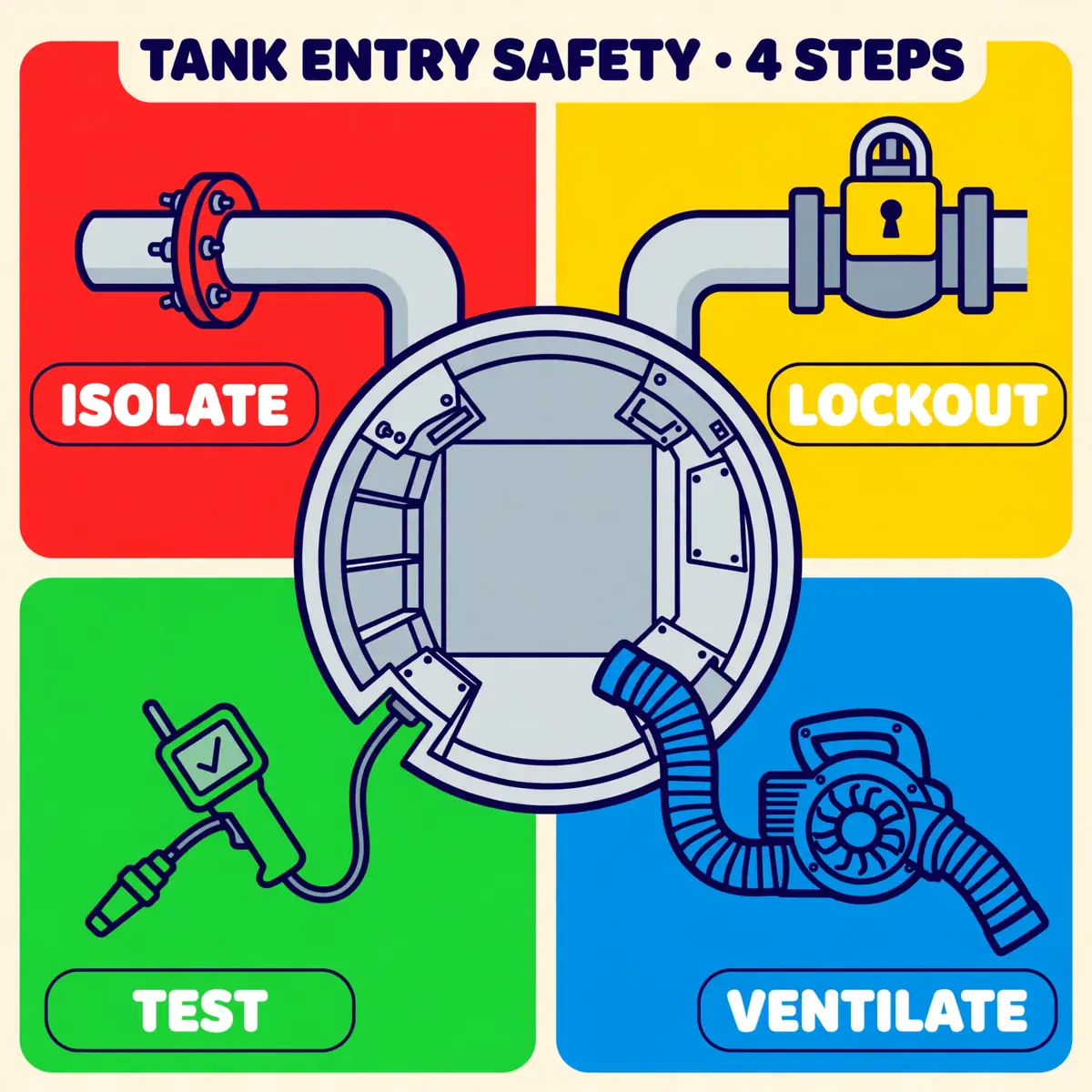
Making the space safe is the work that happens before the permit is signed. It starts with a risk assessment that identifies and evaluates the hazards of the space. It ends with acceptable entry conditions that hold for the whole entry. Four kinds of control do the heavy lifting:
- Isolation.
- Purging and ventilation.
- Barriers against outside hazards.
- Testing that proves the air is safe.
Acceptable entry conditions are set before the work starts and written on the permit. They are the limits the entry must stay inside. The oxygen range. The flammable gas limit. And the toxic gas limits for the substances the evaluation named. If conditions drift outside those limits during the entry, the permit no longer covers the work, and the entry stops.
Isolating the space
Isolation means removing the space from service and protecting it completely against the release of energy and material into it. The methods are:
- Blanking or blinding a line with a solid plate.
- Misaligning or removing sections of pipe.
- A double block and bleed arrangement.
- Lockout or tagout of every energy source.
- Blocking and disconnecting mechanical linkages.
Which method fits depends on what feeds the space.
Isolation is not the same as closing a valve. A single closed valve can leak, be opened by mistake or fail under pressure. A space that was safe at the start of the shift can then fill with product while someone is inside it. That is why the rule names blanking, double block and bleed and disconnection. They give a physical break that a single valve cannot.
WarningNever trust a single closed valve to isolate a space. Use blanking, double block and bleed, or disconnection, and prove the isolation before entry.
Ventilation and purging
Once the space is isolated, purging, inerting, flushing or ventilation removes or controls the atmospheric hazard. Forced air ventilation is the usual method. It must be directed at the immediate area where the entrant will work, not simply blown into the opening. The air supply must come from a clean source and must not add a hazard of its own.
Ventilation has a limit the permit must respect. In the United States, controlling an atmosphere with forced air ventilation does not count as eliminating the hazard. A ventilated space therefore cannot be reclassified as a non-permit space on that basis alone. Inerting with nitrogen makes the atmosphere non-combustible. It also makes it oxygen-deficient and immediately dangerous to life or health. No one enters an inerted space without breathing apparatus.
Testing the air in the right order
Air testing follows a fixed order written into the rule. Oxygen first, then combustible gases and vapours, then toxic gases and vapours. The order matters because the instruments themselves depend on it — a combustible gas sensor needs oxygen to read correctly. Testing must cover every level the entrant will reach. Gases heavier than air sink and lighter ones rise. A single reading at the opening says nothing about the bottom.
Pre-entry testing uses a calibrated direct-reading instrument. For a deep or remote space that means a sample-draw pump and probe. The air at the bottom is then tested before anyone goes down. Entrants may watch the testing and must be given the results at once. Where the space cannot be isolated, testing is done as far as feasible before entry. A sewer that is part of a continuous system is the usual example. Monitoring then continues for the whole entry.
The numbers that define a hazardous atmosphere are fixed:
- Oxygen below 19.5% or above 23.5%.
- Flammable gas or vapour above 10% of its lower flammable limit.
- Any substance above its published exposure limit.
In Great Britain, HSE guidance in L101 notes that normal air holds 20.9% oxygen. It warns that concentrations below 16% can lead to unconsciousness and death. A reading outside the acceptable range means no entry until the cause is found and fixed.
PPE for confined space entry
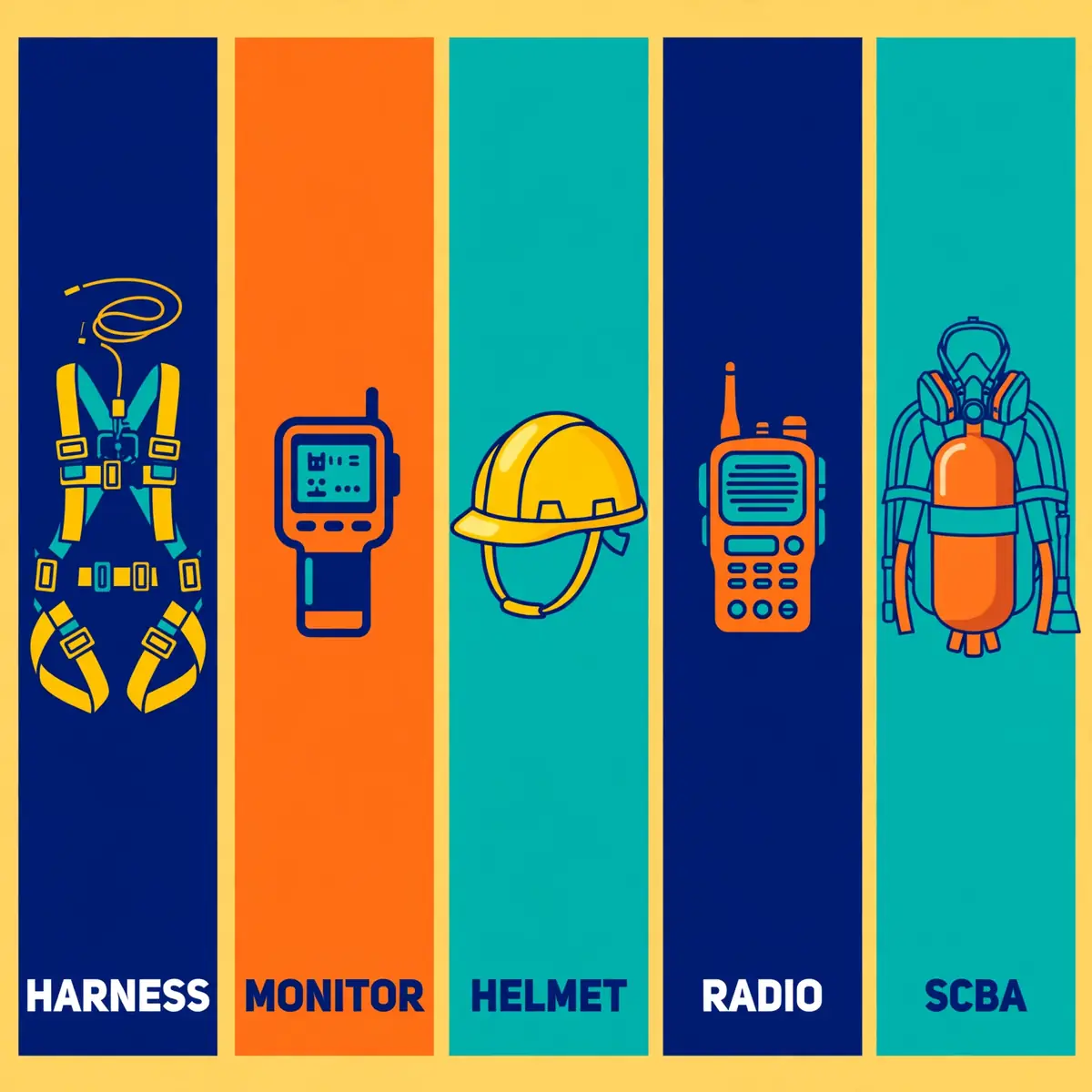
PPE is the last line of defence in a confined space, not the first. Engineering and work practice controls come first, and PPE covers what they cannot. The rule requires the employer to provide the equipment at no cost to the employee. The employer must also maintain it properly and make sure it is used properly. What follows matches the kit to the hazards the risk assessment found, starting with the air itself.
The PPE requirements for any entry come from the hazards of that particular space, not from a standard kit list. A tank that held solvents needs different protection from a grain silo or a sewer. The permit records the equipment chosen for the space in front of the crew. A generic kit that ignores the hazards is a comfort blanket, not protection.
Respiratory protection: when air-purifying is not enough
Respiratory protection for confined space work starts with a question. Can the air be made safe to breathe, or must the entrant carry their own air? Where the atmosphere is hazardous or cannot be proven safe, air-purifying respirators are not enough. A filter cannot add oxygen to air that has none. The entrant then needs supplied-air or self-contained breathing apparatus, chosen and fitted under a respiratory protection programme.
An atmosphere that is immediately dangerous to life or health needs a standby person outside. That person must be capable of immediate action to rescue anyone wearing respiratory protection inside. That is the rule in OSHA 1910.134. It is why a lone entrant in breathing apparatus is never acceptable. The companion page on self-contained breathing apparatus explains the types in depth. It also shows how to put one on, check it and look after it.
WarningNever enter an oxygen-deficient space wearing a dust mask or a cartridge respirator. Filters cannot replace missing oxygen, and the wearer may collapse without warning.
Harness, retrieval line and the tripod
Every entrant wears a chest or full-body harness. The retrieval line attaches at the centre of the back, near shoulder level. The line may also attach above the head. Or it may attach at another point the employer can show gives a profile small enough to pull the person out.
The other end runs to a mechanical device or fixed point outside the space. It is rigged so that rescue can begin the moment it is needed. Retrieval systems are used for every entry. The exception is where the equipment would increase the overall risk or would not help the rescue.
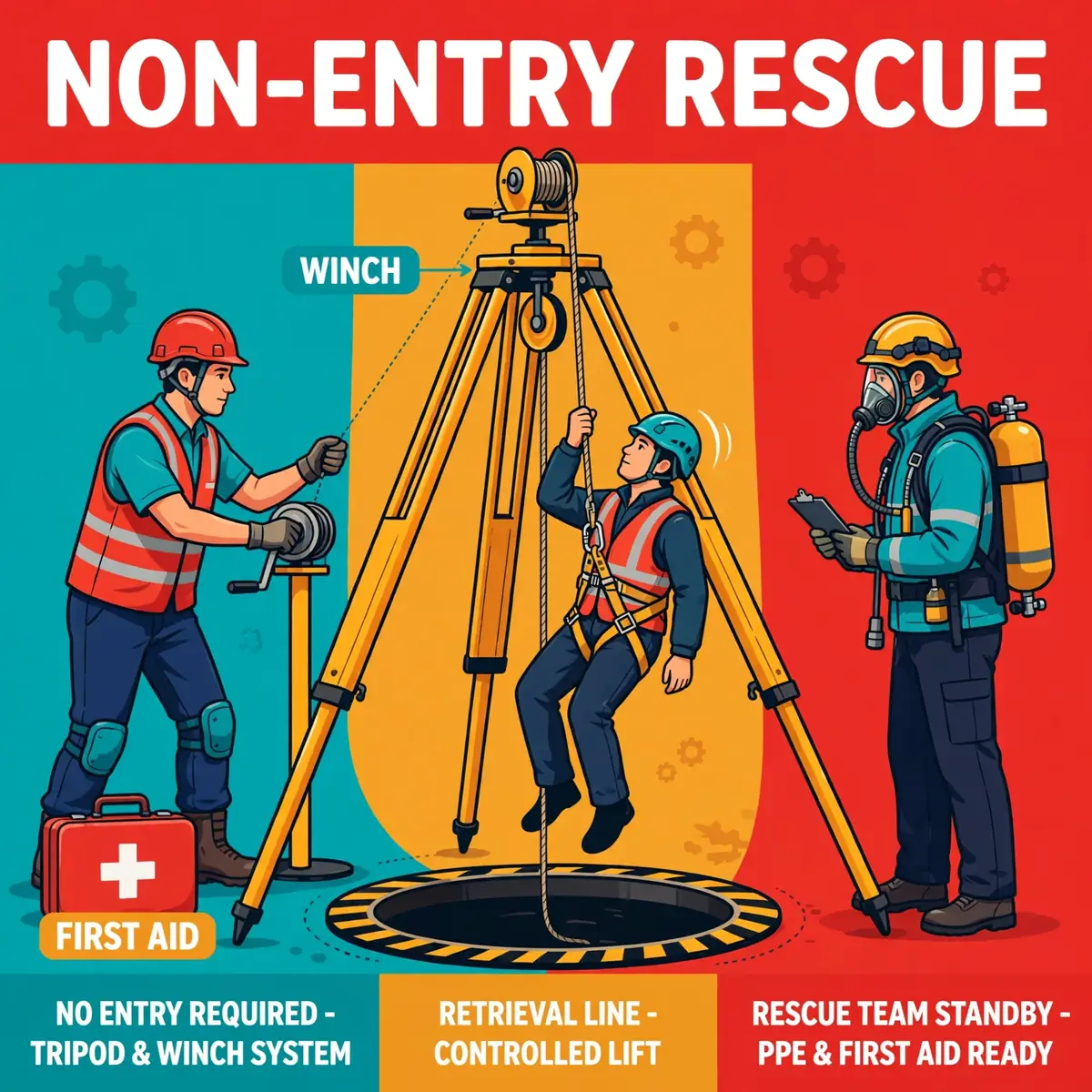
For a vertical space more than 5 feet deep, a mechanical device must be available. In practice that means a tripod or davit with a winch. It is set over the opening before entry starts. Wristlets are allowed only where a harness is infeasible or would make the entry more hazardous. The harness and line must be checked before each use. The line must run free of snags, sharp edges and the work itself.
TipRig the tripod and winch before the first entrant goes in. Test the retrieval line with a short pull. A winch discovered to be jammed during a rescue is discovered too late.
The rest of the kit: monitor, communication and lighting
The rest of the kit is easy to forget and hard to work without. Each entrant carries a personal gas monitor in the breathing zone. A change in the air is then caught where the entrant breathes, not only at the opening. Communications equipment keeps entrant and attendant in contact for the whole entry. Lighting lets the entrant see well enough to work safely and to leave quickly in an emergency.
Barriers and shields protect entrants from outside hazards, such as traffic or falling objects at an open manhole. Ladders or other means give a safe way in and out. In Great Britain, HSE guidance in L101 adds more to the same list. Fire prevention, static control and limits on working time are all things a safe system of work must cover. Every item on the permit's equipment list should be at the opening before entry, not fetched after a problem appears.
The entry itself, step by step
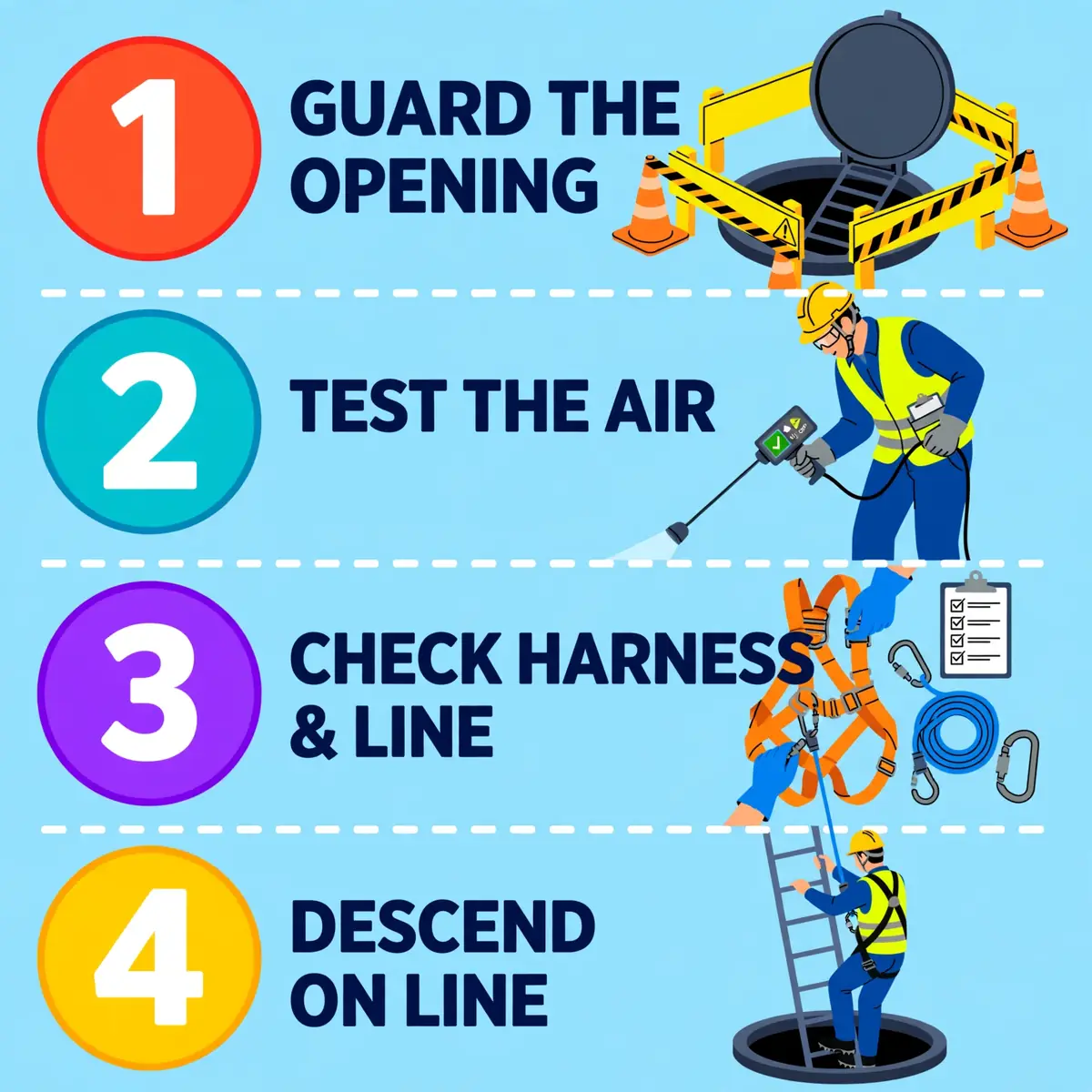
With the permit signed, the equipment laid out and the rescue plan ready, the entry can begin. The sequence below follows the order the rule lays out. It runs from the checks at the opening to the moment the last entrant is out. It is written for a general industry entry under 1910.146. A construction entry follows 29 CFR 1926 Subpart AA, which sets its own requirements for the same steps.
Each step depends on the one before it. A permit signed before the tests are done is a promise without evidence. Equipment checked after entry has started is checked too late. The crew that works the sequence in order finds problems while they are still cheap to fix.
The pre-entry checks at the opening
Start by confirming the permit is the one for this space and this task. Check that it is posted at the entry portal or otherwise available to every entrant. Check that the names on it match the people present. Check that the test results are fresh and within the acceptable range. And check that the rescue service named on it can be reached. Then inspect the equipment: harness and retrieval line, monitor switched on and reading correctly, ventilation running, communications working.
Guard the opening before the cover comes fully off. Use a railing, temporary cover or barrier that stops an accidental fall through it and keeps foreign objects out. Test the air again at every level the entrant will reach. Use the pump and probe where the space is deep. Only when the entry supervisor is satisfied does the permit get signed. The supervisor must first be sure the tests are done and the equipment is in place.
WarningNever let an entrant break the plane of the opening before the permit is signed. Entry begins the moment any part of the body crosses the opening, and an unsigned entry is an uncontrolled one.
Working inside and staying in contact
Inside the space, the entrant works to the permit and stays in contact with the attendant. The attendant keeps the count, watches the readings and the entrant's behaviour, and keeps unauthorised people away from the opening. Monitoring continues for as long as anyone is inside. Any entrant may ask for the space to be re-evaluated if they believe the first evaluation missed something.
Conditions inside a space can change while work is going on. Welding adds fumes and consumes oxygen, a spill releases vapour, a pump starts unexpectedly. That is why the permit names the acceptable entry conditions. It is also why the attendant monitors activities inside and outside the space. When a reading moves outside its limit, or a prohibited condition appears, the entry stops until the cause is found.
When to get out
Four triggers send everyone out at once:
- An order to evacuate from the attendant or the entry supervisor.
- A warning sign or symptom of exposure recognised by the entrant.
- A prohibited condition detected in the space.
- An evacuation alarm.
The attendant orders evacuation under the same conditions. The attendant also orders it when a situation outside the space could endanger the entrants. Or when the attendant can no longer perform the duties safely.
Nobody re-enters until the space is re-tested and the entry supervisor is satisfied that acceptable conditions are restored. A permit that has expired during the work cannot simply be extended. Work stops. The space is evacuated. The hazards are re-assessed and the air is re-tested. A new permit is issued if the entry is still safe. That discipline is what stops a short overrun from becoming an uncontrolled entry.
Rescue: the plan that must exist before entry
Rescue is not something to improvise after an entrant collapses. Most confined space deaths happen to would-be rescuers who go in without a plan, without protection and without backup. The rule therefore requires rescue procedures to be developed and implemented before entry. They must cover:
- How rescue will be summoned.
- How entrants will be rescued.
- What emergency care rescued employees will receive.
- How unauthorised rescue attempts will be prevented.
The habit of rehearsing emergencies is worth building across the whole site, not only at confined spaces. The companion page on practice emergency procedures explains why drills matter and how often to run them. For confined spaces the rule is specific. Rescue is arranged, equipped and practised before the first entrant goes in, never after the first alarm.
Non-entry rescue first
Non-entry rescue is the default, and it is the reason every entrant wears a harness on a retrieval line. When an entrant collapses or cannot climb out, the attendant operates the winch or retrieval device from outside. The attendant pulls them clear, without a second person entering the space. The system must be rigged before entry so rescue can begin the moment it is needed. The attendant must know how to operate it.
Non-entry rescue only works when the space allows it. A horizontal space may have bends, a narrow opening, or an internal obstruction. Any of these may stop a retrieval line from pulling an entrant clear. The rescue plan must be built around the real configuration of each space. Portal size, depth and internal obstructions all matter. Where non-entry rescue cannot work, the plan must say so. And it must provide the entry-rescue alternative before anyone goes in.
WarningNever enter a confined space to rescue a collapsed co-worker without breathing apparatus, a lifeline and backup. Most confined space deaths are rescuers who went in unprotected.
Entry rescue and the outside rescue service
Entry rescue means a trained rescuer goes into the space. The rescuer wears full PPE and breathing apparatus, with a lifeline and a second attendant at the entry point. In-house rescue teams must be trained as authorised entrants. They must also be trained in their rescue duties, and in first aid and cardiopulmonary resuscitation. At least one team member holding a current first aid and CPR certificate must be available. Nobody enters to rescue on courage alone.
An employer that relies on an outside rescue service must evaluate it before entry. Three questions matter:
- Can it respond in time for the hazards involved?
- Is it proficient with the tasks and equipment the space needs?
- Has it been given access to the spaces so it can plan and practise?
Relying on the public emergency services alone is not enough. In Great Britain, HSE guidance is explicit on the same point. The first minutes of a rescue belong to the crew on site. A first aid kit and resuscitation equipment should be at the entry point, ready before the entry starts.
Practice, first aid and the 12-month rule
A rescue plan that has never been practised is a guess. In-house rescue teams must practise making permit space rescues at least once every 12 months. The practice means removing dummies, manikins or actual persons from the actual permit spaces. Representative spaces may be used instead, if they match the real ones in opening size, configuration and accessibility. A drill on flat ground with no opening teaches little about a vertical entry through a 24-inch manhole.
Resuscitation equipment must be provided and maintained where the need for resuscitation is a likely consequence of the space's risks. Great Britain's regulations state that duty in terms. Every rescue plan should meet it in practice. After each drill, note what was slow, what jammed and what the team did not know. Then feed it back into the plan. A rescue plan improves only when drills are treated as tests of the plan, not as a box to tick.
Closing the entry and learning from the permit
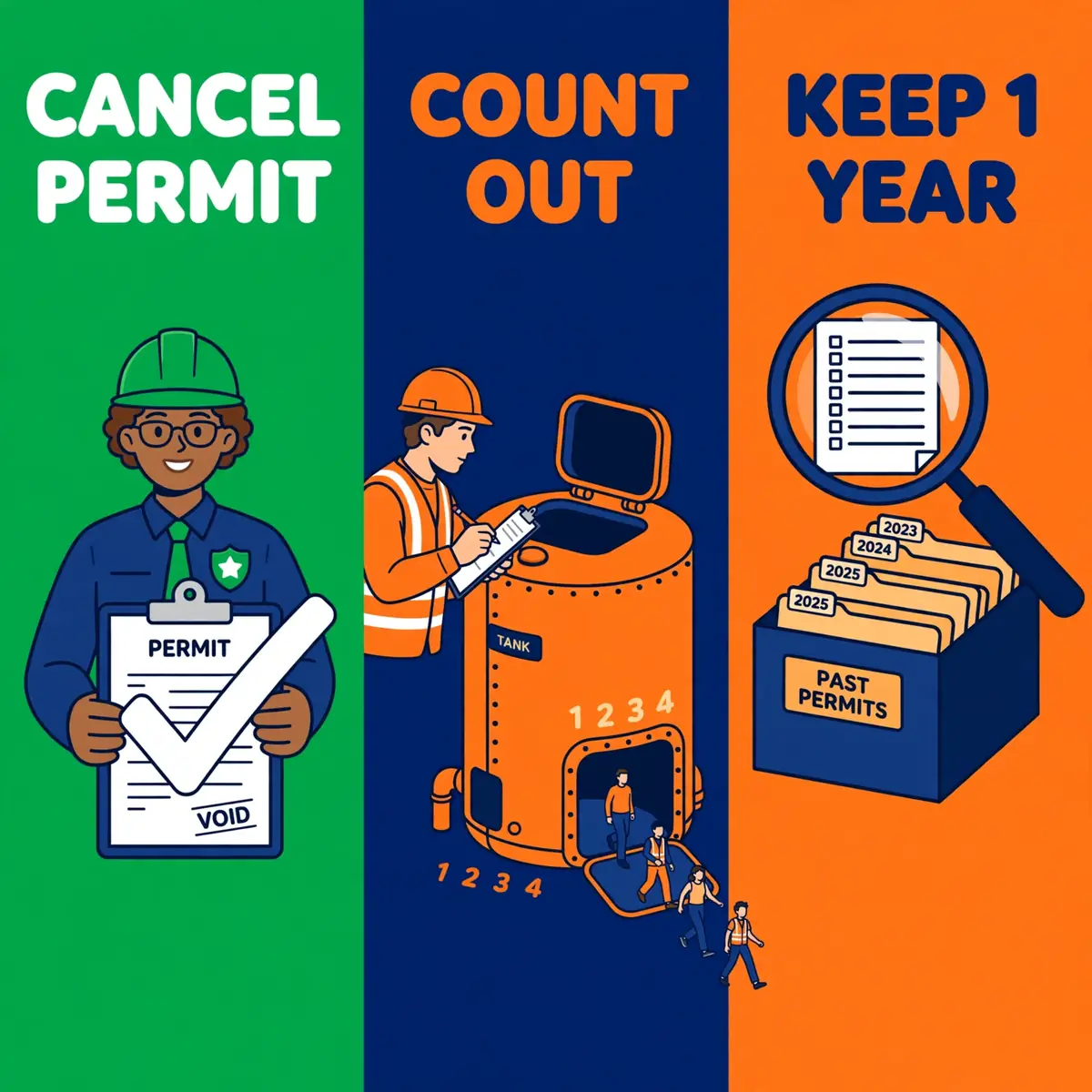
Closing an entry is a procedure in its own right, not simply walking away. The space must be checked, the permit cancelled, and the record kept so the next entry learns from this one. The steps below close the loop the permit opened. They are the reason cancelled permits are kept rather than thrown away.
A clean close also protects the next crew. A space handed back with a blank still in place, a lock still on, or a tool left inside is a hazard. It endangers whoever opens it next. The return-to-service check is the last line of defence against that kind of mistake.
Cancelling the permit and returning the space to service
When the work is finished, the entry supervisor terminates the entry and cancels the permit. Before the space returns to service, the crew checks that everyone is out. The attendant's count is the check. The crew also checks that tools, equipment and isolation devices are accounted for. Blanks are removed, lines reconnected and energy restored only under the return-to-service procedure. A space is never handed back with a blank still in place or a lock still on.
If a prohibited condition arose during the entry, the permit is cancelled at that point. It is not left until the end of the shift. The problem is noted on the permit itself, so the record carries what went wrong. An entry that ends early because the air turned bad is not a failure to hide. It is the system working as designed. And the note on the permit is what stops the same entry from being repeated unchanged.
Keeping permits and reviewing the programme
Every cancelled permit must be kept for at least one year. Any problems encountered during the entry are noted on it. Within one year after each entry, the employer reviews the permit space programme. The review uses those cancelled permits, and the programme is revised as necessary. A single annual review may cover all entries in a 12-month period. If no entry was performed in that period, no review is necessary.
The review is where small problems become fixes, such as:
- A permit that was hard to read at the opening.
- A monitor that alarmed late.
- A retrieval line that snagged on a ladder rung.
Each one is a change to the programme, the permit form or the equipment list.
Training follows the same trigger. Retraining is required before duties change. It is also required when operations change and present a new hazard. And whenever performance shows gaps in knowledge or procedure. The companion page on OSHA training explains what that training must cover and how often it must happen.Common mistakes that turn entries into rescues
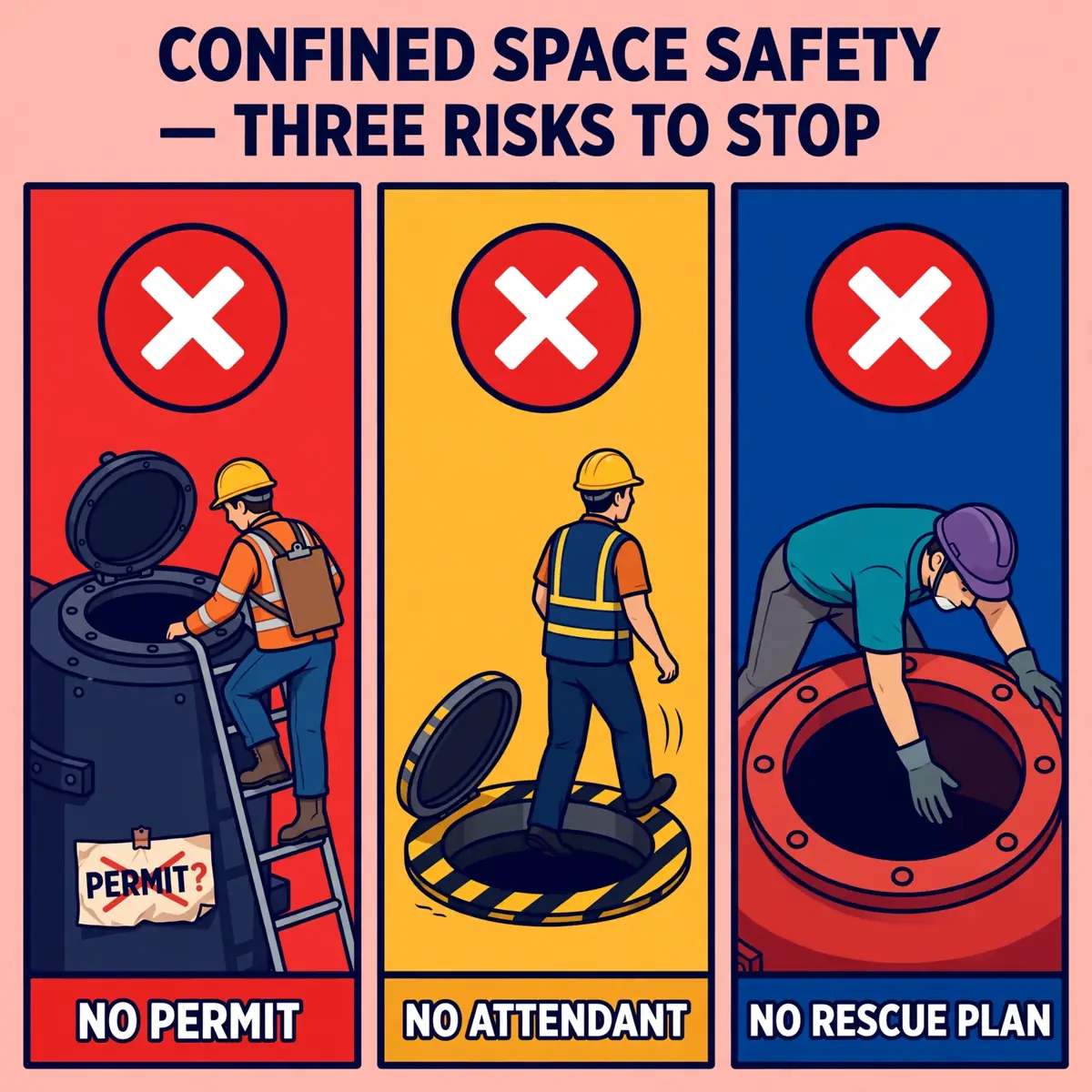
Most confined space incidents are not caused by unknown hazards. They are caused by known rules skipped under time pressure. The mistakes below appear again and again in incident reports and in programme reviews. Each one has a fix that costs less than the rescue it prevents.
The pattern is worth naming plainly. The entry that kills is usually the short, familiar, routine one. It is done in a space the crew has entered a hundred times. Familiarity is not a control. The permit, the tests and the attendant are the controls. They apply on the hundredth entry exactly as they did on the first.
Mistakes made before entry
The commonest mistake is treating a space as a non-permit space because nothing has happened there before. That judgement needs a documented evaluation behind it. Next comes testing only for oxygen, or testing in the wrong order, which leaves flammable and toxic hazards unmeasured. A third is assuming forced air ventilation eliminates the hazard for reclassification. The rule is clear: ventilation controls an atmosphere but does not eliminate it.
- Entering without a signed permit, or with a permit that names a different space or task.
- Relying on the fire service or 911 without checking whether it can reach the space in time and work in it.
- Skipping the rescue plan because the job is short, or because the space looks easy to get out of.
- Using a single closed valve as isolation, instead of blanking, double block and bleed, or disconnection.
Mistakes made during entry
During the entry, the mistakes change shape. The attendant takes on other tasks, or leaves the opening to fetch equipment, and the entrants lose their only watch. An entrant stays inside after an alarm or a warning symptom, hoping to finish the job. And when someone collapses, a co-worker climbs in to help without breathing apparatus, without a line and without backup. That act turns one casualty into two.
The fix for each is already in the permit. The attendant does no other job. Everyone leaves on an alarm, a symptom or an order, and no one re-enters until the space is re-tested. And rescue starts from outside, on the retrieval line, with entry rescue reserved for the trained team that practised it. A permit followed to the letter is not bureaucracy. It is the difference between a difficult job and a fatal one.
Frequently Asked Questions
What is a confined space entry permit?
A written document that allows and controls entry into a permit space. Under OSHA 1910.146(f) it must identify fifteen items. They include the space, the purpose, the date and duration, and the entrants, attendants and entry supervisor. They also include the hazards, the isolation measures and the acceptable entry conditions. The test results, the rescue services and the equipment to be provided complete the list.
Who can sign a confined space entry permit?
The entry supervisor named on the permit signs it to authorise entry, before entry begins. That person may be the employer, a foreman or a crew chief, as the employer designates. Before signing, the supervisor must verify that the tests named on the permit were done. The supervisor must also check that the procedures and equipment it specifies are in place.
How long does a confined space entry permit last?
Only as long as the task on it takes. The duration may not exceed the time required to complete the assigned job. There is no standard length, shift permit or weekly permit. The entry supervisor cancels the permit when the work is finished. The same applies when a condition arises that the permit does not allow. A new entry needs a new permit.
What PPE is required for confined space entry?
It depends on the hazards the risk assessment found. The usual kit is a chest or full-body harness with a retrieval line. It also includes a personal gas monitor in the breathing zone, communications equipment and lighting. Barriers and a means of entry and exit complete it. Respiratory protection is required where the air is hazardous or cannot be proven safe. For an immediately dangerous atmosphere that means supplied-air or self-contained breathing apparatus.
What is the difference between non-entry and entry rescue?
Non-entry rescue pulls the entrant out from outside the space. It uses the harness and retrieval line with a winch or other mechanical device. No second person goes in. Entry rescue sends a trained rescuer into the space in full PPE and breathing apparatus. The rescuer has a lifeline and a second attendant at the entry point. Non-entry rescue is the default under the rule.
Can the fire service be the rescue service for a confined space?
Only if the employer has evaluated it first. Can it respond in time for the hazards involved? Is it proficient with the tasks and equipment the space needs? Has it been given access to the spaces to plan and practise? Relying on the public emergency services alone, without that evaluation, is not enough. That holds under either the US rule or Great Britain's L101 guidance.
How often must confined space rescue teams practise?
In-house rescue teams must practise permit space rescues at least once every 12 months. The practice means removing dummies, manikins or actual persons from the actual permit spaces. Representative spaces may be used instead, if they match the real ones in opening size, configuration and accessibility. At least one member of the rescue team or service must be available. That member must hold a current certification in first aid and CPR.
Sources and further reading
- OSHA — 29 CFR 1910.146, Permit-required confined spaces
- OSHA — 29 CFR 1910.134, Respiratory protection
- OSHA — 29 CFR 1926.1202, Definitions (Confined spaces in construction, Subpart AA)
- The Confined Spaces Regulations 1997 (SI 1997/1713)
- HSE — Safe work in confined spaces: Confined Spaces Regulations 1997, Approved Code of Practice and guidance (L101, 3rd edition, 2014)