
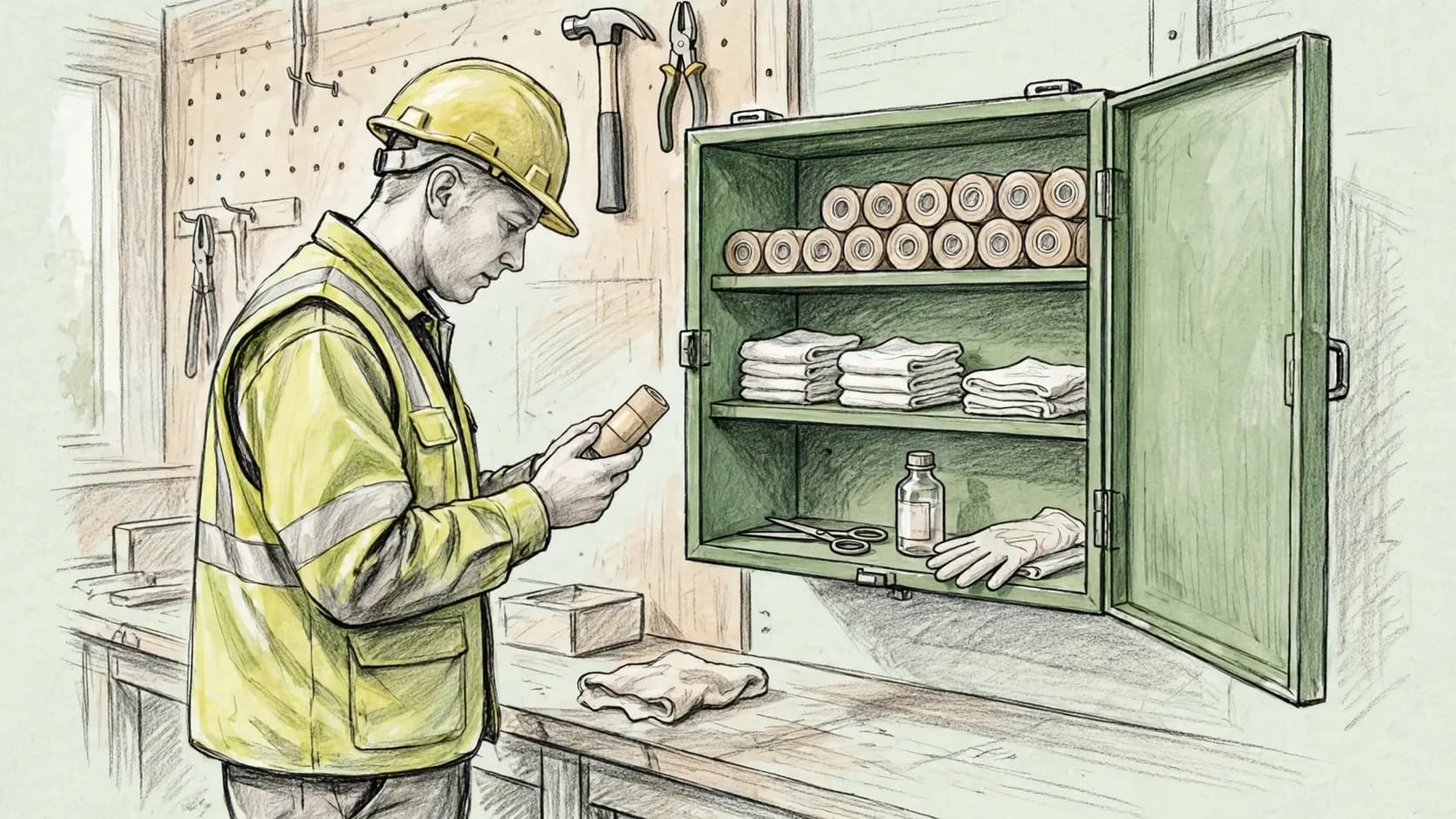
A first aid kit is a box of supplies for treating minor injuries and steadying serious ones until professional help arrives. The short answer is that every kit needs the same seven groups: wound care, bleeding control, burn care, eye care, tools, gloves and a first aid guide. What changes is the quantity and the extras, which depend on where the kit lives and what hazards sit nearby.
For a home, the Red Cross list for a family of four is the baseline. For a workplace, the law sets the duty and a standard sets the contents. In the United States, OSHA requires adequate supplies to be readily available and points employers to ANSI/ISEA Z308.1-2021. In the United Kingdom, the Health and Safety (First-Aid) Regulations 1981 require adequate and appropriate equipment, decided by a needs assessment.
What a first aid kit is for#
A kit does three jobs. It protects the person giving help, it controls bleeding, and it covers wounds until proper care arrives. Everything in the box should serve one of those jobs. If an item does not, it does not belong in the kit.
A kit is not a pharmacy. It does not diagnose illness, and it does not replace training, an ambulance or a hospital. Its value is speed. The right dressing, applied in the first minutes, can stop a small cut from becoming an infection and a bad bleed from becoming a crisis.
Tip
Put the kit where the injury happens, not where it is tidy. A kit in a locked office is no kit at all.
What to include in a home first aid kit#
The list below comes from the American Red Cross, as published by the Centers for Disease Control and Prevention (CDC). It covers a family of four. Scale the quantities up for more people, and add what your household needs.
- 2 absorbent compress dressings (5 x 9 inches)
- 25 adhesive bandages in assorted sizes
- 1 adhesive cloth tape (10 yards x 1 inch)
- 5 antibiotic ointment packets
- 5 antiseptic wipe packets
- 2 packets of aspirin (81 mg each)
- 1 emergency blanket
- 1 breathing barrier with a one-way valve
- 1 instant cold compress
- 2 pairs of non-latex gloves, large
- 2 hydrocortisone ointment packets
- 1 roller bandage, 3 inches wide, and 1 roller bandage, 4 inches wide
- 5 sterile gauze pads (3 x 3 inches) and 5 sterile gauze pads (4 x 4 inches)
- 1 thermometer, non-mercury and non-glass
- 2 triangular bandages
- Tweezers
- A first aid guide and a list of emergency numbers
Keep the kit in one place that everyone in the house knows. A bright, watertight box works well. Tell children where it is, and teach them that it is for injuries, not for play.
Tip
Write the building address on the outside of the kit. In an emergency it is hard to remember an address, and the dispatcher needs it fast.
Adapting the home kit#
Add what your household needs. Allergies call for antihistamines and, where prescribed, an epinephrine injector. Diabetes calls for glucose tablets or gel. Heart disease may call for chewable aspirin, but only if the person is not allergic and only as the emergency operator advises.
Keep personal medicines out of the shared kit. Prescription items belong with the person who needs them, labelled and in date. A shared box invites the wrong person to take the wrong dose.
What to include in a workplace first aid kit#
Workplace kits follow a standard, not a guess. In the United States the standard is ANSI/ISEA Z308.1-2021. It sets two fills. Class A covers the most common workplace injuries: minor cuts, abrasions, sprains and minor burns. Class B covers higher-risk or more complex workplaces, with larger quantities and three extra items.
The table below gives the minimum contents for each class. These are minimums. A manufacturer may put in more, and an employer should add what the hazard assessment calls for.
| Item | Class A | Class B |
|---|---|---|
| Adhesive bandages, 1 x 3 in | 16 | 50 |
| Adhesive tape, 2.5 yd | 1 roll | 2 rolls |
| Antibiotic application, 1/57 oz | 10 | 25 |
| Antiseptic, 1/57 oz | 10 | 50 |
| Breathing barrier (CPR) | 1 | 1 |
| Burn dressing, gel-soaked, 4 x 4 in | 1 | 2 |
| Burn treatment, 1/32 oz | 10 | 25 |
| Cold pack, 4 x 5 in | 1 | 2 |
| Eye covering, with means of attachment | 2 | 2 |
| Eye/skin wash | 1 fl oz | 4 fl oz |
| First aid guide | 1 | 1 |
| Hand sanitizer, 1/32 oz | 10 | 20 |
| Medical exam gloves, pairs | 2 | 4 |
| Roller bandage, 2 in x 4 yd | 1 | 2 |
| Roller bandage, 4 in x 4 yd | 0 | 1 |
| Scissors | 1 | 1 |
| Splint, 4 x 24 in | 0 | 1 |
| Sterile pads, 3 x 3 in | 2 | 4 |
| Tourniquet | Not required | 1 |
| Trauma pads, 5 x 9 in | 2 | 4 |
| Triangular bandage, 40 x 40 x 56 in | 1 | 2 |
| Foil blanket, 52 x 84 in | 1 | 1 |
Buying a kit marked "ANSI Z308.1-2021 Class A" or "Class B" is how most employers meet the rule. Check the label before buying. A kit that only says "first aid kit" on the box may not meet either fill.
Class A or Class B: which one?#
Class A fits offices, shops and other ordinary workplaces. Class B fits manufacturing, warehousing, construction and any site where serious injuries are likely or help is far away. The choice comes from the hazard assessment, not from headcount alone.
Class B adds three items Class A does not require: a 4-inch roller bandage, a splint and a tourniquet. It also raises the quantities across the board. A Class A kit may add a tourniquet as a supplement, and bleeding-control kits sit alongside the standard fill where saws, blades or heavy equipment are in use. The tourniquet in a Class B kit must be a windlass or ratchet type.
Alert
The 2021 edition added a foil blanket to both classes and raised the hand sanitizer counts. A kit built to the 2015 edition is out of date.
Kit types: the container matters too#
The standard also types kits by container. Type I is a fixed indoor cabinet. Type II is portable for indoor use. Type III is portable, mountable and water-resistant for mobile and outdoor use. Type IV is portable, mountable and waterproof for rough conditions and vehicles.
Match the container to the setting. A paper box in a wet workshop will fail before the supplies do. A wall cabinet in a vehicle is useless. Choose the type the work demands.
Buy a ready-made kit or build your own?#
A ready-made kit is the simplest route. Buy one marked ANSI Z308.1-2021 Class A or Class B, and check the label before paying. The label is the promise. A kit with no class marking may not meet either fill.
Building your own kit makes sense when the hazard assessment calls for items the ready-made fill lacks. It also makes sense when you run many kits and want the same contents in each. Buy the container first, then fill it against the Class A or Class B table, or against the HSE list. Keep a list of the contents inside the lid, so a check takes minutes.
The UK workplace list#
The United Kingdom sets no fixed list. What goes in the box depends on the first-aid needs assessment. For a low-hazard workplace, HSE's guidance (L74, Appendix 2) suggests at least the following:
- A leaflet giving general guidance on first aid
- 20 individually wrapped sterile plasters in assorted sizes
- 2 sterile eye pads
- 2 individually wrapped triangular bandages, preferably sterile
- 6 safety pins
- 2 large, individually wrapped, sterile, unmedicated wound dressings
- 6 medium-sized, individually wrapped, sterile, unmedicated wound dressings
- At least 3 pairs of disposable gloves
Higher-hazard workplaces need more. Add burn dressings where hot work happens, eye wash where chemicals are handled, and extra dressings where cuts are common. The assessment decides, and the kit follows the assessment. British Standard BS 8599 gives further information on the contents of workplace first-aid kits.
A kit for travelling workers and the car#
Workers who travel need a smaller kit that rides with them. HSE's guidance suggests a travelling kit containing:
- A leaflet giving general guidance on first aid
- 6 individually wrapped sterile plasters
- 2 individually wrapped triangular bandages, preferably sterile
- 2 safety pins
- 1 large, sterile, unmedicated dressing
- Individually wrapped moist cleansing wipes
- 2 pairs of disposable gloves
The same list works for a car. Keep it in the boot or under a seat, where it stays dry and within reach. Check it as often as the home kit, and restock it after every use.
Warning
Do not keep tablets or medicines in a workplace first aid kit in the UK. HSE guidance is clear on this. Medicines belong to the person who needs them, not in a shared box.
Legal requirements in the United States#
OSHA's rule is short and performance-based. Regulation 29 CFR 1910.151 has three paragraphs. Paragraph (a) requires medical personnel to be readily available for advice on plant health. Paragraph (b) is the one that matters most: where no infirmary, clinic or hospital sits in near proximity, a trained person must be available to render first aid, and adequate first aid supplies must be readily available.
Paragraph (c) covers corrosive exposure. Where eyes or body may be exposed to injurious corrosive materials, suitable facilities for quick drenching or flushing must sit within the work area for immediate use. A small bottle of eye wash in the kit does not satisfy this. The flushing station is separate.
OSHA does not list kit contents in the rule itself. Its non-mandatory Appendix A points to ANSI Z308.1 as the example minimum for a small worksite. The appendix still cites the 1998 edition of the standard. The current edition is Z308.1-2021, and that is the fill to buy.
Alert
OSHA reads "near proximity" as roughly 3 to 4 minutes for life-threatening injuries and up to 15 minutes where the hazard is lower. If help is further away than that, trained people and supplies must be on site.
Construction sites: stricter rules#
Construction follows 29 CFR 1926.50, which is more specific than the general-industry rule. A trained first-aid person must be on site unless a clinic or hospital is reasonably accessible in time and distance. That person must hold a valid first-aid certificate from the US Bureau of Mines, the American Red Cross, or equivalent training backed by documentary evidence.
Supplies must be easily accessible. The kit sits in a weatherproof container with individually sealed packages for each type of item. The employer must check it before it goes out on each job and at least weekly on each job, replacing what has been used. Transport to a physician or hospital must be arranged in advance, and telephone numbers must be posted where 911 service is not available.
Warning
A locked first aid cabinet fails the rule if the supplies cannot be reached when needed. OSHA has said so in writing. Keep the cabinet open, or keep the key with the trained first aiders.
What OSHA does not require#
OSHA does not require an automated external defibrillator (AED) in first aid supplies. It says employers should consider one where sudden cardiac arrest is a recognised risk and response time is long. An AED is a good idea in many workplaces. It is not a legal requirement under 1910.151.
OSHA also sets no kit count per employee. The "10-person" or "25-person" sizes on the box are the manufacturer's scaling of the same Class A or Class B fill. What the rule requires is ready availability: a kit a worker can reach in the time an injury allows, on every floor and in every area where people work.
Legal requirements in the United Kingdom#
The Health and Safety (First-Aid) Regulations 1981 put the duty on the employer. Regulation 3(1) requires the employer to provide, or ensure there are provided, such equipment and facilities as are adequate and appropriate in the circumstances for enabling first aid to be rendered to employees who are injured or become ill at work.
Regulation 3(2) requires a suitable number of suitable persons to render first aid. A person is not suitable unless they have undergone training and hold a qualification approved by the Health and Safety Executive, plus any additional training the circumstances call for.
Low-risk workplaces have an alternative. Regulation 3(4) says that where the nature of the work, the number of employees and the location make it adequate and appropriate, the employer may instead appoint a person to take charge of the situation and the equipment. That person does not render first aid. They take charge until medical help arrives.
HSE guidance adds a rule of thumb. Where 25 or more people are employed, even in a low-hazard workplace, at least one trained first aider should be provided.
Everything starts with a first-aid needs assessment. The employer assesses the hazards, the number of people, the layout of the site and how far away medical help is. The assessment decides how many kits, how many first aiders and what the kits contain. HSE's leaflet INDG214, "First aid at work: your questions answered", walks through the questions the assessment must answer.
Tip
Record the needs assessment in writing. It is the document that justifies the number of kits and first aiders when anyone asks why the provision looks the way it does.
First aid training: who needs it and how long it lasts#
A kit without a trained person is half a provision. In the United States, OSHA expects the trained person to hold a current certificate from a recognised provider. The American Red Cross, the American Heart Association and the National Safety Council all provide one. The training is kept current, usually every two years.
In the United Kingdom, the two workplace courses are Emergency First Aid at Work and First Aid at Work. The first is a one-day course for lower-hazard workplaces. The second runs over three days for higher-hazard workplaces and lead first aiders. Both certificates last three years, as HSE's guidance (L74) sets out.
HSE guidance strongly recommends an annual refresher between certificates, though it is not mandatory. Book the requalification before the certificate expires. Once the date passes, the person no longer counts as a trained first aider until they requalify.
An appointed person needs no first aid training. Their job is to take charge of the situation and the equipment until medical help arrives. Even so, a short course in emergency first aid makes them far more useful in the first minutes.
Where to put the kit#
Place kits where injuries happen and where people can reach them fast. One kit per floor, one per work area, one near each hazard, and one in every vehicle that carries a crew. Put a sign above each kit so a stranger can find it. Tell every employee where the kits are, and put up notices that say so.
Keep the kit at a height everyone can reach and in a place that stays dry and clean. Do not store it behind locked doors, inside a supervisor's office, or on top of a high shelf. In an emergency, seconds matter, and a kit nobody can reach is not a kit.
Keeping the kit ready#
A kit is not a one-time purchase. Supplies expire. Antiseptics, ointments, eye wash, burn gel and sterile dressings all carry dates. Check the kit after every use and on a schedule. At home, check it at least every six months. On a construction site, check it weekly, as the rule requires.
Restock after every use, not at the next scheduled check. A kit short of its fill is not an adequate kit. Keep a log of checks and restocks inside the lid or beside the kit, so the next person can see what was used and what was replaced.
Tip
Set a calendar reminder for the kit check. Six months passes faster than anyone expects, and an expired dressing is no dressing at all.
What not to put in a first aid kit#
Leave out anything the kit is not for. Do not add prescription medicines, loose tablets or out-of-date supplies. Do not add items in open or damaged packaging. Sterile means sealed. Once the seal breaks, the item is no longer sterile.
Do not add personal medication to a shared kit. One person's prescription is another person's risk. Keep personal medicines with the person who needs them, labelled and in date.
Do not add tools the kit does not need. A first aid kit is not a toolbox. Scissors and tweezers belong. A penknife, matches and a whistle belong in a survival kit, not in a workplace first aid box.
Using the kit in an emergency#
Five steps cover most situations. First, make the scene safe. Do not become a second casualty. Second, call for help. Send someone to call emergency services while you start. Third, put on the gloves from the kit — your personal protective equipment — before touching blood or body fluids. Fourth, treat what you can: press on bleeding, cover the wound, cool a burn, flush an eye. Fifth, record what happened and what you used.
For bleeding, press hard with a sterile pad and do not lift it to look. Add more pads on top if blood soaks through. For burns, cool with running water, then cover loosely with a sterile dressing. For eyes, flush with clean water or eye wash for at least 15 minutes. For anything you cannot control, keep the person still and warm and wait for the ambulance.
Knowing the steps matters as much as having the supplies. Learn hands-only CPR, how to operate an AED, and how to control bleeding. The kit is a tool. The skill to use it is what saves a life. For the wider procedure — who calls for help, who takes charge, how a workplace practises for an emergency — see practice emergency procedures.
Warning
Never move a seriously injured person unless they are in danger. Moving someone with a spinal injury can make it worse. Keep them still and wait for help.
Frequently Asked Questions#
Do I legally need a first aid kit at home?
No law requires a first aid kit at home in the United States or the United Kingdom. The duty falls on employers, not households. A home kit is still worth having. The Red Cross list for a family of four is a good starting point, and the cost is small next to the time it saves.
What is the difference between a Class A and a Class B first aid kit?
Class A covers the most common workplace injuries: minor cuts, abrasions, sprains and minor burns. Class B covers higher-risk or more complex workplaces. It holds larger quantities of every item and adds three items Class A does not require: a 4-inch roller bandage, a splint and a tourniquet. The choice comes from the hazard assessment.
How many first aid kits does my workplace need?
Enough that one is readily available wherever people work. The standards set no count per employee. Place a kit on every floor, in every work area, near each hazard and in every crew vehicle. The "10-person" and "25-person" sizes on the box are the manufacturer's scaling of the same fill, not a legal ratio.
How often should I check the first aid kit?
After every use, and on a schedule. At home, check the whole kit at least every six months. On a construction site, the rule requires a weekly check. Replace anything used, damaged or out of date at once, and keep a log of each check.
Can I keep medicines in the first aid kit?
Not in a UK workplace kit. HSE guidance says tablets and medicines should not be kept in the first aid box. Personal medicines belong with the person who needs them. At home, keep medicines in their own place, labelled and in date, away from children.
Do I need training to use a first aid kit?
No law requires training to use a kit at home. At work, the position differs. In the US, OSHA requires a trained person on site unless a clinic or hospital is near enough. In the UK, the 1981 Regulations require suitable trained persons, or an appointed person in a low-risk workplace. Training is worth having either way. A kit is only as good as the hands that open it.
Sources#
- OSHA — 29 CFR 1910.151, Medical services and first aid
- OSHA — Appendix A to 1910.151, First aid kits (Non-Mandatory)
- OSHA — 29 CFR 1926.50, Medical services and first aid (construction)
- Bayshore Safety — OSHA first aid kit requirements: what 1910.151 and ANSI Z308.1 require (ANSI/ISEA Z308.1-2021 Class A and Class B contents)
- Health and Safety (First-Aid) Regulations 1981, regulation 3 — duty of employer to make provision for first aid
- HSE — First aid at work: The Health and Safety (First-Aid) Regulations 1981, Guidance on Regulations (L74)
- HSE — First aid at work: your questions answered (INDG214)
- NI Business Info — What should a workplace first aid kit include? (HSE low-hazard list)
- Workplace Material Handling & Safety — A first-aid kit checklist (adapted from the CDC)
Published 21 November 2026. Reviewed 21 November 2026. Next review 21 November 2027.
Leave a Reply