

An electric blanket presents two separate hazards, and almost every safety list you will read treats them as one. The first is ignition — a damaged element, cord or controller starting a fire in a bed. The second is a low-temperature contact burn, which needs no fault at all and happens to a working blanket doing exactly what it was designed to do. The controls are different, and a blanket that is safe against one can still injure you through the other.
Fifteen years of verifying fire controls across 14 countries has taught me where that matters most: sleeping accommodation, where the person nearest the ignition source is unconscious. This article covers domestic use in the UK, US and Australia, and the duty-holder position where blankets appear in care homes, hotels and workforce camps.
Key takeaways
The six points that decide whether a blanket is safe this winter:
- Fire risk and burn risk are separate. Auto shut-off addresses overheating; it does nothing about a functioning blanket held against skin that cannot feel it.
- Age is the strongest single predictor. ESFI attributes around 500 fires a year in the US to heating pads and electric blankets, and states that almost all involve blankets more than ten years old.
- Over-blankets and under-blankets are not interchangeable. They are constructed for different positions relative to the occupant, and swapping them is a documented misuse.
- The US and UK give opposite advice on sleeping with one on, and both are right for their own product populations — the deciding factor is whether the blanket is thermostatically rated for all-night use.
- In the UK, one plug fuse rating is specified: Electrical Safety First states a 3 A BS 1362 fuse where the 13 A plug fuse needs replacing.
- In managed accommodation this is a legal duty, not a tip sheet. Electricity at Work Regulations 1989 reg. 4(2) and the fire risk assessment under the Regulatory Reform (Fire Safety) Order 2005 both bite.
The two hazards, and why one control does not cover both
Separating these is the whole basis for using an electric blanket sensibly, so it belongs before any list of tips.
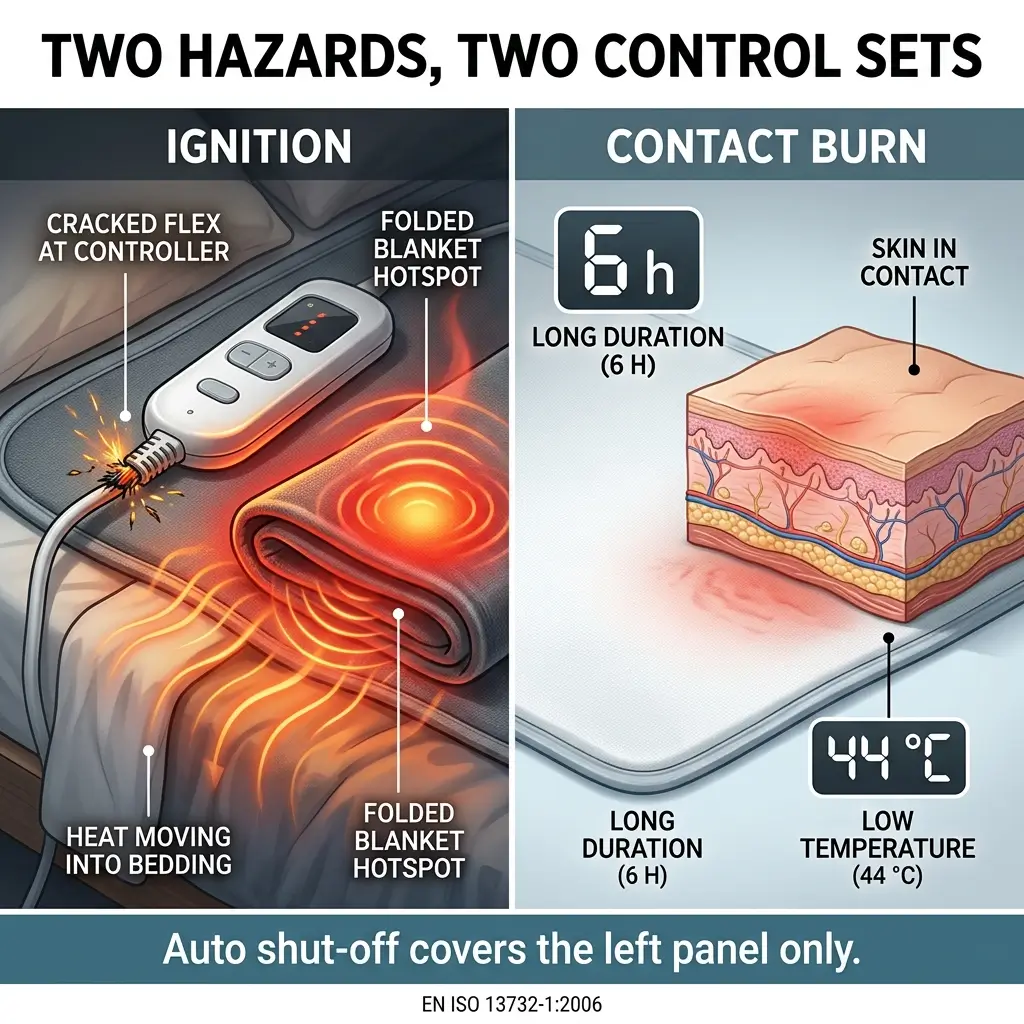
Ignition comes from a fault: a heating element fractured by folding, a cord cracked at the flex entry, a controller connector arcing every time the sleeper moves, or moisture reaching the wiring. The energy is small but it is delivered directly into bedding, which is a fuel bed, in a room where the occupant is asleep. That combination is what makes a low-wattage appliance a life safety problem rather than a property one.
Low-temperature contact burn needs no fault. It happens when skin stays in contact with a moderately warm surface for hours. EN ISO 13732-1:2006 sets out burn threshold temperatures for skin in contact with hot solid surfaces and covers contact periods from 0.5 seconds upward; a systematic review of contact burn injury models records that at 44 °C (111 °F) roughly six hours of exposure was needed to produce epidermal cell death. Six hours is a night's sleep. The blanket does not have to malfunction to do this.
Of the two, the burn is the one I check for last and find unaddressed most often, because the paperwork treats a heated appliance as a fire question and stops there. The two hazards do not share a control, and mapping them out makes that obvious:
| Ignition | Low-temperature contact burn | |
|---|---|---|
| Mechanism | Element, cord or controller fault; trapped heat under folds | Sustained skin contact at moderate temperature |
| Requires a fault? | Yes | No |
| Most exposed | Anyone with an ageing or damaged blanket | Reduced sensation, sedation, immobility, infants |
| Control that works | Inspection, retirement at age, correct positioning | Pre-heat then switch off; separate the skin from the surface |
| What does not cover it | Auto shut-off alone, on a damaged blanket | Auto shut-off, thermostats, "safe all-night" rating |
Two points follow from that table, and they are the reason the rest of this article is ordered the way it is:
- A modern, certified, thermostatically controlled blanket can still cause a burn. The safety features target overheating, not duration of contact.
- An old blanket in perfect apparent condition is still the higher fire risk. Element damage from years of folding is internal and a visual check will not always find it.
House style for all graphics below: Technical line illustration, muted industrial palette with a single accent colour, clean sans-serif labels, red reserved for hazards and failure states. No photorealism, no depicted injuries, no identifiable people.
Buying: the marks and features that actually mean something
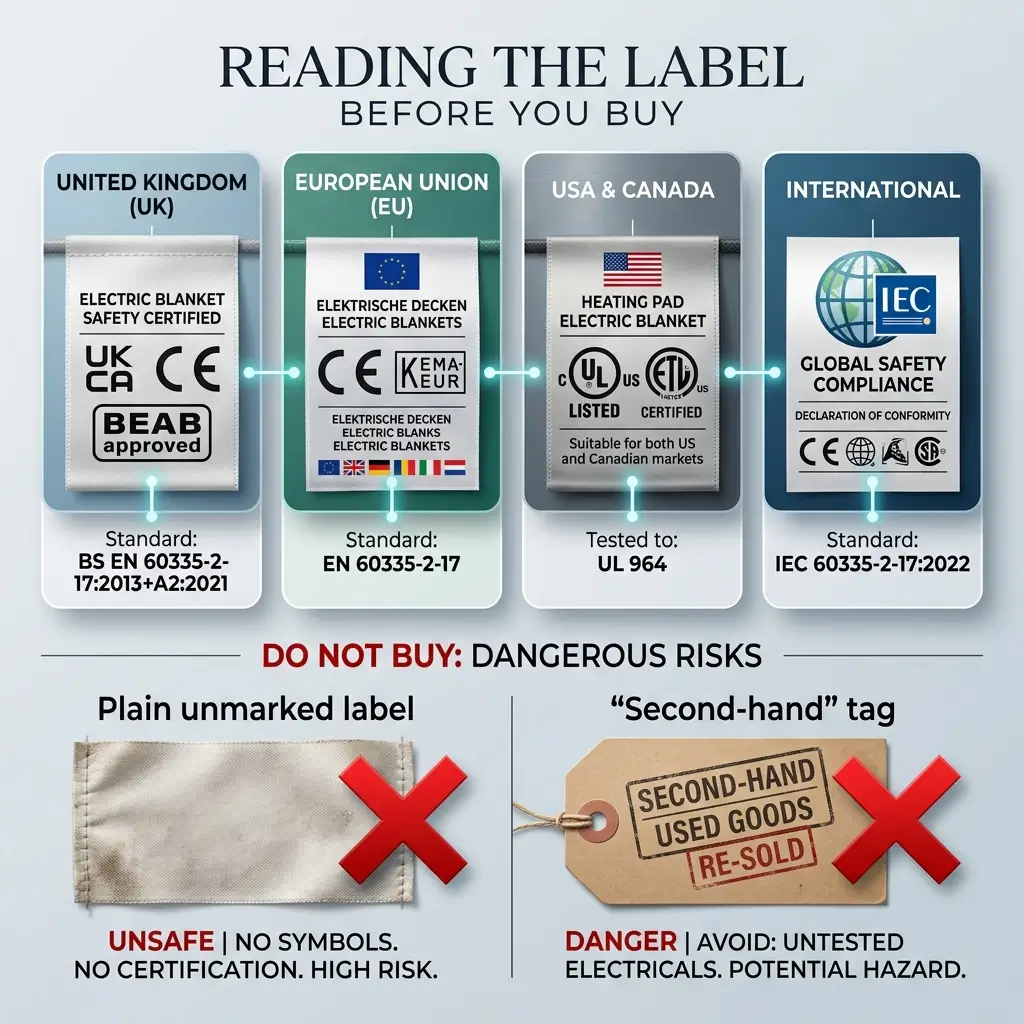
Certification is where most of the real protection sits, because it governs the construction of the heating element and the behaviour of the controller under fault. The mark on the label tells you which standard the product was built and tested against.
When I inspected sleeping accommodation across camp and hotel-type premises, the blankets that worried me were rarely the cheap ones. They were the unmarked ones — gifts, hand-me-downs, marketplace purchases — where nobody could say what standard, if any, the product had ever been built to.
The product safety standard behind the mark
Internationally, IEC 60335-2-17:2022 covers electric blankets, pads, clothing and similar flexible heating appliances rated up to 250 V, including — new in the 2022 edition — DC and battery-powered products. In the UK and Europe the harmonised version is BS EN 60335-2-17:2013+A2:2021. In the US the equivalent is UL 964, Standard for Electrically Heated Bedding, whose September 2020 revision added Supplement SA covering remotely operated and smart-enabled heated bedding — worth knowing if you are buying an app-controlled blanket.
Over-blanket or under-blanket — not interchangeable
Electrical Safety First is explicit that over-blankets must sit above the occupant and under-blankets beneath them, and that the two must not be swapped. This is a construction difference, not a preference: an under-blanket is built to be lain on and an over-blanket is not. Reversing them puts compressive load and body weight on wiring that was never rated for it.
Auto shut-off, overheat protection, and what they leave uncovered
Timed shut-off and overheat cut-out are worth having, and on a new blanket they meaningfully reduce fire risk. They do not touch the burn pathway, because the blanket is at its intended temperature the entire time it is on. Read the shut-off period on the box: a two-hour timer and a ten-hour timer are very different products for someone who falls asleep quickly.
Marks vary by market, so check for the one your jurisdiction recognises:
| Market | Look for | Underlying standard |
|---|---|---|
| UK | UKCA or CE mark, BEAB approved (current logo, not the old round symbol) | BS EN 60335-2-17:2013+A2:2021 |
| EU | CE mark, national approval marks such as KEMA-KEUR | EN 60335-2-17 |
| US / Canada | NRTL listing mark — UL, ETL/Intertek, CSA | UL 964 |
| International | Manufacturer declaration against the IEC series | IEC 60335-2-17:2022 |
Before anything goes in the basket, the buying decisions that matter are:
- Buy new, never second-hand. Electrical Safety First advises against second-hand blankets outright, because you cannot establish age, history or whether the product still meets current requirements.
- Buy from a retailer you can trace. Counterfeit and non-conforming electrical goods reach consumers through marketplace listings, and the certification mark on a counterfeit means nothing.
- Match the type to how you will use it — under-blanket for pre-heating a bed you will sleep in, over-blanket for warmth while awake.
- Check the shut-off duration, not just that shut-off exists.
- Register the product so recall notices reach you rather than requiring you to go looking.
The pre-season inspection: five minutes before the first cold night
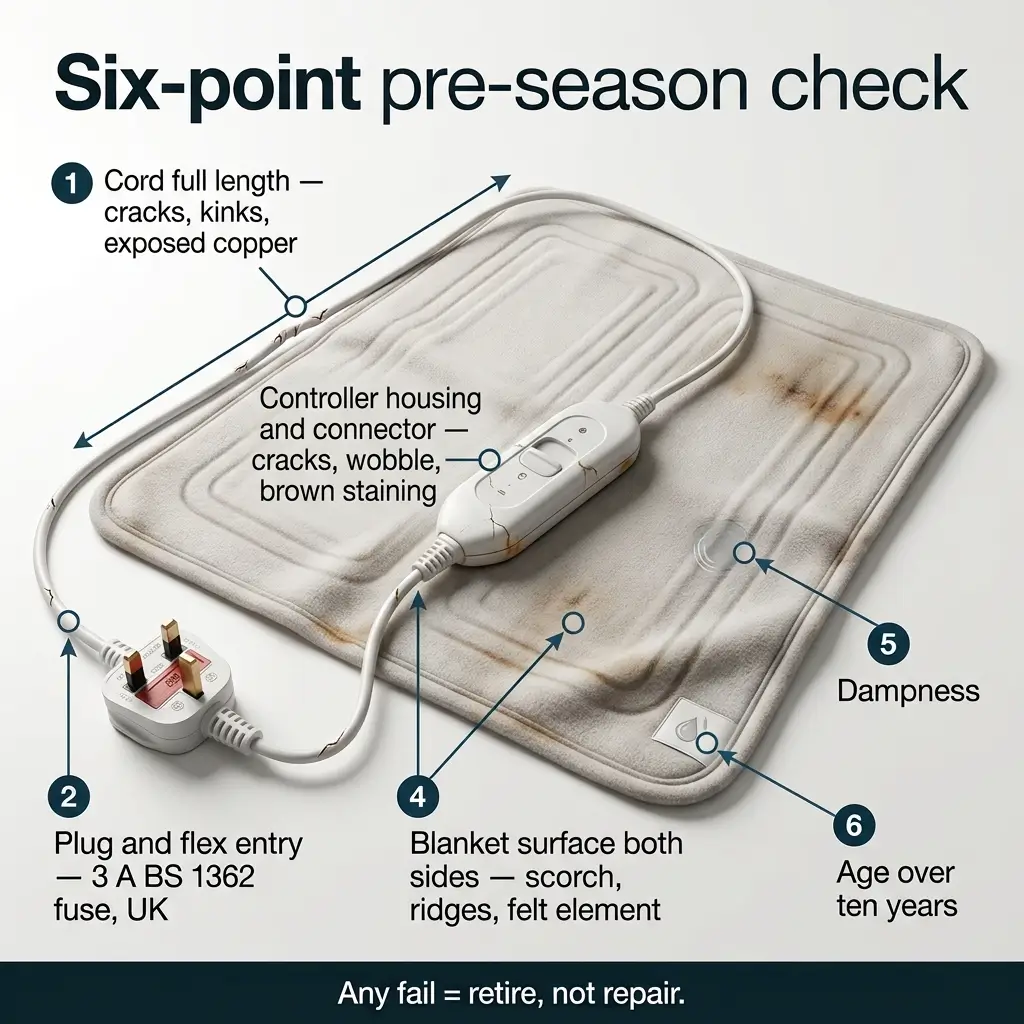
This is the check I would run on any blanket coming out of storage, and it is the one step in this article that changes outcomes most for the least effort. Most failures announce themselves at the cord or the controller before they announce themselves as a fire.
Work in good light with the blanket unplugged and laid flat. You are looking for anything that breaks the insulation barrier or concentrates heat. This is the order I check them in, because it follows the failure sequence rather than the layout of the appliance.
Run the check in this order:
- The full length of the cord. Follow it hand over hand from plug to controller and controller to blanket. Cracks, kinks, flattening, melted patches or any exposed copper mean the blanket is finished.
- The plug and flex entry. Look for discolouration, heat marks or a loose grip where the flex enters the plug body. In the UK, if the plug fuse needs replacing, Electrical Safety First specifies a 3 A BS 1362 fuse — not the 13 A one that came in a generic replacement plug.
- The controller housing and connector. Cracked casing, a connector that wobbles rather than clicking home, or brown staining around the pins all indicate arcing.
- The blanket surface, both sides. Scorch marks, brown patches, hard ridges, or any point where you can feel the element through the fabric.
- Dampness. If any part is damp, do not plug it in and never switch it on to dry it out.
- Age. Find the date or the certification mark generation. Past ten years, the inspection result stops mattering much — see the retirement section.
One rule governs what happens next: a failed check means retirement, not repair. Element and controller wiring are matched to each other, so swapping a controller from another blanket is not a fix. There is no domestic repair for a damaged heating element.
⚠️ Safety critical: If a blanket has ever given off a burning or hot-plastic smell in use, take it out of service permanently. Odour without visible damage usually means insulation breakdown inside the element run, which is exactly the failure a visual check cannot see.
Using it at night: pre-heat and switch off, or leave it running?
Here the published advice genuinely diverges, and readers deserve the reason rather than one country's answer presented as universal.
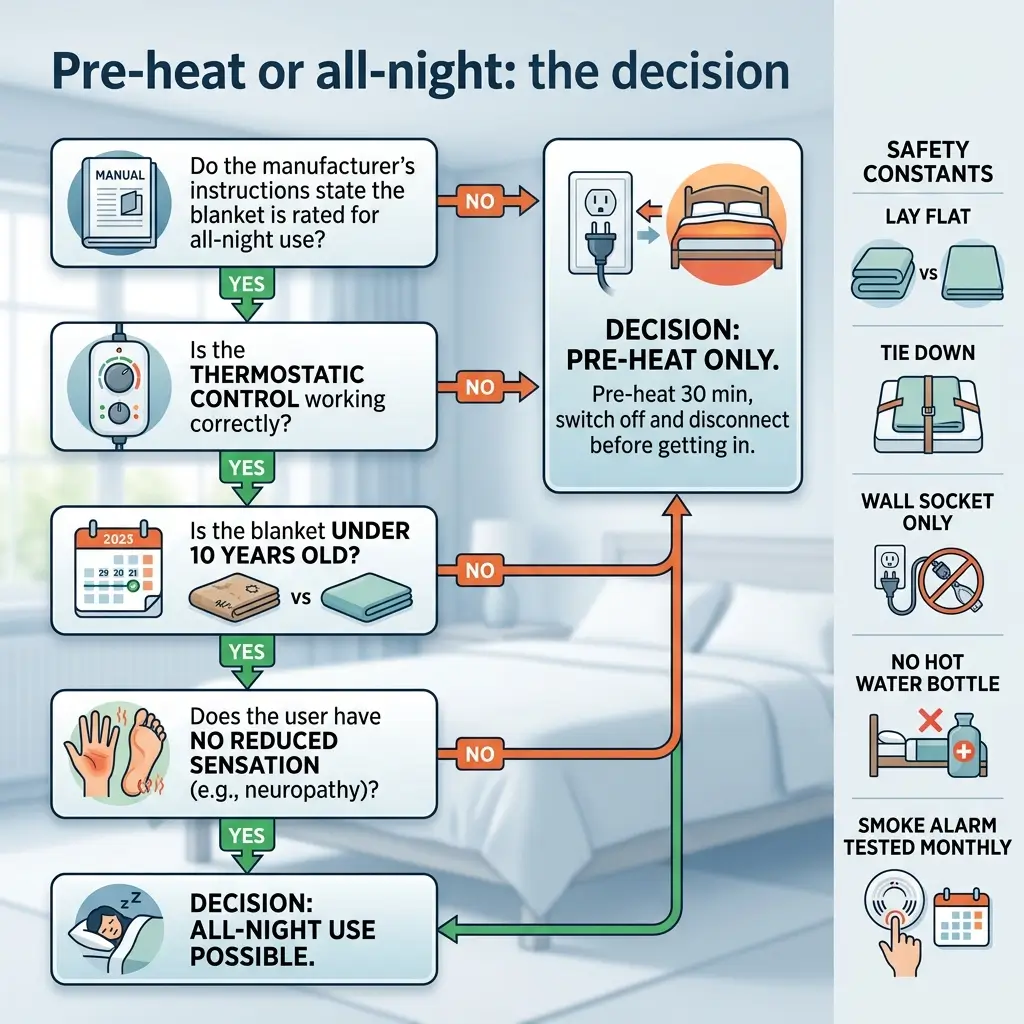
The US position is the more restrictive. ESFI states that heating appliances should never be left unattended or used while sleeping. UK fire and rescue services and Electrical Safety First take a conditional line: switch off and disconnect before you get into bed unless the blanket carries thermostatic controls rated by its manufacturer for all-night use, in which case running it overnight is within its design intent.
Both are defensible. The US guidance is written to cover a whole population of appliances, including the old ones that dominate the fire statistics, and a blanket rule is the right shape for that. The UK guidance leans on a product distinction that the manufacturer's instructions make explicit. Before I accept an all-night arrangement anywhere, I ask to see the instruction sheet for that model rather than the brochure — the rating either appears in writing or it does not exist. My own preference is the pre-heat method regardless of rating. It removes both pathways at once and costs nothing but thirty minutes of planning.
⚖️ Jurisdiction note: Do not carry US "never sleep with it on" advice across to a UK blanket rated for all-night use, or UK all-night practice across to a blanket whose instructions do not permit it. The manufacturer's instruction sheet, not the internet, is the authority for your specific product.
Whichever position applies to your blanket, the physical rules are the same:
- Lay it flat and keep it flat. Folds, bunching and rucks trap heat against the element. This is the single most repeated cause of overheating in every source I reviewed.
- Tie an under-blanket down to the mattress so it cannot slide into creases overnight.
- Plug directly into a wall socket. ESFI advises against extension cords and power strips for this appliance specifically.
- Nothing heavy on top while it is running, and nothing on top of a heating pad at all.
- One heat source only. No hot water bottle in the same bed as a live electric blanket — a leak plus a live element is an electrocution pathway, and the combination also stacks contact temperature.
- Check adjustable beds against the instructions. Repeated articulation can trap or fatigue internal wiring at the hinge line.
- Working smoke alarm in or immediately outside the bedroom, tested monthly. Sleeping-risk premises need detection where the sleeping happens, and that logic does not stop at a front door.
Who should not use one, or should use one differently
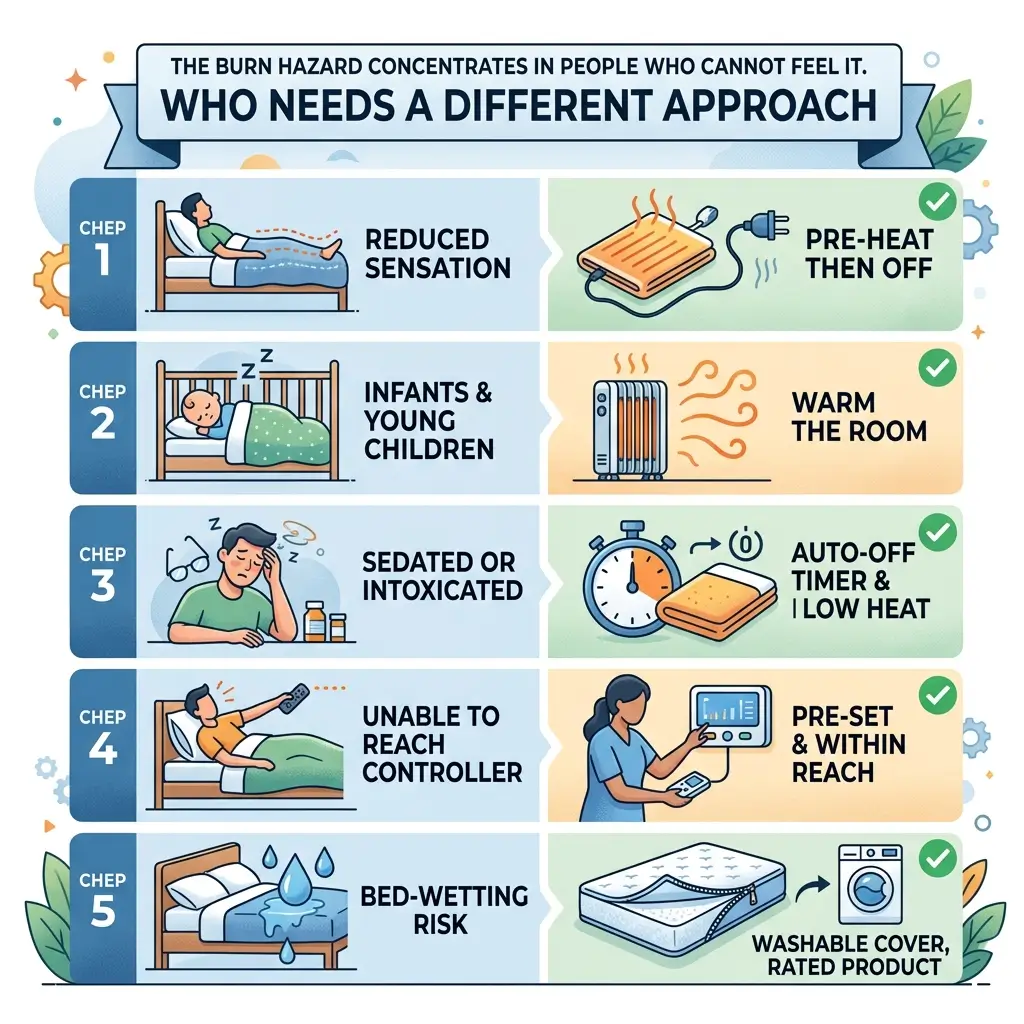
The burn hazard is not evenly distributed. It concentrates almost entirely in people who cannot feel the surface getting too warm, or cannot act on the feeling — which is also the group most likely to be handed an electric blanket as a kindness.
Electrical Safety First advises against using an electric blanket on the bed of an infant, or of a person with a condition that makes them insensitive to heat, and against use by young children unless a parent or carer has pre-set the controls. Reduced sensation is the common thread: diabetic peripheral neuropathy, spinal cord injury, post-stroke sensory loss, sedation, and heavy alcohol use all break the feedback loop that would otherwise make a sleeper move.
| Group | Why the risk changes | What to do instead |
|---|---|---|
| Reduced sensation (neuropathy, spinal injury, post-stroke) | Cannot feel a developing burn; will not move | Pre-heat and remove or switch off before occupancy; consider a warmed room instead |
| Infants and young children | Cannot regulate, communicate or reach controls | Do not use; warm the room and use appropriate bedding |
| Sedated, intoxicated or heavily medicated | Feedback loop suppressed by the medication, not the blanket | Pre-heat only, blanket off before sleep |
| Immobile or unable to reach the controller | Cannot switch off if it becomes too warm | Controller within reach and pre-set, or do not use |
| Anyone at risk of bed-wetting | Moisture and live wiring | Only a product explicitly rated for it, with a washable protective cover per instructions |
⚠️ Safety critical: If you are buying a blanket for an older relative, the decision is not whether they can operate it. It is whether they would notice, and be able to respond, if it became too warm against the same patch of skin for six hours. If either answer is no, warm the room instead.
Where an electric blanket is still the right answer for someone in these groups, three adjustments make it workable:
- Pre-heat and remove. The blanket warms the bed, then comes off or goes off before the person gets in.
- Pre-set and lock the controls. A carer sets the level; the occupant is not left to judge it.
- Reassess when the person's condition changes. Sensation loss is progressive in neuropathy, and a decision made two winters ago may no longer hold.
Pregnancy comes up constantly in searches and deserves a straight answer rather than a scare: the concern raised in obstetric guidance is sustained elevation of core body temperature, particularly in early pregnancy, rather than the blanket itself. Pre-heating the bed and switching the blanket off before getting in addresses that. For anything specific to your own pregnancy, ask your midwife or GP — that is a clinical judgement, not a fire safety one.
Storage and retirement: the decisions made in spring
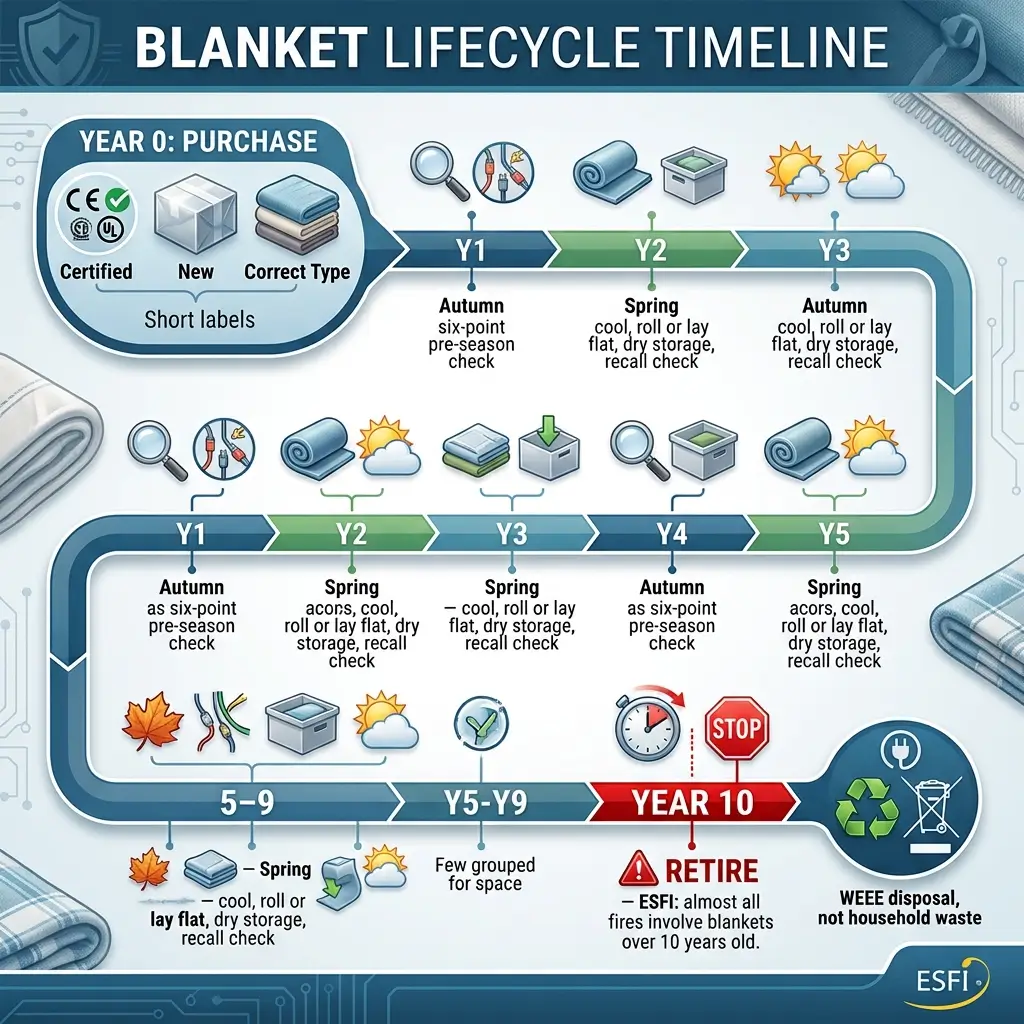
What happens in April determines the condition of the blanket in October. In my experience the damage that ends a blanket is done in storage, not in use: folding is where heating elements fracture, and the damage is internal, permanent and invisible.
Let the blanket cool fully, then roll it or lay it flat. Store it somewhere dry with nothing heavy stacked on top, and keep mothproofing chemicals away from it — they attack the insulation on the element run. If it lives in a wardrobe under a suitcase for six months, the suitcase is the problem.
Retirement is the decision people postpone, and the evidence is unusually clear on it. ESFI's position is that almost all of the roughly 500 US fires a year involving heating pads and electric blankets involve blankets more than ten years old. Electrical Safety First likewise advises considering disposal at ten years. Treat that as a replacement interval rather than a suggestion.
A note on a figure you will meet repeatedly: several consumer sites and older UK campaign materials attribute around 5,000 fires a year to electric blankets. I have not been able to trace that number to a primary fire statistics source, and it sits an order of magnitude above ESFI's traceable figure. Where the two conflict, cite the one you can follow to its origin.
Before the blanket goes back in the cupboard, work through the end-of-season steps:
- Cool it completely before touching storage.
- Roll, or store flat. Never fold, and never store it folded under weight.
- Keep it dry and away from mothproofing products.
- Check the recall lists — the CPSC recall database in the US, and in the UK the manufacturer's own recall page or the government product recall listings.
- Count the years. Ten years is the retirement point regardless of appearance.
- Dispose of it properly. In the UK this is WEEE waste, so it goes to a recycling facility that accepts electrical items, not the household bin.
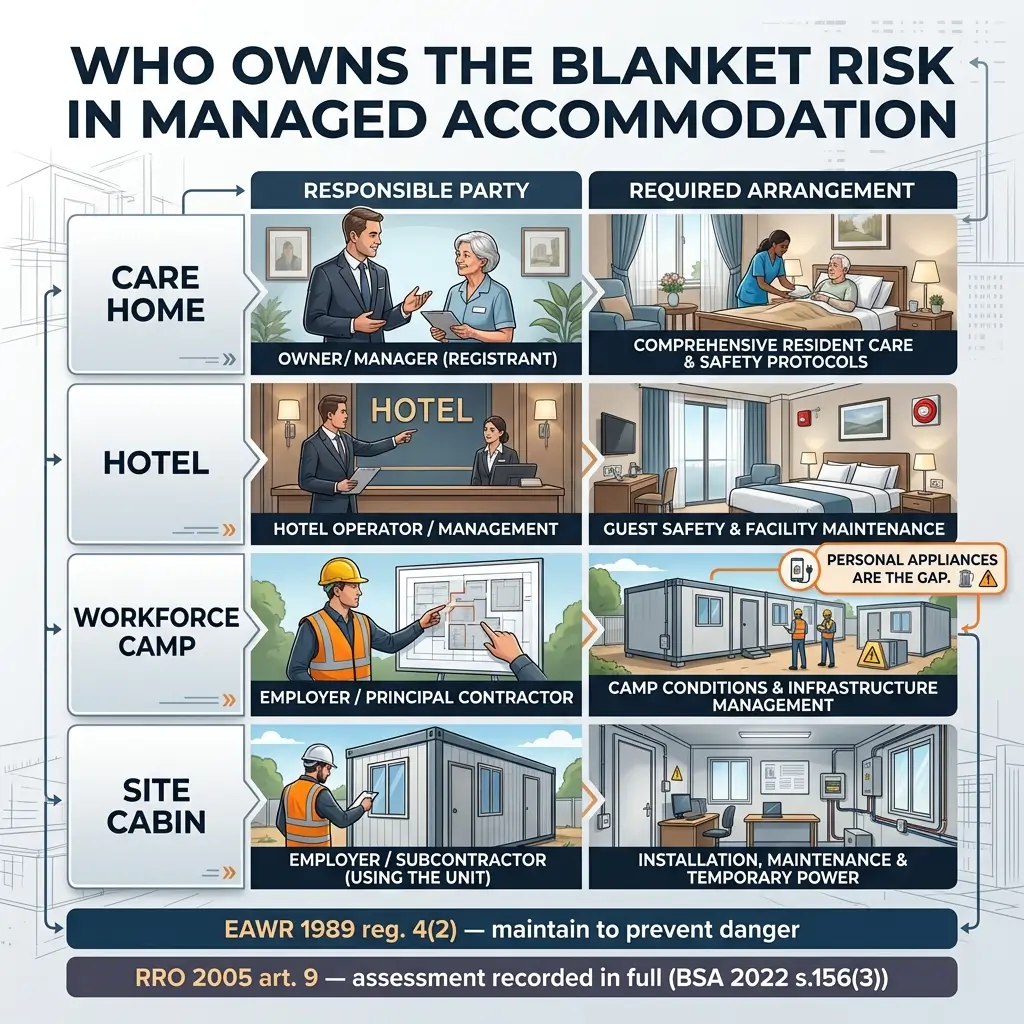
Electric blankets in care homes, hotels and workforce accommodation
This is where the topic stops being a household tip sheet and becomes a duty. In the camp emergency work I did for Minimax Fire Protection, and later verifying detection and alarm coverage on high-rise fit-outs, sleeping accommodation is where I spent most of my inspection time — because a fire that starts in a bed starts next to someone who is asleep and needs the alarm to do the waking.
The recurring gap I write up in sleeping accommodation is not the blanket itself. It is that personal heating appliances brought in by residents, guests or crew never appear on the electrical inventory, so no maintenance regime touches them and no fire risk assessment names them. The appliance is invisible to both systems that were supposed to catch it.
The electrical duty
In the UK, regulation 4(2) of the Electricity at Work Regulations 1989 requires that systems be maintained, so far as is reasonably practicable, to prevent danger. It does not prescribe how or how often. HSE's INDG236 sets out the proportionate answer for low-risk environments — which it names as including hotels and residential care homes — through a tiered regime of user checks, formal visual inspection, and combined inspection and testing where warranted. HSE is direct that annual PAT testing of everything is a myth, and equally direct that visual inspection does not require an electrician; a trained, competent member of staff can do it.
The fire safety duty
Under article 9 of the Regulatory Reform (Fire Safety) Order 2005, the responsible person must make a suitable and sufficient fire risk assessment. Note a change worth checking your paperwork against: section 156(3) of the Building Safety Act 2022 amended article 9 so that responsible persons must now record the fire risk assessment in full, where previously only the significant findings had to be recorded. If your assessment does not name resident-owned heating appliances in bedrooms, that omission is now recorded in full too.
| Setting | Responsible party | What should be in place |
|---|---|---|
| Residential care home | Registered manager / responsible person | Named in the fire risk assessment; formal visual inspection of resident appliances; individual assessment for residents with reduced sensation |
| Hotel and serviced accommodation | Operator | Policy on guest-brought appliances; housekeeping trained to report damaged flexes; bedroom detection coverage |
| Workforce camp and site accommodation | Employing or accommodation-providing organisation | Appliance register including personal items; user check at issue; alarm coverage verified in sleeping blocks |
| Site cabins and night-shift rest rooms | Site management | Blankets treated as portable appliances under the site electrical regime, not as personal effects |
✅ Auditor's tip: I ask the accommodation manager to show me where personal heating appliances appear in the fire risk assessment. If the answer is a general line about electrical equipment, walk the bedrooms. You will find blankets, throws and heated pads that nobody has inspected, and usually at least one plugged into an extension lead behind a bed.
The arrangements worth building before winter, in the order I would expect to see them put in place:
- Register the appliances, including personal ones, so something exists to inspect against.
- Train a competent person to do user checks and formal visual inspection under the INDG236 tiers rather than outsourcing everything to an annual test.
- Name heated bedding explicitly in the fire risk assessment, with the age and inspection basis recorded.
- Assess residents individually where reduced sensation, sedation or immobility is present — the burn hazard belongs to the care plan as much as the fire file.
- Verify detection coverage in sleeping rooms, and test it, because everything above assumes the alarm works.
Frequently asked questions
These are the questions readers search most often around this appliance, answered against the same sources cited above.
Is it safe to sleep with an electric blanket on?
It depends on the product and the jurisdiction. ESFI advises never using heating appliances while sleeping. UK guidance permits overnight use only where the blanket has thermostatic controls rated by the manufacturer for all-night use. If the instructions do not say so explicitly, pre-heat the bed and switch the blanket off before you get in.
How long does an electric blanket last?
Ten years is the working limit. ESFI states that almost all US fires involving this appliance category involve blankets more than ten years old, and Electrical Safety First advises considering replacement at ten years. Condition on inspection does not extend that, because element damage from folding is internal and not visually detectable.
Can you wash an electric blanket?
Only if the manufacturer's instructions say so, and only by the method they specify. Many blankets are not washable at all, and machine washing an unrated one damages the element and the connector. Never switch a damp blanket on to dry it.
Can you use an electric blanket on an adjustable bed?
Check the instructions for that specific blanket first. Repeated articulation of the bed can trap, crease or fatigue the internal wiring along the hinge line. If it is permitted, verify after each adjustment that neither the blanket nor the cord has become trapped.
Are electric blankets safe during pregnancy?
The concern raised in obstetric guidance is prolonged elevation of core body temperature, especially in the first trimester, rather than the blanket itself. Pre-heating the bed and switching the blanket off before getting in avoids that exposure. Discuss anything specific to your pregnancy with your midwife or GP.
Can I use a hot water bottle with an electric blanket?
No. Electrical Safety First advises against using both at once. A leaking bottle brings water into contact with live wiring, and even without a leak the two heat sources stack contact temperature against the same area of skin.
My electric blanket smells of burning but looks fine — is it safe?
No. Take it out of service permanently. A hot-plastic or burning odour without visible damage generally indicates insulation breakdown inside the element run, which is the failure mode a visual inspection cannot detect. Do not attempt a repair or a controller swap.
Conclusion
An electric blanket is a reasonable way to stay warm, and the risk it carries is manageable — but only if you treat the fire hazard and the burn hazard as two separate problems and control both.
The actions that change the outcome, in priority order:
- Retire anything over ten years old, whatever it looks like.
- Run the six-point check before the first cold night, and retire rather than repair on any failure.
- Pre-heat and switch off unless the instructions explicitly rate the blanket for all-night use.
- Keep it flat, on a wall socket, with nothing on top and no hot water bottle.
- Think about sensation, not just controls, before giving one to an older relative.
- If you manage accommodation, put the blanket on the register and in the fire risk assessment — the appliance nobody owns is the appliance nobody checks.
About the author
Mia Collins is an Australian Fire Life Safety & Emergency Response Assurance Consultant with 15 years of continuous field experience across 14 countries, covering industrial fire protection, high-rise fire life safety, detection and alarm, and camp emergency arrangements. Her focus is practical assurance — checking that controls still work where people actually sleep and work. She holds the NEBOSH International General Certificate, ISO 45001 Lead Auditor and IOSH Managing Safely certifications, and now leads Collins Fire & Emergency Assurance in Brisbane, following senior roles with Wormald Fire Systems, Chubb Fire & Security AU, Tyco Fire Protection Services AU and Minimax Fire Protection.
Sources
- Electrical Safety Foundation International — Electric Blanket Fire Prevention
- Electrical Safety First — Electric blankets guidance
- IEC — IEC 60335-2-17:2022, flexible heating appliances
- UL Standards & Engagement — UL 964, Electrically Heated Bedding
- ISO — EN ISO 13732-1:2006, hot surface contact burn thresholds
- legislation.gov.uk — Electricity at Work Regulations 1989, regulation 4
- HSE — INDG236, maintaining portable electric equipment in low-risk environments
- GOV.UK — Fire Safety Order supplement to guidance note 1: enforcement
- US CPSC — Recall database
- PLOS ONE via PMC — Methodology and applicability of the human contact burn injury model