

By Grace Thompson — Principal Human Factors, Ergonomics, Fatigue & Emergency Preparedness Consultant, Thompson Human Factors Safety, Dublin
The 52 checks below cover the five things that actually put older adults in hospital from their own homes: falls, fire, scalds, carbon monoxide, and the time spent on the floor afterwards. Every item comes with a way to test it, because the difference between a home that is safer and a home that only looks safer is whether anyone pulled on the grab bar.
I have spent fifteen years verifying emergency and access controls in fabs, mines, distilleries and water plants across fourteen countries, and the pattern is always the same. The control gets installed. The form gets signed. Nobody tests it under the conditions that cause the failure. A home safety checklist fails in exactly that way, and it fails quietly.
Scope: United States figures and codes lead, with UK equivalents in the comparison table. This is general safety guidance, not medical advice. Where a person's balance, vision or cognition has changed, an occupational therapist assessment does things this article cannot.
Key takeaways
The figures and thresholds that shape every decision below are these:
- Over 14 million US adults aged 65+ report falling each year, and about 37% of those who fall report an injury needing treatment — roughly nine million fall injuries annually, per CDC falls data.
- The age-adjusted fall death rate rose 21% between 2018 and 2024, from 64.7 to 78.4 per 100,000 older adults. Falls are getting more lethal, not less.
- Older adults had 2.5 times the general population's risk of dying in a fire in 2023, rising to 3.4 times for those aged 85 and over, according to the US Fire Administration.
- A grab bar screwed into drywall is worse than no grab bar. It invites full body weight at the exact moment a person is losing balance.
- Water heaters set at 140°F scald in about six seconds; the CPSC recommends 120°F.
- In a cohort of people over 90, 82% of falls happened when the person was alone and 30% of fallers spent an hour or more on the floor. Prevention is half the job; response is the other half.
Why a ticked checklist is not a controlled hazard
Working underground in South Africa on a refuge readiness programme for Glencore, I pulled a refuge checklist and found it signed off complete. The door seal test had not been performed. Somebody had walked to the refuge, looked at it, and ticked the line.
I voided the sign-off, required a real seal test, and spent the next fortnight coaching the crew supervisors on what measurable verification means. Paper-only refuge ticks stopped on that district. The lesson I took out of it: if you did not test the seal, you did not verify the refuge.
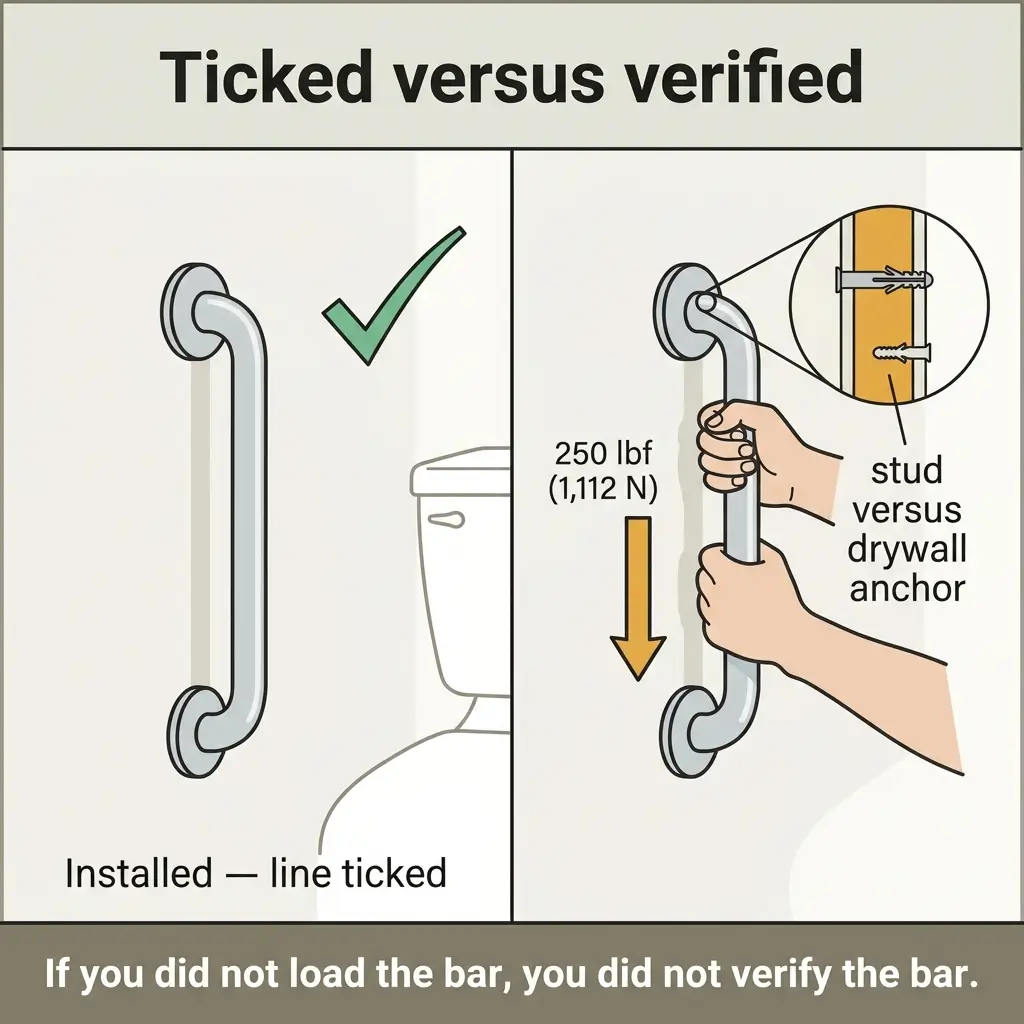
That was a mine, not a house. The failure transfers exactly. Every senior home safety checklist on the internet has a line reading "grab bars are installed in the shower." None of them tells you to hang your weight on the bar. So the bar gets mounted into half-inch drywall with plastic anchors, the line gets ticked, and the control now does something worse than nothing — it invites a 75-year-old to put their full weight on a fitting that will pull out of the wall at the exact moment they are already falling.
The checklist in this article is built differently. Every item has two parts: the condition, and the test that proves the condition. If you cannot perform the test, treat the item as failed.
Three habits separate a real home assessment from a walkthrough:
- Test, do not observe. Pull the bar. Press the alarm button. Walk the route.
- Assess in the conditions that cause the incident. Most falls between bed and bathroom happen in the dark, half-awake, at speed. Do that walk at 2 a.m., not at 11 in the morning with the curtains open.
- Write the date on it. An undated assessment cannot tell you what has degraded since.
Rank the findings before you spend anything
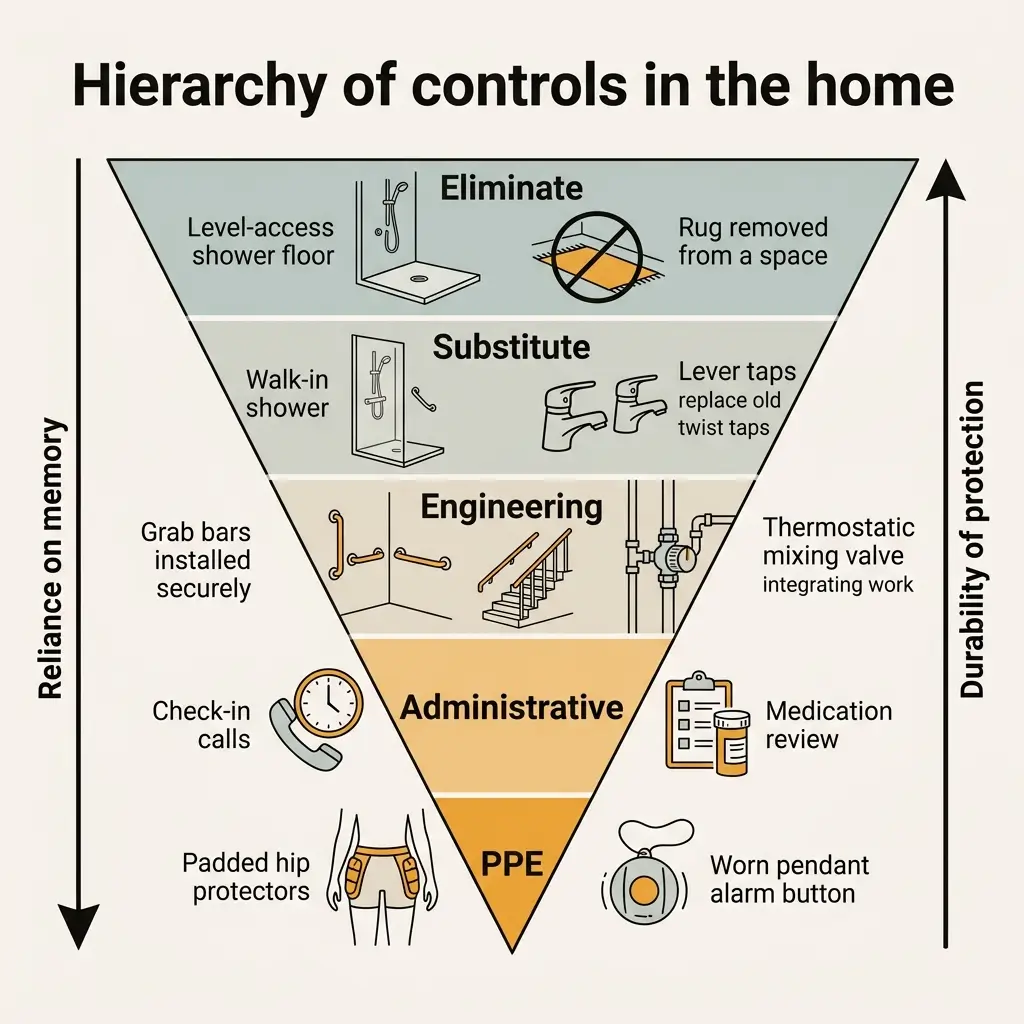
Most families work through a home safety list in the order the list is printed, which means the money goes wherever the article happened to put the bathroom section. That is not how risk works. The occupational hierarchy of controls transfers cleanly into a house and gives you a defensible spending order.
The principle is that controls which remove the hazard outperform controls that ask a person to remember something. In a home, a level-access shower removes the step-over. A grab bar helps someone survive the step-over. A note on the mirror saying "be careful getting out of the bath" does nothing at all, and every household has one.
| Control level | What it looks like in a home | Limitation |
|---|---|---|
| Eliminate | Remove the step-over: level-access shower; move the bedroom to the ground floor; take out the throw rug entirely | Highest cost, highest durability. Nothing to maintain |
| Substitute | Walk-in shower for a bath; lever taps for round knobs; a perching stool for standing at the hob | Changes the task rather than removing it |
| Engineering | Grab bars, second stair handrail, raised toilet seat, motion-sensor lighting, thermostatic mixing valve | Only as good as its fixing and its position |
| Administrative | "Clean spills immediately," medication reviews, check-in calls, monthly alarm test | Depends on someone remembering under fatigue |
| PPE-equivalent | Hip protectors, non-slip slippers, a worn pendant alarm | Only works if worn, every time, including at 3 a.m. |
Applied to a typical home, five findings carry a disproportionate share of the risk, and I would close them before buying anything else:
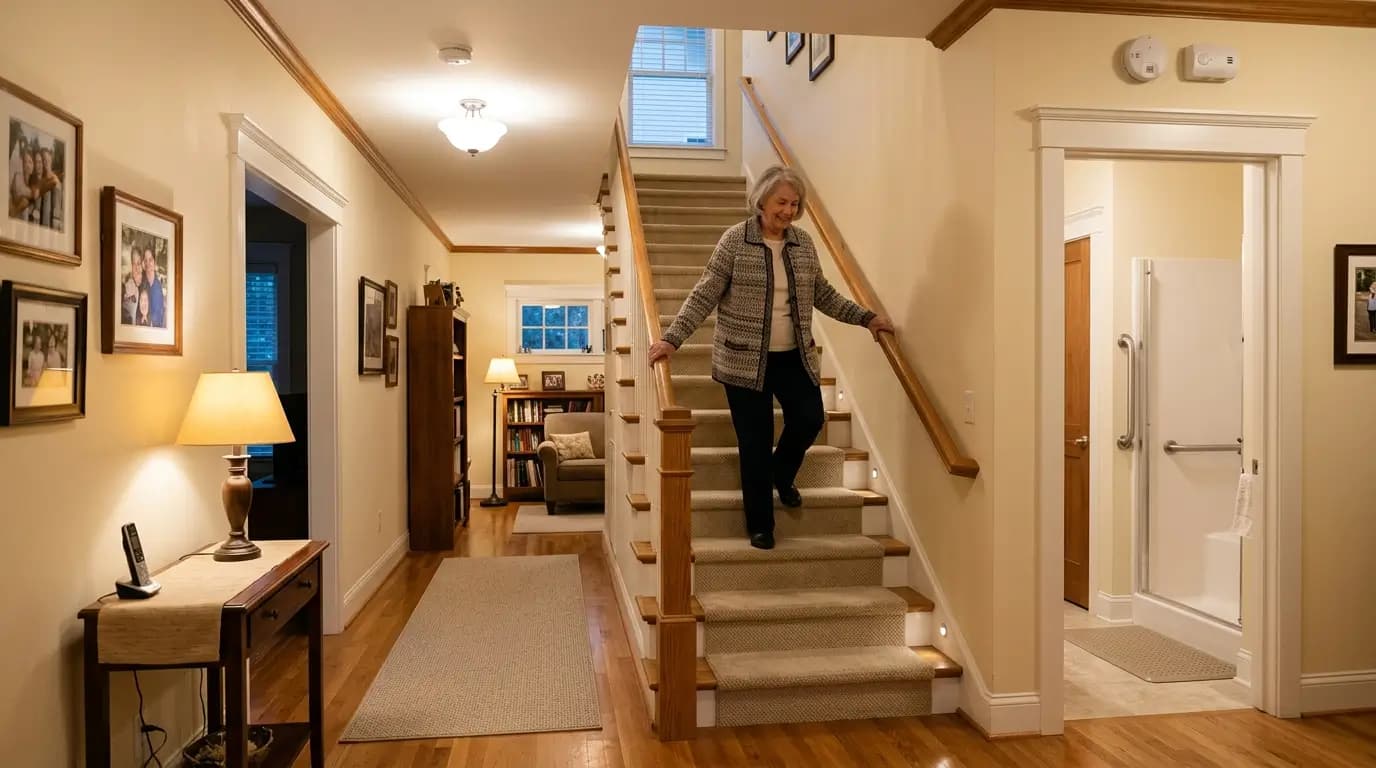
- No second handrail on the stairs, or a handrail that stops short of the bottom riser.
- A grab bar, towel rail or basin the person actually pulls on that is not fixed into structure.
- No light switch at both ends of the night route between bed and toilet.
- A smoke alarm older than ten years, or none inside the bedroom.
- No means of calling for help from floor level in the bathroom or bedroom.
Nothing on that list costs more than a few hundred dollars. Two of them cost nothing at all.
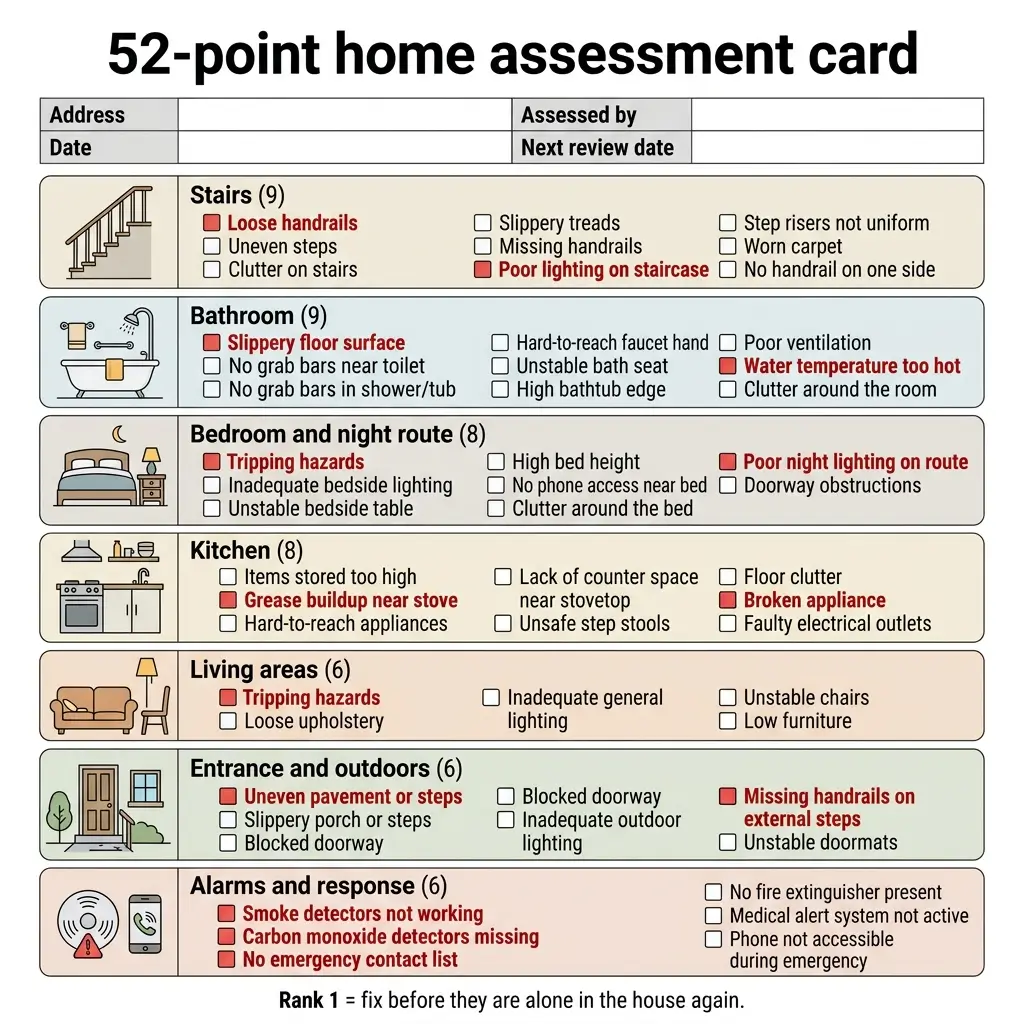
The 52-point home safety checklist for seniors
Work through this in one pass with a torch, a phone camera and a notebook. Photograph anything that fails — a photograph settles the argument later about whether the bar was loose. Do the bedroom and bathroom zones a second time after dark.
Rank each finding 1, 2 or 3. Rank 1 means fix before the person is alone in the house again. Rank 2 means schedule within a month. Rank 3 means improve when convenient. Where I have suggested a rank below, it reflects what the control is protecting against, not how easy it is to fix.
Stairs and level changes (checks 1–9)
Stairs concentrate the two ingredients of a serious fall: height and a change of foot position. This zone gets assessed first.
| # | Check | How to verify it | Rank |
|---|---|---|---|
| 1 | Handrail present on at least one side | Grip and pull outward hard. Any movement is a failure | 1 |
| 2 | Second handrail on the other side | Both hands available on descent, which is when most stair falls happen | 1 |
| 3 | Handrail runs the full flight | Stand on the top and bottom step — the rail should still be in your hand | 1 |
| 4 | Handrail is graspable, not a flat plank | Close your hand fully around it. If your fingers do not meet, replace it | 2 |
| 5 | Every tread the same depth and rise | Measure three treads. Inconsistency of more than about ⅜ in trips people | 2 |
| 6 | Nosings visible in low light | Look from the top with only the landing light on. Add contrast tape if edges blur | 1 |
| 7 | Carpet or treads fixed, no lifted edges | Run a hand along each nosing and every stair edge | 1 |
| 8 | Two-way switching at top and bottom | Turn the light on from the top, off from the bottom. If you cannot, it fails | 1 |
| 9 | Nothing stored on the stairs | Look for the basket of items "to take up later" | 2 |
Bathroom (checks 10–18)
Wet surfaces, bare feet, and a task that requires standing on one leg. Assess this zone as if it were a wet process area, because functionally it is one.
| # | Check | How to verify it | Rank |
|---|---|---|---|
| 10 | Grab bar in the shower or bath, fixed to structure | Hang your full weight on it for five seconds. Suction bars fail this by design | 1 |
| 11 | Grab bar beside the toilet | Same test. Check the fixing, not the finish | 1 |
| 12 | Nothing else is being used as a grab bar | Ask directly: "What do you hold onto getting out?" Then test that thing | 1 |
| 13 | Non-slip surface inside the tub or shower base | Wet it and press with a flat hand. It should not glide | 1 |
| 14 | No loose mat on the bathroom floor | Either non-slip backed or gone. A curled mat edge in a wet room is a rank 1 finding | 1 |
| 15 | Shower seat or bench available if standing is tiring | Watch a transfer, if the person is comfortable being watched | 2 |
| 16 | Handheld showerhead reachable from seated | Sit on the seat and reach for it without leaning | 2 |
| 17 | Hot water at the tap no higher than 120°F / 49°C | Run for two minutes and measure with a cooking thermometer | 1 |
| 18 | Door opens outward or can be unlocked from outside | Try it. A person on the floor behind an inward door blocks their own rescue | 1 |
Bedroom and the night route (checks 19–26)
The route from the pillow to the toilet is the highest-frequency high-risk task in the house, performed daily, in the dark, by someone half-asleep with blood pressure that has not caught up yet.
| # | Check | How to verify it | Rank |
|---|---|---|---|
| 19 | Light reachable from lying in bed | Lie down and reach. Not from sitting on the edge | 1 |
| 20 | Continuous low-level light along the whole route | Walk it at night with the main lights off | 1 |
| 21 | Route is clear of furniture, cables and pets' bowls | Walk it barefoot with your eyes on the doorway, not the floor | 1 |
| 22 | Bed height allows both feet flat with knees at about 90° | Sit on the edge and look at the feet and knees | 2 |
| 23 | Phone or alarm reachable from the floor beside the bed | Kneel down and reach for it | 1 |
| 24 | Nothing stored above shoulder height in the wardrobe | Anything above the shoulder means a chair gets used | 2 |
| 25 | Slippers have a back and a grip sole | Backless slippers are a documented trip contributor | 2 |
| 26 | Blood-pressure and sedating medications reviewed in the last year | Ask for the date of the last review with the prescriber | 2 |
Kitchen (checks 27–34)
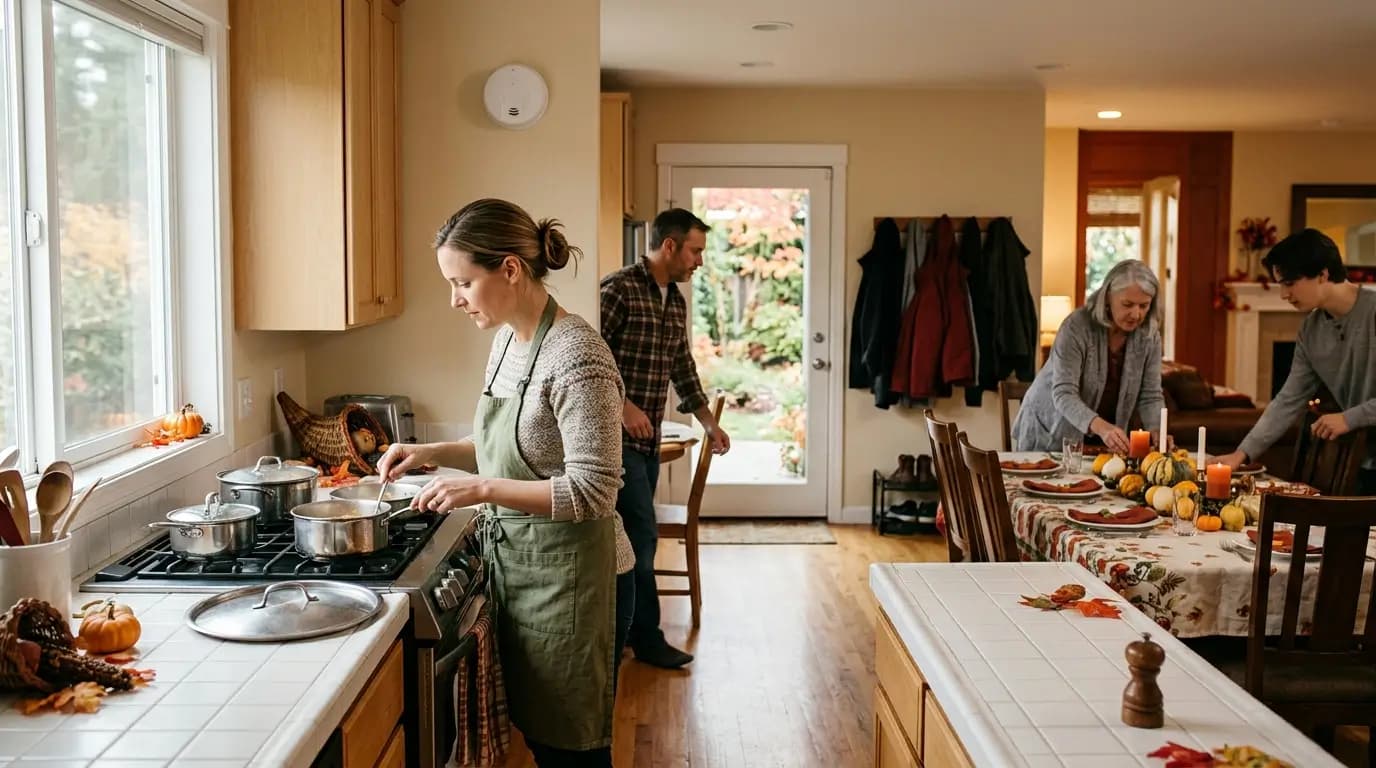
Cooking is the leading cause of fire injuries among older adults, and the kitchen also concentrates reaching, carrying and hot liquids.
| # | Check | How to verify it | Rank |
|---|---|---|---|
| 27 | Everyday items between hip and shoulder height | Open the cupboards and see what is at head height | 2 |
| 28 | No chair used as a step | Ask where the top shelf items come from | 1 |
| 29 | Step stool has a handle and non-slip feet, if one is used | Stand on it and let go with both hands. If it moves, remove it | 1 |
| 30 | Hob has a timer, or the person uses one | A timer is the single most recommended older-adult cooking control the USFA publishes | 1 |
| 31 | Nothing combustible stored above or beside the hob | Look for tea towels, packaging, plastic utensils | 1 |
| 32 | Kettle and pans can be lifted and poured one-handed when full | Fill and lift. A full 1.7 litre kettle is nearly two kilos | 2 |
| 33 | Non-slip mat at the sink, and spills get dealt with | Ask what happens when something spills mid-cook | 2 |
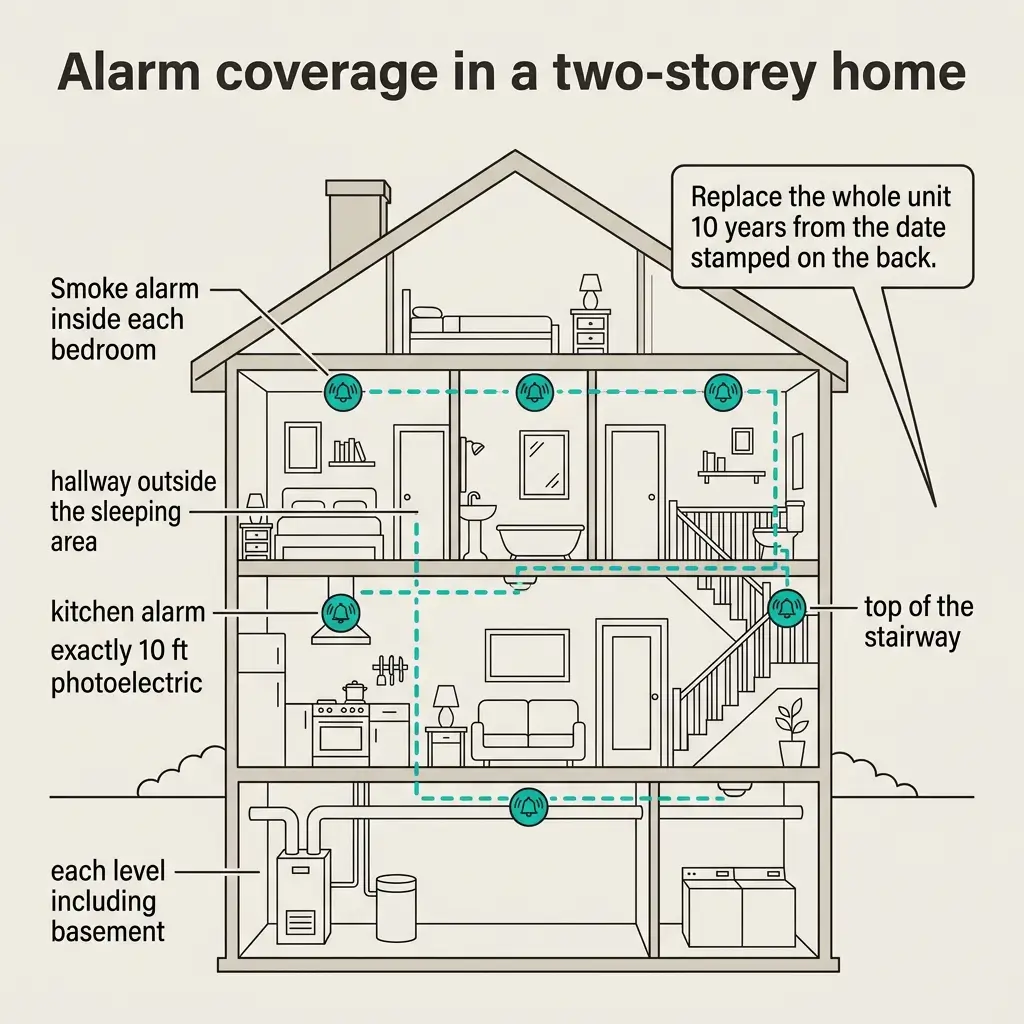
| 34 | Smoke alarm is at least 10 ft from the hob, or is photoelectric | Measure it. Nuisance alarms are why alarms get disconnected | 1 |
Living areas and circulation (checks 35–40)
The living room is where the low-consequence, high-frequency movements happen — standing up, crossing to the door, reaching for the remote.
| # | Check | How to verify it | Rank |
|---|---|---|---|
| 35 | Main chair allows standing without a pull or a rock | Watch one stand. If they rock to build momentum, the seat is too low | 1 |
| 36 | Chair has both armrests | Ask which arm they push on. Both should be available | 2 |
| 37 | A clear path at least the width of a walking frame | Push a frame or a kitchen chair through it, if one is used | 2 |
| 38 | No trailing cables across any walked line | Get down at floor level and look along the carpet | 1 |
| 39 | Rugs removed or fixed on all four edges | Push each rug edge with a foot. If it rucks, it goes | 1 |
| 40 | Threshold strips between rooms are flat and fixed | Run a foot over each doorway | 2 |
Entrances, outdoor steps and paths (checks 41–46)
The entrance is where lighting, weather and a change of level meet, usually while carrying something.
| # | Check | How to verify it | Rank |
|---|---|---|---|
| 41 | Handrail on every outdoor step, including a single step | A single step is a common and underestimated fall point | 1 |
| 42 | Step surfaces sound, level and non-slip when wet | Check after rain, not in dry weather | 1 |
| 43 | Motion-sensor light covers the door and the last three steps | Walk up at night and see where the light starts | 1 |
| 44 | Doormat is flush, backed and does not curl | Kick the corner | 2 |
| 45 | Path free of moss, ice risk, uneven slabs and hose lines | Walk it slowly looking down | 2 |
| 46 | Somewhere to sit and set bags down at the door | Watch an arrival with shopping | 3 |
Alarms, heating and emergency response (checks 47–52)
This zone is the one every competitor covers last and thinnest, and it is where the fatal outcomes sit.
| # | Check | How to verify it | Rank |
|---|---|---|---|
| 47 | Smoke alarm inside every bedroom, outside each sleeping area, on every level | Count them against the rooms. Most older homes fail this | 1 |
| 48 | Every alarm under 10 years old from its manufacture date | Take it down and read the date stamped on the back | 1 |
| 49 | Alarms are audible to this person, from their bed, asleep | Press the test button while they are in bed. If they would not wake, specify a bed-shaker or strobe unit | 1 |
| 50 | Carbon monoxide alarm on every level with fuel-burning appliances | Test the button and check its expiry date | 1 |
| 51 | A means of calling for help that works from floor level in every room | Lie on the bathroom floor and try it. A pendant on the nightstand is not a control | 1 |
| 52 | Someone can get in without breaking a door | Key safe, spare key with a neighbour, or a nominated keyholder on the alarm account | 1 |
The numbers competitors leave out
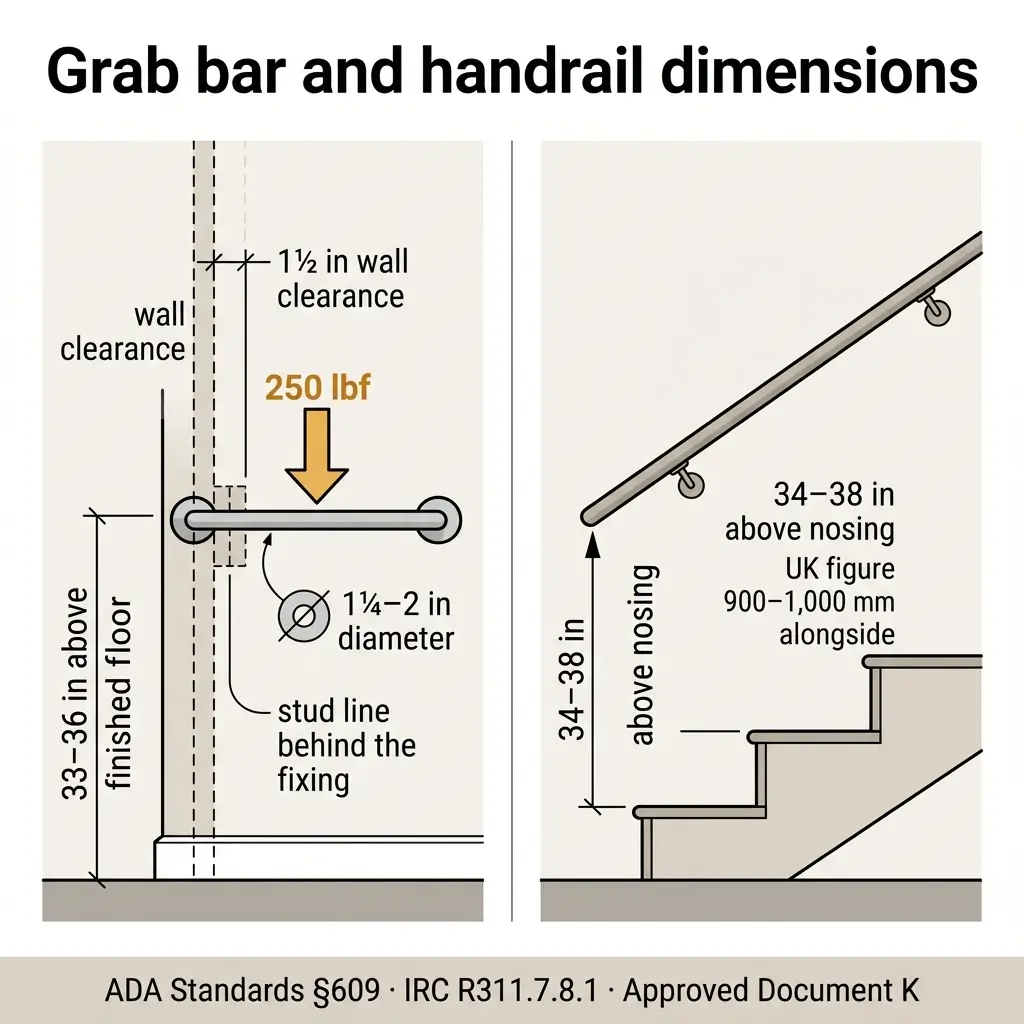
Search this topic and you will read "install grab bars" on every result and a mounting height on none. The dimensions exist. They come from accessibility standards and residential building codes, and while neither is legally binding inside a private home, both encode decades of biomechanical research and both are what a competent installer will work to.
Two points before the table. First, the 2010 ADA Standards do not apply to private residences — several competitor articles imply otherwise. Use them as a design reference, which is what occupational therapists do. Second, the 250 lbf structural requirement is the number that matters most, because it is the one that decides whether the bar goes into a stud or into drywall.
| Element | United States | United Kingdom | Source |
|---|---|---|---|
| Grab bar height | 33–36 in (840–915 mm) above floor | Follows Approved Document M guidance for the dwelling type | ADA Standards §609.4 |
| Grab bar load | 250 lbf (1,112 N) at any point on bar, fastener or mounting | Fixing to structure, per manufacturer | ADA Standards §609.8 |
| Grab bar diameter | 1¼–2 in (32–51 mm) circular | Typically 32–35 mm | ADA Standards §609.2 |
| Clearance to wall | 1½ in (38 mm) — an absolute, not a minimum | 50–60 mm typical | US Access Board Chapter 6 |
| Stair handrail height | 34–38 in (864–965 mm) above nosing | 900–1,000 mm above pitch line | IRC R311.7.8.1 / Approved Document K |
| Handrails both sides | Required on one side for flights of 4+ risers | Both sides where the flight exceeds 1 m wide | IRC R311.7.8 / Approved Document K |
| Max stair rise | 7¾ in (196 mm) | 220 mm (private stair) | IRC R311.7.5.1 / Approved Document K |
| Hot water at outlet | 120°F (49°C) recommended; ADA caps accessible shower spray units at 120°F | 43–46°C at bath outlet via a thermostatic mixing valve | CPSC Publication 5098 / ADA Standards §607.6 |
One further provision is worth knowing if a bathroom is being renovated. Under §607.4 and §608.3 of the ADA Standards, dwelling units may omit grab bars where the walls are reinforced for later installation. Put the blocking in during the work, even if nobody wants a bar yet. It costs almost nothing at that stage and it removes the "there is no stud there" argument three years later.
⚠️ Safety critical: A grab bar mounted below 33 in forces the user to bend forward to reach it. Bending forward moves the centre of gravity ahead of the feet, which is the mechanism of the fall the bar was installed to prevent. Height is not a cosmetic decision.
Lighting and the 2 a.m. route
A 75-year-old retina receives roughly a third of the light a 20-year-old's does at the same illuminance, and the adaptation from a bright bathroom back into a dark hallway takes far longer. That combination is why the same corridor is safe at breakfast and dangerous at 2 a.m.
When I ran night-shift human factors work in a semiconductor fab, I stopped scheduling verification walks during the day. If a route is only going to fail at three in the morning, that is when the walk has to happen. The same discipline is the single most useful thing a family can bring to a parent's house, and it costs nothing but one uncomfortable night.
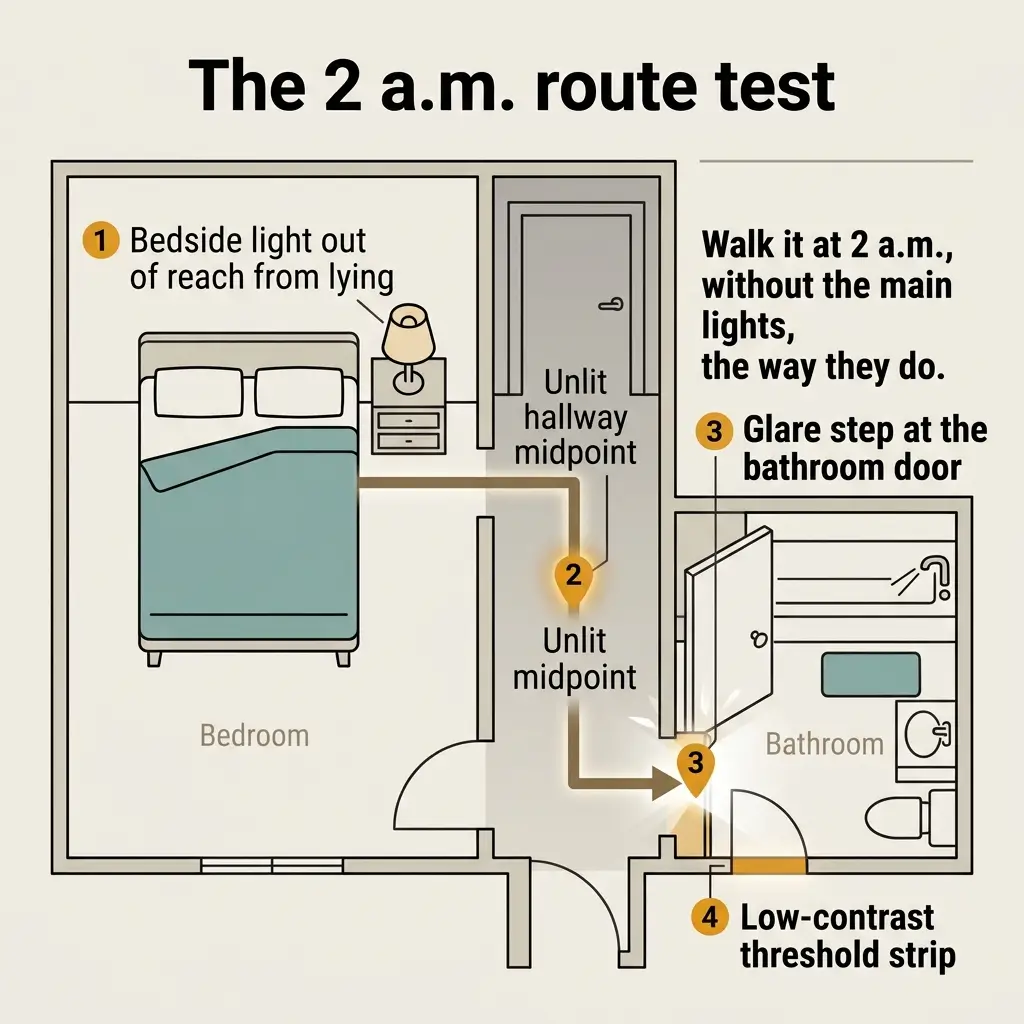
The route test is straightforward. Stay overnight. At around 2 a.m., get up the way they do — no phone torch, no overhead lights — and walk from the pillow to the toilet and back. Then answer four questions honestly.
The four things that route test reveals, in the order they usually fail:
- Where the dark patches are. Continuous low-level light beats one bright fitting. Plug-in sensor lights at ankle height along the whole run work better than a ceiling light nobody switches on.
- Where the reach is wrong. If the bedside light needs a stretch from lying down, the light does not get used and the walk happens in the dark.
- Where the glare is. A bright bathroom light after a dark hallway causes a second adaptation problem on the return leg. A dimmable or low-output night setting solves it.
- Where contrast disappears. Pale grout, a white threshold strip on a pale floor, a cream stair nosing on cream carpet — all invisible at low light levels. Contrast tape is a few dollars and closes a rank 1 finding.
Fire, carbon monoxide and scalds
Falls dominate the numbers, so fire gets one bullet on most senior safety pages. That is a mistake. USFA fire death statistics for 2014–2023 put the 2023 fire death rate for adults aged 65 and over at 33.0 per million population — 2.5 times the general population's risk, rising to 2.9 times for the 75–84 band and 3.4 times for adults aged 85 and over. In the same source, the fire death rate trend for the 65–74 group rose 41% across that decade.
The reason is mechanical rather than behavioural. Escape from a house fire depends on detecting smoke while asleep, standing up quickly, and moving through smoke at speed. Every one of those steps degrades with age, and a walking frame does not fit through a doorway that a person can normally squeeze past.
Scalds run on a similar logic. Older skin is thinner and reaction time is slower, so the same water causes a deeper burn over a longer contact.
| Water temperature | Time to a third-degree burn in most adults |
|---|---|
| 150°F / 66°C | About 2 seconds |
| 140°F / 60°C | About 6 seconds |
| 130°F / 54°C | About 30 seconds |
| 120°F / 49°C | Several minutes |
The controls that carry the most weight in this hazard family are all cheap and all commonly missing:
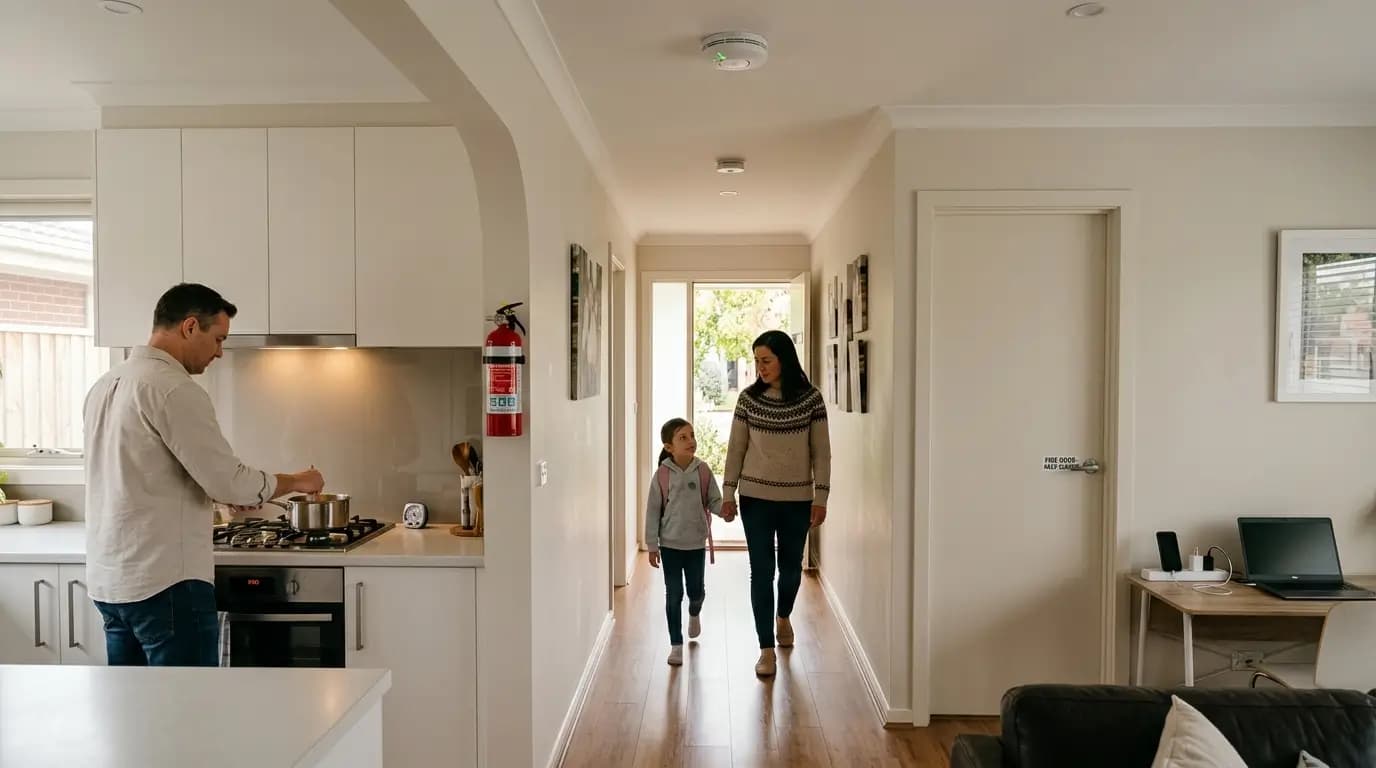
- An alarm inside the bedroom, not only in the hallway. NFPA 72 sets the residential minimum as one alarm inside every sleeping room, one outside each sleeping area and one on every level including the basement. A closed bedroom door cuts the sound substantially — enough that a sleeping person may not wake.
- Interconnected alarms. When one sounds, they all sound. Detection in the kitchen is useless if the alert does not reach the bedroom.
- Ten-year replacement from the manufacture date, not the purchase date. The sensor degrades whether or not the battery is fresh.
- A bed-shaker or strobe alarm where hearing loss is present. The USFA recommends this specifically for older adults, and almost nobody installs one.
- A cooking timer, used every time the hob is on, treated as part of the task rather than as a reminder.
- A thermostatic mixing valve where the heater cannot be turned down without losing hot water elsewhere.
- Never smoke around medical oxygen — a rule that needs stating plainly to the household, not just to the patient.
Why the rug comes back
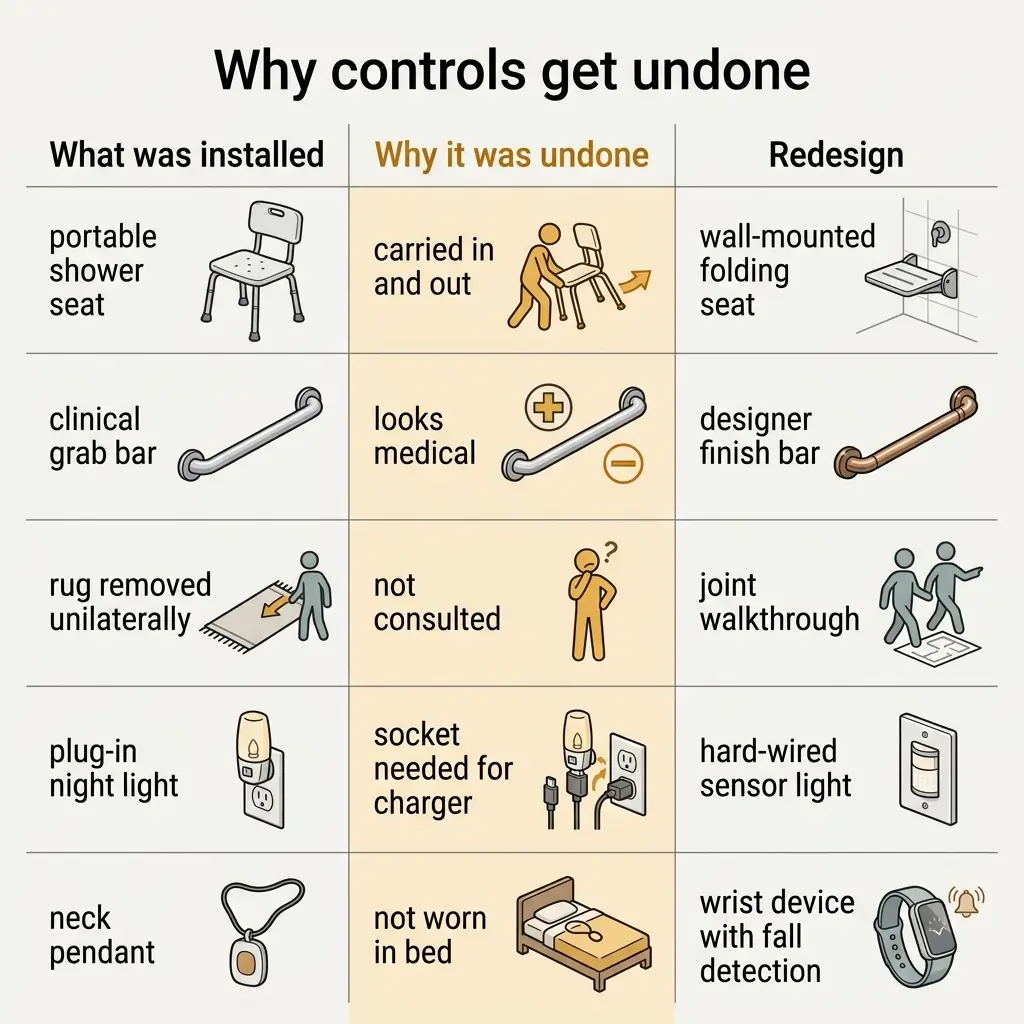
Come back to the house six months after the assessment and a predictable set of things will have been undone. The rug is back down. The grab bar has a towel on it. The sensor light in the hallway is unplugged because the phone charger needed the socket. The pendant alarm lives in the bedside drawer.
The instinct is to read this as non-compliance. It almost never is. In every setting I have worked in — bottling halls, cleanrooms, water treatment plants — a control that gets removed is usually a control that made the task harder, made the person feel diminished, or was never explained. The household is behaving rationally within a design they did not help make. That is a design finding, not a discipline problem.
Five reasons dominate, and each has a design answer.
The control made the task slower or more awkward. A shower seat that has to be carried in and out gets left out. Fit a wall-mounted folding seat instead.
The control looks like a hospital. This is the one families dismiss and older adults care about most. Grab bars now come in finishes that read as fittings rather than equipment, and a bar that gets kept is worth more than a clinical one that gets refused.
The control was installed without a conversation. Somebody removed a rug that had been in that room for thirty years while the owner was out. It came back within a fortnight, and so did the resentment. Do the walk together and let them rank the findings with you.
The control competes for a resource. Night lights lose to phone chargers. Fit sensor lights that take a socket permanently, or hard-wire them.
The control depends on being worn. A pendant alarm on the nightstand protects nobody. Wrist-worn devices get worn far more reliably than neck pendants, and automatic fall detection removes the requirement to press anything at all — which matters, because a person who has hit their head may not be able to.
📋 From the field: The verification I trust most is not the installation photo. It is the unannounced second visit three months later. What is still in use tells you what was designed properly; what has been undone tells you what to redesign.
After the fall: the long lie and the response plan
Prevention gets all the attention and covers about half the risk. The other half is what happens in the hour after a fall, and almost no home safety checklist addresses it.
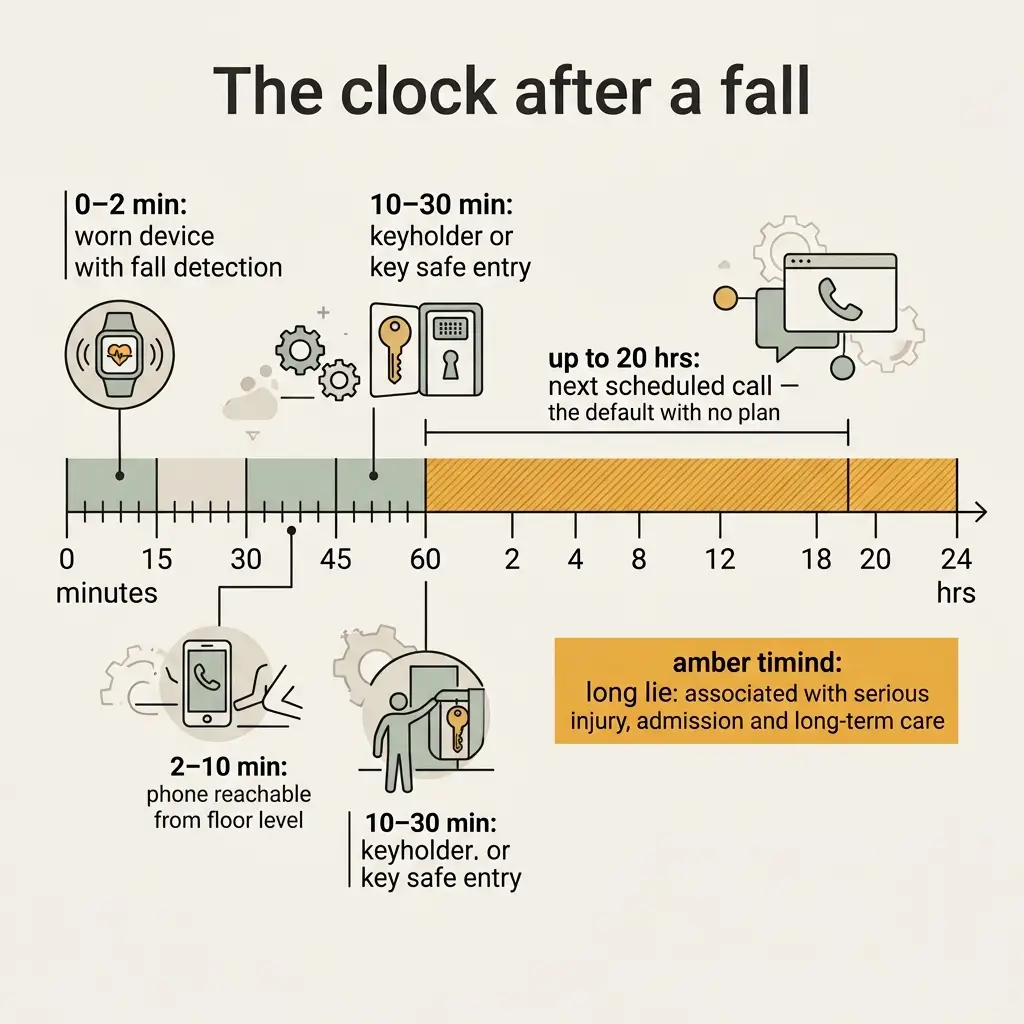
The evidence is stark. Fleming and Brayne's prospective cohort of people aged over 90, published in the BMJ, found that 82% of falls happened when the person was alone, that 80% of those who fell were unable to get up after at least one fall, and that 30% lay on the floor for an hour or more. Time on the floor is independently associated with serious injury, hospital admission and moves into long-term care — separately from whatever the fall itself did. A person can survive the fall and be undone by the ninety minutes afterwards.
Running mine emergency response and muster assurance work for Glencore, the question I asked at every drill was never whether a plan existed. It was how long accountability actually took, measured with a stopwatch, on the shift when the site was busiest and darkest. Apply that same question to a house with one occupant: from the moment they hit the floor, how long until someone knows?
For most homes the honest answer is "until the next scheduled phone call," which can be twenty hours. That number is the finding.
A response plan that actually works has four layers, and each one shortens the clock:
- Detection. A worn device with automatic fall detection, or at minimum a wrist-worn alarm. Test it from the bathroom floor, not from the armchair.
- A second route to raise the alarm. A landline or mobile reachable from floor level in the two rooms where falls concentrate. Charge it where it can be reached from the floor.
- Access. A key safe with the code held by two named people, or a spare key with a neighbour. Forcing a door costs minutes and sometimes causes the second injury.
- A structured check-in. A specific time, a specific person, and an agreed action if there is no answer — including who holds the key and who calls. Vague arrangements produce vague response times.
There is a fifth item that belongs to a physiotherapist rather than to a checklist. Practising how to get up from the floor, safely and with a technique matched to the person's strength and joints, is one of the highest-value hours anyone can spend. Ask the GP for a referral; do not improvise it from a video.
What decays, and when to re-check it
An assessment describes a house on one day. Controls then degrade on entirely different clocks, which is why an annual repeat of the full walkthrough misses most of what has changed.
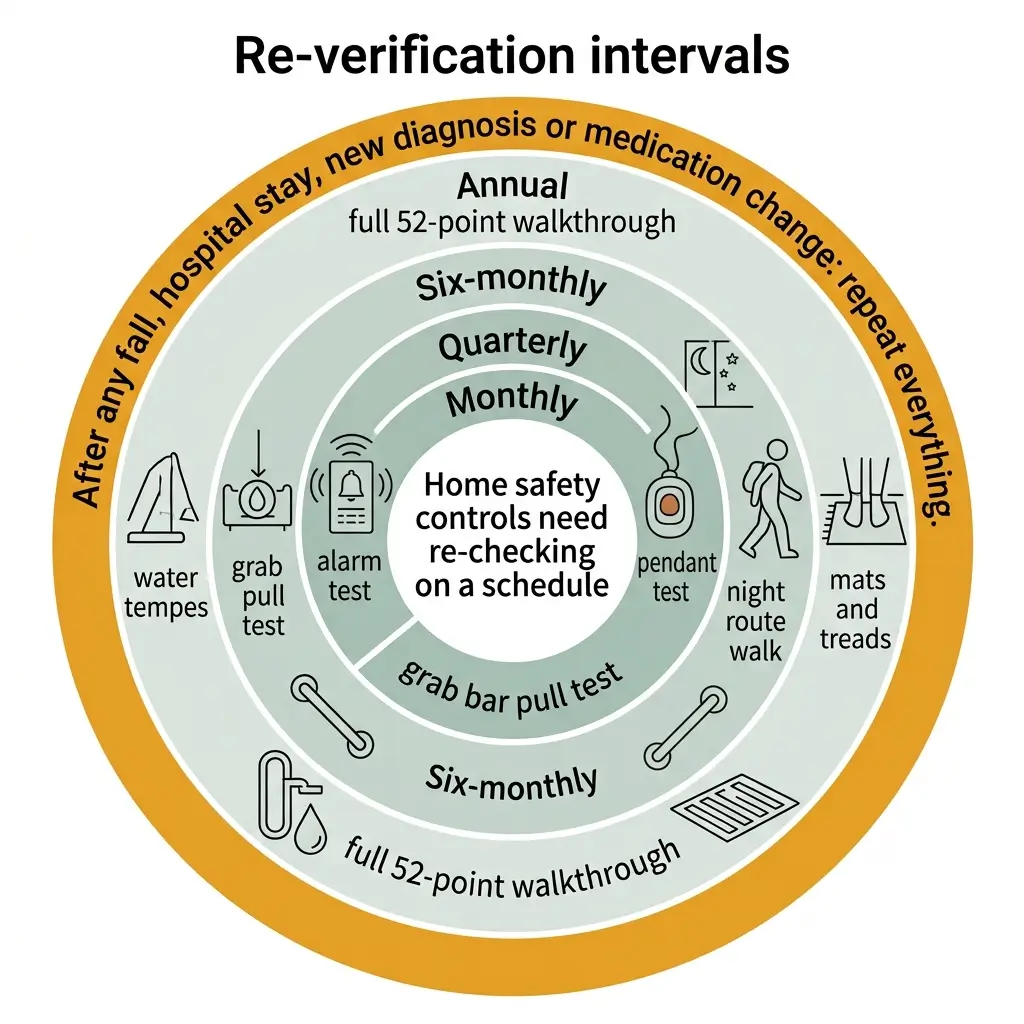
Set the intervals by how the control fails rather than by the calendar. A grab bar fixing loosens gradually under cyclic load and gives almost no warning. A smoke alarm sensor degrades silently over a decade. A rug reappears within weeks.
| Control | How it degrades | Re-check interval | The test |
|---|---|---|---|
| Grab bars and handrails | Fixings loosen under repeated load | Every 3 months | Hang weight on it |
| Smoke and CO alarms | Battery, then sensor | Test monthly; replace at 10 years | Press the button; read the date stamp |
| Sensor and night lights | Bulb output falls, or unit is unplugged | Every 3 months | Walk the route at night |
| Non-slip mats and treads | Backing hardens and curls | Every 6 months | Push the edge with a foot |
| Rugs and clutter | Reappear | Every visit | Look at the floor |
| Water temperature | Thermostat drift, or someone turns it up | Every 6 months | Thermometer at the tap |
| Pendant or wrist alarm | Battery, range, and not being worn | Monthly | Test it from the bathroom floor |
| The person's own capability | Strength, vision, medication changes | After any fall, hospital stay, new diagnosis or new medication | Repeat the full walkthrough |
That last row overrides everything above it. A discharge from hospital changes the person more than six months of ageing does, and a home that was appropriate on admission frequently is not on return.
Frequently asked questions
These are the questions families ask most often once they have walked the house and found more than they expected.
How often should a senior home safety assessment be done?
Repeat the full 52-point walkthrough annually, and immediately after any fall, hospital discharge, new diagnosis or medication change. Individual controls need shorter intervals: test alarms monthly, pull-test grab bars quarterly, and check water temperature every six months.
Where exactly should grab bars be installed?
Inside the shower or bath, and beside the toilet, mounted 33–36 in (840–915 mm) above the floor and fixed into studs or blocking rated to hold 250 lbf. Also install one wherever the person already grabs something — often the basin or a towel rail, neither of which is designed to take load.
Are suction-cup grab bars safe for elderly people?
No. Suction bars can release without warning on tiled surfaces affected by soap film, temperature change or a poor seal, and they fail while carrying full body weight. Use them as a positioning aid only. Anything supporting a transfer must be mechanically fixed to structure.
What is the most important home modification for falls?
There is no universal answer, which is why the walkthrough matters. In most homes the highest-value fixes are a second stair handrail, continuous low-level lighting on the night route, and a properly fixed grab bar at the bath or shower. All three cost under a few hundred dollars.
Do ADA requirements apply to a private home?
No. The ADA covers public accommodations and commercial facilities, not private residences. Its dimensions are still the best available design reference, and occupational therapists work to them routinely, but nothing in the ADA obliges a homeowner to install anything.
How can an older person living alone get help after a fall?
Layer it. A worn device with automatic fall detection, a phone reachable from floor level in the bathroom and bedroom, a key safe or keyholder so responders can get in without forcing a door, and a scheduled check-in with an agreed action if there is no answer. Test each layer from the floor, not from a chair.
About the author — Grace Thompson
Grace Thompson is an Irish Occupational Health, Safety and Environment (OHSE) Human Factors, Fatigue and Emergency Preparedness Consultant with 15 years of continuous field experience across 14 countries. Her work centres on two questions: whether a task can be performed correctly by someone tired and rushed, and whether emergency controls still function when they are actually needed. She led refuge seal-test verification and mine emergency response assurance for Glencore across South African, Zambian and Canadian operations, night-shift human factors and emergency access programmes for Intel, and night packaging fatigue and manual handling work for Diageo, following earlier roles with Veolia, Skanska, Boston Scientific, Pfizer, Ericsson, Heidelberg Materials, Aer Lingus, ESB and Smurfit Kappa.
She holds a BSc in Occupational Safety and Health from Technological University Dublin and an MSc in Human Factors and Safety Management from the University of Nottingham, and is a Chartered Member of IOSH. She has led Thompson Human Factors Safety in Dublin since January 2026.
Sources
- Centers for Disease Control and Prevention — Older Adult Falls Data (reviewed February 2026)
- Centers for Disease Control and Prevention — Facts About Falls
- US Fire Administration — Older Adult Fire Death Risk, 2014–2023
- US Fire Administration — Fire Safety for Older Adults
- US Consumer Product Safety Commission — Publication 5098, Tap Water Scalds
- US Access Board — ADA Standards Guide, Chapter 6: Bathing Rooms
- Fleming J, Brayne C — Inability to get up after falling, subsequent time on floor, and summoning help: prospective cohort study in people over 90, BMJ
- CDC STEADI — Check for Safety: A Home Fall Prevention Checklist for Older Adults