

Thanksgiving concentrates its risk in about six places, and every one of them can be closed out in the hour before your guests arrive: a working smoke alarm, a clear escape route, a stove nobody walks away from, a fryer that is either outdoors or not used at all, a pan lid within reach, and a sober driver home. That is the whole list. Everything else is seasoning.
I verify fire life safety controls for a living — detection, egress, extinguishers, muster — on industrial sites where the stakes are obvious. The reason I write this one every year is that a full house on a holiday reproduces almost every failure mode I write up at work: crowded floor space, blocked doors, distracted operators, and equipment being used by people who have not used it since last November. NFPA's most recent analysis counted an estimated 1,446 home cooking fires reported to US fire departments on Thanksgiving Day 2023 — a 388 percent increase over the daily average, and the highest of any day in the year.
Scope: written for a US home setting, since Thanksgiving is a US holiday (Canada's falls on the second Monday of October). The fire physics and the controls apply anywhere; the standards and product designations differ, and I flag where.
Key takeaways
The six findings that decide how this holiday goes, each sourced below:
- Thanksgiving Day 2023 produced an estimated 1,446 US home cooking fires against a daily average roughly one-fifth of that, per NFPA's 2025 release — the spike is real and it is annual.
- Unattended equipment was the leading contributing factor in nonconfined home cooking fires at 37 percent, according to the US Fire Administration. Distraction, not incompetence, is the mechanism.
- NFPA discourages outdoor gas-fuelled turkey fryers that immerse the bird in hot oil for home use, and states that consumer education alone cannot make the risk acceptably low.
- Never put water on a burning pan. Slide a metal lid over it, kill the heat, and leave the lid on until the pan is cold.
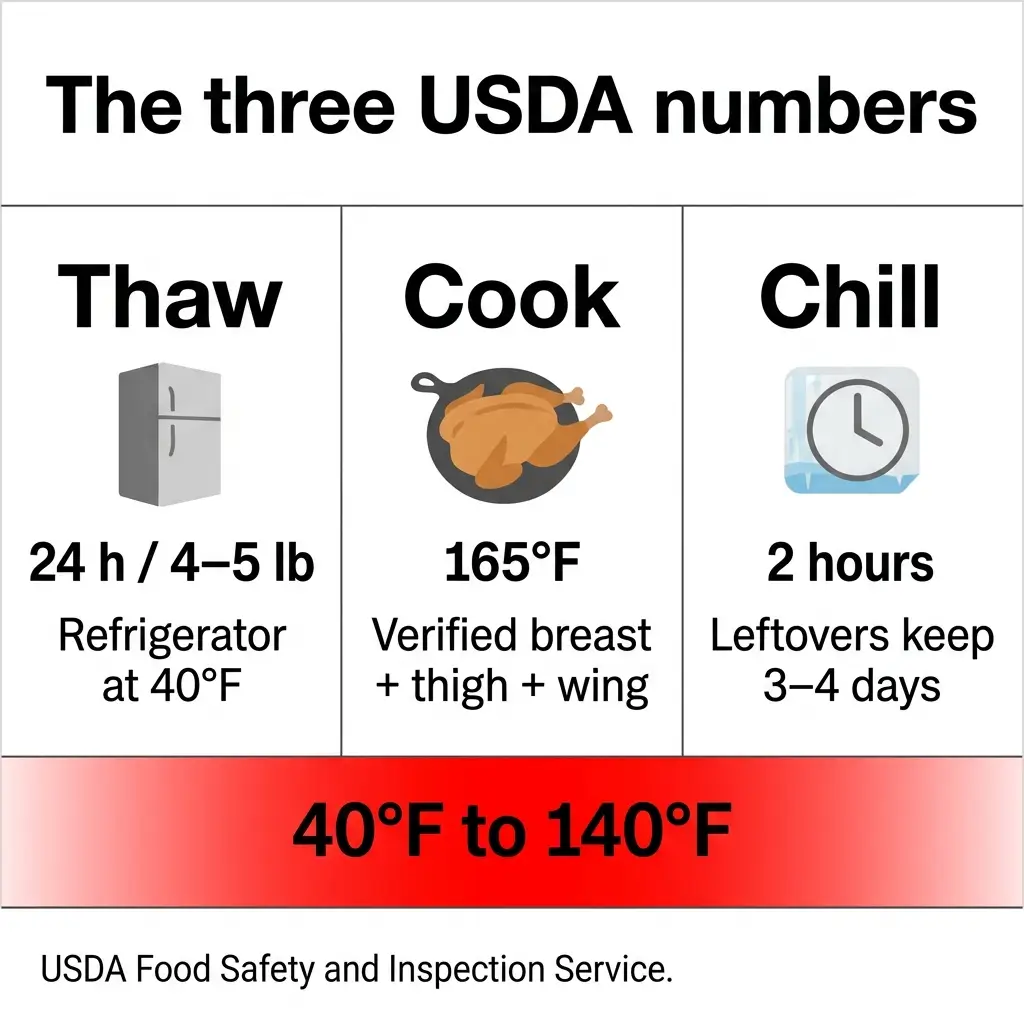
- USDA's three numbers: thaw at roughly 24 hours per 4–5 lb in the refrigerator, cook to 165°F verified in three places, refrigerate leftovers within two hours.
- NSC estimated 439 US road deaths for the 2025 Thanksgiving holiday period, with more than a third of holiday-period fatalities historically involving an alcohol-impaired driver.
Start where I start: does the alarm actually work?
On any site walk, detection comes first, because it is the only control that keeps working when nobody is watching. In a house on Thanksgiving night, that matters more than usual — people fall asleep in unfamiliar rooms, doors get closed, and the person who would normally smell smoke has had two glasses of wine.
So press the test button on every alarm in the house today, not on the day. If an alarm chirps, replace the battery rather than pulling it. If you cannot remember when the unit was installed, look at the date printed on the back: most residential smoke alarms are designed for a ten-year service life and should be replaced at that point regardless of whether they still test.
The nuisance-alarm trap
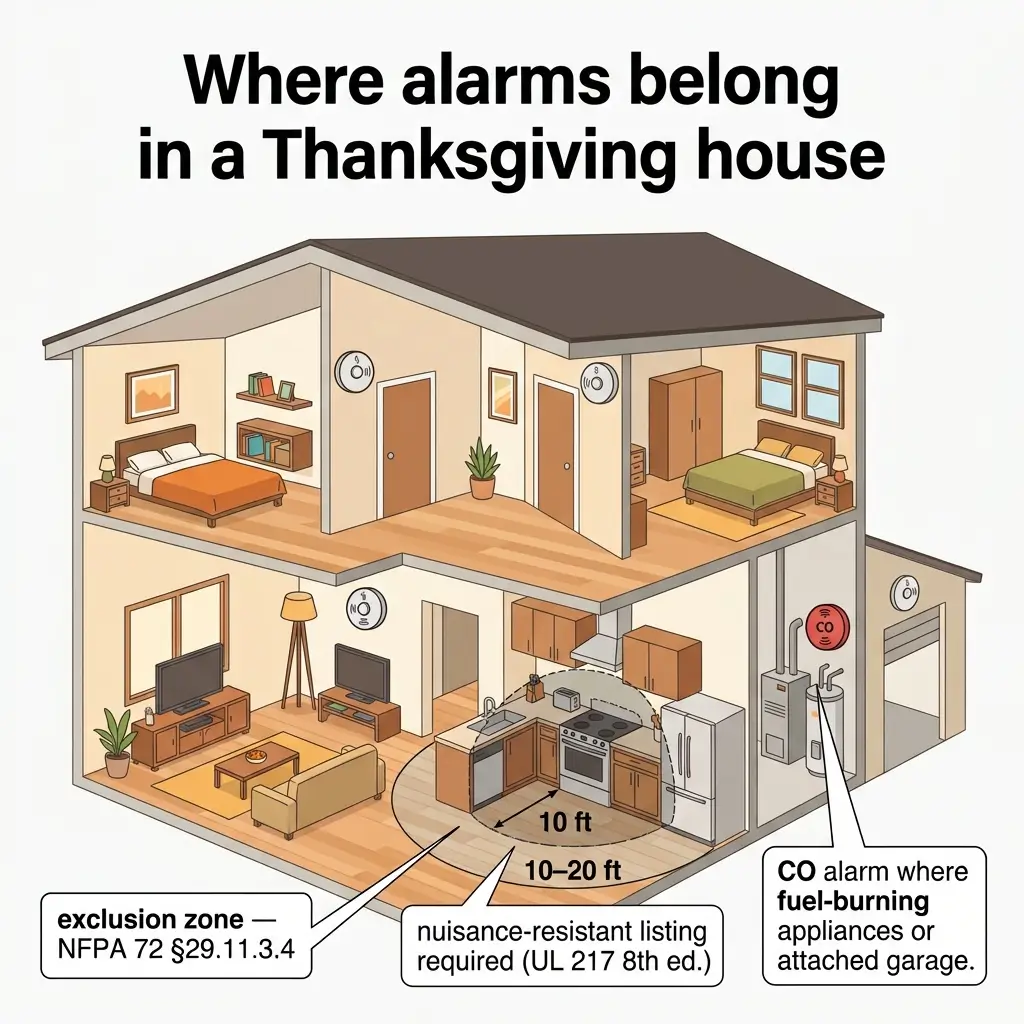
Here is the failure I would flag on a walkdown, and it is the one that actually kills people at home. A smoke alarm sited too close to the cooking appliance will trip on roasting fumes, someone will disable it during the cook, and it will still be disabled at midnight. The person who removes the battery is not being reckless — they are solving the problem in front of them.
NFPA 72, the National Fire Alarm and Signaling Code, addresses this directly in Chapter 29. Clause 29.11.3.4 sets a ten-foot radial exclusion zone around a fixed cooking appliance, and requires alarms sited between ten and twenty feet along the horizontal flow path to be listed for resistance to common nuisance sources from cooking — a UL 217 (8th edition) listing — with that requirement fully in effect from 1 January 2025. Placement between six and ten feet is permitted only in the narrow case where the exclusion zone would otherwise prevent a required alarm from being installed at all.
In plain terms: if your kitchen alarm goes off every time you sear something, the alarm is in the wrong place or is the wrong unit. Move it or replace it. Do not manage it with a battery.
Before the cooking starts, confirm each of the following:
- Every alarm tests audibly, on every level of the home, including outside sleeping areas
- No alarm sits within about ten feet of the stove unless it is listed for close-proximity cooking use
- A carbon monoxide alarm is fitted and working if you have any fuel-burning appliance, an attached garage, or a gas oven
- Guests sleeping over know what the alarm sounds like — a sound nobody recognises is not a warning
- Nothing is stored on top of an alarm, and none are painted over
Clear the escape route before the first guest arrives
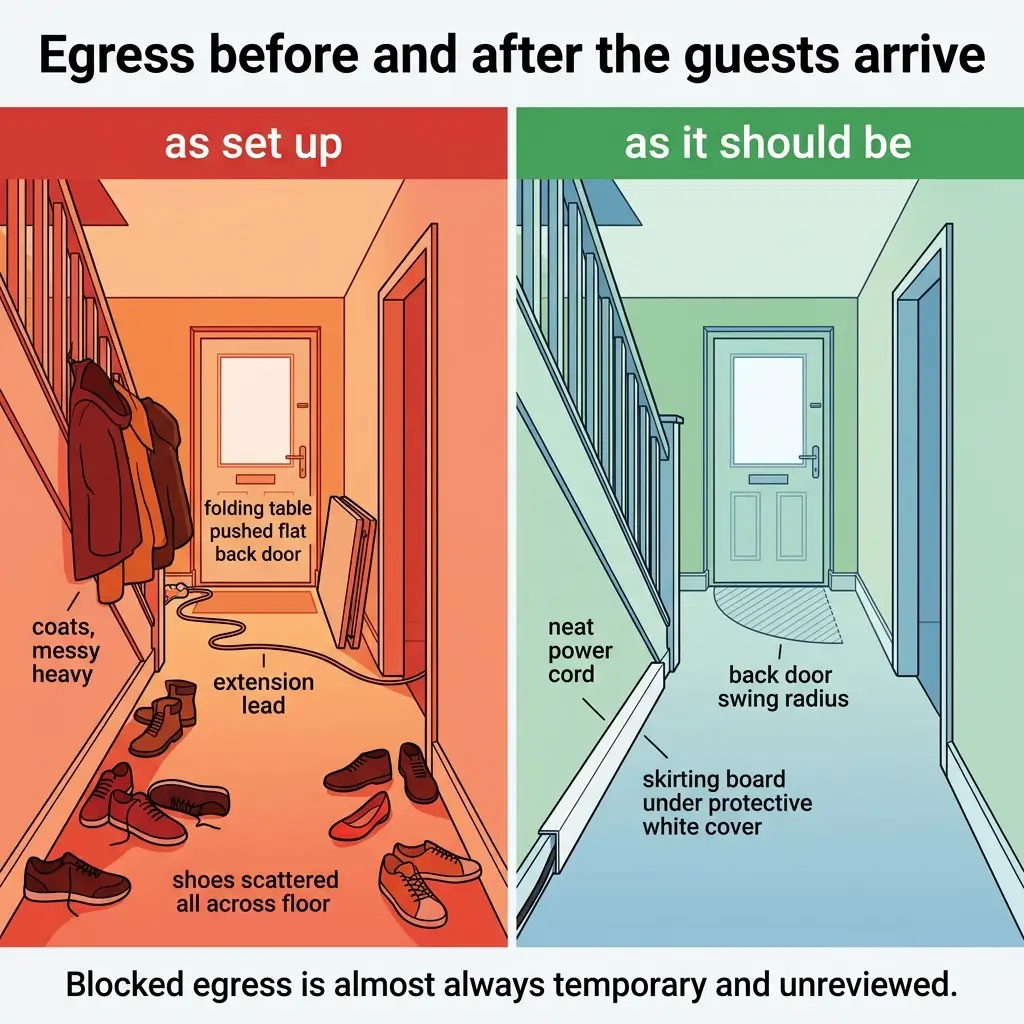
Egress is the control that gets quietly destroyed by hospitality. Coats go on the hallway banister, a folding table blocks the back door, the pushchair sits in front of the side exit, and an extension lead for the warming tray runs across the doorway everyone would use in a hurry. None of it is careless. All of it is the same finding I write up on sites.
I spent a year as an egress integrity advisor for Chubb Fire & Security in Australia, and one walkdown from that scope has stayed with me. A temporary hose had been run across an escape door — a fifteen-minute job that had been in place considerably longer. The door still opened. The route was still marked. On paper the building was compliant. But anyone leaving in smoke, at pace, in the dark, would have met a trip line at ankle height in the one doorway they were being directed towards. I stopped the work, had the route reinstated, and briefed the crew before restart.
The transferable lesson is not "keep exits clear," which everybody already knows. It is that blocked egress is almost always created by a temporary arrangement that nobody re-checked. So re-check it. Walk your own route once the room is set up, not before.
Walk the house after the furniture is moved and confirm:
- Both ways out of the main gathering room are usable by someone carrying a child
- The route to the front door is clear at ankle height — cables, bags, shoes, pet bowls
- Any door you are counting on can be unlocked in the dark without hunting for a key
- Upstairs windows that serve as a second escape route are not blocked by an air bed or stacked chairs
- The garage door still opens manually if you have parked guests behind it
Unattended cooking, not bad cooking, is what starts the fire
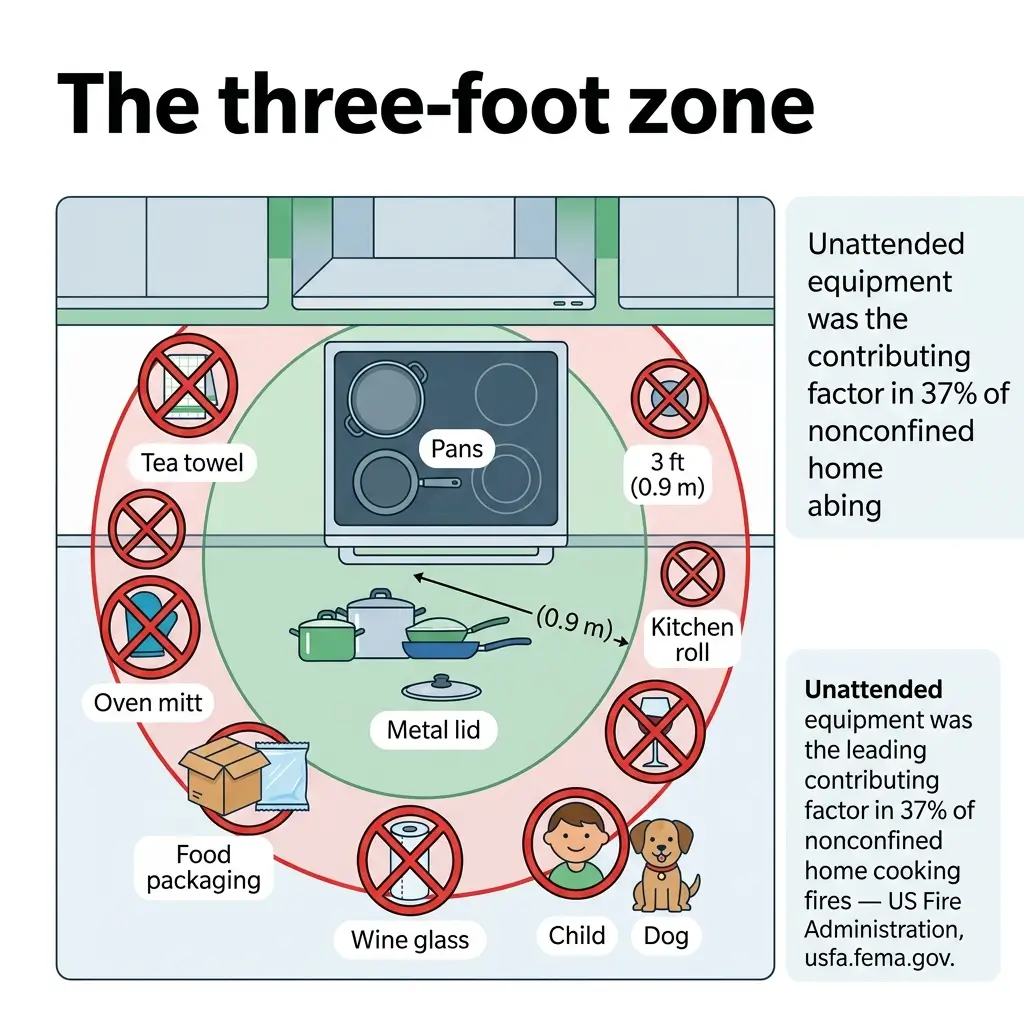
The single most useful number in this whole article is the US Fire Administration's cooking fire data: unattended equipment was the leading contributing factor in nonconfined home cooking fires, at 37 percent. Not faulty appliances. Not inexperience. Somebody left the room. The same source counted around 170,000 home cooking fires in 2021, causing an estimated 135 deaths and over $494 million in property loss.
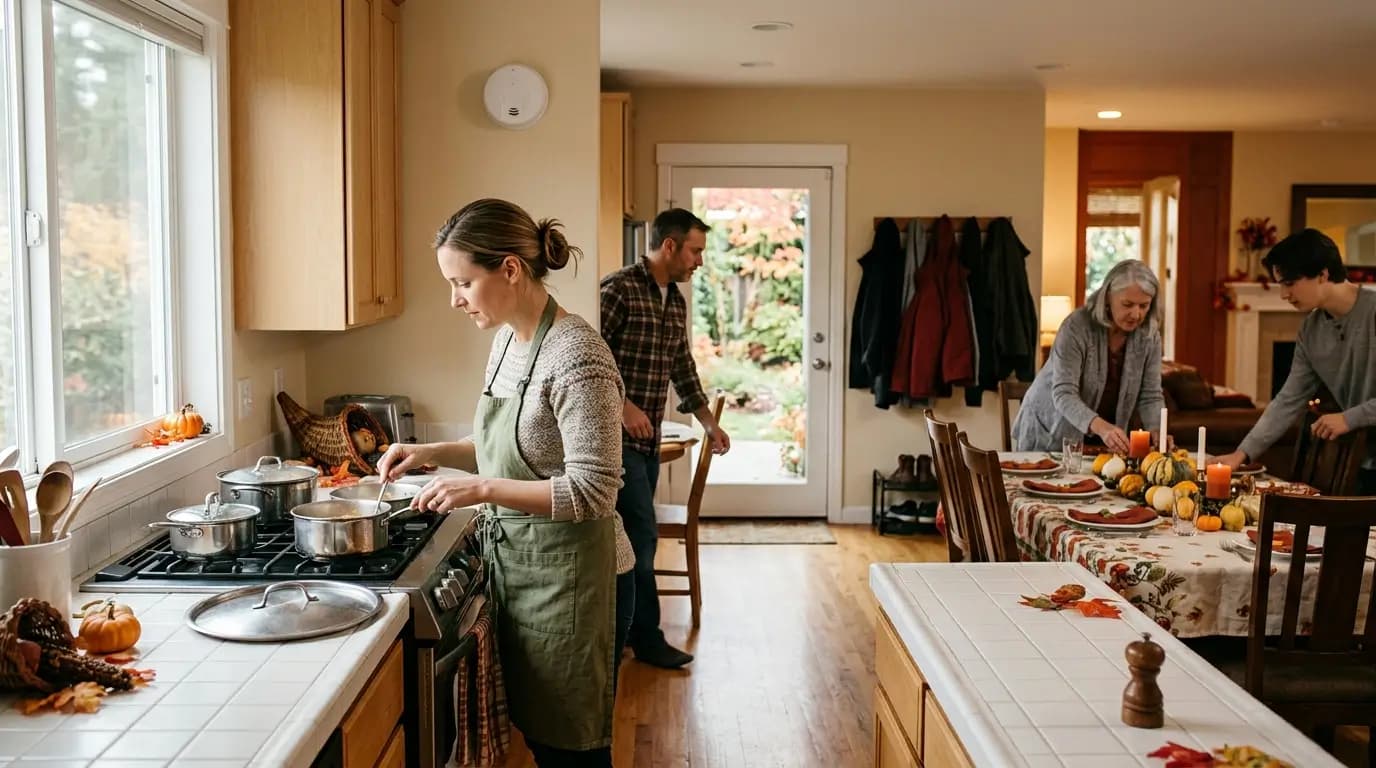
Thanksgiving is built to produce exactly that. Four burners running, an oven at capacity, a doorbell, a football game, and a relative you have not seen since last year asking you a question. The stove does not care that the interruption was reasonable.
The control that works is a physical one, not a resolution to be careful. If you leave the kitchen while something is on the stovetop, turn the burner off. That instruction sounds excessive until you have read enough incident reports where the gap between "just checking the door" and a flashover was under four minutes.
The controls that hold in a crowded kitchen
Space discipline is the other half. A three-foot clear zone around the cooktop — no oven mitts, tea towels, food packaging, wooden spoons or wine glasses — is the standard fire-safety guidance and it is also the one that collapses fastest when six people are working in a kitchen built for two.
The same three-foot rule works for people. Children and pets outside the zone, with a clear job somewhere else, is a control; "keep an eye on them" is not.
The specific habits that carry the most weight in a busy kitchen are:
- Turn the burner off when you leave the room — not down, off
- Set a timer for anything in the oven, and carry the timer with you
- Keep a metal pan lid beside the pan you are frying in, before you start heating oil
- Turn pot handles toward the back of the cooktop so they cannot be caught by a sleeve or a child
- Roll your sleeves up and tie back anything hanging — loose fabric over a gas ring ignites faster than most people believe
- Give one adult the stove, explicitly, and let them hand it over explicitly
Turkey fryers: the highest-consequence choice of the day
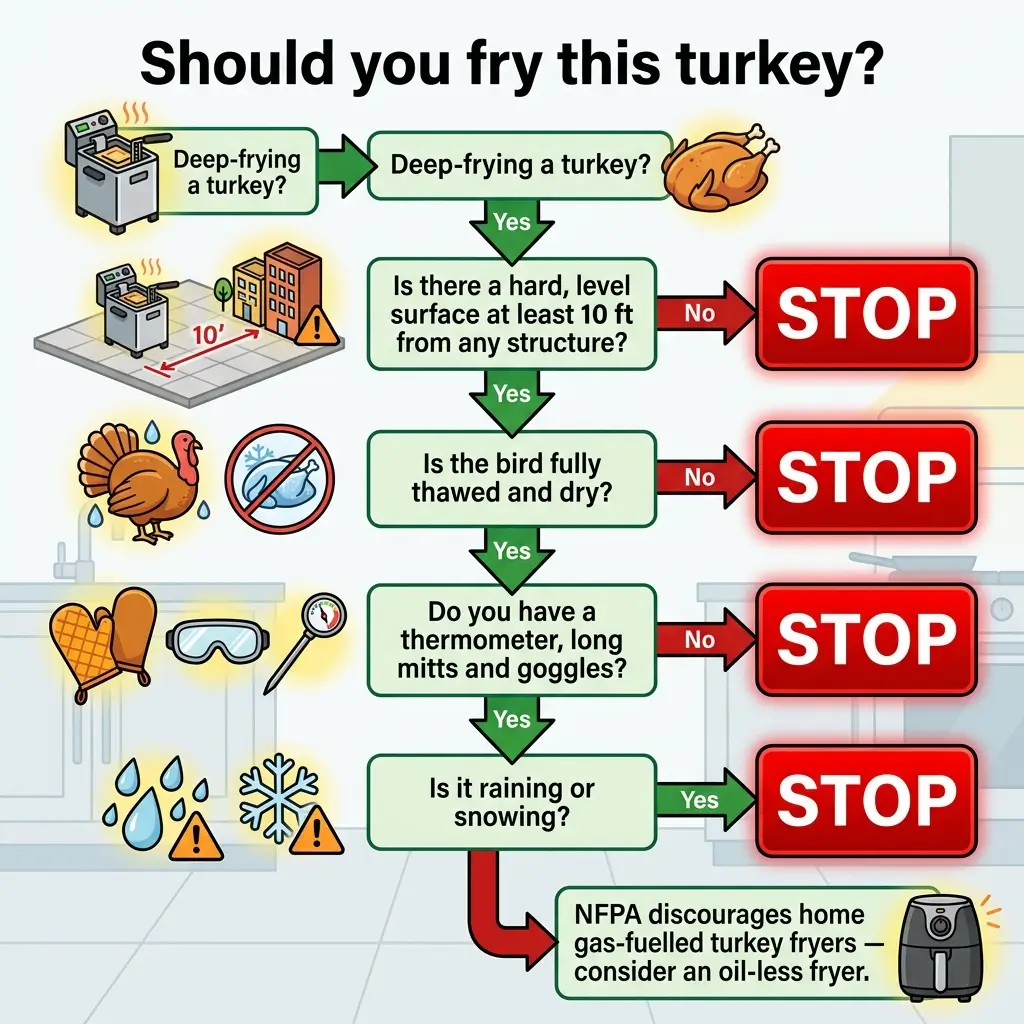
This is the one item on the menu where the worst credible outcome is not a ruined dinner. Deep-frying a turkey means three to five gallons of oil heated to around 350°F, standing on a tripod, over an open propane flame, usually on grass, usually by someone doing it for the first time this year.
NFPA discourages the use of outdoor gas-fuelled turkey fryers that immerse the bird in hot oil, and its position is unusually blunt: the association does not believe consumer education alone can make the risk acceptably low, because of the volume of hot oil involved and the speed and severity of burns on contact. Underwriters Laboratories has declined to certify these units with its mark. That is not a tip. That is two testing bodies saying the equipment class itself is the problem.
I take that position seriously, and I would rather you read it plainly than have it softened into a bullet point. If you want fried turkey without the hazard, an oil-less infrared fryer removes it entirely, and a good restaurant removes it along with the washing up.
If you are going to fry anyway, the failure modes are well documented and each has a specific countermeasure:
| Failure mode | What happens | Countermeasure |
|---|---|---|
| Overfilling | Displaced oil overflows onto the burner when the bird goes in and engulfs the unit | Water-displacement test first: submerge bird in water, mark the level, dry pot completely, fill oil to the mark |
| Frozen or wet bird | Ice flashes to steam inside the oil and ejects burning oil | Fully thawed and patted dry, outside and cavity |
| Tip-over | Tripod on soft or sloped ground collapses | Flat, level, hard ground — never a deck, garage, porch or breezeway |
| Overheating | No thermostat; oil passes its ignition point | Dedicated thermometer, watched continuously; gas off the moment oil smokes |
| Rain or snow | Water hits hot oil and flashes | Do not operate in wet weather |
| Contact burns | Handles and lid reach oil temperature | Long oven mitts, goggles, apron; stand upwind of the burner |
Two more constraints worth stating in their own right:
- Keep at least two feet between the burner and the propane cylinder, and know where the cylinder valve is before you light it
- Turn the burner off before lowering the bird, lower it slowly, then relight — this removes the ignition source during the highest-risk thirty seconds
If a fire starts, the first thirty seconds decide everything
Almost every home cooking fire that ends badly went wrong in the response, not the ignition. The pan fire itself is a small, contained event for a few seconds. What turns it into a house fire is a person doing the intuitive thing — reaching for water, or picking up the pan.
The pan fire sequence
Water on burning oil is not a mistake of degree, it is a physical impossibility handled badly. Water is denser than oil, sinks through it to a layer well above 100°C, and flashes into steam that ejects burning oil across the room and into your face. Carrying the pan outside does the same thing more slowly, because the airflow feeds the flame and the oil slops.
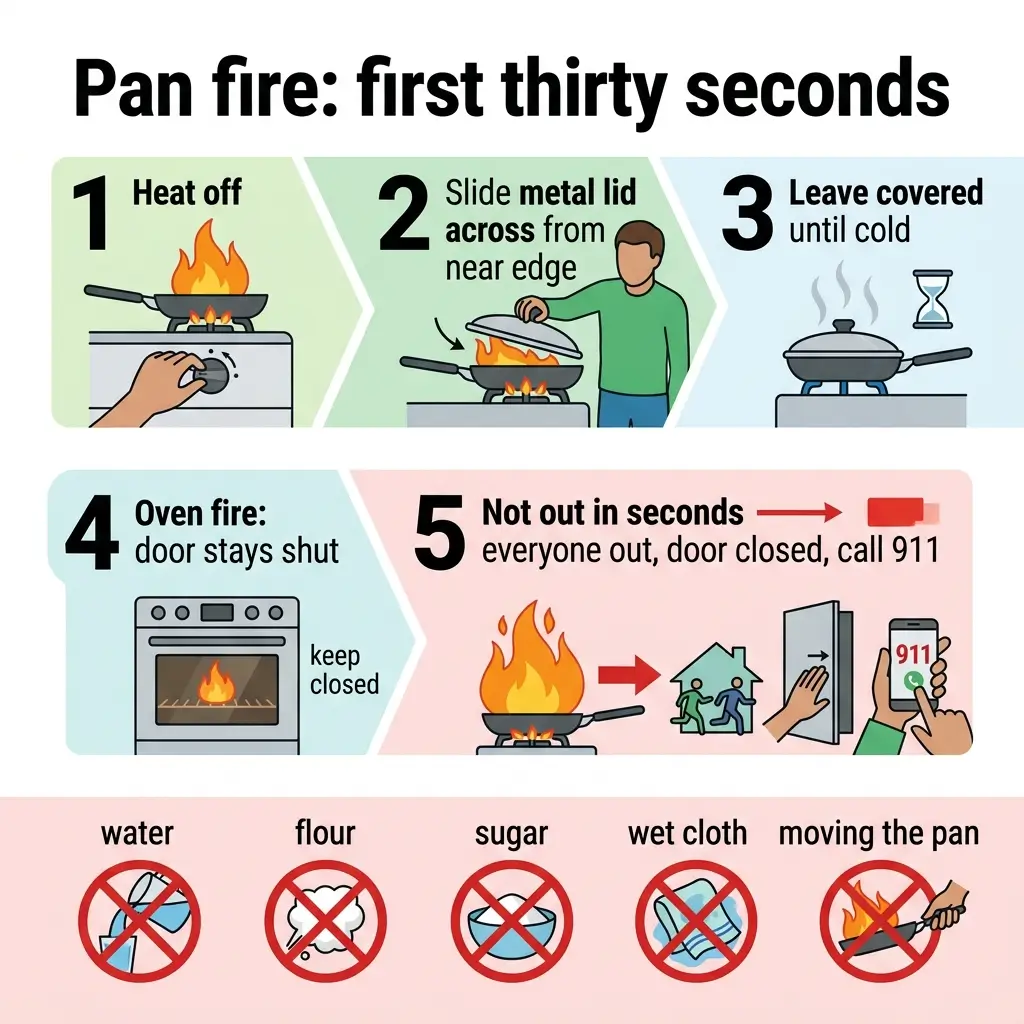
The sequence is:
- Turn off the heat if you can reach the control without passing over the flame
- Slide — do not drop — a metal lid or baking sheet across the pan, working from the near edge to the far edge so the lid shields your hand
- Leave it covered. The oil stays above its ignition point for many minutes; lifting the lid to look re-ignites it
- If it is an oven fire, keep the door shut and turn the oven off
- If the flame is not out within a few seconds, or has spread beyond the pan, leave. Close the door behind you, get everyone out, call 911 from outside, and do not go back in
Never use flour, sugar, or a wet cloth. Baking soda or salt in quantity will smother a very small flare, but a lid is better and faster.
Why the extinguisher on your wall is probably the wrong class
An extinguisher that is present, mounted, in date and wrong for the fuel is a control that fails at the moment of use — and it fails worse than no extinguisher, because someone stands and fights instead of leaving.
I ran a suppression interface scope for Viking Fire Protection in Malaysia, and on one walkdown I found exactly that at a solvent store: the unit at the door did not match the fuel behind it. Everything an inspection sheet checks was in order. The only thing wrong was the thing that mattered. I stopped the arrangement, had the correct provision reinstated, and briefed the crew before restart.
Cooking oil is its own fire class for this reason. Ordinary agents knock the flame down without cooling the oil below its auto-ignition temperature, and it relights.
| Class (US) | Class (UK/EU/AU) | Fuel | Right agent | Use at home? |
|---|---|---|---|---|
| A | A | Wood, paper, fabric | Water, foam, ABC dry powder | Yes |
| B | B | Flammable liquids, solvents | Foam, CO₂, ABC dry powder | Yes |
| C | — (covered under B/E) | Energised electrical equipment | CO₂, ABC dry powder | Yes |
| K | F | Deep-fat cooking oils and fats | Wet chemical (saponifies and cools) | The correct class for a fryer |
Source: fire class designations per NFPA 10 (US) and EN 3 (Europe); see the US Fire Administration's guidance on home fire extinguishers.
My honest position, and it is the one NFPA takes too: for a home cooking fire, the lid is the primary control and leaving is the fallback. An extinguisher is worth having, mounted near the exit rather than beside the stove so you never walk toward the fire to reach it — but only fight a fire you could walk away from at any moment.
Nobody counts heads at Thanksgiving — and that is the gap
I led muster assurance work for Kidde Fire Australia Partners, and the recurring finding across that scope was never the alarm or the assembly point. It was accountability at peak headcount: on a normal day the count works, and on the day with contractors, visitors and a shift overlap, nobody can say with confidence who is still inside.
A house on Thanksgiving is a site at peak headcount. Twenty people, half of whom do not know the layout, several sleeping in rooms they have never slept in, at least one person with limited mobility, small children who hide rather than run, and pets. If you evacuated that house at 2 a.m., who would be able to state — not guess — that everyone was out?
This is the section no Thanksgiving article writes, and it is the one that transfers most directly from industrial practice. It costs one sentence at the table.
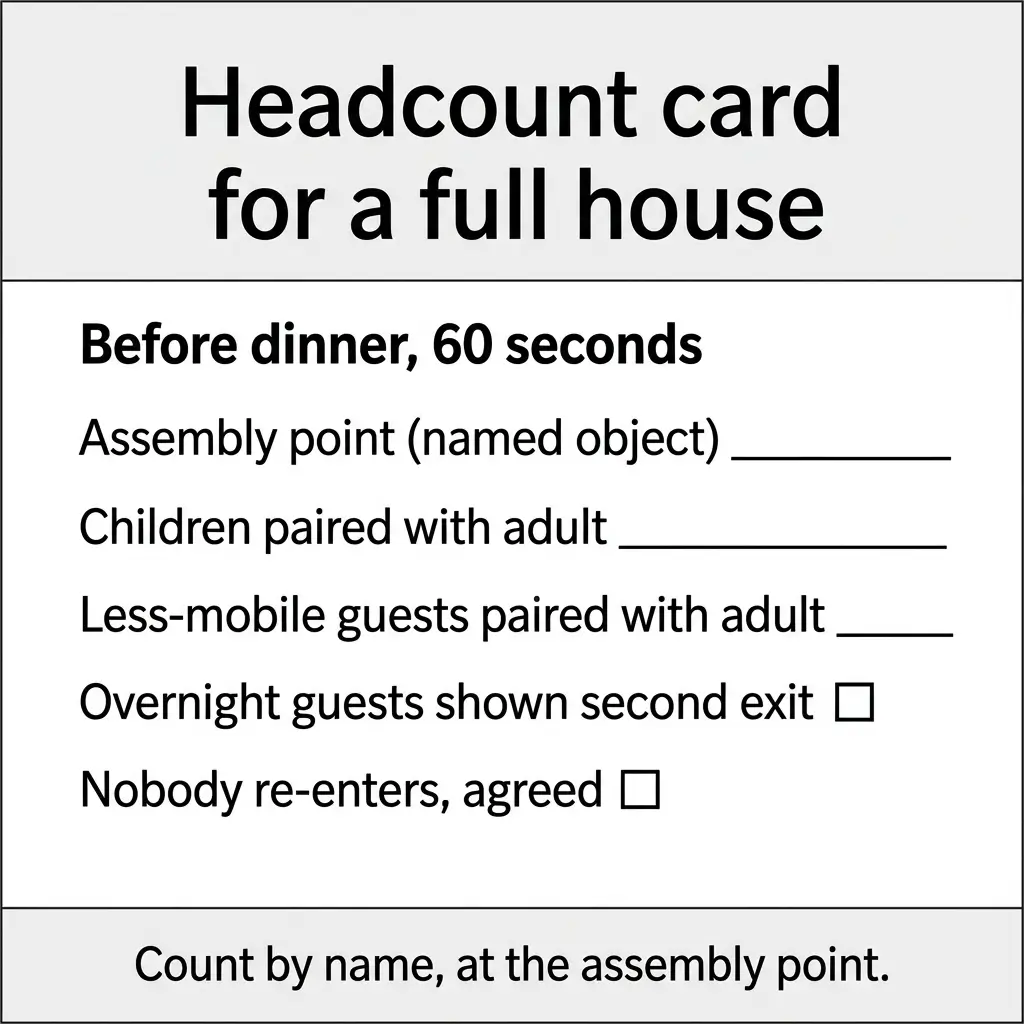
Name the arrangement out loud once, before dinner:
- Pick the assembly point — a specific object, not "outside." The mailbox. The neighbour's driveway. Something you can stand next to in the dark
- Assign each child and each less-mobile guest to a named adult, so responsibility is allocated rather than assumed
- Tell overnight guests where the second way out of their room is
- Agree that nobody re-enters for anything, including a pet, once they are out
- Count at the assembly point, by name, not by looking at the crowd and feeling reassured
Food safety: the three numbers that decide whether anyone gets sick
Fire is the dramatic hazard; foodborne illness is the likely one. USDA's Food Safety and Inspection Service reduces the whole turkey problem to three numbers, and they are worth memorising because most Thanksgiving food-safety failures are timing failures rather than hygiene failures.
Thawing is where the planning goes wrong. A 16 lb bird takes roughly four days in the refrigerator, which means it goes in the Friday before. The counter and the garage are both unsafe — FSIS is explicit that any frozen meat left more than two hours at room temperature has an outer layer sitting in the danger zone between 40°F and 140°F even while the centre is still solid.
| Number | Requirement | Detail |
|---|---|---|
| 24 hours per 4–5 lb | Refrigerator thawing at 40°F or below | A thawed bird keeps 1–2 more days; cold-water thawing is 30 min/lb, water changed every 30 min, cook immediately |
| 165°F | Safe internal temperature | Verified with a thermometer in three places: thickest part of the breast, innermost thigh, innermost wing |
| 2 hours | Maximum time out before refrigerating | Leftovers into shallow covered containers; safe in the refrigerator for 3–4 days |
Two further points that catch people out. Do not wash the raw turkey: CDC and USDA have advised against it since 2005, because rinsing spreads bacteria around the sink and onto surfaces up to about three feet away, and washing removes nothing that cooking would not kill. And a pop-up timer is a useful prompt, not a verification — FSIS still expects a thermometer reading in all three locations.
The habits that prevent most cross-contamination are:
- Prepare salads and anything uncooked before the raw turkey comes out of its packaging
- Wash hands with soap for 20 seconds before and after handling raw poultry and its wrapping
- Keep one board for raw meat and a different one for everything else
- Sanitise surfaces after contact — hot soapy water, then a solution of one tablespoon unscented liquid chlorine bleach per gallon of water
- Carve and divide leftovers into shallow containers so they cool fast enough to be safe
The drive home is the other half of the holiday
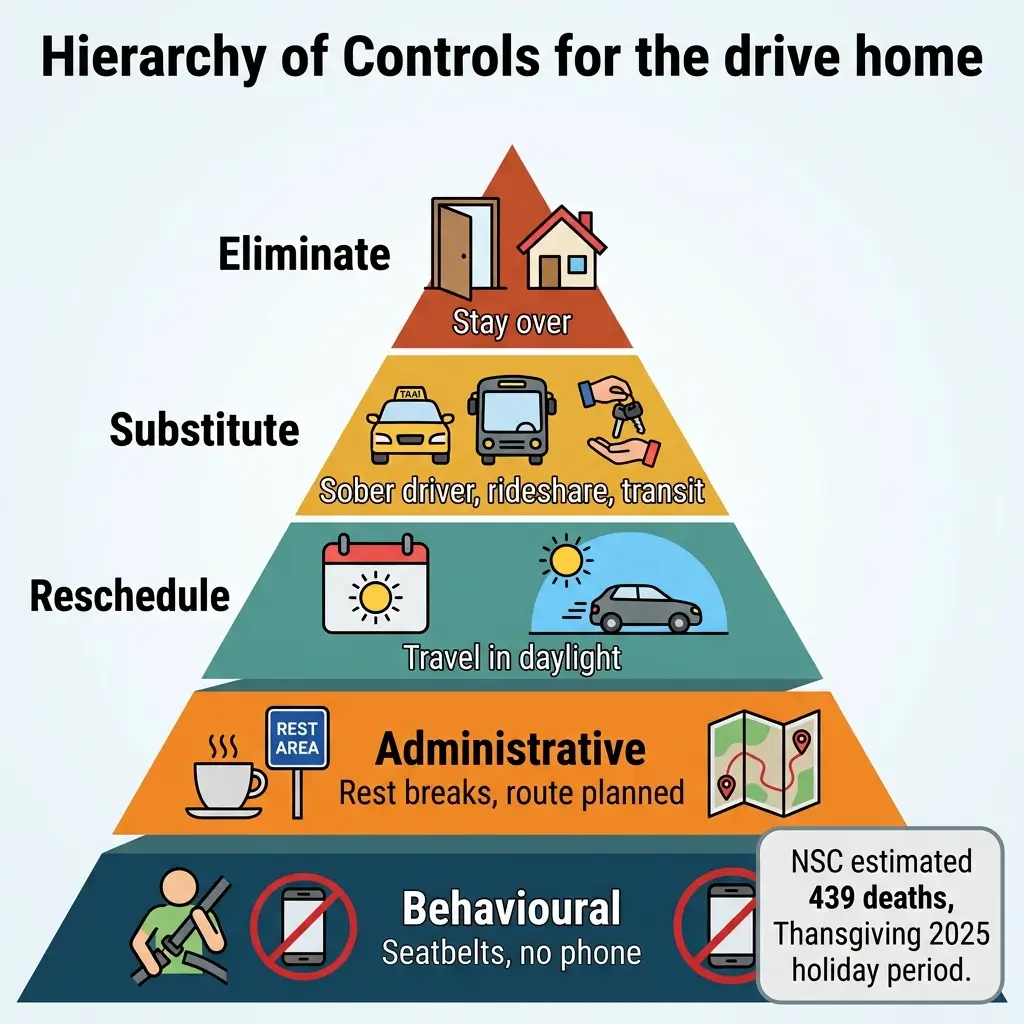
Everything above concerns a few square metres of kitchen. The largest single source of holiday fatalities sits on the road outside. The National Safety Council estimated 439 US road deaths for the 2025 Thanksgiving holiday period, which runs from Wednesday evening to Sunday night, and NHTSA data for 2018–2023 shows more than one-third of deaths in that period involved an alcohol-impaired driver.
The hazard is not only alcohol. It is a long drive at the end of a long day, after a heavy meal, often in the dark, on the busiest travel days of the year. If I assessed this as a work journey it would fail on fatigue alone.
Treat it the way you would treat any controlled risk — eliminate first, then substitute, and leave behaviour last, because behaviour is the weakest layer:
- Eliminate the journey — offer the spare room, or plan to stay
- Substitute the driver or the mode — nominate a sober driver before the first drink, or book the ride
- Reschedule — leaving Friday morning beats leaving Thursday at 11 p.m.
- Rest before driving, and stop if you start missing exits
- Everyone belted, every seat, including the short hop across town
If you are hosting this at work
Staff Thanksgiving lunches, community meals and shift catering move the whole problem into a workplace, where the duty holder is you rather than the host. The controls tighten accordingly, and improvised cooking is where organisations get caught.
Portable cooking appliances brought from home into an office kitchenette sit outside whatever fire strategy the building was designed around. So does a slow cooker on an extension lead in a corridor, and so does a barbecue on a loading bay. If it is not in the fire risk assessment, it does not belong in the building on the day.
When I check a site before a staff catering event, I ask two questions that usually settle it: what is being cooked that was not cooked here yesterday, and who is the warden on this shift. Reduced holiday staffing quietly removes the people the evacuation plan named.
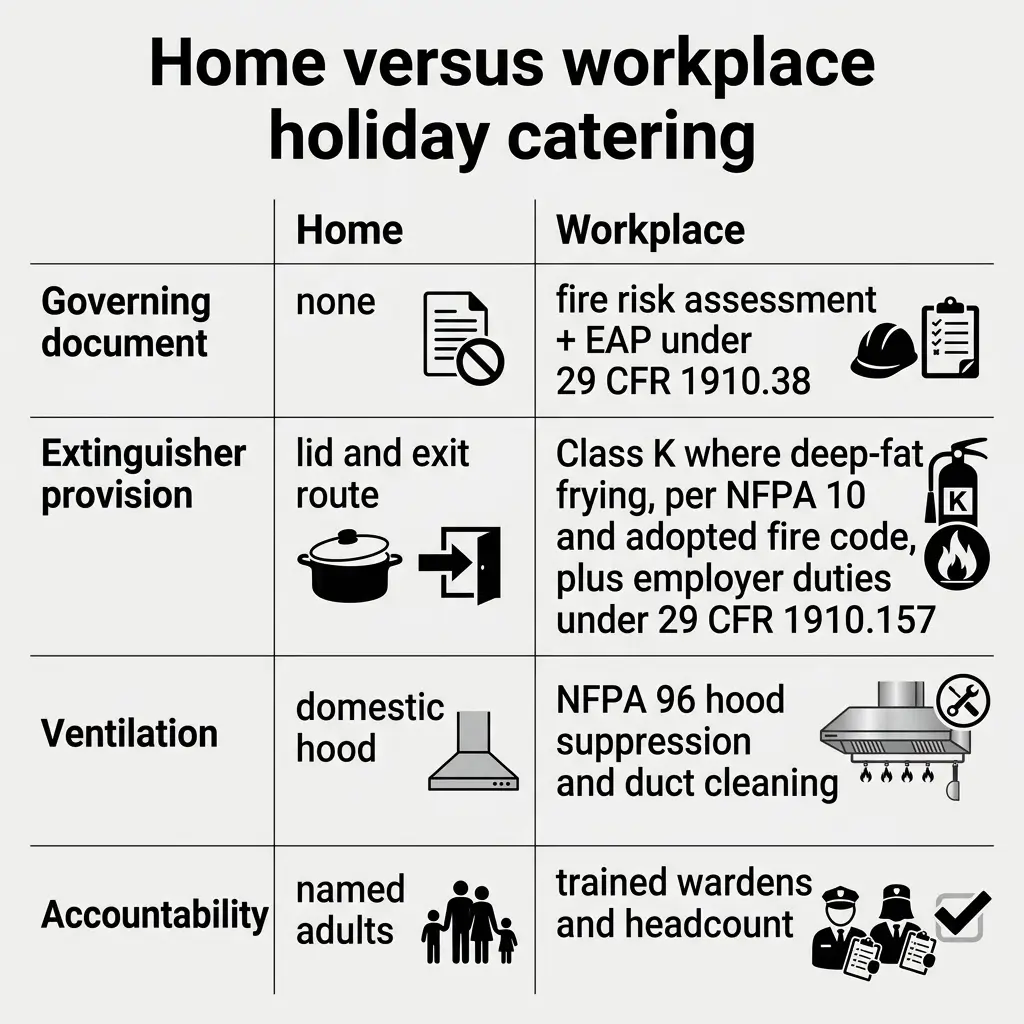
The differences that matter between the home and workplace versions of this article are:
- Commercial cooking operations fall under NFPA 96 for ventilation and fire protection — hood suppression, duct cleaning and filter condition are inspection items, not optional
- Class K wet chemical provision for deep-fat cooking comes from NFPA 10 and the fire code your jurisdiction has adopted, not from OSHA directly. OSHA's own duties for workplace portable extinguishers — selection, mounting, monthly inspection, annual maintenance and employee education — sit at 29 CFR 1910.157, and both apply at once
- Your emergency action plan still applies on a holiday shift under 29 CFR 1910.38, and paragraph (c)(4) requires procedures to account for all employees after evacuation — reduced staffing means the named wardens and the headcount arrangement need checking, not assuming
- Contractor caterers need the same briefing as any other contractor: escape routes, assembly point, who to call, where isolation points are
- Skeleton crews change the muster picture — the person who normally does the count may not be in
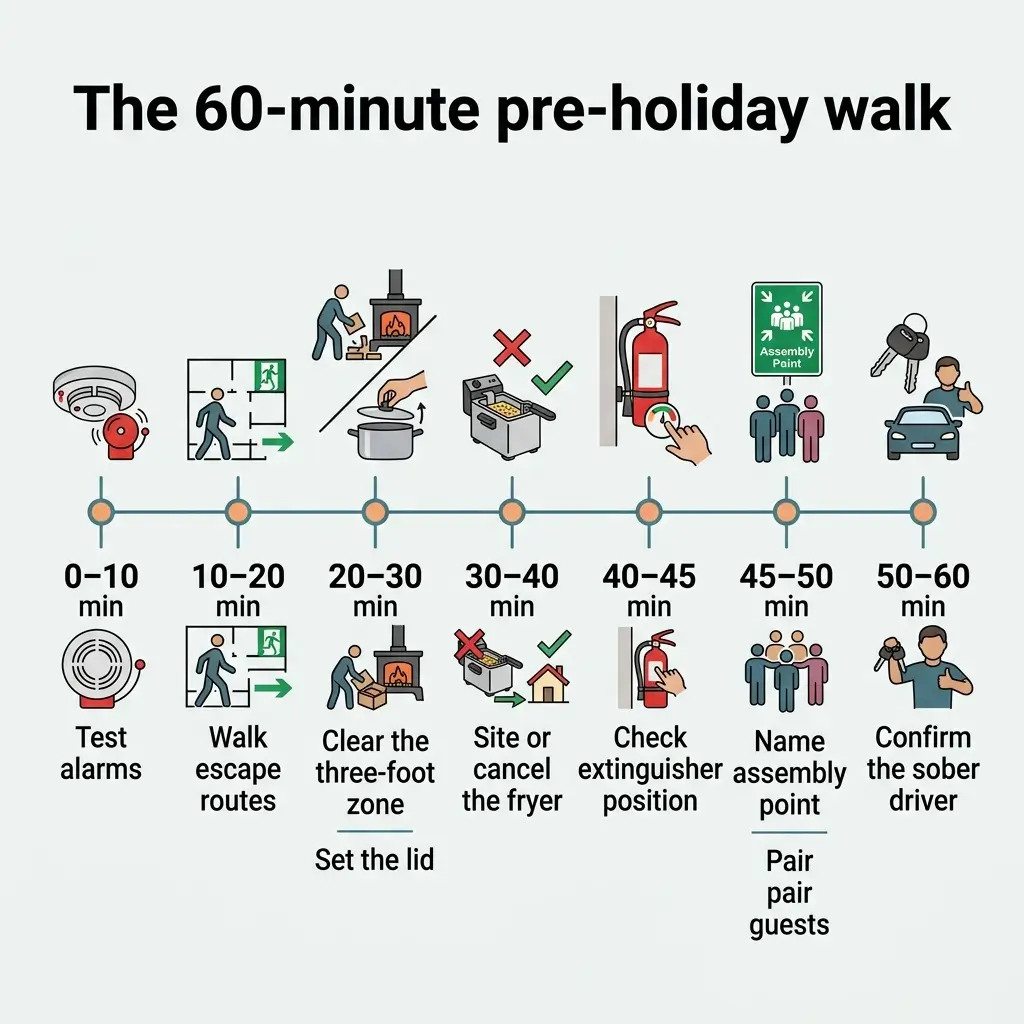
The hour before your guests arrive
If you do nothing else from this article, do this. It takes under an hour and it closes every control described above. I run the same sequence on a site walk, in the same order — detection, egress, ignition, response, accountability — because that is the order in which things fail.
None of it requires equipment you do not already own, and none of it needs to happen on the day itself. I start by testing detection, because it is the control that costs nothing and fails silently.
Work through it in this order:
- Press the test button on every smoke and CO alarm. Replace any battery that chirps; replace any unit past ten years
- Walk both escape routes with the furniture where it will actually be, at ankle height
- Clear three feet around the cooktop and put a metal lid beside the pan you will fry in
- Site the fryer, if you are using one, on hard level ground well clear of the house — or decide now that you are not
- Check the extinguisher is where you can reach it without walking toward the stove
- Name the assembly point and pair up the children and less-mobile guests — out loud, once, at the table
- Confirm who is driving home sober, before anyone pours anything
Frequently asked questions
These are the questions people actually search for in the week before the holiday, answered in the order they tend to come up.
Why is Thanksgiving the worst day of the year for house fires?
Because it concentrates the two conditions that cause cooking fires: many appliances running at once and a cook who keeps being interrupted. NFPA recorded an estimated 1,446 US home cooking fires on Thanksgiving Day 2023, a 388 percent increase over the daily average. The mechanism is distraction, not inexperience.
What should I do if a grease fire starts in a pan?
Turn off the heat, then slide a metal lid or baking sheet across the pan from the near edge and leave it covered until the pan is cold. Never use water, flour or a wet cloth, and never move the pan. If it is not out in a few seconds, get everyone out and call 911.
Is it safe to deep-fry a turkey at home?
NFPA discourages home use of outdoor gas-fuelled fryers that immerse the bird in hot oil, and states that consumer education alone cannot make the risk acceptably low. UL does not certify these units. If you fry anyway, use hard level ground clear of structures, a fully thawed and dried bird, and a thermometer.
How long can Thanksgiving food safely sit out?
Two hours, per USDA — one hour if the room is above 90°F. After that, food has been in the danger zone between 40°F and 140°F long enough for bacteria to multiply. Divide leftovers into shallow covered containers and refrigerate; they keep three to four days.
What temperature does turkey need to reach?
165°F, verified with a food thermometer in three places: the thickest part of the breast, the innermost part of the thigh, and the innermost part of the wing. A pop-up timer is a prompt, not a verification. Stuffing cooked inside the bird must also reach 165°F.
Should I wash my turkey before cooking it?
No. USDA and CDC have advised against washing raw poultry since 2005, because rinsing splashes bacteria up to about three feet around the sink and onto other food. Cooking to 165°F kills what washing cannot remove. Only a brined bird needs rinsing, with the sink area cleared and sanitised afterwards.
Where should a fire extinguisher go in a kitchen?
Near the exit, not beside the stove — so you never have to walk toward a fire to reach it. Cooking oil is Class K in the US and Class F in the UK, Europe and Australia, and needs a wet chemical agent. For a domestic pan fire, a metal lid remains the faster and safer control.
About the author
Mia Collins is a Principal Fire Life Safety & Emergency Response Assurance Consultant with 15 years of field experience across 14 countries in Oceania, Asia, the Middle East, Europe and the Americas. Her work is field verification — checking that detection, egress, suppression and muster arrangements still function under night shift, contractor and schedule pressure. She has inspected 180+ workplaces, conducted 70+ audits and investigated 45+ incidents. She currently leads Collins Fire & Emergency Assurance in Brisbane, Australia, following egress integrity and muster assurance roles with Chubb Fire & Security AU and Kidde Fire Australia Partners, and suppression interface work with Viking Fire Protection.
Credentials: NEBOSH International General Certificate; ISO 45001 Lead Auditor; ISO 14001 Internal Auditor; IOSH Managing Safely; Incident Investigation (ICAM pathway); Fire Safety Awareness; Emergency Response Planning Awareness; First Aid/CPR.
Scope and limits: this article covers domestic fire, food and travel risk for a US Thanksgiving, plus a short workplace-catering note. It is not a fire risk assessment and does not replace one. Where a workplace, licensed premises or multi-occupancy building is involved, the fire risk assessment must be completed or reviewed by a competent person.
Sources
- NFPA, Thanksgiving is leading day of the year for U.S. home cooking fires (November 2025) — https://www.nfpa.org/about-nfpa/press-room/news-releases/2025/thanksgiving-is-leading-day-of-the-year-for-us-home-cooking-fires
- NFPA, Thanksgiving safety tips, including its position on turkey fryers — https://www.nfpa.org/education-and-research/home-fire-safety/thanksgiving
- US Fire Administration, Cooking Fire Safety — https://www.usfa.fema.gov/prevention/home-fires/prevent-fires/cooking/
- US Fire Administration, Fire extinguishers — https://www.usfa.fema.gov/prevention/home-fires/prepare-for-fire/fire-extinguishers/
- US Fire Administration, Turkey fryer fire safety infographic (PDF) — https://www.usfa.fema.gov/downloads/pdf/publications/turkey-fryer-fire-safety-infographic.pdf
- USDA FSIS, Turkey Basics: Safe Thawing — https://www.fsis.usda.gov/food-safety/safe-food-handling-and-preparation/poultry/turkey-basics-safe-thawing
- USDA FSIS, Let's Talk Turkey — A Consumer Guide to Safely Roasting a Turkey — https://www.fsis.usda.gov/food-safety/safe-food-handling-and-preparation/poultry/lets-talk-turkey-roasting
- USDA FSIS, Your Safe Thanksgiving Guide — https://www.fsis.usda.gov/food-safety/safe-food-handling-and-preparation/poultry/your-safe-thanksgiving-guide
- CDC, Preparing Your Holiday Turkey Safely — https://www.cdc.gov/food-safety/foods/holiday-turkey.html
- National Safety Council Injury Facts, Thanksgiving Motor Vehicle Fatality Estimate — https://injuryfacts.nsc.org/motor-vehicle/holidays/thanksgiving-day/
- OSHA, 29 CFR 1910.38 Emergency action plans — https://www.osha.gov/laws-regs/regulations/standardnumber/1910/1910.38
- OSHA, 29 CFR 1910.157 Portable fire extinguishers — https://www.osha.gov/laws-regs/regulations/standardnumber/1910/1910.157
- NFPA 72, National Fire Alarm and Signaling Code, Chapter 29, clause 29.11.3.4 (smoke alarm location relative to cooking appliances)
- NFPA 10, Standard for Portable Fire Extinguishers (fire class designations, including Class K); EN 3 for the European Class F designation
- NFPA 96, Standard for Ventilation Control and Fire Protection of Commercial Cooking Operations