
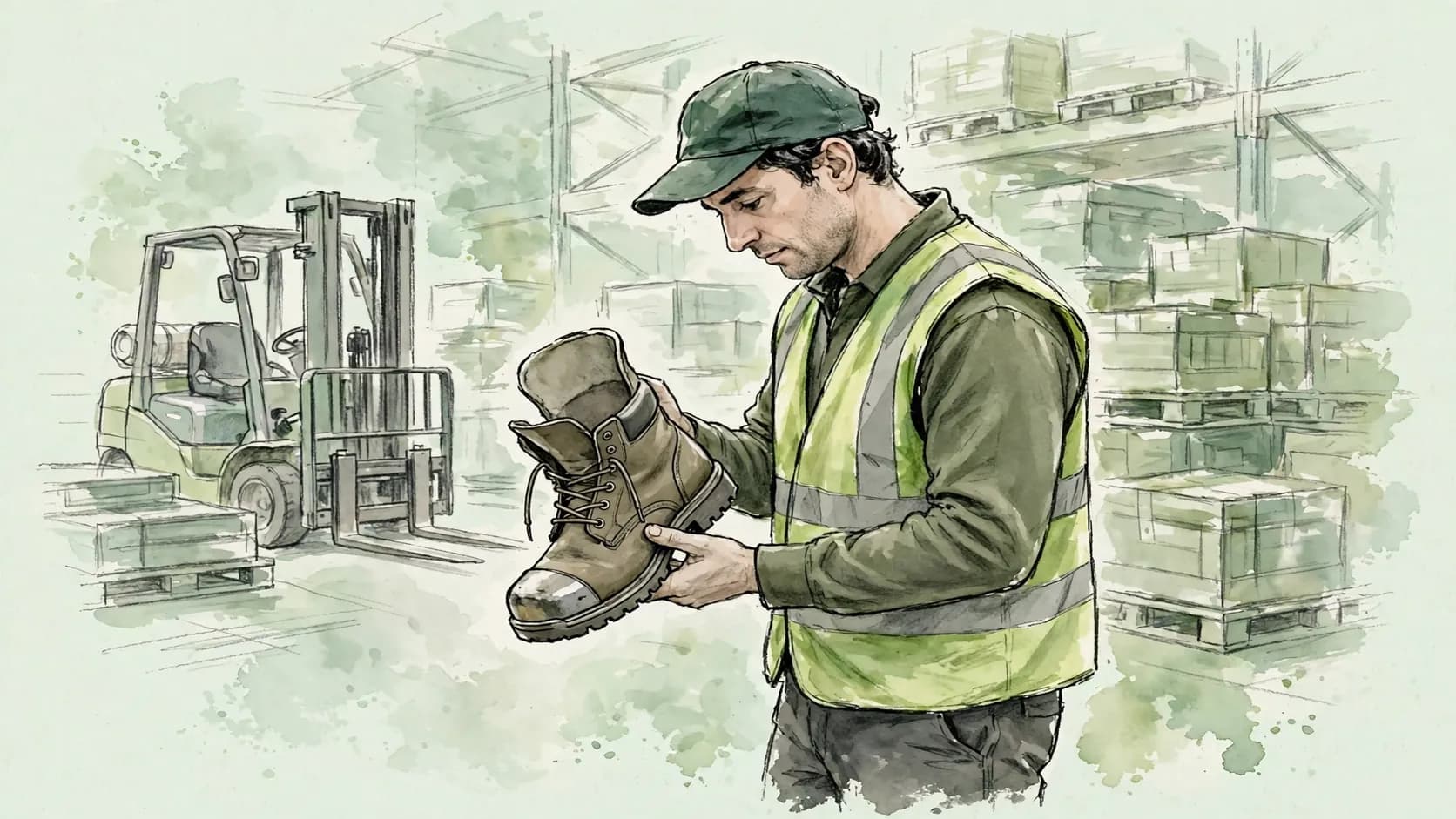
Steel toe boots protect your feet from the three things that injure them most at work: falling and rolling objects, sharp objects that pierce the sole, and electrical hazards. The protection comes from the rating stamped on the label inside the boot, not from the material of the toe cap — a steel, composite or alloy cap must all pass the same impact and compression tests.
What follows decodes the two rating systems that matter, ASTM F2413 in the United States and EN ISO 20345 in Europe and the UK, compares the three toe-cap materials, and shows how to choose the right pair for the job.
What steel toe boots protect against#
Steel toe boots are personal protective equipment (PPE). Like all PPE they are the last resort in the hierarchy of controls — elimination, substitution, engineering controls, administrative controls, then PPE. They protect the wearer, not everyone nearby, and they only protect when they are worn, which is why fit and comfort matter as much as the rating.
In the United States, OSHA's foot protection standard (29 CFR 1910.136) requires the employer to ensure that each affected employee uses protective footwear when working in areas where there is a danger of foot injuries due to falling or rolling objects, or objects piercing the sole, or when protective footwear will protect the employee from an electrical hazard — a static-discharge or electric-shock hazard — that remains after the employer takes other necessary protective measures.
Before selecting any PPE, the employer must assess the workplace to determine which hazards are present or likely to be present, under OSHA's general PPE requirements (29 CFR 1910.132). In the UK, the Personal Protective Equipment at Work Regulations 1992 require PPE wherever risks to health and safety cannot be adequately controlled in other ways, and the employer must provide suitable PPE free of charge if a risk assessment shows it is needed.
The PPE must be properly assessed before use to make sure it is fit for purpose, maintained and stored properly, provided with instructions on how to use it safely. Used correctly — and workers must be given sufficient information, instruction and training.
The three hazards the standards are built around are falling objects (a fumbled tool, dropped materials), compression (a vehicle wheel or equipment rolling over the foot), and punctures (nails, screws and sharp debris underfoot). The ratings add protection for the hazards that follow from the work itself: electrical shock, static discharge, slips, and blows to the top of the foot.
Matching the rating to the hazard is the whole job — a boot with the wrong ratings is a boot that does not protect you.
Safety ratings: the US system (ASTM F2413)#
Safety footwear sold in the United States is certified to a standard published by ASTM International, a nonprofit organisation that develops voluntary consensus standards. The footwear standard is ASTM F2413, Standard Specification for Performance Requirements for Protective (Safety) Toe Cap Footwear. The current edition, F2413-24, was published in 2024, and the test methods sit in a companion standard, ASTM F2412.
ASTM F2413 superseded the older ANSI Z41 standard, so a legacy Z41 reference on a spec sheet is out of date — although OSHA's regulation still names ASTM F2413-2005 and ANSI Z41-1999 and Z41-1991 as acceptable standards, and deems footwear at least as effective as those standards compliant.
F2413 sets minimum performance requirements. Two are mandatory for every certified shoe:
- Impact resistance (I): the toe cap withstands an impact of 75 foot-pounds, equivalent to a 50-pound object dropped from 18 inches.
- Compression resistance (C): the toe cap withstands 2,500 pounds of compressive force.
In both tests the toe cap must keep a minimum amount of clearance above the toes — at least half an inch for a men's boot and 15/32 of an inch for a women's boot. Older footwear may be marked I/75 and C/75. The 2018 edition removed a lower protection tier and shortened the markings to I and C; the required protection level did not change.
All other F2413 ratings are optional, and each is selected for a hazard the assessment identified:
| Marking | Protection | Test |
|---|---|---|
| Mt | Metatarsal protection | Guard over the instep, tested at 75 foot-pounds, maintaining one inch of clearance to the top of the foot |
| EH | Electrical hazard | Sole and heel withstand 18,000 volts at 60 Hz for one minute with no more than 1.0 milliampere of current leakage, in dry conditions; secondary protection only |
| SD | Static dissipative | Allows static electricity to drain to the ground at a controlled rate, in tiers (SD 10, SD 35, SD 100) |
| CD | Conductive | Much lower electrical resistance than SD; keeps the wearer at the same potential as the ground. Must never be worn where employees could contact live electrical circuits |
| PR | Puncture resistance | Plate in the sole withstands 270 pounds of force |
| SR | Slip resistance | Coefficient of friction of 0.40 or greater on dry and wet quarry tile |
| SRO | Slip resistance on oily surfaces | Meets SR and a coefficient of friction of at least 0.33 on quarry tile coated with oil and water |
| DI | Dielectric insulation | Protection against higher electrical exposure than EH, used mainly in electric utility work |
| CS | Chainsaw cut resistance | Used in forestry and tree care |
Three of these ratings are commonly confused, and confusing them can be dangerous.
- EH footwear insulates the wearer from the ground — its outsole and heel reduce the current that can flow through the body if the wearer accidentally contacts a live circuit, and protection decreases when the sole is wet, worn or contaminated.
- SD and CD footwear deliberately connect the wearer to the ground, in opposite directions: SD drains static at a controlled rate to protect static-sensitive components, while CD keeps the wearer at the same potential as the ground so static cannot build up at all.
EH does not replace primary electrical safety controls such as de-energising equipment and lockout/tagout. There is a third standard in the family worth knowing: ASTM F2892 covers soft-toe protective footwear — shoes and boots with no protective toe cap that still carry EH, CD, SD or PR ratings.
Safety ratings: the European system (EN ISO 20345)#
EN ISO 20345 is the European standard for safety footwear, used in the UK and much of the world. Its defining feature is a toe cap rated to a 200-joule impact and 15 kN of compression — that is what separates safety footwear from lesser protective or occupational footwear. The current version is EN ISO 20345:2021.
A basic pass is marked SB; graded categories S1, S1P, S2, S3, S6 and S7 add antistatic, energy-absorption, water-resistance, anti-penetration and outsole properties on top.
| Category | Toe cap | Adds on top of SB | Where it is enough |
|---|---|---|---|
| SB | 200 J | Basic requirement plus baseline slip resistance | Light handling, dry indoor floors |
| S1 | 200 J | Closed seat region, A (antistatic), E (energy absorption at heel), FO (fuel-oil-resistant outsole) | Dry-indoor safety shoe; assembly, packaging, dry warehouses |
| S1P | 200 J | S1 plus P (penetration resistance) | Warehouses with a puncture risk but no water |
| S2 | 200 J | S1 plus WPA (water penetration and absorption of the upper) | Wet floors, food processing, cleaning crews |
| S3 | 200 J | S2 plus P plus a cleated (profiled) outsole | Construction, demolition, scrap, roofing — the workhorse outdoor spec |
| S4 | 200 J | All-rubber or all-polymer footwear, antistatic, energy absorption, cleated outsole | Wet processing, fish, dairy, chemical wash-down |
| S5 | 200 J | S4 plus penetration resistance and cleated outsole | Heavy wet sites with a nail risk |
| S6 | 200 J | S2 plus WR (whole-shoe water resistance) | Fully water-resistant dry-indoor work |
| S7 | 200 J | S3 plus WR (whole-shoe water resistance) | Fully water-resistant construction and outdoor work |
Every level above SB keeps the same 200 J toe cap. The upgrade is about the sole, the upper and where the shoe can be worn — higher number means more protection, not a stronger toe. The tests behind the codes are specific.
- Impact: a 20 kg striker dropped from one metre onto the toe cap; at least 14 mm of clearance must remain inside.
- Compression: a separate test at 15 kN.
- Penetration resistance (P): drives a hardened steel nail, 4.5 mm in diameter, into the sole at 10 mm per minute at four positions; it must not pass through, and the plate must withstand a force of 1,100 N.
- Antistatic (A): requires the electrical resistance of the finished shoe to sit between 100 kΩ and 1,000 MΩ.
The 2021 revision matters because a lot of old spec sheets still get it wrong. Slip resistance is now a mandatory baseline for every safety shoe. The old SRA, SRB and SRC ratings were withdrawn — an optional SR mark now flags enhanced slip performance tested against extra conditions.
Non-metallic penetration codes PL (4.5 mm nail) and PS (3.0 mm nail) were added next to the steel-midsole P, and two new categories, S6 and S7, give a whole-shoe water-resistant option. Two new optional markings were added, SC for scuff-cap abrasion resistance and LG for ladder grip. If a supplier is still quoting SRC as a selling point on a 2021-certified shoe, their paperwork has not been updated.
Three further codes appear on spec sheets: M for metatarsal protection, AN for ankle protection, and C for conductive footwear — the European equivalents of the ASTM Mt and CD ratings.
Do not confuse the three European footwear standards.
- EN ISO 20345 is safety footwear with a 200 J toe cap.
- EN ISO 20346 is protective footwear with a 100 J toe cap — the same criteria, lower demands on the toe protector, marked with P instead of S.
- EN ISO 20347 is occupational footwear with no toe cap at all, covering comfort, slip and antistatic properties only.
And EN ISO 20345 and ASTM F2413 are not interchangeable: they use different impact energies, different test methods and different markings. A shoe certified to one is not automatically compliant with the other — you spec to the standard your destination market enforces.
Steel, composite and alloy toe caps#
The most common question about safety boots is which toe cap is strongest. The answer is that none is certified as stronger than the others: steel, composite and alloy toe caps must all pass the same impact and compression tests. If a shoe carries the I and C markings, it met the same requirements regardless of the cap material. The choice comes down to practical differences in weight, thickness, heat and cold, and metal detection.
| Weight | Transmits heat and cold | Metal detectors | Best suited to | |
|---|---|---|---|---|
| Steel | Heaviest | Yes | Sets them off | Cost-sensitive programmes; proven durability |
| Alloy (aluminium or titanium) | Lighter than steel; slimmest toe box | Yes, less than steel | Sets them off | Warehouse and shop floors where a lighter, low-profile shoe is preferred |
| Composite (fibreglass, carbon fibre or aramid fibres such as Kevlar) | Lighter than steel; bulkier toe box | No | Passes if the entire shoe is non-metallic | Cold storage; sites with metal detector screening; electrical work |
Two points catch buyers out.
- First: a composite toe cap contains no metal, but eyelets, shanks and other hardware may — so if employees pass through metal detectors, confirm that the entire shoe is non-metallic, not only the toe.
- Second: toe material does not determine whether footwear protects against electric shock. The toe cap is fully enclosed inside the shoe; shock protection comes from the insulating sole of footwear certified with an EH rating, and steel-toe footwear can carry an EH rating. A composite toe alone does not provide certified shock protection. If you want non-metallic construction for electrical work, specify a composite toe with an EH rating.
Weight is worth comparing properly. Comparing toe caps alone can be misleading: employees feel the weight of the entire shoe. A low-cut steel-toe oxford can weigh less than a tall, waterproof composite-toe boot. If weight is a priority, compare finished footwear rather than selecting by cap material.
In a 2018 study, boots weighing 2 pounds required up to 7% more energy to walk in than boots weighing 1 pound — and footwear is lifted with every step, so that difference accumulates over a full shift.
Types of safety boots#
Safety boots come in styles built around the job, not around the brand. The style matters because it decides whether the boot is actually worn — and a boot that is not worn protects no one.
- Work boots — the standard lace-up boot, usually 6 or 8 inches tall, for construction, manufacturing and general industry. The most common style, and the one most ratings are written for.
- Athletic and hiker-style safety shoes — lighter, lower-cut, built for workers who walk all day on hard floors, such as warehouse and logistics staff. Alloy or composite toes suit them best, with SR or SRO slip resistance and cushioning.
- Slip-on and pull-on boots — for workers who must remove footwear often, or for wet and wash-down areas. Rubber and polymer boots (S4 and S5 under EN ISO 20345) are the wash-down choice.
- Metatarsal-guard boots — with a guard over the instep, for work where heavy objects can fall onto or strike the top of the foot. The toe cap does not cover the metatarsals; the guard does.
- Waterproof and insulated boots — for wet work and cold storage. Choose a composite toe for cold storage, because metal caps transmit cold — and remember the toe cap alone does not keep feet warm, so specify insulation and lining suited to the temperature as well.
- Electrical-hazard boots — EH-rated, for maintenance and electrical work. Specify the EH rating on the label, not the toe material.
Match the style to the environment, not the catalogue.
- Warehousing and logistics: light weight, SR or SRO slip resistance, cushioning.
- Light manufacturing: confirm the EH rating, or specify the SD tier your process requires.
- Cold storage and freezers: composite toe plus insulation.
- Sites with metal detector screening: fully non-metallic construction.
- Construction, demolition and scrap: add puncture resistance (PR) and metatarsal protection (Mt) where objects can strike the top of the foot.
- Healthcare and food service: slip resistance and all-day comfort, often in a low-cut oxford style.
Where chemical hazards are handled, the outsole and upper must resist the chemicals in use — a standard safety boot is not automatically chemical-resistant.
How to choose the right pair#
Work backwards from the hazard, not the price. The cheapest compliant shoe is rarely the lowest total cost, because a shoe that is uncomfortable or short-lived is replaced more often and worn improperly more often.
- Start with the hazard assessment. List the hazards the wearer will actually face: falling or rolling objects, sharp objects underfoot, wet or oily floors, electrical or static exposure, cold or heat. The assessment decides the ratings, and the ratings decide the boot.
- Match the rating to the hazard. Impact or crush risk means a 200 J toe cap (EN ISO 20345) or I/75 C/75 (ASTM F2413) — the baseline safety line. Sharp objects underfoot mean penetration resistance (P, PL or PS under EN ISO 20345; PR under ASTM F2413). A wet environment means S2 or S3, or S6 or S7 for whole-shoe water resistance. Slip risk means baseline slip resistance, with SR for enhanced performance. Static, electrical or explosive-atmosphere work means A, EH or SD as the job requires. Cold, heat, ladders or scuffing mean CI, HI, HRO, LG or SC.
- Check the label, and name the standard in the purchase specification. The certification marking appears inside the shoe, typically on the tongue, and identifies the standard edition and every rating the shoe has earned — for example, ASTM F2413-18 M I/75 C/75 EH. Footwear advertised as "safety toe" without that marking has not been certified to the standard. When writing a purchase specification, name the standard and the specific ratings required, and ask for the test report from an accredited lab: a code on a box is a claim, and the lab report is the evidence.
- Get the fit right. Safety footwear protects employees only when they wear it, so fit and comfort directly affect a programme's effectiveness. Women's feet generally differ in proportion from men's, so employees should have access to footwear designed for women rather than smaller men's sizes. When launching or updating a programme, consider an on-site fitting event so employees can try sizes and styles before footwear is issued — that reduces returns and poorly fitting footwear. Allow a break-in period, and listen when workers say a boot does not fit: an unworn boot is an unprotected foot.
- Settle who pays before you buy. Under OSHA's rule on payment for protective equipment (29 CFR 1910.132(h)), employers must provide required PPE at no cost to employees. The rule makes an exception for ordinary safety-toe footwear, including steel-toe shoes and boots, if employees are permitted to wear it off the job site. The exception does not apply where the footwear must stay at the workplace, or where the footwear is specialty footwear — OSHA has identified steel-toe rubber boots as specialty footwear — and it does not cover built-in metatarsal protection where the employer provides detachable guards instead. Many employers offer a footwear allowance even when the exception applies, which gives them more control over the footwear employees wear; that is a policy decision, not an OSHA requirement. In the UK, the position is simpler: under the Personal Protective Equipment at Work Regulations 1992, the employer must provide suitable PPE free of charge when a risk assessment shows it is needed, and section 9 of the Health and Safety at Work etc. Act 1974 prohibits charging employees for measures required by health and safety law.
Inspection and replacement#
Safety footwear performs to its certified level only while its components are intact. Include regular inspection in the programme, because worn footwear can appear serviceable after its protection has degraded.
Remove footwear from service if the toe cap has sustained a significant impact, the cap is cracked or exposed, the midsole is compressed, the outsole tread is worn smooth, or an EH-rated sole is damaged. Set a replacement interval appropriate to the work environment, and document it.
If a boot fails in service and a foot injury occurs, follow your site's emergency procedures — and debrief afterwards, so the failure is understood, not just treated.
Warning
Modifying certified footwear, such as resoling it or replacing components, may affect its performance and ratings. If employees use aftermarket insoles, confirm with the manufacturer that they will not affect the footwear's certification. A boot that has been altered without the manufacturer's confirmation is a boot whose rating you can no longer rely on.
Frequently Asked Questions#
These are the questions workers and buyers ask most often about steel toe boots.
Are composite toe boots as safe as steel toe boots?
Yes, by the standard. Steel, composite and alloy toe caps must all pass the same impact and compression tests — 75 foot-pounds and 2,500 pounds under ASTM F2413, 200 joules and 15 kN under EN ISO 20345 — so a certified composite-toe boot provides the same toe protection as a certified steel-toe boot. The difference is practical: composite is lighter and does not conduct heat or cold, but it is bulkier.
Steel is heavier and thinner, and it sets off metal detectors.
Do steel toe boots protect against electric shock?
Not by themselves. Protection against electric shock comes from an electrical hazard (EH) rating, which is a property of the sole, not the toe cap. A steel-toe boot can carry an EH rating, and a composite-toe boot without an EH rating provides no certified shock protection. EH footwear must withstand 18,000 volts for one minute with no more than 1.0 milliampere of current leakage, in dry conditions.
It is only a secondary source of protection — it does not replace de-energising equipment and lockout/tagout.
What does S3 mean on a safety boot?
S3 is the EN ISO 20345 category for the workhorse construction and outdoor boot. It means a 200-joule toe cap, a closed heel, antistatic properties, energy absorption at the heel, a fuel-oil-resistant outsole, a water-resistant upper, penetration resistance in the sole, and a cleated outsole. S1 is the dry-indoor version of the same boot; S2 adds the water-resistant upper; S3 adds the puncture plate and the cleated outsole.
What is the difference between ASTM F2413 and EN ISO 20345?
ASTM F2413 is the US standard and EN ISO 20345 is the European and UK standard. They use different impact energies (75 foot-pounds versus 200 joules), different test methods and different markings, and they are not interchangeable — a shoe certified to one is not automatically compliant with the other. You spec to the standard your destination market enforces.
OSHA's foot protection standard, 29 CFR 1910.136, requires footwear complying with ASTM F2413 (the regulation names the 2005 edition, with ANSI Z41 as an alternative).
Who pays for safety boots — me or my employer?
In the United States, the employer must provide required PPE at no cost, with an exception for ordinary safety-toe footwear if employees are permitted to wear it off the job site. The exception does not apply to footwear that must stay at the workplace or to specialty footwear.
In the UK, the employer must provide suitable PPE free of charge when a risk assessment shows it is needed, and the law prohibits charging employees for it.
How do I know when to replace my safety boots?
Remove them from service if the toe cap has taken a significant impact, the cap is cracked or exposed, the midsole is compressed, the outsole tread is worn smooth, or an EH-rated sole is damaged. Set a replacement interval appropriate to the work environment and document it — and inspect regularly, because worn footwear can look serviceable after its protection has degraded.
Can I wear safety boots with aftermarket insoles?
Only if the manufacturer confirms it. Modifying certified footwear, including adding aftermarket insoles, may affect its performance and ratings. Confirm with the manufacturer that the insoles will not affect the footwear's certification before you use them.
Sources#
- Occupational Safety and Health Administration, 29 CFR 1910.136 — Foot protection — the employer's duty, the hazards covered, and the consensus standards the footwear must comply with.
- Global Industrial, How to Choose Safety Shoes for Your Team — reading the ASTM F2413 label, toe materials compared, the additional ratings, who pays, fit, and replacement.
- DOING, Safety Shoe Standards: EN ISO 20345 Explained — the EN ISO 20345 categories, the property codes, what the 2021 revision changed, and the US system.
- WC Safety, ASTM F2413-18 Safety Footwear Ratings Explained — the marking, ASTM F2413 versus F2412, and the F2892 soft-toe standard.
- Health and Safety Executive, Using personal protective equipment (PPE) to control risks at work — the UK duty to provide suitable PPE free of charge, and the duties to assess, maintain, store, instruct and train.
- Bayshore Safety, Does OSHA require safety-toe shoes? — 29 CFR 1910.136 and ASTM F2413, the codes letter by letter, and composite versus steel versus alloy toe.
Published 21 November 2026. Reviewed 21 November 2026 against OSHA, ASTM and EN ISO 20345 sources. Next review: 21 November 2027.
Leave a Reply