
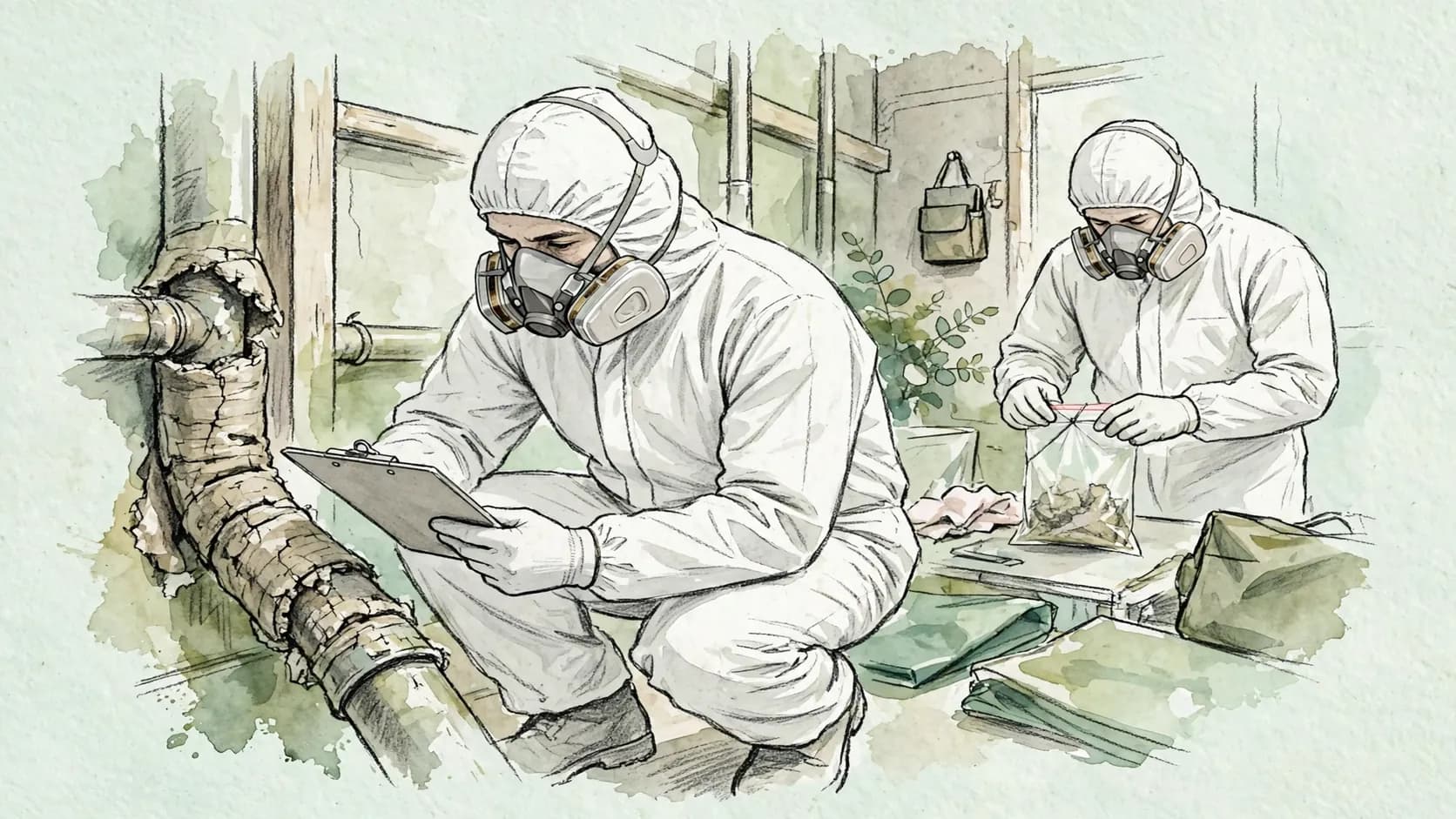
Asbestos is a group of six naturally occurring fibrous minerals that were used for about 150 years in buildings, ships, vehicles and factories, because the fibres resist heat, fire and chemicals and do not conduct electricity.
The fibres are so fine that, once released into the air, they can be breathed deep into the lungs, where they lodge and the body's natural defences cannot break them down — and the diseases that follow can take 15 to 60 years to appear. Asbestos is responsible for over 5,000 deaths every year in the UK.
What follows covers the three main types, the diseases asbestos causes, where it is found in buildings, and the legal duty to manage it.
What asbestos is#
Asbestos is the name given to six minerals that occur naturally as bundles of fibres that can be separated into thin, durable threads. Chemically they are silicate compounds — they contain atoms of silicon and oxygen. The fibres are resistant to heat, fire and chemicals and do not conduct electricity, which is why asbestos was used so widely: in building and construction for strengthening cement and plastics and for insulation, roofing, fireproofing and sound absorption.
In shipbuilding to insulate boilers, steam pipes and hot water pipes. In the automotive industry for brake shoes and clutch pads. And in ceiling and floor tiles, paints, coatings, adhesives and plastics. Asbestos is a chemical hazard, and like other chemical hazards it is controlled by managing exposure at the source, not by treating the worker.
The six minerals fall into two groups. Serpentine asbestos is chrysotile, which has long, curly fibres that can be woven — it is the form that has been used most widely in commercial applications. Amphibole asbestos is actinolite, tremolite, anthophyllite, crocidolite and amosite, which have straight, needle-like fibres that are more brittle than chrysotile and more limited in their ability to be fabricated.
The distinction matters for health: amphibole fibres tend to stay in the lungs for a longer period. Several studies suggest they may be more harmful than chrysotile, particularly for mesothelioma risk.
Three facts shape everything that follows.
- First: asbestos is only dangerous when its fibres are released into the air and breathed in. Material that is in good condition and is not being, or going to be, disturbed or damaged carries negligible risk.
- Second: there is no safe level of asbestos exposure — the risk rises with the dose and the duration of exposure, and diseases have been found in people with only brief exposures.
- Third: the diseases take decades to appear, so the people dying today were mostly exposed in the past, and the exposures that matter now are the ones happening in maintenance, repair and refurbishment work on old buildings.
The three main types#
Three types of asbestos account for almost all commercial use, and they are the three still found in premises. They are commonly called by their colours, but you cannot identify them just by their colour — a laboratory is needed to tell them apart.
| Type | Colour | Mineral group | Fibres | Main uses |
|---|---|---|---|---|
| Crocidolite | Blue | Amphibole | Straight, needle-like | Insulation and industrial products |
| Amosite | Brown | Amphibole | Straight, needle-like | Insulation and construction |
| Chrysotile | White | Serpentine | Long, curly, can be woven | Cement, insulation, textiles |
All three are dangerous carcinogens, but blue and brown asbestos are more hazardous than white. More cases of mesothelioma and cancer have been found in people working with crocidolite than with any other type. The three rarer types — tremolite, anthophyllite and actinolite — were used far less. They can occur as contaminants in other asbestos materials, and all six are named in the Control of Asbestos Regulations 2012.
Warning
White asbestos is not safe. The International Agency for Research on Cancer classifies chrysotile as a category 1 human carcinogen, and HSE's view is that there is sufficient evidence that chrysotile causes cancer in humans, with some uncertainty as to the scale of the risk. HSE recognises that the risks from chrysotile are lower than those from amphibole asbestos, but that does not imply that chrysotile does not cause cancer. There is also a practical reason to treat white asbestos with the same caution: materials whose content is predominantly chrysotile often contain small quantities of amphibole asbestos as impurities, and sometimes amphiboles were intentionally added.
Health risks#
Exposure to asbestos can cause four main diseases.
- Mesothelioma is a cancer of the lining of the lungs; it is always fatal and is almost exclusively caused by exposure to asbestos.
- Asbestos-related lung cancer is almost always fatal.
- Asbestosis is a scarring of the lungs which is not always fatal but can be a very debilitating disease, greatly affecting quality of life.
- Diffuse pleural thickening is a thickening of the membrane surrounding the lungs which can restrict lung expansion and lead to breathlessness.
There is no cure for asbestos-related diseases. The International Agency for Research on Cancer finds sufficient evidence that asbestos causes mesothelioma and cancers of the lung, larynx and ovary. Most mesotheliomas are thought to be due to asbestos exposure.
The numbers are stark. Asbestos is responsible for over 5,000 deaths every year in the UK. HSE's statistics for Great Britain record 2,146 mesothelioma deaths in 2024, with a similar estimated number of lung cancer deaths linked to past asbestos exposures, and 503 deaths in 2024 mentioning asbestosis on the death certificate. The majority of current fatal cases are associated with very high exposures from past industrial processes and the installation of asbestos products.
The diseases take a long time to appear. There is usually a delay of 15 to 60 years between first exposure and the onset of disease. That is why younger people, if routinely exposed to asbestos fibres over time, are at greater risk of developing asbestos-related disease than older workers — they have more years ahead of them for the disease to develop.
The delay also explains why the death toll is still so high decades after asbestos was banned: the people dying today were exposed in the 1960s, 1970s and 1980s.
Several factors affect the risk: how much asbestos a person was exposed to, how long the exposure lasted, the size, shape and chemical makeup of the fibres, the source of the exposure, and individual risk factors such as smoking and pre-existing lung disease.
Smoking and asbestos exposure together are particularly hazardous — smokers who are also exposed to asbestos have a risk of developing lung cancer greater than the individual risks from asbestos and smoking added together. Quitting smoking reduces the risk. Smoking combined with asbestos exposure does not appear to increase the risk of mesothelioma.
Who is at risk is a question of occupation. Since the early 1940s, millions of American workers have been exposed to asbestos, and the same pattern holds in the UK:
- Shipbuilding
- Asbestos mining and milling
- Manufacturing of asbestos textiles and other asbestos products
- Insulation work in the construction and building trades
- Demolition work
- Drywall removal
- Asbestos removal work
- Firefighting and automobile work
Anyone whose work involves drilling, sawing or cutting into the fabric of premises could potentially be at risk. There is evidence that repeated occupational exposures during routine maintenance and repair work can lead to asbestos-related cancers.
The risk is not confined to the workplace: family members of workers heavily exposed to asbestos face an increased risk of mesothelioma, thought to result from fibres brought into the home on the shoes, clothing, skin and hair of workers. Federal law in the US regulates workplace practices to limit this, and some employees are required to shower and change their clothes before they leave work.
Asbestos-related diseases are detected through the symptoms and the exposure history. Anyone who has been exposed, or suspects they have been exposed, should inform their doctor about the exposure history and whether or not they experience symptoms.
The symptoms to watch for are:
- Shortness of breath
- Wheezing or hoarseness
- A persistent cough that gets worse over time
- Blood in the sputum coughed up from the lungs
- Pain or tightening in the chest
- Difficulty swallowing
- Swelling of the neck or face
- Loss of appetite
- Weight loss
- Fatigue or anaemia
A chest x-ray is the most common tool used to detect asbestos-related diseases, and a lung biopsy is the most reliable test to confirm exposure — although neither can determine how much asbestos a person was exposed to or whether disease will develop.
Where asbestos is found#
Asbestos was used in hundreds of different products and buildings from the 1950s to the mid-1980s. Asbestos cement was used up until 1999. Any building constructed, or that had major refurbishment, between the 1950s and the mid-1980s is likely to contain some type of asbestos-containing material, and use peaked in the 1960s and early 1970s. Premises built or refurbished during that time are the most likely to contain some form.
Any building built before 2000, including houses, offices, schools and hospitals, can potentially contain asbestos.
Some asbestos-containing materials are more vulnerable to damage and more likely to give off fibres than others. In general, the materials which contain a high percentage of asbestos are more easily damaged. The list below is roughly in order of ease of fibre release, with the highest potential fibre release first. Sprayed coatings, lagging and insulating board are more likely to contain blue or brown asbestos:
- Sprayed asbestos and asbestos loose packing — generally used as fire breaks in ceiling voids.
- Moulded or preformed lagging — generally used in thermal insulation of pipes and boilers. Asbestos insulation and lagging can contain up to 85% asbestos and are most likely to give off fibres.
- Sprayed asbestos — generally used for fire protection in ducts, fire breaks, panels, partitions, soffit boards, ceiling panels and around structural steelwork.
- Insulating boards — used for fire protection, thermal insulation, partitioning and ducts, and as soffits and ceiling or wall panels. Work with asbestos insulating board can result in equally high fibre release if power tools are used.
- Some ceiling tiles, millboard, paper and paper products — used for insulation of electrical equipment; asbestos paper has also been used as a fireproof facing on wood fibreboard.
- Asbestos cement products — flat or corrugated sheets, largely used as roofing and wall cladding, plus gutters, rainwater pipes and water tanks. Asbestos cement contains only 10–15% asbestos, and the asbestos is tightly bound into the cement, so it will only give off fibres if it is badly damaged or broken or worked on — drilled, cut or sanded.
- Certain textured coatings, bitumen roofing material, and vinyl or thermoplastic floor tiles.
In the United States the picture is similar. It has been estimated that 3,000 different types of commercial products contain asbestos. In homes built before 1978, asbestos is most commonly found as thermal insulation on boilers and pipes.
It can also be found in attic insulation (including vermiculite insulation), some forms of linoleum, window caulking or glazing, roofing materials, HVAC duct insulation, siding material, plaster, fibre cement siding, corrugated panels, boiler lagging and hot water pipe insulation.
The UK legal duty#
There is no single "asbestos law". The duty comes from the Health and Safety at Work etc. Act 1974 and, specifically, the Control of Asbestos Regulations 2012, which came into force on 6 April 2012. The Regulations name all six types of asbestos and set a control limit of 0.1 asbestos fibres per cubic centimetre of air, averaged over a continuous period of four hours.
That limit is not a safe exposure level — exposure must be reduced as far below it as is reasonably practicable. The evidence is that there is no safe level of asbestos exposure.
The central duty is the duty to manage asbestos, in regulation 4 of the 2012 Regulations. It applies to whoever owns, occupies, manages or has responsibilities for non-domestic premises which may contain asbestos, and to whoever is responsible for the common parts of domestic premises, such as hall and lift areas in flats. If you have maintenance and repair responsibilities for the premises, the duty is yours.
If you have information on the whereabouts of asbestos, you have a duty to cooperate and make it available to whoever manages the risk.
The duty requires you to manage the risk from asbestos by:
- finding out if there is asbestos in the premises, its location and what condition it is in — or assessing whether asbestos-containing materials are liable to be present and presuming that materials contain asbestos unless you have strong evidence that they do not;
- making, and keeping up to date, a record of the location and condition of the asbestos-containing materials or materials presumed to contain asbestos;
- assessing the risk of anyone being exposed to fibres from the materials identified;
- preparing a plan that sets out in detail how the risks from these materials will be managed;
- putting the plan into action;
- periodically reviewing and monitoring the plan and the arrangements to act on it, so that the plan remains relevant and up to date; and
- providing information on the location and condition of the materials to anyone who is liable to work on or disturb them.
Asbestos has been banned in the UK in stages. Blue and brown asbestos were banned in 1985, and the importation, supply and use of all types of asbestos — including white asbestos — was banned in 1999. The ban does not remove the asbestos already in buildings, which is why the duty to manage exists. Some work is licensable work.
Regulation 8 of the 2012 Regulations requires the employer to hold a licence granted by HSE before undertaking it — it is an offence to carry out licensable work without a licence.
Work is licensable where:
- The exposure of employees is not sporadic and of low intensity
- The risk assessment cannot clearly demonstrate that the control limit will not be exceeded
- It is work on asbestos coating
- It is work on asbestos insulating board or asbestos insulation that is not sporadic and of low intensity, cannot be shown to stay under the control limit, or is not short duration work
Other work with asbestos does not need a licence, but it must still comply with the Regulations to prevent exposure.
The United States takes a different route. OSHA has established regulations dealing with asbestos exposure on the job, specifically in construction work, shipyards and general industry, that employers are required to follow. Workers should use all protective equipment provided by their employers and follow recommended workplace practices — for example, respirators approved by the National Institute for Occupational Safety and Health (NIOSH) that fit properly should be worn when required.
In 1989 the US Environmental Protection Agency banned all new uses of asbestos, although uses developed before 1989 are still allowed. The EPA requires school systems to inspect buildings for damaged asbestos and to eliminate or reduce exposure by removing the asbestos or encasing it. The decline is visible in the figures: US domestic consumption of asbestos amounted to about 803,000 metric tons in 1973. Had dropped to about 360 metric tons by 2015.
If your organisation operates in both countries, follow the UK rules in the UK and the OSHA and EPA rules in the US.
What to do if you find asbestos#
Warning
Do not disturb it. Do not drill, saw, cut, sand or break any material you suspect contains asbestos, and do not try to identify it by breaking or damaging it. Asbestos is only a risk when its fibres are released into the air, and the surest way to release them is to work on the material without controls.
Presume the material contains asbestos unless there is strong evidence that it does not. Some materials obviously do not contain asbestos, such as glass, solid wooden doors, floorboards, bricks and stone. Building plans may provide evidence that non-asbestos materials were used. If you have any doubts, presume it contains asbestos.
Find out what you have. You may carry out your own assessment inspection where the premises are small and no maintenance work is planned. If you are planning maintenance or refurbishment, or installing wiring, pipework or ducting, employ a suitably trained person to survey the premises to identify asbestos-containing materials.
Ask the person or organisation whether they are accredited or certificated for asbestos survey work, for evidence of their training and experience, and for evidence that they have suitable liability insurance. If you suspect materials contain asbestos, you may need to have samples analysed — often that is the only certain way of identifying whether a material does contain asbestos. Samples should only be taken by suitably trained people.
The United Kingdom Accreditation Service (UKAS) runs an accreditation scheme for organisations that do asbestos surveys and for sampling and analysis of asbestos in materials.
Once you know what you have, follow the duty to manage:
- Record the location and condition of the materials
- Assess the risk of exposure
- Prepare a written plan for managing the risk
- Put the plan into action
- Review and monitor it
- Provide information on the location and condition of the materials to anyone who is liable to work on or disturb them
Anyone working with asbestos must use the right protective equipment, including a respirator that fits properly, and follow the recommended workplace practices and safety procedures.
Make sure you commission the right kind of survey. HSE's survey guide (HSG264) describes two.
- A management survey identifies asbestos during the normal occupation and use of a building, so it can be managed safely day to day; it is largely visual, with light sampling, and carried out with minimal disruption.
- A refurbishment and demolition survey is more thorough and intrusive, designed to locate all asbestos before building work, refurbishment or demolition begins — it involves lifting, drilling and opening up to reach concealed materials, and the area surveyed is usually vacated.
Choose the management survey to meet the duty to manage, and the refurbishment and demolition survey before any work that will disturb the fabric of the building.
Removal is the last resort, not the first step. If the material is in good condition and will not be disturbed, the safer course is to leave it in place and manage it. Where removal is necessary, work on asbestos insulation, sprayed coatings and insulating board must be done by a contractor licensed by HSE.
If you think you have been exposed, inform your doctor about your exposure history and whether you experience any symptoms — and do not smoke, because smoking combined with asbestos exposure multiplies the risk of lung cancer. Knowing how to practise emergency procedures — and to debrief afterwards — is what turns a plan into a response people can actually carry out.
Checklist for employers and duty holders#
Work through this list against your own premises. Every item should have a named person, a date, and a record.
- Find out whether your premises were built or refurbished before 2000, and whether asbestos-containing materials are liable to be present.
- Presume materials contain asbestos unless you have strong evidence that they do not.
- Have a suitably trained person survey the premises, and have samples analysed where identification is needed.
- Make and keep up to date a record of the location and condition of every asbestos-containing material, and of every material presumed to contain asbestos.
- Assess the risk of anyone being exposed to fibres from the materials identified.
- Prepare a written plan that sets out in detail how the risks will be managed, and put it into action.
- Provide information on the location and condition of the materials to anyone who is liable to work on or disturb them, including contractors and maintenance staff.
- Review and monitor the plan periodically, and at once after any change to the building or to how it is used, or after any damage to a material.
- Do not allow drilling, sawing, cutting, sanding or breaking of any suspected material without controls.
- Use only a contractor licensed by HSE for work on asbestos insulation, sprayed coatings and insulating board.
- Make sure everyone who works with asbestos uses the right protective equipment, including a respirator that fits properly, and follows the recommended workplace practices.
- If anyone may have been exposed, tell them to inform their doctor about their exposure history and not to smoke.
Frequently Asked Questions#
These are the questions duty holders and workers ask most often about asbestos.
Is white asbestos safe?
No. The International Agency for Research on Cancer classifies chrysotile (white asbestos) as a category 1 human carcinogen, and HSE's view is that there is sufficient evidence that chrysotile causes cancer in humans. The risks from chrysotile are lower than those from blue and brown asbestos. That does not imply that chrysotile does not cause cancer — and materials whose content is predominantly chrysotile often contain small quantities of amphibole asbestos as impurities.
Can I identify asbestos by looking at it?
No. You cannot identify asbestos just by its colour, and the three main types cannot be told apart by sight. A laboratory is needed to identify the different types of asbestos. Often the only certain way of identifying whether a material contains asbestos is to have samples analysed. Samples should only be taken by suitably trained people. Do not break or damage a material to try to identify it.
Is asbestos dangerous if it is left alone?
No. Asbestos is only a risk to health if asbestos fibres are released into the air and breathed in. As long as asbestos-containing materials are in good condition and are not being, or going to be, disturbed or damaged, there is negligible risk. That is why the safer course is usually to leave the material in place and manage it, rather than to remove it.
How long after exposure do asbestos diseases appear?
Typically 15 to 60 years after first exposure. The diseases take a long time to develop, which is why younger people who are routinely exposed over time are at greater risk than older workers. Why the death toll is still high decades after asbestos was banned.
Do I have to remove asbestos from my building?
No. The legal duty is to manage the risk, not to remove the asbestos. You must find it, record it, assess the risk, prepare a plan, put the plan into action, review it, and inform anyone who may disturb it. Removal is necessary only where the material is damaged, is going to be disturbed, or cannot be managed in place — and high-risk removal work must be done by a contractor licensed by HSE.
Does the US have the same rules?
No, the framework is different. OSHA has regulations for asbestos exposure in construction, shipyards and general industry that employers must follow, and workers should use NIOSH-approved respirators that fit properly. In 1989 the EPA banned all new uses of asbestos, although uses developed before 1989 are still allowed. The EPA requires school systems to inspect buildings for damaged asbestos and to eliminate or reduce exposure by removing the asbestos or encasing it.
US domestic consumption fell from about 803,000 metric tons in 1973 to about 360 metric tons by 2015. Follow the UK rules in the UK and the OSHA and EPA rules in the US.
What should I do if I think I have been exposed to asbestos?
Inform your doctor about your exposure history and whether you experience any symptoms — shortness of breath, a persistent cough that gets worse, blood in the sputum, chest pain, difficulty swallowing, loss of appetite, weight loss or fatigue. A chest x-ray is the most common tool used to detect asbestos-related diseases. And do not smoke: smoking combined with asbestos exposure multiplies the risk of lung cancer, and quitting reduces it.
Sources#
- Health and Safety Executive, General information about asbestos — the three main types, why asbestos is dangerous, the three main diseases, and where it is normally found.
- Health and Safety Executive, Asbestos – FAQs — over 5,000 deaths every year, the four main diseases, and the greater risk to younger people.
- Health and Safety Executive, A short guide to managing asbestos in premises (INDG223) — the duty to manage, where asbestos is found in buildings, and survey and sampling.
- The Control of Asbestos Regulations 2012 — the control limit of 0.1 fibres per cubic centimetre of air, the definitions of the six types of asbestos, and the regulations in force from 6 April 2012.
- National Cancer Institute, Asbestos Exposure and Cancer Risk — the six minerals, how asbestos is used, who is at risk, smoking, symptoms, detection, and OSHA protection.
- Health and Safety Executive, Asbestos-related disease statistics, Great Britain 2026 — around 5,000 asbestos-related disease deaths per year, 2,146 mesothelioma deaths in 2024, and 503 deaths mentioning asbestosis in 2024.
- Health and Safety Executive, Asbestos: The survey guide (HSG264) — the management survey and the refurbishment and demolition survey.
- Health and Safety Executive, Licence application — when do I need a licence to work with asbestos? — licensable work under regulations 2 and 8 of the Control of Asbestos Regulations 2012.
Published 21 November 2026. Reviewed 21 November 2026 against HSE, NCI and Control of Asbestos Regulations 2012 sources. Next review: 21 November 2027.
Leave a Reply