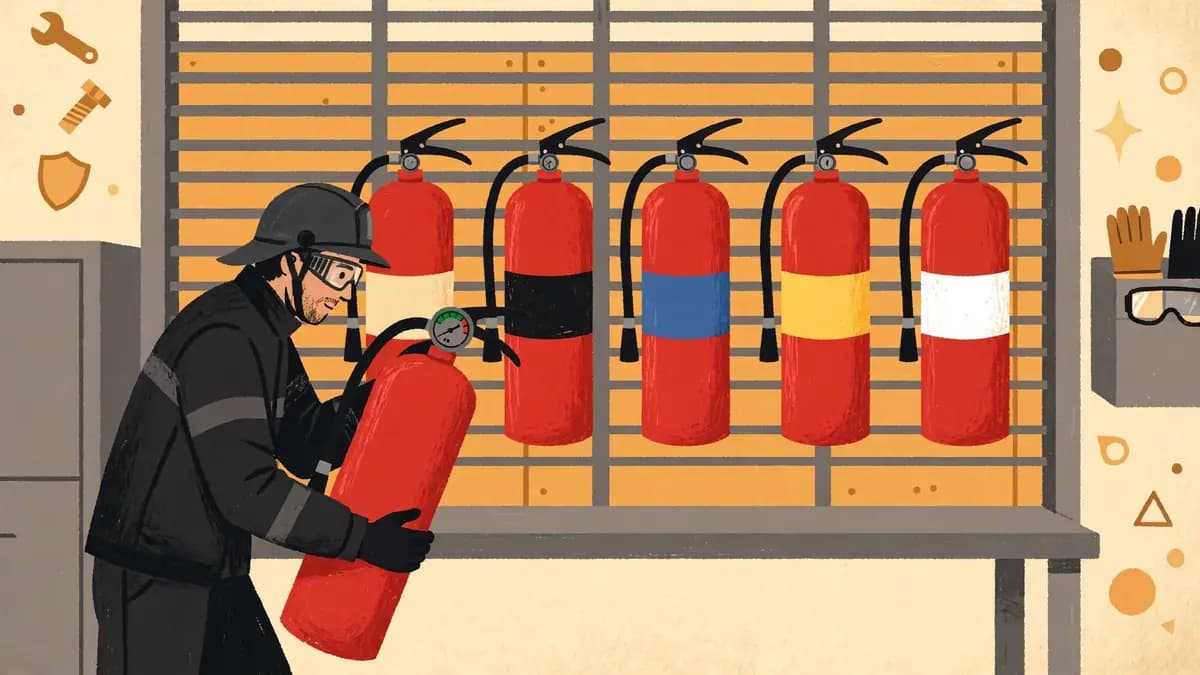
Fire extinguisher classes group fires by what is burning. Class A covers ordinary solids like wood and paper, Class B covers flammable liquids and gases, Class C covers live electrical equipment, Class D covers burning metals, and Class K covers cooking oils and fats. The letter on the extinguisher must match the class of the fire, because the wrong agent can spread the fire or put the person using it in danger.
What fire extinguisher classes are
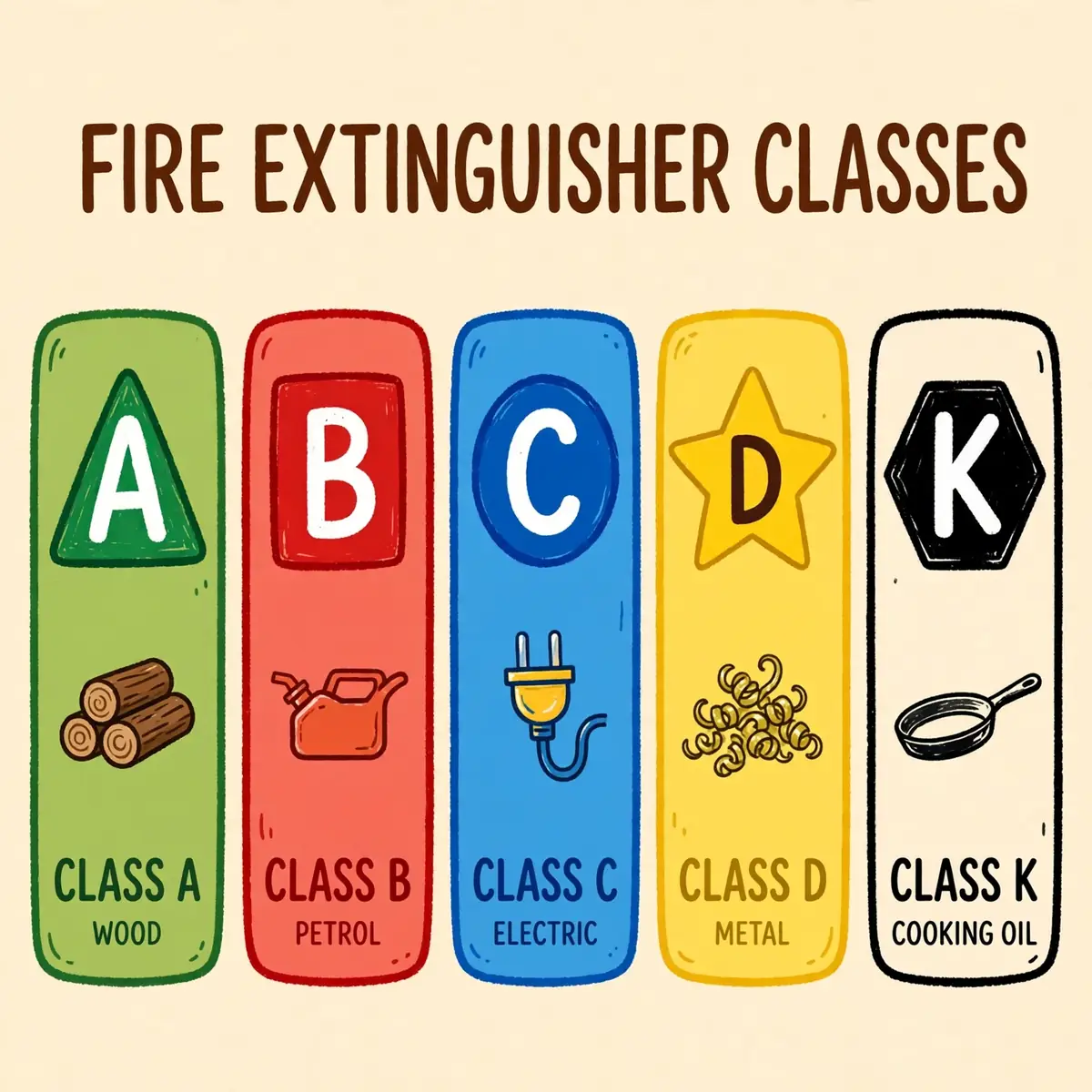
Every fire is classed by its fuel. The system comes from NFPA 10, the US Standard for Portable Fire Extinguishers, whose current edition is 2026. It gives firefighters, building managers and ordinary people a shared vocabulary for naming a fire fast. Five classes cover nearly every fire a portable extinguisher is expected to meet: A, B, C, D and K.
The class matters because each fuel burns in its own way and each agent works in its own way. Water cools. Foam smothers. Dry chemical interrupts the chemical reaction. Carbon dioxide displaces oxygen. Wet chemical turns burning oil into a soapy foam. An agent that defeats one fuel can feed another, so the class letter on the label is the first thing to read.
Behind the classes sits the fire triangle: fuel, heat and oxygen. The fire tetrahedron adds a fourth leg, the self-sustaining chemical chain reaction. Every extinguishing agent attacks at least one leg. Water removes heat, foam and powder cut off oxygen and fuel, and dry chemical breaks the chain reaction.
Why the fuel decides the extinguisher
A burning stack of paper and a burning pan of oil look alike from across a room, but they need opposite treatments. Water soaks into paper and cools it below ignition temperature. The same water dropped into hot oil flashes to steam, throws burning oil across the room and makes the fire bigger. The fuel, not the size of the flames, decides the agent.
That is why extinguishers carry a letter, a symbol and often a rating. The letter names the class it is proven against. The symbol — a green triangle, red square, blue circle, yellow star or black hexagon — lets anyone read it at a glance, even in smoke. The rating, where one exists, says how large a test fire of that class the unit put out.
Class A: ordinary combustibles
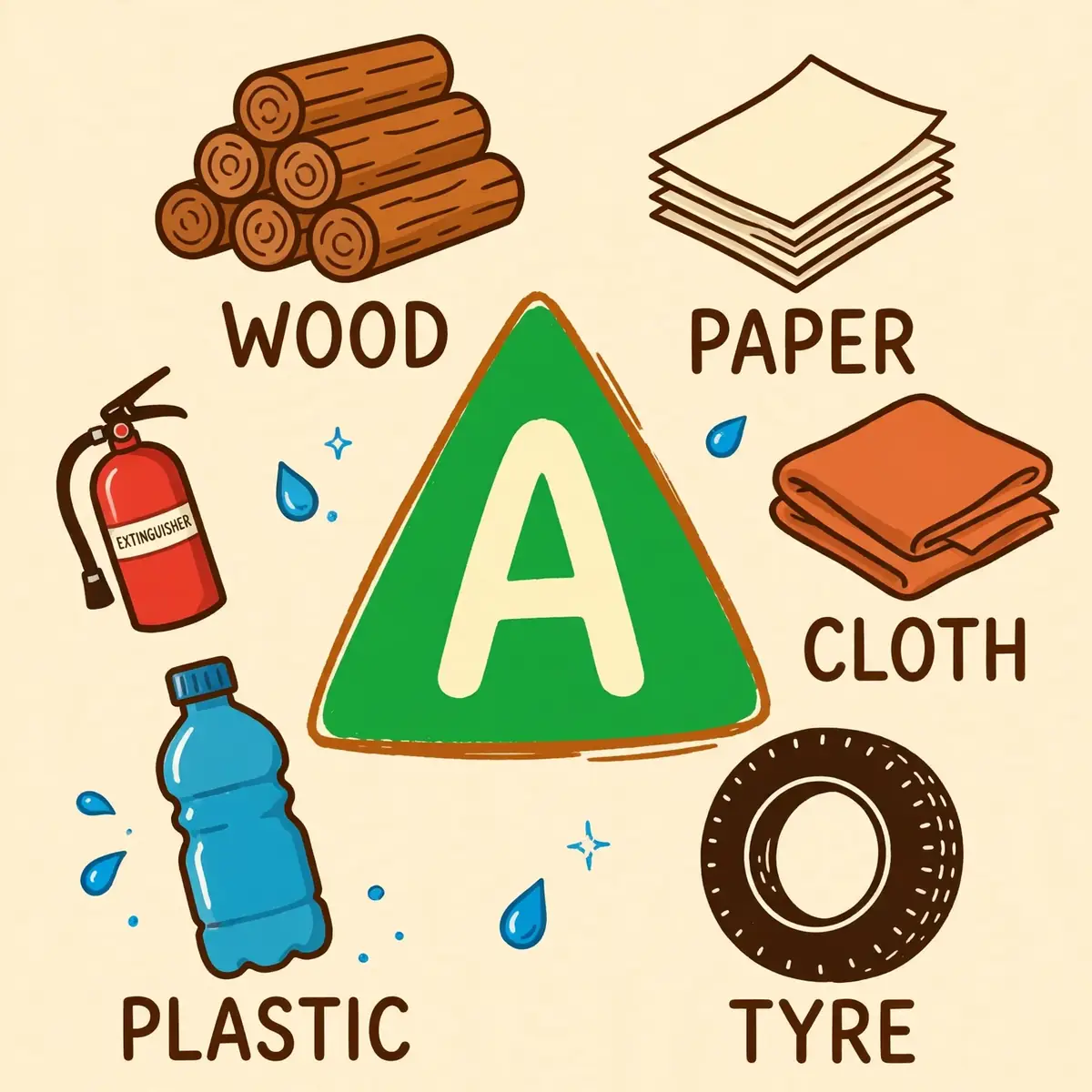
Class A fires burn ordinary solid materials: wood, paper, cloth, rubber and many plastics. They are the most common fires in homes and offices, and the ones most people picture when they think of a building fire. The fuel is solid and leaves ash and glowing embers behind as it burns.
These fires need cooling and soaking. A surface flame can be knocked down quickly, but embers buried in paper or wood keep smouldering and can reignite minutes later. Water is the classic agent here because it absorbs enormous amounts of heat, and an ABC dry chemical extinguisher also works by interrupting the chemical reaction while coating the fuel.
On extinguishers and safety signs, Class A is marked by a green triangle containing the letter A. Typical Class A fuels include:
- Wood, timber offcuts and furniture.
- Paper, cardboard and office waste.
- Cloth, curtains, bedding and upholstery.
- Rubber, including tyres and mats.
- Many plastics, which melt and drip as they burn.
TipAfter a Class A fire is out, soak the material and watch it. Glowing embers can reignite long after the flames disappear.
Class B: flammable liquids and gases
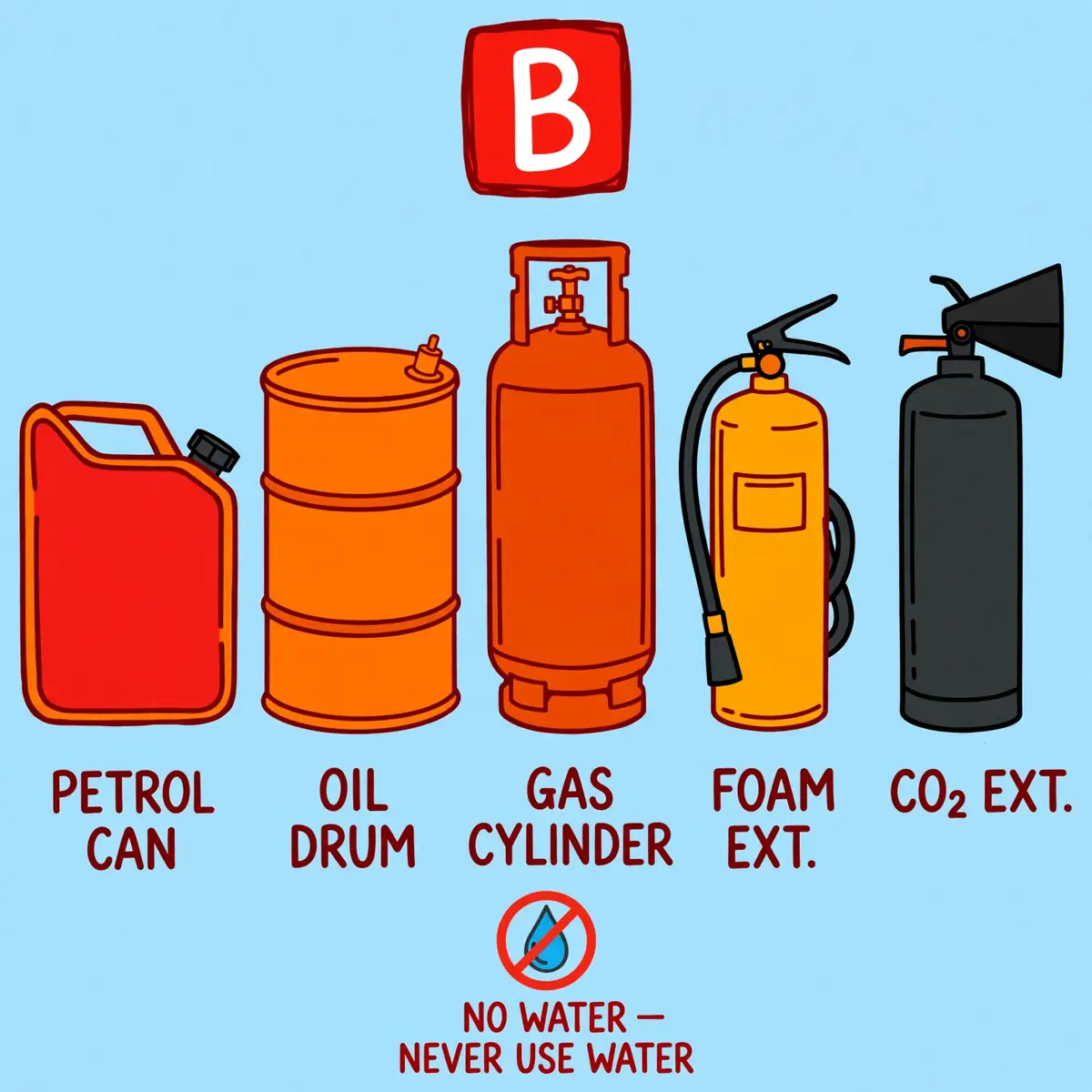
Class B covers fires fuelled by flammable liquids and gases: petrol, diesel, oils, solvents, paints, alcohols and propane. These fires spread across surfaces and can flow, so they grow fast and travel. They are common in workshops, garages, fuel stores and anywhere solvents are used.
The right agents smother the fire or cut off its vapour supply. Foam lays a blanket over the liquid surface. Carbon dioxide displaces oxygen and cools slightly without leaving residue. Dry chemical interrupts the chemical reaction. The B rating number on the label states roughly how many square feet of liquid fire a non-expert user can expect to put out with that unit.
Cooking oils and fats do not belong in Class B, even though they are liquids. They burn hotter and behave differently at high temperatures, so they have their own class, K. On extinguishers and signs, Class B is marked by a red square containing the letter B.
WarningNever use water on a Class B fire. Water sinks under burning liquid, flashes to steam and spreads the burning fuel across the floor.
Class C: energized electrical equipment
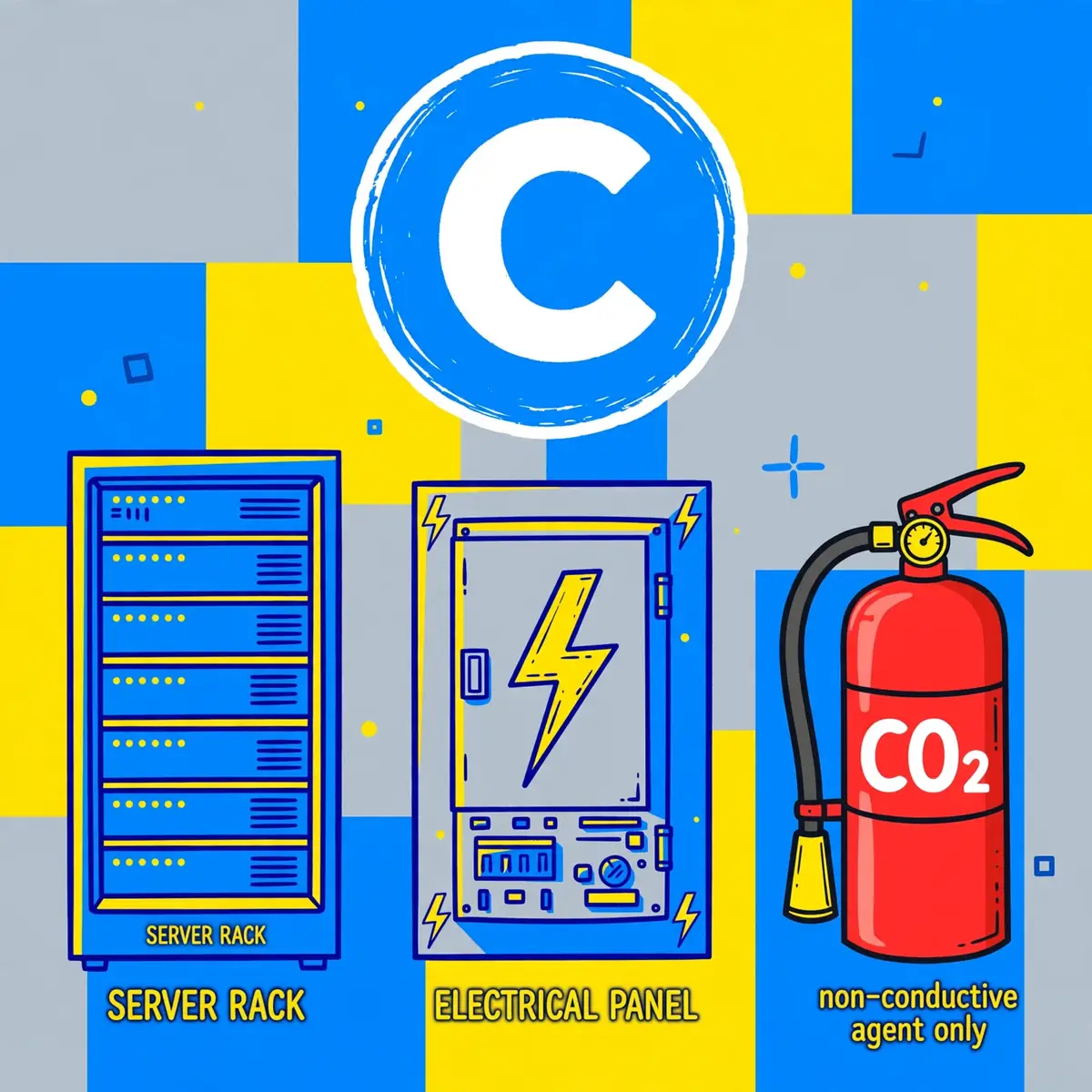
Class C fires involve energized electrical equipment: servers, transformers, circuit panels, motors, wiring and appliances under load. The fuel may be the insulation or the casing, but the danger that defines the class is the live current. Any agent that conducts electricity can carry that current back to the person holding the extinguisher.
Only non-conductive agents are safe here: carbon dioxide and dry chemical. Class C has no numerical rating, because the letter itself is the rating — it certifies that the agent will not conduct electricity. Once the equipment is de-energized, the fire is no longer Class C and can be treated as Class A or Class B, depending on what is actually burning.
On extinguishers and signs, Class C is marked by a blue circle containing the letter C. In the UK the same letter means something different, which the US and UK section below explains.
WarningWater and foam conduct electricity. Using either on live equipment can electrocute the user, so check the C mark before aiming at any electrical fire.
Class D: combustible metals
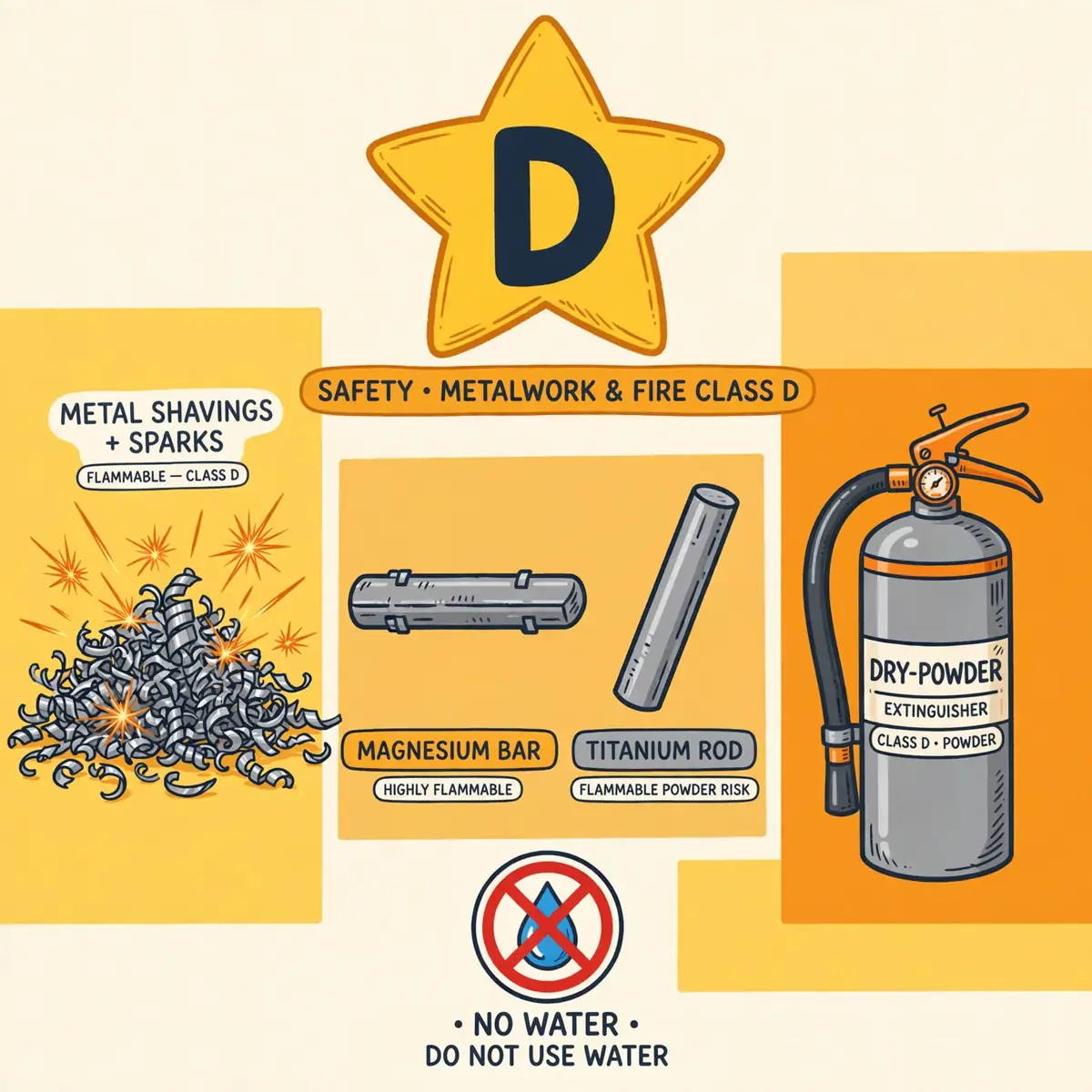
Class D fires involve metals that burn: magnesium, titanium, zirconium, sodium, lithium and potassium. These fires are mostly an industrial and laboratory hazard, showing up in metalworking shops, foundries and facilities that process metal powders, flakes or shavings. They burn at extremely high temperatures and throw off intense white light.
Ordinary extinguishers cannot handle them. Class D units use specialised dry powder agents, typically graphite powder or granular sodium chloride, that smother the burning metal and absorb heat without reacting with it. Many Class D extinguishers are made for one specific metal, so the label must name the metal it is proven against. There is no multi-purpose Class D rating.
On extinguishers and signs, Class D is marked by a yellow five-point star containing the letter D. Water must never be used on a metal fire: it can react violently with burning sodium, lithium or magnesium and make the fire explode.
WarningIf no Class D extinguisher is at hand, leave the area. Water, foam and ordinary dry chemical can all make a metal fire worse.
Class K: cooking oils and fats
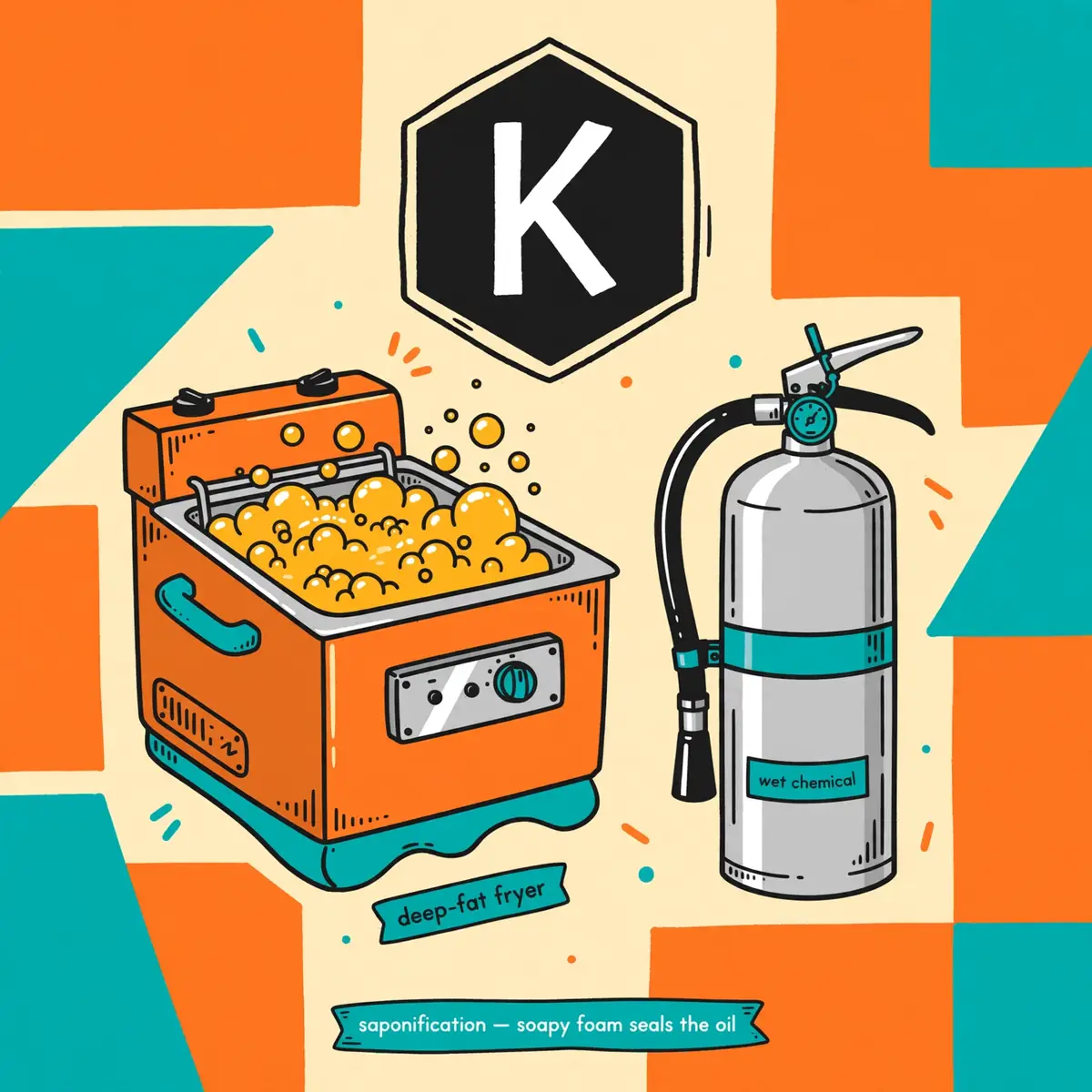
Class K fires involve vegetable oils and animal fats used in commercial cooking: deep-fat fryers, griddles and ranges in restaurants, cafeterias and catering kitchens. The oil burns hotter than ordinary liquid fuel and can auto-ignite if it is left heating. A thin crust of burnt food on the surface does nothing to slow it.
The only agent made for this fire is a wet chemical, usually a potassium acetate or potassium carbonate solution. It attacks the fire in two ways. First it cools the oil. Then it reacts with the fatty acids in a process called saponification, forming a soapy foam layer that seals the surface and stops flammable vapours escaping. That foam blanket is what keeps the oil from reigniting.
On extinguishers and signs, Class K is marked by a black hexagon containing the letter K. In the UK the same fire is called Class F, and wet chemical extinguishers there carry a yellow band.
WarningNever throw water on burning cooking oil. A cup of water in a pan of burning oil flashes into a fireball of steam and burning droplets.
How to read an extinguisher rating
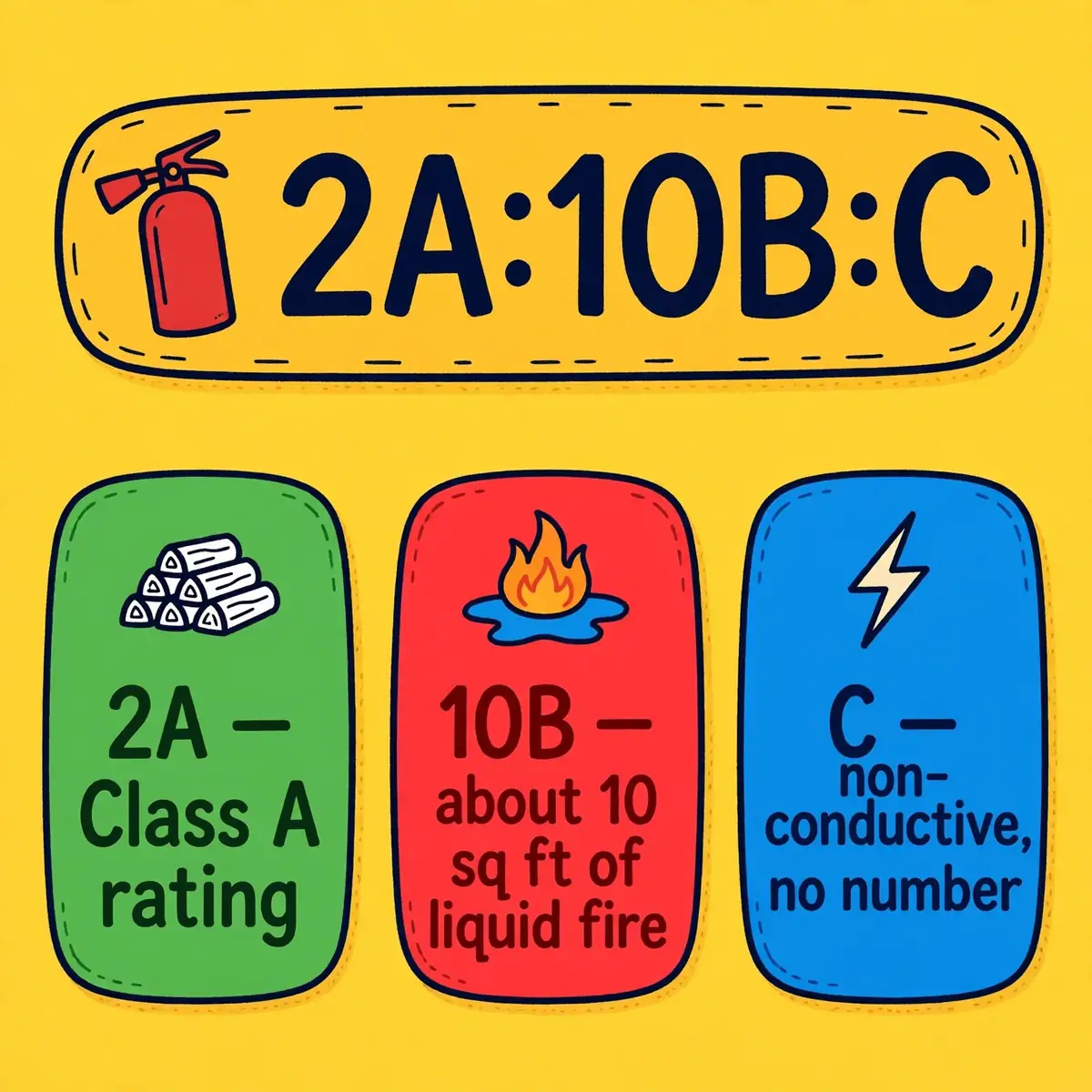
Most extinguishers carry an alphanumeric rating, such as 2A:10B:C. The letters name the classes the unit is proven against. The numbers come from standardised laboratory tests, run by bodies such as Underwriters Laboratories, that measure how large a test fire of that class the extinguisher put out. A bigger number means a bigger test fire, not a bigger extinguisher.
| Part of the rating | What it means | What it tells you |
|---|---|---|
| 2A | Class A rating of 2 | The unit put out a Class A test fire twice the size of the 1A reference fire. |
| 10B | Class B rating of 10 | A non-expert user can expect to put out about 10 square feet of flammable liquid fire. |
| C | Class C, no number | The agent is non-conductive and safe on energized electrical equipment. |
Only Classes A and B carry numbers. Class C has no number because the letter itself is the certification. Class D has no number because each unit is proven against a specific metal. Class K has no number because wet chemical units are rated by the size of fryer they protect, not by a test-fire number. When two extinguishers look the same size, the higher rating is the more capable unit.
TipCompare ratings, not sizes, when choosing between two extinguishers. A compact unit with a 3A:40B:C rating outperforms a larger unit rated 1A:10B:C.
Matching the extinguisher to the fire
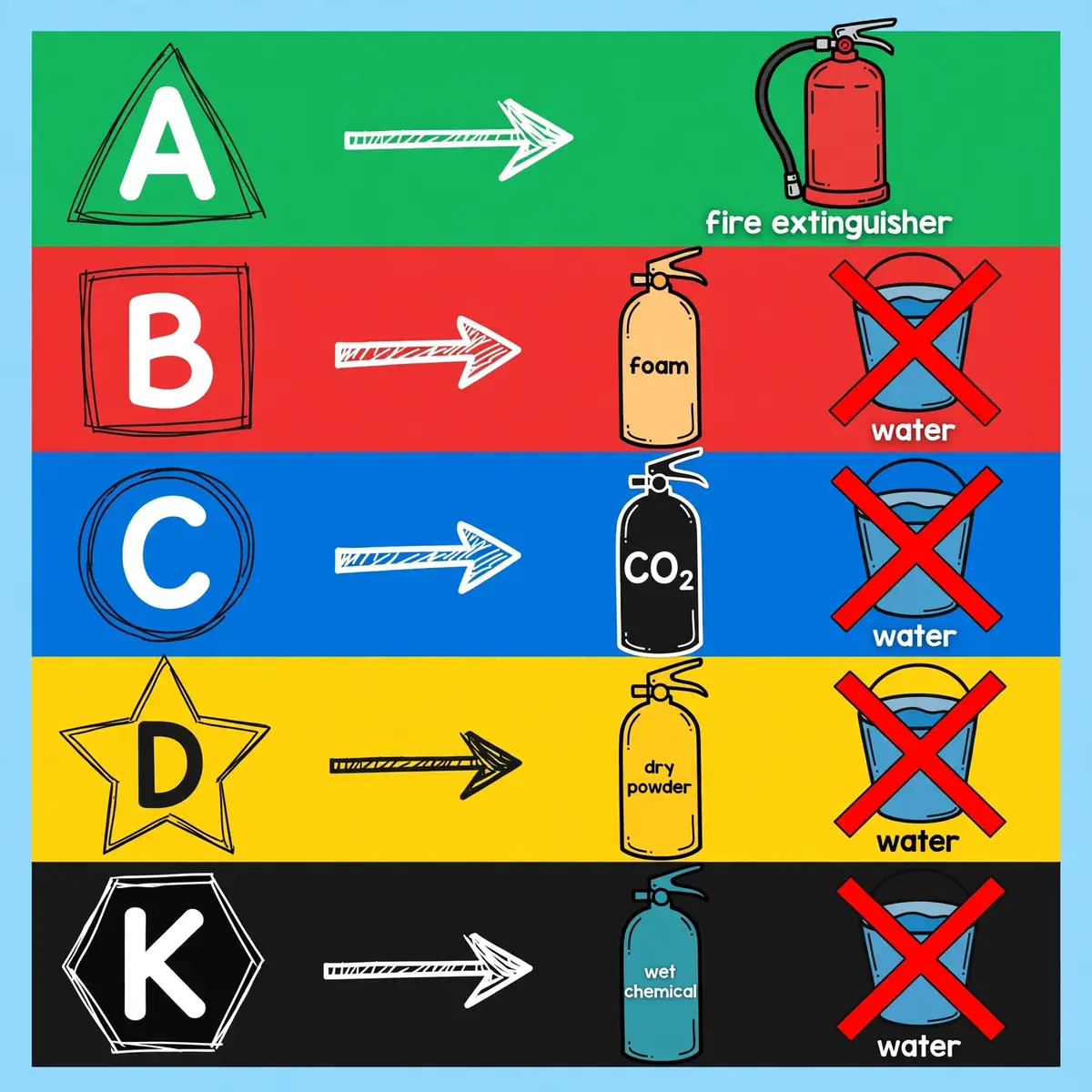
The match is simple once the class is known: read the fuel, read the letter, grab the extinguisher that carries it. The table below covers the five classes and the agents that belong to each. A multi-purpose ABC dry chemical extinguisher covers Classes A, B and C, which is why it is the standard unit in most homes and offices. It does not cover Class D or Class K.
| Fire class | Fuel | Use | Never use |
|---|---|---|---|
| A | Wood, paper, cloth, rubber, plastics | Water, foam, ABC dry chemical | Nothing common — most agents work |
| B | Petrol, oil, solvents, gases | Foam, carbon dioxide, dry chemical | Water — it spreads the liquid |
| C | Live electrical equipment | Carbon dioxide, dry chemical | Water or foam — they conduct |
| D | Magnesium, titanium, sodium, lithium | Specialist dry powder for that metal | Water — it can react violently |
| K | Cooking oils and fats | Wet chemical | Water — it flash-boils the oil |
What the wrong extinguisher does
The wrong agent does not simply fail. It actively makes the fire worse, and it does so in the seconds when the user is closest to the flames. Water on a liquid fire spreads burning fuel across the floor. Water on live equipment turns the extinguisher into a conductor. Carbon dioxide on a deep-seated Class A fire knocks the flames down without cooling the embers, so the fire comes back. Dry powder on a cooking-oil fire breaks the surface without sealing it, so the oil reignites.
- Water on Class B: spreads burning liquid and enlarges the fire area.
- Water or foam on Class C: conducts current and risks electrocution.
- Carbon dioxide on Class A: no cooling, so embers reignite.
- Dry powder on Class K: no foam seal, so the oil reignites.
- Water on Class D: violent reaction with burning metals.
When to walk away instead
An extinguisher is a first line of defence against a fire of limited size — that is how NFPA 10 describes it. It is the right tool for a waste-bin fire, a small pan fire or a smouldering pile of paper. It is not the right tool for a fire that has reached the ceiling, filled the room with smoke or blocked the way out.
Fight a fire only when it is small and contained, the right extinguisher is in hand and charged, and a clear escape route is behind you. If any of those fails, leave at once, close doors behind you to slow the spread, and call the emergency services: 911 in the US, 999 in the UK. Practise the PASS method — pull the pin, aim at the base, squeeze the handle, sweep side to side — before an emergency, not during one. A fire drill is the right place to learn it.
US and UK: the same letters, different meanings
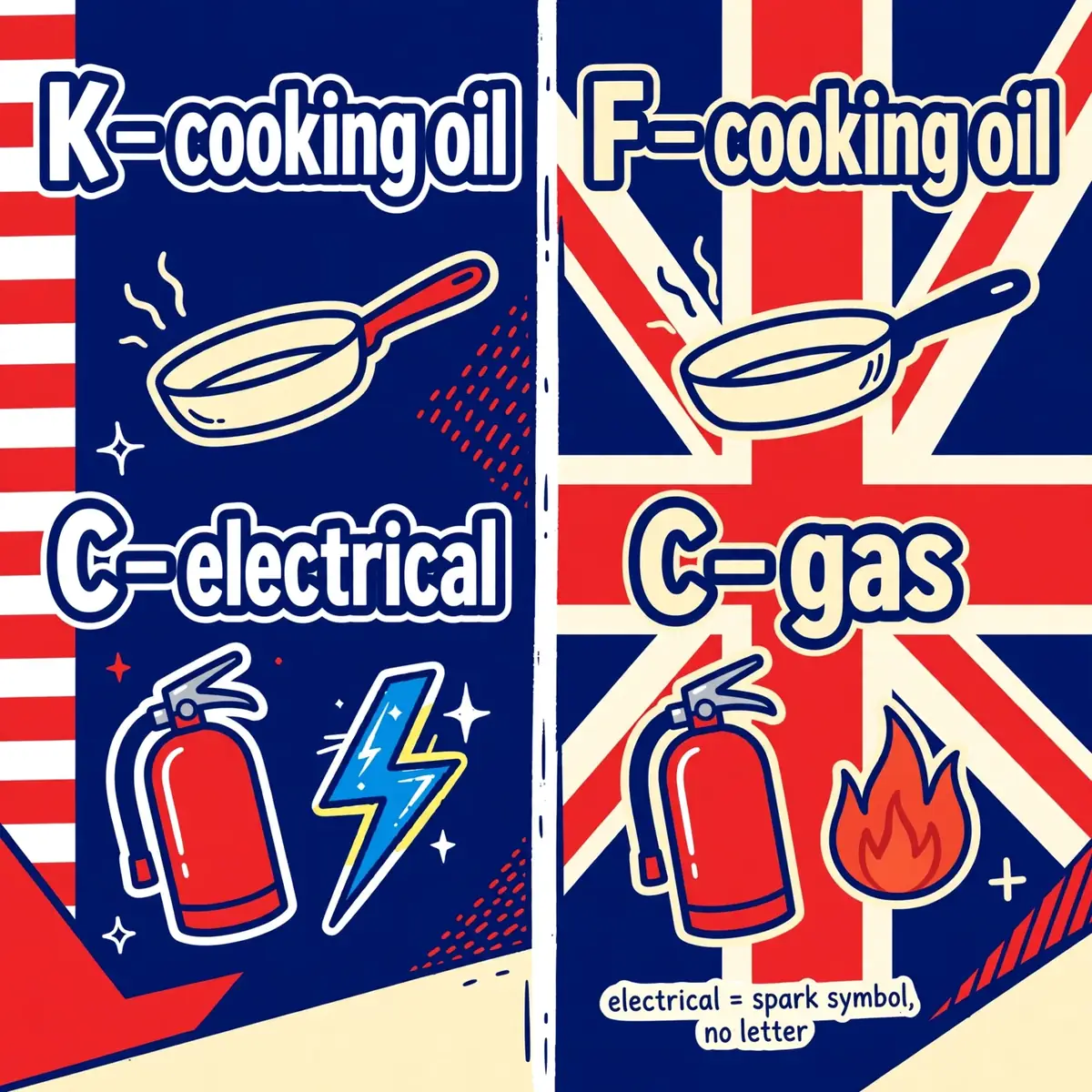
The five letters look universal, but they are not. The United States follows NFPA 10. The United Kingdom follows BS EN 2 for fire classification, BS EN 3 for extinguisher construction and BS 5306 for selection and maintenance. The two systems agree on Classes A, B and D, and disagree on C, on cooking oil, and on how extinguishers are colour-coded. Anyone who works in both countries, or reads guidance from both, needs to know the differences.
The US system
In the US, Class C means energized electrical equipment. The letter certifies that the agent is non-conductive. Class K means cooking oils and fats, and the symbol is a black hexagon. Each class has its own pictograph: a green triangle for A, a red square for B, a blue circle for C, a yellow star for D and a black hexagon for K.
OSHA's rule for portable extinguishers, 29 CFR 1910.157, turns the classes into placement duties. Extinguishers must be selected for the classes of fire anticipated in the workplace, mounted where they are readily accessible, and kept fully charged and in their designated places. The rule sets travel distances: 75 feet or less to a Class A extinguisher, 50 feet or less for Class B, and 75 feet or less for Class D.
The UK system
In the UK, Class C means flammable gases such as propane, butane and natural gas. Electrical fires are a separate category, shown by a spark symbol with no letter at all. Cooking oil is Class F, not K. The classes are A for solids, B for liquids, C for gases, D for metals and F for cooking oils.
UK extinguishers all have a signal-red body under BS EN 3, with a coloured band or panel showing what is inside: red for water, cream for foam, blue for dry powder, black for carbon dioxide and yellow for wet chemical. Specialist Class D powder units carry a violet band. The legal duty sits in the Regulatory Reform (Fire Safety) Order 2005 for England and Wales, and the practical rules for selection, siting and servicing sit in BS 5306-8 and BS 5306-3.
| Band colour | Type | Use on | Never use on |
|---|---|---|---|
| Red | Water | Class A solids | Live electrics, liquids, cooking oils |
| Cream | Foam | Classes A and B | Live electrics, cooking oils |
| Blue | Dry powder | Classes A, B, C and electrical | Cooking oils, confined spaces |
| Black | Carbon dioxide | Electrical and Class B | Deep-seated Class A, chip pans |
| Yellow | Wet chemical | Class F cooking oils | Liquids, gases, electrics |
Class L: lithium-ion batteries
A new class arrived in January 2026, when BS ISO 3941 added Class L for fires involving lithium-ion cells and battery packs that contain no metallic lithium: e-bikes, e-scooters, power tools, forklifts, electric vehicles and battery storage. Lithium-ion fires burn hot, reignite without warning and give off toxic gases, and ordinary extinguishers struggle with them.
Class L is a risk-assessment tool for now, not a rating shown on portable extinguishers, because BS EN 3 has not yet incorporated it. If lithium-ion batteries are charged or stored on a site, the fire risk assessment should say so and the emergency plan should reflect it. Water mist and specialist lithium-ion agents exist, but the rating on the unit is what counts — check it before relying on it.
Where extinguishers belong and how often to check them
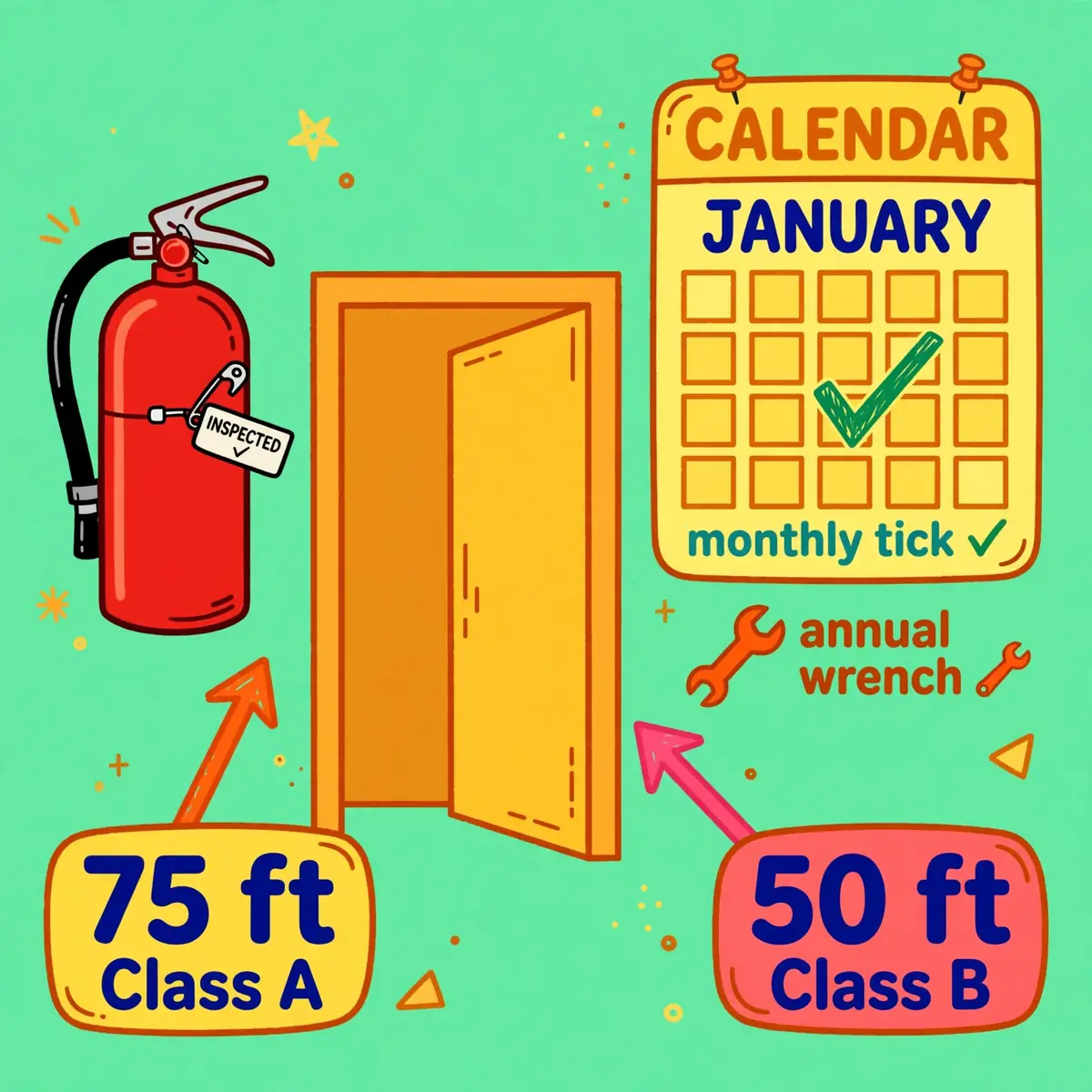
An extinguisher that cannot be reached in seconds is decoration. OSHA requires extinguishers to be mounted, located and identified so employees can reach them without being exposed to injury. The travel distances in 29 CFR 1910.157 are 75 feet or less for Class A, 50 feet or less for Class B and 75 feet or less for Class D, measured from the hazard to the nearest suitable unit. Class C units follow the pattern of the Class A or Class B hazard they protect.
Placement follows the risk. Kitchens need a wet chemical unit near the fryer, never above the cooker where flames would block access. Workshops with solvents need foam or dry chemical within 50 feet. Server rooms need carbon dioxide. At home, the kitchen, the garage and the hallway near bedrooms are the usual spots — the same logic behind any home fire safety plan. Every unit needs a sign above it so it can be found in smoke.
Checks keep the unit ready. OSHA requires a visual inspection every month and a maintenance check every year, with the annual date recorded and the record kept for one year. Stored-pressure dry chemical units also need a maintenance procedure every six years and a hydrostatic test every twelve. Training runs on the same annual rhythm: education when an employee starts and at least once a year after that, with designated users trained on assignment and at least annually.
A monthly visual check takes a minute:
- Pressure gauge needle sits in the green zone.
- Pin, tamper seal and safety tag are intact.
- Hose and nozzle are undamaged and unblocked.
- Body shows no dents, rust or corrosion.
- Unit is in its designated place and easy to reach.
- Sign above it is visible and the instructions are legible.
AlertA discharged, damaged or out-of-date extinguisher must come out of service at once, and equivalent protection must be provided while it is away for maintenance or recharging.
Checklist: choosing the right extinguisher
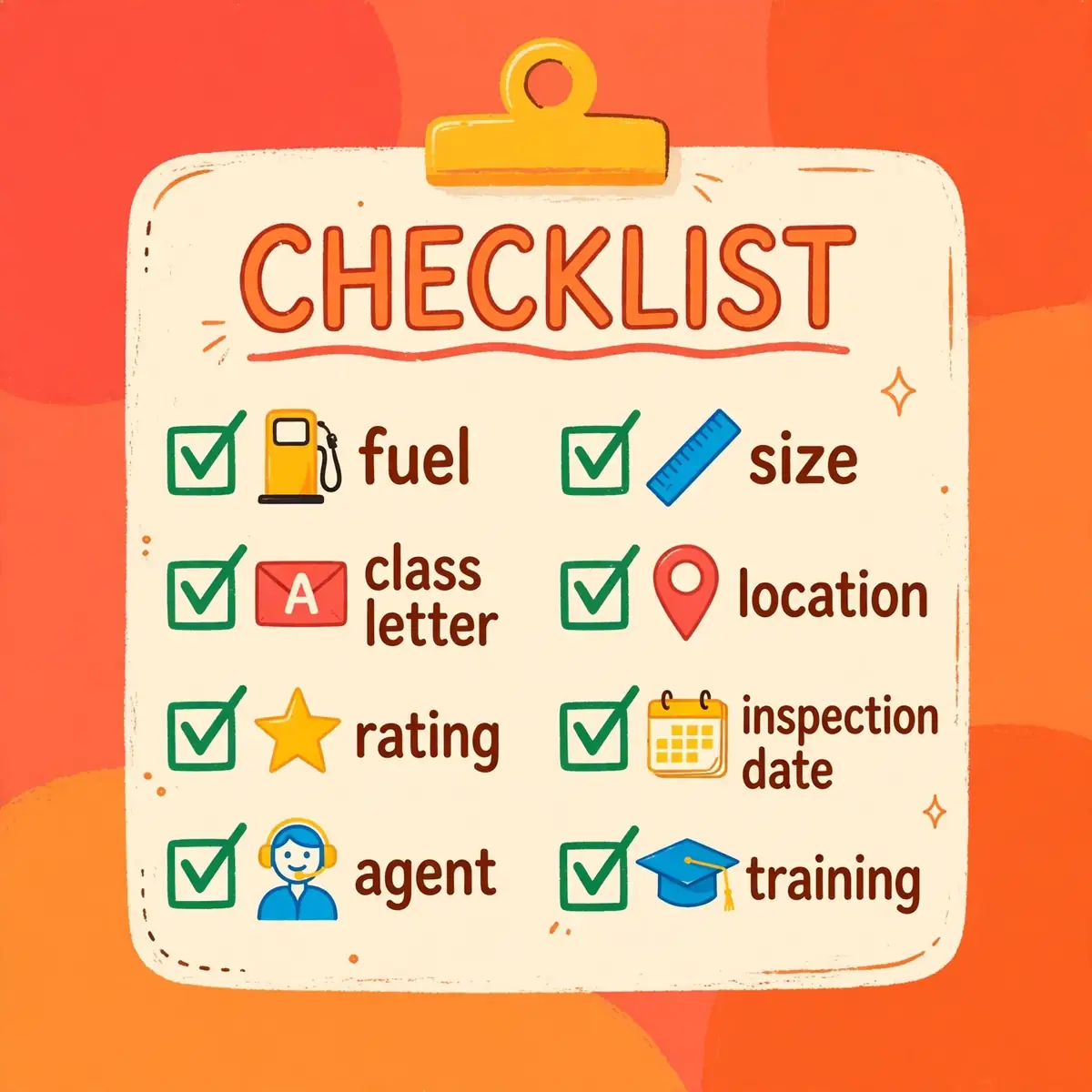
Work through the list before buying or siting an extinguisher. Each step takes a minute, and the last two are the ones most often skipped.
- List every fuel present in the area: solids, liquids, gases, electrical equipment, metals and cooking oil.
- Match each fuel to its class letter: A, B, C, D or K in the US; A, B, C, D or F in the UK.
- Check the rating on the label and pick the highest A and B numbers that fit the space.
- Pick the agent the class demands, and refuse any unit whose letter does not cover the fuel.
- Size the unit to the room and the risk, and check the travel distance from the hazard.
- Place it where it is visible, reachable and signed, never behind doors or above the hazard.
- Check the inspection tag, the gauge and the service date before accepting the unit.
- Train the people who may use it, and repeat that training at least once a year.
Frequently Asked Questions
Short answers to the questions readers ask most about extinguisher classes.
What does 2A:10B:C mean on a fire extinguisher?
It is the unit's rating. 2A is the Class A rating, measured against a standard test fire. 10B means a non-expert user can expect to put out about 10 square feet of flammable liquid fire. C means the agent is non-conductive and safe on energized electrical equipment, and it carries no number.
Can one extinguisher cover all fire classes?
No single unit covers all five classes. A multi-purpose ABC dry chemical extinguisher covers Classes A, B and C, which is enough for most homes and offices. Class D metal fires need a specialist dry powder, and Class K cooking-oil fires need a wet chemical unit.
Why can't I use water on a grease fire?
Water dropped into hot oil flashes to steam in an instant. The steam throws burning oil across the room and spreads the fire. A wet chemical extinguisher cools the oil and seals it with a soapy foam layer, and a fire blanket works for a small pan fire.
Is Class K the same as Class F?
Yes, for the same fire. Class K is the US name for cooking-oil and fat fires under NFPA 10, and Class F is the UK and European name under BS EN 2. The agent is the same in both systems: a wet chemical extinguisher with a yellow band in the UK.
How far should an extinguisher be from the hazard?
Under OSHA 29 CFR 1910.157, the travel distance must be 75 feet or less for Class A hazards, 50 feet or less for Class B hazards and 75 feet or less for Class D hazards. UK guidance in BS 5306-8 sets similar siting rules by risk. Check the local rules for the building.
How often must extinguishers be inspected?
OSHA requires a visual inspection every month and a professional maintenance check every year, with the annual date recorded. Stored-pressure dry chemical units also need maintenance every six years and a hydrostatic test every twelve. In the UK, BS 5306-3 sets a similar annual service schedule.