

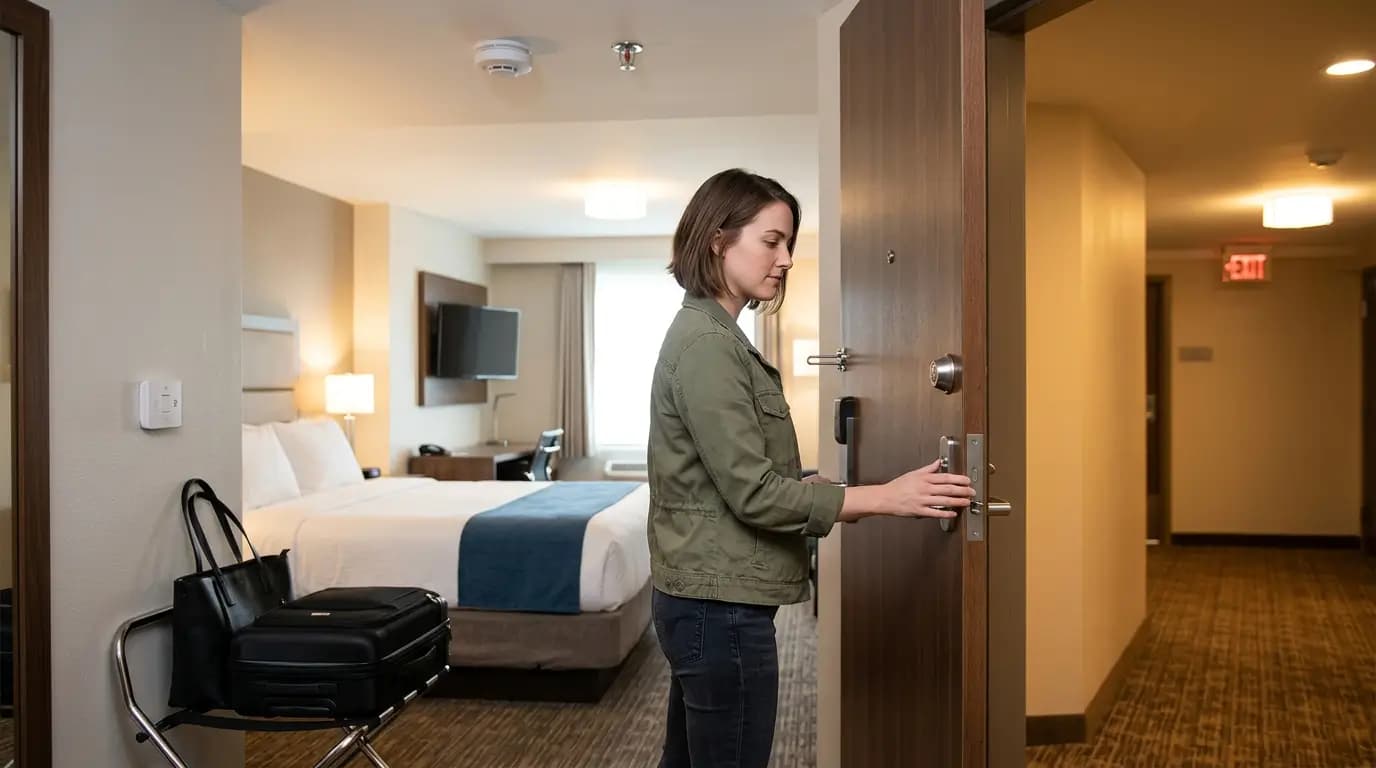
The last hotel I stayed in, I counted eleven doors from my room to the nearest exit stair and seven in the other direction. It took under a minute. I do it every time, because the exit sign I can see from my door in good light is invisible in smoke, and at two in the morning in an unfamiliar corridor the only thing I will be able to use is a number I already know.
That habit is not on any of the hotel safety lists currently ranking for this search. Those lists are about theft — door locks, room safes, do-not-disturb signs. Theft is real and worth managing, and this article covers it. But it is almost never what kills a hotel guest. Smoke and carbon monoxide are.
Egress integrity is my field. Across fifteen years and fourteen countries I have inspected more than 180 workplaces, and the finding I write up most often is not a missing exit — it is an exit that exists on the drawing and cannot be used on the day. Hotels are the building type where you personally, as a guest, are the only person who will ever check that. This guide is written for any commercial accommodation anywhere; where the legal position differs by country, I have said so rather than presenting one nation's rule as universal.
Key takeaways
The six things that change how you book and how you arrive:
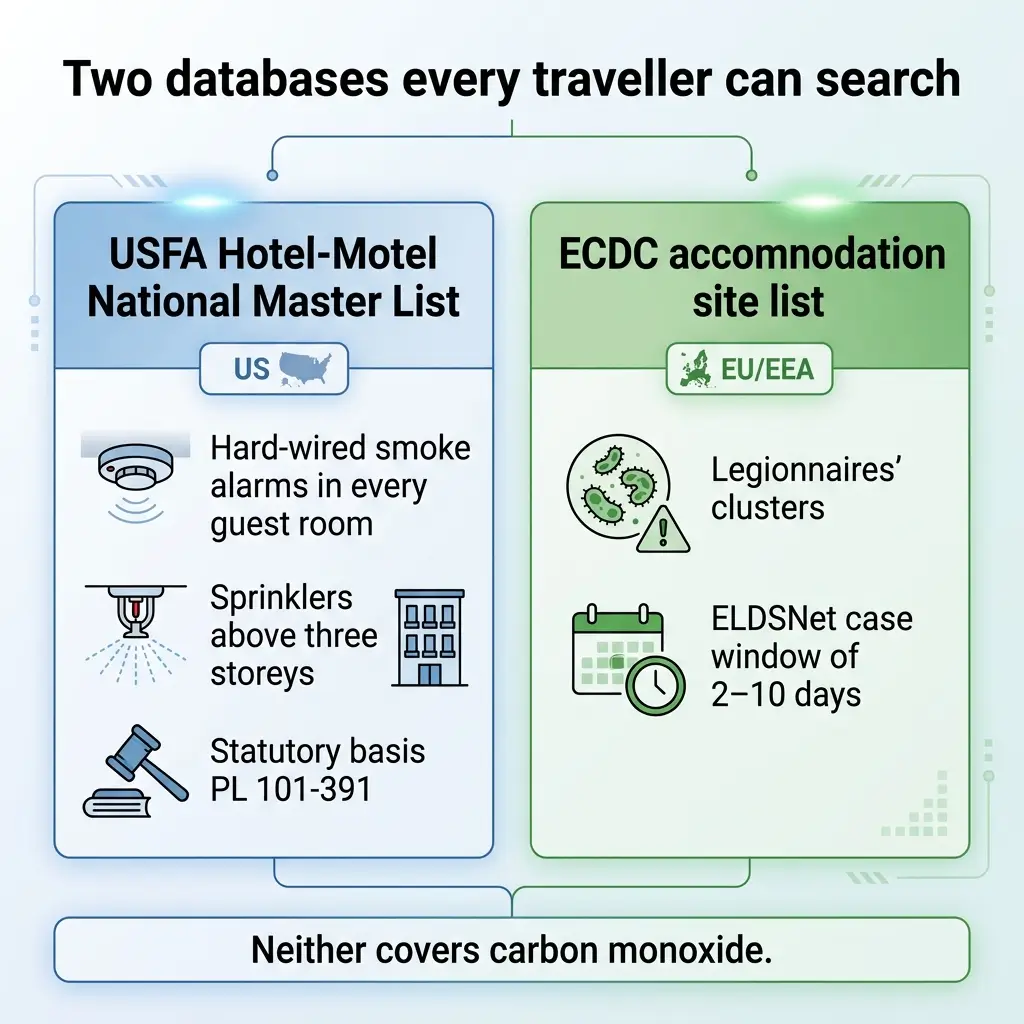
- Two free public databases let you screen a property before you book. The US Fire Administration's Hotel-Motel National Master List records US properties certified as having hard-wired guest-room smoke alarms and sprinklers. The ECDC accommodation site list names EU/EEA properties linked to unresolved Legionnaires' clusters. Almost no travel guide mentions either.
- Sprinkler protection is the single largest variable in a hotel fire. The US Fire Administration estimates around 3,900 hotel and motel fires each year in the United States, causing 15 deaths, 100 injuries and $100 million in losses.
- Carbon monoxide is the hazard with the widest gap between risk and protection. A study in Preventive Medicine Reports identified 905 guests poisoned in 115 US lodging incidents between 2005 and 2018, including 22 deaths — and in all but one incident the source sat outside the guest room.
- No country requires a carbon monoxide alarm in every hotel bedroom. In the US, roughly a quarter of states mandate them in lodging. In England, the requirement attaches to rooms containing a fixed combustion appliance, not to every room where someone sleeps.
- Count the doors to two exits before you unpack. Not "locate the exit" — count, in both directions, by hand.
- If your employer booked the trip, accommodation sits inside their duty of care. ISO 31030:2021 carries a dedicated annex on accommodation in higher-risk locations.
Two public databases tell you more than any review does
Guest reviews describe how a hotel felt. They do not describe whether it has sprinklers, because no guest checks and no reviewer knows. Two public registers do carry that kind of information, and both are free to search before you book.
The US register exists because of a law. The Hotel and Motel Fire Safety Act of 1990 requires the US Fire Administration to maintain a national list of accommodation meeting minimum life-safety criteria, and it obliges federal employees on official travel to use listed properties. To be listed, a property declares that every guest room has at least one hard-wired, single-station smoke alarm installed to NFPA 72 — battery-only units do not qualify — and that buildings above three storeys have automatic sprinklers throughout. Anyone can search it, not just government travellers.
The European register exists because of surveillance. The European Legionnaires' Disease Surveillance Network defines a travel-associated case as someone who stayed at or visited a commercial accommodation site two to ten days before symptoms began, and a cluster as two or more such cases at the same site within a two-year window. Where a site cannot be risk-assessed, or where ECDC judges there may be increased risk to travellers, the site is published by name.
Neither list is a guarantee, and it matters to be precise about what each one actually proves:
| USFA Hotel-Motel National Master List | ECDC accommodation site list | |
|---|---|---|
| Covers | United States | EU / EEA countries |
| Tells you | Property has declared hard-wired guest-room smoke alarms, plus sprinklers if over three storeys | Property is linked to a Legionnaires' cluster that has not been satisfactorily resolved |
| Does not tell you | Whether the declaration was verified recently, or anything about carbon monoxide | Anything about fire protection, or about sites outside the EU/EEA |
| Absence from the list means | Not listed — which may mean non-compliant, or simply never registered | Nothing at all. Most properties have never had a reported cluster |
| Source | apps.usfa.fema.gov/hotel | ecdc.europa.eu |
Outside those two regions there is no equivalent public register, which means the question has to be asked directly. When I book somewhere unfamiliar in Asia or the Middle East, I email the property and ask two things: whether the building is sprinklered throughout, and whether guest rooms have carbon monoxide detection. The answer matters. So does the fact that a property with functioning life safety systems answers quickly and specifically, while a property without them tends to answer with reassurance instead.
What the law requires of your hotel — and where it stops
Hotel fire safety law is national, and it is not converging. The one thing that is consistent across jurisdictions is a duty on the operator, not a checklist a guest can verify at the desk.
In the United States, construction and fire code requirements are set at state and local level, generally adopting NFPA 101 or the International Fire Code; the federal Act described above sets a travel benchmark rather than a building standard. In England and Wales, the Regulatory Reform (Fire Safety) Order 2005 places the duty on a "responsible person" to make a suitable and sufficient assessment of fire risk and record the significant findings, supported by the Home Office's Article 50 guidance for sleeping accommodation. Across the EU there is no single fire code — national building regulations apply, with Legionella handled through EU-level surveillance rather than legislation.
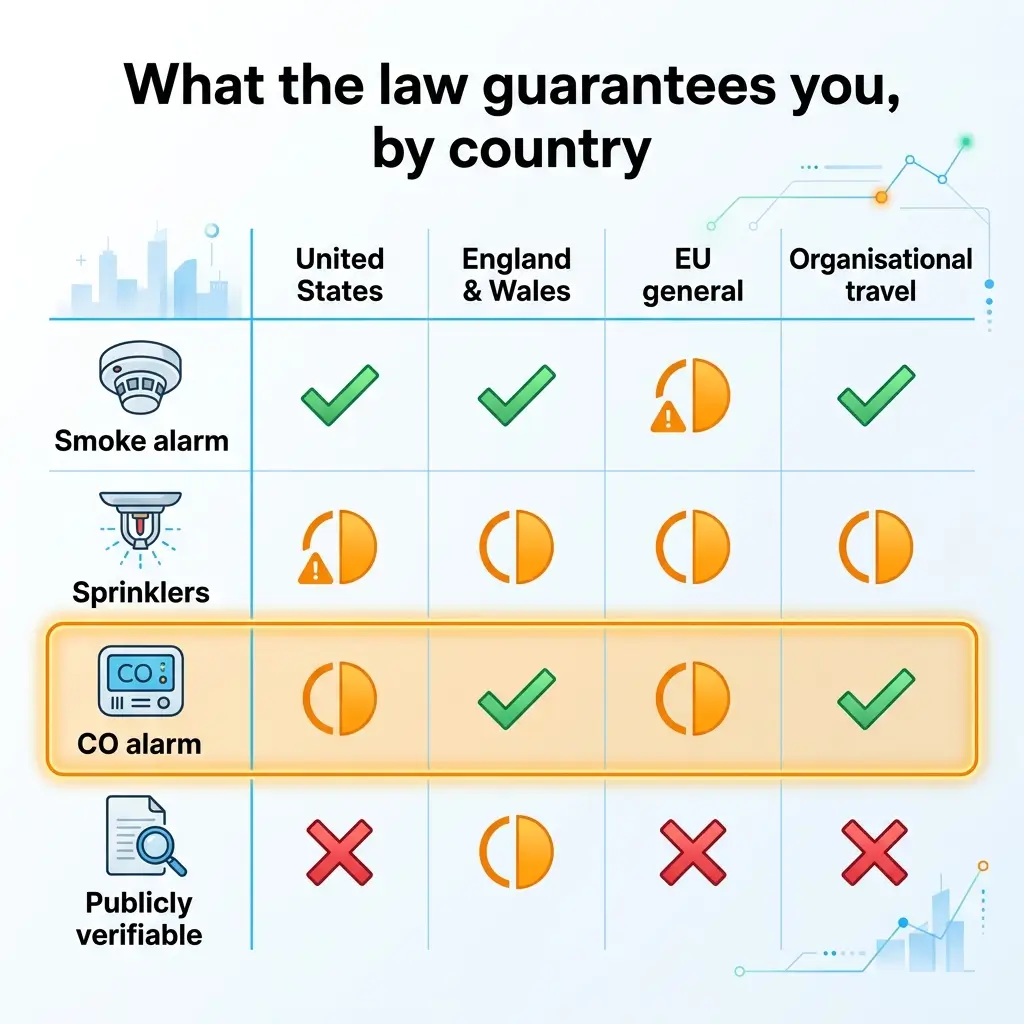
The comparison that matters to a traveller is what each regime does and does not guarantee:
| United States | England & Wales | EU (general) | Organisational travel | |
|---|---|---|---|---|
| Primary instrument | State and local codes adopting NFPA 101 / IFC; Hotel and Motel Fire Safety Act 1990 for federal travel | Regulatory Reform (Fire Safety) Order 2005 | National building codes; ELDSNet surveillance for Legionella | ISO 31030:2021 (guidance, not certifiable) |
| Guest-room smoke alarm | Required by code; hard-wiring required for master-list listing | Required through the fire risk assessment and supporting guidance | Set nationally | Not applicable |
| Sprinklers | Generally required in new build; older stock is often exempted | Determined by the fire risk assessment and building regulations | Set nationally | Not applicable |
| Carbon monoxide alarm in every bedroom | No federal requirement; roughly 14 states require them in lodging | Requirement attaches to rooms with a fixed combustion appliance, not every bedroom | Set nationally; no EU-wide rule | Screening expected under ISO 31030 Annex F |
| Verifiable by a guest | Via the national master list | No public register | No public register | Via the employer's travel programme |
Two things follow from that table. First, older buildings are the gap almost everywhere: retrofitting sprinklers into existing stock is expensive, and most codes grandfather it. Second, carbon monoxide is the one hazard for which the legal floor is genuinely low in every jurisdiction I have worked in — which is why it gets its own section below rather than a bullet point.
⚖️ Jurisdiction note: A four-star rating is a hospitality grade, not a life safety grade. In several countries I have worked in, star ratings are awarded on service, room size and facilities, with no fire engineering assessment at all.
At the check-in desk: what to ask, and what not to say
Check-in is thirty seconds of opportunity, and most travellers spend it on the wrong things. The security advice you already know is sound — keep your room number off the air, take it written rather than spoken, and do not keep the written number with the key card. Keep that. Then add three questions.
Ask what the fire alarm sounds like in this building. This is not small talk. Many larger hotels operate phased or staged evacuation, where an alarm sounds on the affected floor and those immediately around it while the rest of the building receives an alert tone only. If you do not know which signal means "leave now," you will lose time deciding.
Ask whether the building is sprinklered. Ask whether rooms have carbon monoxide detection. Front desk staff frequently do not know, and that itself is information — in a well-run property the duty manager knows the answer within a minute.
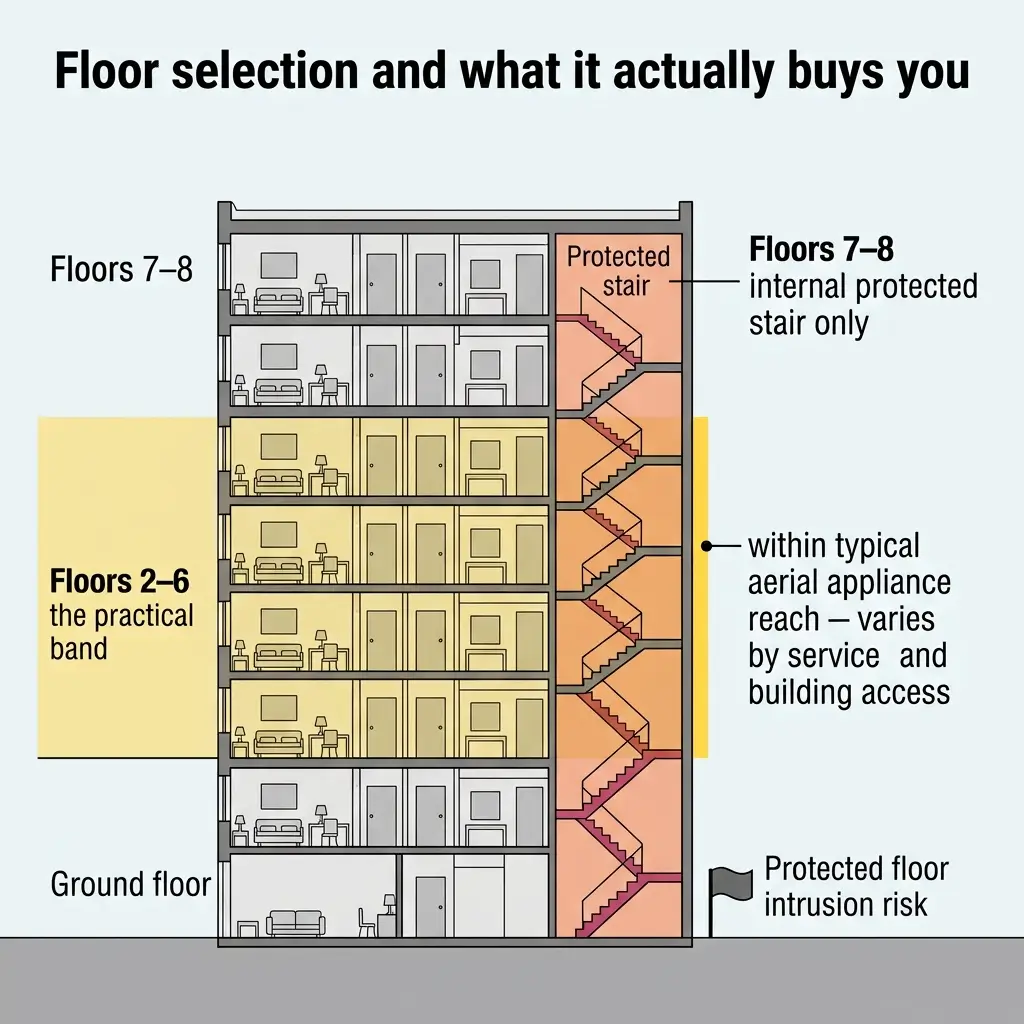
On floor selection, the common advice to take floors two to six is broadly right but usually given without its reasoning. Ground-floor rooms carry higher intrusion risk and offer less privacy. Very high floors leave you dependent entirely on internal protected stairs. External rescue from a fire service aerial appliance has a practical reach that varies by country and by service — and it depends on whether the appliance can be positioned against that face of the building at all. Treat two-to-six as a heuristic, not a rule — and understand that the real protection at any height is a protected stair you have already walked.
The requests worth making before you take the key are:
- Room number written, not spoken — and stored separately from the key card
- A floor between the second and the sixth where the building allows it
- A room away from the stair and lift lobbies, which are the corridors with the most footfall
- No connecting door, or if unavoidable, one you can verify is locked from your side
- Not directly above or below plant — pool halls, boiler rooms, loading bays and generator rooms, for reasons covered below
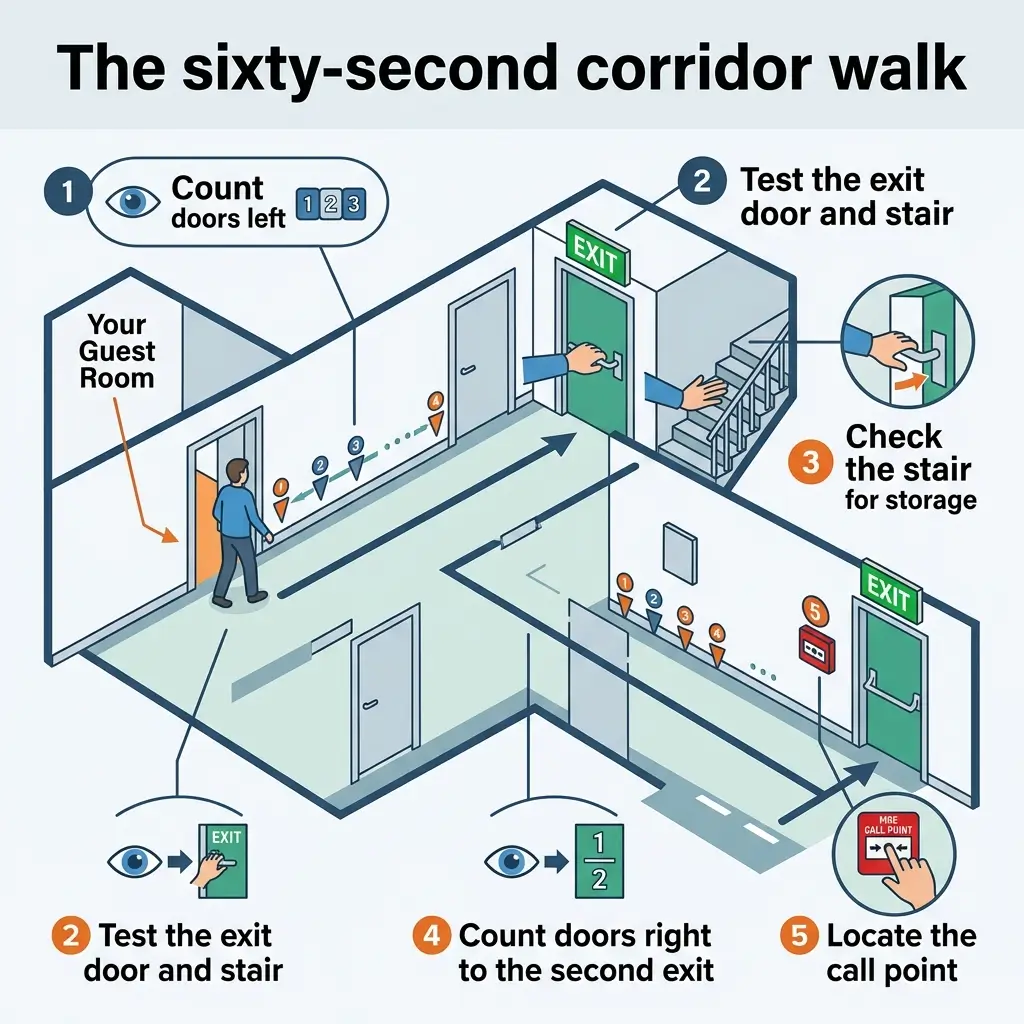
The corridor walk: count the doors before you unpack
This is the part of the article that comes from my own trade, and it is the one thing here I would keep if I could keep only one.
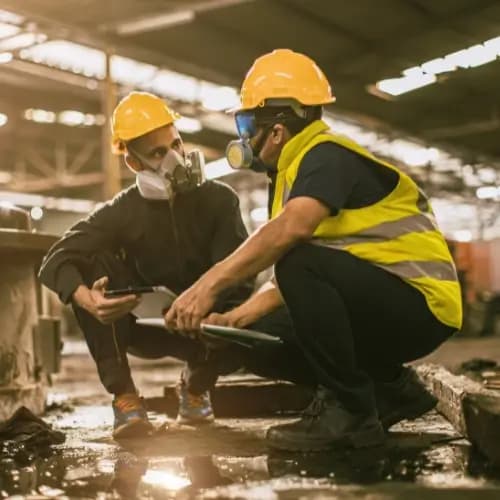
Exits rarely fail by being absent. They fail by being obstructed, and obstructions accumulate without anyone ever deciding to block an exit. On an egress integrity assignment for Chubb in Australia, I found a temporary hose run straight across an escape door during a live walkdown. Nobody had chosen to block that door. Someone needed water on the other side of it for an hour. I stopped the pattern, had the route reinstated and briefed the crew before work restarted. On a suppression interface scope for Viking in Malaysia, the same failure in a different form: a cable laid across a primary escape stair, on a route that everybody used daily and nobody looked at.
Neither of those was a hotel, and I am not going to pretend otherwise. What transfers is the mechanism. A corridor with a housekeeping cart wedging a cross-corridor fire door open, a function room's cabling taped across a stair landing, a fire exit locked because it kept setting off the door alarm — these are the same failure, in a building where you are asleep and unfamiliar. The one difference is that on an industrial site there is an assurance programme looking for it. In a hotel corridor at eleven at night, there is you.
The walk takes under a minute:
- Leave the room and turn one way. Count the doors on your side of the corridor until you reach the exit. Touch them as you go — in smoke you will navigate by touch, not sight, and a number you counted with your hand is a number you will remember.
- Open the exit door. Do not assume. Check that it opens, that it leads to a stair rather than a service cupboard or a dead end, and that the stair goes down.
- Look at what is in the stair. Stored furniture, function-room equipment, cabling, propped doors. If something is there, tell reception — politely, once, and specifically.
- Walk back past your room the other way and count to the second exit. One route is not a plan. The single fatal weakness of a single exit is that the fire may be between you and it.
- Note the fire alarm call point nearest your room, and whether the cross-corridor doors are held open on magnetic releases that will drop when the alarm operates.
✅ Auditor's tip: If a cross-corridor fire door is propped with a wedge or a fire extinguisher, that is not a quirk. It is a smoke-control failure and it tells you how the building is managed. I would ask for a different property.
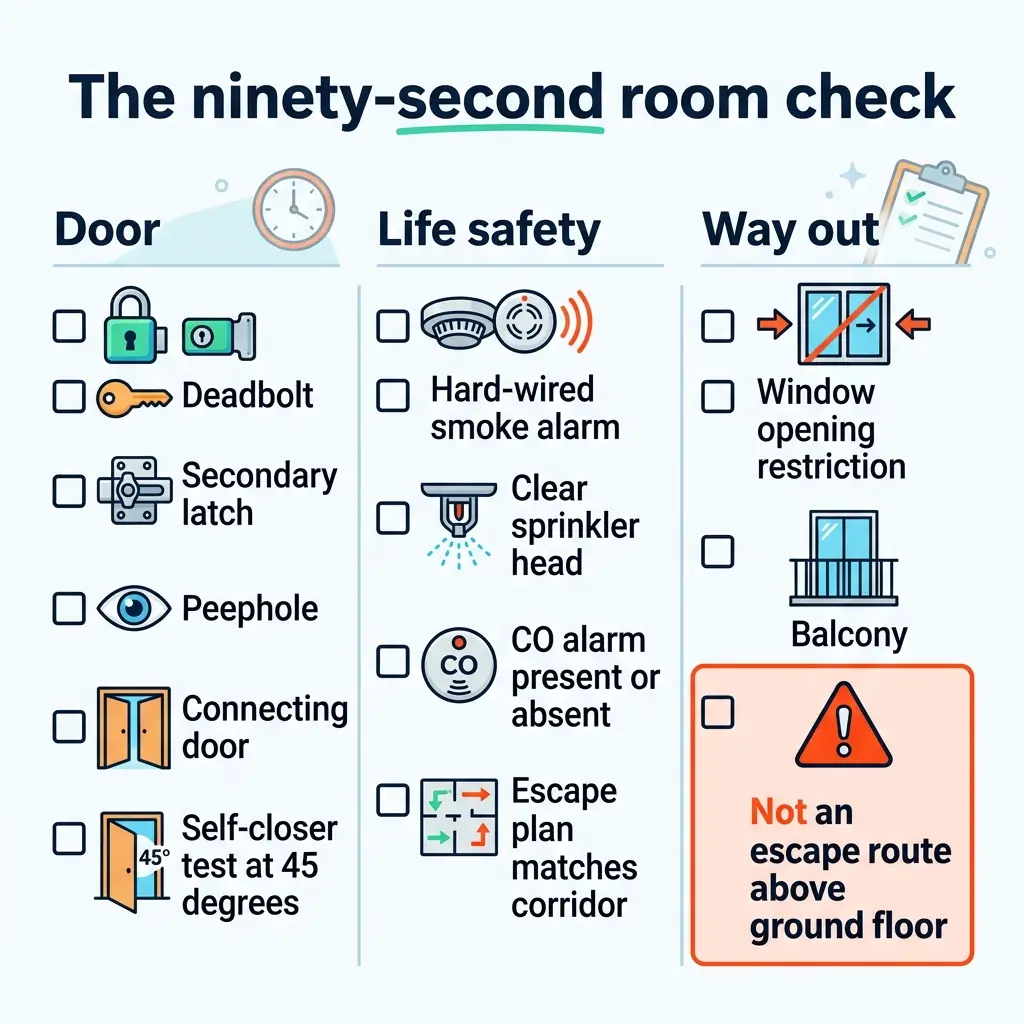
The ninety-second room check
Back inside, the room check splits into three things that are usually treated separately and should not be: the door, the life safety hardware, and the way out that is not the door.
The door
The security items are the ones every other guide covers, and they are worth doing: engage the deadbolt and the secondary latch or swing bar whenever you are inside, use the peephole before opening to anyone including staff, and confirm any connecting door is locked on your side. A portable door wedge or travel lock adds a layer, and is the one piece of kit I think earns its space in a bag.
The item nobody covers is whether the door works as a fire door. In most hotels the guest room door is a fire-resisting, self-closing door — it is what buys you time if the fire starts in the corridor. Open it to about forty-five degrees and let go. If it does not swing shut and latch on its own, the closer has failed or been adjusted out, and the room's primary protection has been quietly removed. That is worth reporting.
The life safety hardware
Look up. You are checking for four things, and the whole scan takes about twenty seconds.
- A smoke alarm, and whether it looks hard-wired and interconnected rather than a battery unit stuck to the ceiling
- A sprinkler head — and that nothing is hanging from it. Coat hangers on sprinkler heads are common and dangerous; the head is a thermal device, not a hook
- A carbon monoxide alarm. Frequently absent. Note it now rather than discovering it at three in the morning
- The escape plan on the back of the door, which should show your room and the routes out. Compare it against the corridor you just walked. If they disagree, believe the corridor
The window and the balcony
Check whether the window opens, and how far. Many upper-floor hotel windows are restricted to a narrow opening, which is a fall-prevention measure and a sensible one. A balcony can serve as a place of relative safety with air, which is useful to know before you need it. What a window is not, above the first floor, is an escape route. People die making that decision under stress, and the point of checking now is so that the decision is already made.
Carbon monoxide: the alarm your hotel probably does not have
This is the section that separates a safety publication from a travel blog, and the numbers deserve to be stated precisely.
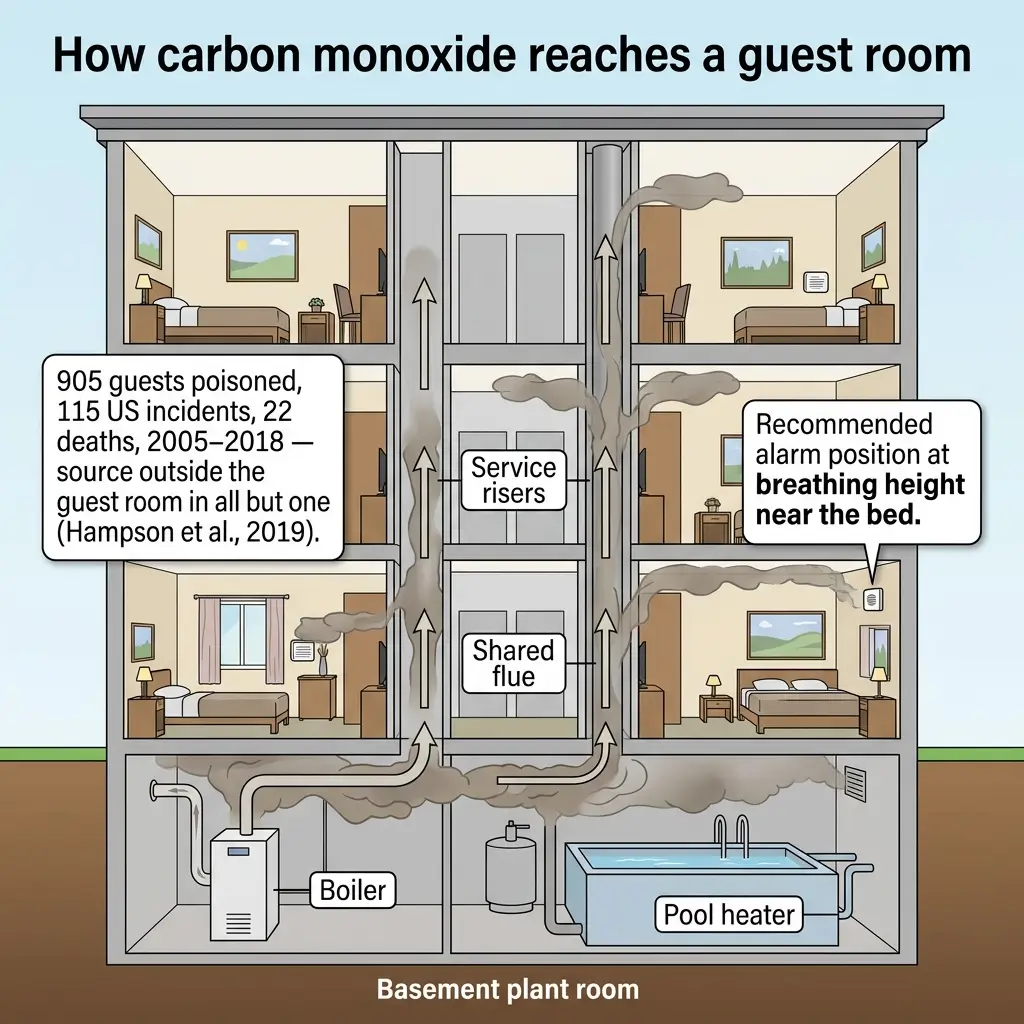
Hampson and colleagues, publishing in Preventive Medicine Reports in 2019, identified 905 guests poisoned in 115 carbon monoxide incidents in US hotels, motels and resorts between 2005 and 2018, including 22 deaths. Children made up 16 percent of those poisoned and 27 percent of the fatalities. Most incidents involved natural-gas-fired appliances — boilers, water heaters and pool heaters — and in all but one, the source was located outside the guest rooms affected. The authors' conclusion was that in-room alarms would likely have prevented most of them.
That last detail is the one that changes behaviour. The gas does not have to originate in your room to reach it. It migrates through service voids, shared flues, ductwork and structural gaps from plant that may be two floors below you, which is why the room selection advice above includes staying clear of pool halls, boiler rooms and loading bays.
You cannot detect carbon monoxide. It has no colour, no smell and no taste. The early symptoms — headache, nausea, dizziness, confusion — are indistinguishable from a migraine, food poisoning, flu or a hangover after a long flight. There are two discriminators worth memorising, because they are what people miss:
- Everyone in the room is affected at the same time, including children and pets, and typically the smallest person worst
- Symptoms improve when you leave the room and return when you go back
The control is a small battery carbon monoxide alarm in your bag, certified to the standard used where you are travelling — UL 2034 in North America, EN 50291 in the UK and Europe. It costs less than one night in the hotel it is protecting you in, weighs almost nothing, and works in rentals and guest houses that have no detection at all. Put it near the bed at roughly breathing height, not on the floor and not in the bathroom.
If it sounds: get everyone out of the room into fresh air first, then call emergency services from outside the room, then tell reception. Do not go back in to investigate, open windows or collect belongings. If anyone is unconscious, drowsy or confused, that is an emergency call, not a taxi to a clinic. Carbon monoxide poisoning has specific treatment, and the exposure history is what tells a clinician to look for it.
⚠️ Safety critical: If you wake with a headache and nausea and someone else in the room feels the same, leave the room before you look for another explanation. Getting out costs you a few minutes if you are wrong.
Water, bed bugs and the parts of a room nobody inspects
Two further hazards live in a hotel room, and both are managed by habits rather than equipment.
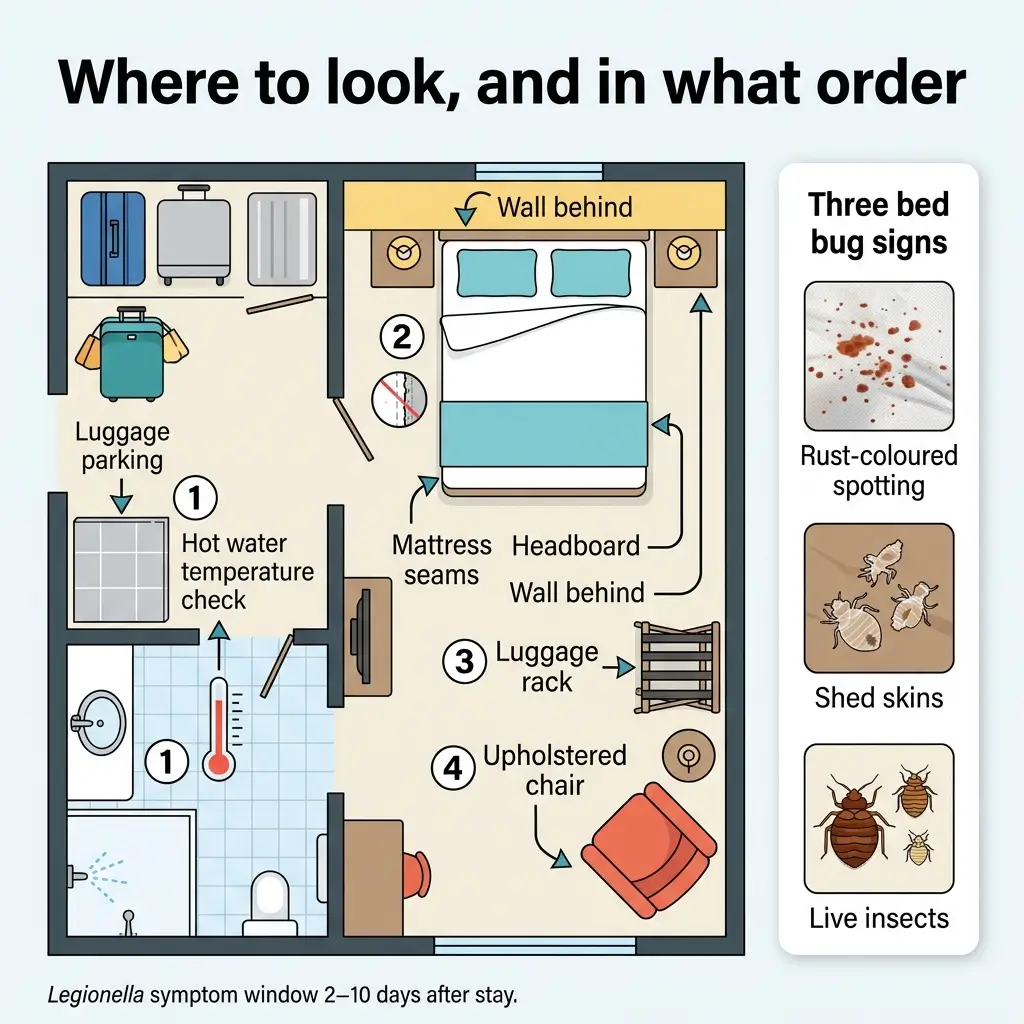
Legionella grows in building water systems that run warm and stagnant, which describes the plumbing of a large hotel with variable occupancy rather well. Guests are exposed through inhaled aerosol, principally showers and spa pools. The surveillance case definition is the useful number to carry: symptoms beginning two to ten days after staying at commercial accommodation. You cannot inspect a water system. What you can do is check the ECDC list before booking in Europe, and, far more importantly, tell a doctor where you stayed and when if you develop a chest infection or pneumonia within ten days of a trip. Travel-associated clusters are detected because someone mentioned the hotel. If nobody mentions it, the site is never investigated.
Bed bugs are not a health emergency, but they travel home with you and that is expensive. The EPA's traveller guidance is short and sound, and the sequence is what matters:
- Put luggage in the bathroom — tile and porcelain offer nowhere to harbour — while you inspect
- Check the mattress seams, the headboard and the wall behind it. EPA lists the signs as rusty or reddish stains from crushed bugs, dark excrement spots, tiny pale shed skins and eggshells, and live insects — and notes they harbour around the piping, seams and tags of the mattress and box spring, and in cracks in the frame and headboard
- Inspect the luggage rack itself, which is where they most often transfer
- Keep bags off the bed and off upholstered furniture for the whole stay
- Unpack into the washing machine on return, and run clothes through a hot dryer, because heat kills them and washing alone often does not
While you are in the bathroom, run the hot tap for a moment and note the temperature. Hotel hot water is often stored hot for Legionella control and delivered through mixing valves that fail; scalding is a genuine and under-reported injury, especially with young children.
If the alarm sounds: the decisions you already made
Everything above exists to make this section short, because at three in the morning you will not be reasoning. You will be executing whatever you already decided.
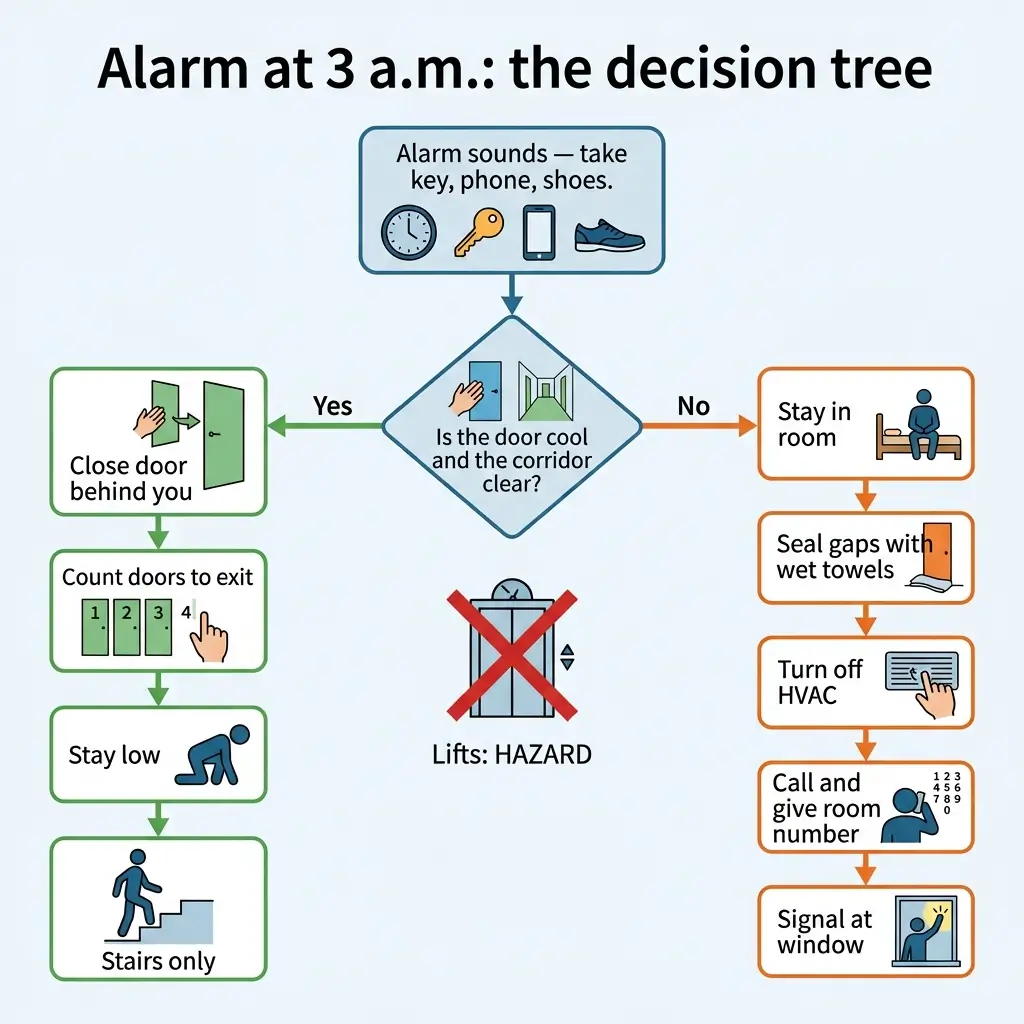
Wake and take three things. Room key card, phone, shoes. The key card because re-entry may be controlled and because it identifies your room. Shoes because escape stairs after an evacuation are full of broken glass, water and people.
Feel the door before you open it. Back of the hand against the door and the handle. Look at the gap along the bottom.
If the door is cool and the corridor is clear: leave, close your door behind you — a closed door is a fire door doing its job and it protects the corridor you are walking down — and go to the exit you counted. Stay low if there is any smoke. Never the lift.
If the door is hot, or the corridor is smoke-logged: stay in the room. This is a legitimate decision, not a failure, and modern hotel construction is designed around it. Close the door and seal the gaps with towels, wet if there is time. Turn off the air conditioning if it is drawing air in. Call emergency services and reception and give your room number — that number is how a fire crew finds you. Go to the window and make yourself visible.
Do not stop to collect anything else. People die returning for bags.
The consequence of a building without those systems was demonstrated at the Grand Kartal Hotel in Kartalkaya, Turkey, in January 2025. The fire began in the fourth-floor kitchen area during a school holiday, with the hotel near capacity. Seventy-eight people died and 51 were injured, most from suffocation. Reporting on the investigation pointed to the absence of working detection, sprinklers, alarms and emergency exit lighting as factors in the death toll. The systems you checked for on arrival are the difference between an incident and that.
If your employer booked the trip: what duty of care covers
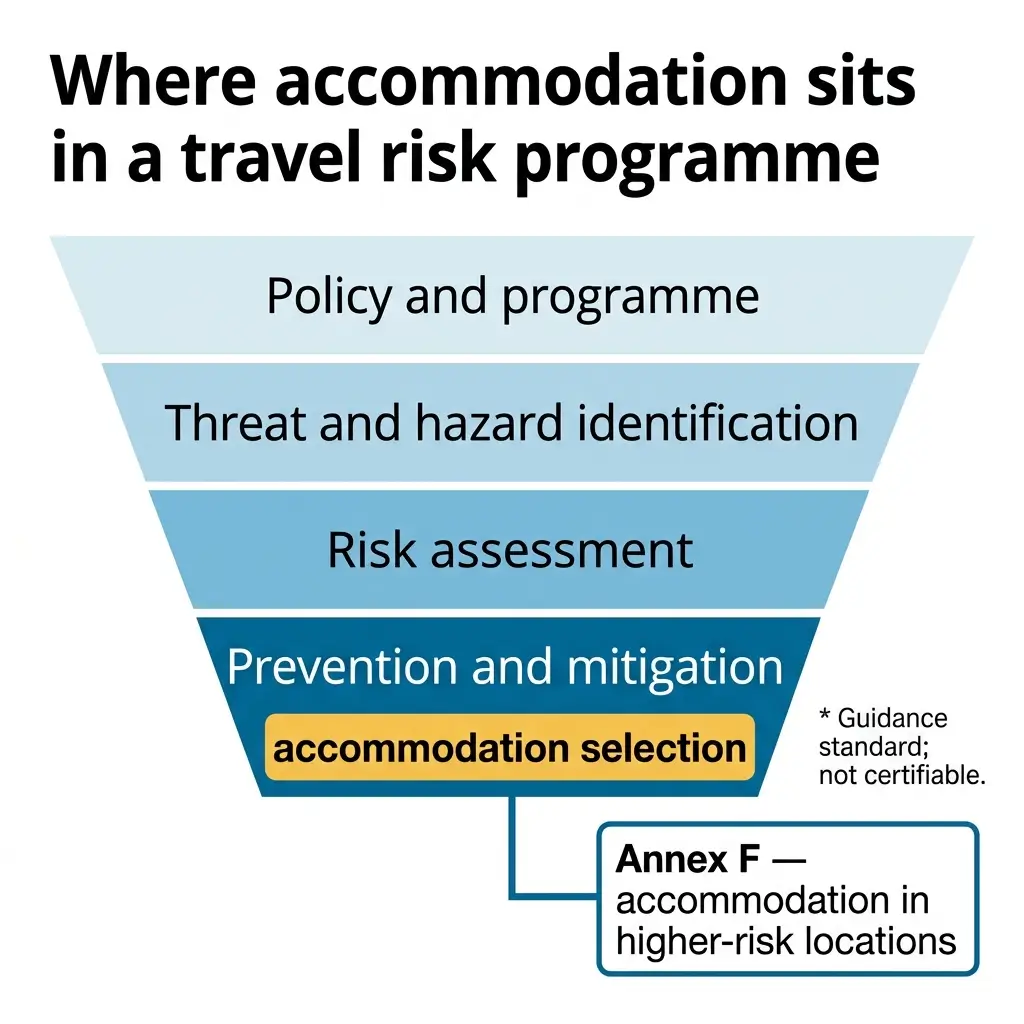
If you are travelling for work, your accommodation is not a personal choice you make alone — it sits inside your employer's duty of care, and there is an international standard describing what a competent travel risk programme looks like.
ISO 31030:2021, Travel risk management — Guidance for organizations, gives organisations a structured approach to policy, threat identification, risk assessment and mitigation for work-related travel. It is guidance rather than a certifiable management system standard, and it is aligned with ISO 31000 and ISO 45001. The 2021 edition is current, but it entered ISO's systematic review cycle in April 2026 — worth checking before you cite it in a policy document. Two features matter to a traveller. It covers accommodation selection explicitly as part of the programme, and it carries an informative annex — Annex F — devoted to considerations for accommodation in higher-risk locations.
That gives you something concrete to ask for rather than a general complaint about a hotel you disliked. The questions worth putting to a travel manager or HSE lead are:
- Is accommodation screened against any life safety criteria, or booked purely on rate and location?
- Is there a 24-hour assistance number that reaches a person, not a voicemail, in the time zone I am travelling to?
- What is the check-in protocol — who expects to hear from me, and by when, and what happens if they do not?
- Who authorises a change of hotel if I arrive and the property is not acceptable, and does that decision cost me anything?
- What does the arrangement cover for lone travellers and for travellers at elevated risk in a given destination?
An organisation that can answer those has a programme. An organisation that treats the corporate booking tool as a travel risk programme does not, and that gap is worth raising through your safety representative rather than absorbing personally.
Frequently asked questions
These are the questions travellers most often search on this topic. Where the answer sits in the body above, the short version is here and the detail is in the relevant section.
What floor is safest in a hotel?
Floors two to six are the usual recommendation. Ground floor rooms carry higher intrusion risk; very high floors leave you dependent entirely on internal protected stairs, since external rescue reach varies by fire service, appliance and whether the building can even be approached from that side. Treat it as a heuristic, not a rule.
How do I know if my hotel has sprinklers?
In the United States, search the USFA Hotel-Motel National Master List, which records properties declaring sprinklers in buildings above three storeys. Elsewhere, ask the property directly before booking, and look for a sprinkler head in the room when you arrive. Older buildings are frequently exempted from retrofitting.
Do hotels have carbon monoxide detectors?
Often not. There is no federal US requirement and roughly 14 states mandate them in lodging; in England the requirement attaches to rooms containing a fixed combustion appliance rather than to every bedroom. A small travel CO alarm certified to UL 2034 or EN 50291 is the practical answer.
What should I do if the fire alarm goes off in a hotel?
Take your key card, phone and shoes. Feel the door and handle before opening. If cool and the corridor is clear, close your door behind you and use the stairs to the exit you counted on arrival. If the door is hot or the corridor is smoke-filled, stay in, seal the gaps, call and give your room number, and signal at the window. Never use a lift.
Are hotel room safes secure?
Treat them as theft deterrence, not security. Many run on default override codes, and hotels commonly disclaim liability for items left in guest room safes. For genuinely valuable items, use the front desk safe and get a written receipt, and check what your travel insurance actually covers.
Should I bring a portable door lock?
A travel lock or door wedge is a reasonable extra layer and takes almost no space. It does not replace the deadbolt and secondary latch, and it should never be used in a way that would delay your own exit — the point is to slow entry, not to seal yourself in.
How do I check a hotel room for bed bugs?
Park your luggage in the bathroom, then inspect the mattress seams, the headboard, the wall behind the bed and the luggage rack with a phone torch, looking for rust-coloured spotting, shed skins or live insects. Keep bags off the bed for the whole stay, and unpack into a washing machine and hot dryer on return.
The part that actually takes ninety seconds
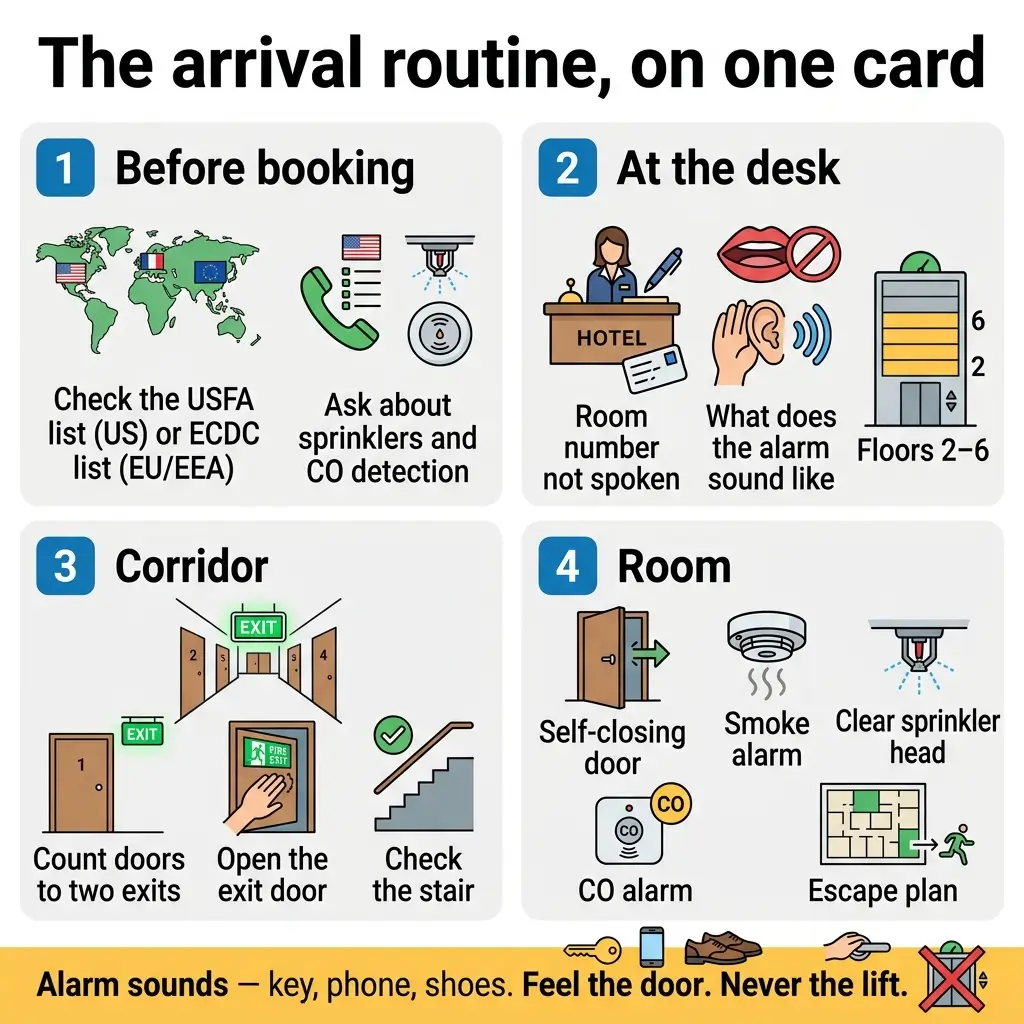
None of this makes travel feel like an audit. The database check happens once, at booking. The corridor walk and the room check together take about two minutes, once, on arrival — and after a few trips you stop noticing you are doing it.
What you get for those two minutes is that every subsequent decision is already made. You know which way the exit is and how many doors away. You know whether there is a sprinkler above you and an alarm beside you. You know whether anyone is expecting to hear from you. That is the whole difference between reacting and executing, and it is available to any guest in any hotel in the world, for free, before they unpack.
About the author — Mia Collins
Mia Collins is an Australian Fire Life Safety and Emergency Response Assurance Consultant with 15 years of continuous field experience across 14 countries, covering high-rise fire life safety, egress integrity, detection and alarm, industrial fire protection and camp emergency arrangements. She has inspected more than 180 workplaces and conducted over 70 audits, and her focus is practical assurance — checking that controls still work where people actually are. She currently leads Collins Fire & Emergency Assurance in Brisbane, after senior roles including Egress Integrity Advisor at Chubb Fire & Security AU, High-Rise Fit-Out Fire Lead at Johnson Controls Fire AU and Camp Emergency Advisor at Minimax Fire Protection.
Credentials: NEBOSH International General Certificate · ISO 45001 Lead Auditor · ISO 14001 Internal Auditor · IOSH Managing Safely · Emergency Response Planning Awareness · Fire Safety Awareness · Incident Investigation (ICAM pathway) · First Aid / CPR
A note on scope: egress, detection and emergency response are my field. The two field examples in this article come from industrial assignments, not hotels, and I have said so where they appear — the mechanism transfers, the setting does not. The clinical material on carbon monoxide, the Legionella surveillance definitions and the bed bug guidance are cited directly to Hampson et al., ECDC and the US EPA rather than drawn from my own practice. For a professional assessment of a specific building, or for medical advice after a suspected exposure, speak to a competent fire risk assessor or a doctor.
Sources
- U.S. Fire Administration — hotel and vacation rental fire safety
- U.S. Fire Administration — Hotel-Motel National Master List
- Hampson NB, Hauschildt KL, Deru K, Weaver LK — Carbon monoxide poisonings in hotels and motels, Preventive Medicine Reports, 2019
- European Centre for Disease Prevention and Control — accommodation site list for Legionnaires' disease
- ECDC — ELDSNet operating procedures
- GOV.UK — fire safety risk assessment: sleeping accommodation
- GOV.UK — making your small paying guest accommodation safe from fire
- ISO — ISO 31030:2021, Travel risk management — Guidance for organizations
- U.S. Environmental Protection Agency — protecting your home from bed bugs and how to find bed bugs