

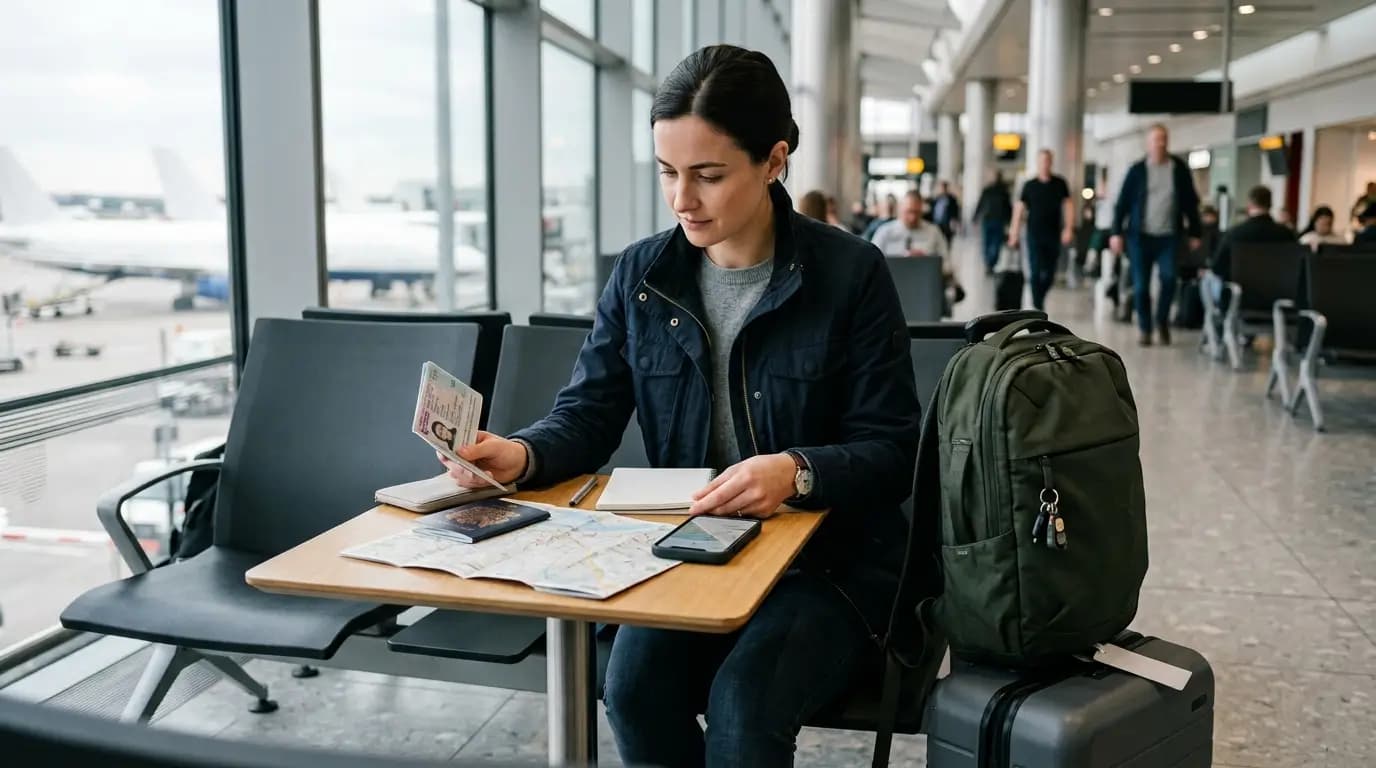
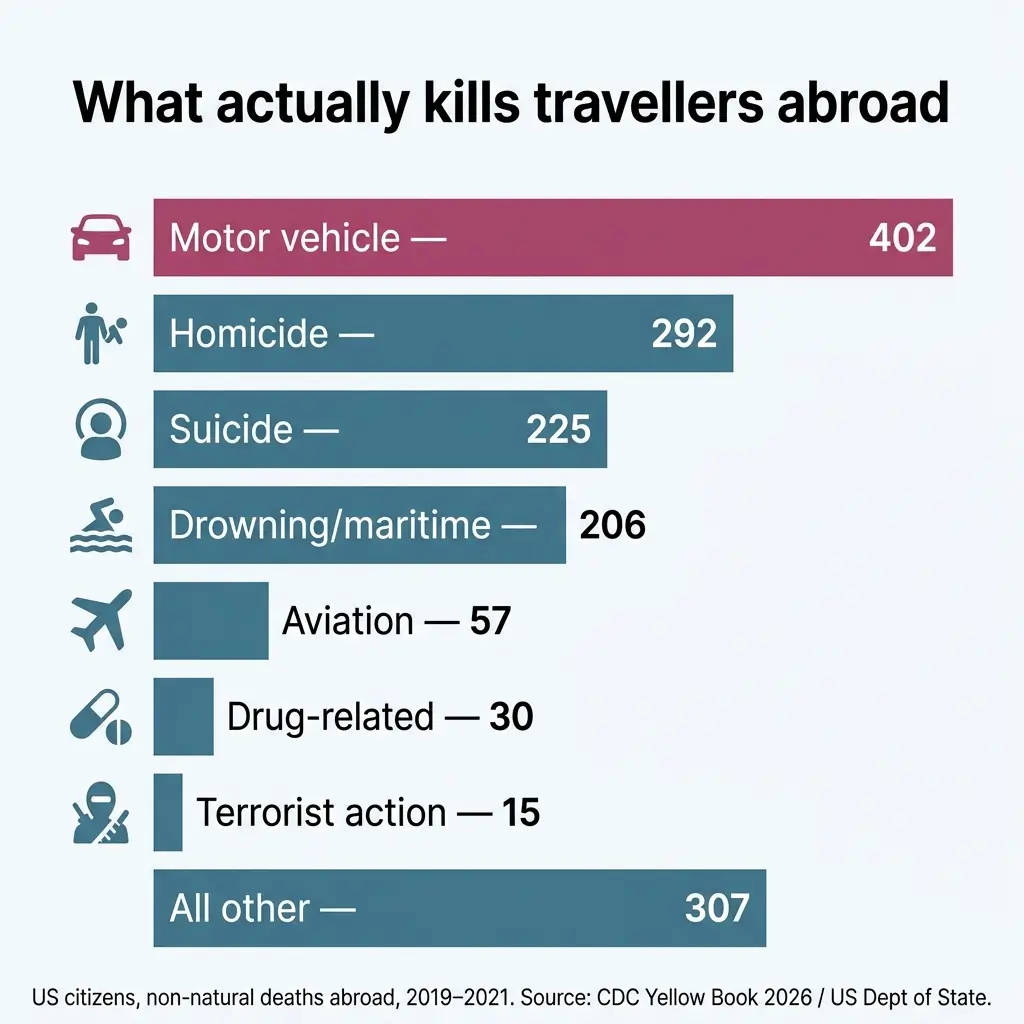
Between 2019 and 2021, more than 1,500 US citizens died of non-natural causes in foreign countries. Motor vehicle crashes were the single largest cause at 26%, followed by homicide, suicide and drowning, according to the CDC Yellow Book 2026 drawing on US State Department consular records. Theft does not appear on that list, because theft does not kill people.
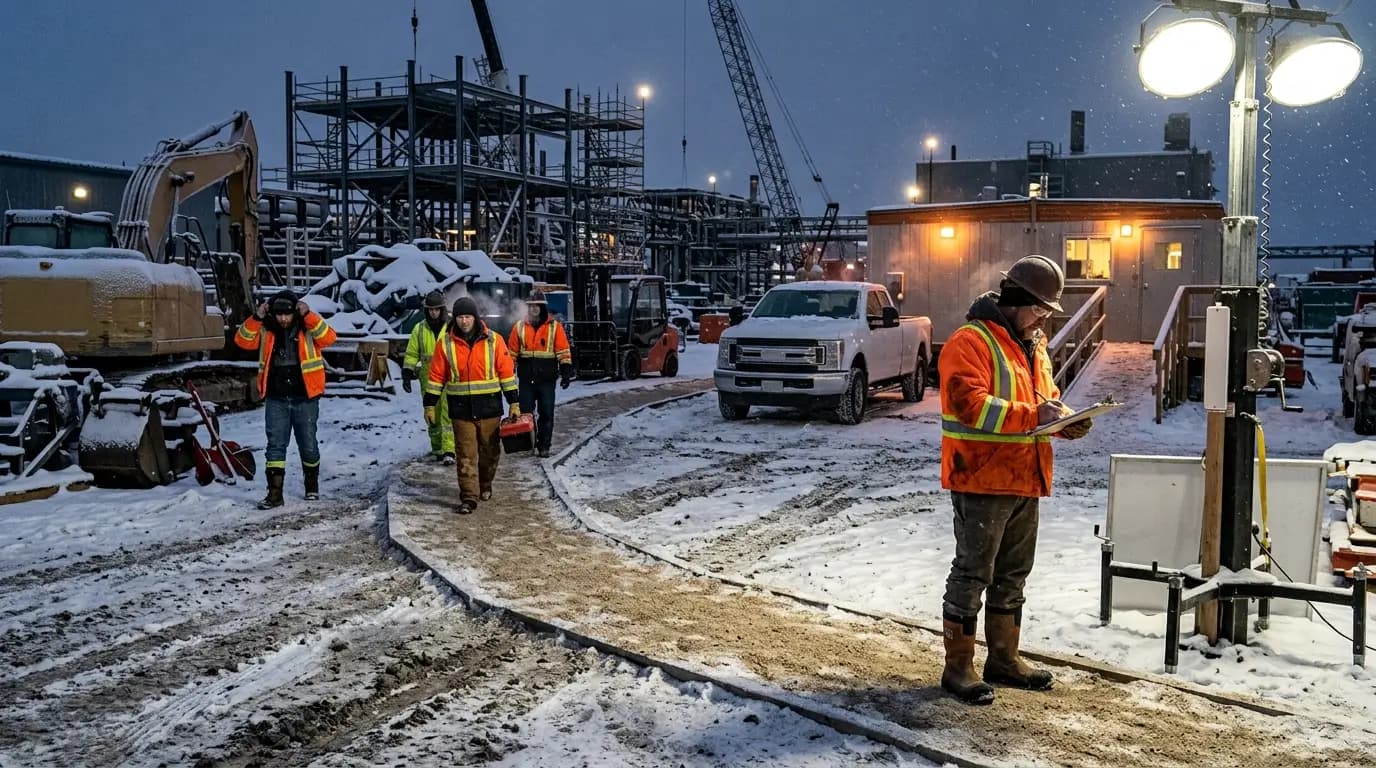
Almost every travel safety guide you will read is sorted the other way round — pickpockets first, seatbelts last or never. I spend my working life arriving at industrial sites I have never seen, run by someone else, and working out in the first hour what is actually going to hurt someone. The method transfers to a holiday, and applying it changes the order of this advice completely.
This guide covers international leisure and business travel. It ranks controls by how often the hazard kills or seriously injures travellers, not by how frightening it feels.
Key takeaways
The six decisions that carry the most weight, before anything else in this guide:
- Road crashes are the leading cause of non-natural traveller death. Wear a seatbelt in every vehicle including taxis and rear seats, and refuse vehicles that have none.
- Book accommodation no higher than the sixth floor. Fire ladders in most countries cannot reach above it, which is the reason the "which floor?" arguments online never resolve.
- Drowning and water incidents kill more travellers than aviation, terrorism and drug-related deaths combined.
- ISO 31030:2021 is the international travel risk management standard. It is written for organisations, not holidaymakers, but its five-part structure is the best free upgrade a private traveller can make.
- Buy insurance that names medical evacuation and repatriation explicitly. Trip cancellation cover is not the part that matters.
- Count the doors between your room and the fire exit on the night you arrive. You will not be able to see them when it matters.
What actually happens to travellers, ranked
Start with the record rather than the folklore. The US State Department publishes causes of death for citizens who die abroad, and the pattern has been stable for a decade: vehicles, violence, and water, with crime against tourists as a property problem rather than a fatal one.
The figures below cover 2019 to 2021 and exclude deaths never reported to a US embassy or consulate, so the true totals run higher. They remain the best public dataset on what happens to travellers.
| Cause of non-natural death abroad | Deaths, 2019–2021 |
|---|---|
| Motor vehicle | 402 |
| Homicide | 292 |
| Suicide | 225 |
| Drowning and maritime | 206 |
| Aviation | 57 |
| Drug-related | 30 |
| Terrorist action | 15 |
| All other and undetermined | 307 |
Source for the whole table: CDC Yellow Book 2026, Injury and Death During Travel, Figure 3.10.1, using US Department of State data.
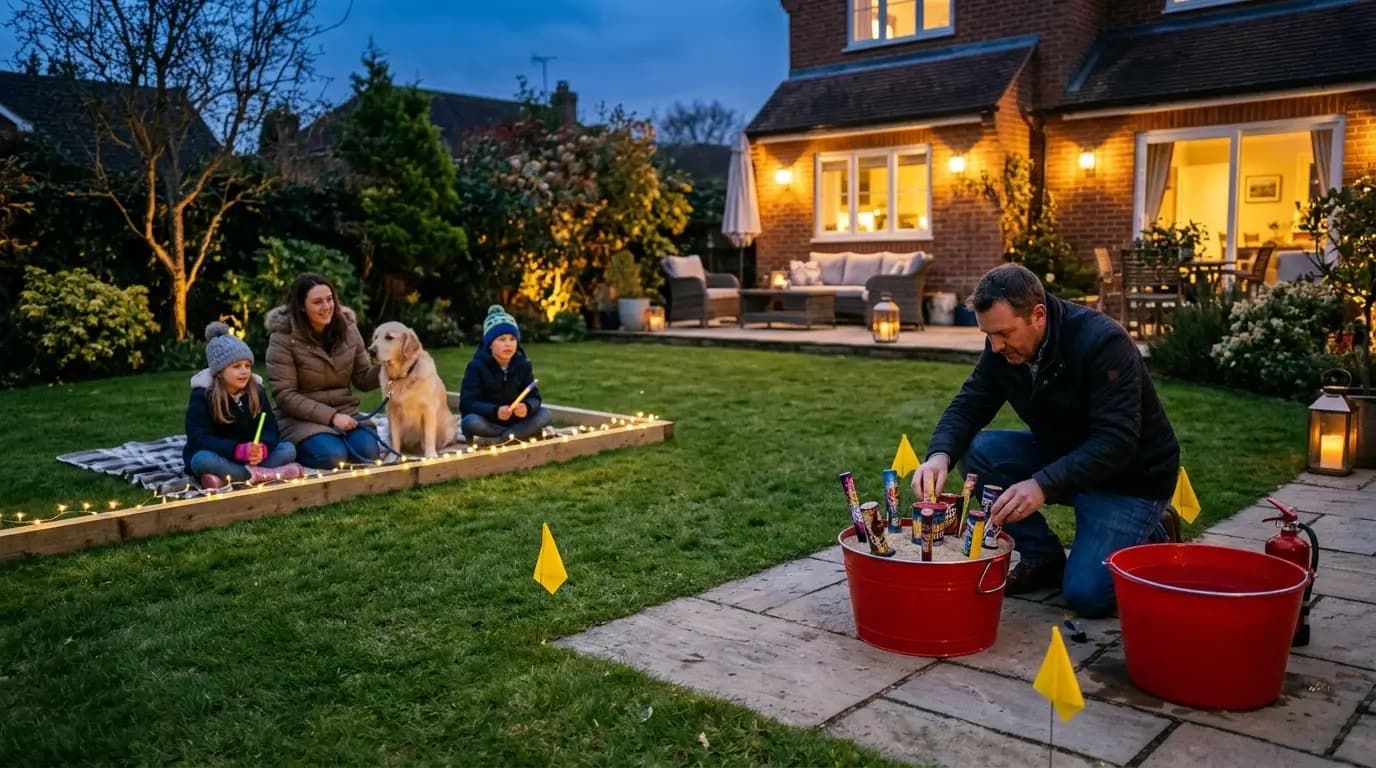
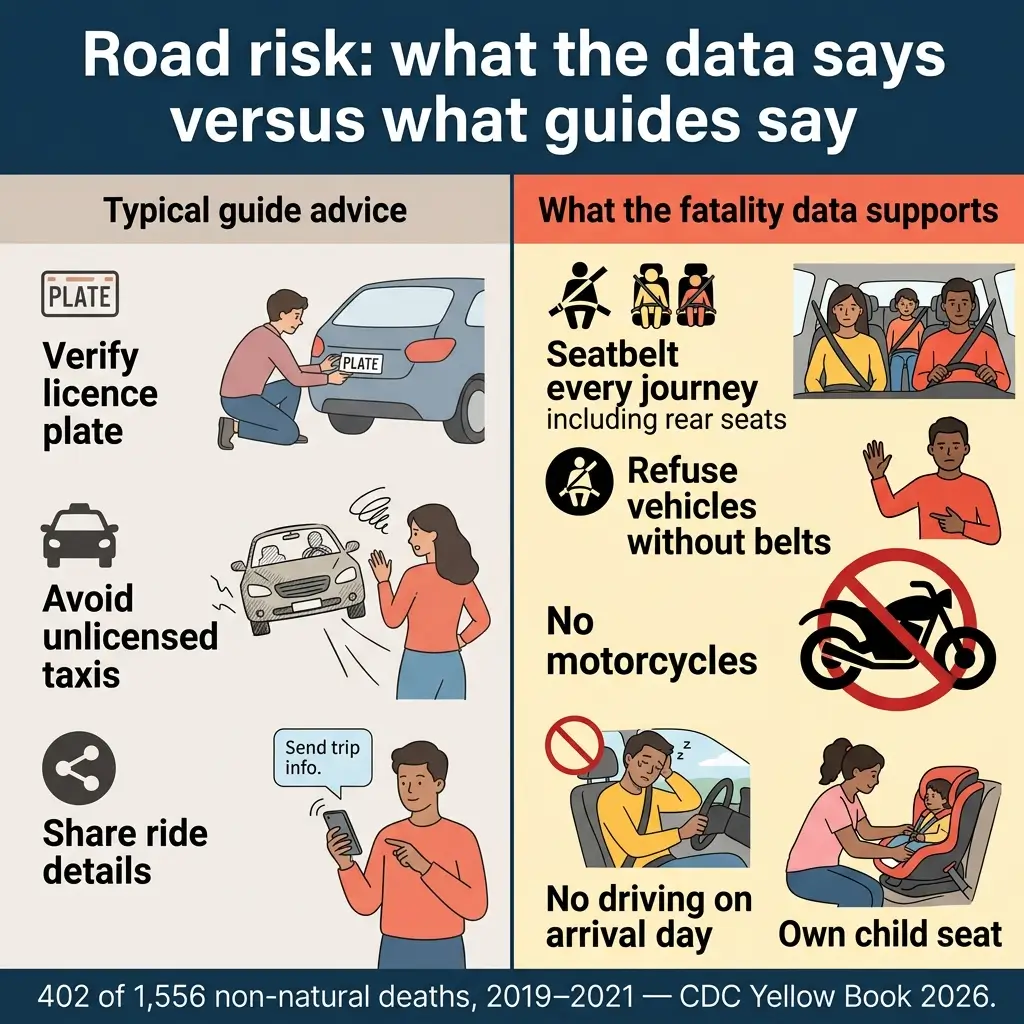
Look at what the ranking does to standard advice. Terrorism sits at the bottom and drives an enormous share of travel anxiety. Vehicles sit at the top and get a line about verifying your ride-share licence plate. That mismatch is the whole problem with the genre.
The distribution is also concentrated by destination rather than spread evenly. Mexico accounted for 141 of the 402 road deaths, and for over 68% of all homicides of US citizens abroad, on the same CDC source cited above the table. Country matters more than any packing decision you will make.
Three conclusions follow from the data:
- Rank your preparation by fatality, not by anxiety. Vehicles, water and accommodation fire deserve most of your attention.
- Check your specific destination, not the general idea of "abroad" — risk is not evenly distributed.
- Treat theft as a financial and administrative problem. It is worth preventing, but it belongs after the things that put people in hospital.
The five-minute travel risk assessment
There is an international standard for this. ISO 31030:2021, Travel risk management — guidance for organizations, was published in September 2021 and covers policy, threat identification, risk assessment and mitigation across the travel lifecycle. It entered ISO's five-yearly systematic review in April 2026, so check for a revision before relying on it professionally.
Be clear about what it is: the standard states plainly that it does not apply to tourism and leisure travel, except where the traveller is going on behalf of an organisation. It is written for the company that sends me abroad, not for your family holiday. But the structure underneath it is not proprietary, and running a stripped-down version of it before a personal trip takes about five minutes.
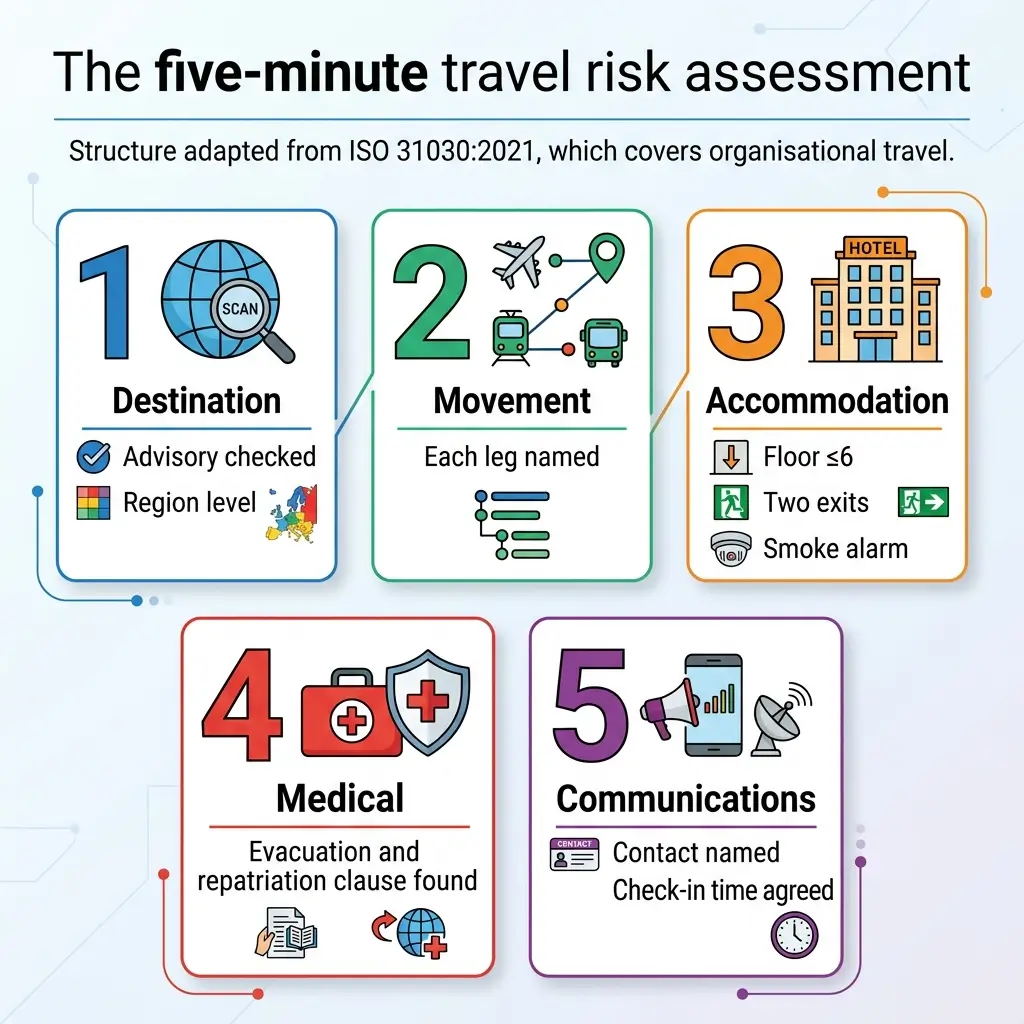
When I mobilise to an unfamiliar site, I work through the same five questions before I do anything else. Adapted for travel, they are destination, movement, accommodation, medical, and communications.
| Question | What you are actually deciding | Where to check |
|---|---|---|
| Destination | Is any part of this trip in a region under advisory? | FCDO travel advice or US travel advisories |
| Movement | How am I crossing each gap between airport, hotel and activity? | Booked transfers, vehicle type, night driving |
| Accommodation | Can I get out of this building at 3am in smoke? | Floor number, two exit routes, smoke alarms |
| Medical | What happens if I need surgery here? | Insurance evacuation clause, medication supply |
| Communications | Who knows where I am, and by when do they raise an alarm? | Named contact, agreed check-in time |
The last one is the one people skip, and it is the one that determines how long you lie undiscovered after something goes wrong. On site we call it a check-in protocol; on a trip it is one text message and an agreed deadline.
Run through these before you book, not after:
- Read the advisory for your specific region, not the country average. The US system runs Level 1 to Level 4 and is applied state by state in countries like Mexico, so a national headline figure can hide both a Level 1 and a Level 4 in the same trip. Levels 1 and 2 are reviewed every 12 months and Levels 3 and 4 at least every 6 months, so check the issue date as well as the level.
- Name every journey leg and decide how you are covering it. Airport transfers after a night flight are where fatigue and unfamiliarity meet.
- Ask the accommodation two questions at booking: what floor, and are there smoke alarms.
- Read your insurance for the words "medical evacuation" and "repatriation". If they are absent, the policy is a refund service.
- Give one person your itinerary and a check-in time, and agree what they do if you miss it.
Roads: the risk that outranks everything you were warned about
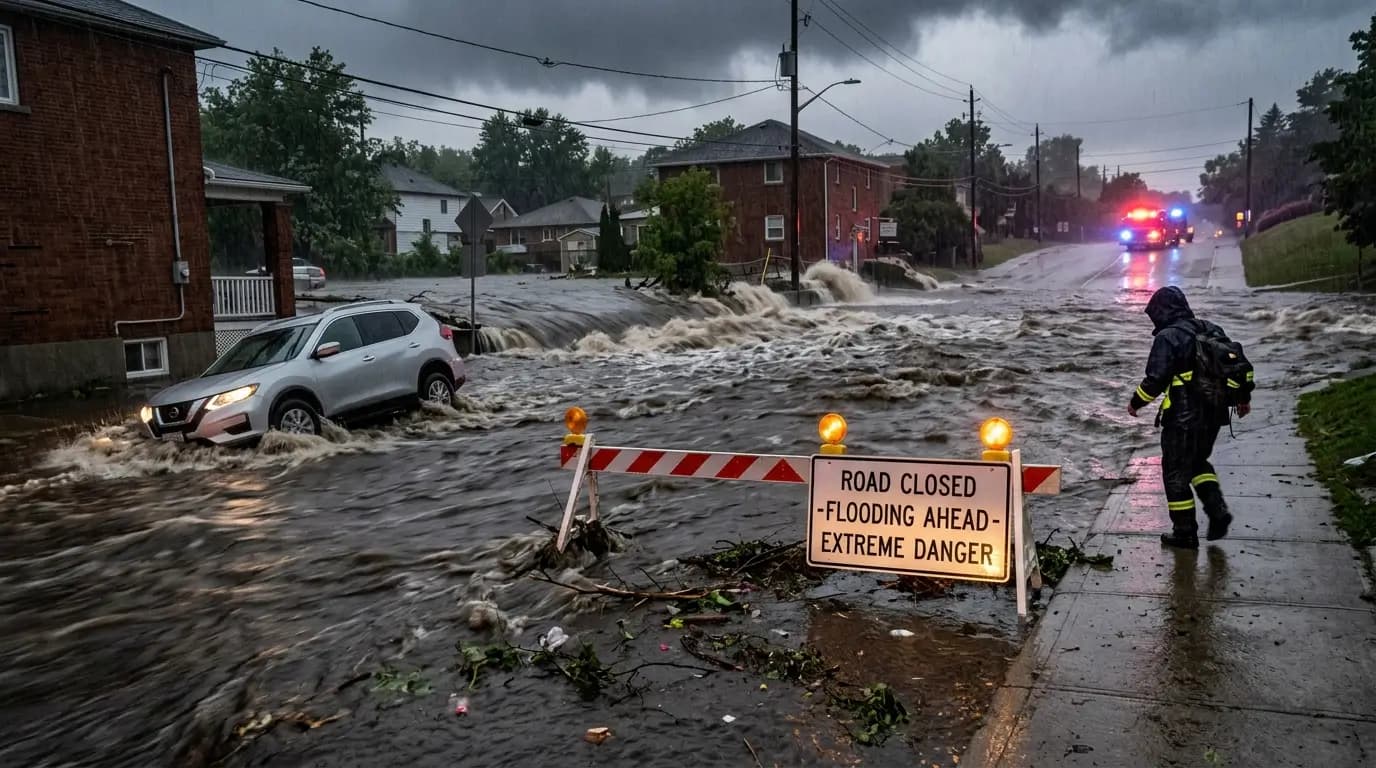
Globally, road crashes kill about 1.19 million people a year and remain the leading cause of death for people aged 5 to 29, according to the WHO Global status report on road safety 2023. Nine in ten of those deaths occur in low- and middle-income countries, and more than half of those killed are pedestrians, cyclists and motorcyclists.
You arrive into that system with no feel for local driving conventions, possibly on the opposite side of the road, often tired, sometimes after a drink, in a vehicle you did not choose. The CDC lists all of those as risk factors, alongside poor road surfaces, unprotected curves and absent lighting.
Seatbelts, rear seats, and the taxi you should refuse
Of the 402 US citizen road deaths abroad from 2019 to 2021, 62% were drivers and occupants of passenger vehicles, per the CDC's road traffic chapter. These are ordinary car journeys, not exotic adventures.
The intervention is unglamorous and free. Wear a seatbelt on every journey, including rear seats and including short hops. Where a taxi has no working rear belts, take a different taxi. I have refused site vehicles for exactly this reason and been thought difficult for it; the alternative is arriving at a job in a vehicle whose only restraint system is the driver's judgement.
Bring child seats from home unless you can confirm quality and availability at the destination. This is the CDC's own recommendation, and rental agencies in many countries treat child restraints as an optional extra rather than a fitted standard.
Motorcycles, scooters and the helmet numbers
Motorcycles accounted for 19% of those road deaths, per CDC Yellow Book 2026. Scooter hire in resort destinations is the classic mechanism: no licence check, no helmet offered, unfamiliar road, and a rider who has never ridden at home.
The CDC's position is to discourage motorcycle and motorbike travel outright, including motorbike taxis. Where someone will not be dissuaded, a helmet meeting recognised safety standards reduces the risk of death by around 40% and severe injury by around 70%, figures cited in the same CDC source. Bring your own if you ride regularly. Hire helmets are frequently the wrong size, and a helmet that moves on impact is decoration.
Travel fatigue is a road hazard, not a mood
The CDC lists travel fatigue among the risk factors for crashes abroad, and it is the one travellers consistently write off as a personal failing rather than a hazard.
Supporting a mine site in Arizona for Freeport-McMoRan, I reviewed roster data and found high-risk haul roles stacking overtime past the site's own fatigue thresholds. Nobody had decided to run tired drivers. The roster window simply allowed it, shift by shift, until it did. I challenged the overtime stack, reset the roster window and briefed the supervisors, and the extreme overtime peaks on that role dropped through the pilot.
That is a haul road, not a holiday. What transfers is the mechanism: fatigue is a system design problem, not a personal weakness. Nobody chooses to drive impaired by tiredness — they simply accept a schedule that guarantees it. A red-eye landing at 06:00 followed by a three-hour drive to a rental villa is the same design error, made by you, at the booking stage.
Design the fatigue out when you book:
- Do not drive on arrival day after an overnight or long-haul flight. Book a transfer or a first night near the airport.
- Avoid night driving on unfamiliar rural roads, where lighting and shoulders are often absent.
- Break long drives on a fixed schedule rather than by how you feel, because self-assessment of fatigue is unreliable.
- Treat the first 48 hours after a large time-zone shift as a period of reduced capability, particularly for driving and water activities.
Water: the second unglamorous killer
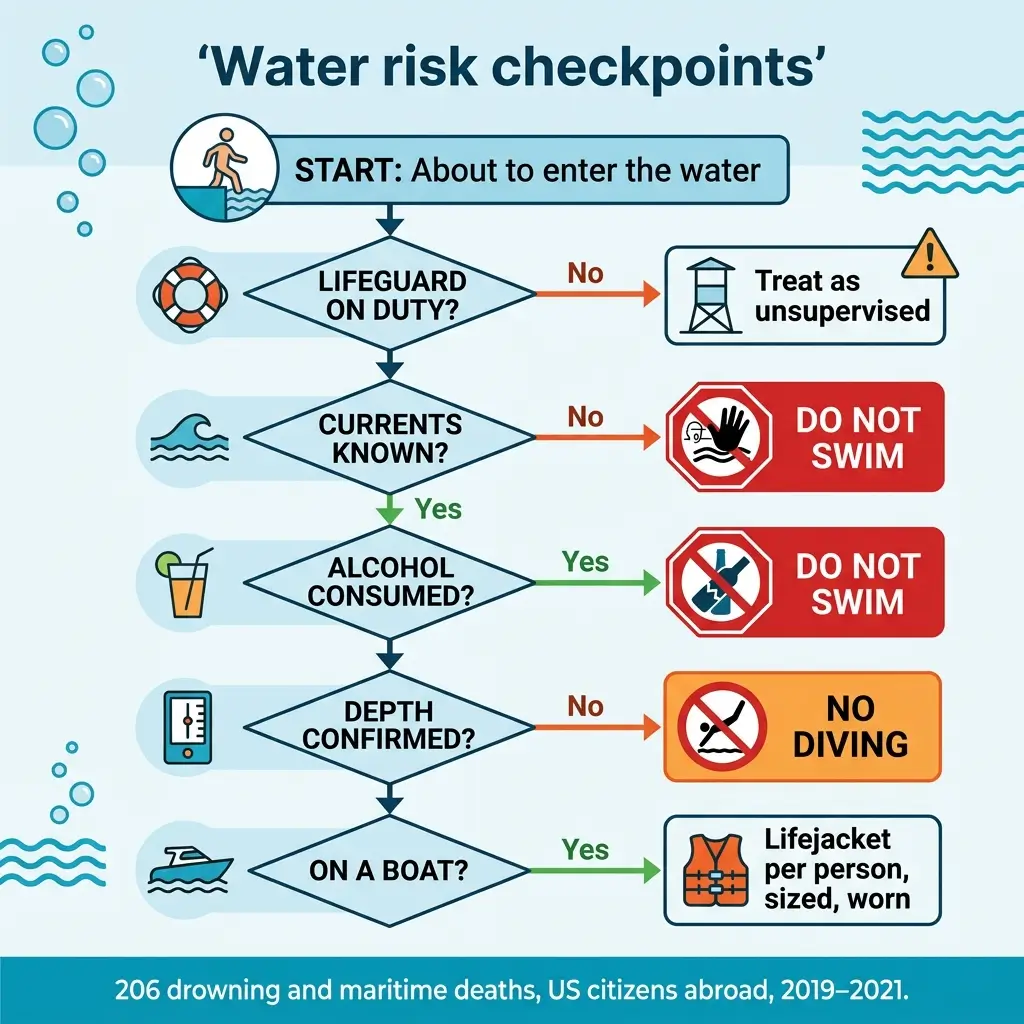
Drowning and maritime incidents caused 206 deaths in that three-year window — more than aviation, drug-related deaths and terrorism combined. It rarely appears in travel safety guides at all, which is remarkable given that swimming is what most people go on holiday to do.
The contributing factors the CDC identifies are unfamiliarity with local currents and conditions, absence of lifeguards, inability to swim, and alcohol. Rip currents are singled out specifically. Diving into shallow water is named as a mechanism for head and spinal injuries, disproportionately affecting young men.
Boating adds its own layer. Many fatalities follow from inexperience or from simply not wearing a flotation device, and the CDC advises against travelling in boats operated by anyone obviously inexperienced, uncertified or intoxicated. For scuba, the estimated worldwide death rate is around 16 per 100,000 divers per year, per the same CDC chapter — low, but entirely dependent on diving with a reputable operator.
The controls that carry the most weight in the water are these:
- Do not swim alone or in unfamiliar water, and treat an unstaffed beach as an unsupervised one.
- Learn what a rip current looks like before you travel to a coast, and what to do in one.
- Keep alcohol and water apart, on the same principle as alcohol and driving.
- Never dive head-first into water of unknown depth, however inviting it looks.
- Wear a lifejacket on small boats and count them before boarding — one per person, correctly sized.
- Stay within arm's length of infants and toddlers near any water, without a phone in your hand.
Where you sleep: book the floor, not just the hotel
Search for hotel safety advice and you will find flat contradictions: book the second floor, book the third or higher, avoid the ground floor, stay near the lobby. Every one of those is reasoned from intruders, and none of them cites anything.
There is a sourced answer, and it comes from the hazard that actually kills people in buildings.
The sixth-floor rule
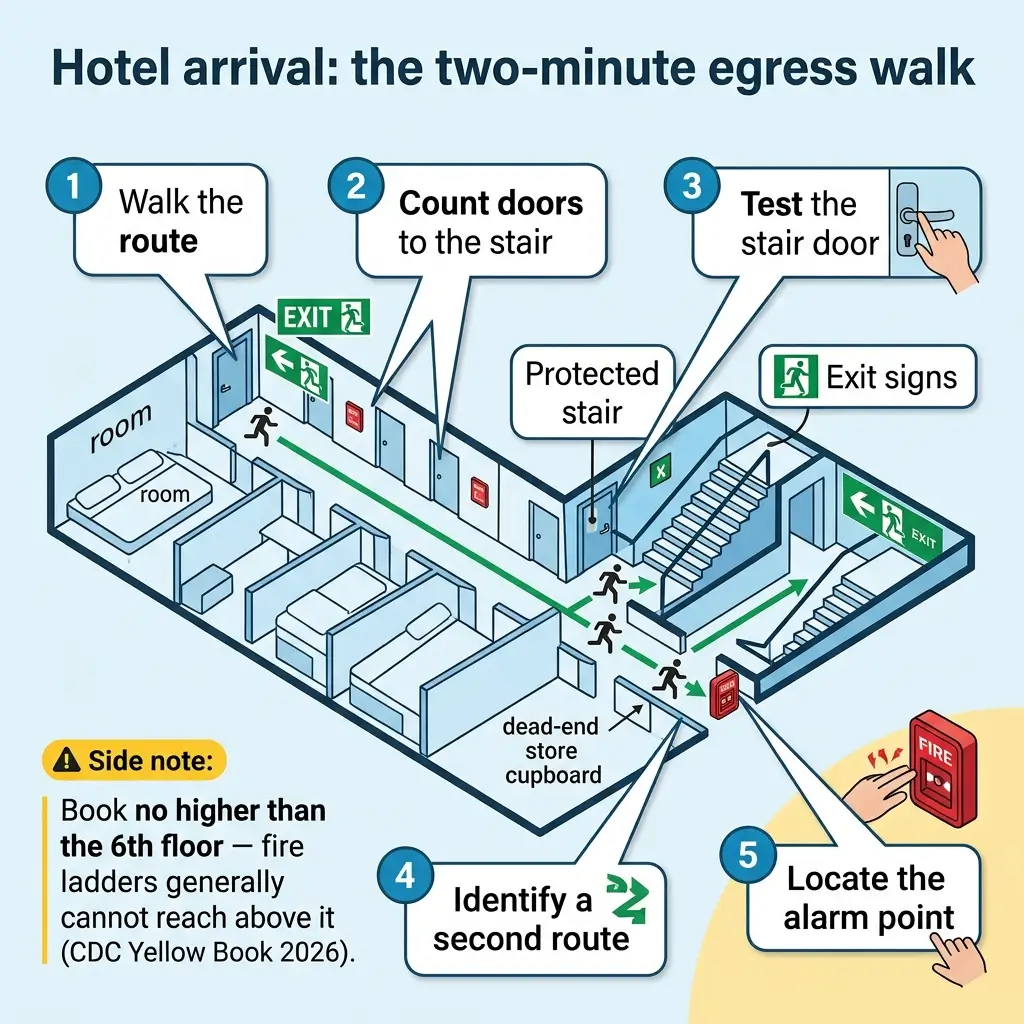
The CDC advises travellers to select accommodation no higher than the sixth floor, because fire ladders generally cannot reach above it. It also advises confirming that the property has smoke alarms and preferably sprinklers, and identifying at least two escape routes from the building.
That single criterion resolves the argument the internet cannot. High enough that ground-floor and balcony access is harder; low enough that external rescue is still possible. The CDC notes that in many countries building codes are not enforced or do not exist, and that fire services may be oriented toward extinguishing fires rather than rescuing occupants.
| Booking decision | Common online advice | What the fire risk supports |
|---|---|---|
| Floor selection | 2nd to 3rd floor, for intruders | Above ground level, no higher than 6th — ladder reach |
| Smoke alarms | Rarely mentioned | Confirm at booking; consider a travel smoke alarm |
| Exit routes | Rarely mentioned | Identify two, walk one on arrival |
| Room position | Away from stairwells, for concealment | Near a protected stair, for egress |
Note the direct conflict in the last row. Avoiding stairwells is defensible against a rare crime risk and works against you in the far more common fire scenario. My preference, having written up blocked egress on industrial sites for years, is to favour the fire case.
Count the doors on the night you arrive
Working a night sanitation shift at a Nestlé ready-meals plant in Toronto, I traced a clean-in-place hose at 01:40 and found it pinned across a marked exit leaf. The exit sign was lit. The door was unusable. Every person on that shift had walked past it and stopped seeing it, because the hose was temporary and the sign was permanent. I stopped the sequence, had the hose rerouted, and added an exit check to the sanitation start card. Obstruction findings on subsequent night cleans dropped.
A hotel corridor is the same failure waiting to happen — a linen trolley, a stacked chair, a locked fire door, a route that ends at a store cupboard. The sign tells you an exit exists. It does not tell you that route works tonight.
So do what I do on the first walkdown of any building I will be sleeping in. It takes two minutes:
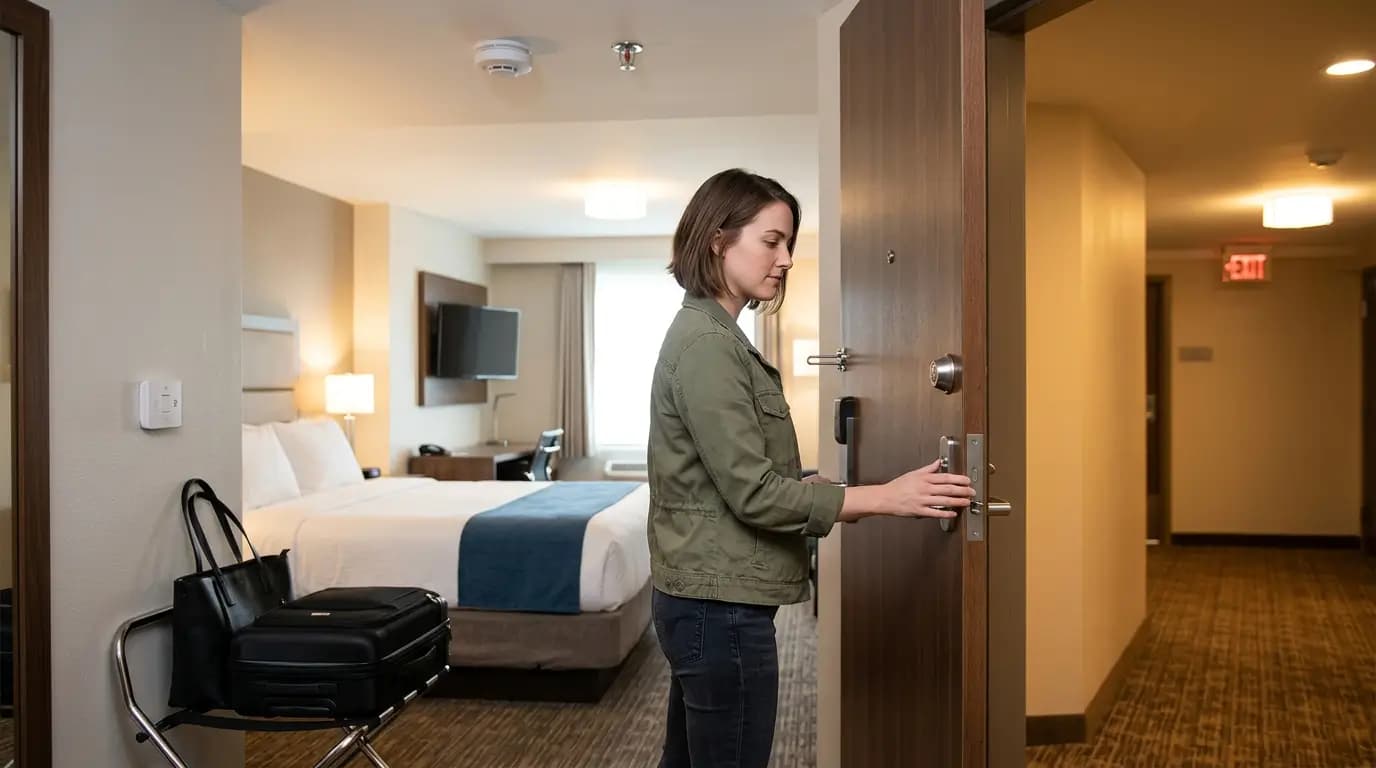
- Walk to the nearest exit from your room, the whole way, before you unpack.
- Count the doors between your room and the stairwell, and remember the number. In smoke you will be crawling and counting by hand, not reading signs.
- Check the stair door actually opens and the stairway is clear of storage.
- Identify a second route in the opposite direction.
- Locate the alarm point and note whether you can hear an alarm from inside your room with the door closed.
Theft and scams: right advice, wrong priority
Nothing in the standard advice about theft is wrong. Distribute your cash, use the room safe, keep copies of your passport, be discreet at ATMs, do not advertise expensive items. It works, and you should do it.
The problem is proportion. Theft is the most written-about travel risk and one of the least dangerous. Treat it as an administrative and financial exposure — annoying, expensive, occasionally trip-ending, very rarely fatal — and give it the preparation time that ranking deserves.
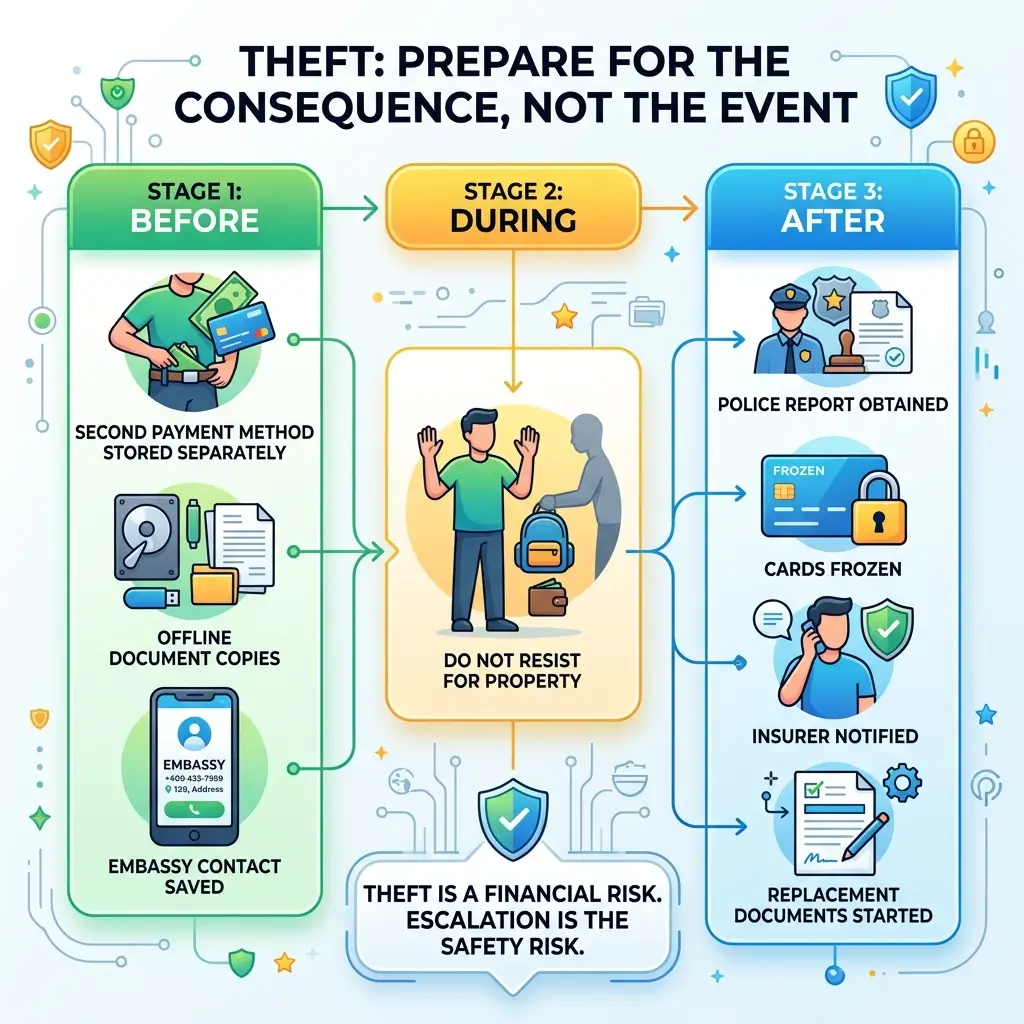
Where theft does become a safety issue is at the interface with the risks above: a stolen phone that removes your ability to call for help, a stolen passport that strands you past your medication supply, a confrontation that escalates. Prepare for the consequences rather than only the event.
The preparations that actually reduce the downstream harm are:
- Carry a second means of payment stored separately from the first, so a theft is not also a mobility failure.
- Keep offline copies of passport, insurance policy number and emergency contacts — a paper copy in your luggage, not only cloud storage you need a stolen phone to reach.
- Know your embassy's location and contact route before you need it.
- Do not resist a robbery for property. The property is replaceable and the escalation is what puts people in hospital.
- Report thefts to local police and get a written report, which insurers will require.
Health, medication and insurance that pays for evacuation
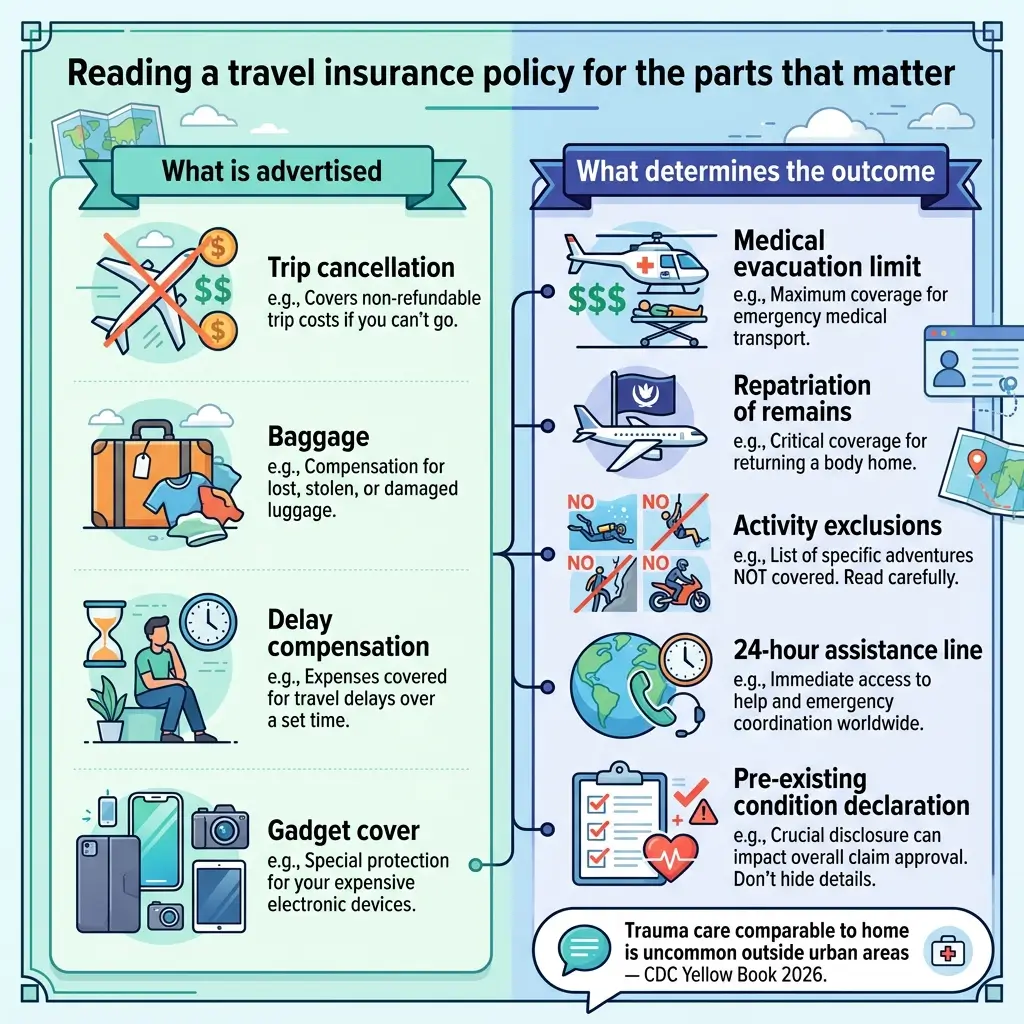
The CDC's blunt observation is that travel destinations may lack emergency care approximating home standards, and that trauma centres capable of handling serious injury are uncommon outside urban areas. That is the sentence that should govern how you buy insurance.
Trip cancellation cover protects your holiday. Medical evacuation cover protects you. They are frequently sold together and are not remotely equivalent — an air ambulance from a remote location can run into six figures, and it is the single largest financial exposure most travellers carry without knowing it.
Medication needs the same deliberate handling. Carry enough for the trip plus several days for delays, keep it in original labelled packaging in hand luggage, and check that anything you take is legal at your destination. Common prescriptions including some painkillers and stimulants are controlled substances in parts of the Gulf and Asia.
Before departure, confirm the following:
- Your policy names medical evacuation and repatriation of remains, with a stated limit, not just "medical expenses".
- Adventure activities you plan are listed, since diving, skiing and motorcycling are standard exclusions.
- You have the insurer's 24-hour emergency number saved offline, along with your policy number.
- Vaccinations and any malaria prophylaxis have been reviewed against your specific itinerary with a travel health service, several weeks ahead.
- Prescription medication is legal at your destination and carried in labelled original packaging with a copy of the prescription.
When it goes wrong: the first hour
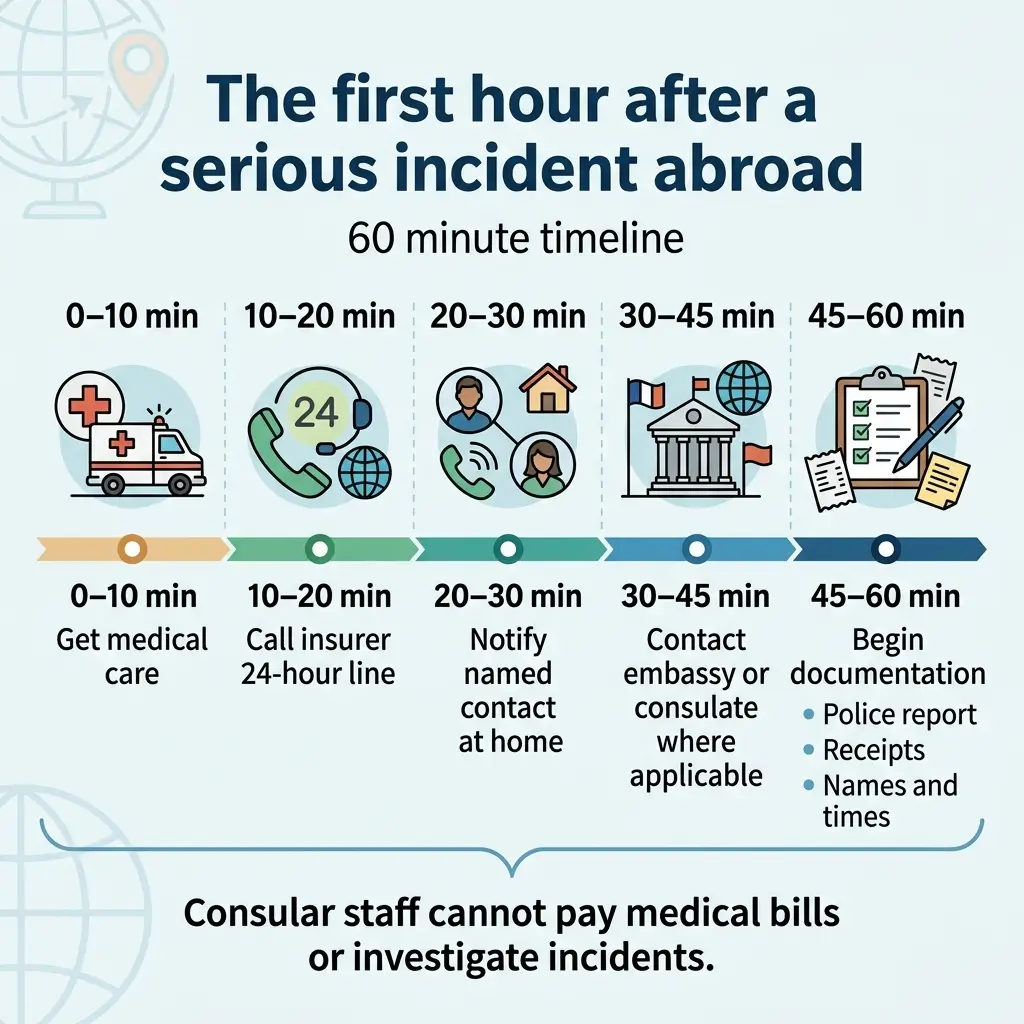
The first hour after a serious incident abroad is spent on things that are hard to arrange under stress and easy to arrange in advance. This is why the communications question in the assessment above is not administrative padding.
Order matters. Medical care first, then notification, then documentation, then the administrative recovery. Travellers routinely invert this and spend the first hour on their bank cards.
For US citizens, enrolment in the Smart Traveler Enrollment Program puts you on the embassy's list for the destination and gives them a contact route in a crisis. UK travellers should have the relevant FCDO travel advice page and the local consulate details saved offline. Consular staff cannot pay your medical bills or investigate an incident, and knowing the limits of that help before you need it prevents a second crisis.
Work in this order:
- Get medical care. Do not wait for insurer pre-authorisation if the injury is serious; call them once the patient is stable.
- Call the insurer's 24-hour line. Evacuation decisions are made by them, and the earlier they are involved the better the options.
- Notify your named contact at home and tell them the situation, the location and the next check-in.
- Contact the embassy or consulate for a death, arrest, hospitalisation or lost passport.
- Document everything — police report, medical records, receipts, names and times of everyone you spoke to.
Frequently asked questions
These are the questions travellers most often search on this topic, answered against the sources cited above.
What is the biggest safety risk when travelling abroad?
Road crashes. They caused 402 of the non-natural deaths of US citizens abroad between 2019 and 2021, more than any other cause, according to CDC Yellow Book 2026 data drawn from State Department records. Homicide, suicide and drowning follow. Theft is common but very rarely fatal.
What floor should I book in a hotel for safety?
Above ground level but no higher than the sixth floor. The CDC's reasoning is that fire ladders in most countries cannot reach above the sixth floor, so higher rooms lose external rescue as an option. Ground floor rooms are more exposed to entry through windows and balconies.
Is travel insurance really necessary?
The clause that matters is medical evacuation and repatriation, not trip cancellation. Trauma care comparable to home standards is uncommon outside major cities in many countries, and an air ambulance can cost six figures. Check the policy names evacuation with a stated limit.
How do I check if my destination is safe?
Read your government's advisory at region level rather than country level, since advisories are often issued by state or province. UK travellers use FCDO travel advice; US travellers use State Department advisories and can enrol in STEP for destination updates.
Should I rent a scooter or motorbike on holiday?
The CDC advises against motorcycle and motorbike travel abroad, including motorbike taxis. Motorcycles accounted for 19% of US citizen road deaths abroad in 2019–2021, per the CDC Yellow Book 2026 source listed below. If you ride anyway, wear a properly fitted helmet meeting a recognised standard, ideally brought from home.
What should I do first if something serious happens abroad?
Medical care first, then your insurer's 24-hour line, then your contact at home, then the embassy if the situation involves death, arrest, hospitalisation or lost documents. Documentation comes last but matters for every claim afterwards.
Does ISO 31030 apply to my holiday?
Not directly. ISO 31030:2021 gives travel risk management guidance to organisations and explicitly excludes tourism and leisure travel, except where someone is travelling on an organisation's behalf. Its assessment structure is still useful to borrow for a personal trip.
Conclusion
The ranking is the point. Sort your preparation by what actually puts travellers in hospital — vehicles, water, fire, and distance from decent medical care. Do that, and the theft advice that dominates every other guide falls into its proper place: a financial nuisance worth twenty minutes of planning.
Four decisions do most of the work, and all four are made before you leave. A vehicle with a working seatbelt for every journey. Accommodation below the seventh floor with two exits you have walked. Insurance that names evacuation. One person at home who knows when to raise an alarm.
Where a trip involves a region under advisory, an underlying medical condition, or activities like diving or high-altitude trekking, get advice specific to your circumstances from a travel health service and your insurer. This guide sets the priorities; it does not replace that conversation.
About the author
Benjamin Turner is a Principal Field HSE and Contractor Interface Assurance Consultant with 18 years of field experience across 14 countries in North America, Europe, Asia, South America and Oceania, and more than 200 workplaces inspected. His work is field verification — arriving at sites run by other people and checking whether controls hold up before schedule pressure declares the job safe. He leads Turner Field HSE Assurance from Calgary, Canada, following senior roles with Nestlé, Freeport-McMoRan, Canadian National Railway, Woodside Energy and PCL Construction.
Credentials: NEBOSH International General Certificate, ISO 45001 Lead Auditor, ISO 14001 Internal Auditor, IOSH Managing Safely, incident investigation (ICAM or equivalent pathway).
Sources and further reading
- CDC Yellow Book 2026 — Injury and Death During Travel
- WHO Global status report on road safety 2023
- ISO 31030:2021 Travel risk management — Guidance for organizations
- CDC Global Road Safety
- UK FCDO foreign travel advice
- UK guidance on foreign travel insurance
- US Department of State travel advisories
- Smart Traveler Enrollment Program (STEP)