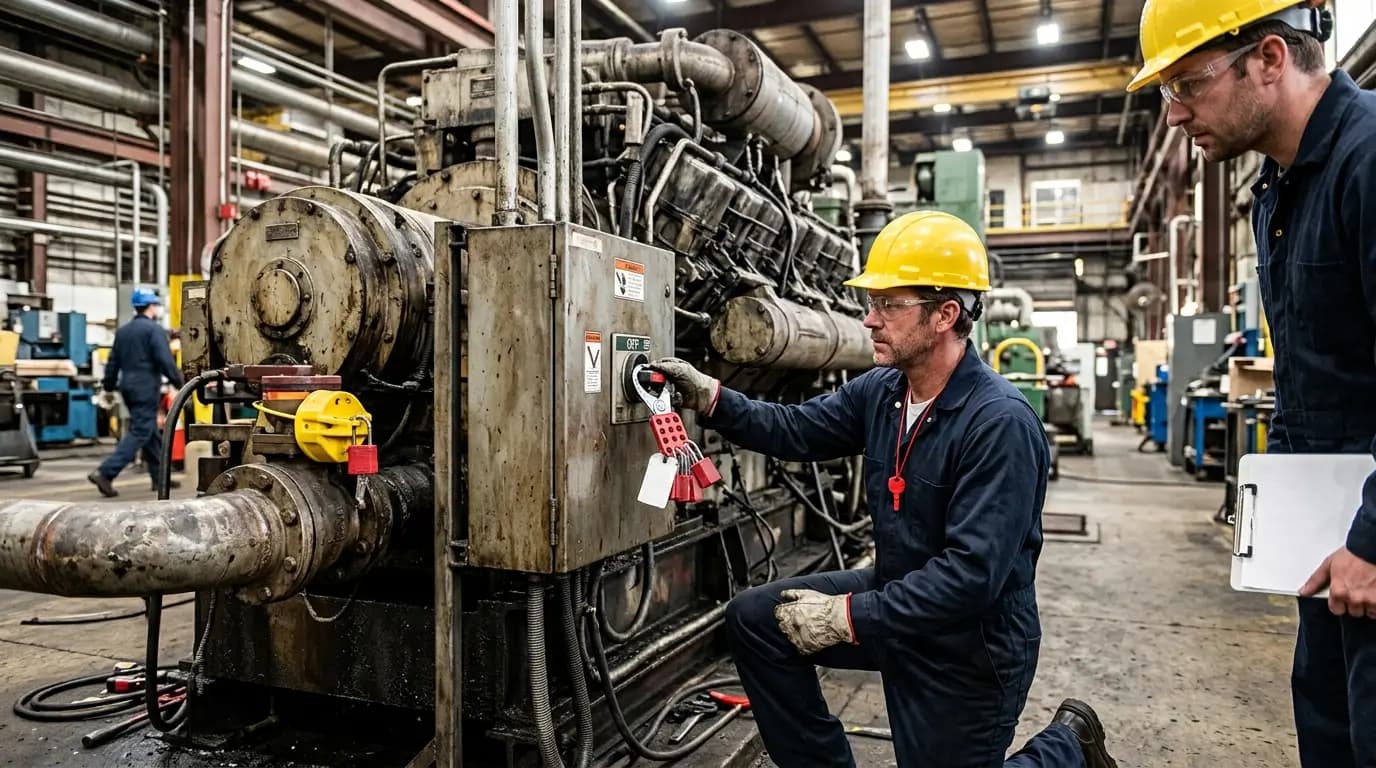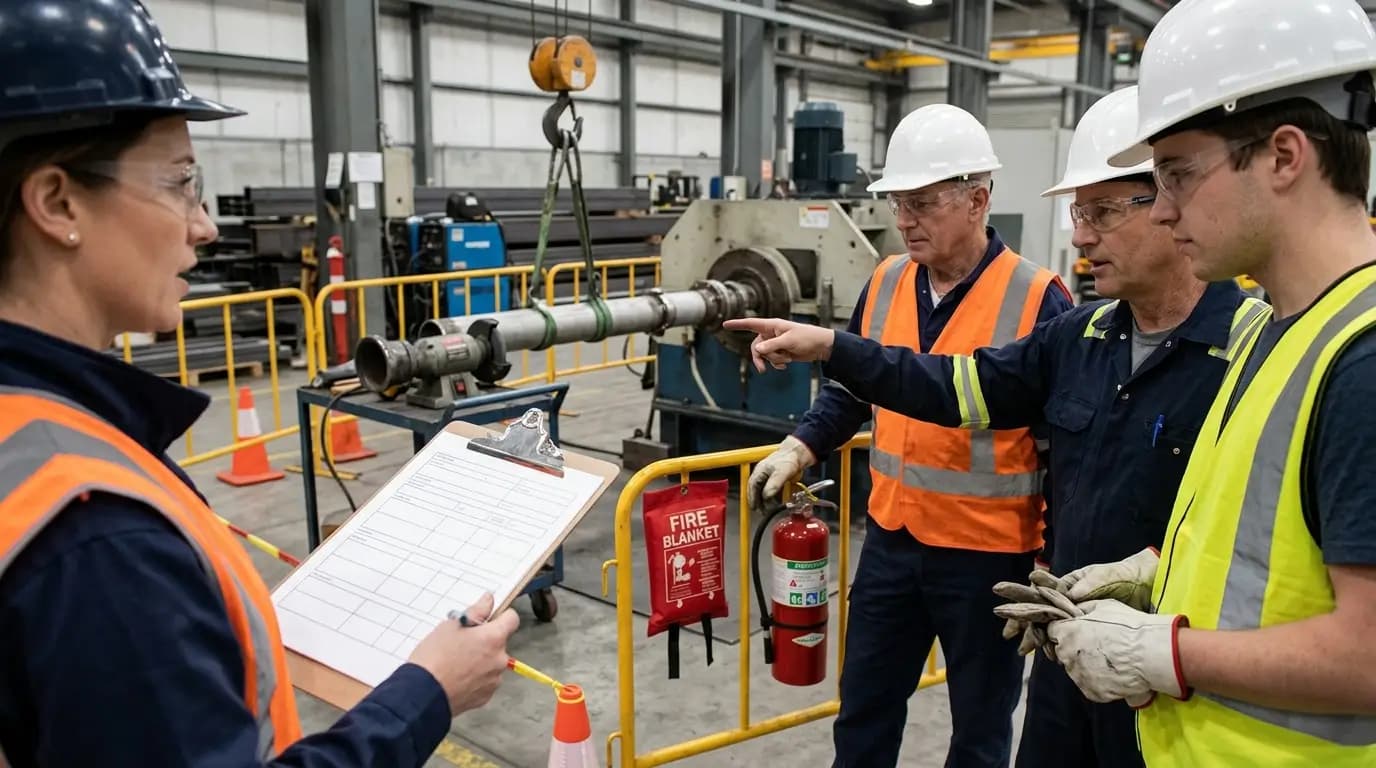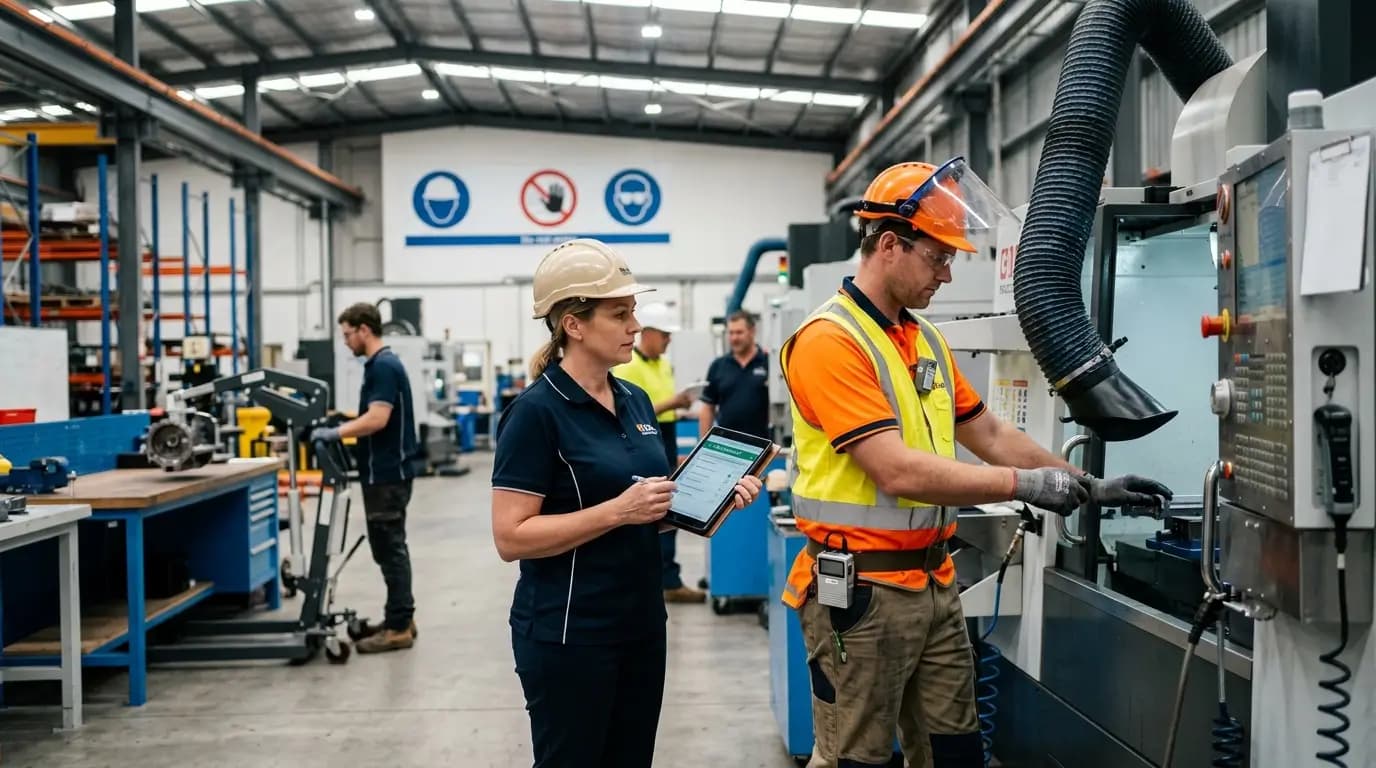


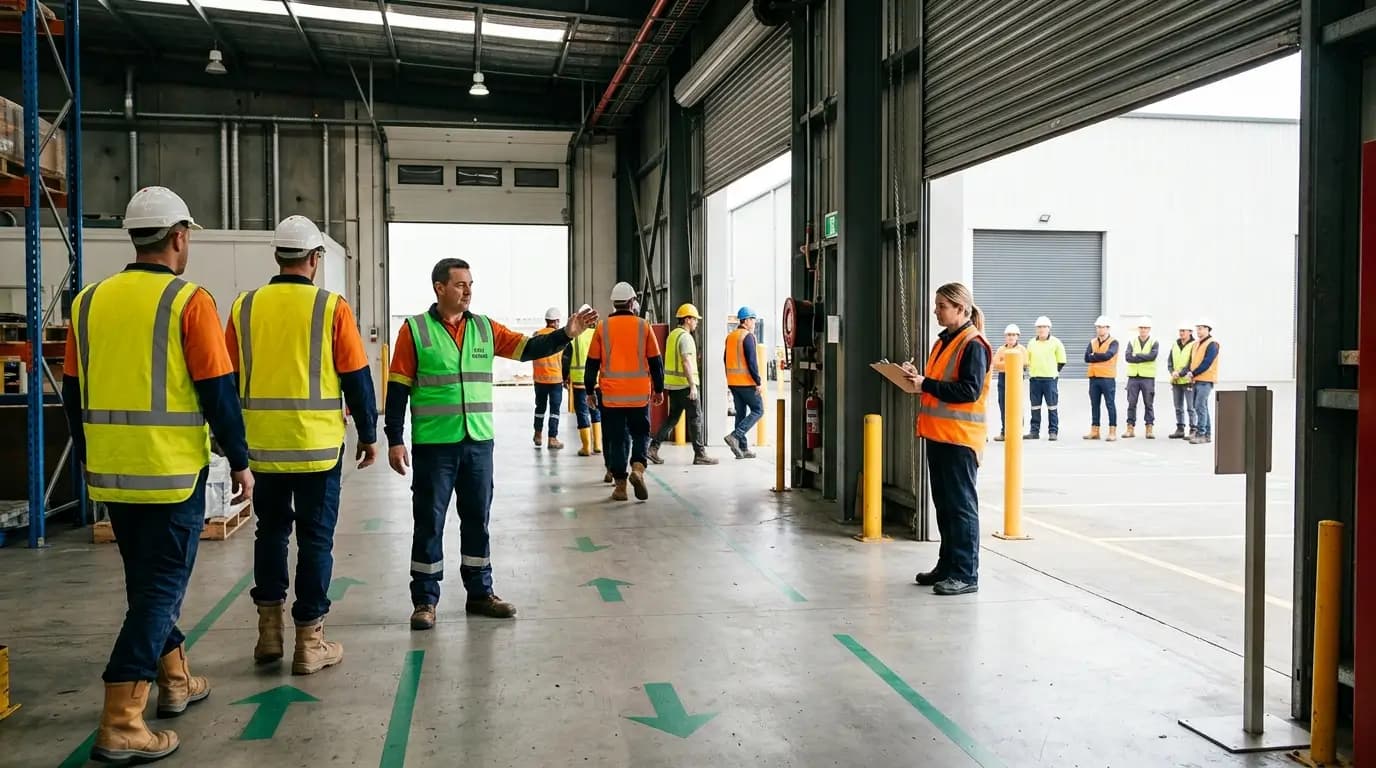
You practise emergency procedures because a written plan is an untested assumption, and a drill is the only cheap way to find out which parts of it are wrong. The training benefit is real. The bigger return is the defect list.
I ran a night muster drill at a mine camp in Zambia during a contractor surge, and the headcount would not reconcile. The plan was current, the assembly point was correct, the wardens were trained. The contractors were simply invisible to the accountability system, because they had come through a gate that fed no roll. Nobody would have discovered that during a real evacuation in time for it to help.
This article sets out 15 reasons to practise, grouped by what the practice actually tests: your people, your plan, and your systems. It covers US, UK and international requirements, and is written for supervisors, wardens and HSE managers who have to justify the disruption.
Key takeaways
The six points that decide whether your drill programme is worth running:
- 29 CFR 1910.38 does not require drills. The US emergency action plan standard mandates the written plan, an alarm system, trained evacuation assistants and a plan review — not a rehearsal. Drill duties come from other standards.
- UK law is more direct. Article 15 of the Regulatory Reform (Fire Safety) Order 2005 requires appropriate procedures "including safety drills".
- Some intervals are fixed. Permit-space rescuers must practise at least once every 12 months under 29 CFR 1910.146(k)(2)(iv); COMAH internal emergency plans must be reviewed and tested at intervals not exceeding three years.
- The debrief is the deliverable. A drill that produces no corrective actions has tested nothing except the alarm.
- Time of day changes the result. Drills at 10:00 on a Tuesday do not test the site that exists at 02:00. MSHA already requires underground mine evacuation drills every six months for each shift under 30 CFR 57.4361.
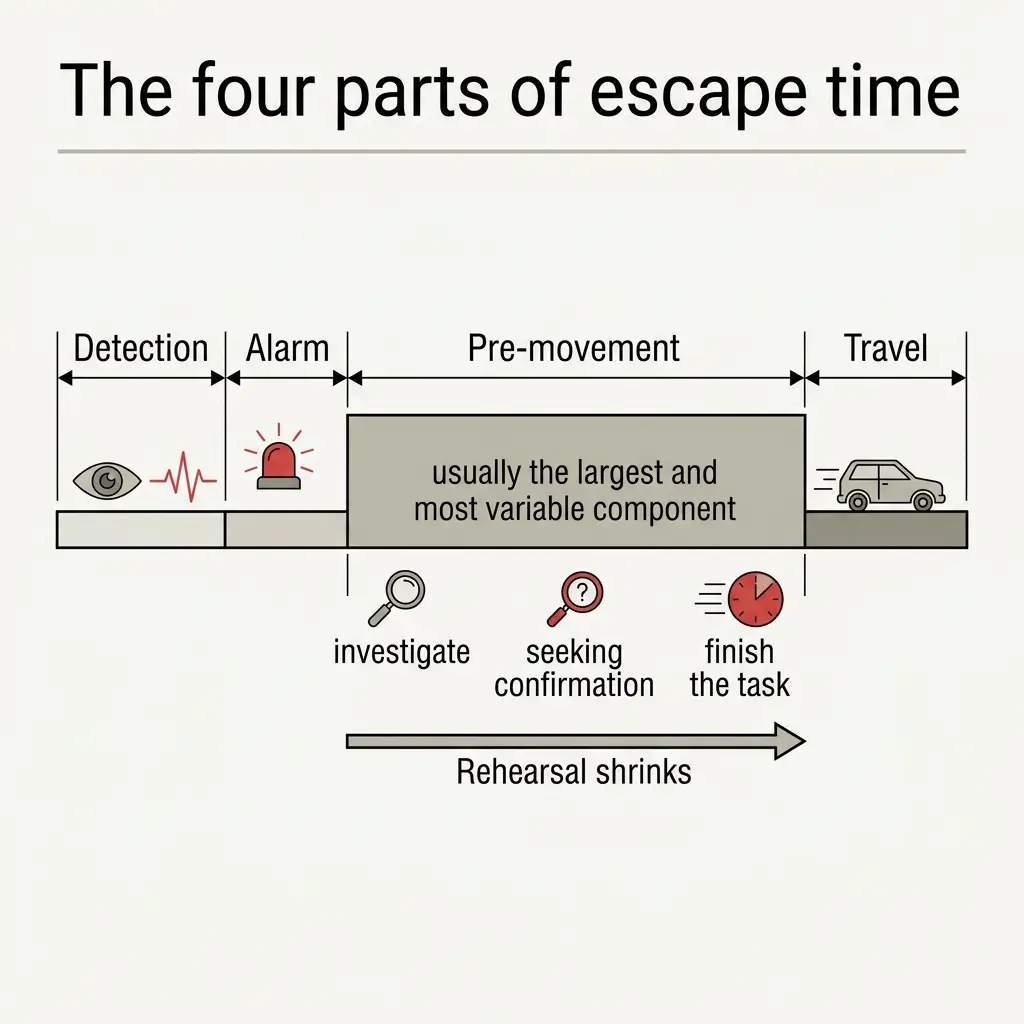
- Pre-movement time dominates. The delay before people start moving is usually a larger share of total evacuation time than the walk to the exit.
What the rules actually require — and the gap they leave
Most articles on this topic state that emergency drills are a legal requirement. In the United States, for general industry, that is not accurate, and getting it wrong matters because it changes what an inspector can cite you for.
29 CFR 1910.38 requires a written emergency action plan containing six minimum elements, a distinctive employee alarm system, designated and trained employees to assist evacuation, and a plan review with each worker when the plan is developed, when their duties change, and when the plan changes. There is no drill clause. OSHA's own emergency preparedness guidance recommends practice drills and post-drill evaluation, but recommendation is not the same as a mandate.
Drill duties in the US come from elsewhere — from confined space rescue, from mining rules, from fire codes adopted at state and local level. Outside the US the picture is firmer. The UK ties drills directly into fire safety law, and the major hazard regimes attach fixed testing intervals.
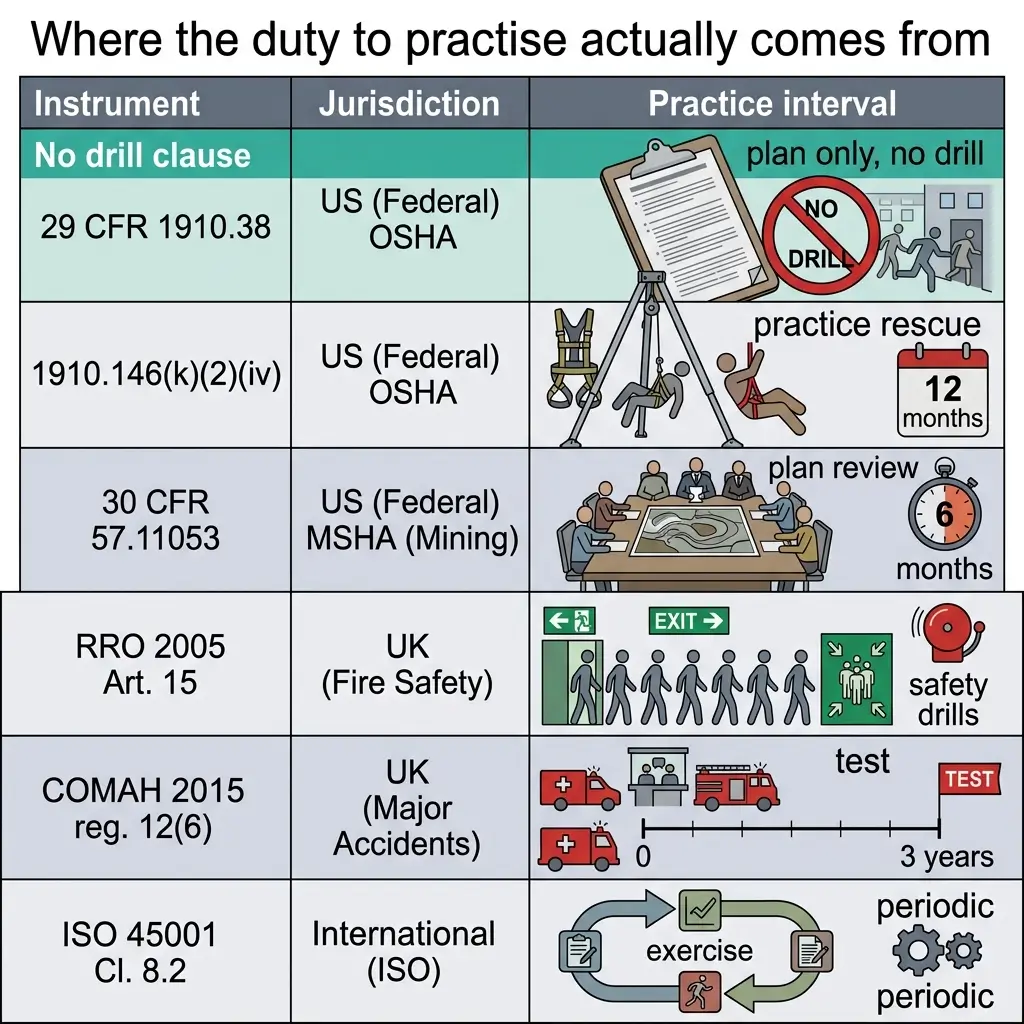
The instruments that actually govern practice, by jurisdiction:
| Jurisdiction | Instrument | What it requires on practice |
|---|---|---|
| US — general industry | 29 CFR 1910.38 | Written plan, alarm, trained evacuation assistants, plan review. No drill requirement |
| US — confined space | 29 CFR 1910.146(k)(2)(iv) | Rescuers practise simulated rescues at least once every 12 months, in actual or representative spaces |
| US — underground metal/nonmetal mines | 30 CFR 57.11053 | Written escape and evacuation plan, posted, reviewed jointly with MSHA at least every six months |
| US — underground mine evacuation | 30 CFR 57.4361 | Evacuation drills at least every six months, for each shift, not at a shift change, with the alarm activated |
| UK — fire | RRO 2005, Article 15 | Appropriate procedures "including safety drills"; nominated competent persons |
| UK — major hazard | COMAH 2015, reg. 12(6) | Internal emergency plan reviewed, revised and tested at intervals not exceeding three years |
| International | ISO 45001:2018, Clause 8.2 | Periodically test and exercise the planned response; evaluate and revise after testing |
Two things follow from that table. Frequency is set by your hazards and your jurisdiction, not by a universal annual rule. And the standards that do set an interval set a floor, not a target — twelve months is the minimum for a rescue team, not the point at which competence is comfortable.
Before you set a schedule, establish three things about your own site:
- Which standard actually triggers your plan — under 1910.38(a) the plan is only mandatory when another Part 1910 standard calls for one
- Which of your activities carry their own practice interval — confined space rescue, mining, major hazard, and local fire code adoptions all do
- Which jurisdiction governs each site — a multinational procedure has to satisfy the strictest of them, not the average
Reasons 1–5: what practice changes in people
The first group of reasons is about human performance under acute stress, which is where my work sits. People do not behave in an emergency the way the plan assumes they will, and the gap is predictable enough to design against — but only if you have watched it.
1. It compresses pre-movement time
Total escape time is not the walk to the exit. It is detection, alarm, the delay before anyone starts moving, and then travel. That third component — pre-movement time — is routinely the largest, and research published in Fire Technology found it varies so widely between settings that a single design assumption is unsafe to rely on (Forssberg et al., 2019).
What eats the time is investigation. People check with a colleague, finish a sentence, look for a supervisor, decide whether this one is real. Practice shortens that by removing the ambiguity: an alarm the workforce has responded to six times is not a question, it is a cue.
2. It replaces decision-making with recognition
Under stress, attention narrows and working memory degrades. That is a poor moment to read a laminated sheet. Rehearsal moves the response from deliberate reasoning into recognition — the person sees the situation and already knows the pattern.
This is why unfamiliar scenarios are worth drilling even when they feel improbable. A team that has only ever practised an alarm-and-walk-out has one pattern. A team that has practised a shelter-in-place, a partial evacuation, and a casualty extraction has three.
3. It shows who actually holds the role at 02:00
Org charts describe day shift. Auditing night operations in a semiconductor fab at Intel, I found the pattern that shows up everywhere: the named warden works days, and the person who would actually be standing there at 01:20 has never been told they hold the role.
A drill run in daylight will never surface this. A drill run on the shift you are worried about surfaces it in the first ninety seconds.
One regulator has already written this down. 30 CFR 57.4361 requires underground mine evacuation drills at least every six months, held for each shift, at a time other than a shift change, with the fire alarm actually activated. That is what a serious drill specification looks like.
4. It breaks the habit of using the familiar exit
People move towards what they know. In a real evacuation they will head for the door they came in through, past a nearer exit they have never used. This is one of the most consistent findings in evacuation behaviour, and it produces congestion at one door while another stands empty.
The only reliable correction is to make people walk the unfamiliar route while nothing is wrong. Blocking a designated exit during a drill and forcing the alternative is uncomfortable, and it is the single most useful variation available to you.
5. It reaches contractors and visitors
Induction tells a contractor where the assembly point is. It does not make them move there. On a busy site, contractors are frequently the largest group with the least practice and the least local knowledge — and often the group working in the least familiar parts of the building.
ISO 45001 Clause 8.2 is explicit that the planned response must be communicated to contractors, visitors, emergency services and, where appropriate, the local community. Communication is the minimum. Inclusion in the drill is the test.
The human-performance gains that only rehearsal delivers are:
- Shorter pre-movement delay — the alarm stops being a question to investigate
- Recognition over reasoning — trained patterns survive stress better than instructions do
- Real role coverage — the person on shift, not the person on the chart
- Route diversity — the nearest exit gets used because it has been used before
- Contractor inclusion — the least-practised group gets the practice
Reasons 6–10: what practice reveals about the plan
This is the group that justifies the disruption to a production manager. Everything below was found in a drill or a readiness walk, and none of it was visible in the document.
6. It proves the muster headcount reconciles
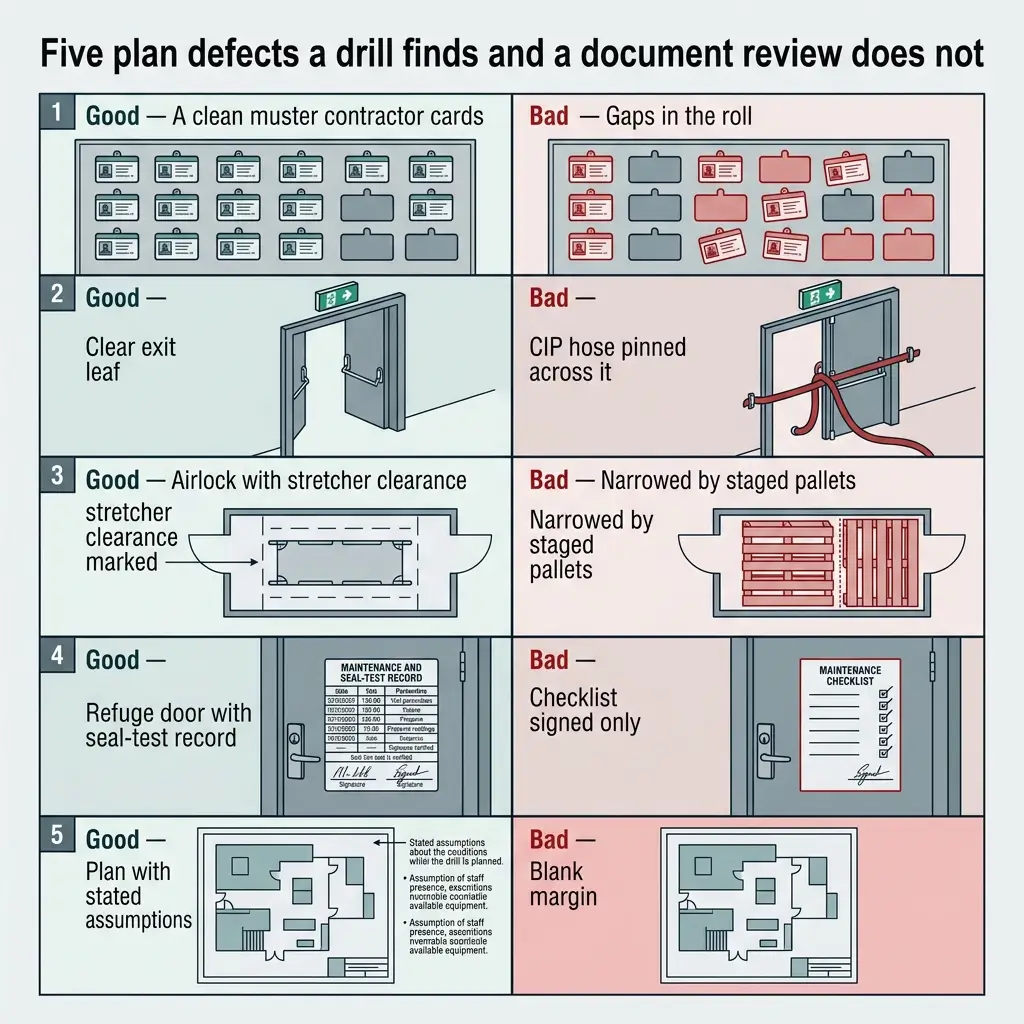
Return to the Zambian mine camp. A night drill during a contractor peak produced headcount gaps — not because wardens failed, but because contractor movement was never fed into the accountability system in the first place. I reset the muster cards, added gate controls so contractor presence was captured on entry, and re-ran the drill. Headcount reliability held on subsequent night runs.
If contractors are invisible to your muster, your emergency plan is fiction. Test it by asking a simple question of whoever owns the roll: how would you know, tonight, how many people are underground?
7. It finds the escape route that operations quietly annexed
At 01:35 in a bottling hall in Dublin, I traced a clean-in-place hose running across a marked exit leaf. The night sanitation crew had done it for years. It was efficient, it was invisible to the day shift, and it meant one of the escape doors could not be opened.
I stopped the sequence, had the hose rerouted, and put an exit check on the sanitation start card so the crew verified it themselves before beginning. Obstruction findings fell on subsequent night cleans. Process hoses do not outrank a blocked escape door — but nobody had ever looked at that door at that hour.
8. It shows whether a casualty can physically be moved
Egress is not only about people walking out. It is also about a stretcher going in. In a production corridor at a Pfizer site on the Belgian interface, I found staged packaging materials that had narrowed a gowning airlock to the point where a stretcher could not pass cleanly.
Everything on the drawing was compliant. The temporary build had eaten the clearance, and no one had walked the route with a stretcher since. We cleared it and added egress checks to the temporary staging list, which made the check a gate rather than an afterthought.
9. It tests refuge and shelter integrity instead of the checklist
In an underground district in South Africa, I found a refuge checklist signed while the door seal test had not been performed. The paperwork was complete and the refuge was unverified.
I voided the sign-off and required a real seal test. This is the check I would put in front of any site that relies on refuges, shelter-in-place rooms or safe havens: if you did not test the seal, you did not verify the refuge. A signature is a record of an intention, not a record of a test.
10. It surfaces the assumptions the plan never wrote down
Every emergency plan rests on unwritten assumptions — that the assembly point is reachable in weather, that the warden can get to the far end of the building, that someone has the keys. Drills expose these because reality refuses to cooperate with them.
Write the assumptions down as you find them. A plan with fifteen stated assumptions is far more auditable than a plan with fifteen hidden ones.
The plan defects that only show up when you rehearse are:
- Accountability gaps — people on site who exist in no roll
- Annexed escape routes — exits used as storage, cable runs or hose paths
- Lost clearance — stretcher and casualty paths narrowed by temporary work
- Unverified refuges — seals, air supply and capacity signed off but never tested
- Hidden assumptions — everything the plan takes for granted and never states
Reasons 11–15: what practice proves about the system
Hardware and outside agencies are the third thing a drill tests. Equipment records tell you a device was serviced. A drill tells you it works where people actually are, on the day, at the hour.
11. It confirms alarm coverage where people actually are
Alarm systems are commissioned against a design. Then the site changes — a plant room gets a new compressor, a mezzanine gets built, a noisy line moves. Sound levels get measured at commissioning and rarely again.
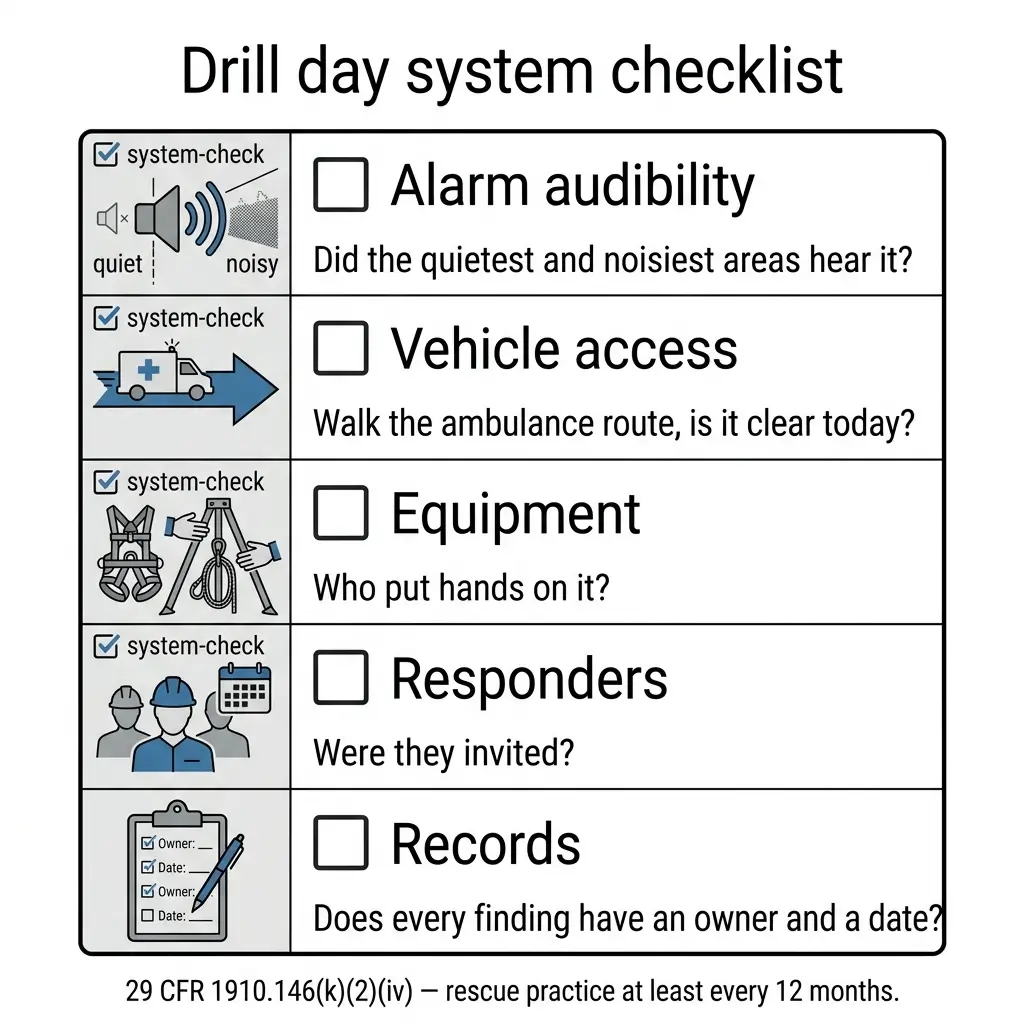
I have watched drills where a small group in a high-noise area simply did not know anything had happened. A drill is a free coverage survey: send observers to the quietest, noisiest and most isolated corners and ask them one question afterwards — did you hear it, and how did you know it was for you?
12. It verifies emergency vehicle access is still there
On a mine surface approach in Canada, I found drill consumables staged across a marked emergency vehicle route ahead of a blast window. The laydown was temporary, sensible and directly in the path an ambulance would take.
I required relocation and added a photo example to the readiness checklist, because a written instruction to keep routes clear performs worse than a picture of what the violation looks like. Laydown that blocks rescue turns a drill into a real failure — and this one was found in a walk, not in a document.
13. It puts hands on equipment before the day it matters
Evacuation chairs, eyewash stations, spill kits, SCBA, retrieval tripods. All get inspected. Far fewer get used by the people who would have to use them under pressure.
Where the equipment is rescue equipment, this stops being good practice and becomes a rule. 29 CFR 1910.146(k)(2)(iv) requires permit-space rescuers to practise simulated rescues at least once every 12 months, using the actual spaces or representative ones matched for opening size, configuration and accessibility. Appendix F adds that each practice should be critiqued so deficiencies in procedure, equipment, training or team size are identified and corrected.
14. It builds the relationship with responders before you need it
Fire services and ambulance crews arriving for the first time during a real event have to learn your site while the clock runs. Involving them in a drill converts that into a rehearsal — they see the gate, the muster point, the isolation panel, the substance inventory.
The major hazard regimes formalise this. Under COMAH 2015, external emergency plans are tested with the cooperation of designated Category 1 responders, and internal plans are reviewed and tested at intervals not exceeding three years. Below that threshold there is no duty — and a phone call to your local station is still the cheapest preparedness investment available.
15. It generates the record that shows the plan was managed
A drill record is evidence that the plan is live. It matters to a regulator, an insurer and a certification auditor, and it matters more when something has gone wrong and the question becomes what you knew and when.
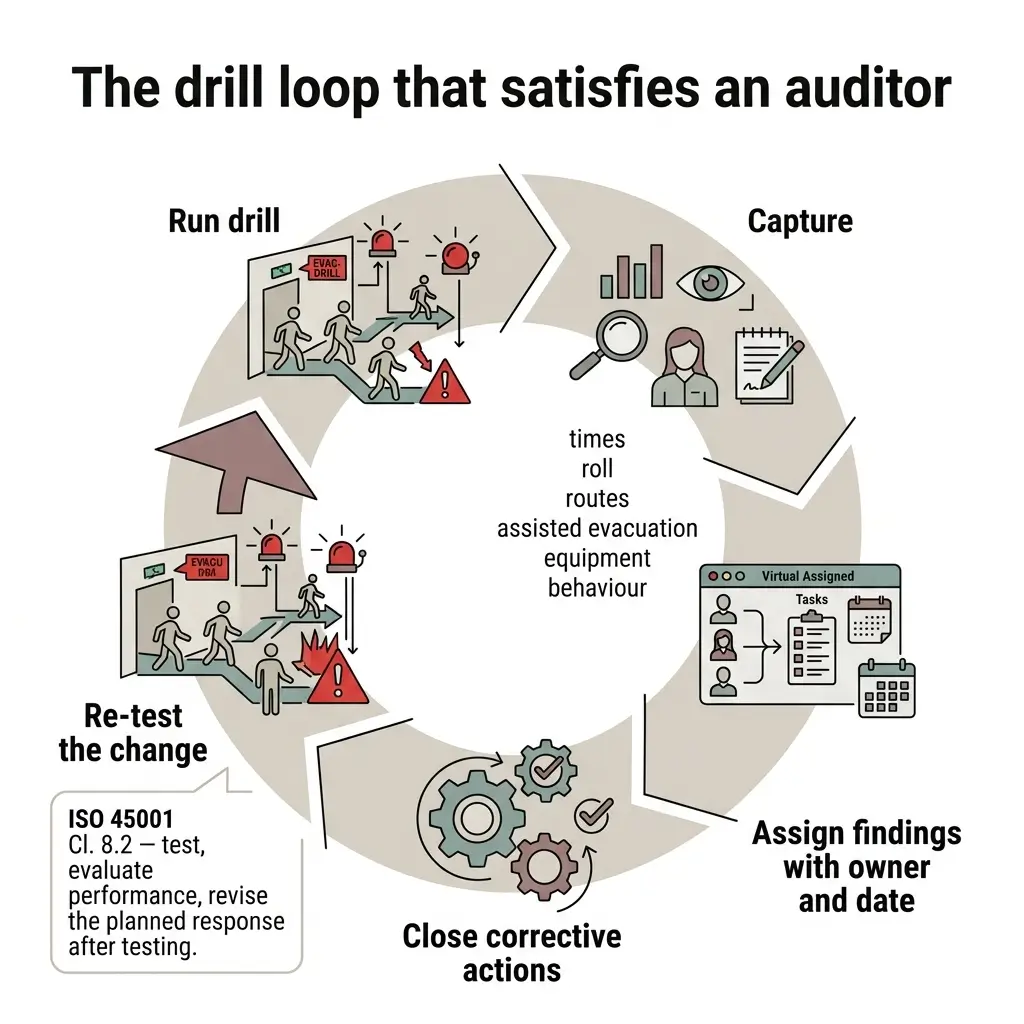
ISO 45001 Clause 8.2 requires periodic testing, evaluation of performance, and revision of the planned response after testing. The audit trail an assessor wants is the loop: drill, findings, corrective actions, re-test. A logbook of dates with no findings reads as a programme that is not looking.
The system-level checks a drill delivers are:
- Alarm audibility in the real acoustic environment, including plant rooms and outdoor areas
- Emergency vehicle access verified on the ground, not on the site plan
- Hands-on equipment use by the people who would actually use it
- Responder familiarity with gates, muster points and inventory
- A defensible record linking findings to corrective actions and re-tests
How often to practise, and why annual is usually the wrong answer
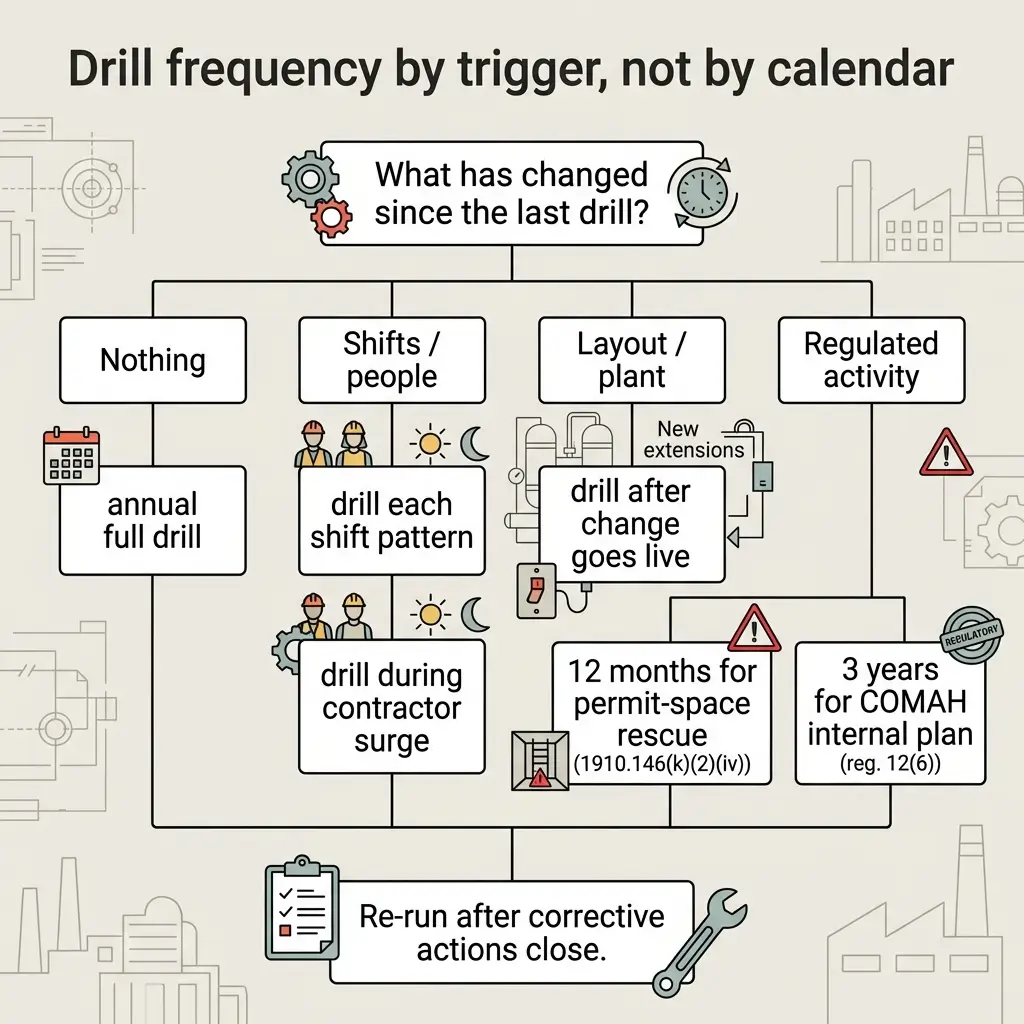
Annual is the number most sites land on because it is the number most guidance mentions. It is a floor derived from low-hazard office premises, and it is a poor fit for a plant with shift work, contractors and turnover.
Set frequency from what changes. If nothing about your site, your workforce or your process has moved since the last drill, an annual cycle may genuinely be enough. If any of them have, the last drill tested a site that no longer exists.
A practical way to schedule, driven by trigger rather than calendar:
| Trigger | Suggested response | Why |
|---|---|---|
| Nothing material changed | Annual full drill | Maintains familiarity; meets most baseline expectations |
| Multi-shift operation | One drill per shift pattern per year | A day-shift drill tests a site that does not exist at night |
| Underground mine | Every six months, each shift (30 CFR 57.4361) | The one regime that already mandates per-shift drills — worth copying |
| Contractor surge, turnaround, shutdown | Drill or muster test during the surge | Peak headcount is when accountability fails |
| Layout change, temporary works, new plant | Drill after the change goes live | Routes and clearances move with the build |
| Permit-space rescue team | At least every 12 months (29 CFR 1910.146(k)(2)(iv)) | Regulatory floor, not a target |
| Upper-tier COMAH site | Test within three years (reg. 12(6)) | Statutory maximum interval |
| Findings from the last drill | Re-run after corrective actions close | An unclosed finding is an untested fix |
The other variable worth changing is realism. A pre-announced 10:00 walk-out tests almost nothing. Vary the hour, vary the scenario, occasionally block an exit, and involve the people who are hardest to schedule. My preference, after seeing daytime drills pass on sites with serious night-shift defects, is that any site running 24 hours should drill at night at least once a year even if it costs production time. Underground mining already works this way by law; the rest of industry has simply not caught up.
The variables worth rotating between drills, so the programme keeps finding things:
- Hour — day, night, shift handover, and the hour your headcount peaks
- Scenario — evacuation, shelter-in-place, casualty extraction, partial evacuation
- Route — block a designated exit and force the alternative
- Participants — include contractors, drivers, visitors and, periodically, external responders
The debrief is where a drill becomes worth the disruption
A drill with no findings has not proved the plan works. It has proved nobody was looking hard enough. In every drill I have observed, something was wrong — a door, a roll, a route, a radio. The sites that improve are the ones that write it down and give it an owner.
Run the debrief while people are still at the assembly point and the detail is fresh. Wardens forget within the hour which stairwell was congested, and the observer notes are worth more than anyone's recollection the following week.
Separate what you measure from what you judge. Evacuation time is a number; whether the wardens could see their whole area is a finding. Both matter, but only the second one usually leads to a change.
Before people disperse, capture the following, in this order:
- Times — alarm sounded, first person out, last person out, all-clear given
- Roll reconciliation — who was unaccounted for, and how long it took to resolve
- Route observations — congestion points, unused exits, blocked or difficult doors
- Assisted evacuation — did the arrangements for anyone needing help actually work
- Equipment — anything that failed, was missing, or nobody could operate
- Behaviour — who collected belongings, who ignored the alarm, who went the familiar way
- Actions — each finding with a named owner and a date, not a general recommendation
Then close the loop. A finding with no owner is a note; a finding with an owner and a re-test date is a control. Where a corrective action changes a route, a role or a piece of equipment, run a short focused drill on that change rather than waiting a year to find out whether the fix worked.
Frequently asked questions
These are the questions I am asked most often when a site is building or defending a drill schedule.
Are emergency drills a legal requirement?
It depends on jurisdiction and hazard. In US general industry, 29 CFR 1910.38 requires an emergency action plan but contains no drill clause; OSHA recommends drills rather than mandating them. In the UK, Article 15 of the Regulatory Reform (Fire Safety) Order 2005 requires procedures including safety drills. Specific standards, such as confined space rescue, set their own intervals.
How often should emergency drills be conducted?
Set the interval from your hazards, shift patterns and rate of change rather than a default. Annual suits stable, low-hazard premises. Multi-shift sites should drill each shift pattern; sites with contractor surges should test accountability during the surge. Permit-space rescue teams must practise at least every 12 months.
What is the difference between a drill, an exercise and a tabletop?
A drill rehearses one procedure in real time, such as an evacuation. A functional exercise tests a wider response with the people who would run it. A tabletop is a facilitated discussion against a scenario, with no movement. Tabletops find plan and decision gaps cheaply; only a live drill tests routes, timing and equipment.
Should drills be announced or unannounced?
Both, for different purposes. Announced drills are for teaching a new procedure or a changed route safely. Unannounced drills measure how the site actually performs. Run announced drills after a change, then verify with an unannounced one. Always tell the alarm monitoring company and, where relevant, the fire service.
Who should take part in emergency drills?
Everyone on site at that moment, including contractors, agency staff, drivers and visitors. Contractors are usually the least practised group and the least familiar with the layout. Where external responders will attend a real event, invite them periodically so they learn your gates, muster point and inventory in advance.
What should be recorded after a drill?
Record the date, time and scenario, evacuation and all-clear times, roll reconciliation and any gaps, route and congestion observations, whether assisted evacuation arrangements worked, equipment failures, and each finding with a named owner and a due date. The corrective actions and their closure matter more to an auditor than the times.
Do drills need to include night shift?
If you operate at night, yes. Staffing, supervision, lighting, contractor presence and the physical state of routes all differ after dark. A daytime drill can pass on a site with serious night-shift defects — blocked exit leaves and unstaffed warden roles are overwhelmingly night findings in my experience. MSHA already requires per-shift evacuation drills underground under 30 CFR 57.4361.
About the author
Grace Thompson is an Irish Occupational Health, Safety and Environment (OHSE) Human Factors, Fatigue and Emergency Preparedness Consultant with 15 years of continuous field experience across 14 countries, 170+ workplaces inspected and 65+ audits conducted. Her emergency preparedness work has focused on proving that refuge seals, muster headcounts and access routes hold up under real conditions — including as Mining Emergency Preparedness Lead at Glencore, where she led mine emergency response and muster assurance across South African, Zambian and Canadian operations, and in night-shift human factors and emergency access work at Intel, Diageo, Veolia and Pfizer. She leads Thompson Human Factors Safety, based in Dublin.
Credentials: CMIOSH or equivalent professional membership pathway · NEBOSH International Diploma in Occupational Health and Safety · ISO 45001 Lead Auditor · ISO 14001 Internal Auditor · IOSH Managing Safely · Emergency Response Planning Awareness · Confined Space Entry & Rescue Awareness · Fatigue Risk Management Awareness · Incident Investigation (ICAM or equivalent pathway).
Sources and further reading
- OSHA, 29 CFR 1910.38 — Emergency action plans
- OSHA, 29 CFR 1910.146 — Permit-required confined spaces and Appendix F — rescue service evaluation criteria
- OSHA, Emergency preparedness and response: getting started
- MSHA, 30 CFR Part 57 — underground metal and nonmetal mines, including § 57.11053 (escape and evacuation plans) and § 57.4361 (underground evacuation drills)
- Regulatory Reform (Fire Safety) Order 2005, Article 15
- Control of Major Accident Hazards Regulations 2015, regulation 12 and HSE's COMAH 2015 overview
- Forssberg, Kjellström, Frantzich, Mossberg and Nilsson, The Variation of Pre-movement Time in Building Evacuation, Fire Technology 55(6), 2019
- ISO 45001:2018, Clause 8.2 — Emergency preparedness and response