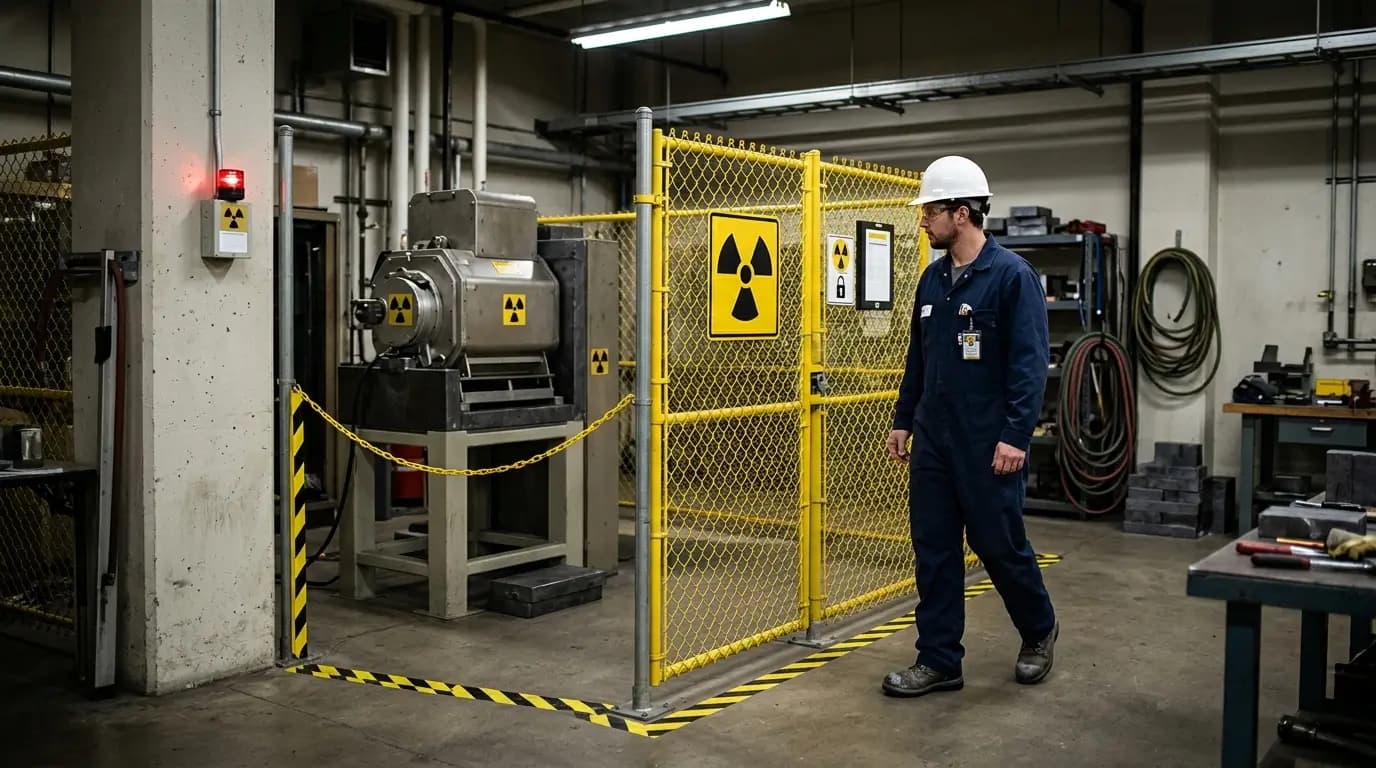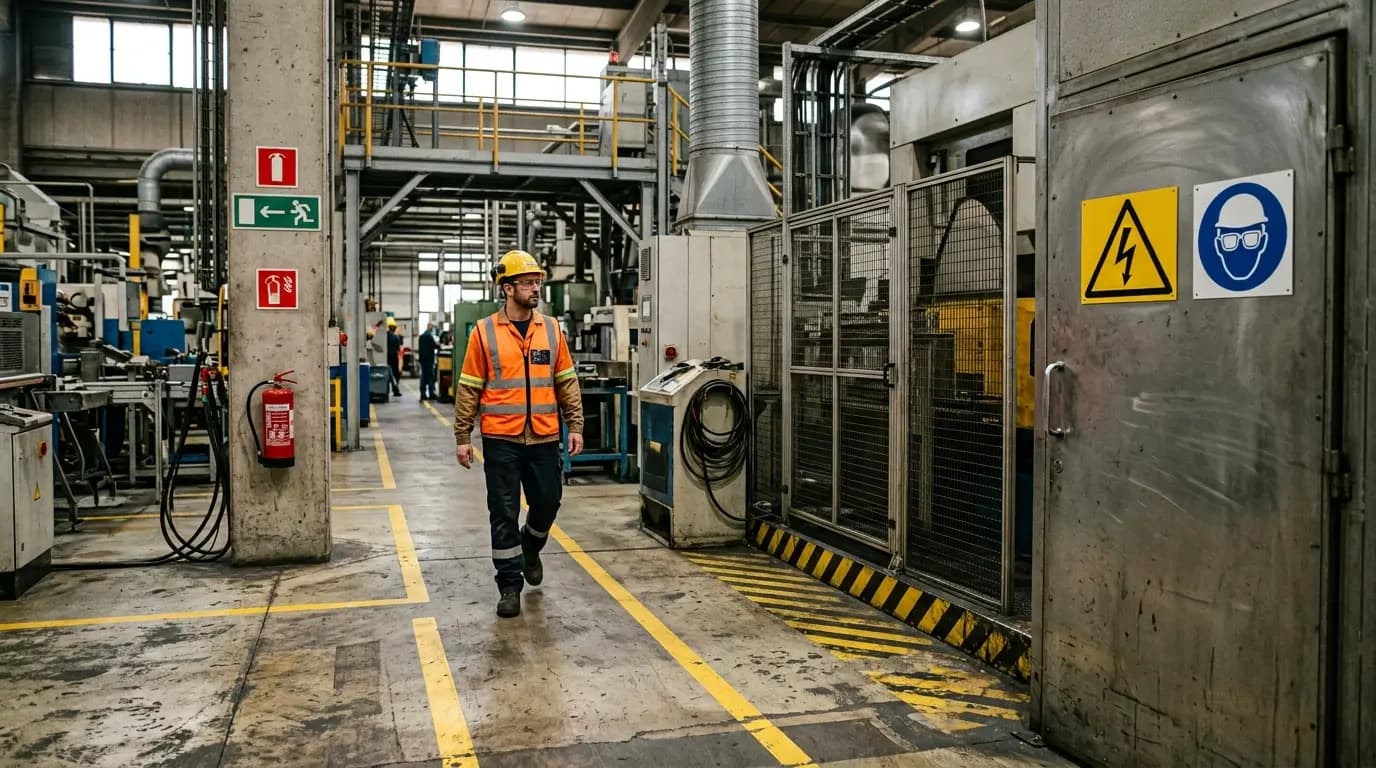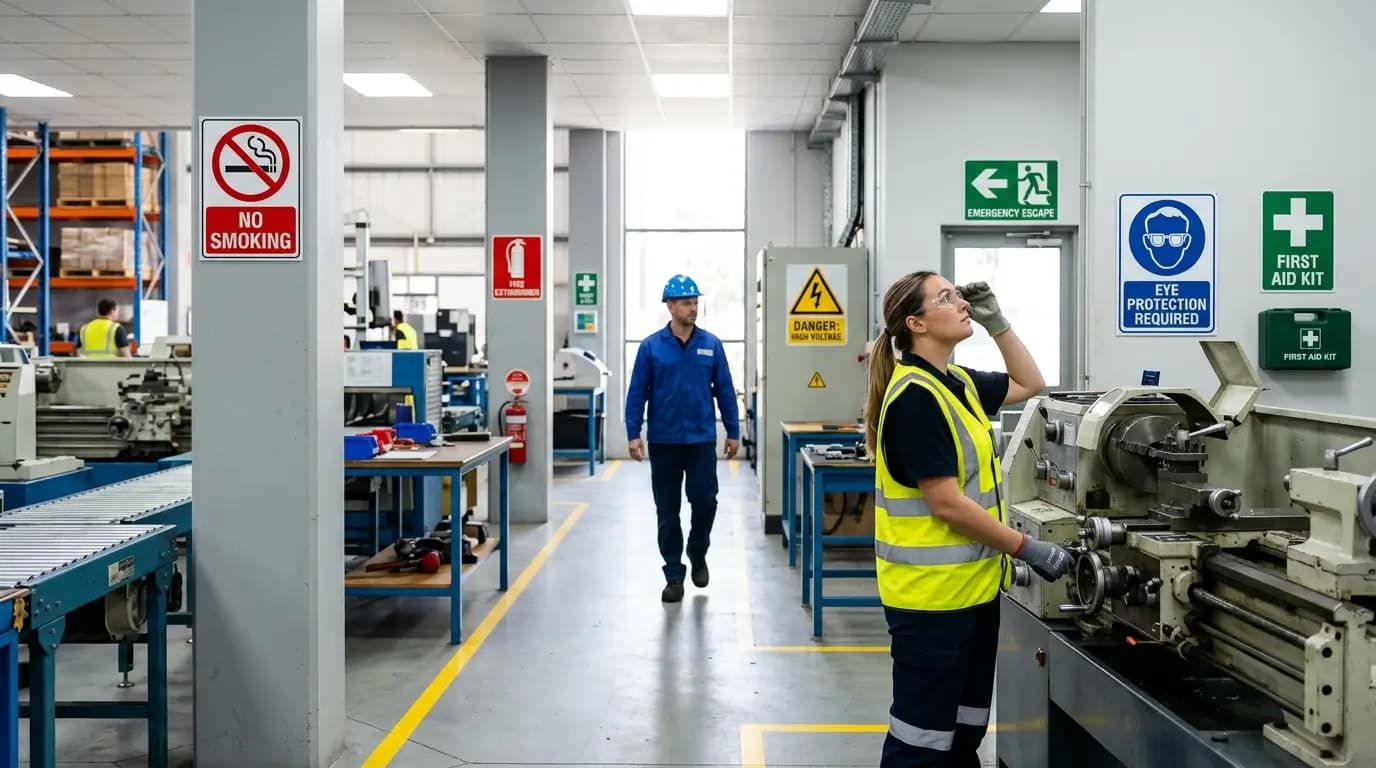


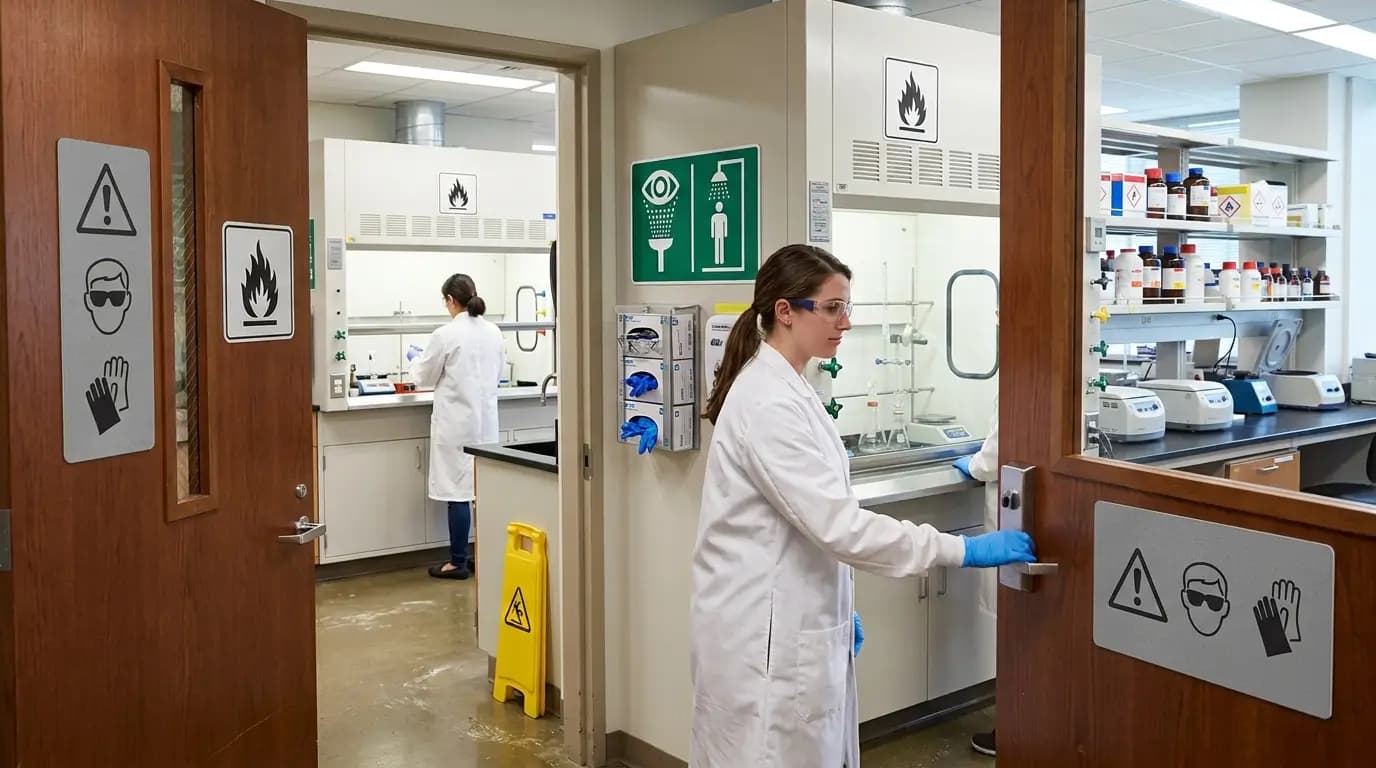
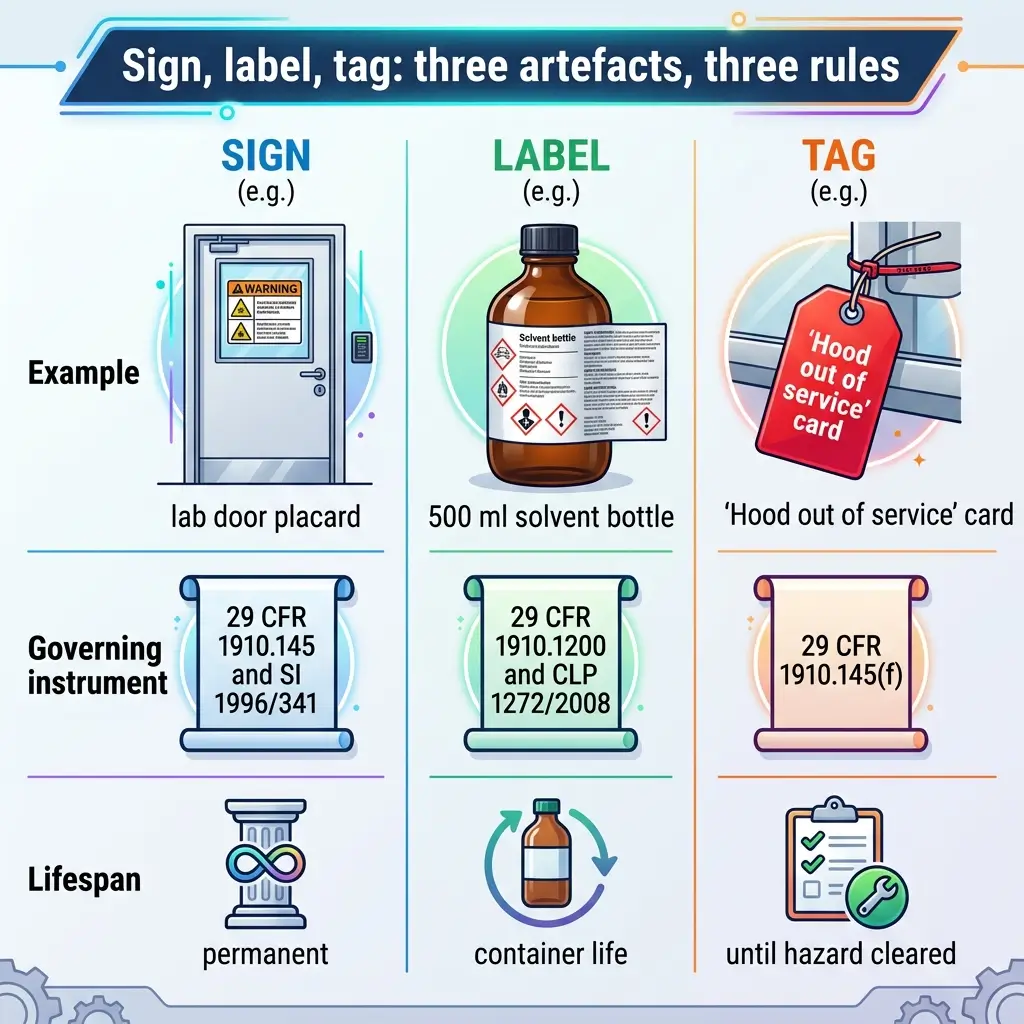
A sign warns you about a place. A label warns you about a container. Almost every laboratory signage problem I am asked to fix starts with those two things being treated as one, and the rules governing them are genuinely different: in Great Britain the sign duty sits in the Health and Safety (Safety Signs and Signals) Regulations 1996, while container labelling sits under CLP; in the United States, signs fall under 29 CFR 1910.145, containers under the Hazard Communication Standard, and laboratory-specific signage advice sits in a non-mandatory appendix to the Laboratory Standard.
That last point surprises people. Across 180+ workplace inspections in 14 countries — including two years as lab chemical hygiene lead at Cabot Corporation and two more advising Clariant International's pilot plants — the sign that most often fails an audit is not a missing one. It is a correct-looking sign that stopped being true eighteen months ago.
This article is written for lab managers, chemical hygiene officers, principal investigators and EHS advisers running chemistry, QC, pilot-plant or teaching laboratories under UK, EU or US rules.
Key takeaways
Six points decide whether a laboratory's signage holds up under inspection:
- In Great Britain, signs are a last-resort control. HSE guidance L64 applies the 1996 Regulations only where a significant risk remains after other measures have been taken — a sign never substitutes for a fume hood or a segregated store.
- US laboratory signage guidance is advisory, not mandatory. The three sign types named in Appendix A to 29 CFR 1910.1450 are recommendations; the binding sign rules sit in 1910.145, and the binding container rules in 1910.1200.
- OSHA recognises three sign classes, not four. Under 29 CFR 1910.145(c) they are Danger, Caution and Safety instruction. "Warning" is a tag signal word under 1910.145(f)(7) and an ANSI Z535.2 sign format — not an OSHA sign class.
- A US deadline lands this November. OSHA extended the HazCom compliance dates by four months in January 2026; employers must update alternative workplace labelling for substances by 20 November 2026.
- Biological agents change the door. The CDC/NIH BMBL — advisory in itself, but the recognised code of practice, and enforced through funding and institutional conditions — specifies an entrance sign carrying the biohazard symbol, the biosafety level, a responsible person's name and telephone number, and entry and exit requirements.
- The single highest-value check costs nothing: does the sign still describe the room as it is today, and can someone reach a named human on the number printed on it?
A sign warns about a place; a label warns about a container
These are separate legal artefacts with separate owners, and confusing them produces postings that satisfy nobody. A GHS pictogram enlarged and stuck on a laboratory door is not a sign under the UK Regulations or under 1910.145 — it is a classification element lifted off a container label, and it tells an incoming responder nothing about quantity, location or who to ring.
A third artefact does the temporary work. Under 1910.145(f) a tag covers a hazardous condition that is out of the ordinary, unexpected or not readily apparent, and stays in place until the hazard is eliminated or the operation is finished. In a laboratory that is the out-of-service fume hood, the reaction left running overnight, the freezer that has failed. Signs are for the permanent character of the room; tags are for today.
The table below sets out which instrument governs which artefact.
| Artefact | What it covers | US instrument | UK / EU instrument |
|---|---|---|---|
| Sign | A room, area, door or fixed installation | 29 CFR 1910.145(c)–(e) | Health and Safety (Safety Signs and Signals) Regulations 1996; BS EN ISO 7010 |
| Label | An individual container, including secondary vessels | 29 CFR 1910.1200(f); 1910.1450(h) | CLP Regulation 1272/2008 (assimilated in GB) |
| Tag | A temporary or abnormal condition | 29 CFR 1910.145(f) | Covered by the 1996 Regulations as a temporary sign |
| Pictogram | A hazard class, as a component of a label | GHS elements under 1910.1200 | CLP hazard pictograms |
Before anything goes on a wall, three questions sort it into the right category:
- What is being warned about — a space, a vessel, or a condition today? That answer picks the artefact.
- Who owns keeping it true? A sign with no named owner degrades within a year.
- What does the reader have to do differently because of it? If nothing, the posting is decoration, and decoration dilutes the postings that matter.
What the law actually requires — and what it leaves to you
The honest summary is that both major regimes tell you how a sign must look and behave, and leave which signs your laboratory needs to your risk assessment. That is not a loophole. It is why two chemistry labs on the same corridor can legitimately carry different door signs.
Great Britain and the EU
The Health and Safety (Safety Signs and Signals) Regulations 1996 (SI 1996/341) came into force on 1 April 1996 and transpose Directive 92/58/EEC, which is why a prohibition sign means the same thing in Rotterdam as in Runcorn. HSE's guidance, published as L64 (third edition, 2015), is explicit that signs are required where a significant risk to health and safety remains despite other relevant measures being in place. Signs also have to be maintained so they can still perform their function — a faded pictogram is a non-compliant one.
Text-only fire safety signs are no longer acceptable; pictograms to BS EN ISO 7010 are the expected form, with text as a supplement rather than a substitute. For containers, CLP handles classification, labelling and packaging, and COSHH 2002 drives the assessment that decides whether a sign is needed at all.
United States
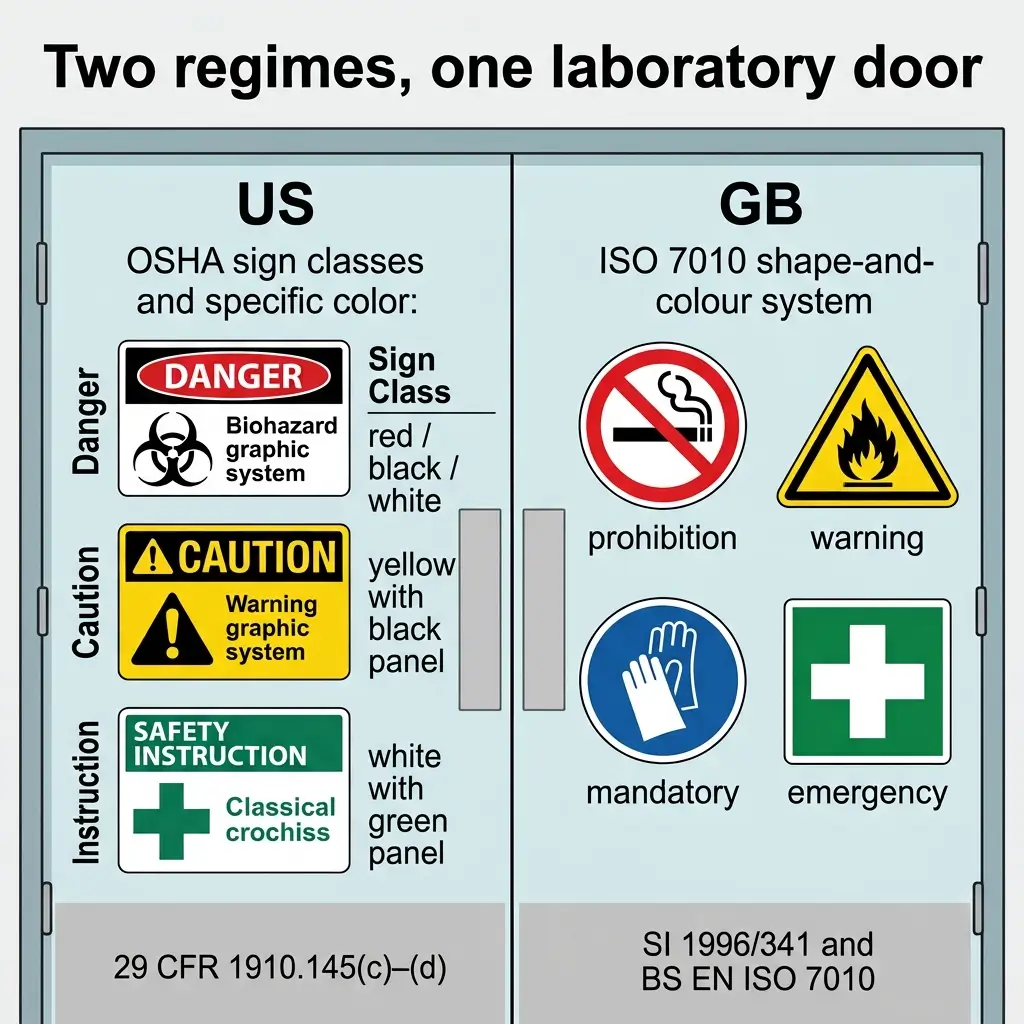
The binding sign rule is 29 CFR 1910.145. It recognises Danger (red, black and white), Caution (yellow background, black panel with yellow letters) and Safety instruction signs (white background, green panel with white letters), and it separately defines the biological hazard warning at 1910.145(e)(4) for rooms, equipment, containers and materials contaminated with viable hazardous agents. Signs must have rounded or blunt corners and no sharp projections — a genuinely practical clause in a room where people move fast in gloves.
For laboratories, the OSHA Laboratory Standard requires a written Chemical Hygiene Plan, and its Appendix A recommends three types of prominent posting: emergency telephone numbers, location signs for safety showers, eyewash stations, other safety and first-aid equipment and exits, and warnings at areas or equipment where special or unusual hazards exist. Appendix A also asks for a posted sign identifying the nature of the experiment and the substances in use whenever an operation runs unattended.
The two errors I correct most often in US lab postings
The first is "OSHA-approved signs." No such approval exists. OSHA specifies design and colour, and 1910.6 incorporates ANSI Z535.1 colour tables by reference; a vendor can sell a compliant sign, but nobody certifies it.
The second is the placement rule. The "as close as safely possible" wording sits at 1910.145(f)(4)(vi) and applies to tags, not signs — as does the requirement that a signal word be readable at five feet or more. I have seen that misquoted as a sign rule in three separate site procedures. It does not make the underlying instinct wrong, but a procedure that cites the wrong clause fails the first audit that checks it.
| Requirement | United States | Great Britain |
|---|---|---|
| Primary instrument | 29 CFR 1910.145 | SI 1996/341 |
| Trigger for a sign | Hazard whose non-designation may cause injury | Significant risk remaining after other controls |
| Sign classes / format | Danger, Caution, Safety instruction | Prohibition, warning, mandatory, emergency, firefighting |
| Symbol standard | ANSI Z535.2-2011 (R2017) | BS EN ISO 7010 |
| Lab-specific guidance | 1910.1450 Appendix A (non-mandatory) | COSHH assessment; L64 |
Both regimes fix the same three things and leave the same three to you:
- Fixed: form. Colour, shape, symbol standard and legibility are prescribed and not open to house style.
- Fixed: maintenance. A sign that has faded, been obscured or gone out of date is a failed control in both jurisdictions.
- Left to you: which signs, where, and what they say — which is a risk assessment output, not a purchasing decision.
The door: what a laboratory entrance sign has to carry
The entrance sign is the only one that gets read by people who do not work in the room — the night security officer, the contractor changing a light fitting, the fire crew deciding whether to open the door. Design it for them, not for the people who already know what is inside.
The test I apply is simple. I cover the room number, hand the sign to someone who has never been in that laboratory, and ask what they would do if they arrived at two in the morning and the alarm was sounding. If the answer requires knowledge that is not on the sign, the sign is incomplete.
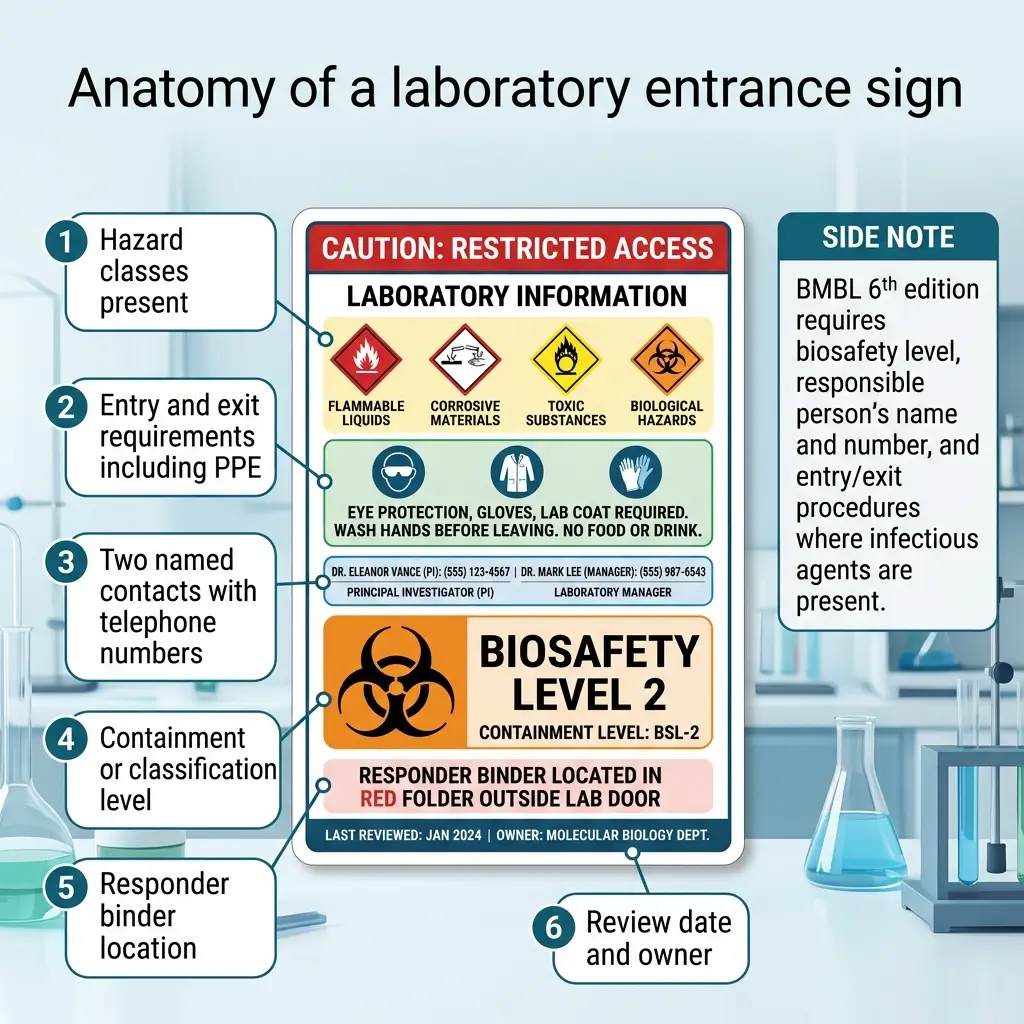
Where biological agents are present, the CDC/NIH Biosafety in Microbiological and Biomedical Laboratories sets the content. Its sixth edition describes itself as an advisory code of practice rather than a regulation, but institutions and funders treat its BSL criteria as binding, so read it that way: a sign incorporating the universal biohazard symbol at the entrance, showing the biosafety level, the name and telephone number of the principal investigator or other responsible person, and the required procedures for entering and exiting. Many institutions deliberately omit the agent name for biosecurity reasons and hold it in a responder binder instead — a defensible choice, provided the binder location is on the sign.
An entrance sign that survives an audit carries these elements:
- The hazard classes actually present — not the catalogue's generic set, and not every class the department has ever held
- Entry and exit requirements, including PPE and any restriction on lone or out-of-hours working
- Two contactable names with numbers, because one person is on annual leave at some point every year
- Containment or classification level where biological agents, lasers, ionising radiation or magnetic fields are in use
- A date and a review owner, printed small, in the corner — the single cheapest control on the whole placard
In the Cabot Corporation lab chemical hygiene role, the recurring gap I dealt with was not missing door signs. It was contact details that had aged out: named postholders who had moved on, and an extension number routing to a desk nobody sat at after six. The fix was procedural rather than graphic — the door sign became an item in the starter and leaver checklist, so a name change triggered a sign change.
PPE signs tell people to gear up. They do not tell them what to wear.
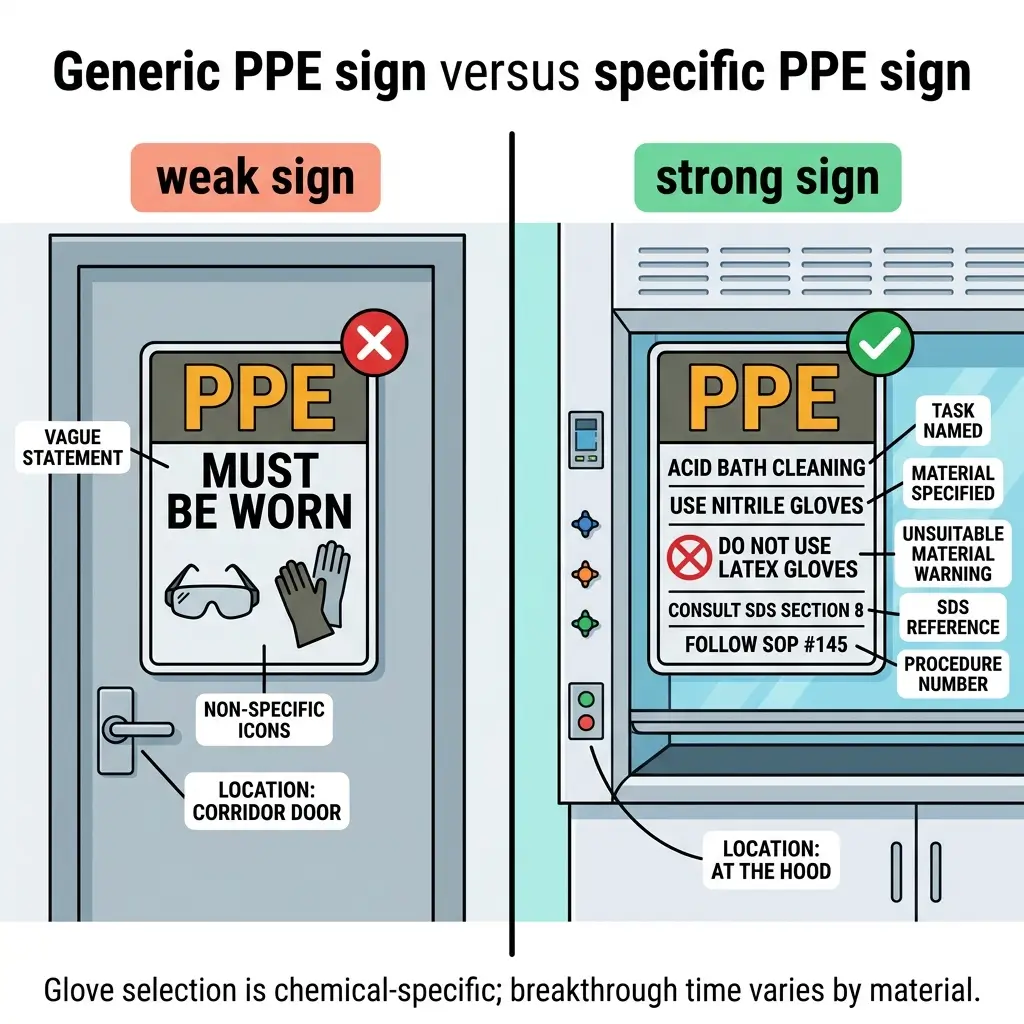
"Eye protection and gloves must be worn" is the most common sign in any laboratory and one of the least useful, because glove selection is a chemical-specific decision and the sign contains no chemistry. Nitrile is not a general-purpose answer; against several chlorinated solvents its breakthrough time is measured in minutes.
The clearest version of this I have seen was not in a laboratory. Auditing a drum and IBC store for LANXESS in France, I found the crews selecting gloves and eyewear by habit — the pair that was always in the box — rather than from the safety data sheet for the product being decanted that shift. The material was compatible with what they had been decanting the previous week and not with what they were decanting that day. I stopped the transfer, had the SDS section 8 requirements checked against what was actually issued, and briefed the crew before the work restarted.
That was a drum store, not a laboratory, and the transfer to a lab bench is not automatic. What does transfer is the mechanism: where the PPE instruction is generic, people default to habit, and habit tracks the last job rather than this one. A door sign reading "gloves required" is precisely that kind of generic instruction.
A PPE sign earns its place when it does one of the following:
- Names the material and the task — "Viton gloves for chlorinated solvent decanting; nitrile is not suitable"
- Points to the controlling document at the point of use, so the SOP or SDS is one step away rather than one floor away
- States the exception, where the room has one — laser eyewear at a stated optical density, or a face shield rather than goggles for cryogenic decanting
- Sits where the decision is made, at the glove box or the hood, not only at the corridor door
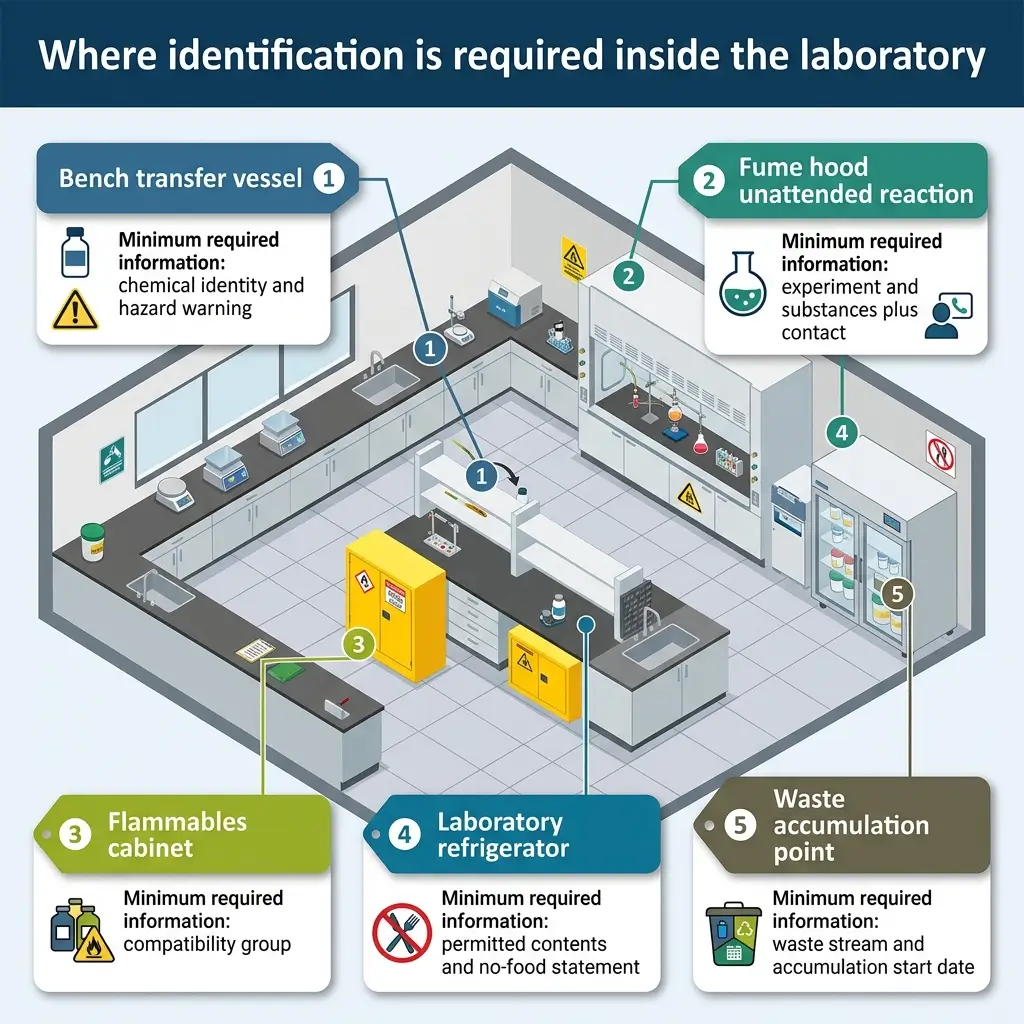
Inside the room: bench, hood, cabinet, fridge and waste
Once past the door, signage stops being about warning and starts being about identification. The question shifts from "what is in this room" to "what is in this vessel, and can the next person tell without opening it".
Secondary containers are where laboratories most often fall down. Appendix A to 1910.1450 asks that labels on containers used for storing hazardous chemicals include the chemical identification and appropriate hazard warnings, and that the contents of all other transfer vessels — beakers, flasks, reaction vessels — be properly identified. A flask marked "IW 14/8" identifies nothing to anyone except the person who wrote it, and that person is not the one who finds it in a fume hood after they have left.
The table below maps the common postings inside a laboratory to what they must carry and where the requirement comes from.
| Location | What the posting must carry | Source |
|---|---|---|
| Secondary container | Chemical identity plus hazard warnings; transfer vessels identified | 1910.1450 App A; 1910.1200(f)(6) for alternative workplace labelling |
| Storage cabinet or shelf | Compatibility group held; segregation from incompatibles | 1910.1450 App A chemical storage; COSHH assessment |
| Refrigerator or freezer | Permitted contents, and an explicit no-food statement | 1910.1450 App A (no food storage in lab refrigerators) |
| Waste container | Waste stream, accumulation start date, hazard warnings; kept sealed | 1910.1450 App A waste collection and storage |
| Unattended operation | Nature of the experiment, substances in use, emergency contact | 1910.1450 App A |
Three checks tell you within five minutes whether internal labelling is real or nominal:
- Read three transfer vessels at random in a fume hood and see whether a stranger could identify the contents and the hazard.
- Open the flammables cabinet and check that what is inside matches what the door claims is stored there.
- Look at the oldest waste container in the accumulation area for a start date, a named waste stream and a closed lid.
Advising Clariant International's pilot plants, the postings that consistently held up were the ones tied to a physical trigger rather than a calendar: a label printed at the moment of transfer, a waste tag dated when the container was opened rather than when it was full. Anything that relied on someone remembering to go back and write it up later had usually not been written up.
Emergency equipment signs are the ones people use under pressure
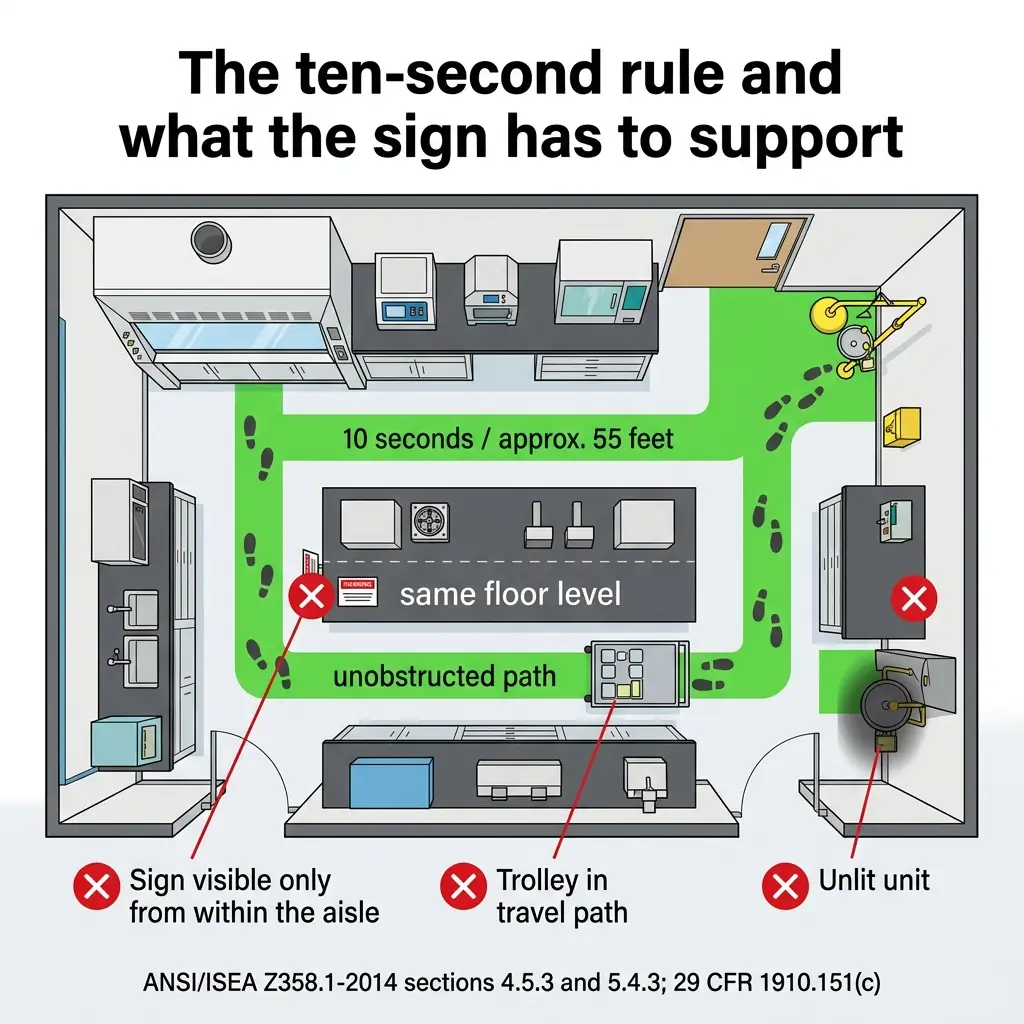
Every other sign in the laboratory is read at walking pace. The eyewash sign is read by someone whose eyes are shut, being led by a colleague who has never used one. That changes what "visible" has to mean.
ANSI/ISEA Z358.1-2014 is the standard OSHA points to when it enforces the general requirement at 29 CFR 1910.151(c) for suitable quick-drenching facilities. It requires emergency equipment to be identified with a highly visible sign, positioned so the sign is visible within the area served, with the area around the unit well lit. It also fixes the geometry that the sign has to support: reachable within ten seconds — roughly 55 feet — on the same level as the hazard, with an unobstructed path.
The failure I find most often is not an absent sign. It is a sign that can only be seen from inside the aisle it serves, so it works for anyone who already knows where the unit is and fails everyone else. The second most common is a trolley, a bin or a stack of cartons parked in the travel path, which invalidates the geometry the sign is advertising.
Verify emergency equipment signage by walking it, in this order:
- Stand where the hazard is — at the hood, the decanting point, the corrosive store — and look for the sign without moving your feet.
- Walk the path at normal pace and count. If it takes more than ten seconds, or you change floor level, the arrangement is wrong regardless of the sign.
- Check the obstruction line, including things that are only there on some shifts — deliveries, trolleys, waste bins staged before a collection.
- Confirm the lighting at the unit, out of hours as well as at midday.
- Check the inspection tag against the weekly activation and annual inspection the standard expects, because a signed unit that does not run is worse than no sign at all.
The November 2026 HazCom deadline for US laboratory labelling
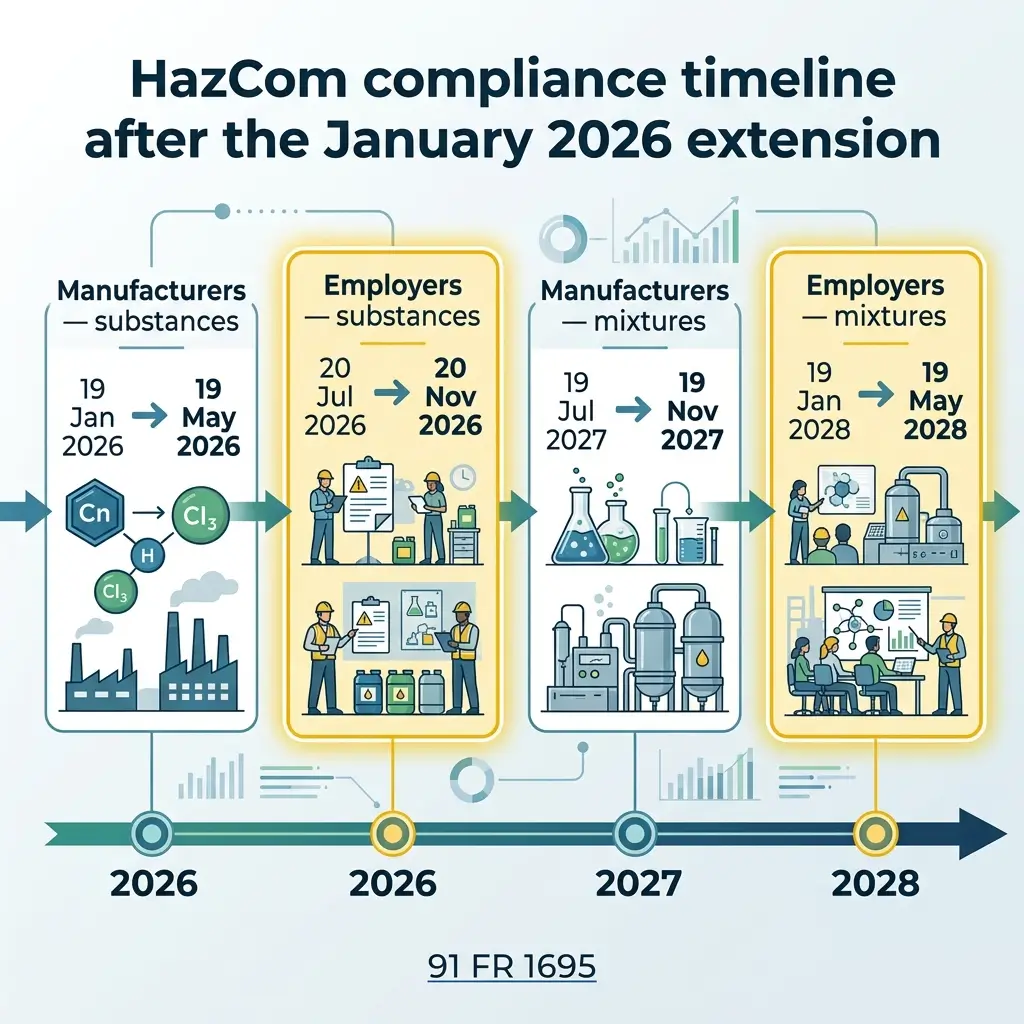
If your laboratory is in the United States, one date matters more than anything else in this article. OSHA's 2024 rule aligned the Hazard Communication Standard with GHS Revision 7, and in January 2026 the agency extended each compliance date by four months to allow time for guidance to be published.
For laboratories the operative deadline is the employer one, not the manufacturer one. By 20 November 2026, employers must update any alternative workplace labelling used under 1910.1200(f)(6), update the written hazard communication programme, and provide additional training for newly identified hazards — for substances. The mixtures deadline runs to 19 May 2028.
| Milestone | Original date | Extended date |
|---|---|---|
| Manufacturers, importers, distributors — substances | 19 January 2026 | 19 May 2026 |
| Employers — labelling, programme, training (substances) | 20 July 2026 | 20 November 2026 |
| Manufacturers, importers, distributors — mixtures | 19 July 2027 | 19 November 2027 |
| Employers — labelling, programme, training (mixtures) | 19 January 2028 | 19 May 2028 |
Source: 91 FR 1695, 15 January 2026, amending 29 CFR 1910.1200(j). Until the applicable date, the 2012 standard, the 2024 standard, or both may be used — which is exactly why laboratories are currently holding two label vocabularies at once.
Three practical consequences follow for a laboratory bench:
- Incoming stock will carry mixed vintages through the transition, so training has to cover both label formats rather than replacing one with the other.
- In-house label templates are alternative workplace labelling under (f)(6) and fall inside the employer deadline, including the printed sheets most labs keep by the balance.
- Hazard statements may change without the chemical changing, so a reclassified substance can require a new secondary label on a bottle that has sat untouched for a year.
Six laboratory signage failures I write up most often
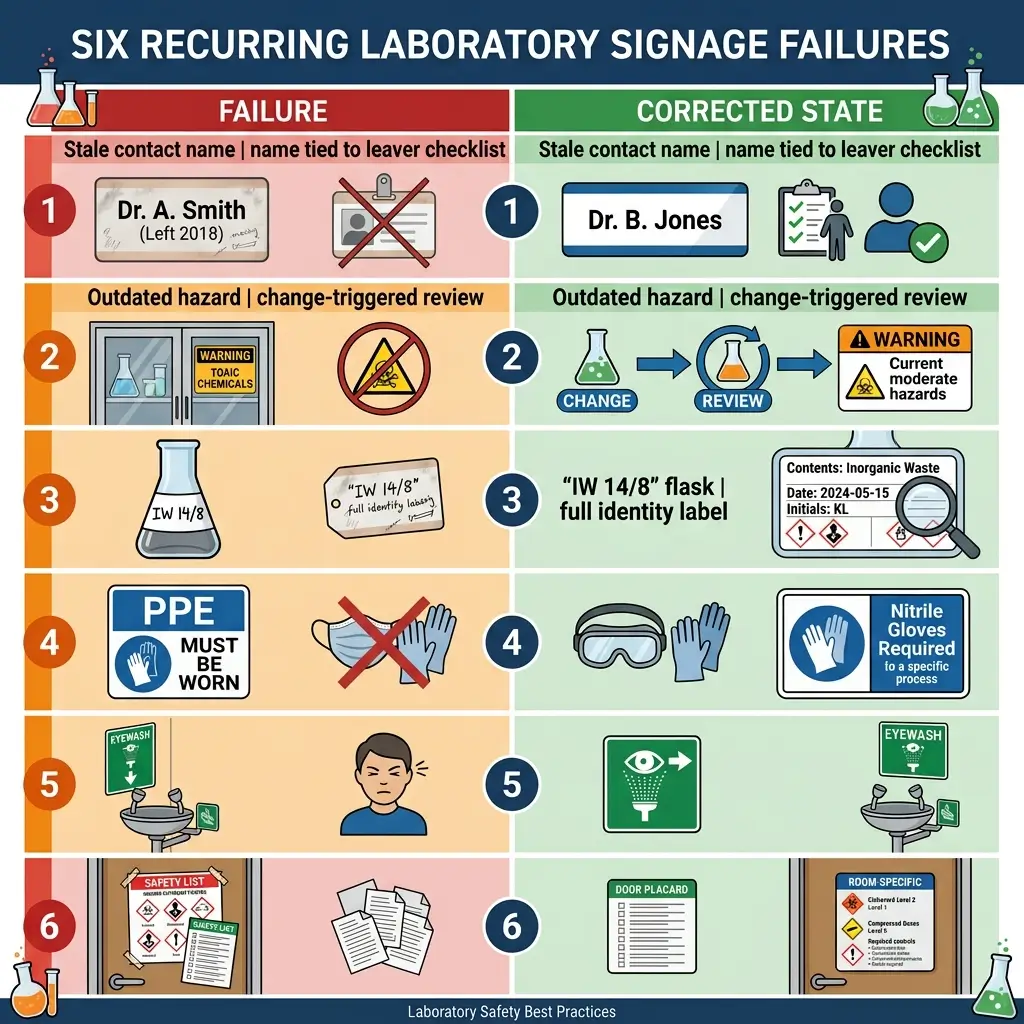
None of these are exotic. They are the findings that recur across specialty chemical sites, pilot plants and QC laboratories, and every one of them is a maintenance failure rather than a design failure.
The pattern underneath them is worth stating plainly: laboratories buy signs as a project and then own them as an afterthought. The purchase has a budget and a completion date. The upkeep has neither, so it drifts until an audit or an incident makes it visible again.
| What fails | Why it happens | What I check | What good looks like |
|---|---|---|---|
| Stale contact names | No trigger links leavers to signage | Ring the number on the sign, on the spot | Door sign sits in the starter/leaver checklist |
| Sign describes a former hazard | Research scope changed; sign did not | Compare the sign against the current inventory | Change of agent or process triggers a sign review |
| Secondary containers with initials only | Labelling deferred to "later" | Open a hood and read three vessels at random | Label printed at the moment of transfer |
| Generic PPE instruction | Sign bought from a catalogue, not written from the assessment | Ask which glove material and why | Material and task named on the sign |
| Eyewash sign visible only from the aisle | Sign placed at the unit, not aimed at the user | Stand at the hazard and look | Sign readable from every position it serves |
| Pictogram poster used as a door sign | Convenience; it looks official | Ask what a responder would do with it | Room-specific placard, poster kept as training material |
Auditing hazmat stores for Evonik Specialty, the finding I raised most often in this area was the third one — vessels identified well enough for the person who filled them and for nobody else. It is the cheapest finding on the list to close and the one most likely to reappear at the next visit.
Building a laboratory signage set that survives an audit
The programme that works is small. It has an inventory, an owner per room, a trigger that forces review, and a walk that verifies it — and it can be built in a fortnight in a laboratory that currently has nothing but a drawer of catalogue signs.
Start from the risk assessment rather than the catalogue. A supplier's laboratory bundle is built to sell to every laboratory, which means it describes none of them. The COSHH assessment or Chemical Hygiene Plan already contains the hazard list your door sign needs.
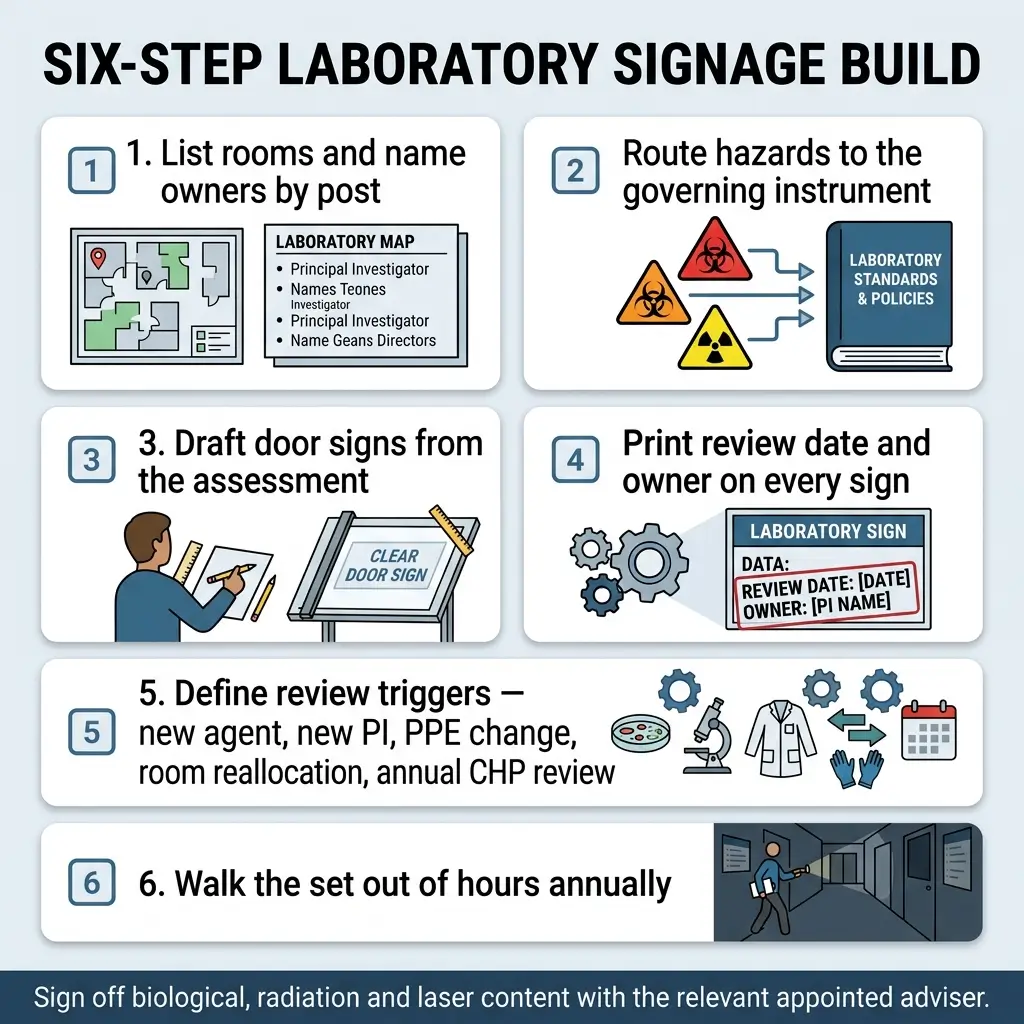
Build it in this order:
- List the rooms and name an owner for each, by post rather than by person, so the ownership survives a leaver.
- Route each room's hazards to the right instrument — chemical, biological, laser, ionising radiation, magnetic field — because the content requirements differ and only some are discretionary.
- Draft each door sign from the assessment, then have someone who does not work in the room read it back to you.
- Print a review date and owner on every sign, small, in the same corner every time, so an auditor can scan a corridor in a minute.
- Define the triggers that force a review: new agent or process, new principal investigator, PPE change, room reallocation, and the annual Chemical Hygiene Plan review.
- Walk it out of hours at least once a year. Lighting, obstruction and legibility all behave differently at eight in the evening than they do on the day of the audit.
Where a laboratory holds biological agents, ionising radiation sources or Class 3B and 4 lasers, the signage content is set by regimes outside chemical safety and needs the relevant biological safety officer, radiation protection adviser or laser safety officer to sign it off. That is a competence boundary worth respecting rather than improvising across.
Frequently asked questions
These are the questions lab managers and principal investigators ask me most often about signage, answered against the instruments cited above.
Are laboratory safety signs legally required?
Some are, and which ones depends on the hazard. In Great Britain, the 1996 Regulations require a sign where a significant risk remains after other controls. In the US, biohazard warnings, radiation postings and bloodborne pathogen research signage are mandatory, while the general laboratory postings in Appendix A to 1910.1450 are recommendations.
What must a laboratory door sign include?
At minimum: the hazard classes actually present, entry and exit requirements including PPE, and at least two contactable names with numbers. Where infectious agents are present, the BMBL adds the biosafety level and the required entry and exit procedures. A review date and named owner are not required anywhere, but they are what keeps the rest true.
What is the difference between a hazard label and a safety sign?
A label belongs to a container and travels with it; a sign belongs to a place and stays there. They are governed by different rules — HazCom or CLP for labels, 1910.145 or the 1996 Regulations for signs — and a pictogram taken off a label does not become a compliant sign by being enlarged.
What colours are used on laboratory warning signs?
Under 29 CFR 1910.145, Danger signs use red, black and white; Caution signs use a yellow background with a black panel and yellow letters; Safety instruction signs use a white background with a green panel and white letters. Under BS EN ISO 7010, shape and colour carry the meaning: red circle for prohibition, yellow triangle for warning, blue circle for mandatory action, green square for emergency and escape.
Is "Warning" an OSHA sign category?
Not for signs. 29 CFR 1910.145(c) recognises Danger, Caution and Safety instruction signs. "Warning" appears as a tag signal word at 1910.145(f)(7) and as a signal word in ANSI Z535.2, where it sits between Caution and Danger. Using ANSI-format signs is permitted, but do not describe them as an OSHA sign class.
How often should laboratory signs be reviewed?
Tie the review to events rather than a calendar: a new agent or process, a new principal investigator, a PPE change, a room reallocation. Add one annual walk alongside the Chemical Hygiene Plan review, which OSHA's Appendix A expects to happen at least annually in any case.
Do GHS pictograms belong on a laboratory door?
They can supplement a door sign, but they cannot replace one. A pictogram communicates a hazard class and nothing about quantity, location, entry conditions or who to contact — which is most of what an entrance sign exists to convey.
About the author
Isabella Wright is a British Chemical Safety & Hazardous Materials Assurance Consultant with 17 years of continuous field experience across specialty chemicals, petrochemicals, coatings and solvents, chlor-alkali, polymer processing and laboratory chemical handling. Her focus is practical assurance — checking that controls still work where work actually happens. She leads Wright Chemical Safety Assurance from London, following laboratory and pilot-plant roles with Cabot Corporation and Clariant International and senior chemical safety roles with Huntsman Advanced Materials, Evonik Specialty, Solvay Specialty Polymers, Arkema Coatings and LANXESS.
Credentials: NEBOSH International General Certificate; ISO 45001 Lead Auditor; ISO 14001 Internal Auditor; IOSH Managing Safely; incident investigation (ICAM or equivalent pathway); dangerous goods awareness.
Sources and further reading
- OSHA, 29 CFR 1910.145 — Specifications for accident prevention signs and tags
- OSHA, Appendix A to 29 CFR 1910.1450 — NRC recommendations concerning chemical hygiene in laboratories
- OSHA, Hazard Communication rulemaking and the 2024 final rule
- Federal Register, Hazard Communication Standard — extension of compliance dates, 91 FR 1695 (15 January 2026)
- HSE, Safety signs and signals: the Health and Safety (Safety Signs and Signals) Regulations 1996, guidance on Regulations (L64)
- CDC/NIH, Biosafety in Microbiological and Biomedical Laboratories, 6th edition
- OSHA, Hospitals eTool — the OSHA Laboratory Standard