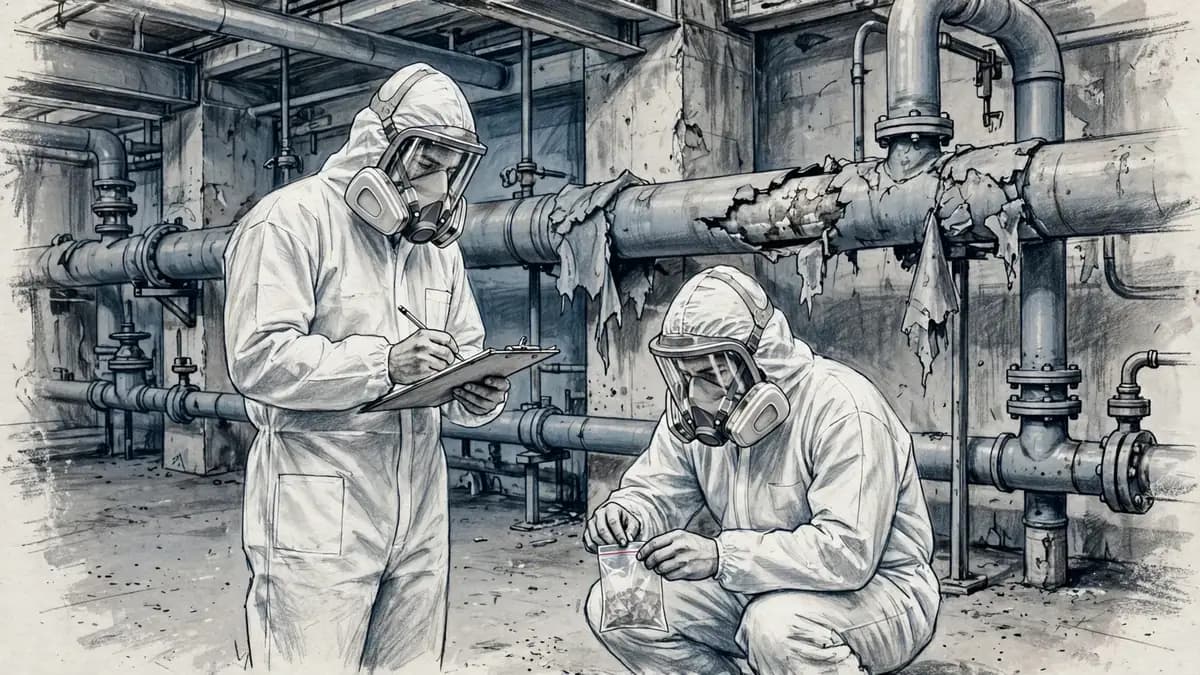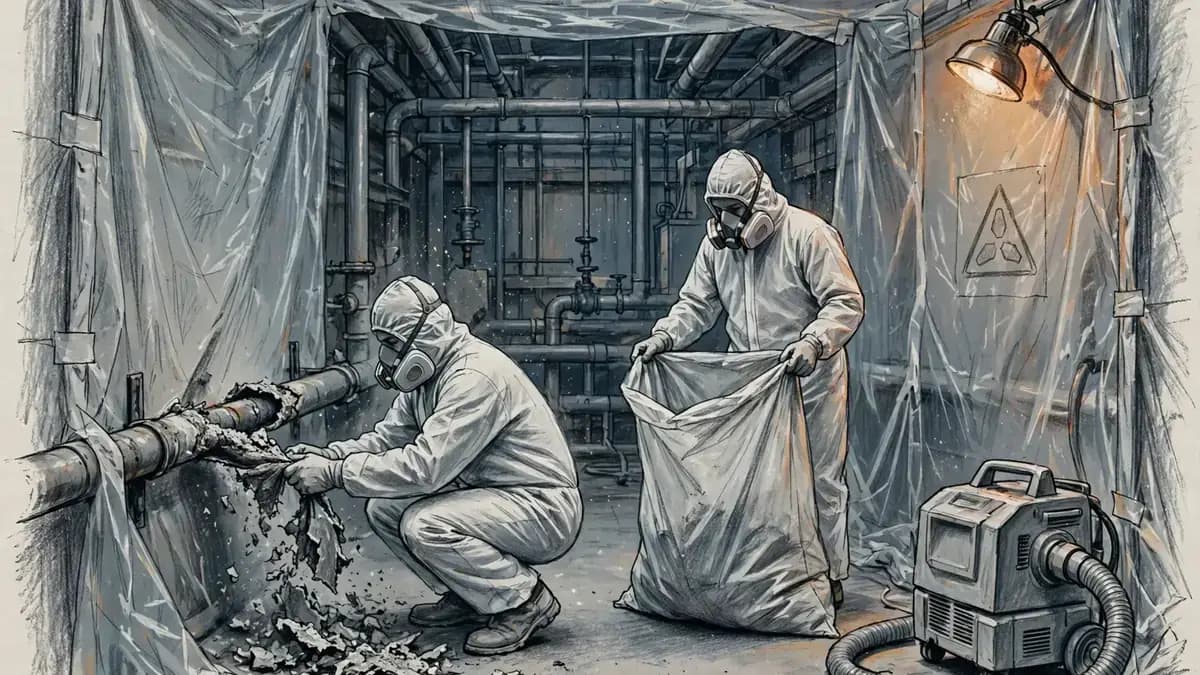
Asbestos removal means taking asbestos-containing material out of a building under controlled conditions, so no fibres escape into the air. In most cases only a trained, licensed contractor should do it. The rules are strict in both the United States and the United Kingdom, and they cover who may do the work, what must happen before it starts, and how the waste is handled.
Removal is not always the right answer. Undamaged material that will stay undisturbed is often safer left in place, and slightly damaged material can sometimes be sealed instead. What follows explains when removal is the right call, who may carry it out, the rules that apply, what it costs, and when to call a professional.
What asbestos removal means
Asbestos removal is the physical stripping out of asbestos-containing material, known as ACM, from a building or structure. In the US, OSHA defines ACM as any material containing more than 1% asbestos. The work covers everything from taking down a single pipe run to stripping sprayed fireproofing from a whole floor.
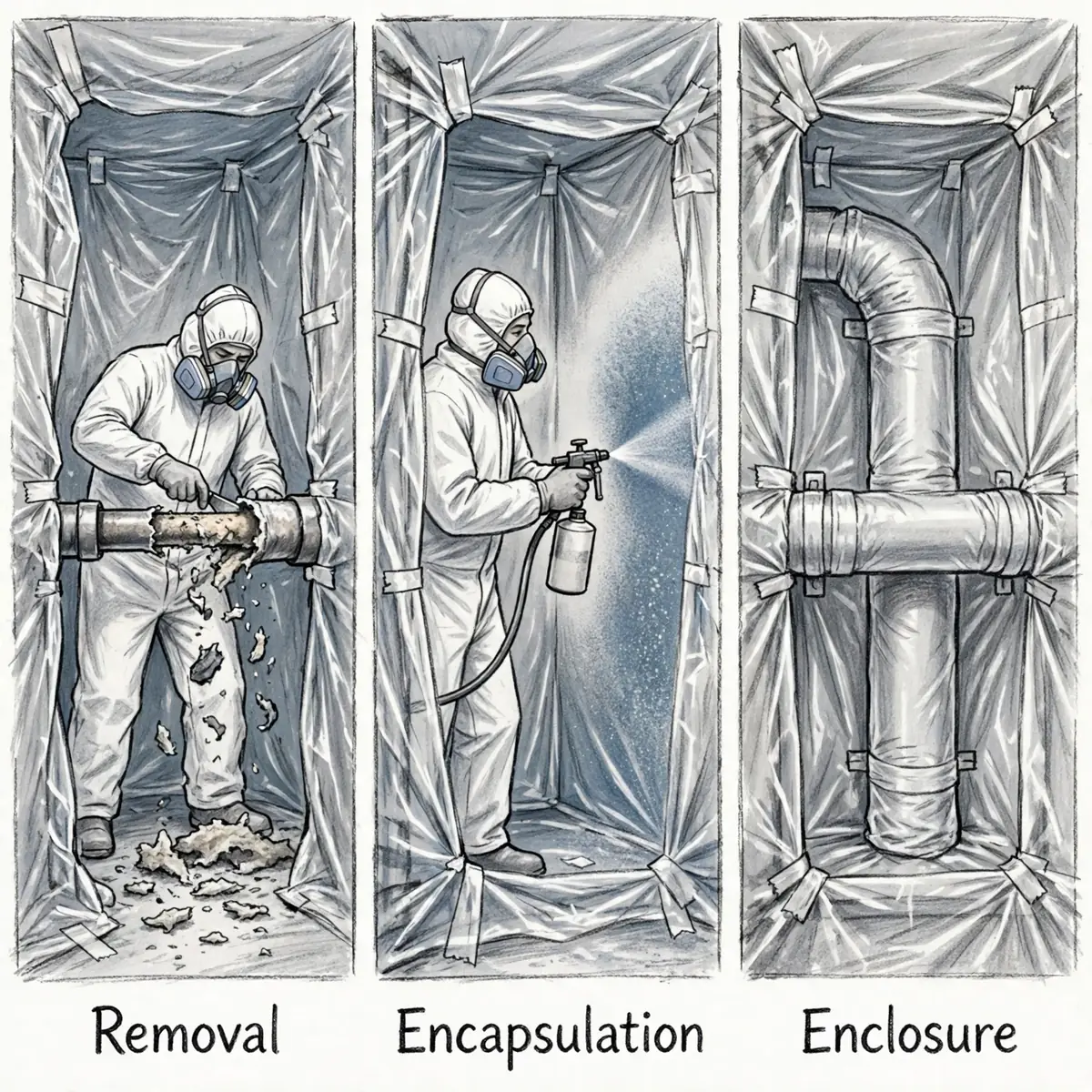
Removal is one of three ways to deal with asbestos in place. The other two leave the material where it is. Encapsulation seals the surface with a coating so fibres cannot escape. Enclosure covers the material, for example by fitting a sleeve over pipe insulation or laying a new floor over old tiles. Removal is the only option that gets rid of the hazard for good.
Removal, encapsulation and enclosure
Removal is the right choice when the material is damaged, friable, or in the way of planned work. Friable material crumbles easily by hand pressure and releases fibres with little disturbance. Once it is out, future work on that part of the building needs no asbestos controls.
Encapsulation and enclosure cost less and disturb the material less, so they suit sound material that will stay put. Both are temporary. The seal or cover needs checking over time, and the asbestos is still there when the building is next altered or demolished. The EPA advises homeowners that removal is the most expensive method and should be the last option in most situations.
Friable and non-friable material
Friable material is the higher risk. Sprayed coatings, pipe lagging, loose-fill insulation and damaged insulating board can all release fibres when touched. Only a licensed professional should handle friable material, in either country.
Non-friable material holds its fibres in a solid matrix, such as asbestos cement sheet, floor tiles or roofing felt. It is lower risk while intact, but it becomes friable when it is sanded, cut, drilled or broken. Any work that disturbs it must follow the same controls as friable work.
TipIf you are unsure whether a material contains asbestos, treat it as if it does until a laboratory says otherwise. Only a sample analysed in a laboratory can confirm it.
When removal is the right call
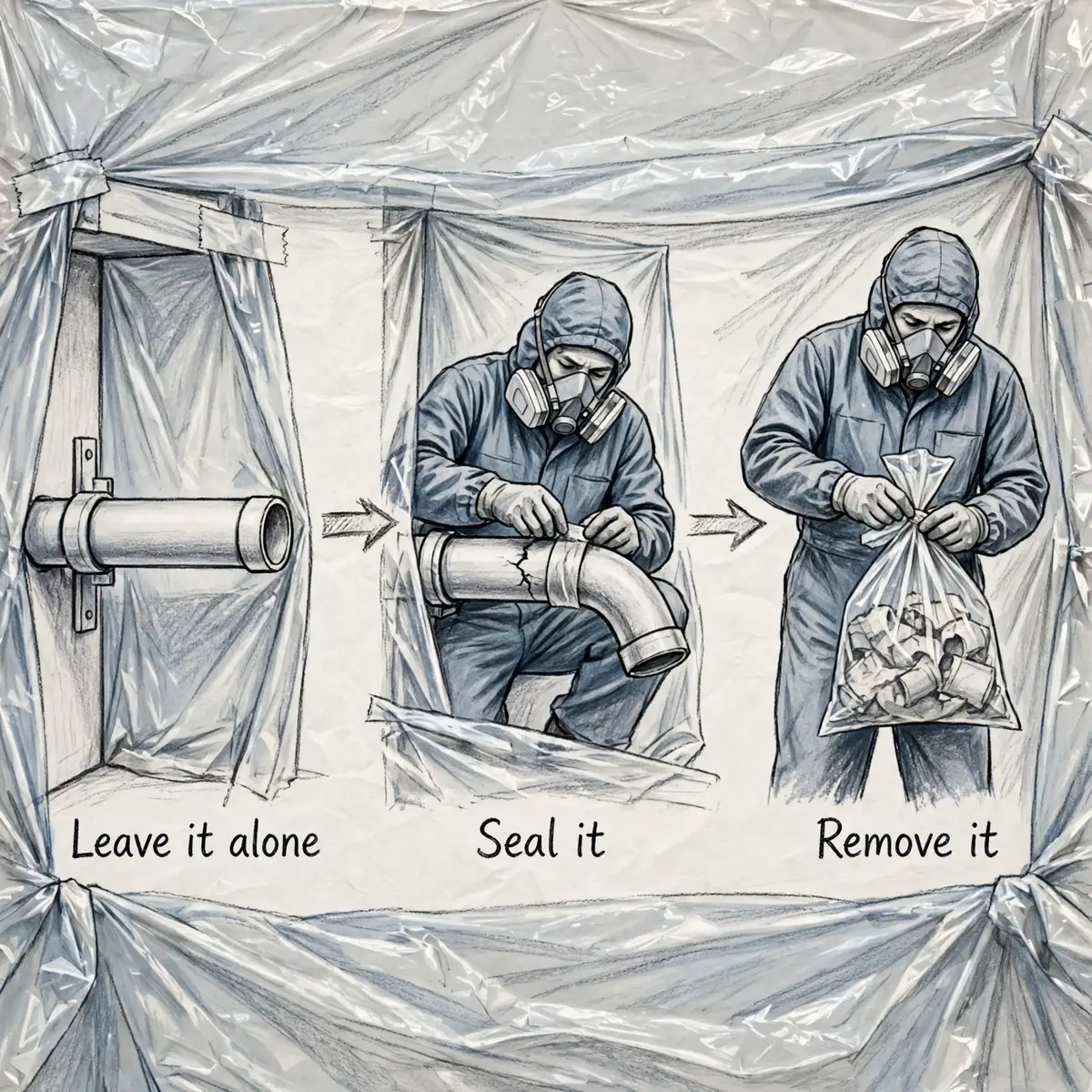
The decision turns on three questions: what condition is the material in, will it be disturbed, and what does the survey say? A surveyor or inspector answers the first two with a visual check and laboratory results. The answers point to one of three outcomes: leave it, seal it, or remove it.
Removal is the right call when the material is damaged or deteriorating, when it is friable and exposed, or when planned work will disturb it. Demolition and major refurbishment almost always mean removal first, because the work will break the material apart.
Remove it when
Removal is needed when the material cannot be left safely in place. The clearest cases are damaged lagging, crumbling coatings, and loose-fill insulation that has spread through a void. Work that will cut, drill or demolish the material also calls for removal.
- The material is damaged, crumbling or releasing visible dust.
- It is friable and in an area people use every day.
- Planned refurbishment or demolition will disturb it.
- Sealing or covering it would not last, or would hide a growing problem.
- A survey recommends removal rather than management in place.
Leave it alone when
Material in good condition that will not be disturbed is usually safest left alone. The EPA advises homeowners that asbestos-containing material which is not damaged or disturbed is not likely to pose a health risk. Leaving it avoids the fibre release that any removal creates.
Leaving it still means managing it. In the UK, the dutyholder for a non-domestic building must keep an asbestos register and check the material regularly. In a home, the practical rule is simple: do not drill it, sand it, or hang anything from it, and check it when anything changes.
Seal it when
Sealing suits material that is slightly damaged but still sound underneath. Encapsulation coats the surface and locks the fibres in. Enclosure puts a physical barrier between the material and the room. Both are cheaper than removal and faster to complete.
Sealing is not a fix for badly damaged material. A coating will not hold on a crumbling surface, and a cover will not stop fibres escaping from material that is already breaking apart. A professional should judge whether the material is sound enough to seal.
Who may remove asbestos
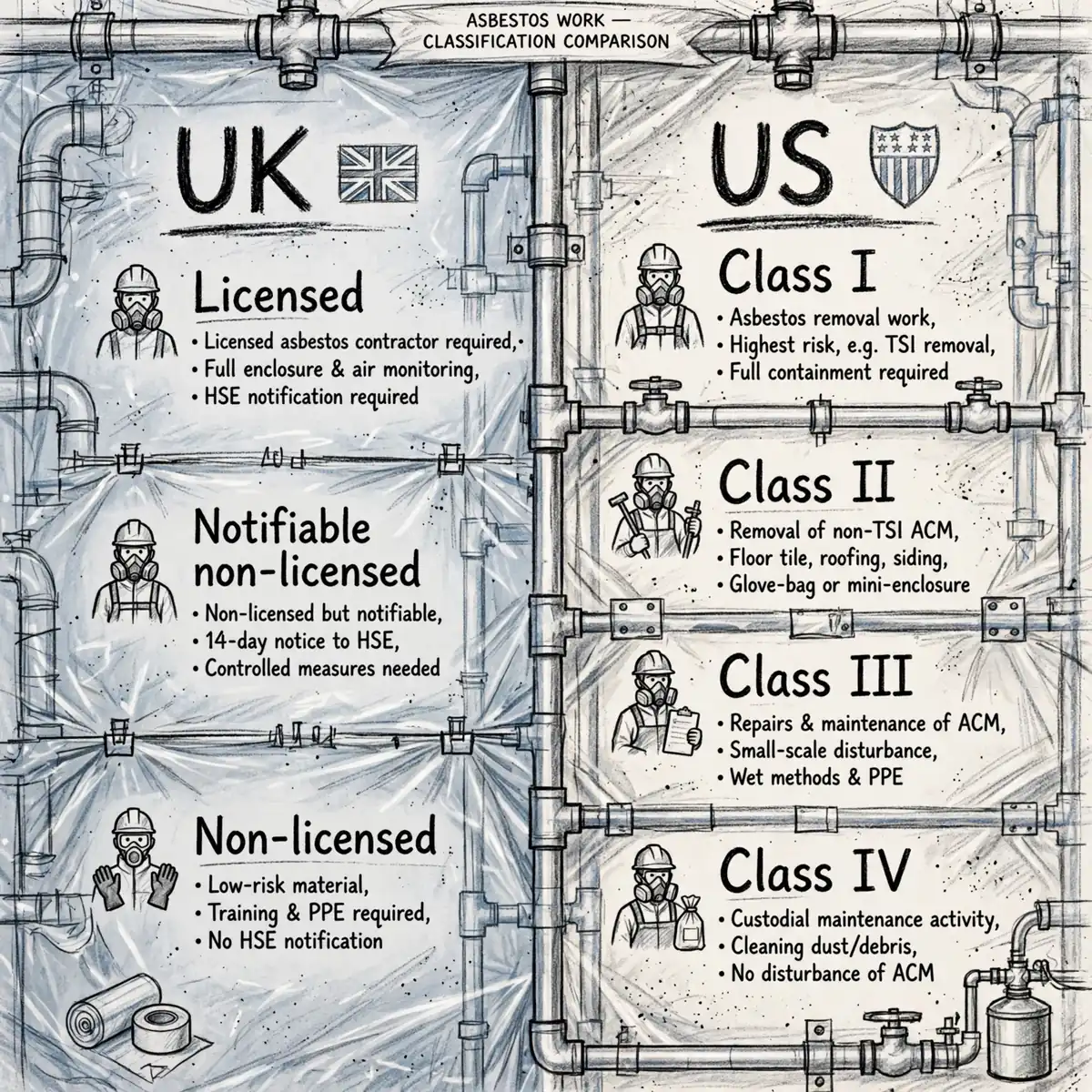
Who may remove asbestos depends on the material, its condition, and the country. High-risk work belongs to licensed contractors in both the US and the UK. Lower-risk work may be done by trained workers without a licence, but only with the right controls. The categories below decide which route applies.
In the United Kingdom
The Control of Asbestos Regulations 2012, known as CAR 2012, divides work into three categories. Licensed work is the highest risk and must be done by a contractor holding an HSE licence. Notifiable non-licensed work, or NNLW, needs notification and medical surveillance but no licence. Non-licensed work is the lowest risk and needs trained workers, a risk assessment and a plan of work.
| Category | Licence needed | Notification | Typical work |
|---|---|---|---|
| Licensed | Yes | ASB5 form, at least 14 days before work | Sprayed coatings, pipe lagging, loose-fill insulation, most insulating board |
| Notifiable non-licensed (NNLW) | No | Online form before work starts | Some short-duration insulating board work, some textured coating removal |
| Non-licensed | No | None | Small, low-risk tasks on sound material, following HSE task sheets |
Licensable work is defined in regulation 2 of CAR 2012. It covers work where exposure is not sporadic and of low intensity, work where the risk assessment cannot clearly show the control limit will not be exceeded, work on asbestos coating, and work on insulating board or insulation that is not short-duration work. Short-duration work means no more than 2 hours in any 7-day period, with no person working for more than 1 hour in that time.
AlertCarrying out licensable work without an HSE licence is a criminal offence under regulation 8 of CAR 2012. Misclassifying a job as non-licensed is one of the most serious compliance errors a dutyholder can make.
In the United States
OSHA divides asbestos work in construction into four classes under 29 CFR 1926.1101. The class decides the controls, the training and the supervision the job needs. A competent person must supervise all work inside a regulated area.
- Class I: removal of thermal system insulation and surfacing material, such as pipe lagging and sprayed fireproofing.
- Class II: removal of other asbestos material, such as wallboard, floor tile, roofing and siding shingles, and mastics.
- Class III: repair and maintenance where asbestos material is likely to be disturbed.
- Class IV: maintenance and custodial work that contacts asbestos material without disturbing it, and clean-up after Class I, II and III work.
Workers on Class I and II jobs must be trained under the EPA Model Accreditation Plan, and the employer must run an exposure assessment. State rules add their own layers: some states licence every abatement contractor, and some require a state permit on top of the federal notification.
Homeowners and small jobs
In the US, the EPA does not endorse homeowners removing asbestos themselves. The agency advises homeowners to hire a trained, accredited professional for repair or removal. Some states allow a homeowner to remove a small amount from their own single-family home, but the waste must still go to a licensed facility.
Even where homeowner removal is legal, it is a poor trade. The saving is small against the cost of proper respirators, coveralls, containment and disposal, and a mistake can contaminate a home for years. Friable material, sprayed coatings and loose-fill insulation should never be a homeowner job in any state.
The rules before work starts
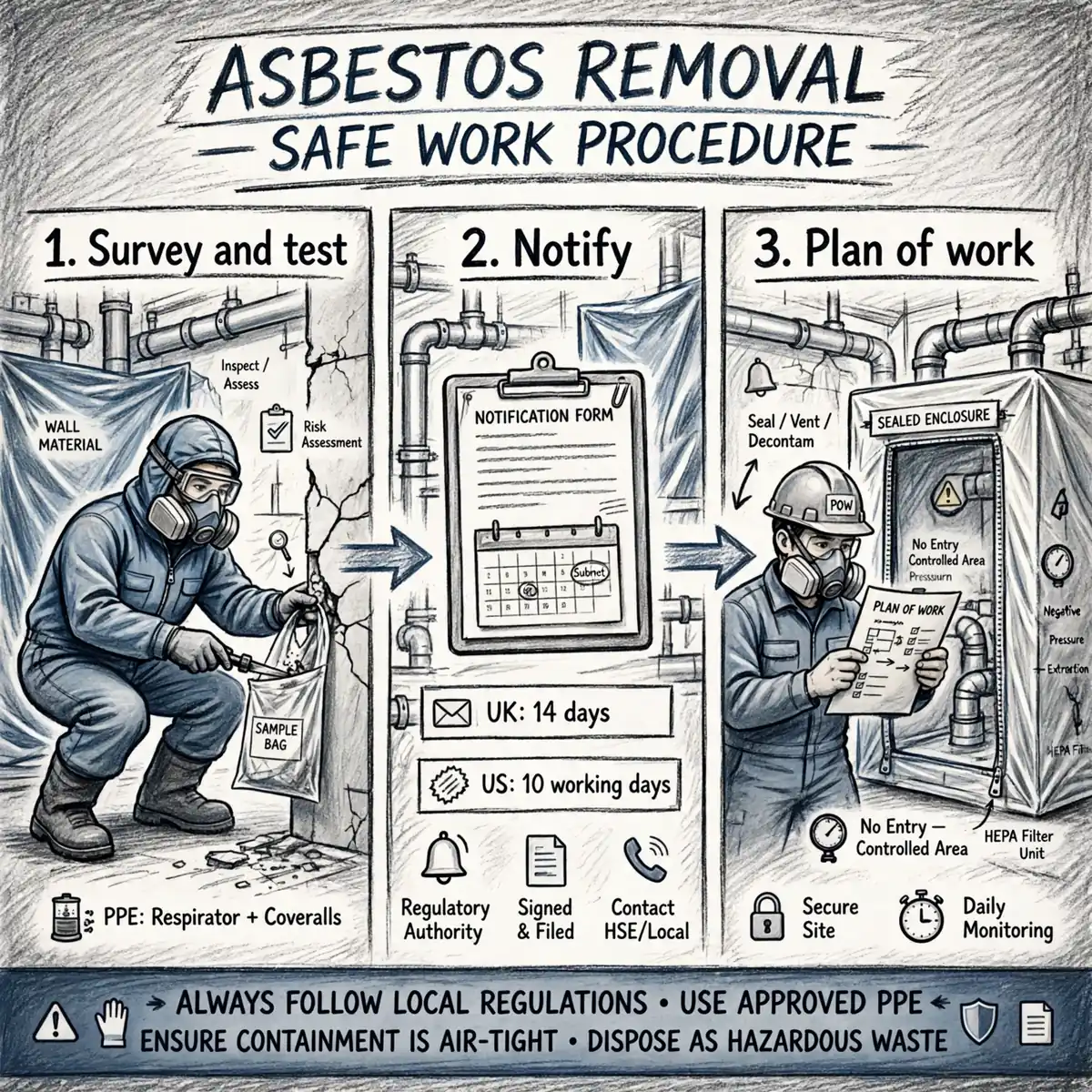
No removal starts without three things: a survey, a notification where the rules require one, and a written plan of work. Skipping any of them is the most common way a job goes wrong. The contractor should be able to show all three before the first sheet of plastic goes up.
Survey and testing
Before demolition or renovation, the affected part of the building must be thoroughly inspected for asbestos. In the US, the NESHAP rule at 40 CFR 61.145 requires that inspection for every demolition and renovation of a facility, including Category I and II non-friable material. In the UK, a refurbishment and demolition survey is needed before work that will disturb the building fabric.
Samples go to an accredited laboratory for analysis, usually by polarised light microscopy. The survey records the type of asbestos, where it is, how much there is, and what condition it is in. That record decides the category of work, the controls, and the notification. For more on where asbestos hides and what the different forms look like, see the guide to asbestos types.
Notification
Notification gives the regulator time to check the job before work starts. The deadlines differ by country, and both are strict.
- UK, licensable work: notify the enforcing authority in writing at least 14 days before work, using the ASB5 form. Tell them about any material change without delay.
- UK, notifiable non-licensed work: notify online before work starts, using the NNLW1 form.
- US, demolition: written notification is required before every demolition, even if no asbestos is found.
- US, renovation: notification is required at least 10 working days ahead when the job disturbs 260 linear feet of asbestos material on pipes, 160 square feet on other components, or 35 cubic feet of material that cannot be measured.
State and local agencies often run the US notification system under delegation from the EPA. The notice goes to the delegated agency, not always to the EPA itself. Check which agency covers the site before the clock starts.
One exception matters for homeowners: NESHAP notification generally does not apply to a single-family home on its own, unless the property is covered by NESHAP through another route. State rules may still apply, so check with the local agency before assuming the job is exempt.
Plan of work
Every job needs a written plan of work built on a risk assessment. The plan names the material, the method, the controls, the protective equipment, the decontamination route, and the waste arrangements. In the UK, HSE guidance in HSG247 sets out what a licensed contractor's plan should cover, from enclosures to decontamination.
The plan also names the people. A competent person supervises the work, and in the UK the analyst who will carry out clearance testing should be independent of the removal contractor. Workers must be trained for the class of work they are doing, and their health records must be kept.
How licensed removal is done, step by step
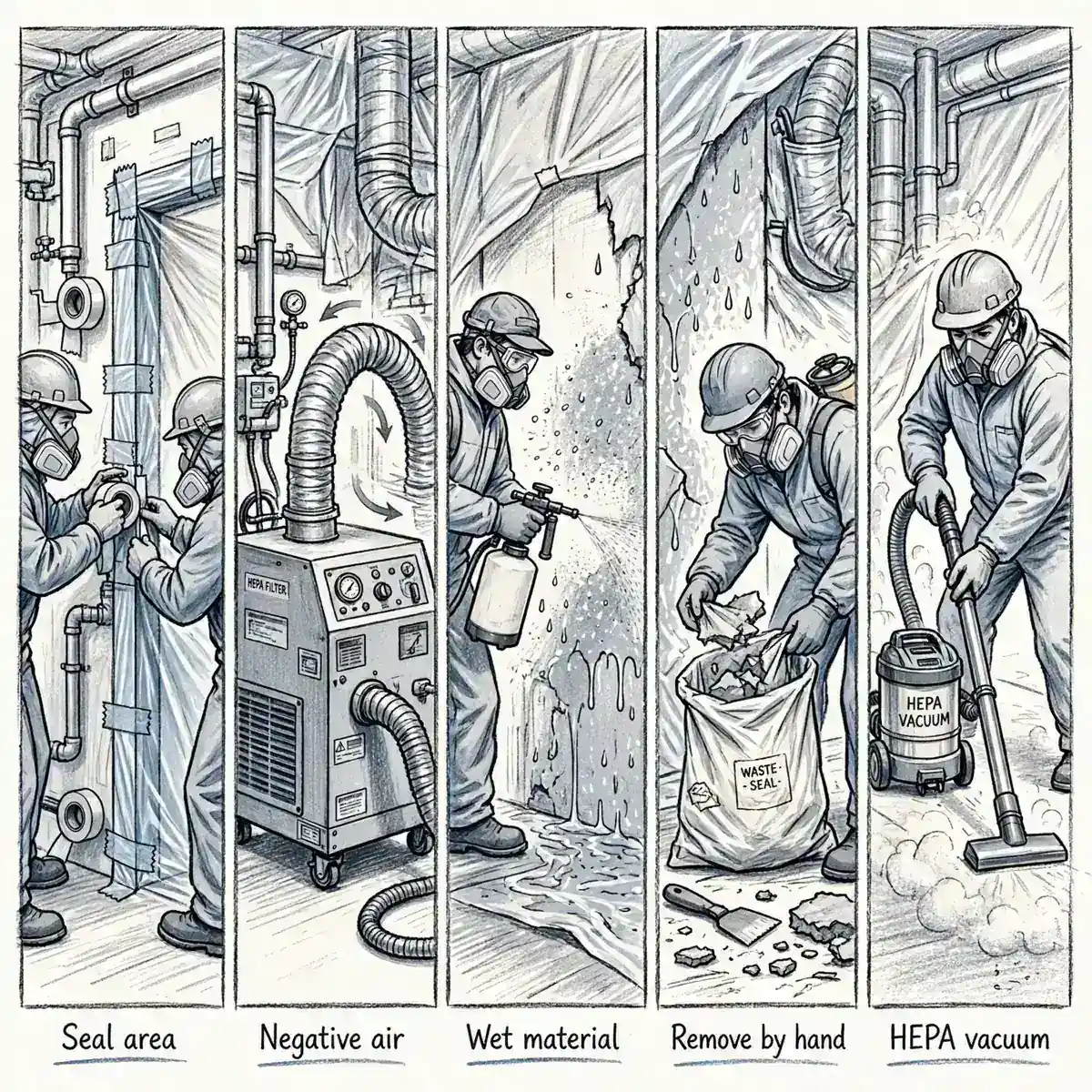
Licensed removal follows the same sequence on every job, whether it is one pipe run or a whole floor. The sequence is designed so fibres stay inside the enclosure from the first cut to the final clean. Knowing the steps helps a client judge whether a contractor is doing the job properly.
WarningNever dry-sweep, vacuum with a household vacuum, or use power tools on material that may contain asbestos. Dry methods throw fibres into the air, where they can stay suspended for hours and be breathed in.
- Seal the work area with plastic sheeting over every opening, and set up a negative air machine so air flows into the enclosure, not out of it.
- Wet the material thoroughly with amended water, which is water with a wetting agent added so it soaks into the fibres.
- Remove the material by hand with simple tools, working from the top down, and place it straight into labelled waste bags.
- HEPA-vacuum every surface, then damp-wipe it, and repeat until no visible dust or debris remains.
- Workers leave through the decontamination unit, showering and changing out of coveralls before they reach the clean area.
- An independent analyst inspects the enclosure and tests the air before the sheeting comes down.
Protective equipment
Workers inside the enclosure wear disposable coveralls with a hood, gloves, and a respirator fitted for asbestos work. The respirator is the critical item: a dust mask or surgical mask will not filter asbestos fibres. Respirators must be fit-tested for the wearer, and the filters must be rated for asbestos.
Protective clothing stays inside the work area. Coveralls go into labelled waste bags at the end of each shift, and workers shower before putting street clothes back on. Taking contaminated clothing home spreads fibres to the family. For the wider rules on choosing and using protective gear, see the guide to PPE requirements.
What workers must never do
Some mistakes turn a controlled job into a contamination event. Every one of them is avoidable, and every one of them is banned by the regulations or the plan of work.
- Dry-sweep or use a household vacuum on asbestos dust or debris.
- Cut, sand, grind or drill asbestos material with power tools.
- Eat, drink, smoke or apply cosmetics inside the regulated area.
- Carry waste out of the enclosure in open containers or torn bags.
- Leave the enclosure without decontamination, or take coveralls home.
Asbestos waste disposal
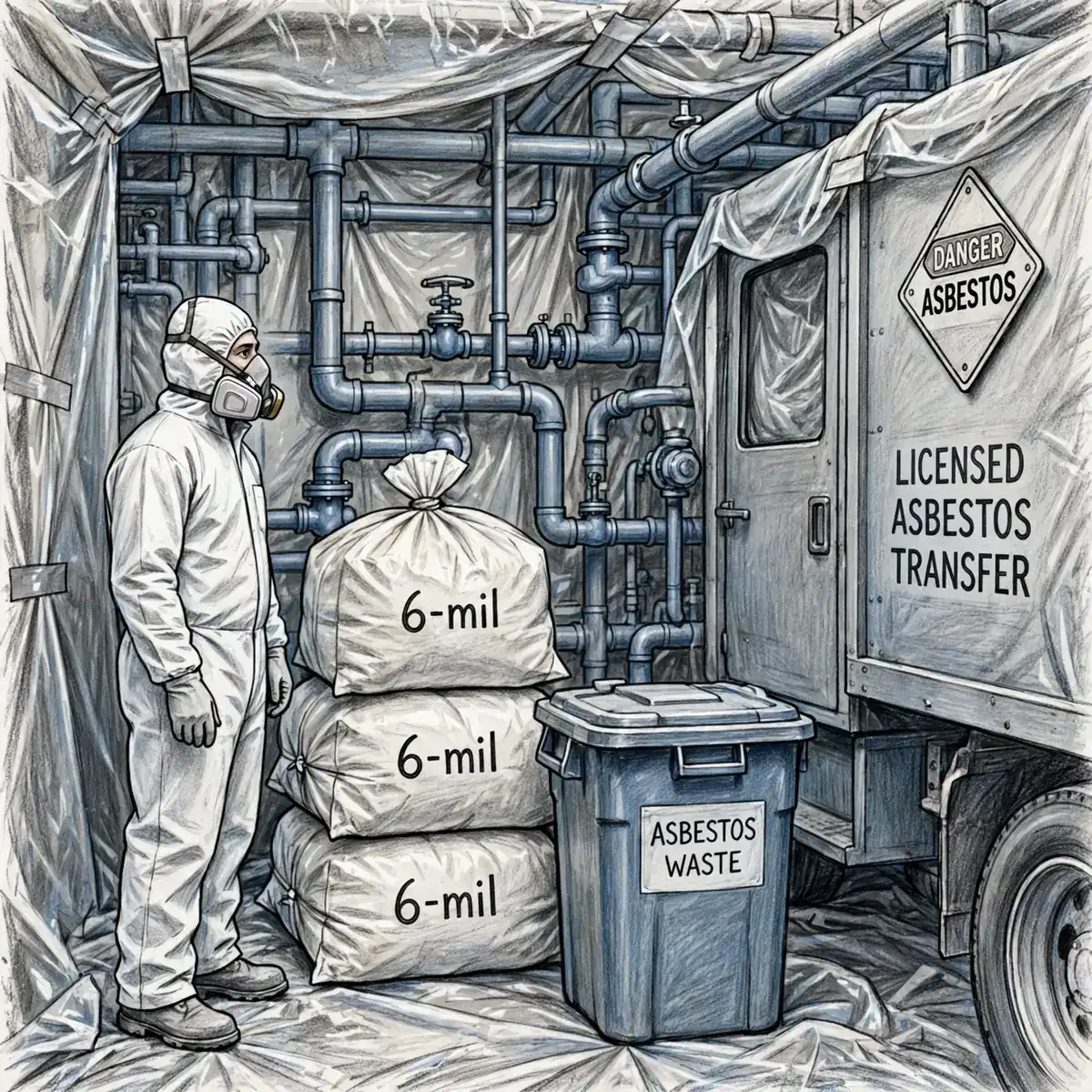
Asbestos waste is hazardous waste, and the rules follow it from the enclosure to the landfill. The material stays wet, sealed and labelled at every step. A bag that tears or a load that goes to the wrong site can undo all the care taken during removal.
In the US, the NESHAP waste rule at 40 CFR 61.150 requires leak-tight containers, warning labels, and a waste shipment record for every load. State and landfill rules add their own detail. Landfills that accept asbestos usually require the waste to be wetted and double-bagged in 6-mil plastic bags, or wrapped in two layers of 6-mil plastic for bulky items. Two 3-mil bags are not the same as one 6-mil bag.
- Wet the waste before bagging, and keep it wet until it is buried.
- Double-bag in leak-tight 6-mil plastic bags, sealing each bag separately.
- Label every bag and container with the asbestos warning and the site it came from.
- Load bags by hand at the disposal point; never throw them from a truck.
- Take the waste only to a site licensed to accept asbestos, and keep the signed waste shipment record.
Keeping the paper trail
Every load leaves a paper trail. The waste shipment record names the generator, the transporter and the disposal site, and the site signs it on receipt. The client should receive a copy, because it proves the waste went where it was supposed to go.
Keep that record with the building's asbestos register or survey. It matters at the next refurbishment, at a sale, and if anyone asks later where the material went. A contractor who cannot produce a waste receipt for the last job is a contractor to avoid.
TipAsk the contractor for the signed waste receipt before paying the final invoice. A licensed site signs on receipt, so the receipt is proof the waste arrived.
Clearance and air testing
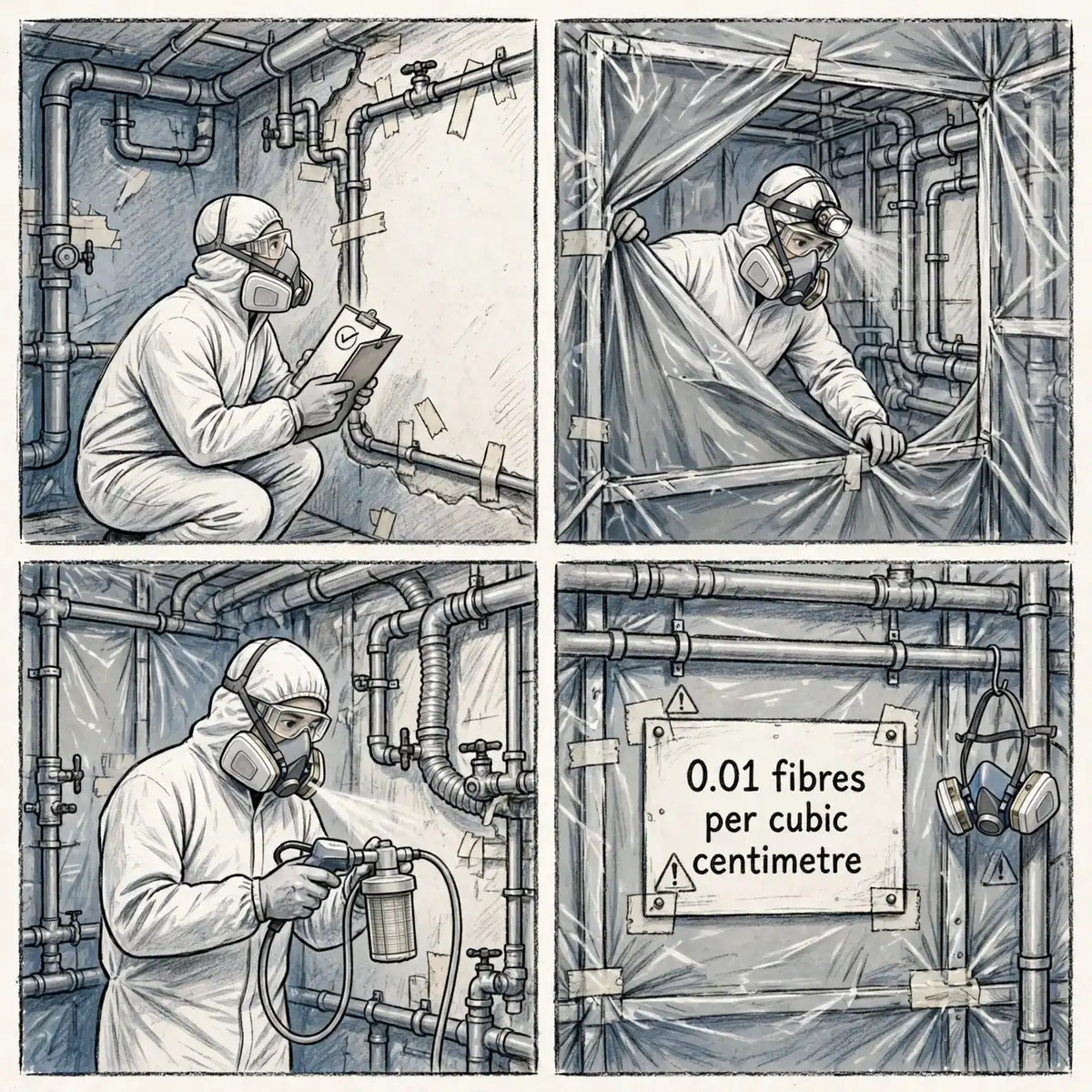
Nobody reoccupies the area until clearance testing passes. Clearance is a separate job from removal, and in the UK it must be done by an analyst from a UKAS-accredited laboratory. The analyst checks the work, inspects the enclosure, samples the air, and only then signs the area back into use.
The four-stage clearance in the UK
HSE guidance in HSG248 sets out a four-stage clearance after licensed work inside an enclosure. Each stage must pass before the next begins. The process is thorough by design: air testing alone cannot prove an area is clean.
- Check the work is complete, including the transit and waste routes out of the enclosure.
- Carry out a thorough visual inspection. No visible dust or debris may remain inside the enclosure.
- Sample the air while the air is disturbed, and compare the result with the clearance indicator of 0.01 fibres per cubic centimetre.
- Take the enclosure down and check the area again, then issue the certificate of reoccupation.
Clearance in the United States
In the US, clearance air sampling is standard practice after abatement, and the results are commonly compared with 0.01 fibres per cubic centimetre, the same figure used in the UK. Several states set that figure in their own rules, requiring each clearance sample to come in at or below 0.01 fibres per cubic centimetre when analysed by phase contrast microscopy.
Schools follow a stricter regime. Under the EPA's Asbestos Hazard Emergency Response Act, known as AHERA, clearance in schools must meet the standard in 40 CFR 763, Subpart E. That standard uses transmission electron microscopy as well as phase contrast microscopy, and the work must be done by accredited inspectors and abatement workers.
What the number means
The figure of 0.01 fibres per cubic centimetre is a clearance indicator, not a safe exposure limit. It is the level at which the laboratory method can reliably show the air is clean enough to hand the area back. It does not mean the air is free of fibres, and it must never be used as a general safe level.
There is no known safe level of asbestos exposure. That is why the workplace control limit is set as low as reasonably practicable, and why clearance is only one part of a four-stage process that starts with a visual inspection. A number on a lab report means little if dust is still visible on a ledge.
What asbestos removal costs
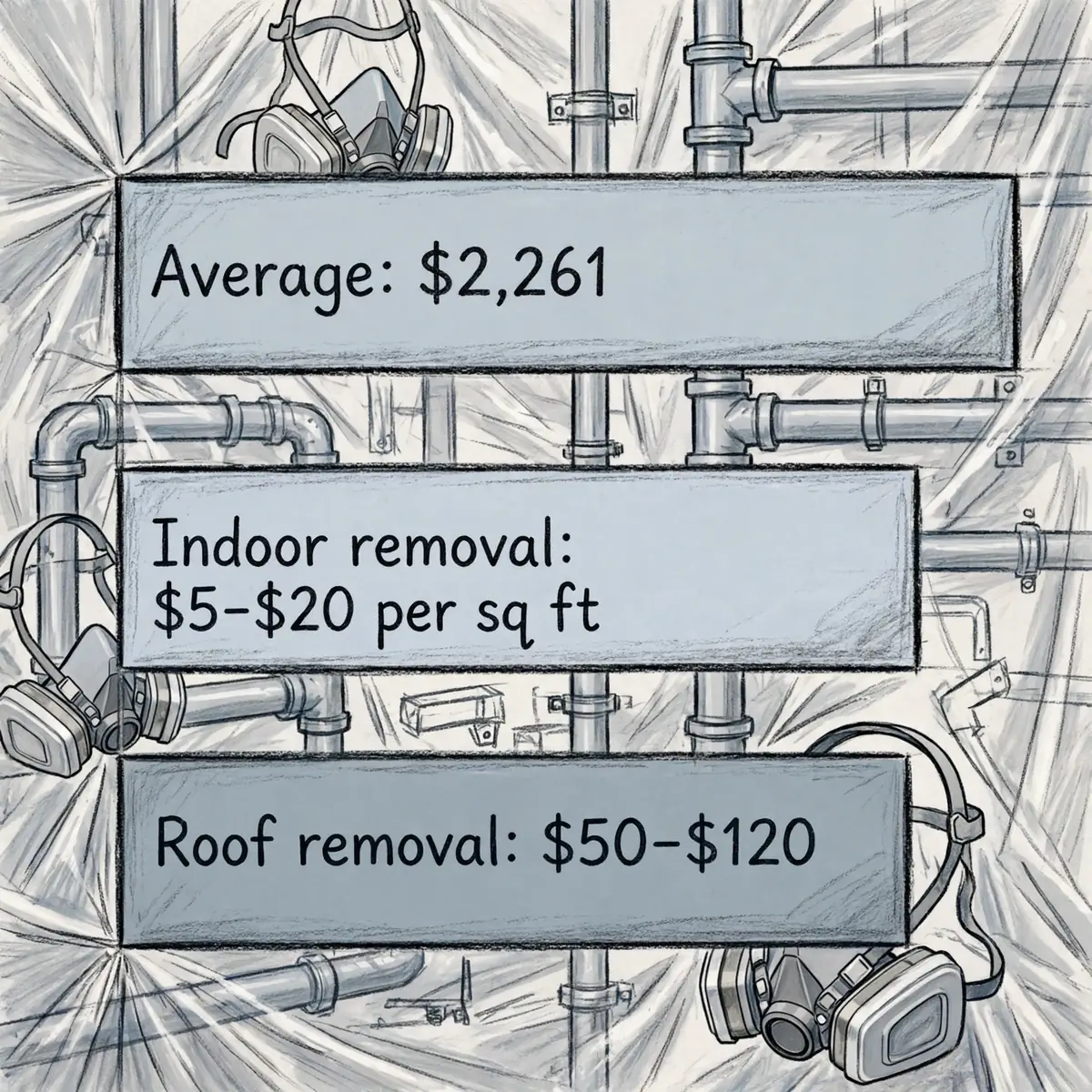
Costs vary widely by location, material and access, so the figures below are US estimates from Angi, updated 30 October 2026 and based on 3,805 verified projects. The national average for asbestos removal in 2026 was $2,261. Most homeowners paid between $1,218 and $3,304. Whole-home removal started at $5,700.
| Location of asbestos | Typical cost per square foot (US, 2026) |
|---|---|
| Indoor, general | $5–$20 |
| Walls and drywall | $8–$13.50 |
| Attic insulation | $11–$25 |
| Popcorn ceilings | $9–$20 |
| Flooring and floor tile | $5–$15 |
| Pipe insulation | $5–$15 |
| Basement | $5–$20 |
| Siding | $3–$15 |
| HVAC ducts | $35–$55 |
| Roof and shingles | $50–$120 |
Encapsulation costs $2 to $6 per square foot, which is 15% to 25% less than removal. Disposal adds about $10 to $50 per cubic yard, and permits add $50 to $100. Replacing what was removed, such as insulation or roofing, is a separate cost on top.
What drives the price up
Access is the biggest driver. A pipe run in an open basement costs far less than the same run buried behind three rooms of finished wall. Friable material, large areas, and work in confined spaces all push the price up, because they need more containment, more labour and more disposal.
- Hard-to-reach areas that need demolition before removal can start.
- Friable material that needs full containment and negative pressure.
- Large areas that need more labour, more bags and more disposal trips.
- Roofs and ductwork, where access is difficult and the work is slow.
- Remote sites, where the nearest licensed landfill is a long drive away.
Getting a fair quote
Get three written quotes from licensed firms, and compare them line by line. A proper quote covers the survey, the notification, containment, removal, disposal and clearance testing. A quote that leaves out disposal or testing is not cheaper; it is incomplete.
No verified UK cost figures were found from a primary source, so no UK prices are given here. UK readers should treat the US figures above as a guide to the cost drivers only, and get local quotes. Prices differ by region, by contractor, and by the licensed landfill the waste goes to.
NoteThe cost figures in this section are US estimates from Angi, updated 30 October 2026. They are a guide to budgeting, not a quote for any specific job.
When to call a professional
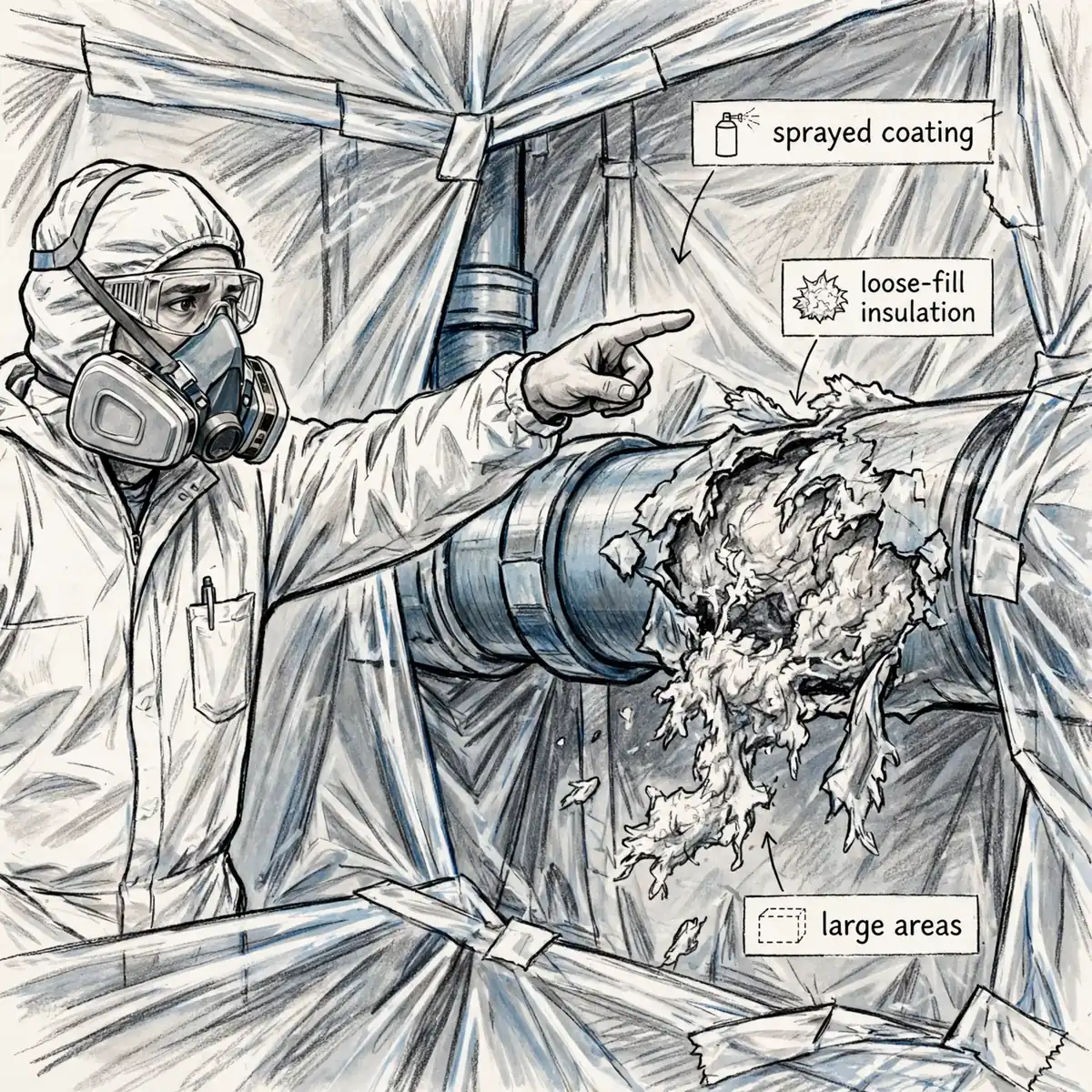
Call a professional whenever the material is damaged, the work is high-risk, or the rules say so. The cost of a survey is small against the cost of contaminating a building. If any item on the list below applies, stop and call a licensed contractor before doing anything else.
- The material is damaged, crumbling, or releasing visible dust.
- It is a sprayed coating, pipe lagging, loose-fill insulation or insulating board.
- The area is large: more than 160 square feet in the US, or more than a short-duration job in the UK.
- The building is a school, hospital or workplace with other people in it.
- Planned work will cut, drill, sand or demolish the material.
- You have no survey, no lab result, and no idea what the material is.
If you disturb material by accident
Stop work at once and leave the area. Close the doors behind you and keep everyone else out. Do not sweep, vacuum, or wipe the dust, and do not try to finish the job. Damp-wiping a small area is only for trained workers with the right equipment.
Call a licensed asbestos contractor and describe what happened. They will advise whether the area needs testing, cleaning, or full removal. If the work is part of a larger project, follow the site's emergency procedures and record what was disturbed, where, and when.
Checklist: hiring a licensed asbestos removal contractor
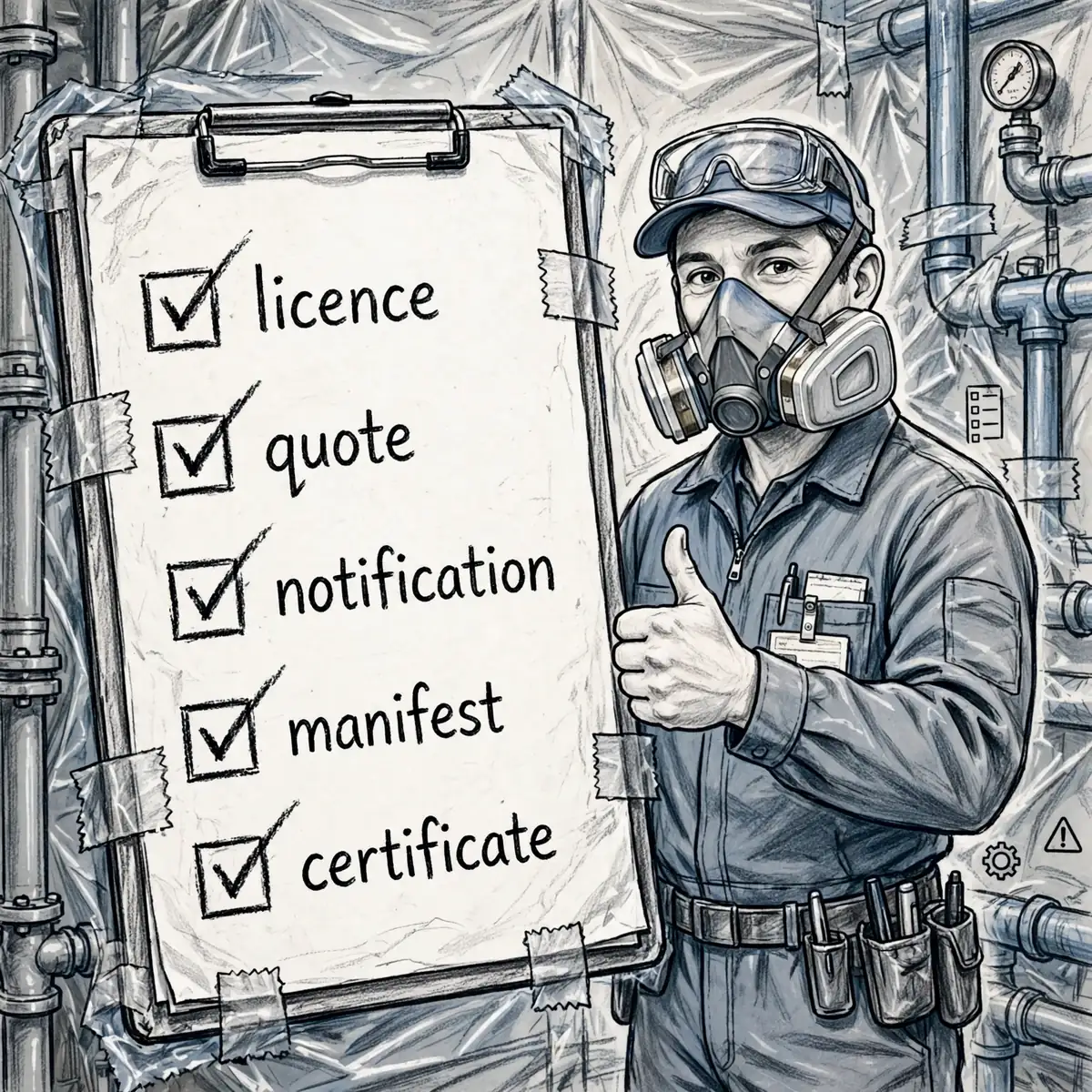
Searching for asbestos removal near me is a reasonable first step, but the search result is not the check. Run every firm through the list below before signing anything. A licensed contractor will answer every question without hesitation, and will show the paperwork to prove it.
- Check the licence: in the UK, ask for the HSE licence number and check it against the HSE list of licensed contractors. In the US, check the contractor's licence with the state asbestos programme.
- Ask for a written, itemised quote that covers the survey, notification, containment, removal, disposal and clearance testing.
- Confirm the contractor will file the notification: ASB5 in the UK, or the NESHAP notice in the US, in good time.
- Ask who does the clearance testing, and confirm the analyst is independent of the removal team.
- Agree in writing that you receive the signed waste shipment record and the certificate of reoccupation.
- Get three quotes, and be wary of any price far below the others: it usually means a step has been left out.
Frequently Asked Questions
Can I remove asbestos myself?
The EPA does not endorse homeowners removing asbestos themselves, and advises hiring a trained, accredited professional. Some US states allow a homeowner to remove a small amount from their own single-family home, but the waste must still go to a licensed facility, and friable material should never be a homeowner job.
How much does asbestos removal cost?
In the US, the national average was $2,261 in 2026, with most homeowners paying between $1,218 and $3,304, according to Angi data from 3,805 verified projects. Indoor work typically costs $5 to $20 per square foot, while roof work costs $50 to $120 per square foot. Encapsulation costs $2 to $6 per square foot.
How long does asbestos removal take?
Trade guidance puts a small job, such as removing floor tiles from one room, at one to three days, including containment, removal, cleaning and clearance testing. Larger jobs with extensive pipe insulation or fireproofing can take several weeks. The survey and the notification period come first, so the calendar time is longer than the days on site.
Is it safe to stay in the house during asbestos removal?
Occupants should leave the work area while removal is under way, and many contractors ask the household to leave the home for the day. Asbestos fibres are invisible and can stay airborne for hours, so staying out is the safe choice. Follow the contractor's advice on when it is safe to return.
What is the difference between asbestos removal and asbestos abatement?
Abatement is the wider term. It covers removal, encapsulation, enclosure and repair of asbestos material. Removal is one kind of abatement: taking the material out entirely. A contractor may recommend encapsulation or enclosure instead of removal, and that is still abatement.
Do I need a permit to remove asbestos?
In the US, a NESHAP notification must be filed at least 10 working days before demolition, or before a renovation that disturbs more than 260 linear feet, 160 square feet or 35 cubic feet of regulated material. In the UK, licensable work must be notified at least 14 days ahead on the ASB5 form. Local rules may add permits on top, so check with the local authority.
How do I know the area is safe after asbestos removal?
The area is safe to reoccupy only after clearance testing passes. In the UK, that means the four-stage clearance in HSG248, including a visual inspection and air sampling below the clearance indicator of 0.01 fibres per cubic centimetre. Ask for the certificate of reoccupation before using the room again.
Sources
- OSHA — 29 CFR 1926.1101, Asbestos (construction)
- OSHA — 29 CFR 1910.1001, Asbestos (general industry)
- EPA — 40 CFR 61.145, Standard for demolition and renovation (NESHAP)
- EPA — Asbestos in older homes: additional information for homeowners
- The Control of Asbestos Regulations 2012 (legislation.gov.uk)
- HSE — Licensable work with asbestos
- HSE — HSG247, Asbestos: The licensed contractors' guide
- Angi — How Much Does Asbestos Removal Cost? [2026 Data]
- U.S. Waste Industries — Asbestos Abatement & Removal