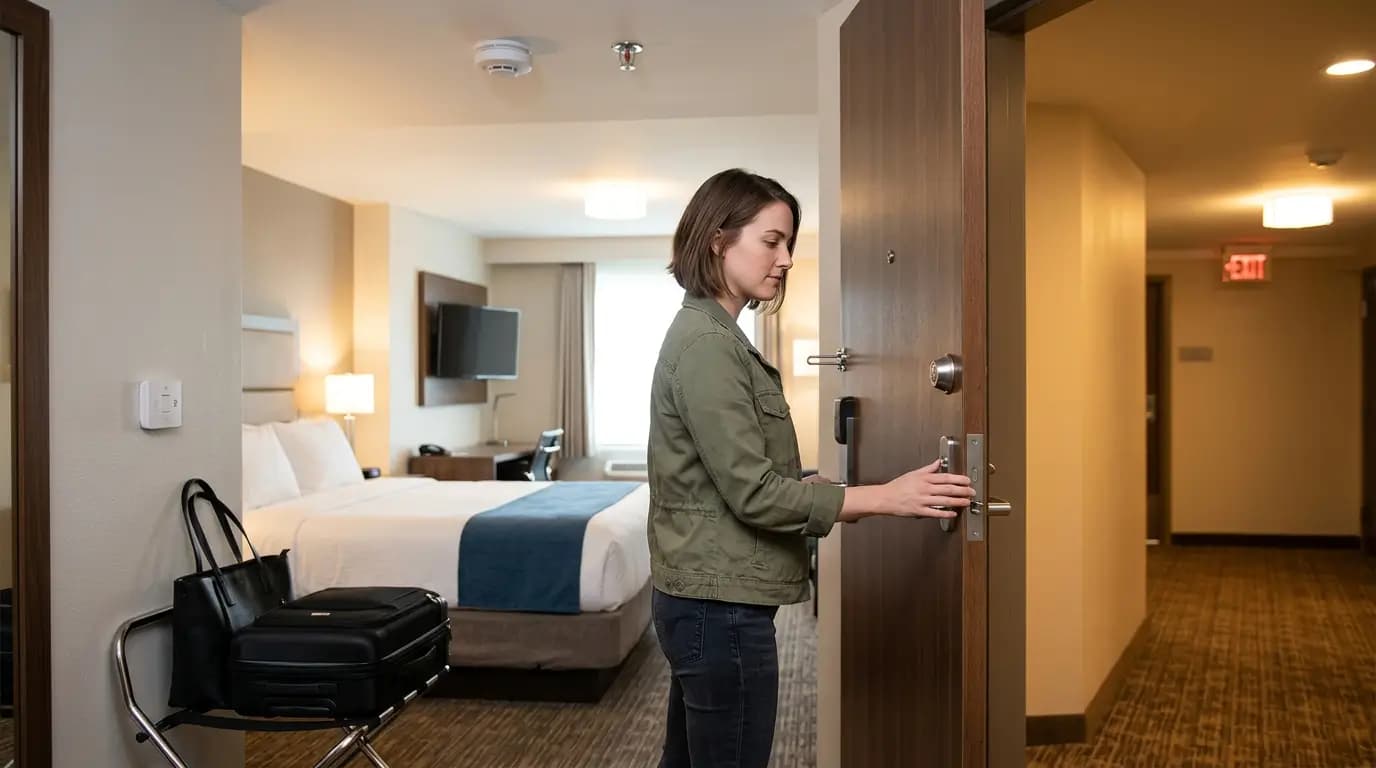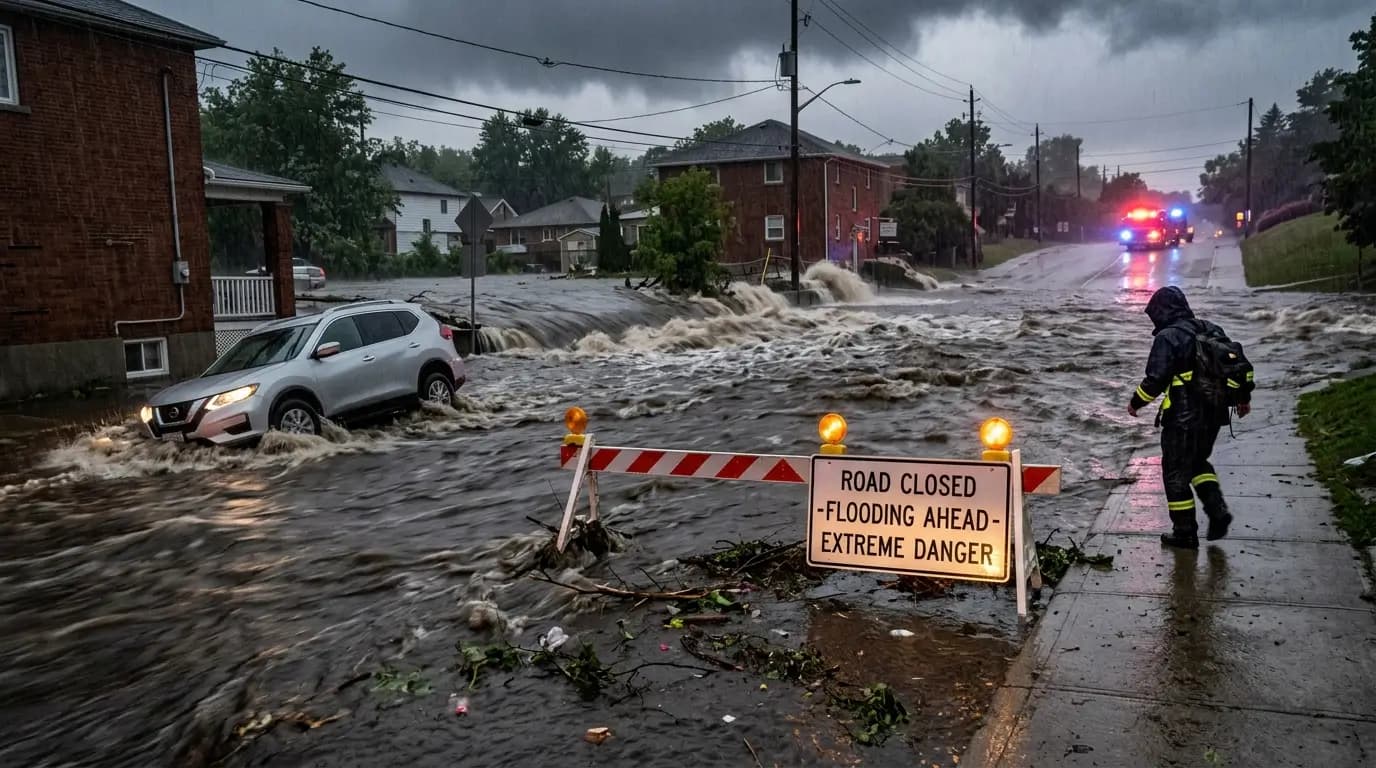


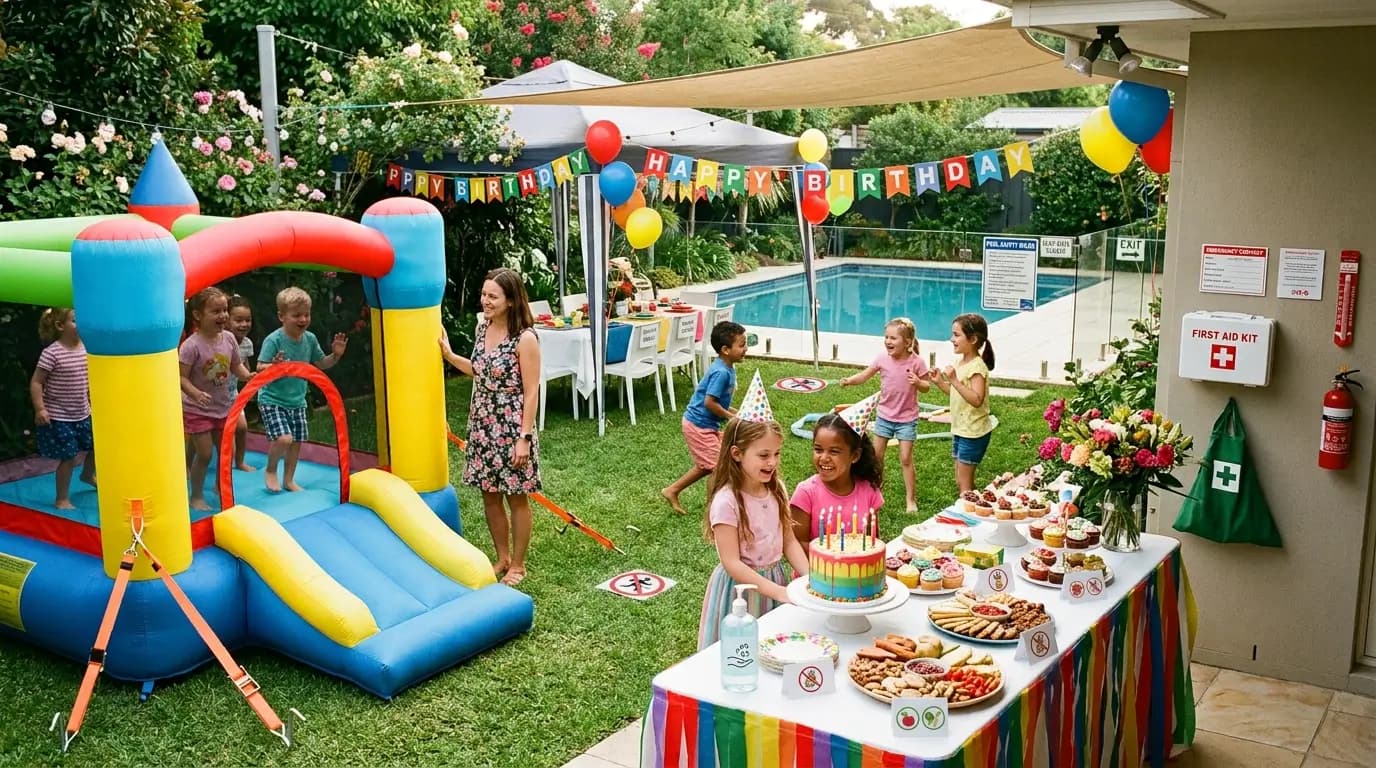
Most birthday party injuries are grazed knees, a bumped head on a table corner, someone crying over a broken toy. Those are not the ones to plan for. A small number of party hazards can kill a child in under five minutes, and they are not the ones that look dangerous — they are water, airway obstruction, wind under an inflatable, and a battery the size of a coin.
That distinction should decide where your attention goes. My work is fire life safety and emergency response assurance: for fifteen years across fourteen countries I have audited whether controls still function in crowded, noisy, distracting spaces. A garden with twenty over-excited children is a crowded, noisy, distracting space. The failure patterns are the same ones I write up on industrial sites, and so are the fixes.
These twelve tips are ordered by consequence, not by the order things happen at a party.
Key takeaways
The six points that change how a party is planned, before the detail:
- Supervision fails at transitions, not during activities. Most lapses happen when the group moves — outside to inside, pool to cake table. Count heads at every move.
- Inflatables have a hard numerical wind limit. UK guidance says no inflatable above 24 mph (Force 5); the US standard sets 15 mph as the default operating ceiling where the manufacturer gives none. Judging by eye is not a method.
- Uninflated and burst balloons are the hazard, not inflated ones. CPSC data makes balloons the leading children's-product suffocation cause, and the mandatory warning covers children under eight — not under three.
- A swallowed button battery can burn through a child's oesophagus in about two hours. Party favours, light-up decorations and musical cards all contain them.
- The AAP's 2010 choking policy statement was retired in June 2026. Articles still citing it are citing a withdrawn document; the Academy's consumer guidance remains current.
- One adult should have no hosting job at all. Everyone with a task is a person who cannot respond.
Sort the hazards by how badly they end
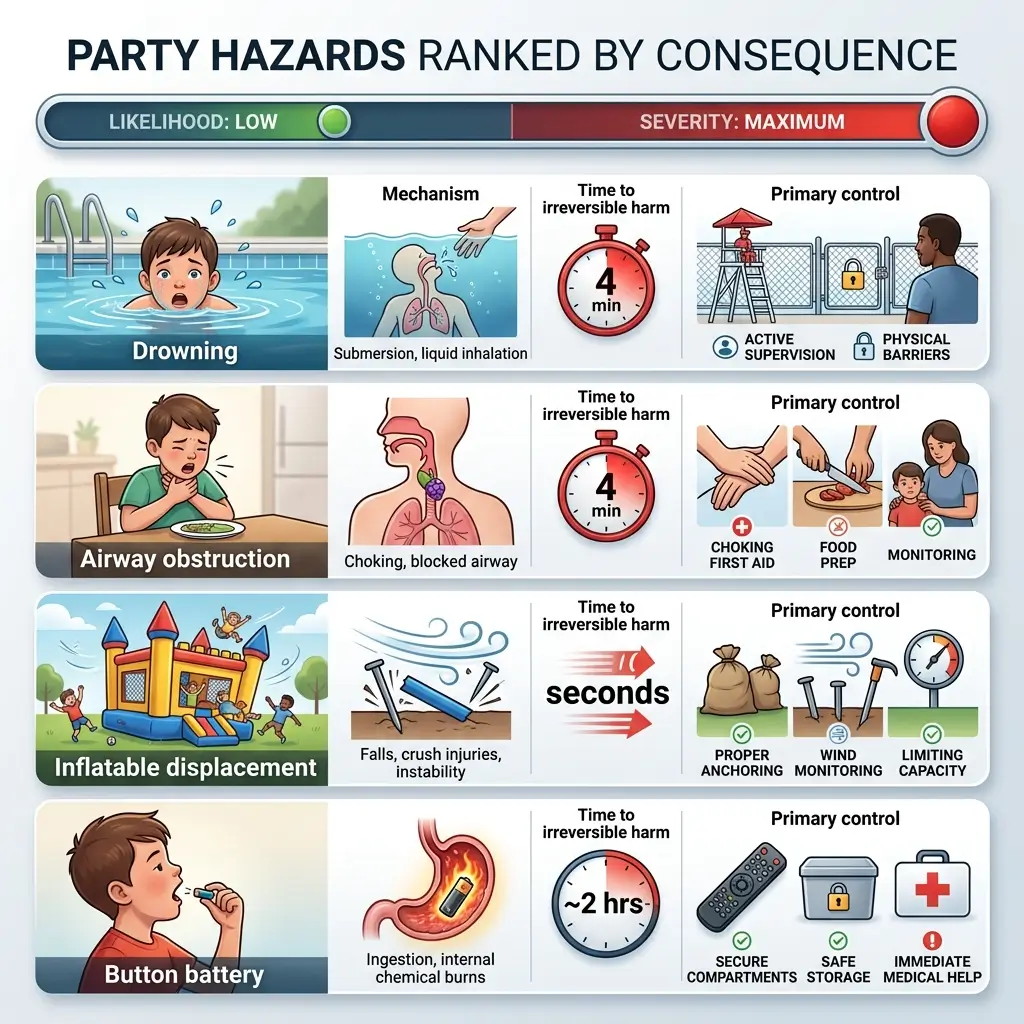
Before the twelve tips, it is worth being explicit about why they are in this order. Risk is severity multiplied by likelihood, and party planning almost always over-weights likelihood. Grazes are near-certain and trivial. Drowning is rare and final. Effort should follow the second column, not the first.
The four life-threatening mechanisms at a children's party, with the time you have to intervene:
| Mechanism | How fast it becomes irreversible | What prevents it |
|---|---|---|
| Drowning | Brain injury from roughly 4 minutes; silent, no splashing | Named, undistracted supervisor; physical barrier |
| Airway obstruction | Same window — 4 minutes without oxygen can cause brain damage or death; the child cannot call out | Food shape control; balloon control; trained adult present |
| Inflatable displacement in wind | Seconds, once the anchoring is overcome | Measured wind speed; every anchor point loaded |
| Button battery ingestion | Tissue burn begins within about 2 hours | Battery compartments secured; immediate hospital transfer |
Everything else on the list — burns, falls, cuts, food poisoning — matters, but it does not have this shape. Read the rest of this article knowing that the first seven tips address the four mechanisms above.
Water: the failure is always about who was watching
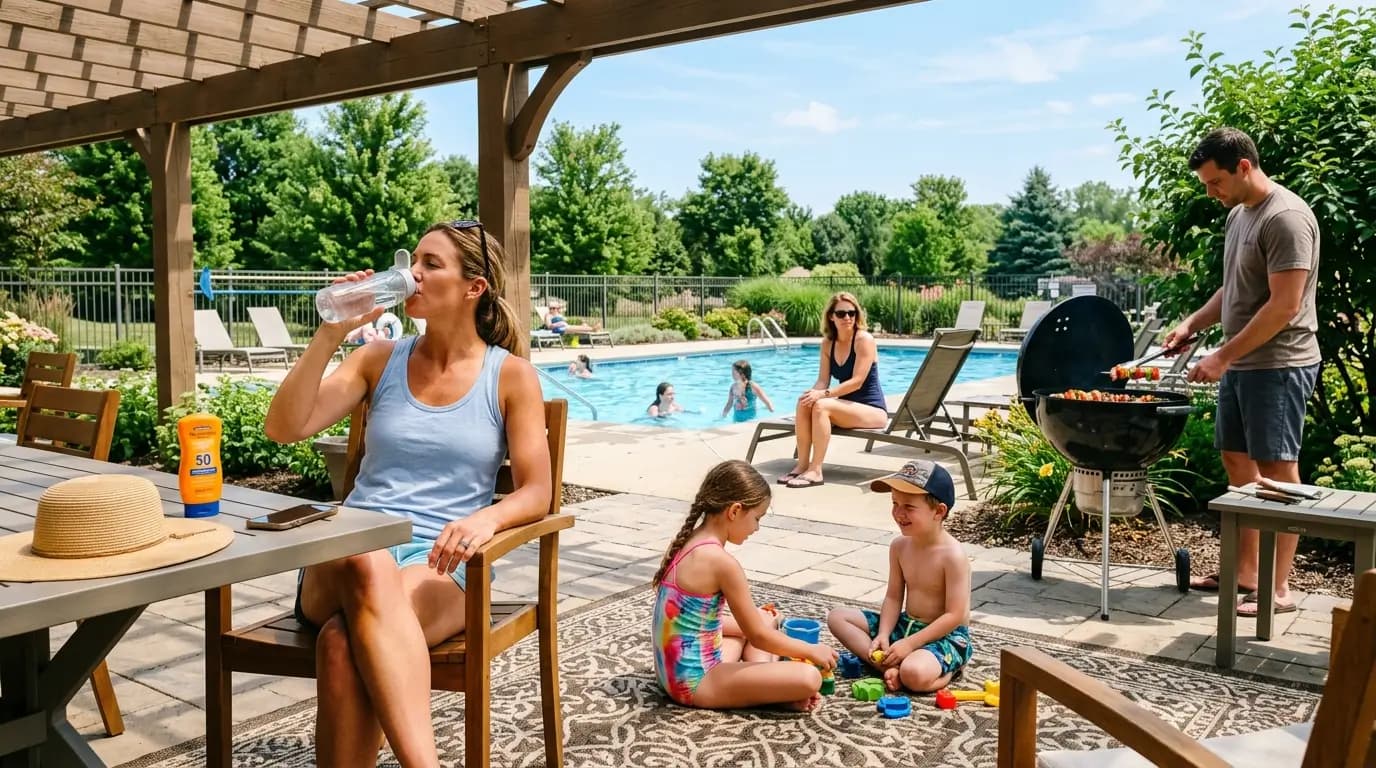
Drowning is the hazard where the gap between what people believe and what happens is widest. Parents picture thrashing and shouting. Drowning is quiet, and at a party the ambient noise is the reason nobody hears anything — because there is nothing to hear.
The American Academy of Pediatrics technical report on drowning prevention reported 981 US children under twenty dying from drowning in 2023, and identifies pool parties and gatherings specifically as the setting where supervision breaks down, because with several adults present each assumes another is watching.That is diffusion of responsibility, and it is the same mechanism behind every muster failure I have investigated.
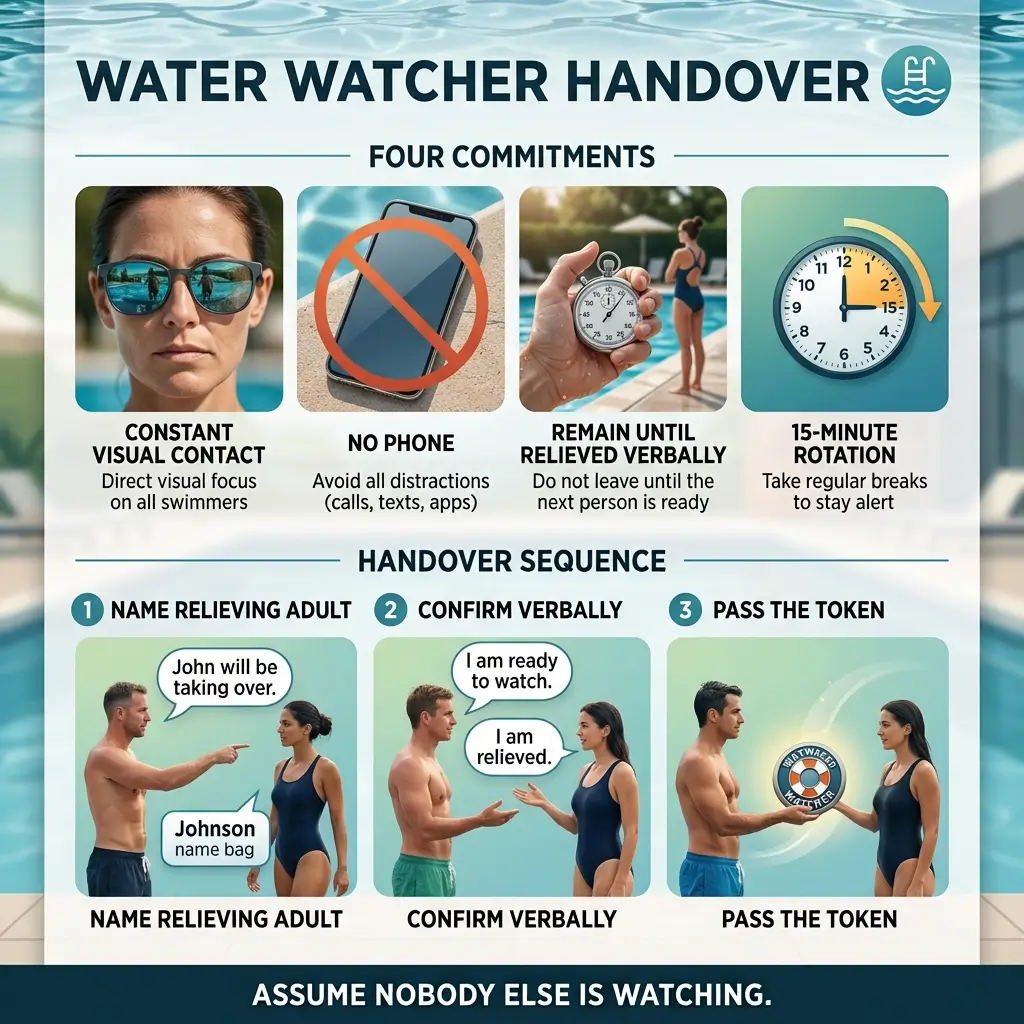
1. Name one water watcher, out loud, and rotate them
The role means a single adult who agrees to supervise constantly with no competing activity — no phone, no conversation, no drink — and who hands over on a fixed rotation, commonly every fifteen minutes, because attention degrades. The handover must be explicit and verbal. "I'm taking over" is the control; a vague sense that someone is near the pool is not.
Make the role visible. A physical token — a lanyard, a badge, a hat — does the same job as a permit-to-work signature: it makes accountability something you can see across a garden rather than something you assume.
The checks worth running before guests arrive:
- The barrier works — gates self-close and self-latch, and nothing is propped or wedged open for convenience
- The watcher can swim and knows how to call emergency services from that address
- Buckets, paddling pools and water features are emptied when not in use, not just covered
- Someone present holds current CPR competence — and you know who, by name, before you need them
2. Count heads at every transition
This is the tip competitors miss entirely, and it is the one from my own trade.
Auditing a chemical store operation in Indonesia for Honeywell, I found a muster headcount that failed at contractor peak — the count worked at normal staffing and collapsed exactly when the population was largest and most mixed. I stopped the pattern and had it re-run before restart. The lesson transferred well beyond that site: an accountability system that has never been tested at full population is not an accountability system.
A birthday party is a workplace at contractor peak. Adults and children mixing, a population that changes as guests arrive, and no register. The moment supervision fails is not during the swimming — it is when the group moves indoors for cake and everyone assumes the garden is now empty.
Count before every move. Count the children by name, not by scanning the group and getting a number that feels right.
Inflatables: the one hazard with a published number
Bounce houses are where the consumer advice is weakest and the engineering standards are clearest. Every competitor article says "rent from a reputable company." None of them tells you what to check.
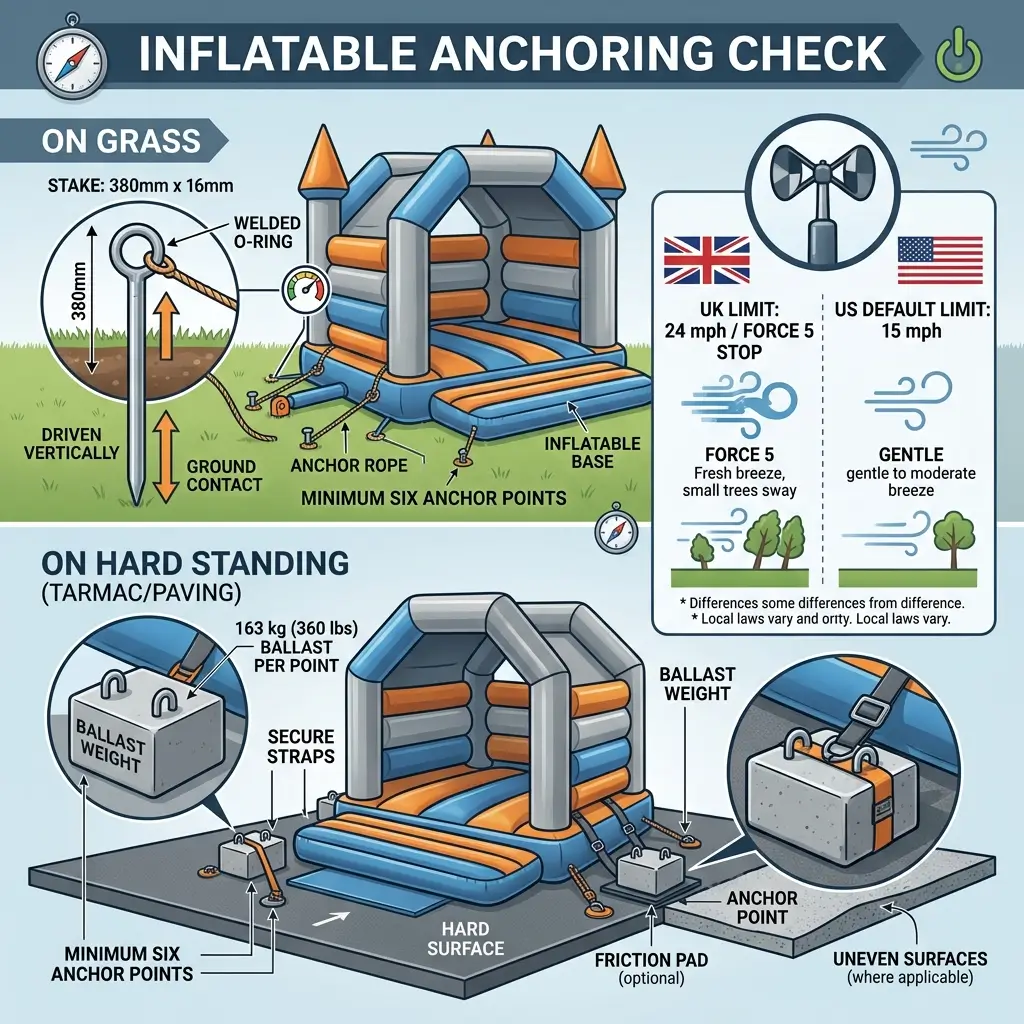
Two standards govern these devices.In the United States, ASTM F2374 requires the design to assume a maximum allowed operational wind speed of at least 25 mph with the highest sustained gusts over a three-second period— a design figure, not a permission to operate in 25 mph wind. Where the manufacturer specifies no operational limit, the standard requires the operator to adopt 15 mph as the default maximum or obtain an engineering analysis setting another.HSE guidance on bouncy castles is a single hard line: no inflatable should be used in winds above 24 mph, Force 5 on the Beaufort Scale, and some have a lower limit set by the manufacturer.
| Requirement | United States (ASTM F2374) | United Kingdom / EU (BS EN 14960, HSE) |
|---|---|---|
| Design wind speed | At least 25 mph, 3-second gust | Per EN 14960, Beaufort scale in Annex B |
| Operating limit | Manufacturer's figure; 15 mph default if none given | mph (Force 5) maximum; lower if specified |
| Minimum anchor points | Minimum of four | At least six |
| Ground stakes | Per design specification | At least 380 mm long, 16 mm wide, rounded top, welded O or D ring |
| Where stakes can't be used | Engineered ballast | Ballast of at least 163 kg per point with suitable fixings |
| Certification to ask for | Manufacturer compliance documentation | Numbered PIPA tag or ADiPS declaration of compliance |
3. Measure the wind — do not assess it by looking
On an egress integrity assignment for Chubb in Australia, I found a weather limit exceeded on a critical lift. The limit was written down. The crew judged conditions by eye, decided it looked acceptable, and proceeded. I stopped it and required the reading before restart.
That is precisely how inflatables come loose. Nobody decides to operate a bounce house in dangerous wind; someone looks at the trees, decides it is fine, and is wrong by six miles per hour. HSE is unambiguous that an anemometer should be used at regular intervals, and that if one is not available the inflatable should not be operated at all.A handheld meter costs less than the cake.
Do not substitute a weather app. It reports conditions for your region, not the funnel between your house and the neighbour's fence.
4. Verify the anchoring yourself, after setup
Anchoring is where installation shortcuts hide, and it is checkable in ninety seconds without any expertise:
- Count the anchor points and count the stakes. Every anchor point must be used — the operator manual states how many there should be, and they must not have been removed. Partial anchoring is not partial protection.
- Check the stakes are driven fully and vertically, not angled for convenience into hard ground.
- On tarmac or a hard surface, ask what the ballast weighs. The UK figure is at least 163 kg per anchor point. A few sandbags do not reach it.
- Ask to see the tag. A numbered PIPA tag or ADiPS declaration of compliance shows the device has been tested by a competent inspection body. A company that cannot produce one has told you something important.
- Confirm who is supervising it, for how long, and what the user limit is.
Airway: shape matters more than size
Three separate hazards share one mechanism — something conforms to a child's airway and seals it. The child cannot cough, cannot speak, and cannot signal.
5. Treat uninflated and burst balloons as the hazard
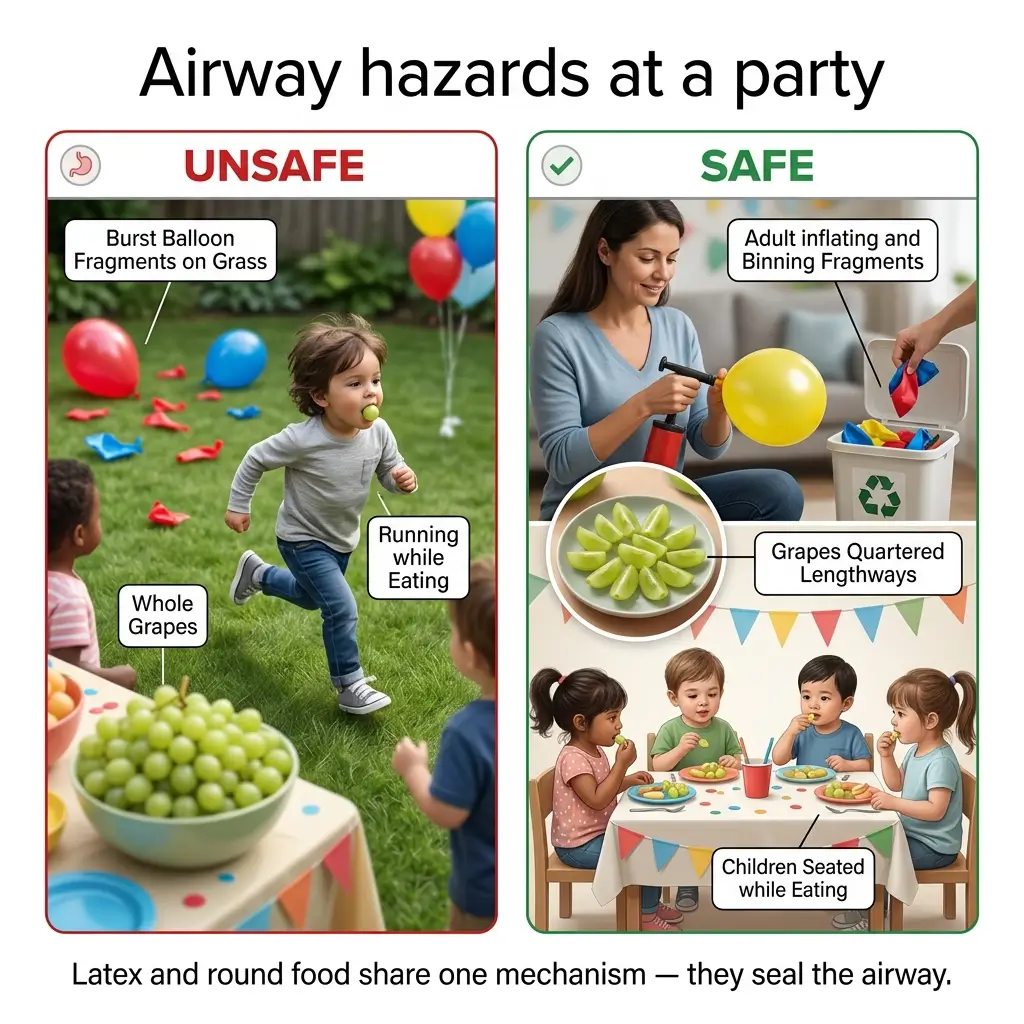
This surprises people every time. CPSC injury data makes balloons the leading cause of suffocation death among children's products, and the two mechanisms are a child drawing an uninflated balloon into the mouth while trying to blow it up, and pieces of a burst balloon being inhaled. Latex conforms to the airway and forms a seal that is very difficult to clear.
The mandatory US warning under 16 CFR 1500.19 covers children under eight years old — not under three, which is the threshold most parents assume applies. The AAP states the same thing plainly: balloons pose a choking risk to children up to eight years of age. Practically: an adult inflates, burst balloons are collected immediately rather than at the end, and the spares bag stays out of reach.
6. Control food shape, and stop children eating while moving
The current evidence has not changed, but the citation has. The AAP's 2010 policy statement on choking prevention, which nearly every article on this topic still references, was retired in June 2026.The Academy's consumer guidance remains live and current.
Its current choking prevention guidance advises keeping high-risk foods from children until at least four years of age depending on the individual child's development, and notes that round, firm foods such as hot dogs or grapes can be served if chopped into small pieces.The high-risk group includes hard candy, nuts, seeds, whole grapes, raw carrots, apples, popcorn, chunks of peanut butter, marshmallows, chewing gum and sausages — foods that share physical characteristics making them effective plugs for a young airway.
Two numbers make this actionable at a party. Cut food for young children into pieces no larger than half an inch, and insist they eat sitting down — never running, walking, playing or lying down with food in their mouths. Party games and food should not overlap in time.
There is a second-order risk worth naming, because it is common at mixed-age parties: many choking incidents happen when older siblings hand dangerous foods, toys or small objects to a younger child. The seven-year-old sharing their sweets with the two-year-old is acting kindly and creating the hazard.
7. Run an allergen plan, not an allergen question
Asking parents at the door whether anyone has allergies is not a plan. A plan means knowing, before the day, which child has what, and having an agreed response.
UK and European regulators recommend that people at risk of anaphylaxis be prescribed two adrenaline auto-injectors and carry them at all times, because some reactions need more than one dose and devices can be used incorrectly or misfire.If a guest has that prescription, the devices come to the party with them.
The arrangements to confirm in advance:
- Which named adult holds or knows the location of each child's device — not "it's in a bag somewhere"
- Whether that adult has been shown how to use it by the parent, on the day
- Where the allergen-free food is kept, physically separated, with serving utensils that do not cross over
- That the emergency response is call an ambulance immediately after administration, because of the risk of a second-phase reaction
Fire and escape: my own trade, applied to your living room
NFPA data for 2020 to 2024 records an annual average of 835 US home structure fires beginning with decorations, excluding Christmas trees, causing three civilian deaths, 29 injuries and $18 million in property damage — and nearly half, 47 percent, started because decorations were too close to a heat source such as a candle.
8. Keep the candle moment short and bounded
The candles are lit for perhaps ninety seconds. In that window there is an open flame at child height, long hair leaning over it, and paper decorations within reach. Bound it deliberately: tie hair back, clear a radius around the cake, light the candles at the table rather than carrying a lit cake through a crowd, and confirm every candle is out before the cake is cut. For very young children, battery candles remove the hazard entirely without removing the moment.
9. Keep the escape route clear — this is where parties fail
Egress integrity is my specialism, and it is the finding I write up most often across the 180-plus workplaces I have inspected: exits that are technically present and practically unusable.
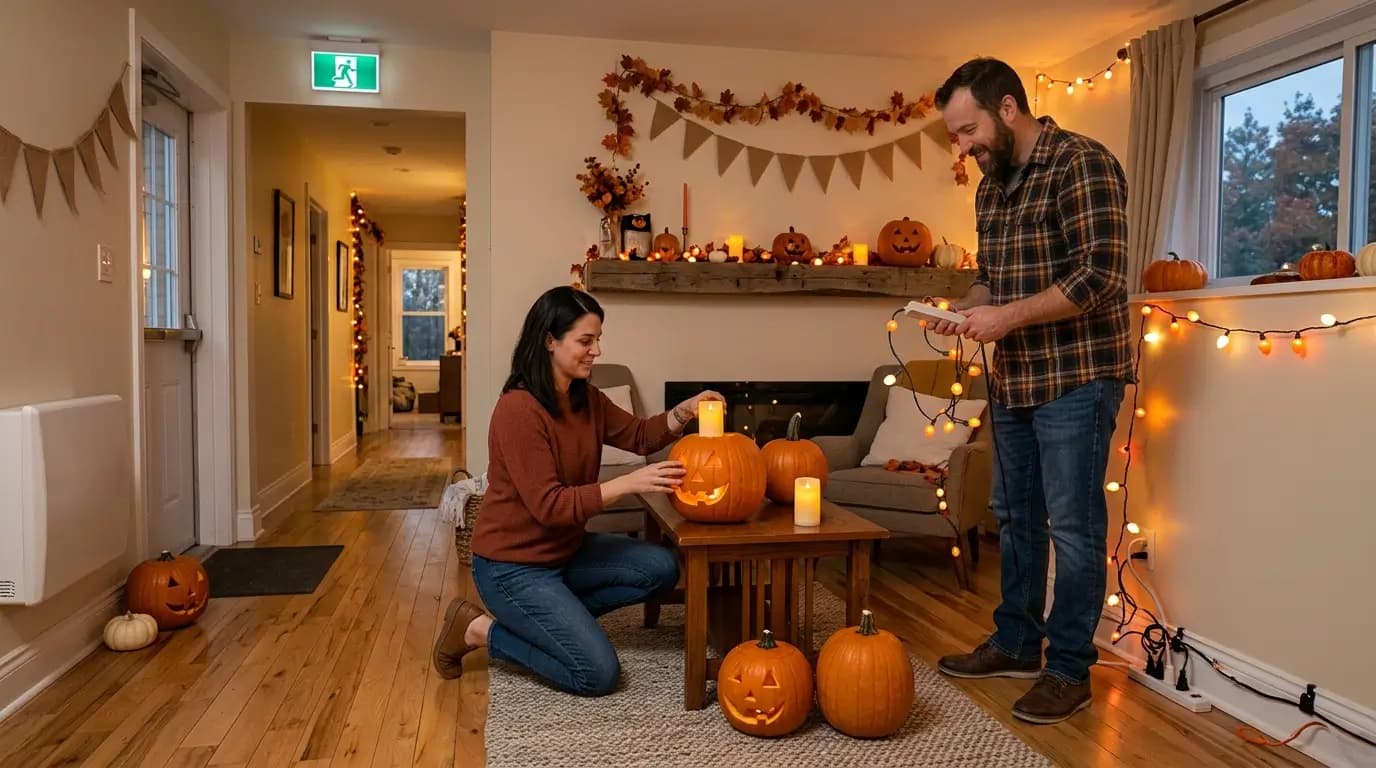
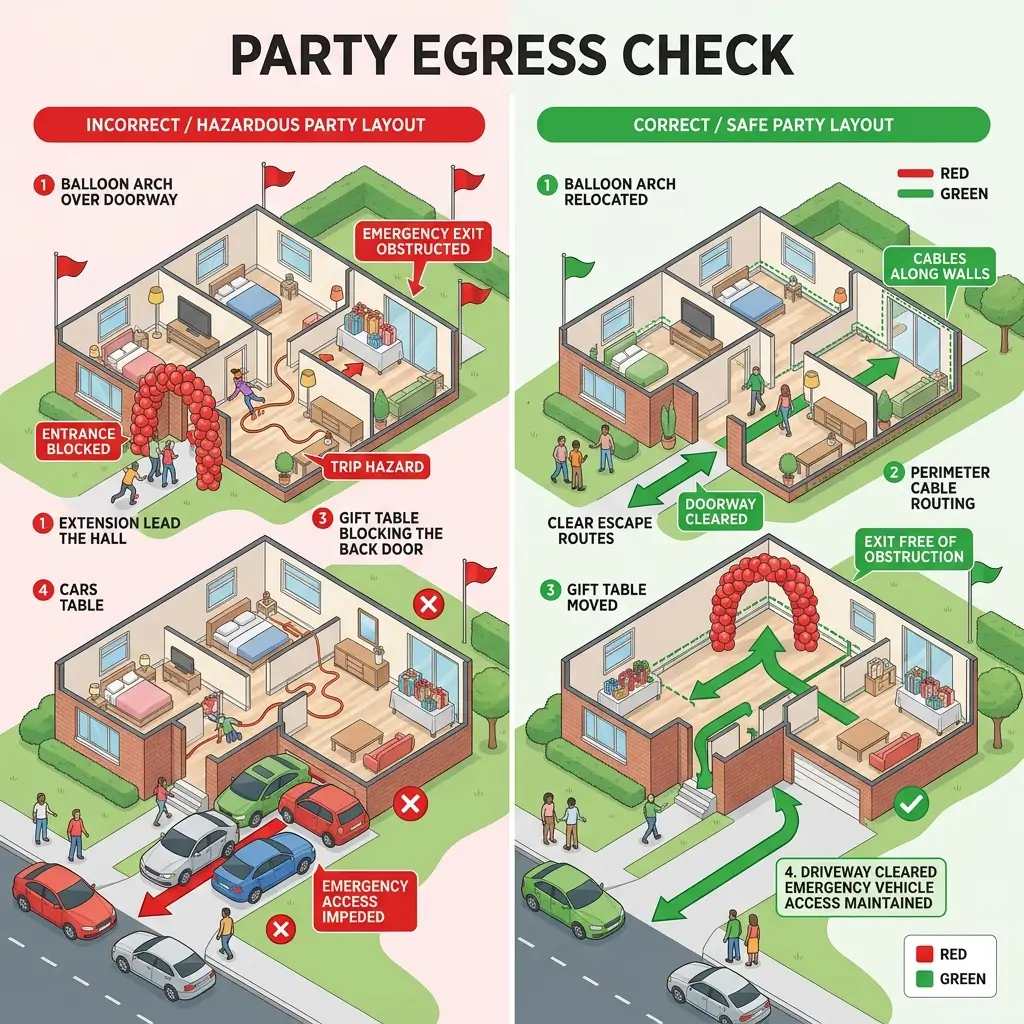
Parties create the exact conditions. Balloon arches across doorways. An extension lead for the music running through a hall. A gift table in front of the back door. Chairs narrowing a corridor. Each is individually reasonable and collectively means that in a fire, twenty children are funnelling toward a door that opens onto an obstruction.
Walk your own escape route before guests arrive, at child height, and check that:
- Every external door opens fully and is not blocked by furniture, gifts or catering
- Cables cross doorways nowhere — route them around the room perimeter and tape them down
- Decorations hang clear of doorways and away from lights, heaters and candles
- The driveway stays clear for an ambulance, which means telling guests where to park before they arrive
That last point comes from a finding I raised at Wormald in Brisbane, where equipment staged across an emergency access route had made the site unreachable by emergency vehicles. Nobody had made a decision to block it; things simply accumulated there. A driveway full of guest cars is the same failure with the same consequence: the response you called for cannot reach you.
The two hazards nobody plans for
10. Account for the button batteries
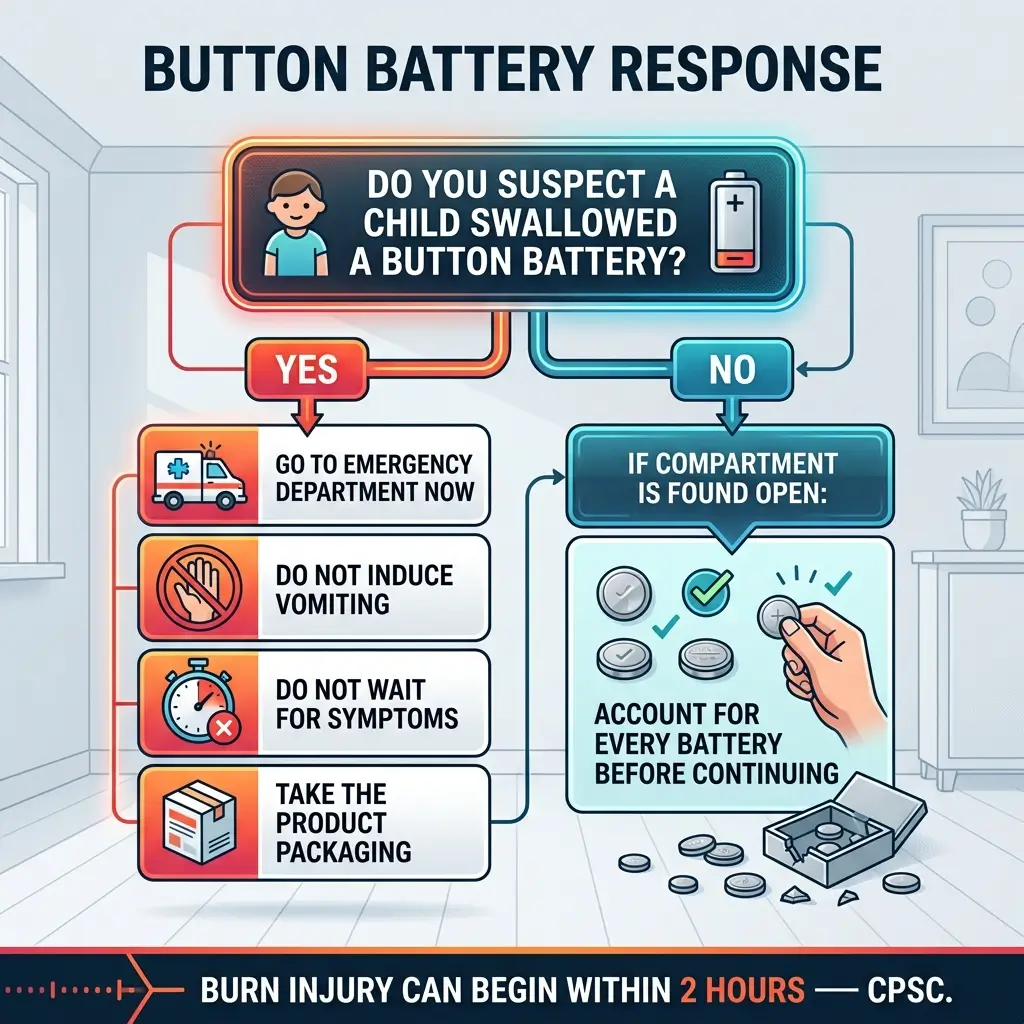
Coin cells are in light-up decorations, musical cards, remote-controlled favours, novelty badges and cheap toys handed out in party bags. CPSC states these batteries can burn through a child's throat or oesophagus in as little as two hours if swallowed, and recorded 27 deaths and an estimated 54,300 emergency room injuries associated with ingested or inserted button cells between 2011 and 2021.
Reese's Law, enacted in August 2022, made ANSI/UL 4200A a mandatory standard for consumer products containing these batteries, with child-resistant battery compartments and warning labelling. Products bought cheaply through overseas marketplaces frequently do not comply.
Two rules: check that any battery compartment in a favour or decoration needs a tool to open, and if you suspect a child has swallowed one, go to an emergency department immediately. Do not wait for symptoms and do not induce vomiting.
11. Plan arrival and departure as carefully as the party
The riskiest fifteen minutes are at each end, when the population is changing, adults are distracted by greetings, and the front door is open. Agree in advance which children are being collected by whom, and do not release a child to an adult you have not confirmed with their parent. Confirm collection times so no child is left waiting. If you are driving guests home, seat belts and appropriate child restraints are not optional courtesy items.
12. Keep one adult completely un-tasked
This is the tip that makes the other eleven work, and it is the one I would keep if I could only keep one.
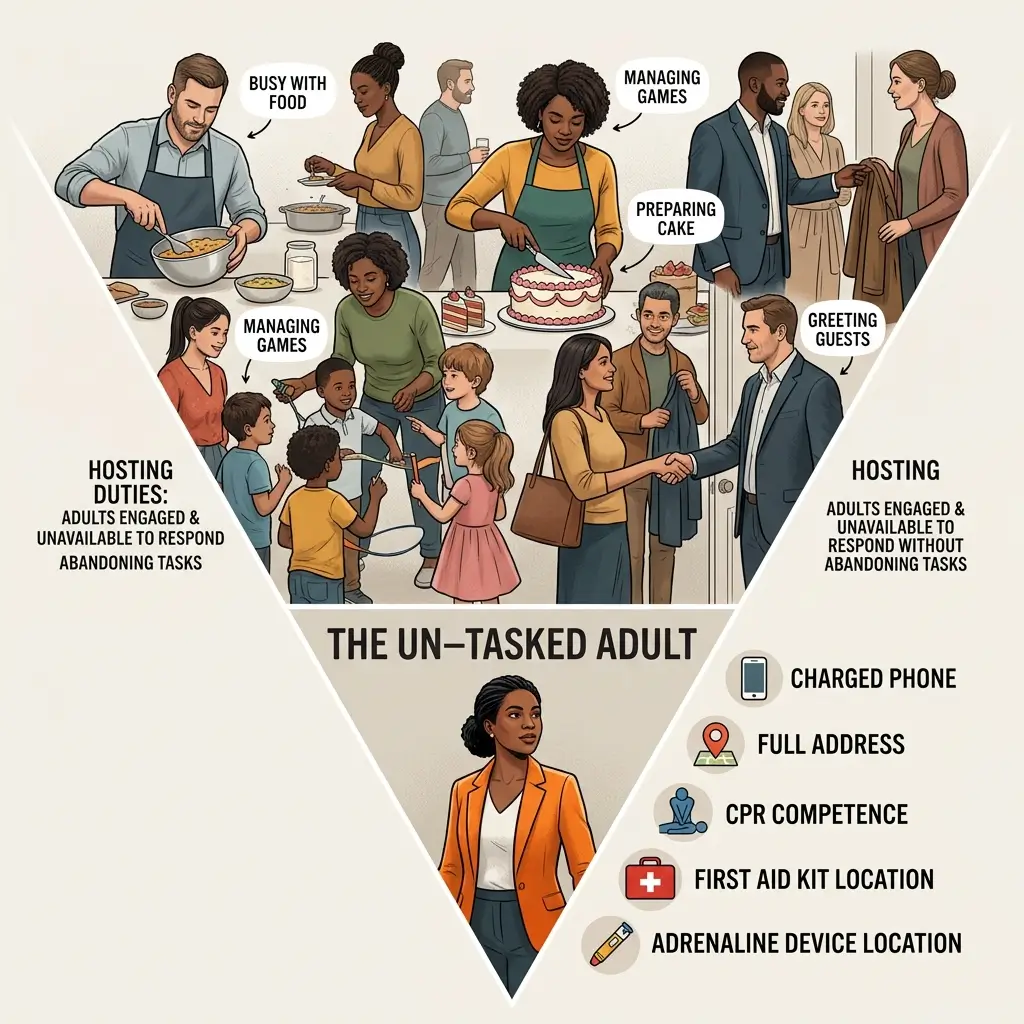
Every adult at a party has a job. Someone is serving food, someone is running games, someone is managing the cake, someone is talking to a guest they have not seen in a year. An adult with a job is an adult who cannot respond, because responding means abandoning the job at the exact moment they are needed.
In emergency response planning we do not staff to normal conditions; we staff so that the response still functions when everything is happening at once. Designate one adult who is hosting nothing. They carry a charged phone, they know the full address including any access notes for an ambulance, they hold current CPR competence if anyone present does, and they know where the first aid kit and any adrenaline devices are. If nothing goes wrong, they had a pleasant afternoon. If something does, they are the difference between a four-minute response and a fourteen-minute one.
The un-tasked adult carries five things and holds no hosting job:
- A charged phone, on their person rather than on a table
- The full address, including gate codes or access notes for an ambulance
- Current CPR competence, if anyone present holds it
- Knowledge of where the first aid kit is — not a guess
- Knowledge of where any adrenaline devices are, and whose they are
The first sixty seconds
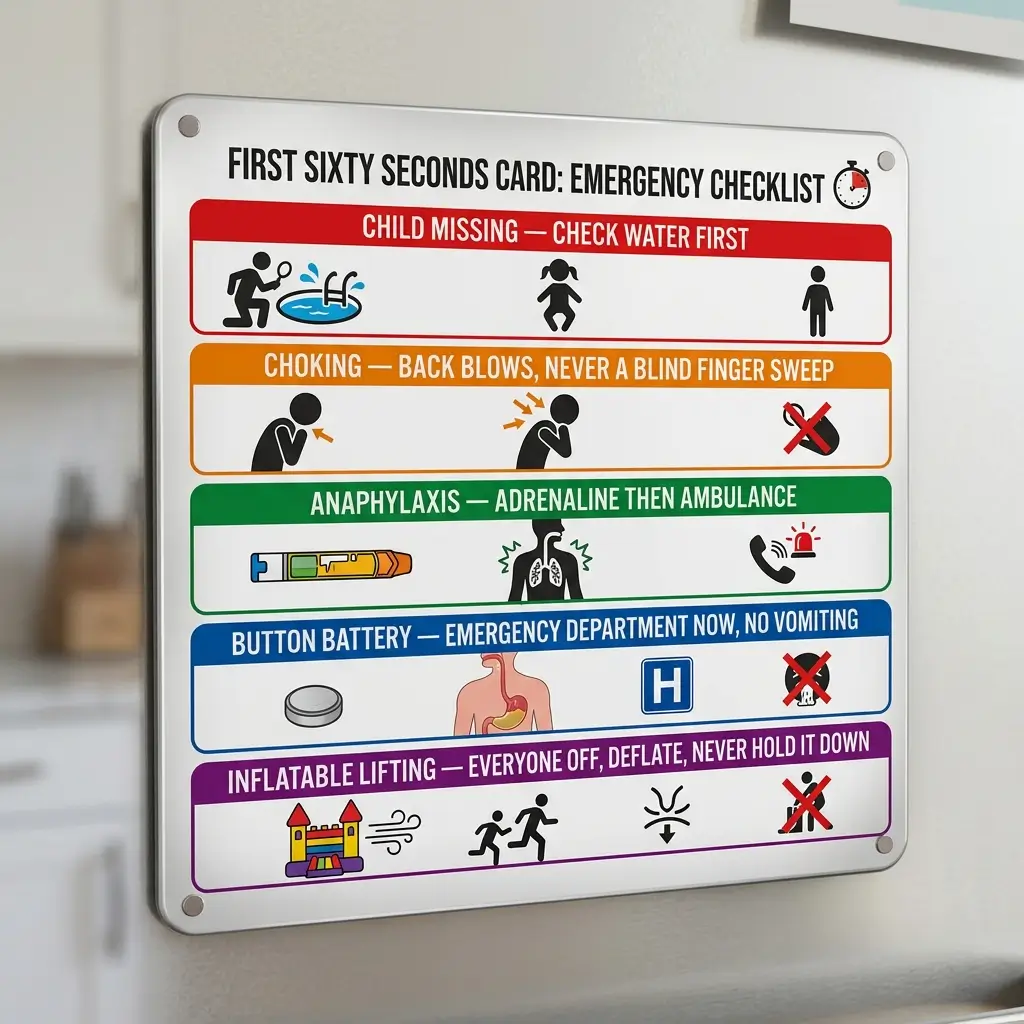
If something goes wrong, the useful actions are short and specific. This is worth reading once before the party rather than for the first time during it.
| Situation | First action | Do not |
|---|---|---|
| Child missing | Check water first, every time, before searching the house | Assume they went inside |
| Child choking, cannot cough or speak | Call for help and begin back blows immediately | Put fingers in the mouth to sweep blindly |
| Suspected anaphylaxis | Administer adrenaline, then call an ambulance immediately | Wait to see whether symptoms worsen |
| Suspected button battery ingestion | Go to an emergency department now, take the product | Induce vomiting or wait for symptoms |
| Inflatable moving or lifting in wind | Get everyone off and deflate | Try to hold it down |
None of these replaces training. If you host children regularly, a paediatric first aid course is a few hours and changes what you are able to do in exactly these sixty seconds.
Three habits make the table above usable rather than theoretical:
- Read it once before the party, not for the first time during one
- Tell the un-tasked adult where the first aid kit is, by pointing at it
- Say the full address out loud once, so that under stress it is recalled rather than searched for
Frequently asked questions
How many adults do I need per child at a birthday party?
There is no single regulated ratio for private parties, and any number quoted as universal is invented. What matters more is role clarity: one named supervisor per activity area, one un-tasked responder, and closer ratios where water is involved. Around water, non-swimmers need an adult within arm's length.
At what age are balloons safe for children?
The mandatory US choking warning for latex balloons applies to children under eight, not under three. Inflated balloons under supervision are lower risk; uninflated balloons and burst fragments remain the hazard across that whole age range.
Are bounce houses safe for a home birthday party?
They can be, provided the wind is measured rather than estimated, every anchor point is used, and the hire company can produce inspection documentation. The UK ceiling is 24 mph, Force 5.In the US, use the manufacturer's stated limit, or 15 mph if none is given.
What should I do if a child chokes at a party?
Shout for help, do not leave the child, and begin back blows and abdominal thrusts appropriate to the child's age. Never perform a blind finger sweep — it can push the obstruction further in. If the child becomes unresponsive, start CPR and have someone call emergency services.
Do I need to ask about food allergies before the party?
Yes, and in advance rather than at the door, so that separated food and a named responsible adult can be arranged. Guests at risk of anaphylaxis should have two adrenaline auto-injectors with them.
Are trampolines safe at children's parties?
Home trampolines carry a high injury rate, particularly from multiple simultaneous users and attempted somersaults. If one is present, the practical controls are one user at a time, no somersaults, and constant supervision — the same rules that apply to inflatables.
What is the single most useful thing I can do?
Nominate one adult with no hosting responsibilities, and make sure everyone knows who it is.
About the author — Mia Collins
Mia Collins is an Australian Fire Life Safety & Emergency Response Assurance Consultant with 15 years of continuous field experience across industrial fire protection, high-rise fire life safety, warehouse fire systems, detection and alarm, egress integrity, and muster and accountability. She has inspected 180-plus workplaces across 14 countries, and her focus is practical assurance — checking that controls still work where activity actually happens. She currently leads Collins Fire & Emergency Assurance in Brisbane, after senior roles including Egress Integrity Advisor at Chubb Fire & Security AU and Chemical Store Fire Advisor at Honeywell Fire Solutions AU.
Credentials: NEBOSH International General Certificate · ISO 45001 Lead Auditor · IOSH Managing Safely · Emergency Response Planning Awareness · Fire Safety Awareness · First Aid / CPR
A note on scope: occupational fire and emergency response assurance is my field; paediatrics is not. The clinical guidance in this article — choking, drowning and anaphylaxis — is cited directly to the American Academy of Pediatrics, CPSC, NFPA and the UK medicines regulators rather than drawn from my own practice. What I bring is the supervision, egress and wind-limit discipline, which transfers directly. For anything specific to your child's medical needs, ask your doctor.
Sources
- U.S. Consumer Product Safety Commission — balloon suffocation warning
- eCFR — 16 CFR 1500.19, misbranded toys and articles intended for children
- Health and Safety Executive — bouncy castles: safety advice
- ASTM International — F2374, inflatable amusement devices
- American Academy of Pediatrics — Prevention of Drowning: Technical Report, Pediatrics, 2026
- HealthyChildren.org (AAP) — choking prevention guidance
- National Fire Protection Association — candle safety
- CPSC — Reese's Law and the button cell battery standard
- Anaphylaxis UK — adrenaline auto-injector factsheet