Teach children to judge what a person does, not what a person looks like. A stranger is anyone a child does not know well. Most strangers are harmless, yet a child still needs clear rules for the few approaches that are not safe. The strongest lesson is a short set of actions a child can repeat under pressure. Check first, stay with a friend, say no, get away, and tell a trusted adult straight away.
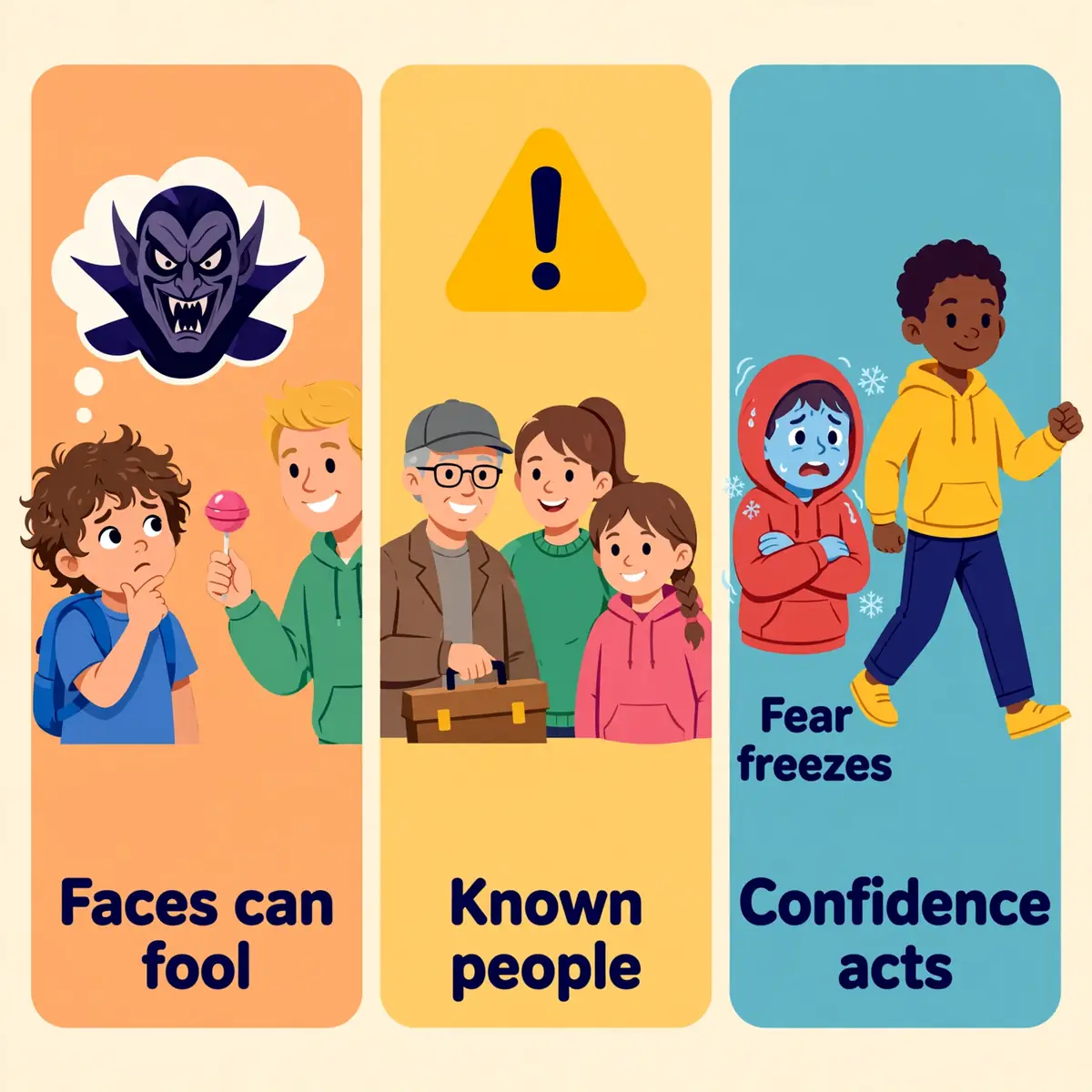
Parents often start with the phrase stranger danger because it is short and easy to remember. Child safety experts now advise a wider lesson, because the phrase alone leaves three gaps. Children picture strangers as villains, they may need help from a stranger when lost. Most harm to children comes from people they already know. Teaching behaviour, practice and trusted adults fills those gaps without frightening a child.
Why “Stranger Danger” Alone Does Not Work
The phrase has been used for decades, and it survives because it rhymes and fits on a poster. The National Center for Missing & Exploited Children, known as NCMEC, says plainly that it is not the most effective abduction prevention lesson for children. The phrase points at a type of person, while safety depends on recognising a type of behaviour. That mismatch is why parents need a fuller lesson behind the slogan.
Children Picture Strangers the Wrong Way
Young children imagine a stranger as a villain from a story: mean-looking, shady, easy to spot. A friendly adult offering help with a lost puppy does not match that picture, so the child may not register any risk at all. Cleveland Clinic paediatrician Dr Richard So warns that not everyone with bad intentions looks like a villain or gives off obvious warning signs. Looks alone cannot sort safe people from unsafe ones.
The same confusion works in reverse. A child may decide that a neighbour seen walking a dog is no longer a stranger. A friendly person in the park may seem safe because they shared a name. Dr So notes that children need time to fine-tune the definition. Parents should keep the conversation going rather than expect one talk to settle it. The working definition is simple: a stranger is anyone the child does not know well.
Warning:. Never teach a child that bad people look a certain way. Friendly, well-dressed adults can still be unsafe, and a child who trusts appearances may follow the wrong person.
Most Harm Comes from Someone the Child Knows
NCMEC states that most children are abducted by someone they know. Avoiding strangers will not help when the person is a family member, neighbour or family acquaintance. In the United Kingdom, NHS guidance for parents notes that in 90% of abuse cases the person is known to the victim. A lesson built only on strangers leaves the larger risk unaddressed, which is why experts shift the focus to behaviour and situations instead of faces.
That shift does not mean strangers are harmless. It means the rule must cover anyone who tries to trick a child, whether known or unknown. A child who only fears strangers may still follow a familiar adult into trouble, or accept a secret from someone the family trusts. Teaching children to spot pressure, secrecy and unwanted touch protects them in both cases It keeps the lesson honest about where risk actually sits.
A Frightened Child is Not a Safer Child
Warnings that paint every stranger as a threat can leave a child anxious and less able to act. A child who is scared of all strangers may freeze when approached, or refuse help from a shop assistant or police officer when lost. NCMEC argues that building confidence and self-esteem helps children stay safer. Teaching them to be wary of strangers, or to watch for a particular type of person, helps less. Calm, practised rules beat fear.
The goal is a child who is alert without being afraid. Short rules, repeated often and practised through games, give a child something to do instead of something to dread. Parents can watch for signs of anxiety and ease off when a cautious child becomes worried. For a sociable child who talks to everyone, keep the lessons flowing. The tone of the talk matters as much as the words in it.
What to Teach Instead: Judge Behaviour, Not Faces
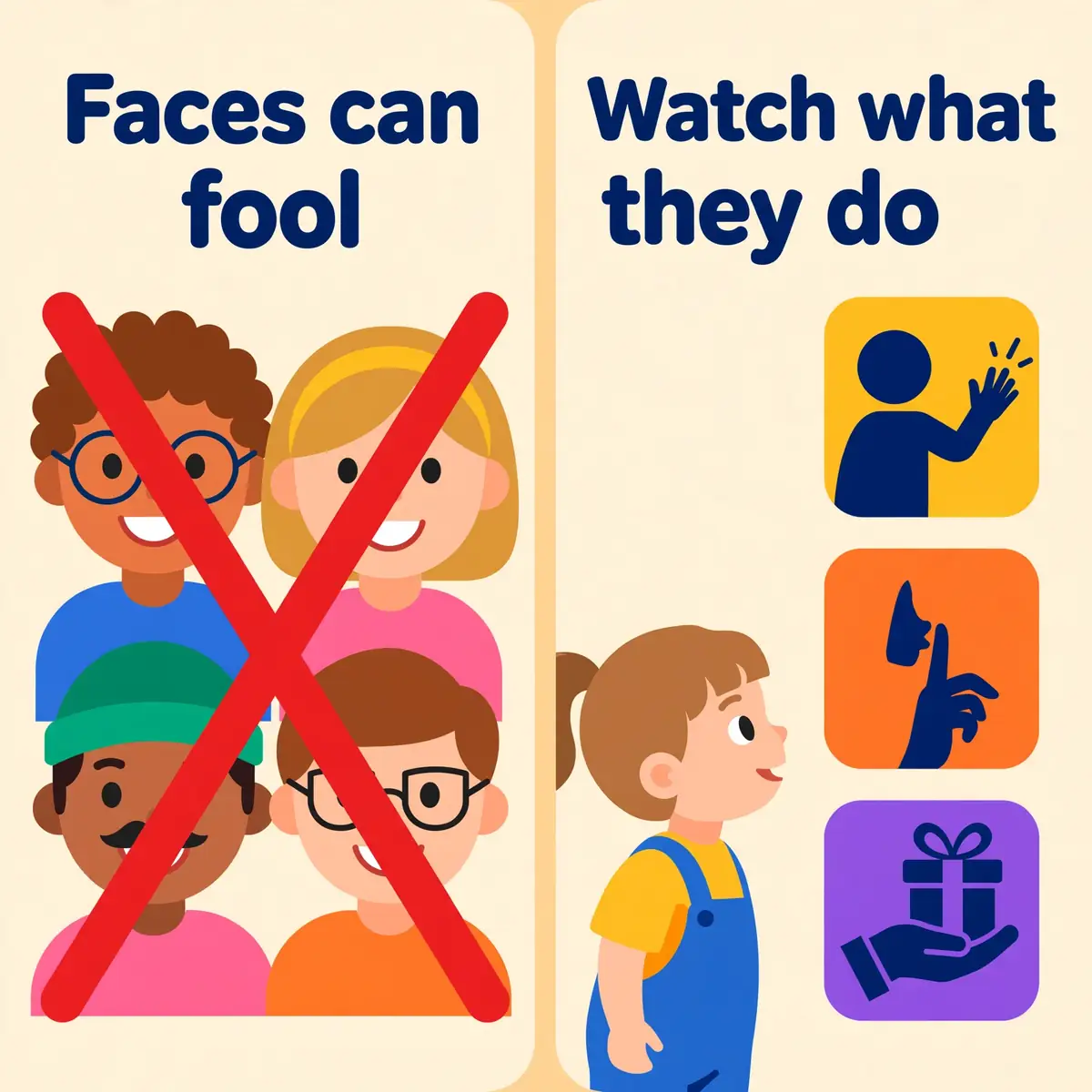
The replacement lesson is simple to state and takes years to practise: pay attention to what people do. A safe adult behaves in predictable ways, while a tricky person tries to move a child, isolate a child, or keep a secret. Children can learn that distinction from about age three. The words must stay concrete, and the examples should come from everyday places like the park, the shops and the school gate.
Tricky People, Not Scary People
Child safety experts use the phrase tricky person for anyone who tries to get a child to break a safety rule. That person may be known or unknown. Johns Hopkins Medicine advises parents to use that phrase. Stranger is a challenging concept for young children, who may not grasp who counts as one. A tricky person is defined by behaviour: asking a child to go somewhere, keep a secret, or accept something without a parent’s permission.
The test a child can use is short. Did the person ask me to go somewhere, keep something secret, or do something my parents would not allow? If the answer is yes, the person is acting like a tricky person, whatever their face or manner suggests. That test works for a stranger at the park. It also works for a familiar adult who oversteps. That is exactly why it is stronger than a warning about strangers alone.
Safe Adults and Safe Strangers
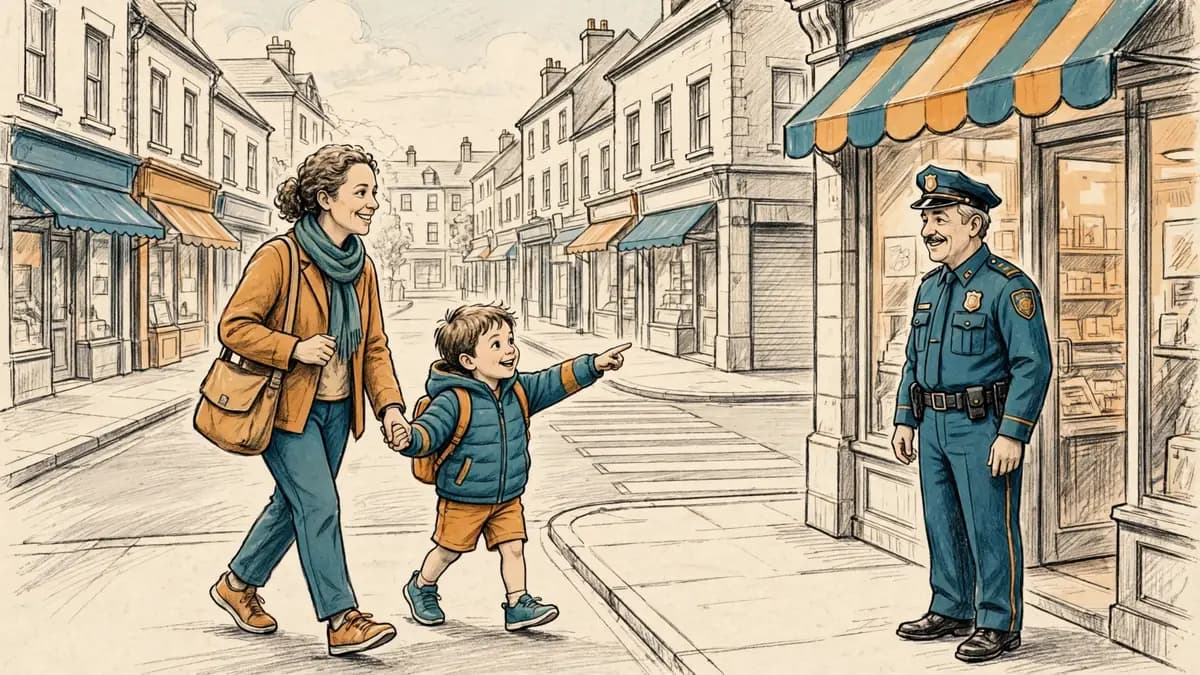
Children also need to know that some strangers can help. NCMEC gives three examples of people a lost child can approach. They are a police officer in uniform, a store clerk with a name tag, and a parent with children.
Name three safe adults — a parent, a grandparent, a teacher, a neighbour. That gives a child a short list to memorise and use. Parents should tell the child that if they say someone is safe, the child may talk to them, and may still refuse a hug.
Safe places matter as much as safe people. A shop, a library, a school office or a home with the lights on can be a refuge when a child feels unsafe.
Parents can walk the route to school with a child and point out the safe places along the way. They can also point out the stretches to avoid, such as empty car parks and deserted paths. A child who knows where help sits is less likely to panic when something feels wrong.
The Permission Rule
One rule covers most situations: a child never goes anywhere, accepts anything, or gets into a car without first checking with the adult in charge. That single check stops the offer trick, the ride trick and the fake pick-up in one move. Every one of those tricks needs the child to leave without permission. Parents should repeat the rule until it is automatic, and praise the child each time they check first, even for small things.
The rule needs a clear exception for emergencies. If a child is hurt or lost, they should ask a safe stranger for help rather than wander alone. They should stay where they are so a parent can find them. A stranger coming to the child is a warning sign. A child going to a uniformed helper is a safe choice. Explaining the difference prevents the rule from becoming a blanket fear of all strangers.
Tip:. Name three safe adults with your child tonight and write them on the fridge. A child who can name them can find them.
The Four Rules of Personal Safety
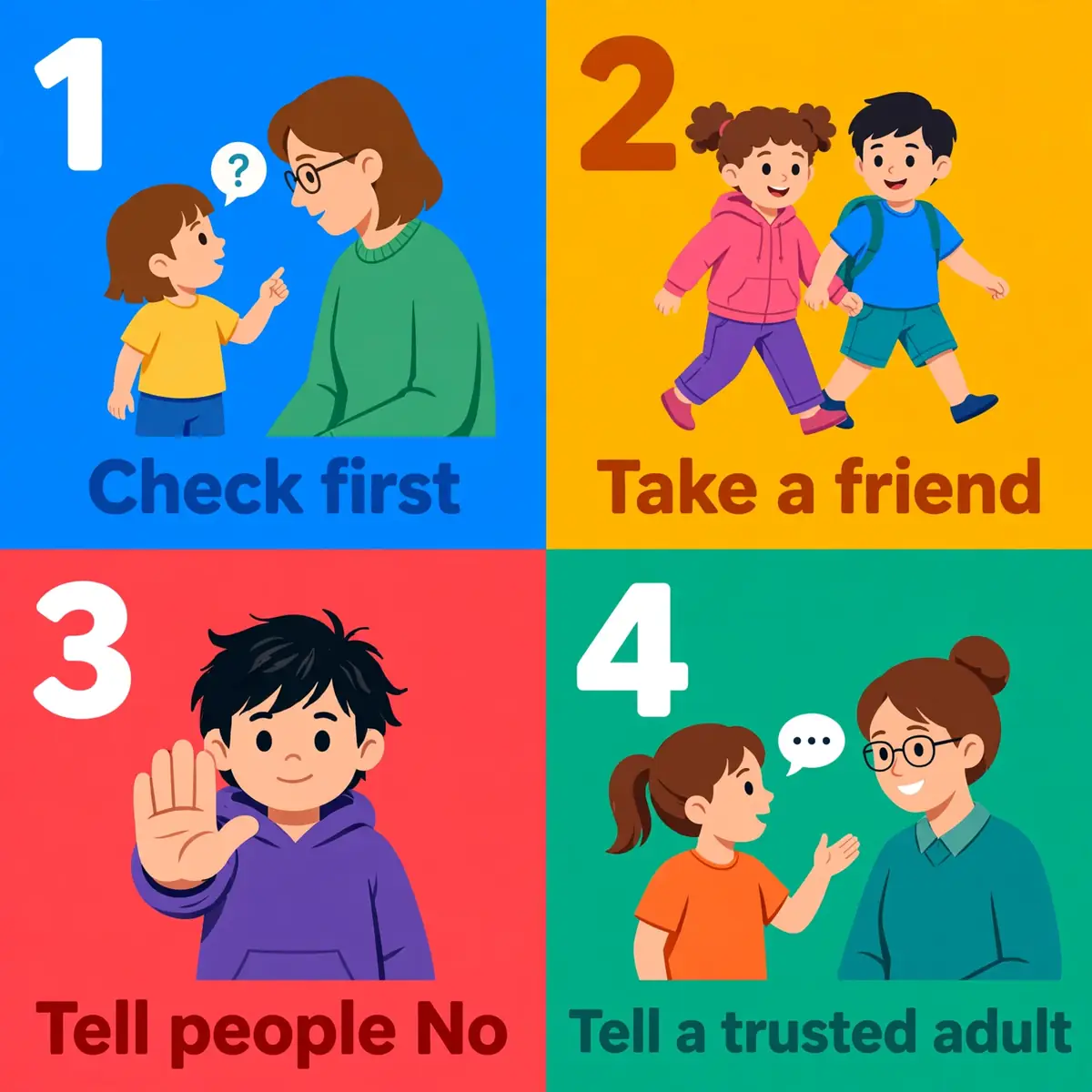
NCMEC’s KidSmartz programme teaches four rules of personal safety to children in grades K to 5. It uses the same wording every time, so the rules survive stress. The rules are short enough for a young child to memorise and strong enough to cover most approaches. Parents can teach them as a set and practise one rule each week. Repeat them at the school gate, the park and the shops until the child can say them back without thinking.
| Rule | What it means | Words a child can use |
|---|---|---|
| Check first | Always ask a parent, guardian or other trusted adult before going anywhere, helping anyone, accepting anything or getting into a car. | “I check first.” |
| Take a friend | Go places with a friend, not alone. Two children are harder to approach than one. | “I take a friend.” |
| Tell people “No” | Say no loudly if someone tries to touch or hurt you. It is okay to stand up for yourself. | “No! I will tell.” |
| Tell a trusted adult | Tell a parent or trusted adult if anything makes you feel sad, scared or confused. | “I tell right away.” |
Check First
Checking first is the rule that prevents most trouble, because it inserts an adult between the child and the approach. A child who checks first cannot be collected from school by someone new. They cannot be talked into a car, and they cannot accept a gift that comes with a condition. The check must happen before the child moves, not after, so parents should practise the pause: stop, find the adult in charge, and ask.
Make the rule concrete with examples from the child’s week. Before going to a friend’s house, before accepting a lift, before following a coach to a different pitch — each one needs a check first. Children who practise the check on small decisions will use it on big ones. Parents should accept the interruption cheerfully rather than treating it as a nuisance.
Take a Friend
Children are safer in pairs, and NCMEC’s analysis of attempted abductions supports the point. Approaches often happen when a child is alone, travelling to or from school. A friend is not a bodyguard, but two children are harder to approach, harder to move, and more likely to attract attention. Parents can make the buddy rule part of every outing: walk together, play together, and come home together.
The buddy rule also gives a child a witness and a helper. If one child is approached, the other can run for help while the first child moves away. Parents should agree the buddy in advance for regular trips, such as the walk to school or the park after lunch. They should also check that the friend’s parents know the arrangement. A child who always has a companion is simply a harder target.
Tell People “No”
Children are taught to be polite to adults, and that politeness is exactly what a tricky person exploits. The third rule gives a child permission to be rude: say no in a firm voice, step back, and leave. NCMEC’s KidSmartz lessons put it plainly — it is okay to stand up for yourself. Parents should practise the loud no at home. A child who has never raised their voice to an adult will struggle to do it under pressure.
The no applies to touch as well as to trips. If anyone tries to touch a child in a way that feels wrong, the answer is the same loud no. The same applies if someone asks the child to keep a secret about touch. Say no, get away, and tell. Parents should be clear that a child will never be in trouble for saying no to an adult, even a familiar one. They should mean it when the moment comes.
Tell a Trusted Adult
The final rule closes the loop. Tell a trusted adult right away, every time, even if the child is not sure it was a big deal. Children often stay quiet because they fear blame, or because the person told them to keep a secret. Parents should promise that telling never brings punishment, and then keep that promise when a child reports something awkward or embarrassing.
Telling also protects other children. A report about an approach near the park or school lets parents, teachers and police warn others and watch the area. Parents should thank the child for telling, stay calm while listening, and act the same day rather than waiting to see if it happens again. A child who is believed once will tell again.
The Tricks Children Need to Recognise
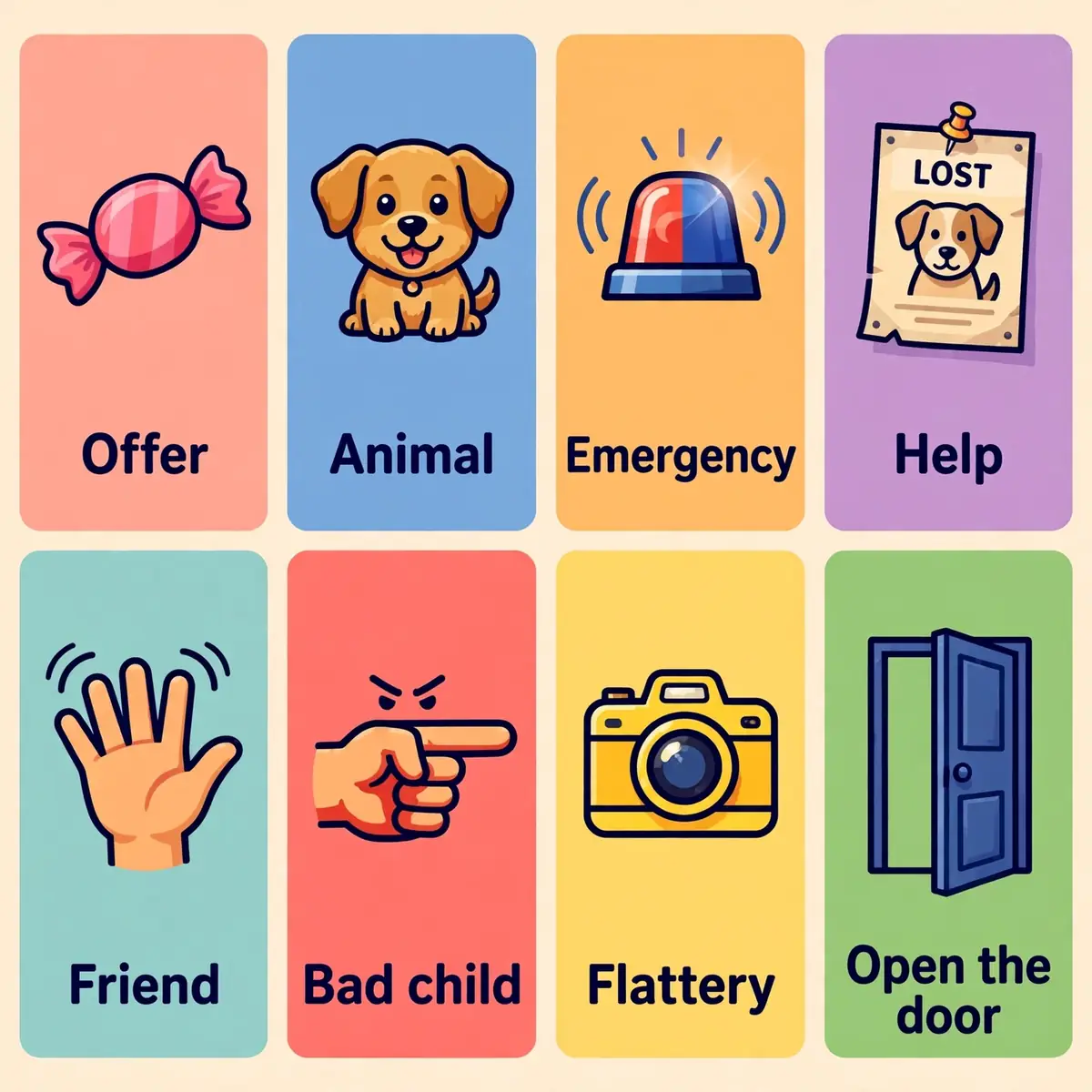
NCMEC has noted more than 100 tactics used in abduction attempts, and the common ones follow a handful of patterns. Johns Hopkins Medicine lists the five most used methods from the same analysis. Offering a ride, offering candy or sweets, asking questions, offering money, and offering or showing an animal. Teaching the patterns matters more than memorising a list, because a new trick still fits an old pattern.
| Trick | How it sounds | The reply to practise |
|---|---|---|
| The offer trick | Sweets, money, toys or a ride are offered. | Say no, walk away, tell an adult. |
| The animal trick | “Come and see my puppy.” | Never follow anyone to see an animal. |
| The emergency trick | “Your mum had an accident. Come with me.” | Check with the adult in charge first. |
| The help trick | “Can you help me find my lost dog?” | Step back and say “I can’t help you.” |
| The friend trick | “Your mum sent me to collect you.” | Ask for the family code word. |
| The “bad child” trick | “You are in trouble. Come with me.” | Check with a trusted adult first. |
| The flattery trick | “You should be a model. Let me take your picture.” | Say no and walk away. |
| The open-the-door trick | Someone knocks when parents are out. | Do not open the door. Stay inside. |
The Offer and Animal Tricks
Gifts and animals are the oldest lures because they work on curiosity and kindness. A child offered sweets, money or a ride hears a reward, not a risk, and a child shown a puppy wants to follow it.
The reply is the same in both cases. Do not accept gifts without a parent’s permission, and never enter anyone’s vehicle or home to see an animal. Parents can practise the moment with a treat offered by a relative, so the child learns that checking first applies to everyone.
Children should also learn that a stranger who knows their name is still a stranger. Names appear on school bags, sports kits and lunch boxes, and a person who uses a child’s name may seem familiar when they are not. Parents can avoid putting a child’s name where strangers can read it, and teach the child that knowing a name proves nothing about being safe.
The Help and Emergency Tricks
The help trick asks a child to do an adult’s job: find a lost pet, give directions, carry a package. Safe adults ask other adults for help, not children, and a child who hears that request should step back and get away. Cleveland Clinic’s Dr So puts it plainly: safe adults do not need children to help them find a lost dog or give them directions. The request itself is the warning sign.
The emergency trick is crueller, because it uses fear: a parent has had an accident, and the child must come at once. Children should be taught that a real emergency message would reach them through a teacher, a parent or the school office. It would never come through a stranger at the gate. A family code word settles the question in seconds, which is why the code word belongs in every family’s plan.
The Friend and Flattery Tricks
The friend trick claims the parent sent the person to collect the child, sometimes using real details to sound convincing. Parents should tell the school who may collect the child and agree that nobody else is released to anyone without a call first. A child who hears “your mum sent me” should answer that they must check with the adult in charge, then walk away and tell.
The flattery trick offers fame or a prize: a modelling contract, a photograph, a part in a video. Older children are the usual target. The answer is that a genuine photographer or casting agency talks to a parent or guardian, not to a child. Parents should also teach children that anyone who accuses them of being in trouble and orders them to come along is using a trick, not authority. The reply is the same: check first, then tell.
Alert:. Agree a family code word for pick-ups and use it every time. Anyone collecting your child must know the word, and your child must never go with someone who does not.
What to Do If a Stranger Approaches
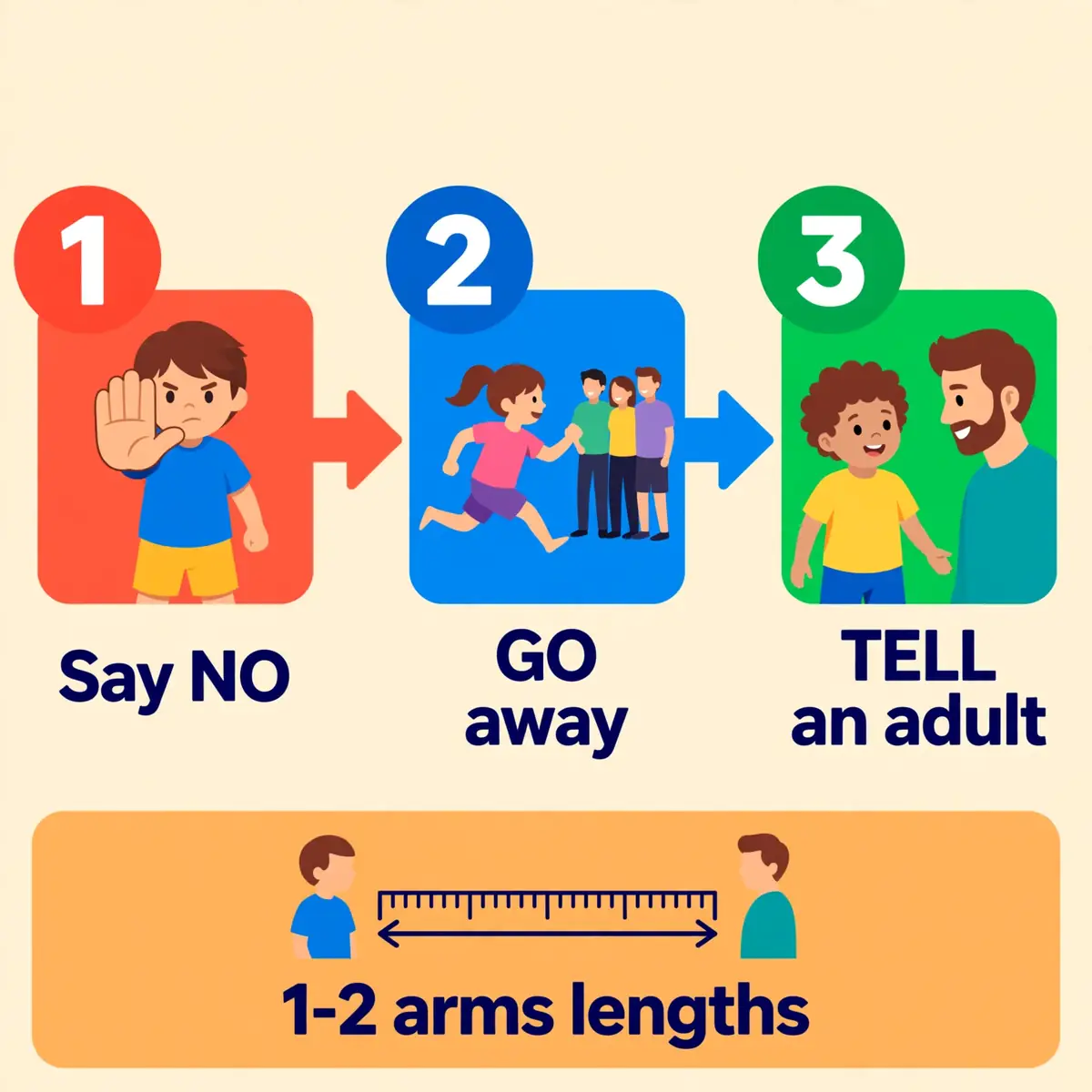
NCMEC’s review of attempted abductions found that 83% of children who escaped did something proactive. They walked or ran away, yelled, kicked or pulled away. Action beats politeness in that moment, and children who have practised an action can use it when fear would otherwise freeze them. The sequence to teach is short: no, go, tell. It works whether the approach comes from a car, on foot, or from someone the child knows.
No, Go, Tell
The three steps are: say no in a firm voice, go quickly away from the situation toward people, and tell a trusted adult right away.
Johns Hopkins Medicine and Scholastic both teach this NO-GO-TELL sequence, which NCMEC recommends, because each step protects the child in a different way. The no breaks the spell of politeness, the going creates distance, and the telling brings adult help. Parents should rehearse the three words until the child can say them in order without prompting.
Distance matters from the first second. NCMEC advises children to stand at least one to two arms’ lengths away while talking with an unknown adult. They should never walk up to a car window. A child who keeps that gap has room to turn and run, while a child who steps close has already given that room away. The rule is easy to practise in the garden with a parent playing the stranger.
If a Stranger Approaches by Car
Many attempted abductions in the NCMEC analysis involved a suspect driving a vehicle. Many happened while children travelled to or from school, often between 2 p.m. and 7 p.m. A child should never walk to a car window or get closer to talk, no matter what the driver says. The child should keep as far from the car as possible and decline the offer. Then they should run in the opposite direction from the car’s path while yelling for help.
If the child is near home or a friend’s house, they should go there and tell someone what happened. If they are away from home, they should go into a shop or business and tell the staff. As a last resort, a child in immediate danger can go to any house and scream for help. Parents should walk the school route with the child and agree which houses and shops count as safe stops.
If a Stranger Approaches on Foot
On foot, the same sequence applies. Decline the offer, keep the distance, and walk toward the adult the child is with or toward the area with the most people. A child can shout “Mum!” and run in that direction even if their mother is not there. The shout attracts attention, and the movement breaks the approach. The child should not worry about being rude or about overreacting — if they feel unsafe, they are probably right.
After getting away, the child should tell an adult what happened. That includes what the person looked like and which way they went. The adult should call the police. Parents should also talk with the child afterwards about what went well, so the child remembers a success rather than a fright. A calm review turns a scare into a lesson the child will keep.
If Someone Grabs Your Child
If a child is grabbed, the advice changes from leaving to fighting back loudly. The child should scream “Stranger! Let go of me!”, kick, bite, poke at the person’s eyes, and grab onto anything fixed — a fence, a lamp post, a bicycle — to make themselves hard to move. Noise is the point. An abductor wants a quiet child, and a screaming child who clings to street furniture is a problem they did not plan for.
Parents should practise this too, gently and briefly, so the child knows that fighting back is allowed and expected. The practice should be short, physical and even fun, with the parent playing the grabber and the child practising the shout and the wriggle. A child who has done it once in play is far more likely to do it for real. That is the whole purpose of the rehearsal.
Warning:. Teach your child that it is never rude to run from an adult who makes them feel unsafe. Politeness never comes before safety.
How to Talk About Strangers at Each Age
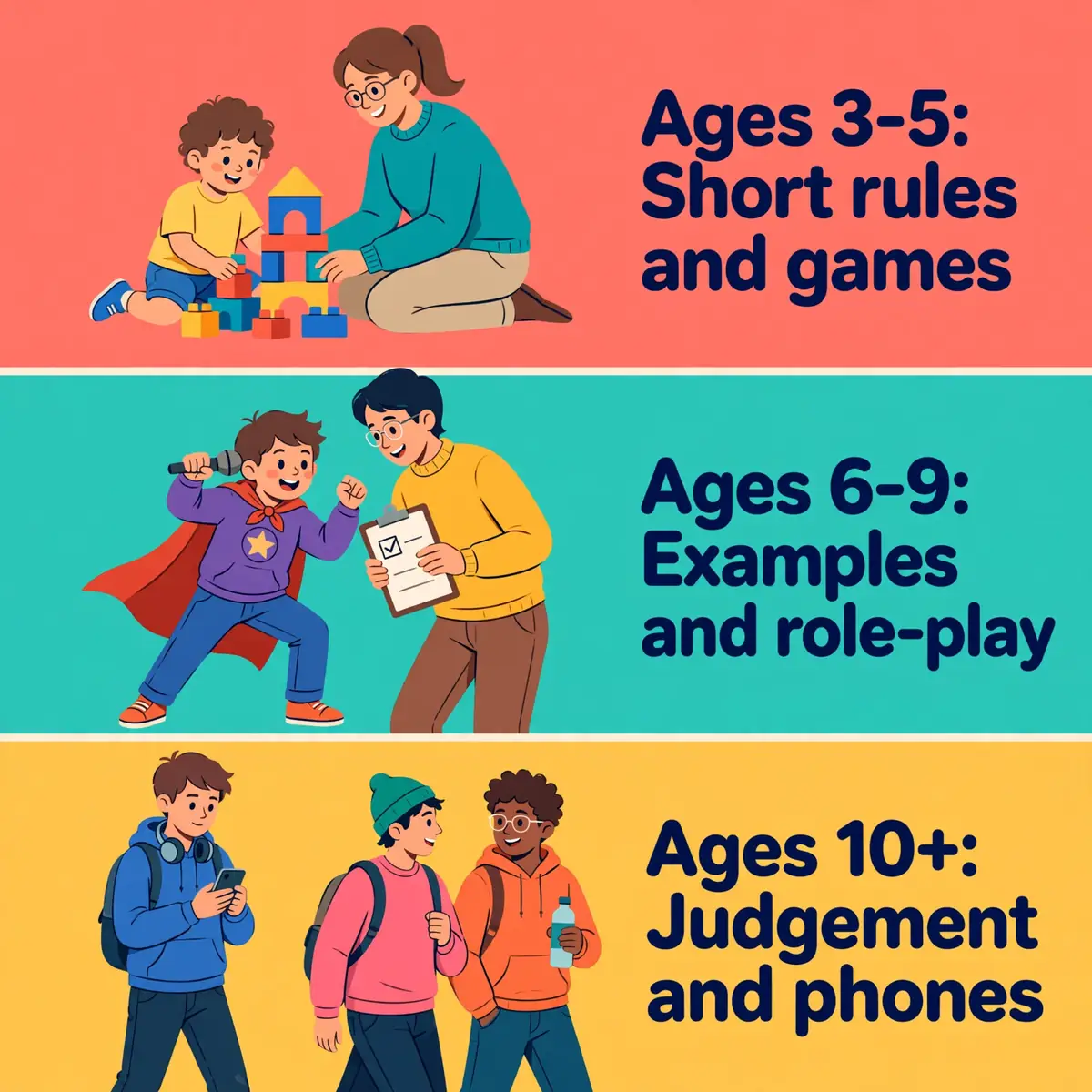
The conversation should start early and change as the child grows. Cleveland Clinic paediatrician Dr Richard So advises parents to start young and talk often, beginning before school and continuing through the teenage years. The words change at each stage, but the message stays the same. Stay close to trusted adults, check first, and tell someone when something feels wrong.
Ages 3 to 5: Short Rules and Games
Preschoolers are curious and trusting, and they do not yet read other people’s intentions, so the lesson must be short and concrete. Two sentences carry the whole message at this age: always ask first, and grown-ups do not need children to help them. Games and play teach the rules better than lectures. A puppet show about a tricky person, or a game of naming the three safe adults, will stick where a warning will not.
At this age, teach the child their full name, their address. The names of their parents, plus how to call 999 in the United Kingdom or 911 in the United States in an emergency. Keep the language simple: use “safe adults” and “tricky people” rather than “stranger”, which is a hard concept for a three-year-old. Repeat the rules often, and praise the child each time they remember one.
Ages 6 to 9: Concrete Examples and Role-Play
Children of this age care about right and wrong and can learn clear rules. They also want to please adults, so a tempting offer can trick them. Concrete examples and role-playing work best now. Act out the lost-puppy request, the offer of a ride, and the stranger who claims a parent sent them. Repetition matters, because a rule heard once fades while a rule practised weekly becomes a habit.
This is also the age to teach the child what to do if they get lost. The child should look for a uniformed police officer, a store clerk with a name tag, or a parent with children. They should not leave the place where they were separated from their parent. Parents can agree a meet-up place in every shop and park they visit, and point out what staff uniforms look like. The child knows exactly who to approach.
Ages 10 and over: Judgement, Friends and Phones
Tweens and teens travel alone more often and spend time with friends unsupervised. They also care about looking cool in front of peers, which makes them slower to act on a bad feeling. The conversation now shifts from rules to judgement: trust your instincts, get away, and do not worry about overreacting. NCMEC’s analysis found many attempted abductions involved girls and children aged 10 to 14, so these years deserve the most open discussion, not the least.
Online life belongs in the same conversation. People met in games and chatrooms are strangers, however long the child has talked with them. Personal details — name, address, school, phone number — must never be shared. A child should never agree to meet an online contact in person. Parents should know which apps the child uses and how the parental controls on each one work.
Tip:. Use real moments to teach. A news story, a scene in a film, or a walk past the school gate all make natural openings for a short safety chat.
Practice That Makes the Rules Stick
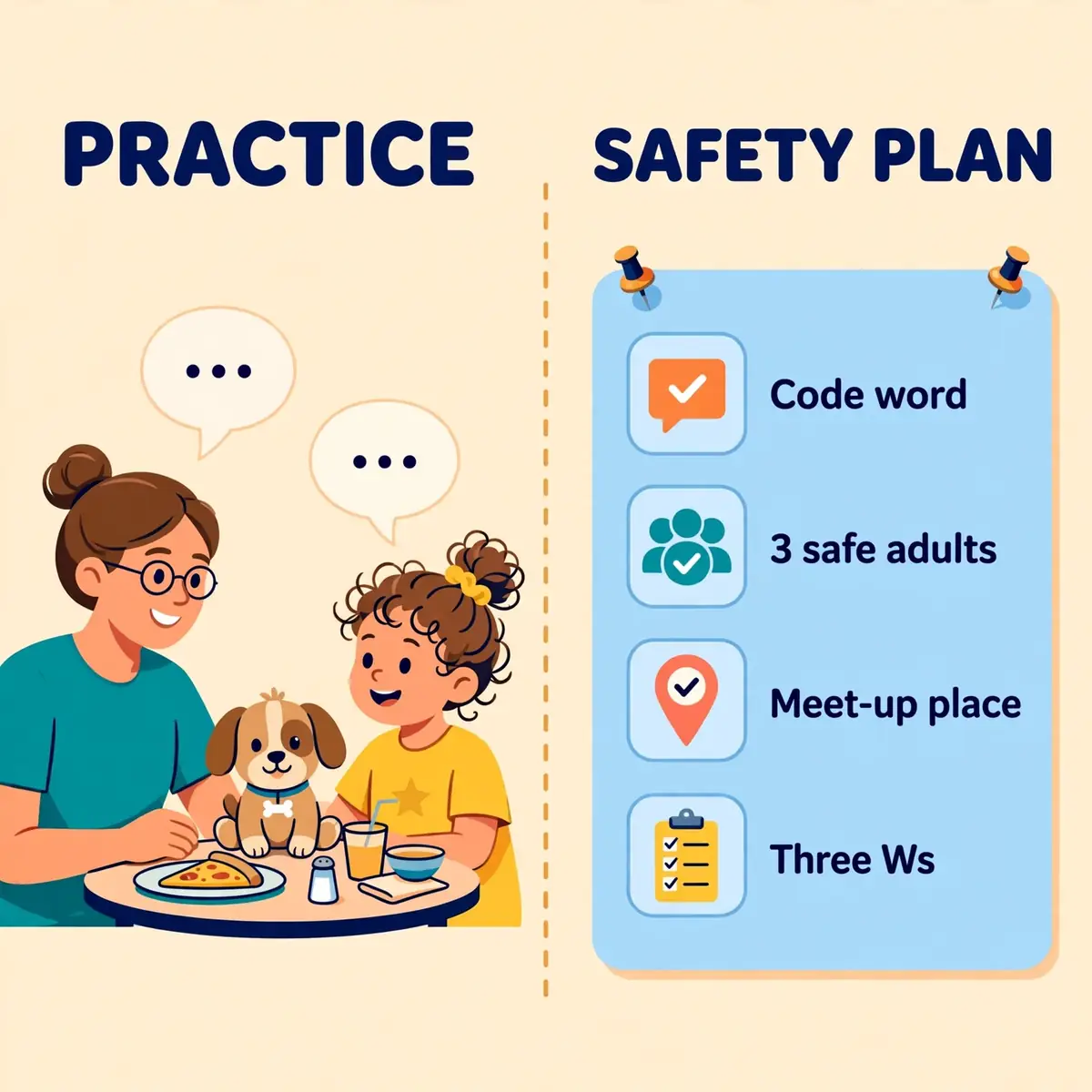
Knowing the rules is not the same as using them. NCMEC’s KidSmartz programme is built on role-playing scenarios. Children who have practised a response can produce it under stress, while children who have only heard a rule often freeze. Practice should be regular, short and calm — a few minutes at dinner or on a walk. It should always end with the child succeeding.
Role-Play the Approach
Take turns playing the tricky person and the child, and act out the common approaches. The lost puppy, the offer of a ride, the stranger who says a parent sent them.
The child’s answer is the same every time — step back, say no in a firm voice, walk away, and tell an adult. Parents should let the child win every round. The practice builds confidence rather than fear, and vary the setting so the skill travels from the kitchen to the park.
Ask “what if” questions on ordinary outings as well. What if a person in a car asks for directions? What if someone offers a lift home from football practice? What if a stranger asks the child to keep a secret? A child who has answered these questions out loud has already rehearsed the real decision. Parents can hear exactly which parts of the lesson still need work.
Build a Family Safety Plan
A written family plan turns scattered rules into one page a child can remember. The plan should name three trusted adults and state the family code word for pick-ups. It should also mark the meet-up place for each regular outing and list the school’s pick-up rule. Parents should share the plan with grandparents, childminders and anyone else who collects the child. Every adult in the child’s life enforces the same rules.
The plan should also cover the three Ws for older children going out alone. Who they are with, where they will be, and when they will return home. Parents should ask for the three Ws every time, and expect the child to report any change of plan. The plan is complete with a phone that is charged and carried, plus an agreed check-in time. That covers a child old enough to go out without an adult.
Repeat Little and Often
Safety lessons fade fast, so repetition matters more than any single talk. A short reminder on the walk to school, a question over dinner, a quick role-play before a holiday. These small moments keep the rules fresh without turning safety into a lecture. Cleveland Clinic’s Dr So advises parents to keep the conversation going across the years. A child who hears the rules often will remember them when they count.
Parents should also revisit the plan after any change: a new school, a new route, a new phone, a holiday abroad. Each change is a natural moment to check that the child still knows the code word, the safe adults and the meet-up place. A plan that is reviewed stays useful; a plan that is filed and forgotten does not.
Staying Safe at Home, at School and Online
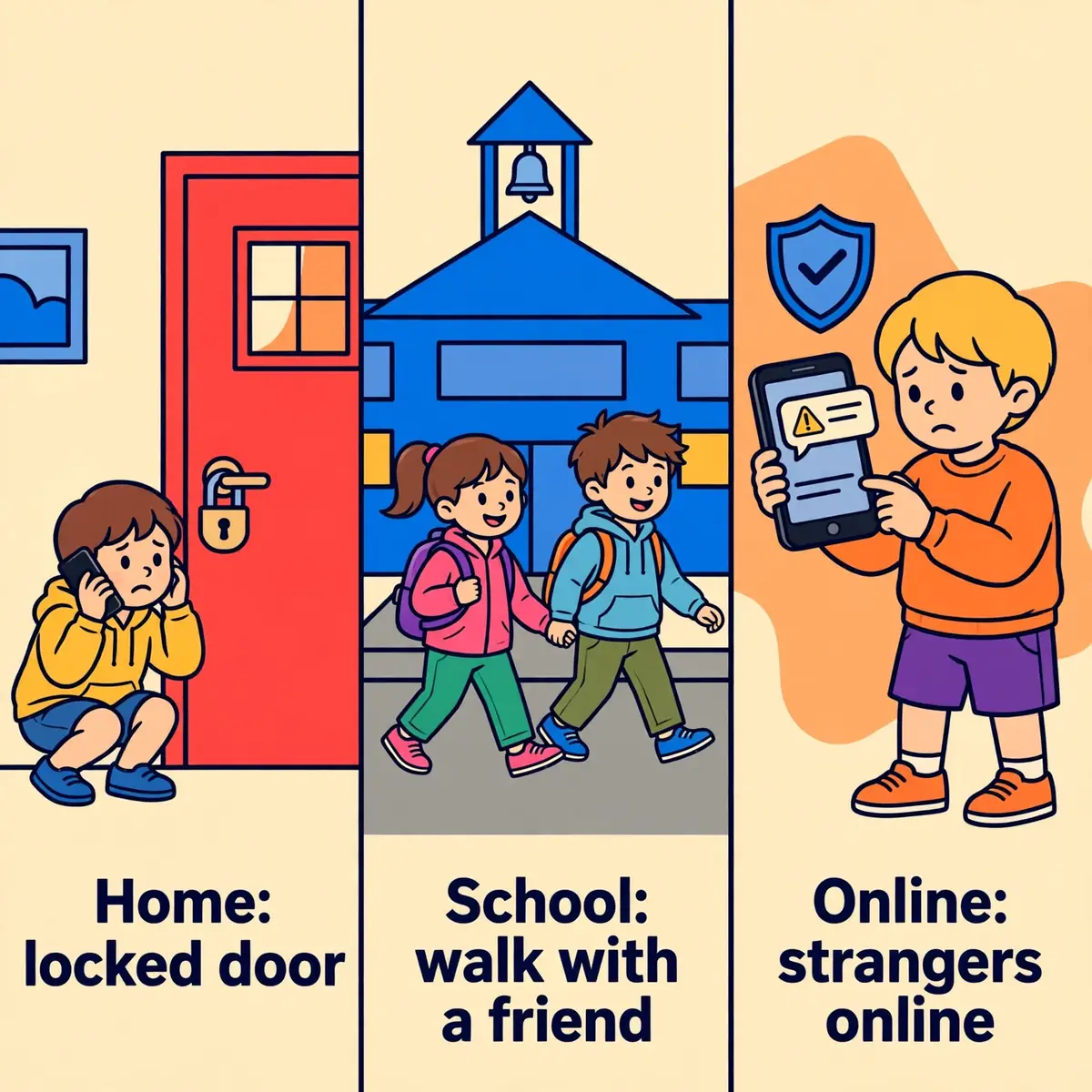
Stranger safety is part of everyday public safety for families, and it is not only about the street. The same rules apply at the front door, on the school run and on a phone screen. Each setting has its own habits to build. Parents who set the household rules early find the outdoor rules easier. The child already knows that checking first is simply how the family works.
A household fire plan belongs in the same routine, and fire safety for kids shows how a second emergency lesson fits alongside the stranger rules.
At Home and at the Door
Children who are old enough to stay home alone should keep the door locked. They should never open it to a stranger, even one in uniform or holding a parcel. A genuine delivery driver or service worker will return when an adult is home. A child should never feel obliged to answer the door or the phone to a caller asking personal questions.
Parents can agree a simple script — “My mum is busy, please come back later” — and practise it until it sounds natural.
The home itself should be part of the safety lesson. A child who knows where the exits are has a plan for the rare moment when something feels wrong indoors. They should also know how to call for help and which neighbour to run to. A childproofing guide usually covers locks, gates and cupboards. Yet the same habit of thinking ahead protects a child from people as well as from hazards. The two lessons belong together.
On the Way to and from School
The school journey deserves its own plan, because many attempted abductions happen while children travel to or from school. Parents should agree a safe route with the child, walk it together, and point out the safe places and the stretches to avoid. The buddy rule applies here too. Children should walk with a friend or in a group, and parents should know the route, the timing and who the child walks with.
The school’s pick-up rule is the other half of the plan. Parents should tell the school exactly who may collect the child. The child should know that nobody else can take them home without a call to a parent first. The stranger lesson sits naturally among the safety rules at school the child follows every day, from fire drills to road crossings to playground rules.
Online Strangers
Online strangers follow the same patterns as offline ones, using compliments, gifts and secrets to build trust before asking for a meeting or a photograph. A child should treat every person met online as a stranger. They should never share personal details, and never arrange to meet someone from a game or chatroom in person. Parents should set up parental controls on every app and device, and check them regularly, because a control that was never switched on protects nobody.
The most useful habit is a standing invitation to talk. A child who can tell a parent about a strange message without fear of losing their device will report the approach early. A child who expects punishment will hide it. Parents should react calmly to the first report, praise the child for telling, and deal with the account or contact together. The child learns that telling always helps.
Warning:. Never let a child arrange to meet an online contact in person. If a meeting is ever suggested, tell a parent or trusted adult immediately.
What Parents Should Do After Something Happens
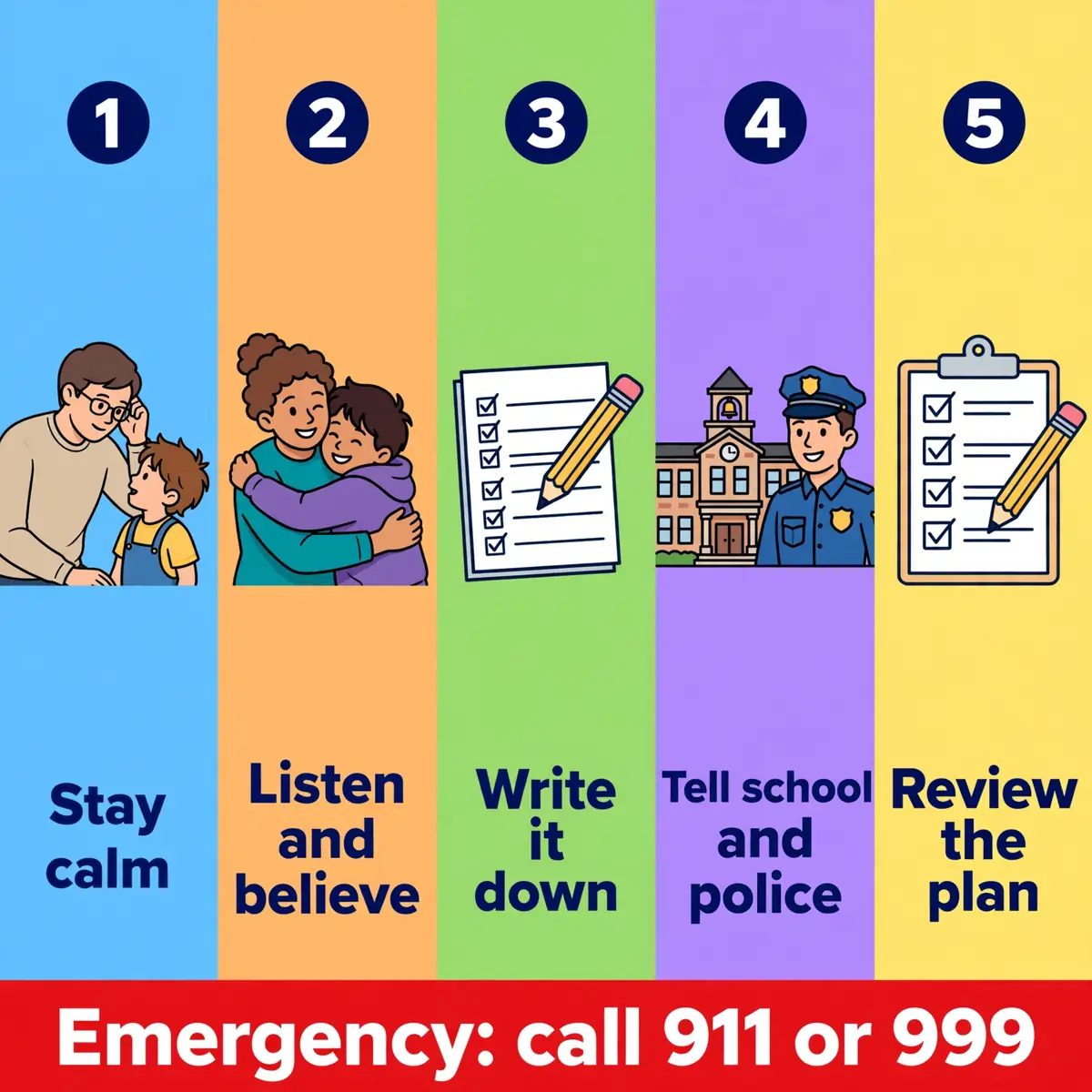
A child who reports an approach has done exactly the right thing. The parent’s response in the next hour shapes whether the child will ever tell again. Stay calm, believe the child, and act the same day. The steps below cover the approach itself, a scare that turns out to be nothing. The rarer case where a child has been harmed or is missing.
Believe the Child and Stay Calm
Thank the child for telling you, and listen without interrupting, correcting or showing panic. Children who sense anger or fear may stop talking or change their story to protect the adult. A steady voice and an open expression matter more than the questions asked. Reassure the child that they did the right thing, that they are not in trouble, and that telling was the brave choice.
Write down what the child said as soon as you can. What happened, where, when, what the person looked like, which way they went, and whether a vehicle was involved. Details fade quickly, and a short written note is far more reliable than memory a week later. Keep the note even if the approach turns out to be innocent, because a pattern across reports is often what identifies a real risk.
Report It and Review the Plan
Tell the child’s school the same day, so teachers can watch the area and warn other parents. Report the approach to the police, even if the child got away safely.
In the United States, a parent can also contact the National Center for Missing & Exploited Children, which runs a 24-hour call centre on 1-800-843-5678. In the United Kingdom, adults worried about a child can call the NSPCC Helpline on 0808 800 5000. Children can call Childline on 0800 1111. In an emergency, call 911 in the United States or 999 in the United Kingdom.
Afterwards, sit down with the child and review the family plan together. Ask what went well, what felt hard, and what the child would do differently next time, then update the plan. A different route, a new meet-up place, a changed code word. A scare that ends with a better plan is a lesson the child will carry. A child who sees adults act on their report learns that their voice matters.
Alert:. If a child is missing, call the police immediately and then contact the National Center for Missing & Exploited Children in the United States. Do not wait 24 hours.
Frequently Asked Questions
At What Age Should I Start Talking to My Child About Stranger Danger?
Start before school, from about age three, with two short rules: always ask first, and grown-ups do not need children to help them. Keep the talks brief, calm and frequent, and change the words as the child grows. Use games and role-play for young children, and judgement and online safety for older ones.
What Should I Teach My Child to Say If a Stranger Approaches Them?
Teach three steps: say no in a firm voice, go quickly away toward people, and tell a trusted adult right away. A child should also keep one to two arms’ lengths from an unknown adult and never walk up to a car window.
What is a Tricky Person?
A tricky person is anyone, known or unknown, who tries to get a child to break a safety rule. It can also mean doing something that feels wrong. For example, asking a child to go somewhere, keep a secret, or accept something without a parent’s permission. The phrase works better than “stranger” because young children judge people by how friendly they look.
Should My Child Never Talk to Strangers?
No. Children sometimes need help from strangers, for example when they are lost. Teach the child to ask a safe stranger for help. That could be a police officer in uniform, a store clerk with a name tag, or a parent with children. The child should still never go anywhere with someone who approaches them first.
What is a Family Code Word and How Does It Work?
A family code word is a secret word only the family and the school know. Anyone sent to collect the child must say the word, and the child must never go with someone who cannot. Agree the word together, tell the school, and change it if it ever leaks.
What Should I Do If My Child Tells Me a Stranger Approached Them?
Stay calm, thank the child for telling you, and listen without interrupting. Write down what happened, tell the school the same day, and report it to the police. Then review the family safety plan together and update anything that needs changing.
Sources
- National Center for Missing & Exploited Children — KidSmartz
- Cleveland Clinic — Stranger Danger: Stranger Awareness for Kids
- Johns Hopkins Medicine — Stranger Danger and Stranger Safety
- Scholastic — Talking About Stranger Safety
- Keep Your Child Safe — Stranger Danger for Kids
- Just One Norfolk NHS — Staying Safe Around Other People
- NSPCC — Support & advice for families