
A business continuity plan is a written set of procedures, roles and resources. It lets a business keep its critical work going during a disruption and restore normal operations afterwards. It names the functions that matter most and how long each one can be down. It also names who acts when something fails and how the business communicates while it does.
The plan is built around work, not equipment. Restoring a server does not restore a business process if the staff, the premises or the suppliers are still unavailable. What follows sets out what belongs in the plan. It then gives the eight steps that turn a blank page into a tested document.
What a business continuity plan is
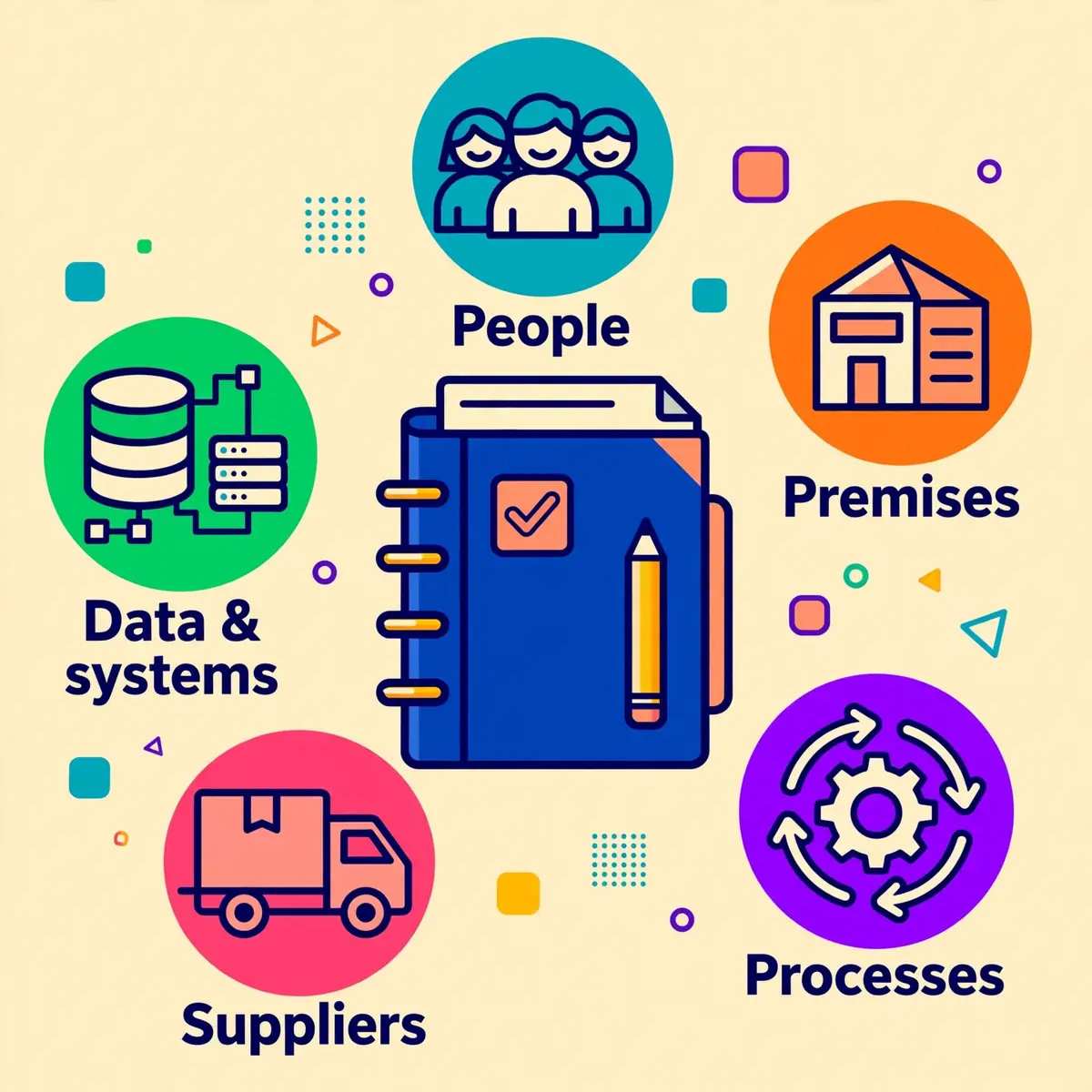
A business continuity plan is the document that answers four questions before a disruption happens. It is often shortened to BCP. Those questions are what must keep running, who decides, where people work, and in what order things come back. It is written for the people who will use it under pressure. Its first-action instructions stay short, and its detail sits in appendices.
NIST, the US National Institute of Standards and Technology, defines it as a predetermined set of instructions or procedures. They describe how an organisation's business processes will be sustained during and after a significant disruption. Its examples of such processes are payroll and customer service. That is the right level of detail: the plan is written around work, not around equipment.
The one-sentence definition
A business continuity plan is the agreed answer to what the business does when it cannot work normally. It covers the disruption itself and the return to normal. That return includes the reconciliation of temporary records and the clearing of backlogs. A plan that stops at "systems are back online" is unfinished.
The plan is one part of a wider capability. Business continuity management, or BCM, is the ongoing programme that governs, maintains and improves that capability. The plan is the document. The programme is the work that keeps it current. ISO 22301, the international standard for business continuity management systems, sets the requirements for that programme.
What the plan protects
A usable plan protects five things. A plan that covers only one of them will fail at the first real test. Each one needs a named owner and a recovery strategy of its own.
- People. Staff, their safety, their roles and the skills only one person holds.
- Premises. Offices, warehouses, shops and anywhere else work happens.
- Processes. The work itself: taking orders, paying staff, serving customers, shipping goods.
- Suppliers. The vendors, carriers and service providers each process depends on.
- Data and systems. The applications, files and records the processes need to run.
Who needs one
Any business that would lose money, customers or a legal deadline within days of stopping needs a plan. Size does not decide the question. A ten-person firm that cannot take orders for a day needs one as much as a large company does. What changes with size is the length of the document, not whether it exists. Emergency preparedness is not only for large companies.
For a small business, the plan can be short. Write it for the handful of processes that would cost money, customers or a legal deadline within days. Then widen it. The discipline is the same at any scale. Name the critical work, set a recovery target for each piece, and test whether the targets hold.
Business continuity plan vs disaster recovery, emergency response and crisis plans
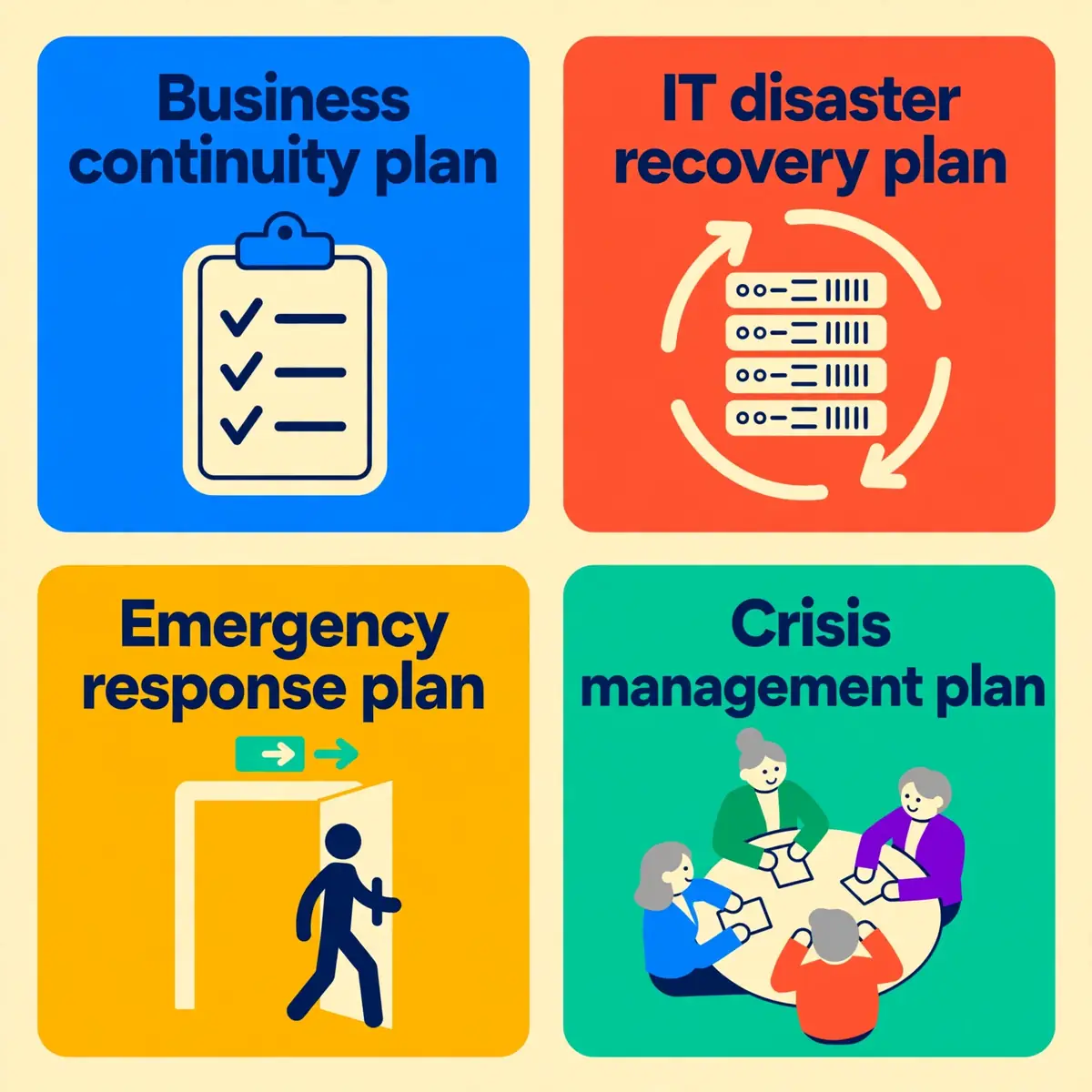
Four documents are often confused, and the confusion is expensive. A business that files its IT disaster recovery plan and calls it a continuity plan has a plan for its servers. It does not have a plan for its business. Each document answers a different question, is used at a different moment, and belongs to a different owner.
| Plan | What it covers | When it is used | Who owns it |
|---|---|---|---|
| Business continuity plan | Keeping essential business activities going and restoring them | During and after a disruption, until normal work resumes | Plan owner, with the executive sponsor |
| IT disaster recovery plan | Restoring IT services, systems and data | When systems or data are lost or unavailable | IT lead |
| Emergency response plan | Immediate actions to protect people, property and the environment | In the first minutes of an incident: evacuation, shelter, lockdown | Facilities or safety lead |
| Crisis management plan | Decisions, coordination and communication during an event | While the incident is being managed at senior level | Senior leadership or crisis team |
The four plans must fit together. Emergency response ends when people are safe; continuity starts there. Restoring a server does not restore a business process if staff, facilities or suppliers are still unavailable. Equally, a temporary manual process may need reliable data and a clear path for later reconciliation.
WarningDo not file the IT disaster recovery plan and call it a continuity plan. A tested server restore proves nothing about whether orders can be taken, staff can be paid or customers can be served.
Why the confusion costs money
Most of the cost comes from the gap between the documents. The IT team restores the order system in four hours, as its plan promises. Then it discovers that nobody can reach the warehouse. The phone provider has no forwarding in place. The only person who knows the manual workaround is on leave. Each gap was somebody else's document, and nobody owned the join.
The fix is to link the documents, not merge them. The continuity plan should point to the disaster recovery plan for the technical detail. The disaster recovery plan should cite the same recovery time and recovery point objectives as the business impact analysis. Two documents that use different numbers will drift apart.
What to include in a business continuity plan
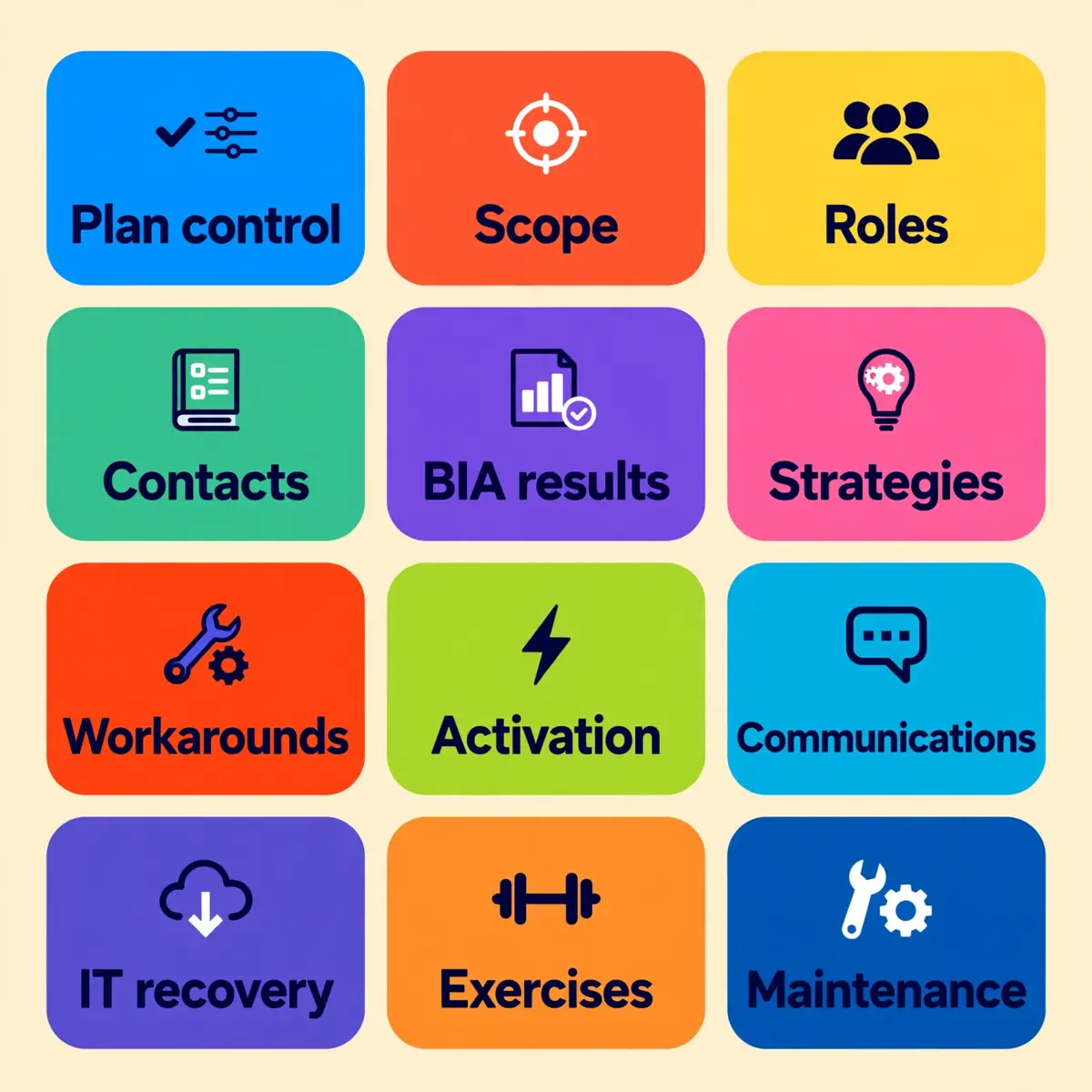
A usable plan contains twelve parts. Each one needs a named owner, and each one must be short enough to use under pressure. Treat the table below as both a business continuity plan template and a business continuity plan guide. Replace every entry with the people, places and numbers of the business it belongs to.
| Section | What to write | Why it matters |
|---|---|---|
| 1. Plan control | Company name, plan owner, version, who approved it and when, next review date | Proves which version is current and who stands behind it |
| 2. Scope and objectives | Sites, processes and events covered, what is excluded, what the plan aims to protect | Stops the plan growing until nobody can maintain it |
| 3. Roles and succession | Who activates the plan, who leads, who approves spending, who speaks for the company, a deputy for each | Prevents the plan failing because one person is unreachable |
| 4. Contact lists | Team members with work and personal numbers, key customers, vendors and contractors with emergency numbers | Lets the team be reached when the company directory is down |
| 5. Business impact analysis results | Critical processes, the damage over time if each stops, recovery targets and dependencies | Sets the numbers every other section depends on |
| 6. Continuity strategies | How each critical process keeps going: another site, remote work, a second supplier, cross-trained staff | Turns the targets into a workable way of operating |
| 7. Manual workarounds | The forms, printed lists and supplies needed to work by hand, and where they are kept | Keeps essential work moving while systems are down |
| 8. Activation and incident management | How a problem is reported, who is alerted, the criteria for activating the plan, the first-hour checklist | Removes the hesitation that wastes the first hour |
| 9. Communications plan | Audiences, who contacts each one, channels, prepared messages | Keeps staff, customers and regulators informed and calm |
| 10. IT recovery reference | Where the IT disaster recovery plan lives, the agreed recovery order, the IT emergency contact | Links the technical recovery to the business priorities |
| 11. Training and exercises | Orientation for new staff, tabletop and functional exercises, with dates and owners | Proves the plan works before an incident does |
| 12. Maintenance and revision record | Review schedule and triggers, open corrective actions, distribution list, dated log of changes | Keeps the plan current after the first version |
Keep the first-action instructions concise enough to use during an incident. Supporting inventories and detailed technical procedures can sit in controlled appendices. They must stay reachable when the systems they describe are down.
TipWrite the first-hour checklist on one page. If the team must search the document for what to do first, the document is too long.
The parts small businesses skip most often
Four sections are the ones most often left blank, and they are the ones that decide whether the plan works. A plan without them reads well and fails early.
- Manual workarounds. Paper order forms, a printed price list and a phone list only help if they exist, are current, and someone knows where they are kept.
- Supplier continuity. A vendor outage becomes your outage, with no recovery steps under your control, unless the plan records an alternative.
- Succession. Every named role needs a deputy. A plan that depends on one person being reachable fails the first time that person is on leave.
- Where copies live. A plan stored only on the company file server is unavailable in the outage it was written for.
How to write a business continuity plan
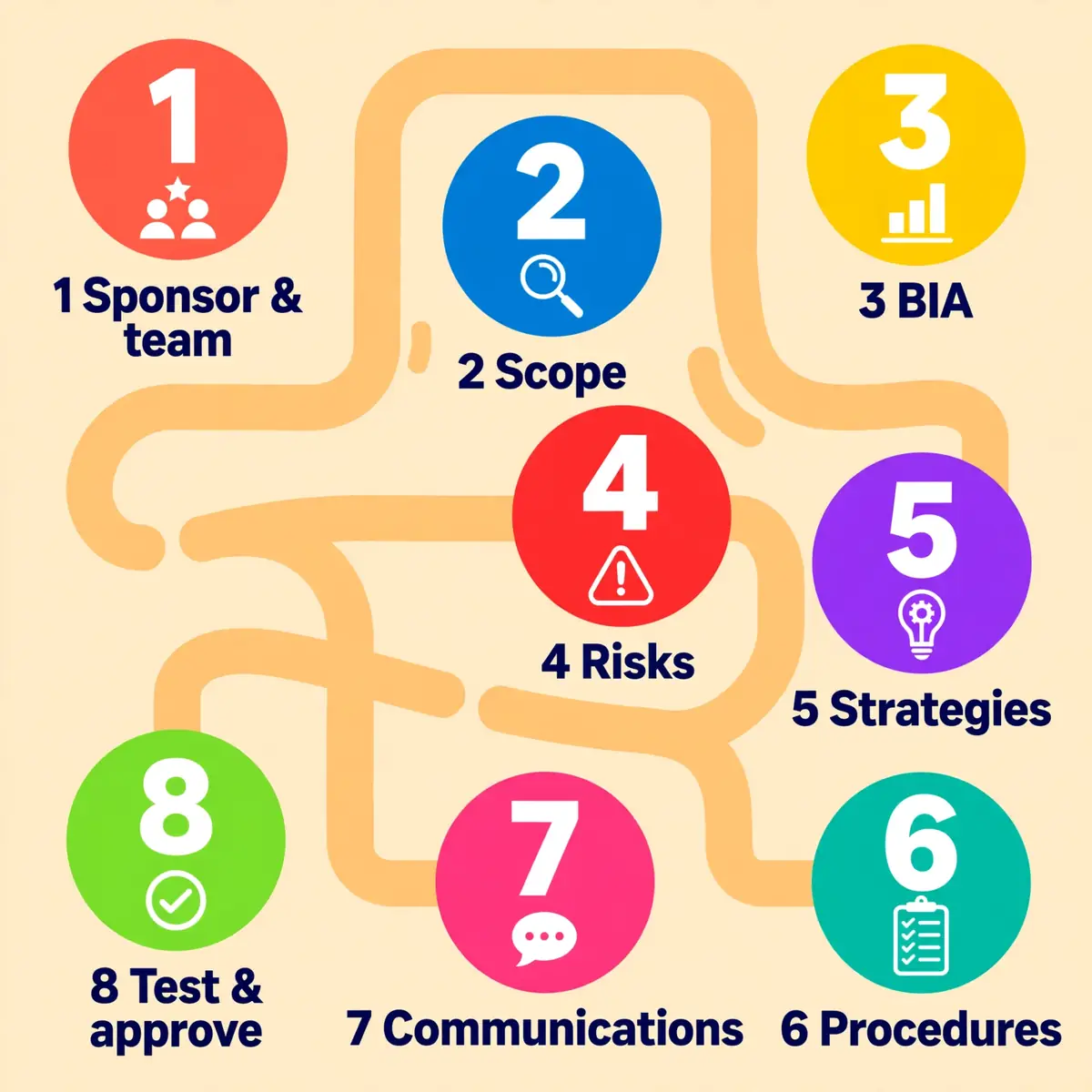
Eight steps take a business continuity plan from a blank page to an approved, stored and exercised document. Work them in order. Each step produces an input the next one needs. The first four decide how much effort the remaining four require.
Step 1: Get a sponsor and build the team
Form a continuity team with an executive sponsor, a plan owner, and a representative from each function the plan covers. The sponsor secures the budget and settles conflicts between departments. The owner writes and maintains the document. The business unit representatives supply the process detail that only the people running those processes hold.
Include IT, HR, facilities, legal, communications and procurement at a minimum. Each controls a recovery dependency: systems, people, space, regulatory obligations, messaging and suppliers. Name a backup for every role on the team, and record a deputy owner for the plan itself.
Step 2: Set the scope
State which locations, business units and services the plan covers and what it excludes. Then list the obligations that set minimum standards. They include sector rules, customer contracts with availability commitments, and any standard the organisation is certified against, such as ISO 22301. Scope decisions made here decide how many plans must be maintained later.
Write the scope down in one paragraph and get the sponsor to agree it. A plan with no agreed scope grows with every meeting until it covers everything and is used by nobody. What the plan excludes matters as much as what it includes.
Step 3: Run the business impact analysis
Interview the people who run each process and ask what happens if it stops, hour by hour and day by day. Record the financial, operational, customer and legal harm at each interval, and the resources each process needs to run. The analysis, not opinion, decides which functions are critical.
For each critical process, agree the four numbers the rest of the plan depends on. They are the maximum tolerable period of disruption and the recovery time objective. The other two are the recovery point objective and the minimum acceptable level of service. The next section explains each one and gives a worked example.
Step 4: Assess the risks
Pair the impact analysis with a risk assessment. It rates the threats most likely to interrupt each function. They include cyberattack, power or network loss and severe weather. They also include loss of a key supplier, loss of key staff and loss of a facility. Rank each threat by likelihood and impact. Then choose a recovery strategy for every function whose downtime tolerance is shorter than its expected recovery time.
The impact analysis and the risk assessment answer different questions. The first asks what happens if a function stops, whatever the cause. The second asks what is likely to stop it. A risk assessment done properly covers five steps: identify, decide who is harmed, evaluate, record and review. This plan uses its findings rather than repeating them.
Step 5: Choose recovery strategies
Strategies fall into a few types: alternate sites, remote work, manual workarounds, redundant suppliers and system failover. Match the strategy to the recovery time objective. The function with the shortest tolerance gets the fastest and most expensive option. Every other function gets the cheapest option that still meets its objective.
Check that each alternative is available when needed. A named supplier with no capacity commitment is an assumption, not a validated strategy. So is a manual workaround that needs a database nobody can reach. Record the limits of every temporary arrangement. Note what volume it can support, how long it can operate, and what risks need management approval.
Step 6: Write the response procedures
Write procedures that someone under pressure can follow without having helped write them. Define the activation criteria: the specific conditions under which the plan is declared. Also name who holds the authority to declare it. Then give each team a short action list for the first hour, the first day and the first week.
Keep procedures to checklists and decision points, and move background and rationale to an appendix. A plan that has to be searched for the right page will not be used at 2 a.m. Include an alternate decision-maker if the usual one cannot be reached. State who can authorise emergency spending. Emergency supplies belong in the procedures too. Keep a first aid kit at every work location, including the alternate site. Name someone trained to use it.
AlertActivation authority must be named in writing before any incident. A team that waits for permission it was never given loses the first hour of every disruption.
Step 7: Build the communications plan
Decide in advance who tells whom, in what order, and through which channel. The plan needs an employee notification method that works when email is down. It also needs a customer and partner message approved in outline before any incident. And it needs a notification path for regulators and insurers, with the deadlines each one carries.
Keep the contact tree somewhere that survives the failure it describes. If the directory lives only on the network that went down, nobody can reach anybody. Write the first message for each audience now, while nobody is under pressure, and store it with the plan.
Step 8: Test, approve and store
Train every person named in the plan on their role. Exercise the plan before an incident does it for you. Start with a tabletop exercise: a facilitated walk-through of a realistic scenario. Then progress to functional drills, and eventually to a full simulation, as the plan matures.
Have the executive sponsor approve the plan formally. Record the version, approval date and next review date on the cover. Store copies where they remain reachable in the scenarios the plan covers. Keep one in a secure off-site location and one printed copy where the team will gather. Keep an electronic copy the team can reach without the corporate network.
The business impact analysis: MTPD, RTO, RPO and MBCO
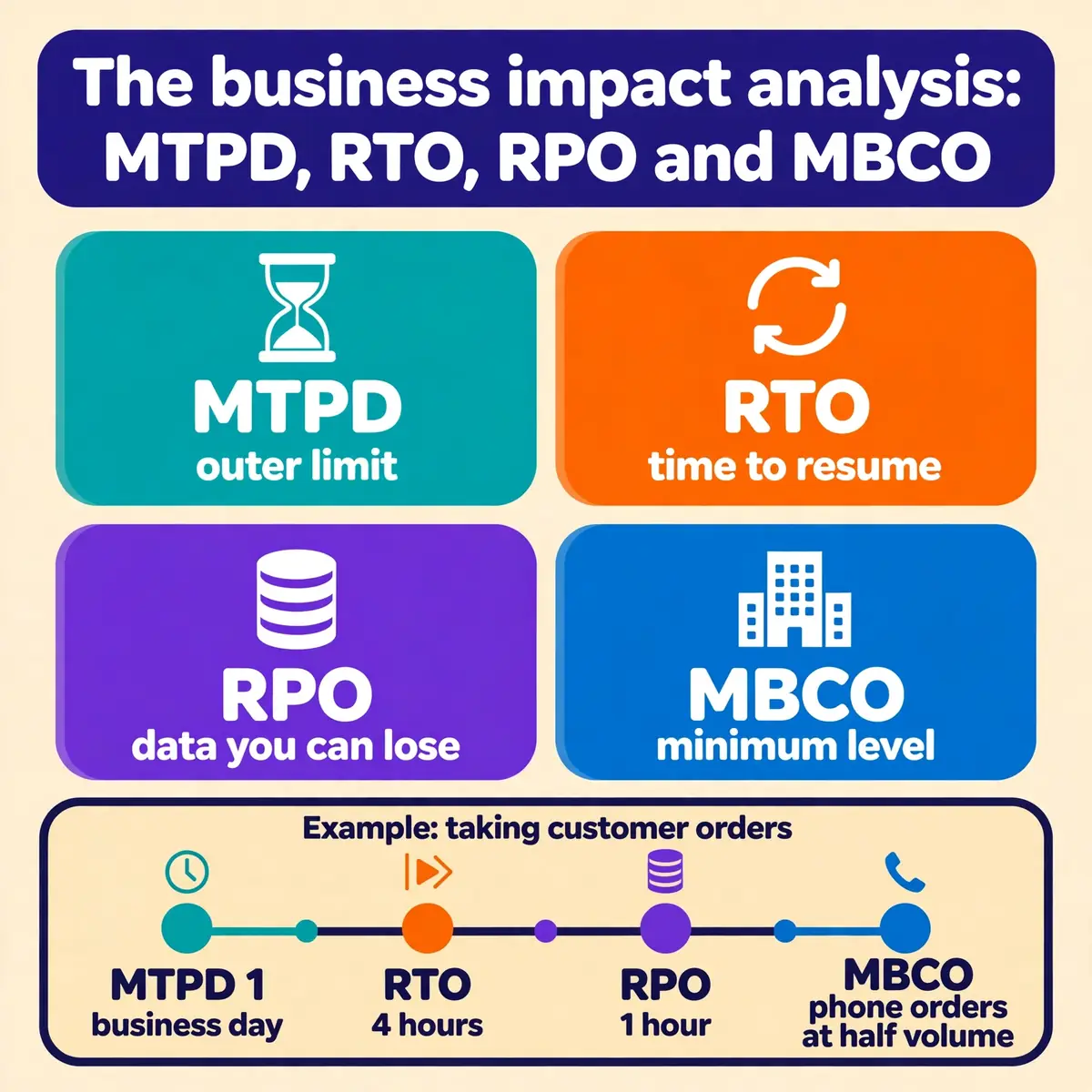
The business impact analysis, or BIA, is the foundation of the plan. Without it, recovery spending is guesswork. It identifies each critical function and the resources it depends on. It also records the cost of losing each one over time. That understanding becomes the recovery targets the whole plan is built on.
Under ISO 22301 the BIA is a requirement, not a suggestion. Clause 8.2.2 asks the organisation to define impact types and criteria. It also asks it to identify the activities behind each product or service. Then it asks for the impacts over time and the point at which not resuming becomes unacceptable. Prioritised time frames for resuming each activity must be set. The resources and dependencies each activity needs must be identified too.
How a business impact analysis works
A BIA runs in three moves. First, list the products and services that matter and the activities behind them. Second, interview the people who run those activities. Record how the impact grows over time: after four hours, one day, three days and one week. Measure it in money, customers, obligations and reputation. Third, agree the recovery targets with leadership.
Interview process owners rather than relying on a survey alone. Dependencies on specific people, spreadsheets and single vendors rarely appear on a form. Ask each owner what the process needs to run: people and skills, systems and data, premises, equipment and suppliers.
The four numbers
Four numbers come out of the analysis for each critical process. Getting them right is the difference between a plan that works under pressure and one that collapses at the first real test.
| Number | What it means | Rule |
|---|---|---|
| Maximum tolerable period of disruption (MTPD) | The time after which the impact of not resuming the activity becomes unacceptable | The outer limit; every other target must fit inside it |
| Recovery time objective (RTO) | The target time within which the activity must be running again, at least at a minimum level | Must be shorter than the MTPD |
| Recovery point objective (RPO) | How much data, measured in time, the activity can afford to lose | Sets how often backups or replication must run |
| Minimum business continuity objective (MBCO) | The minimum level of service that is acceptable while the disruption lasts | States plainly what the business will temporarily stop doing |
One more number belongs beside them. Work recovery time is the time needed after systems return to verify data, clear the backlog and resume normal work. The recovery time objective plus the work recovery time should not exceed the maximum tolerable period of disruption.
TipAn RPO of one hour means backups or replication must capture data at least every hour. Set the backup schedule from the RPO, not from what is convenient.
A worked example
The table below shows the four numbers for one process in a small wholesale business: taking customer orders. The figures are illustrative, agreed by that business's own process owners, and every business must set its own.
| Process | MTPD | RTO | RPO | MBCO |
|---|---|---|---|---|
| Taking customer orders | One business day | Four hours | One hour | Phone orders at half the normal volume, from home, on company laptops |
Read the row as a promise the business can keep. Orders must be running again within four hours, and no more than one hour of order data may be lost. The recovery time objective of four hours sits inside the one-day maximum tolerable period, so the target is achievable. And because the minimum level is spelled out, nobody has to guess what "running again" means.
Testing and exercising the plan
A plan is validated by exercising it. Business continuity plan testing means exercising the document the way it would be used, not reading it in a meeting. An untested backup is an assumption, and an untested plan is the same. ISO 22301 requires an exercise programme. The exercises should prove the plan works, not merely that the team turned up.
Choose exercises according to the organisation's risk and recent changes. The number of exercises matters less than what they demonstrate. A good exercise shows decisions made, messages sent, alternatives used, and gaps found and fixed.
The four exercise types
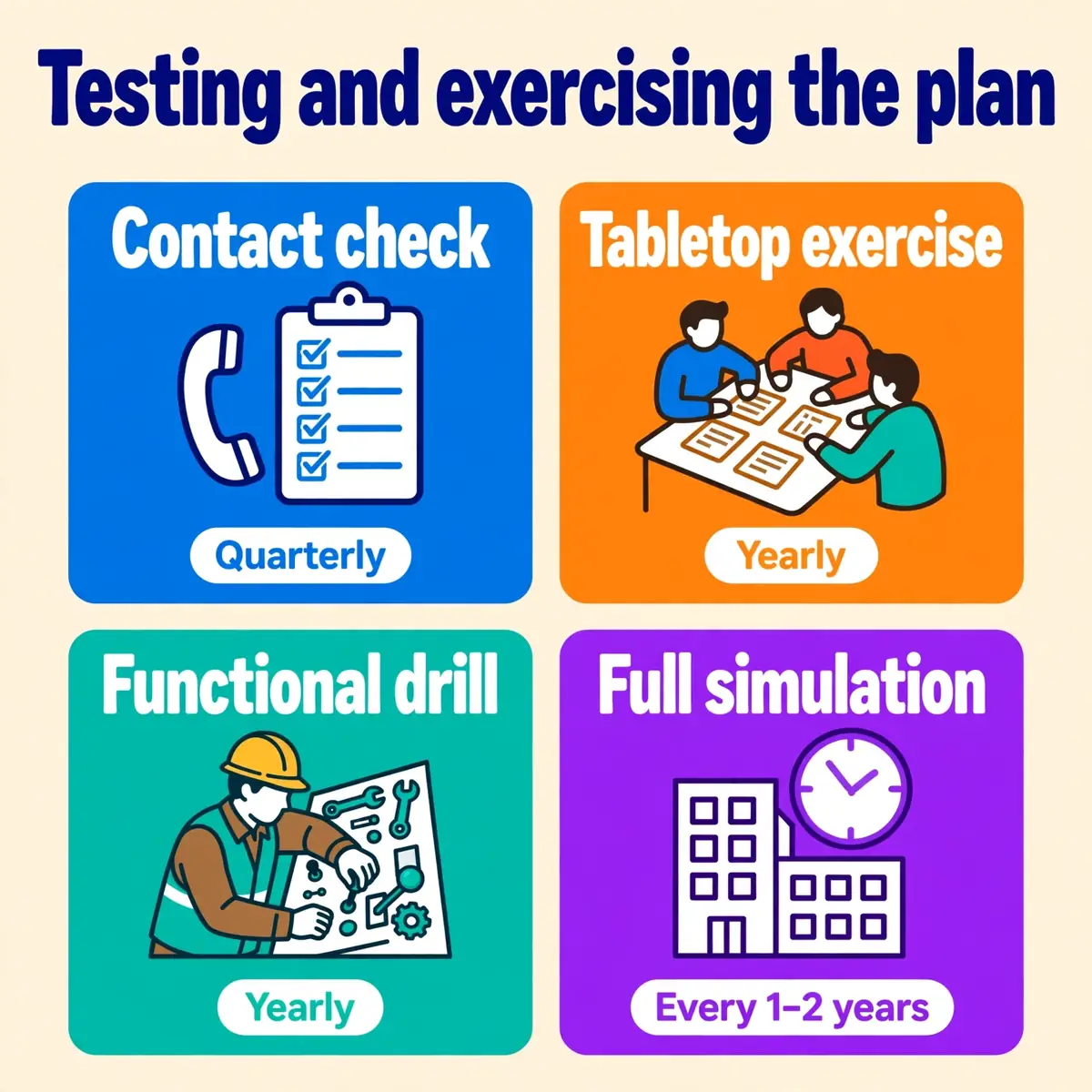
Exercises progress from the cheapest to the most demanding. Start with the first two, then add the others as the plan matures. Each type proves something different, so running the same tabletop every year does not test the whole plan.
| Exercise | What it proves | Suggested frequency |
|---|---|---|
| Contact list check | The numbers and the people behind them are current | Quarterly |
| Tabletop exercise | Roles, decisions and communications hold up in a realistic scenario | Yearly, and after a real incident |
| Functional drill | A single capability works: a system failover, phone forwarding, a manual workaround | Yearly for each critical workaround |
| Full simulation | The whole plan works end to end, under time pressure | Every one to two years, or as regulation or a customer requires |
Record what happened, where assumptions failed and what needs to change. Assign each gap an owner and a due date, then retest significant corrections. An exercise that ends without corrections has only rehearsed the failure.
What a good exercise proves
A good exercise proves three things. First, the people named in the plan can explain what triggers their work. They can also say who authorises it and what completion looks like. Second, the messages reach the right people through the channels the plan names. That includes the alternate channel for when email is down.
Third, that the recovery strategies survive contact with reality. Test the manual workaround by running it for a day. Test the alternate site by working from it. Test the supplier's promise by asking for evidence of its own continuity capability. A supplier that cannot show a plan is a risk, not a recovery strategy. Ask for a last exercise date and recovery objectives for the service you buy.
TipPractise the plan with the same discipline as practice emergency procedures. Run the exercise at a time and with the people who would actually be there. Then debrief while the details are fresh. A drill run at 10 a.m. on a Tuesday does not test the site that exists at 2 a.m.
Who must have a plan: the rules by jurisdiction
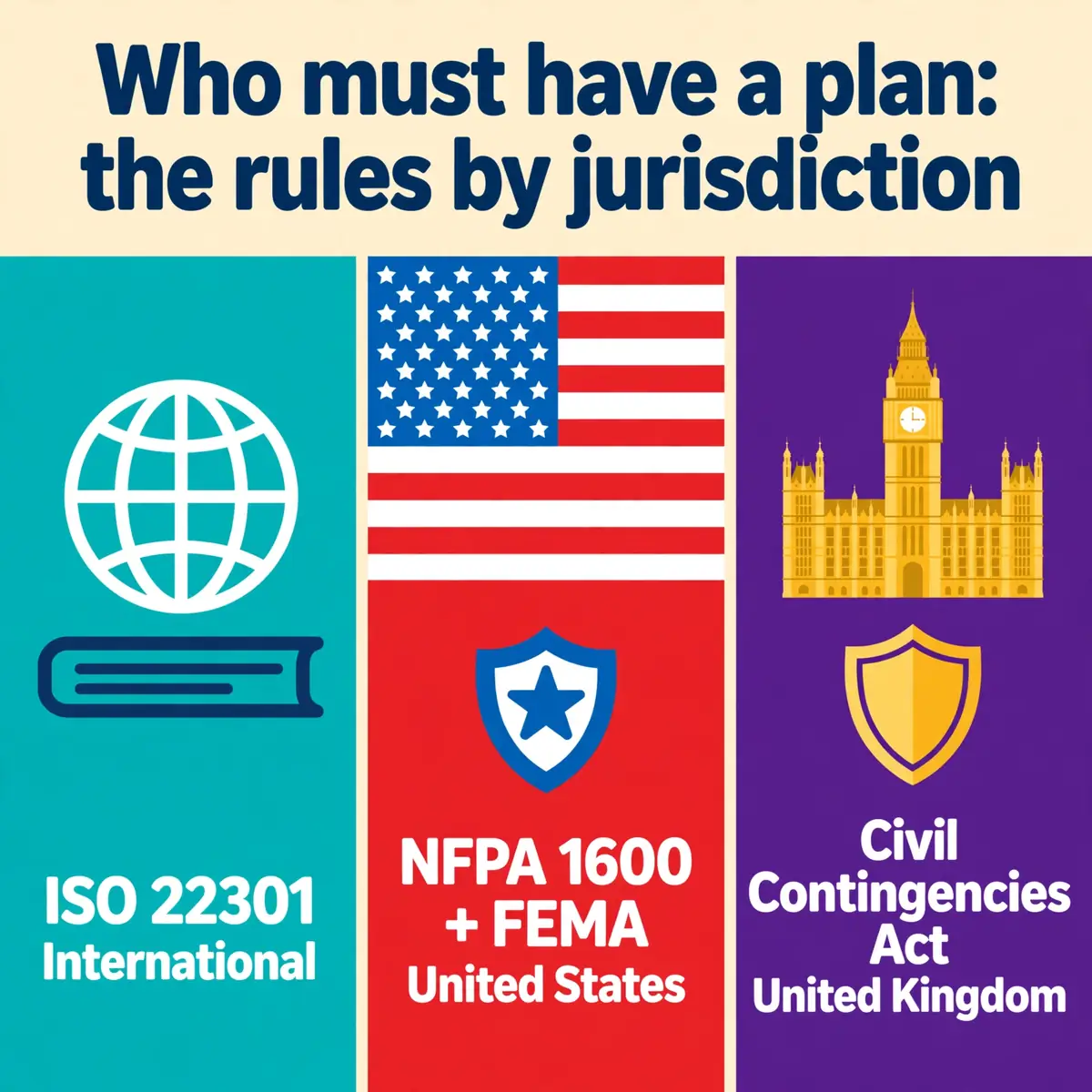
No single law requires every business in every country to hold a business continuity plan. The requirement comes from four places: an international standard, national guidance, sector regulation and customer contracts. Which one applies depends on where the business operates and what it does.
International: ISO 22301
ISO 22301:2019 is the international standard for business continuity management systems. It provides a framework for organisations to plan, establish, implement and operate a documented management system. That system is then monitored, reviewed, maintained and continually improved. It protects against disruptive incidents, reduces their likelihood, and ensures recovery from them.
The standard is voluntary unless a contract, a regulator or a certification requires it. Its clause 8 runs in order. It covers operational planning, business impact analysis and risk assessment. Then come continuity strategies, plans and procedures, the exercise programme, and evaluation. ISO 22313:2020 gives guidance on using the standard, and ISO/TS 22317:2021 gives guidance on the business impact analysis method.
United States: NFPA 1600 and FEMA
In the United States, NFPA 1600 is the national standard for continuity, emergency and crisis management. It is an American National Standard, adopted by the Department of Homeland Security. It sets out the programme elements a preparedness plan should address: programme management, planning, implementation, training and exercises.
FEMA's Ready Business guidance follows the same framework. It gives business leaders a step-by-step way to build emergency preparedness. Its business continuity plan outline covers roles, succession, key suppliers and alternate sites. OSHA's emergency action plan standard, 29 CFR 1910.38, is different: it requires a written plan for evacuation and employee safety, not a continuity plan. The two documents serve different purposes and both are needed.
United Kingdom: the Civil Contingencies Act
In the United Kingdom, the Civil Contingencies Act 2004 places a duty on Category 1 responders. These are the emergency services, local authorities and NHS bodies that protect public safety. They must maintain plans so they can continue to exercise their functions in an emergency. These are the organisations the public depends on most when a disruption happens, and the duty reflects that.
Ordinary businesses are not covered by that duty. For them, business continuity is voluntary, or it is required by a customer contract, an insurer or a sector regulator. The old British standard, BS 25999, was superseded by ISO 22301. A plan written to ISO 22301 is the recognised route for a UK business. It applies when that business wants its continuity capability certified or audited.
WarningDo not tell a UK business that the Civil Contingencies Act requires it to hold a continuity plan. The duty falls on Category 1 responders. For most businesses the driver is a contract, an insurer or a regulator, not that Act.
Sector rules that force a plan
Some sectors carry their own requirement. It is usually written as a contingency plan rather than a business continuity plan. The requirement still has to be met, whatever the name on the document.
- Healthcare (US). The HIPAA Security Rule requires covered entities to maintain a contingency plan with a data backup plan, a disaster recovery plan and an emergency mode operation plan, and to test and revise it periodically.
- Financial services. Regulators and large customers commonly require evidence of continuity arrangements, recovery objectives and exercise records before they will do business.
- Supply chains. A customer with its own ISO 22301 programme will often ask suppliers for a summary of their plan, the date of its last exercise and its recovery objectives.
Common mistakes that leave a plan useless
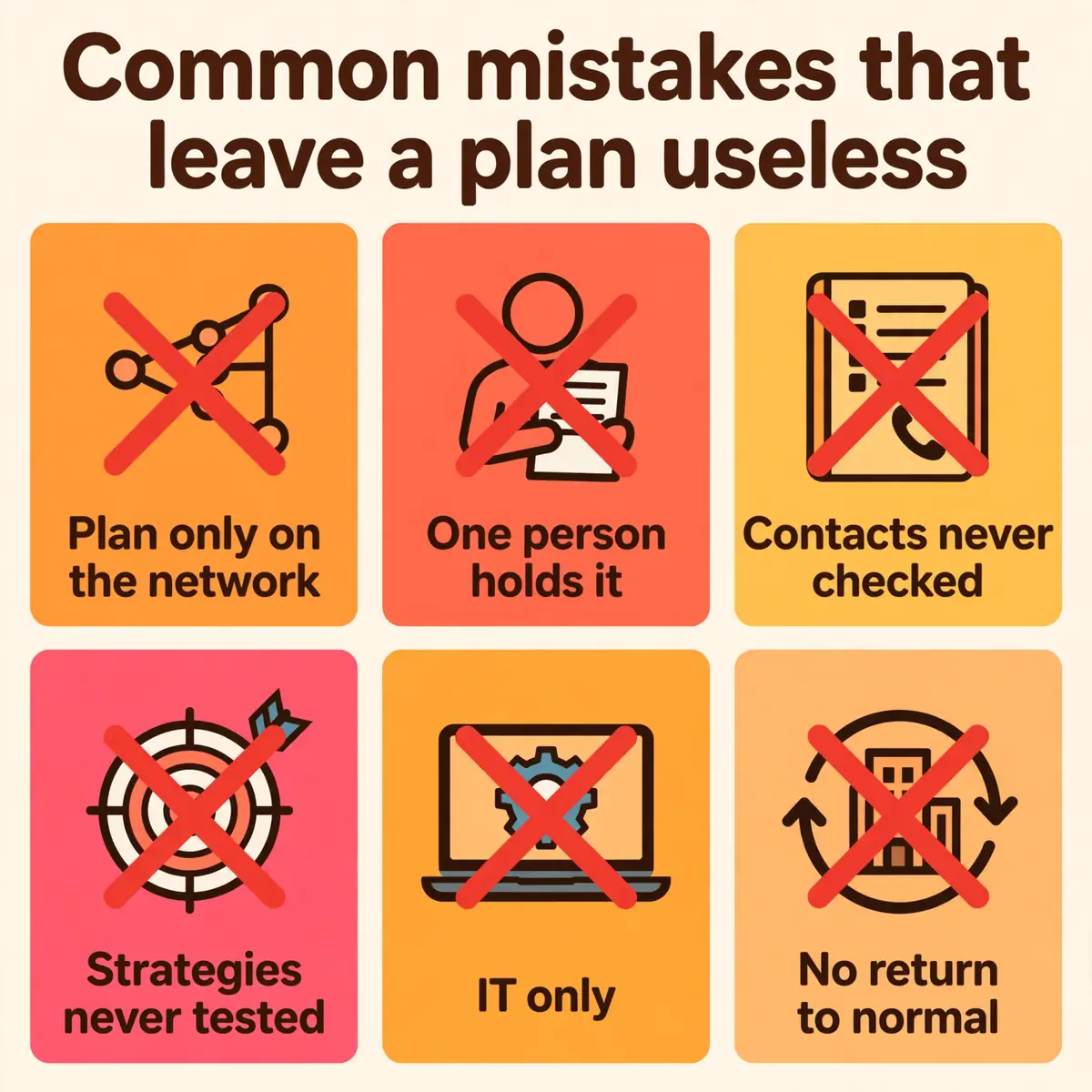
Most failed plans were not badly written. They were written once, filed, and never tested, never updated, and never read by the people named in them. Six mistakes account for most of the failures.
- Stored where the disruption hits. A plan kept only on the company network, or only in the office, is unavailable in the outage it was written for. Keep a printed copy and an off-site electronic copy.
- One person holds it together. If the plan depends on a single person being reachable, it fails the first time that person is on leave, ill or unreachable.
- Contacts are never checked. Phone numbers and roles change constantly. A contact tree that has not been checked this quarter is a list of guesses.
- Strategies are assumed, not tested. A named alternate site that has never been visited, or a supplier that has never shown its own plan, is an assumption.
- The plan covers IT only. Restoring systems is one section of a continuity plan, not the plan itself. People, premises, processes and suppliers need their own strategies.
- No return to normal. A plan that ends when systems are back leaves nobody to reconcile temporary records, clear the backlog and tell customers the service is restored.
Each mistake is cheap to fix and expensive to discover during a real disruption. The test for every section of the plan is the same. Can the person named in it explain what they would do at 2 a.m., with the resources the plan gives them?
Checklist: is your plan ready?
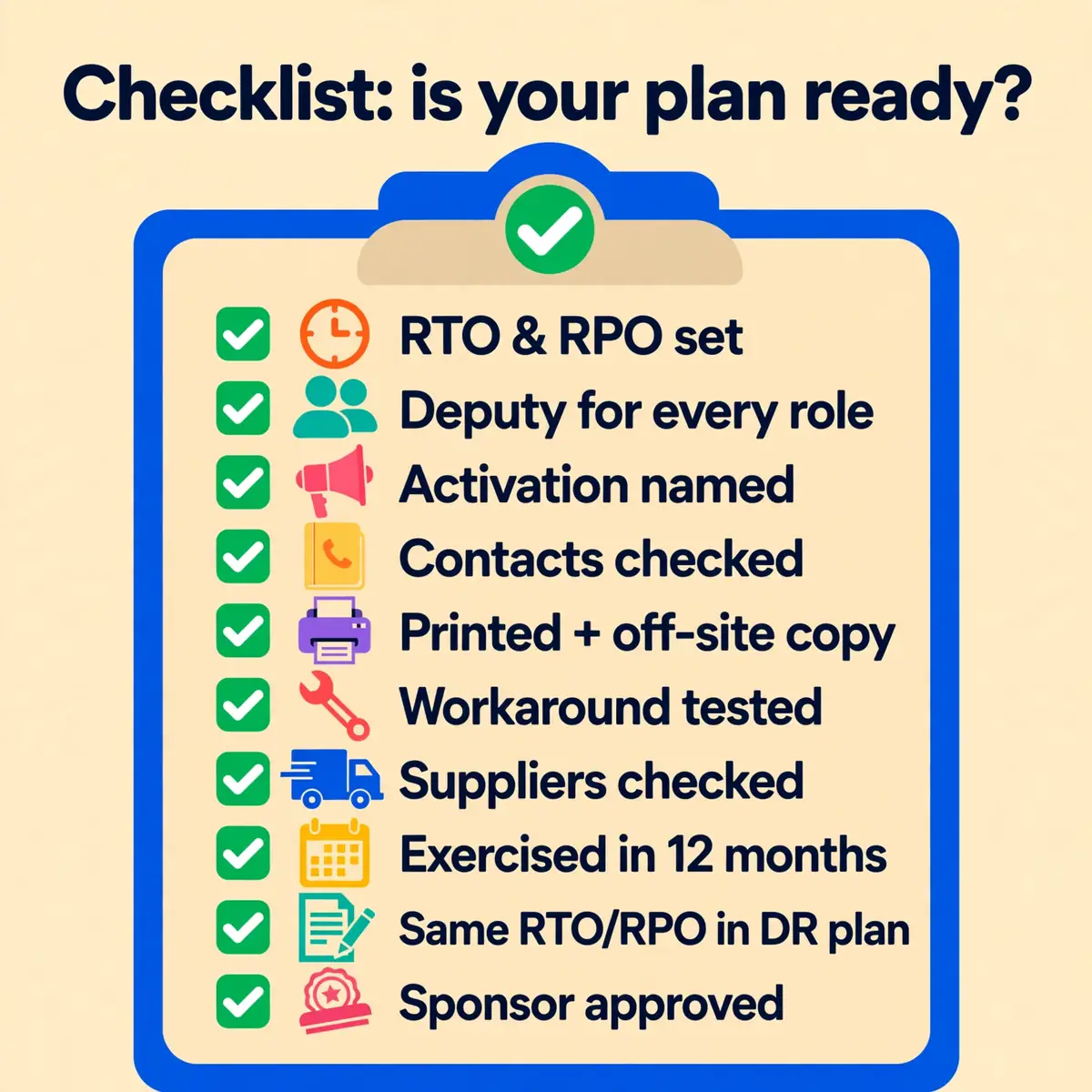
Work through the list before the plan is approved, and again at every annual review. Every item needs a yes, a named owner and a date — a "mostly" is a no.
- Every critical process has an agreed maximum tolerable period of disruption, recovery time objective and recovery point objective.
- Every named role has a deputy, and the deputy has been told and trained.
- Activation criteria are written down, and the person who can declare the plan is named.
- The contact tree has been checked this quarter and works without the company network.
- A printed copy sits where the team will gather, and an electronic copy sits off the company servers.
- Each critical process has a manual workaround, and at least one has been run for real.
- Key suppliers have shown their own continuity capability, with a last exercise date.
- The plan has been exercised in the last twelve months, and every gap found has an owner and a due date.
- The disaster recovery plan cites the same recovery time and recovery point objectives as the impact analysis.
- The sponsor has approved the current version, and the next review date is on the cover.
Frequently Asked Questions
What is the difference between a business continuity plan and a disaster recovery plan?
A business continuity plan covers the whole business: people, premises, processes, suppliers and systems. A disaster recovery plan covers only the technical restoration of IT services and data. The disaster recovery plan is one part of the continuity plan. The two must use the same recovery time and recovery point objectives.
How long does it take to write a business continuity plan?
A small business can usually produce a usable first version in a few weeks of part-time work. The heavy work is the business impact analysis: interviewing process owners and agreeing recovery targets. A larger organisation with several sites and regulated services should allow a few months, including the first tabletop exercise.
How often should a business continuity plan be tested?
Run a tabletop exercise at least once a year, and check the contact list every quarter. Test each critical manual workaround at least once a year. Run the IT recovery test on the schedule in the disaster recovery plan. Exercise again after any real incident. Exercise again after a major change, such as a move, a new system or a change of key staff.
What is a good recovery time objective?
There is no universal good number. A good recovery time objective sits inside the maximum tolerable period of disruption for that process. It leaves time for the work recovery that follows restoration, and it has been tested. Four hours is a reasonable target for taking customer orders in a small business. It would be far too slow for a payment service.
Does a small business need a business continuity plan?
Yes, if it would lose money, customers or a legal deadline within days of stopping. The plan can be short. Cover the handful of processes that matter, name a deputy for each role, and keep a printed copy off site. The discipline is the same at any scale; only the length of the document changes.
Who should own the business continuity plan?
One named plan owner coordinates the document, the review calendar and the exercises. A deputy owner is named from the start. An executive sponsor approves the plan, settles conflicts between departments and reviews a one-page status each quarter. Process owners keep their own sections current.
What is the difference between RTO and RPO?
The recovery time objective is how quickly a process must be running again after a disruption. The recovery point objective is how much data, measured in time, the process can afford to lose. An RTO of four hours and an RPO of one hour means two things. The process is back within four hours. No more than one hour of data is lost.
Sources
- ISO 22301:2019 — Security and resilience: Business continuity management systems — Requirements
- NIST SP 800-34 Rev. 1 — Contingency Planning Guide for Federal Information Systems
- Ready.gov — Business continuity plan
- NFPA 1600 — Standard on Continuity, Emergency, and Crisis Management
- Civil Contingencies Act 2004 (UK)
- Mitratech — How to Build and Maintain a Business Continuity Plan in 2026
- NetSys Group — Business Continuity Plan Template, With a Sample Plan
- JPMorgan — Business Continuity Plan (BCP): What is it & How Does it Work?
- Acronis — Why Every Business Needs a Business Continuity Plan (BCP Plan)