


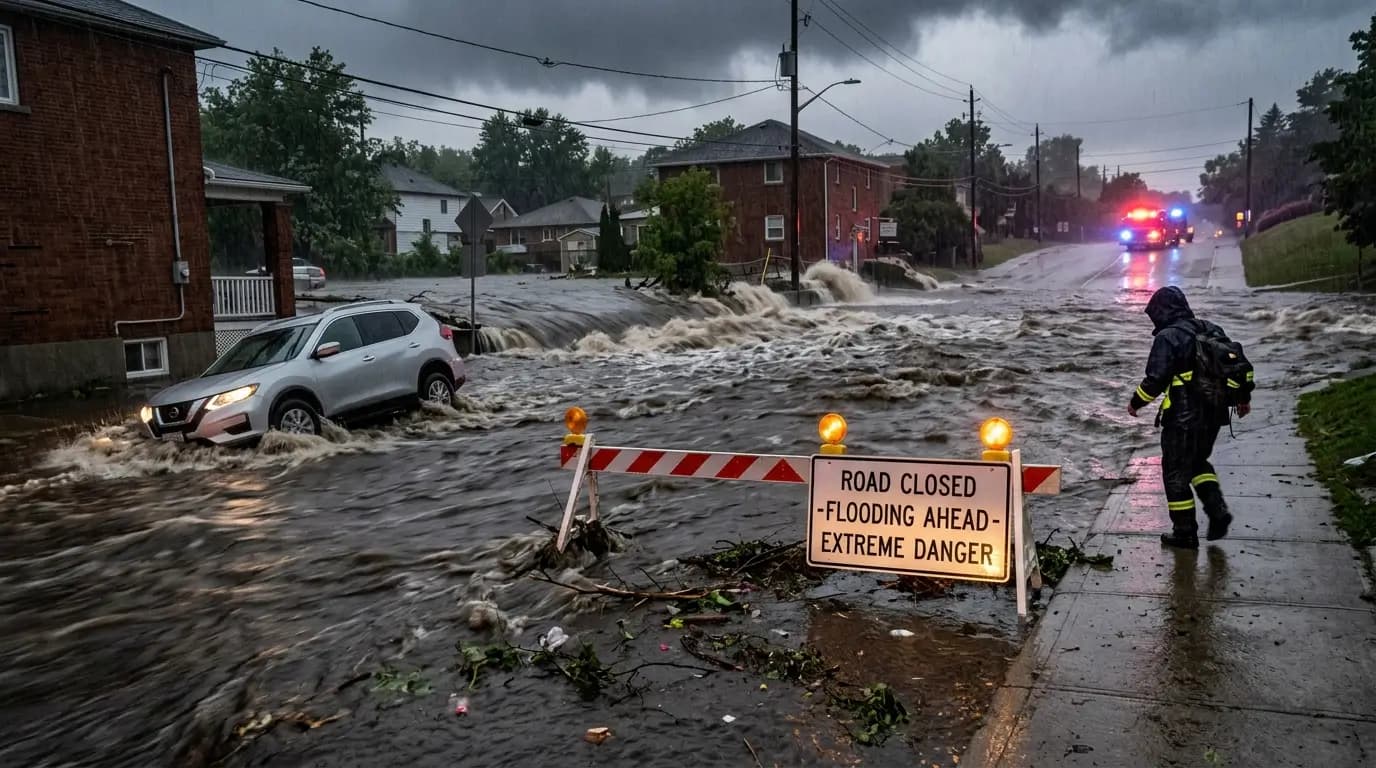
Most flash flood advice is written for someone standing in their kitchen deciding whether to leave the house. It doesn't say much about a site with forty people spread across three contractors, a laydown yard sitting six feet lower than the access road, and a supervisor who has to decide — right now, without waiting for a call from head office — whether to stop work. Verifying that a mustered headcount, a refuge point, or a muster assurance programme actually works under real conditions, not just on paper, has been most of my job across a mine emergency-response programme in southern Africa, a water utility in Ireland and France, and an urban infrastructure programme across three European cities. The gap between a written plan and one that functions in the first ninety seconds is where flash flood incidents on worksites actually happen.
This article covers what flash flooding is and what causes it, but it spends most of its length on the part general safety guides skip: what a site's emergency coordinator, supervisor, and headcount controller each need to do differently, and a specific gap in the UK warning system that catches sites that assume they'll get an official alert.
Key takeaways
The six points below are the ones most household-facing guides leave out, and the ones that actually change what a site does differently:
- A flash flood typically develops within six hours of the triggering rainfall, dam failure, or ice melt — often within minutes — which is too fast for most sites' standard weather-monitoring routine to catch on its own.
- In the US, the National Weather Service tags Flash Flood Warnings as Base, Considerable, or Catastrophic — but phone-based Wireless Emergency Alerts only fire for Considerable and Catastrophic tags, so a site whose trigger is "wait for a phone alert" will miss the earliest warning stage.
- The UK Environment Agency's flood warning service explicitly does not cover surface water or flash flooding — GOV.UK states this directly: "You cannot get flood warnings for surface water flooding (sometimes known as 'flash flooding')."
- US employers need a written emergency action plan under 29 CFR 1910.38 wherever an OSHA standard requires one — but the standard sets minimum content, not a flood-specific trigger, so the trigger has to be written in separately.
- Six inches of fast-moving water can knock an adult off their feet, and the National Weather Service's Turn Around Don't Drown guidance puts the threshold for carrying away most cars at twelve inches, and SUVs or trucks at two feet.
- A headcount taken at a muster point means nothing if nobody has verified that every route to that point still exists once the water is moving — and that verification is a task, not an assumption.
What flash flooding is, and why the workplace version differs
A flash flood is a rapid rise of water into a normally dry area, typically within six hours of the rainfall, dam or levee failure, ice melt, or blocked drainage that caused it — sometimes within minutes. That speed is what separates it from an ordinary flood, which builds over days as rivers rise and can usually be tracked on a forecast.
The causes are well covered elsewhere and worth summarising briefly: intense rainfall exceeding what soil or drainage can absorb, dam or levee failure, rapid snow or ice melt, blocked or undersized drainage, and landslide or glacial lake outburst events. What's less covered is that a workplace multiplies several of these causes at once. A construction site strips vegetation and compacts soil, which increases runoff. An excavation or a below-grade plant room is a sump by geometry, whether anyone designed it to be one or not. A site laydown yard built on cheap, low-lying land because it was cheap and low-lying is, by definition, sited where water goes.
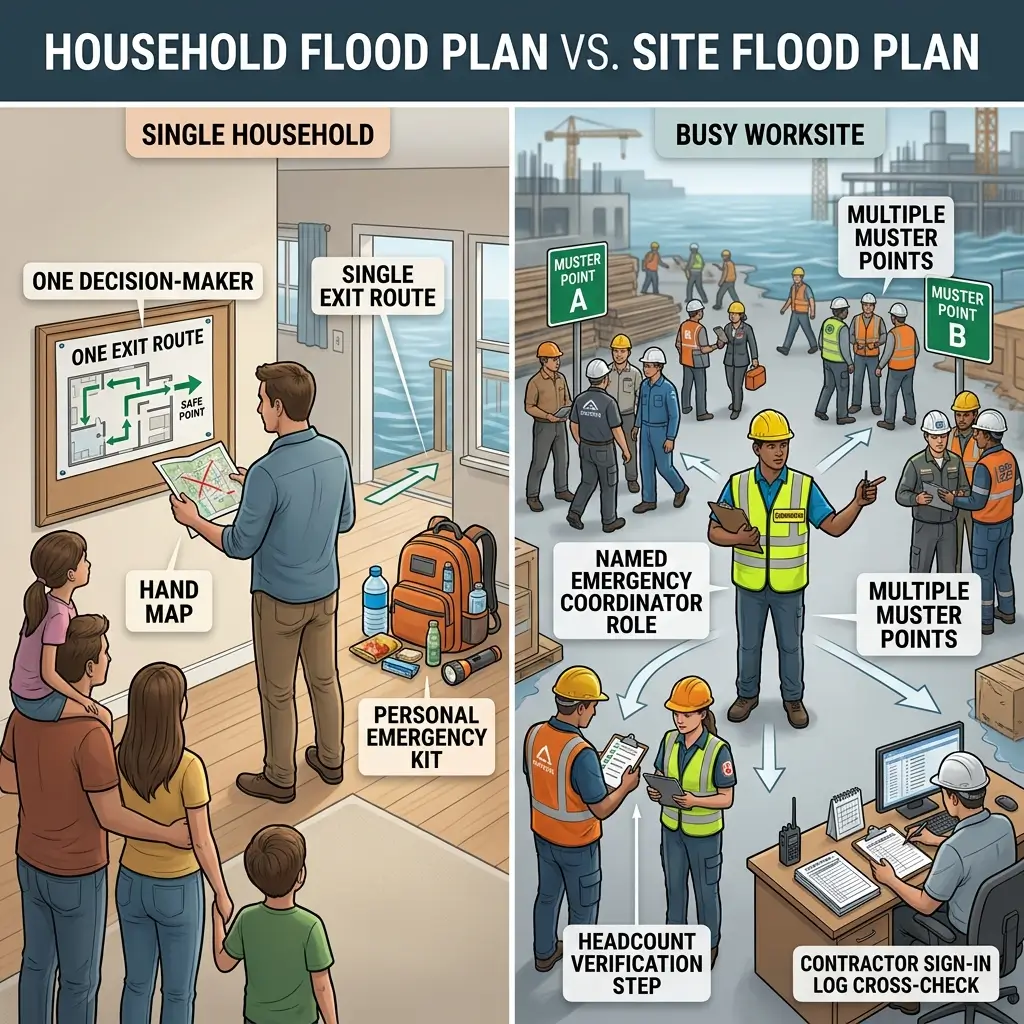
The household version of this advice assumes one household, one decision-maker, one exit. A worksite has multiple employers, workers who don't know the site as well as the people who work there daily, and — critically — no single person whose job is obviously "decide when we leave" unless that's been assigned in advance. I've inspected enough site layouts across mining, water utility, and urban construction work to say the geometry is never neutral: someone chose where the laydown yard sits, and that choice usually got made on land cost, not drainage.
Watch, warning, emergency — and a gap most sites miss
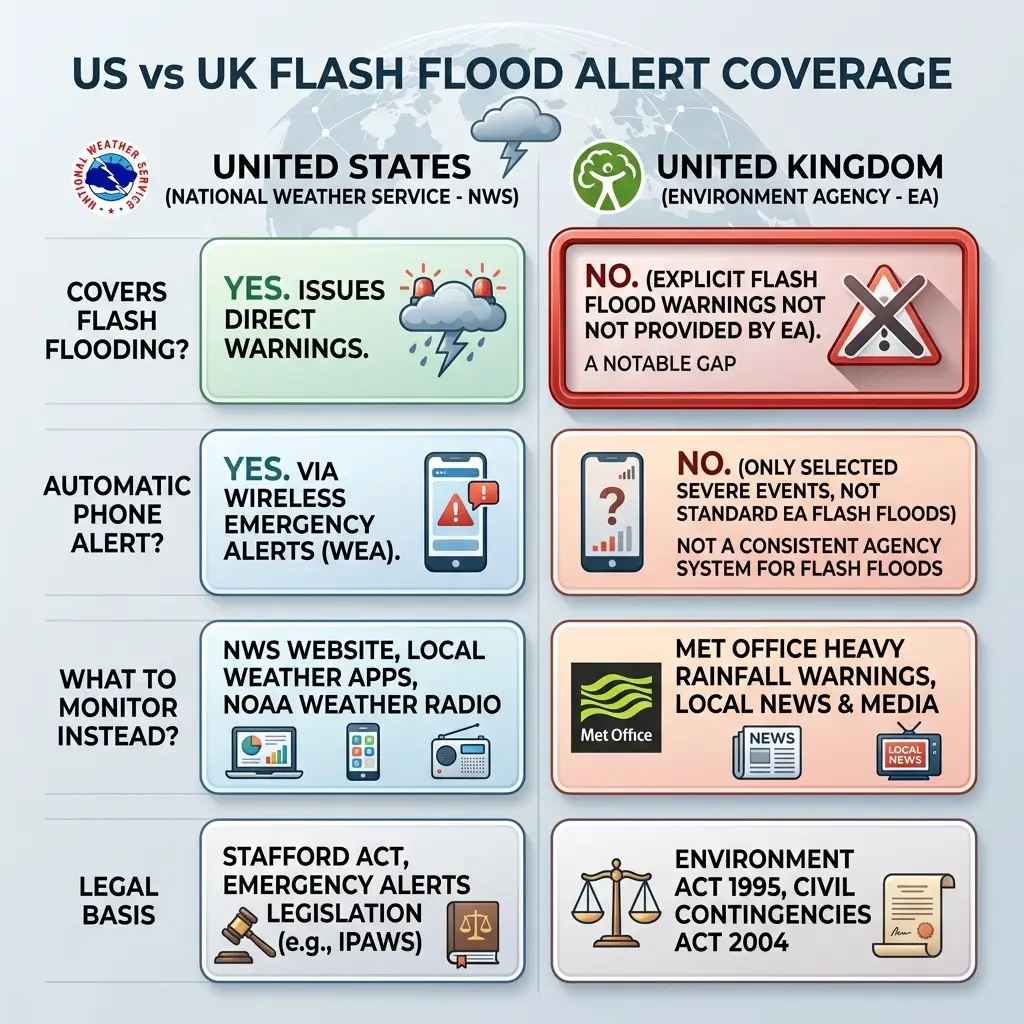
The US and UK systems both use tiered alerts, and they don't work the same way. Treating them as interchangeable is where a written trigger goes wrong.
In the US, the National Weather Service issues a Flash Flood Watch when conditions are favourable but flooding isn't certain, and a Flash Flood Warning when it's imminent or occurring. Since the move to impact-based warnings, every Flash Flood Warning also carries a damage-threat tag: unflagged (the base tier), Considerable, or Catastrophic. Wireless Emergency Alerts — the automatic push notification to phones in the warned area — are limited to Considerable and Catastrophic tags. A base-tier Flash Flood Warning, which still means flash flooding is imminent or occurring, will not push an alert to anyone's phone. Rarer still is a Flash Flood Emergency, reserved for a severe, catastrophic threat to life that is happening or about to happen.
In the UK, the Environment Agency issues Flood Alert, Flood Warning, and Severe Flood Warning — but this service covers rivers, the sea, and in limited locations groundwater. It does not cover surface water or flash flooding. GOV.UK's own registration page is explicit about this: "You cannot get flood warnings for surface water flooding (sometimes known as 'flash flooding')." A UK site's flood plan built around "we'll get a Floodline alert" has a blind spot for the exact hazard the plan is meant to cover.
| US — National Weather Service | UK — Environment Agency | |
|---|---|---|
| Covers flash/surface water flooding? | Yes — dedicated Flash Flood Watch/Warning/Emergency products | No — explicitly excluded from the flood warning service |
| Automatic phone alert | Yes, for Considerable/Catastrophic Flash Flood Warnings only | Yes, for river/sea/groundwater alerts you register for — not applicable to flash flooding |
| What a site should actually monitor | NWS Flash Flood Warning issuance, regardless of WEA push | Met Office rainfall warnings and local, site-level rainfall/drainage monitoring |
| Legal basis to plan for it | 29 CFR 1910.38 — emergency action plan | HSWA 1974 s.2 — general duty to plan for foreseeable risks |
The practical consequence: a US site whose trigger is "wait for the phone to buzz" misses the base tier. A UK site whose trigger is "wait for an Environment Agency alert" misses the hazard entirely and needs to build its own local rainfall/drainage-level trigger instead.
⚖️ Jurisdiction note: Where the article says "warning," check which country's system it means — the two are not equivalent, and a site operating in both needs two separate written triggers, not one translated.
Four types, and which one actually threatens your site
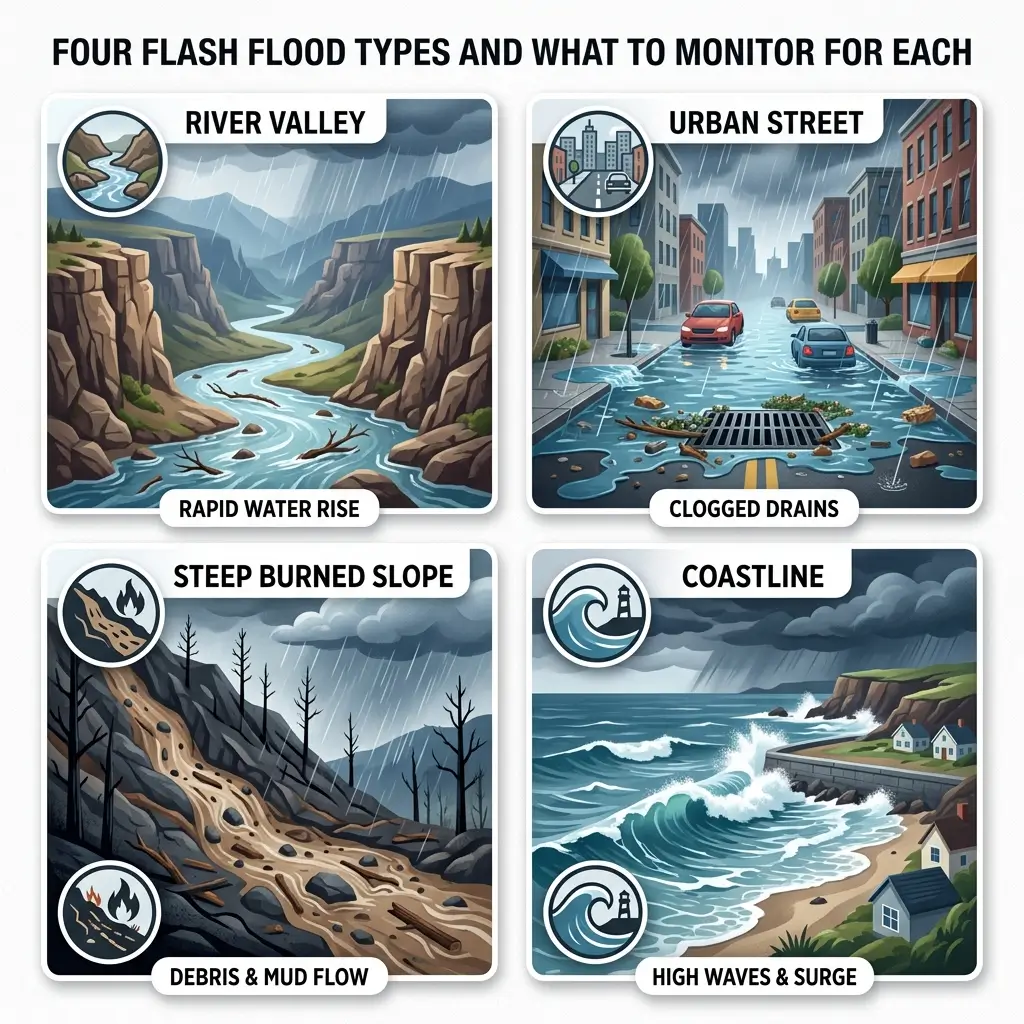
Not every site faces the same version of this hazard, and the type determines what you should be watching.
Riverine flash flooding hits sites near small rivers or steep-valley streams, where water can rise several feet in minutes and move fast enough to sweep away vehicles and equipment. If your site sits in or near a narrow valley, this is your primary exposure, and rainfall upstream — not rainfall on your site — is what to track.
Urban and stormwater flash flooding is the one most sites actually face, because most sites sit on paved or compacted ground. Storm drains overwhelmed by debris or simply undersized for the rainfall rate send water into streets, basements, and below-grade plant rooms within minutes. This is the type I've seen catch sites off guard most often, because the trigger — an overflowing drain — looks like routine bad weather until it isn't.
Debris flow, a mix of water, soil, rock, and vegetation, follows wildfire-scarred or steep terrain after intense rain and can move fast enough to carry vehicle-sized debris. Sites doing earthworks, civil infrastructure, or anything downstream of recently burned land should treat this as a distinct hazard from ordinary flooding, not a variant of it.
Coastal flash flooding combines storm surge with the speed of a flash flood, most relevant to ports, coastal construction, and low-lying dockside operations, especially around high tide.
A site can face more than one type — an urban site downstream of a burned hillside faces both stormwater and debris-flow risk, and the trigger for each is different. Across the mining sites I've worked on in southern Africa and steep-terrain sites in Canada, the type that gets underestimated most is debris flow, because it's filed mentally under "flooding" when it behaves more like a landslide with the speed of water.
The type of flash flooding a site faces should decide what gets monitored, not a generic "watch the weather" instruction:
- Riverine — track upstream rainfall, not just rainfall on site
- Urban/stormwater — track drain and gutter capacity against sustained rainfall
- Debris flow — track burn-scar and steep-slope conditions upstream, separately from ordinary rain
- Coastal — track storm surge forecasts and tide timing together, not either alone
What this means depending on your role on site
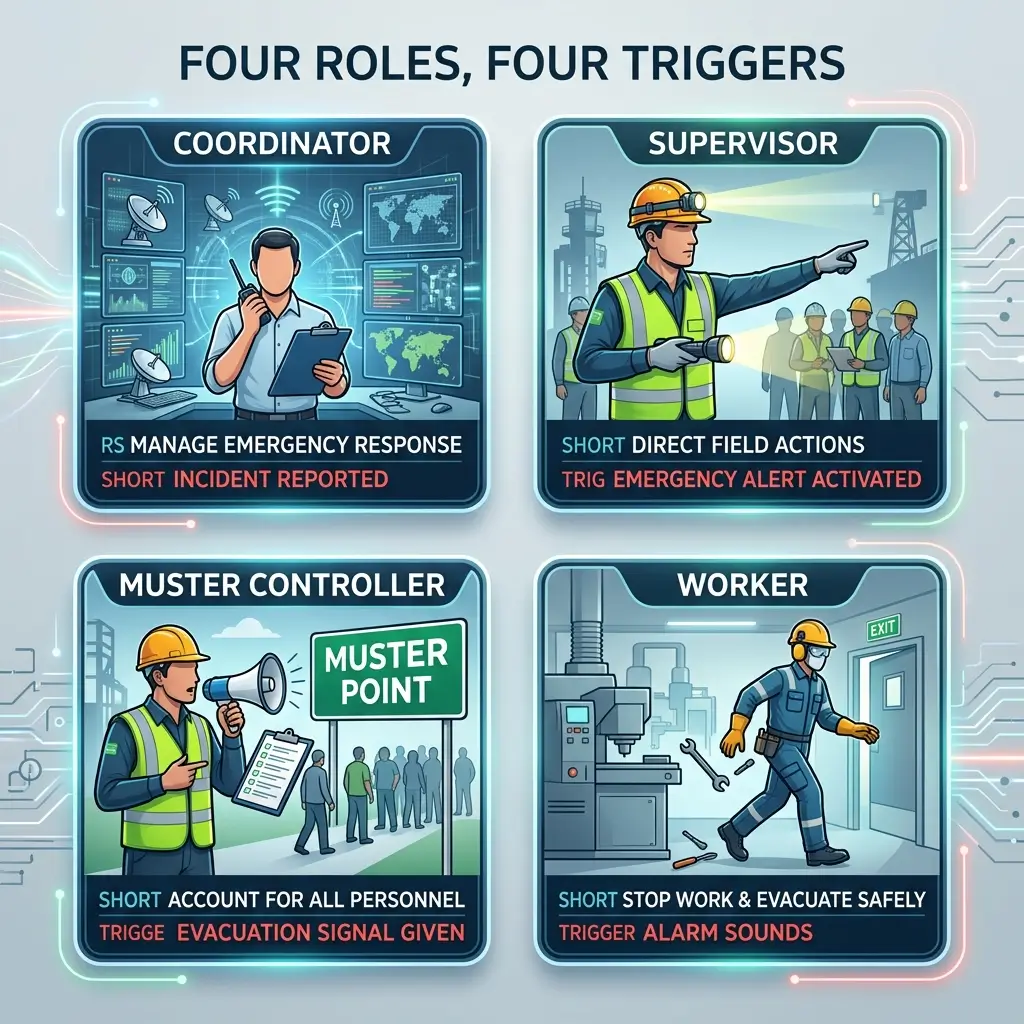
A written plan that only says "evacuate if flooding occurs" hasn't actually assigned anything. Four roles carry distinct, specific responsibilities, and the plan should name who holds each one.
The emergency coordinator — setting the trigger in advance
The coordinator's job is to have already decided, in writing, what triggers a stop-work-and-evacuate call — a specific rainfall rate, a specific water level at a specific point, or a specific alert tier — so that nobody is making that judgment call for the first time while water is already moving. On a mine emergency-response programme across South Africa, Zambia, and Canada, the recurring failure I found wasn't a missing plan. It was a plan that existed on paper but had never been tested against the actual physical layout — a refuge point whose door seal hadn't been pressure-tested, a muster count that assumed radio coverage that didn't reach the lower levels. The lesson transfers directly: a flood trigger that's never been rehearsed against the site's real geography is a trigger nobody will actually use under pressure.
The field supervisor — recognising signs, acting without delay
A supervisor doesn't need to wait for the coordinator's call if the signs are already there: a storm drain running backward, water rising in a ditch that was dry an hour ago, a distant roar from a culvert or streambed, or heavy rain sustained for more than 30 minutes with visibly overwhelmed drainage. The plan needs to state explicitly that a supervisor has standing authority to stop work and move people to high ground without waiting for sign-off — because the alternative is a chain-of-command delay measured in the minutes a flash flood doesn't give you.
On the urban infrastructure programme I ran with Skanska, the written plan already gave supervisors that authority. The gap I kept finding was that supervisors didn't believe it applied to weather, only to obvious site hazards like a crane fault. That belief has to be corrected in the toolbox talk, not just in the document.
The muster controller — proving the headcount is real
A "headcount taken" line in an incident log is not evidence anyone actually counted correctly. Verifying evacuation and muster arrangements under real conditions — not the conditions the plan assumed — was the specific discipline built into the Skanska public-interface programme across Dublin, London, and Stockholm, where crane zones and public barriers had to keep working in an active urban environment, not an idealised one.
Applied here, the controller's job before any flood risk arrives is to confirm that every named muster point is reachable by a route that doesn't itself cross low ground. The headcount then gets cross-checked against contractor sign-in logs, rather than accepted from whoever happens to answer a roll call.
The individual worker — what to do in the moment
If water is rising, moving toward high ground beats waiting for instructions. Six inches of fast-moving water can knock an adult down, and the same NWS guidance puts the point where moving water carries off most cars at twelve inches, and larger vehicles at two feet — so a flooded site road is not a "drive through carefully" situation, on foot or in a vehicle. If a vehicle is caught and starts taking on water, get out and onto the roof rather than staying inside as the level rises. Standing water on a work site may be carrying sewage, chemicals from a plant area, or a live electrical fault, so treat any floodwater at or near equipment as electrically hazardous until someone qualified says otherwise.
The lead-in for each role, if you had to write it as a checklist:
- Coordinator: trigger defined in writing before the season starts, tested against the site's actual layout
- Supervisor: standing authority to stop work and move people without waiting for sign-off
- Muster controller: routes to muster points verified as passable, headcount cross-checked against sign-in records
- Worker: move to high ground on the first sign, never enter moving water on foot or by vehicle
After the water recedes: site re-entry hazards
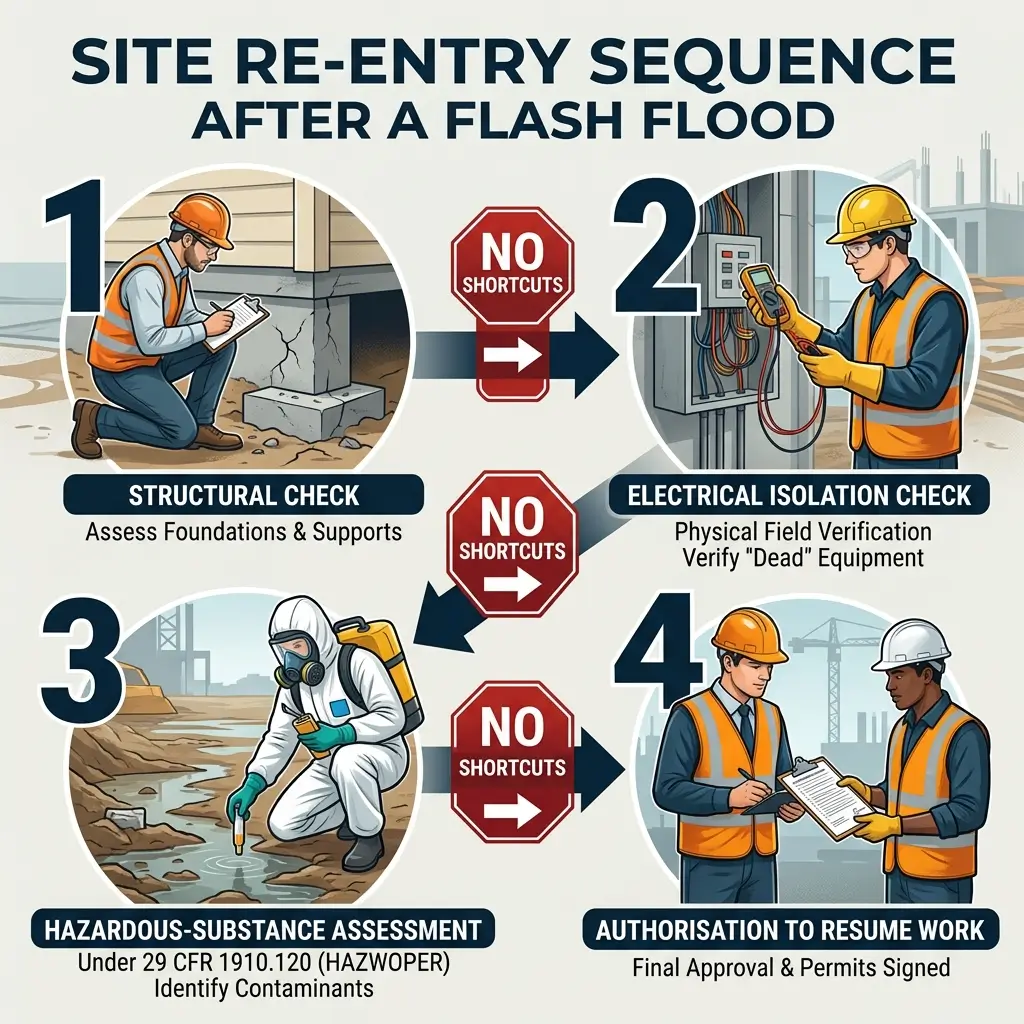
Household advice on flood recovery is mostly about mould and insurance claims. A site has a narrower, sharper set of hazards before anyone should be allowed back in.
Floodwater that has moved across a work site may have picked up fuel, solvents, or chemicals from a storage area, and standing water anywhere near electrical distribution should be treated as live until a qualified electrician confirms otherwise. Where flood response or recovery work brings employees into contact with an unknown mix of hazardous substances — which is common on an industrial or construction site — OSHA's Hazardous Waste Operations and Emergency Response standard, 29 CFR 1910.120, can apply to the response operation itself, not just to the everyday work. That's a training and PPE trigger most sites don't think to check until it's already been missed.
Structural checks matter before anyone resumes normal movement around the site: a road or slab that looked intact from a distance may have been undercut, and debris carried in by the water can conceal drops, exposed rebar, or unstable ground. None of this should be assessed by whoever happens to be first back on site — it needs a specific, named re-entry check before work resumes, the same way a confined space needs gas testing before entry rather than after someone's already inside.
📋 From the field: The water utility site I worked at in the Dublin region had a standing rule that no plant room below grade got re-entered after any flood event until someone had confirmed the electrical isolation independently — not from the panel schedule, but by physically checking the breaker. It cost fifteen minutes. The alternative, on a site where the panel schedule and the actual wiring had drifted apart years earlier, would have cost considerably more.
Building the trigger into your emergency action plan
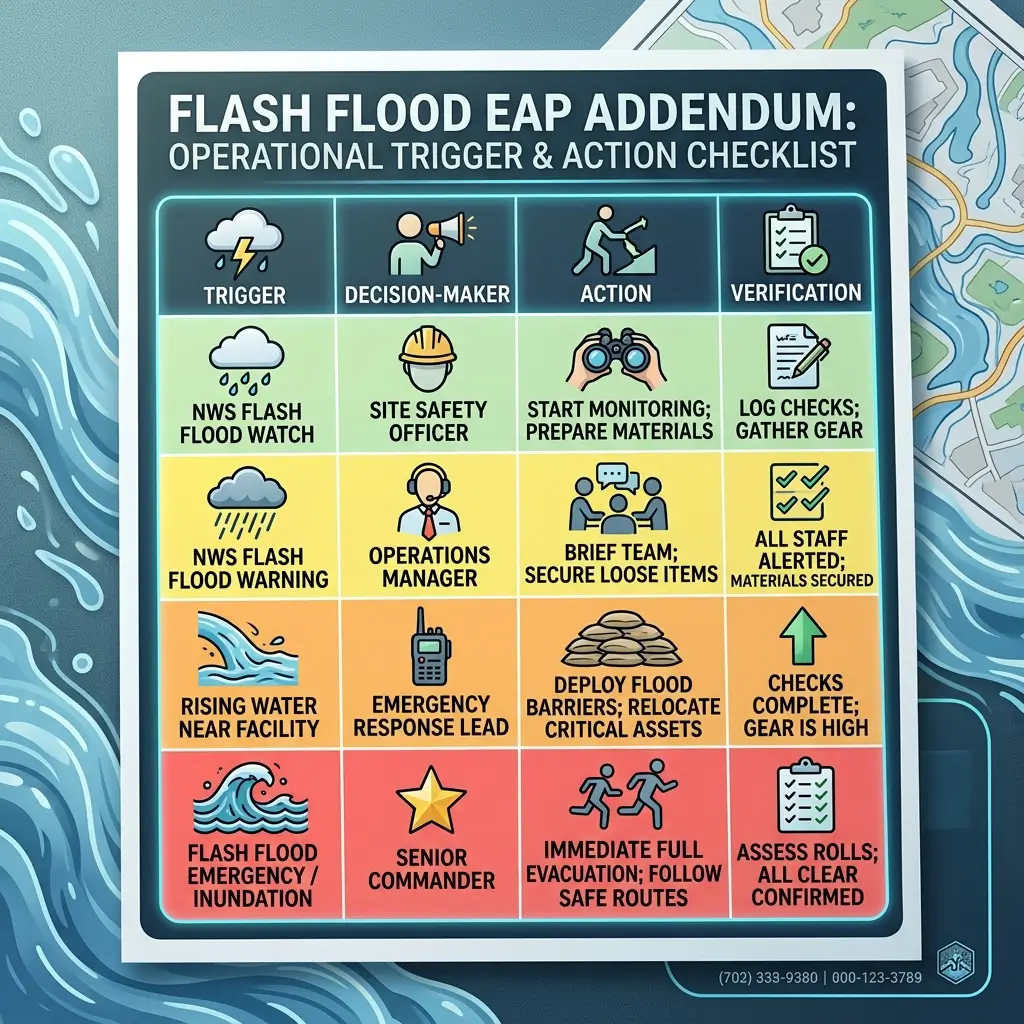
An emergency action plan under 1910.38 has to include evacuation procedures, a way to account for everyone afterward, and a way for people to report the emergency — but it doesn't have to specify what triggers a flood-specific evacuation unless you write that in. Left blank, that decision defaults to whoever is on site when the water starts rising, which is the worst possible time to invent a threshold.
A flood-specific EAP addendum should name the exact trigger, who owns the call, what happens, and how it gets verified — not as separate documents, but as one table anyone on site can find and read in under a minute:
| Trigger | Who decides | Action | How it's verified |
|---|---|---|---|
| Flash Flood Warning issued for the site's watershed (any damage-threat tag) | Emergency coordinator, or supervisor if coordinator unreachable | Stop outdoor and below-grade work; move to pre-named high ground | Coordinator confirms via the NWS/Met Office feed directly, rather than relying on a phone alert |
| Storm drain or ditch visibly overwhelmed on site | Any supervisor, no sign-off required | Immediate stop-work and move to high ground | Logged after the fact, not before acting |
| Sustained heavy rain (30+ min) with low visibility | Any supervisor | Suspend outdoor work, prepare to evacuate | Reassessed every 15 minutes until rain eases or escalates |
| Post-event re-entry | Site electrical/structural competent person | No re-entry to below-grade or flooded areas until sign-off | Physical isolation check, not a panel-schedule check |
Building the table costs an afternoon. Not having it costs the minutes a flash flood doesn't give back.
Frequently asked questions
These are the questions that come up most once the causes and types are already understood.
How much warning do you actually get before a flash flood?
Often very little. Flash floods typically develop within six hours of the triggering rainfall or dam failure, and sometimes within minutes, which is why a site's own drainage and rainfall observation matters as much as any official alert.
Does my emergency action plan need to cover flash flooding?
In the US, 29 CFR 1910.38 requires a written plan with minimum elements but doesn't mandate a flood-specific trigger — that has to be added deliberately, matched to the site's actual flood exposure.
Can staff be made to keep working during a flood warning?
There's no blanket rule against it, but a supervisor should have standing authority to stop work regardless of what the schedule says once the warning signs described above are present — production pressure is a real constraint, and the plan should say explicitly that safety authority overrides it.
What's the difference between a Flood Watch and a Flash Flood Warning?
A watch means conditions are favourable for flooding but it isn't certain; a warning means flash flooding is imminent or already happening, and requires immediate action, not continued monitoring.
Is floodwater on a work site dangerous even if it looks shallow?
Yes. It may carry chemicals, sewage, or an electrical fault, and the depth needed to sweep a person off their feet is only six inches of moving water.
Do UK sites get advance warning for flash flooding?
Not from the Environment Agency's flood warning service, which explicitly excludes surface water and flash flooding. UK sites need to rely on Met Office rainfall warnings and their own local monitoring instead.
What should a lone worker do if their vehicle floods?
Get out immediately rather than waiting to see if the water keeps rising, and move to the vehicle roof or higher ground if the water is already too deep or fast to walk through safely.
The trigger is the plan
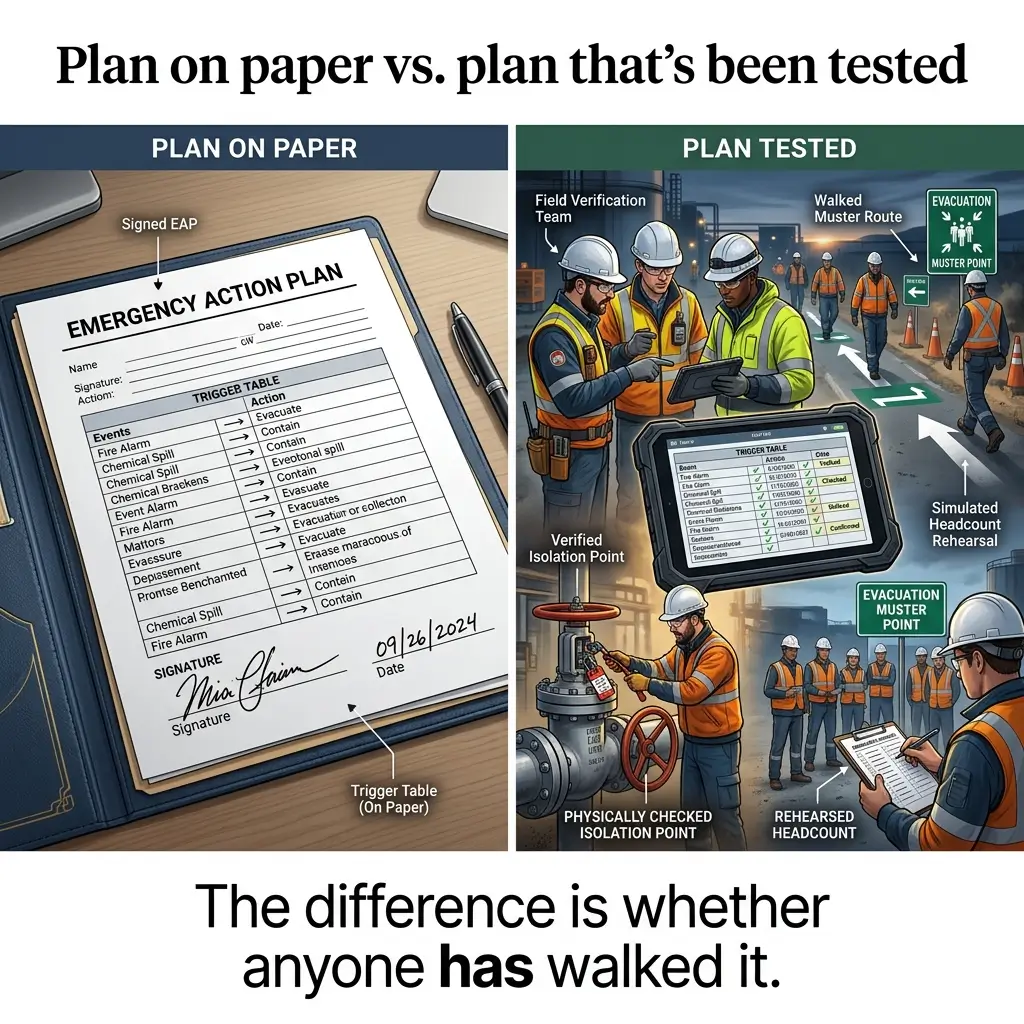
Flash flooding punishes plans that exist only on paper. The causes and types are the easy part to learn; the part that actually protects people is deciding, in advance and in writing, who calls it and on what signal — then testing that decision against the site's real geography before the water ever arrives. A muster point that's never been walked in the rain, a trigger that's never been checked against how fast the nearest drain actually overflows, is a plan that looks complete and isn't.
About the author — Grace Thompson
Grace Thompson is an Irish Occupational Health, Safety and Environment (OHSE) Human Factors, Fatigue and Emergency Preparedness Consultant with 15 years of continuous field experience across 14 countries. Her emergency-preparedness work has included a mine emergency-response and muster-assurance programme across South Africa, Zambia, and Canada for Glencore, water utility HSE advisory work with Veolia across Ireland, France, and Spain, and an urban infrastructure public-interface HSE programme spanning Dublin, London, and Stockholm for Skanska. She currently leads Thompson Human Factors Safety, based in Dublin.
Sources
- OSHA — Flood Preparedness and Response
- OSHA — 29 CFR 1910.38, Emergency action plans
- OSHA — Hazardous Waste Operations and Emergency Response (HAZWOPER)
- National Weather Service — Flood Related Products
- National Weather Service — Flash Flood Impact-Based Warnings
- National Weather Service — Turn Around Don't Drown
- GOV.UK — Get flood warnings by text, phone or email
- GOV.UK — Check for flooding
- legislation.gov.uk — Health and Safety at Work etc. Act 1974, Section 2
- NFPA — NFPA 1660 (2024), Standard for Emergency, Continuity, and Crisis Management