

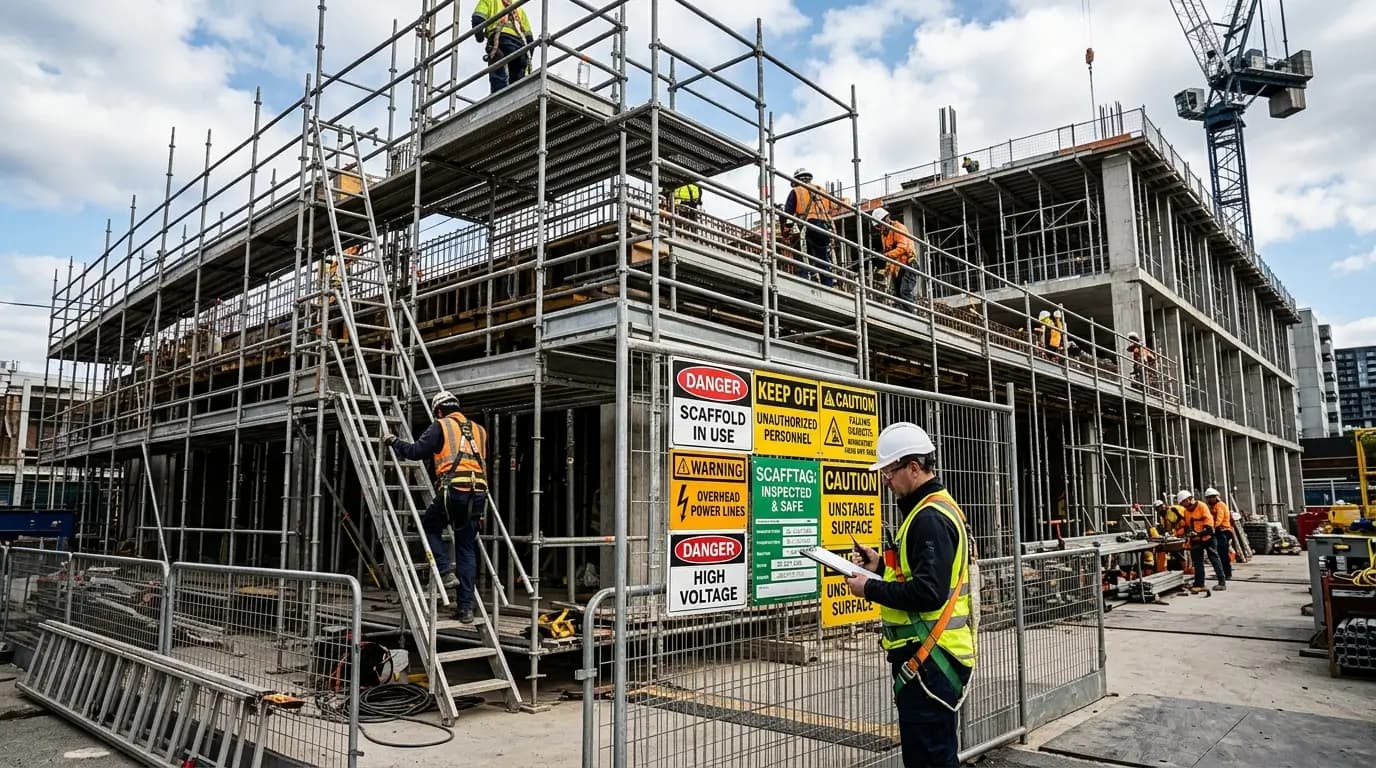
On a Dragados USA assignment in Mexico, I walked a scaffold that had a complete, correctly-worded "Scaffold Incomplete — Do Not Use" tag hanging at the access point. The paperwork was right. What was wrong was twelve feet along the same lift: the edge above a public walkway had no toe board, no screen, and a stack of loose fixings sitting on the open deck. The tag told the truth about the ladder. It said nothing about the edge.
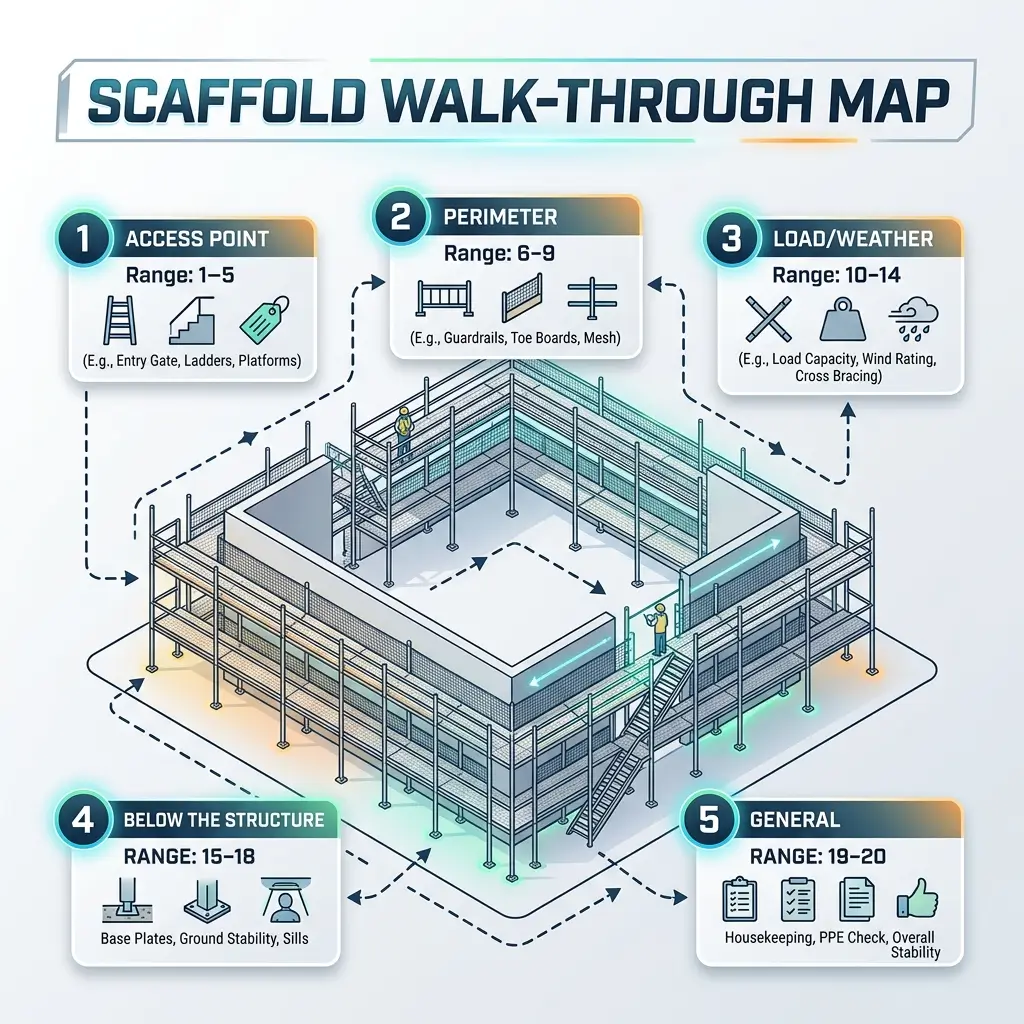
That's the thing about scaffold signs that most explainer articles skip: a sign is only as good as whether it matches the physical condition it's describing, and that match is exactly what a competent person is checking when they walk a scaffold. This guide covers the 20 signs and tags you'll actually see on a US site, grouped the way I check them — starting at the access point and working outward — with the OSHA clause behind each one.
Scope: United States, primary reference 29 CFR 1926 Subpart L (scaffolds) and Subpart G (signs and tags). UK and international readers will find a comparison note in the tag-system section, since the color convention itself isn't a US legal requirement in the way many sites assume.
Key takeaways
Five things worth knowing before you read the full breakdown:
- Sign and tag colors aren't scaffold-specific folklore — they trace to 29 CFR 1926.200, which sets red for danger, yellow for caution, and green for safety instructions, referencing ANSI Z535.
- Scaffolds must be inspected by a competent person before every work shift, not on a calendar schedule — 29 CFR 1926.451(f)(3).
- The green/yellow/red tag system is industry convention, not an OSHA-mandated color code for scaffolds specifically — the legal requirement is that the hazard be tagged and visible, per 1926.200(h).
- There's no fixed OSHA wind-speed number for scaffold work — the standard requires a competent person's judgment call, which is why the mph figure on a site's wind-restriction sign is a company policy, not a federal limit.
- Power line clearance signs exist because the distances are non-negotiable: 3 ft for insulated lines under 300V, 10 ft for insulated lines 300V–50kV and all uninsulated lines under 50kV — 1926.451(f)(6).
What a scaffold sign is legally allowed to claim
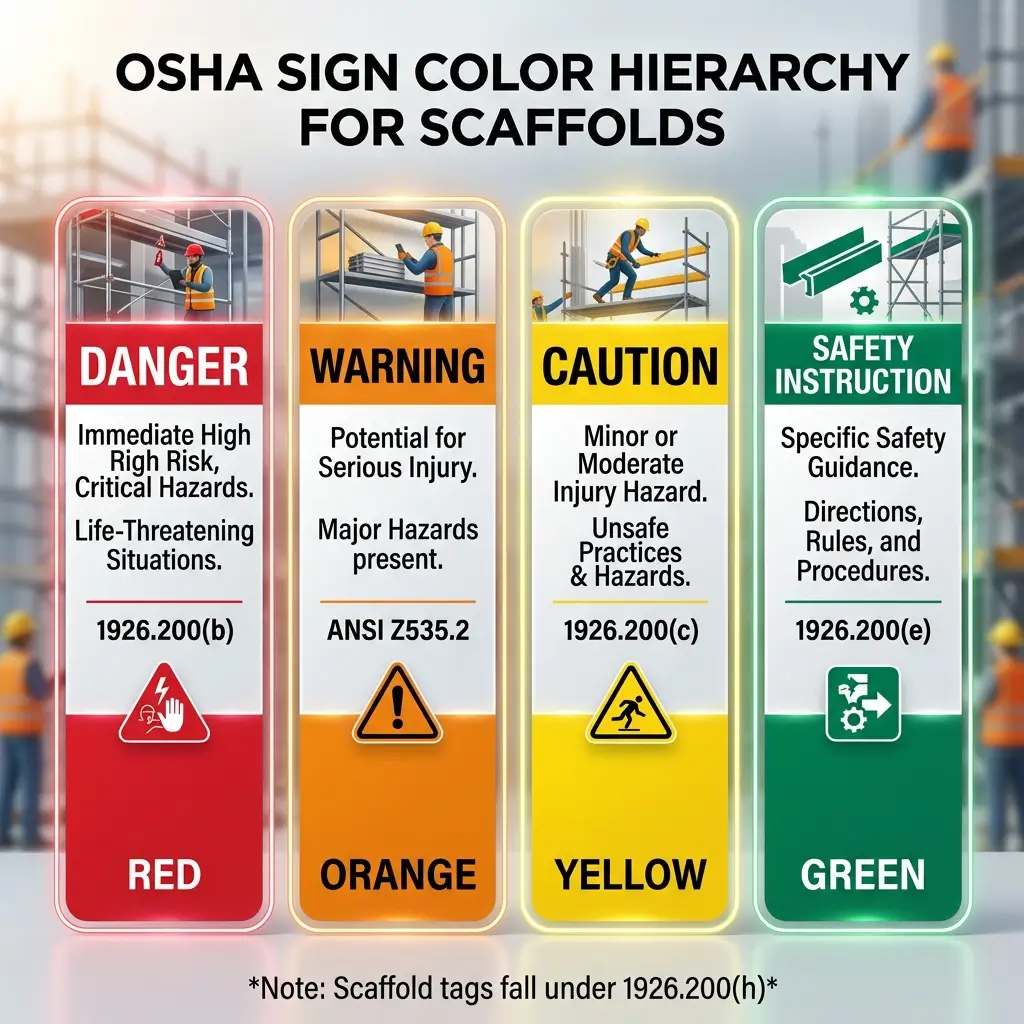
A sign or tag on a scaffold isn't decoration — it's an accident prevention sign or tag under 29 CFR 1926.200, Subpart G of the construction standard. That's the clause that actually governs colors, and it's the one almost every "scaffold signs" article skips in favor of just describing what red and yellow mean.
The rule is specific about what each color is for, not just what it looks like. A Danger sign is reserved for an immediate hazard and must use red as the predominant color, with a black border and white lower panel for wording. A Caution sign uses yellow as the predominant color with black lettering, for a potential hazard or an unsafe practice — not an immediate one. A Safety Instruction sign is white with a green upper panel. The specifications trace back to ANSI Z535.1, Z535.2, and Z535.5-2011, which OSHA incorporates by reference in §1926.6. A modern designer working from ANSI Z535 also has a fourth tier — orange Warning signs, for a hazard more serious than Caution but not immediate — which is why you'll see orange "Warning – Fragile Roof" signage that doesn't map cleanly onto OSHA's older three-color text.
Separately, 1926.200(h)(1) covers accident prevention tags: a temporary means of warning about an existing hazard, such as an incomplete scaffold. Tags supplement signs — they don't replace them, and OSHA is explicit that one is not a substitute for the other.
None of that tells you who is allowed to hang a red tag or take it down. That's 1926.451(f)(3): scaffolds and scaffold components must be inspected for visible defects by a competent person before each work shift, and after any occurrence that could affect structural integrity — a storm, a vehicle strike, a dropped load. A competent person, under 1926.32(f), is someone capable of identifying existing and predictable hazards and who has the authority to take prompt corrective action. Only that person changes what a tag says.
| Category | Predominant color | Governing standard | Used for |
|---|---|---|---|
| Danger | Red / black / white | 1926.200(b), ANSI Z535.2 | Immediate hazard |
| Warning | Orange / black | ANSI Z535.2 (referenced via §1926.6) | Serious hazard, not immediate |
| Caution | Yellow / black | 1926.200(c), ANSI Z535.2 | Potential hazard or unsafe practice |
| Safety instruction | White / green | 1926.200(e) | Non-hazard-related safety guidance |
| Accident prevention tag | Varies by header | 1926.200(h), ANSI Z535.5 | Temporary hazard warning |
The check I run before I look at a single sign is whether the tag holder and the person who last touched the scaffold are the same person the record says they are. A tag with the right color and the wrong signature is worse than no tag — it's a false confidence signal.
The tag system at the access point (signs 1–5)
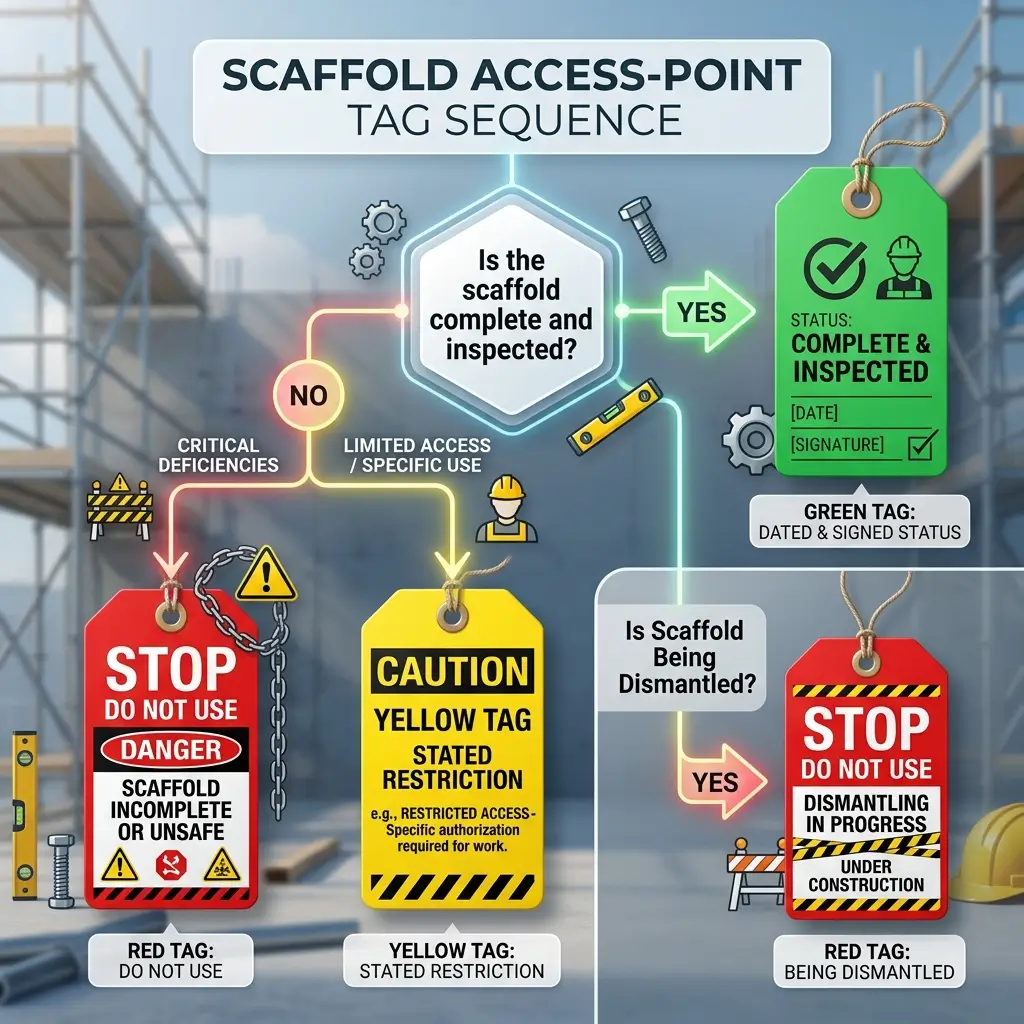
Every scaffold walk starts at the ladder, and the first thing I check is whether the tag at that access point matches what a five-second look at the structure tells me. Five sign types live here.
1. Scaffold Complete – Safe to Use tag (green)
A green tag confirms a competent person has completed the pre-shift inspection required under 1926.451(f)(3) and found no defect that affects structural integrity. It's dated and signed — an undated green tag is functionally a blank tag, because there's no way to know if it predates the last shift's use.
2. Scaffold Restricted – Caution tag (yellow)
Less common than green or red, and often misread. A yellow tag means the scaffold is usable, but only under stated restrictions — a specific trade, a load limit below the rated capacity, or specific platform levels while others remain incomplete. If the restriction isn't written on the tag, the tag isn't doing its job; a yellow tag with no stated limit is a caution sign pretending to be information.
3. Scaffold Incomplete – Do Not Use tag (red)
This is the tag from the Dragados walkdown. A red tag means guardrails, planking, bracing, or edge protection are missing, and it's the one tag that should never be treated as a formality by anyone but the erection crew. On that assignment, the tag itself was correct — the scaffold genuinely wasn't ready, and the tag said so clearly at the access point.
The finding wasn't the tag. It was that a red tag at the ladder doesn't tell a passerby fifteen feet away that the platform edge above their head has no toe board. I raised it as an immediate stop, and the fix wasn't a better tag — it was closing the falling-object gap under 1926.451(h)(1), which is a separate requirement from the tag entirely. The lesson that transfers to any site: a red tag protects the person who reads it. It does nothing for the person standing underneath who never will.
4. Scaffold Being Dismantled sign
Distinct from "incomplete" — this scaffold was complete and is now coming apart in a controlled sequence, which is its own hazard profile. Under 1926.451(f)(7) (referenced in OSHA guidance on competent-person duties), only workers the competent person selects may erect, alter, or dismantle a scaffold, and fall protection during that work is a documented feasibility determination under 1926.451(g)(2) — the employer has to show fall protection was considered for the crew doing the dismantling, not just the eventual users.
5. Permission to Use Scaffold sign
Common on sites where the erecting contractor and the using trades are different companies — a bridging-document control more than an OSHA-mandated sign. It states that use requires sign-off from a named supervisor beyond the tag itself. On multi-employer sites this is the sign that catches the gap between "the scaffold passed inspection" and "the using trade's own supervisor has actually reviewed it," which is exactly where responsibility gets lost when nobody owns the interface.
Signs at this stage share one thing worth checking as a set:
- Every tag has a date — an undated tag is not evidence of anything
- The signature is legible and matches the site's competent-person register
- Restrictions on a yellow tag are written out, not implied
- A red tag has no gap between what it says and what the rest of the structure shows
One more thing worth flagging before moving past the tag system:
⚖️ Jurisdiction note: The green/amber/red convention isn't unique to the US — UK sites run a near-identical system under NASC guidance (TG20 for tube-and-fitting design, SG4 for fall prevention during erection), commonly sold as commercial tagging kits. The meaningful difference is the inspection interval: OSHA ties inspection to each work shift, while UK practice under the Work at Height Regulations 2005 requires a documented check at least every 7 days regardless of shift pattern. A US site copying a 7-day interval from a UK template is under-inspecting by OSHA's own standard.
Who's allowed on, and where they get on (signs 6–9)
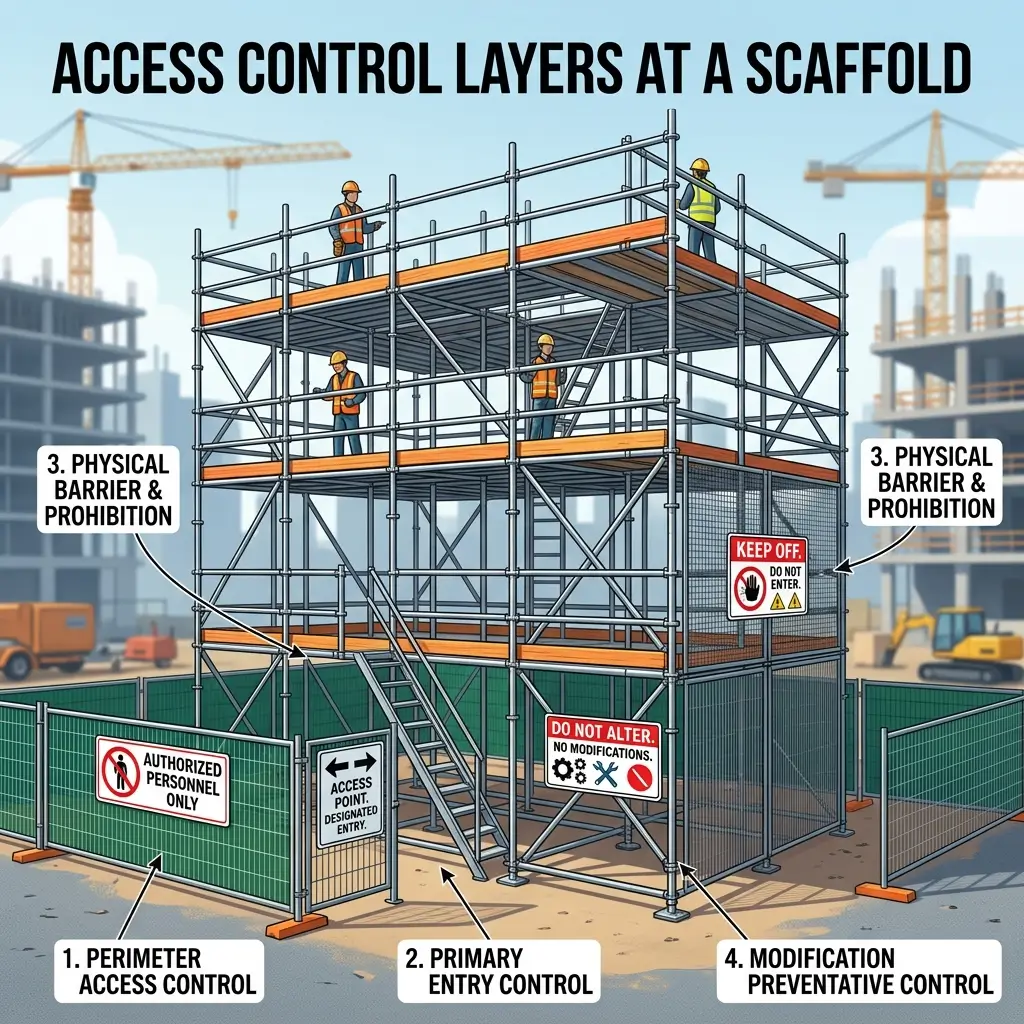
Past the tag, the next question is access control — who's permitted up, and through which route.
6. Authorized Personnel Only sign
Restricts the scaffold to trained, designated workers. It's a general-duty control rather than a scaffold-specific OSHA clause, but it does real work on multi-employer sites: it's the sign that lets a supervisor cite unauthorized access as a stop-work condition without having to prove a structural defect first.
7. Designated Ladder / Access Point sign
Marks the approved entry, which matters because 1926.451(e) requires safe access whenever a platform is more than two feet above or below the point of access — ladder, stair tower, ramp, or integral prefabricated frame. Climbing cross-bracing to save a walk to the ladder is one of the most common findings I write up, and it's almost always a distance problem: the access point was placed for the erector's convenience, not the user's route.
8. Keep Off Scaffolding sign
A blunt restriction, usually paired with a red tag rather than replacing it. On its own, a sign is a deterrent; a tag plus a physical barrier is a control. I treat a "Keep Off" sign with no barrier the same way I treat an unlocked door with a "Private" label on it.
9. Danger – Scaffold In Use. Do Not Alter or Move Sign
Prohibits anyone outside the competent person's crew from adjusting or relocating the structure. This one exists because scaffold failures often trace back to a well-meaning trade moving a brace or removing a tie to fit a delivery through — a change nobody signs off and nobody re-inspects.
A lead-in worth remembering for all four: none of these signs substitutes for the others. Authorization, access, restriction, and alteration control are four separate failure modes, and a site that posts one sign and assumes it covers the rest usually finds out the hard way which one it skipped.
Load, structure, and weather signs (signs 10–14)
This is where most competitor lists stop at "maximum load capacity" and move on. Two of the five signs below are the ones I see missing most often — not because they're obscure, but because they cover hazards that don't announce themselves until conditions change.
10. Maximum Load Capacity sign
States the rated capacity — workers, tools, and materials combined. The number on the sign should trace to the scaffold's design: 1926.451(a)(1) requires every scaffold and component to support its own weight plus at least four times the maximum intended load without failure. That 4:1 safety factor is a design margin, not a load limit — the sign states the intended working load, well under the failure threshold, and treating the two numbers as interchangeable is a common misreading I correct on walkdowns.
11. Decking / Boarding Removed sign
Posted where a section of platform has been temporarily lifted or removed — common during material hoisting or when a section is being modified mid-shift. It's a narrow-purpose sign, but it prevents exactly the accident a green tag can't: a worker stepping onto a platform that was complete an hour ago and isn't now.
12. Platform Overload / Collapse Warning sign
A general structural-risk warning, typically paired with the load capacity sign rather than replacing it. Where I've found this sign most useful is on scaffolds carrying stored materials for more than one shift — 1926.451(f)(13) prohibits debris accumulating on platforms, and stored material has a way of drifting from "staged for tomorrow" to "debris" without anyone deciding that on purpose.
13. Wind Speed / Weather Restriction sign
This is one of the two signs almost no competitor article covers, and it's worth knowing exactly what it does and doesn't represent. 1926.451(f)(12) prohibits work on or from scaffolds during storms or high winds unless a competent person has determined it's safe and the crew is protected by a personal fall arrest system or wind screens — and OSHA does not set a numerical mph threshold for scaffolds the way it does for crane-suspended personnel platforms (20 mph, under 1926.1431(k)(8)(i)). Any specific wind-speed figure printed on a site's restriction sign is a company policy decision, not a federal limit — which means it's only as good as whoever set it, and it's worth confirming that number was set by someone qualified to make the call rather than copied from a different site's toolbox talk.
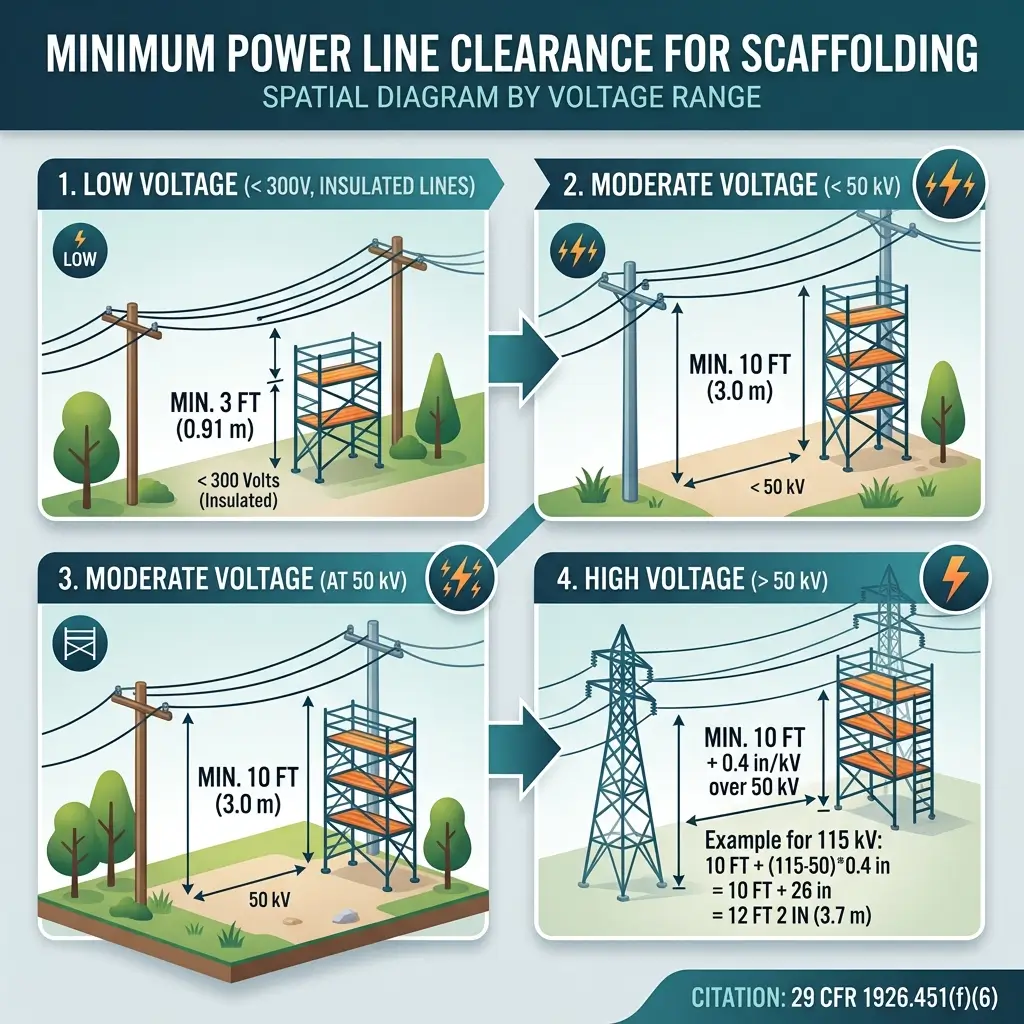
14. Overhead Power Line Clearance sign
The other sign I see missing most often, and the consequences of missing it are the most severe on this list. 1926.451(f)(6) sets minimum clearances between a scaffold — or any conductive material handled on it — and exposed energized power lines. The distances aren't negotiable field judgment; they're a table:
| Power line type | Voltage | Minimum clearance |
|---|---|---|
| Insulated | Under 300V | 3 ft |
| Insulated | 300V – 50kV | 10 ft |
| Uninsulated | Under 50kV | 10 ft |
| Either | Over 50kV | 10 ft + 0.4 in per additional kV |
A scaffold can only work closer than these distances if the utility has de-energized the line, relocated it, or installed protective covering — and that has to happen before the scaffold goes up closer than the table allows, not after someone notices the gap.
The signs in this section carry more weight together than any one of them does alone:
- Load capacity and platform-collapse signs travel together — one states the number, the other states the consequence
- Decking-removed signage has a start and an end time — it should come down the moment the platform is complete again, or it stops meaning anything
- A wind-restriction sign's mph figure is only as trustworthy as who set it
- Power line clearance is a hard distance, not a judgment call, unless the utility has actively changed the line's status
What protects the people below and around it (signs 15–18)
Everything so far protects the people on the scaffold. This group protects the people who never climb it — the public, other trades, and anyone walking underneath.
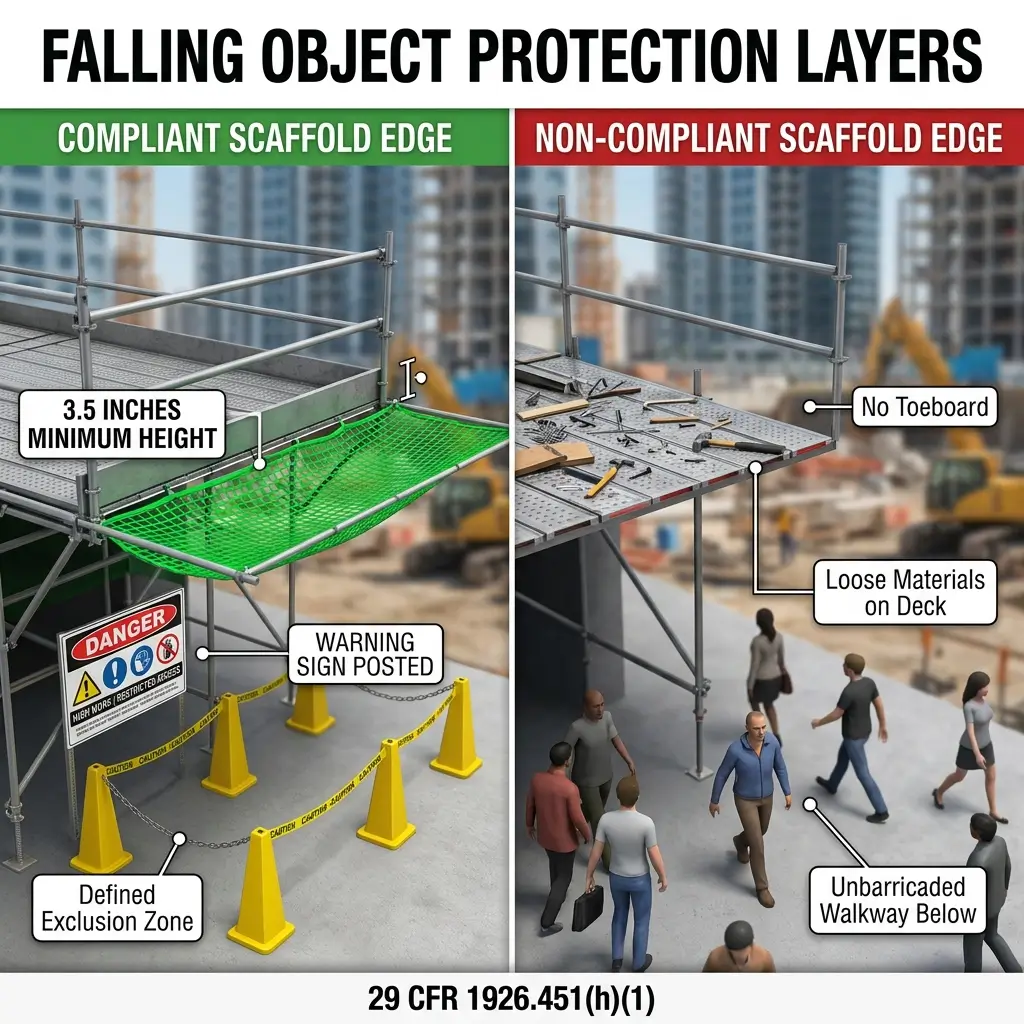
15. Danger – Falling Objects / Watch for Falling Debris sign
This is the sign that would have told a passerby what the red tag at the Dragados access point couldn't: that the edge above the walkway wasn't protected. It's a warning sign, not a control — the actual control is 1926.451(h), which requires toeboards, screens, guardrail systems, debris nets, catch platforms, or canopy structures wherever tools, debris, or materials could fall on someone below. Where a platform sits more than 10 feet above a lower level, (h)(2)(ii) makes a toeboard mandatory, and (h)(4) sets the spec: minimum 3.5 inches high, no more than a quarter-inch gap above the deck, openings no larger than one inch. After that walkdown, the fix wasn't a sign. It was a toeboard that met that spec, installed before work resumed. The sign belongs up regardless — it tells the public what the barrier is protecting them from while it's being fixed.
16. Hard Hat and Fall Protection Required sign
A mandatory-PPE sign covering both the scaffold user and anyone entering the drop zone below. Pairs with 1926.451(h)(1)'s hardhat requirement for workers on the scaffold itself, plus general fall protection duties for the crew working the platform.
17. Debris Netting / Catch Fan in Use sign
Marks where a net or catch platform is doing the falling-object job instead of a toeboard — one of the alternatives 1926.451(h)(1) allows where toeboards alone won't contain what's up there. Worth flagging because a net has an inspection cycle of its own; a torn net with an intact "In Use" sign is the falling-object equivalent of an outdated green tag.
18. Mind Your Head / Low Headroom sign
Warns of overhead scaffold components, beams, or bracing in a tight access route — common on tunnel or below-grade work and often the sign missing from an otherwise well-signed site simply because head-height hazards don't photograph as dramatically as a fall risk.
Four signs, one shared purpose worth stating plainly before the list:
- Falling-object warning signs point at a physical control — a toeboard, net, or barricade — and should never be the only thing standing between the hazard and the public
- PPE-required signage covers the drop zone, not just the platform
- Netting and catch systems need their own inspection record, separate from the scaffold tag
- Low-headroom signage belongs at the point of restriction, not somewhere upstream where it's already too late to duck
The signs that cover everything else (signs 19–20)
19. Fragile Roof Warning sign
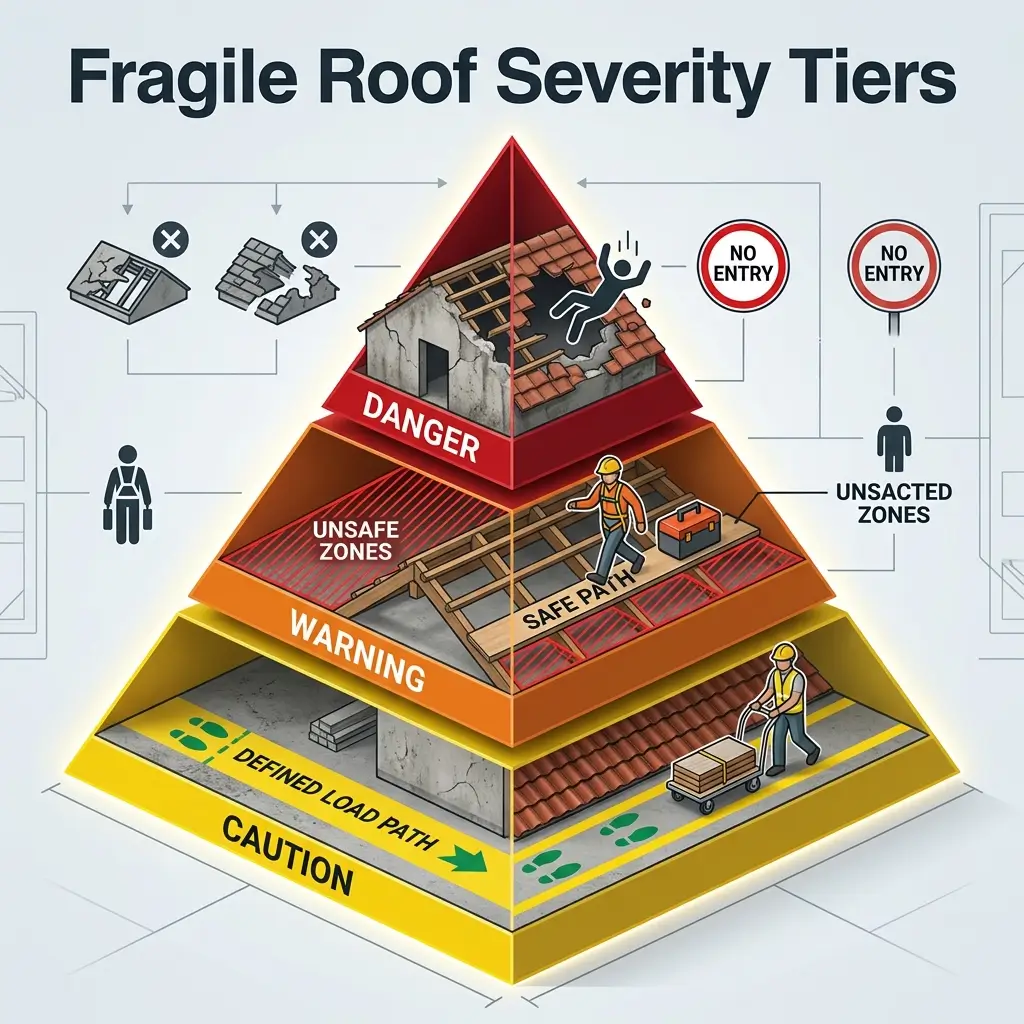
Older explainer articles list this three separate times — Danger, Warning, and Caution versions — as though they're three signs. They're one sign at three severity tiers, and treating them as three inflates a count without adding information. The tier that belongs on a given roof depends on how the roof was assessed, not on which template a sign vendor had in stock: a genuinely non-load-bearing surface gets Danger (red); a surface with a stated safe zone or load path gets Warning (orange) or Caution (yellow) with the restriction written out. If a fragile-roof sign doesn't specify what's actually restricted, it's a liability disclaimer wearing a safety sign's colors.
20. Scaffold Safety Rules sign
A summary board — dos and don'ts, often with emergency contact information — usually posted at the muster point or main access rather than at every scaffold individually. It's the least legally load-bearing sign on this list and the most commonly skipped in an audit, precisely because nobody expects it to matter. It matters when a new worker's first exposure to a site's scaffold rules is this sign and nothing else — which happens more often on fast-mobilizing multi-employer sites than most site leads want to admit.
Both signs share a trait the first eighteen don't: neither one traces to a specific OSHA clause, which makes it tempting to treat them as optional. Two reasons they aren't:
- The fragile-roof tier is only meaningful if it matches an actual assessment — a mismatched severity is worse than no sign, because it either over-restricts a safe area or under-warns a genuinely dangerous one
- The safety-rules sign is often the only document a new worker reads before their first climb, which makes its accuracy matter more than its legal weight suggests
Quick-reference: all 20 signs at a glance
The table below is the version of this article you can screenshot and pin to a site trailer wall — every sign from the walkthrough above, in the order you'd actually encounter them, with the clause behind each one.
| # | Sign | Color/Type | Governing clause |
|---|---|---|---|
| 1 | Scaffold Complete – Safe to Use tag | Green | 1926.451(f)(3) |
| 2 | Scaffold Restricted – Caution tag | Yellow | 1926.451(f)(3) |
| 3 | Scaffold Incomplete – Do Not Use tag | Red | 1926.451(f)(3), 1926.200(h) |
| 4 | Scaffold Being Dismantled | Danger | 1926.451(f)(7), (g)(2) |
| 5 | Permission to Use Scaffold | Notice | Site bridging control |
| 6 | Authorized Personnel Only | Notice/Caution | General duty |
| 7 | Designated Ladder / Access Point | Directional | 1926.451(e) |
| 8 | Keep Off Scaffolding | Danger | Site control |
| 9 | Danger – Do Not Alter or Move | Danger | Site control |
| 10 | Maximum Load Capacity | Notice | 1926.451(a)(1) |
| 11 | Decking / Boarding Removed | Caution | Site control |
| 12 | Platform Overload Warning | Warning | 1926.451(f)(13) |
| 13 | Wind Speed / Weather Restriction | Caution | 1926.451(f)(12) |
| 14 | Overhead Power Line Clearance | Danger | 1926.451(f)(6) |
| 15 | Danger – Falling Objects | Danger | 1926.451(h)(1) |
| 16 | Hard Hat & Fall Protection Required | Notice | 1926.451(h)(1) |
| 17 | Debris Netting / Catch Fan in Use | Notice | 1926.451(h)(1) |
| 18 | Mind Your Head / Low Headroom | Caution | Site control |
| 19 | Fragile Roof Warning | Danger/Warning/Caution | ANSI Z535.2 tiers |
| 20 | Scaffold Safety Rules | Safety instruction | 1926.200(e) |
Frequently asked questions
What is a scaffold tag system and how many colors does it use?
Most sites run three: green (safe to use), yellow (restricted, use only under stated conditions), and red (do not use). It's industry convention rather than an OSHA-specified color code, but the underlying requirement — visible hazard tagging — comes from 1926.200(h).
Who is allowed to put up or take down a scaffold tag?
Only a competent person, defined under 1926.32(f) as someone able to identify hazards and authorized to take corrective action. It's an employer designation, not a certification — but the authority has to be documented.
How often must a scaffold be re-inspected and re-tagged?
Before every work shift, and after any event that could affect structural integrity — a storm, an impact, a dropped load — under 1926.451(f)(3). There's no fixed calendar interval like the UK's 7-day rule.
What does a yellow scaffold tag mean?
The scaffold is usable but under stated restrictions — a specific trade, a reduced load, or limited platform levels. If the tag doesn't state what's restricted, it isn't functioning as a caution tag.
Can a written sign replace a scaffold tag?
No. OSHA treats accident prevention signs and tags as complementary under 1926.200(h)(1) — a durable sign reinforces the message, but it doesn't substitute for the dated, signed inspection record a tag represents.
What's the minimum distance a scaffold must keep from power lines?
3 ft for insulated lines under 300V; 10 ft for insulated lines between 300V and 50kV and for all uninsulated lines under 50kV; 10 ft plus 0.4 inches per additional kV above 50kV. Full table in 1926.451(f)(6).
Is there an OSHA wind speed limit for working on scaffolds?
Not a fixed number. 1926.451(f)(12) requires a competent person to determine it's safe and to add fall arrest or wind screens before work continues in storms or high winds. Any specific mph figure on a site sign is a company policy, not a federal threshold.
What should I do if a scaffold's tag doesn't match what I see?
Stop and report it before using the scaffold. A tag reflects the last inspection, not a guarantee of current condition — treat a visible mismatch the same way you'd treat an expired tag, and let the competent person re-verify before anyone climbs.
The short version
A scaffold sign or tag is only as trustworthy as the last person who actually looked at the structure it's describing. Twenty sign types cover four real jobs: recording the last competent-person inspection, controlling who gets on and how, stating the structural and environmental limits, and protecting the people who never climb it at all. Get the first eighteen right and most sites still miss the wind-restriction and power-line clearance signs — not because they're hard to understand, but because nothing about them looks urgent until conditions change.
If you manage or inspect scaffolds, the habit worth building isn't memorizing colors. It's walking past the tag to the condition it's describing, every time.
About the author — Jack Peterson
Jack Peterson is a Principal Construction & Infrastructure HSE Assurance Consultant with 18 years of continuous field experience across civil infrastructure, high-rise construction, bridges & highways, tunnelling, industrial construction, and related environments. His focus is practical assurance — checking that controls still work where work actually happens. He currently leads Peterson Construction Safety Partners, based in Houston, United States, after senior roles with Turner Construction, Skanska USA Civil, Kiewit Infrastructure, Dragados USA, FCC Construction, and others.
Sources
Every regulatory claim above traces to one of these primary sources, verified live at time of publication:
- OSHA, 29 CFR 1926.200 — Accident prevention signs and tags
- OSHA, 29 CFR 1926.451 — General requirements (scaffolds)
- OSHA, 29 CFR 1926.32 — Definitions (competent person)
- eCFR, 29 CFR Part 1926 Subpart L — Scaffolds
- OSHA standard interpretation, Training qualifications for the competent person inspecting scaffolds
- OSHA standard interpretation, Minimum approach distances to insulated power lines
- OSHA standard interpretation, Falling object protection on scaffolds