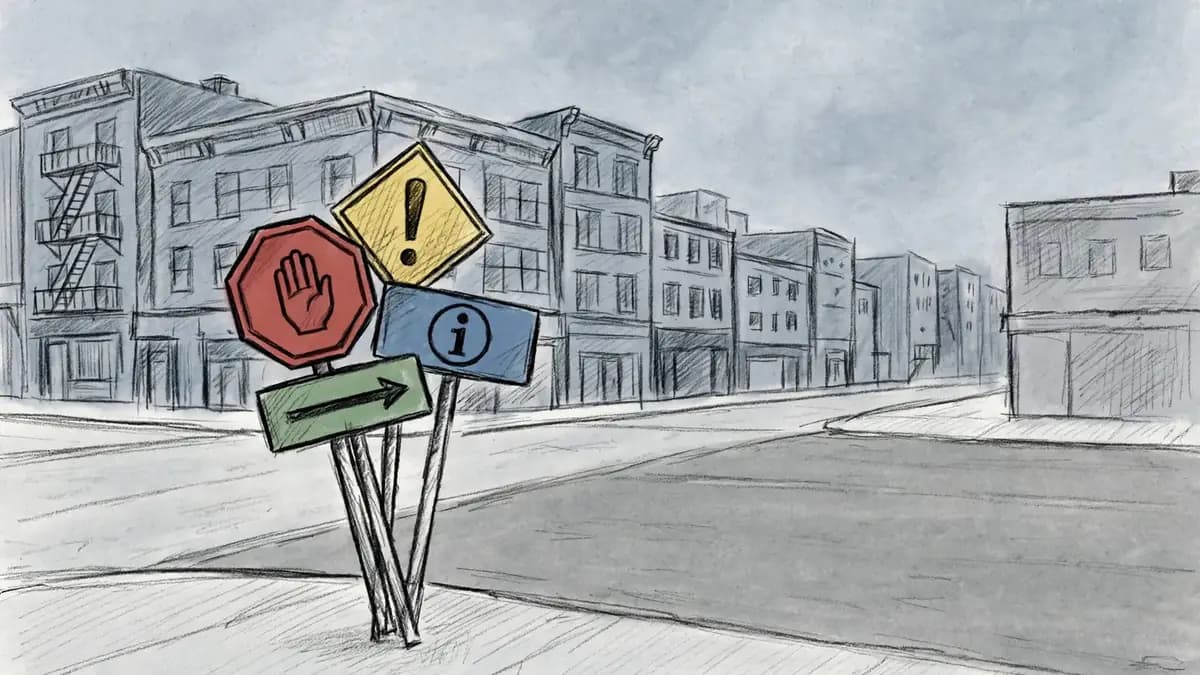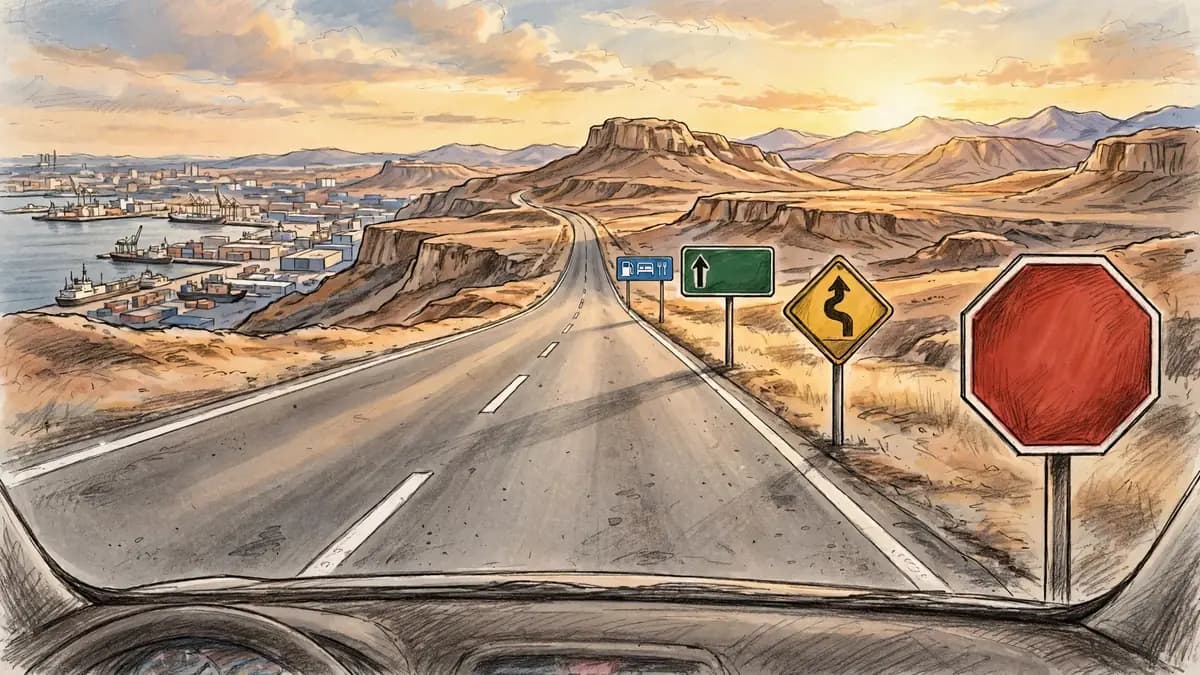
Road signs make sense fastest when they are read where they stand. A yellow diamond before a bend, a red circle at a junction, a blue rectangle on a motorway: each sign belongs to a place. And the place tells a driver what to do. Learn the signs by the places they mark, and every journey becomes a series of small, clear instructions.
Most drivers already know a few signs by heart. Stop, give way, speed limit: those three cover many journeys. Trouble starts at unfamiliar places, where several signs appear together and each one asks for a different action. A roundabout needs a warning, an order and a lane arrow in a few seconds. A work zone replaces the usual rules with orange ones. A level crossing asks a driver to stop for a train that cannot be seen yet.
A quick decoder before you drive
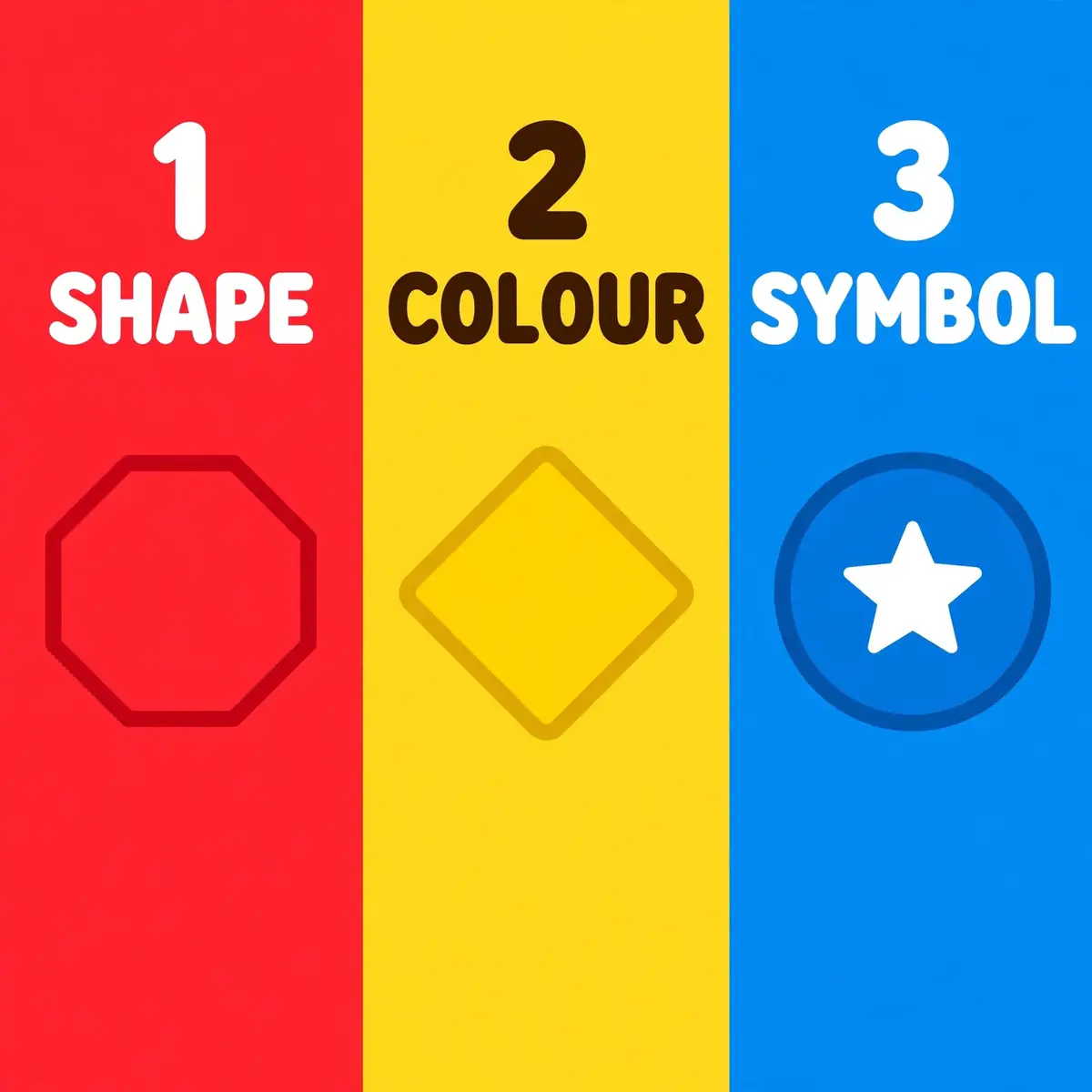
Three families cover almost every road sign. Regulatory signs state traffic laws, warning signs flag hazards ahead, and guide signs give directions, distances and services. The United States writes its code in the Manual on Uniform Traffic Control Devices, known as the MUTCD. The United Kingdom follows The Highway Code and the Vienna Convention on Road Signs and Signals. Both systems use the same three ideas, and both give each family its own shapes and colours.
Shape arrives first, colour second, and the symbol third. An octagon means stop, a downward triangle means give way, and a diamond means a warning in the United States. In the United Kingdom, warning signs are triangles with a red border, orders are circles, and information signs are rectangles. Red means stop or prohibition, yellow means warning, orange means temporary traffic control, and green or blue means guidance.
A full account of the shape and colour tables, with the MUTCD sections behind them, sits in the road signs decoder. A catalogue of 25 traffic safety signs, organised by family, lists each sign with its own meaning.
Three questions that read any sign
Ask three questions in order, and most signs answer themselves. First, what family is it: does it order, warn or guide? Second, where does it stand: what place or hazard does it mark? Third, what does the symbol or word add: which turn, which limit, which distance? A sign that orders needs obedience at the sign itself. A sign that warns needs action before the hazard it names.
Plates below a sign qualify the message, and they change the action. A speed limit with a plate reading "except buses" applies to other vehicles only. A warning sign with a distance plate puts the hazard that far ahead. A time plate limits a restriction to stated hours. Reading a sign without its plate means reading half the message, so check below the main sign before acting.
When the two systems disagree
Two details catch drivers who cross between the United States and the United Kingdom. Direction-sign colours differ: green marks motorway directions in the United States, while blue marks motorways in the United Kingdom and green marks primary routes. Warning shapes differ too: the United States uses yellow diamonds, while the United Kingdom uses red-bordered triangles. Red for prohibition and yellow for warning are widely shared, so those two colours travel well.
Driving on the other side of the road does not change what a sign means. But it changes where to look for it. A no-passing pennant sits on the left side of a two-way road in the United States. A mini-roundabout in the United Kingdom asks drivers to give way to vehicles from the immediate right. Check the local rule for the junction itself. And let the sign confirm it, rather than assuming a familiar sign works the same way abroad.
TipLearn the three families first, because the family tells you whether to obey, slow down or follow directions before you read a single word.
Motorways and highways: signs that guide at speed
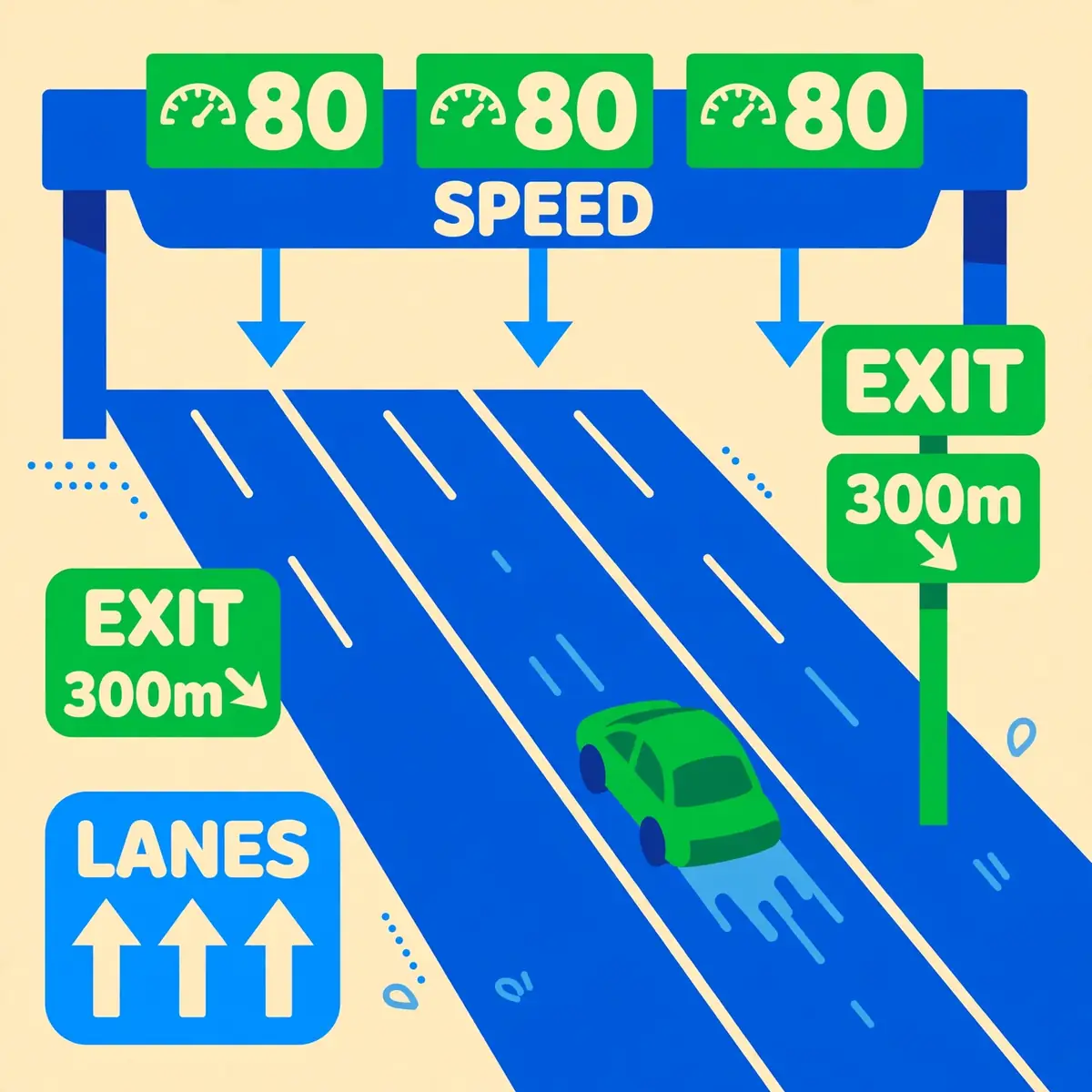
Motorways and highways move fast, so their signs give information early and in large letters. Direction signs show destinations, distances and exit numbers well before the junction. Lane arrows tell drivers which lane leads where. Speed signs set the legal maximum, and variable limits can change it when traffic builds. A driver who reads these signs a mile ahead has time to move over calmly.
The colours change by country, and that is the first thing to learn. In the United States, motorway direction signs use green backgrounds with white lettering. In the United Kingdom, motorway signs use blue backgrounds, and green marks primary routes instead. Route numbers on a blue background point toward a motorway, while route numbers on a green background point toward a primary route. Brown panels mark tourist attractions in both systems.
Exits, junctions and lane arrows
Exit signs appear in stages, and each stage has a job. An advance sign names the junction and its destinations. A sign at the junction shows which lanes leave and which carry on. A route confirmatory sign after the junction names the road and the next destination. So a driver can check the choice was right. Junction numbers sit on a black background in the United Kingdom. And countdown markers near an exit show the distance left: each bar stands for 100 yards.
Lane arrows work with the exit signs. Downward-pointing arrows mean get in lane, and the left-hand lane may lead to a different destination from the other lanes. A panel with an inclined arrow shows the destinations reached by leaving at the next junction. Overhead lane-use signs can also close a lane or limit it to certain vehicles. Missing a lane arrow means missing the exit, so read the arrows with the destination signs, not after them.
Speed limits that change with traffic
Speed limit signs on motorways state the legal maximum for that stretch, and the limit applies from the sign itself. Some motorways use variable speed limits, shown on overhead signs with camera enforcement. The displayed number becomes the limit while it shows. And it can fall when traffic slows or when an incident blocks a lane ahead. A driver who treats a variable limit as advisory risks a fine and a sudden queue.
Minimum speed signs appear on some highways. And they set the slowest speed a vehicle may travel in that lane or on that road. They keep slow traffic from blocking fast lanes. A vehicle that cannot reach the minimum speed should use a slower road instead. Together, the maximum and the minimum keep traffic moving at similar speeds, which is what makes a motorway safe at volume.
Where the motorway starts and ends
A start-of-motorway sign marks the point where motorway regulations apply. Certain vehicles, learners and pedestrians are not allowed beyond it, and the rules on stopping, reversing and U-turns become stricter. An end-of-motorway sign marks the point where those regulations stop and ordinary road rules return. Both signs matter because the law changes at the sign, not at the next junction.
Service areas get their own signs, showing the operator name and the distance ahead. A blue hospital sign with a white H points toward emergency care. And the Highway Code adds "Hospital ahead with Accident and Emergency facilities" where that applies. Emergency diversion route symbols, shown as shapes on yellow or black backgrounds, guide traffic around a closed motorway section. Follow the symbol, not memory, because the diversion route can change with the closure.
WarningA variable speed limit shown overhead is the legal limit while it displays. So slow to the number shown rather than the usual limit for the road.
Junctions and roundabouts: signs that settle who goes first
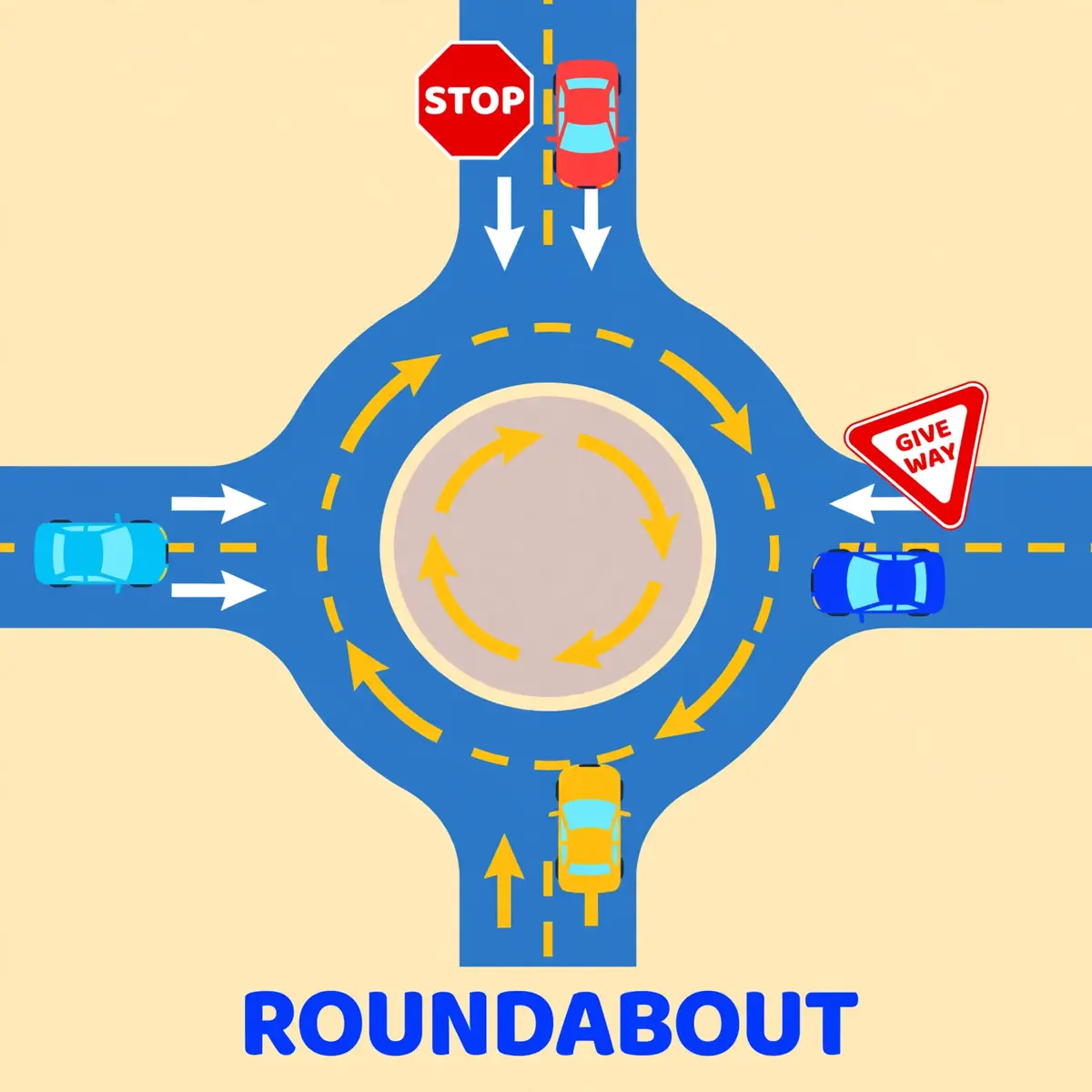
Junctions are where roads meet and where priority must be settled in seconds. The signs there do three jobs: warn that a junction lies ahead, order drivers to stop or give way. And show which lanes turn and which go straight. A driver who reads the warning sign first has time to slow down, check the order sign. And choose a lane before the junction itself.
Advance warning signs name the junction type. A crossroads sign shows two roads crossing. A T-junction sign shows a side road joining, with the priority route drawn as the broader line. A staggered junction sign shows two side roads offset from each other. A sign for traffic merging from the left or right warns that another stream will join. Each one means the same thing in practice: slow down, look for the joining traffic. And be ready to give way.
Stop, give way and priority
The stop sign is a red octagon, and it orders a complete stop at the line. The give-way sign is a downward-pointing triangle. And it orders a driver to slow down. And give way to traffic on the major road, stopping only if traffic is coming. In the United Kingdom, the stop sign reads "Stop and give way". And advance warning triangles give the distance to the stop line or the give-way line ahead, such as 100 yards.
Priority signs settle narrow sections and one-way streets. A sign reading "Give priority to vehicles from the opposite direction" orders a driver to wait for oncoming traffic. A blue sign showing a white arrow against a black one gives priority the other way. One-way signs show a white arrow on a blue circle. And they mark streets where traffic flows in one direction only. A driver who meets a no-entry sign, a red circle with a white bar, must not enter from that direction at all.
Roundabouts and mini-roundabouts
A roundabout warning sign, a triangle with circular arrows, appears before the roundabout itself. At the roundabout, drivers give way to traffic already circulating. In the United Kingdom, that means giving way to vehicles from the immediate right. Lane arrows and direction signs before the roundabout show which lane serves each exit. So a driver should choose a lane early and stay in it through the junction.
Mini-roundabouts use a blue circular order sign showing the roundabout circulation. And the rule is the same: give way to vehicles from the immediate right. The painted circle on the road is small, and some drivers treat it as a suggestion. But the sign carries the same force as at a full roundabout. Approach slowly, look right, and enter only when the circulating traffic leaves a gap.
Turns, lanes and no-turn orders
Turn restriction signs appear at junctions where a turn would be unsafe. A red circle with a crossed arrow forbids a left turn, a right turn or a U-turn. And the ban applies at that junction only. Lane-use signs show which movements each lane allows, such as left turn only or straight ahead only. An "ahead only" blue circle orders traffic to continue straight. And a "turn left ahead" sign orders a turn at the junction it marks.
Keep-left and keep-right signs tell drivers which side of an island or obstruction to pass. A sign showing vehicles may pass either side applies where both sides lead to the same destination. These signs sit at the obstruction itself, not ahead of it. So a driver who reads them late has little room to react. Watch for the island first, then the sign that tells which side to take.
AlertA give-way sign orders a driver to give way to traffic on the major road. So entering the junction without checking is an offence, not a judgement call.
School zones and pedestrian crossings: signs that protect people on foot
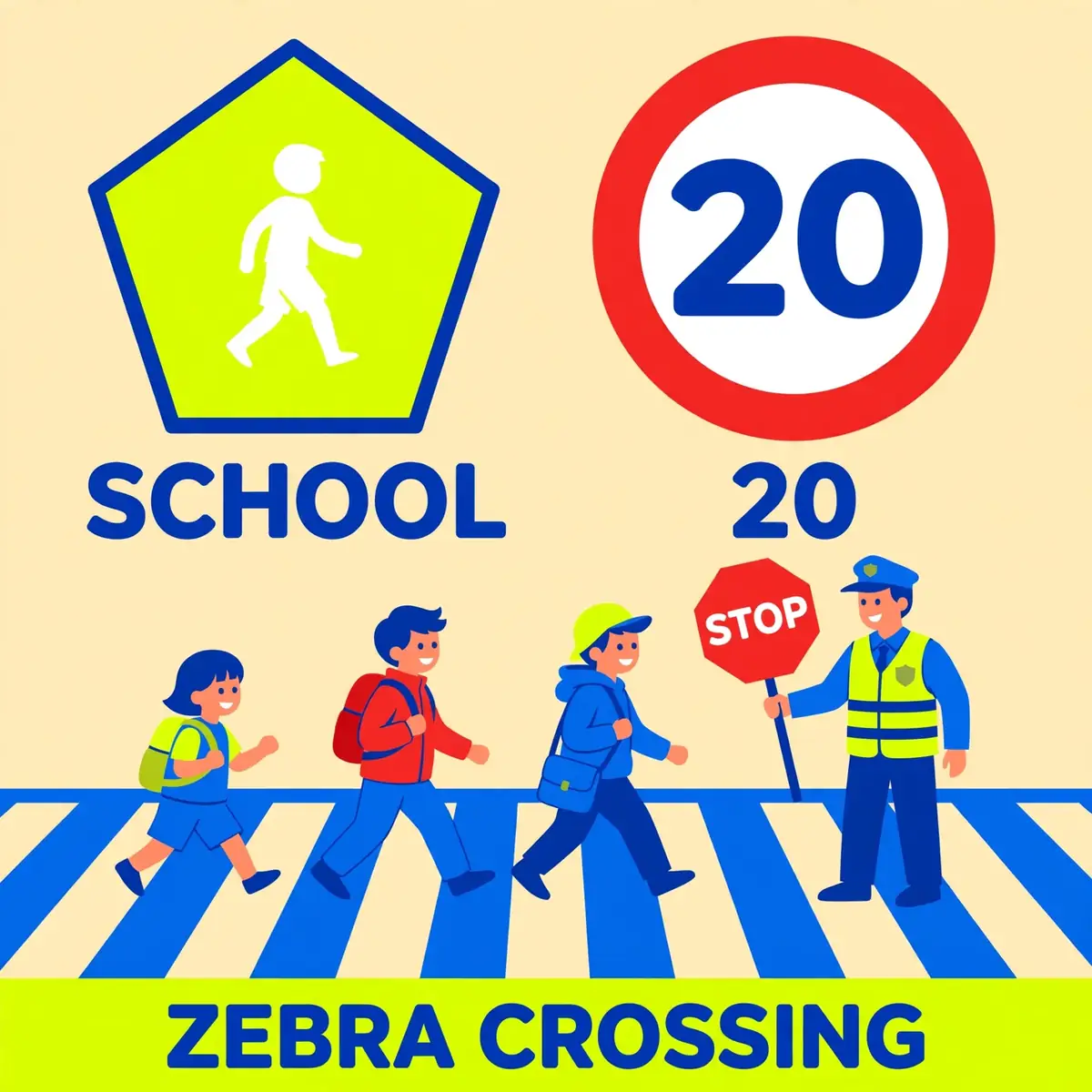
School zones and pedestrian crossings are the places where signs protect the most vulnerable road users. Children cross without warning, and they are small enough to hide behind parked cars. The signs in these places use the brightest colours on the road. And the speed limits around them carry heavier penalties when broken. A driver who slows early gives children time to be seen.
In the United States, school signs use an upward-pointing pentagon in fluorescent yellow-green, a colour reserved for pedestrian, bicycle, playground and school warnings. In the United Kingdom, the warning is a red-bordered triangle showing children crossing. And a school crossing patrol sign shows a patrol officer with a stop sign. Some school signs carry amber lights that flash while the crossing is in use, which means children are crossing now, not at some other hour.
School zones and their speed limits
A school zone sign marks the start of a lower speed limit around a school. And the limit applies while the zone is in force. In the United Kingdom, 20 mph zones cover many streets around schools, with entry and end signs marking the zone boundary. A speed limit sign inside the zone states the maximum, and it applies from the sign itself. Fines and points for speeding in a school zone are higher than on an ordinary street, because the risk to children is higher.
Flashing amber lights above a school crossing patrol sign mean the patrol is operating. A driver must stop when the patrol officer steps out with the stop sign. And must wait until the children have crossed and the officer has returned to the pavement. Overtaking near a school crossing, or passing a stopped vehicle at one, hides the children behind it and removes the time to react.
Crossings where pedestrians have priority
Zebra crossings give pedestrians priority once they step onto the crossing. The warning sign shows black and white stripes. And the crossing itself uses the same stripes on the road, with flashing amber beacons at each side in the United Kingdom. A driver must slow on approach, stop if a pedestrian is waiting to cross. And wait until the pedestrian has cleared the driver's side of the road.
Other crossings use signals or a patrol. A pedestrian crossing sign with a walking figure warns that people cross ahead. And a pelican or puffin crossing adds traffic lights that pedestrians control. A sign for frail, blind or disabled pedestrians warns that people who move slowly or cannot see traffic may cross ahead. At every crossing, the correct action is the same: slow down early, look for people on both pavements, and stop rather than guess.
Signs for cyclists and shared routes
Cycle routes get their own signs, and drivers meet them where cycle lanes cross or join the road. A blue circle showing a bicycle marks a route for pedal cycles only. A sign for a segregated pedal cycle and pedestrian route shows the two groups separated by a line. A with-flow cycle lane runs in the same direction as traffic, while a contra-flow lane runs against it. So a driver turning across it must look both ways.
Children on bicycles use the same crossings as pedestrians. And the fluorescent yellow-green bicycle warning sign marks places where they join the road. A driver should treat a cycle crossing like a pedestrian crossing: slow down, look for small riders who may not signal, and give them room. The sign warns of the place; the rider's behaviour decides the exact action.
WarningFlashing amber lights at a school crossing mean children are crossing now. So slow to a crawl and be ready to stop rather than holding your speed.
Work zones: orange signs that override the usual road
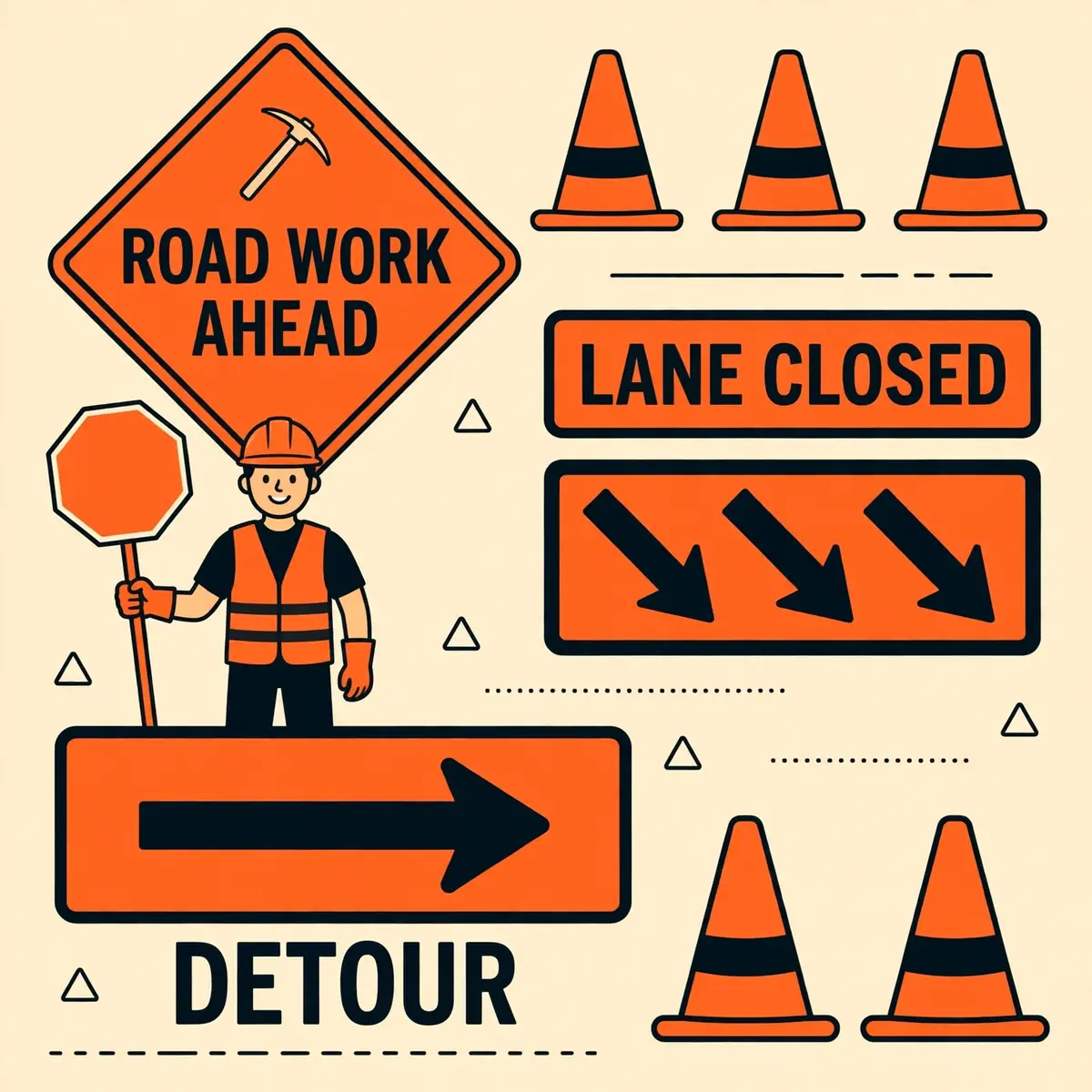
Work zones change the road from day to day, and orange signs are how drivers learn the new layout. Road works, maintenance, detours and lane closures all use orange in the United States. And the Highway Code uses the same idea with road works signs in the United Kingdom. The layout a driver memorised yesterday may not match the road today. So the orange signs are the current map, not a decoration.
Temporary signs override permanent ones inside a work zone. A temporary speed limit replaces the usual limit until the end of the works. And a temporary lane closure replaces the usual lane layout. A driver who follows the permanent limit through a work zone is breaking the temporary one. The end-of-road-works sign marks the point where the temporary restrictions stop and the usual rules return.
Road work ahead, detours and lane closures
The first sign in a work zone is usually "Road work ahead", a diamond in the United States or a triangular warning in the United Kingdom, sometimes with a distance plate such as "1 mile ahead". It tells a driver to slow down and prepare for a changed layout, not to brake at the sign itself. A detour sign, an orange rectangle, shows the alternative route around a closure. Follow the signed route, because the detour is chosen for vehicle size and turning space.
Lane closure signs show which lanes stay open and which close, using arrows and red bars that match the lanes on the road. A temporary lane closure sign in the United Kingdom shows the number and position of the arrows for the lanes open and closed. A "one lane crossover" sign marks a contraflow, where traffic crosses to the other carriageway. Merge early and smoothly where the sign asks, because late merging at the closure point blocks the lane that stays open.
Flaggers, temporary lights and stopped traffic
A flagger ahead sign warns that a person will direct traffic. And the flagger's instructions override the signs while they are working. Manually operated temporary stop and go signs appear where a single lane serves both directions. And a driver must obey the sign the flagger shows, not the traffic behind. A slow-moving works vehicle blocking a lane carries a sign on its back telling drivers which way to pass. And there are no cones on the road in that case.
Temporary traffic lights control a narrowed section. And they work like ordinary lights: red means stop, green means go when the way is clear. A sign for a temporary hazard at road works warns of loose chippings, uneven surfaces or a sudden step in the road. Loose chippings can throw stones and reduce grip, so slow down and leave extra space behind the vehicle ahead.
What the law requires in a work zone
Work zone signs carry the force of law. And penalties for offences inside a work zone are often higher than elsewhere. Speeding past workers, ignoring a flagger or passing a road-closed sign can bring a larger fine and more points. The higher penalty exists because workers stand close to moving traffic with little protection. And a driver who follows the caution signs at the site gives them room to work safely.
Workers in a work zone wear high-visibility clothing. And drivers share the duty by slowing down and following the signed route. A vehicle that enters a closed lane forces workers to stop and can close the whole site. If the signed route is unclear, slow down. And follow the vehicle ahead rather than guessing a shortcut through the works. The delay costs minutes; a wrong turn through a work zone can cost a worker's safety.
AlertTemporary signs override permanent ones inside a work zone. So follow the orange sign even when it contradicts the usual speed limit or lane layout.
Level crossings: signs that warn of trains
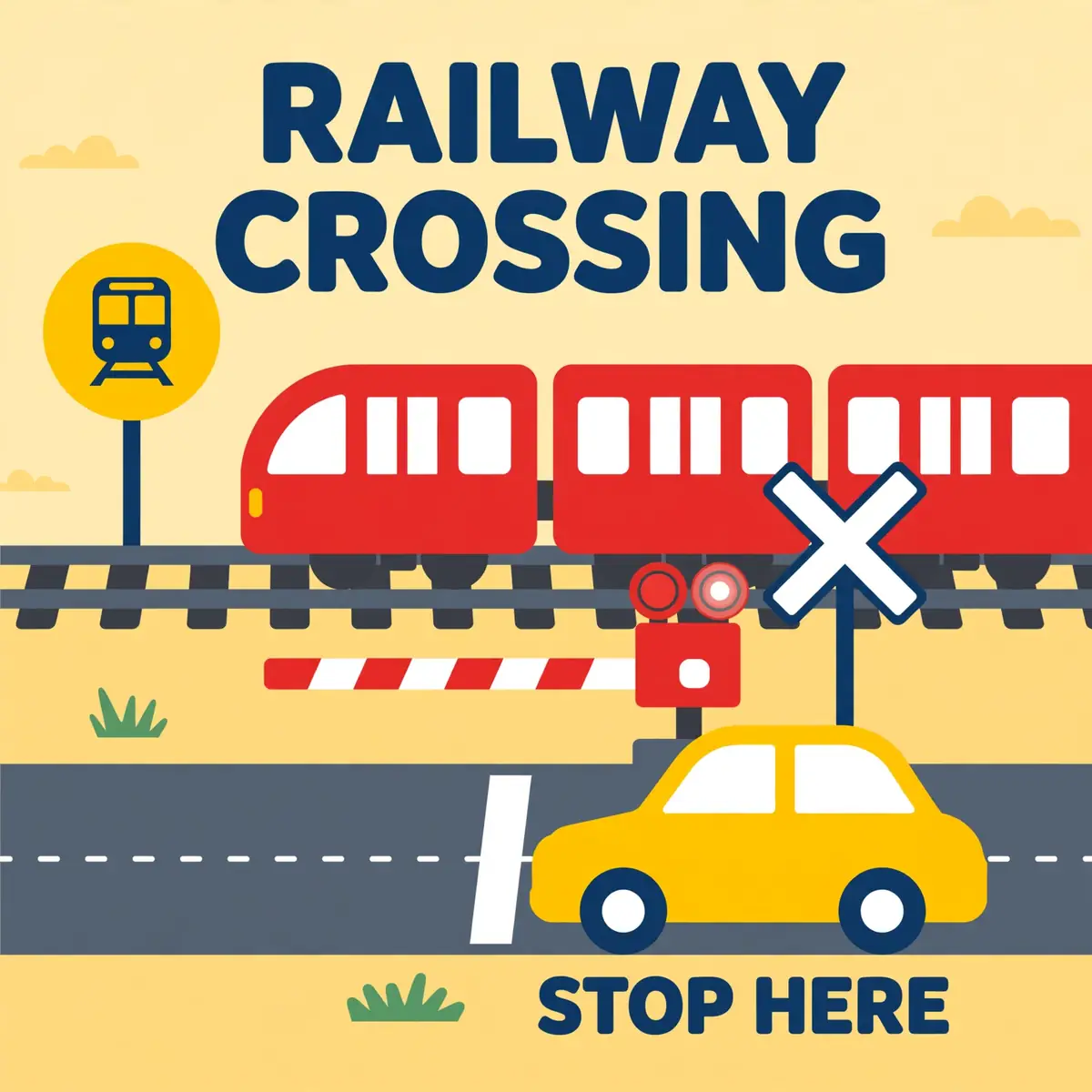
Level crossings are the places where a road meets a railway. And the signs there exist because a train cannot stop for a car. A train needs a long distance to halt, and it cannot swerve. The signs give a driver time to slow down, look both ways. And stop before the tracks if a train is coming. Ignoring them is one of the most dangerous mistakes a driver can make.
The signs appear in stages. An advance warning sign comes first, then the crossing itself carries its own signs and signals. In the United States, the advance warning is a round yellow sign marked with a black X and the letters RR. At the crossing, a crossbuck, white crossed blades reading "Railroad Crossing", marks the tracks. In the United Kingdom, triangular warning signs name the crossing type: with barrier or gate ahead, without barrier or gate ahead, or without barrier.
Barriers, gates and flashing lights
At a crossing with barriers or gates, the barrier is the order: do not pass it while it is down or coming down. Flashing red lights at the crossing mean stop, and they work with the barrier or on their own. A sign reading "Stop here when flashing" marks the place to wait. And a driver must stop at that line rather than creeping onto the tracks. Wait until the lights stop and the barrier rises fully before moving.
Some crossings have miniature warning lights instead of full barriers. And they work the same way: a flashing red light means stop. A crossing without a barrier or gate has no physical block, so the driver must look and listen before crossing. Slow down on approach, open a window if needed to hear a train. And cross only when the track is clear in both directions.
What to do when a train is coming
When the lights flash or the barrier starts to fall, stop at the marked line and wait. Do not try to beat the barrier, and do not stop on the tracks. A vehicle that stalls on a crossing should be left at once: get everyone out. And away from the tracks, then call for help from a safe distance. A train cannot stop in time, so the vehicle is not worth a life.
After one train passes, look again before crossing, because a second train can follow on another track. A sign for light signals ahead at a level crossing, airfield or bridge warns that signals control the crossing rather than a barrier. At a crossing with a telephone, a driver of a long or slow vehicle can call the signal operator before crossing. When in doubt, wait: a train that is not visible yet can arrive in seconds.
WarningNever stop on a level crossing, and never try to beat a falling barrier. A train cannot stop or swerve for a vehicle on the tracks.
Low bridges and narrow roads: signs that limit size
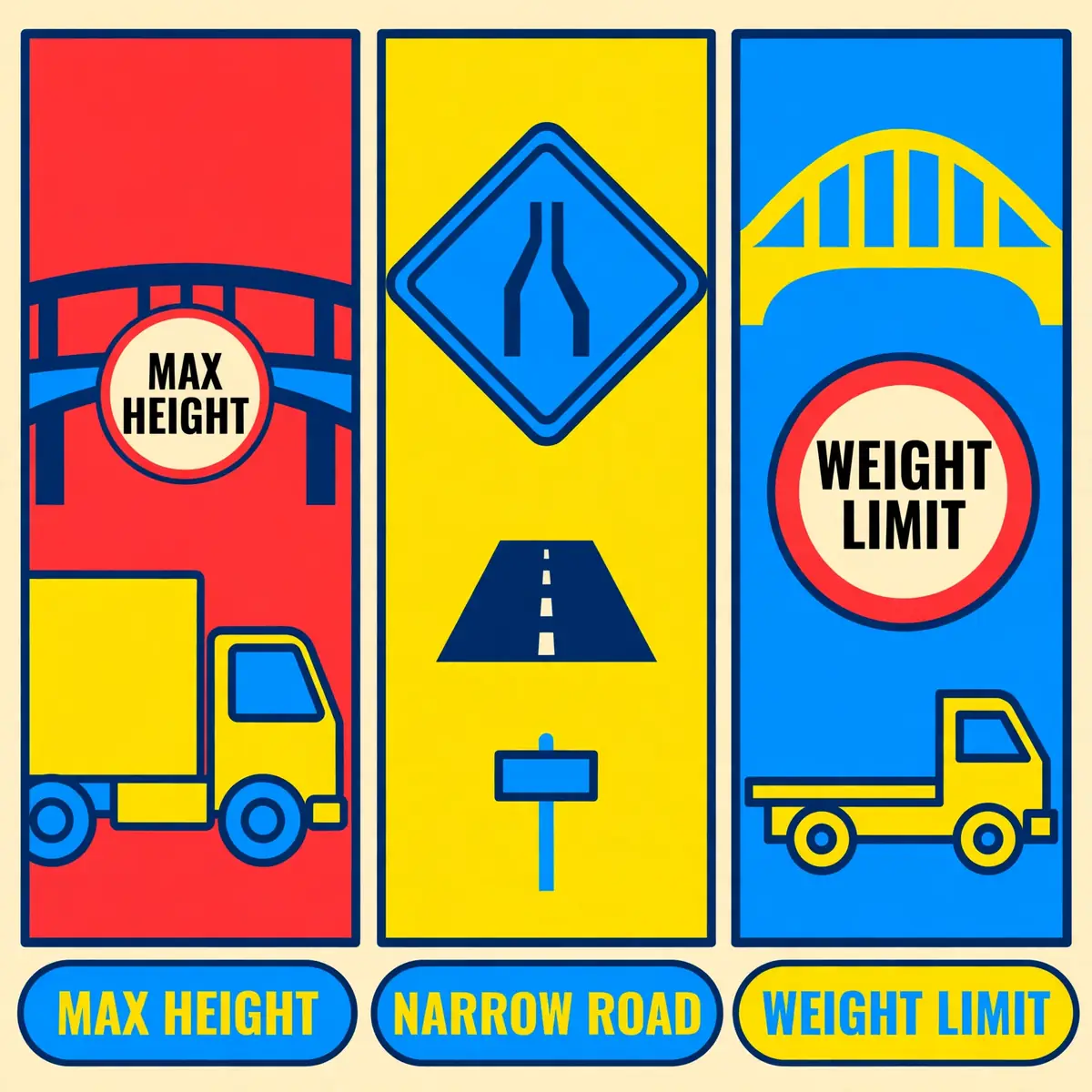
Low bridges and narrow roads are the places where a vehicle's size becomes the rule. A car passes under most bridges without thinking. But a lorry, a bus or a vehicle carrying a load can strike a bridge that is too low. The signs in these places state a maximum height, width, length or weight. And they appear well before the restriction so a large vehicle can turn away.
In the United States, a low clearance warning is a yellow diamond that names the clearance ahead. In the United Kingdom, the order is a red circle reading "No vehicles over height shown", with the maximum height in metres or feet and inches. A plate below an overhead electric cable sign gives the maximum height of vehicles that can pass safely under the cable. A separate sign states the available width of headroom where the limit is a width rather than a height.
Height, width, length and weight limits
Height limits protect bridges, cables and tunnels. A driver of a tall vehicle must know the vehicle's height, including any load or roof rack. And compare it with the signed maximum before passing under. Width limits protect narrow bridges and gates: a sign reading "No vehicles over width shown" states the maximum in metres. Length limits apply to combinations of vehicles. And weight limits apply to goods vehicles over a stated gross weight, sometimes except for loading and unloading.
Weight limit signs use tonnes, and they protect weak bridges as well as narrow roads. A sign reading "No goods vehicles over maximum gross weight shown, except for loading and unloading" allows local access but forbids through traffic above the limit. A driver who ignores a weight limit risks damaging the bridge and the vehicle. And enforcement treats it as a serious offence because the structure itself is at risk.
Narrowing roads, hump bridges and soft verges
Road narrows signs warn that the road ahead becomes narrower, on one side or on both sides. The sign gives a driver time to slow down. And to give way to oncoming traffic where the road fits only one vehicle at a time. A hump bridge sign warns of a short, steep bridge that hides oncoming traffic and can ground a long vehicle. Slow down before the hump, because the road beyond it cannot be seen from the approach.
Soft verges and side winds are rural hazards that pair with narrow roads. A soft verge sign warns that the edge of the road will not support a vehicle's weight. So a wheel that leaves the tarmac can sink or trap the vehicle. A side winds sign warns that gusts can push a high-sided vehicle sideways, especially on an exposed bridge or embankment. Both signs ask for the same action: slow down, keep a firm grip, and stay on the paved surface.
TipKnow your vehicle's height, width and weight before a journey, because a limit sign is only useful when the driver can compare it with a real number.
Rural roads and bends: signs that warn of what lies ahead
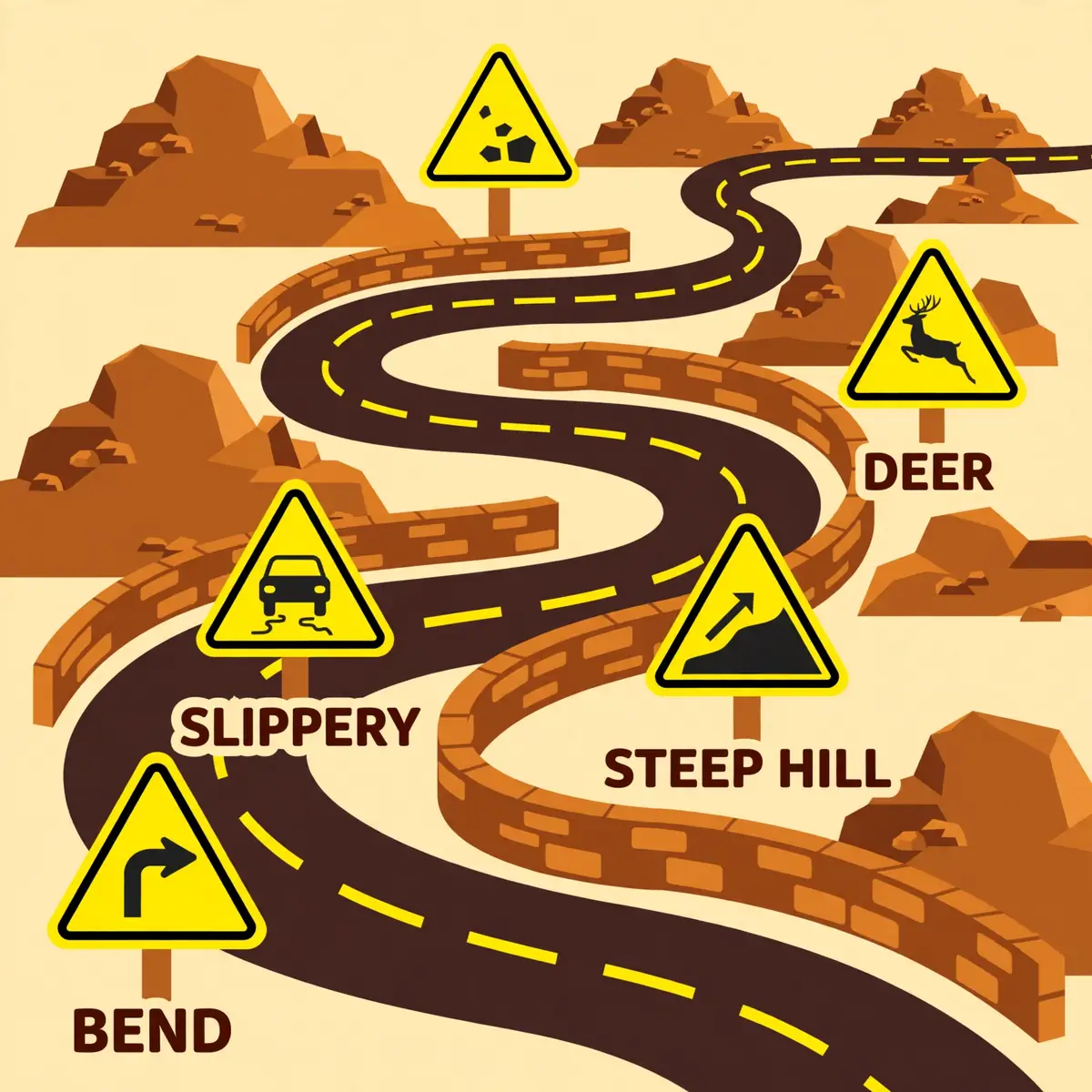
Rural roads carry fewer signs than motorways, and each one matters more. Bends hide oncoming traffic, hills hide the road beyond, and animals cross without warning. The warning signs on rural roads name the hazard ahead. And give a driver time to slow down before reaching it. A driver who reads them early can take a bend at a safe speed instead of braking inside it.
Curve and bend signs are the most common rural warnings. A turn sign shows a sharp bend of about 90 degrees, while a curve sign shows a gentler bend. And the arrow points the way the road turns. A double bend sign shows two bends in opposite directions, with the first bend going the way the arrow starts. A chevron alignment sign, a row of yellow chevrons along the outside of a curve, shows which way the road bends at night or in poor light.
Slippery surfaces, steep hills and ice
A slippery road sign warns that the surface ahead loses grip when wet. And the correct action is to slow down before the slippery section and avoid sudden braking or steering inside it. A sign for risk of ice warns of a stretch where ice forms first, such as a shaded dip or a bridge. Steep hill signs show a gradient, which the Highway Code may give as a ratio. So a 20 percent gradient reads as 1:5. On a steep descent, choose a low gear before the hill and let the engine hold the speed.
Loose chippings, uneven roads and road humps each get their own warning. Loose chippings can reduce grip and throw stones at following vehicles, so slow down and leave space. An uneven road sign warns of dips and bumps that can unsettle a vehicle at speed. A sign showing the distance over which road humps extend tells a driver how long the slower speed applies. None of these signs sets a new limit by itself. But each one asks for a slower speed until the hazard passes.
Animals, rocks and sudden hazards
Animal crossing signs show the animal to expect: cattle, wild animals, wild horses or ponies, and accompanied horses. The risk is highest at dawn and dusk, when animals move and light is poor. A driver who sees the sign should slow down. And scan the verges, because an animal that crosses once may be followed by another. Falling or fallen rocks signs mark cliffs and cuttings where rock can reach the road. And the same slow-and-scan action applies.
Other rural warnings cover hazards that appear without a shape of their own. A sign for traffic queues likely ahead warns that a queue may sit around the next bend. A tunnel ahead sign warns of a dark, enclosed section where lights are needed and stopping is restricted. An opening or swing bridge ahead sign warns that the road may lift for boats. A sign reading "Other danger" carries a plate that names the hazard. So the plate is the message and must be read with the triangle.
TipSlow down before a rural bend, not inside it, because braking in a bend reduces grip exactly when the road asks for it most.
Car parks, services and hospitals: signs that help you stop
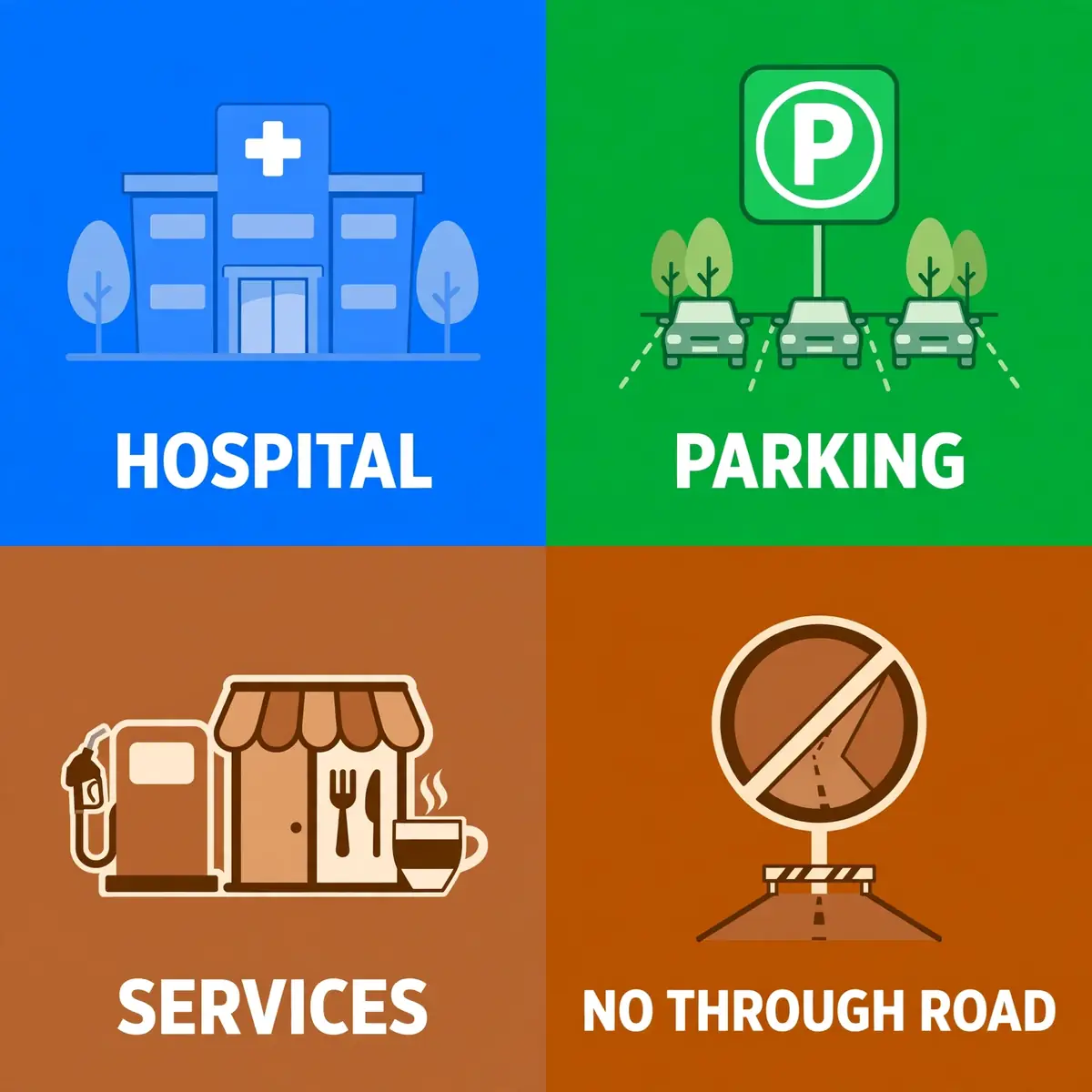
Not every road sign controls moving traffic. Some signs help a driver stop: find a car park, reach a hospital, use a service area, or follow a tourist route. These signs are mostly rectangles, and they use blue, green, brown or white backgrounds to name the service they point toward. They appear where a driver has time to read them, at junctions and on approach roads rather than at speed.
Direction signs to services use blue in the United States and in the United Kingdom, with white symbols for fuel, food, lodging, hospitals and rest areas. A motorway service area sign shows the operator name and the distance ahead. A hospital sign uses a white H on a blue background. And the Highway Code adds Accident and Emergency facilities where they exist. A tourist information point sign marks a place to stop and ask. And brown signs mark tourist attractions, picnic sites and camping grounds.
Parking, waiting and stopping rules
Parking signs state where a vehicle may stop and for how long. A no-waiting sign forbids waiting, while a no-stopping sign, known as a clearway in the United Kingdom, forbids stopping at all except in an emergency. A sign for a controlled parking zone marks the entrance to an area where parking is restricted to permit holders or to stated hours. A sign for a congestion charging zone marks an area where a charge applies to drive in, not just to park.
Time plates qualify parking signs, so a restriction may apply only during stated hours or days. A sign reading "No stopping during times shown except for as long as necessary to set down or pick up passengers" allows a brief stop for passengers but not waiting. A parking place sign for solo motorcycles marks bays for bikes only. Read the plate with the sign, because the same sign can allow parking at one hour. And forbid it at the next.
Dead ends, no-through roads and local routes
A no-through-road sign warns that the road ahead ends without an exit for vehicles. It saves a driver, and a large vehicle in particular, from a long reverse out of a dead end. A direction sign to a car park shows where to leave the vehicle. And a sign for a picnic site or an ancient monument marks a stopping place rather than a through route. An advisory route for lorries shows the preferred route for heavy vehicles through an area.
Local route signs use white backgrounds with black borders in the United Kingdom. And they name villages and local destinations that the main direction signs skip. Route numbers on a green background show the direction to a primary route. And route numbers on a blue background show the direction to a motorway. A driver following local signs should watch for the colour change, because it marks the point where the local road joins a faster one.
NoteA no-stopping sign forbids stopping at all, not just parking. So dropping off a passenger inside a clearway can still break the rule.
Signs that look alike at the same place
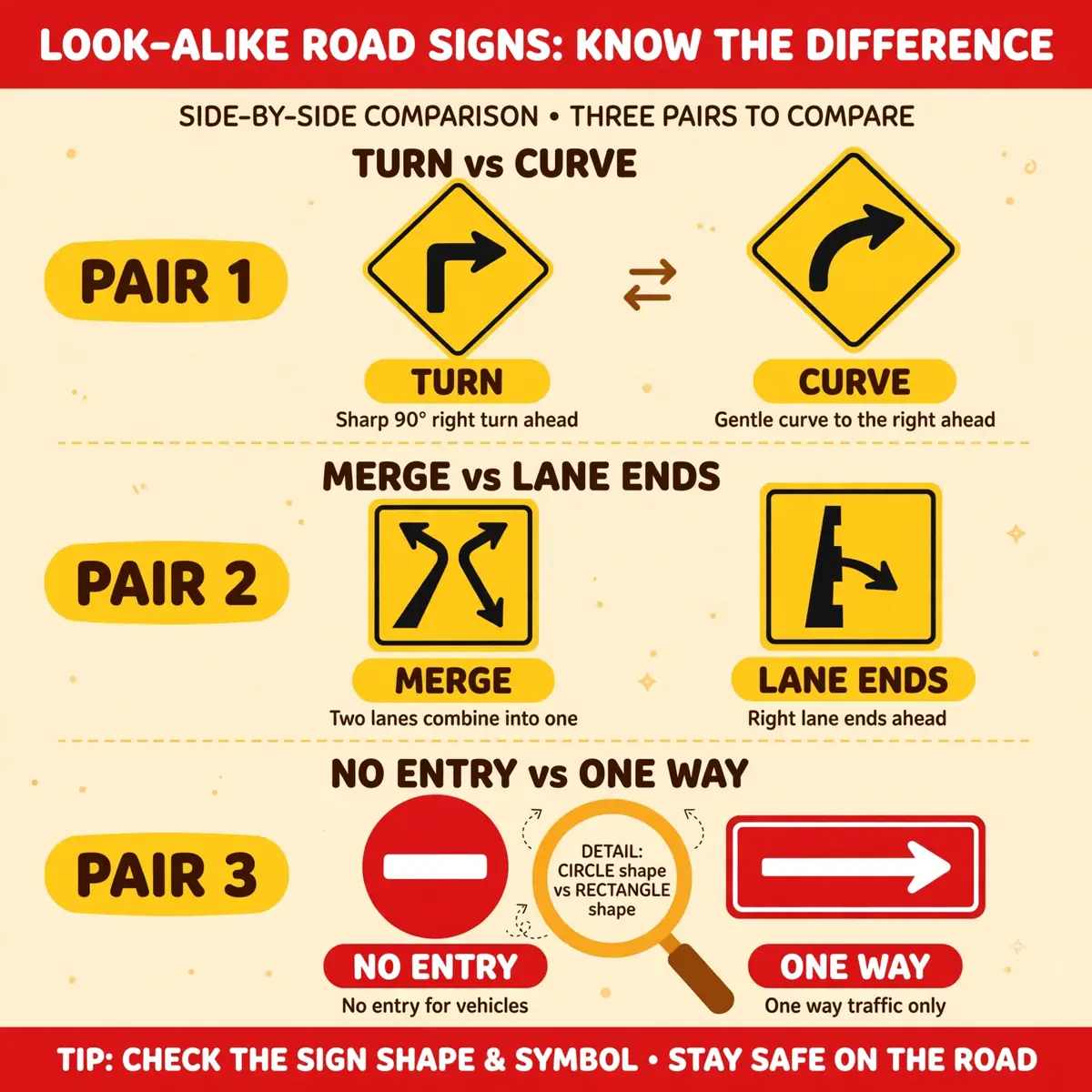
Some signs look alike on purpose: they share a shape and a colour, and only one detail separates them. Permit tests use these pairs because drivers mix them up on the road too. Learning the pairs, rather than each sign alone, stops the confusion at the place where it happens. The detail that separates each pair is small, and it is the whole meaning.
Turn and curve signs are the classic pair. A turn sign shows a sharp bend of about 90 degrees, and a curve sign shows a gentler bend. The arrow tells the story: a sharp, angled arrow means turn, and a gently bending arrow means curve. A reverse turn shows two sharp turns in opposite directions, and a reverse curve shows two gentler curves. All four mean slow down, but the turn needs more slowing than the curve.
Merge, lane ends and added lane
Three diamonds describe lanes, and each one gives a different job. A merge sign means two streams of traffic join, and both streams share the work of blending. A lane-ends sign means a lane on the driver's side ends ahead. And only the drivers in that lane must move over. An added-lane sign means a new lane begins ahead, and nobody needs to merge at all. The question to ask is who has to move: both streams, one lane, or nobody.
Divided highway signs form another trio. A divided highway sign means the road ahead splits around a median. A divided-highway-ends sign means the median ends. And oncoming traffic will share the road without a barrier, which is the dangerous one of the three. A two-way traffic sign means traffic ahead travels in both directions on a road that was one-way or divided. Do not confuse the ends sign with a keep-right sign, which only tells a driver to pass to the right of an island.
Do not enter, wrong way and advisory speeds
Do not enter and wrong way signs look similar and do opposite jobs. A do-not-enter sign, a red square with a white bar, marks a road or ramp that must not be entered from that direction. A wrong way sign, a red horizontal rectangle, warns a driver who has already turned the wrong way. And the correct action is to stop and turn around safely. One stops a driver going in; the other tells a driver who is already in.
An advisory speed plaque is a small yellow square with a number, mounted under a warning sign such as a curve. It shows the recommended safe speed for that hazard, and it is not the legal speed limit. Speed limits use white rectangles with black numbers. A question that asks what the number under a curve sign means wants the advised speed for the curve, not the limit. And a driver who treats the advisory number as a limit may drive too fast through the bend.
Two pentagons, two meanings
Two pentagon signs share a shape and differ in colour. A school sign is a pentagon pointing upward, with a black symbol on fluorescent yellow-green. And it warns of a school area where children may be present. A county route sign is a pentagon with a yellow county name and number on blue. And it only marks a county road. Colour settles it: fluorescent yellow-green means school, and blue means a route marker.
Railroad signs form a similar set. A round yellow sign with a black X and the letters RR warns that a crossing lies ahead. A crossbuck, white crossed blades reading "Railroad Crossing", stands at the crossing itself. A white rectangle reading "Stop here when flashing" marks where to wait when the lights work. The round sign comes first, the crossbuck is at the tracks, and the stop line is where the waiting happens.
TipWhen two signs look alike, name the one detail that separates them out loud, because saying it once fixes it better than reading the pair twice.
What to do when a sign is missing, damaged or wrong
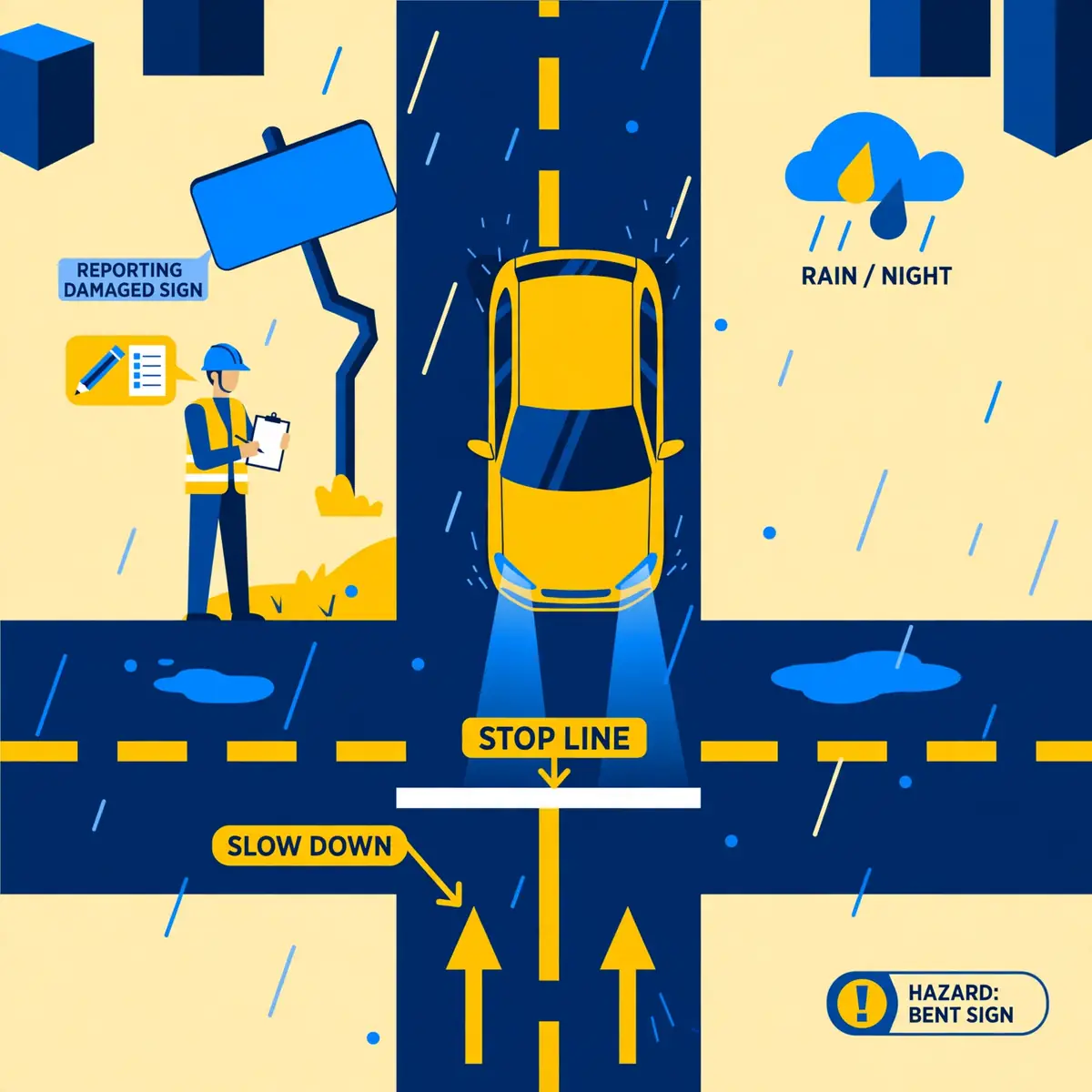
Signs go missing. Storms bend them, crashes knock them down, vandals turn them, and overgrown branches hide them. A missing sign does not remove the hazard it marked, and a turned sign can point the wrong way. A driver who meets a junction with no sign. Or a sign that cannot be read, must fall back on the road itself and on the other road users.
Slow down first, because speed is what turns a missing warning into a crash. Read the road markings: a stop line, a give-way line, a centre line. And lane arrows all carry the same message as the signs they pair with. Watch the other traffic: vehicles slowing ahead, brake lights at a junction. Or a queue forming around a bend all say something about the road ahead. Give way where the layout is unclear, rather than assuming priority.
Report the sign, and do not fix it yourself
A missing or damaged sign should be reported to the local highway authority or the road operator, with the location and the sign that is gone. A driver should not try to straighten, clean or replace a sign: the sign belongs to the authority. And a repair done wrong can mislead the next driver. Note the place, the direction of travel and what the sign should have said. And pass that on through the authority's reporting route.
Where a sign contradicts the road markings, treat the stricter instruction as the rule until the conflict is resolved. A stop line on the road with no stop sign still asks for a stop. A temporary sign inside a work zone overrides the permanent sign beside it. If the contradiction makes the safe action unclear, slow down. And follow the road users ahead, then report the conflict with the location so it can be checked.
Night, rain and glare
Signs are made to be read at night, using reflective material that returns a headlight beam to the driver. A sign that cannot be read at night may be dirty, faded or facing the wrong way. And it should be reported like a missing sign. In rain, slow down and use dipped headlights, because a wet sign reflects less light and a wet road reflects more. In low sun, a sign can be unreadable for a few seconds. So slow down until it can be read or until the next sign confirms it.
A sign hidden by a parked lorry or a hedge is the same problem as a missing sign: the hazard it marks is still there. Slow down, look past the obstruction, and expect the hazard the sign would have named. The habit that protects a driver is not memorising every sign, but slowing down whenever the road stops giving information.
WarningA missing sign does not remove the hazard it marked. So slow down and read the road markings and the traffic ahead instead of holding speed.
Frequently Asked Questions
What signs tell me a school zone is starting?
In the United States, an upward-pointing pentagon in fluorescent yellow-green marks a school area. And a lower speed limit sign follows it. In the United Kingdom, a red-bordered triangle showing children crossing warns of a school ahead. And a school crossing patrol sign may carry amber lights that flash while children are crossing. Entry signs for a 20 mph zone mark the boundary where the lower limit begins.
What should I do at a level crossing with flashing lights but no barrier?
Stop at the marked line and wait until the lights stop flashing, then look both ways before crossing. A crossing without a barrier has no physical block, so the lights are the only warning. Never cross while the lights flash, even when no train can be seen. And look again for a second train after the first one passes.
Why are work zone signs orange?
Orange marks temporary traffic control, so a driver can tell at a glance that the layout ahead is not the usual one. Road works, maintenance, detours and lane closures all use orange signs. And temporary limits shown in orange override the permanent signs inside the works. The colour exists so the change is visible before the words can be read.
Which sign tells me the maximum height my vehicle can pass under?
A low clearance warning sign gives the clearance ahead. And in the United Kingdom a red circle reading "No vehicles over height shown" states the maximum height allowed. A plate below an overhead electric cable sign gives the maximum height that can pass safely under the cable. Compare the signed number with the vehicle's height, including any load or roof rack, before passing under.
What does an advisory speed plaque under a curve sign mean?
It shows the recommended safe speed for that curve, and it is not the legal speed limit. The plaque is a small yellow square with a number, mounted under the yellow diamond warning sign. The legal limit uses a white rectangle with black numbers. Drive at or below the advisory speed through the bend, even when it is lower than the posted limit.
What do I do if a sign contradicts the road markings?
Treat the stricter instruction as the rule until the conflict is resolved, and slow down while deciding. A stop line on the road still asks for a stop when the sign is missing. And a temporary sign inside a work zone overrides a permanent sign beside it. Report the conflict to the local highway authority with the exact location so it can be checked.
Sources
- Federal Highway Administration, Manual on Uniform Traffic Control Devices, 11th Edition, Chapter 2A: General — sign classification (§2A.03), shapes and Table 2A-1 (§2A.05), colours (§1D.05).
- Federal Highway Administration, Manual on Uniform Traffic Control Devices, 11th Edition with Revision 1 (December 2025) — the current US national standard for signs, signals and markings.
- Federal Highway Administration, Manual on Uniform Traffic Control Devices, 11th Edition — overview of the 11th Edition and its parts.
- UK Department for Transport, The Highway Code: Traffic signs — signs giving orders, warning signs, direction signs, information signs and road works signs.
- UK Department for Transport, The Highway Code: Traffic signs (PDF) — the full illustrated sign lists, including plates, countdown markers and level crossing signs.
- United Nations, Convention on Road Signs and Signals, Vienna, 8 November 1968 (UNTS vol. 1091, p. 3) — classes of signs (Article 5).