
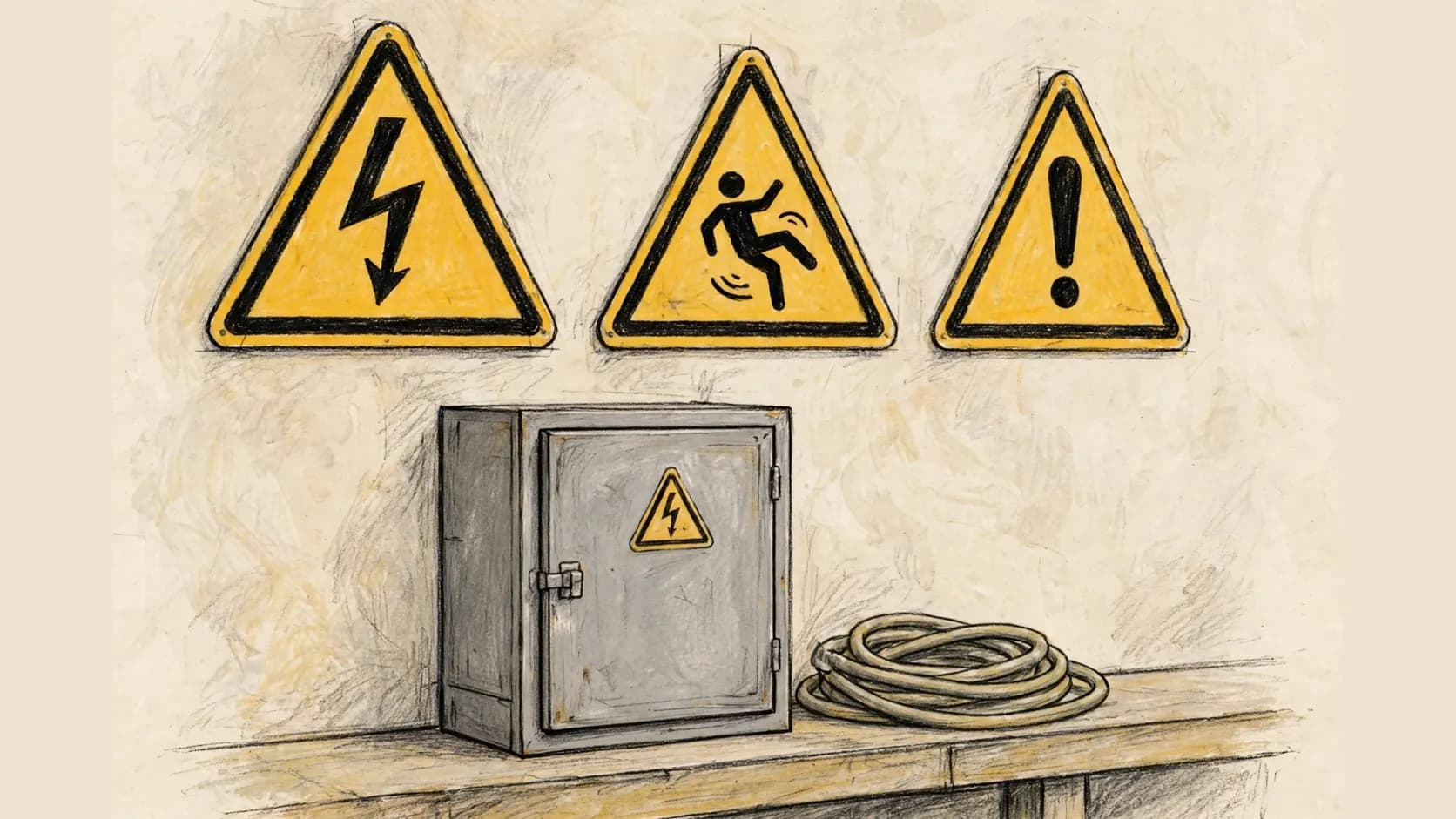
A warning sign is a yellow triangle with a black border and a black pictogram inside it. It tells anyone approaching that a hazard lies ahead, before they reach it. The shape and colour carry the message. The sign works even for people who cannot read the words on it or who speak another language.
Warning signs belong to a wider family of safety signs. Each family uses its own shape and colour. The code is the same in workplaces across Great Britain under the Health and Safety (Safety Signs and Signals) Regulations 1996. In the United States the same job is done by a different system. It is built on signal words under rules from the Occupational Safety and Health Administration (OSHA) and the Z535 standard from the American National Standards Institute (ANSI).
What a warning sign is
A warning sign is a safety sign whose whole purpose is to alert people to a hazard so injury or damage can be avoided. It is a passive control: it does not remove the hazard, it communicates it. Other controls sit above signage in the hierarchy of controls. Guards and ventilation rank higher, and so do safe systems of work. A sign supports those measures rather than replacing them.
Meaning is coded in layers that work together. Shape and colour are recognised from a distance, long before the eye resolves fine detail. The pictogram then names the specific hazard. Under the international system the warning sign is the yellow equilateral triangle with a black border. The pictograms inside it come from the standard BS EN ISO 7010, published by the International Organization for Standardization (ISO).
TipRead a sign by its shape and colour first, then by its pictogram, and only then by its words.
How the three layers work together
The triangle shape says "warning" before any detail is visible. Yellow says "be careful" and draws the eye, which is why the same colour marks physical hazards such as steps and low headroom. The black pictogram inside the triangle then identifies the hazard. A lightning flash means electricity. A slipping figure means a slippery floor. Wavy lines above a hand mean a hot surface.
Because the code is standardised, a worker who has never visited a site before can still read it. That matters on sites with contractors, agency staff and visitors from different language backgrounds. Where no pictogram exists for a hazard, the general warning sign is used instead. It is a black exclamation mark in a yellow triangle, known in ISO 7010 as W001, with words underneath explaining the hazard.
What the colours and shapes mean
Safety signs use five families, and each family has its own shape and colour. Once the code is learned, the meaning of any sign is clear at a glance. The table below sets out the system used in Great Britain under the 1996 Regulations, which follows the same conventions as ISO 3864.
| Shape and colour | Family | Meaning | Examples |
|---|---|---|---|
| Yellow triangle, black border | Warning | Be careful, take precautions | Electricity, slippery surface, overhead load |
| Red circle, diagonal bar | Prohibition | Do not do this | No smoking, no entry, no naked flames |
| Blue circle, white pictogram | Mandatory | You must do this | Wear a hard hat, wear eye protection |
| Green rectangle or square | Safe condition | Escape route, first aid, safe place | Fire exit, first aid point, emergency shower |
| Red rectangle or square | Fire equipment | Location of firefighting equipment | Fire extinguisher, hose reel, alarm call point |
The yellow triangle in detail
Schedule 1 of the 1996 Regulations fixes the warning sign exactly. The sign is triangular, with a black pictogram on a yellow background with black edging. The yellow part must take up at least 50% of the area of the sign. The colour table in the same Schedule gives yellow or amber one meaning only: warning sign, "be careful, take precautions, examine".
That precision is the point. If every workplace used its own colours, a yellow sign would mean nothing reliable. The code is fixed by law. So a yellow triangle means the same thing in a factory in Leeds, a warehouse in Glasgow and a laboratory in Cardiff. Visitors and new starters do not need a site induction to understand the shape.
The other four families, and why they must not be confused
A red circle forbids an action, while a yellow triangle warns of a hazard. The two are often posted side by side. A yellow triangle warns of forklift traffic next to a red circle barring pedestrian access. Each answers a different question. One says "a hazard is here", the other says "do not do this".
- A blue circle orders an action, such as wearing hearing protection or a hard hat, and it pairs naturally with a warning sign for the hazard that makes the protection necessary.
- A green rectangle points to safety: an escape route, a first aid point or an emergency shower.
- A red rectangle marks firefighting equipment, and it must never be confused with the red circle of a prohibition sign.
Common warning signs and what each one tells you
The 1996 Regulations list the warning signs that workplaces use most often. Each one names a hazard and implies the precaution that goes with it. The table below covers the signs readers are most likely to meet, with the action each one calls for.
| Sign | Pictogram | What it means | What to do |
|---|---|---|---|
| General danger | Exclamation mark | A hazard with no pictogram of its own | Read the words below the sign before proceeding |
| Danger: electricity | Lightning flash | Live electrical parts that can shock or kill | Do not touch, do not open, keep clear |
| Slippery surface | Slipping figure | A floor that may be wet, oily or icy | Slow down, hold a rail, wear suitable footwear |
| Overhead load | Load hanging from a hook | Loads moving above head height | Do not walk under the load, wear a hard hat |
| Hot surface | Hand above wavy lines | A surface hot enough to burn | Do not touch, use gloves or tools provided |
| Forklift trucks | Forklift truck | Industrial vehicles operating in the area | Keep to marked walkways, make eye contact with drivers |
| Corrosive material | Test tubes dripping liquid | A substance that can burn skin or damage surfaces | Wear the protective equipment shown, follow the Control of Substances Hazardous to Health (COSHH) assessment |
| Biological risk | Biohazard symbol | Infectious material or contaminated items | Follow hygiene rules, use the protective equipment provided |
Electricity and stored energy
The lightning flash triangle, catalogued as W012 in ISO 7010, marks switch rooms, distribution boards and substations. It also marks overhead lines. It warns that live parts are present and that contact can kill. The sign is often paired with words giving the voltage, such as "Danger 400 volts", and with a prohibition sign barring unauthorised access.
Electrical warning signs also appear on equipment that stores energy after switch-off, such as capacitors and battery banks. A worker who sees the triangle should treat the equipment as live until a competent person has proved it dead and isolated it. Lockout and isolation procedures, not the sign alone, make the work safe.
Slips, trips and falls
Slippery surface and drop warnings mark floors that are wet, oily, icy or uneven, and edges where a fall is possible. These are among the most common warning signs. Slips and trips happen in almost every workplace, from kitchens and corridors to loading bays and roofs.
The sign is a warning, not a fix. A wet floor still needs drying, mopping or gritting, and a hole still needs a cover or a barrier. Readers who see a slip warning should slow down. They should use a handrail where one is fitted. They should also report the hazard if the cause has not been dealt with.
Heat, chemicals and machinery
Hot surface, corrosive material and toxic material triangles mark hazards that injure by contact. A hot surface sign belongs on heated equipment such as ovens and steam pipes. A corrosive sign belongs on stores and cupboards holding corrosive substances such as acids and cleaning chemicals. It links to the COSHH assessment for those substances.
Machinery warnings cover crushing and entanglement risks, and the risk of automatic start-up. A triangle showing counter-rotating rollers or a hand near moving parts warns that guards must stay in place and that isolation comes before maintenance. Where chemical hazards are present, the warning triangle on the door and the label on the container work together. Each has its own job.
WarningNever remove, cover or paint over a warning sign to make a wall look tidy.
Warning, Danger, Caution and Notice: the US signal words
The United States uses a different system for the same job. OSHA rule 29 CFR 1910.145 sets the classes of accident prevention sign for general industry. Danger is one class, Caution is another, and safety instruction signs are the third. The ANSI Z535 standard adds two more levels, Warning and Notice, which OSHA accepts. Each level has its own signal word and colour.
| Signal word | Header colour | Severity | When to use it |
|---|---|---|---|
| DANGER | Red | Immediate hazard; death or serious injury is likely | Only where an immediate hazard exists |
| WARNING | Orange | Hazard that could cause death or serious injury | A hazard between Caution and Danger in severity |
| CAUTION | Yellow | Potential hazard or unsafe practice | A possible hazard against which precaution should be taken |
| NOTICE | Blue | No personal injury risk | Information about property, security or procedure |
| SAFETY INSTRUCTIONS | Green panel, white background | General guidance | Instructions and suggestions about safety measures |
Where WARNING sits in the scale
WARNING is the middle level. OSHA's tag rule says warning tags may represent a hazard level between Caution and Danger. OSHA's recommended colour coding gives WARNING an orange header. A WARNING sign therefore means a hazard that could cause death or serious injury. The risk does not rise to the immediate danger that DANGER marks.
Choosing the right word matters, because the word sets the urgency of the response. DANGER used for a minor hazard trains people to ignore red signs; CAUTION used for a lethal hazard leaves people unprepared. The rule is to use the lowest level that still communicates the risk honestly. Step up a level when the severity justifies it.
What OSHA requires for the signs themselves
Under 29 CFR 1910.145, all new signs and replacements of old signs must follow the rule's specifications. Danger signs must use red, black and white with no variation in design. Caution signs have a yellow background with a black panel and yellow letters, and any letters on the yellow background are black. Signs must have rounded or blunt corners, with no sharp edges or projections.
Wording must be easily read and concise, accurate in fact, and framed as a positive suggestion where possible. Employers must also instruct all employees that danger signs indicate immediate danger and that caution signs indicate a possible hazard. A sign that nobody has explained is only half a control.
AlertIn the United States, some hazards have their own sign rules that override the general system.
Where you will see warning signs
Warning signs appear wherever a significant hazard remains after other controls have been applied. The pattern is the same in every sector. The sign stands at the point where a person must make a decision, before they reach the hazard. A sign hidden behind a door or posted past the danger has already failed.
At work: factories, warehouses and construction sites
Factories use warning triangles on machines and chemical stores. Electrical cabinets carry them too. Warehouses post forklift and overhead load warnings at aisle entries and loading bays. Construction sites mark excavations and overhead lines at the site boundary. Falling objects and deep water are marked at each hazard.
- Plant rooms carry electricity and hot surface warnings on switchgear and boilers.
- Laboratories post corrosive, toxic and biological risk triangles on doors, fume cupboards and stores.
- Farms mark slurry pits, bull pens and overhead lines where workers and visitors may enter.
- Offices and shops use slippery surface and low headroom signs where the building creates the risk.
On construction sites the signs also speak to the public, not only to workers. Hoarding at the boundary warns of overhead loads and moving vehicles. The duty to protect non-employees is part of the same legal framework as the duty to workers.
In public places: roads, buildings and leisure sites
Warning triangles also appear outside workplaces. Leisure centres mark deep water and slippery poolside floors. Car parks warn of moving vehicles and low ceilings. Schools and hospitals post hot water and slippery floor warnings where patients and visitors may meet the hazard. Medical gas warnings mark the stores and outlets in hospitals.
Road warning signs are a separate family, governed by traffic law rather than workplace law. They use the same visual logic: a triangle that warns of a hazard ahead, such as a bend or a junction. The red-bordered triangle on a road sign and the yellow triangle in a workplace both say "hazard ahead, take care".
How to place a warning sign so it works
A well-chosen sign in the wrong place protects nobody. Placement follows a simple sequence, and each step is a check that can be done on a walk around the premises.
- Identify the hazard and the decision the sign must support, such as stopping, keeping clear or wearing protection.
- Choose the correct family: a yellow triangle for a hazard, a red circle to forbid, a blue circle to order, a green rectangle to guide.
- Put the sign where it is seen before the hazard is reached, at eye level and in the line of approach.
- Make it large enough to read from the distance at which the decision must be made, and light it if the area is dim.
- Keep it clean, undamaged and unobstructed, and remove it when the hazard it warns of no longer exists.
Size, lighting and viewing distance
A sign must be legible from the point where the reader has to act on it. A small triangle on a door is enough when the reader stands at the door. A sign warning drivers of forklifts needs to be read from across a yard. The further away the reader stands, the larger the sign and its letters must be. Guidance L64 from the Health and Safety Executive (HSE) covers sign dimensions in relation to viewing distance, and the principle is simple: size follows distance.
Lighting matters as much as size. A sign in a dim plant room, a stairwell or a corridor with poor lighting must be illuminated or made from self-luminous material. That applies where the regulations require it. A sign that cannot be seen in the dark is not a sign at all during a night shift or a power cut.
Checking and maintaining signs
Signs fade, peel, get painted over and get hidden behind stored goods. A sign that is illegible or missing leaves the hazard unwarned. An employer who provided the right sign and then let it rot has not discharged the duty. Regular checks belong in the same routine as fire extinguisher and emergency lighting checks.
- Walk the route a visitor would take and check that each sign is visible before the hazard.
- Replace signs that are faded, cracked, peeling or covered in dust, grease or paint.
- Remove signs for hazards that no longer exist, so the signs that remain keep their authority.
- Check after any change: new machines, new chemicals, new layouts and new contractors all change the signs needed.
- Explain unfamiliar signs to employees, visitors and contractors when they first meet them.
Materials and durability
Warning signs are made from rigid plastic, aluminium or self-adhesive vinyl, and the choice follows the environment. A vinyl sticker suits a clean indoor door, while a washdown area, a yard or a chemical store needs a rigid sign that resists water, cleaning chemicals and knocks. Signs in dim areas may need retroreflective material or illumination so they stay visible in low light.
Durability is part of compliance, not a cosmetic extra. A sign that has faded in sunlight or peeled in steam no longer warns anyone, and it must be replaced just as a cracked sign must. When ordering replacements, match the material to the place: the same triangle that lasts years on an office wall may fail within months beside a steam line or outdoors.
TipPhotograph each sign location during a safety walk, and compare the photos at the next check.
A sign is the last control, not the first
The law in Great Britain sets a clear order. Regulation 4 of the 1996 Regulations sets the test. A sign is required where the risk assessment shows a significant risk that cannot be avoided or adequately controlled by other means. Collective protection and work organisation come first; the sign warns about what is left.
That order is what stops a workplace from papering over danger. A missing guard cannot be fixed with a warning triangle, and a toxic substance cannot be made safe by a label alone. Inspectors look behind a sign to ask whether the underlying risk was properly managed. A sign used as a substitute for a control is evidence of a failure, not of compliance.
The same logic applies at home and in public. A slippery floor sign in a shop is not a reason to leave a spill unmopped. A hot surface sign on a heater is not a reason to leave it unguarded where children play. Warning signs work when they are the last step in a chain of controls, and they fail when they are the only step.
WarningA sign does not make a hazard safe; it only warns that the hazard is there.
Common mistakes with warning signs
Most sign failures are not about the sign itself. They are about too many signs, the wrong sign, or a sign that nobody can see. Each mistake below is easy to spot on a walk around any premises.
- Sign overload: a wall covered in triangles teaches people to ignore all of them, including the one that matters.
- Wrong family: a warning triangle used where a prohibition circle or a mandatory circle is needed, so the reader is warned but not told what to do.
- Wrong level: DANGER on a minor hazard, or CAUTION on a hazard that can kill, so the signal word loses its meaning.
- Hidden placement: a sign behind a door, above head height, or blocked by pallets, racking or parked vehicles.
- Stale signs: warnings for machines that were removed years ago, or for chemicals no longer stored on site.
- Unreadable signs: faded print, cracked plastic, handwritten additions, or text too small to read from the approach.
- No explanation: signs in a language the workforce does not read, with no induction or briefing to explain them.
Fixing these mistakes costs little. Removing stale and duplicate signs, moving a sign into the line of sight, and replacing a faded triangle usually takes minutes. The harder job is the one the sign points to: removing the hazard, guarding it, or changing the way the work is done. Where PPE requirements apply, the mandatory sign and the warning sign should stand together. Then the reader sees the hazard and the protection in the same glance.
Not every yellow sign is a warning sign
Three other yellow markings are often confused with warning triangles, and each has a different job. Using the wrong one in the wrong place leaves the real hazard unwarned and the reader misled.
Chemical labels: the GHS diamond
The red-bordered diamond on a chemical container is a hazard pictogram from the Globally Harmonized System (GHS), used under the Classification, Labelling and Packaging (CLP) Regulation. It is not a workplace warning sign. It labels the container, the drum or the bottle, and it travels with the substance. A corrosive diamond on a bottle and a corrosive triangle on a store door both warn of the same substance. The diamond belongs on the container and the triangle belongs on the door.
Readers who handle chemicals should learn both systems. The diamond says what is in the container; the triangle says a hazard is present in the room. Safety data sheets and the COSHH assessment tie the two together. The warning triangle on the store door should match the substances listed inside.
Vehicle and site plates: Hazchem and ADR placards
Orange Hazchem panels and placards under the European Agreement concerning the International Carriage of Dangerous Goods by Road (ADR) mark vehicles and large chemical sites for the emergency services. They carry codes that tell firefighters what the load is and what to do with it. They are not workplace warning signs, and they do not belong on a machine or a door inside a building.
The confusion matters most at loading bays, where a vehicle placard and a workplace warning sign may stand metres apart. The placard speaks to the fire crew; the triangle speaks to everyone approaching the hazard. Both must be present, and neither replaces the other.
Warning signs and the rest of the safety system
Warning signs work best when they are part of a system, not a collection of isolated triangles. The warning sign warns. The mandatory sign orders the protection. The safe condition sign shows the way out. The training explains what each one means. Each part supports the others.
That system shows up in the places readers already know. A first aid point is marked with a green rectangle. The route to it is signed along the way. Guidance on first aid kit contents explains what should be in the box at the end of that route. An asbestos warning triangle on a door links to the duty to manage asbestos in the building. The same logic applies to asbestos survey and removal work.
Emergency planning ties the system together. A warning sign for a hazard that could cause an emergency only works if people also know what to do when the hazard strikes. That is why workplaces practice emergency procedures rather than relying on signs alone. The sign warns before the event; the drill prepares for it.
Frequently Asked Questions
What does a warning sign mean?
A warning sign means a hazard is present and you should be careful and take precautions. In the UK system it is a yellow triangle with a black border and a black pictogram. Yellow must cover at least 50% of the sign.
What is the difference between a warning sign and a danger sign?
A warning sign is a yellow triangle that alerts you to a hazard. In the US system, DANGER is a red sign for an immediate hazard that will cause death or serious injury. WARNING is an orange sign for a hazard that could cause death or serious injury but is not immediate.
Where should warning signs be placed?
Place a warning sign where it is seen before the hazard is reached, at eye level and in the line of approach. It must be large enough to read from the distance at which the reader must act. It must be lit if the area is dim.
Are warning signs required by law?
In Great Britain, the Health and Safety (Safety Signs and Signals) Regulations 1996 set the rule. A sign is required where a risk assessment shows a significant risk that cannot be avoided or adequately controlled by other means. In the United States, OSHA 29 CFR 1910.145 sets the design and use rules for accident prevention signs.
What is the general warning sign?
The general warning sign is a black exclamation mark in a yellow triangle, catalogued as W001 in ISO 7010. It is used where no specific pictogram exists for the hazard, usually with words underneath explaining what the hazard is.
Do warning signs replace other safety controls?
No. A warning sign is the last control, not the first. Guards and ventilation come first, along with isolation and safe systems of work. The sign warns about the risk that remains after those controls.

Leave a Reply