Road signs speak in shape and colour before a driver can read a single word. An octagon means stop, a diamond means a hazard lies ahead, and a green rectangle points the way. Learn the code behind the shapes and colours, and any sign becomes readable, even one never seen before.
Three families cover almost every sign on the road. Regulatory signs state the law, warning signs flag hazards ahead, and guide signs give directions and information. The United States writes its code in the Manual on Uniform Traffic Control Devices (MUTCD). The United Kingdom follows The Highway Code and the Vienna Convention on Road Signs and Signals. The details differ, but the logic is the same in both systems.
The three families of road signs
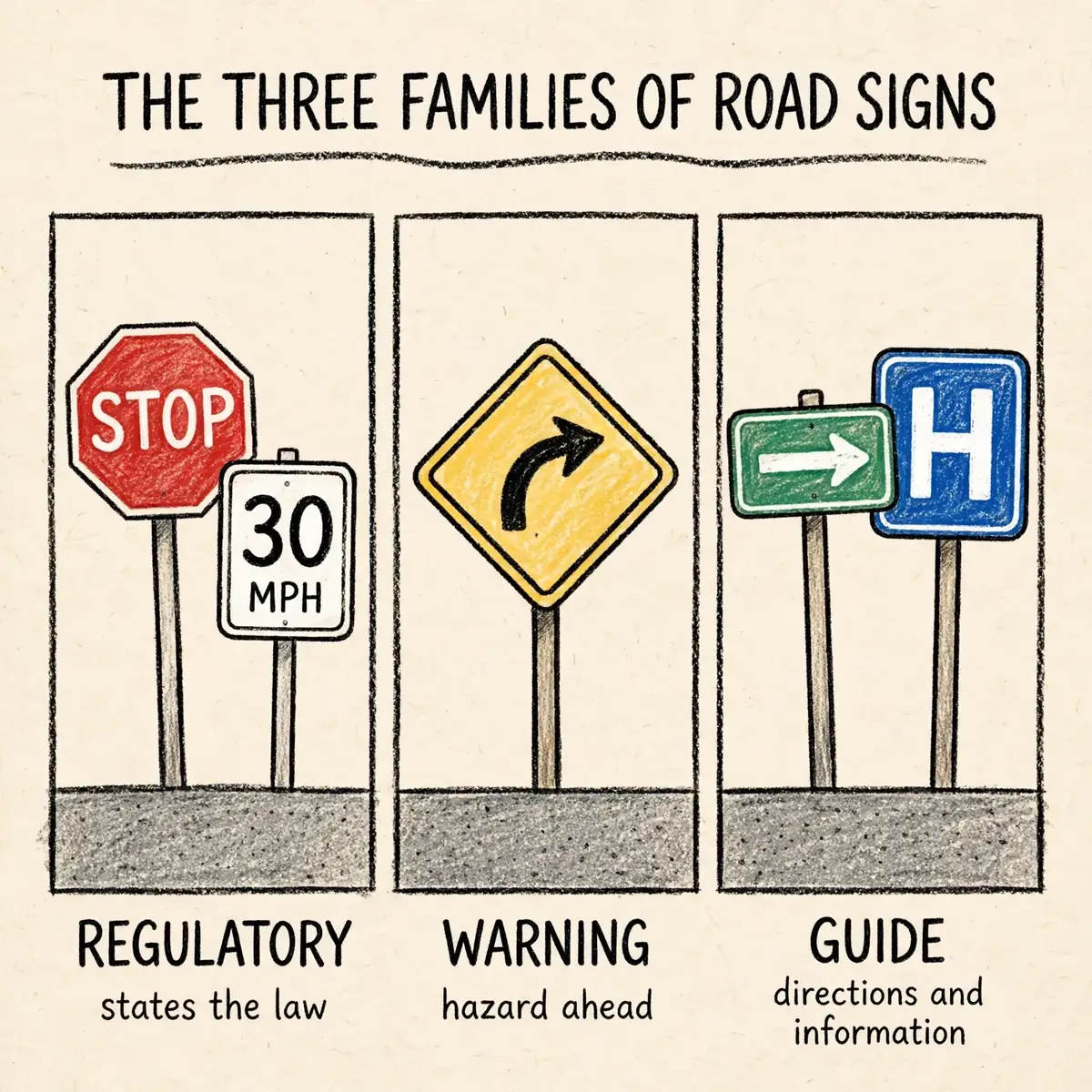
The MUTCD, the national standard for traffic signs in the United States, defines every sign by its function. Section 2A.03 gives three classes. Regulatory signs give notice of traffic laws. Warning signs give notice of a situation that might not be readily apparent. Guide signs show routes, destinations, directions, distances and services. The Vienna Convention uses the same three ideas, calling them regulatory, danger warning and informative signs.
Knowing the family is the fastest way to read a sign. A red-bordered sign demands obedience, a yellow sign demands attention, and a green or blue sign offers help. The family decides what kind of action follows, and the symbol or words on the sign fill in the detail.
Regulatory signs
Regulatory signs state traffic laws and regulations. Speed limits, stop signs, yield signs, one-way signs, no-entry signs and turn restrictions all belong here. A driver who disobeys one breaks the law, and enforcement follows the same rules as any other traffic offence.
Most regulatory signs are rectangular with a white background and black legend. The two most urgent orders have shapes of their own. The STOP sign is an octagon, and the YIELD sign is a downward-pointing triangle, so both stay recognisable even when snow, dirt or darkness hides the words.
AlertRegulatory signs carry the force of law in the country where they stand. A sign that looks advisory may still be an enforceable order.
Warning signs
Warning signs give notice of a hazard or a change in the road that a driver might not see in time. Curves, junctions, merging traffic, slippery surfaces, steep hills, school crossings and level crossings all get warning signs. The correct response is to slow down, look ahead and be ready to act before reaching the hazard.
In the United States, warning signs are diamond-shaped with a yellow background and black symbols. In the United Kingdom, they are triangles with a red border and a white or yellow centre. The shape and colour differ, but the message is the same: something ahead needs attention.
- Curve and bend signs warn of a change in road alignment ahead.
- Junction signs warn that another road joins or crosses ahead.
- Pedestrian and school signs warn that people may cross the road.
- Surface signs warn of slippery roads, loose chippings or uneven surfaces.
Guide and information signs
Guide signs show route designations, destinations, directions, distances and services. They answer the questions a driver asks on a journey: which way, how far, and where can I stop for fuel, food or help. A green motorway sign, a blue hospital sign and a brown sign for a historic site are all guide signs.
Information signs also cover parking, lane use, route confirmation and emergency facilities. They never order or warn; they help a driver make a good decision. Because they carry the most words, they use the largest lettering and sit where a driver has time to read them.
Not every sign stands beside the road. Lorries carrying dangerous goods display diamond-shaped hazard placards on the vehicle itself, and those placards follow the same shape-and-colour logic as road signs. Drivers who share the road with such vehicles can read the placard system in the chemical hazards guide.
How shape tells you the meaning
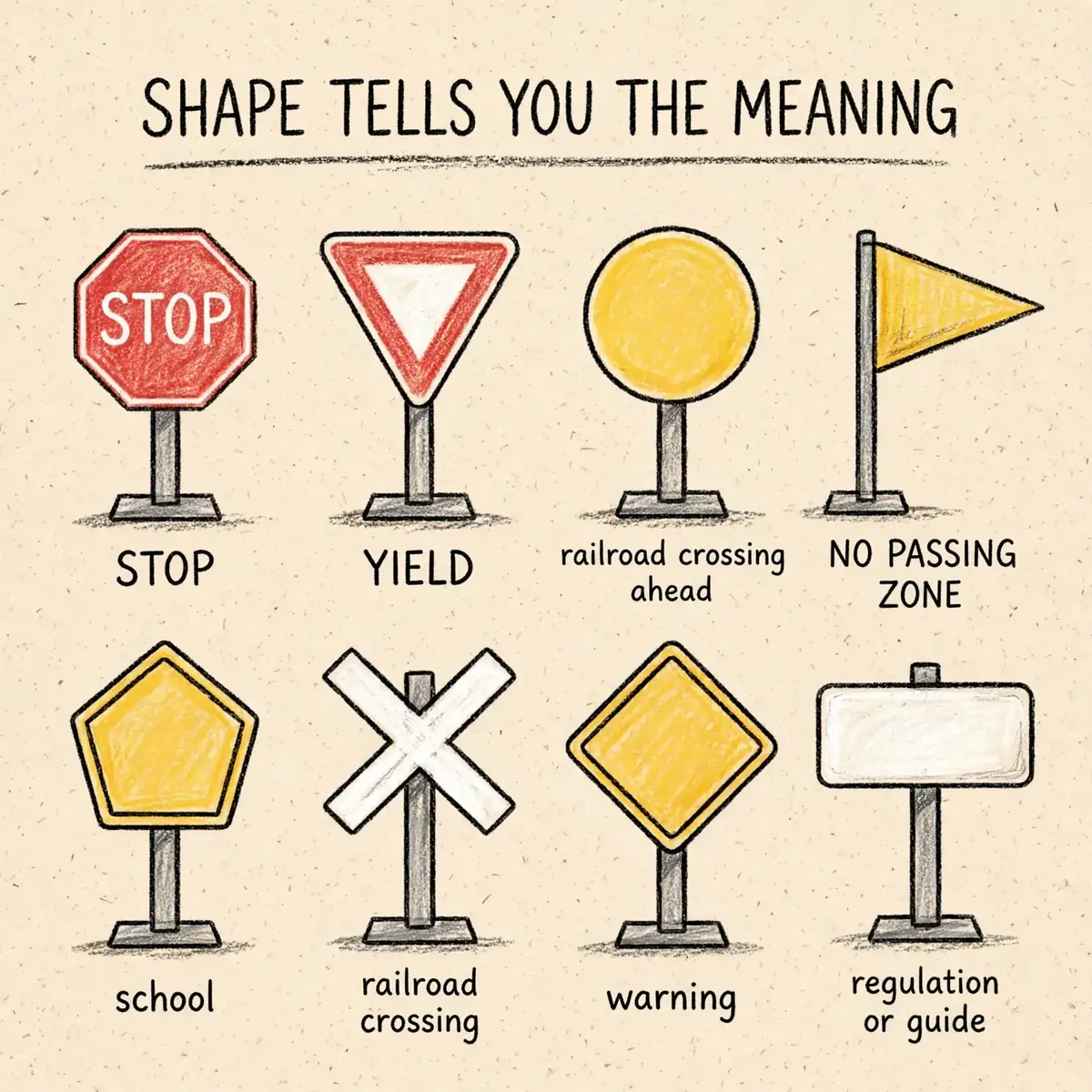
Shape is the first message a sign sends, and it arrives before the words are legible. The MUTCD states that standardised colours and shapes are specified so the classes of signs can be promptly recognised. A driver travelling at speed gets a fraction of a second to react. An outline can be read at a far greater distance than a word.
Table 2A-1 of the MUTCD assigns a shape to each sign or series. Seven shapes are reserved for one sign or one series only, which is what makes them readable even when partly hidden. The diamond and the rectangle are not reserved: the diamond serves the whole warning series, and the rectangle serves regulatory, guide and warning signs alike.
| Shape | Used for |
|---|---|
| Octagon | STOP sign only |
| Downward-pointing triangle | YIELD sign only |
| Circle | Railroad crossing advance warning only |
| Pennant (triangle pointing right) | NO PASSING ZONE only |
| Upward-pointing pentagon | School signs and county route markers |
| Crossbuck (X shape) | Railroad crossing only |
| Diamond | Warning signs |
| Rectangle (including square) | Regulatory, guide and some warning signs |
| Trapezoid | Recreational area guide signs and forest route signs |
Seven shapes that belong to one sign
Seven shapes in the MUTCD are reserved, and each one names its sign without a single word. An octagon is STOP, a downward triangle is YIELD, a circle warns of a railroad crossing ahead, and a pennant marks a no-passing zone. A pentagon marks a school or a county route, a crossbuck marks the crossing itself, and a trapezoid marks recreation areas and forest routes.
The reservation exists for bad conditions. Snow can cover a word, glare can wash out a colour, and a branch can hide half a sign, but the outline survives. That is why the STOP sign keeps its octagon in every country that follows the Vienna Convention too.
- Octagon: stop completely, then give way to all traffic with priority.
- Downward triangle: slow down and give way; stop only if needed.
- Circle: a railroad crossing lies ahead, so prepare to stop.
- Pennant: the passing zone ends; do not overtake from here.
TipLearn the seven reserved shapes first, because they answer the most urgent questions on the road without any reading at all.
Diamonds and rectangles
The diamond is the workhorse of the warning series. Every diamond-shaped sign warns of something ahead, from a sharp bend to a pedestrian crossing, and the symbol inside names the hazard. The diamond is not reserved in the strict sense, but no other series uses it, so a yellow diamond always means caution.
The rectangle is the most flexible shape of all. Tall rectangles usually carry regulations such as speed limits, wide rectangles usually carry guidance such as directions, and squares often mark routes. The orientation is a teaching convention rather than a rule, so the colour and the legend decide the meaning when a rectangle is unfamiliar.
What each colour means
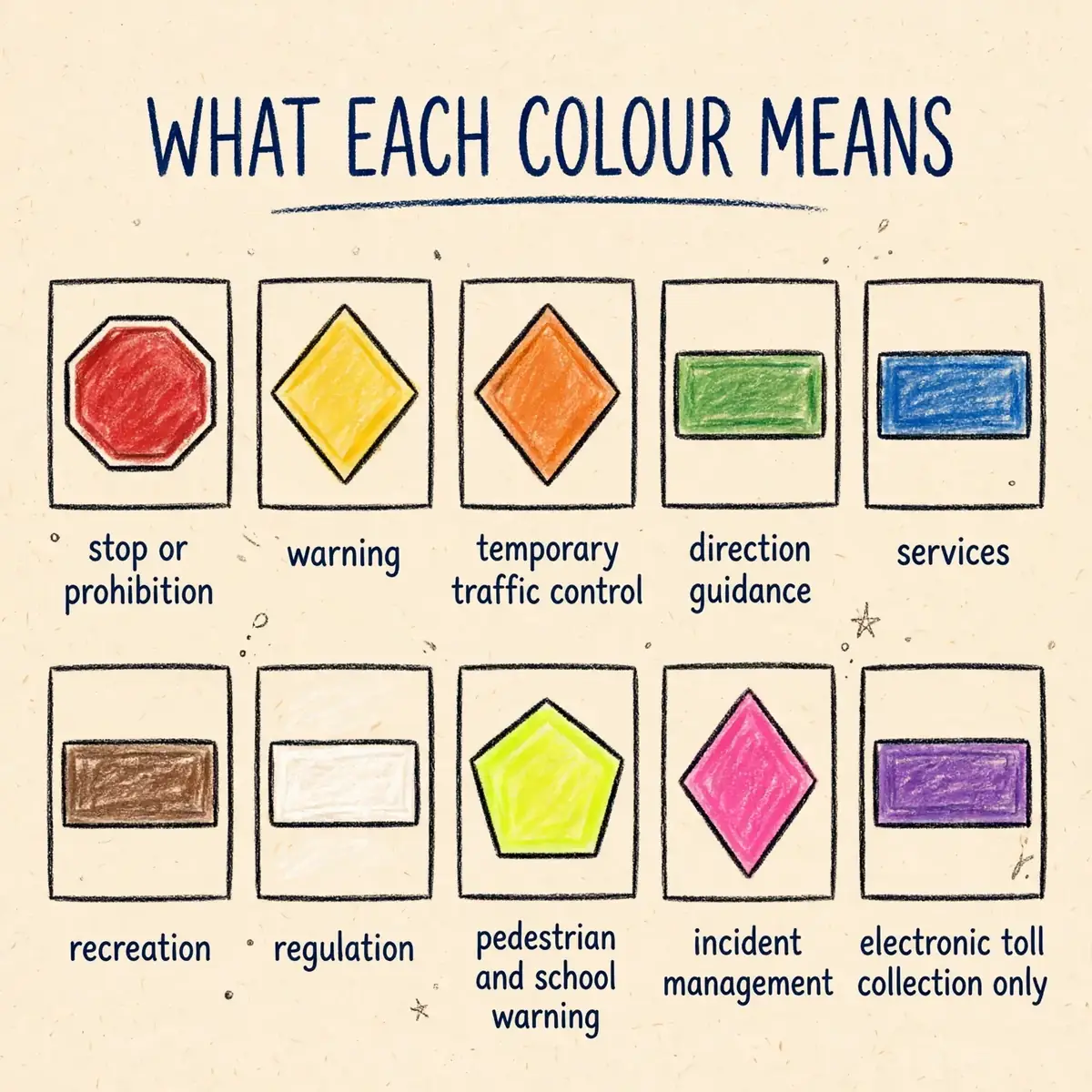
Colour is the second message, and the MUTCD assigns each colour a general meaning in Section 1D.05. Thirteen colours are defined, eleven carry an assigned meaning, and two, coral and light blue, are held in reserve for future use. Colour gradients are forbidden, so a sign reads the same at any distance and in any light.
The colour code works with the shape code, not instead of it. Red on an octagon means stop, red on a circle means prohibition, and yellow on a diamond means warning. Reading both together removes most of the guesswork from an unfamiliar sign.
| Colour | General meaning |
|---|---|
| Red | Stop or prohibition |
| White | Regulation |
| Black | Regulation |
| Yellow | Warning |
| Fluorescent yellow-green | Pedestrian, bicycle, playground, school bus and school warning |
| Orange | Temporary traffic control |
| Fluorescent pink | Incident management |
| Green | Movements permitted and direction guidance |
| Blue | Road-user services, tourist information and evacuation routes |
| Brown | Recreational and cultural interest area guidance |
| Purple | Electronic toll collection accounts only |
Red, white and black: the rules
Red is the colour of orders that must be obeyed at once. It marks the STOP sign and the border of a YIELD sign. It also marks the circle and slash of a prohibition and the words DO NOT ENTER and WRONG WAY. A red sign never suggests; it commands, and the command takes effect at the sign itself.
White and black carry the everyday rules of the road. Speed limits, lane-use signs, parking restrictions and one-way signs use a white background with black lettering, which gives the highest contrast for reading at speed. Black also forms the symbols and borders on warning signs, where it must stand out against yellow.
Yellow and fluorescent yellow-green: warnings
Yellow is the colour of caution. Diamond warning signs use a yellow background, and the black symbol inside names the hazard ahead. The message is always the same: slow down, look ahead, and be ready to change speed or direction before the hazard arrives.
Fluorescent yellow-green is a brighter warning reserved for the most vulnerable road users. It marks pedestrian crossings, bicycle warnings, school zones, playgrounds and school buses. The brighter colour exists because a driver must notice these signs earlier than an ordinary warning, and the fluorescence stays visible in poor light.
WarningA yellow sign warns of a hazard ahead, not at the sign itself, so braking hard beside the sign is already too late.
Green, blue and brown: guidance
Green is the colour of direction and permitted movement. In the United States, motorway and highway direction signs use green backgrounds with white lettering. The same colour marks distance signs, exit signs and route confirmations. Green tells a driver where to go and how far it is.
Blue marks services and information for road users. Fuel, food, lodging, hospitals, rest areas and tourist information all appear on blue signs, and blue also marks evacuation routes. Brown points to recreation and culture: parks, historic sites, picnic areas and scenic routes all use brown backgrounds with white symbols.
Orange and fluorescent pink: temporary conditions
Orange means the road ahead is not as usual. Road works, maintenance, detours and lane closures all use orange signs, and the layout can change from day to day as the work moves. A driver who memorised yesterday's route through a work zone cannot rely on it today.
Fluorescent pink marks incident management: crashes, spills and emergency closures. Pink signs appear quickly and disappear when the incident clears, so they are often portable or mounted on vehicles. Workers in a work zone wear high-visibility clothing that meets the site's PPE requirements. Drivers share the duty by slowing down and following the signed route.
- Orange diamond: road work ahead; expect a changed layout.
- Orange rectangle: detour or lane closure; follow the signed route.
- Fluorescent pink: an incident ahead; expect delays and emergency vehicles.
- Temporary speed limit: the signed limit applies until the end of the works.
WarningTemporary signs override permanent ones inside a work zone, so follow the orange sign even when it contradicts the usual limit.
The same sign in different countries
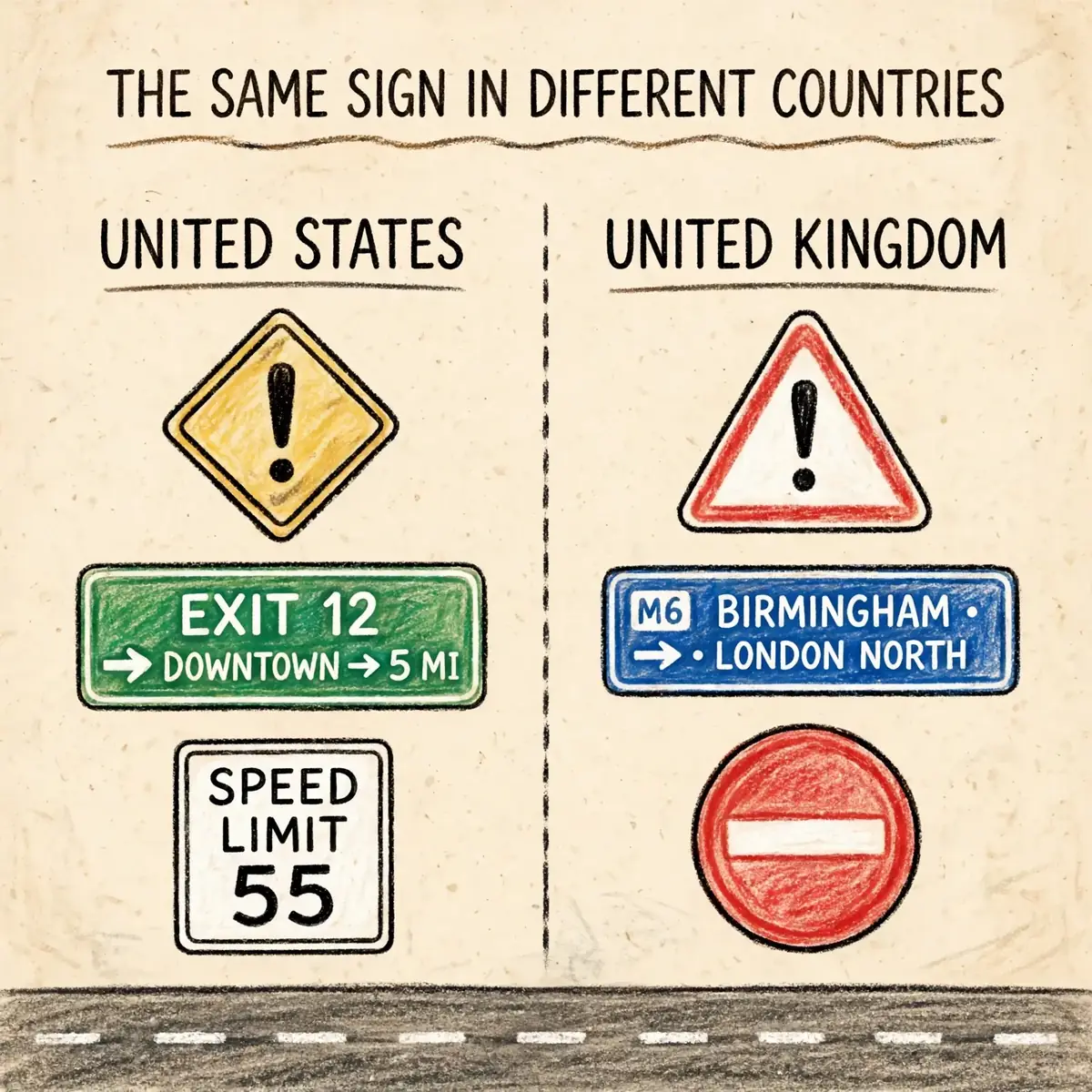
Two systems cover most of the world's roads, and they disagree on several details. The United States follows the MUTCD. The United Kingdom and most of Europe follow the Vienna Convention on Road Signs and Signals, agreed in 1968. A driver who crosses between the systems needs to know where the codes match and where they part.
The agreement is wider than the differences. Both systems give STOP its octagon, give warning signs a distinctive shape, and use red for prohibition and orders. The differences sit in the details: which shape warns, which colour guides, and how direction signs are coloured.
The United States: the MUTCD
The MUTCD is the national standard for traffic control devices on all roads open to public travel in the United States. The 11th Edition was published in December 2023, with Revision 1 in December 2025. It sets the shapes in Table 2A-1 and the colour code in Section 1D.05. States adopt the MUTCD and may add their own signs, but they may not change the standard shapes or colours.
American warning signs are yellow diamonds, regulatory signs are usually white rectangles, and guide signs are green rectangles on motorways. The YIELD sign is a downward red-and-white triangle. The NO PASSING ZONE sign is a yellow pennant on the left side of the road. It is the only warning sign posted there.
The United Kingdom and the Vienna Convention
The Vienna Convention divides signs into danger warning, regulatory and informative classes in Article 5, and the United Kingdom's Highway Code follows that division. Signs giving orders are mostly circular. Red circles are mostly prohibitive, telling drivers what they must not do. Blue circles without a red border give positive instruction, telling drivers what they must do.
Warning signs in the United Kingdom are mostly triangular, with a red border and a white or yellow centre. Direction signs are mostly rectangular, and their background colour names the road.
- Blue backgrounds mark motorways.
- Green backgrounds mark primary routes.
- White backgrounds with a black border mark local routes.
- Brown backgrounds mark tourist attractions.
Information signs are all rectangular.
NoteGreen means motorway directions in the United States but primary routes in the United Kingdom, where motorways use blue. A colour that guides in one country can mislead in the other.
Plates below the sign
Many signs carry a smaller plate underneath that qualifies the message. The Highway Code states that plates below signs qualify their message, and the MUTCD uses the same idea with plaques. A plate can add a distance, a time, a vehicle type or an exception, and the main sign must be read with its plate.
Plates change the action a sign requires. A speed limit with a plate reading "except buses" applies to other vehicles only. A warning sign with "200 yards" puts the hazard at that distance. Reading the sign without its plate is reading half the message.
- Distance plates: "200 yds" means the hazard or restriction lies that far ahead.
- Time plates: "Mon–Fri 8am–6pm" means the restriction applies only then.
- Vehicle plates: "Except buses" or "No goods vehicles" limits the sign to some users.
- Exception plates: "Except for access" permits entry for a stated purpose.
Common signs and what to do
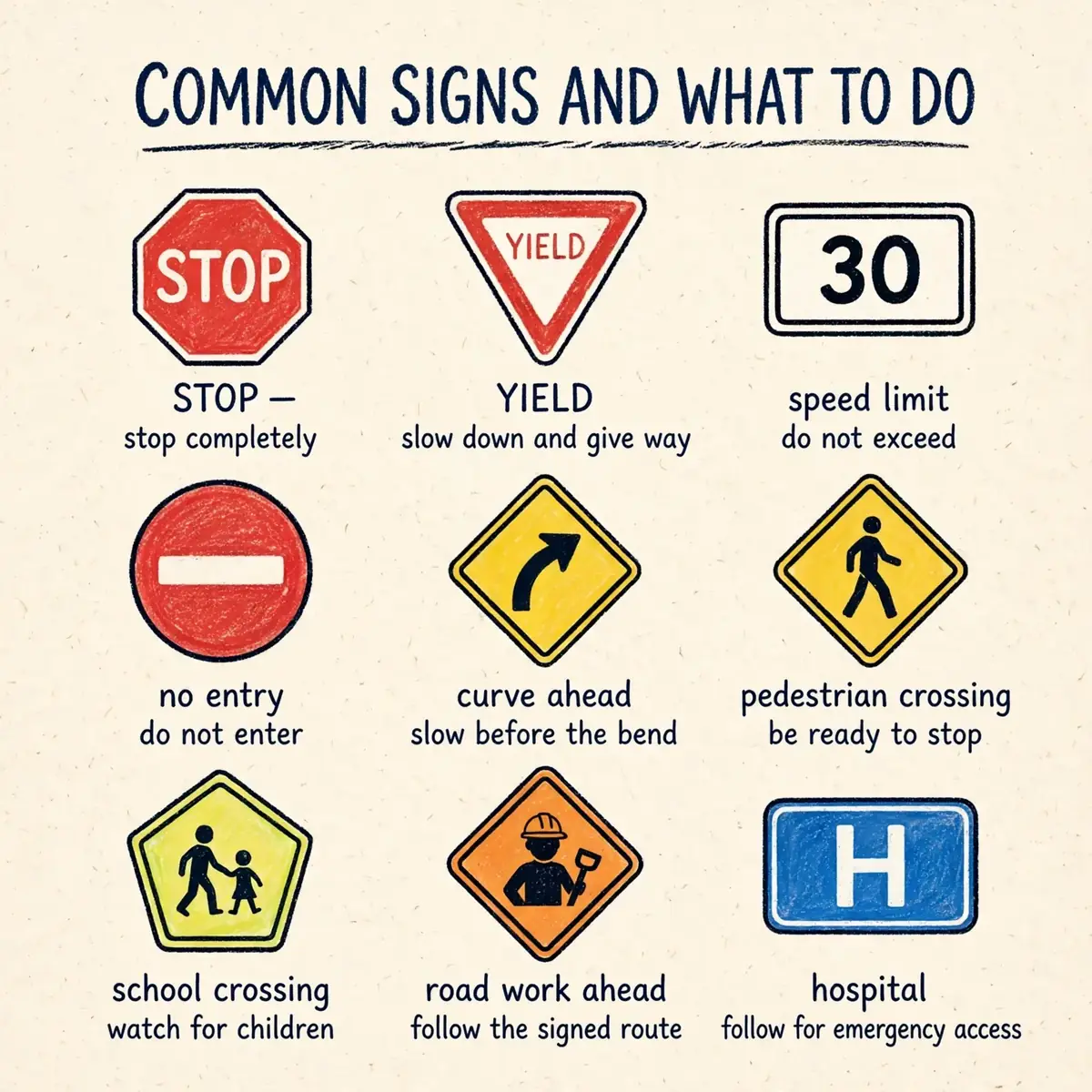
The signs below appear on almost every journey, and each one has a single correct response. Learn the response with the sign, and the action becomes automatic when the sign appears. The table gives the shape and colour first, because those are what a driver sees before the words.
| Sign | Shape and colour | What to do |
|---|---|---|
| STOP | Red octagon | Stop completely, then give way to all traffic with priority |
| YIELD / Give way | Red and white downward triangle | Slow down and give way; stop only if traffic is coming |
| Speed limit | White rectangle, black numbers | Do not exceed the signed maximum speed |
| No entry | Red circle, white bar | Do not enter; the road runs the other way |
| No overtaking | Red circle, two cars | Do not overtake until the restriction ends |
| Curve ahead | Yellow diamond, black arrow | Slow to the advisory speed before the bend |
| Pedestrian crossing | Yellow diamond, walking figure | Slow down and be ready to stop for people crossing |
| School crossing | Fluorescent yellow-green pentagon | Slow down and watch for children near the road |
| Road work ahead | Orange diamond, worker symbol | Slow down and follow the signed route through the works |
| Hospital | Blue rectangle, white H | Follow the sign for emergency or hospital access |
How to read a sign you have never seen
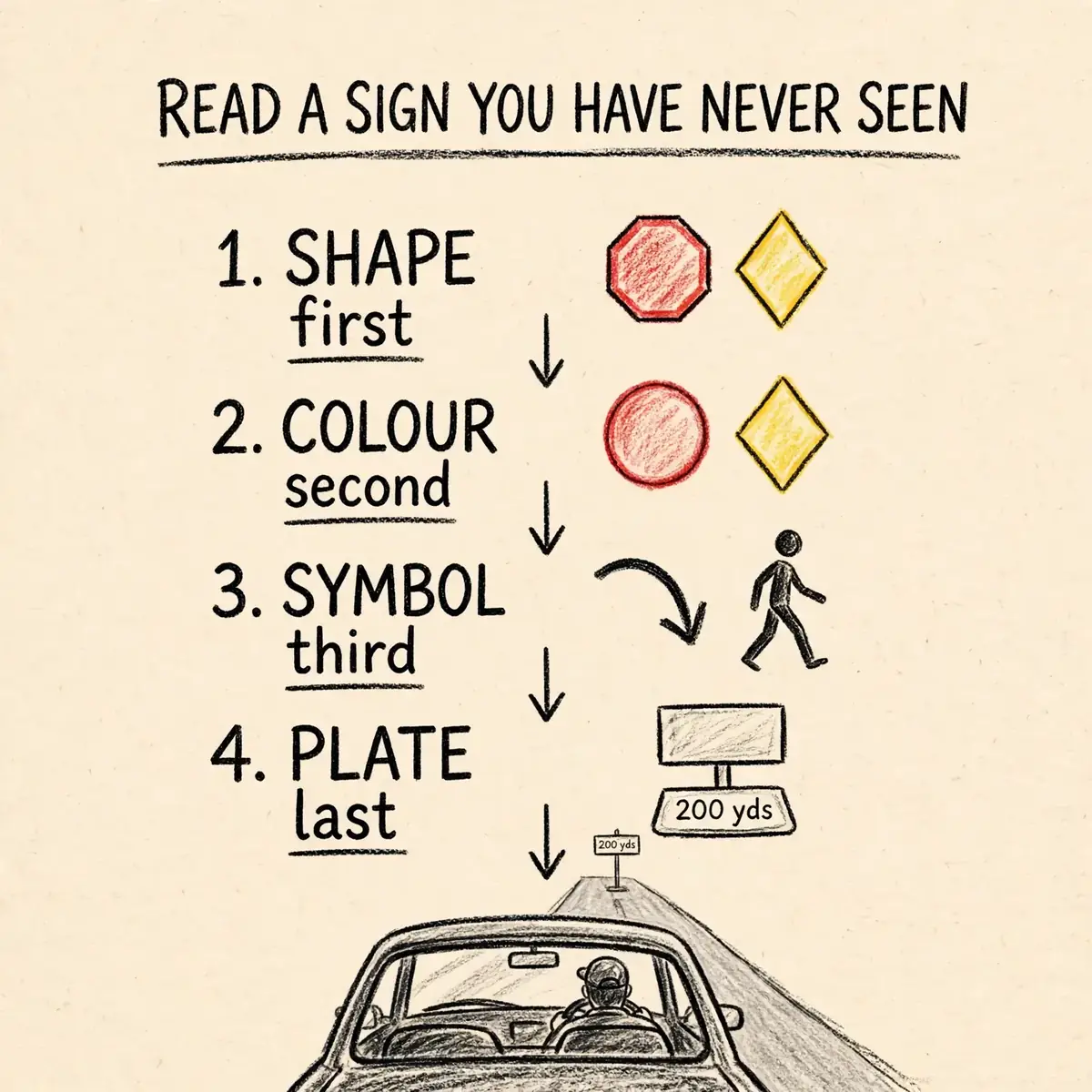
An unfamiliar sign is not a mystery; it is a code with four parts, and they can be read in order. Shape gives the family, colour gives the urgency, the symbol gives the subject, and the plate gives the conditions. Four checks take less than a second once the habit is learned.
Preparation answers the warnings that signs give. A charged phone, a reflective vest and a first aid kit in the vehicle turn a warning into a plan. They matter when a hazard becomes a real stop on the roadside.
- Read the shape first: octagon means stop, downward triangle means give way, diamond means warning, and rectangle means a rule or guidance.
- Read the colour second: red means stop or prohibition, yellow means warning, orange means temporary works, and green or blue means guidance.
- Read the symbol third: the picture names the hazard, the road layout or the service, and it needs no translation.
- Read the plate last: a small plate below the sign adds distance, times, vehicle types or exceptions that change the action.
TipRead shape first, colour second, symbol third and plate last, because that order gives the family and the urgency before the detail.
Traffic lights and road markings are not signs
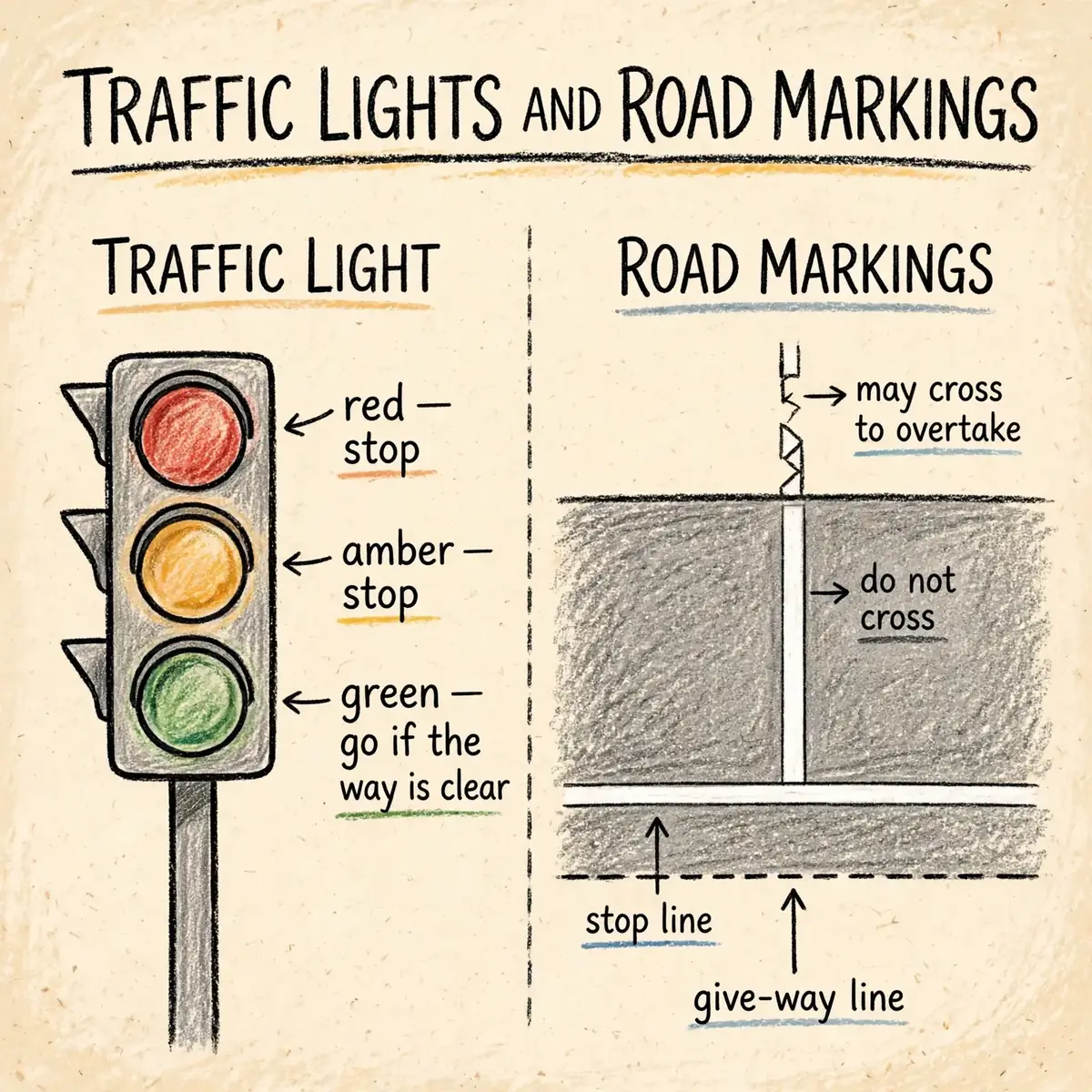
Two other parts of the road work with signs, and both use colour the same way. Traffic lights control who moves at a junction, and painted markings control where vehicles may go. Neither one is a sign, but a driver who cannot read them will misread the signs around them.
Traffic lights follow a fixed sequence. The Highway Code states that red means stop and wait behind the stop line. Red and amber together also mean stop. Green means go only if the way is clear. Amber means stop at the stop line. The exception covers a driver who has already crossed the line or is too close to stop safely.
Road markings use the same logic in paint. A broken white centre line marks the centre of the road. It may be crossed to overtake when safe. A solid white line on the driver's side must not be crossed. Highway Code rules 127 to 129 list the only exceptions. A solid white line across the road is a stop line. A broken line across the road is a give-way line.
WarningAmber means stop, not speed up to beat the red light.
Mistakes that cause confusion
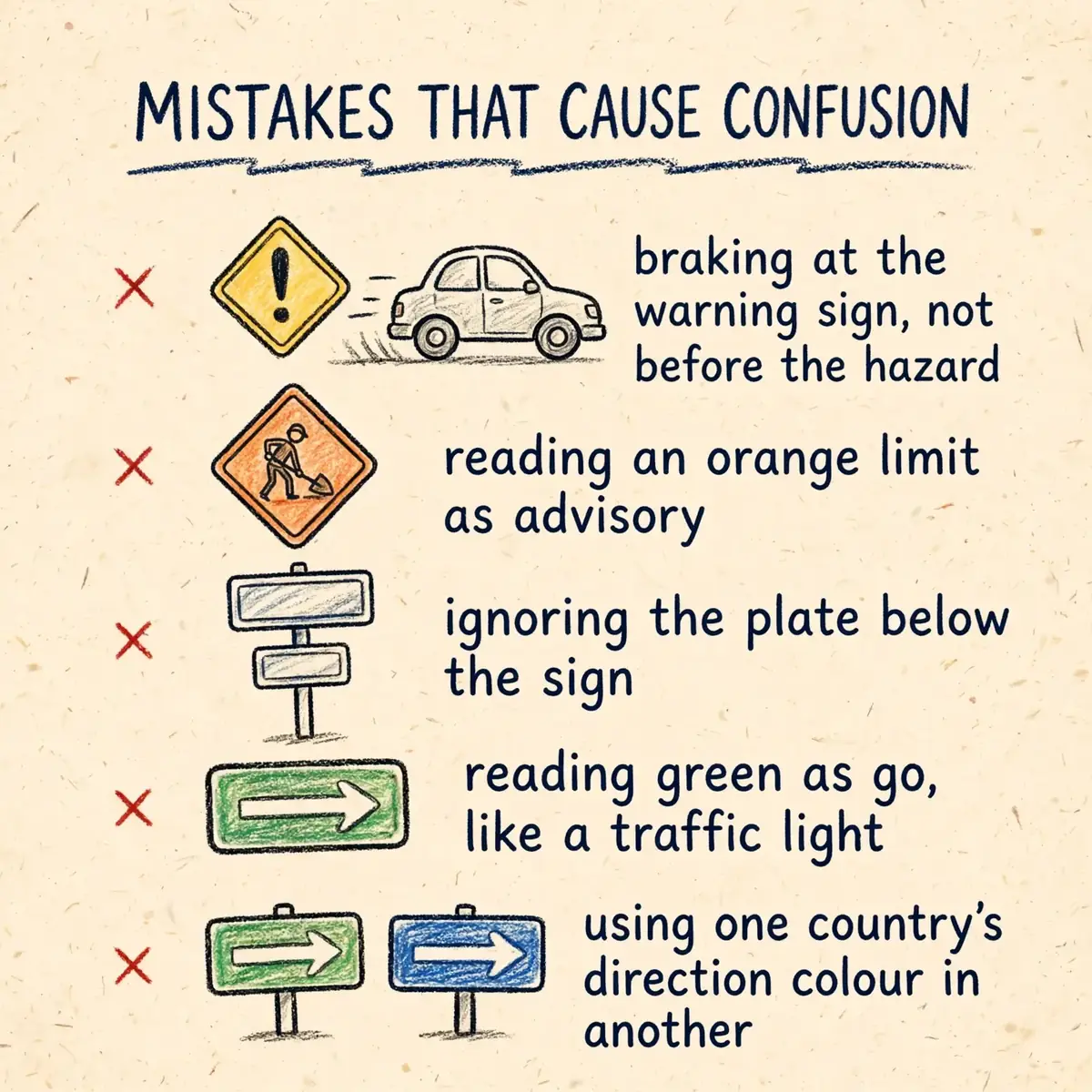
Most sign mistakes come from reading only part of the code. A driver who reads the words but ignores the shape misses the urgency. A driver who reads the colour but ignores the plate misses the conditions. The errors below are the ones that appear most often in driving tests and in crash reports.
Two shapes cause the most trouble. The YIELD sign's downward triangle is sometimes read as a warning, and the pennant's sideways triangle is sometimes read as a direction arrow. Both are orders, not advice, and both need a response before the junction or the passing zone, not after it.
- Treating a warning sign as the hazard itself, instead of slowing down before it.
- Reading a temporary orange limit as advisory when it overrides the permanent limit.
- Ignoring a plate below the sign, so a time or vehicle exception is missed.
- Assuming a green sign means go, when green on a sign means direction, not a traffic light.
- Following a direction colour from one country while driving in another.
Frequently Asked Questions
What are the three main types of road signs?
Regulatory signs state traffic laws, warning signs flag hazards ahead, and guide signs give directions, distances and services. The MUTCD defines the three classes in Section 2A.03, and the Vienna Convention uses the same three ideas.
Why is the STOP sign an octagon?
The octagon is reserved for the STOP sign alone, so the shape itself gives the order even when snow, dirt or darkness hides the word. The MUTCD reserves seven shapes this way in Table 2A-1.
What does a yellow diamond sign mean?
A yellow diamond is a warning sign. It flags a hazard or a change in the road ahead, such as a curve, a junction or a pedestrian crossing. The correct response is to slow down and prepare.
What does an orange road sign mean?
Orange means temporary traffic control. Road works, maintenance, detours and lane closures use orange signs, and the layout they describe can change from day to day.
Do road sign colours mean the same thing in every country?
No. Red for prohibition and yellow for warning are widely shared. Direction-sign colours differ. Green marks motorway directions in the United States. In the United Kingdom, blue marks motorways and green marks primary routes.
What is the difference between a regulatory sign and a warning sign?
A regulatory sign states a law that must be obeyed, such as a speed limit or a no-entry order. A warning sign describes a hazard ahead and asks the driver to slow down and prepare, but it does not itself create an offence.
Sources
- Federal Highway Administration, Manual on Uniform Traffic Control Devices, 11th Edition, Chapter 2A: General — sign classification (§2A.03), shapes and Table 2A-1 (§2A.05), colours and Table 2A-2 (§2A.06).
- Federal Highway Administration, Manual on Uniform Traffic Control Devices, 11th Edition with Revision 1 (December 2025) — colour code (§1D.05).
- UK Department for Transport, The Highway Code: Traffic signs — signs giving orders, warning signs, direction signs, information signs and road works signs.
- UK Department for Transport, The Highway Code: Light signals controlling traffic — traffic light signals, flashing red lights, motorway signals and lane control signals.
- United Nations, Convention on Road Signs and Signals, Vienna, 8 November 1968 (UNTS vol. 1091, p. 3) — classes of signs (Article 5).