

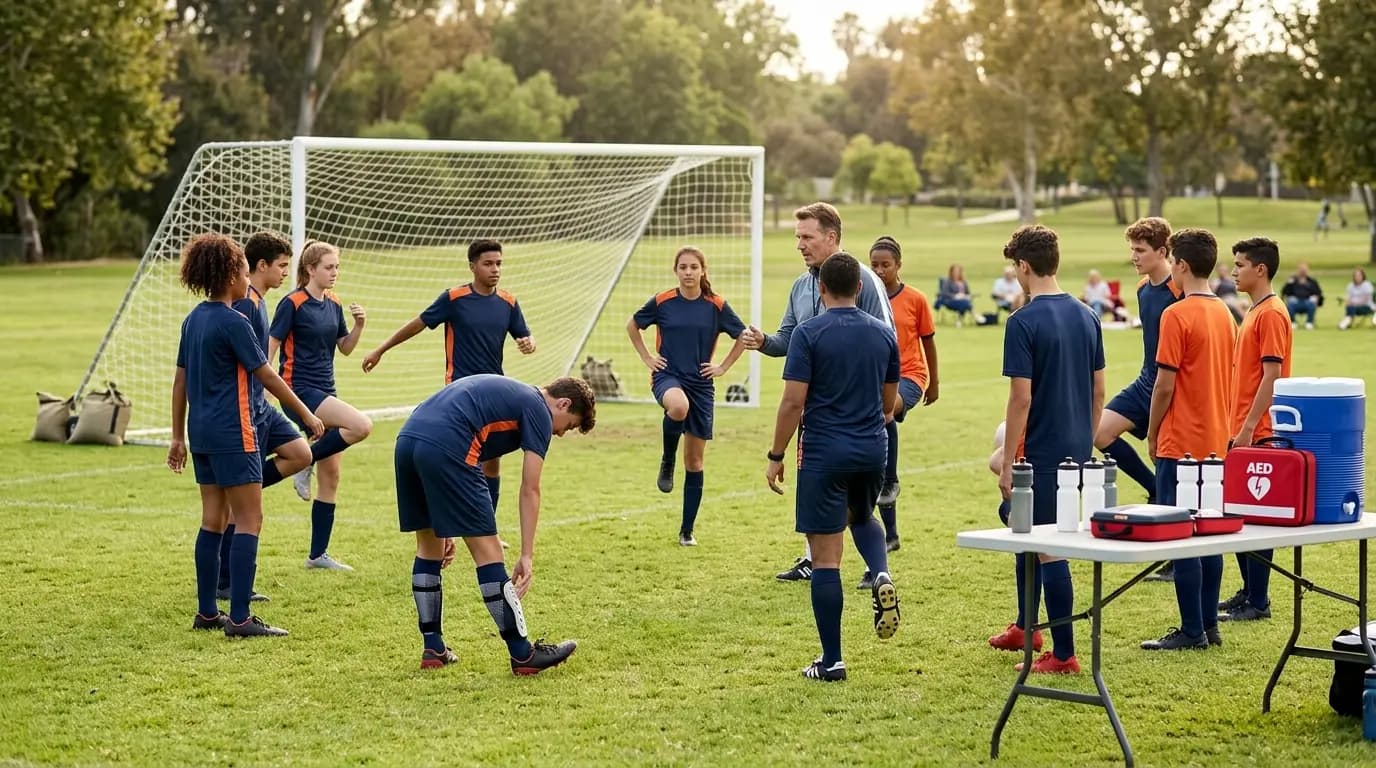
The safety tips that prevent the most serious harm in soccer are not the equipment ones. Anchoring a movable goal, knowing where the defibrillator is, and having a warm-up that people actually complete will do more for a squad than any shin guard on the market. Most lists start with kit because kit is easy to photograph, which puts the weakest control at the top of the page.
I work in human factors, fatigue and emergency preparedness across industry, not in sports medicine. What I do for a living is watch controls fail for boring reasons: the access route blocked by something parked, the checklist signed in an office, the roster nobody added up. Those failures look identical on a Sunday pitch. The 20 tips below are ordered by how much harm each one removes, with the evidence attached, and they cover both US and UK practice.
Key takeaways
The points that matter most, before the detail:
- Movable soccer goals weigh 68–227 kg (150–500 lb) and have killed children; the CPSC guidelines on movable soccer goals record that most investigated incidents happened when nobody was playing.
- Structured neuromuscular warm-ups such as the FIFA 11+ cut overall injury risk by roughly a third, and the children's version performs better again — but only where teams keep doing them.
- Under IFAB Law 4, the referee checks that shinguards are worn and covered; the player is responsible for whether they actually protect anything.
- Heading limits are now specific numbers, not advice: the FA caps adult amateur training at 10 headers in one session a week, and England has phased deliberate heading out of U7–U11 matches.
- UK grassroots concussion guidance sets no return to competition before 21 days from injury, with 14 symptom-free days before that.
- Suspend play at the first thunder and hold for a full 30 minutes after the last thunder or flash; dugouts and bleachers are not shelter.
Why this list is ordered the way it is
Every safety list is an argument about priority, whether or not the writer says so. Mine follows the hierarchy of controls, which is the ordering used in occupational safety because it reflects how reliably a control works when people are tired, rushed or distracted. Elimination and substitution beat engineering; engineering beats administration; administration beats personal protective equipment. Shin guards are PPE. They sit at the bottom for a reason.
Applied to a pitch, the hierarchy sorts the usual advice into something more useful.
| Control level | Example on a soccer pitch | Why it can still fail |
|---|---|---|
| Elimination | Removing deliberate heading from U7–U11 matches | Only works where the rule is enforced in training too |
| Substitution | Lighter, tip-resistant goals instead of heavy homemade frames | Older goals stay in service for years |
| Engineering | Ground anchors, padded posts, a defibrillator on the clubhouse wall | Anchors get pulled for mowing and not replaced |
| Administrative | Warm-up programmes, heading caps, load limits, weather triggers | Depends entirely on adherence |
| PPE | Shin guards, gloves, mouthguards, appropriate footwear | Protects one body part against one mechanism |
Two consequences follow from reading the table honestly. The first is that the items at the top need doing once, properly, by an adult with authority, and then verifying. The second is that the items at the bottom need doing by every player, every session, forever, which is why they fail so often.
The order I have used for the 20 tips is:
- Tips 1–5: readiness controls that decide whether a rare, catastrophic event is survivable
- Tips 6–10: equipment, starting with the goal frame rather than the kit bag
- Tips 11–14: the warm-up and rehabilitation work with the strongest evidence behind it
- Tips 15–17: load, fatigue and head impact exposure across a whole week
- Tips 18–20: heat, hydration and lightning

Before anyone kicks a ball: five controls most lists leave out
The first five tips have nothing to do with technique or kit. They decide what happens on the worst day, and they are the ones I would check first if someone asked me to look at a club rather than a plant. Rare events are exactly where readiness controls earn their keep, because there is no second attempt.
1. Write an emergency action plan for this pitch
A plan that lives in a club folder is not a plan. US Soccer publishes emergency action plan templates through Recognize to Recover, and the value is in filling one in for the specific venue rather than downloading it. What works is a single laminated card at the pitch that names the venue address including the access gate, who calls the ambulance, who fetches the defibrillator, who holds the gate open, and who stays with the player. Named roles, not job titles.
The failure I would expect to find is access rather than paperwork. Auditing a mine surface approach in Canada for Glencore, I found drill consumables staged across a marked emergency vehicle route. Nobody had done anything reckless; a laydown area had crept sideways over several shifts. I required relocation and had the readiness checklist reissued with a photograph of what good looked like. The pitch version of that finding is a padlocked field gate, a coach's car parked across the only vehicle access, or a barrier the ambulance cannot pass. It is the same failure wearing a different coat.
Before your next fixture, confirm the following and write the answers on the card:
- The address a dispatcher can find, including which entrance to use
- Who unlocks and holds the vehicle gate, named for that session
- Where the nearest AED is, and whether it needs a code
- Who has the medical consent and contact details for youth players
- Who calls if the coach is the casualty — this is the gap I see most often
2. Time the walk to the nearest defibrillator
Do not estimate this. Walk it, at a jog, with a stopwatch, and write the number on the card. Sudden cardiac arrest is an electrical fault, not a fitness problem, and defibrillation is the only treatment that reverses it.
The evidence on venue AEDs is unusually clean. In an 18-year study of sudden cardiac arrest in amateur sports centres, on-site AEDs cut the time to first shock from 7.3 minutes to 3.3 minutes and on-site availability was the only independent predictor of neurologically intact survival. An ambulance cannot beat a device on the clubhouse wall.
3. Put trained first aid at training, not only at matches
Clubs staff matches and leave midweek sessions uncovered, which is backwards: most contact hours happen in training. At least one adult present at every session should hold current first aid and CPR training, and the certificate should be in date rather than remembered.
Competence here is genuinely regulated in places. In England, Emergency First Aid in Football is the minimum expectation for affiliated coaches, and certificates expire. Check yours before the season rather than during it.
4. Treat collapse, chest pain or fainting as a stop
A player who faints during exertion, complains of chest tightness, or is breathless out of proportion to the work has a medical problem until a clinician says otherwise. Do not coach through it and do not let the player talk you out of it. The same applies to a family history of sudden death in someone young.
I am not a clinician and this article does not replace one. What I can say from the system side is that the decision to stop must sit with the person on the touchline, not with the player, because the player is the least well placed to judge.
5. Walk the pitch before every session
Two minutes, before the cones come out. Look for holes, glass, dog fouling, sprinkler heads, hard frozen ruts, discarded equipment behind the goal line, and standing water. Fill or flag what you find and move the session away from it if you cannot fix it.
Public pitches change between sessions in ways private facilities do not. Baylor College of Medicine's athletic training staff describe the surface check as one of the first things a trainer does before play, and it is the cheapest control on this entire list.
The checks worth making part of the routine are:
- Walk both penalty areas, where the ground wears fastest
- Check the run-off behind each goal for hard obstacles
- Remove spare balls and bags to the sides, off the touchline
- Look at the goalmouth for depressions that turn an ankle
- Note anything you cannot fix, and tell the players about it

Equipment: start with the goal, not the shin guard
Soccer's fatal equipment hazard is not a boot or a ball. It is a heavy metal frame standing on grass with nothing holding it down. The CPSC guidelines on movable soccer goals record that most goals weigh 68–227 kg (150–500 lb), that at least 21 deaths were associated with movable goals in the United States between 1979 and 1994, and that the injuries were blunt force trauma to the head, neck, chest and limbs.
Read the next sentence twice, because it is the one that changes behaviour. The majority of the incidents CPSC investigated did not happen during a match. They happened when the goal was unattended and somebody climbed on it.
6. Anchor every movable goal, every single time
Anchor at the rear of the goal, keep the anchors flush with the ground, and make them visible. Auger, semi-permanent, peg and J-hook anchors all work; the number needed depends on soil type, moisture and the weight of the goal, so follow the manufacturer's specification rather than a habit. On indoor or artificial surfaces where an anchor cannot penetrate, use sandbags or counterweights sized to the goal.
One error is common enough to name. Net pegs secure the net, not the frame. Using them as goal anchors leaves you with a goal that is not anchored and a coach who believes it is.
7. Secure or store goals when nobody is playing
Since most deaths happened outside play, the end-of-session routine matters more than the pre-match one. Remove the nets, then chain goals face to face, lock them to a fence post or other fixed structure, fold and lock them flat, or put them in a store. Fully disassemble for seasonal storage.
Wind is a live hazard here as well: CPSC documents a nine-year-old fatally injured when a goal was tipped by a gust. A goal that is stable in still air is not necessarily stable in February.
8. Check goal hardware, labels and nets before use
Look at the connecting hardware before every use and replace damaged or missing fasteners immediately rather than at the end of the season. Confirm the warning labels are legible and positioned where someone about to climb would see them, under the crossbar and at eye level on the posts. Use movable goals only on level ground.
Then enforce the rule that no one hangs from the crossbar or climbs the net, including siblings on the touchline and adults doing pull-ups. In the US, ASTM F2673 covers tip resistance for movable goals, and several states legislate for it; if you are buying, buy to the standard.
9. Wear shin guards that meet a published standard
IFAB Law 4 requires shinguards made of suitable material, of an appropriate size to provide reasonable protection, and covered by the socks. The Law is explicit that the referee checks they are worn and covered, while the player is responsible for size and suitability. That responsibility split is the reason so many players wear guards that protect nothing.
A standard turns "reasonable protection" into a measurement. EN 13061:2009 is the harmonised European standard: guards are drop-tested with a 1 kg mass and fail if transmitted force exceeds 2 kN, are stud-impact tested for penetration resistance, and are assessed for coverage, restraint and ergonomics. In Europe they are Category II PPE and carry a CE mark. In the United States, look for NOCSAE certification.
The table below is what I would check before a season, not during a match.
| Check | What good looks like | Source of the requirement |
|---|---|---|
| Certification | EN 13061 CE mark or NOCSAE mark on the guard itself | EN 13061:2009 / NOCSAE |
| Size and coverage | Below the knee to just above the ankle bone, tibia fully covered | IFAB Law 4, player responsibility |
| Condition | No cracks, no collapsed foam, straps intact | EN 13061 impact performance assumes an intact shell |
| Fit | Held in place by socks or integral sleeve, does not migrate | EN 13061 restraint assessment |
| Modification | Uncut, unaltered | Cut-down guards fail inspection under Law 4 |
10. Match boots to the surface and remove jewellery
Studs are chosen for the surface, not for the brand. Firm-ground studs on hard, dry ground or on artificial turf give grip the joint has to absorb, and worn moulded soles on wet grass do the opposite. Check studs for sharp edges and missing pieces before play.
Law 4 also forbids all jewellery — necklaces, rings, bracelets, earrings, leather and rubber bands — and taping over it is not permitted. Plan around new piercings before the season rather than arguing at kick-off. Soft protective equipment such as gloves, headgear, facemasks and padded knee and arm protectors is permitted where it is not dangerous.
Before the first fixture of a season, I would want a named person to have confirmed all five of the following at the venue:
- Every movable goal anchored at the rear, anchors flush and visible
- No net pegs used as goal anchors anywhere on site
- Warning labels legible under the crossbar and at eye level on the posts
- An end-of-session securing routine that someone owns by name
- Shin guards checked once, at registration, rather than argued about at kick-off

The 20 minutes that actually change your injury numbers
If a club can only change one thing, it should be the warm-up. This is the part of soccer safety with the strongest evidence base and the widest gap between what is known and what is done, because the intervention is free and boring and takes 20 minutes that coaches want to spend on the ball.
11. Run a structured warm-up at every session
The FIFA 11+ is a structured neuromuscular warm-up: running drills, then strength, plyometrics and balance work with three levels of progression, then higher-intensity running mechanics. A systematic review of the FIFA 11+ found a 30% reduction in injury risk across the pooled studies, with individual trials reporting reductions from around 30% up to 46% in male collegiate players. A separate meta-analysis found a 33% lower ankle injury rate.
Run it before training as well as before matches. Half a season of match-day-only warm-ups is a half-dose of the only intervention here that has been tested at scale.
12. Use the version built for the age group
The standard 11+ was designed for players aged 14 and over. For children under 14, FIFA 11+ Kids is the correct programme: a 15-minute set of seven exercises including a running game, jumping, balance and coordination, body stability, and falling technique. The evidence for it is stronger than for the adult version. A meta-analysis of FIFA 11+ Kids reported a 48% reduction in overall injury risk and a 67% reduction in severe injuries.
Falling technique is the item coaches drop first and the one I would keep. It is the only part of the programme that addresses the mechanism rather than the tissue.
13. Add eccentric hamstring work, and keep it going
Hamstrings are the biggest single injury category in the professional game. In the UEFA Elite Club Injury Study, hamstring injuries rose from 12% of all injuries in 2001/02 to 24% in 2021/22, and accounted for a fifth of all absence days.
Here I am going to be more careful than most lists are. The Nordic hamstring exercise is widely cited as halving hamstring injury rates, with one meta-analysis of 8,459 athletes putting the reduction at up to 51%. A later methodological reappraisal reanalysed those studies and concluded the protective effect remains inconclusive, warranting only a conditional recommendation.
What the adherence data supports more firmly is that programmes completed by most of the squad most of the time work, and programmes completed sporadically do not. In the pooled exercise-programme evidence, squads reaching 75% adherence saw a clear reduction in hamstring injury risk while squads below that threshold showed no clear benefit at all (source: the same body of controlled trials reviewed above).
So: do the eccentric work, do it year-round, and treat attendance as the active ingredient rather than the exercise selection.
14. Finish rehabilitation before you return to matches
The recurrence data is the argument. Around 18% of hamstring injuries in the UEFA Elite Club Injury Study were recurrences, and over two-thirds of those happened within two months of the player's return to play. Returning at nine-tenths fitness is how a three-week injury becomes a three-month one.
Before a player goes back into a match, satisfy yourself of the following:
- Full, pain-free range of movement, compared against the uninjured side
- Strength and control at speed, not just walking or jogging
- Completed sport-specific training, including cutting and sprinting, before any match minutes
- A graded return, with limited minutes in the first fixtures
- Clinician sign-off for anything more than a minor knock

Load, fatigue and heading exposure across a whole week
Three tips here, and they share a cause. Injury risk is created by the total week, but every decision is made by one coach looking at one session. That is a system design problem, and it does not resolve itself by telling players to be sensible.
15. Count the whole week's load, not one team's
The player who trains twice with a club, plays a school fixture, plays a Sunday match and attends a development session has done five sessions. Each of the four adults involved believes they scheduled one.
I have run the equivalent exercise in industry. Reviewing a night packaging roster for Diageo, I pulled the actual roster data rather than the plan and found high-risk vehicle roles stacked well past the fatigue thresholds the site had set for itself. Nobody had decided to do that; overtime had been added one shift at a time by people who could each see only their own line. I challenged the stack and had the roster window reset. The transfer to a multi-team teenager is direct: the risk lives in the total, and only someone who adds it up can see it.
Add it up once a month. Ask the player, not the calendar.
16. Keep heading inside the published limits
Heading guidance is now numeric, and it differs by country, so use the set that applies where you play.
| Age group | England (FA) | United States (US Soccer / US Youth Soccer) |
|---|---|---|
| U11 and below | No heading in training; deliberate heading phased out of U7–U11 matches, U11 included from 2026-27 | No heading in practices or games at U11 and below |
| U12–U13 | Heading may be introduced: max one session a week, max five headers, unopposed | Practice limited; US Youth Soccer caps 11- and 12-year-olds at 25 headers a week |
| U14–U18 | Max 10 headers per session, one session a week | No restriction in games; club practice limits vary |
| Adult amateur | Max 10 headers per session, one session a week | No national cap |
Two details from the FA's heading guidance are worth carrying into session planning. Headers from long balls and crosses over 35–45 m produced the highest loads on the head in professional-game research, so set-piece and crossing drills deserve more attention than general heading practice. And because certain positions head far more than others, a squad-average cap can still leave one centre-back badly over-exposed.
In the US, the restriction follows the player rather than the team. A 10-year-old playing up in a U12 match should not head at all, even though the referee will not whistle it, which makes it the coach's job rather than the official's.
17. Substitute for fatigue before it costs a hamstring
Fatigue reduces the hamstring's capacity to decelerate the leg, and muscle injuries cluster late in each half for that reason. If a player's mechanics are deteriorating, take them off. Managing a substitution is cheaper than managing a rehabilitation.
The same logic applies to tournament weekends, where four matches in two days sit far outside any weekly load a squad is conditioned for. Rotate deliberately, plan the rotation before the tournament, and give it to the coach in writing so the decision is not made at 2–2 in the second half.
The three questions that surface most of the hidden load in a youth squad are:
- How many teams does this player turn out for in a normal week?
- Who else is scheduling them — school, club, development centre, futsal?
- What did last week look like compared with the week before it?

Weather: heat, hydration and lightning
The last three tips are about conditions rather than people, and they share a common failure: the decision gets made by whoever most wants to keep playing. Set the trigger in advance, in writing, and name who calls it. That is standard practice for weather stops in industry and it works for exactly the same reason on a pitch.
18. Set the heat trigger before the day starts
"It feels hot" is not a trigger. Wet Bulb Globe Temperature accounts for air temperature, humidity, radiant heat and air movement, and it is the index used in ISO 7243 and by athletic trainers in the US. Exertional heat injuries start climbing once WBGT reaches roughly 82°F (28°C), and activity should be modified in bands above that: more and longer breaks, shorter sessions, less equipment, and cancellation at the top band.
Two things belong in the plan alongside the trigger. Acclimatisation, so the first hot week of pre-season is not the hardest week. And treatment: for suspected exertional heat stroke, the NATA position statement on exertional heat illnesses sets the goal of lowering core temperature below 102.5°F (39.2°C) within 30 minutes of collapse, with cold water immersion as the most effective method. Cool first, transport second.
Build the following into the session plan before a hot fixture:
- A measured trigger — WBGT where available, with named bands and named breakpoints
- Structured breaks in shade, not water taken on the run
- Cooling capacity on site — ice, towels, an immersion tub for tournaments
- Acclimatisation across the first ten days of hot-weather training
- One person with authority to shorten or cancel
19. Drink to your own sweat rate
Sweat rates vary widely between players, so a fixed rule serves nobody well. Weigh in before and after a hot session; the difference is fluid, and it tells the individual player what they actually need. Hydrating across the day works better than drinking heavily immediately before kick-off.
Over-drinking carries its own risk. Consuming large volumes of plain water well beyond sweat losses can produce exercise-associated hyponatraemia, which is rare but dangerous. The target is replacement, not maximum intake.
20. Stop at the first thunder and hold for 30 minutes
If you can hear thunder, the storm is close enough to strike where you are standing. Suspend play immediately, move everyone to a substantial building with wiring and plumbing or to a fully enclosed metal-roofed vehicle with the windows shut, and wait.
The waiting rule is the one people break. Resume no earlier than 30 minutes after the last thunder heard or flash seen, and reset the clock every time either occurs. Thirty minutes puts a typical storm 16–19 km (10–12 miles) away. Blue sky overhead and no rain are not reasons to go back out. Dugouts, bleachers, tents and open shelters do not count as safe shelter, and someone should be named as weather watcher before kick-off so the call has an owner.

Head injuries: recognise, remove, and do not rush the return
Heading limits reduce cumulative exposure. They do nothing about the collision that happens anyway, so a club needs a response as well as a limit. The message is the same on both sides of the Atlantic: if in doubt, sit them out.
Any player with suspected concussion comes off immediately and does not return to play that day. Loss of consciousness is not required for a diagnosis — the UK Concussion Guidelines for Non-Elite (Grassroots) Sport note that it occurs in fewer than 10% of concussions — and symptoms may take 24–48 hours to appear.
The UK guidance, updated in November 2024, sets out timings that a coach can hold in their head. There must be no return to competition before 21 days from injury, and only where the player has had 14 symptom-free days beforehand and is symptom-free during sport-specific training. Anyone still symptomatic after 28 days should see their GP. In the US, CDC's HEADS UP resources cover the same recognise-and-remove sequence, and state concussion laws set the return-to-play requirements.
Two things I would build into the club routine rather than leaving to memory:
- A written removal decision — who took the player off, at what time, and what was seen
- A named contact for the parent or player, with the local return-to-play requirement attached

Frequently asked questions
These are the questions parents and coaches ask most often, answered against the same sources used above.
What is the most common injury in soccer?
Lower-limb injuries dominate, and hamstring strains are the single largest category in the professional men's game, at 24% of all injuries in the most recent season of the UEFA Elite Club Injury Study. Ankle and knee sprains, contusions and abrasions are the most common presentations in amateur and youth play.
Do shin guards actually prevent injuries?
They prevent contusions, abrasions and tibial fractures from stud and blunt impacts, which is what they are tested for. A guard certified to EN 13061 must keep transmitted force below 2 kN in a drop test. They do nothing for sprains, strains or head injuries, so they are one control among many.
At what age can children head the ball?
It depends where you play. In England, deliberate heading is being phased out of U7–U11 matches and is not introduced in training below U12. In the US, players in U11 programmes and younger do not head in practices or games, with capped practice heading at U12–U13.
How long should a player sit out after a concussion?
Under UK grassroots guidance, no return to competition before 21 days from the injury, and only after 14 symptom-free days and symptom-free sport-specific training. In the US, return-to-play is governed by state law and requires clearance from a qualified healthcare provider.
Are portable soccer goals dangerous?
Unanchored ones are. CPSC records at least 21 deaths in the US associated with movable goals between 1979 and 1994, mostly from climbing or hanging on unattended goals. Anchored, secured and stored correctly, they are not a significant hazard.
Does warming up really reduce soccer injuries?
A general jog does little. A structured neuromuscular programme such as the FIFA 11+ has repeatedly reduced injury rates by roughly 30% or more in controlled trials, with larger effects in children using FIFA 11+ Kids, provided the squad keeps doing it.
How hot is too hot for youth soccer?
Use a measured index rather than a judgement. Exertional heat injuries rise once WBGT reaches around 82°F (28°C), and activity should be progressively modified above that, up to cancellation. Children heat up faster than the adults watching them.
Conclusion: what to do this week
Pick the three that cost nothing. Walk the pitch before the next session. Time the route to the defibrillator and write it on a card with the gate keyholder's name. Check that every movable goal at your venue is anchored at the rear and that nobody is using net pegs to do it.
Then pick the one that costs 20 minutes a session, and commit to it for a season rather than a month. The warm-up is the only item on this list with trial evidence behind it, and it is also the first thing that gets dropped when a session runs late.
Where an injury needs assessment, or a player has any symptom that could be cardiac or neurological, this article stops and a clinician starts. Nothing here is a substitute for that.
About the author
Grace Thompson is a Principal Human Factors, Fatigue and Emergency Preparedness Consultant with 15 years of continuous field experience across 14 countries. She leads Thompson Human Factors Safety in Dublin, and has held senior HSE roles with Intel, Diageo, Glencore, Veolia, Skanska, Boston Scientific, Pfizer, Ericsson, Heidelberg Materials, Aer Lingus, ESB and Smurfit Kappa. Her work centres on two things that transfer directly to sport: redesigning tasks and rosters so that tired people can still follow controls, and verifying that emergency access, muster and rescue arrangements work under real conditions rather than on paper. She holds CMIOSH or equivalent professional membership, the NEBOSH International Diploma in Occupational Health and Safety, ISO 45001 Lead Auditor and ISO 14001 Internal Auditor certification, and First Aid at Work / CPR. She is not a sports medicine clinician, and this article is written from a systems and standards perspective rather than a clinical one.
Sources and further reading
- Guidelines for Movable Soccer Goals — US Consumer Product Safety Commission
- Law 4: The Players' Equipment — IFAB Laws of the Game 2026/27
- FA guidance on heading in football in England — The Football Association
- UK Concussion Guidelines for Non-Elite (Grassroots) Sport — Sport and Recreation Alliance / DCMS, November 2024 update
- HEADS UP to Youth Sports — US Centers for Disease Control and Prevention
- EN 13061: shin guards for association football players — SATRA
- The FIFA 11+ injury prevention program: a systematic review
- Effects of the FIFA 11+ Kids programme: systematic review and meta-analysis
- Hamstring injury rates in the UEFA Elite Club Injury Study, 2001/02 to 2021/22
- Outcomes after sudden cardiac arrest in sports centres with and without on-site AEDs
- NATA position statement: exertional heat illnesses — National Athletic Trainers' Association
- Recognize to Recover: injury prevention and emergency action plans — US Soccer