

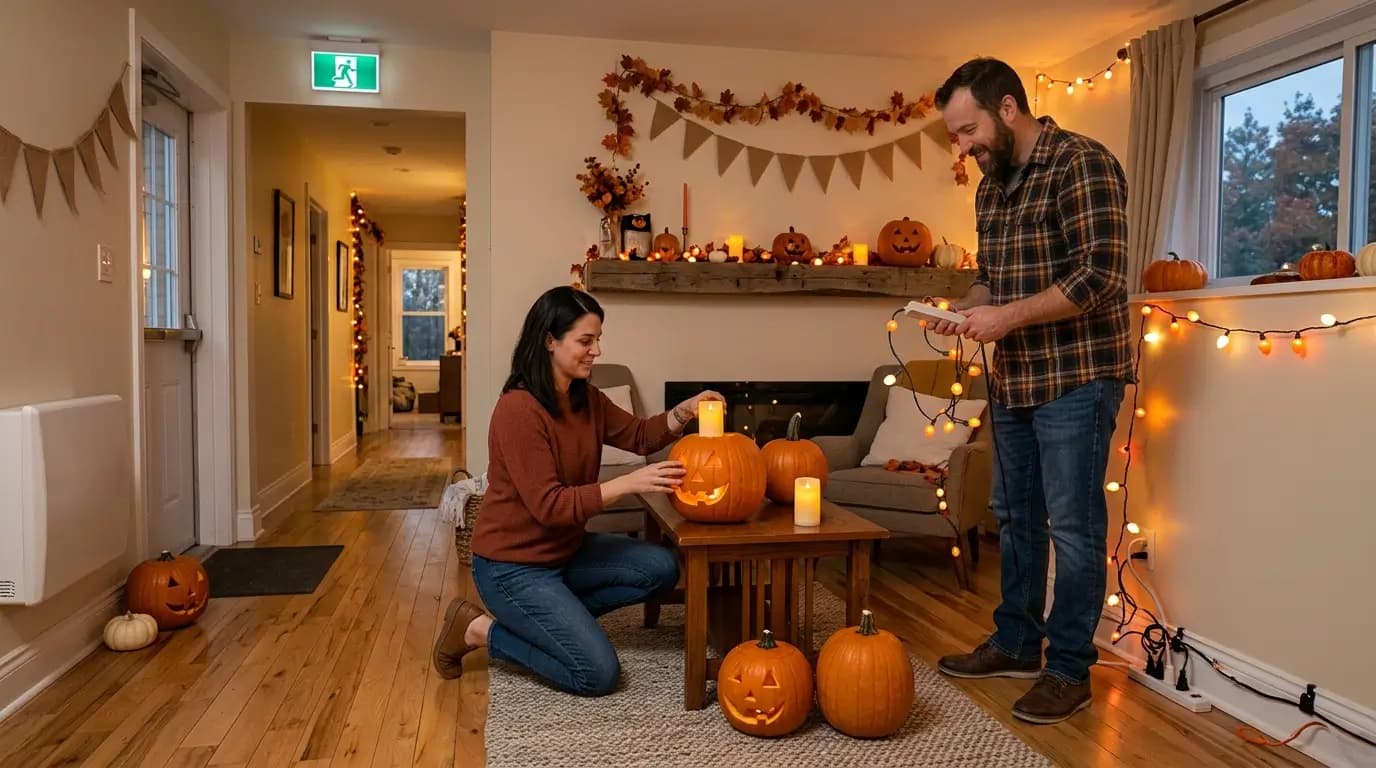
There are two different Halloween safety articles, and almost everyone writes the first one. The first is for parents: reflective tape, check the candy, hold a torch. It is good advice and it is covered thoroughly elsewhere. The second is for whoever signs off the building — the facilities manager whose reception now has a fabric cobweb over the exit sign, the retail duty manager whose staff decorated at height on a Sunday, the fleet supervisor rostering vans through residential streets at six in the evening on 31 October. That second article barely exists, so this is it.
The short version: Halloween does not introduce a new hazard to your premises. It quietly degrades four controls you already depend on — escape routes, ignition control, detection and suppression, and access — and it does so through decorations that nobody put through a risk assessment because they cost eleven dollars and came in a carrier bag. In fifteen years across fourteen countries, verifying egress and detection for firms including Chubb Fire & Security and Tyco Fire Protection Services, I have never seen a seasonal decoration go through a change process. Not once.
Key takeaways
The six points below are what a responsible person needs to act on. Each is verified against the primary source named beside it and linked in full where the article covers it:
- In the US, 29 CFR 1910.37 (source: OSHA) already covers this: exit routes must be free and unobstructed (a)(3), kept free of explosive or highly flammable furnishings or other decorations (a)(1), and each exit route door must be free of decorations or signs that obscure its visibility (b)(3). No seasonal exemption exists.
- In England and Wales, Article 14 of the Regulatory Reform (Fire Safety) Order 2005 (source: legislation.gov.uk) requires routes to emergency exits and the exits themselves to be kept clear at all times.
- NFPA, the source for the fire figures below, records an annual average of 835 US home structure fires starting with decorations (2020-2024), causing 3 deaths and 29 injuries a year. Source data shows 47% happened because decorations sat too close to a heat source and 33% started with a candle.
- Falls account for about 25% of the roughly 3,200 Halloween injuries treated in US emergency departments each year, per the CPSC source cited later - largely from putting decorations up and taking them down. If your staff do that, it is work at height.
- A costume marked "flame resistant" in the US has passed 16 CFR 1610 (source: CPSC), a screening test that only bars the most dangerously flammable fabrics. In the UK, costumes are regulated as toys, not clothing.
- The eight teenagers who died in the 1984 Six Flags Haunted Castle fire were found within roughly 25 feet of an exit. Egress failure is rarely about distance.
Where the parenting advice stops and your duty starts
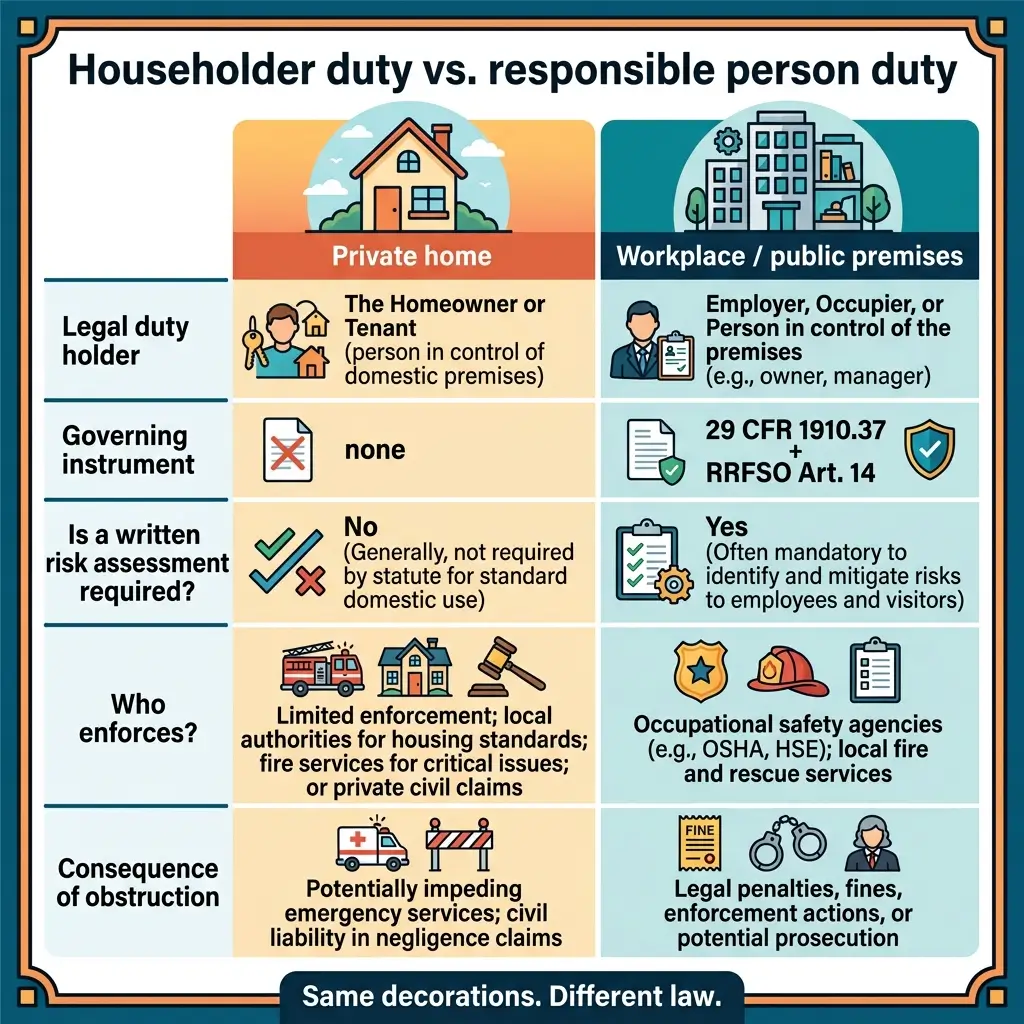
Most Halloween guidance is addressed to a private householder, who owes a duty of care but is not a duty-holder under fire safety law. The moment the same decorations go up in a workplace, a shop, a school, a care home or a leased office suite, a named person becomes legally accountable for the fire precautions in that building — and the decorations become part of what they are accountable for.
This matters because the two audiences need opposite advice. A parent needs to be told to use a glow stick instead of a candle. A responsible person needs to be told that their fire risk assessment, written in March against an empty corridor, no longer describes the corridor. The assessment has not changed. The building has.
The confusion is worth clearing up early, because the wrong reader takes the wrong action. Below is who actually carries the duty in the settings where I get asked about this.
| Setting | Who holds the duty (US) | Who holds the duty (UK) | What changes on 31 October |
|---|---|---|---|
| Office or warehouse | Employer, under 29 CFR 1910 Subpart E | "Responsible person" (usually the employer) under RRFSO 2005 | Added combustible load; corridor and stair obstruction |
| Retail floor | Employer plus building owner per lease | Responsible person; often shared with landlord | Public occupant load, display materials, obscured exit signage |
| Haunted attraction | Operator, under adopted fire code | Responsible person; assembly premises guidance | Low light, theatrical smoke, confusing egress path, crowds |
| School or care home | Employer / operator | Responsible person, with a higher expected standard | Vulnerable occupants, evening events, unfamiliar visitors |
Three questions decide whether this article is written for you:
- Do you sign or own a fire risk assessment for any premises? If yes, the decorations are inside its scope whether you assessed them or not.
- Do your staff put decorations up, or work in a building where somebody does? If yes, you own the work-at-height exposure and the added fuel load.
- Do your people drive on the evening of 31 October? If yes, you own a journey risk that is measurably elevated for a few hours and back to normal by midnight.
The escape route: what decorations actually do to egress
Start here, because this is the failure that kills people. Not the fire — the fire is usually small and survivable. What kills is a route that stopped working while everyone assumed it still did.
On 11 May 1984, a fire started in the Haunted Castle walk-through attraction at Six Flags Great Adventure in Jackson Township, New Jersey. The structure was a maze built from connected truck trailers, lined with polyurethane foam padding, with no automatic sprinkler system and no smoke detection. Eight teenagers aged 15 to 19 died of smoke inhalation and carbon monoxide poisoning. They were found within roughly 25 feet of an exit. The attraction had illuminated exit signs and working panic hardware on the doors. NFPA's own account of the fire and the code changes that followed sets out how the 1988 edition of NFPA 101 gained a dedicated section for special amusement buildings as a direct result.
Twenty-five feet. That number has stayed with me through every egress verification I have run. It tells you that egress does not fail because the exit is far away. It fails because in smoke, in the dark, in a space you do not know, the exit stops being findable — and anything you hang, drape or stand in that path shortens the time available to find it.
What the regulations already say
There is no seasonal carve-out to find here, in either jurisdiction. The requirements are ordinary, permanent and specific.
Under the US standard on maintenance and operational features for exit routes, 29 CFR 1910.37, three provisions bite directly on decorations:
- 1910.37(a)(1) — exit routes must be kept free of explosive or highly flammable furnishings or other decorations
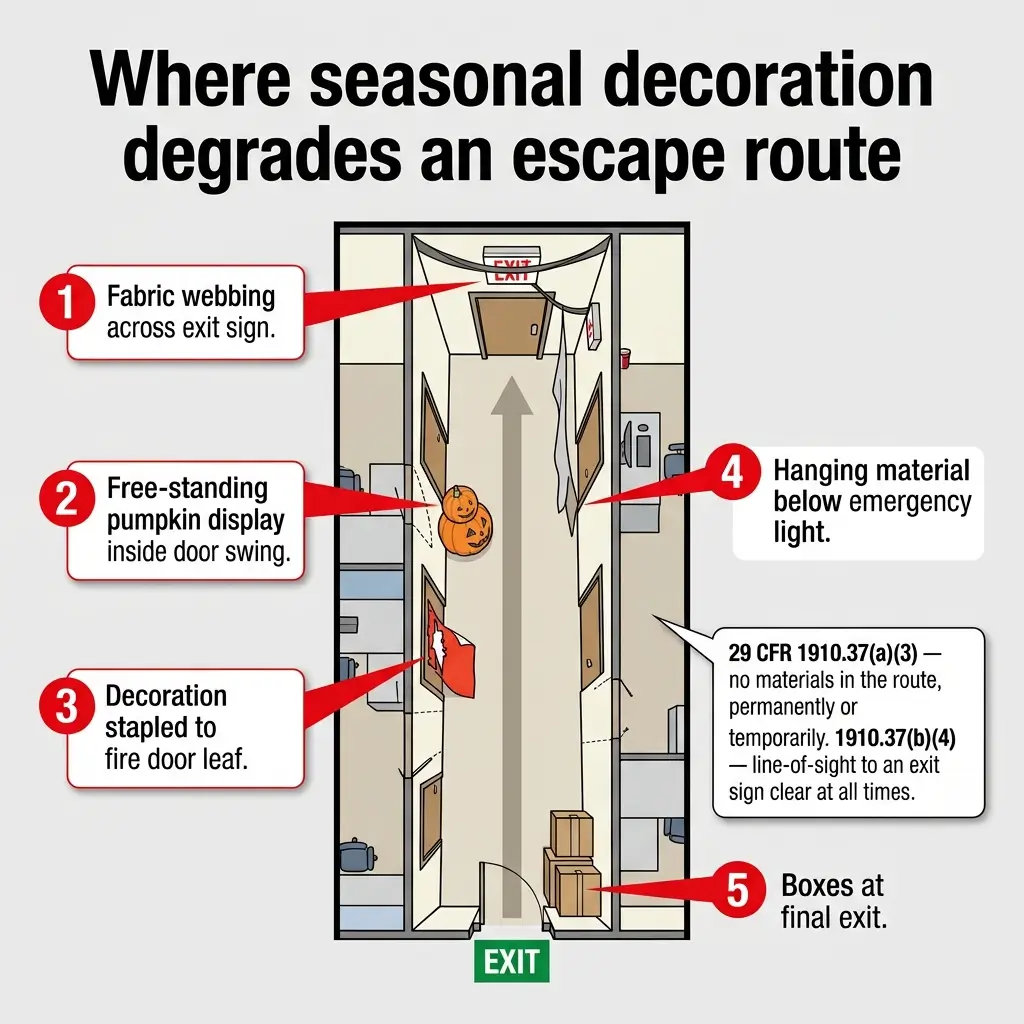
- 1910.37(a)(3) — exit routes must be free and unobstructed; no materials or equipment may be placed in the route, either permanently or temporarily
- 1910.37(a)(4) — safeguards including sprinkler systems, alarm systems, fire doors and exit lighting must be in proper working order at all times
- 1910.37(b)(3) — each exit route door must be free of decorations or signs that obscure the visibility of that door
- 1910.37(b)(4) — the line-of-sight to an exit sign must be clearly visible at all times
That phrase "either permanently or temporarily" is the one people miss. A three-week pumpkin display is temporary, and temporary is explicitly covered.
In England and Wales, Article 14 of the Regulatory Reform (Fire Safety) Order 2005 requires the responsible person to ensure that routes to emergency exits and the exits themselves are kept clear at all times, that routes lead as directly as possible to a place of safety, that emergency doors are not fastened so they cannot be immediately opened, and that routes and exits are indicated by signs. Scotland and Northern Ireland operate equivalent regimes under their own legislation.
The finding I write up most often
On a live assignment as Egress Integrity Advisor for Chubb Fire & Security in Australia, I stopped work over a temporary hose run across an escape door. Not a decoration — a hose, laid by a crew who intended to move it within the hour and had a genuinely good operational reason for where it sat. The door still opened. The sign was still lit. The route was still, on paper, compliant.
What I asked the supervisor was not whether it was compliant. I asked him to walk the route at normal pace with his eyes closed for the last three metres. He caught his foot on the hose and put a hand out against the door frame. Then he moved it himself.
That finding transfers directly to seasonal decoration, and I want to be precise about how far the transfer goes: a hose is not a cobweb, and nobody died. What transfers is the mechanism. Both are placed by someone acting reasonably, both are intended to be temporary, both leave the paperwork technically intact, and both are invisible to the person who placed them because they placed them in good light while walking slowly and knowing exactly where they were.
The check worth stealing: walk your own escape route at pace, in the dark, from the furthest desk. If your hand finds fabric before it finds the door bar, you have your finding — and you do not need a standard to tell you what to do about it.
Escape-route checks that catch most seasonal problems in a single walk are:
- Nothing hung on, across or beside a fire door, including on the back of it — fire doors are tested as assemblies and a stapled decoration breaches the leaf
- Exit signage visible from every point on the route, not just from where you are standing when you look up at it
- Nothing in the door swing, on either side, including a free-standing display that gets nudged during the day
- Final exit doors and external routes clear, since these are the ones nobody decorates but everyone stacks boxes against
- Emergency lighting unobstructed by hanging material, which is the one people never think to look up at
Ignition sources and the fuel load nobody assessed
Escape routes are the consequence. Fuel and ignition are the cause, and the numbers here are unusually clear for a seasonal topic.
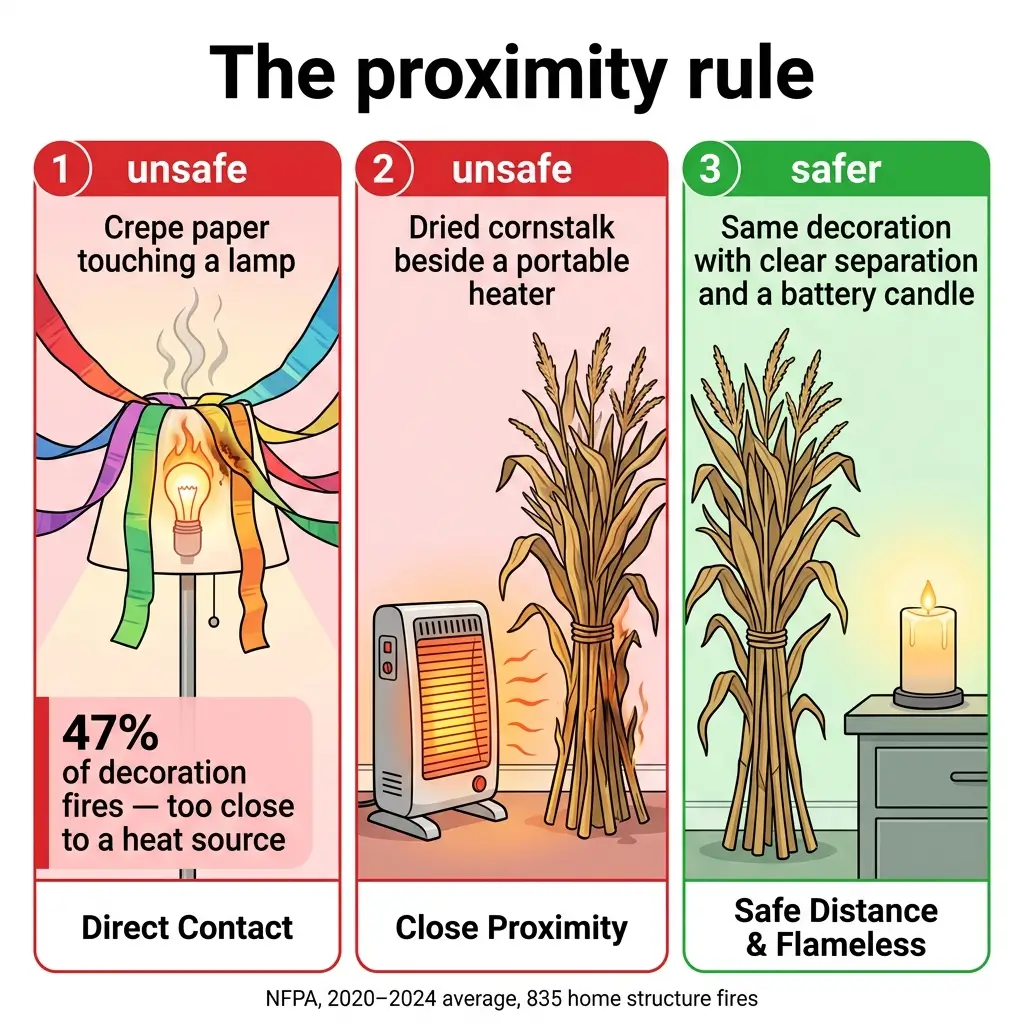
NFPA's Halloween fire safety data records an annual average of 835 US home structure fires beginning with decorations across 2020–2024, causing an average of 3 civilian deaths, 29 civilian injuries and $18 million in direct property damage a year. Nearly half — 47% — occurred because decorations sat too close to a heat source. Approximately one-third, 33%, were started by candles.
Read those two percentages together and you get the mechanism. This is not a story about arson or faulty wiring. It is a story about proximity: a combustible item placed a few centimetres closer to a heat source than it should have been, by someone who was thinking about how it looked rather than what was behind it.
The heat sources involved are mundane, and that is exactly why they get missed. Candles, obviously. But also halogen and incandescent lamps, which people still use in display lighting; portable heaters brought out as the weather turns in the northern hemisphere; and the transformers and motors in inflatable and animated decorations, which run warm and get positioned wherever the power outlet happens to be.
Materials, and what each one demands
Decoration materials behave very differently under a small ignition source, and the ones that look most seasonal are usually the worst. NFPA specifically identifies dried flowers, cornstalks and crepe paper as items that catch fire easily.
| Decoration material | Behaviour under a small flame | What to require |
|---|---|---|
| Dried flowers, cornstalks, straw bales | Ignites readily, fast flame spread, high surface area | Exclude from escape routes entirely; keep well clear of any heat source |
| Crepe paper, tissue, paper chains | Rapid flame spread; burning fragments can drop | Not on or near escape routes; nothing near lamps |
| Synthetic cobweb and gauze | Spreads across large areas; can drip when burning | Never over lighting, detectors, sprinklers or signage |
| Fabric drapes and curtains | Depends entirely on treatment | In public premises, require certification to NFPA 701 or the equivalent adopted test |
| Inflatables and animated props | Motor and transformer run warm continuously | Keep combustibles clear of the unit; inspect cords; never run through a doorway |
For any premises where the public is admitted, the drape and hanging question stops being a matter of judgement. NFPA 701 sets the test method for flame propagation of textiles and films, and where a local code adopts it, an uncertified drape does not go in the building. Ask the supplier for the certificate before the order, not after the inspection.
Before the decorations go up, settle four things with whoever is putting them there:
- No open flame anywhere in a workplace or public premises. Battery candles and glow sticks cost less than the incident report.
- Half a metre minimum from any lamp, heater or motor, and more if the fitting runs hot to the touch after ten minutes.
- One named person owns removal, with a date. Decorations that stay up until December become permanent fuel load that nobody re-assesses.
- Extension leads and cords are not run across walkways or through doorways, which is both a trip hazard and a cable-damage route to an ignition source.
Costume flammability: what the label actually certifies
This is where the mainstream advice is not wrong so much as incomplete, and the gap between what a label says and what it certifies is wide enough to matter.
Every list tells you to buy a costume marked "flame resistant." Very few explain what that mark rests on, and the answer differs sharply between the two jurisdictions most readers of this site work across.
United States — a screening test, not a performance claim
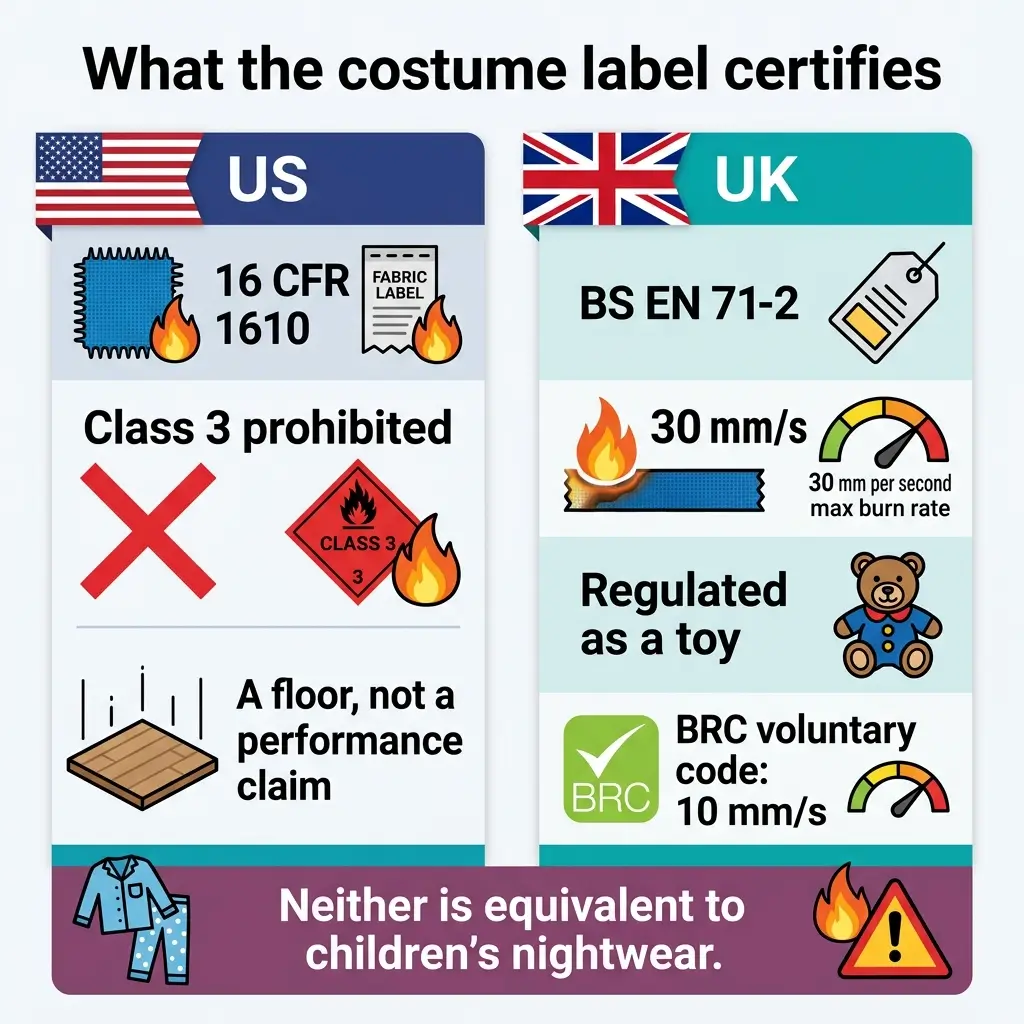
Costumes sold as general wearing apparel fall under 16 CFR 1610, the Standard for the Flammability of Clothing Textiles. CPSC describes its purpose plainly: to keep dangerously flammable textiles out of US commerce. The test classifies fabrics into three classes by flame-spread speed and burning behaviour, and Class 3 — the most dangerously flammable — is prohibited for clothing use.
That is a floor, not a ceiling. Passing 16 CFR 1610 means a fabric is not among the worst; it does not mean the garment resists ignition in the way flame-resistant workwear does. Note also what a costume is not covered by: the stricter children's sleepwear standards at 16 CFR 1615 and 1616 apply to sleepwear, and a Halloween costume is not sleepwear. A child in a costume is held to a lower flammability requirement than the same child in pyjamas.
United Kingdom — costumes are toys
The UK position surprises people every time I explain it. Children's dress-up costumes are classified as toys, not clothing, and are tested to the toy flammability standard BS EN 71-2 rather than to any garment standard. Because they are toys, the standard's underlying assumption is that a child can move away from or drop a burning object — which is not a reasonable assumption about something fastened around them.
After sustained pressure, the British Retail Consortium published a voluntary Code of Practice tightening the test. SGS's summary of the 2022 update confirms the code retains a maximum flame-spread rate of 10 mm/s where EN 71-2:2020 permits 30 mm/s — three times slower. Costumes tested to the code carry a swing label stating that the garment has undergone additional safety testing for flammability.
| United States | United Kingdom | |
|---|---|---|
| Costume classified as | General wearing apparel | Toy |
| Governing test | 16 CFR 1610 | BS EN 71-2 |
| Requirement | Class 3 (most flammable) prohibited | Flame spread not exceeding 30 mm/s |
| Voluntary higher standard | — | BRC Code of Practice, 10 mm/s |
| Stricter standard exists for | Children's sleepwear (16 CFR 1615/1616) | Children's nightwear (BS 5722) |
| How to identify the better product | Look for genuine FR certification, not a marketing claim | Swing label: additional flammability testing |
If your organisation buys costumes — for a retail promotion, a school event, a hospital ward, a staff party — the purchasing decision is yours and it is documentable. What to specify:
- Ask the supplier for the test evidence, not the marketing copy. A reputable supplier produces it within a day.
- In the UK, specify the BRC swing label as a purchasing requirement. It costs nothing and it triples the margin.
- Reject long trailing fabric, capes and loose sleeves for anything worn near a kitchen, a laboratory, a workshop or a naked flame.
- Buy from a known retailer. Counterfeit costumes carry counterfeit safety labelling, which is worse than no labelling because it stops people looking.
Detection and suppression: the things that get covered up
Everything so far has been visible. This section is about the controls that fail silently, which in my experience are the ones that fail worst — because nobody discovers the problem until the system is being asked to work.
Hanging decoration goes up at ceiling level. So do smoke detectors and sprinkler heads. The two get combined by people who were looking at the wall, not the ceiling, and the resulting defect produces no symptom at all until there is a fire.
Sprinkler clearance is a regulated number
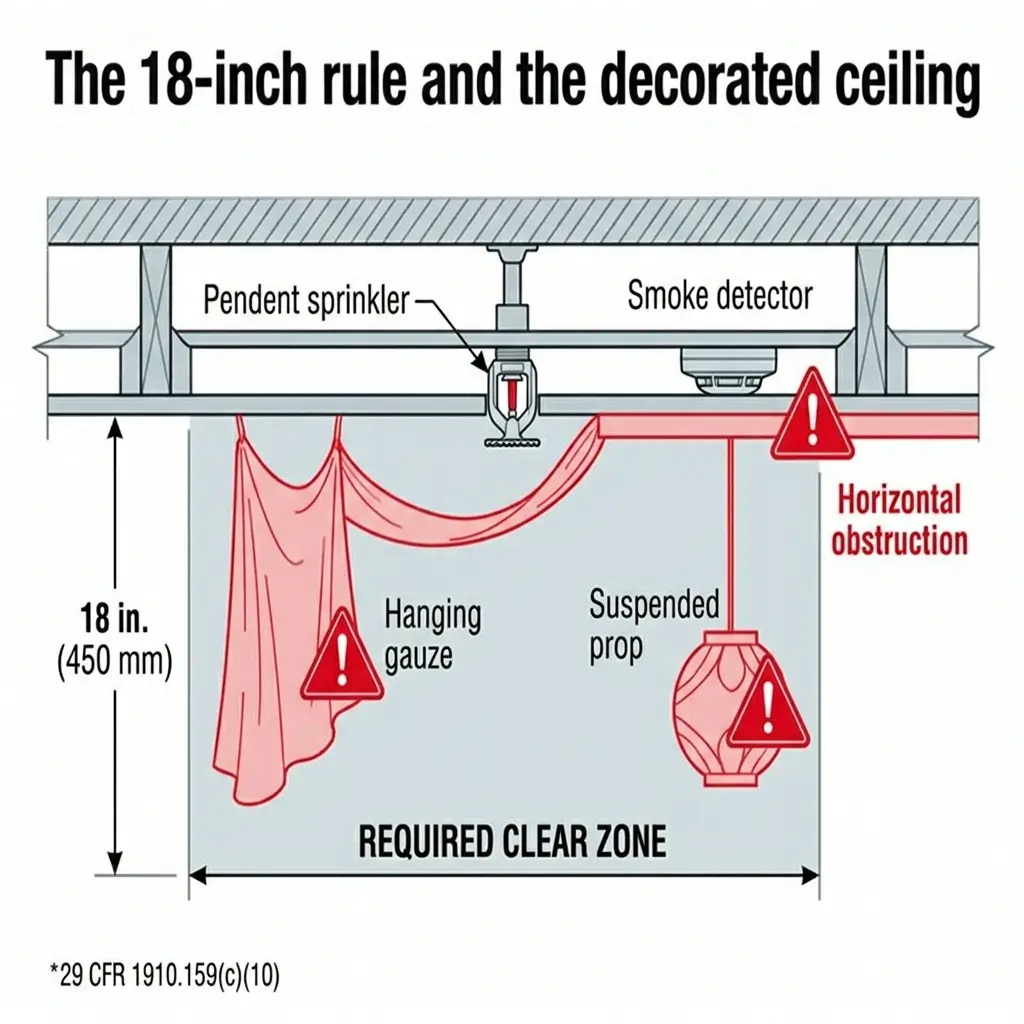
The clearance below a sprinkler is not a rule of thumb. In the US it is codified for workplaces at 29 CFR 1910.159(c)(10), which requires a minimum vertical clearance of 18 inches (45.7 cm) between sprinklers and the material below them. OSHA's interpretation letter on the clause adds the detail that most people get wrong: the 18 inches is treated as a horizontal plane throughout the room, not a cylinder under each head. A decoration hung between two sprinklers, touching neither, is still inside the plane.
Eighteen inches exists because that is the distance a sprinkler needs to develop its spray pattern. An obstruction inside it does not reduce the system's performance by a proportionate amount — it can collapse the pattern over the area that matters. A synthetic cobweb draped under a head is a small object doing a large amount of damage.
Detectors and the mistake I see in retail
Smoke detectors get covered for a reason that is entirely understandable: a bare detector looks like an appliance in a display someone has spent hours dressing. So it gets a gauze over it, or a hanging prop under it, and the sensing chamber stops seeing the air it is supposed to sample.
Working as Detection & Alarm Advisor for Tyco Fire Protection Services across Australia and Southeast Asia, the pattern I saw repeatedly on retail and warehouse floors was not deliberate defeat of a device. It was a display built upward until it reached the ceiling and then finished, because that is where the wall ended. Nobody in the process had a reason to look at what was above the top shelf.
The ceiling-level checks that take four minutes and catch nearly all of this:
- Stand under every sprinkler head on the decorated floor and look up. Eighteen inches of clear air, or it comes down.
- Check each smoke detector is unobstructed in a horizontal plane, not just directly beneath it — smoke reaches a detector by travelling along the ceiling.
- Confirm no decoration is suspended from a sprinkler pipe or head. This happens constantly and it is a mechanical damage risk on top of an obstruction.
- Verify manual call points are visible and reachable, not behind a display.
- Photograph the ceiling before and after decorating. It takes two minutes and it settles every subsequent argument.
Decorating the premises is work at height
Here is the statistic that reframes the whole topic, and almost nobody in this niche connects it to a control.
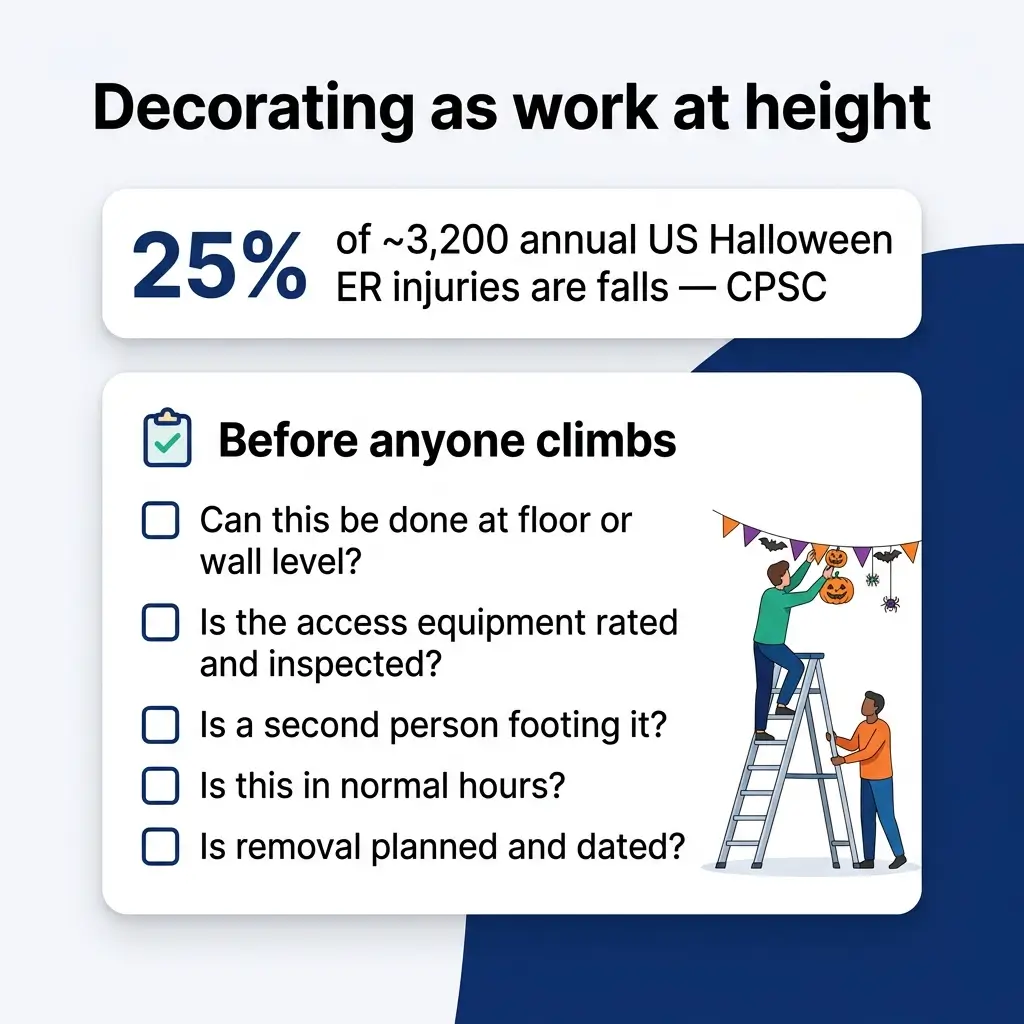
The US Consumer Product Safety Commission estimates about 3,200 Halloween-related injuries treated in emergency departments each year, averaged over three years. Pumpkin carving accounts for 55%. But 25% are falls — from putting decorations up and taking them down, from tripping on costumes, and from walking while trick-or-treating. Among the injured in that CPSC source dataset, 54% are adults.
Strip out the trick-or-treating falls and you are left with a substantial number of adults injured while decorating. In a workplace, that activity has a name, and the name is work at height.
Nobody treats it as such. The decorating happens after hours or on a quiet Sunday, by willing staff, on whatever was to hand — a swivel chair, a stack of pallets, a stepladder with a wobble everyone knows about. There is no permit, no ladder inspection, no second person, and frequently no supervisor present. If the same person climbed the same ladder on Monday morning to change a light fitting, there would be a procedure.
The duty does not care that the task is festive. In the UK, the Work at Height Regulations 2005 apply to any work at height where a fall could cause personal injury, with no minimum height threshold. In the US, general industry requirements for walking-working surfaces and portable ladders sit in 29 CFR 1910 Subpart D. Neither instrument contains a seasonal exemption, and neither cares what is being hung.
The controls here are unremarkable, which is precisely why the omission is hard to defend afterwards:
- Decide whether the work needs to happen at height at all. Most ceiling decoration is a preference, not a requirement. Wall-level and floor-level displays carry none of this risk.
- Use the right access equipment. A stepladder rated for the load and inspected before use — never a chair, a desk, a shelf edge or a pallet stack.
- Two people, always. One footing the ladder, one working. This is the control that gets dropped first and matters most.
- Do it in normal hours where possible. Evening and weekend decorating means an injured person may be alone in the building.
- Plan the removal at the same time as the installation. Taking decorations down is the same work at height, done by tired people in January, and it is where a disproportionate share of the falls happen.
The drive through: fleet and pedestrian exposure
The last control belongs to whoever runs vehicles, and it is the only one in this article where the risk is measurable, time-bound and almost entirely avoidable by rescheduling.
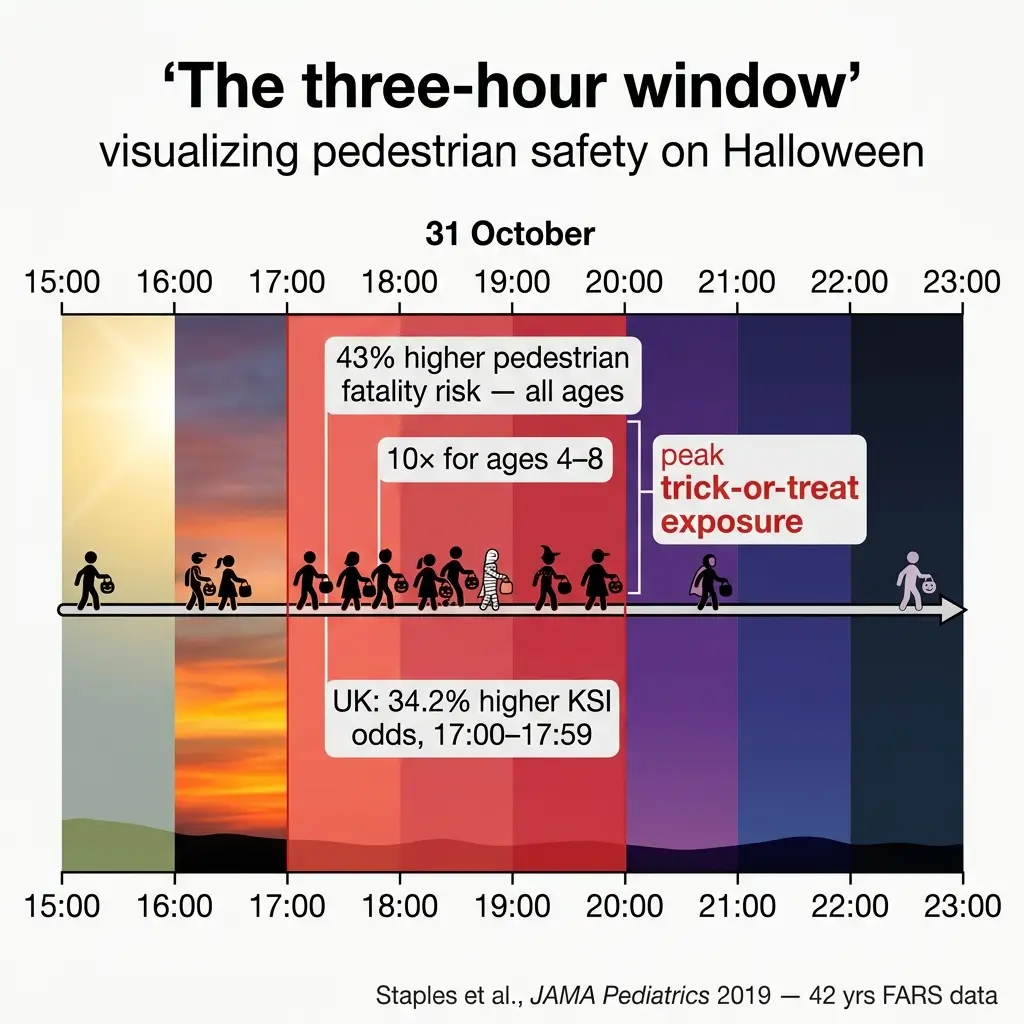
Staples, Yip and Redelmeier examined 42 years of US Fatality Analysis Reporting System data in a 2019 research letter in JAMA Pediatrics. Across 42 Halloween evenings there were 608 pedestrian fatalities, against 851 across 84 matched control evenings — an average rate of 2.07 pedestrian deaths per hour versus 1.45. In that source, the relative risk of a pedestrian fatality was 43% higher on Halloween (odds ratio 1.43, 95% CI 1.29–1.59). For pedestrians aged 4 to 8, the same source reports a tenfold increase (odds ratio 10.00, 95% CI 5.23–19.11). The average Halloween produced four additional pedestrian deaths.
A UK analysis of paediatric traffic casualties, published in the International Journal of Environmental Research and Public Health (Hsu et al., 2021, doi:10.3390/ijerph18179093) and drawing on 73,587 paediatric casualties in the UK STATS19 database from 1990 to 2017, found a comparable pattern on a compressed timescale. That source reports that between 17:00 and 17:59 on Halloween, the odds of a child being killed or seriously injured were 34.2% higher than on other days.
Be precise about the window, because it drives the control. The US study measured 17:00 to 23:59 and found risk highest around 18:00; the UK study found its effect concentrated in the single hour from 17:00. Overlay that on typical trick-or-treating hours and the practical exposure for a fleet is roughly 17:00 to 20:00 on residential streets — children who are excited, wearing dark clothing, sometimes in a mask that removes their peripheral vision, crossing between parked cars rather than at junctions.
NHTSA's Halloween guidance makes the same point about drivers needing to expect pedestrians in unexpected places, and adds a figure that matters for the return leg: in 2023, nearly half of all crash fatalities on Halloween night were alcohol-related.
For a fleet or delivery operation, that narrowness is an advantage. You are not managing a diffuse risk across a year. You are managing three hours.
What I would put in a journey plan for 31 October:
- Reschedule residential deliveries out of the 17:00–20:00 window. This single decision removes most of the exposure and costs one afternoon of planning.
- Route away from residential streets during those hours where the schedule cannot move.
- Brief drivers specifically, with the numbers rather than a slogan. "Children aged four to eight are ten times more likely to be killed tonight" changes behaviour in a way that "drive carefully" does not.
- Reinforce that reversing and manoeuvring is the highest-risk action in a street full of small pedestrians who are below mirror line and moving unpredictably.
- Address the return leg. Staff driving home from an evening event share the road with the impaired-driver population behind that NHTSA figure.
The pre-Halloween walkthrough
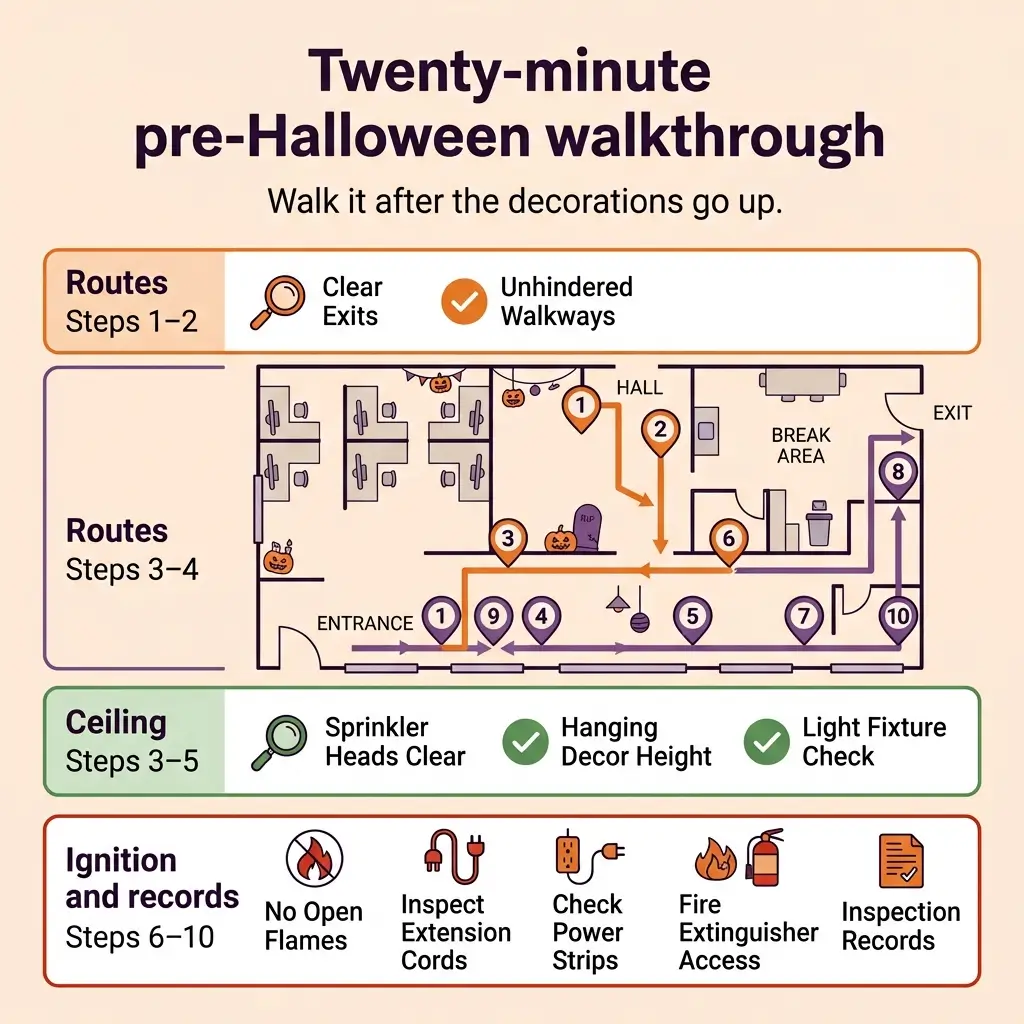
Everything above collapses into one walk of the building, done in the order below, taking about twenty minutes in a typical office or retail floor. I have written it as the sequence I would actually use, because the order matters — the ceiling checks are the ones people abandon when they get tired.
Do it after the decorations go up, not before. A walkthrough of an undecorated building tells you nothing.
- Walk each escape route from its furthest point, at normal pace, looking ahead rather than down. Anything your eye or hand meets before the exit door is a finding.
- Check every fire door — nothing hung on it, nothing in its swing, nothing wedging it, closer still working.
- Look up at every sprinkler head on the decorated floor. Eighteen inches of clear air below the deflector.
- Look up at every smoke detector. Clear horizontally as well as vertically.
- Check exit signage and emergency lighting are visible and unobstructed from the route, not just from the doorway.
- Find every heat source — lamps, heaters, transformers, motors — and check what is within half a metre of it.
- Confirm no open flame anywhere, including in staff areas and back of house, where the rules get relaxed.
- Trace every extension lead. Not across a walkway, not through a doorway, not daisy-chained.
- Ask who took it down last year, and when. If the answer is vague, name someone and put a date on it now.
- Photograph what you found and what you fixed. This is the record that makes the same walk faster next year.
If you find something you cannot resolve — a sprinkler layout you are unsure about, a drape with no certification, an assembly premises with an occupant load you have not calculated — that is the point to bring in a competent fire safety professional rather than making a judgement call. Fire risk assessment for anything beyond a simple low-risk premises is specialist work, and the law in most jurisdictions expects it to be done by someone competent to do it.
Frequently asked questions
These are the questions I am asked most often in the fortnight before 31 October, answered against the sources cited throughout this article.
Can Halloween decorations legally block a fire exit at work?
No. In the US, 29 CFR 1910.37(a)(3) requires exit routes to be free and unobstructed and prohibits materials being placed in the route permanently or temporarily. In England and Wales, Article 14 of the RRFSO 2005 requires routes and exits to be kept clear at all times. There is no seasonal exemption in either regime.
Are Halloween costumes actually flame resistant?
Rarely in the sense people mean. US costumes must pass 16 CFR 1610, which bars only the most dangerously flammable fabrics — a floor, not a performance claim. UK costumes are regulated as toys under BS EN 71-2. Neither is as demanding as the standards applied to children's sleepwear or nightwear.
What are the most common Halloween injuries?
CPSC estimates roughly 3,200 Halloween-related injuries treated in US emergency departments annually. Pumpkin carving accounts for about 55%, and falls — from decorating, tripping on costumes and walking while trick-or-treating — account for about 25%. In the same CPSC source, adults make up 54% of those injured.
Do haunted attractions need sprinklers?
In jurisdictions adopting NFPA 101 or NFPA 1, haunted attractions are classified as special amusement buildings and require an approved automatic sprinkler system, with a narrow exception for structures under 10 ft high and under 160 sq ft. Where lighting is reduced, smoke detection is also required. Confirm requirements with your authority having jurisdiction.
What time on Halloween is most dangerous?
Roughly 17:00 to 20:00. The JAMA Pediatrics analysis found pedestrian fatality risk peaked in the early evening, and a UK collision study found the odds of a child being killed or seriously injured were 34.2% higher between 17:00 and 17:59. Exposure returns to baseline later in the evening.
Is a candle in a jack-o'-lantern actually a problem?
In a workplace or public premises, yes — treat open flame as prohibited. NFPA attributes about 33% of decoration fires to candles, and 47% of those fires occurred because decorations were too close to a heat source. Battery-operated candles and glow sticks remove the ignition source entirely.
Do we need to update our fire risk assessment for Halloween?
Not necessarily a full reassessment, but the assessment must reflect the premises as they are. If decorations materially change the combustible load, the escape routes or the occupant numbers, record that you reviewed the change and what you did about it. A dated walkthrough record attached to the assessment usually satisfies this.
What to take from this
The single most useful habit in this whole article costs twenty minutes once a year: walk the building after it has been decorated, not before, and look up as much as you look ahead.
Everything else follows from that walk. The escape route problem, the sprinkler obstruction, the covered detector, the cornstalk against the display lamp — none of them are difficult to find and none are expensive to fix. They persist because the person who created them was standing still in good light, and the person who signs the risk assessment never went back to look.
Eight teenagers died within twenty-five feet of an exit in 1984. The lesson from that fire was never that exits should be closer. It was that an exit you cannot find is not an exit — and that in the last week of October, a lot of buildings quietly become harder to escape than they were in September.
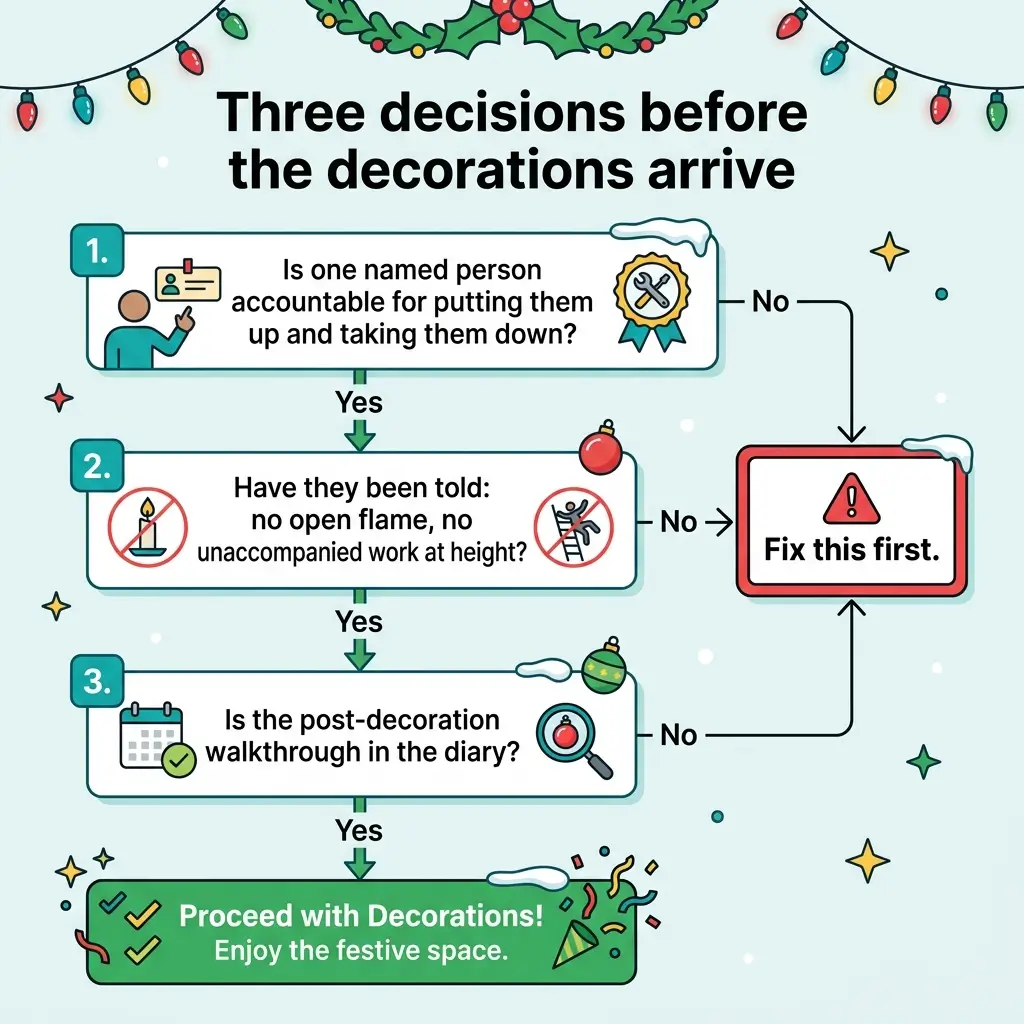
If you do nothing else with this article, three actions carry most of the value and can all be done before the decorations arrive:
- Name the person who owns installation and removal, and put a removal date in the diary now rather than in November.
- Tell them open flame is out and ceiling level is off limits without a second person and rated access equipment — two sentences that pre-empt most of what this article describes.
- Diarise the twenty-minute walk for the day after decorating, and take photographs while you do it.
About the author — Mia Collins Mia Collins is an Australian Fire Life Safety & Emergency Response Assurance Consultant with 15 years of continuous field experience across industrial fire protection, high-rise fire life safety, warehouse fire systems, detection and alarm, egress integrity and emergency response planning. Her focus is practical assurance — checking that controls still work where work actually happens. She currently leads Collins Fire & Emergency Assurance (since January 2026) in Brisbane, Australia, following senior roles as Egress Integrity Advisor at Chubb Fire & Security AU and Detection & Alarm Advisor at Tyco Fire Protection Services AU. She has inspected 180+ workplaces and conducted 70+ audits across 14 countries.
Credentials: NEBOSH International General Certificate · ISO 45001 Lead Auditor · ISO 14001 Internal Auditor · IOSH Managing Safely · Incident Investigation (ICAM pathway) · Emergency Response Planning Awareness · Fire Safety Awareness
Sources and further reading
- OSHA — 29 CFR 1910.37, Maintenance, safeguards, and operational features for exit routes
- OSHA — Standard interpretation on 29 CFR 1910.159(c)(10), sprinkler clearance
- legislation.gov.uk — Regulatory Reform (Fire Safety) Order 2005, Article 14
- NFPA — Halloween fire safety and decoration fire statistics
- NFPA Journal — The Haunted Castle, Revisited
- CPSC — Halloween injury estimates and safety guidance
- CPSC — Clothing flammability FAQ, 16 CFR 1610
- SGS — BRC Code of Practice update: flammability safety of children's disguise costumes
- Staples JA, Yip C, Redelmeier DA — Pedestrian Fatalities Associated With Halloween in the United States, JAMA Pediatrics 2019;173(1):101–103
- Hsu LM, Wiratama BS, Chen PL, Saleh W, Lin HA, Pai CW — Pediatric Traffic Injuries on Halloween in the United Kingdom, Int J Environ Res Public Health 2021;18(17):9093 (doi:10.3390/ijerph18179093)
- NHTSA — Halloween safety tips for drivers and pedestrians