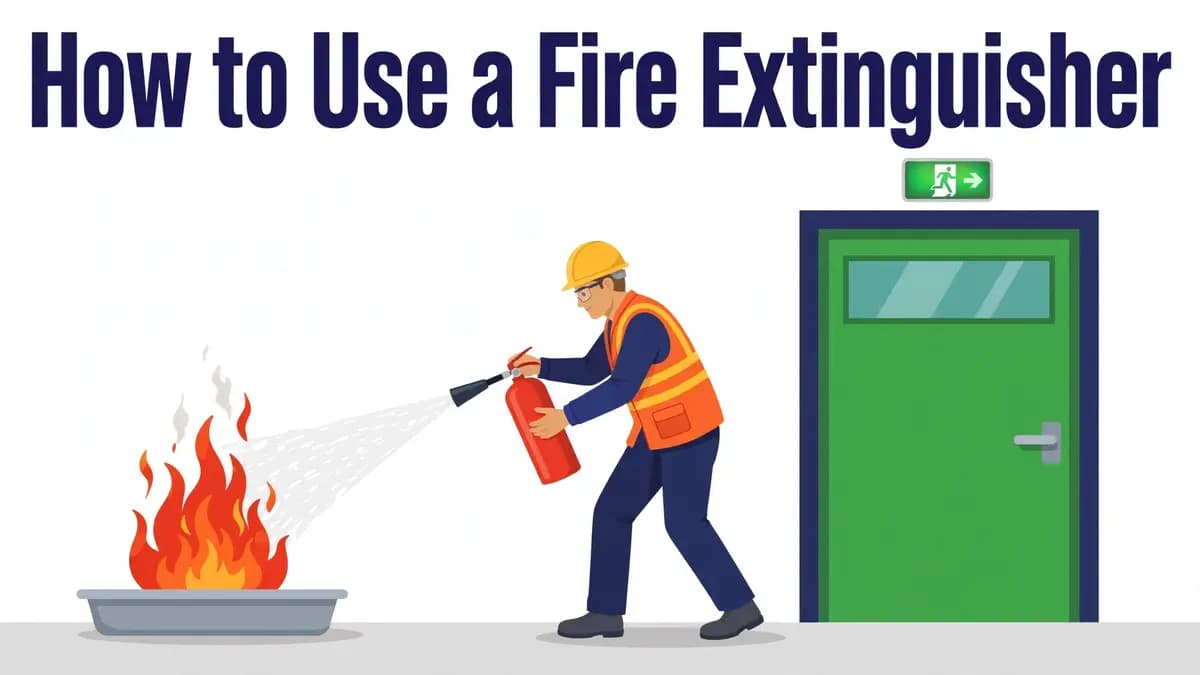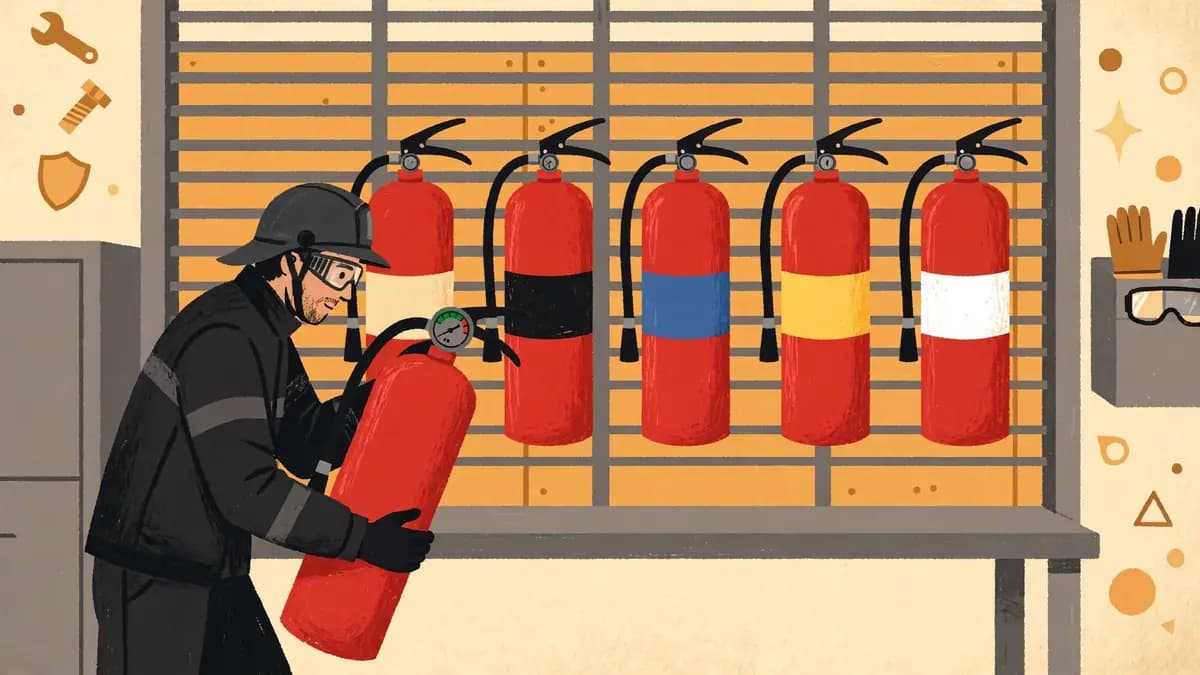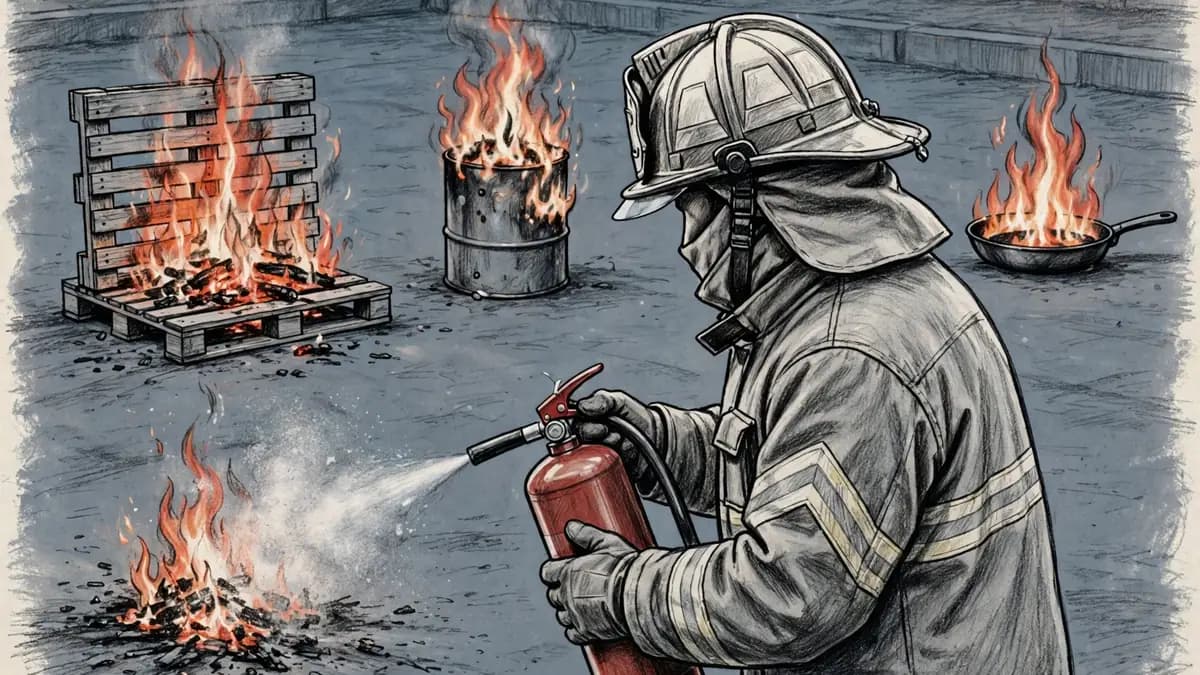
Fire classes group fires by what is burning. Class A covers ordinary solids such as wood, paper and cloth. Class B covers flammable liquids such as petrol and solvents. Class C means live electrical equipment in the United States and flammable gas in the United Kingdom and Europe. Class D covers burning metals such as magnesium and sodium.
Class F in the UK and Class K in the US both cover cooking oils and fats. The letter tells you which extinguisher can work and which agent will make the fire worse. A small pan of burning oil and a large pile of burning paper need opposite treatments, even though both are fires.
The class comes from the fuel, not the size of the flames. Name the fuel first, then match the letter, then decide whether to fight the fire or leave. That order matters because the wrong agent does not just fail. Water on burning oil throws a fireball across the room. Water on live equipment can electrocute the person holding the extinguisher. The class system exists so that decision takes seconds, not minutes.
What the Classes of Fire Are
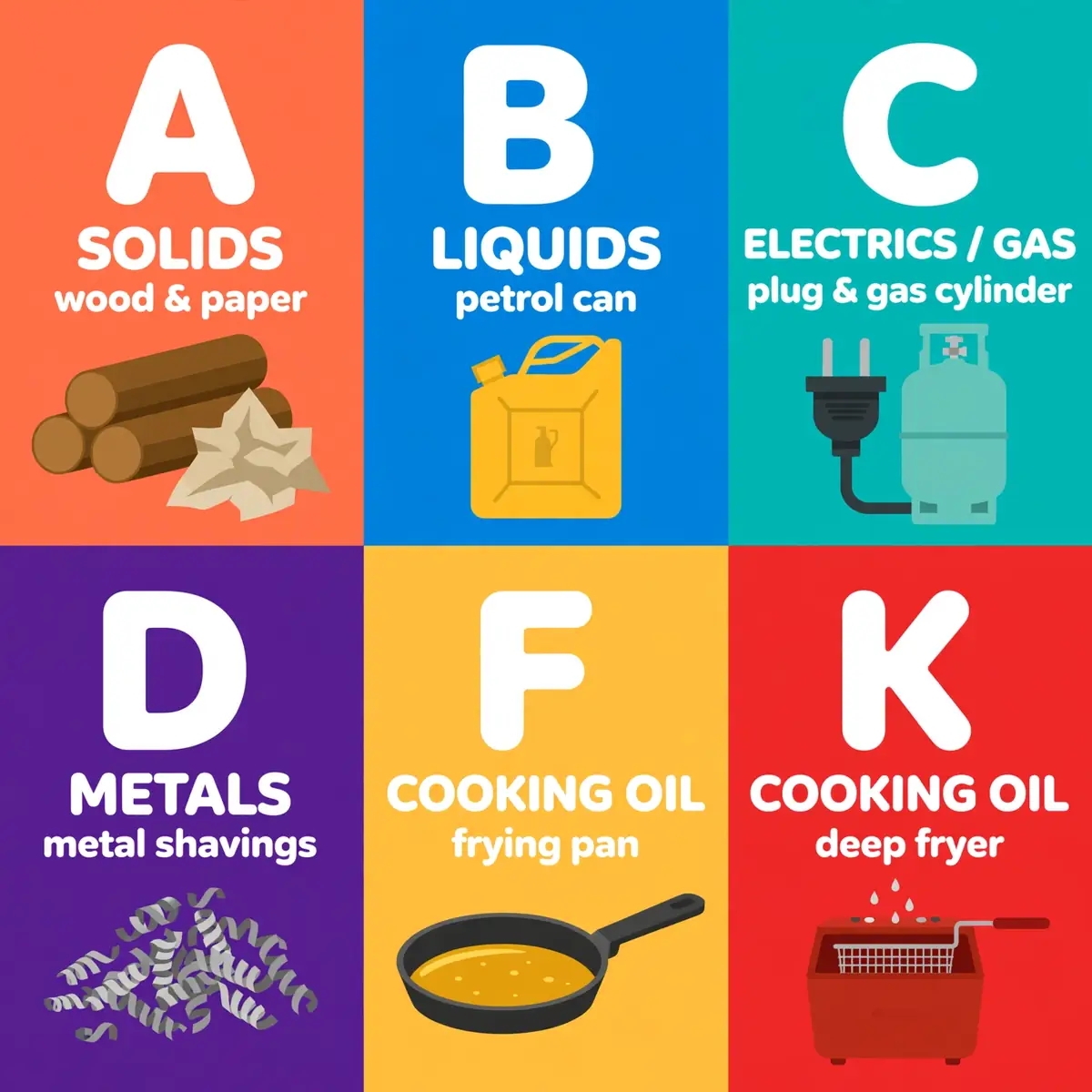
A fire class is a category based on the fuel that is burning. The system gives firefighters, safety officers and ordinary people a shared vocabulary for naming a fire fast. In the United States the classes come from NFPA 10, the Standard for Portable Fire Extinguishers. It sets out Classes A, B, C, D and K. The NFPA guidance on fire extinguishers explains how those classes map to the units on the wall.
In the United Kingdom and Europe the classes come from BS EN 2, the Classification of fires, and the international standard ISO 3941. Both systems agree on most letters and disagree on two, which is where the confusion starts. The table below sets out the six letters in the title, the fuel behind each one, and the agent that belongs to it.
| Class | Fuel | Right agent | Never use |
|---|---|---|---|
| A | Ordinary solids: wood, paper, cloth, rubber, plastics | Water, foam, ABC dry chemical | Nothing common — most agents work |
| B | Flammable liquids: petrol, diesel, solvents, paint | Foam, carbon dioxide, dry chemical | Water — it spreads the liquid |
| C (US) | Energised electrical equipment | Carbon dioxide, dry chemical | Water or foam — they conduct |
| C (UK/EU) | Flammable gases: propane, butane, natural gas | Dry powder, after shutting off the supply | Water — it cannot stop the gas |
| D | Combustible metals: magnesium, titanium, sodium, lithium | Specialist dry powder for that metal | Water — it can react violently |
| F (UK/EU) / K (US) | Cooking oils and fats | Wet chemical | Water — it flash-boils the oil |
Two Systems, One Set of Letters
The United States and the United Kingdom use the same letters for different fuels in two places. Class C is the first: live electrical equipment in the US system, flammable gas in the UK and European system. Class F and Class K are the second. The same cooking-oil fire carries the letter F in the UK and Europe and the letter K in the US. Australia calls electrical fires Class E, a letter neither the US nor the current European system uses.
The letters also carry a picture. Each class has a shape and colour on extinguisher labels and safety signs. A green triangle marks A, a red square marks B, a blue circle marks C, a yellow star marks D and a black hexagon marks K. The shape lets anyone read the class at a glance, even in smoke. When a label, a sign or a training note uses a letter, check which country it comes from before acting on it.
Why the Class Matters More Than the Size
A fire is beaten by attacking the thing that keeps it going. Each fuel keeps going in its own way. Water cools. Foam smothers. Dry chemical interrupts the chain reaction. Carbon dioxide pushes oxygen away. Wet chemical cools oil and seals it with a soapy layer. The fire triangle explains the first three attacks: remove heat, fuel or oxygen and the fire stops. The fire tetrahedron adds the fourth leg, the chain reaction, which is why dry chemical works where cooling and smothering do not.
Size misleads. A waste-bin fire and a burning deep fryer can look alike from across a room. Yet one takes water and the other turns water into a fireball. The class, not the flame height, decides the agent. That is why the first question at any fire is not how big it is, but what is burning.
TipRead the letter on the extinguisher label before you pick it up. If the letter does not match the fuel, put it down and leave.
How to Tell Which Class a Fire Is
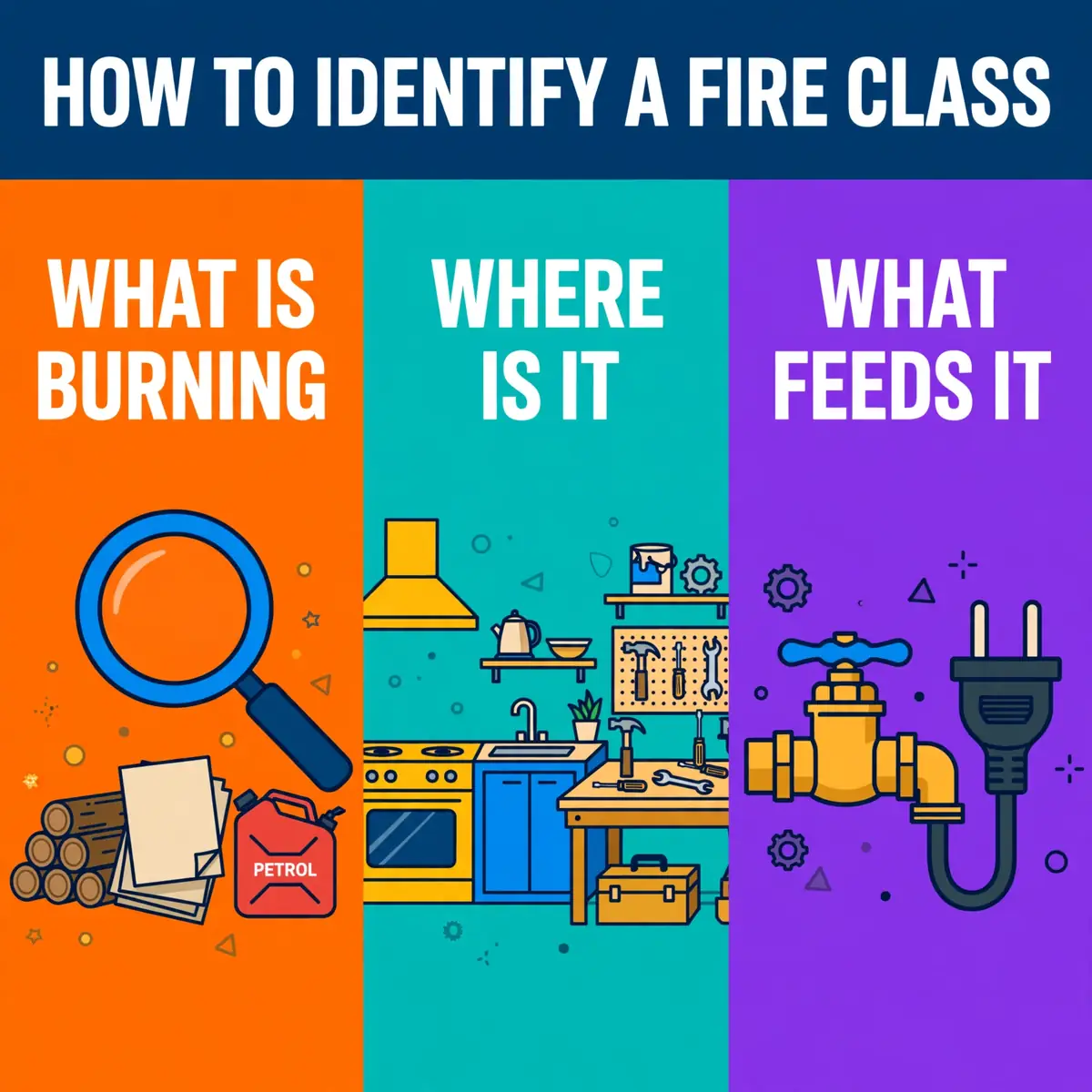
Identification starts with three questions, asked in order. What is burning? Where is it burning? What is feeding it? The answers usually name the class within seconds. A stack of cardboard in a store room is Class A. A pool of petrol under a car is Class B. A fryer with smoking oil is Class F or K. When the answers are unclear, the fire is unknown, and an unknown fire is a fire to walk away from.
Use your eyes first, then your ears and nose. Flame colour, smoke, sound and smell all carry clues, and the section below sets out the clearest ones. No single clue proves a class on its own. Two or three together usually do, and the fuel in front of you is the strongest clue of all.
Ask What is Burning
Name the material, not the room. A kitchen can hold three classes at once. A tea towel burns as Class A, a chip pan as Class F and a gas hob as Class C. A workshop can hold Class A timber, Class B solvents and Class D metal swarf within a few steps. The room tells you where to look. Only the material tells you the class.
Work through the materials in front of you:
- Solids that leave ash: wood, paper, cloth, rubber and most plastics point to Class A.
- Liquid that pools and flows: petrol, diesel, oil, paint and solvents point to Class B.
- Gas at a valve or pipe, or equipment that is still live: flammable gas or live electrics point to Class C.
- Metal that glows white-hot: magnesium, titanium, sodium and lithium point to Class D.
- Oil or fat in a pan or fryer: cooking oil points to Class F in the UK and Class K in the US.
Read the Flame, Smoke, Sound and Smell
Each class behaves in its own way once it is burning. A Class A fire leaves ash and glowing embers that keep smouldering after the flames die down. A Class B fire spreads across a liquid surface and gives off thick, dark smoke. A gas fire burns at the point of release, often with a hiss from the leak.
An electrical fire crackles, throws sparks and smells of burning plastic. A metal fire burns with a blinding white light and fierce heat. A cooking-oil fire smokes above a pan of oil that is hotter than boiling water.
Trust the fuel over the flames when the two disagree. A fire that started in wiring can spread to paper. It can look like an ordinary Class A fire while the circuit is still live. A fire in a fryer can spread to wooden cabinets and look like a Class A fire, while the oil is still burning underneath. The visible flames show what is burning now. The fuel underneath decides what the fire will do next.
WarningNever guess the class from the colour of the flames alone. Confirm the fuel first, and if you cannot name it, treat the fire as unknown and leave.
Class a: Ordinary Solids
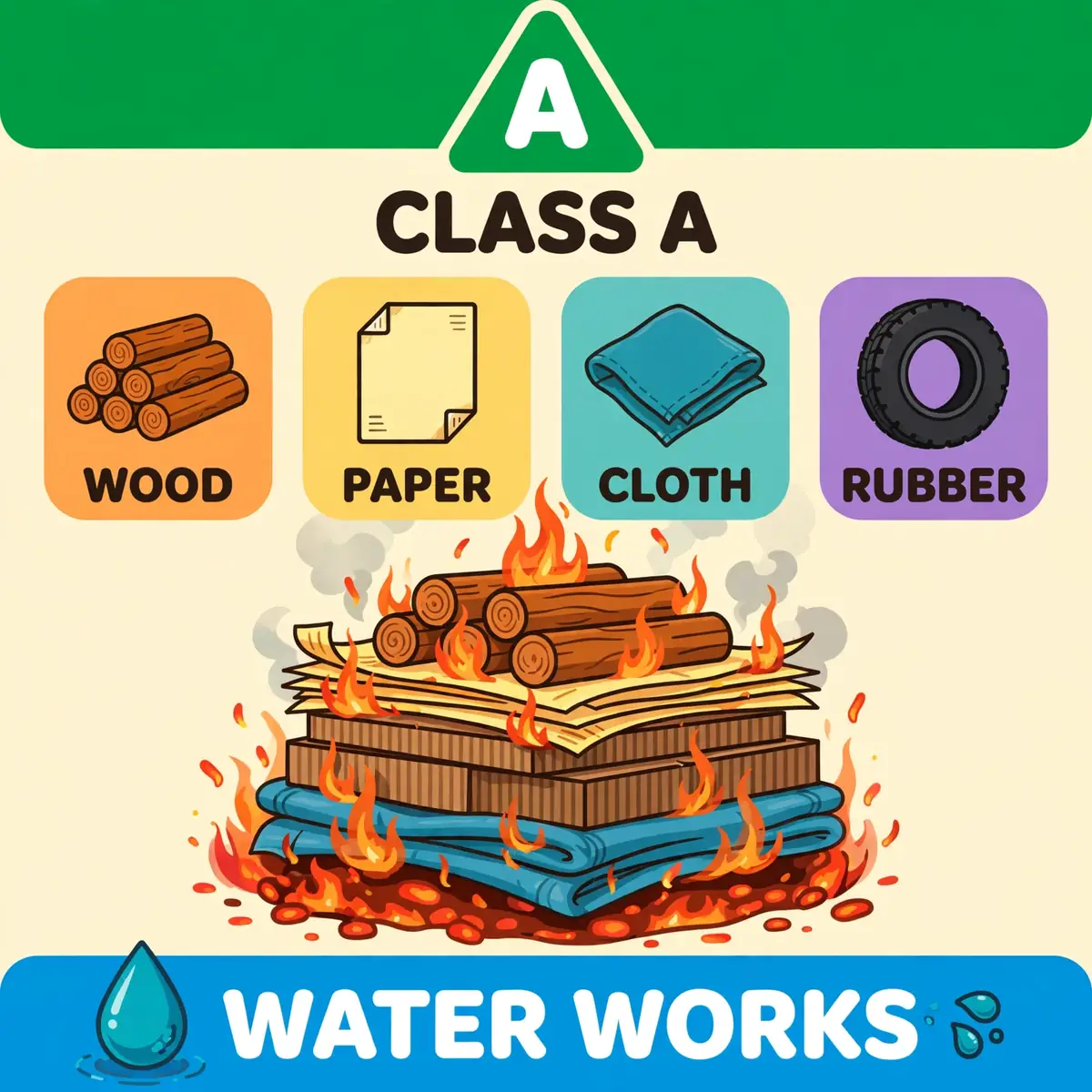
A Class A fire burns ordinary solid materials: wood, paper, cardboard, cloth, curtains, bedding, rubber and many plastics. It is the most common fire in homes, offices, schools and warehouses, and the one most people picture when they think of a building fire. The fuel is solid, and it leaves ash and glowing embers behind as it burns.
Class A fires are marked on extinguishers and signs by a green triangle containing the letter A. Water, foam and ABC dry chemical extinguishers all carry the A rating, which makes Class A the easiest class to fight. The danger is not the first flames. It is the embers buried inside the fuel, which keep smouldering and can reignite long after the flames disappear.
Where Class a Fires Happen
Class A fuel is everywhere people live and work. Homes hold timber furniture, books, bedding and clothing. Offices hold paper files, cardboard packaging and fabric chairs. Warehouses hold pallets, crates and bales. Construction sites hold timber offcuts, sawdust and insulation. Any of these can catch from a dropped cigarette, a faulty heater, hot work such as welding, or a fire that spreads from another class.
Common ignition sources include:
- Smoking materials dropped on bedding, upholstery or waste.
- Portable heaters placed too close to curtains or furniture.
- Hot work such as welding and grinding near timber or packaging.
- Electrical faults that set light to the material around them.
How a Class a Fire Behaves
Solid fuel burns from the surface inward, which makes Class A fires deep-seated. Flames on the outside can be knocked down quickly. The inside of a mattress, a bale of cloth or a stack of paper can keep burning. The fire gives off heat slowly at first, then faster as more surface catches. Smoke builds up before the flames reach the ceiling. A Class A fire in a closed room is dangerous long before it looks large.
Reignition is the trap. Embers buried in paper or wood hold their heat for minutes or hours, and a draught from an opened door can bring the flames back. A Class A fire is only out when the fuel is cool all the way through. Soaking the material and watching it afterwards is part of putting it out, not an extra step.
The Right Agent — and What Never to Use
Cooling is the main attack on a Class A fire. Water soaks into the fuel and pulls the heat out, which is why water extinguishers carry the A rating. Foam cools and smothers at the same time. ABC dry chemical interrupts the chain reaction and coats the fuel. It is useful where water would damage stock or equipment. All three agents work, so the choice depends on what is nearby and what the fuel is.
Agents for a Class A fire:
- Water: the classic agent, best where soaking the fuel is safe.
- Foam: cools and seals the surface, useful on mixed solid and liquid fuel.
- ABC dry chemical: fast knockdown, useful where water would cause damage.
- Carbon dioxide: poor on its own, because it cools nothing and embers reignite.
TipAfter a Class A fire is out, soak the material and watch it. Glowing embers can reignite long after the flames disappear.
Class B: Flammable Liquids
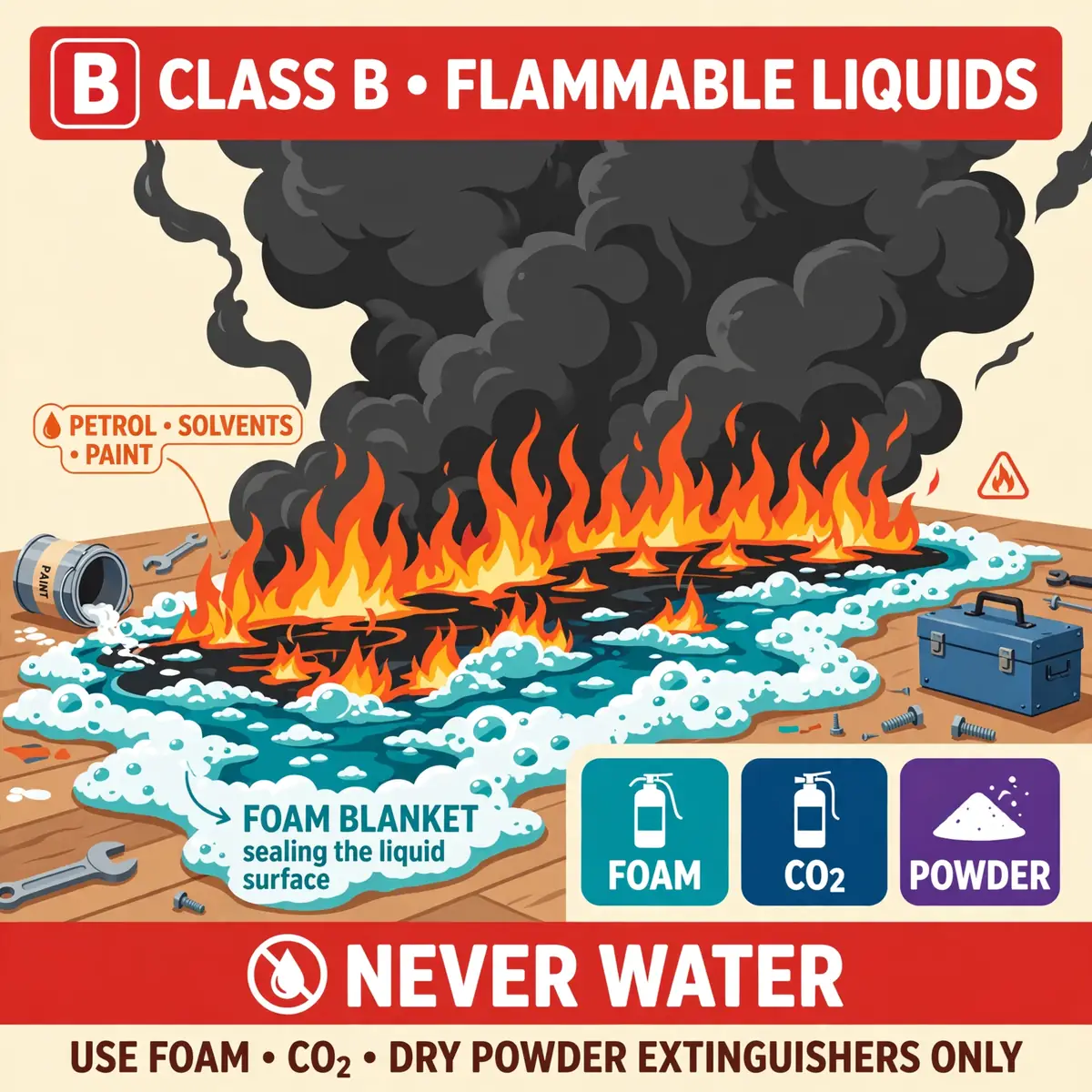
A Class B fire burns flammable liquids: petrol, diesel, kerosene, oils, solvents, paints, alcohols and aviation fuel. The liquid itself does not burn. Its vapour mixes with air above the surface, and that vapour is what catches fire. That is why a Class B fire spreads across a spill in seconds and why it can flow around corners and under doors.
Class B fires are marked by a red square containing the letter B. In the European and UK systems, a liquid counts as Class B when its flash point is no more than 93 °C. In the United States, Class B also covers flammable gases, which the UK and Europe put in Class C instead. Cooking oils and fats are excluded from Class B in both systems, even though they are liquids, because they burn hotter and behave differently.
Where Class B Fires Happen
Class B fuel turns up wherever liquids are stored, moved or used. Petrol stations and fuel stores hold the obvious risk. Vehicle workshops hold fuel, oil and solvents in open containers. Paint shops and printing plants hold thinners and inks. Chemical stores hold drums of flammable liquid. A spill the size of a dinner plate can give off enough vapour to catch from a spark several steps away.
Places where Class B fires are most likely:
- Garages and vehicle workshops with fuel, oil and cleaning solvents.
- Paint shops, print works and anywhere thinners are used.
- Fuel stores, loading bays and chemical storage areas.
- Kitchens and boiler rooms where oil is stored near heat.
Why Water Makes a Class B Fire Worse
Water is denser than most flammable liquids. It sinks beneath the burning surface instead of covering it. At the temperature of a burning liquid, the water flashes to steam at once and expands to about 1,700 times its volume. The steam throws burning liquid across the floor and onto anyone nearby. A jet of water does not put a liquid fire out. It spreads it.
The same rule applies to any liquid that floats on water. A burning pool of petrol, solvent or paint will run with the water and carry the fire with it. Foam, carbon dioxide and dry chemical work because they attack the vapour or the chain reaction instead of the liquid itself. Water belongs nowhere near a Class B fire, whatever its size.
WarningNever use water on a Class B fire. Water sinks under burning liquid, flashes to steam and spreads the burning fuel across the floor.
The Right Agent for a Class B Fire
Smothering is the main attack. Foam lays a blanket over the liquid surface and seals the vapour away from the air. Carbon dioxide displaces oxygen and cools slightly, without leaving residue. Dry chemical interrupts the chain reaction and knocks the flames down fast. All three belong on a Class B fire, and the choice depends on the size of the spill and what is nearby.
Fire extinguisher types are built around these agents, and each type carries the letters for the classes it is proven against. Agents for a Class B fire:
- Foam: seals the liquid surface and stops vapour escaping.
- Carbon dioxide: displaces oxygen, best in enclosed spaces.
- Dry chemical: fast knockdown by breaking the chain reaction.
- Water: never use it — it spreads the burning liquid.
Class C: the Letter That Changes Meaning
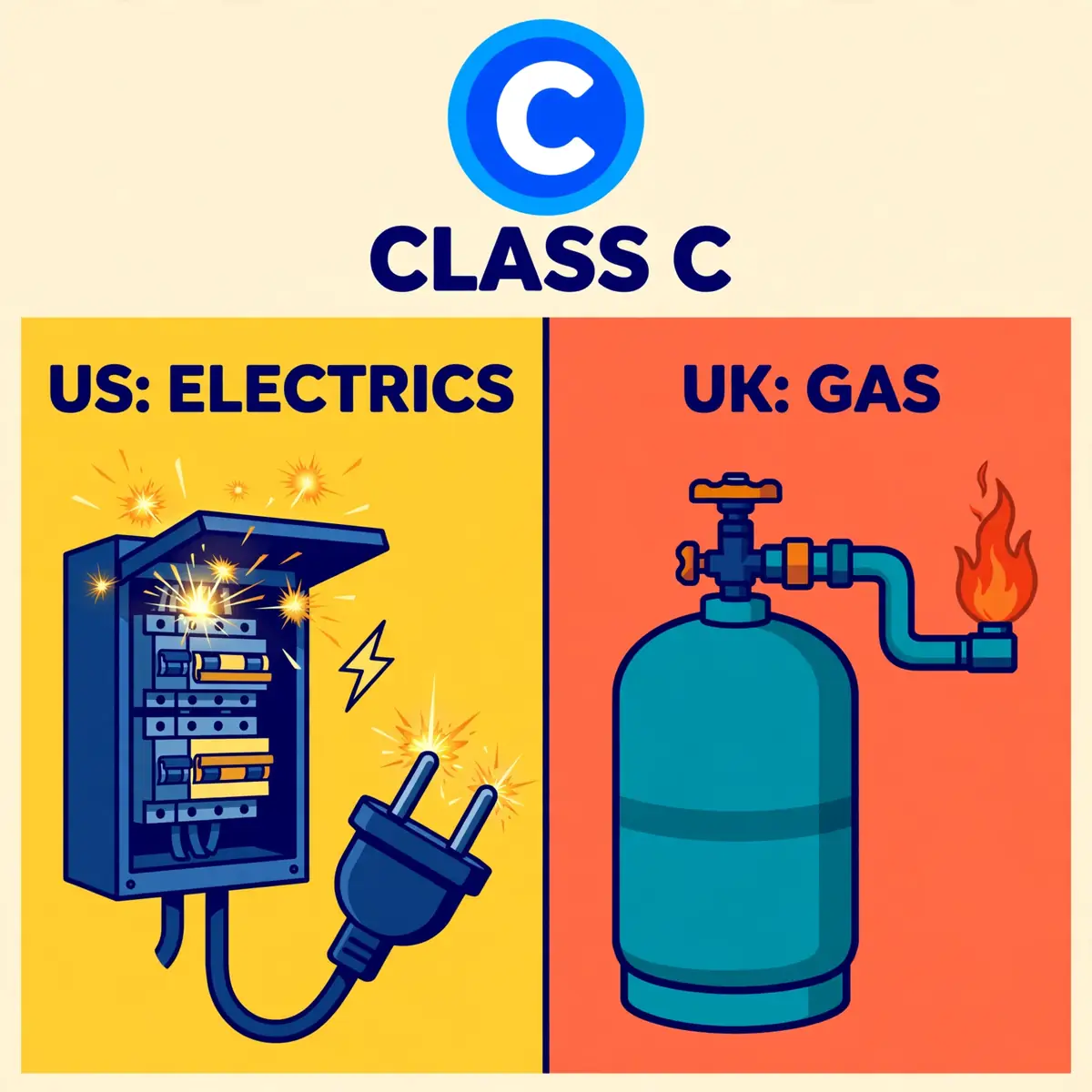
Class C is the most dangerous letter in the system, because it means two different things. In the United States, Class C means a fire involving energised electrical equipment. In the United Kingdom and Europe, Class C means a fire involving flammable gas. The same letter on two documents can describe two different fires that need opposite treatments.
The confusion is not academic. A worker who reads a US manual in a UK building, or a UK manual on a US site, can pick the wrong agent. The rest of this section takes the two meanings in turn, then sets out how to avoid the mistake. Whenever a label, a sign or a training note uses the letter C, check which country it comes from first.
In the United States: Live Electrical Equipment
A US Class C fire involves energised electrical equipment. Servers, transformers, circuit panels, motors, wiring and appliances under load all count. The fuel may be the insulation or the casing, but the danger that defines the class is the live current. Any agent that conducts electricity can carry that current back to the person holding the extinguisher, which is why water and foam are forbidden here.
Only non-conductive agents are safe: carbon dioxide and dry chemical. Class C carries no number in a rating, because the letter itself certifies that the agent will not conduct electricity. Once the equipment is de-energised, the fire stops being Class C. It becomes Class A or Class B, depending on what is actually burning, and it can then be fought with the agent for that class.
In the United Kingdom and Europe: Flammable Gases
A UK and European Class C fire involves flammable gases. Propane, butane, natural gas, methane, acetylene and hydrogen all count. The fire burns at the point of release — a leaking valve, a ruptured pipe, a damaged fitting or a fractured cylinder. The gas itself is the fuel, and it keeps flowing until someone shuts it off.
The golden rule is to shut off the gas supply first, whenever it is safe to do so. Putting out the visible flame while gas still leaks is worse than leaving it burning. The unburned gas keeps escaping, builds up invisibly and can reignite explosively when it finds a source of ignition. A controlled flame is often safer than an uncontrolled gas cloud, so the first move is the valve, not the extinguisher.
How to Avoid the Class C Mistake
Three habits prevent the mistake. First, read the country on the label, the sign or the training material, not just the letter. Second, learn both meanings, so a letter C on a foreign document raises a question instead of an answer. Third, teach the difference in induction training for anyone who works across borders or reads guidance from both systems.
A quick check before acting on a letter C:
- US document or US-built equipment: C means live electrics — use a non-conductive agent.
- UK or European document or equipment: C means flammable gas — shut off the supply first.
- No country shown: stop and check, or treat the fire as unknown and leave.
AlertA letter C on a label means live electrics in the US and flammable gas in the UK. Check the country before you trust the letter.
Class D: Combustible Metals
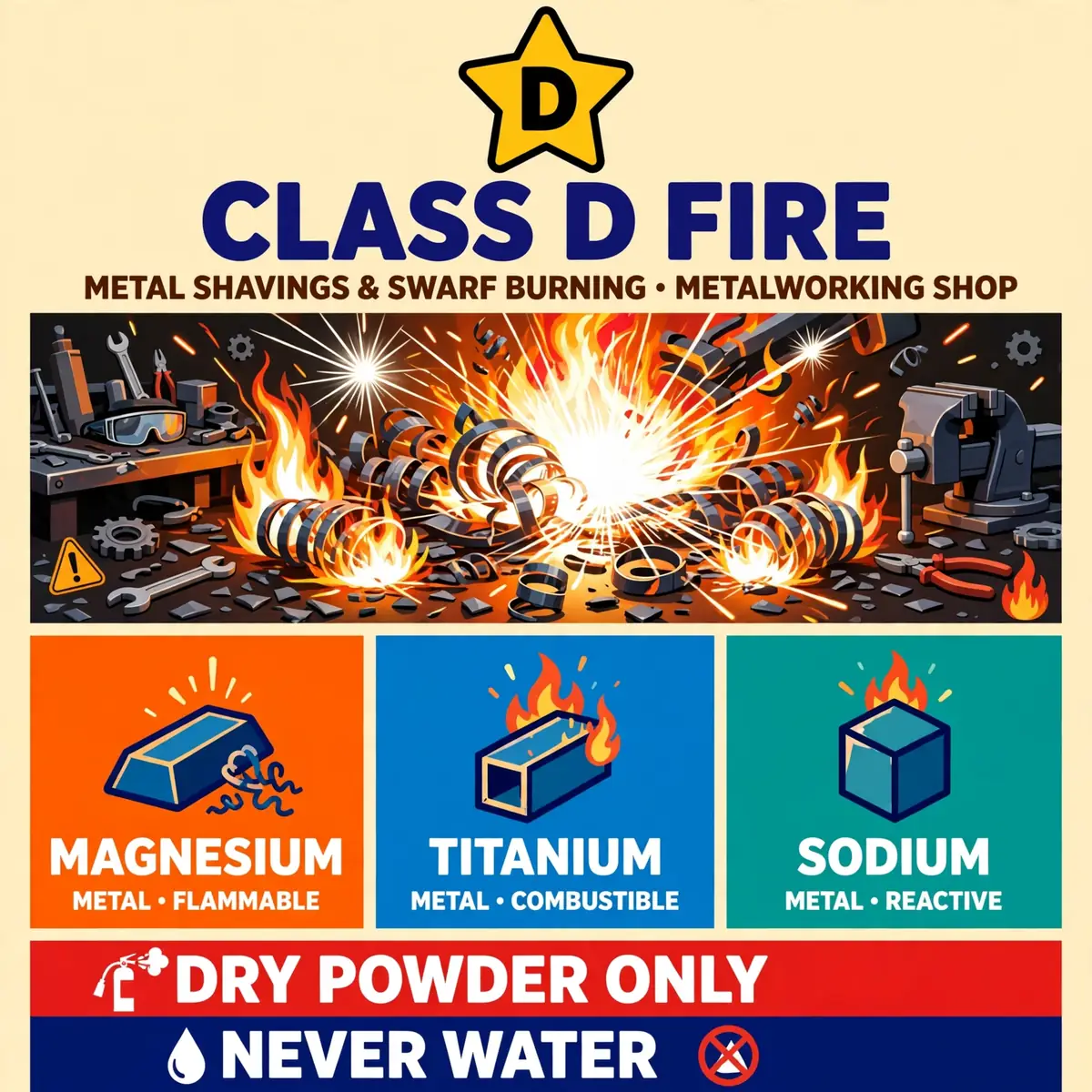
A Class D fire burns combustible metals: magnesium, titanium, zirconium, sodium, lithium and potassium. These fires are rare outside industry, and they are the most violent class when they do happen. They burn at extremely high temperatures, throw off intense white light, and react with the very agents that put other fires out.
Class D fires are marked by a yellow five-point star containing the letter D. Most Class D risk comes from metal in small pieces: swarf, shavings, dust and powder. A solid block of metal sheds heat too fast to keep burning, but fine particles have a huge surface area and catch easily. Grinding, cutting and machining are the usual ignition points, along with hot work near stored swarf.
Where Class D Fires Happen
Class D fires belong to metalworking shops, foundries, laboratories and aerospace plants. Magnesium and titanium are machined for aircraft and vehicle parts. Sodium and potassium are handled in chemical laboratories. Lithium metal appears in battery research and production. Fine metal dust raises the risk wherever it collects. A dust cloud on ledges, in ducts or on the floor can ignite from a single spark.
Places where Class D fires are most likely:
- Metalworking and machining shops, especially where magnesium or titanium is cut.
- Foundries and smelters handling molten or powdered metal.
- Chemical laboratories storing sodium, potassium or lithium.
- Aerospace and pyrotechnic manufacturing plants.
Why Ordinary Extinguishers Fail on a Class D Fire
Water is the worst agent on a metal fire. It reacts violently with burning sodium, lithium and magnesium, gives off hydrogen gas, and can make the fire explode. Carbon dioxide fails on magnesium, because the burning metal strips oxygen straight out of the carbon dioxide molecule and keeps burning. Foam and standard dry chemical can make some metal fires worse, not better.
Dry powder and dry chemical are also different things, and the difference matters here. Dry powder is a specialist agent made for metal fires, usually graphite powder or granular sodium chloride. Dry chemical is the ordinary ABC powder in most extinguishers. Using dry chemical on a metal fire in place of dry powder can be ineffective. It can also increase the intensity of the fire. Only the agent matched to the metal belongs on a Class D fire.
WarningIf no Class D extinguisher is at hand, leave the area. Water, foam and ordinary dry chemical can all make a metal fire worse.
The Right Agent for a Class D Fire
A Class D fire needs a specialist dry powder extinguisher, matched to the metal that is burning. The powder smothers the metal and absorbs heat without reacting with it. Many Class D units are made for one specific metal, so the label must name the metal it is proven against. There is no multi-purpose Class D rating, and one metal's powder cannot be assumed to work on another.
The powder is applied gently, to form a crust over the burning metal rather than scattering it. That crust seals the metal away from oxygen and holds the heat down. If the label does not name the metal that is burning, do not use it. If no Class D unit is available, leave and call the emergency services.
Class F: Cooking Oils and Fats (UK and Europe)
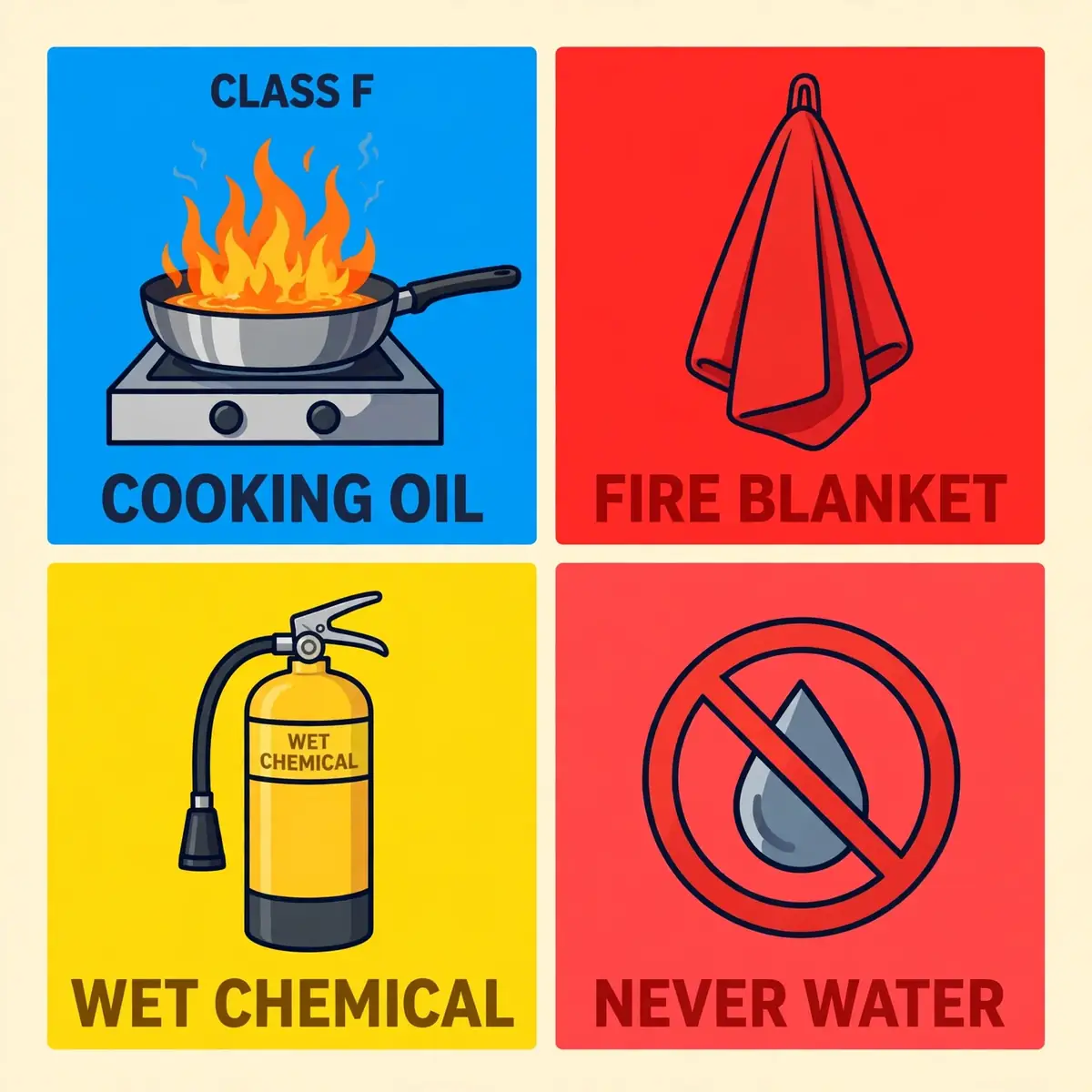
A Class F fire burns cooking oils and fats. Vegetable oil, animal fat and deep-fryer oil all count, in home kitchens, restaurants, takeaways and catering kitchens. In the United Kingdom and Europe this is the letter for a chip pan or fryer fire. The same fire is called Class K in the United States, and the next section covers that letter.
Cooking oil is excluded from Class B, even though it is a liquid, because it burns hotter and behaves differently from petrol or solvents. A pan of oil left heating can ignite on its own, without any spark, once it reaches its auto-ignition temperature. The oil also holds its heat, which is why a cooking-oil fire reignites so easily after the flames are knocked down.
Why Cooking Oil Fires Are Different
Oil burns at a higher temperature than ordinary flammable liquids, and it stays hot long after the flames disappear. A thin crust of burnt food on the surface does nothing to slow it. The fire is fed by vapour rising off the hot oil, and the oil below keeps producing more vapour as long as it stays hot. Cooling the oil matters as much as putting out the flames.
Water is uniquely dangerous here. A cup of water dropped into burning oil flashes to steam at once and expands to about 1,700 times its volume. The steam throws burning oil across the room in a fireball of droplets. That is why kitchen fires cause severe burns so often, and why water must never go near a burning pan or fryer.
WarningNever throw water on burning cooking oil. A cup of water in a pan of burning oil flashes into a fireball of steam and burning droplets.
The Right Agent for a Class F Fire
The only agent made for a Class F fire is a wet chemical extinguisher. It is usually a potassium acetate or potassium carbonate solution. It works in two ways at once. First it cools the oil. Then it reacts with the fatty acids in a process called saponification. The reaction forms a soapy foam layer that seals the surface and stops flammable vapour escaping. That foam blanket is what keeps the oil from reigniting.
What works on a Class F fire, and what does not:
- Wet chemical: cools the oil and seals it with a soapy foam layer.
- Fire blanket or lid: smothers a small pan fire by cutting off the air.
- Water: never use it — it flash-boils and spreads burning oil.
- Standard foam or ABC powder: cannot cool the oil, so the fire reignites.
- Carbon dioxide alone: knocks the flames down without cooling the oil.
Class F at Home
Most Class F fires start in home kitchens. A chip pan or a wok left heating while the cook is distracted is the usual cause. A fire blanket belongs in the kitchen, within reach but away from the cooker, so flames cannot block access to it. A wet chemical extinguisher is the right unit for a kitchen that fries food regularly, and it carries a yellow band in the UK.
Prevention is simple and it works. Never leave a pan of oil heating unattended. Never fill a pan more than one-third full of oil. Turn the handles inward so a pan cannot be knocked over. If oil starts to smoke, turn off the heat and let it cool — smoke means the oil is close to igniting. For wider kitchen safety, the home fire safety guide connects these habits to detection and escape.
Class K: Cooking Oils and Fats (US Commercial Kitchens)
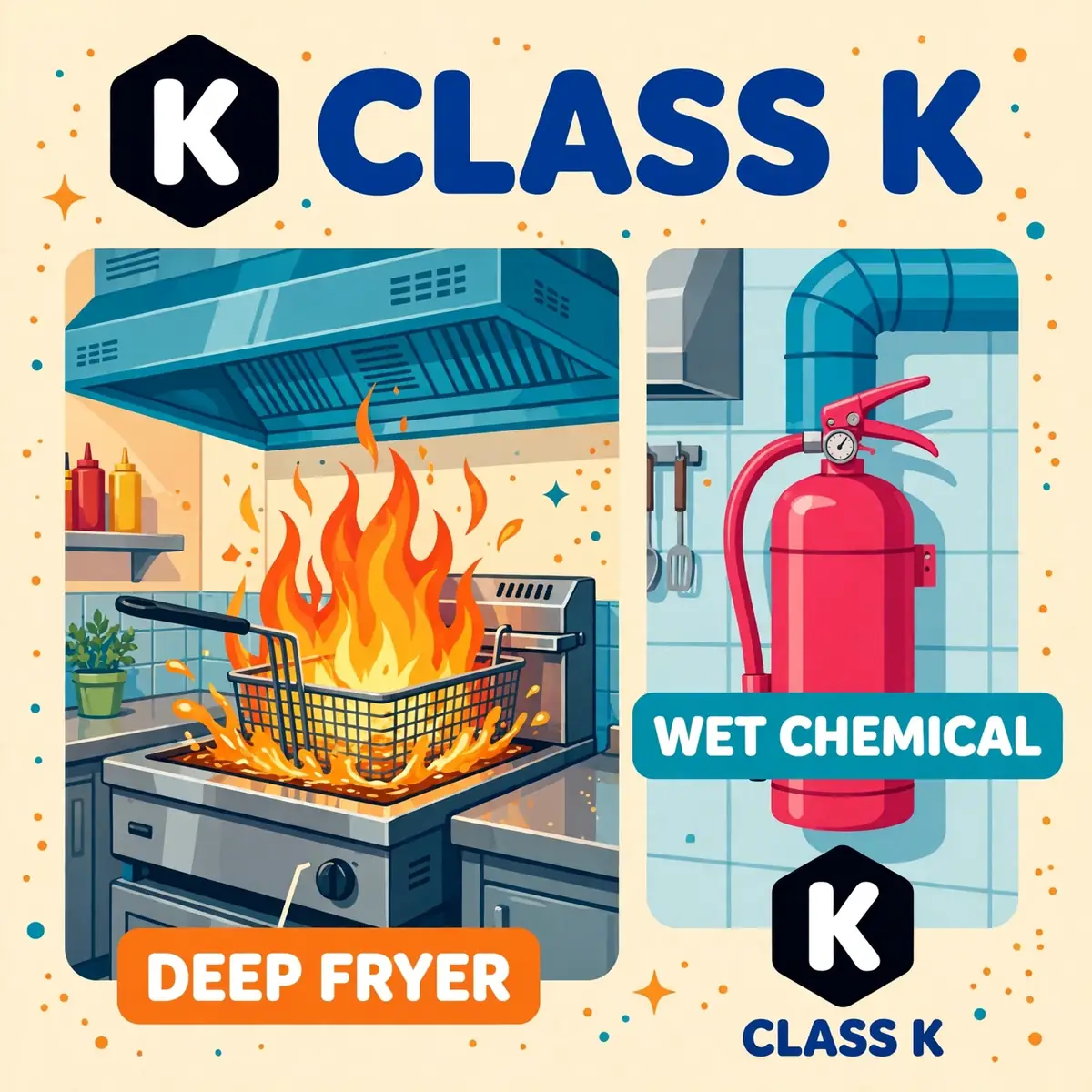
A Class K fire burns vegetable oils and animal fats in commercial cooking. Deep-fat fryers, griddles and ranges in restaurants, cafeterias and catering kitchens all count. The letter K is the United States name for the fire the United Kingdom calls Class F. The fuel is the same, the danger is the same, and the agent is the same — only the letter changes.
Class K fires are marked by a black hexagon containing the letter K. They are a commercial-kitchen hazard more than a home hazard, because commercial fryers hold far more oil at far higher temperatures than a home pan. The oil can auto-ignite if it is left heating, and a fryer fire can spread to the hood, the ducting and the kitchen in minutes.
Where Class K Fires Happen
Class K fuel sits in every commercial kitchen that fries food. Deep-fat fryers are the main risk, followed by griddles, tilt skillets and ranges where oil is held hot for service. Food courts, school cafeterias, hospital kitchens and catering units all carry the same hazard. The larger the fryer, the more oil is involved and the faster the fire grows.
Places where Class K fires are most likely:
- Restaurant and takeaway kitchens with deep-fat fryers.
- School, hospital and workplace cafeterias.
- Catering units and food courts with griddles and ranges.
- Any kitchen where oil is held hot for long service periods.
The Right Agent for a Class K Fire
Wet chemical is the only agent made for a Class K fire, exactly as for Class F. The potassium solution cools the oil and reacts with it to form a soapy foam seal. The seal stops vapour escaping and keeps the fire from reigniting. Many commercial kitchens also have a fixed suppression system in the exhaust hood. It releases agent onto the range automatically or from a manual pull station.
ABC dry powder is not a substitute. The powder knocks the flames down but cannot cool the mass of hot oil, so the fire reignites once the powder cloud settles. Carbon dioxide has the same weakness. Only wet chemical, or a fixed hood system, cools and seals the oil at the same time.
Class F and Class K Side by Side
The two letters describe one fire. Class F is the UK and European name under BS EN 2, and Class K is the US name under NFPA 10. Both use a wet chemical extinguisher, and in the UK that unit carries a yellow band. A cook who moves between countries needs to know both letters, because the extinguisher on the wall will carry whichever letter the local system uses.
| System | Letter | Standard | Agent |
|---|---|---|---|
| United States | K | NFPA 10 | Wet chemical |
| United Kingdom and Europe | F | BS EN 2 | Wet chemical |
TipIn a commercial kitchen, the wet chemical unit belongs near the fryer but never above the cooker, where flames would block access to it.
Fires with More Than One Fuel, and Fires That Change Class
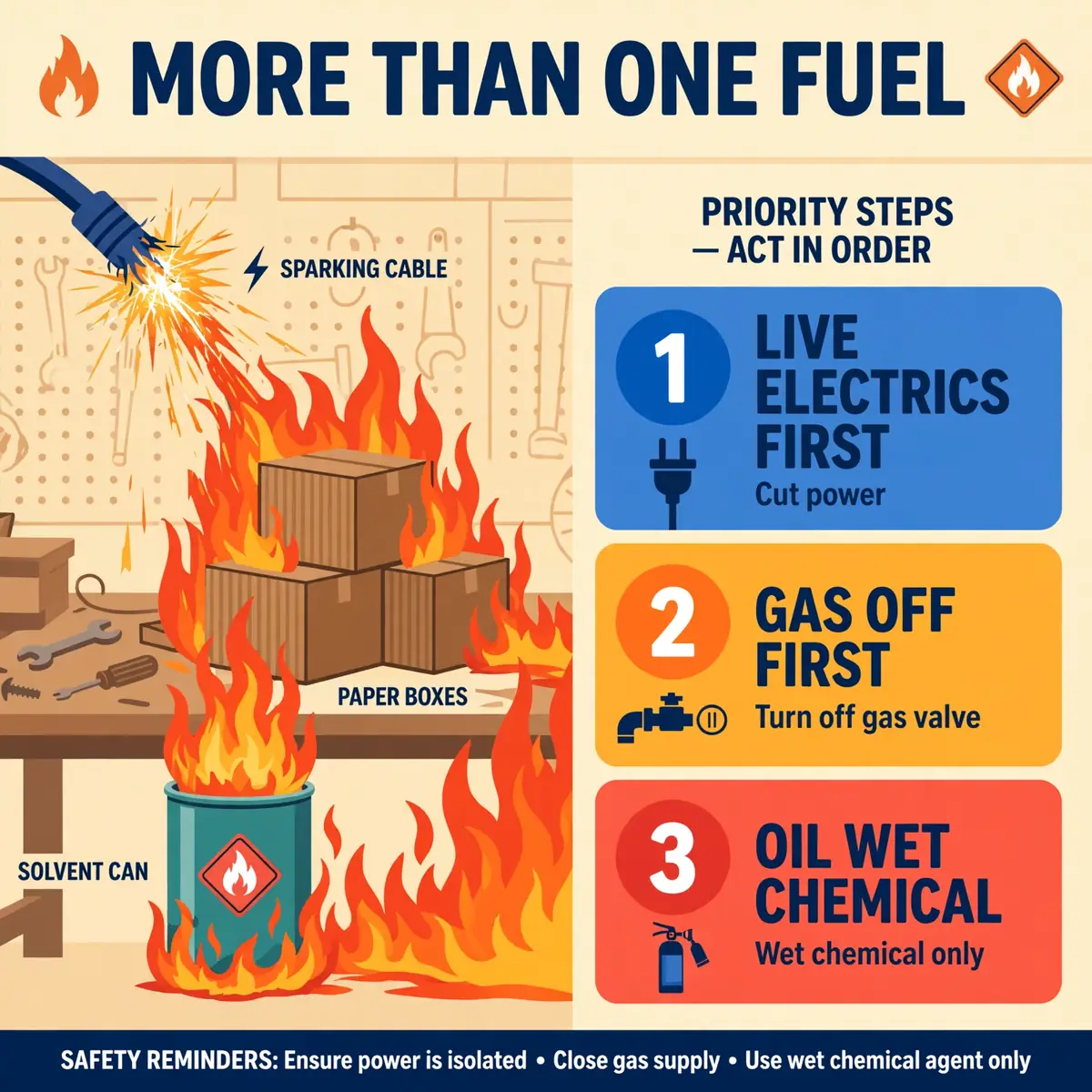
Real fires rarely burn one fuel. An electrical fault sets light to paper, and the fire spreads to a curtain and a can of solvent. A fryer fire spreads to wooden cabinets. A petrol spill runs under a stack of tyres. The class system still works, but it has to be applied to every fuel in the fire, not just the first one that caught.
The rule is simple: name every fuel, then let the most restrictive fuel decide. If any fuel is live electrics, the agent must be non-conductive until the power is cut. If any fuel is cooking oil, the agent must be wet chemical. If any fuel is a burning metal, only the specialist dry powder for that metal will do. A multi-purpose ABC extinguisher covers Classes A, B and C in the US system. It covers neither Class D nor Class F or K.
Which Fuel Governs
Work through the fuels in the order that protects you first. Live current is the first danger, because it can kill the person holding the extinguisher. Flowing gas is the second, because it can explode. Burning oil is the third, because water and powder cannot stop it reigniting. Burning metal is the fourth, because almost every agent makes it worse. Ordinary solids and liquids come last, because most agents work on them.
Priority order when fuels mix:
- Live electrics: de-energise first, or use only a non-conductive agent.
- Flowing gas: shut off the supply before fighting the flames.
- Cooking oil: wet chemical only — no other agent cools and seals it.
- Burning metal: specialist dry powder for that metal only.
- Solids and liquids: water, foam or ABC dry chemical, as the class allows.
How a Fire Changes Class
A fire can change class while it is burning, and the change matters. Cut the power to a burning server and the fire stops being Class C. It becomes Class A or Class B, depending on what is actually burning. Shut off the gas to a burning hob and the Class C fire goes out at its source. Let a fryer fire spread to cabinets and the fire gains a Class A fuel alongside the oil.
Reclassification is a decision, not a detail. After the power is cut, an extinguisher that was forbidden becomes safe. After the gas is shut off, a fire that could not be fought can be approached. Check what changed before choosing a new agent, and if the change is unclear, treat the fire as unknown and leave.
WarningA fire that started in wiring can look like an ordinary Class A fire while the circuit is still live. Confirm the power is off before using water or foam.
When You Cannot Tell Which Class a Fire Is
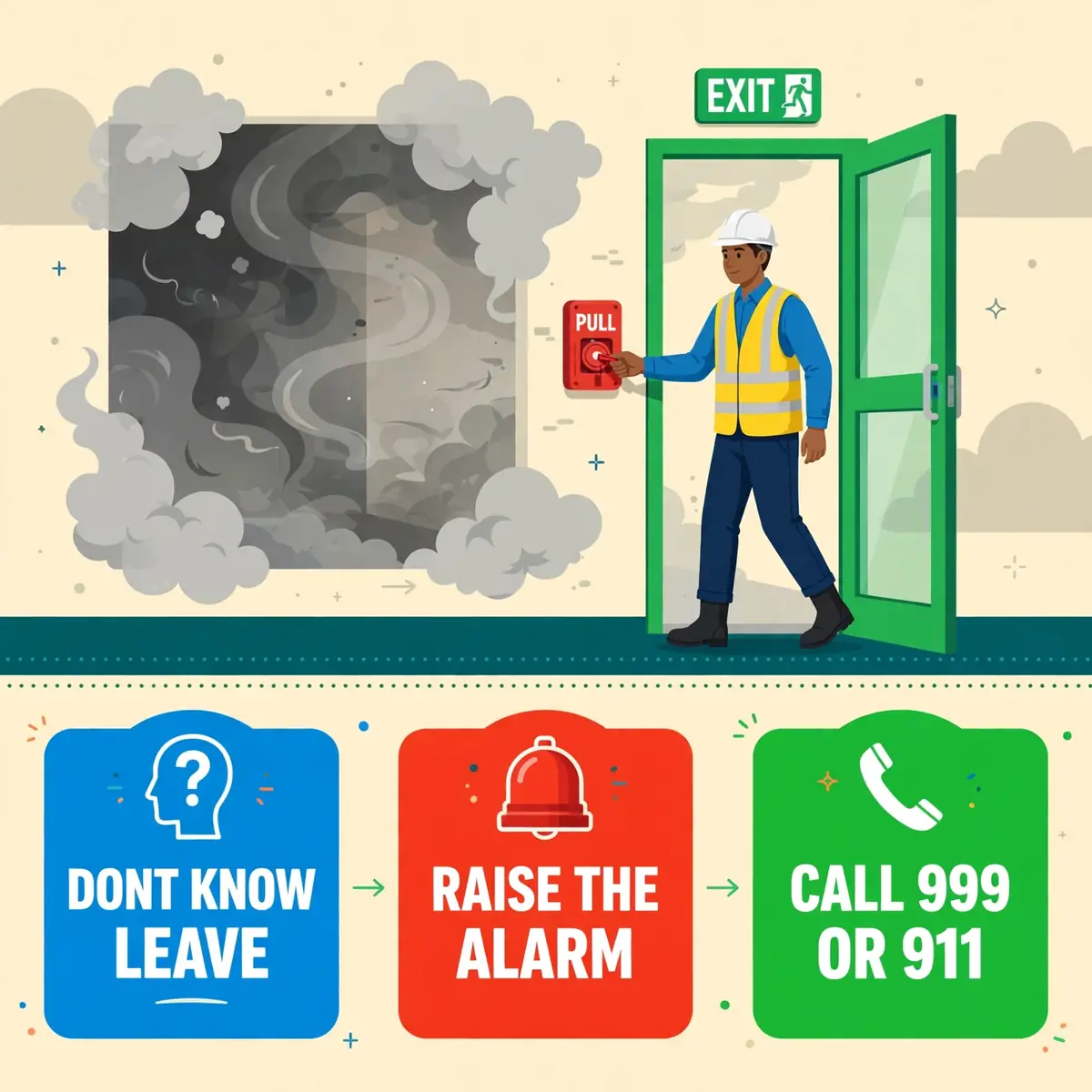
Sometimes the class cannot be told. Smoke fills the room, the fuel is hidden behind a panel, or the fire has spread across several materials at once. Guessing in that moment is worse than not fighting. The wrong agent can spread the fire, feed it or electrocute the person holding the extinguisher. An unknown fire is a fire to walk away from.
The decision takes seconds and it has five parts. The fire must be small and contained. The class must be known. The right extinguisher must be in hand, charged and in reach. An escape route must be clear behind you. If any one of those fails, leave at once. Practising that decision in a fire drill matters more than memorising the classes, because the decision is made under stress.
What to Do Instead
Raise the alarm first, then leave. Close doors behind you to slow the spread of fire and smoke. Call the emergency services: 911 in the US, 999 in the UK. Tell them what is burning, if you know, and where the fire is. Meet the fire service outside and tell them anything that changes the risk, such as gas cylinders, fuel stores or lithium-ion batteries on the site.
Do not go back for belongings, and do not re-enter to look for the class. The information the fire service needs is the location, the fuel if it is known, and the people who may still be inside. Everything else can wait until the fire is out.
AlertIf the fire has reached the ceiling, filled the room with smoke or blocked the way out, leave at once and call the emergency services. No extinguisher is worth a life.
Class L: Lithium-Ion Batteries — the New Class
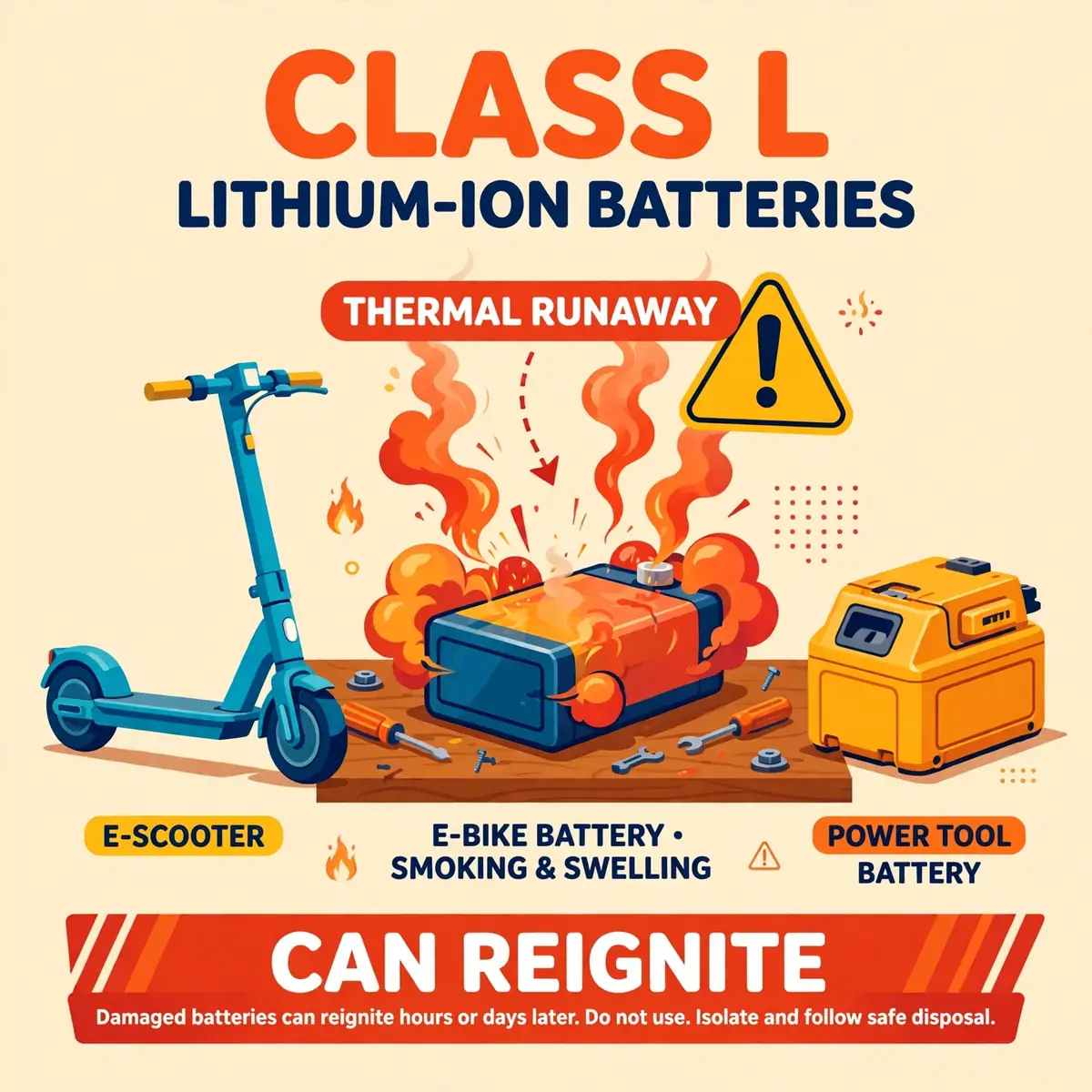
A new class arrived in January 2026. ISO 3941 added Class L for fires involving lithium-ion cells and battery packs that contain no metallic lithium. The devices are familiar: e-bikes, e-scooters, power tools, forklifts, electric vehicles and battery storage. The fire is not, and it does not behave like the classes above.
A lithium-ion fire is driven by thermal runaway: a self-sustaining internal chemical reaction that generates heat and releases flammable gases. Cells can reignite without warning, even after the visible flames are out. Damaged batteries can reignite hours or even days after appearing to be out. The fire also gives off toxic gases. Ordinary extinguishers struggle with it, because the heat is generated inside the cells rather than on a surface that an agent can reach.
Class L is a risk-assessment tool for now, not a rating shown on portable extinguishers, because BS EN 3 has not yet incorporated it. If lithium-ion batteries are charged or stored on a site, the fire risk assessment should say so. The emergency plan should reflect it. Cooling is the usual approach for a small lithium-ion battery fire, because only cooling the cells stops thermal runaway. The US NFPA system has not adopted Class L, and lithium metal fires remain Class D.
Frequently Asked Questions
What Are the Classes of Fire?
There are six letters in common use. A covers ordinary solids, B covers flammable liquids, C covers live electrics in the US or flammable gas in the UK, and D covers combustible metals. F in the UK or K in the US covers cooking oils and fats. A seventh class, L for lithium-ion batteries, was added to ISO 3941 in 2026.
How Do I Tell Which Class a Fire Is?
Name the fuel first. Solids that leave ash point to Class A, and pooling liquid points to Class B. A hissing gas leak or live equipment points to Class C, white-hot metal to Class D, and oil in a pan or fryer to Class F or K. Flame, smoke, sound and smell confirm the fuel. If you cannot name the fuel, treat the fire as unknown and leave.
Is Class F the Same as Class K?
Yes, for the same fire. Class F is the UK and European name under BS EN 2, and Class K is the US name under NFPA 10. Both cover cooking oils and fats, and both need a wet chemical extinguisher.
Why Does Class C Mean Different Things in the US and UK?
The two systems grew up separately. In the US, Class C covers energised electrical equipment. In the UK and Europe, Class C covers flammable gases, and electrical fires have no class of their own. The guidance is to cut the power and treat what is left as Class A or B. Always check which country's system a label follows.
Can One Extinguisher Cover All Fire Classes?
No single unit covers every class. A multi-purpose ABC dry chemical extinguisher covers Classes A, B and C in the US system, which is enough for most homes and offices. Class D metal fires need a specialist dry powder, and Class F or K cooking-oil fires need a wet chemical unit. Ratings, siting and inspection are covered in the fire extinguisher classes guide.
What Class is a Lithium-Ion Battery Fire?
Under ISO 3941:2026 it is Class L, in the UK and Europe. The US NFPA system has not adopted Class L. Lithium metal, as opposed to lithium-ion cells, is Class D. Battery fires can reignite without warning, so treat any battery fire as a reason to leave and call the emergency services.
What Should I Do If I Do Not Know the Class of a Fire?
Do not guess. Leave, raise the alarm, close doors behind you and call the emergency services — 911 in the US or 999 in the UK. Fight a fire only when it is small, the class is known, the right extinguisher is in hand and an escape route is clear.
Sources
- NFPA — Fire extinguishers
- OSHA — Portable fire extinguishers: OSHA requirements
- Cornell Law Institute — 29 CFR 1910.157, Portable fire extinguishers
- U.S. Fire Administration — Choosing and using fire extinguishers
- GOV.UK — Workplace fire safety: your responsibilities
- BSI — BS EN 2:1992 Classification of fires