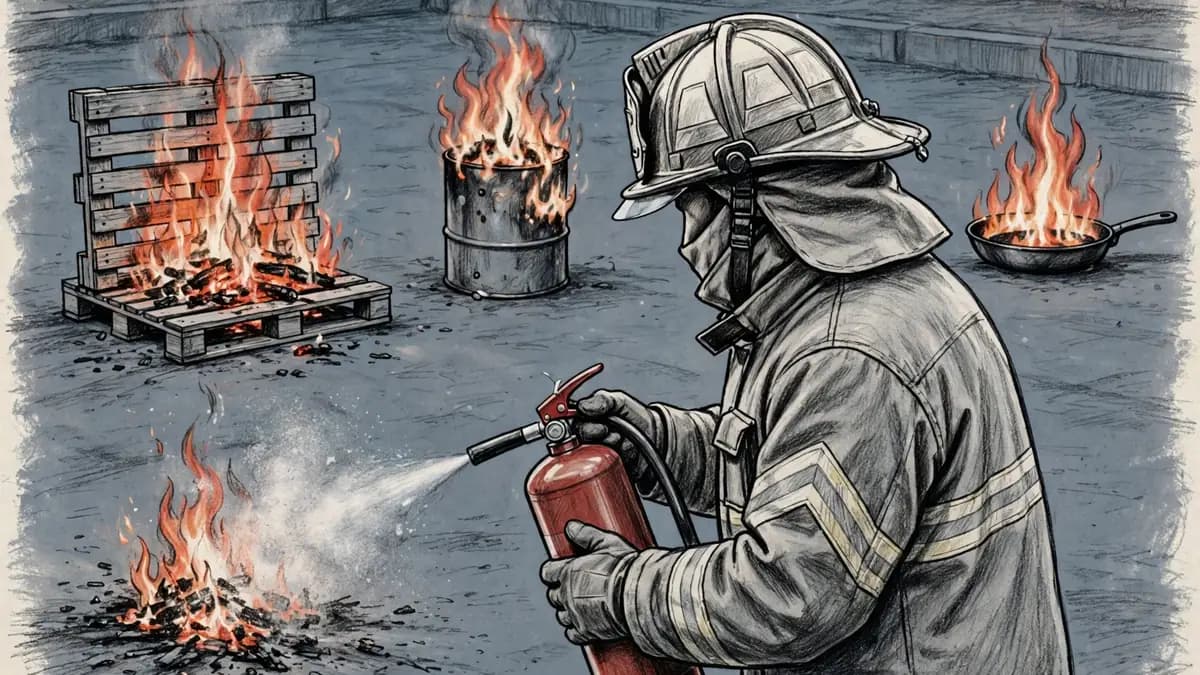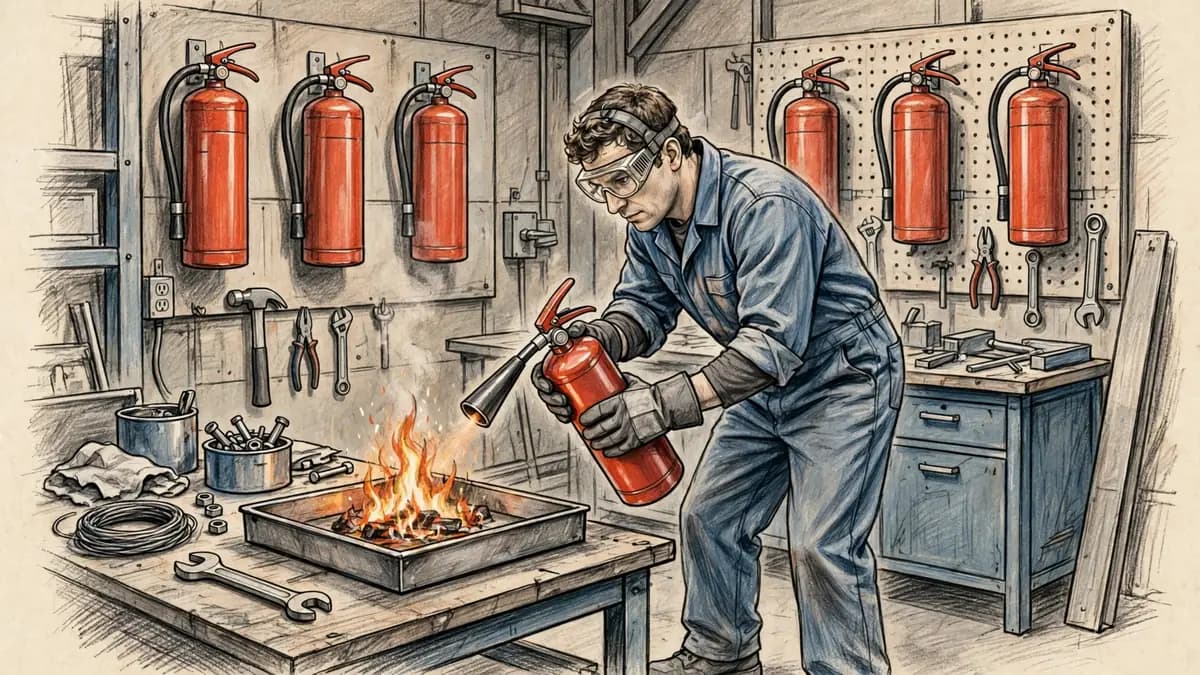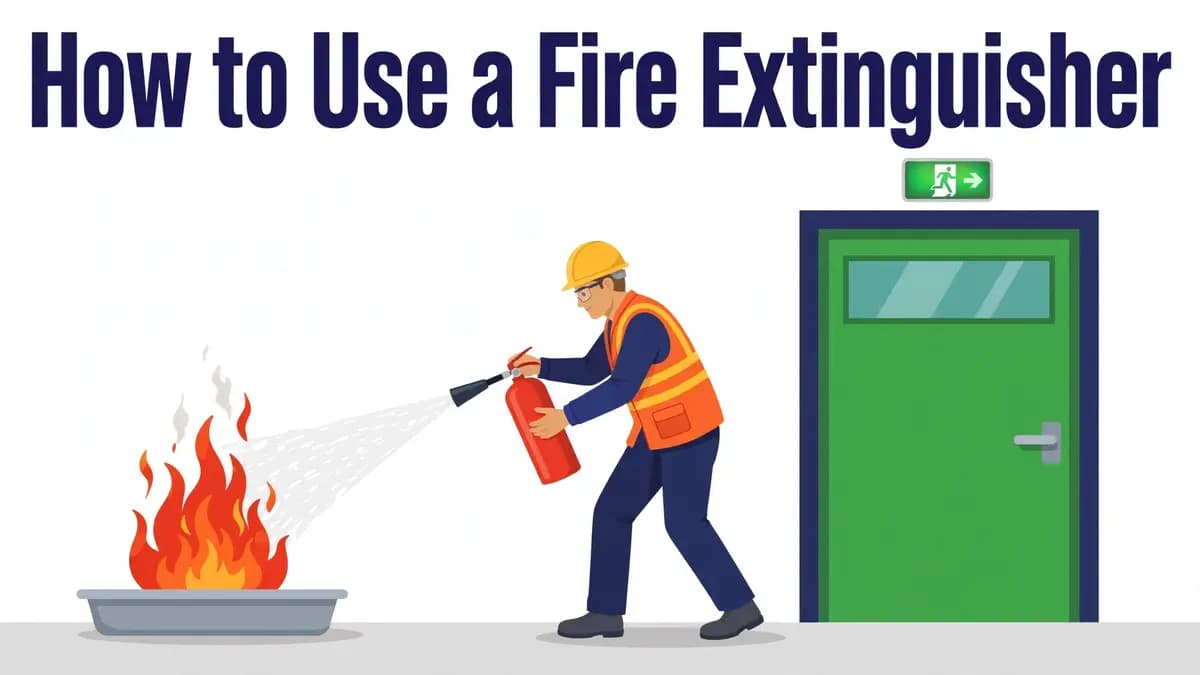
To use a fire extinguisher, pull the pin, aim the nozzle at the base of the fire, squeeze the handle, and sweep from side to side until the fire is out. Those four steps spell PASS, and they work the same way on almost every portable extinguisher. The steps take seconds to learn, and a small unit empties in about 8 to 12 seconds, so the time to learn them is before a fire starts.
PASS is only half the job. Before you pick the unit up, decide whether the fire is small enough to fight, raise the alarm, and put the exit behind you. An extinguisher is a first-response tool for a small fire in its early stage. If the fire is growing, the smoke is thick, or you cannot see the base of the fire, leave at once and call the fire service.
Should You Fight This Fire or Leave?
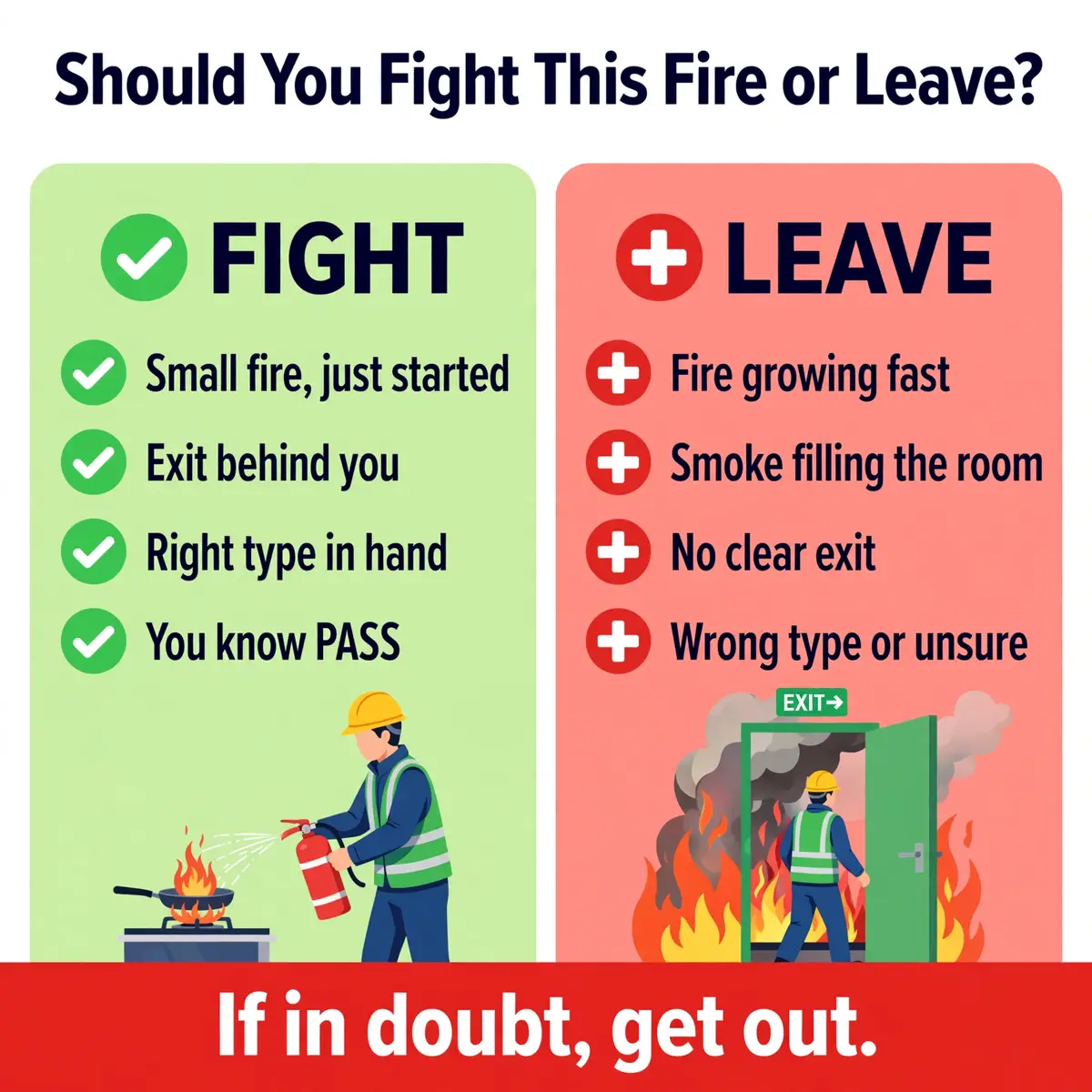
Decide before you touch the extinguisher. The decision takes a few seconds, and it is the most important part of the whole procedure. A fire extinguisher puts out a small fire or holds it back until help arrives. It cannot stop a fire that has already grown past its early stage, and trying can trap you in smoke and heat.
Fight only if every point on the list below is true. If any point fails, leave, close the door behind you, and call the fire service. No property is worth the risk of staying in a room with a fire you cannot control.
- The fire is small and still where it started, such as a pan on the stove or a waste bin.
- You know what is burning, and you have the right extinguisher for it.
- The alarm has been raised and someone has called the fire service.
- Your exit is clear and behind you, and the fire cannot cut you off from it.
- The smoke is thin enough to breathe and see through.
- You have been shown how to use the extinguisher, or you know the PASS steps.
- You feel steady enough to act, with no doubt about what to do.
Size is the first test. A pan fire that is still in the pan is small enough to fight. Flames taller than you, or fire climbing the walls, the curtains or the cabinets, is past the point where one handheld unit can help. A fire that has spread from where it started is growing faster than a single extinguisher can follow.
Smoke is the second test. Thick smoke filling the upper half of the room means the air is already unsafe, even if the flames still look small. Smoke kills more people in fires than flames do. If you have to crouch to breathe, or you cannot see the base of the fire through the smoke, the fire has already beaten the extinguisher.
Knowing what is burning is the third test. If you do not know the fuel, you cannot know which extinguisher suits it. The wrong agent can make a fire worse: water on burning oil throws a fireball across the room, and water on live electrics risks electrocution. An all-purpose ABC dry powder unit covers most fires, but it cannot stop something from exploding or giving off toxic smoke. When the fuel is unknown, leave.
WarningIf you have the slightest doubt about your ability to fight a fire, evacuate at once. The words come from OSHA, and they are the whole rule in one sentence.
Some fires are a reason to leave whatever their size. A lithium-ion battery fire can re-ignite or explode even after it looks out, and ordinary extinguishers rarely put a developing battery fire out. A fire involving gas cylinders, aerosols or chemicals you cannot identify is not a fire to fight. Close the door, get out, and let the fire service handle it.
What "Incipient Stage" Means in Practice
Regulators describe a fightable fire as an incipient-stage fire: a fire in its early stage that can be controlled with a portable extinguisher. In plain terms, that means the fire is small, it is still in one place, and one person with one extinguisher can reasonably expect to put it out. The moment the fire grows past that point, it is no longer incipient, and the right move is evacuation.
OSHA's guidance for workplaces puts the same line in practical terms. Employees should evacuate at once if the extinguisher runs out before the fire is out. They should also leave at once if the fire progresses beyond the incipient stage. The rule is simple to apply under pressure: if the fire is not shrinking, you are losing, and the exit is your next step.
Your Position is Part of the Decision
Choose your position before you pull the pin. Move so the door or hallway is at your back and the fire is in front of you, even if that takes a few extra seconds. A clear way out is part of the decision to fight. If the fire grows or the extinguisher sputters, you can then back straight out, rather than trying to squeeze past the flames.
Never let the fire, the heat or the smoke come between you and your way out. That is the rule OSHA sets for responding to an incipient-stage fire, and it applies at home as well as at work. If reaching the extinguisher means walking past the fire, do not do it. Leave by the route you already have.
Before You Touch the Extinguisher
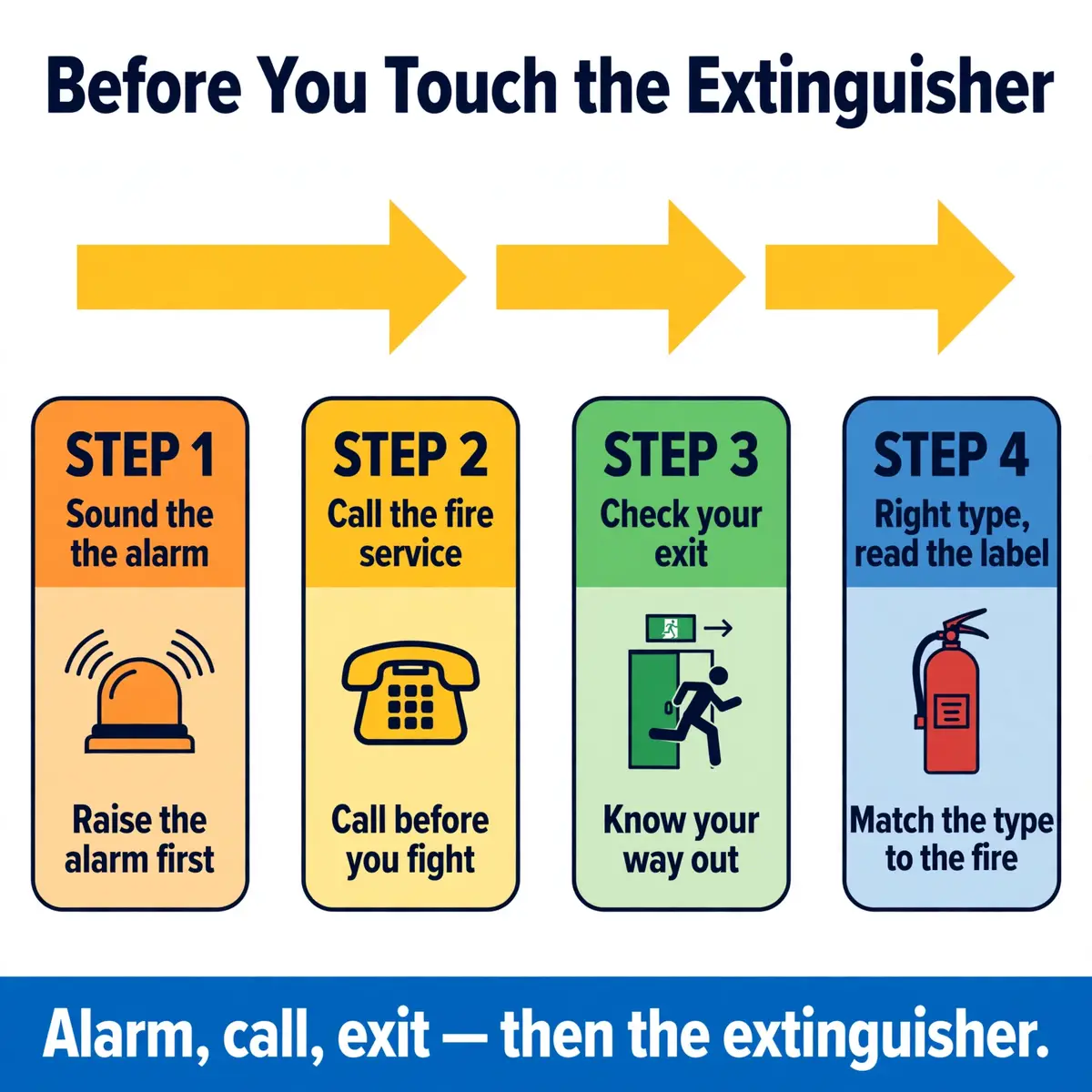
Four things happen before PASS, and they happen in order. Sound the alarm, get help coming, check your way out, and pick the right unit. Each step takes seconds, and skipping one can turn a small fire into a trap. Work through them every time, even when the fire looks trivial.
- Raise the alarm. Sound the fire alarm and call the fire service, or make sure someone else has. Help should already be on its way before you start fighting, in case you lose the fight.
- Check your exit. Identify a safe evacuation path before you approach the fire. Keep your back to the exit and the fire in front of you.
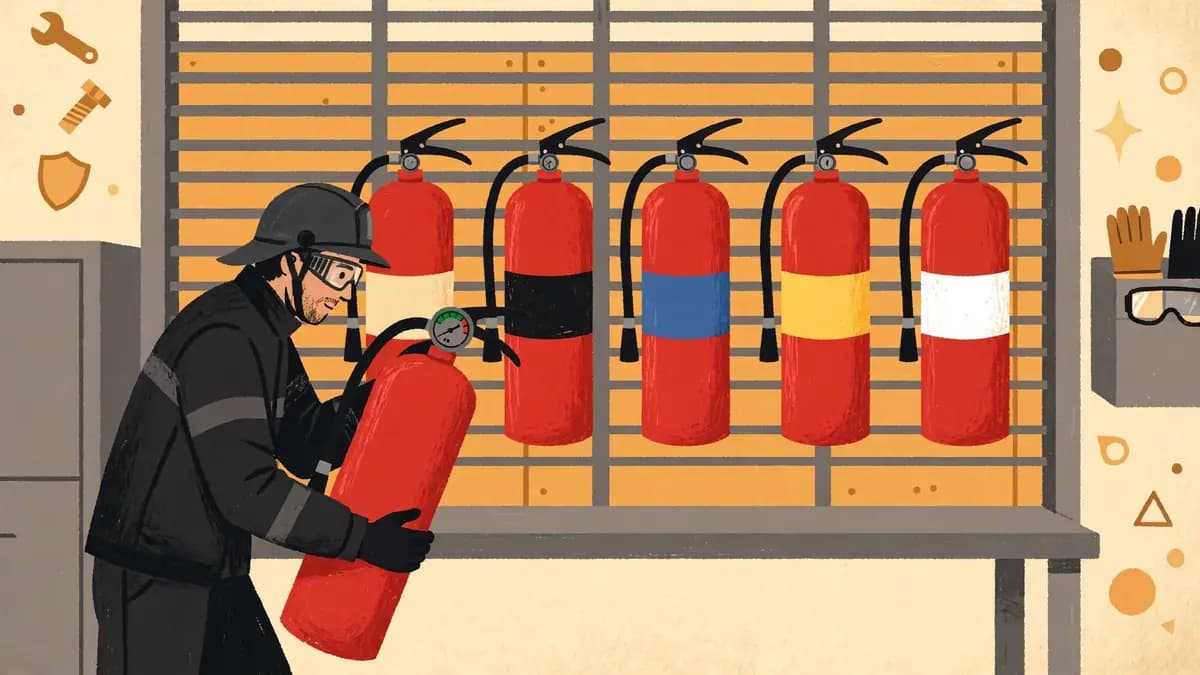
- Pick the right extinguisher. Read the label. Match the agent to the fire class, and do not use a unit whose label you cannot read.
- Check the unit. Look at the gauge, the pin and the seal. A needle outside the green zone or a broken seal means the unit may not work.
Raising the alarm comes first for a reason. A fire you put out still needs the fire service to check for hidden heat. They can look inside walls, appliances and ceilings, which you cannot see yourself. A fire you cannot put out needs them urgently. Either way, the call should go in before the first squeeze, not after the extinguisher runs out.
Picking the right unit matters more than speed. Water puts out wood, paper and textiles, but it spreads burning liquid and conducts electricity. Foam handles liquids and solids, but never live electrics or cooking oil. Carbon dioxide (CO2) suits electrical equipment and liquids, but it cools poorly and a deep-seated fire can re-ignite. Dry powder covers the widest range, but its cloud cuts visibility. Wet chemical is the one for cooking oil. The full comparison, with the UK colour bands and the US class letters, is in the companion piece on fire extinguisher types.
AlertNever use water on burning cooking oil. The water turns to steam in an instant, expanding to about 1,700 times its liquid volume, and throws burning oil across the room.
Read the label even when you think you know the unit. In the United States there is no colour code, so the label does the job instead. The class letters, the picture symbols and the rating tell you what the unit covers and how large a fire it can handle. In the United Kingdom the coloured band helps, but the label still rules. If the band and the label disagree, trust the label and report the unit.
Check the gauge and the seal in the same glance. The pressure gauge needle should sit in the green zone. A needle to the left means the pressure is too low, and the unit may not discharge properly. A needle to the right means it is overcharged, which is also not right for use. A broken or missing tamper seal suggests the unit has been used or tampered with. Any failed check means you take a different unit, or you leave.
What to Do If There is No Suitable Extinguisher
Leave. That is the whole answer. An extinguisher of the wrong type is worse than no extinguisher, because it invites you to stay and fight a fire it cannot put out. A fire blanket can smother a small pan fire, and closing a door slows a fire down, but neither replaces the right extinguisher. If the unit on the wall does not match the fire, your job is evacuation, not improvisation.
At home, the same rule applies to the kitchen. A wet chemical unit or a fire blanket belongs by the kitchen door, never above the hob, so you can grab it as you pass and still have a clear retreat. If the only unit in reach is a water extinguisher and the fire is in the chip pan, do not use it. Leave and call the fire service.
The PASS Method in Four Steps
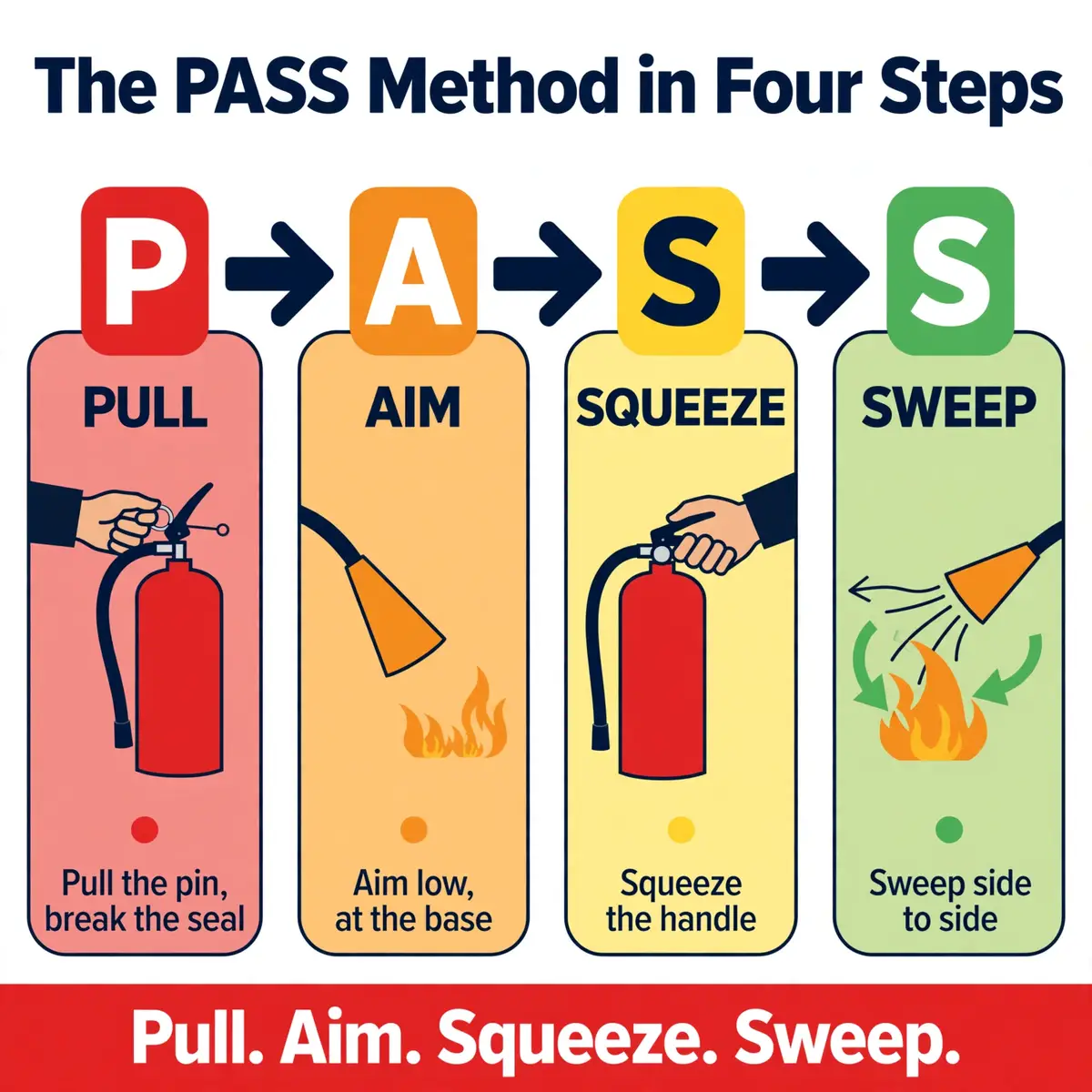
Every portable extinguisher works the same way, whatever agent it holds. The four steps spell PASS, and they are worth rehearsing before a fire starts, not during one. OSHA sets them out in its guidance on fire extinguisher use, and the wording below follows that guidance. Each step gets its own section, because each one has a mistake that wastes the agent.
- Pull the pin and break the tamper seal.
- Aim low, at the base of the fire.
- Squeeze the handle steadily to discharge the agent.
- Sweep from side to side until the fire is out.
Pull the Pin
Pull the pin straight out of the handle. The pin stops the handle from being pressed by accident, so the extinguisher cannot discharge before you need it. Pulling it also breaks the tamper seal, a thin plastic tie or tag through the pin that shows nobody has used or tampered with the unit since it was last checked.
Hold the unit upright with one hand on the handle and pull the pin with the other. The seal is made to snap easily, so a firm pull is enough. Do not squeeze the handle while you pull the pin, and do not aim the nozzle at anyone while you do it. Once the pin is out, the extinguisher is live, and any squeeze will discharge it.
If the pin will not pull, do not force it. Take another unit if one is within reach, or leave the room. A unit that will not open is a reason to evacuate, not a problem to solve in front of the fire.
Aim at the Base
Aim the nozzle, horn or hose low, at the base of the fire. The base is where the fuel burns, at the bottom of the flames, in the pan, the bin or the pile of material. Hitting the fuel is what puts the fire out. The flames above it are only the visible part of the fire.
Most people instinctively point the nozzle at the flames. That is the commonest mistake in extinguisher use, and it wastes the agent. Spray aimed at the tall flames passes straight through the fire, and the burning material underneath keeps feeding it. Get low, point at the base, and keep the nozzle there. If you cannot see the base, you cannot aim at it, and the fire is not one to fight.
TipThink of the base as the source of the fire, not the flames. Once the fuel is fully covered, the fire has nothing left to burn.
Squeeze the Handle
Squeeze the top handle or lever steadily to discharge the agent. The handle works as a lever that opens the valve, so a firm grip is enough, but it does take real hand strength. Squeeze smoothly rather than snatching at it. The discharge starts with a loud hiss or blast, and the nozzle can kick a little in your hand, so hold the unit firmly and do not let the noise startle you into dropping it.
You control the flow with the handle. Release it and the spray stops, so you can pause to check the fire and re-aim before squeezing again. Use that control. Short bursts aimed at the base beat one long blast sprayed across the room, because each burst lets you see what the fire is doing and where the agent is landing.
If nothing comes out when you squeeze, stop and leave at once. Do not stand in front of the fire trying to fix the unit. A silent extinguisher has already failed, and the exit is your next step.
Sweep Side to Side
Sweep the nozzle from side to side at the base of the fire until it appears to be out. Move in steady strokes across the whole burning area, overlapping them so no part of the fuel is left uncovered. If you hold the nozzle on one spot, the material around it can keep feeding the fire, or re-ignite after you thought it was out.
Keep sweeping until the flames are gone, then stop and watch. If the fire breaks out again, repeat the aim, squeeze and sweep steps. Do not empty the whole unit in one pass and then stand there with nothing left. Save some agent for a flare-up, and if the fire is still burning when the unit runs out, leave at once.
Where to Stand and How to Close In
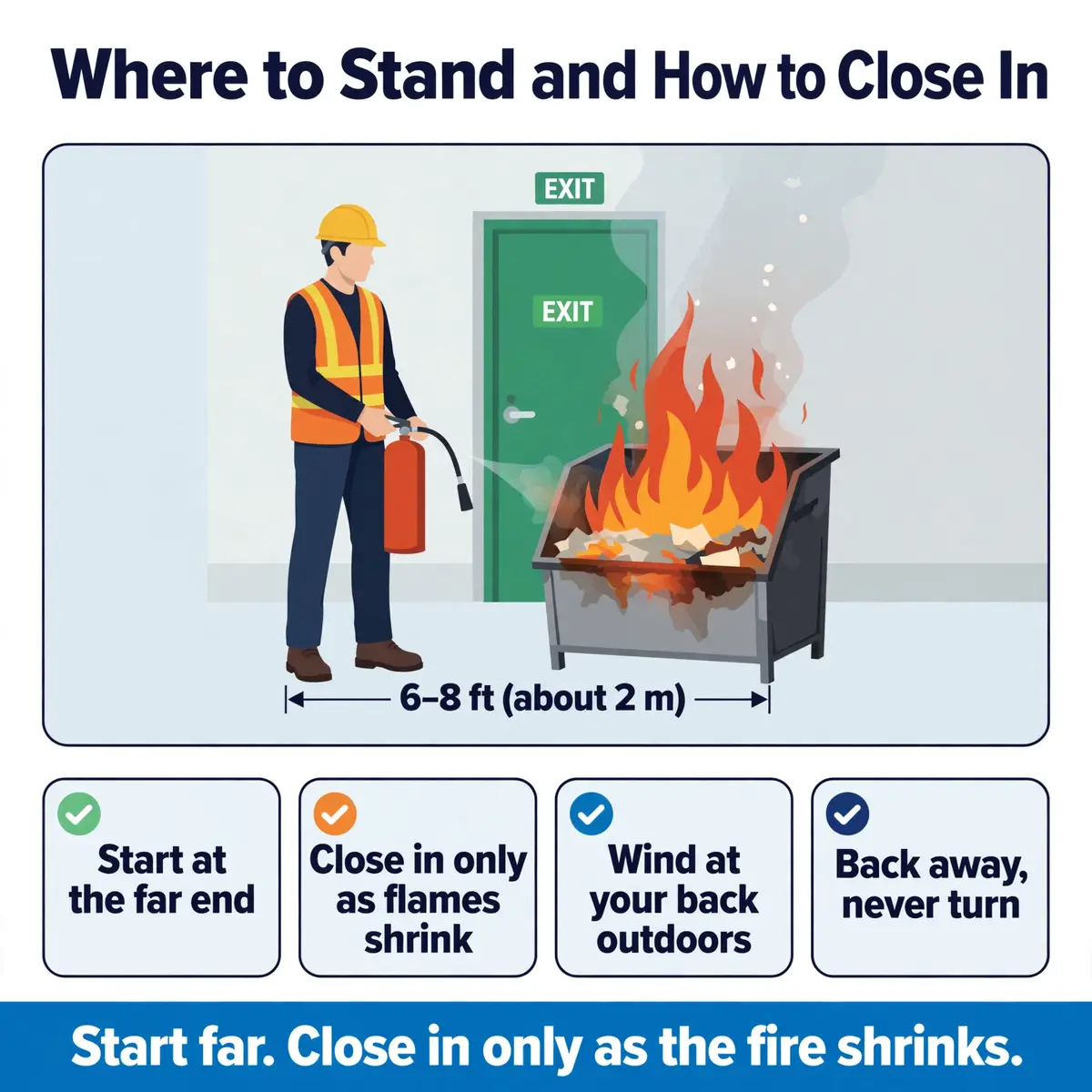
Start discharging about 6 to 8 feet (around 2 metres) from the fire, and move closer only as the flames shrink. That distance keeps you out of the worst heat while letting the agent reach the base. The exact effective range is printed on the label, so read it when you pick the unit up. Starting much closer is no help: the force of the blast can scatter burning material such as grease, which spreads the fire.
Step forward slowly, and only as the flames shrink. Advancing while the fire is still full-sized puts you in its heat for no gain. Hold your position while the fire is strong, sweep the base, and close in step by step as the flames die down. If the fire grows instead of shrinking, stop advancing and back out.
Stay on your feet and keep your balance. Crouch low if the smoke is rising, but do not kneel or sit, because you need to move fast if the fire turns. Keep the extinguisher upright unless its label says otherwise. Some cartridge-operated units work at an angle, but most stored-pressure units need to stay upright to discharge properly.
WarningNever turn your back on a fire, even if you believe it is out. It can rekindle, and you need to see it happen.
Outdoors, the wind decides which side you stand on. Spraying into the wind can blow flames or embers back toward you and spread the fire. Stand upwind, with the wind at your back, so it carries the agent onto the fire. Standing upwind also keeps smoke and fumes away from your face.
Backing Away After the Fire is Out
Back away from the fire while still facing it. OSHA lists this as part of the procedure: back away from an extinguished fire in case it flames up again. Walk backwards toward your exit, keep the nozzle pointed at the fire, and keep your eyes on it until you are clear of the room. Turning your back means you cannot see a flare-up, and a flare-up behind you can cut off your exit.
Do not run. Move steadily, watch the area, and leave the room as soon as you are sure the fire is out or the unit is empty. Close the door behind you if you can do so safely. A closed door slows a fire down and keeps smoke out of the escape route.
Using Different Types Without Hurting Yourself
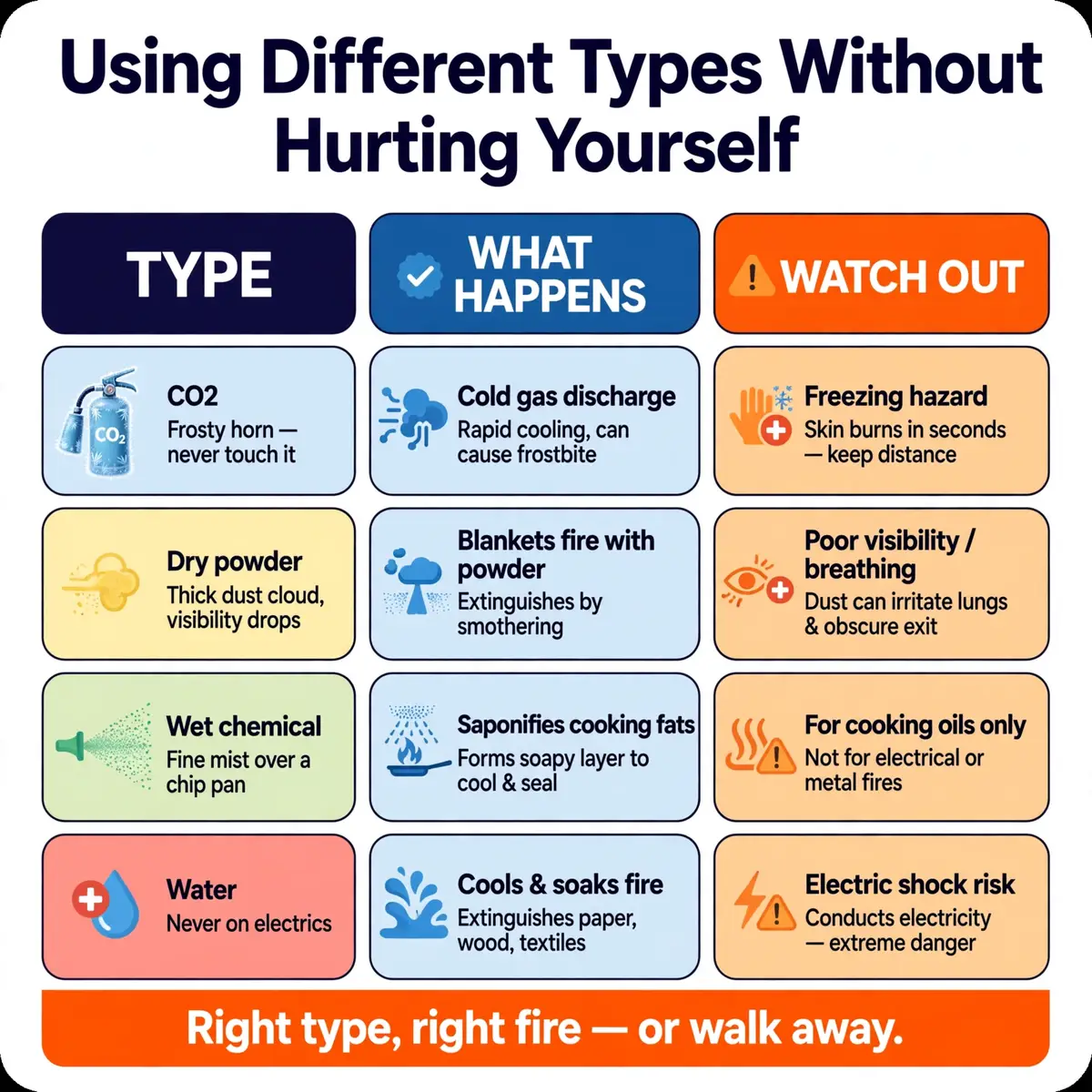
PASS is the same for every type, but each agent has its own handling trap. The four traps below cover the types most people meet. Knowing them before you squeeze is the difference between putting the fire out and hurting yourself while you try.
Carbon dioxide needs the most care. The discharge horn gets cold enough to cause frost burns on bare skin, so never touch the plastic horn while the unit is discharging. Hold the handle and the body, not the horn. CO2 also displaces oxygen, so take care in a small enclosed space: ventilate the room as soon as the fire is out, and leave at once if you feel light-headed. The gas leaves no residue, which makes it the standard choice beside computers and electrical panels, but it cools poorly, and a deep-seated fire can re-ignite once the gas clears.
Dry powder needs a different kind of care. The powder interrupts the chemical chain reaction of the fire. One unit covers Class A, B and C fires and live electrical equipment. The trade-off is the cloud it makes. Discharged powder cuts visibility and irritates the lungs. It is a poor choice in a small room with no ventilation. British guidance in BS 5306-8 advises against dry powder in offices and small rooms. If you must use it indoors, keep your face out of the cloud and leave the room to breathe as soon as the fire is out.
WarningDo not hold the horn of a CO2 extinguisher while it discharges. The horn gets cold enough to cause frost burns on bare skin.
Wet chemical works differently again. The unit discharges a potassium acetate solution as a fine mist over burning cooking oil. The mist cools the oil below its auto-ignition point, then reacts with it to form a soapy layer that seals the surface and stops the fire re-igniting. Aim the mist gently across the surface of the oil rather than blasting straight down into the pan, which can splash hot oil. Keep the yellow-banded unit by the kitchen door, never above the hob.
Water and foam are the simplest types, and their trap is the one people forget. Water puts out wood, paper and textiles by cooling, and foam smothers liquid fires with a film, but neither must ever be used on live electrical equipment. Water conducts electricity. Foam is water-based, so it carries the same risk.
If the fire involves anything plugged in or wired up, reach for CO2 or dry powder instead. The full type-by-type detail, including the UK colour bands and the US class letters, is in the companion piece on fire extinguisher types, and the letter-by-letter class detail is in fire extinguisher classes.
What the Spray Does to Your Breathing
The agents are not meant to be breathed in. CO2 pushes oxygen away, which is the point of the agent and the danger of it in a small room. ABC powder is not classed as toxic, but it strongly irritates the airways, makes the throat sore, and makes breathing hard, especially for people with asthma. The powder cloud also cuts visibility while you are discharging it.
If you cough or feel dizzy after a discharge, move to fresh air right away and stay out of the affected room until it is aired out. Seek medical care if breathing trouble does not settle in fresh air, and sooner if you have asthma. Keep a first aid kit within reach for minor burns, and check everyone for smoke inhalation after any fire, even a small one.
Common Mistakes That Waste the Extinguisher
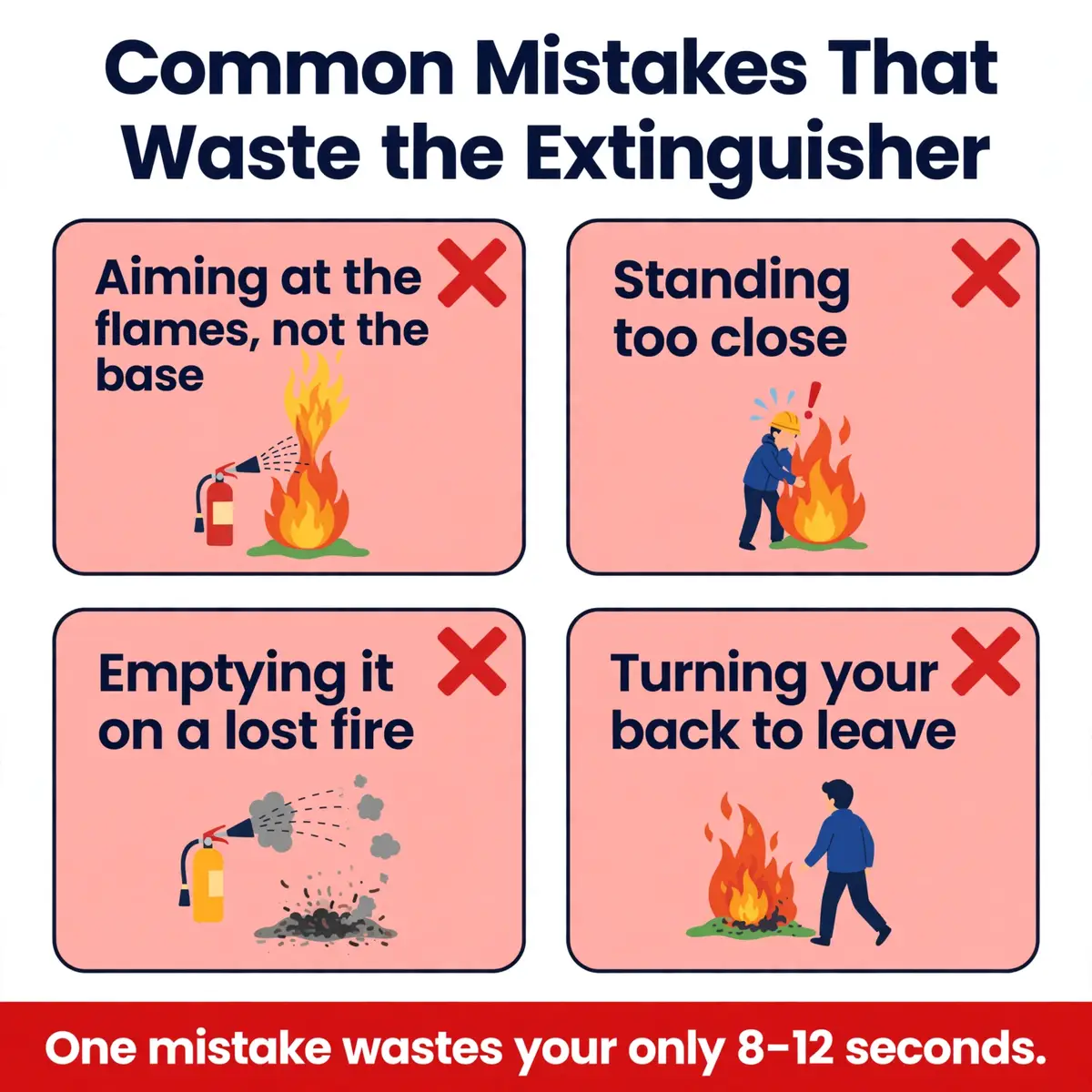
Most failed attempts share the same few mistakes, and all of them are avoidable. A small unit empties in about 8 to 12 seconds, so there is no spare agent for a second try. Each mistake below wastes the one chance the unit gives you.
- Aiming at the flames. The agent passes through the flames and the fuel underneath keeps burning. Aim at the base every time.
- Standing too close. The blast scatters burning material and puts you in the heat. Start at 6 to 8 feet and close in only as the fire shrinks.
- Grabbing the wrong type. Water on oil or electrics makes the fire worse. Read the label before you squeeze.
- Emptying the unit in one blast. Short bursts aimed at the base let you check and re-aim. Save some agent for a flare-up.
- Turning your back. A fire that looks out can rekindle. Back away facing it.
- Staying when the fire grows. If the fire is not shrinking, the extinguisher has lost. Leave while the exit is still clear.
- Rehanging a used unit. Even a short squeeze lets out pressure and breaks the seal. A partly used unit cannot be trusted.
The first mistake is the commonest, and it comes from instinct. Flames are bright, tall and frightening, so the eye goes to them and the hand follows. Train yourself to look past the flames to the base, where the fuel sits. In a pan fire, that means the surface of the oil. In a bin fire, it means the rubbish at the bottom. In a pile of burning material, it means the lowest point of the pile.
The second mistake is standing still when the fire changes. A fire that is shrinking is safe to approach; a fire that is growing is not. Watch the flames as you sweep, and let what they do decide your next step. If they shrink, step forward. If they grow, or if the smoke thickens, step back and leave. The extinguisher is a tool with a limit, and knowing that limit is part of using it well.
TipPractise the four steps on a training unit before you need them for real. Muscle memory is what works when the alarm is sounding and your hands are shaking.
The Mistake of Fighting Alone
Trying to fight a fire alone, with nobody else in the building knowing, is a mistake in itself. Someone needs to raise the alarm, call the fire service, and watch your exit while you work. In a workplace, that is why the emergency plan names who does what. At home, it means shouting to the household first, not after. A second person at the door, ready to call for help, is worth more than a second extinguisher.
The same thinking applies to children. Children should never be asked to use an extinguisher, and they should be taught to leave and raise the alarm instead. The site's guide to fire safety for kids covers what children need to know: get out, stay out, and call for help from outside.
What to Do After the Fire Looks Out
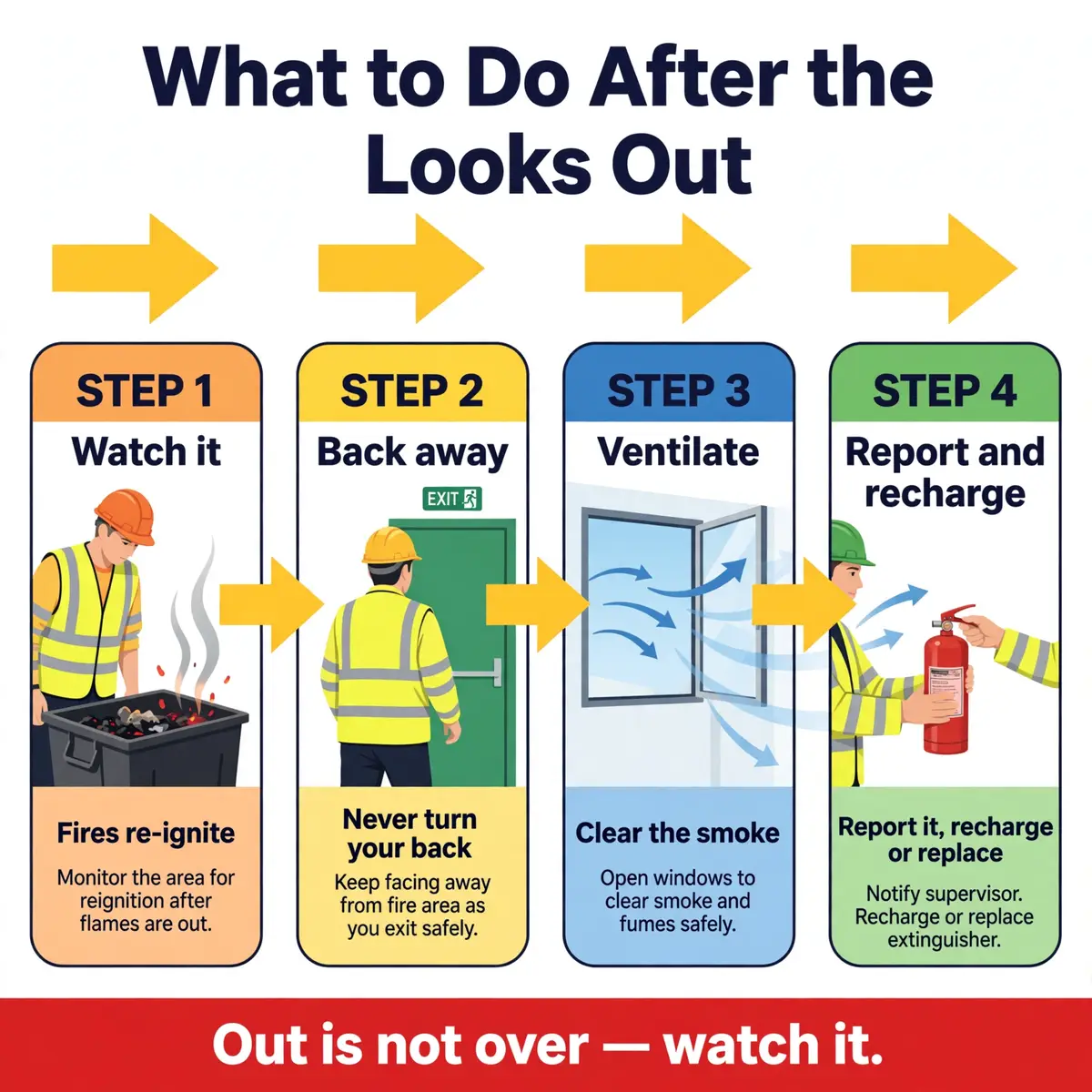
The job is not finished when the flames disappear. A fire that looks out can flare up again, and the minutes after the fire are when hidden heat does its damage. Work through the steps below before you relax, and treat the room as unsafe until you have checked it.
- Watch the area. Keep the extinguisher aimed and be ready to spray again if flames return. Hot embers or hot oil can stay hot beneath a layer of powder, even though the surface looks dead.
- Back away facing the fire. Leave the room backwards, eyes on the fire, and close the door behind you if it is safe to do so.
- Ventilate and get fresh air. Open windows and doors from outside the room. Leave the room if you cough or feel dizzy.
- Call the fire service if you have not already. Firefighters have tools to check for hidden heat inside walls, appliances and ceilings, which you cannot see yourself.
- Report the fire. Tell your employer, your landlord or your building manager what happened, which extinguisher you used, and what residue to expect.
- Do not reuse the extinguisher. A used unit, even a partly used one, must be recharged or replaced before it goes back on the wall.
Re-ignition is the reason for the watch. Burning can continue out of sight inside cushions, bins or wall material, where the agent never reached. Hot oil stays hot long after the flames die, and a thin crust of powder can hide embers that are still burning underneath. Watch the area for a few minutes, and keep the extinguisher in your hand while you do. If flames return, repeat the aim, squeeze and sweep steps.
Calling the fire service after you have put the fire out is reasonable, not overcautious. Tell them which extinguisher you used, so they know what residue to expect, and tell them what was burning. They can check the room with a thermal camera and confirm there is no hidden heat. If anyone breathed in smoke, say so when you call.
AlertA used extinguisher cannot be trusted again. Recharge or replace it right after use, because even a short squeeze lets out pressure and breaks the seal.
Do not hang a partly used unit back on the wall. Fire equipment service companies recharge reusable units, while cheap disposable home units are simply replaced. While a unit is away for maintenance or recharging, alternate protection must be provided, so a gap on the wall is never left uncovered. The person responsible for the building should arrange the replacement the same day.
Reporting and Recording the Incident
Write down what happened while it is fresh:
- The time and the place.
- What was burning.
- Which extinguisher you used.
- Whether anyone was hurt or breathed in smoke.
In a workplace, the report goes to the person responsible for fire safety, and the incident feeds into the fire risk assessment. A small fire that was put out quickly can still reveal a real problem, such as an extinguisher in the wrong place or a risk the assessment missed.
Check the rest of the building's extinguishers at the same time. If one unit was in the wrong place, or its gauge was out of the green, the others may be too. A fire is a useful audit: it shows whether the equipment, the training and the plan actually worked when they were needed.
Practise Before You Need It
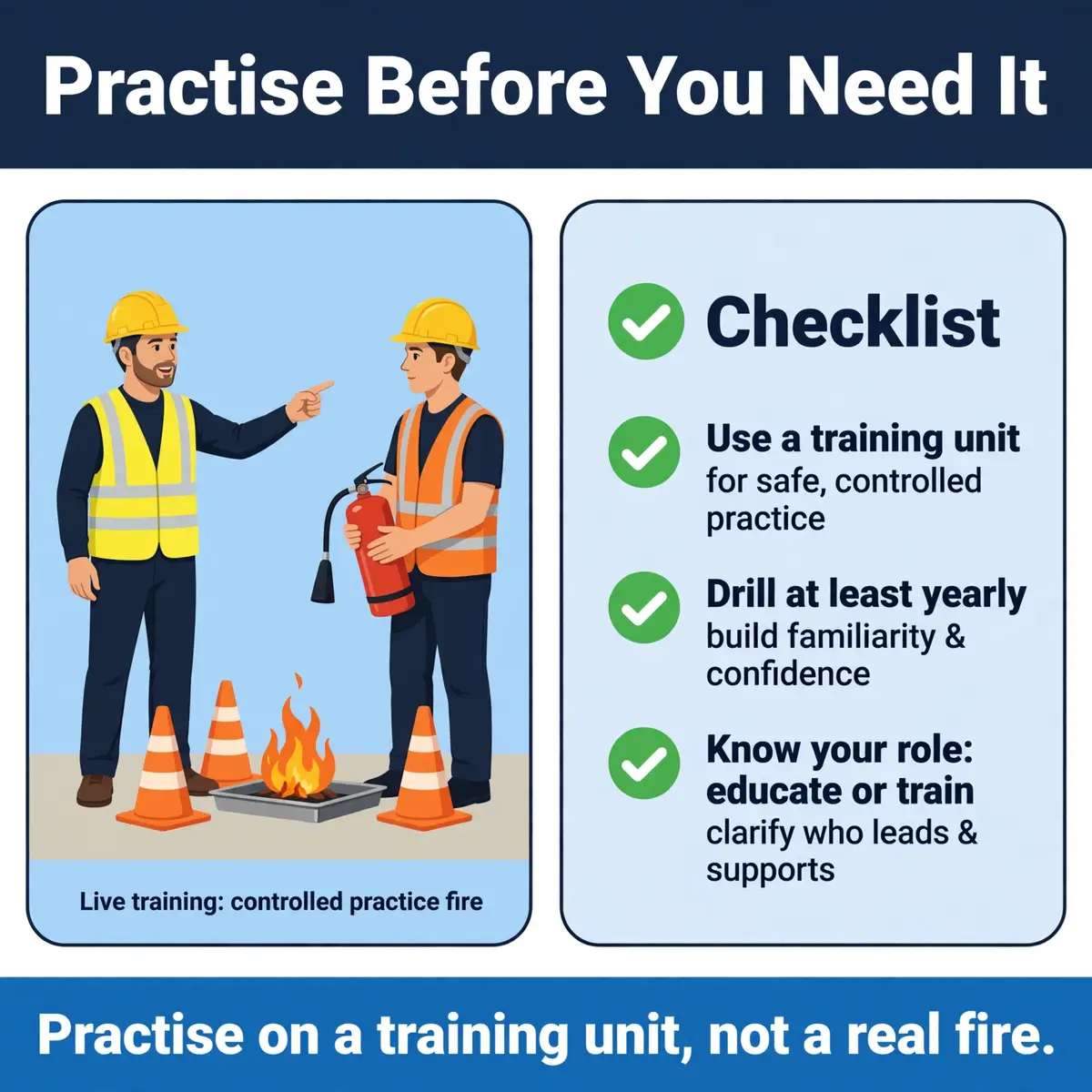
Reading the PASS steps is not the same as doing them. Under stress, hands shake, the noise startles, and the obvious step gets forgotten. The only fix is practice, and the practice has to happen before the fire, not during it. A training session with a real unit, even once, is worth more than any number of posters on the wall.
The best practice uses a training extinguisher or a discharged unit on a controlled training fire, run by a competent trainer. You learn four things from one practice run:
- The weight of the unit in your hands.
- The force needed to pull the pin.
- The kick of the nozzle when it discharges.
- How fast the agent runs out.
That last lesson is the one people remember: a small unit empties in about 8 to 12 seconds, and the time goes faster than you expect. After one practice run, the steps stop being a list and start being a habit.
If your workplace runs fire drills, take the extinguisher part seriously. Walk the route to the nearest unit, lift it off its bracket, and check the gauge, the pin and the seal. Knowing where the unit is, and that you can lift it, matters as much as knowing PASS. The site's guide to practice emergency procedures covers how to run a drill that people actually learn from, rather than one they walk through.
What the Law Expects from Employers
In the United States, OSHA draws a clear line between education and training. Where extinguishers are provided for employee use, the employer must provide an educational programme on the general principles of extinguisher use and the hazards of incipient-stage firefighting. That education must be given when a new employee starts and at least once a year after that. The rule is 29 CFR 1910.157(g)(1) and (g)(2).
Employees who are designated to use firefighting equipment as part of the emergency action plan get more than education. They get training in the use of the appropriate equipment, on first assignment to those duties and at least annually after that. That is 29 CFR 1910.157(g)(3) and (g)(4). The difference matters. Education tells everyone what an extinguisher does and when to leave. Training teaches the named people how to operate one under pressure.
In the United Kingdom, the Regulatory Reform (Fire Safety) Order 2005 puts the duty on the responsible person. The articles that matter here are:
- Article 8: general fire precautions.
- Article 9: fire risk assessment.
- Article 13: fire-fighting equipment.
- Article 17: maintenance.
- Article 21: training for employees.
The Health and Safety Executive's guidance adds the practical test: enough extinguishers of the right type, workers who know how to use them, and extinguishers kept serviced and maintained.
Practising at Home
At home, there is no trainer and no drill, so the practice is simpler and still worth doing. Show everyone in the household where the extinguisher is, how to lift it off its bracket, and how to pull the pin on a training unit or a discharged one. Let each person hold it, aim it at a marked spot on the floor, and squeeze the handle on an empty unit to feel the force needed.
Talk through the decision as well as the steps. Agree that children leave and raise the alarm, and that no one fights a fire that has grown past the pan or the bin. A two-minute conversation at the kitchen table is enough to fix the plan in everyone's mind. The fire safety for kids guide gives age-by-age words for that conversation.
Keeping the Extinguisher Ready
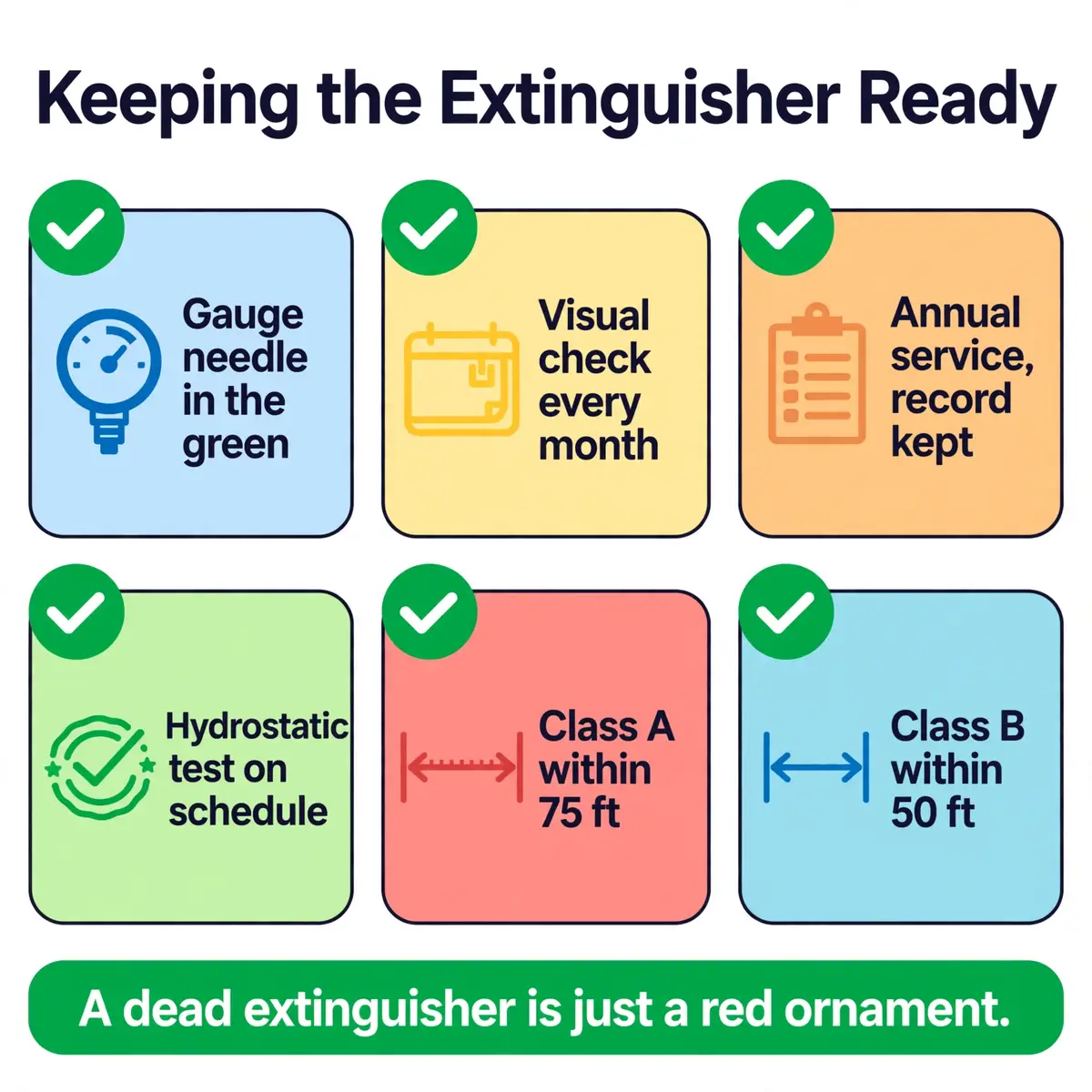
An extinguisher that has lost pressure or had its seal broken is a decoration, not a safety device. Keeping it ready takes a minute a month and a service once a year. Both rhythms are set by law in the United States and by British Standards in the United Kingdom, and both are easy to keep.
Walk the route and look at each unit in turn. The monthly visual check takes a minute and needs no tools. Record the check in the fire safety log book. A unit that fails any item comes out of service at once and is replaced or repaired before the next shift.
- It is in its designated place, visible and not blocked by boxes or furniture.
- The pin and tamper seal are intact.
- The pressure gauge needle sits in the green.
- There is no damage, corrosion or leakage.
- The hose or horn is clear and undamaged.
- The service label is in date.
OSHA requires the monthly check in the United States under 29 CFR 1910.157(e)(2), and the same rhythm is recommended in the United Kingdom under BS 5306-3. OSHA also requires an annual maintenance check under 1910.157(e)(3), carried out by a competent person, with the date recorded on the tag. In the United Kingdom, a competent person must service each extinguisher at least once a year under BS 5306-3. Water, foam, powder and wet chemical units also need an extended service every 5 years, and CO2 units need an overhaul every 10 years.
The longer-term tests run by type. In the United States, hydrostatic tests fall due every 5 years for water, CO2 and wet chemical units, and every 12 years for dry chemical units. Stored-pressure dry chemical units also need an internal examination every 6 years. Non-rechargeable units are never tested; NFPA 10 retires them at 12 years. The current edition of NFPA 10, the Standard for Portable Fire Extinguishers, is the 2026 edition. It describes extinguishers as a first line of defence against fires of limited size.
TipCheck the gauge every month, on the same day as another regular job. A check tied to a date gets done; a check left to memory does not.
Where to Keep an Extinguisher at Home
At home, keep the extinguisher near an exit and not right beside the stove, since a fire at the stove could block your access to it. Choose a spot you can reach while backing out of the room, and make sure everyone in the household knows where it is. In a kitchen, mount it near the door, never above the hob, so you can grab it as you pass and still have a clear retreat.
One unit rarely covers a whole home. A kitchen needs wet chemical or a fire blanket, a hallway or living room needs water or foam, and a home office with computers needs CO2. The choice starts with the risks in each room, and the fire risk assessment does the same job in a workplace. In the United States, OSHA sets the travel distances directly: no more than 75 feet (22.9 metres) to a Class A extinguisher, and 50 feet (15.2 metres) to a Class B extinguisher.
Frequently Asked Questions
What Does PASS Stand for When Using a Fire Extinguisher?
PASS stands for Pull, Aim, Squeeze and Sweep. Pull the pin, aim low at the base of the fire, squeeze the handle to discharge the agent, and sweep from side to side until the fire is out. The steps come from OSHA's guidance on fire extinguisher use, and they work the same way on almost every portable extinguisher.
How Far Should I Stand from the Fire?
Start about 6 to 8 feet (around 2 metres) from the fire, and move closer only as the flames shrink. The exact effective range is printed on the label. Starting much closer is no help: the force of the blast can scatter burning material and spread the fire.
Can I Use a Fire Extinguisher on an Electrical Fire?
Yes, with the right type. Use a CO2 extinguisher or a dry powder extinguisher on live electrical equipment. Never use water or foam on live electrics, because water conducts electricity. If you can isolate the power safely first, do so, then use the extinguisher.
What Should I Do If the Extinguisher Runs Out Before the Fire is Out?
Leave at once. Do not reach for a second unit and do not try to fix the empty one. OSHA's guidance is explicit: evacuate immediately if the extinguisher is empty and the fire is not out, and evacuate immediately if the fire has grown beyond its early stage.
Can I Use a Fire Extinguisher More Than Once?
No. A used extinguisher, even a partly used one, must be recharged or replaced before it goes back on the wall. Even a short squeeze lets out pressure and breaks the seal. Fire equipment service companies recharge reusable units; cheap disposable home units are simply replaced.
Do I Need Training to Use a Fire Extinguisher?
Everyone who may use one should know the PASS steps and the hazards of fighting a small fire. In the United States, OSHA requires employers to educate all employees on those principles when they start and at least once a year, and to train employees who are designated to fight fires. At home, a practice run on a training unit is the best preparation.
How Often Should a Fire Extinguisher Be Checked?
Check it visually every month: its place, the pin and seal, the gauge needle in the green, and no damage or leaks. Have it serviced by a competent person every year. In the United States, OSHA requires the monthly inspection and the annual maintenance check; in the United Kingdom, the same rhythm is set by BS 5306-3.
Sources
- OSHA — Fire Extinguisher Use (Evacuation Plans and Procedures eTool)
- OSHA — 29 CFR 1910.157, Portable fire extinguishers
- OSHA — Evacuation Plans and Procedures eTool: Portable Fire Extinguishers
- NFPA — NFPA 10, Standard for Portable Fire Extinguishers (2026 edition)
- HSE — Workplace safety and welfare: fire precautions in workplaces
- The Regulatory Reform (Fire Safety) Order 2005
- University of Cincinnati — Extinguisher Training: P.A.S.S. Method
- University of Massachusetts Dartmouth — Fire Safety: Portable Fire Extinguisher