
Employee health at work means the employer takes active steps to protect workers' physical and mental health, checks for harm before it becomes illness, and supports people back to health when something goes wrong. The law requires the core of it: a safe workplace, health checks where the risks call for them, medical tests named in specific standards, first aid, and basic welfare facilities. Beyond that core, good employers add mental-health support, health promotion, and a clear route back to work after sickness.
An employer does not have to provide general healthcare. In the United States there is no general legal duty to provide health insurance, and in the United Kingdom there is no general duty to provide private medical care. What both systems do require is protection of health at work, and the specific health measures the risk assessment and the safety standards call for. The sections below list those measures, name the rule behind each one, and explain why they pay for themselves.
What Employee Health Means at Work
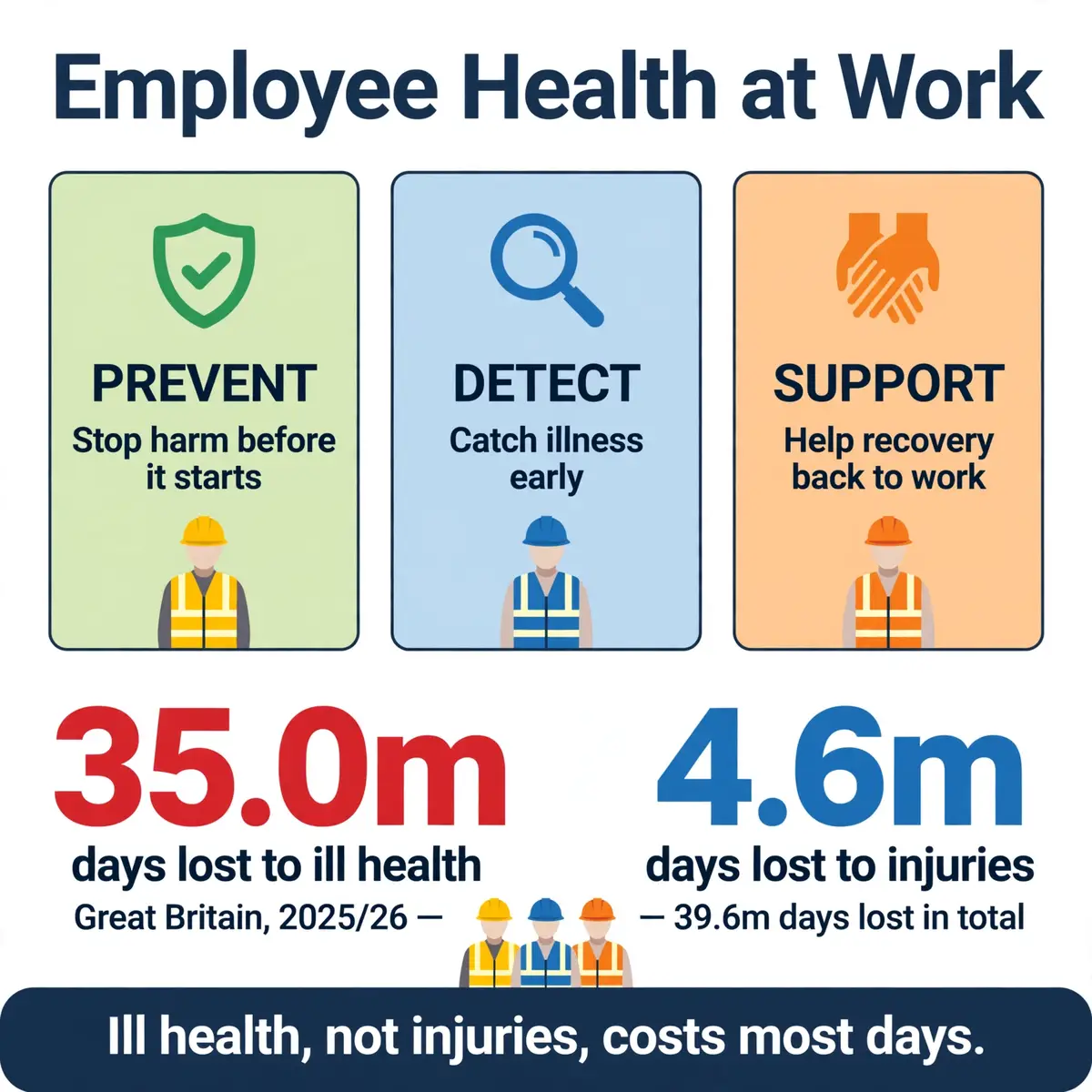
Employee health covers the physical and mental well-being of workers in relation to their work. It starts with preventing harm: removing or controlling the hazards that damage lungs, hearing, skin, backs and minds. It continues with checking for early signs of harm while they are still reversible. And it ends with helping people recover and return to work when their health has suffered.
Three ideas run through every duty in this area. First, prevention comes before treatment: a health check never replaces a control. Second, timing matters: a baseline check before exposure, then regular checks, catches change early. Third, the employer organises and pays for what the law requires, while the worker's private medical details stay private.
Health is More Than the Absence of Injury
An injury is visible at once. Ill health is often slow. Noise damages hearing over years. Dust scars lungs over decades. Stress builds week by week until a worker cannot cope. Because ill health is slow, it is easy to miss until it is serious. That is why the law asks employers to look for it on purpose, not to wait for someone to fall ill.
The numbers show the scale. In Great Britain, an estimated 1.8 million workers were suffering from work-related ill health in 2025/26. Ill health caused 35.0 million of the 39.6 million working days lost that year. Injuries caused only 4.6 million. Health, not accidents, is now the larger part of the harm work causes.
WHO Employee Health Covers
The duties cover employees, and in most cases everyone else who works on the employer's premises or under their direction. Agency workers, temporary staff, contractors and volunteers all need the same health protection for the work they do. A short contract does not remove the duty. The checks and controls follow the risk, not the contract type.
Some groups need extra attention. Young workers are still developing and may not recognise a risk. Night workers face specific health effects from disrupted sleep. New starters need induction and a baseline check before exposure. Pregnant workers need their risk assessment reviewed. A good programme names these groups and sets out what changes for each of them.
The Legal Foundation: What the Law Actually Requires
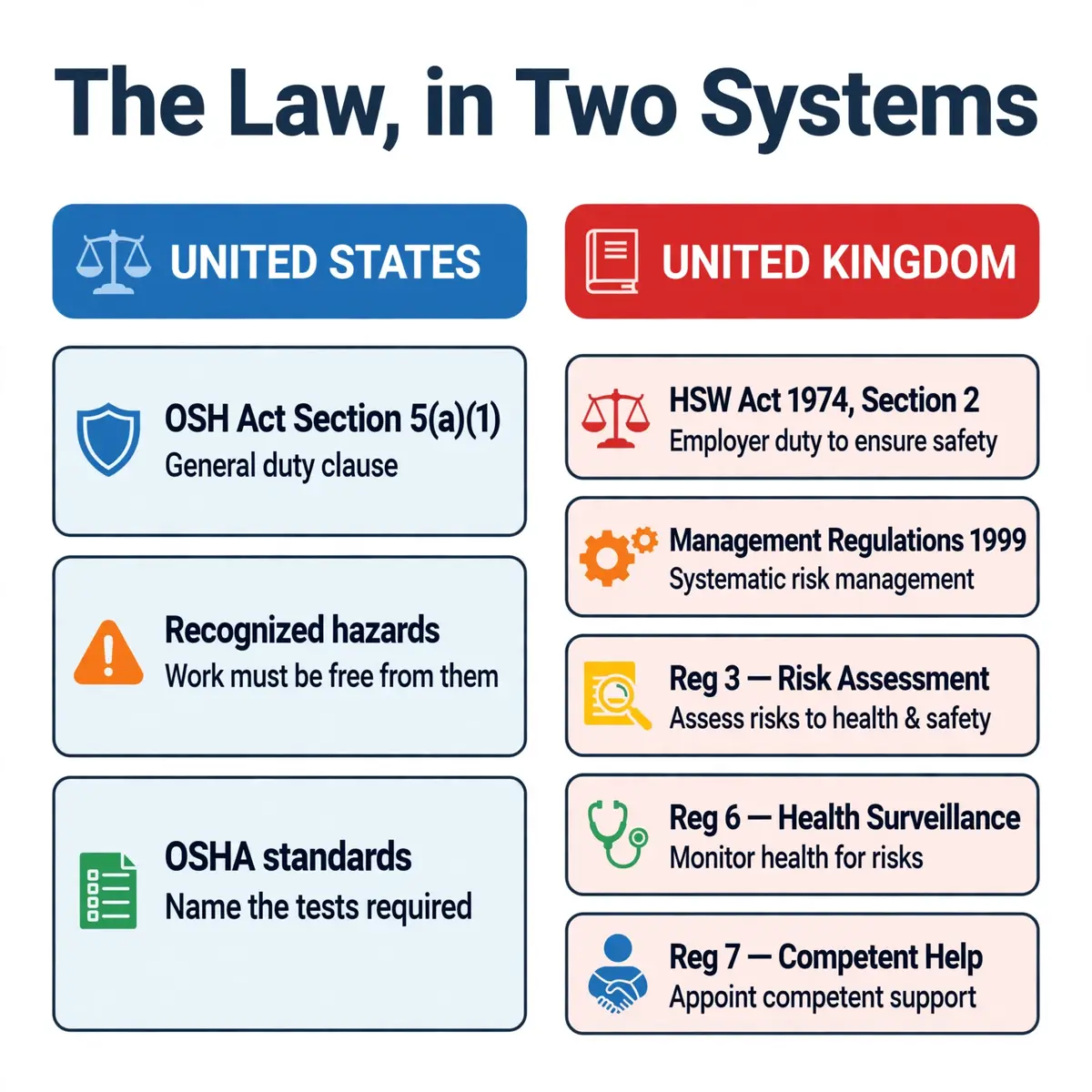
Two legal systems shape most of what follows. The United States works from the Occupational Safety and Health Act of 1970 and the standards the Occupational Safety and Health Administration (OSHA) writes under it. The United Kingdom works from the Health and Safety at Work etc. Act 1974 and the regulations made under it. The duties are similar in spirit and different in detail, so each requirement below names its jurisdiction.
The table below gives the short version. The sections after it explain each row in plain language, with the exact rule behind it.
| What must be provided | United States | United Kingdom |
|---|---|---|
| A workplace free of recognised health hazards | OSH Act Section 5(a)(1), the general duty clause | Health and Safety at Work etc. Act 1974, Section 2 |
| Risk assessment | Required by specific standards; OSHA recommends a full safety and health programme | Management of Health and Safety at Work Regulations 1999, Regulation 3 |
| Health surveillance | Required by substance-specific standards (noise, lead, silica, asbestos) | Management Regulations 1999, Regulation 6 |
| Named medical tests | OSHA standards 1910.95, 1910.134, 1910.1030 and others | Substance regulations (lead, asbestos, COSHH) and the Working Time Regulations 1998 |
| First aid and welfare facilities | OSHA 1910.151; sanitation standard 1910.141 | Health and Safety (First-Aid) Regulations 1981; Workplace Regulations 1992 |
| Health records | Kept for employment plus 30 years (1910.1020) | Kept while relevant; data protection law governs access |
The United States: the General Duty Clause and OSHA Standards
The OSH Act's general duty clause, Section 5(a)(1), requires every employer to furnish employment free from recognised hazards that cause or are likely to cause death or serious physical harm. That single sentence is the foundation. On top of it sit the OSHA standards, each of which names a hazard and the measures the employer must take. Where a standard names a medical test or a vaccination, the employer must provide it.
The Department of Labor lists the core employer duties in plain terms:
- Provide a workplace free of known hazards.
- Display the OSHA poster that describes workers' rights and duties.
- Train workers in a language they understand.
- Keep injury and illness records.
- Provide required personal protective equipment at no cost.
- Provide the hearing exams and other medical tests the standards require.
State plans may add their own rules, so an employer should check the plan for their state as well.
The United Kingdom: the 1974 Act and the 1999 Regulations
The Health and Safety at Work etc. Act 1974, Section 2, places a general duty on every employer to ensure, so far as is reasonably practicable, the health, safety and welfare at work of all employees. The Management of Health and Safety at Work Regulations 1999 add the machinery. Regulation 3 requires a suitable and sufficient assessment of the risks to employees' health and safety. Regulation 6 then requires health surveillance where the assessment shows it is appropriate. Regulation 7 requires the employer to appoint competent persons to help meet the duties.
Other regulations add specific duties. The Control of Substances Hazardous to Health Regulations 2002 (COSHH) require health surveillance for workers exposed to certain substances. The Control of Lead at Work Regulations 2002 and the Control of Asbestos Regulations 2012 carry their own medical surveillance rules. The Working Time Regulations 1998 require free health assessments for night workers. Each of these is explained in the sections below.
What the Law Does Not Require
No general duty requires a US employer to provide health insurance. The Affordable Care Act may penalise large employers, those with 50 or more full-time employees, that do not offer affordable health coverage. But the Act does not require any employer to provide specific health benefits. Health insurance is a benefits question, not a safety duty.
The same line applies in the UK. There is no general duty to provide private medical care or a company doctor for every worker. The duty is to protect health at work and to provide the specific health measures the risk assessment and the regulations call for. An employer that offers a private health plan or a gym membership is going beyond the law, not meeting it. The two should never be confused.
Health Surveillance: Checking Health Before Harm Shows
Health surveillance means watching workers' health over time so that work-related illness is caught early, while it can still be stopped or reversed. It is not a general medical, and it is not a fitness test for hiring. It is a targeted check, chosen because a specific work hazard can damage health in a way that early detection can prevent.
In the UK the duty is direct. Regulation 6 of the Management of Health and Safety at Work Regulations 1999 states that every employer shall ensure that employees are provided with such health surveillance as is appropriate, having regard to the risks to their health and safety identified by the assessment. The risk assessment decides whether surveillance is needed, and the hazard decides what form it takes.
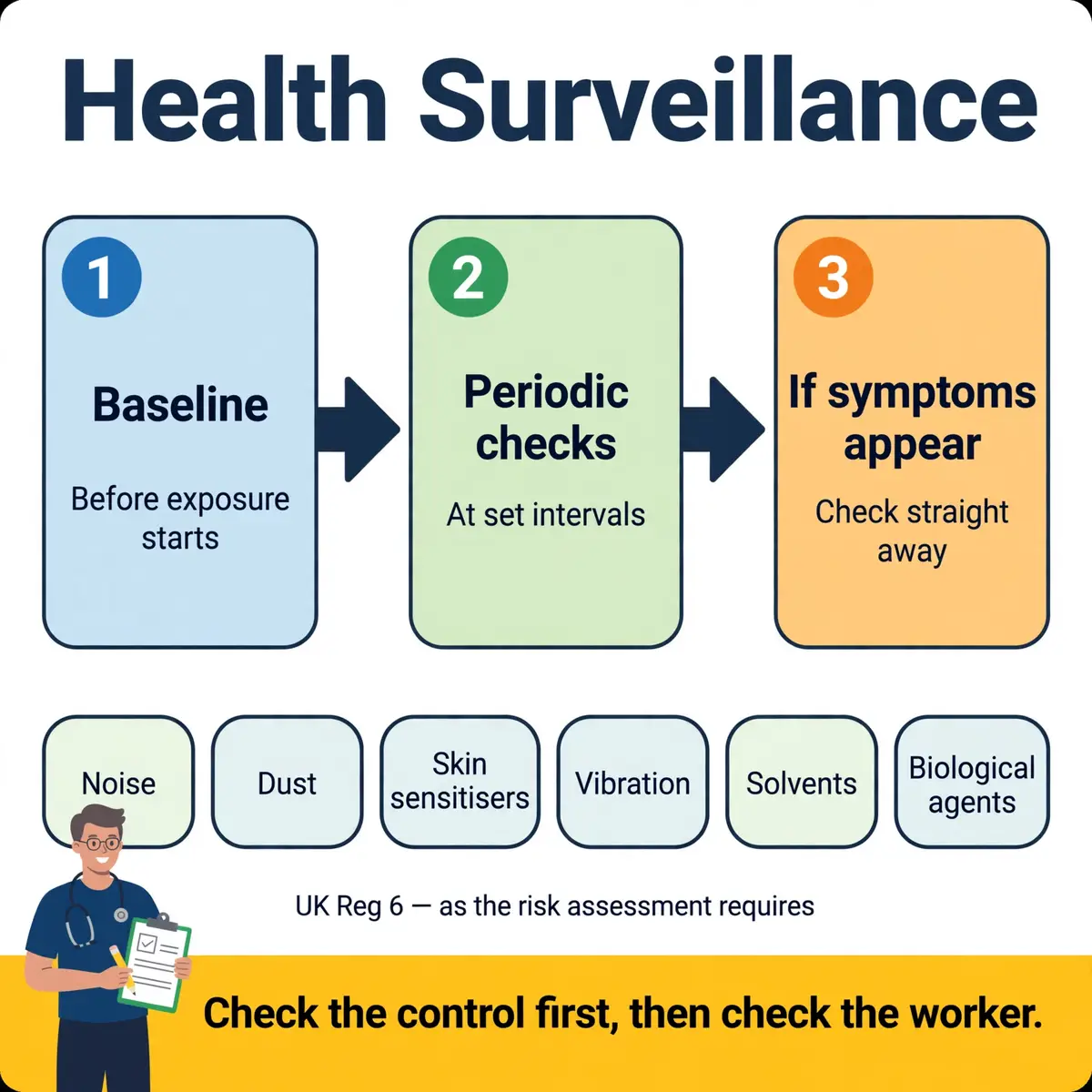
AlertHealth surveillance never replaces a control. A hearing test does not make a noisy machine safe, and a skin check does not replace gloves. Check the control first, then check the worker.
When Health Surveillance is Needed
Surveillance is needed when workers are exposed to a hazard that can harm health, when the harm can be detected early, and when finding it early changes the outcome. The HSE names the common triggers: noise, vibration, solvents, dusts, fumes, biological agents, and substances that damage skin or lungs. If the risk assessment finds such an exposure, surveillance follows.
Typical triggers include:
- Noise at or above the level where hearing damage begins, with hearing tests to match.
- Dusts such as silica or asbestos, with lung function tests and chest checks.
- Substances that irritate or sensitise skin, with regular skin inspection.
- Solvents and fumes that affect the liver, kidneys or nervous system, with biological monitoring.
- Hand-arm vibration, with checks for tingling, numbness and loss of grip.
- Work with biological agents, with screening for infection where the risk assessment calls for it.
What Surveillance Looks Like in Practice
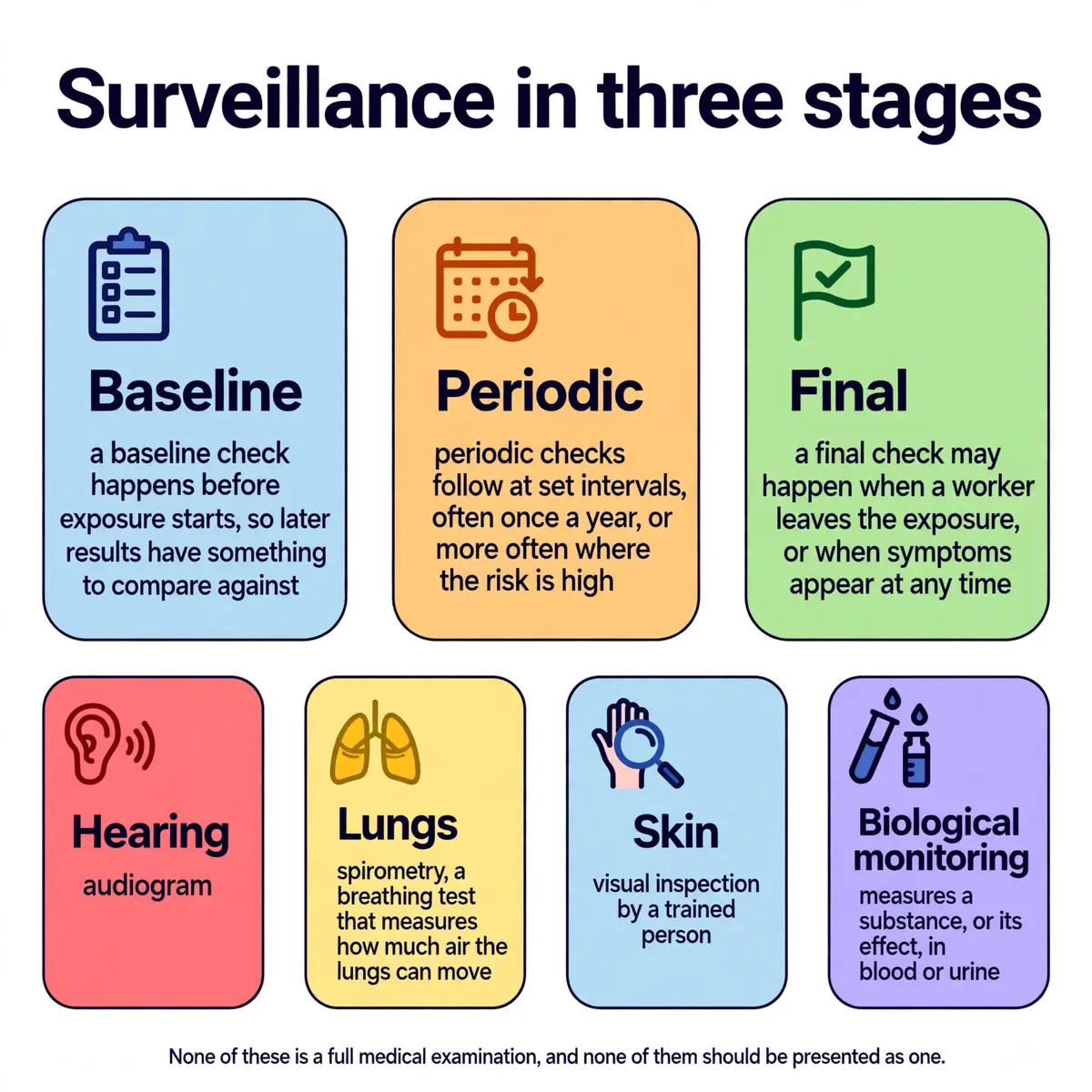
A surveillance programme usually has three stages. A baseline check happens before exposure starts, so later results have something to compare against. Periodic checks follow at set intervals, often once a year, or more often where the risk is high. A final check may happen when a worker leaves the exposure, or when symptoms appear at any time.
The checks themselves are simple and specific. A hearing test is an audiogram. A lung check is spirometry, a breathing test that measures how much air the lungs can move. A skin check is a visual inspection by a trained person. Biological monitoring measures a substance, or its effect, in blood or urine. None of these is a full medical examination, and none of them should be presented as one.
What Happens with the Results
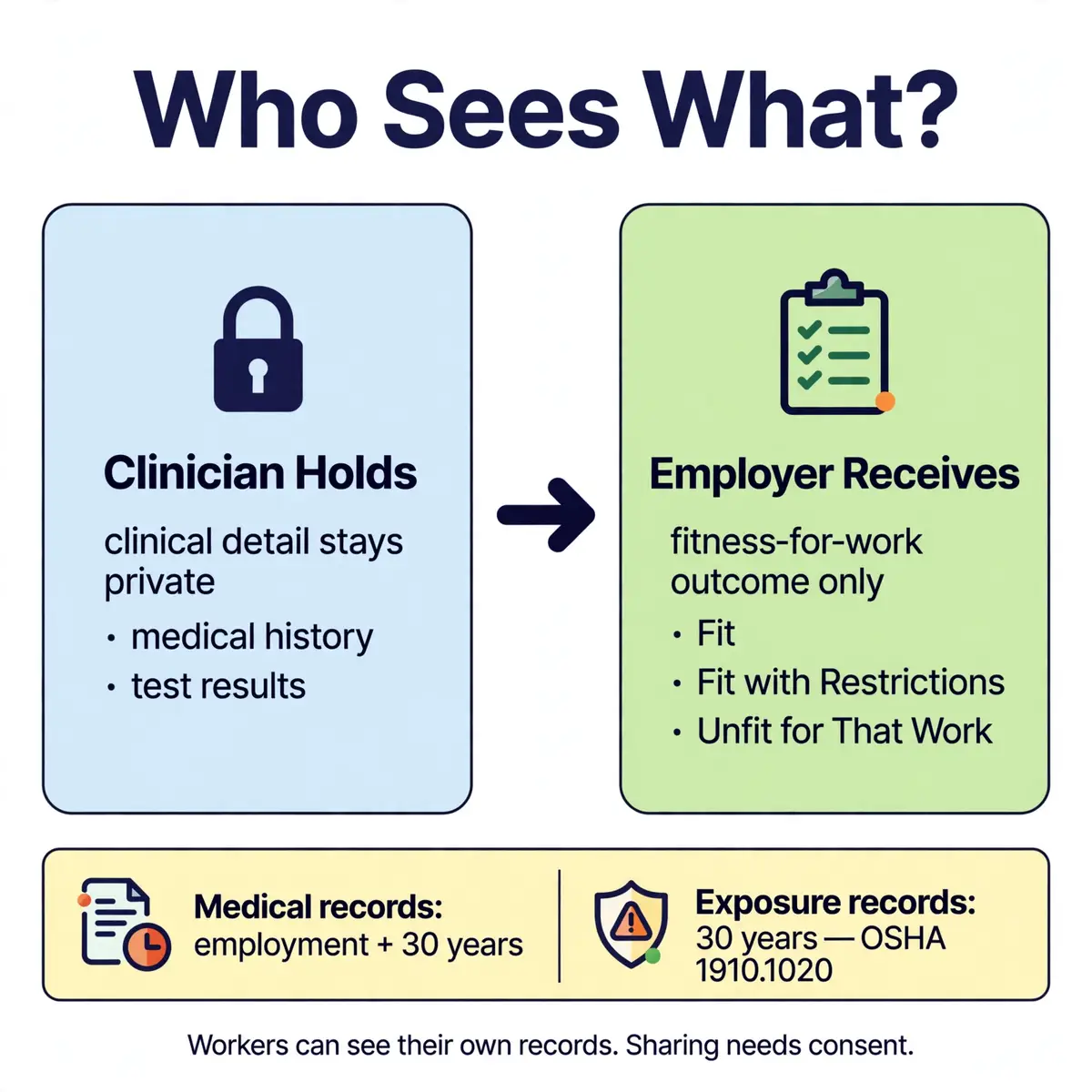
Results go to the clinician first. The employer receives only a fitness-for-work outcome: fit, fit with restrictions, or unfit for that work. The clinical detail stays with the health professional. This split protects the worker's privacy and still gives the employer what it needs to act.
When a check finds early harm, the employer must act on it. That can mean:
- Improving the control that allowed the exposure.
- Moving the worker away from the exposure.
- Referring the worker for treatment.
A surveillance result that is filed and forgotten is worse than no surveillance at all, because the employer then knew and did nothing. Record the result, record the action, and review both at the next check.
Medical Tests and Assessments the Employer Must Arrange
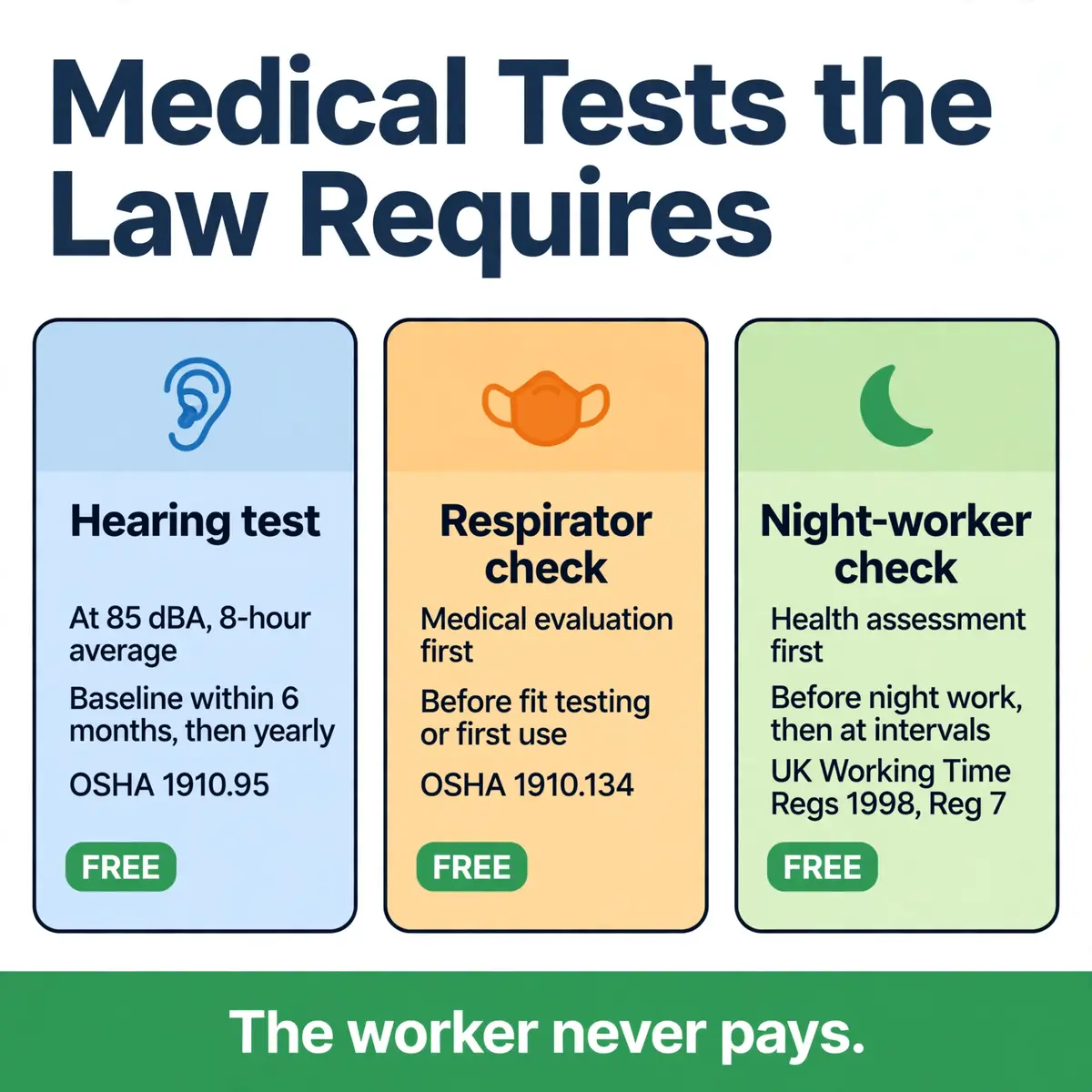
Some medical tests are named in the standards themselves. Where a standard names a test, the employer must arrange it, pay for it, and give the worker time to attend it. The tests below are the ones that come up most often. Each one has a trigger, a deadline, and a rule that says who pays. The worker never pays.
The table gives the short version. The sections after it explain each test and the rule behind it.
| Test or assessment | Who needs it | When | Rule |
|---|---|---|---|
| Hearing test (audiogram) | Workers exposed to noise at 85 dBA over 8 hours | Baseline within 6 months, then yearly | OSHA 1910.95 |
| Respirator medical evaluation | Workers who must wear a respirator | Before fit testing or first use | OSHA 1910.134 |
| Night-worker health assessment | Workers assigned to night work (UK) | Before starting, then at regular intervals | Working Time Regulations 1998, Regulation 7 |
| Pre-employment and fitness-for-work assessment | Workers in safety-critical or physically demanding roles | Before starting, and after illness or injury | Risk assessment; disability law sets the limits |
Hearing Tests for Noisy Work
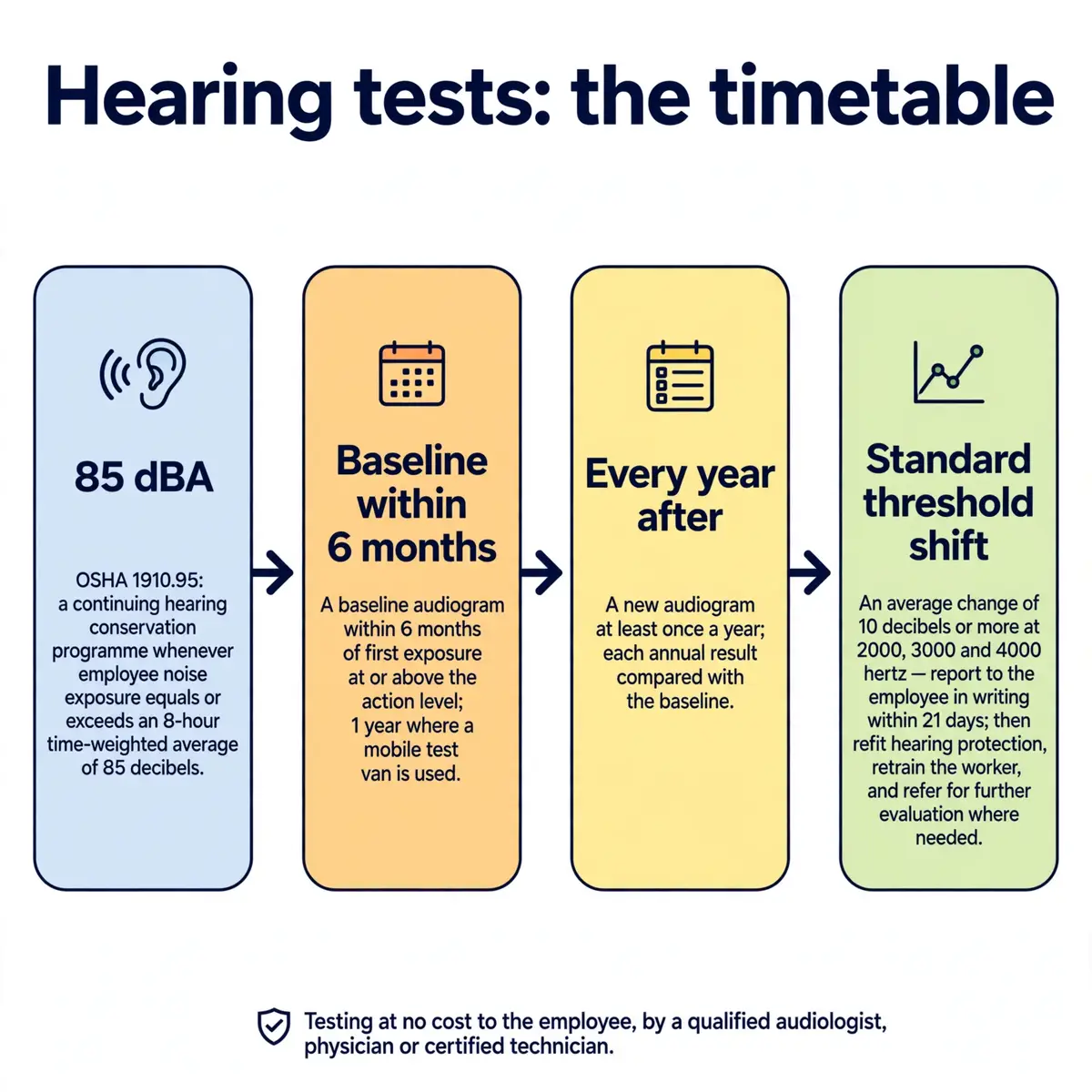
OSHA's noise standard, 1910.95, requires a continuing hearing conservation programme whenever employee noise exposure equals or exceeds an 8-hour time-weighted average of 85 decibels. The programme includes audiometric testing for every exposed worker. The employer must provide the testing at no cost to the employee, and the tests must be done by a qualified audiologist, physician or certified technician.
The timing is specific. A baseline audiogram must be established within 6 months of the employee's first exposure at or above the action level. Where a mobile test van is used, the deadline is 1 year. After that, a new audiogram is required at least once a year. Each annual result is compared with the baseline.
A standard threshold shift is an average change of 10 decibels or more at 2000, 3000 and 4000 hertz. It must be reported to the employee in writing within 21 days. The employer must then refit hearing protection, retrain the worker, and refer them for further evaluation where needed.
Medical Evaluation Before Respirator Use
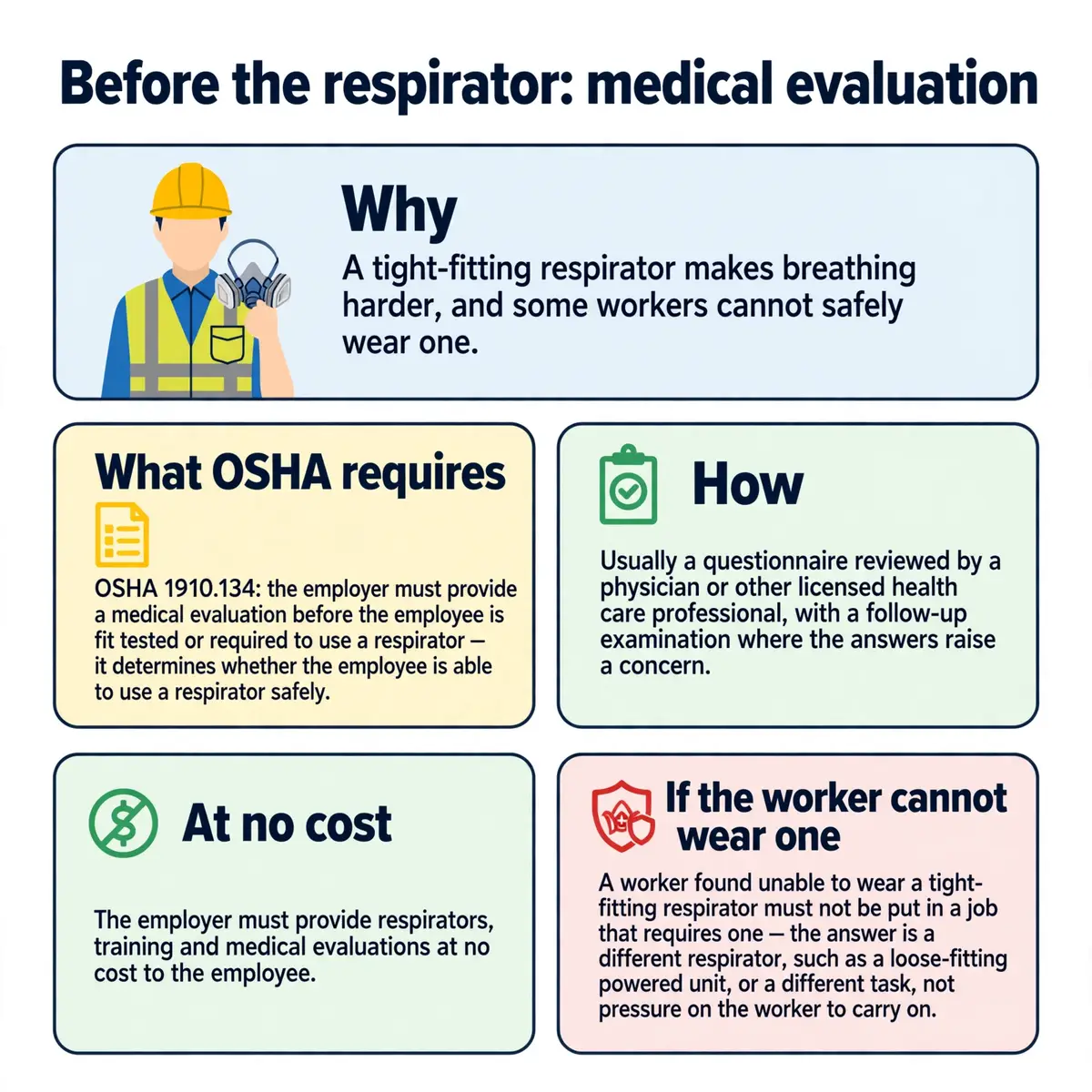
A tight-fitting respirator makes breathing harder, and some workers cannot safely wear one. OSHA's respiratory protection standard, 1910.134, requires the employer to provide a medical evaluation before the employee is fit tested or required to use a respirator. The evaluation determines whether the employee is able to use a respirator safely. It is usually a questionnaire reviewed by a physician or other licensed health care professional, with a follow-up examination where the answers raise a concern.
The same standard requires the employer to provide respirators, training and medical evaluations at no cost to the employee. A worker who is found unable to wear a tight-fitting respirator must not be put in a job that requires one. The answer is a different respirator, such as a loose-fitting powered unit, or a different task, not pressure on the worker to carry on.
Fitness for Work and Pre-Employment Checks
Some roles are safety-critical: driving, working at height, operating machinery, or entering a confined space. For these, an employer may ask a health professional to assess whether the worker is fit for the specific demands of the role. The assessment must match the job. A general medical that probes unrelated health history is not a fitness assessment, and it invites a legal challenge.
There are limits on what an employer may ask. In the United States, disability law restricts pre-offer medical questions, and an employer may ask for health information only for defined purposes such as insurance, a wellness programme, workers' compensation or sick leave. Health professionals generally cannot share an employee's health information with the employer without the employee's permission. The employer receives a fitness outcome, not a diagnosis.
TipAsk the clinician for a fitness outcome in plain words: fit, fit with named adjustments, or unfit for this task. A one-line outcome protects privacy and still lets a manager act.
Vaccinations and Screening at Work
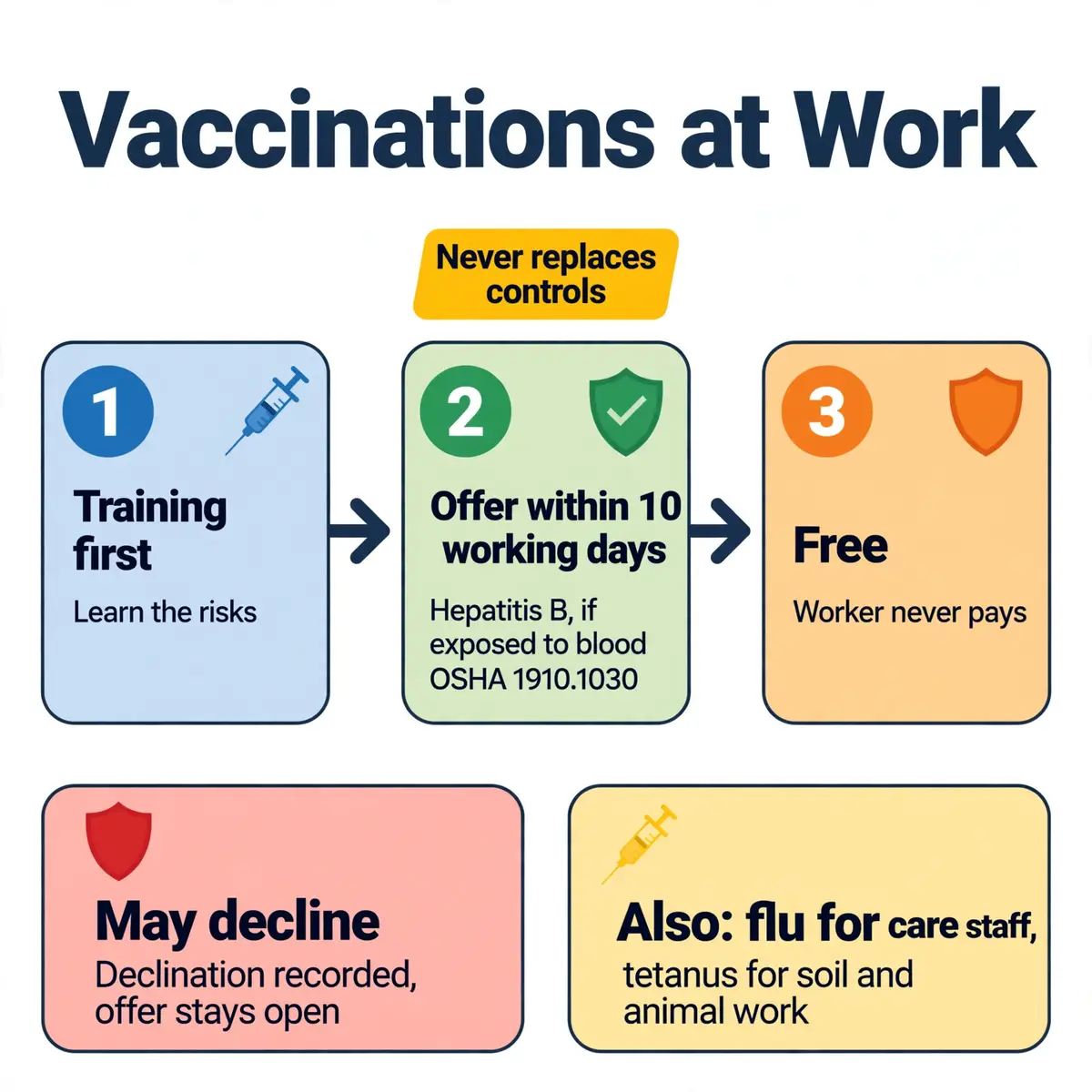
Some jobs expose workers to infections. Healthcare, laboratory work, waste handling, sewage work, animal care and some kinds of cleaning all carry that risk. Where the risk assessment finds it, the employer must offer the relevant vaccination, free of charge, and on work time. A vaccination is a control for the worker, not a substitute for safe systems of work.
Screening sits beside vaccination. It means checking for early signs of an illness the work can cause, such as skin checks for workers handling sensitisers or lung function tests for workers breathing dust. Screening and surveillance overlap, and the same rules on consent and confidentiality apply to both.
Hepatitis B Vaccination
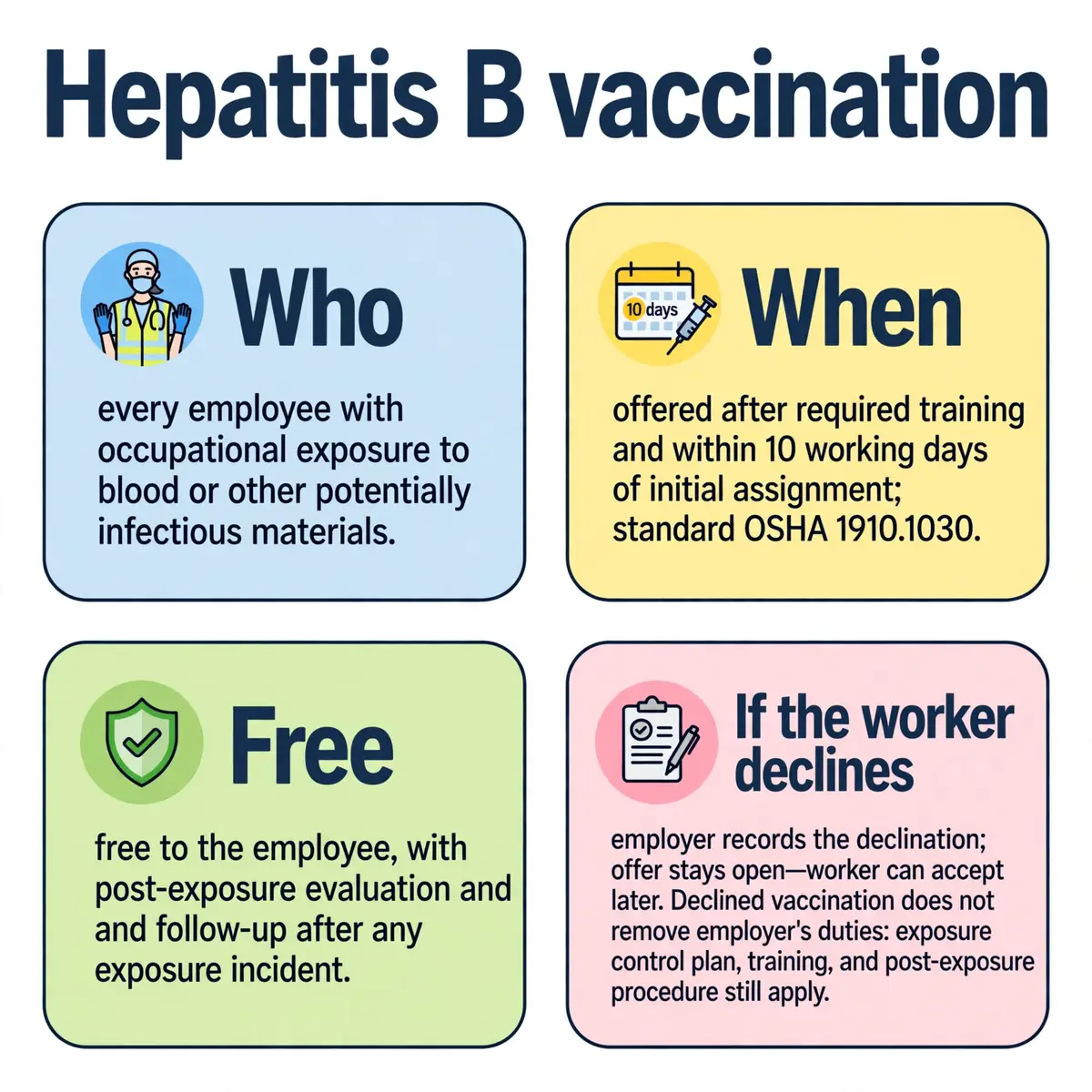
The clearest example is hepatitis B. OSHA's bloodborne pathogens standard, 1910.1030, requires the employer to make hepatitis B vaccination available to every employee with occupational exposure to blood or other potentially infectious materials. The vaccination must be offered after the required training and within 10 working days of initial assignment. It is free to the employee, and the employer must also provide post-exposure evaluation and follow-up after any exposure incident.
A worker may decline the vaccination. The standard requires the employer to record the declination, and the offer stays open: the worker can accept it later. A declined vaccination does not remove the employer's other duties. The exposure control plan, the training and the post-exposure procedure all still apply.
Other Vaccinations and Screening
Other vaccinations follow the same principle: offer what the risk assessment calls for, and no more. Flu vaccination is often offered to healthcare and care workers. Tetanus vaccination is relevant where workers handle soil, animal waste or rusty metal. Tuberculosis screening applies in some healthcare and laboratory settings. The employer should take advice from an occupational health professional on which vaccinations fit the actual exposure.
Screening should be targeted, not blanket. A lung function test suits a worker breathing dust. A skin check suits a worker handling wet cement or solvents. A blanket health screen for every employee, with no link to a work hazard, wastes money and collects health data the employer has no right to hold. Tie every check to a named risk, and record why it is there.
WarningA vaccination never replaces an engineering control or safe working practice. A worker vaccinated against hepatitis B still needs sharps disposal, gloves and training. The vaccine is the last layer, not the first.
Mental Health at Work
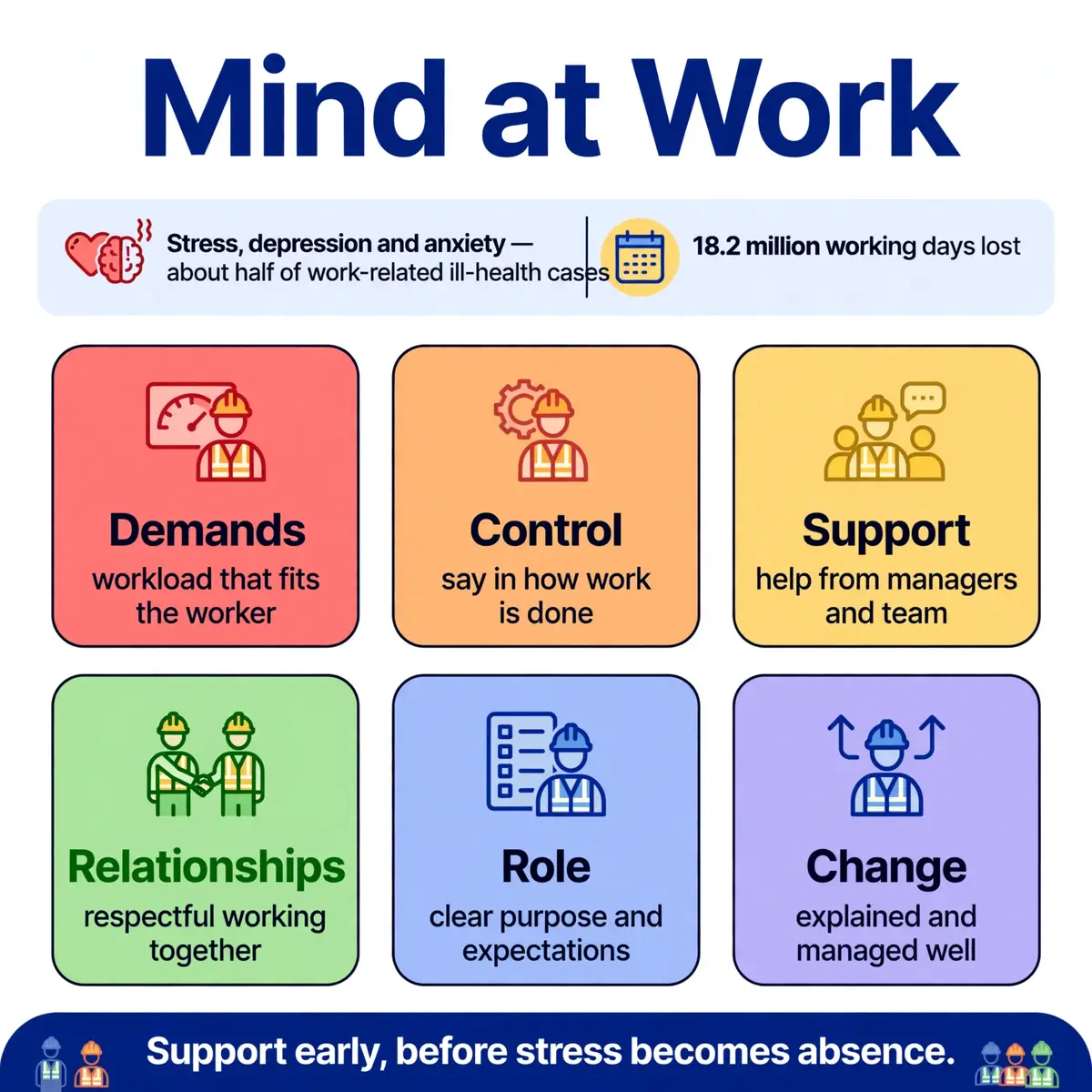
Mental health is a health risk like any other, and the employer must manage it the same way: assess the risk, control it, and support the people affected. Work-related stress, depression and anxiety accounted for about half of all work-related ill-health cases in Great Britain in 2025/26, and for 18.2 million working days lost. No employer can claim the subject is outside their duty.
The law treats stress as a foreseeable risk. In the UK, the Management Regulations require a risk assessment that covers stress, and the Health and Safety at Work etc. Act requires the employer to protect health so far as is reasonably practicable. In the US, the general duty clause covers recognised hazards, and the National Institute for Occupational Safety and Health (NIOSH) publishes guidance on job stress and its health effects. The duty is the same on both sides: find the causes and reduce them.
Assessing the Risk of Stress
The HSE Management Standards give a practical frame for the assessment. They cover six areas of work design that, when badly managed, are linked to poor health, lower productivity and more sickness absence. An employer that works through all six has assessed the main causes of work-related stress.
- Demands: workload, work patterns and the work environment.
- Control: how much say a person has in the way they do their work.
- Support: the encouragement, sponsorship and resources provided by the organisation, line management and colleagues.
- Relationships: promoting positive working, and dealing with unacceptable behaviour.
- Role: whether people understand their role and are not given conflicting roles.
- Change: how organisational change, large or small, is managed and communicated.
Assess each area with the workers affected, not about them. A short survey, a team discussion or a one-to-one conversation all work, as long as people can speak honestly. Record the findings, agree the actions, and review them. A stress risk assessment that names no action is a formality, not an assessment.
Support That Actually Helps
Support starts with the line manager. A manager who notices a change in behaviour, asks how someone is doing, and knows what to do next is worth more than any poster campaign. Train managers to have that conversation, to agree adjustments, and to refer onward where the problem is beyond their skill. Make the training practical: what to say, what not to say, and who to call.
Other support includes:
- An employee assistance programme, a confidential counselling and advice service.
- Access to an occupational health professional.
- Clear routes to report bullying or excessive workload.
Adjustments help too:
- A change in hours.
- A quieter workspace.
- A temporary reduction in workload.
- Time to attend appointments.
Most adjustments cost little, and they keep a skilled worker in the job.
Bullying and Harassment
Bullying sits inside the relationships standard, and it is a health risk in its own right. It causes stress, anxiety, depression and absence, and it drives good people out of the job. An employer needs a clear policy, a named route for reporting, and a process that acts quickly and fairly. A policy that nobody has read and no manager enforces is not a control.
The same applies to harassment linked to a protected characteristic, which is also a matter of equality law. The health duty and the equality duty point the same way: stop the behaviour, support the person affected, and deal with the person responsible. For the detail on recognising and handling bullying, see workplace bullying.
AlertA worker who reports stress or bullying is reporting a hazard. Treat the report the same way as a report of a broken guardrail: record it, assess it, act on it, and tell the worker what was done.
First Aid, Welfare Facilities and the Everyday Basics
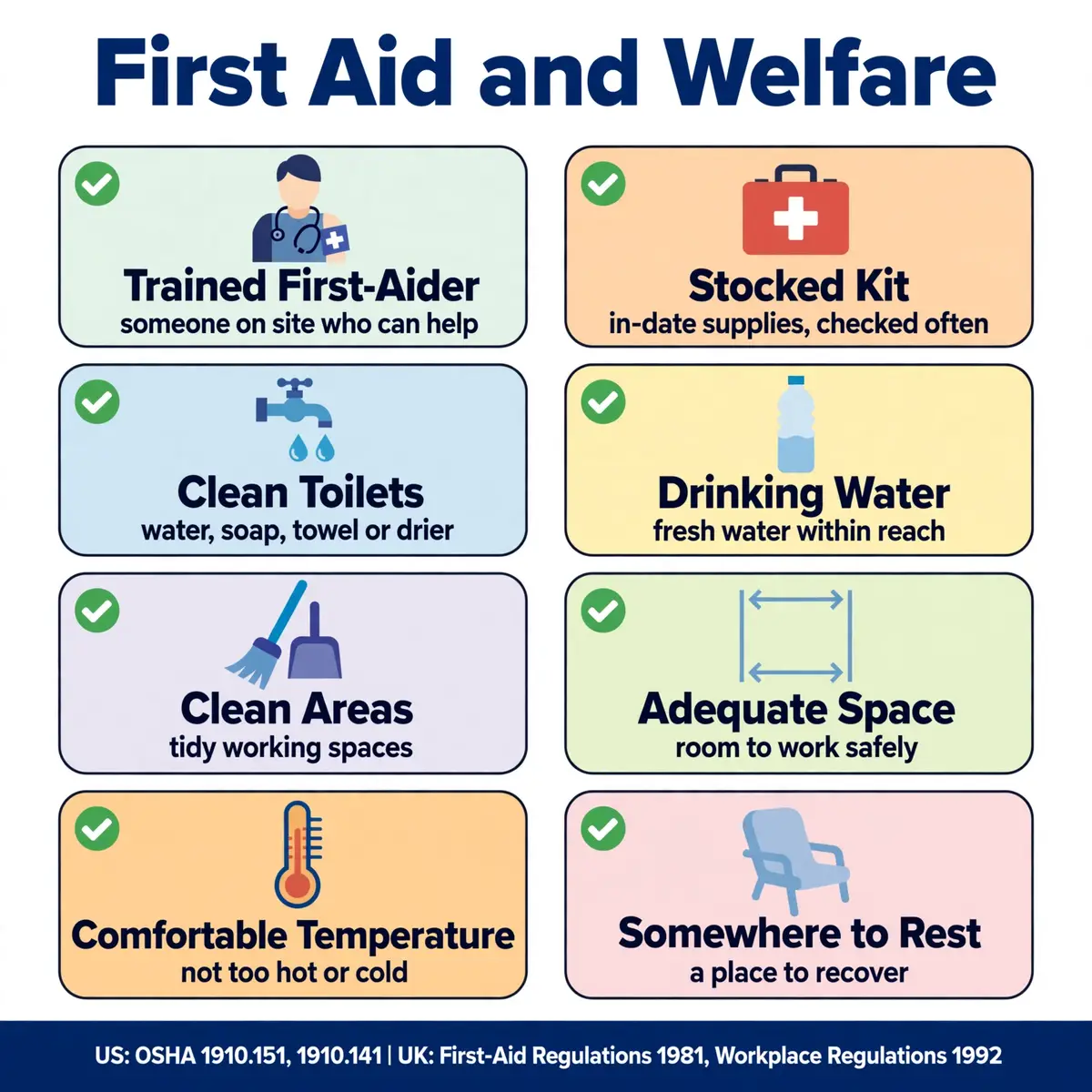
Before any specialist provision, every workplace needs the basics:
- Someone who can give first aid.
- A kit that is stocked and in date.
- Clean toilets and drinking water.
- Somewhere to rest.
- A temperature people can work in.
These are not extras. They are legal duties in both the US and the UK, and they are the foundation the rest of the programme stands on.
The basics are also the most visible sign of whether an employer takes health seriously. A worker who cannot find a clean toilet, a drink of water or a first-aider will not believe the employer's claims about health surveillance. Get the basics right first, then build the specialist provision on top.
First Aid
US employers must provide first aid under OSHA 1910.151, which requires medical personnel to be available, or first-aid supplies and trained first-aiders where a hospital or clinic is not near. In the UK, the Health and Safety (First-Aid) Regulations 1981 require adequate and appropriate first-aid equipment, facilities and personnel. The number of first-aiders and the size of the kit depend on the risk, the number of workers, and how far the site is from medical help.
First aid is about the first minutes, not treatment. The first-aider stops bleeding, keeps an airway open, starts resuscitation, and calls for help. The kit must match the risks: a burns kit where there is hot work, eye wash where there are chemicals. For the full detail on choosing and stocking a kit, see first aid kit.
Welfare Facilities
UK workplaces must provide the facilities the Workplace (Health, Safety and Welfare) Regulations 1992 require:
- Clean toilets with water, soap and a towel or drier.
- Access to drinking water.
- Clean working areas with waste removed.
- Adequate space to work in.
- A comfortable working temperature.
- Somewhere to rest.
The workplace and any shared company vehicles must also be smoke-free.
US rules are similar in substance. OSHA's sanitation standard, 1910.141, requires potable water, toilet facilities, washing facilities and a place to eat away from toxic materials. The details differ, but the principle is the same: a worker should not have to choose between their health and their shift.
Rest, Breaks and Working Time
Rest is a health provision, not a perk. Long hours and skipped breaks raise the risk of fatigue, mistakes and ill health. In the UK, the Working Time Regulations 1998 set limits on weekly hours and require rest breaks and daily and weekly rest. They also give night workers the right to a free health assessment before starting night work, and at regular intervals after that.
Employers should plan work so that breaks are actually taken. A break room that nobody uses because the workload does not allow it is not a provision. Rotas, staffing levels and workload are health decisions as much as they are business decisions, and they belong in the risk assessment.
Health Records: What to Keep, WHO Sees What
Health provision creates records: surveillance results, audiograms, vaccination records, fitness outcomes, exposure measurements and referrals. These records are sensitive, they belong to the worker, and the employer holds them only for defined purposes. Getting the records wrong is one of the fastest ways to lose workers' trust in the whole programme.
Three rules govern the records. Keep only what is needed for the purpose. Keep it secure and limit access. And tell the worker what is held, why, and who can see it. Everything below follows from those three rules.
What Records to Keep
Keep a record for every health measure the employer provides. That includes:
- The surveillance result and the action taken.
- The exposure measurements behind it.
- The training given.
- The vaccinations offered, and accepted or declined.
- The fitness-for-work outcome of any assessment.
Keep the record in a form that can be found again in ten or thirty years, because that is how long some of these duties last.
Keep health records separate from the general personnel file. A manager deciding on a promotion or a pay rise has no need to see a worker's audiogram. Separate storage, with access limited to the occupational health professional and named administrators, prevents the record from being used for a purpose the worker never agreed to.
How Long to Keep Them
In the United States, OSHA 1910.1020 sets the retention periods. Employee medical records must be preserved for at least the duration of employment plus 30 years. Employee exposure records must be kept for at least 30 years. Analyses that use exposure or medical records must also be kept for 30 years.
The only exceptions are narrow:
- First-aid records of minor one-time treatment.
- Health insurance claims kept separately from the medical programme.
- Records of workers employed for less than a year, which need not be kept beyond employment if they are given to the worker on leaving.
In the United Kingdom there is no single retention period for health records. The employer should keep them for as long as they are needed for the purpose, and data protection law requires that personal data is not kept longer than necessary. In practice, health surveillance records are often kept for many years, and some, such as asbestos medical records, for decades. The employer should set a retention schedule, write it down, and follow it.
Confidentiality in Practice
The working rule is simple: the clinician holds the detail, the employer receives the outcome. A surveillance result, an audiogram or a vaccination record is clinical information. The employer needs to know whether the worker is fit for the task, and what restrictions apply. The employer does not need the diagnosis, the test values or the medical history behind the outcome.
Workers have a right to see their own records. Under OSHA 1910.1020, employees and their designated representatives have a right of access to relevant exposure and medical records. In the UK, data protection law gives workers the right to see the personal data an employer holds about them. An employer that hides a worker's own health record from them is breaking the law, not protecting privacy. Consent is required before sharing a worker's health information with anyone else, including another manager, an insurer or a client.
TipPut the confidentiality rule in writing and give it to every worker at their first health check. Trust is built when people know exactly who will see their results before the test happens.
Sickness Absence and Getting Back to Work
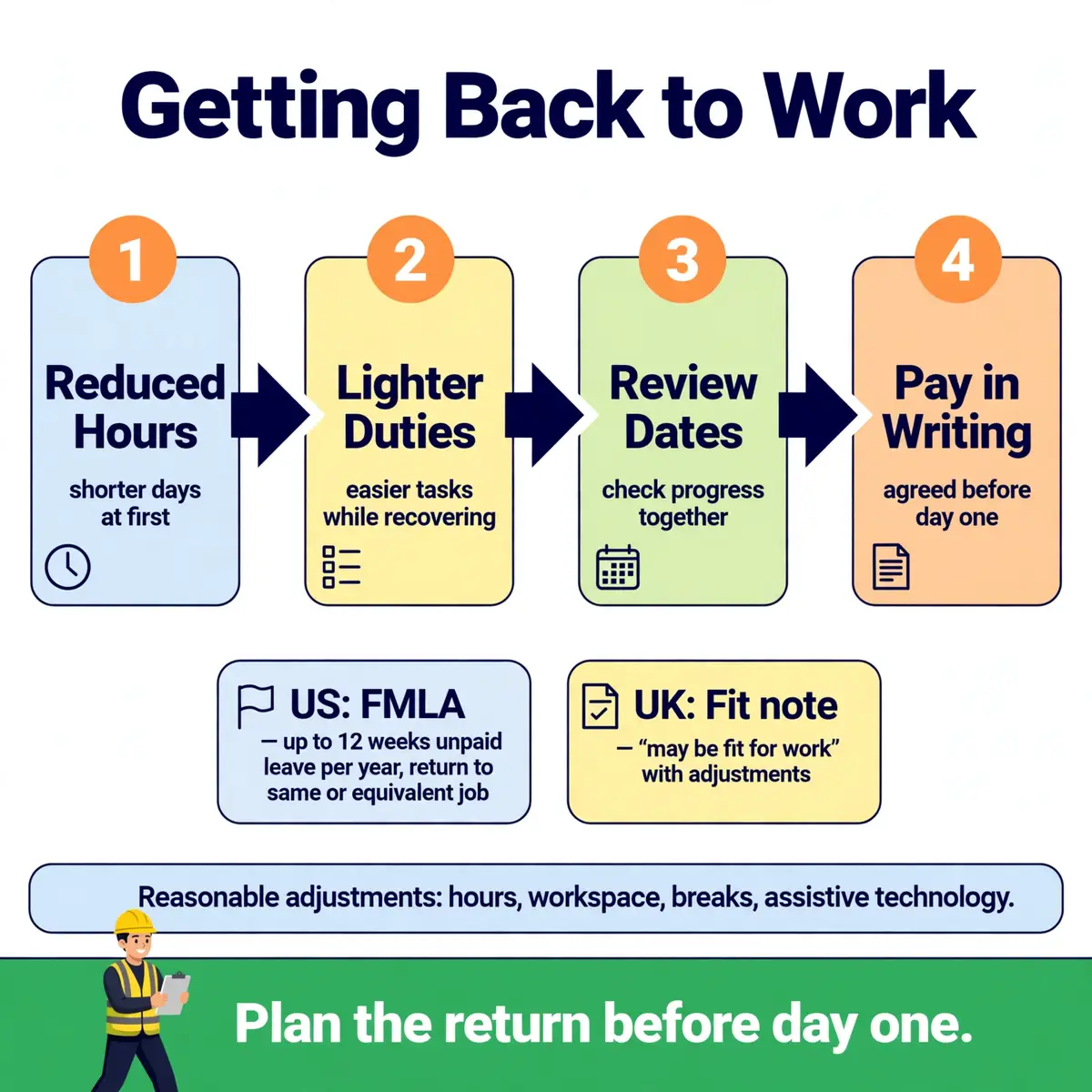
Every worker will be ill at some point, and the way an employer handles absence shapes whether they recover well and return, or drift away from work altogether. The goal is a return that lasts, not the fastest possible return. A worker sent back too soon, to the same conditions that made them ill, will be off again within weeks.
Start with contact, not suspicion. A short call to ask how someone is doing, and what support they need, is both decent and practical. It also gives the employer early warning of a work-related cause. If several people in one team report the same symptoms, the problem is likely the work, not the workers.
When Someone is Off Sick
Keep the process simple and written down. Tell workers who to contact, by when, and what evidence is needed. In the UK, a fit note from a doctor is the usual evidence for absence beyond seven days. It can state that a worker "may be fit for work" with adjustments. In the United States, the Family and Medical Leave Act allows eligible employees to take up to 12 weeks of unpaid leave per year for a serious health condition. They have the right to return to the same or an equivalent job.
Do not ask for medical detail the employer has no right to see. A fit note or a doctor's letter that states the restrictions is enough. The diagnosis belongs to the worker and their clinician. A manager who presses for it is overstepping, and the worker is entitled to refuse.
A Phased Return
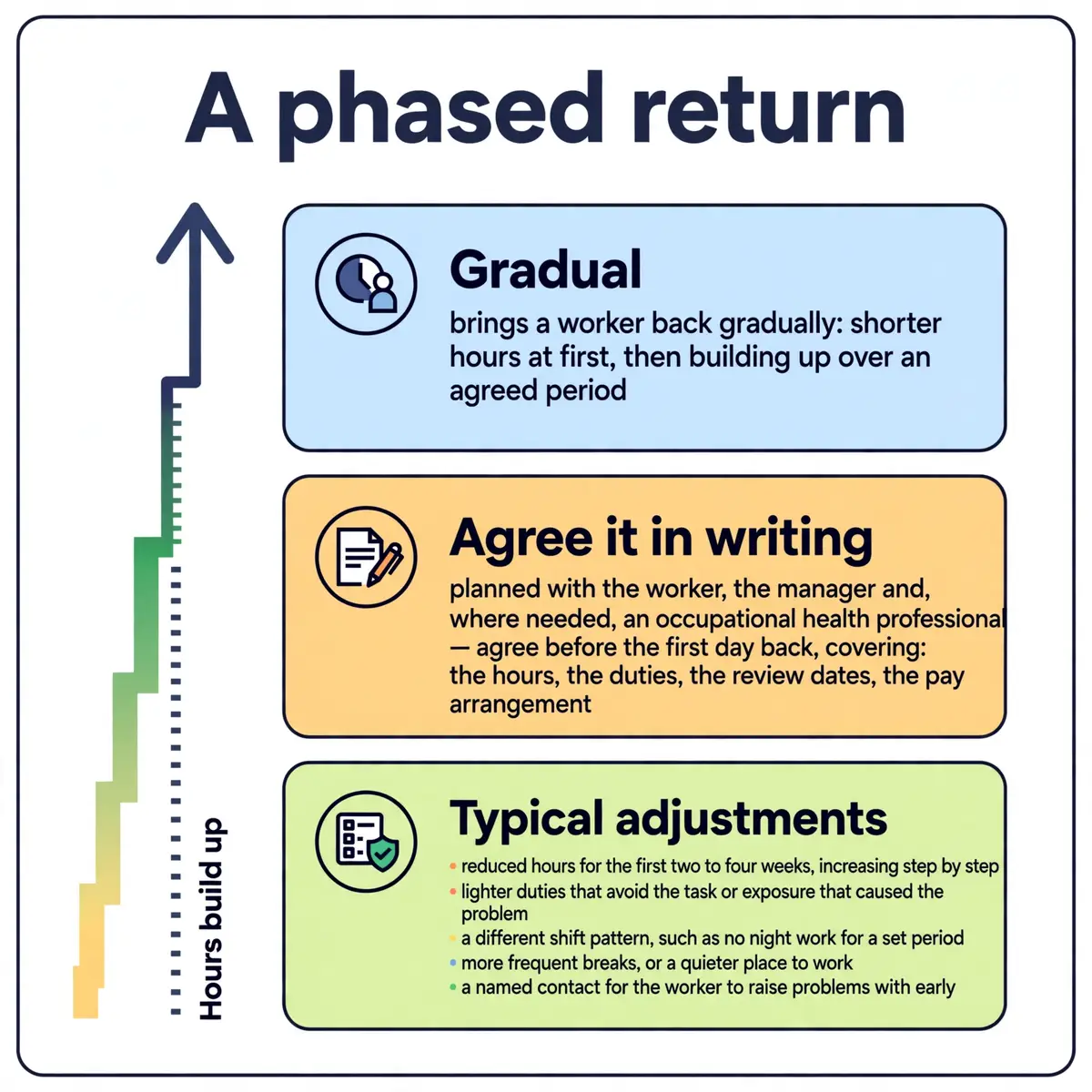
A phased return brings a worker back gradually: shorter hours at first, then building up over an agreed period. It works best when it is planned with the worker, the manager and, where needed, an occupational health professional. Agree the return in writing before the first day back, covering:
- The hours.
- The duties.
- The review dates.
- The pay arrangement.
Typical adjustments during a phased return include:
- Reduced hours for the first two to four weeks, increasing step by step.
- Lighter duties that avoid the task or exposure that caused the problem.
- A different shift pattern, such as no night work for a set period.
- More frequent breaks, or a quieter place to work.
- A named contact for the worker to raise problems with early.
Reasonable Adjustments
Some workers live with a long-term health condition or a disability. The employer must make reasonable adjustments so they can do the job. In the United States, the Americans with Disabilities Act requires reasonable accommodation for a qualified worker with a disability, unless it causes undue hardship. In the UK, the Equality Act 2010 requires reasonable adjustments for disabled workers.
Adjustments are practical, not generous. They include accessible communications, assistive technology, physical changes such as ramps and handrails, and policy changes such as flexible hours to attend health appointments. Ask the worker what would help, take advice from an occupational health professional where needed, and record what was agreed. An adjustment that is agreed and then forgotten helps nobody.
Health Promotion and Wellness: Beyond the Legal Minimum
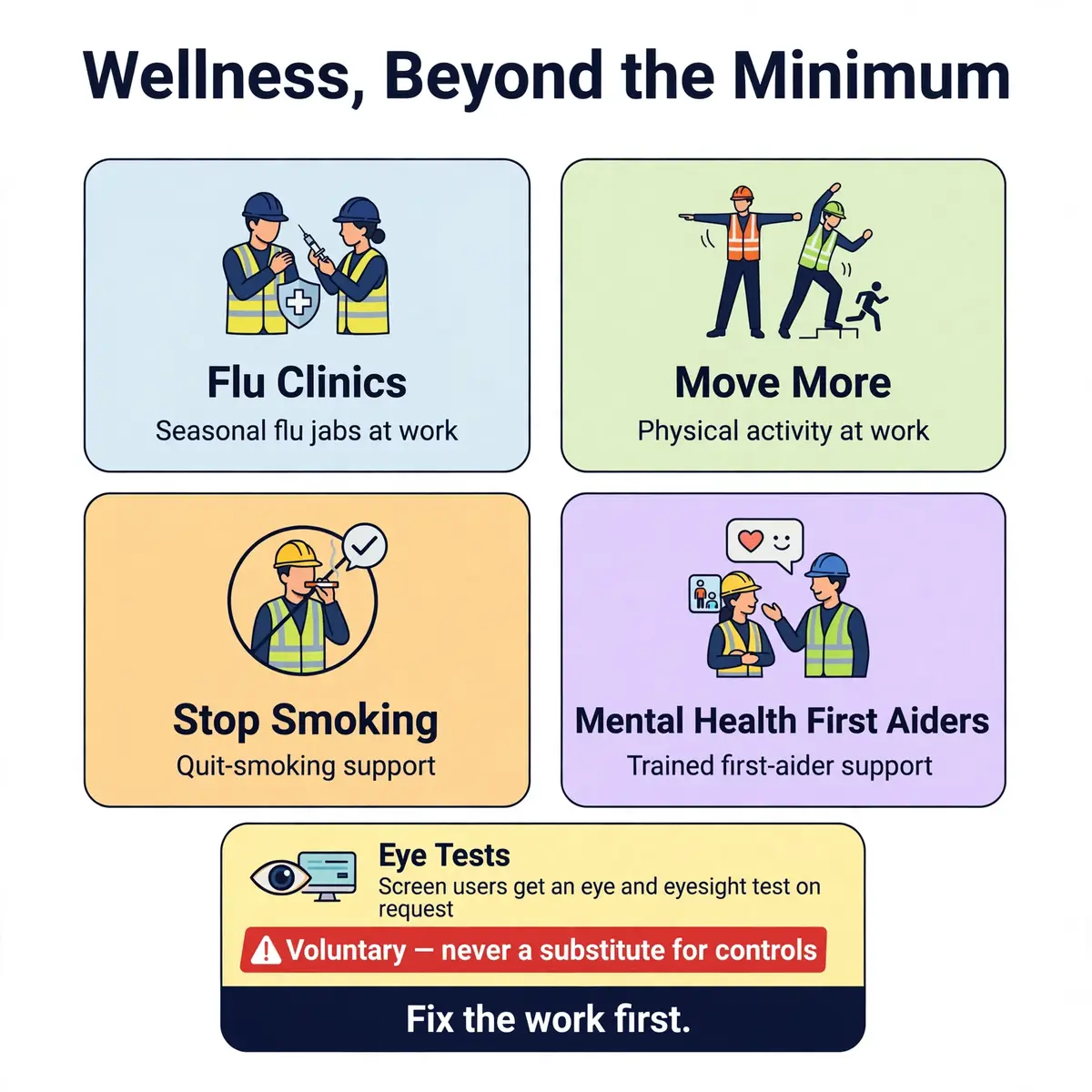
Once the legal duties are met, many employers add health promotion: flu clinics, physical activity, healthy food options, stop-smoking support, and eye tests for screen users. These are voluntary, and they can help, but they sit on top of the legal duties. A fruit bowl does not make up for an unguarded machine or an unassessed stress risk.
The test for any wellness measure is simple: does it address a real health need of the workforce, is it voluntary, and is it measured? A programme that nobody uses, or that punishes workers who do not take part, is worse than no programme. Offer it, make it easy to use, and leave the choice to the worker.
What Good Employers Add
Common additions include:
- Annual flu vaccination for care and healthcare staff.
- Physical activity schemes.
- Mental-health first-aider training.
- Health checks that screen for risks such as high blood pressure.
In the UK, display screen users are entitled to an eye and eyesight test on request under the Display Screen Equipment Regulations 1992. Further tests follow at regular intervals, and special corrective appliances are provided where the test shows they are needed.
None of these replaces the duties above. An employer should fund them only after the risk assessment, the surveillance and the first aid are in place. Wellness is the top layer of the programme, not the foundation.
What Wellness is Not
Wellness is not a way to shift responsibility onto the worker. Telling workers to eat better and exercise more while ignoring a harmful workload, a noisy workshop or a bullying manager is not health provision. It is blame dressed as care. The employer controls the work; the employer fixes the work first.
Wellness is also not a condition of employment. A worker who declines a health check, a vaccination or a gym membership must not be penalised, passed over for promotion, or treated as a problem. Participation is voluntary, and the records of who took part are confidential. Keep the two separate: the employer's duties are mandatory, and the extras are a choice.
TipBefore spending on wellness, ask workers what would actually help them stay healthy. A survey of twenty people often beats a budget spent on a programme nobody asked for.
When There is No In-House Team: Buying in Occupational Health Services
Most small and medium employers have no occupational health department, and they do not need one. The services can be bought in: a local occupational health provider, a contracted physician or nurse, or a mobile screening unit that visits the site. The employer keeps the legal duty, but the provider does the clinical work.
Buying in works only if the employer knows what to ask for. A vague request for "an OH service" produces a vague service. A request that names the hazards, the numbers of workers, and the checks required produces a service that fits. The sections below give that list.
What to Buy
A basic bought-in service should cover:
- Health surveillance for the hazards the risk assessment identifies.
- Fitness-for-work assessments for safety-critical roles.
- Pre-employment checks where they are justified.
- Advice when a worker's health changes.
It should also cover referrals after an incident, and support for return to work after sickness.
Ask the provider to:
- Name the clinician who will do the work.
- Confirm their qualifications in occupational health.
- Explain how results will be reported.
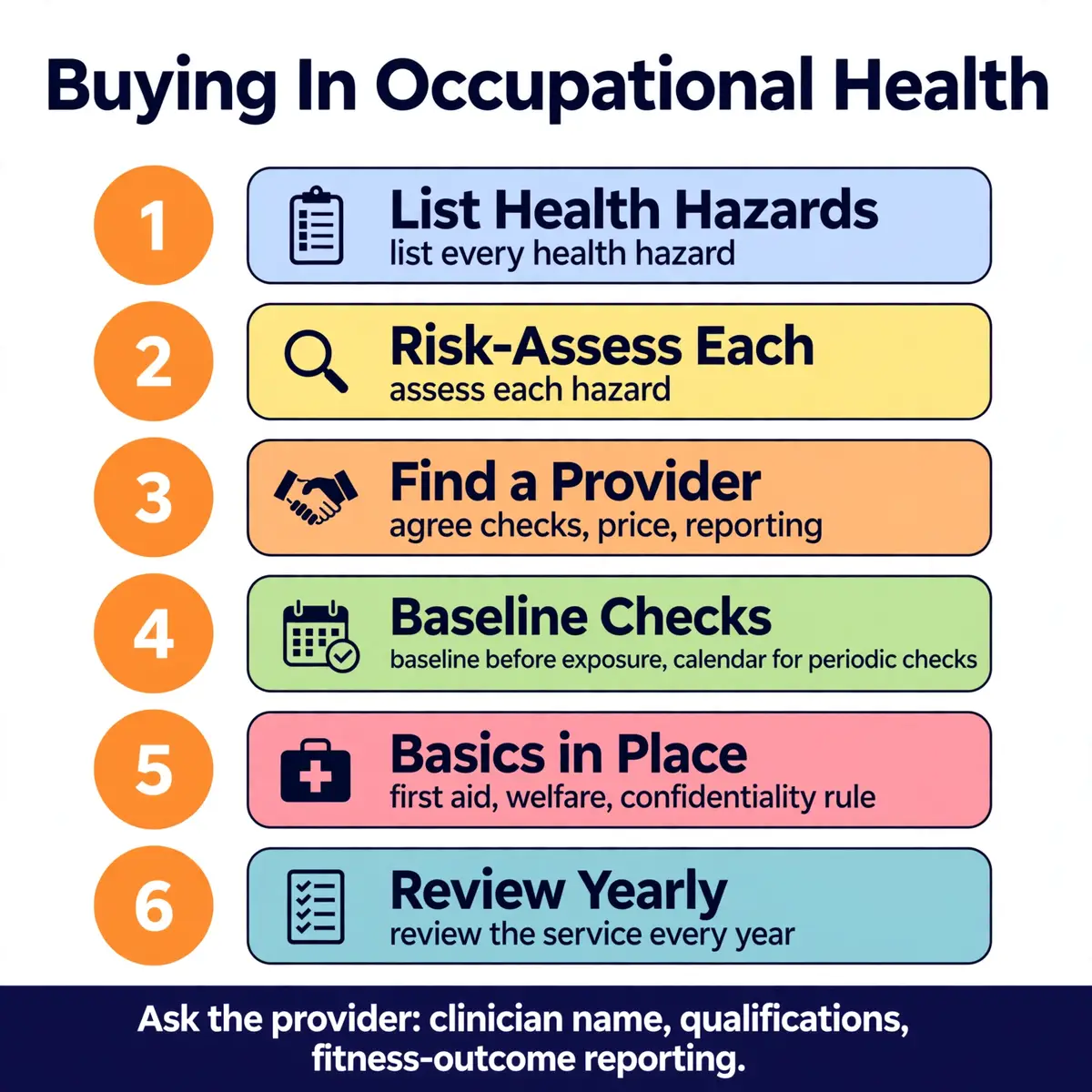
The report to the employer should be a fitness outcome, not clinical detail. Agree the turnaround time for results, the price per check, and what happens when a check finds a problem.
Choosing a Provider
Choose a provider with real occupational health qualifications, not a general clinic that offers health checks on the side. Ask for references from similar employers, and ask how they handle confidentiality, record-keeping and referrals. A good provider will ask about the hazards first, and will refuse to run checks that have no link to the work.
Check that the provider's reports are usable. A report that says "fit" with no explanation of restrictions is little help. A report that gives a fitness outcome, names the restrictions in plain words, and suggests a review date is what a manager needs. If the provider cannot produce that, look elsewhere.
A Starting Checklist for a Small Employer
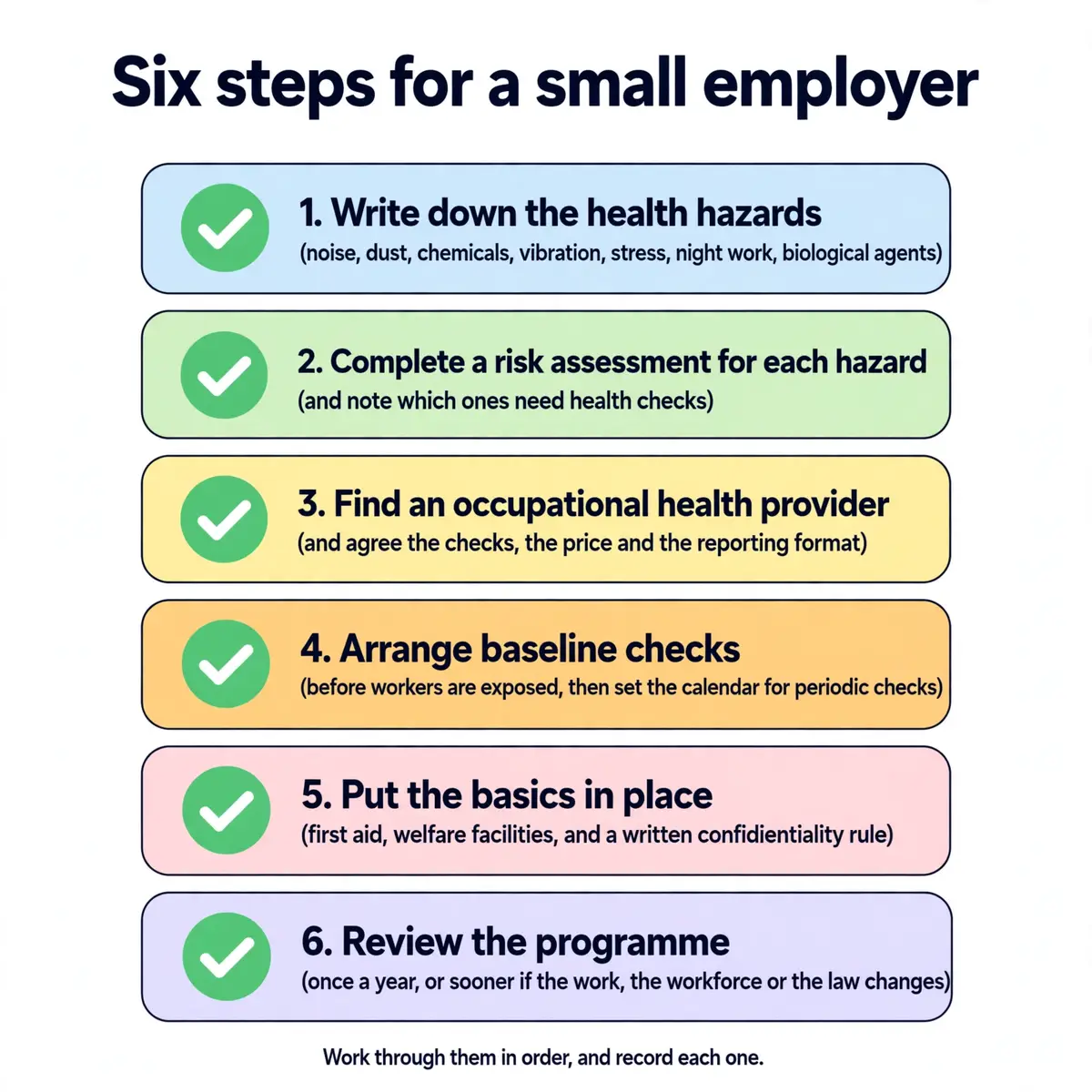
A small employer can set up the basics in six steps, without hiring anyone full time. Work through them in order, and record each one.
- Write down the health hazards: noise, dust, chemicals, vibration, stress, night work, biological agents.
- Complete a risk assessment for each hazard, and note which ones need health checks.
- Find an occupational health provider and agree the checks, the price and the reporting format.
- Arrange baseline checks before workers are exposed, then set the calendar for periodic checks.
- Put the basics in place: first aid, welfare facilities, and a written confidentiality rule.
- Review the programme once a year, or sooner if the work, the workforce or the law changes.
Why It Matters: the Cost of Getting It Wrong
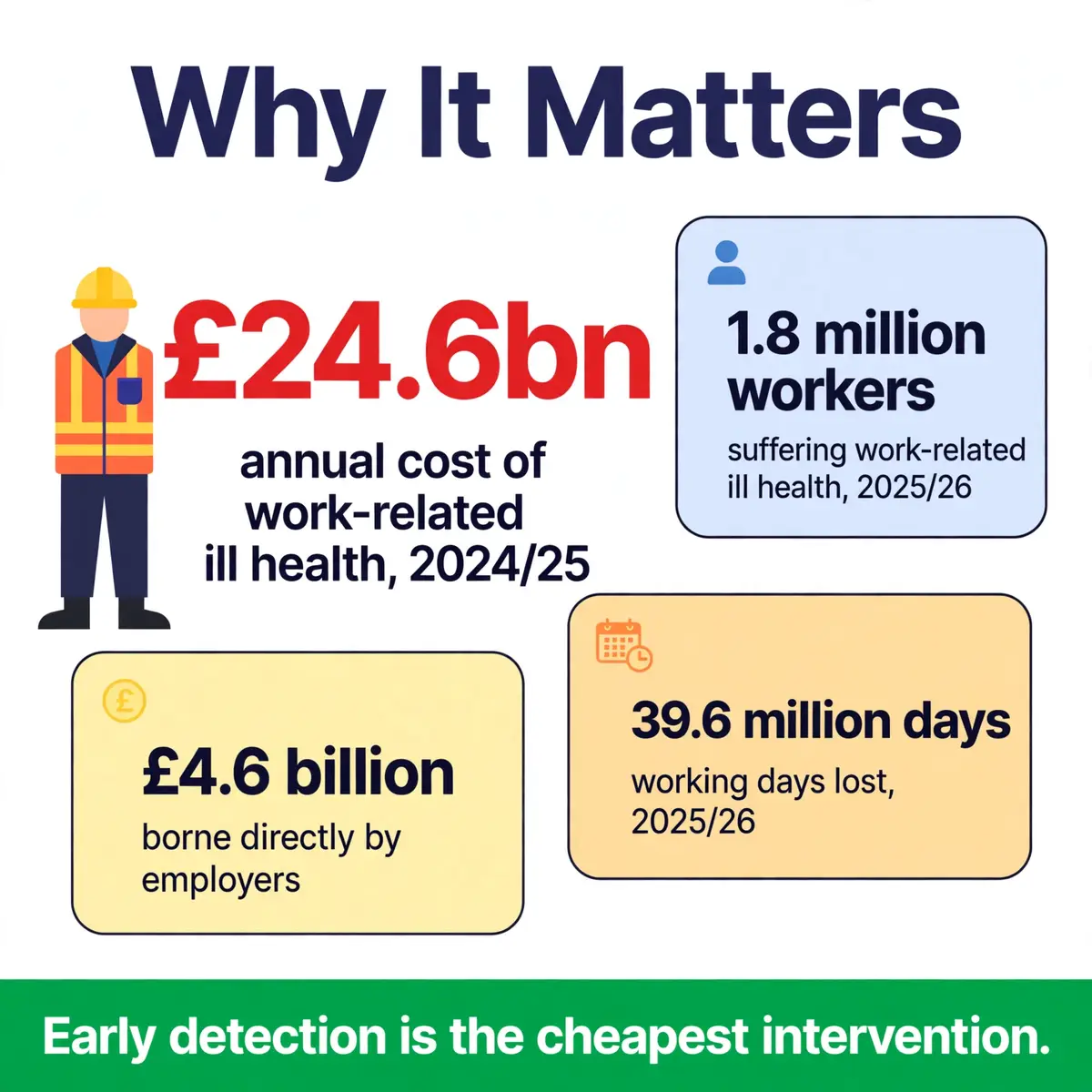
Health provision costs money: checks, vaccinations, training, time away from the job. The cost of not providing it is larger, and it falls on everyone. The worker pays with their health. The employer pays with absence, lost skill, recruitment, and, where the law was broken, enforcement and compensation. The state pays with healthcare and benefits.
The HSE's latest statistics put a number on it. In Great Britain in 2025/26, an estimated 1.8 million workers suffered from work-related ill health, and 39.6 million working days were lost to ill health and injury. The annual cost of workplace injury and new cases of ill health was an estimated £24.6 billion in 2024/25. Employers bore £4.6 billion of that directly, before the less visible costs of covering absent colleagues and managing cases.
The Business Case
Early detection is the cheapest intervention in occupational health. A hearing test that finds a shift at 10 decibels costs little, and the fix, better hearing protection and a quieter process, is cheap. A hearing loss found five years late is permanent, and the employer faces a compensation claim, a lost worker and a regulator's questions. The same logic applies to lungs, skin and stress.
Health provision also keeps skilled workers. A worker whose employer notices early hearing loss, adjusts their job and protects their hearing is a worker who stays. A worker whose employer ignores the first symptoms will leave, or will be forced out by ill health. Recruitment costs far more than a yearly audiogram.
The Human Case
Behind every statistic is a person whose health was damaged by work they did for someone else. Noise-induced hearing loss does not heal. Occupational asthma does not go away when the worker leaves the job. Chronic stress leaves a mark that lasts years. These are not abstract costs. They are the reason the law places the duty on the employer, not the worker.
An employer that provides health checks, acts on the results, and supports people back to work is doing more than complying. It is showing workers that their health matters to the business, not just their output. That trust is the foundation of every other safety measure. Without it, workers stop reporting, stop cooperating, and stop believing the safety programme.
Common Mistakes Employers Make
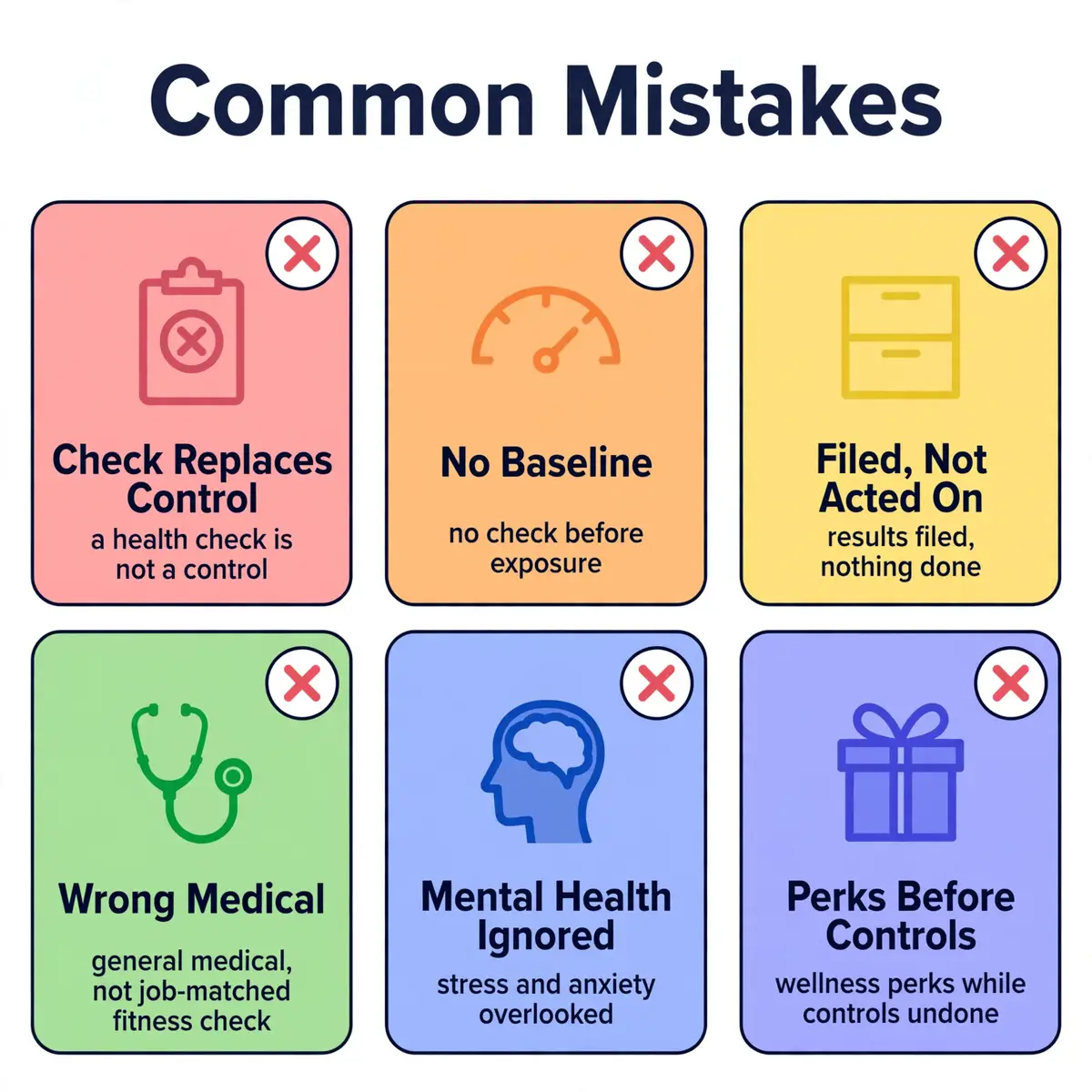
Most failures in employee health are not deliberate. They come from treating health as an afterthought, or from confusing a gesture with a provision. The mistakes below appear again and again in enforcement cases and in workplaces that mean well but fall short.
- Treating a health check as a substitute for a control. A hearing test never makes a noisy machine safe.
- Running surveillance with no baseline, so a later result has nothing to compare against.
- Collecting health data with no clear purpose, and no limit on who can see it.
- Filing surveillance results without acting on them, even when they show early harm.
- Asking a general medical question at hiring instead of a fitness assessment matched to the job.
- Ignoring mental health because it is harder to measure than noise or dust.
- Offering wellness perks while leaving the risk assessment and the controls undone.
- Forgetting agency and temporary workers, who face the same risks as everyone else.
- Letting records drift: no retention schedule, no separation from personnel files, no worker access.
- Waiting for someone to fall ill before setting up any health provision at all.
Frequently Asked Questions
Does an Employer Have to Provide Health Insurance?
No, not as a safety duty. In the United States there is no general legal duty to provide health insurance. The Affordable Care Act may penalise large employers, those with 50 or more full-time employees, that do not offer affordable health coverage, but it does not require any employer to provide specific health benefits. In the UK there is no general duty to provide private medical care. Both systems require the employer to protect health at work and to provide the specific health measures the risk assessment and the standards call for.
Can an Employer Require a Medical Examination?
An employer can require a medical assessment that is matched to the job. Examples include:
- A fitness-for-work check for a safety-critical role.
- A respirator medical evaluation.
- A hearing test for noisy work.
The assessment must relate to the demands of the role. An employer cannot demand a general medical, cannot ask questions unrelated to the job, and in the US cannot ask medical questions before offering the job. The employer receives a fitness outcome, not a diagnosis.
What is Health Surveillance and WHO Needs It?
Health surveillance is the regular checking of workers' health so that work-related illness is caught early. It is needed where workers are exposed to a hazard that can harm health, where the harm can be detected early, and where early detection changes the outcome. Common triggers include:
- Noise.
- Dust.
- Solvents.
- Skin sensitisers.
- Vibration.
- Biological agents.
In the UK, Regulation 6 of the Management of Health and Safety at Work Regulations 1999 requires it where the risk assessment shows it is appropriate.
WHO Pays for Health Surveillance and Medical Tests?
The employer pays. Medical tests the law requires are free to the worker: hearing tests under OSHA 1910.95, respirator medical evaluations under OSHA 1910.134, and hepatitis B vaccination under OSHA 1910.1030 are all provided at no cost to the employee. In the UK, night-worker health assessments under the Working Time Regulations 1998 must be free to the worker. The worker also attends in work time.
Can an Employer See an Employee's Medical Records?
An employer can see the fitness-for-work outcome, not the clinical detail. The clinician keeps the diagnosis, the test values and the medical history. The employer receives a statement of fitness and any restrictions. Workers have a right to see their own records, and an employer needs the worker's consent before sharing health information with anyone else. In the US, medical records must be kept for the duration of employment plus 30 years.
What Should a Small Business Do First?
Start with the hazards. List the health hazards in the work, complete a risk assessment for each one, and note which ones need health checks. Then arrange the basics: first aid, welfare facilities, and a written rule on confidentiality. After that, find an occupational health provider, agree the checks and the reporting format, and set a calendar for baseline and periodic checks. Review the programme once a year.
Sources
- U.S. Department of Labor — Employer Responsibilities. beta.dol.gov — Employer Responsibilities
- Occupational Safety and Health Administration — 29 CFR 1910.95, Occupational noise exposure. osha.gov — 1910.95
- Occupational Safety and Health Administration — 29 CFR 1910.134, Respiratory protection. osha.gov — 1910.134
- Occupational Safety and Health Administration — 29 CFR 1910.1030, Bloodborne pathogens. osha.gov — 1910.1030
- Occupational Safety and Health Administration — 29 CFR 1910.1020, Access to employee exposure and medical records. osha.gov — 1910.1020
- The Management of Health and Safety at Work Regulations 1999, Regulation 6 (Health surveillance). legislation.gov.uk — Regulation 6
- The Working Time Regulations 1998, Regulation 7 (Health assessment and transfer of night workers). legislation.gov.uk — Regulation 7
- The Health and Safety (Display Screen Equipment) Regulations 1992, Regulation 5 (Eyes and eyesight). legislation.gov.uk — Regulation 5
- Health and Safety Executive — Management Standards for work-related stress. hse.gov.uk — Management Standards
- Health and Safety Executive — Health and safety at work: summary statistics for Great Britain 2026. HSE ebulletin, 19 November 2026
- Medical News Today — Employer health responsibilities and employee rights. medicalnewstoday.com — Employer health