Home security works best as layers, not gadgets. Strong doors and locks slow an intruder down, lights and cameras make the approach visible, and working smoke and carbon monoxide alarms guard against fire and gas while everyone sleeps. Most of the protection costs little or nothing: locked doors, trimmed shrubs and a household plan do more than any single device.
Burglars look for the easiest opening, and the figures back that up. In the United States, the FBI counted 779,542 burglaries in 2024, and homes made up about half of them. Roughly two in five entries involved no force at all, which means an unlocked door or an open window. Fixing those openings first gives the biggest return for the least money.
How Burglars Get In
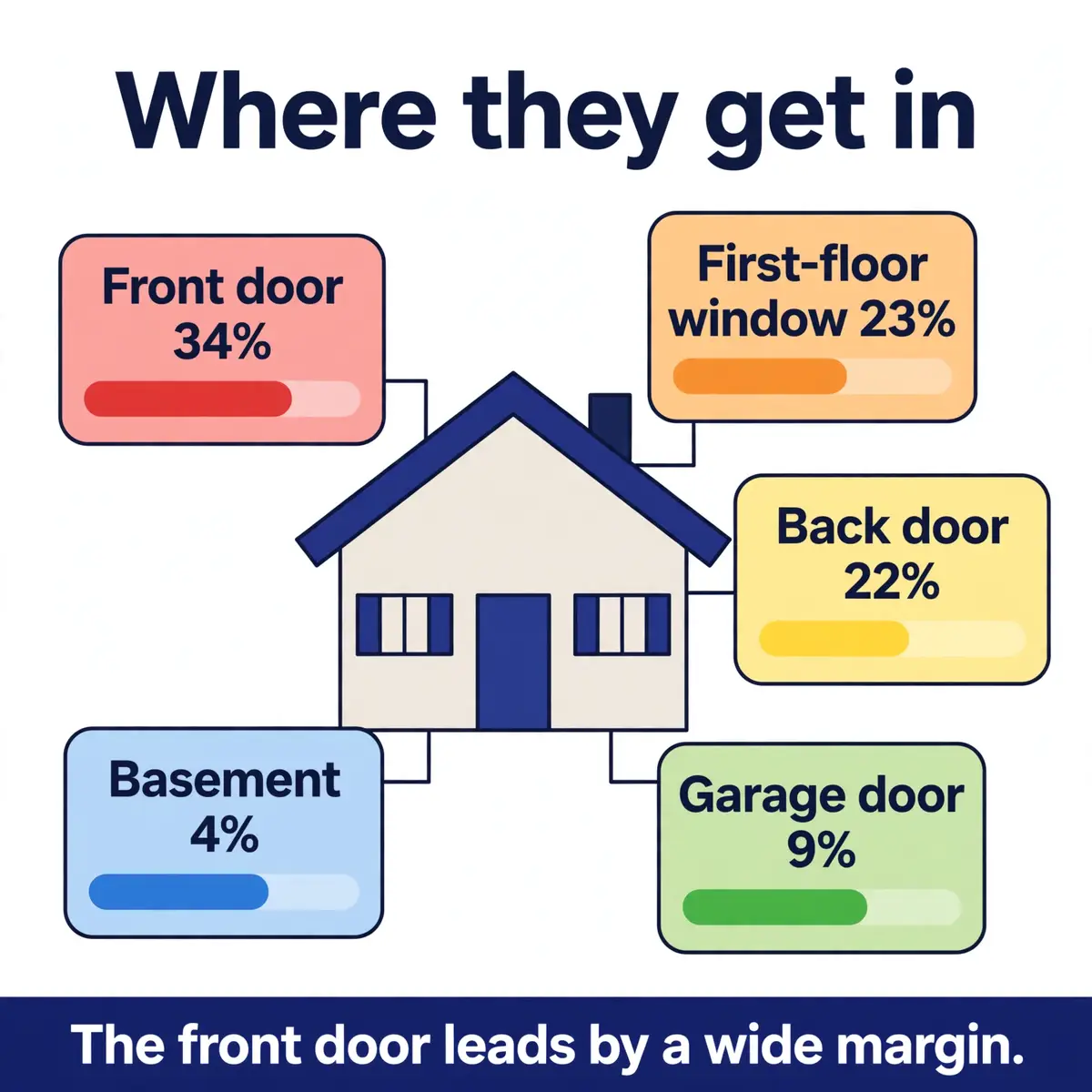
Burglars are usually opportunists, not planners. They walk a street, look for a dark approach or an open window, and pick the house that offers the least resistance. Knowing where they enter tells you where to spend money first, and the pattern barely changes from year to year. The front door leads the list by a wide margin.
| Entry point | Share of burglaries | What stops it |
|---|---|---|
| Front door | 34% | Grade 1 deadbolt, reinforced strike plate |
| First-floor window | 23% | Window locks, security film, trimmed shrubs |
| Back door | 22% | Same treatment as the front door |
| Garage door | 9% | Closed door, shielded release, deadbolt on the interior door |
| Basement | 4% | Window locks, well covers, lighting |
| Second-floor window | 2% | Locks on reachable windows |
The Front Door is the Most Common Way In
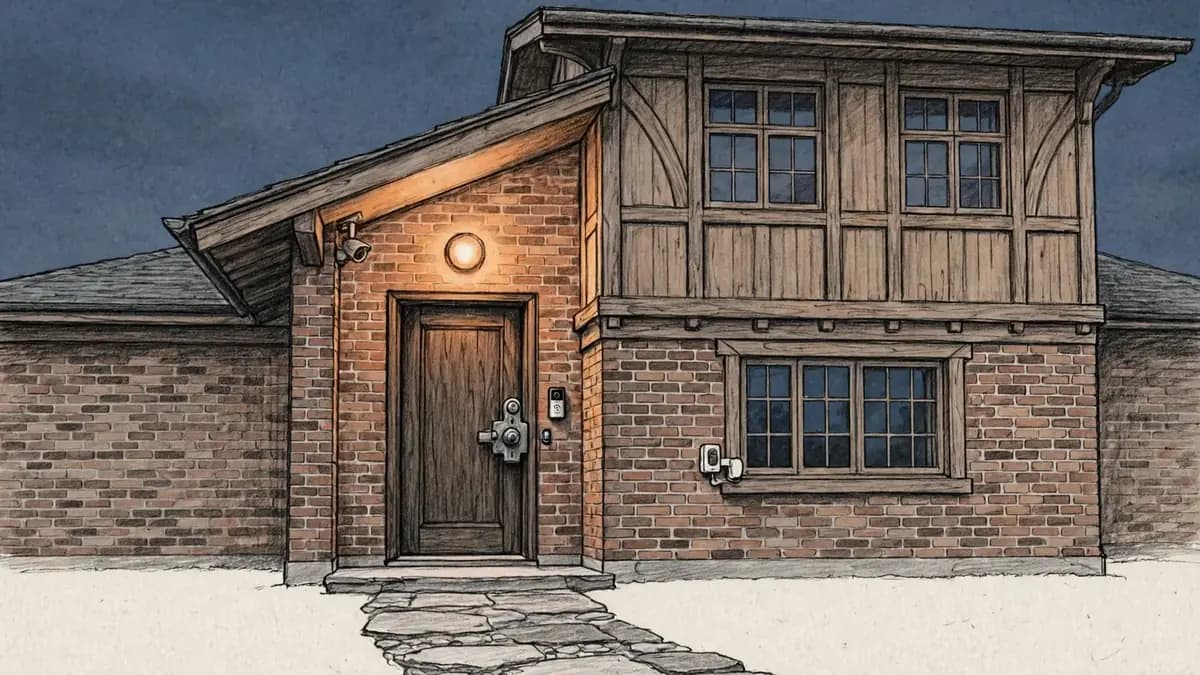
About a third of burglars enter through the front door, and many of them simply try the handle first. A solid-core or metal door, a Grade 1 deadbolt and a reinforced strike plate turn that quick try into a slow, noisy job. The bolt should extend at least one inch into the frame, and the strike plate needs 3-inch screws that reach the wall stud.
A video doorbell or a wide-angle peephole lets you check who is there without opening the door. A chain lock will not stop a determined push, so treat it as a way to talk through a gap, not as security. Never leave a spare key under the mat, in a planter or above the frame, because those are the first places an intruder checks.
Windows, Back Doors and the Garage
First-floor windows account for about 23% of entries, and back doors for about 22%. Both are often hidden from the street, which gives an intruder time to work unseen. Ground-floor windows need working locks, and windows near a door lock need security film or laminated glass, so breaking the pane does not let a hand reach the deadbolt.
- Fit window pins or keyed locks on ground-floor windows and any window beside a porch roof or deck.
- Keep shrubs below window height so nobody can work on a window out of sight.
- Treat the door from the garage into the house as an exterior door: solid core, deadbolt, locked every night.
- Shield the garage emergency release so it cannot be hooked from outside with a coat hanger.
- Cover garage windows so nobody can see whether the car is gone.
Basement windows and cellar doors deserve the same attention, because they sit out of sight from the street. Lock them, light them, and fit well covers or grates that still open from inside. A window well that is dark and unlocked is an invitation, not a storage space. Check cellar doors for rusted hinges and weak padlocks, and replace them before they fail.
Most Break-Ins Happen in Daylight
Most people picture a break-in at night, but the figures say otherwise. In 2024, daytime residential burglaries in the United States outnumbered nighttime ones, 216,601 to 174,053. The busiest window is roughly 10 a.m. to 3 p.m., when homes sit empty while people are at work or school. That is why locking up matters just as much on a weekday morning as it does at bedtime.
Daylight also changes what deters an intruder. A house that looks occupied — lights on a timer, a car in the drive, a neighbour collecting parcels — is a poor target in the middle of the day. Cameras and motion lights help, but the simplest daytime defence is a locked door and a home that looks lived in.
Start with a Layered Plan
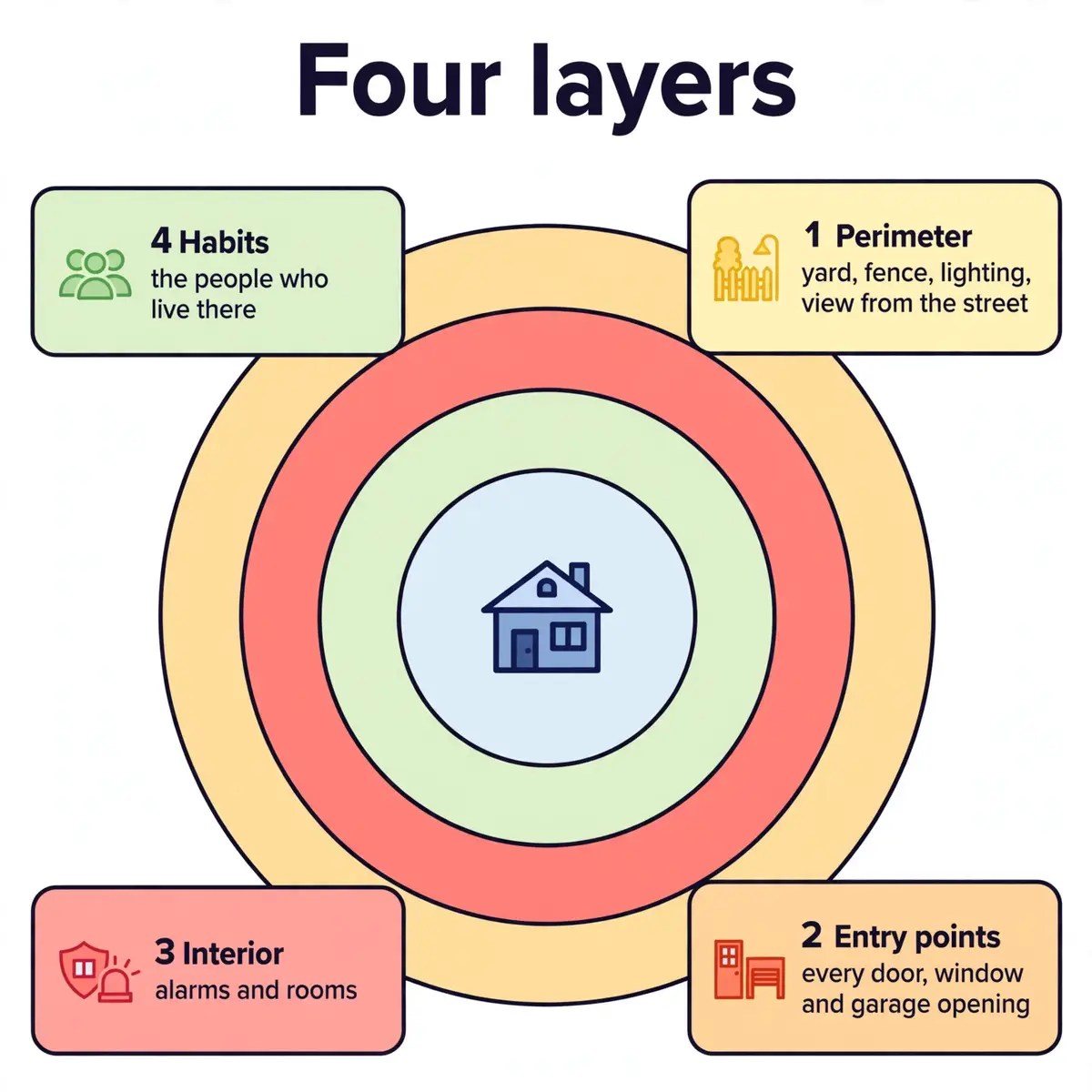
A layered plan beats a pile of gadgets. Each layer costs an intruder time and adds risk, and most burglars move on to an easier house rather than work through them. The four layers are the perimeter, the entry points, the interior and the habits of the people who live there.
The Four Layers
Think of the home as four rings. The perimeter is the yard, fence, lighting and the view from the street, and its job is to make the house look watched and hard to approach unseen. The entry points are every door, window and garage opening, and their job is to make getting inside slow and noisy.
- Perimeter: lighting, clear sight lines, locked gates and no hiding places.
- Entry points: solid doors, good locks, secured windows and a closed garage.
- Interior: valuables out of sight, a bolted-down safe and a room to retreat to.
- Habits: locking up every time, no clues that the house is empty, and a practised plan.
Walk the House Twice
Spend fifteen minutes walking around the property with a notebook, once in daylight and once after dark. Look at each space the way an intruder would: where could someone get in, where could they hide, and which areas stay dark at night? Write down every weak spot before buying anything, because the walk decides what each spot needs.
For each weak spot, decide whether it needs seeing, hearing or warning. Seeing means a camera or video doorbell. Hearing means a chime, siren or two-way audio. Warning means motion lights, clear signage or a visible camera. A spot that needs none of these probably needs a lock or a habit instead of a device.
TipDo the night walk first if time is short. Darkness shows the gaps that daylight hides, and most of the fixes it reveals cost nothing.
Doors and Locks
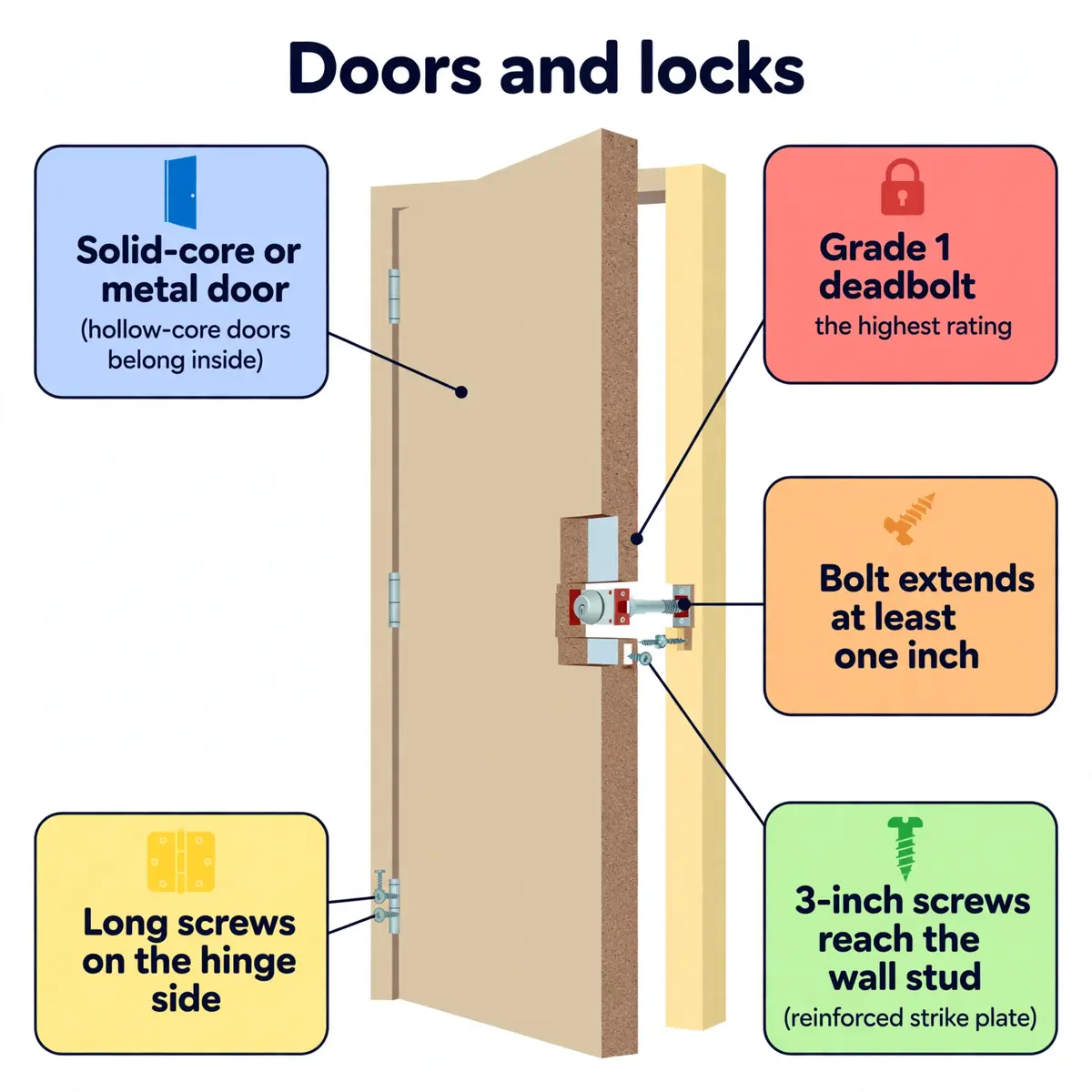
Doors and locks are the best first investment in home security. Most forced entries do not defeat the lock; they split the door frame, because the strike plate was held on by short screws. Fix the door, the lock and the frame together, and the whole entry point gets stronger.
The Front Door and Other Exterior Doors
Use solid-core or metal doors for every exterior opening. Hollow-core doors belong inside the house, and a door you can dent with a fist needs replacing. Check the hinges too: long screws on the hinge side, and security hinges or set screws where the pins sit on the outside.
Fit a Grade 1 deadbolt, which is the highest rating in the ANSI/BHMA grading system for residential locks. Look for a bolt that extends at least one inch into the frame. Then replace the short strike-plate screws with 3-inch screws that reach the wall stud, or fit a heavy-duty strike plate or frame reinforcement kit.
Sliding Doors Need a Second Lock
The factory latch on most sliding glass doors is weak and can often be forced with a screwdriver. A security bar or a cut wooden dowel in the bottom track stops the door sliding even if the latch fails. A pin lock through both frames adds a second barrier, and screws partway into the upper track stop the door being lifted off its rollers.
Security film on the glass makes it harder to break through quickly, and closed curtains at night stop anyone seeing inside. Keep the track clean, because grit and dirt wear the rollers and leave the door sitting loose in its frame. A sliding door that rattles is a sliding door that needs attention.
Keys, Codes and Spares
A spare key is only safe in trusted hands. Give one to a neighbour you know well, or fit a keypad lock and give visitors their own code. Change the code when a tenant, cleaner or contractor stops coming, and never share the master code with anyone who only needs one-off access.
Rekey the locks when you move into a new home, because you cannot know how many copies of the old keys exist. The same rule applies after a break-up, a lost key or a contractor finishing a job. Rekeying is cheaper than replacing the lock, and a locksmith can usually do a whole house in one visit.
WarningNever hide a key outside the house. Under the mat, in a planter and above the frame are the first places an intruder looks.
Essential Devices: What to Buy and in What Order
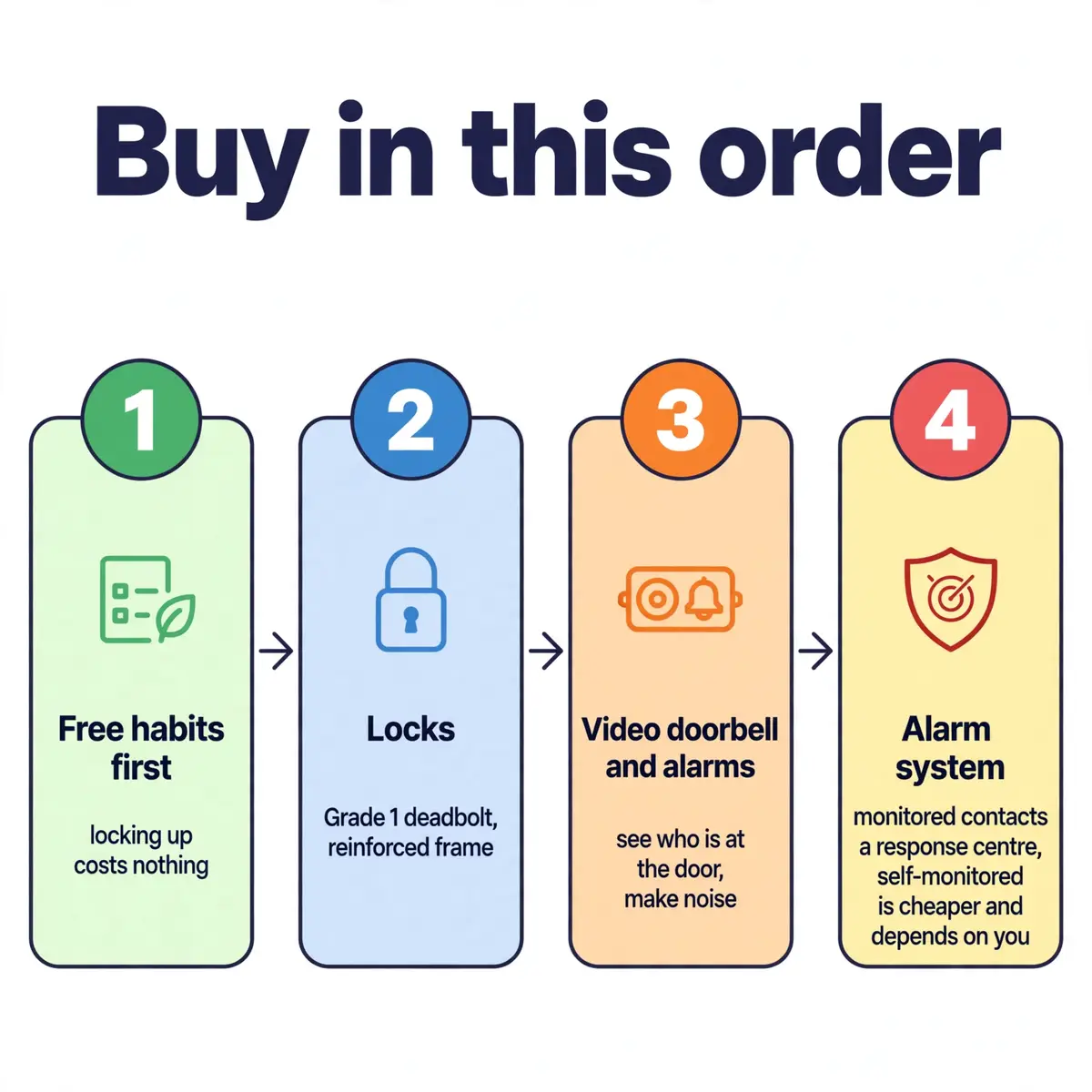
Devices help when they cover a gap the locks and habits cannot. A camera shows what happened, an alarm makes noise and calls for help, and a smart lock controls who can enter. None of them replaces a locked door, so buy in the order that closes the biggest gaps first.
Alarm Systems: Monitored or Self-Monitored
A monitored alarm contacts a response centre when it triggers, which helps if you travel often, sleep through phone alerts or want a backup. A self-monitored system is cheaper and works well, but it depends entirely on you seeing the alert and reacting. Cameras make either option better, because they let you check whether the trigger was a person or a pet.
Door and window sensors are the core of any alarm, and they belong on every ground-floor opening. Add motion sensors in hallways and large rooms, and a siren loud enough to be heard from outside. Test the system monthly, and make sure everyone in the house knows the code and the procedure when it sounds.
Cameras and Video Doorbells
Outdoor cameras belong near driveways, front doors, side gates, rear entrances and garages — anywhere you want to know what is happening before someone reaches the house. A video doorbell covers the front door and lets you speak to visitors without opening it. Indoor cameras are best used to check an alarm event, watch pets or confirm a sensor was triggered by a real person.
- Choose cameras with night vision and a wide enough angle to cover the whole approach, not just the step.
- Prefer local storage or a subscription you understand; check what happens to clips if the Wi-Fi drops.
- Mount cameras high enough that they cannot be reached or covered easily.
- Tell household members and regular visitors where indoor cameras are, and keep them out of bedrooms and bathrooms.
Smart Locks
A smart lock opens with a code, fingerprint or phone instead of a key, and it keeps a log of who entered and when. That suits families, rental properties and anyone who needs to let in a carer or dog walker without handing out keys. Choose a lock and video doorbell from the same brand when you can, so both run from one app.
A smart lock is only as safe as the account behind it. Use a strong, unique password for the app, turn on two-factor authentication, and keep the lock's firmware updated. If the lock runs on batteries, set a reminder to change them, and keep a physical key as a backup for a flat battery.
Secure the Home Wi-Fi
Security cameras, smart locks, video doorbells and alarm systems all run through the home Wi-Fi, so the network is a security device in its own right. Change the router's default admin username and password, turn on WPA3 encryption — or WPA2 if the router does not support WPA3 — and keep the router firmware updated. A weak network hands an intruder the keys to every smart device in the house.
- Put smart devices and guests on a separate guest network.
- Turn off WPS and remote management if you do not use them.
- Change the default password on every camera, lock and smart device.
- Turn on two-factor authentication for camera, alarm and smart lock apps.
- Replace routers that no longer get security updates from the manufacturer.
What to Buy First
Start with the fixes that cost nothing, then spend where the risk is highest. Locks and strike plates come before cameras, because a camera records a break-in while a lock can stop one. A monitored alarm makes sense once the doors and windows are sound, and only if someone will answer when it triggers.
| Priority | Cost | What it covers |
|---|---|---|
| 1 | Free | Lock doors and windows, trim shrubs, hide valuables from street view |
| 2 | Low | Grade 1 deadbolt, 3-inch screws, window locks, sliding-door bar |
| 3 | Medium | Video doorbell, motion lights, smoke and carbon monoxide alarms |
| 4 | Higher | Alarm system, cameras, smart locks |
Check the total cost before you buy, and look for devices that work without a monthly subscription. Local storage and solar charging keep running costs down, and a wired camera system costs more upfront but records reliably. Whatever you buy, test it the day it arrives and set a reminder to check it every few months.
Fire and Carbon Monoxide Alarms
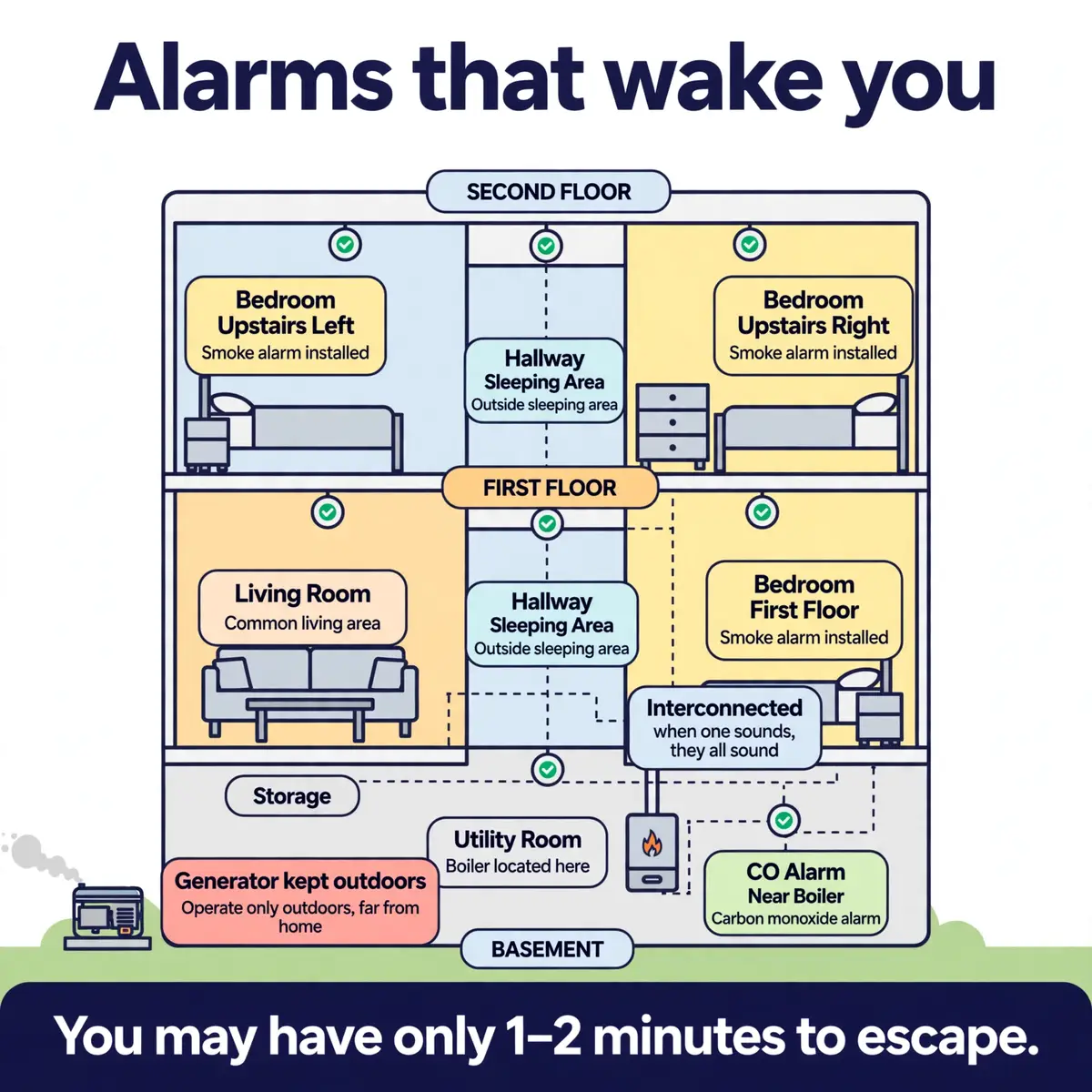
A secure home is not only a home nobody can enter; it is a home that warns everyone inside when fire or gas threatens. Smoke alarms and carbon monoxide alarms are cheap, and they work while the household sleeps. Fit them before buying any intruder alarm, because fire and carbon monoxide kill faster than a burglar can act.
Smoke Alarms
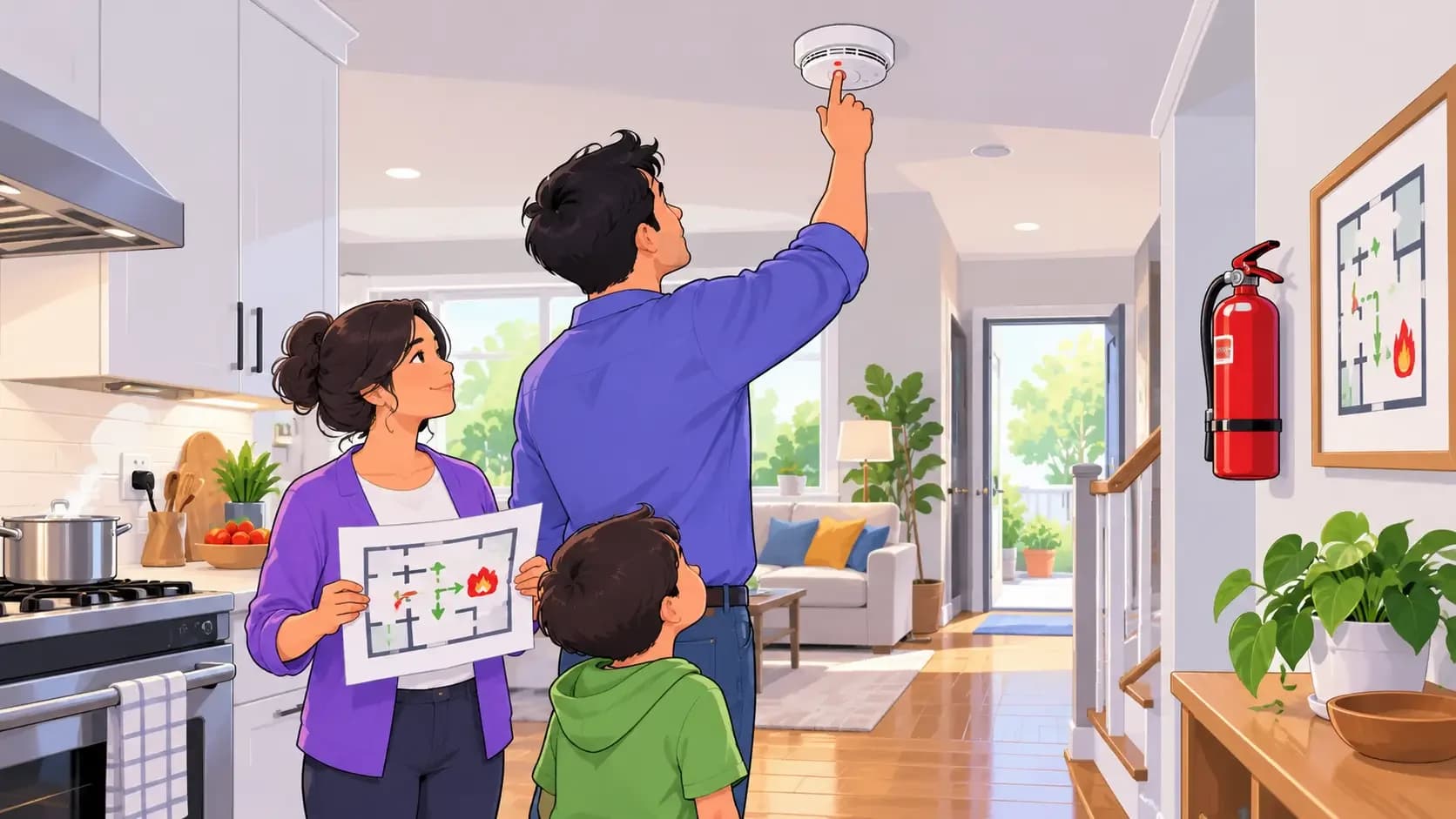
The National Fire Protection Association (NFPA) advises fitting smoke alarms inside every bedroom, outside each sleeping area and on every level of the home, including the basement. Interconnected alarms give the best protection: when one sounds, they all sound. People may have only one to two minutes to escape once an alarm sounds, so early warning matters.
- Test every alarm at least once a month by pressing the test button.
- Replace all smoke alarms when they are 10 years old, or sooner if they do not respond when tested.
- Keep alarms at least 10 feet from the stove to cut down on false alarms from cooking.
- Use alarms with strobe lights or bed shakers for anyone who is deaf or hard of hearing.
Never take the battery out of an alarm because cooking sets it off. Open a window or wave a towel instead, and fit an alarm with a hush button near the kitchen. A disabled alarm protects nobody, and the NFPA notes that most home fire deaths happen in homes with no alarms or alarms that do not work.
Carbon Monoxide Alarms
Carbon monoxide (CO) is a colourless, odourless gas produced by fuel-burning heaters, boilers, fireplaces and generators. The US Consumer Product Safety Commission (CPSC) advises fitting CO alarms on every level of the home and outside sleeping areas. Choose alarms that are battery-operated or have battery backup, so they still work in a power cut.
Test CO alarms monthly and change the batteries at least once a year, unless the alarm has sealed 10-year batteries. If a CO alarm sounds, get outside at once and call the emergency services from outside the home. Never ignore the alarm or try to find the source of the gas yourself.
Heaters, Fireplaces and Generators
The CPSC estimates that portable heaters are involved in an average of 1,600 fires a year in the United States, causing about 70 deaths and 150 injuries a year. Keep portable heaters at least three feet from drapes, furniture and bedding, plug them directly into a wall outlet, and turn them off when you sleep.
Have fuel-burning heating systems, chimneys and flues inspected by a professional every year. Never use a portable generator inside a home, garage, basement or shed. Run it outdoors only, at least 20 feet from the home, with the exhaust pointed away from the building. Keep the area around the furnace clear of stored paint, boxes and clutter.
AlertA generator can produce as much carbon monoxide as hundreds of cars. Never run one indoors, even with doors and windows open.
Lighting, the Yard and the Street
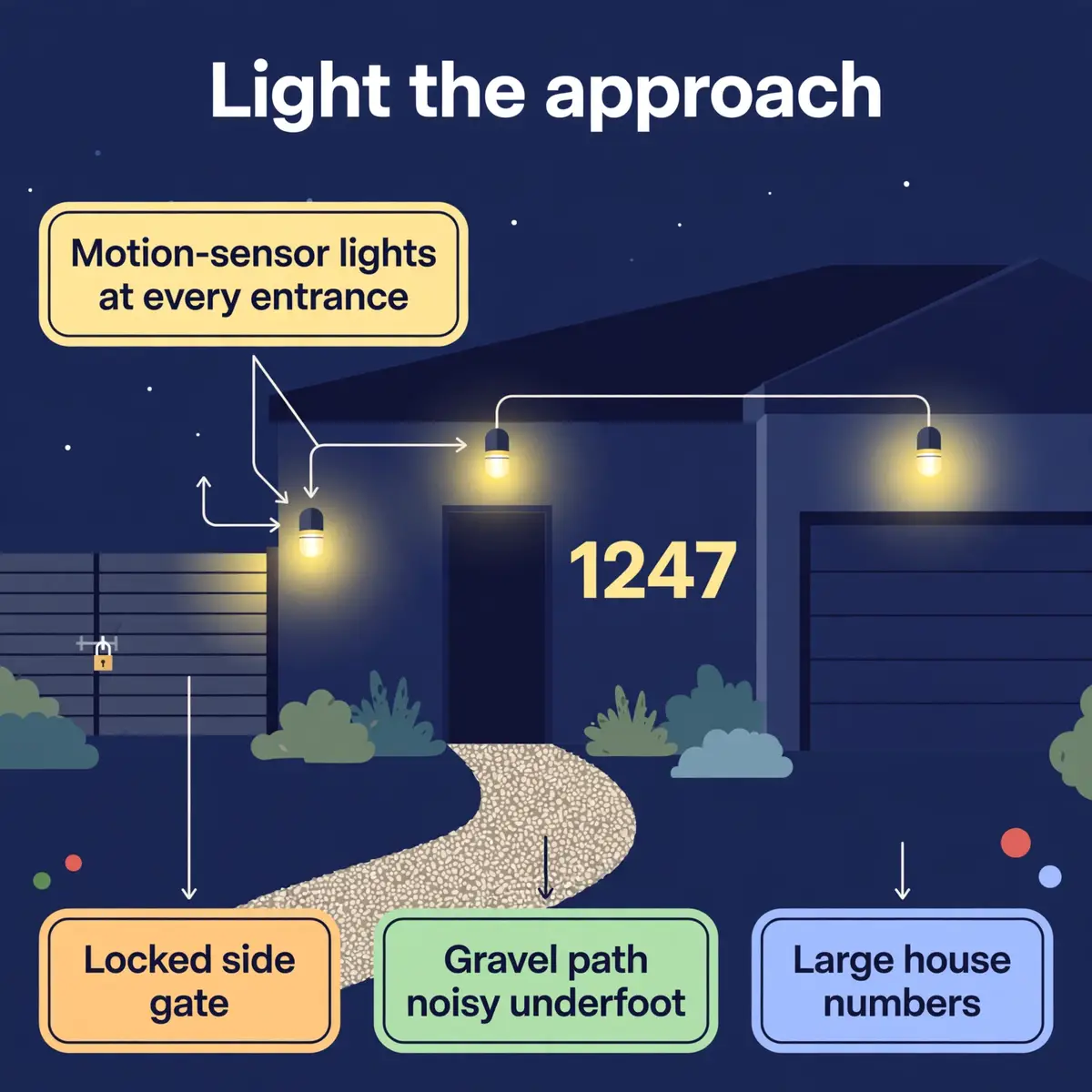
An intruder wants darkness and cover. Lighting and clear sight lines take both away, and they cost far less than an alarm system. The aim is simple: anyone approaching the house should be visible from the street and from inside the home. Trimmed shrubs, a lit porch and a clear view of the doors do most of the work.
Light the Approaches
Fit motion-sensor lights at every entrance, on each side of the house and over the garage. Solar lights work where wiring is awkward, and LED bulbs keep the running cost low. Check the lights at night: a bulb that has failed or a sensor that points at the wrong place is the same as no light at all.
- Light the front door, back door, driveway and any side gate.
- Use timers or smart plugs so indoor lights switch on and off while you are away.
- Keep house numbers visible from the street so emergency services can find the home quickly.
Keep the Yard Working for You
Cut back shrubs and trees so they cannot hide someone working on a window or door. Thorny plants under ground-floor windows make an approach uncomfortable, and gravel on paths crackles underfoot and gives the household an audible warning. Lock ladders, tools and bins away, because an intruder can use them to reach a window or force a door.
Keep the fence and gates in good repair, and lock side gates even when you are home. A fence that is easy to climb is decoration, not security. If anti-climb spikes are legal in your area, fit them and put up a sign saying they are there. Check local rules first, because the law on spikes and barriers varies by place.
Sheds, Parcels and the Garage
Sheds and outbuildings are commonly targeted and frequently overlooked. Fit a strong lock, add motion lighting, and point a camera at the shed from the main house when you can. Keep valuable tools locked inside, and never leave the garage door open while you work in the garden.
Parcels left on a porch invite theft, so use a lockbox or delivery locker when you can, or ask a neighbour to take deliveries in. Break down boxes from new televisions and computers before they go out for recycling, because the packaging advertises what is inside the house.
Keep paints, solvents and other flammable liquids in a locked metal cabinet, away from heaters and pilot lights. Store them upright, with lids tight and labels facing out, so a leak is easy to spot. The storage rules for household chemicals are covered in the guidance on chemical hazards.
Habits That Cost Nothing
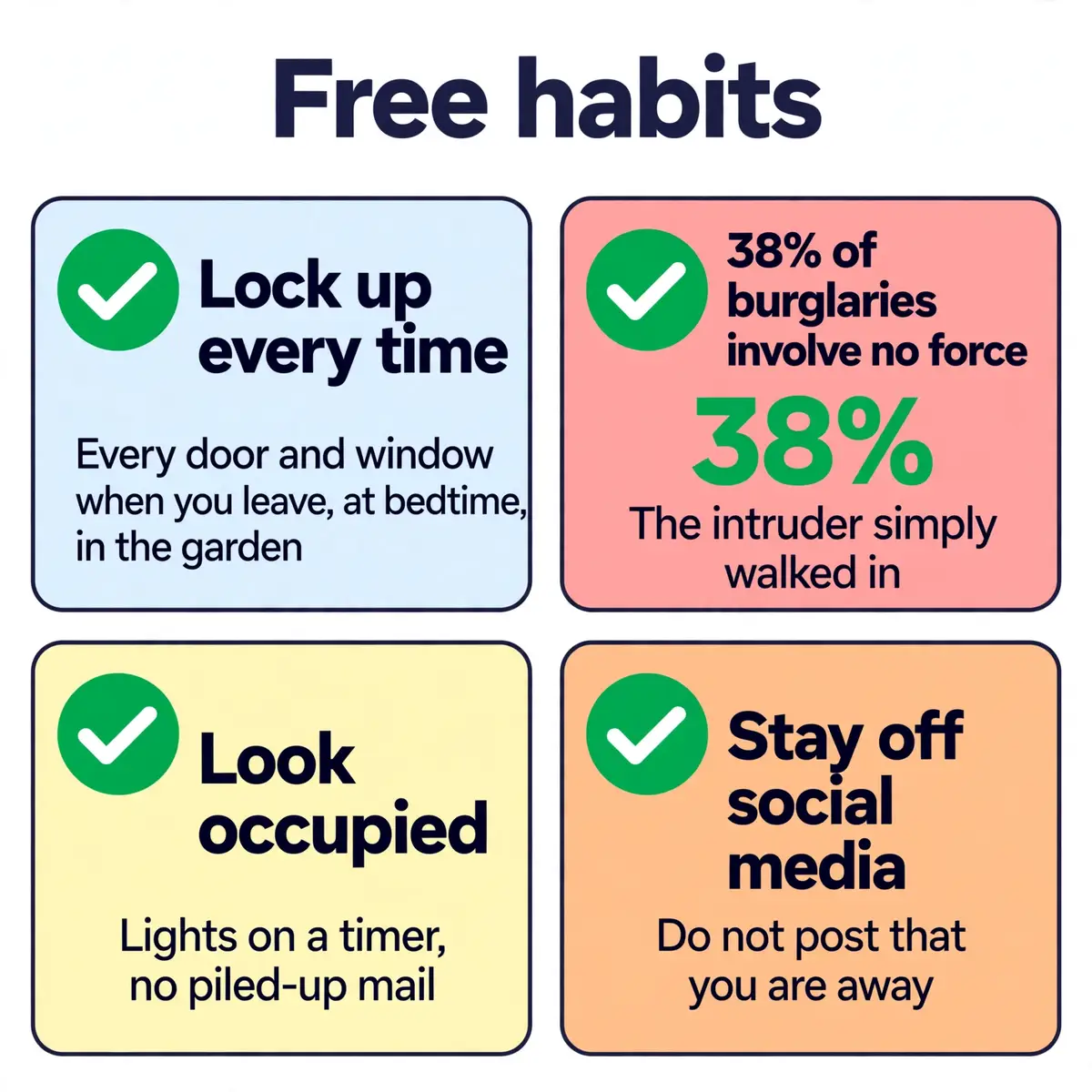
The cheapest security measures are habits, and they are also the most effective. Locking up, hiding valuables and looking occupied cost nothing, yet they close the gaps that most burglaries exploit. Devices help, but they sit on top of habits, not instead of them. A household that locks up every time is already harder to break into than one with cameras and open windows.
Lock Up Every Time
Lock every door and window when you leave, when you go to bed and when you work in the garden. Check the back door and ground-floor windows as part of the routine, not just the front door. About 38% of burglaries involve no force, which means the intruder walked through an opening somebody left unlocked.
Keep the garage door closed even when you are home, and take the opener with you instead of leaving it in a car parked outside. Close curtains at night so nobody can see valuables from the street. Small routines, repeated every day, are what make a home a poor target.
When You Are Away
A home that looks empty invites attention, so make it look lived in. Put indoor lights on timers, stop mail and deliveries or ask a neighbour to collect them, and keep the lawn cut if you are away for weeks. Never announce travel plans on social media until you are back home.
- Ask a trusted neighbour to park in the drive or put the bins out on collection day.
- Leave a car in the driveway when you can, or ask the neighbour to use it.
- Set lights and a radio on timers so the pattern changes through the evening.
- Do not leave a note on the door saying nobody is home.
If Someone is at the Door
Talk to visitors through a closed door or a video doorbell, and never open the door to someone you cannot identify. Check the identity of utility workers by calling the company yourself, using a number from a bill rather than one the visitor gives you. Many home invasions start with a knock, a fake delivery or someone claiming to need help.
Agree on a family code word that means go to the safe room now, and make sure children know it. Keep doors locked even when you are home, including during the day and while you are in the garden. If something feels wrong, trust that feeling and call the police rather than opening the door to check.
A Household Plan and a Safe Room
Every household needs a plan for what to do if someone gets in. Pick one room as a safe room — the main bedroom usually works — with a solid-core door that locks from the inside. Stock it with a charged phone, a flashlight, a first aid kit and a list of emergency contacts, and make sure everyone knows the route to it.
Practise the plan the way you would a fire drill, so the household reacts without thinking. Decide in advance who collects the children and who calls the police. A written plan, kept where everyone can see it, turns a frightening moment into a set of steps — so practice emergency procedures before you ever need them.
Renters: What You Can Still Do
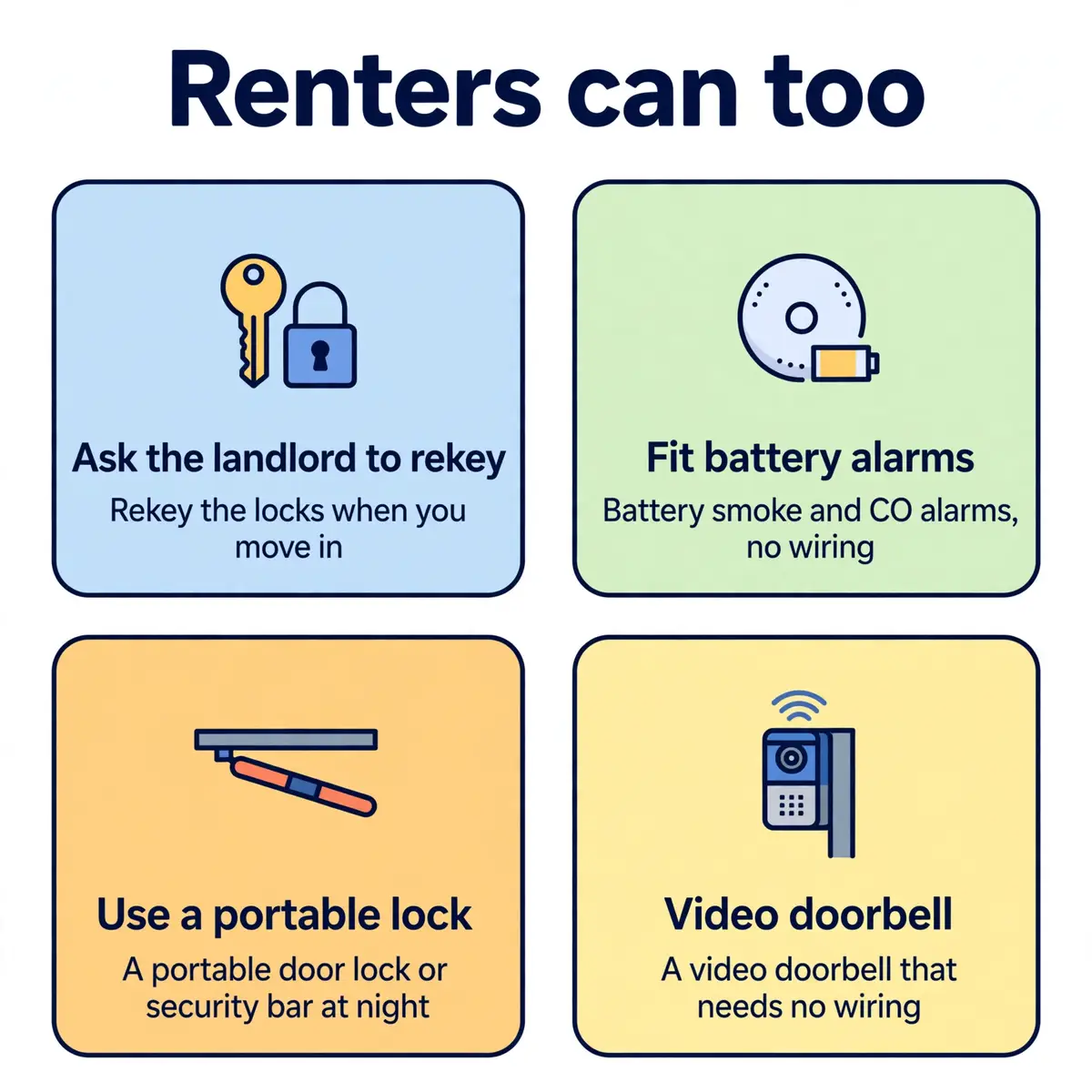
Renters cannot always change locks or fit an alarm system, but most of the measures above still apply. Locking up, lighting, alarms and habits need no permission from a landlord. For anything fixed to the property, ask first and put the agreement in writing. A landlord who refuses a lock change should at least agree to a portable lock or a door bar.
- Ask the landlord to rekey the locks when you move in, or to approve a replacement deadbolt.
- Fit battery-powered smoke and CO alarms, and a video doorbell that needs no wiring.
- Use a portable door lock or security bar for extra protection at night.
- Keep valuables out of sight and photograph serial numbers for insurance.
Check the tenancy agreement before drilling holes or fitting anything permanent. If the landlord refuses a reasonable security request, keep a written record of the request and the reply. In a home built before the 1980s, read about asbestos health risks before drilling into walls or disturbing old insulation.
Frequently Asked Questions
What is the First Thing to Do to Secure a Home?
Lock every door and window, and fit a Grade 1 deadbolt with 3-inch screws in the strike plate. Those two steps close the most common way in and cost very little.
Do I Need a Monitored Alarm System?
Not always. A monitored system suits homes that stand empty often or households that want a backup. A self-monitored system with door sensors and a camera works well when someone will see the alert and act on it.
Where Should Smoke Alarms Go?
Inside every bedroom, outside each sleeping area and on every level of the home, including the basement. Test them monthly and replace them when they are 10 years old.
How Can I Secure My Home Without Spending Much?
Lock up every time, trim shrubs, light the entrances and make the home look occupied. Those habits cost nothing. After that, spend on a deadbolt and window locks before buying cameras.
Are Smart Locks Safe?
Yes, when the account behind them is protected. Use a strong unique password, turn on two-factor authentication and keep the firmware updated. Keep a physical key as a backup for a flat battery.
What Should I Do If Someone Tries to Break in While I Am Home?
Go to the safe room, lock the door and call the police. Do not confront the intruder. Make sure everyone in the house knows the plan and the family code word in advance.