
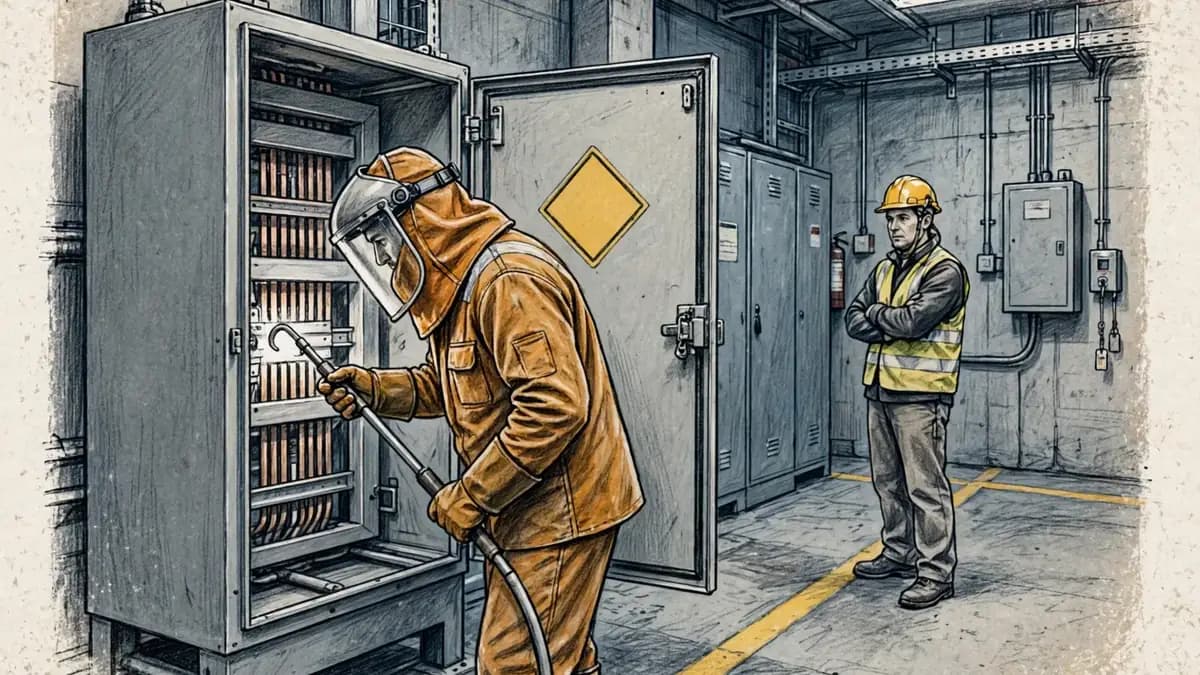
NFPA 70E is the US standard for electrical safety in the workplace. It tells employers and qualified electrical workers how to protect people from shock, arc flash and arc blast when they work on or near energized equipment. Its first rule is to de-energize before work starts.
The current edition is NFPA 70E 2027, in effect since 6 May 2026. It sets the arc flash and shock boundaries and the two ways to choose arc-rated PPE. It also covers the energized work permit and the training a qualified person needs. Workplace safety around energized equipment starts with that sequence: de-energize, assess, protect.
What is NFPA 70E?
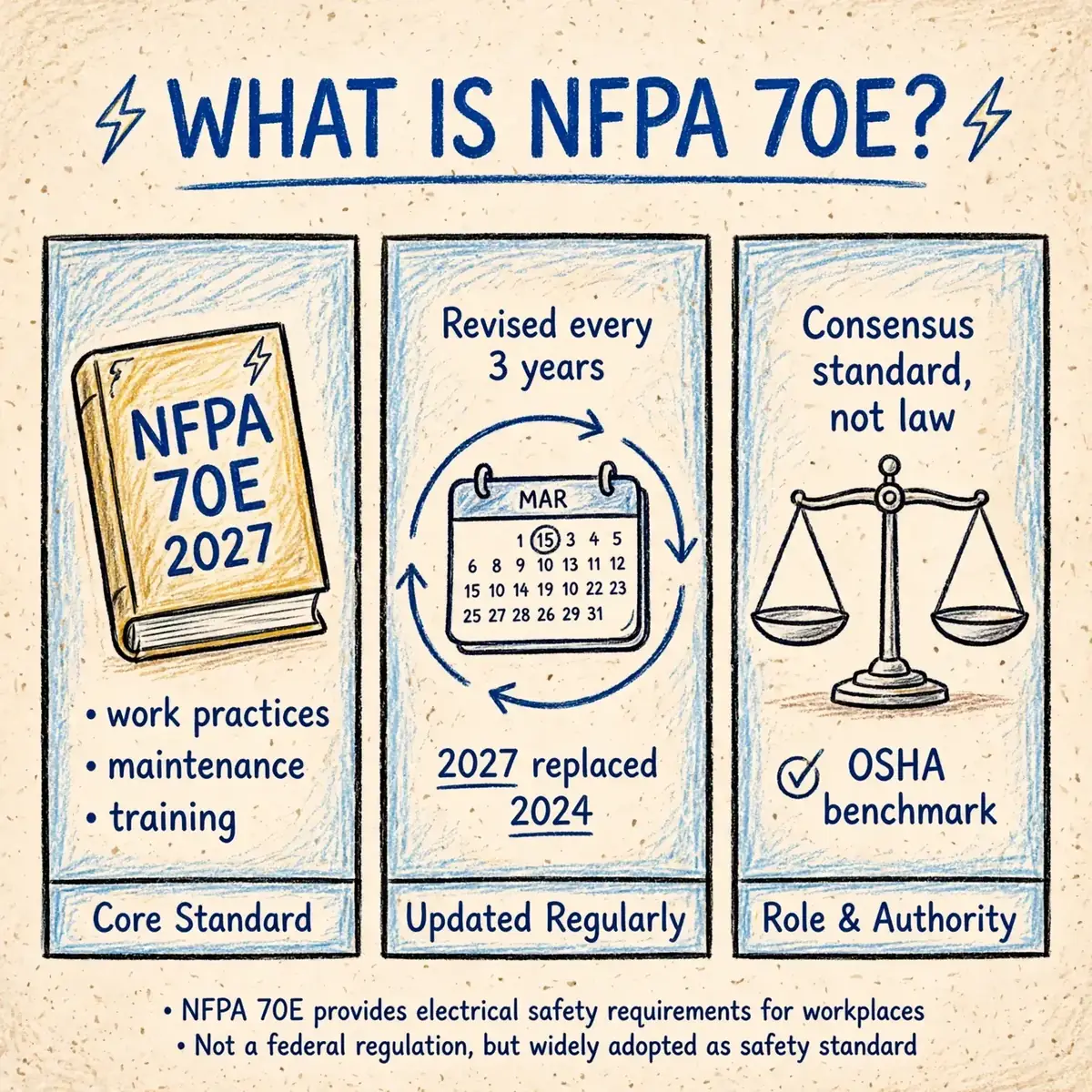
NFPA 70E, Standard for Electrical Safety in the Workplace, is published by the National Fire Protection Association (NFPA). It covers safety-related work practices, maintenance requirements and training for people who work on or near electrical conductors and equipment.
The standard is revised on a three-year cycle. The 2027 edition replaced the 2024 edition on 6 May 2026. Training decks, permit forms and program documents that still cite 2024 are out of date. Check which edition a program names before relying on it.
NFPA 70E is a consensus standard, not federal law. OSHA enforces electrical safety through its own regulations, and uses NFPA 70E as the recognised benchmark for safe practice. The National Electrical Code (NFPA 70) is a different document: it governs how installations are built, while NFPA 70E governs how people work on them once energized.
AlertNFPA 70E is not an OSHA regulation. An inspector cites the OSHA rule that was broken, and treats NFPA 70E as evidence of recognised safe practice.
The standard applies wherever workers may be exposed to electrical hazards: panelboards, switchgear, motor control centers, data-center power distribution, battery rooms and photovoltaic systems. Its requirements reach employers, qualified workers, and the host and contract employers who share a site.
What is an arc flash?
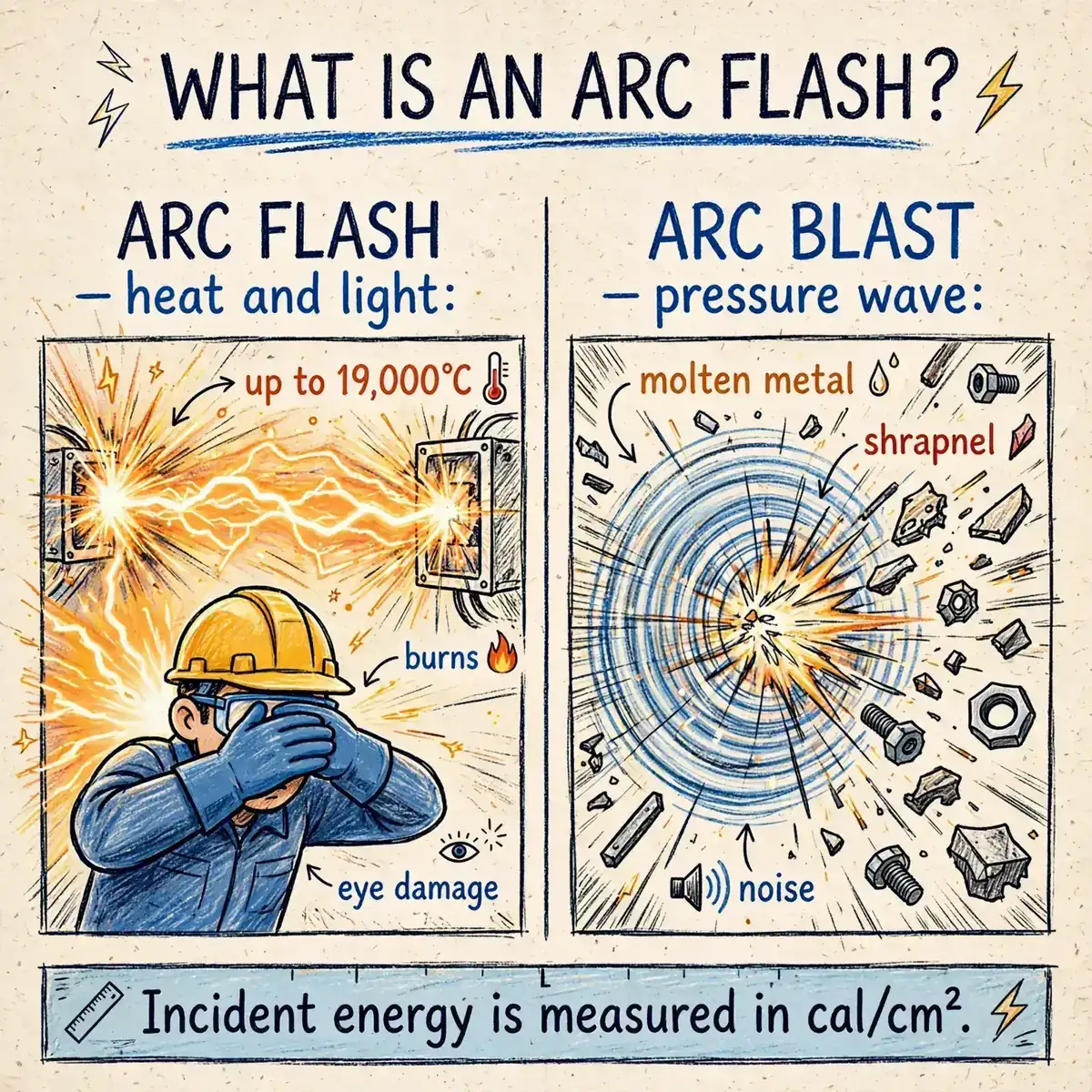
An arc flash is an explosive release of heat, light and pressure caused by an arc fault. Current jumps through ionized air between conductors, or between a conductor and earth. It happens in a fraction of a second, after insulation fails, a tool bridges live parts, or a switching error creates a fault.
Temperatures at the arc terminals are commonly quoted at up to about 19,000°C (35,000°F), several times hotter than the surface of the sun. What matters for safety is the incident energy at the worker's position, measured in calories per square centimetre (cal/cm²). That figure depends on the fault current and how long the protective device takes to clear the fault. It also depends on the distance from the arc and the equipment configuration.
Arc flash and arc blast are different hazards
Arc flash is the thermal and optical radiation from the arc. It causes severe burns and eye damage, and it can ignite clothing. Arc-rated clothing is designed to limit this thermal exposure, and nothing else in the PPE list addresses it.
Arc blast is the pressure wave and debris from the same fault. Vaporized metal expands violently, throwing molten metal and shrapnel and producing damaging noise. A commonly cited figure puts the expansion of vaporized copper at about 67,000 times its solid volume. Arc-rated clothing offers little protection against blast forces, which is another reason de-energizing comes first.
What causes an arc flash
Most arc flashes trace back to a small list of causes. Knowing them shapes the inspection and maintenance program, because several are visible before they fail.
- Contact: a dropped tool, an uninsulated probe or a test lead bridging live parts.
- Equipment failure: insulation breakdown, loose connections and worn components, often visible as hot spots first.
- Contamination: dust, moisture, corrosion or vermin creating a tracking path across insulation.
- Operation: racking breakers in or out, and switching onto a fault.
- Poor maintenance: a breaker that opens slowly, or a fuse of the wrong type, lengthens the arc and raises incident energy.
Slow clearing time is the biggest driver of severe outcomes. A protective device that opens late lets the arc feed far more energy into the worker's position than the label assumed.
De-energize first: the electrically safe work condition
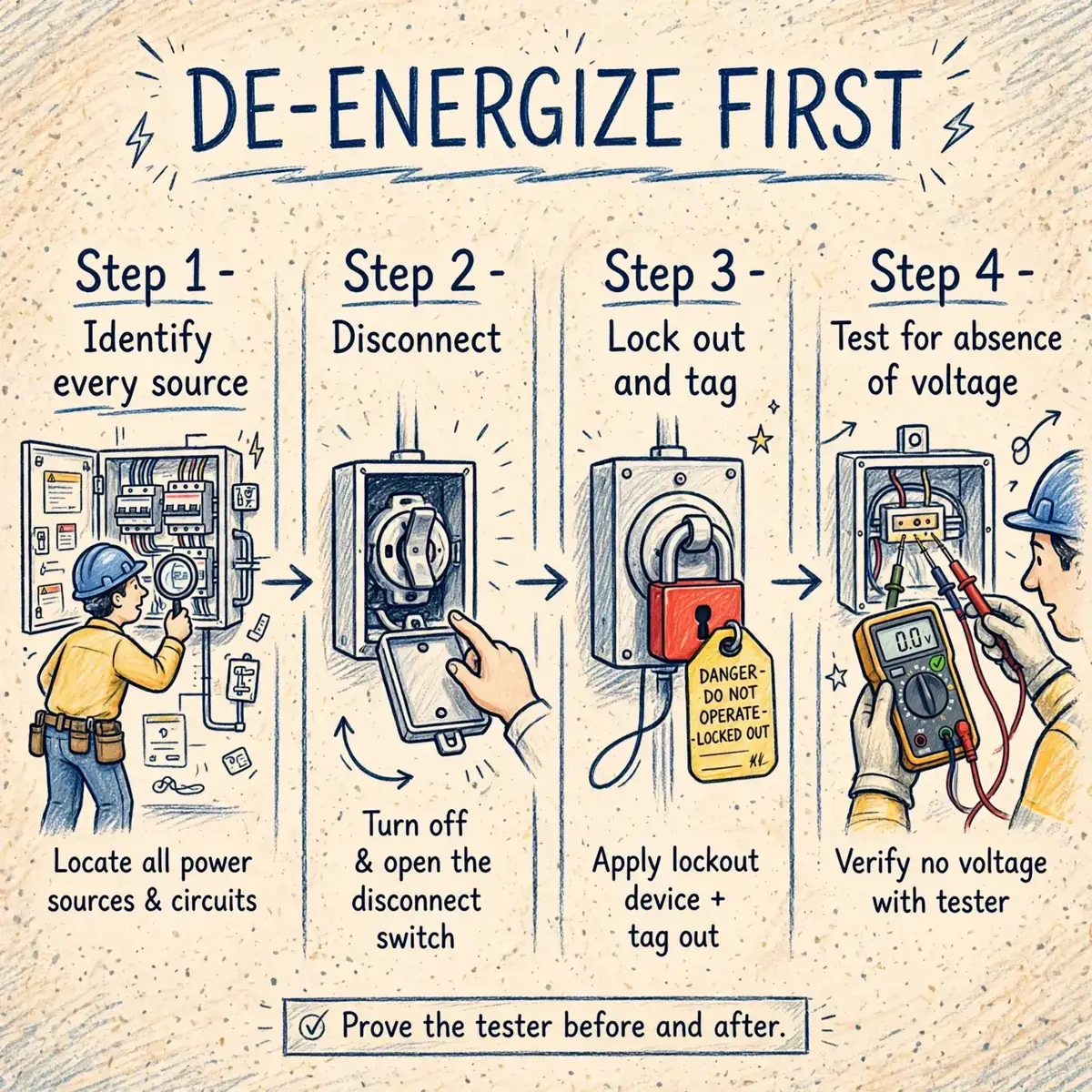
The electrically safe work condition is the state NFPA 70E wants before any work starts. Equipment is disconnected, locked out, tested for absence of voltage and grounded where needed, so it can be treated as de-energized. Energized work is permitted only when it is justified and documented.
OSHA's rule says the same thing in plainer terms. Under 29 CFR 1910.333(a)(1), live parts an employee may be exposed to must be de-energized before work. The exception applies only if the employer can demonstrate that de-energizing introduces additional or increased hazards, or is infeasible because of equipment design or operational limits.
WarningNever trust a breaker position indicator or a switch handle to prove a circuit is dead. Test for absence of voltage at each point of work, and prove the tester works before and after the test.
- Identify the circuit or equipment and every source of supply feeding it, including backfeeds, stored energy and UPS systems.
- Disconnect it from all electric energy sources. Control devices such as push buttons and interlocks are not a sole means of de-energizing.
- Lock out and tag each disconnecting means, so the circuit cannot be re-energized while work is under way.
- Release or restrain stored energy: discharge capacitors, and block or relieve non-electrical energy that could re-energize the circuit.
- Test for absence of voltage at each point of work with a rated tester. Prove the tester on a known live source before and after the test.
- Apply temporary protective grounding where the standard or the risk assessment calls for it, then treat the equipment as de-energized.
Since the 2027 edition, the condition is expected wherever an electrical hazard exists, not only above 50 volts. A low-voltage, high-current circuit such as a battery string or a DC bus can carry a contact thermal hazard even below 50 volts. The old voltage-only trigger no longer decides the question.
The 2027 edition also adds testing where an absence-of-voltage test alone cannot prove a circuit is dead. Current transformer secondaries are the classic example: they can read near zero volts until the loop is broken, when a dangerous voltage appears. Test for absence of current in current-driven circuits, and list a clamp-on ammeter as required test equipment.
Arc flash risk assessment: two ways to choose PPE
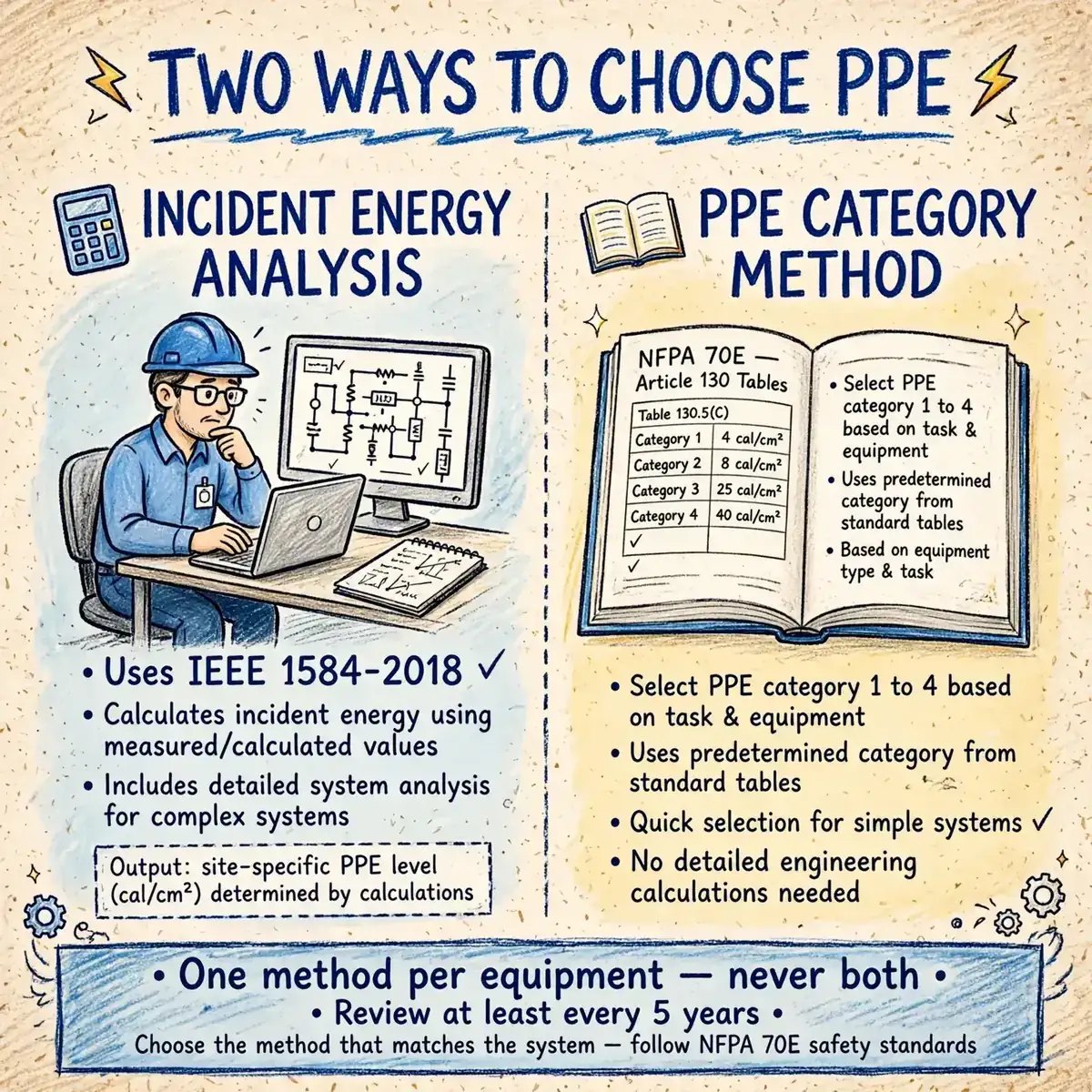
Before work within the arc flash boundary, NFPA 70E requires an arc flash risk assessment. It identifies the hazard, estimates the likelihood and severity, and decides the protective measures — including the boundary and the PPE. The assessment must be reviewed at intervals not exceeding five years, and updated after any major modification or renovation.
| Method | What it is | When to use it |
|---|---|---|
| Incident energy analysis | Engineering calculation, usually with IEEE 1584-2018, giving incident energy and boundary for each location | Complex or high-energy systems, and where labels need exact values |
| PPE category method | Lookup tables in Article 130 assign PPE Category 1 to 4 by equipment type and task | Simple systems that fit the table limits on fault current and clearing time |
Incident energy analysis
An incident energy analysis models the electrical system: the supply, transformers, conductors and every breaker, fuse and relay. From that model it calculates the available fault current at each piece of equipment and how long the upstream device takes to clear a fault. It then gives the incident energy a worker would receive at the normal working distance, usually 18 inches for low-voltage panels and motor control centers.
The IEEE 1584-2018 model covers three-phase systems from 208 volts to 15 kV, with five electrode configurations. Clearing time moves the result most. A breaker that trips in 2 cycles and one that takes 30 cycles can sit on the same bus and give very different boundaries. That is why changing a transformer, a breaker or a relay setting can make an existing label wrong.
The PPE category method
The category method uses the task tables in Article 130. Each row names an equipment type with a maximum fault current and a maximum clearing time. It gives the PPE category and an arc flash boundary for that row. If the actual equipment is within those parameters, the table boundary may be used without a calculation.
If the fault current or clearing time is unknown, or exceeds the row, the tables may not be used and an incident energy analysis is required. The tables suit simple systems; they are not a shortcut around an unknown fault current.
Pick one method for each piece of equipment and apply it consistently. Never mix them on the same equipment, and never show both results on one label. The label carries one PPE approach only: either the incident energy with its working distance, or the PPE category.
The arc flash boundary
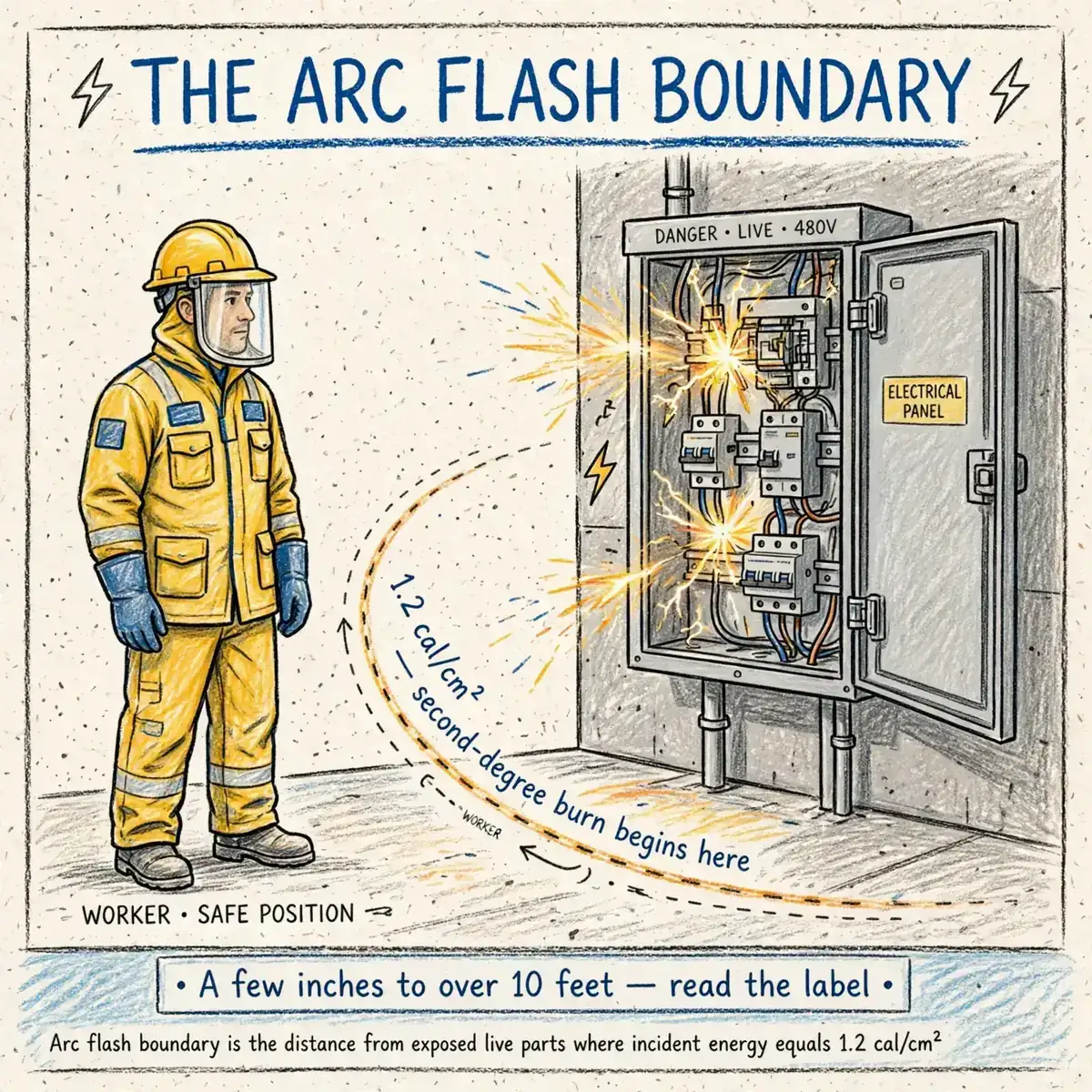
The arc flash boundary is the distance from the arc source at which the incident energy falls to 1.2 cal/cm². That is the point where a second-degree burn begins on bare skin. Anyone crossing that line while an arc flash hazard exists must wear arc-rated clothing and PPE rated for the energy at their working distance.
There is no typical boundary distance. It is calculated for each piece of equipment and can run from a few inches to well over 10 feet. It depends on fault current and clearing time rather than voltage alone. A 480-volt panel can have a larger boundary than a 4,160-volt switch. The only reliable source is the label or the study for that equipment.
The boundary is measured from the prospective arc source, not from the cabinet door or the room wall. Inside it, the worker also needs hearing protection, a hard hat and eye protection, on top of the arc-rated clothing.
TipRead the label before opening any panel. It carries the voltage, the arc flash boundary and the incident energy or PPE category for that exact equipment.
Shock boundaries: limited and restricted
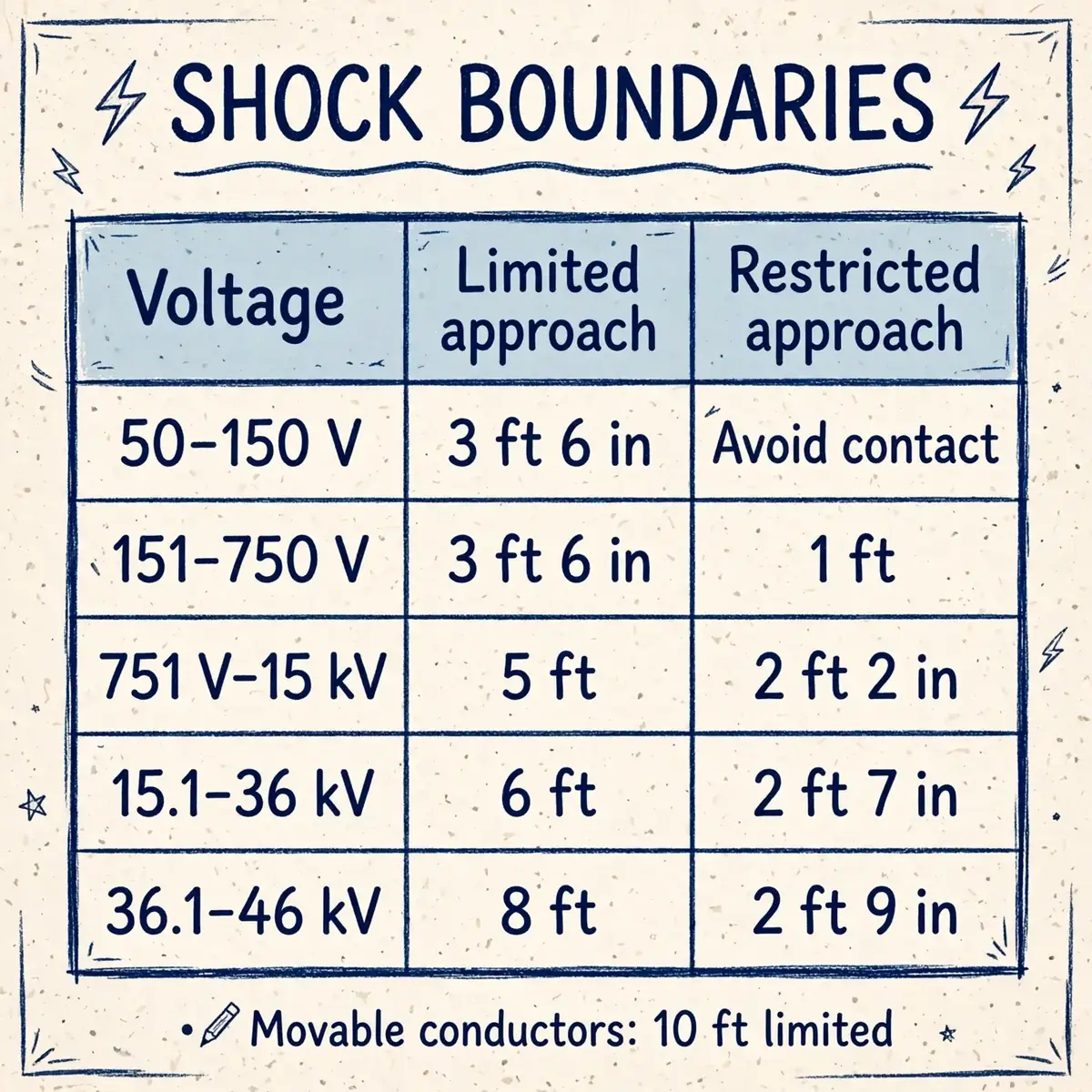
Shock boundaries protect against electric shock, and they are set by system voltage — not by incident energy. NFPA 70E defines two of them. They are worked out independently of the arc flash boundary, and either one may be the larger distance on a given job.
| Nominal voltage (AC) | Limited approach (fixed parts) | Restricted approach |
|---|---|---|
| 50–150 V | 3 ft 6 in (1.0 m) | Avoid contact |
| 151–750 V | 3 ft 6 in (1.0 m) | 1 ft (0.3 m) |
| 751 V–15 kV | 5 ft (1.5 m) | 2 ft 2 in (0.66 m) |
| 15.1–36 kV | 6 ft (1.8 m) | 2 ft 7 in (0.8 m) |
| 36.1–46 kV | 8 ft (2.4 m) | 2 ft 9 in (0.9 m) |
These values are for exposed fixed circuit parts, from NFPA 70E Table 130.4(E)(a). Exposed movable conductors use a 10 ft limited approach boundary. Confirm the full table for other voltages and for DC systems.
The limited approach boundary
The limited approach boundary is the closest an unqualified person may come to exposed energized conductors. Only qualified persons may cross it. An unqualified person may enter only when continuously escorted by a qualified person.
Crossing it is a decision, not a habit. The escort must be able to recognize the hazard and warn the other person away from it. The work inside the boundary still needs its own risk assessment and PPE.
The restricted approach boundary
The restricted approach boundary is closer still, and only qualified persons may cross it. Crossing requires a written plan, shock protection PPE — rubber insulating gloves with leather protectors — and training in shock-protection techniques. Insulated tools are required inside it.
Treat crossing the restricted boundary as work on energized parts. That means an energized electrical work permit, a job briefing, and the PPE the risk assessment specifies — not a quick reach past the line.
Older training sometimes names a third shock boundary, the prohibited approach boundary. It was removed in the 2015 edition, so material that still teaches it is out of date. The current standard has two shock boundaries: limited and restricted.
Arc flash PPE categories 1 to 4
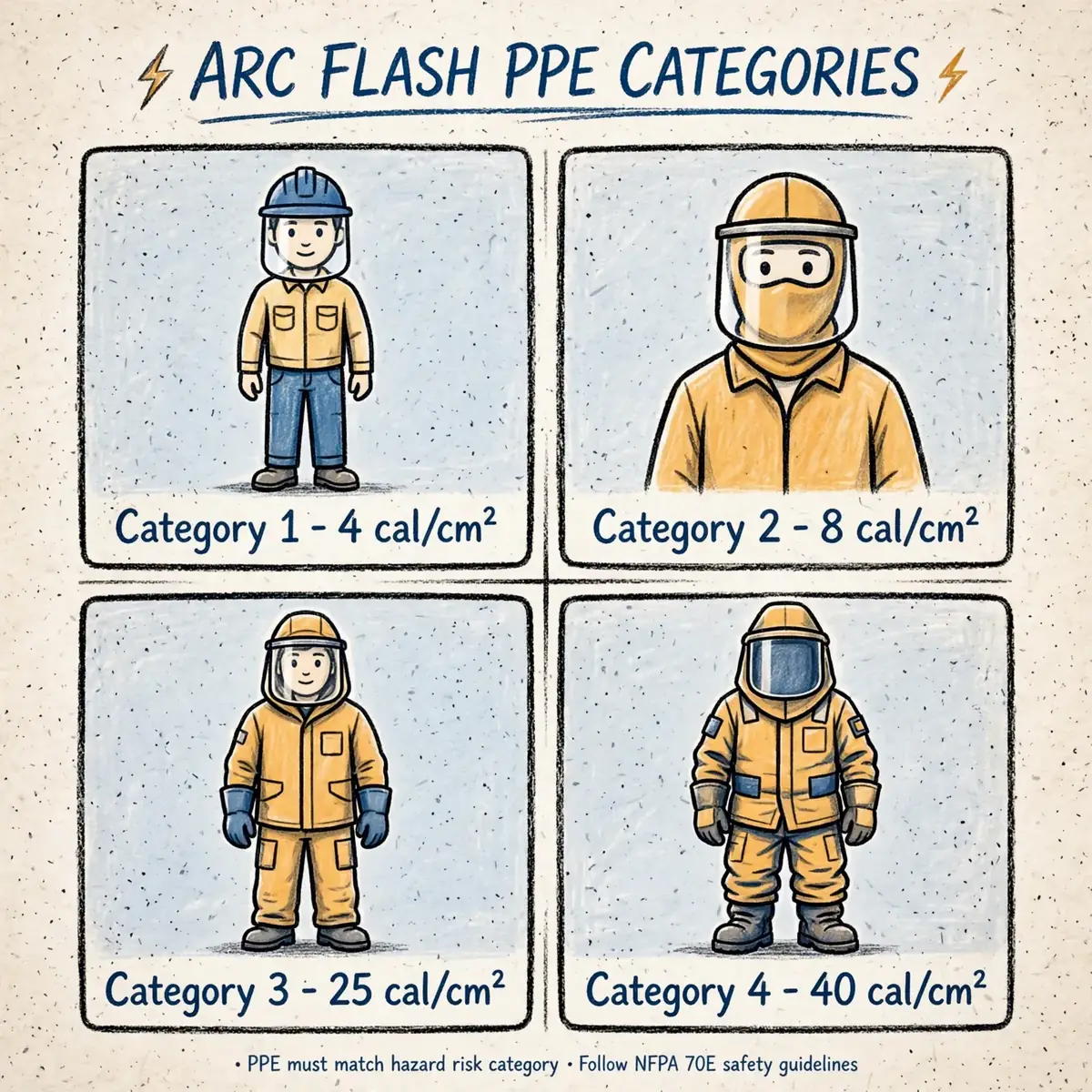
Arc flash PPE is chosen by minimum arc rating, in calories per square centimetre. Four categories cover the range of incident energy a worker is likely to meet, and each category names the clothing and equipment that go with it.
| Category | Minimum arc rating | Typical clothing and equipment | Example tasks |
|---|---|---|---|
| 1 | 4 cal/cm² | Arc-rated long-sleeve shirt and pants or coverall; arc-rated face shield or hood; hard hat; safety glasses; hearing protection; leather gloves; leather footwear | Reading a panel meter; operating a circuit breaker with covers on |
| 2 | 8 cal/cm² | Category 1 clothing plus arc-rated balaclava with face shield, or a full arc flash suit hood | Voltage testing; thermography with covers off; racking a breaker in or out |
| 3 | 25 cal/cm² | Arc flash suit jacket and pants, or multi-layer coverall; arc flash suit hood; insulating gloves with leather protectors | Inserting or removing starters from MCC buckets; work on energized parts up to 600 V with covers off |
| 4 | 40 cal/cm² | Heavy multi-layer arc flash suit, jacket and bib overalls; arc flash suit hood; insulating gloves with leather protectors | Work on energized parts above 600 V; tasks where the analysis gives 25–40 cal/cm² |
Above 40 cal/cm², NFPA 70E does not permit energized work. The equipment must be de-energized before any work begins. No amount of PPE is considered adequate protection above that threshold, and there is no Category 5.
Category 0 no longer exists either. It was removed in the 2015 edition, so any task with an arc flash hazard needs arc-rated clothing. Ordinary work clothes do not count, even flame-resistant ones that were never arc-tested.
The same selection discipline applies to all protective equipment. PPE requirements on this site cover fit, inspection and maintenance for the full range of workplace PPE.
ATPV, EBT and ELIM: reading an arc rating
Arc-rated clothing is tested to ASTM F1959, which produces the arc rating printed on the garment. The arc thermal performance value (ATPV) is the energy at which there is a 50 percent probability of a second-degree burn behind the fabric. The energy breakopen threshold (EBT) is the energy at which the fabric breaks open.
Whichever value is reached first becomes the garment's arc rating, so a garment rated 8 cal/cm² protects to 8 cal/cm² by whichever measure failed first. In North America the clothing itself must meet ASTM F1506. The European system adds ELIM, an incident energy limit set at a lower burn probability than ATPV or EBT.
What not to wear underneath
Meltable synthetic fibers — acetate, nylon, polyester, polypropylene and spandex — must not be worn in underlayers beneath arc-rated garments, because they can melt onto the skin in an arc. Check base layers, not just the outer garment.
Non-melting flammable fibers such as cotton may be worn beneath arc-rated garments. That holds only if the arc rating of the system prevents the innermost arc-rated layer from breaking open at the expected incident energy. Plain cotton on its own is not arc-rated PPE: it can ignite and keep burning. Non-arc-rated garments never count towards the rating of the system.
Insulated tools and gloves
Insulated tools are required inside the restricted approach boundary, and anywhere else a tool could present an electrical contact hazard. They must be rated for the voltage of the circuit, meet ASTM F1505 or IEC 60900, and carry the double-triangle marking. Standard tools with plastic-dipped handles are not insulated tools, and wrapping a tool in tape does not make it one.
Rubber insulating gloves protect against shock, and leather protectors shield the rubber from damage. The 2027 edition adds a separate requirement: thermal hand protection where a contact thermal hazard is possible, for example on battery, UPS or DC drive work. Rubber gloves are not thermal gloves, so most glove programs now need a thermal category.
What the label on the equipment must show
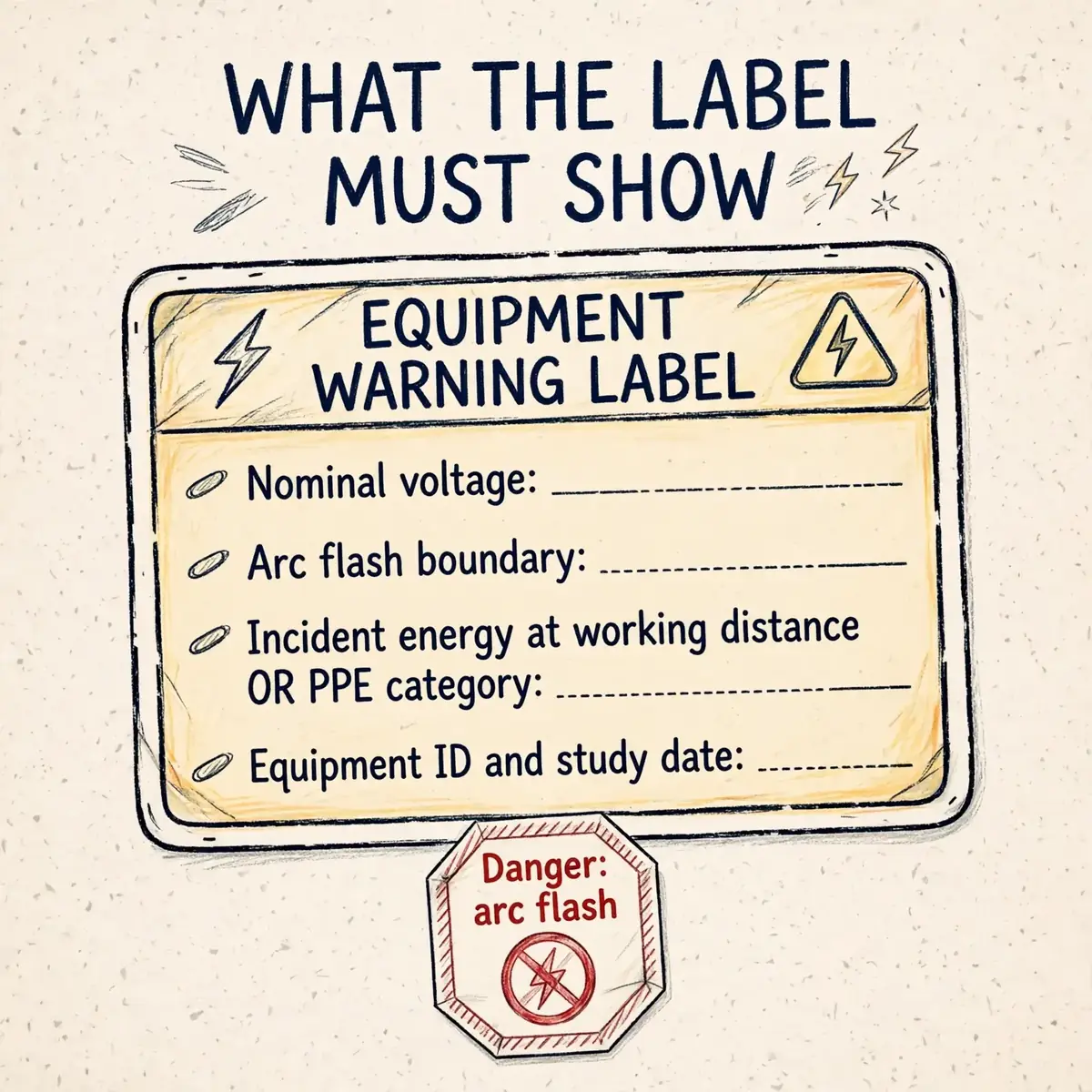
Equipment likely to need examination, adjustment, servicing or maintenance while energized must be field-marked with a label. The label is where the risk assessment becomes something a worker can read at the panel, so it has to carry the numbers, not a generic warning.
- The nominal system voltage.
- The arc flash boundary for that equipment.
- One PPE approach only: the available incident energy at a stated working distance, or the PPE category for the equipment.
Many sites also add the equipment identifier and the study date, which makes out-of-date labels easy to spot. A generic "Danger: arc flash" sticker does not meet the requirement, and neither does a label from a study that no longer matches the system. Labels are not a substitute for warning signs at the approach to the area.
Labels go stale when the system changes. A new transformer, a different breaker setting or a changed utility supply can alter fault current and clearing time, and with them the incident energy. Review the assessment at intervals not exceeding five years, and update the label whenever a major modification or renovation changes the result.
The energized electrical work permit
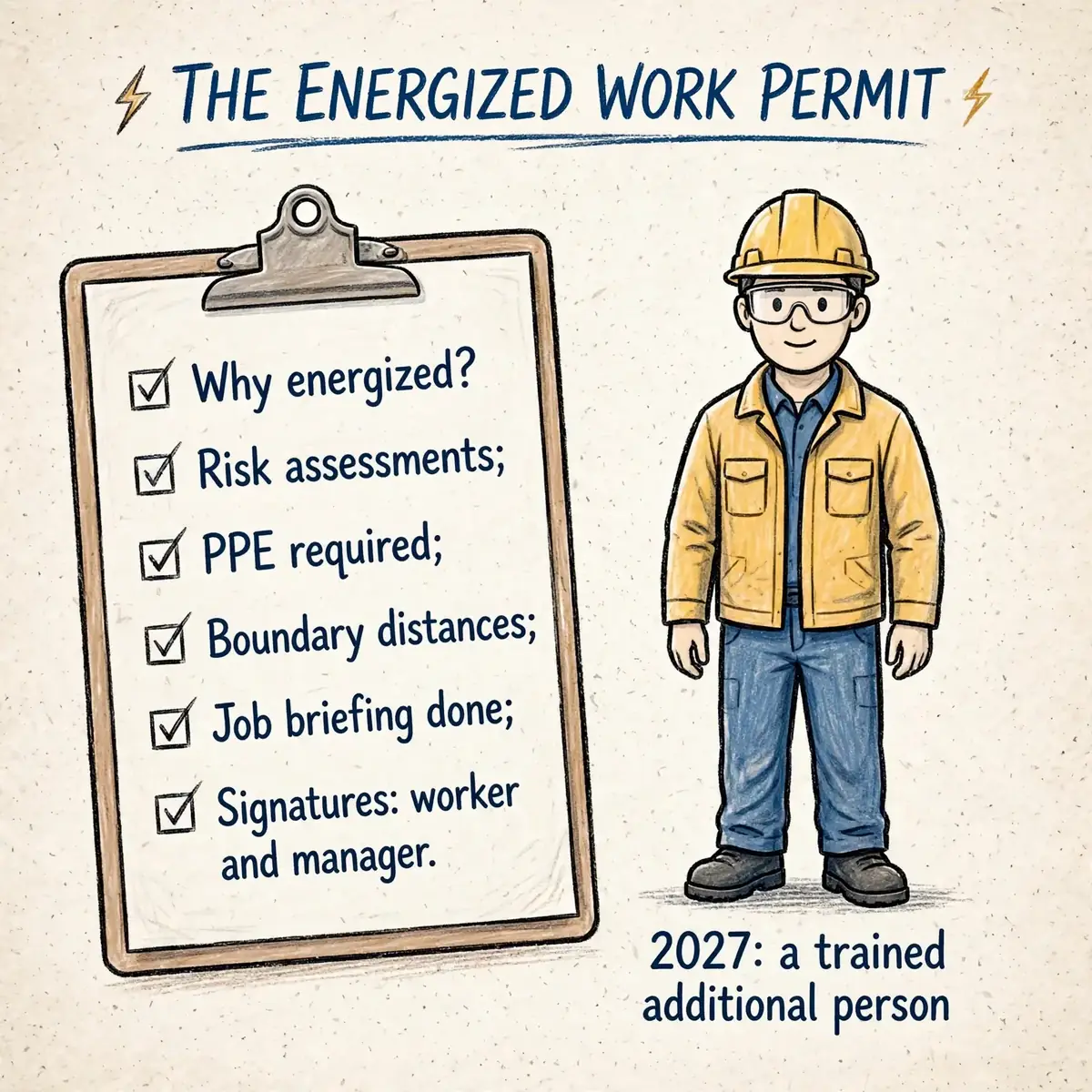
An energized electrical work permit (EEWP) is required when work will be performed within the restricted approach boundary, or when an arc flash hazard exists. It documents the justification for working energized instead of de-energizing first, and it is signed by the worker and a responsible manager.
A permit that cannot explain why the work must be done live is not ready to sign. "It will only take a minute" is not a justification, and unfamiliarity with the permit requirement is not one either.
The permit must record:
- A description of the circuit and equipment to be worked on.
- The justification for performing the work energized.
- The safe work practices to be used.
- The results of the shock and arc flash risk assessments.
- The PPE the risk assessment requires.
- The approach boundary distances for the task.
- Evidence that a job briefing was completed.
- Energized work approval signatures from the worker and a responsible manager.
The 2027 additional-person rule
Since the 2027 edition, permitted energized work needs a second person in defined cases. Where an energized electrical work permit is required and it specifies shock or arc flash PPE, at least one additional person trained in emergency response must be present. That person stands outside the limited approach boundary or the arc flash boundary, whichever is greater.
The additional person does not need to be an electrician. Operators, supervisors and EHS staff can fill the role once trained, and the training covers contact release: safely freeing a victim from contact with energized parts. Contact release training must be refreshed annually, so plan for it in the training calendar.
Job safety planning must now include an emergency response plan for when the job does not go as planned. A good plan names who does what during an electrical injury and where the first aid kit and AED are. It also says how the worker will practice emergency procedures before the job starts.
Work that does not need a permit
Some tasks are exempt from the permit, because they are the work of proving a circuit dead or observing it from outside the hazard. Testing to verify de-energized status, thermographic scanning, voltage measuring for diagnostic purposes, and operating a disconnect switch under normal conditions do not need a permit.
Exempt does not mean unprotected. These tasks still need a risk assessment and the PPE the assessment specifies, and voltage testing on energized equipment typically falls under PPE Category 1 or 2. The permit exemption removes paperwork, not protection.
Qualified persons and training
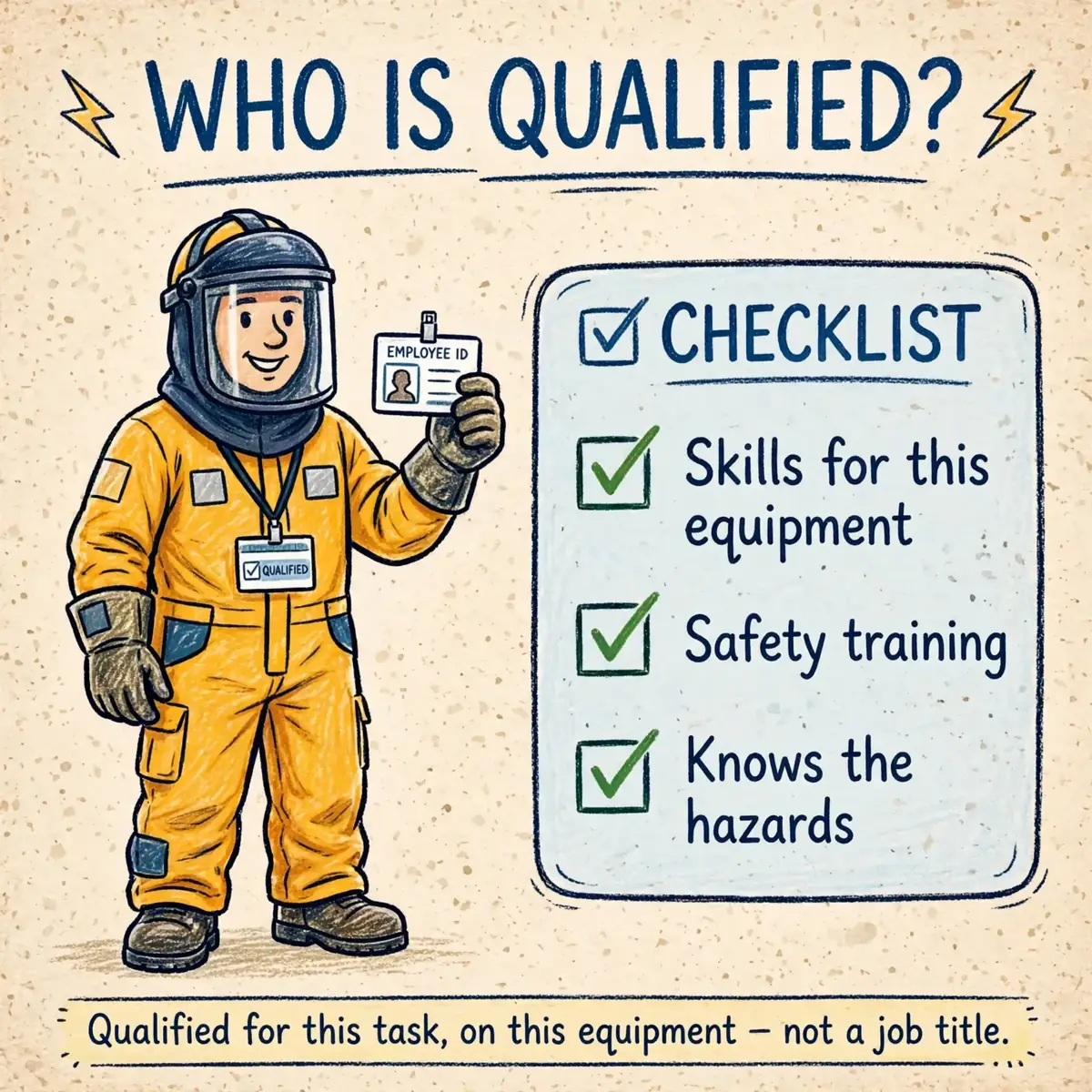
Only qualified persons may work on energized parts. A qualified person is someone who has demonstrated the skills and knowledge for the construction and operation of the equipment. They have also received safety training to identify and avoid the hazards involved.
Qualification is task and equipment specific
The 2027 edition restores a point the 2024 wording had blurred: a person can be qualified for certain equipment and tasks and unqualified for others. An operator trained to take voltage readings and replace fuses on their own machine is qualified for exactly those tasks on that machine. That does not qualify them to replace a motor starter, or to work on a different line across the building.
Qualification comes from demonstrated skills and knowledge, not from a job title. The claim that only electricians can be qualified is one the standard does not support. It also narrows the pool of people who can do the work and act as the additional person on a permit.
Training records and retraining
Training must cover the specific equipment the person will work on, plus arc flash and shock hazard awareness. It must also cover the proper use of PPE and emergency procedures including CPR and AED use. The 2027 edition requires the employer to provide and document that training — "we trained them" without records is now a direct gap.
Retraining is required at intervals not exceeding three years, and sooner when practices change, new equipment arrives, or an audit finds a gap. Keep individual records that list the tasks and equipment each person is qualified for, and how they demonstrated it.
What changed in the 2027 edition
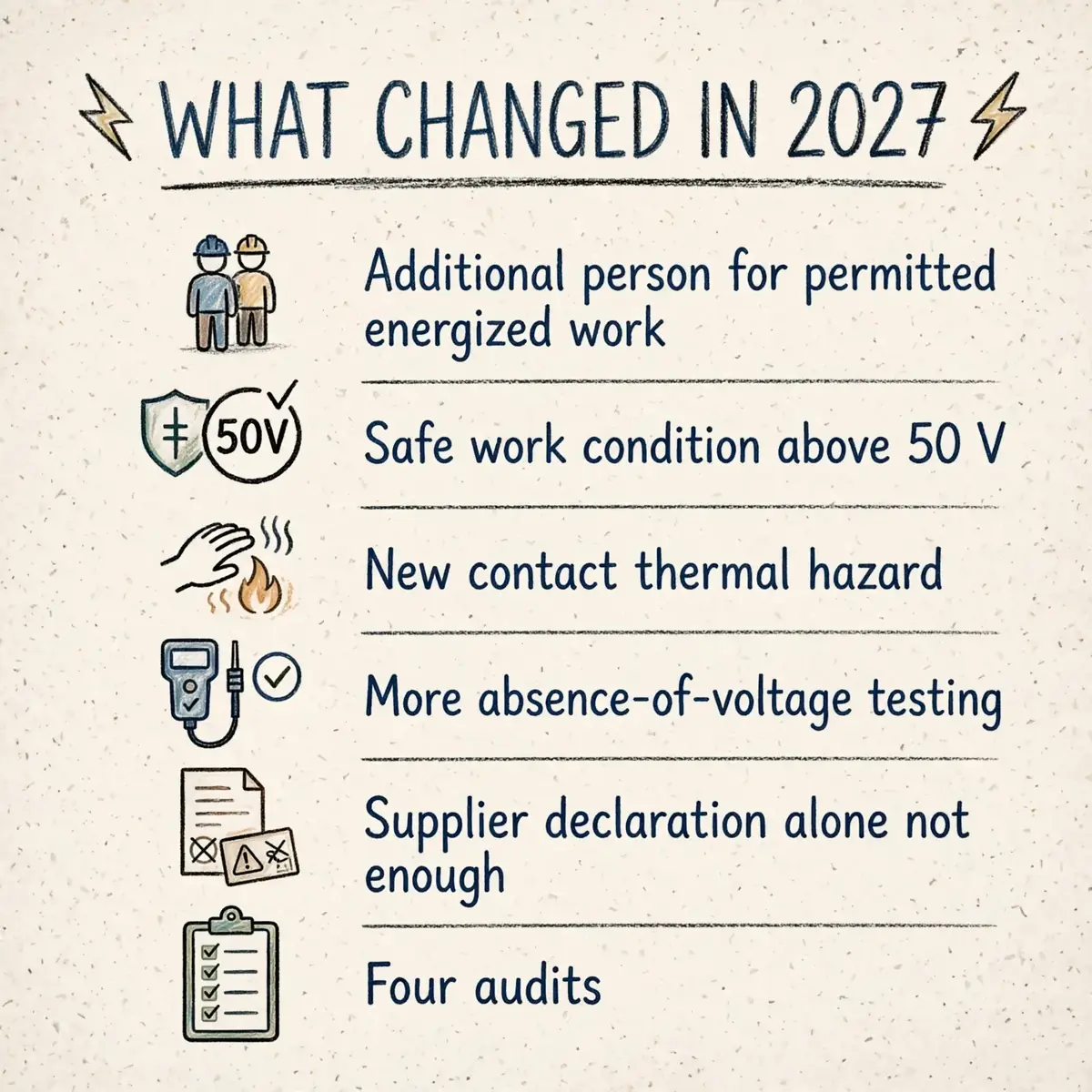
The 2027 edition is a reorganisation more than a redesign, but several changes reach daily work. Programs that cite NFPA 70E without naming an edition now point to 2027, so review program documents, permit forms and training decks against the new text. Herzig Engineering's section-by-section summary of the 2027 changes walks through each one in detail.
| Change | What it means in practice |
|---|---|
| Additional person for permitted energized work (130.2(A)(2)) | A trained second person must be present where a permit specifies shock or arc flash PPE |
| Electrically safe work condition (110.2(B)) | Required above 50 volts, or wherever an electrical hazard exists — including low-voltage, high-current circuits |
| Contact thermal hazard | New hazard definition; thermal hand protection required where a contact thermal hazard is possible |
| Absence-of-voltage testing (120.5, 120.6) | Additional testing, such as testing for absence of current, where a voltage test alone cannot prove a circuit dead |
| Arc-rated PPE conformity (130.7(C)(14)) | Supplier declaration of conformity alone no longer proves compliance; labels must state the conformity method |
| Audits (110.3(L), 120.3, 120.4) | Four audits: electrical safety program at intervals not exceeding 3 years, work practices 1 year, lockout/tagout program 3 years, procedure 1 year |
| Batteries, PV and capacitors | New Article 360 for batteries, Article 380 for photovoltaic systems, Article 370 for double layer capacitors |
A new edition does not automatically make an existing arc flash study, label or item of PPE non-compliant. PPE already marked under the old conformity method is grandfathered. Review the program against the new text, and keep qualified persons retrained at intervals of no more than three years.
NFPA 70E and OSHA: how the rules fit together
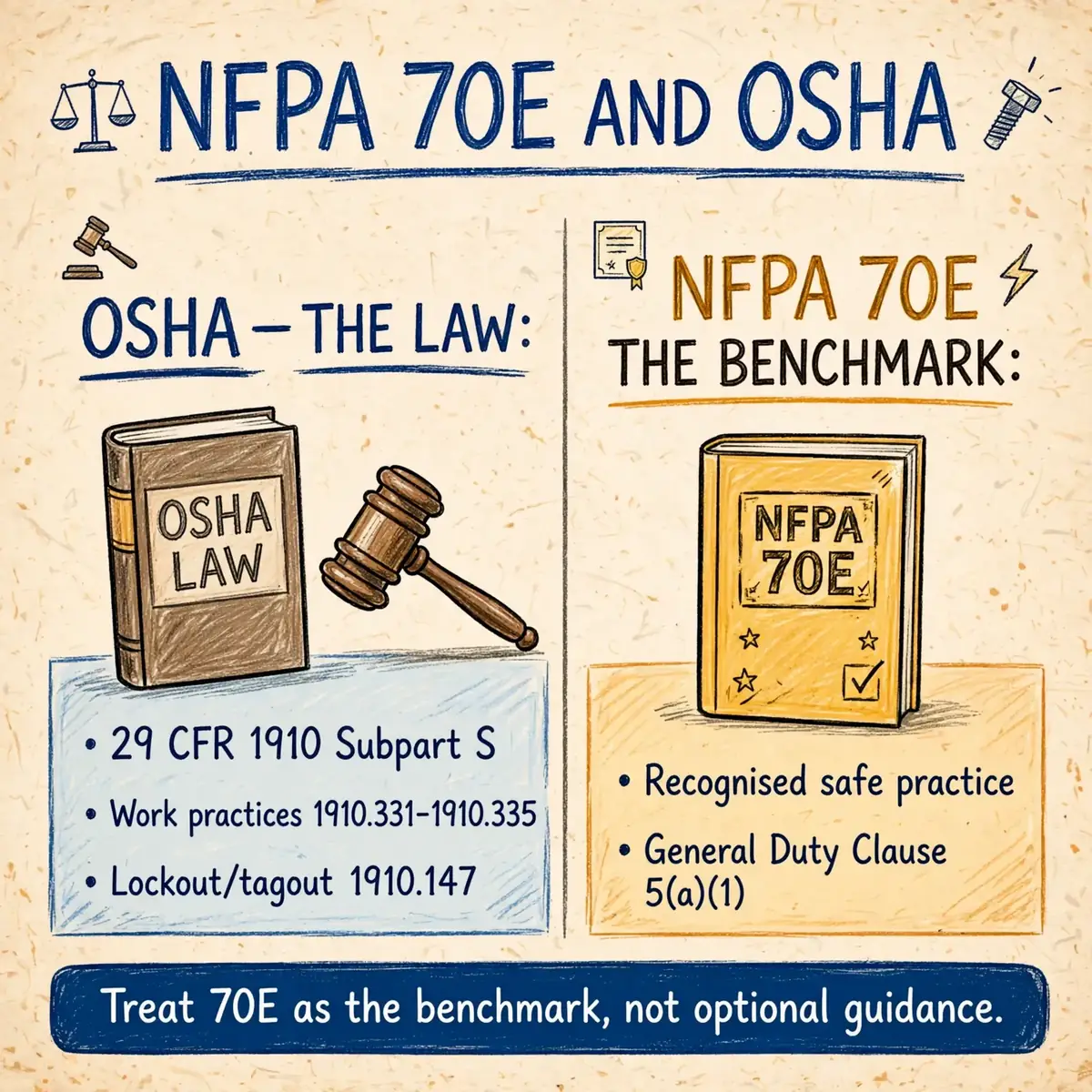
The line between standards and regulations is where many employers get confused. OSHA's electrical rules are federal regulations in 29 CFR 1910 Subpart S: design in 1910.302 to 1910.308, and work practices in 1910.331 to 1910.335. They sit alongside 1910.132 on PPE hazard assessment, 1910.137 on electrical protective equipment, and 1910.147 on lockout/tagout.
NFPA 70E is not one of those regulations, and OSHA does not adopt it by name in Subpart S. But OSHA's work-practice rules were written in language that tracks NFPA 70E, and inspectors use the standard as evidence of recognised safe practice. An employer can be cited under the General Duty Clause, section 5(a)(1) of the OSH Act. That applies where the employer fails to follow NFPA 70E requirements and the hazard is recognised.
AlertTreat NFPA 70E as the benchmark, not as optional guidance. An OSHA inspector will ask what recognised practice the program follows, and "none" is not an answer.
OSHA's own safeguards rule backs the same point. Under 29 CFR 1910.335(a)(1)(i), employees working where there are potential electrical hazards must be provided with electrical protective equipment. They must use equipment appropriate to the body part and the work. Eye or face protection is required wherever there is danger from electric arcs or flashes.
The practical reading is simple. Follow OSHA's regulations because they are law, and follow NFPA 70E because it is how the law's general duties are met in practice. A program that names the edition it follows, documents its risk assessments, and keeps its labels current satisfies both.
Outside the United States: Great Britain and Canada
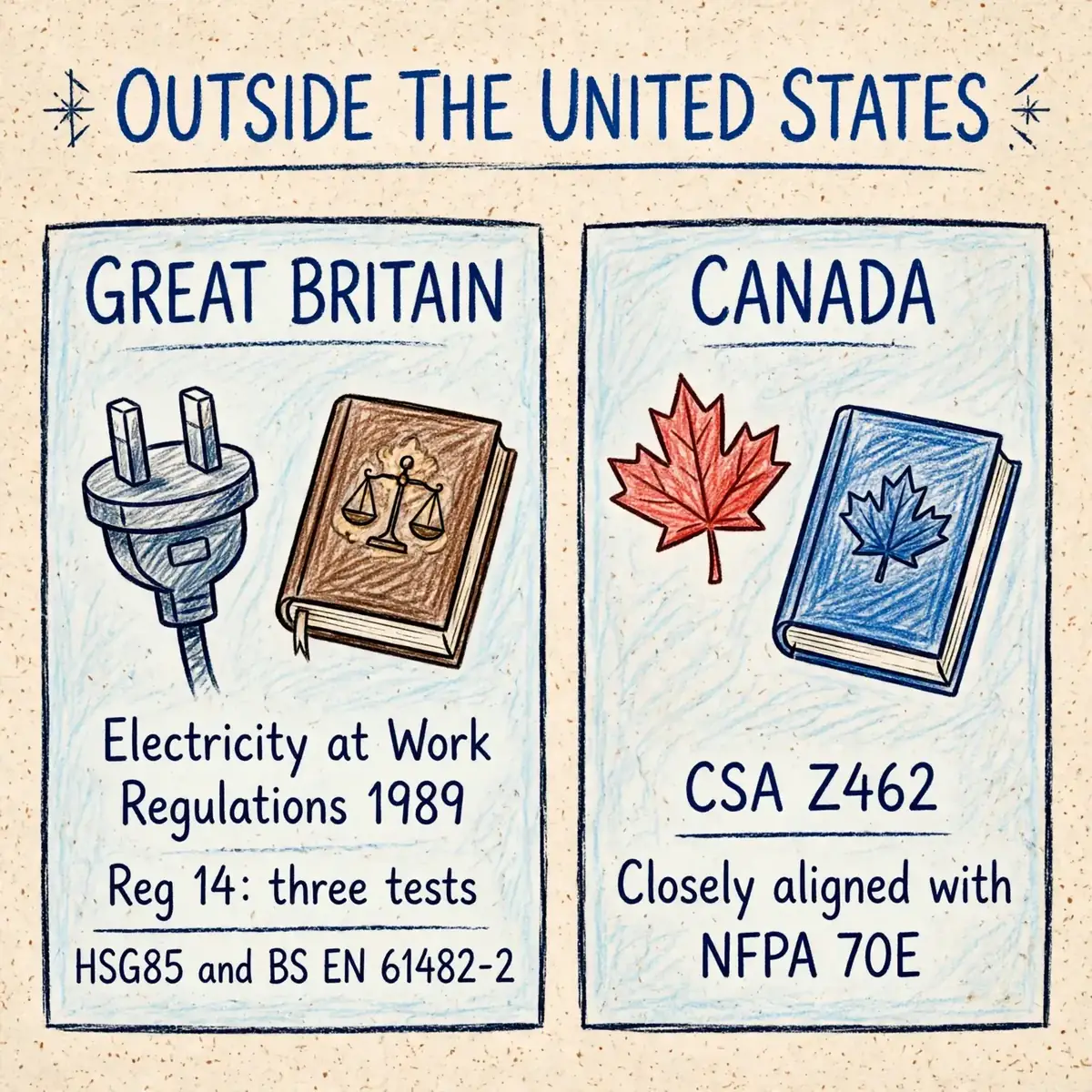
NFPA 70E is a US standard, and its legal force stops at the border. Employers outside the United States must meet their own law first, and may use NFPA 70E methods to support their risk assessments where the local rules allow it.
Great Britain
In Great Britain, the duties come from the Electricity at Work Regulations 1989, made under the Health and Safety at Work etc. Act 1974. Regulation 14 covers work on or near live conductors, regulation 4 covers work activities, and regulation 16 covers competence. HSE guidance HSG85, Electricity at work: safe working practices, sets out the usual ways of meeting them.
Regulation 14 allows live work only when all three of these are true:
- It is unreasonable in all the circumstances for the conductor to be dead.
- It is reasonable in all the circumstances for the person to be at work on or near it while it is live.
- Suitable precautions, including suitable protective equipment where necessary, are taken to prevent injury.
Convenience, or saving time, does not make live work reasonable.
Arc-rated clothing in Britain is specified to BS EN 61482-2. The open arc test gives ELIM, ATPV and EBT, and the box test gives Arc Protection Class 1 (4 kA) or Class 2 (7 kA). Many UK and multinational sites still use IEEE 1584 calculations and NFPA 70E methods to support their risk assessments, alongside the European PPE standards.
Canada
Canada uses CSA Z462, Workplace electrical safety, which is closely aligned with NFPA 70E. The boundaries, PPE categories and risk assessment approach will look familiar to anyone who has worked under NFPA 70E. The document is still a Canadian standard with its own edition cycle.
Other countries may adopt IEC standards or national rules, so check local law before importing a US program wholesale. The hazard is the same everywhere; the legal instrument that controls it is not.
Arc flash safety program checklist
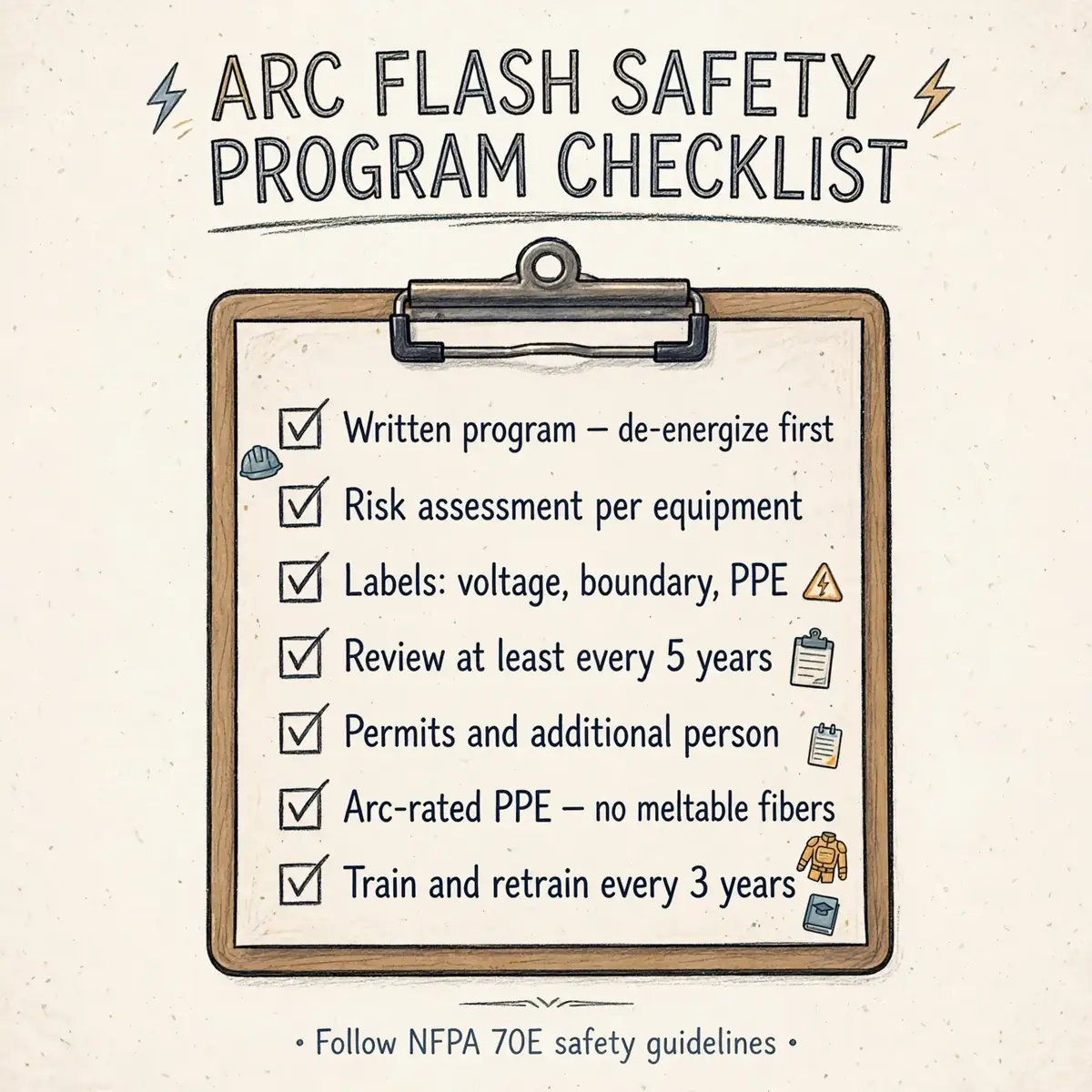
A program that covers the items below meets the core of NFPA 70E. Use it as a gap check, not as a substitute for the standard.
- Adopt a written electrical safety program that makes de-energizing the default.
- Carry out an arc flash risk assessment for each piece of equipment, using IEEE 1584 or the PPE category tables — not both for the same equipment.
- Label equipment with voltage, arc flash boundary and one PPE approach.
- Review the assessment at least every five years, and after any change that alters fault current or clearing time.
- Set energized work permits, and confirm a trained additional person is in place where the 2027 rules require one.
- Issue and maintain arc-rated PPE, and ban meltable fibers in underlayers.
- Use engineering controls such as remote racking and fast-clearing protection where energized work cannot be avoided.
- Maintain protective devices and inspect equipment for hot spots, following NFPA 70B for condition of maintenance.
- Train and retrain qualified persons at least every three years, and audit work practices and lockout/tagout on the required intervals.
- In Great Britain, document how each live-working task meets all three tests in Regulation 14.
When an incident or a near miss happens, investigate it properly. A root cause analysis finds the failed control behind the event, so the same arc flash does not happen twice.
Frequently Asked Questions
Is NFPA 70E an OSHA regulation?
No. NFPA 70E is a consensus standard published by the NFPA, not a federal regulation. OSHA's electrical safety rules are in 29 CFR 1910 Subpart S, and inspectors use NFPA 70E as the benchmark for recognised safe practice. Employers can be cited under the General Duty Clause for not following it.
What is the arc flash boundary?
The distance from an arcing source at which incident energy falls to 1.2 cal/cm², the onset of a second-degree burn on bare skin. Anyone crossing it while an arc flash hazard exists must wear arc-rated PPE suited to the task.
How often must an arc flash study be updated?
NFPA 70E calls for the arc flash risk assessment to be reviewed at intervals not exceeding five years. It must also be updated after major modifications or renovations that change fault current or clearing time. A new transformer, breaker or relay setting can make a label wrong before the five years are up.
Does NFPA 70E apply in the UK?
No, it is not law in Great Britain. UK employers must comply with the Electricity at Work Regulations 1989, and HSE guidance HSG85. Many sites still use NFPA 70E and IEEE 1584 methods to support their risk assessments, alongside European arc PPE standards.
Is there a PPE Category 0?
Not any more. Category 0 was removed in the 2015 edition, so any task with an arc flash hazard requires arc-rated clothing. There is also no Category 5: above 40 cal/cm², energized work is not permitted at all.
Do I still need arc flash PPE if I am only taking voltage readings?
Yes. Voltage testing on energized equipment exposes the worker to both shock and arc flash hazards. The task must be assessed for its PPE category, and the worker must wear the appropriate arc-rated PPE. Voltage testing typically falls under Category 1 or 2, but the risk assessment decides — never assume.
Is a free NFPA 70E guide enough to build a program?
A summary can orient a program, but it cannot replace the standard. Only NFPA 70E itself carries the requirements, tables and clause numbers an auditor will check, and paragraph numbers changed between editions. Buy the current edition from NFPA and check exact wording there.
Sources
- NFPA — NFPA 70E, Standard for Electrical Safety in the Workplace (2027 edition)
- OSHA — 29 CFR 1910.333, Selection and use of work practices
- OSHA — 29 CFR 1910.335, Safeguards for personnel protection
- Legislation.gov.uk — The Electricity at Work Regulations 1989, Regulation 14
- HSE — HSG85, Electricity at work: Safe working practices (3rd edition, 2013)
- Bayshore Safety — What is the arc flash boundary, and how is it determined?
- Herzig Engineering — NFPA 70E 2027: What Changed and What it Means for Your Program
- HSEWatch — Arc Flash Safety: Hazards, Boundaries, PPE Categories And NFPA 70E
- US Made Supply — NFPA 70E: Electrical Workplace Safety (PPE categories, approach boundaries, insulated tools)